← The Thyroid (and Hormone) Fixer Podcast: Thyropause, Menopause, Metabolism and How to Fix It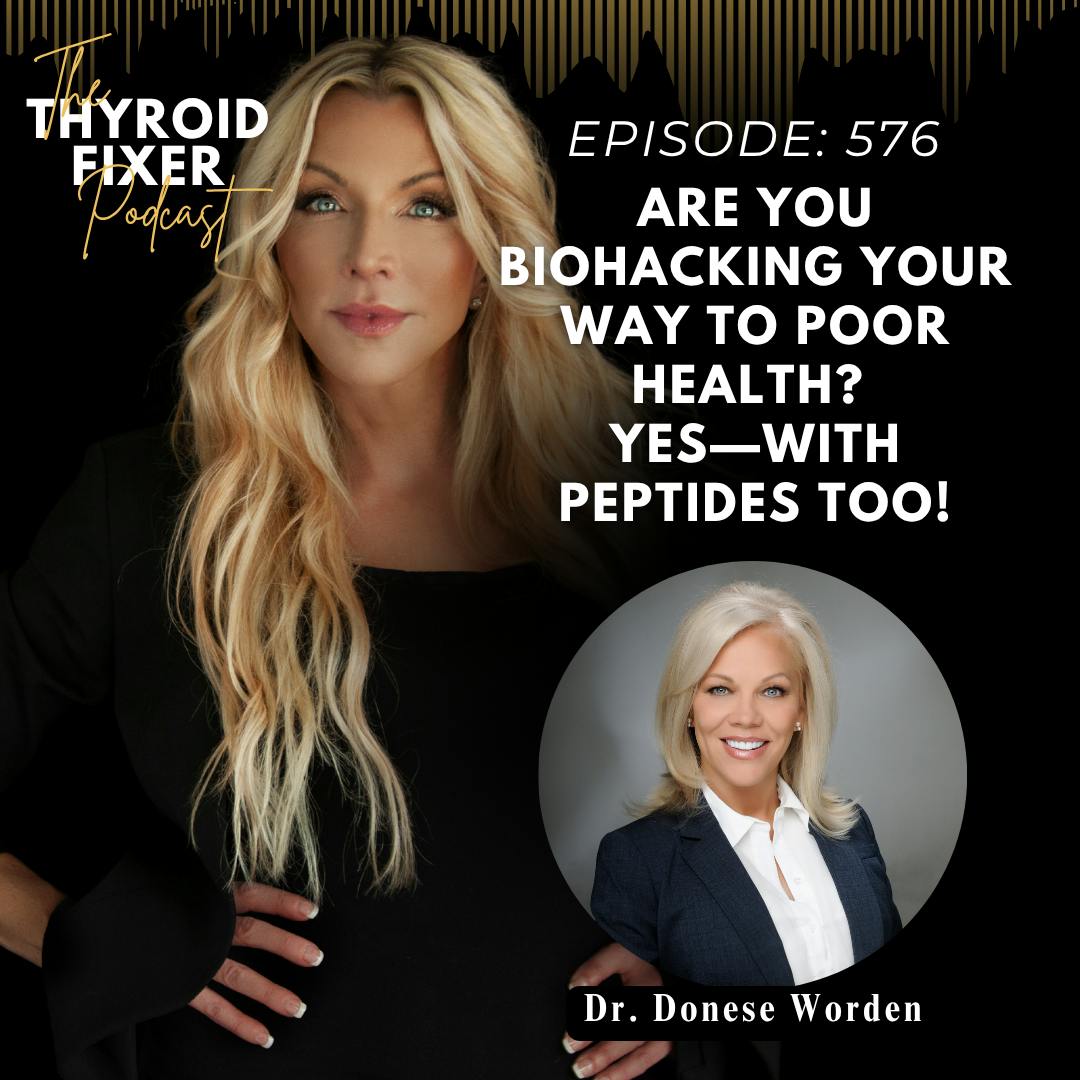
The Thyroid (and Hormone) Fixer Podcast: Thyropause, Menopause, Metabolism and How to Fix It
576. Are You Biohacking Your Way to Poor Health? Yes—with Peptides Too!
00:52:02
Loading summary
Transcript110 lines
- [00:00]
A
You know, we really want to participate in our health. We're trying to do things, but, you know, the most powerful medicine isn't what we buy or do. It's what we understand. And it's the job. The job is to know. I tell patients. Anything you put in your body every day, you better know about it.
- [00:18]
B
Welcome to the Thyroid Fixer podcast, where we dive deep into the world of thyroid and hormones, especially for you ladies navigating perimenopause and menopause, and really for anyone struggling with hypothyroidism. I'm your host, Dr. Amy, thyroid and hormone specialist and CEO of a global telemedicine practice where we prescribe the right thyroid treatment and bioidentical hormones to all 50 states and most of Canada, helping you become that badass human that you're meant to be. So if you're battling weight gain and hair loss, you can't lose weight. No matter what you do, your energy levels are plummeting and your libido left town that you're in the right place and you have found your tribe. Remember, I want you to embrace every inch of that badass woman that you truly are. So if you're ready to dive in and fix things, let's get started. I completely and totally hear you, and I see you and I understand you, and I know exactly where you're at. You're gaining weight. You can't lose. You have all the symptoms that no one's listening to. The fatigue, the hair loss, the. The brain fog. You can't remember why you walked into a room. You don't want to get dressed and go out because you know, if you have that glass of wine with your friend, if you have that dessert with your husband or even order an appetizer, you're going to be five pounds heavier the next day, and your clothes are already tight. Every single doctor is telling you that you're normal and everything is fine. You've been to multiple conventional medicine doctors trying to use your insurance, hoping to God that somebody has an answer. Then you drop thousands of dollars on functional medicine or integrative medicine because you keep hearing how functional medicine gets to the root cause of the problem. But not every functional medicine practitioner knows the thyroid and knows the hormones and can treat you as a nuanced, personalized individual, a unique person. That is exactly what my team and I do. We specialize in thyroid problems. We specialize in hormones. You can't do one without the other. You cannot just see someone for your thyroid and have them ignore your Hormones or have them half ass your hormones. They better be a hormone and thyroid expert if you are going to spend your time, your energy and your money if you are going to invest in functional medicine they need to be a thyroid and hormone expert and treat you as an individual. They can't have a cap on how much T3 that they're going to give you. They have to personalize your treatment plan to get you feeling your best no matter what that looks like so that every system in your body functions at the very top at the very best. And that is exactly what we do. I made it my mission because I went through this. I was dismissed, I was gaslit, I was misdiagnosed and I dropped thousands of dollars before I found an answer. That is why I made it my mission to be able to treat people in all 50 states so we can prescribe via telehealth. Thyroid and hormones and peptides. Yeah, the GLPs as to all 50 states, most of Canada and now Puerto Rico. That is my mission to be able to help you wherever you are because I want you living your best life. I want you to join me in optimization land where you can go out and love life and go out with your friends and go out with your partner and not gain weight looking sideways at a brownie. Yes, we do have financing options available. I'm talking like 0% or 12 months. The whole thing based on your credit score. We got you and our programs are affordable. They're completely and totally affordable and they will get you from point A to point B. They will bring you into optimization land. So please don't waste another moment struggling, please. I want you living here with me, a great happy life in optimization land. So go to my website@dramy.com, click the Become a patient button so we can have a chat. Let's talk it out. Let's hear what you've done, what you haven't done, what's worked, what hasn't worked, and let's get you on the right path to feeling your absolute best. If you can imagine the best life ever that is absolutely possible for you. I'm not BSing you. I am not BSing you. I was in your shoes. Many of my patients have been in your shoes. We will get you there and that is my promise to you. Over the past few months, I've leaned on Wave Watch as a supportive tool in my own journey. It's a wearable that plays sound frequencies to help your body shift from stress into recovery and from that fight or flight mode that Adrenaline stress mode into rest and digest. Whether you're using it for sleep, clarity or balance, the frequency sets make it simple to support your body daily. You can try way watch too risk free for 30 days. You have to try it out and you also get a hundred dollars off with a code. Dr. Amy@wavewatch.com forward slash Dr. Amy. So you're going to spell it W A V W a t c h.com forward/r a m I E. You gotta try it. Let me know how it goes. Are you biohacking your way to insanity? Are you getting supplement fatigue to the point where you just stare at all of your supplements and you end up taking nothing because you are exhausted, you're overwhelmed and you feel even a little bit pressured to do all of these anti aging biohacking things that Dave Asprey, Ben Greenfield and every influencer out there under the sun are talking about, but that you either ate, you don't have the time, you don't have the money, you don't have the motivation and you're just like, well great, then I guess I'm going to die at the age of 55 because I'm not doing all of the things that Brian Johnson's doing. We are here to clear up that confusion. So I brought back on the show Dr. Doneese Worden we talked about before we had part one and part two. If you missed that, you need to go back and listen to that. In fact, we'll put the links in the show notes for you. That's where we dove deep into a variety of different cancer treatments, my journey as she helped me through my journey of uterine cancer and deciding on what to do, what not to do, the treatments that were available to me at the time and even some of the biohacking treatments that I was exposed to when I announced that I was diagnosed with uterine cancer. So I wanted to bring her back on because we had such great conversations off air about biohackers being the most stressed out. We talked about this on the last episode of how sometimes biohackers have higher cortisol than all of us and they are just driving their glucose and they're literally driving the growth of cancer cells because of their stressed out environment, their stressed out state that they are in. So Dr. Denise, thank you so much for coming back on. This is going to be a juicy conversation.
- [08:00]
A
Always fun, always fun with you, Amy. So let's, let's dig in. I'm excited about it.
- [08:06]
B
Let's just start where we left off in the last conversation about all of these biohacking tools. Let's first start with what actually has some clout and what doesn't, both in the cancer world, but also in just the anti aging longevity space.
- [08:24]
A
Yeah, you know, it's all kind of the same. Whether we're talking about cancer or neurological disease or Parkinson's or whatever it is, or longevity. They're all the same treatments and the biohacks being used for all of it. Some of it is real in the sense that we've got some science and research behind it. Some of it is we don't know yet. And some of it is really not being proven. And I'll tell you a funny story. I just gave a talk about this whole biohacking thing to a group of entrepreneurs two days ago. And I asked them, there's probably 80 people in the room. And I said, how many of you have tried a cold plunge? Every single hand went up. And I said, how many of you did any testing before you jumped in, before you plunged? No one had done it. Then I told them there have been deaths, heart attacks, strokes, drownings. Because, you know, if you're ready for a cold plunge, it can have some benefits. It really can. But if you have an aneurysm that hasn't been identified, if you have a heart arrhythmia that you could throw into a bad heart arrhythmia that your autonomic nervous system, and even with thyroid not being balanced, those cold plunges can work very much against you and actually become so dangerous that they could actually kill you. So I did a whole talk and then I talked about the quality of the supplements and that by these stacking things, all this, we don't know how they interact with one another. Most people are doing it, they're doing a clinical trial on themselves without supervision. Right. And they read, this is good for this. Oh, I better take that supplement. Well, this one's good for that. I might have that, or my mother had that. Pretty soon you've got this stack, and no one can tell you how those all work together, much less how they work within your body. So they could be causing more harm than good. To your point about people saying, let's just take all of these things and think it's going to magically go in our body and correct deficiencies or try to protect things or try to help our telomeres be longer, to live longer, we don't know enough, and we certainly don't know. And you know, if you have a physician, they're Going to make sure maybe some of those supplements don't counteract with your medications. But what about supplement to supplement? We don't know a lot. And I talked about peptides, regenerative injections, what we know and that we don't know, and that there's a really big gap between safety and between efficacy. So we're always doing risk versus reward and that talk, really, by the end, we were only allowed 10 minutes by the end. I mean, almost everyone in the group tried to get to me afterwards because they were shocked. They said, I was about to go do this. I was about to do an exosome. I had no idea. None of them are approved in the United States. And some were doing peptides. And I said, for what? And for your indication. Do you even know if it's approved for your indication? They just didn't know. Yes, they've been excited about this. Might work for this. To your point.
- [11:24]
B
Okay, so we have to break down all of that because I love what you just said there. And my thoughts. I went to. It's either Brian Johnson, for those who don't know, he's just a really, really rich dude that wants to live to like 120. And then we have, of course, beloved Dave Asprey, who also wants to live to like 110 or something like that. And I think they both take roughly like a hundred or so pills per day. I mean, it's something just ridiculous. I mean, honestly, Even if it's 50 pills a day, that's too much. So just something ridiculous. And it's, my husband's going to love you, Dr. Denise, because he has said this for years. How do you know what you're taking? How they mix in your body? And, you know, he's just a lay person. He should bring a common sense to the table.
- [12:15]
A
Right.
- [12:15]
B
Just saying, like, when you mix all of this.
- [12:18]
A
Yep.
- [12:18]
B
What is happening in your body? So super happy you brought that up. And we are absolutely going to unpack peptides. I was just saying this morning people are spending hundreds, if not thousands of dollars on peptides. That's right. And their thyroid and their hormones are in the toilet or they're inflamed or they're eating like garbage. It's like, you really think those peptides are going to do an. And there are some that we want to avoid if we've had cancer, so.
- [12:44]
A
That's right.
- [12:45]
B
Oh, girl. I don't know where we start. I want to stay on the biohacking tools first, and then we'll move to peptides and supplements.
- [12:52]
A
You know what I, I came up with? It was funny. At that same talk, I said, many of you are biohackers and many of you are biotrackers, but don't be a bioslacker. And when I said that, of course Joe Polish said, I'm buying that URL for you. And I said, I don't know if I'm gonna do anything with it, but don't be a bioslacker. That means do your homework, understand what you're putting into your body, what you're taking. And even Amy, this is another part, is that you know, the test that we're relying on, they said, well, I took a test, a specialty functional medicine test to know that I needed to do this. Well, here's the problem. I would ask how many of your listeners or even their doctors actually know if the test is reproducible, which means if you ran the test the same day again, would you get the same results? And I'm here to tell you that many of them don't. So you're making changes in your supplements, in your diet, what you eat, what you don't eat. These are meaningful, life altering decisions being made on faulty labs. Even so, you can't just say, well, I did this and it told me to do that. You know, there's labs that are reproducible, but some aren't. So I just think we've got to really be aware of what we really understand and what we don't.
- [14:08]
B
Yes, yes, 100%. 100%. Okay. So you mentioned the cold plunge, and I never even thought about all of those detrimental effects that could occur.
- [14:17]
A
Nobody has.
- [14:19]
B
Wow. Okay, so what about things like sauna? Yeah, just, you know, your basic detox. Like kind of walk us through all of HBOT we mentioned in the last episode as well.
- [14:31]
A
Sure. So, you know, if you understand your body and you know, are there any weak spots that could be a problem, let's just take cold plunge for a minute. Right. Brief cold exposure can decrease your inflammation, increase fat, the brown fat, the good fat, and boost your dopamine. You feel good and that's real, but it's an intense physiological shock. Now, saunas, usually, it kind of heats up. It gives your body a chance and your nervous system a chance to get ready for the heat. You know, you're sweating and your body says, get out. Cold plunge, you're jumping in. And in those first few, few seconds, your blood vessels clamp down. The blood pressure can spike 30 to 50 points. If you've got a weak aneurysm and it bursts. That's. There have been deaths attributed this and the heart racing arrhythmias. People go into afib and they have heart attacks. There have been strokes attributed to it and drowning. So all of these things, you've got to understand the risk and you got to know your body and have you really done some accurate testing to know are you safe to go in these? They all cause a hormetic stress. That means you tell you stress the body on purpose, so your immune system gets in there, it wakes everything up. And we're supposed to have a little bit of that.
- [15:46]
B
Right.
- [15:46]
A
We were designed to have a little bit of stress, but not a lot and not long periods. And if you have a brain aneurysm or a aneurysm somewhere in the abdominal or thoracic area, that's an area. That's a weak area in a big blood vessel, Amy. That's. It's a weak area. And so if you put blood pressure spike or those blood vessels clamping down, it's just like a balloon. It just burst. And most people don't survive those. Okay. So knowing. I don't want to scare everybody, but if you're going to do these things, you need to understand your body.
- [16:19]
B
Yeah.
- [16:20]
A
And if you can withstand.
- [16:21]
B
Yep. No. I love that.
- [16:22]
A
Yeah. Okay.
- [16:23]
B
So then we have people. Oh, gosh, they're doing all kinds of things to their bodies, and it's like, I don't even know how people even have the time. So they're going from their cold plunge to their sauna. They're standing in front of the red light. They got hydrogen going up their nose. They got oxygen coming in from different places. And to me, even just finding the time to get that in is a stressor as well. Is it really beneficial?
- [16:51]
A
Yeah.
- [16:51]
B
Are we getting the ROI on the biohacking?
- [16:53]
A
Right. Exactly. I will say red light. We have a lot of studies on red light. We have. I've used red light lasers for, you know, and lectured for Doctors for almost 30 years now. We know a lot about red light. It's safe, it's effective. If it's a cold laser, it decreases inflammation. It does a lot of things, but we also know it can help you, your blood vessels. But now there's a catch to that. If you have a tumor in a part of the body, I do not want angiogenesis. That means creation of new blood flow. Because cancer doesn't use your own blood flow, your own blood vessels, it creates its own. It's called new angiogenesis it has to gear up. And that's how thermography and other things can start. Seeing cancers sometimes before they form a tumor, because we see these blood vessels gearing up because the cancer cells are going, okay, let me make a bed. Let me make an environment of blood vessels and doing it. So I don't think that we should be putting red light directly over any cancerous tumor cell. Go to a different part of the body. And red light before hyperbaric, we believe, is synergistic and. And really helps the hyperbaric work even better. So if you're working with a doctor who really understands these things, and you have a cancer, and then there's a specific protocol that should be done, but it doesn't mean go do everything and put red light all over your body, do all these things and not know what you're doing. And if you're just listening out there in influencer land, they don't know what they're talking about a lot of the times and could be causing more harm than good.
- [18:28]
B
Well, and then that leads perfectly into even some of the peptides. So as you were talking, I was thinking TB500, known to be part of this wolverine stack of peptides, mainly for speeding healing. But one of the things it does is it increases blood flow and increases that angiogenesis, correct?
- [18:47]
A
That's exactly right. We've been concerned. Let me just say that I love peptides. I was actually consulting and working with a clinic down in Mexico on peptides and teaching doctors about it. It's been almost 15 or 20 years ago before anybody was even talking about it. I knew the power of them. But we were concerned then even. We call it a research signal. If it's causing this growth, if it's causing this hyperactivity in normal cells, what's it doing with cancer cells? And honestly, I do not believe that we know enough at this point that everybody should be doing all of it. You gotta say, if you've got an injury that's not healing, your quality of life is terrible. Is it worth the risk? Maybe you've gotta look at all of it. But it's always risk versus reward. But I will say any of these cellular therapies that include stem cells, I already mentioned exosomes. There's not a single exosome that's approved in the United States. And many are repackaged and they're repurposed. They're not tested for sterility, and they're promising beautiful skin and all these things. But there's a risk now you can say maybe the FDA is trying to keep us from this or that. Honestly, the FDA for the most part does a pretty darn good job. Now, is it blocking some things? Maybe, but maybe for the right reason. And that's what I would say. And so until we know something is safe, I think you always have to think about that stem cells. I mean, it's documented. Stem cells have caused tumors to grow, blindness. I mean, I could go on. Infections have been reported. We need to be careful. I do believe that we're over promising and putting people at risk. And it was interesting. I was at a conference with a lot of regenerative doctors, very successful regenerative doctors in the room. And they asked me, they said, what do you think about stem cells? And I said, well, do you really want to hear? Because once you hear it, you can't unhear it. And they laughed confidently and said, yeah, yeah, go ahead, go ahead. And I told them all these things that we just don't know enough right now and especially when it comes to cancer biology and long term safety. And so I said it and said my piece and it was interesting. Dr. Jeffrey Bland, who is the father of functional medicine, was standing next to me, beside me, and I turned to him and I said, I'd like to know your thoughts. And he turned to the group and said, I think Donnie says, right, so. And of course, you know, the room, they didn't want to hear it. It was unpopular. I knew it would be because they're doing quite well with these therapies now. I don't think all of them were about just the money. They really felt like they were helping their patients. Right. But when we both said, you know, we need to be a lot more careful, I do believe that most of those doctors went back to their clinics and didn't change a thing after they heard it, and they just didn't. And that's why these kind of conversations that we're having matter. You know, the truth isn't always convenient and can be very unpopular. But as we taught before we started this episode, Amy, is that somebody's got to do it. We've got to say, wait a minute, like your husband going, wait, that doesn't make sense. You don't have to have a medical degree to be, have common sense.
- [21:54]
B
Right.
- [21:54]
A
And we need to start asking more about these things. I think there's some of the best possible therapies that may come down the line and be some of our best medicine Peptides, prp. They may end up being fantastic. That's why I got involved from the beginning. Yes. Right. And I was using those PRP and prolotherapy for two decades. So now the more we learn, the more we say we need to caution. We need to caution and make sure it's worth it.
- [22:21]
B
Well, and I'm wondering if this is the first podcast ever that is actually calling all of this to the carpet because so many people do make money off of it, of course, and they make money off of the sponsors and the. And the promotion and the affiliates and all of that.
- [22:37]
A
So, yeah, I agree with you. I mean, it's unpopular. Those are our groups that support us, Amy, and our work and the things. And they're our colleagues and our friends.
- [22:46]
B
Yes, they are.
- [22:48]
A
But. But I'm a researcher, I'm a physician. We are treating people. And you gotta speak our truth. And I could end up being wrong. But I will tell you right now what I am saying we know to be true at this point. And the biggest piece is we don't know enough. You know, you gotta ask, is it FDA registered for what? Even what I'm using it for, they may say, well, it's really for this, but we're gonna use it over here. There's no safety data behind that. Is there any published studies? If is there in a registry data somewhere? Have they checked the source, the sterility and the safety profile? Some of these things, like you've mentioned, hundreds of thousands of dollars or $10,000 a pop, and sometimes it's not even in the vial. There's no active live cells in those vials, and they're unsterile and they've caused infections. So you've got to ask these questions because you need science. You know, stories aren't enough. We really need more science, more behind.
- [23:43]
B
It, and a price tag isn't enough. I think people, you know, well, if I'm spending 10k on a stem cell therapy, it must be good.
- [23:52]
A
Yeah.
- [23:53]
B
And yeah, right.
- [23:54]
A
Interesting, Amy, is that there was a stem cell clinic, successful one, and they came to me because of my research company and they said, we want to do a research study on this. Can you design the research? And I said, yeah, we can design it, but we can't do it. You can't get an irb. They are not FDA approved and you cannot do a study. And he was shocked. Now, this guy, he's made how many millions and millions treated how many people highly successful, and he wasn't even aware that he wouldn't be allowed to even do a study on it because it's not FDA approved. And that's concerning to me. That's concerning. So not. These are not bad people. They are trying to do the right thing. But I really believe a lot of these need to be in a clinical research setting because, you know, stem cells can repair tissue, lower inflammation, help with spinal cord injuries. We're seeing it, it's great. But long term and cancer biology, we don't know. Don't know enough. Yeah, it's the wild west.
- [24:52]
B
So basically, if you're getting some stem cells for let's say your knee or for, you know, facial rejuvenation, do we have to worry about those targeted stem cell therapies or just the ones that are kind of systemic intravenous?
- [25:07]
A
Well, they say target. There's no such thing as targeted. Are you sure? They only go to the one spot that they're supposed to be going to. Of course they're going outside of that. The other thing is the sterility testing. Many of them either, they're unverified labs where they were made, sterility is not there. They're contaminated. And there may not even be any viable cells now. It's just expensive. Expensive, but you still may have a contamination from a vial being injected that didn't have any stem cells in it. Now there are good players, there are better players, there's better companies. But those are all things that people really should be asking and testing for. Because blind faith and the more expensive doesn't mean better, right? I mean PRP and prolotherapy. Prolotherapy is cheap in my opinion. Works better most of the time with an experienced injector that knows the needle and knows where to go. That were trained, you know, and I trained them for 20 years. If they're a good injector, you don't even have to have that PRP piece because if you do, you're putting those cells back in even though your own. You can make autoimmune disease worse. So now you know, we could have used prolotherapy instead of PRP and had the same effect of regenerating a joint without cell therapy. Putting the cells in there that can affect the immune system in ways that we don't know everything.
- [26:25]
B
Okay. Yep, that makes sense. BPC 157, that's a really common peptide. Also part of that wolverine stack. People are using it. I want to talk about that one. And I want to talk about the growth hormone peptides that.
- [26:39]
A
Yeah.
- [26:40]
B
That people are also using willy nilly half the time. These Ladies I talk to, they don't even know why they're using it or.
- [26:48]
A
What to expect from it. That's right.
- [26:50]
B
They're just using it because some guru somewhere or some clinic like sold it. They don't even know why. And it's like, okay, wait a minute. All right, so BBC 157. I've recently heard, especially since going on my journey here, that that can create growth of cancer cells. Is there truth in that?
- [27:09]
A
Any peptide, any growth hormone, they're all growth cellular therapies. And is it possible they don't? Yes. Is it possible they do? Yes. That's. Those are those long term safety studies that we just don't have and we don't know them in relation to cancer biology. I will say the ones that are FDA approved have enough safety study that as far as we can see, so far they look okay. But we're also being told they haven't been out long enough. We don't have enough data to know for sure, but they're safe enough.
- [27:46]
B
Okay, so you're Talking about the GLPs, since they're kind of falling? Yeah, yeah, yeah, yeah.
- [27:49]
A
Or any of the peptides. There are a few that are. Most, most peptides are not FDA approved. Right. There are a few that you can, anybody can get on chat and Google and find it, which ones are FDA approved. But then you got to say, have I had cancer? Did my family, do I have, is there potential? You still got a risk there. So you got to say, my life is terrible because I can't, you know, my joint is ruined, I don't want to get a replacement or I can't get a joint replacement. All these things, you gotta weigh it and say, is it worth the potential risk? And me working with cancer and neurological diseases and I work, I'm a pain management expert, you know, so I've done these therapies for a long time. It's always been risk versus rewarding anything that you choose to do. And more is not better. My patients, I just swear they're going to get T shirts that say more is not better. More supplements is not better. Stacking isn't science, you know, it's a wishful thinking. And you know, turmeric capsules that can have been damaging liver cells, adrenal boosters, which you're well aware of, they found there was spike with steroids. So yeah, people were getting energy, but they were also steroids in it. Protein powders have been laced with heavy metals. I've been in this industry a long time as A formulator and an industry expert in this. And I know how bad the quality is on a lot of these. You know, I've got a full time person. All they do is vet not the beginning raw material. So you know, when somebody gets there. And most of the raw materials are coming from China by the way, talking about supplements, they're coming from China. That doesn't mean they're bad as long as they're tested. But they come in, they get this big batch of stuff that sits for maybe a year or two. Now if there's moisture in there, all that it can grow bacteria, fungus, all kinds of bad things, viruses even in those batches. So then they make a capsule. But they can tell you we tested it at the beginning. Now a lot of em don't even test it at the beginning, right? They don't even test it. But even if they did, what happened until the end batch, you know, and you probably do this on yours too and your good quality supplements that you have your name behind. You gotta know what's in that capsule. I don't care what it says on the label. You know, I gotta get trust that the manufacturer is going to give me the testing to show me what that end capsule looked like when it was made, when it came out and what was actually in that capsule. And it's a full time job. But we're talking about some of them have pharmaceuticals in them. So you feel better and you keep buying it. I know you might as well got in the pharmacy. You know, it's just people need to wake up and remember, don't be a bioslacker. That that's the point. Don't be a bioslacker. Yes, hoping just the next best thing.
- [30:33]
B
Okay, you know that I love peptides and I love what peptides can do for our skin. Now we know with age and UV exposure we're getting wrinkles, our skin is aging, it's getting age spots. So there's one company in particular, One Skin, which side note, founded and led by an all woman team of skin longevity scientists, they looked at over 900 peptides. And from diving into the science of these 900 peptides, they combined many of them and developed OSO1, which is the first ingredient scientifically proven to interrupt our core aging process where our cells just really stop functioning normally. And then that collagen and elastin that plumps our skin and makes it look good and youthful goes into the toilet. And then what happens with age and UV exposure, the release of harmful inflammatory chemicals, that's just Going to damage our skin and make you look older than you already are. That's not good. We don't want that. We want to look younger and we want to stop our skin from aging. So OSO1 switches off these bad cells, these toxic cells and it addresses the root cause of skin aging, which helps your skin stay younger and healthier.
- [31:53]
A
It's your largest organ.
- [31:55]
B
It's not just about appearance, but you know, appearance is great. When you start to look a little bit better and you look a little bit younger and you take a couple years off of your face, who doesn't want that? So that's why I love my one Skin OS one. I chose one skin because of the research, because of the peptide action on our face. As much as peptides work in our bodies, they also work topically. You just have to try this, just try out one skin. You can let me know about your skin's appearance after you use it for a month or so. So you're going to go to One Skin Co, that's O N E S K I N.com C CO Dr. Amy. Use the code Dr. Amy. D R A M I E. This is giving you 15% off your first order. You are not going to regret it. Your skin is going to thank you and then you're going to thank me. Well, and I did not know, going back to your statement about peptides, I did not realize that all peptides are growth promoting. I had in my mind, you know, you have your CJC intestine, the growth hormone, like the growth hormone secreting peptides or the growth hormone stimulate your own growth hormone. It's not really growth hormone but it stimulates your own.
- [33:09]
A
Right.
- [33:10]
B
Those are what I had in the category of growth promoting. But you're saying all peptides have that potential.
- [33:15]
A
They have the potential. They're not known. Right. So some, we know our growth potential when some can block certain pathways. And that's where the science is going to get really, really good. And someday we'll probably be using peptides and stem cells particularly for different things with different peptides because we know what they do right now we don't know that. I think they hold great promise. I don't want anybody to think that I'm not excited about them. I am. I just think we're overusing and over promising at this point. So they're not necessarily all particular growth hormones, potentially growth ones, progenitors. But I will tell you growth hormone is one of the best thing you want to. You have a knee or a, a Joint or a cartilage or something that's not working. Growth hormone's amazing in its repair, but we also know it has a cancer signal with it. Right?
- [34:06]
B
Right, Absolutely.
- [34:07]
A
Yeah. You have to be careful anything I always say before you inject it, before you ingest it or invest in it. Three questions. Is it proven for your what you want to do it for, Is it proven, is it tested and is it safe for me, me right now at this part, what I have going on for me right now, Proven, tested, is it safe for me right now? If you can't answer those three questions, I think you're playing with fire.
- [34:36]
B
That's so good. Yeah. And that's simple. That's something simple that people can do and step back and pause before you drop the money, before you put in all of it. It save you time, effort.
- [34:45]
A
That's right.
- [34:46]
B
Stress and money. That's right. Exactly.
- [34:48]
A
And you know, you mentioned it is that you can spend a fortune and do all the next biohacks, but if you don't haven't mastered the basics, sleep, good food, exercise. Exercise is one of the best anti cancer, best things that we can do for many diseases. Alzheimer's, brain exercise, your purpose and community. Without those things, those biohacks, even if they're going to be safe and good for you, they can only do so much. And you know, the body's inner pharmacy is the real one. It's potent, it's regenerative, and it really understands what you need. But you know, every pharmacy needs a good pharmacist. And if you're not giving them the good basics, keeping the pharmacy healthy, how good can any of these things work? So you know, your body gives us signals when something isn't right and we need to really listen to our body and look for safety.
- [35:41]
B
Okay, I love that. All right. I'm going to kind of move more into supplements since you mentioned that. In your opinion, this is what I tell my audience, but I want you to unpack it and tell me if I'm right or wrong here. I tell my audience, number one, you do not buy your supplements from big box stores. Costco, Sam's Club, Walmart, it even get into like the drugstore. Don't pop into your CVS to buy your vitamin D. That's probably the wrong move. And I really nudge them to purchase from now this isn't tried and true. I know you can poke holes in this, but to, to purchase from an individual owner, founder of that company. What I mean, I'll back up to my Bodybuilding days. Yeah, way back in the day when I was in that world and in that supplement world and what I really saw go on behind the scenes, I would tell people, you know what? Buy from Lee Labrada. Because Lee Labrada still owns Labrada Nutrition is his name behind it. The quality is tied to his personal reputation in this world. Like all obviously if you buy the Fixer formula supplement line, it is my name on the line, it is my face behind it. If something goes wrong, that's on me. So you bet your ass there's high quality behind it. So is that an in general, do I have the rules right or what else should we, should we put in there for consumers?
- [37:07]
A
Right. They are the rules and they should be. But I will tell you, you know, it took me 15 years before I would put my name on a product because I knew what was happening behind it. Right? You probably do the same thing. You'd white label or you bring in some other supplements and still I have ones other companies, right. And I have a few that have my name on it. But boy, they're all tested. So here's the problem. Most doctors, they buy from what they consider a doctor's line so they assume they're safe. They don't even know what a C of A is, Certificate of analysis, they don't even know to ask. So when I have any company I won't start working with them. I've got a list that you can't believe. It's not just looking at certificate of analysis. It's not CGMP certified, it's way beyond that. And many won't, can't comply or won't and I don't use those companies but I spent a lot of time on it. So I would say I bet the majority of doctors lines aren't testing to the extent that you and I are. And I know that's the way it has been. I, we've been out, you know, you're talking about it, I'm talking about it. Hopefully more are starting to ask because I'm talking to them from a regulatory standpoint about fta, FTC and fda, about what's going to happen in the million dollar fines. And even the companies that manufacture the products, they know they need to do the testing but they have literally told me some of them, listen, I make millions a month on my products. I don't care if the FTC comes in here and finds me a million dollars for this or that or not doing this or that. I'd rather take that chance. So These poor doctors put their names on it thinking it's all. So it's really, you know, more than studies show, meta analysis show more than half of supplements are mislabeled, they're adulterated or they're contaminated. And I will tell you, I think it's far more than that. Just how many aren't doing any testing to get caught that they were contaminated. So it's just tough. I would say to any of your listeners, any doctor or anybody, you're buying it, you should at least ask, do you get a certificate of analysis? And can I see it for this batch? That means this batch right here might have been tested and it was okay. But the new batch from China that came in this one, this isn't the same lot number. So for every lot number I get, I get all my testing far beyond the cfa. I require all kinds of other stuff because I know what's possibly in there. But at least a certificate of analysis. And listening to you, those of us that are really spending a lot of time and effort to make sure we've got that quality behind it, that's the only places to buy it because the big boxes, you don't know where it's been sitting in a warehouse, it got hot. So now all the active ingredient is dead. You're just buying stuff it was contaminated to start with. Now I will say a lot of the big boxes are making sure that kind of the big pieces are there because they don't want to get sued, but it's not the depth of quality that we're talking about. And also recently there are companies that buy other people's products and then they use the bottles they put in junk filler, nothing in there, relabel it. And so good companies right now, guess what they're having to do. They have to watch Amazon, they have to buy any of the product that's their label, it's not their product. They didn't make it. But somebody's ripped off their label. They're buying everything by retail cost off Amazon to get it out of the market.
- [40:43]
B
Yes.
- [40:43]
A
Now is that ridiculous? And people need to know. You don't know what you're getting unless you get it directly from like you and I. We get ours direct from the manufacturer. It comes directly to us. The temperature controlled, babysat, we know. And checking the quality, all that stuff, that's the only way you're going to know for sure.
- [41:02]
B
Yeah. And on Amazon, purchasing from that company's Amazon store, you don't just search the name of the supplement on Amazon, because you could get five listings and four of them were counterfeit. It's funny that you mentioned that because again, this is years ago. This is 20 some years ago when I was in the bodybuilding industry, there was a documentary made where this gentleman, just to prove how many counterfeit supplements are out there. And I knew about the counterfeiting of the actual product. Like someone would buy thyroid fixer, like you said, take out the capsules, fill little capsules that you can, you can buy empty capsules anywhere, fill it with talcum powder, whatever, and put it back in and sell it. Well, this gentleman, he brought a couple. He literally picked up a couple dudes on the street, brought them to his apartment, sat them down at the kitchen table, had the empty capsules. He's got this bowl he's mixing. He's like, I'm just gonna throw in some rice flour. I'm gonna put in like some baby laxative, whatever. And had these two dudes fill in the capsules, putting them in a bottle. He had a professional label maker, he had a professional feeling machine. He's like, boom, $60 product that I can now sell on Amazon and it has nothing in it whatsoever.
- [42:24]
A
Exactly.
- [42:24]
B
It's like, ah, if consumer beware, consumer, wake up and realize what you are. So you're not saving $10 by buying it, you know, on the fake Amazon store at Walmart. You're wasting the entire amount of that model because you don't even know if you're getting the active ingredient in it.
- [42:44]
A
Well, that's exactly right. I mean, you're not just wasting your money. It can be dangerous.
- [42:48]
B
Yes.
- [42:48]
A
You know, it's a bigger problem. You know, we really want to participate in our health. We're trying to do things, but, you know, the most powerful medicine isn't what we buy or do, it's what we understand. And it's the job. The job is to know. I tell patients, anything you put in your body every day, you better know about it. I know that if you get it from me or another reputable source like from your store, Amy, when they get it, I. We're good. You don't have to do the work. But if you found something you love, you take, you think it's working better. I don't care if it's placebo, but you better make sure and at call that company their numbers on the bottle. It has to be. If it's not, first of all, don't buy it. But you get in contact with that company and you ask them to at least show you the certificate of analysis that shows that the active ingredient that's supposed to be in there is actually in there. And it's actually the thing that's supposed to be in there to your point, but also that they tested for the bacteria, the molds, the, you know, these things, heavy metals, things that shouldn't be in there. And if they won't do that, you should not be taking that product, period.
- [43:52]
B
Yeah, I love that. So when you have a patient kind of moving into the supplement overwhelm, supplement fatigue. But it ties beautifully into this conversation, into this topic. When you have a patient that, you know they've been through a cancer journey, I mean, just take me like, you know that I, I definitely need to be on your, I'm on your hormone path. You know, I take some basic, like the vitamin D, I take my magnesium at night, I throw in some dim little things like that. But there are times where I'm looking at all the supplements that I should.
- [44:23]
A
Be taking just, yeah, shut down.
- [44:26]
B
Right. And the struggle is real. The struggle is because there's, there's guilt that comes all like, oh, I really should take this because, you know, I don't want that estrogen to come in and start, you know, wreaking havoc and causing another cancer.
- [44:38]
A
Who.
- [44:38]
B
I'm deficient in vitamin D. I just got my test back. I'm only at a 54. I got to be more consistent with this. There's guilt, there's pressure, there's overwhelm, there's stress. It's freaking supplements. What do you do with people like me?
- [44:54]
A
Did I say listen? Part of our group, you know, this international group of researchers and physicians that work with cancer metabolically looking at cancer as a mitochondrial disease. We know that this, it's the press pulse therapy that we've got. We know that if you give cancer the same thing all the time, it's going to figure it out. It's gosh darn smart. It's going to find a pathway around it. It's going to do. So doing things in cycles is a good thing. Or changing what you're taking. So these pulse type things. So I say, listen, if you want to take a week and go on vacation, you want to take all your stuff with you. Good, go on vacation. Because there are two pathways that feed cancer, right? Glutamate and glucose. They are both fueled. And I could get into the technical. What are the pathways? I could get into all that. But let's just say we know there's two pathways that feed cancer. Both of Them are fueled by stress in different ways. One's through the nervous system because, you know, running from the bear, the other one has got a conversion thing going on. But both pathways are from stress. So if you're on vacation, you're having a good time, you're protected, don't worry about having to take and do all the stuff. And oh, I didn't get into my hyperbaric. I didn't get it. Listen, if you're not stressing right now, if you're stressing, you need to do your stuff. Right? But I like the idea. I mean, you know, we know some of the repurposed drugs were three days on, four days off. There are things that we cycle that we pulse on purpose. The thing that we generally don't, if you have an active cancer, is to say that sugar is ever going to be a good idea. You just need to be ketogenic. We've got plenty of other sweeteners now that you can use to feel like you're getting a treat and blah, blah, blah. So you don't feel like you're leaving things out that you're not enjoying food. But the glucose, getting that through your diet. We don't need to cheat very often. If you have a cheat, it's your birthday or it was a party. Then there are ketones that you can take, exogenous ketones, get back in ketosis and go your own way. Did the cancer cells love the shot of glucose they got that day? Yeah. But you only gave them a meal, you only gave them a time. Right. And then we get back pushing against them again. So I think taking the guilt out of it and the worry, to your point, it was like, oh my gosh, what's gonna happen if I don't take this? Nothing right now. But you probably, if it's been guided into what is particular for you, things that will help your healthy cells be healthy, push against your cancer cells. Those need to be paid attention to. And most of the time you wanna take em, but not every day. Not every day. You know, I think remembering the power, you know, stress isn't just emotional, it's actually metabolic. And those chronic stress hormones, adrenaline, cortisol, they raise blood sugar and glutamine, the two fuels that cancer and other diseases crave. We're talking neurological, Alzheimer's, dementia, you name it. So, you know, oxygen is another thing that we know that helps if we're low in oxygen. Cancer loves it. They turn the fuel, it's a whole pathway that they turn it into fuel. So we know high oxygen. So if you don't have a hyperbaric change or you're, you're going on vacation, you can still exercise, get out in the beautiful place you are and create oxygen. So it's oxygen, it's not feeding them those two pathways which include stress because, you know, a main driver both ways. Poor sleep spikes glucose repeatedly. Right. Those are the things that, when I talk about the basics, sleeping, pooping, well, all those things and enjoying life. Those are blocking and exercise. Those block those bad pathways. So stress is huge. We don't talk about it. You know, the biohackers are doing all the stuff, taking all these things and they're stressing out about it because so and so just talked about that thing. I haven't heard about that one. I'm going to add it to my stat. They've got a financial stress and a body stress and not knowing what in the heck it's all going to do together. I'm sorry, they just don't. There's no way they can know the science.
- [49:13]
B
Oh yeah, yeah.
- [49:15]
A
You know, absolutely. Music therapy, you know, music been proven. Decreasing anxiety decreases cortisol. A lot of meta analysis showed that it reduces the rate of reoccurrence and everything else in oncology patients. Breath work reduces anxiety and HRV improvement. Those things help fight cancer. Exercise is very important. I think we just don't. The, you know, the biohackers usually exercise. If not over exercise, they're creating free radical damage because they're doing too much of it. But for most people doing a type of exercise, it showed 28% lower reoccurrence and 37% lower mortality, meaning 37% less likely to die in colon cancer. It was just one big study that was just done. And hyperbaric oxygen helps us with the stress, anxiety and, and it helps that oxygen piece that we're talking about that puts stress against those cancer cells. So, you know, when you calm the mind and you oxygenate the body and you control your sugar and the glutamine, you're not just managing stress. You're really changing the whole terrain that cancer and other diseases rely on. It's not that hard.
- [50:29]
B
And it actually sounds like the free and the deep therapies are more effective than the expensive therapies.
- [50:36]
A
Actually, the studies show. We have the studies to know a lot of the therapies that don't cost anything. Right. So the other things we're saying, I say let's tweak it like you and I, for you, we looked at this particular test to say, is there anything else that for your particular cells would push against them? Those are the ones that you say, okay, those make sense. But do they have to be every day?
- [50:57]
B
No.
- [50:57]
A
Do you have to stress about it?
- [50:59]
B
No.
- [50:59]
A
And then I tend to look at it and make sure as far as we know, they're not contraindicated with each cell other and then with other people I have to make sure they're okay with their medicines. But you can't just throw more at it and spaghetti on the wall and hoping it sticks. It's not good medicine and it's not good health wise either.
- [51:17]
B
Right. I love that, I love that. So the message of really today's episode is I really want people to step back and look at what they are doing. I mean we might have some listeners, they're not doing anything and that's fine. I mean again, just do the core things that Denise just talked about about sunlight, grounding, breathing air, for God's sake, exercising, getting good sleep, turn off your freaking phones at night. Yeah, all of those things are going to impact your health much more than the peptides and the 50 long supplement stacks and all of the expensive tools that you can get. But if you get them because they're in your budget and that's not creating a stress, a financial stress, you got it. Don't put extra pressure on yourself to then do them every single day. Get in what you can get in, work it into your daily life. I'm telling you, the pressures of biohacking are going to cause more harm than good. And I can see this coming in the next couple of years.
- [52:22]
A
Oh yeah, stressed us, you're right. We know what stress does. It feeds this, it causes damage, not just cancer, it increases inflammation, it decreases your immune system. Now you can't fight viruses and bacterias. We know what stress does. So I think we need to be talking about what is it for you? Is it walking in nature? Is it reading a book? Those are the things that are some of your best medicines.
- [52:50]
B
Yeah.
- [52:50]
A
Now it doesn't mean you don't enjoy the other stuff. I mean, I have an infrared sauna. I feel better, I like it. I like my red sauna. I have a hyperbaric chamber. I don't get it in every day, but when I do, and I am for a few days in a row, I love the way my skin looks and how I feel. But do I stress out that I haven't been in it in two weeks because I've been traveling? No, no, because I've been having fun.
- [53:13]
B
Yes. Increasing your cortisol. Traveling, having fun. I love it. I love it. Dr. Denise, can you please tell people where they can find you, follow you and all that good stuff? And of course, we'll put it in the show notes too.
- [53:26]
A
I appreciate it. They can call the office at 480-588-2233 for your listeners. They get a free complimentary discovery call with me to make sure. Is it a right fit? Is it a good fit? You know, we all have limited time and budget and I want to make sure it's the right fit. And then my website is doctorwarden D R W O R D E N dot com. So that's pretty easy. And I'm starting to do more social. I'm trying and you're one of the people pushing me to do it. And I love this doing podcast with you because it's fun and it's informative and it's fearless and you're telling the truth as far as we know it. You know, things can change, but right now, as far as what we know, we're not so worried about upsetting our biohacker buddies. I'm big on this. Don't be a bio slacker. Which means you better know what you're doing. Cause more harm than good.
- [54:15]
B
I love the. Joe bought the URL for you, so now you got to use.
- [54:18]
A
I know. I got. Yeah. Who does? What are those things again? I love coming on podcast with you because it's easy and great and very informative and we're telling the truth, so. But I'm trying to do more social, so I'd appreciate if they would support me on those too. Just my YouTube channel and all that kind of stuff.
- [54:35]
B
Absolutely. So put all that down in the show notes and if you have not listened to part one and part two that Dr. Donis and I went into regarding all things cancer and my journey, we're going to link that in the show notes as well. So you can go back and listen to that because a lot of juicy information in there as well. So I know we're going to have.
- [54:54]
A
You come back on. Can we? Yeah. You and I already broached that next subject, didn't we? I don't know if you're going to hold it back or talk about it, but that's going to be a fun one.
- [55:04]
B
The carrot. Should we release the carrot? Yeah. Tell people what we're talking about and what episode will be in the pipeline for them to listen to.
- [55:12]
A
Yeah, yeah, that's going to Be a fun one. We're going to get some laughter, but yet really understanding of something that will help everybody's life.
- [55:19]
B
Yeah. So we'll unpack the female mind and the male mind.
- [55:23]
A
Yeah.
- [55:24]
B
And it's actually going to be good for the ladies because they are going to learn how to effectively communicate.
- [55:32]
A
Right.
- [55:32]
B
With the male mind in their life, especially when it comes to health.
- [55:38]
A
That's right.
- [55:38]
B
And. And how we're feeling and how we're navigating things like perimenopause and menopause. And the change is happening in our body. Guys don't get that. They don't get it. So we need to speak their language.
- [55:48]
A
We're different animals. We really are. And our brains are built very differently. And when we understand each other, you quit trying to unders. Not try to understand why they aren't behaving the way we want them to. It's actually quite funny. It's humorous, but it's real. And then you go, oh, that's why when you ask a man, what are you thinking about? And they say, nothing. And you're like, seriously? They can literally turn their brain off. They can do it if their eyes are open. It might have the occiput in the back a little bit open, but if otherwise, they can shut it off. Women never shut off their brains. So those kinds of things are interesting, fun, and help us navigate between male and female brains, children, work, whatever it may be, not just partnerships.
- [56:33]
B
Oh, yeah, we're doing it.
- [56:34]
A
That's going to be fun topic. Fascinating. Yeah.
- [56:38]
B
Amazing. Well, thank you so much for your time today and obviously we'll be bringing you back on so everybody can eagerly await that next episode. But in the meantime, go back and listen to part one and part two with my episode with Dr. Denise Warden, and you will thoroughly enjoy it and you'll get a lot out of it, too. So thank you so much for listening and thanks for being on again.
- [56:58]
A
Thank you, Dr. Ng.
- [57:02]
B
Foreign the information shared on the Thyroid Fixer podcast is intended solely for informational and educational purposes. It is not a substitute for professional medical advice, diagnosis or treatment. Always consult with your physician or other qualified healthcare provider with any questions you may have regarding a medical condition treatment or before making changes to your healthcare regimen, including medications, supplements or other therapies. Use of the information provided in this podcast does not establish a doctor, patient or client provider relationship between you and the host or between you and any other healthcare professionals featured on the show. Any medical opinions or statements made by guests are their own and do not necessarily reflect those of the host or affiliated parties. Statements regarding dietary supplements or health related products mentioned in this podcast have not been evaluated by the fda. These products are not intended to diagnose, treat, cure, or prevent any disease. Some episodes of the Thyroid Fixer podcast may include sponsorships or affiliate links. The host may receive compensation for discussing or promoting certain products or services. Any such sponsorships or affiliations will be clearly disclosed during the episode. All opinions expressed are those of the hosts or guests and do not necessarily reflect the views of any sponsors. The inclusion of a product or service does not imply endorsement by any healthcare professional featured on this podcast.