← The Thyroid (and Hormone) Fixer Podcast: Thyropause, Menopause, Metabolism and How to Fix It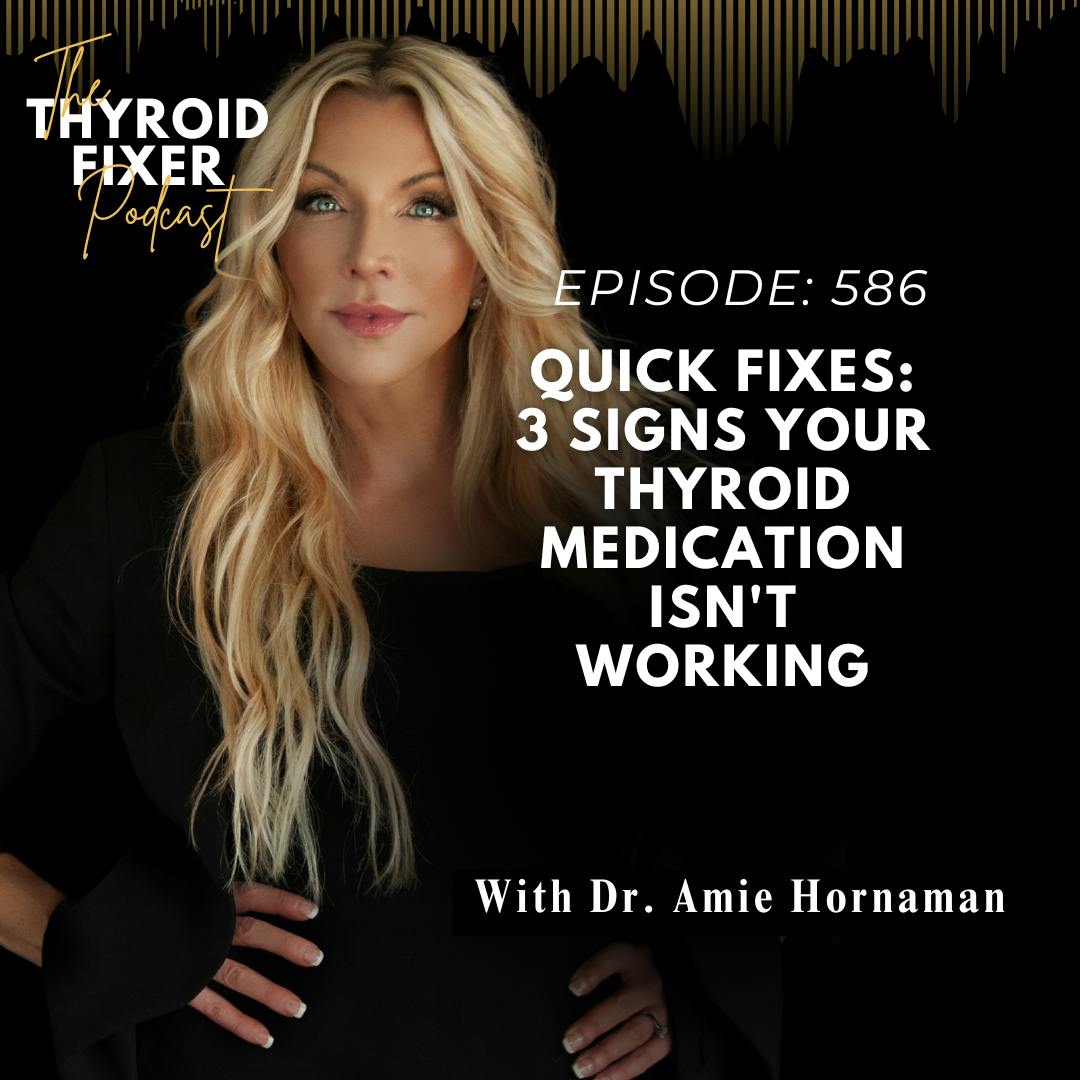
The Thyroid (and Hormone) Fixer Podcast: Thyropause, Menopause, Metabolism and How to Fix It
586. Quick Fixes: 3 Signs Your Thyroid Medication Isn't Working
00:32:33
Loading summary
Transcript1 lines
- [00:00]
A
If you have been on the same medication for an extended period of time and you still have symptoms, then guess what? That is a sign that your thyroid medication isn't working. Is not working. Welcome to the Thyroid Fixer podcast where we dive deep into the world of thyroid and hormones. Especially for you ladies navigating perimenopause and menopause and really for anyone struggling with hypothyroidism. I'm your host, Dr. Amy, thyroid and hormone specialist and CEO of a good global telemedicine practice where we prescribe the right thyroid treatment and bioidentical hormones to all safety states and most of Canada, helping you become that badass human that you're meant to be. So if you're battling weight gain and hair loss, you can't lose weight no matter what you do, your energy levels are plummeting and your libido left town. Then you're in the right place and you have found your tribe. Remember, I want you to embrace every inch of that badass woman that you truly are. So if you're ready to dive in and fix things things, let's get started. Healthy hormones begin with healthy cells. So when we talk about thyroid or hormone health, we usually focus on lab supplements or symptoms. But there's a deeper story happening in your body and that's one that begins in your cells. Every hormone your body produces relies on healthy, energized cells to do its job. At the heart of each cell are the mitochondria, your energy centers. As we age or when the body is under stress, mitochondrial function naturally declines. That can show up in so many ways. Fatigue, slower recovery, or just simply that feeling off. This is where Timeline Nutrition's breakthrough Mito Pure comes in. Mito Pure is a highly pure form of a nutrient called urolithin A, if you've ever heard of that. It's backed by over 15 years of research, multiple human studies, and has been shown to support mitochondrial health, muscle function and overall cellular performance. By helping your mitochondria work more efficiently, you're supporting the foundation of your energy and your long term wellness. I personally found that this deeper cellular approach to health is a powerful complement to everything we do for thyroid and hormone balance. It's not about quick fixes, it's about building resilience from the inside out. If you're ready to support your body at the cellular level, Mitopure offers a clean, clinically backed way to start. So you are going to go to timeline.com forward/doctor Amy so that's T-I M E L-I N E dot com, forward slash dash R A M I E. And you're going to see the code on there. Doctor Amy 10 D R A M I E 10. But if you want to try the gummies, the Mito pure taste actually going to give you 20% off your order. So just go ahead and click that code. D R a m I e 10. You'll see it on the page or you can add it at checkout. You're going to save some money while giving new life to yourselves. I completely and totally hear you and I see you and I understand you and I know exactly where you're at. You're gaining weight. You can't lose. You have all the symptoms that no one's listening to. The fatigue, the hair loss, the brain fog. You can't remember why you walked into a room. You don't want to get dressed and go out because you know if you have that glass of wine with your friend, if you have that dessert with your husband or even order an appetizer, you're going to be five pounds heavier the next day and your clothes are already tight. Every single doctor is telling you that you're normal and everything is fine. You've been to multiple conventional medicine doctors trying to use your insurance, hoping to God that somebody has an answer. Then you've dropped thousands of dollars on functional medicine or integrative medicine because you keep hearing how functional medicine gets to the root cause of the problem. But not every functional medicine practitioner knows the thyroid and knows the hormones and can treat you as a nuanced, personalized individual, a unique person. That is exactly what my team and I do. We specialize in thyroid problems. We specialize in hormones. You can't do one without the other. You cannot just see someone for your thyroid and have them ignore your hormones or have them half ass your hormones. They better be a hormone and thyroid expert. If you are going to spend your time, your energy and your money, if you are going to invest in functional medicine, they need to be a thyroid and hormone expert and treat you as an individual. They can't have a cap on how much T3 that they're going to give you. They have to personalize your treatment plan to get you feeling your best, no matter what that looks like, so that every system in your body functions at the very top, at the very best. And that is exactly what we do. I made it my mission because I went through this. I was dismissed, I was gaslit, I was misdiagnosed, and I dropped thousands of dollars before I found an answer. That is why I made it my mission to be able to treat people in all 50 states so we can prescribe via telehealth. Thyroid and hormones and peptides. Yeah, the GLPs as well. To all 50 states, most of Canada and now Puerto Rico. That is my mission to be able to help you wherever you are, because I want you living your best life. I want you to join me in optimization land where you can go out and love life and go out with your friends and go out with your partner and not gain weight looking sideways at a brownie. Yes, we do have financing options available. I'm talking like 0% or 12 months. The whole thing. Based on your credit score. We got you. And our programs are affordable. They're completely and totally affordable and they will get you from point A to point B. They will bring you into optimization land. So please don't waste another moment struggling, please. I want you living here with me, a great, happy life in optimization land. So go to my website@dramy.com, click the Become a patient button so we can have a chat. Let's talk it out. Let's hear what you've done, what you haven't done, what's worked, what hasn't worked, and let's get you on the right path to feeling your absolute best. If you can imagine the best life ever that is absolutely possible for you. I'm not BSing you. I am not bsing you. I was in your shoes. Many of my patients have been in your shoes. We will get you there. And that is my promise to you. Is your thyroid medication actually working? Going to go over three signs that it just isn't. This is your quick fix of the week. Okay, so you're on thyroid medication and I don't care whether it's T4 only. Natural desiccated thyroid. Let your armor and your NP, if you're on a T4 and T3 blend, or if you're on T3 only, we want to ultimately know that our thyroid medication is working for us and not against us. So the number one sign that your thyroid medication is not working symptoms. Now let's break that down because here's the thing. We're all human and the reality is, is that thyroid symptoms, hypothyroid symptoms, can overlap with other things. Meaning, okay, you could not be losing weight. Maybe you're gaining weight. Chances are it's your thyroid because T3 controls your metabolism and is the master controller of your metabolism. And the thyroid also controls your insulin, controls Your hormones, it's the master gland at the top. So again, it doesn't matter how many adrenal supplements, insulin supplements, GLPs, hormones, even bioidentical hormones that you throw at your body. If your thyroid is not optimized, if your medication is not working, nothing will work. But the reality is, okay, what if, what if your weight gain is more tied to just you eating garbage and being insulin resistant? Maybe type 2 diabetic? Only you can separate this out. I'm going to give you the knowledge and the tools to do a really good job assessing your current situation with your medication. And then I want you to be honest with yourself. And if it is the case of like, well, maybe it's the holidays and I'm eating too much, or maybe it's because I'm not moving enough, okay, just be honest with yourself. But we're going high level here. High level. When we say symptoms. Now, you know those hypothyroid symptoms that you started with. It's the low energy, it's the weight gain, the inability to lose weight, hair loss, joint pain, fatigue, brain fog, anxiety, depression. Your outer eyebrows are falling out. You're intolerant to cold, intolerant to heat. Let's see, frozen shoulder, muscle pain, joint pain, constipation. That's a big one. So if you think head to toe, low and slow head to toe, the thyroid runs the show. So just remember that and then you can really step back and decipher. Okay, maybe I just have one random symptom like hair loss that we talked about last week. There are multiple causes of hair loss. It's not just thyroid related. So if you only have one symptom and it's isolated, it could be your thyroid medication. It could be that it's not working, it could be that you need to change, or it could be something else. But since we're talking about thyroid medication not working, that's what we're going to focus on, symptoms. When you have, I would say three or more of those classic hypothyroid symptoms that I just listed. Now there are a couple other ones out there. And again, just think head to toe, low and slow. So hair growth is slowed down, hair loss occurs. Then we move down your forehead right to the outer corners of your eyebrows. Those start to go like we said before, eyesight can start to get a little bit hazy. Foggy, swelling in your throat, hoarseness, always clearing your throat. Or actually some people have indicated that they can feel that inflammation every time they swallow. Then we go to the Heart. Maybe it's a low heart rate, maybe it's low blood pressure, low body temperature. Then we go shoulders, joint pain, muscle pain. We can have other autoimmune conditions as well, like Raynaud syndrome. We can have rheumatoid arthritis. We could have psoriasis affecting our skin. So now I'm starting to move down low. And slow digestion, slow gastric motility, heartburn, acid reflux, bloating, constipation gas. That's all thyroid related as well. Adrenal glands, yes. We can be more stressed out than we normally are. Our response to stress isn't what it used to be. We feel wired and tired. We're gaining weight in our midsection. The thyroid has control over cortisol, Thyroid has control over insulin. Maybe we're wearing CGM and our glucose is all over the place and we just can't control it. We're eating low carb, we're eating Carnivore and our blood sugar is still through the roof and our insulin is still coming back above a six. Our cholesterol panel is way off. And I mean way off. Not just the core, according to the standard lab value ranges that we currently see on the panel because those are complete and total, especially when it comes to cholesterol. But I mean way off. Like, let's say your total cholesterol is 700, right? And you just have no control over your lipids, then we can move down. Maybe we have excess knee pain, hip pain. Hip pain is definitely associated with low estrogen, ladies, which your thyroid has control over your sex hormones and can put you into a state of early menopause. And then of course, low testosterone can lower that protective armor in our bodies and spur on Hashimoto's, allow Hashimoto's to present itself more easily when we lose that testosterone. But the thyroid also has control over our hormones. So the thyroid is also going to say two testosterone, two estrogen, two progesterone. Ah, yeah, sorry, you're not going to be in balance this week, this month, this year, because I'm still low and slow, I. E. The thyroid. Therefore, I can't possibly help you out right now. I can't possibly help you be optimal. Testosterone and estrogen and progesterone, head to toe, it runs the show. So if you have three or more symptoms, then you are not being properly medicated. Now, maybe you're on the journey. If you're working with us, don't worry, we got you. You're on the journey and think you might be in Month, two or three, and things are still getting better. We're still amping up those hormones. But if you have been on the same medication for an extended period of time and you still have symptoms, then guess what? That is a sign that your thyroid medication isn't working. Is not working. Okay? The other sign and symptom that we have that your thyroid medication isn't working is your reverse T3. Now, we're going to talk about this in a totally different episode and unpack just this lab value, but for the purpose of today, you want to look at your reverse T3, and if that is above 12. Now, I'm going to give you some other scenarios too. So really, hang on. This is a juicy, meaty episode that you're probably going to want to take notes on, but I'm keeping it short so it's nice and digestible, no pun intended, and understandable. Reverse C3, if it's above a 12, then that means that you are on way too much thyroid medication. Now, I have absolutely seen many of you on natural desiccated thyroid medication and it's better than T4 only. I'll give you that. It is better than T4 only, but it's not always the best, and here's why. Because NDT medication, natural desiccated thyroid medication is 80% T4 and only 20% T3, roughly. So what does this do? Well, we actually had a question that came up in the Just Texture Thyroid Facebook group of how is it possible that getting prescribed thyroid medication like Armour could actually make my T4 and my T3 decrease? Well, it's all tied into. If we give you too much T4, it's going to drive up your reverse T3 and in most instances it will lower the free T3. Now, I'm going to get to this specific question and unpack that for you because it's a little bit different. But along the same lines, it all kind of gets lumped into this second reason why your thyroid medication isn't working. Now, we all know if you're on T4 only, if you're on Levo, if you're on Synthroid, if you're on Tyresin only, and that is it, that's not going to work. You have no hope there. I'm sorry, I'm all about giving hope in all circumstances, but I'm also about being truthful. And I am not going to blow sunshine up your ass and tell you that all you have to do is take my T3 conversion fixer. And if you're on T4 only. You'll be fine. No, I'm never going to lie to you. The T3 conversion fixer will help, but you are never, ever, ever going to get better if you're on T4 only. I'm sorry, you. You need to be working with someone who knows what they're doing with the thyroid. Okay? If you're on natural desiccated thyroid medication, that's your arm or your NP or a compounded T4 and T3 and back to that 80, 20 split, 80 T4. Well, 80 T4 is going to really drive up your reverse T3. And I mean, how similar is that to being on T4 only? Okay, you're getting a sprinkle. You're getting a little fairy dust of T3. But leading into this question, how is it possible that getting prescribed thyroid medication, armor specifically, could actually make my T4, my T3, decrease? Well, that's because you're not getting prescribed enough. So there, there's. On the one hand, you could be getting prescribed more T4, more T4, more T4. That's what conventional medicine does. Now, over here in the functional medicine space, because they seem to love the word natural. And I've seen this at thyroid clinics. I've seen it with, seen it with thyroid specialists, I've seen it with functional medicine providers, naturopathic doctors, integrated practitioners who do not know what they're doing with the thyroid, even though they claim to. And they will prescribe nothing but natural desiccated thyroid because there's natural in the title. That's it. They love the word natural and they think that they're doing you a service, or maybe you even asked for it. Will you please prescribe me something with natural in the title? Because you've been brainwashed as well to think that natural equals better. Well, what if it doesn't equal better for you? I have said over and over again that the best thyroid medication is the one that works for you in the combination that works for you and the dose that works for you. What if that's not natural desiccated thyroid medication? What if that NDT is too much T4 for you? And it doesn't matter if you go from 60 to 90 to 120 to 200 to 220. It doesn't matter how high you go. Every time you increase, you're pushing up the amount of T4 that's going in your body. And if you have issues converting, you're going to convert that to reverse T3. It's going to drive up reverse T3. It's going to put your body in survival mode. It's going to put your body in survival mode. Now, if you're new to the podcast, there's a couple other ones that you're going to have to listen to. You need to understand reverse T3. Like I said, I will do another quick fix. Deep dive into reverse D3, because that is the number one test that is not ordered. It's not even on Mark Hyman's function health tests. Okay? The, the father of functional medicine did not even put the most important thyroid marker in his panel called Function Labs. So this is, this is the whole problem with this whole freaking industry is that we are using the term functional and integrative. Like it's like it's an AI term. Like it's freaking AI, Right? Like we're just going to use it and everybody's going to think that it's great. No, you have to look at the nuances. Just like with AI, there are good things, there are bad things. Okay? Same thing with functional medicine. There are good and there are bad functional practitioners. There's a lot of conventional doctors that are realizing that insurance is only paying them 18 for their 5 minute visit with you, and they're tired of it and they're tired, tired of battling insurance companies. So they slap the term functional into their marketing, but they don't treat you any different. They haven't learned functional medicine, they just learned how to market. And that's a problem. The thyroid is the nuanced gland. It's a nuanced art to get you optimized. It's totally doable. We can do it with our eyes closed and our hands tied behind our backs. Most people can't. It's not easy, but it's doable. It's easy for us. It's not easy for the general practitioner who hasn't dove deep into thyroid health. So if you are on natural desiccated thyroid and your integrative or functional practitioner just keeps increasing it, or maybe they even give you this little baby dose of T3. Maybe you're lucky enough that they're like, well, we'll give you 5 or maybe 10 micrograms of T3 and that's it. Don't you ask for more. But Doc, what if I need more? Don't you ask for more? Because don't you know that if we go up in that T3, you're going to lose bone and have a heart attack? Well, wait a minute, Doc, I thought that that has been debunked. Like that's totally not a thing anymore. Well, I'm sorry, that's all we do. We'll give you NDT out the wazoo and maybe we'll glance over at your reverse C3 or maybe we'll test it one time. But then we're just going to pretend that that natural desiccated thyroid is working for you. And it must be something else. It must be those adrenals. You probably need an adrenal supplement. I could keep going, but I won't. You get the picture. So this is something crazy that I learned about electrolytes that I did not know before. Low sodium diets, you know, when you cut back on your salt, can actually contribute to insulin resistance. So number one, we don't want that. We know that is going to definitely increase our weight. Low potassium status suppresses your growth hormone, your anti aging hormone, and that even just having low thyroid function disrupts your electrolyte excretion. So I mean, if your magnesium is low, we know that that's going to interfere with thyroid T4 to T3 can conversion. Now you have this whole electrolyte excretion issues that you're pushing out more electrolytes, but you need to keep them in for that conversion. I'm telling you, the data is crazy on the importance of electrolytes. So I use the OG of electrolyte powders, element number one because they taste absolutely freaking amazing. I want to use probably too many packets in a day, quite honestly, because I keep putting them in my water because they taste that good. But of course I also know that I'm getting my balance of electrolytes. And in the summer I need more. Hey, even in the winter when I'm skiing and snowboarding, I'm sweating that all out. You need more. So if you want to try some of these amazing, just amazing electrolytes and actually feel the difference, I mean you will feel the difference. You'll feel more energized, you won't cramp up and you will get better sleep with this as well. I'm telling you, definitely better sleep. Go to drinklmnt.com so spell out drinK-R-I-N k l m n t.com thyroid and this is going to save you some money. You can get the sample box, you can try all the different flavors. My absolute favorite. Just side note, grapefruit and orange drink element.com thyroid. So if you continue to increase your natural desiccated thyroid medication, God forbid you're still on T4 only. But if you're in the camp of NDT, and you keep increasing your NDT or you're given a baby dose of T3, sure. That's enough to drop both hormones. It's called a negative feedback loop. And in that negative feedback loop, let's say we're given just enough thyroid hormone to tell our hypothalamus, to tell our pituitary to stop yelling at the thyroid gland. Just stop. The thyroid gland does not need to produce any more hormone on its own. Or maybe it just needs to spit out just a little bit. And no worries, meds are taking over. Nothing wrong with that. Nothing wrong with the feedback loop because your thyroid gland wasn't working properly anyways. But here's the problem. Here's when it is a problem, is when they give you too little of a dose of thyroid hormone replacement, but it's not enough to replace. It's enough to tell your brain to shut down your own thyroid hormone production. And I'm simplifying this. But you. So you can get the picture, but it's not enough to replace all of the T3 that every single cell in your body needs. Every single cell in your body needs T3. So if we're only giving you a little tiny bit, just that little 20% that comes in NDT medication, or we're only giving you a little baby dose of T3, just a little baby dose. Yep. It's enough to completely shut things down. So on your labs, your T4 is going to drop, your free T3 is going to drop, reverse may or may not go up, and you are left sick and tired and gaining weight and feeling like you are back at the beginning. Maybe things even got better for a little while. You might actually be sitting there nodding your head right at this moment going, yes, that's exactly what happened. I got better and then I got worse. I thought things were getting better and then things got worse. I get that. I understand it because I see it every day. We get patients coming into the clinic all the time who say the same thing. I was getting better and now I'm getting worse. So that is absolutely why it's usually a dose issue, why your T4 and your T3 decrease. It's because you're on too little. But we want to go on to the third, the third reason why your thyroid medication might not be working. And that, my friends, your hormones here is where thyroid and hormones play together in the sandbox. So you have the thyroid medication coming in. You're working with someone who knows what they're doing with the thyroid, they're looking at your reverse T3, making sure that it's less than 12, but also also looking at the fact that people with a reverse T3 of an 8, 9, 10, 11 could also be having issues with conversion and might need more T3. So ratio wise, you might need more T3 than T4. Instead of an 80, 20 ratio of T4 to T3, you might need a 60, 40 ratio or a 70, 30 ratio, or you might actually need 30, 70, 30% T4, 70% T3. You might need 0% T4 and 100% T3, I. E. T3 only. Once you are actually optimized with your thyroid, you have to step back and say, okay, if I feel like my thyroid medication is just not working, what else could it be? This is where we go to hormones. All right, let me back up. Before we journey into the third realm, let me give you one other nugget to think on. Okay, I just mentioned T3 only. Now, it's very, very rare that a practitioner would put you on T3 only and leave you at too low of a dose. Because if they're open minded enough to recognize the fact that you might need T3 only, they're going to be open minded enough to be increasing your dose to what you need most of the time. Most of the time. Now, there are instances where a doctor is willing to do T3 only, but they won't go above a certain cap. That is a problem that's still, that's still in number one and two, because you're still going to have symptoms, you're still not on the right dose. So we could summarize. Number one sign that your thyroid medication isn't working is that you are still having symptoms. The number two sign that your thyroid medication is not working is that you were on too much NDT, too much T4 or a baby dose of T3. And this can be determined by your reverse T3 or your symptoms. Now, that baby dose of T3, that's going to push your reverse T3 down. You're not going to have an elevated reverse T3 with a baby dose of T3, but you are going to have symptoms number one. And your free T3 most likely will not be in the optimal range of the upper quadrant of the range or over. So that's going to fall in number two, but could also fall in number one because it's going to produce symptoms number three, if you still have symptoms and your labs look perfect, I mean Perfect, your free T3 is in the upper Quadrant of the range. Your reverse T3 is below a12. We don't care what your TSH is, I don't care what your free T4 is. Preferably it's a little bit low because if free T4 is high, your reverse is going to be high as well. Your TP on your TGA antibodies can be anywhere. They could be at one, they could be at a thousand, it doesn't matter. That's not indicative of your thyroid medication working or not working. That's indicative of the fact that you need to add in some black cumin seed oil or maybe low dose naltrexone to tighten up on your diet. So in category number three, we're going to look at hormones. I mentioned them in the beginning. Going to dive a little bit deeper now. Thyroid and hormones go hand in hand. They play together in the sandbox, but the fire controls it. Thyroid is the master, has control over your hormones. Now, if the thyroid is optimized, remember we're going from a perspective of thyroid is optimized. Labs look good. But over here in category one still has symptoms. What's going on? Let's look at your hormones because number one, like I said, testosterone, optimal testosterone is required to give you that protection against autoimmunity. So the reason why us ladies get hit with more Hashimoto's than guys is because we naturally have lower testosterone levels than men do. We just do. So that lower T lowers our protective armor. In addition, low testosterone, I. E. Below 50 nanograms per deciliter in total or below under the halfway cutoff in the free testosterone marker, you are going to have overlapping symptoms that seem like it's fiery but it's not. Muscle weakness, joint pain, low libido, loss of strength, loss of muscle tone, weight gain, inability to lose weight, inability to put on muscle even though you're lifting heavy. That is testosterone. Drive, focus, attention. That is testosterone. Estrogen lining of the midsection. Yes. Dry vagina, hot flashes, low libido. That's all estrogen. And that's kind of like in its own little estrogen box. And we're not going to have a dry vagina and blame it on our thyroid. We're not going to have a hot flash and necessarily blame it on our thyroid. We can be intolerant to heat and absolutely despise being in Florida most of the year. That's me. But it's not going to be a hot flash. There's a difference. Hair loss could be estrogen. Yeah, brain fog. Yeah, estrogen too. So you have to look at what does estrogen do to our thyroid? Well, I'm talking about low estrogen, what about high? So what if you're still in perimenopause and your estrogen is on a roller coaster and you go into that estrogen dominant state. Now this could be where your estradiol itself is measuring high. So if you're measuring in the ludal phase, which is where you should be testing your progesterone and your estrogen, if you're still cycling, we don't want that estradiol to be like five, six, seven, hundreds. I mean, unless you're super young. We want it to be, you know, 100, 200, maybe even 300 in our perimenopause, menopause, midlife. But if estrogen is high and progesterone is low, that is still an estrogen dominant state. So your estradiol could be coming in at, let's say a 150. But if your progesterone is non existent at a less than 05, then you are still estrogen dominant. That estrogen dominance will actually increase. Something called thyro binding globulin. And it's very similar to sex hormone binding globulin in that it's a little sticky train that drives around the thyroid hormone jumps on it, it gets delivered to the cells where it needs to go, pretty much every single cell. So if TBG is increased because of estrogen dominance, that is going to bind to your thyroid hormone. So if you were optimized in your thyroid, but you're still having symptoms, it's not necessarily that your thyroid medication isn't working. It might be over here in category three where you need hormones, you need hormones. So in the case of estrogen dominance, you need progesterone. Progesterone balances estrogen dominance beautifully. Beautifully. And you might need a little bit of dim. You might have to throw in some estrogen fixer. Not sure, just depends on your numbers. But you need to look at your hormones because that actually could be a sign that your thyroid medication isn't working. If your hormones are tanking early, and they shouldn't be if you're going into early perimenopause or early menopause. But if you're having hormone specific symptoms that we just talked about, then you need hormones balanced in order for your thyroid to work properly. We need testosterone in order for our armor, our protection to be up and ready to protect us against antibodies and that thyroid antibody attack on our thyroid. We need progesterone to convert T4 to T3, going to have an elevated reverse T3 if your progesterone is low. We need progesterone to balance estrogen and get out of that estrogen dominant state. But we also don't want to be low estrogen because low estrogen is going to widen our midsection and cause weight gain and brain fog and memory loss and hair loss and skin changes all the like. And then what's the point in throwing on a boatload of thyroid medication if your estrogen in the toilet? You're not going to feel better. So again, symptoms. Do you have three or more symptoms? Are you on T4 only? Which is just hands down, Come on, that's just a no brainer if you're on T4 only. Like I said, sorry, I don't have any hope to give you except change freaking doctors and work with someone that knows what they're doing. But if you're on NDT medication, too much increase in the dose, increase in the dose baby dose of T3, that's a problem. And then we need to balance our hormones over here. Now I'm going to do a whole section separate episode on why the thyroid and the hormones, why they play together. But this is a great little snippet over here in the third column that I really want you to pay attention to. Now I could have sat here all day long and said, well, you need to look at your cortisol and you need to look at your adrenals. Yeah, they play a role. And I again, I will do another quick fix on just adrenals and cortisol, but I'm sorry, it's not at the top of the list. I promise you. No, I will give you. No, you cannot sprinkle adrenal fairy dust or an adrenal mocktail cocktail, salt loading drink with cayenne pepper, whatever the hell it is that people are doing these days on Instagram, you cannot just think that you're going to heal your adrenals and heal your thyroid and your hormones. It's not going to happen. You cannot sprinkle adrenal theory dust all over your body and and think that your thyroid gland is going to lower its reverse C3 and increase your free T3 without any kind of proper intervention with thyroid hormone replacement. Okay? Those are your three huge, big, glaring, screaming signs that your thyroid medication is not working. I want you to share this episode because these quick fix episodes, that's what needs to get out there. That's what needs to be sent to your mom, your sister, your best friend. Post it on Instagram, post it on Facebook, share this everywhere so that we collectively can join together and help every single woman out there. Guys, I know you get hit with thyroid stuff too. We want to include you but girls get hit more. Us ladies get hit the hardest and we get hit more often than than y'. All. So I have minimal sympathy for you guys. But I do still have it in my heart. If you're a man listening, help your partner, help your best friend, help your sister, help your mom. We've had many guys listen to the podcast and share it with the lady in their life, whoever that is to help her. And guys, if you are in that 5 to 10% of the male population that gets hit with hypothyroidism or Hashimoto's, your testosterone is going to be low too. So we can help you too. These are going to be great for you as well. So thank you for listening to the new, improved, revamped Thyroid Fixer Podcast giving you exactly what you need to fix your thyroid, fix your hormones, and fix your life. The information shared on the Thyroid Fixer Podcast is intended solely for informational and educational purposes. It is not a substitute for professional medical advice, diagnosis or treatment. Always consult with your physician or other qualified healthcare provider with any questions you may have regarding a medical condition, treatment or before making changes to your healthcare regimen, including medications, supplements or other therapies. Use of the information provided in this podcast is does not establish a doctor, patient, or client provider relationship between you and the host or between you and any other healthcare professionals featured on the show. Any medical opinions or statements made by guests are their own and do not necessarily reflect those of the host or affiliated parties. Statements regarding dietary supplements or health related products mentioned in this podcast have not been evaluated by the fda. These products are not intended to diagnose, treat, cure, or prevent any disease. Some episodes of the Thyroid Fixer Podcast may include sponsorships or affiliate links. The host may receive compensation for discussing or promoting certain products or services. Any such sponsorships or affiliations will be clearly disclosed during the episode. All opinions expressed are those of the hosts or guests and do not necessarily reflect the views of any sponsors. The inclusion of a product or service does not imply endorsement by any healthcare professional featured on this podcast.