← The Thyroid (and Hormone) Fixer Podcast: Thyropause, Menopause, Metabolism and How to Fix It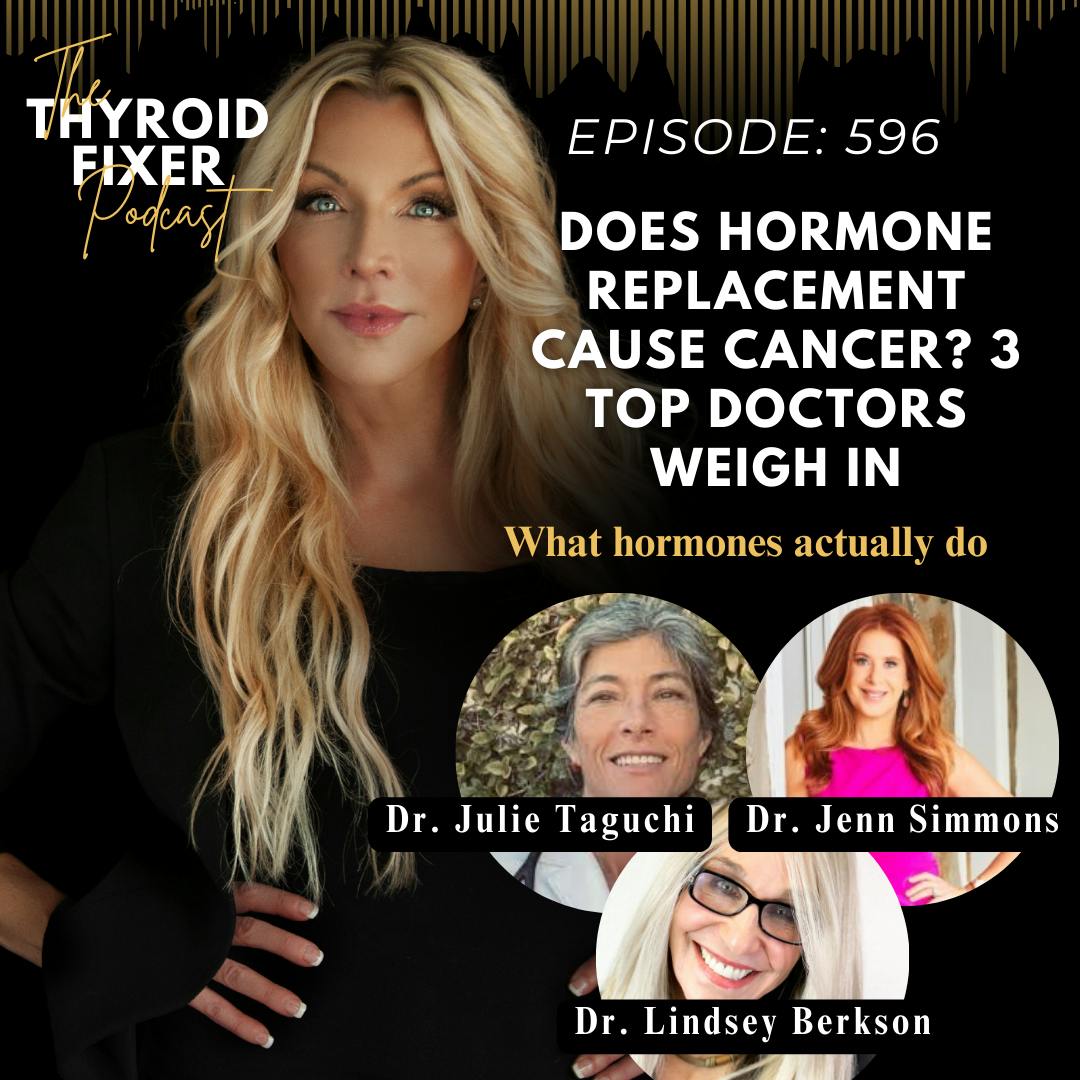
The Thyroid (and Hormone) Fixer Podcast: Thyropause, Menopause, Metabolism and How to Fix It
596. Does Hormone Replacement Cause Cancer? 3 Top Doctors Weigh In
01:04:08
Loading summary
Transcript110 lines
- [00:00]
Dr. Lindsey Berkson
This information is not yet mainstream. Hormones have been blacked out ever since 2002. Blacked out. So I'm trying to open the windows and let the sunlight in and let you see that you can have muscles and stamina. Most of my friends that were very frightened, understandably, of hormones, they're searching for words. They're not talking the same, they're shuffling. Aging is diverse, but if you want to age better, hormones must be a part of that foundational tool bag that you've developed.
- [00:32]
Host of Thyroid Fixer Podcast
Welcome to the new and completely reimagined Thyroid Fixer Podcast, a podcast that refuses to sound like every other health show out there. We're here to disrupt this entire space, and now you are part of that disruption. If you're listening right now, it's because something inside you finally said, I'm done being ignored. And I'm here to tell you good, because this is where everything changes for you. This is where you say, no more. No more being dismissed by your doctor. No more being told your labs are normal. No more recycled medical advice. No more recycled biohacking advice. No more being told to accept what you know isn't right here. You'll get truth. You'll get clarity. You'll get information you can actually use, tools, strategy, and guidance you can apply right now to. To take back your energy, your hormones, your metabolism, and your life. Every episode will give you something real, something that moves you forward, something that reminds you that you were never the problem the system was. This is the Thyroid Fixer podcast. This is your turning point. This is where you rise. Get ready. We're about to disrupt everything you thought you knew about thyroid and hormone health. Let's go. If you're like me and many other women over the age of 40, falling asleep and staying asleep can feel impossible. Oslo sleepbuds are designed to help you drift off faster, stay asleep longer, wake up feeling refreshed, and block any other outside noise, like a snoring husband. These were engineered by former Bose engineers, backed by neuroscience, and recognized by TIME as one of the best inventions of 2025. So super cool. They block out snoring, city noise, dog barking, other distractions, and their ultra soft little silicone tips are side sleeper approved, so they won't jam into your ear. And they're built in sensors which switch your audio from streaming to calming soundscapes once you fall asleep. So if you want to listen to, let's say, a podcast or a meditation before you drift off, and it'll change over to this nice little calm white noise once you fall asleep and the battery lasts all night. So don't worry about waking up mid charge. Turn your nights into a restorative ritual. Use the code ttfpod. So total Thyroid Fix Pod TTF P O D for $75 off at Oslo sleep.com forward/ttfpod. So that's O Z L O S L-E-E-P.com forward slash T T, F, P O D and enjoy a fantastic night's sleep. You have questions about your thyroid, about your labs, what they mean. What about your hormones? What about insulin? Why are you gaining weight? Why are you so tired? Why are you losing your hair? Why won't my doctor listen to me? Why won't my doctor test these things, all of these questions that you have running around in your brain and you know that if you just had the answers that that could push you over the edge into optimal health, that you could be that badass human that you are meant to be. Well, I got you covered there because I am going live every single week in the just fix your thyroid Facebook group. That is my Facebook group. A beautiful community just filled with amazing people. Where I am in there, my nurse practitioners are in there, My health coaches are in there. There are patients in there that have been with me for so long, they're experts in their own right and they answered just the way that I would. So we have you completely covered in this group. So not only can you post your question every single day, every single hour, if you want, you can mark your calendars for our weekly live Q and A sessions. We where you get to ask your question to me and I'm going to answer it live on air. And not only that, we are doing product giveaways. We're doing working with our team giveaways. You're going to want to be in there and actually be live on that call. If you're at work going in the closet, just shut the door. Take minutes for yourself. Take a half an hour for yourself. Take an hour for yourself so that you can get the information that you need to bring yourself into optimization land where you're not looking sideways at a brownie and gaining weight at the same time, where you can feel amazing every single day. Because that's my goal for you. You know that I love, love, love to answer your questions. And this is the place where you can get them answered live. For over 20 years, women have been living under the shadow of one terrifying question. Do hormones cause cancer? Even after the government removed the black box warning on hormone replacement, I'M still hearing the same fear based question over and over again. And I get it. When doctors repeat misinformation for decades, it becomes ingrained in you, it becomes belief. And then that belief drives fear. So instead of bouncing you around to three separate episodes, I wanted to do something different. I wanted to put the best minds in hormone therapy and oncology into one conversation. So in this episode, I'm bringing together everything I learned from three powerhouse women who live at the intersection of hormones and cancer every single day. Dr. Lindsey Berkson, Dr. Jen Simmons, and Dr. Julie Taguchi. These are the women who are deep in the research, deep in the patient care, and just deeply committed to telling the truth. They don't operate on fear based medicine. They use real science, real nuance, real context to deliver their information and to help their patients. So we're going to unpack where this fear came from, why it persisted for so long, what the data actually shows, and how hormones can be protective, supportive, and in many cases, essential to a women's long term health. Because the real danger isn't hormones. It's when you are suffering unnecessarily because you were never given the full story in the first place. So if you have ever hesitated to consider hormone therapy because of cancer fear, this episode is for you. And honestly, it's one that every single woman should hear. So let's get into it. Have you ever seen women that were diagnosed with osteoporosis, osteopenia, come out of that diagnosis? They go on progesterone, they do a follow up DEXA or bone density scan, and all of a sudden, oh my gosh, you no longer have this issue. You've rebuilt bone?
- [07:36]
Dr. Julie Taguchi
Yep, absolutely. Actually, I'm doing a research study right now. We're trying to get NIH funding and private funding, and it's doing basically rhythmic dosing against this, a patch in oral cyclical progesterone at the standard levels. And we're comparing those two hormone protocols and bone density is the endpoint, the primary endpoint. We have a million secondary endpoints, but bone density is first, but yeah, so you can turn it around like nobody's business. It's really interesting.
- [08:01]
Host of Thyroid Fixer Podcast
That is a benefit that I have not heard yet. So I'm so happy that you said that. So there's progesterone and then finally testosterone, which I talk about ad nauseam on here as well. It is not just a male hormone. Females need it as well. So can you go over the benefits of testosterone?
- [08:17]
Dr. Lindsey Berkson
Yes.
- [08:18]
Dr. Julie Taguchi
First of all, the ovaries make testosterone, the ovaries make testosterone that gets converted into estradiol as a reproductive woman. And of course you need to, once you have popped that egg, you know, estrogen levels go up, then drop sharply, then the testosterone levels have to go up because they eventually turn into estradiol, but they go up because you need to use that egg. You know, in terms of the fertility and all of that, it's an important signal. But in the postmenopausal woman, you still make some testosterone. If you have ovaries, there's always a little bit of testosterone in the, in the background. The testosterone helps with its mental health. It's bone health, it's muscular, keeping your muscle mass, et cetera. So there's a lot of benefits. And besides mood and drive.
- [08:57]
Host of Thyroid Fixer Podcast
Yeah, absolutely. And, and protection of your muscles because we don't want sarcopenia as we age too. That's a whole other issue. If your bones are becoming brittle, you're not on estrogen progesterone, now you're losing muscle as well. That's where we see the classic. I fell, I broke my hip, I was in the hospital, couldn't move, died. And it's like you didn't die from falling down, you didn't die from even the hip fracture. But, but had you have the muscle to protect you, that might not have happened. Or if you had all hormones on board, might not happened like at all because your bones would be strong.
- [09:32]
Dr. Julie Taguchi
Yeah, I mean you're, you're absolutely right. I mean, and they said muscle mass as well, also metabolism. And so there are like people who are type to diabetics or my diet people have diabetes. It's like, you know, I really like them to be on board with the testosterone exercising because they can build more muscle mass. And obviously the more muscle mass that needs to be maintained, it reduces their insulin resistance. Reason to have testosterone.
- [09:54]
Dr. Lindsey Berkson
Right.
- [09:54]
Host of Thyroid Fixer Podcast
And that has a trickle effect into so many different disease states because insulin's so inflammatory. We won't go down that path because I want to stay in the, in the hormone and, and cancer realm. But, but let's talk about the Women's Health Initiative study because you were saying some amazing things off camera like wait, wait, wait, we need to get this recorded. I've talked about the, the WHI study on here. The way that you broke it down is just so beautiful. And ladies, this really is. Even if you've never heard of the Women's Health Initiative study, this is the starting point to why your conventional doc says don't go on hormones you don't need hormones. Hormones cause cancer. X, Y, Z. And this fear is still really perme the medical community and it still is in the minds of so many women. I would really like to break this down and listen to you explain what exactly we found, what was done in the Women's Health Initiative study that we kind of can't use if we're talking about bioidentical hormone replacement. And then what the findings were.
- [10:58]
Dr. Julie Taguchi
I'm sure your listeners are well educated, but to review, the Women's Health Initiative was started in the early 90s as a cardiovascular study because they had a signal that estrogen at that point in time, I want to remind you, this is only using Premarin and a progestin called medroxyprogesterone acetate. I call them drugs with hormone effects. And they're not hormones. Absolutely. Affect the receptors very differently. And of course, Premarin comes from a horse. We are not horses. You know, so there's an inflammatory aspect of the Premarin. But this study was done because there wasn't signals showing that oral, at least oral Premarin was helping reduce cardiovascular issues. And so the Women's Health Initiative wanted to study that. And it was a great study because they studied a lot of women and we learned a lot of information that maybe had some wrong interpretations. Initially there were two groups. One was the women who had a uterus. They were given oral Premarin and oral medroxyprogesterone acetate every day. We call that continuous combined therapy versus the placebo. That some women didn't get anything. There was another group with women who did not have the uterus and they were given only oral Premarin against another group of placebo. So those two studies were continuously, you know, side by side going along. After five years, the group found a signal of there was like one more breast cancer in this group compared to the placebo out of like 5,000 women. And they were completely freaked out about that. Not freaked out, I should say that was a signal to stop it. That's really what they, they did a pre planned signal to stop. And so what ended up happening? We heard this announcement in 2002 that breast cancer hormones increase the risk of breast cancer by 26%. So I am not kidding. When doctors, doctors heard that, they said, oh, 26, like one in four. So that means one in four women who go on hormone replacement will have breast cancer. That's what the interpretation was. But it's not okay. It was just a 20, 26% increase. Against the placebo. And when you go back to the numbers, there were eight. It's like you did. There were eight more cancers out of that group divided by the number, total number of cancers, it turned out to be like a quarter. So it was just that one more person was 26%. And it was like the risk was 0.4% a year if you did that. So it's like tiny, tiny risk. Now, in that group that got the cancers, we know now those people already had breast cancer, right? The breast cancer does not develop in years. On hormone replacement does not happen. So it just. These were occult cancers that probably were diagnosed when this study happened, because women who were on placebo also got breast cancer. And when you compare the two groups, the death of breast cancers are the same 20 years later. There's another finding now that if women who are on the hormones, they might even actually live a little bit longer compared to the ones not on placebo. I mean, the overall death rate is actually the same. So that was awesome. The problem in 2002, we had this big, huge scare that breast cancer happens from the hormone replacement. One out of four women didn't get it. Like, why would you do that? You'd be crazy. But it was the statistics. Doctors didn't understand the statistics. They didn't know how it was, how studies were evaluated and why that was said like that. I mean, really, it was a major disservice to women. And when you'd hear Joanne Manson, who was the author of that study, she was saying, well, we didn't intend for women to, you know, people not to have hormones. They say that now, but that's. That's what the data showed. And they had to follow that. Right.
- [14:32]
Host of Thyroid Fixer Podcast
I was gonna say, haven't the. The authors of the study come out recently and basically kind of backpedaled, like, we're sorry. We're sorry your hormones were taken from you. Things weren't really quite right with this study in a nutshell, right?
- [14:48]
Dr. Julie Taguchi
And they didn't know. But looking back, though, we can. We have gained a lot of great information from that. But in that same study, as I was saying to you before, the women's health initiatives, they took women who were 50 to 80 years of age and started them on hormones with these. Or drugs with hormone effects. And so women who were 60 were at least 10 years without having a period or without their hormones. And we know that without hormones, you're going to have more risks and incidence of cardiovascular disease and coronary disease, et cetera. So what we know now is that there's this, the current want to say the law is that you don't start women over 60 on hormone replacement. Okay. Because women who are 50 to 59, if they took even these drugs with hormone effects, anything, they had an overall cause mortality. They did better. They didn't. They did better. And then if you gave a woman the same drugs with hormone effects after the age of 60 and 70, they had more adverse outcomes. And there was like the benefits were not the same. So they said, oh, it's harmful to give hormones after 60. But it's based on this study and the other one is the elite study. It's very similar in terms of the timing hypothesis. Are you, are you familiar with the elite study?
- [16:05]
Host of Thyroid Fixer Podcast
No. What's that one?
- [16:06]
Dr. Julie Taguchi
It's another very. It's a really important one that women who, they took women, they gave them oral estrogen and vaginal progesterone and they followed their intimate thickness and they divided it into women who were. Their last period was 10 years, within 10 years or after 10 years. And so same thing. Women who were within 10 years had a benefit of decreased intimal cardiac thickness of the carotid arteries. And then women who were past 10 years of menopause, they did not get that same benefit.
- [16:37]
Host of Thyroid Fixer Podcast
So do you have an issue giving women hormones or starting women on hormones over the age of 60?
- [16:45]
Dr. Julie Taguchi
I do not.
- [16:46]
Host of Thyroid Fixer Podcast
So if someone is estrogen receptor positive or even progesterone receptor positive, do you still. Is that a, a marker for this person cannot have estrogen, cannot have progesterone or what does that mean when it comes to hormone replacement with these, with these women?
- [17:05]
Dr. Julie Taguchi
So most important thing, it took me a while to figure this out too. Gosh. Normal breast tissue has estrogen and progesterone receptors on it. It's normal to have that. And we know oncology, estrogen and progesterone receptor positivity is a good thing because it is more like a breast cell versus not a breast cell and a cancer its own individual thing. So we like having strong estrogen receptor positive and progesterone positive tumors. It's a bonus, it's a plus. But does that mean that you can't have estrogen? And the answer is no. But that's because the cancer's, that's how the cancer presents. And what it looks like, it's basically the breast cell was taken over by a cancer process. And that's why I would say it was hijacked into breast and so but it looks like a breast. But it's hijacking, acting like its own thing. Okay, now, can estrogen influence the growth? Yes, it can about 50% of the time, but the other 50%, it doesn't. That's the thing that's really interesting. I am sure you've heard the stats where they say, well, if you take the anastrozole or the tamoxifen, we can reduce the risk recurrence by 50%. Well, that's the 50% that is sensitive to the estrogen and the other 50 is not. That's why that, that market. And we don't know what the other 50% is. It could be insulin, it could be other growth factors or things that might be under our control. Or not under our control.
- [18:28]
Host of Thyroid Fixer Podcast
Sure, right. Even genetics. So kind of going into the, the BRCA gene, even when we're looking at that, that's not prognostic. I mean, again, we can look at the extreme case. We always reference Angelina Jolie, who chopped off her breasts because she had a genetic marker that came back positive and had obviously a family history. But we don't have to do that just because we have signs and signals. That doesn't mean that it's going to actually express itself. And that's certainly not a reason to avoid hormones. In fact, it might even be a reason to start on hormones because of their protective effects. Am I saying that correctly?
- [19:06]
Dr. Julie Taguchi
Yeah, it's interesting. Yeah, I like the way you said that. The BRCA thing, it's interesting is that we know that if you remove your ovaries and remove your breasts, nobody has a problem giving hormone replacement. Just FYI, that's our, that's our current guidelines. Okay. Removing the ovaries after childbearing makes sense because you can't detect ovarian cancer early enough to make a difference. So, you know, you can't palpate your ovaries and go, oh, yeah, I have a little mass in there. Let's evaluate it. So they remove it to reduce that. But when it comes to the breast, we have very, we have very good screening now with MRI scans, particularly for the high risk patients. And so I've had women on hormone replacement who are BRCA1 BRCA positive on hormone replacement. As a postmenopausal woman, you know, they're just. I just say you have to be. Your deal is you have to be responsible for the screening and any risk. Obviously, you take all the risk. I'm happy to support you, but it's how you want to live your life. And happy to support you in that.
- [20:03]
Host of Thyroid Fixer Podcast
Regard right now, I have also heard that testosterone is very breast protective. It literally protects us against cancer. Is that true as well?
- [20:13]
Dr. Julie Taguchi
Thank you. It's a. Yes, it is. It also inhibits the estrogen receptor, so it will reduce proliferation of the breast.
- [20:20]
Host of Thyroid Fixer Podcast
So hormone to throw in the mix. Yeah, yeah.
- [20:23]
Dr. Julie Taguchi
And if. I'm sure you've seen women who do bodybuilding and they, they use testosterone. Right. They have no breast tissue, they have pecs, but they don't have breasts unless they're implants. Right. So. But yeah, it's an important thing. So testosterone back again. Plug for testosterone in addition to. Is good.
- [20:41]
Host of Thyroid Fixer Podcast
All three. Right. So now you have someone that comes in and this is more of what I see. They've already gone through the treatment and they've been scared off of hormones. You know, know, my doctor told me I, I can't use it. I can't use it. You're comfortable as, as an integrative oncologist, you are comfortable even after they've gone through the treatment and they've been told by, let's say, their past oncologist, no, you have to stay away from hormones. Is this your belief. I don't want to put words in your mouth. Is this your belief that we can start you on hormones and possibly reduce your risk of recurrence at that point?
- [21:20]
Dr. Julie Taguchi
I do not say that can't at this point in time. But because we don't have that kind of data, I have to take everybody on an individual basis and review what the risks are, because every woman has their own individual risk. Did you have children? Did you have early pregnancies? Did you breastfeed for years? That will reduce your risk of breast cancer? Are you over? Did you gain weight at perimenopause? Did you smoke? Did you drink? Did you binge drink? Because that actually has an effect. There's different factors. Do you have a high risk genetics? Do you have other family history that doesn't have a genetic factor? So I have to look at women once they've had cancer. I try to do the best in terms of looking at the risk of this particular tumor and this particular woman and if she wants to be on hormone replacement. Because quality of life, the relationship, whatever it is that they want, I have to make sure they understand their risk. And if they're willing to take the risk, I will support it. You understand? I have to, I do educate them. Because women who have breast cancer have a risk of recurrence. They just have it. I don't know what that risk. It's either 50. 50, actually. Right. You either do. You don't. But I don't know what it is for always what it is. And when people say, oh, my, the cancer came back, you know, I really have to remind them, no, it never left. And that's the thing that's, I think, really striking for most people is that. Oh, yeah, no, it was. It was. You've always had it. It's now showing up again years later. Because what we did didn't knock out the stem cell or whatever. We just didn't. We removed the evidence, but we didn't remove the root cause.
- [22:48]
Host of Thyroid Fixer Podcast
Right. And I think what you just said there, too, is so powerful. I want to circle back to it. You listed off a long list of other behavioral and lifestyle and genetic factors that can, I don't want to say cause cancer, but that can be the. The root of cancer. That it's not necessarily the hormones. It could be that you been drinking and avenger and a smoker and you have the genetics for it and everything that you just listed off that we have to remember that as well. It's not just taking hormones or avoiding hormones that are going to determine our ultimate outcome. Whether we get cancer, don't get cancer, and how that goes for us in the end. It's everything else. And I would even say that everything else is more impactful than hormones or no hormones.
- [23:35]
Dr. Julie Taguchi
Oh, my gosh, absolutely. Even the birth control pills and dense breast tissue are probably the most. When I see somebody for the first time for breast cancer, in my mind, I'm going to check what. What are the risk factors for cancer for her, for this. And I can find multiple. In every patient.
- [23:50]
Host of Thyroid Fixer Podcast
Yeah. And then we have to jump in and change their lifestyle. So is there anything that we did not talk about that you wanted to talk about today or that I just missed? Because this is just so fascinating. I'm kind of caught up in the discussion and I'm thinking about all the. The questions I get from my patients, my listeners. Is there anything that we didn't cover?
- [24:08]
Dr. Julie Taguchi
I think. Let me just go with the women that are on hormone replacement. I will say that anybody who has had ductal carcinoma, in situ dcis treated properly, never a problem. Honestly, those doctors are saying, oh, you have a risk for more disease, et cetera. There's always a risk for more disease. The biggest risk for cancer, for breast cancer, if you have boobs in the first place and you have birthdays. Boobs and birthdays. The older you get, the more risk you have for cancer. You Just can't help it. This is what happens.
- [24:34]
Host of Thyroid Fixer Podcast
Right.
- [24:35]
Dr. Julie Taguchi
You know, just understanding that. But DCIS to me is on as long as it's been and I have my own personal data collection for those women. If on rhythmic dosing after dcis, no problem. And even, you know, early stage one, usually not a problem. But you know, as I said, stuff crap happens in my population. I have a little mini study and I've never published it and I should because I didn't publish it because it wasn't as pristine and perfect like I'd like it to be.
- [25:01]
Host of Thyroid Fixer Podcast
Right.
- [25:01]
Dr. Julie Taguchi
But I had about 50 women and I put them on the rhythmic dosing and they all stages up, all stages up to, you know, one DCIS 0, 1, 2, 3 and 4. And I put them on rhythmic dosing and I realized all the estrogen negative women, not a problem. As a matter of fact, I think rhythmic dosing, it should be given to women with ER, negative disease because that rhythm, I think will keep things in line. My patients, I'm going to say that they didn't do worse than what was expected. I don't want to say they did well, but I know they did well, they did better. But I can't say that as a journal because it's not a randomized trial.
- [25:34]
Dr. Jen Simmons
Right.
- [25:34]
Host of Thyroid Fixer Podcast
Right now you should still publish it though, because that's again, it's unbiased data coming out that we need in the world to take the fear out of women and doctors alike. Both subsets.
- [25:50]
Dr. Julie Taguchi
Yeah. One of the things I should, I hope I'm at liberty to say this, but I knew one person in the study was an actress who died recently, who was a very big hormone promoter and even on rhythmic dosing. And she had recently died from breast cancer after having it 25 years ago. But the story wasn't told. I know her story. So I, although I hadn't, I've not been treating her for all of these years, but I have been in touch with her, had been in touch with her and you know, she developed a second cancer, breast cancer. I'm just an example of what crap happens, right? She had a estrogen receptor positive, PR positive. Her two negative tumor, like the year 2000, small stage one. She had a lumpectomy, radiation. They told her she was going to die because she didn't get chemo. And she said, I'll die instead. She didn't want chemo. And she was right about that. Actually. She, that disease was not going to help her. I mean, chemotherapy was not going to help her. Okay. And started was on hormones and started the rhythmic dosing after that and did very well until a couple years ago, she developed another tumor in the radiated breast. And I know when that happens. I have seen this happen before. When that happens, it is not good that it becomes a beast. And that's what ended up taking her life. And she didn't do chemotherapy. She didn't do it. She said, I want it. I don't want. And she was really a hardcore person to the end. She did some chemotherapy after she got into some trouble. So she used it for palliation, but the hormones didn't do that. I would say the radiation did. Right.
- [27:22]
Host of Thyroid Fixer Podcast
And that, that brings me to really my, my last question for you, which is an important one. What about the whole mammogram versus thermography talk where, you know, you have this group of really functional and integrated practitioners saying, no, no, no, don't do mammograms every year because you are radiating the breast and that can actually trigger a cancer that might be sitting there and that might stay dormant for 10 years. But you just get your mammogram every single year and boom, boom, boom. Now you're activating it versus thermography, which is not radiation, not as invasive, but it doesn't pick up on as much. But then you have the subset of people that say that it picks up on more. So what is your take on the proper way that women should screen themselves?
- [28:08]
Dr. Julie Taguchi
It's going to depend on the person. It's going to be done on the woman. Because if someone has a Broca gene, they're going to be at much higher risk than someone who doesn't. So those people deserve to have MRI screenings. Now, I have issues with MRI scans right now because they use intravenous gadolinium for their contrast, which is a heavy metal. But it is our. It's our gold standard. And it will find early active, aggressive cancers before a mammogram. So that's why it becomes important. If you're talking about somebody who's older, in their 70s and whatever, they're unlikely to get a very aggressive cancer. They might get the standard garden variety first cancer. I said garden variety cancer. But, you know, they can have a mammogram every two years or so intermittently, depending on how comfortable they feel. But I think the issue is when you have a problem, you need a baseline. You'd like to have a baseline mammogram to compare it with, or some kind of. If the radiologist does a mammogram, for instance, let's just say you have a lump and it's not cancer, but you have, you have to get it evaluated. Then you to have something to gauge it against.
- [29:19]
Dr. Jen Simmons
Seeing breast cancer in women whose estrogen levels are declining, in women whose estrogen levels are barely measurable. These are the times when we're seeing breast cancer. Now, I am not saying that breast cancer doesn't happen in young women. It does. Right? We have a whole host of environmental issues that we are dealing with now that we were never dealing with in the past. So we are not living on our grandmother's earth. We're not even living on our mother's earth. So we have a level of toxicity that simply is unprecedented that we did not have to deal with before, and that is without question contributing to breast cancer diagnoses and a lot of diagnoses. I mean, we can walk right into your wheelhouse and talk about metabolic health. We are dealing with a crisis in metabolic health that is unprecedented that we have never, ever, ever seen before. Right. And I think the last number that I heard quoted was that more than 90% of people have metabolic dysfunction in the United states. More than 90%. This is crazy. And without question, that is directly related to, to both the incidence of breast cancer and the progression of breast cancer. So people are getting breast cancer because of metabolic dysfunction, and they are getting more advanced, worsening breast cancer because of metabolic dysfunction. They're having recurrences because of metabolic dysfunction. So, you know, this is a huge issue. But what's not the huge issue and what hasn't changed in centuries is estrogen. We are modern beings living on a very old gene code. We don't suddenly have more estrogen. We don't suddenly have bad estrogen. Estrogen is not the problem. And I cannot say that enough times. Estrogen is not the problem. And even when we look at the one study that called out hormone replacement as the problem, right, The Women's Health Initiative, when we look at that one study, which was poorly done, and the stop the presses hormone replacement causes breast cancer release that hit the newspapers and stuck in everyone's head. People, you know, patients, practitioners alike, everyone got stuck in that loop. Even when we look at that, when you look at the estrogen alone arm, and that wasn't even bioidentical, that was synthetic estrogen. When you look at the estrogen alone arm, those people did better. They had 25% less breast cancers than the control arm. And yet where was the stop the presses for that?
- [32:21]
Host of Thyroid Fixer Podcast
Since the release of metabolism fixer, we have been Bombarded by stories of people just raving about it and the results that they're getting. So what we're seeing across the board, control of appetite. And without the use of expensive GLPs. Because metabolism contains that patented trademark ingredient suppressor has a boatload of studies behind it reducing appetite by 69%. We have heard massive reports thanking us, thank you for Metabolism Fixer. Because finally I have control over my appetite once and for all. I'm not binging, I'm not overeating. And that's really half the battle. But beyond that, we have to get the metabolism up. We have to get your metabolism up. How do we do that? Metabolism Fixer contains T2. Now it also contains purple tea and green tea, which both increase your metabolic furnace. But T2 is really the key. That forgotten thyroid hormone that increases your basal metabolic rate stimulates brown adipose tissue. That's why you're jumping into cold plunges people to stimulate that brown adipose tissue, turn the white squishy fat brown, make it more metabolically active, protect your muscles. T2 acts like an exercise mimetic. So it's just like you're going to the gym. This is what gives us that better metabolism. So that we're burning fat while we're just sitting around doing nothing. So you don't have to starve yourself to lose weight. You don't have to work out three hours a day to lose weight. By adding a metabolism fixer, you're going to have better appetite control. You're going to have nice steady energy through the day. That's another thing that T2 does.
- [34:00]
Dr. Julie Taguchi
Bonus.
- [34:01]
Host of Thyroid Fixer Podcast
And you're going to have a better overall basal metabolism. The amount of body fat and energy that you are burning at rest. And that is what is going to ignite your metabolic furnace. And that is what is going to get that weight off of you once and for all. So if you need better appetite control and you know you just want a better metabolism and you don't want to carry around extra weight. Add in Metabolism Fixer. Just one scoop a day. That's all you need, one scoop a day. It will start kicking in very shortly to control your appetite. Studies show about two week onset, but we've had people notice that appetite control kick in within a day or two. Add in one scoop. Metabolism Fixer, you are going to thank me that you saved hundreds if not thousands of dollars not using a GLP but using this. Yummy. Throw it in your water flavors your water. Oh my God, it tastes like Tang.
- [34:57]
Dr. Jen Simmons
Metabolism Fixer every day you know, unfortunately, the pharmaceutical industry very much wants people to believe that estrogen is a problem for the purposes of selling estrogen blocking or estrogen lowering medications.
- [35:14]
Host of Thyroid Fixer Podcast
Or birth control.
- [35:15]
Dr. Jen Simmons
Yeah, or birth control.
- [35:17]
Host of Thyroid Fixer Podcast
Right, right.
- [35:18]
Dr. Jen Simmons
Or synthetics. And synthetics are a problem. And we definitely need to talk about that because there is a world of difference between these synthetic. I'm going to struggle with the word synthetic a little bit because even when we are talking about a bioidentical, we are still synthesizing them from a precursor to estradiol and a precursor to estriol in plan that we then synthesize into the bioidentical. So the distinction that I want to make is not so much synthetic versus non synthetic, because that's not really what's happening, but bioidentical versus non bioidentical. Because bioidentical, though it is synthetic when we use it. And we can talk about how to use it because that matters too. But when we use bioidentical hormones, they act like they should act in our body. And they are protective. They are biologic, they are physiologic, they're doing what they're meant to do in our bodies. That is very different than the non biologic hormones. And when we take non biologic hormones, like a birth control pill, we see some very serious ramifications of doing that. And the effects of that run from. They run the gamut from mood disorders, from weight gain, from infertility to thyroid dysfunction.
- [36:57]
Dr. Julie Taguchi
Yeah.
- [36:58]
Host of Thyroid Fixer Podcast
Breast cancer, thyroid dysfunction, Yep.
- [37:00]
Dr. Julie Taguchi
Absolutely.
- [37:00]
Dr. Jen Simmons
And so synthetic non bioidentical hormones are a problem. There's no doubt about that. We have plenty of data that we know supports that. Here's what we don't have data for. We don't have data for the dysfunction caused by bioidentical hormones. We only have data that shows that these are safe and effective. And so for me, unless you have known cardiovascular disease, that would absolutely 100% preclude you from going on hormone replacement. And I don't. I don't even know that that exists.
- [37:47]
Dr. Lindsey Berkson
Right, right.
- [37:48]
Dr. Jen Simmons
Like for me, I really don't have anyone that I'm saying no to. I might be saying not now. Because if I have a woman who is just coming to me with a breast cancer diagnosis, who is highly, highly, highly inflamed, who we have tons of stuff to work on in terms of getting her diet straightened out, getting her on a movement routine, getting her to prioritize sleep, getting her to get away from so many EMFs, getting her to clean up the mouth because the Mouth is a huge source of inflammation. So when we have a lot of stuff to work on, I'm not going to pile on hormone replacement onto that person, because what they need in that inflamed state and what they're going to eventually need are two very different things. And I don't want to confuse the picture. I want to do my investigations, But I also, I want to make sure that I am firmly installing those pillars of health first before I start manipulating their hormones. But there's really not anyone that I am ultimately saying no to, unless it's someone who's just like, I'm not interested in doing the work. I just want you to give me hormones for me. I'm just not comfortable with that. I know that there are people that will do that. It's just not for me.
- [39:17]
Host of Thyroid Fixer Podcast
You're going to end up with a dissatisfied patient who thinks that hormones are a magic pill. And they are magical and they do give life and they give a ton of benefits, but it has to coincide with lifestyle changes and full body support.
- [39:32]
Dr. Jen Simmons
Or it's not 100%. I mean, you know, the reason that we all went into functional medicine is because we want people to have optimal function. But that is a partnership. You know that. That is a partnership. It's not me giving you a pill, because that is just. That's just conventional medicine in a different form. And that's not what we're about. We're about helping you to achieve optimal function, but we can't do that alone in a vacuum, because we know that health happens at home. And you can have a brilliant meeting with your patient. And if nothing changes after that meeting, nothing's going to change.
- [40:12]
Host of Thyroid Fixer Podcast
Nothing's going to change.
- [40:13]
Dr. Julie Taguchi
Absolutely. Yeah.
- [40:14]
Dr. Jen Simmons
And so it really has to be cooperative. It has to be a partnership, and it has to be, you know, two very willing participants.
- [40:24]
Host of Thyroid Fixer Podcast
So what do you say to the woman that comes in and let's say she has had HR positive breast cancer? Can you go over what that means, first of all? And then what would you say to her regarding hormone replacement therapy? Because I've had this. I've had these patients that are HR positive, and. And they're scared. They're scared to use hormones because of exactly what you said. The Women's Health Initiative study. And now their oncologist or their family doctor or their friend told them, oh, my God, no, you don't want to use hormones that's going to feed your cancer.
- [41:00]
Dr. Jen Simmons
I mean, we have this whole fear culture that is completely built around this kind of paternalistic medicine where like doctor knows best. And we just had this hammer nail syndrome. Estrogen receptor, estrogen block. Estrogen receptor, estrogen block.
- [41:22]
Dr. Lindsey Berkson
Yeah.
- [41:23]
Dr. Jen Simmons
So first, it is absolutely normal to have an estrogen receptor on a breast cell. How do you think the breast cells get their normal signaling? Because they have an estrogen receptor that binds the estrogen which then sends these signals into the cell of what to do. And I'm using estrogen as a general term, but there are actually three forms of estrogen. There's estradiol, there's estrone and there's estriol. And so they each have a different primary function. But for the purposes of this discussion, let's just use them kind of together as one. So it is absolutely normal to have estrogen receptors on the breast cell. And no one's talking about that like they're making it like it is some unique property to a breast cancer and that if you have a breast cancer with estrogen receptors, oh my God, you can't have any estrogen. Well, look at what happens to these women who go on these hormone blocking drugs. I'm not even going to talk about tamoxifen, which basically tamoxifen blocks the. It occupies the estrogen receptor and stimulates it differently because it's just a synthetic estrogen. It's so crazy to me that they tell people that you can't have estrogen and then they prescribe tamoxifen, which is a synthetic estrogen and. No, no, no, don't talk about that. Hide behind the name.
- [42:57]
Host of Thyroid Fixer Podcast
Wow.
- [42:57]
Dr. Jen Simmons
But these women that are postmenopausal and go on these aromatase inhibitors, this is a drug that really only works on non ovarian hormone production, which is why it's only given in the postmenopausal woman whose ovaries are no longer producing estrogen and progesterone. So the women that go on these drugs and at that point, because they're postmenopausal, you and I know, because we measure people's hormone levels all the time. A postmenopausal woman, how much estrogen does she really have in circulation? It's almost immeasurable, right? It's nothing. And when you take away that almost nothing, what happens to these women? They immediately become horribly symptomatic. And they're talking about fatigue, they're talking about joint pain, they're talking about muscle weakness, they're talking about brain fog, they're talking about sleep disturbance, they lose any libido they had, they have vaginal atrophy, they Bleed. They can't even have sex.
- [44:05]
Host of Thyroid Fixer Podcast
No.
- [44:06]
Dr. Jen Simmons
Right.
- [44:06]
Host of Thyroid Fixer Podcast
Because it's too painful.
- [44:07]
Dr. Jen Simmons
So painful. And there's not enough lube in the world to make sex enjoyable when you have horrible vaginal atrophy.
- [44:16]
Host of Thyroid Fixer Podcast
Right.
- [44:16]
Dr. Jen Simmons
And they become incontinent. They have to wear diapers because anytime that they laugh or sneeze, they have urine come out.
- [44:24]
Host of Thyroid Fixer Podcast
Yeah.
- [44:25]
Dr. Jen Simmons
And not to mention that their cardiovascular disease is so accelerated that they are dying two to three times more frequently than the woman without breast cancer of cardiovascular disease. So we're basically taking these women and taking away years of their life. Quality of their life.
- [44:50]
Host of Thyroid Fixer Podcast
Mm.
- [44:51]
Dr. Jen Simmons
And people on those drugs are also having a recurrence, just like people not on those drugs are having a recurrence. And they're quoted these crazy numbers which are. Which are relative statistics and not absolute statistics. And I also worry about any and all of these studies that say that these drugs are effective at lowering breast cancer recurrence. Because, you know, who pays for all of these studies?
- [45:21]
Dr. Julie Taguchi
They're.
- [45:22]
Dr. Jen Simmons
They're paid for by the very company that's making these drugs.
- [45:25]
Host of Thyroid Fixer Podcast
Right.
- [45:26]
Dr. Jen Simmons
So even the absolute numbers that are published in these studies, they're minuscule. It's like 1% advantage. What are you doing all of that for? For a 1% advantage. And to feel so awful. And what ends up happening is most of these women don't even feel comfortable confronting their doctor about it, or they've confronted their doctor, and their doctor just said, well, you know, this is the price that you have to pay. So they just stop taking the drugs and don't tell their doctor about it. So now the doctor is saying that they're on these drugs, and that's the reason that they're doing okay. And, oh, well, I have plenty of patients that don't have joint pain and don't have this and don't have that. That are taking that drug. Really? You don't, because you think that they're taking the drug, and they're just not. And because these drugs are awful. They're awful. We are not meant to be without estrogen. We have estrogen receptors everywhere for a reason. For a reason. Right. Because our brains can't work without it. Because our heart can't work without it. Because our blood vessels can't work without it. Because our bones can't work without it. Our joints can't work without it. Our gut can't work without it. We can't sleep without it. We can't have healthy skin without it. We can't have a healthy genitourinary Tract without it, can't have a healthy mood without it is literally the hormone of life. And we know that we shouldn't take it away. I mean, that's the one thing that we have to have learned from the Women's Health Initiative, that even with that non biologic estrogen, we saw a 25% reduction in breast cancer. And we know when we look at the population of women that take hormone replacement and the ones that don't, everyone's going to get breast cancer. I don't mean everyone is going to get breast cancer, but I mean people who take hormone replacement are going to get breast cancer just like people who don't take hormone replacement are going to get breast cancer because we're living in the kind of society that just fosters disease. But when we look at the women who are taking hormone replacement and compare them to the women that aren't that get breast cancer, the outcomes in the hormone replacement group are much better. Much better. They live longer, they live happier, and they live healthier. And conversely, when we take women who have had breast cancer, regardless of whether or not it was hormone positive, if they take hormone replacement after they have breast cancer, they have greater longevity and greater quality of life.
- [48:00]
Host of Thyroid Fixer Podcast
Well, that's what I was just gonna ask is because we know that hormones definitely give life and expand the quality of life, improve upon the quality of life, hands down. But then when you start really diving into the properties of hormones, even outside of estrogen, okay, we wouldn't give estrogen without progesterone and progesterone is anti proliferative. So adding in the progesterone with the estrogen now sets you up for a greater degree of protection against occurrence or recurrence. And then you start looking at testosterone as well, which is very, very fascinating as it relates to cancer. Oftentimes it's, it's added in. I heard a story from another guest I interviewed that she had, this is a male now. She had a male with either testicular or prostate cancer that came in. It was pretty far along, not looking really good. His quality of life obviously was zero and his testosterone was low. And she gave him testosterone replacement therapy to get his levels back up.
- [48:59]
Dr. Jen Simmons
Was probably horrified, right?
- [49:01]
Dr. Lindsey Berkson
Absolutely.
- [49:02]
Host of Thyroid Fixer Podcast
But it was at that point of like, well, I mean, what do we have to lose? Like, this guy's probably gonna die anyways. He's end stage, so let's just improve his quality of life. Well, his cancer shrunk and he ended up living way beyond like he was given six months, he's now like six years down the road, cancer free.
- [49:21]
Dr. Jen Simmons
Yeah.
- [49:21]
Host of Thyroid Fixer Podcast
Now, I'm not saying testosterone is gonna cure your cancer, but that's a very powerful story of how protective all the hormones are. And you gotta wonder, why are we so scared of that?
- [49:40]
Dr. Lindsey Berkson
Most people thought hormones drive cancer, and women bought this hook, line and sinker. You mentioned estrogen replacement. I was just talking to a lady at a dinner the other evening. And now, of course, I had breast cancer 30 years ago. I've been on hormone replacement for about 26 years. And I mentioned to her, you know, it's all turning around. She goes, no, no, I'm fine, I'm fine. Nobody wants to talk about it. And they almost unconsciously put their arms over their breasts because everyone's fearful that estrogen causes breast cancer. So when the Women's Health Initiative came out In July of 2002, I sat there reading the results. I remember this clearly, right in this chair in this office. And I went, that F that is inaccurate. F that. So I spent three years diving into the literature because everyone was saying, now no longer do hormones in the United States. I spent three years writing Safe Hormones, Smart Women, looking at the science every which way and showing that it wasn't accurate. Now, mind you, a lot of people have been uncomfortable with how things have been unfolded, especially Leon Spiroff. He writes the main books that OB GYNs are teased on. He started pumping out articles saying, don't listen to this one study. We gotta reevaluate this. Stephen Naftalan, a major statistician at Yale, started taking apart all the statistics and seeing that there were lots of holes in it. And a guy named Hudes really jumped on it. He published a paper, fast forward in 2018. He discovered that a major issue with the Women's Health Initiative. So you have an experimental arm where you give them the women the hormone and then you've got what you call matched cohorts, women who are matched so that you're basically dealing with a similar demographic. And they're called a match cohort. But they're given placebo so that you can test the difference.
- [51:31]
Host of Thyroid Fixer Podcast
Right.
- [51:31]
Dr. Lindsey Berkson
Well, in the control arm, they forgot to ever ask any of the women if they'd ever been on estrogen. So they didn't control for historical use of estrogen. And the 19 year reanalysis which was published. So every year in San Antonio, there's a breast cancer symposium where breast cancer researchers from all over the world and major highly respected institutions get together. 19, 12-19-12 Very prestigious cancer institutions like from Harvard And Stanford and Frank Hutchinson Research Center. They reanalyzed the Women's Health Initiative after HUDA said the whole methodology sucked. It was ridiculous. It couldn't come out with the right answer. And when they had hindsight is 20 20, when they looked back and did a deep dive and redid the statistics so much for randomized trials, they were able to show that if a woman was ever on estrogen just a year or a few years, it decreased her incidence of getting breast cancer by 23%, almost 25%, which is unbelievable. And if she got breast cancer with a history of being on hormones or while she was on hormones, it decreased risk of dying from this disease, which is enormous, by 44%. They republished this in 2019. It's called the 19 Year Reanalysis. Did this make headline news like the bad news made headline news in 2002? No. No, no, no, no. So the Women's Health initiative, the fateful first statistical fiasco blush was in July 2002. So everyone was frightened of hormones. Not me, but everyone was frightened. Mostly everyone was frightened of hormones. In October, the Cache county studies out of Utah were published where they took healthy people in their 50s and it was a prospective study. And they looked at them as they went into the future and they said, who gets dementia and who doesn't and what did they do differently? Well, they found that if women were on estrogen for 10 years, depending on which spinoff study you read, she had a decreased incidence of getting Alzheimer's by 40 to 50%. Nothing else is ever shown that protection. And then University of Arizona published about six, seven months ago an insurance study where they looked at 400,000 insurees to see who got dementia and who didn't and what they did in their past, what meds they had been on and so forth. And they were able to show that if a woman had been on hormones for five years, if she'd been on any kind of hormone for five years, she had about a 60 some percent decreased incidence of Alzheimer's. But if she'd been on bioidentical hormones, the hormones that are the same shape and look molecularly like the ones that Mother Nature gifted us, there was almost a 79%, almost an 80% reduction in cognitive decline or Alzheimer's disease. And last week, a study that also did not make headline news came out of the nih, the National Institute of Health and the National Library of Medicine. They got together with Medicare, they looked at 7 million. Did you hear this study?
- [54:36]
Host of Thyroid Fixer Podcast
No, I haven't heard this one. Yet, no, I'm. I'm interested.
- [54:39]
Dr. Lindsey Berkson
Million Medicare people. And they looked to see who had dementia, who had the bad cancers. For women, it was breast, uterine, ovarian and colorectal. And for gents, it was prostate cancer, which many men get as they age, and colorectal. And their data showed that if women had been on hormone replacement for five years, they had a 33%, the same percentage that was found in the reanalysis of the Women's Health Initiative. Decreased incidence of breast cancer. If you were on estrogen, you had 33% less breast cancer. And not just less breast cancer, less ovarian cancer, uterine cancer, and less colorectal cancer, which is cancer of the colon. And the southerly part of the colon is the rectum. So it's called colorectal rectal cancer. And the statistics were the same for men. If men had been on Testosterone for about five years, they also had a 33% decreased incidence of prostate cancer or colorectal cancer. And the other real amazing thing that this didn't make headline news all over the world is that people lived longer, five to 10 years, statistically longer, with better quality of health, with comorbidities. How you get really ill toward the end compressed. So you had a healthier, longer, you were younger, longer on hormones. And now what we're seeing is hormones protect against cancer, against multiple hormonally driven cancers. They help you live longer, safer. And this information is just. Most doctors don't know any of this information. Most gynecologists don't know this information. Endocrinologists. This has really been kept more quiet, very similarly to the ways that Frontline Covid Care alliance interventionals. We won't go to Covid, but so I love having this opportunity because, as you know, I'm going to be 74 in a few months, which is.
- [56:36]
Host of Thyroid Fixer Podcast
I guess I just. I can't. I just can't. I mean, I know people are going to be listening to this as a podcast, but if you just look her up, just look her up. And I mean, you can hear. Dr. B. Your voice has not changed. And I remember you saying that in one of your podcasts. You.
- [56:52]
Dr. Lindsey Berkson
You also have hormone receptors all over your vocal cords. Yeah.
- [56:56]
Host of Thyroid Fixer Podcast
Your voice has not changed. You have not gotten into the, I hate to say old lady voice, but it's just true.
- [57:01]
Dr. Lindsey Berkson
I'm.
- [57:01]
Host of Thyroid Fixer Podcast
You look like you're in your 50s.
- [57:03]
Dr. Lindsey Berkson
No joke. When I lecture now. When I lecture now. So if I. Let's say I'm lecturing in the gastroenterology module for a 4M. The relicensing module for docs that want to become functional docs or, you know, they. People hear my age, they don't want to hear what I'm lecturing about. I'm surrounded by them at the break because they've. Everyone's frightened of aging and they don't want to age. You know, they want to stay younger longer and the safety of hormones and the power of hormones. And so I ask this of all of my doctors when I talk on hormones. In the last few months, I've been lecturing at quite a number of medical continuing medical education conferences talking about the research giving hormone replacement to ER positive breast cancer patients and depressed.
- [57:48]
Host of Thyroid Fixer Podcast
Yeah, we're going to dive into that.
- [57:49]
Dr. Lindsey Berkson
And I say to them, so think about it. Why would mother Nature make the very hormones that drive humanity? You know, these hormones, we think of them as sexy things and reproductive things. But Covid showed us that all our immune cells, our dendritic cells, our T reg cells, our white blood cells, they all have receptors for estrogen and progesterone. That's why men died more from COVID and women died less if they were premenopausal. And if they were postmenopausal on estrogen, they died even less compared to women who had less hormones on board. Why? Because hormones help your immune system function. So why would mother nature make the very hormones that drive Homo sapiens, the human race? Why would she make those cancer causing. So Abraham Morgenthaler is on the same mission as me. I lectured with him in Miami a few months ago at an anti aging CME course for medical doctors. And I heard him and I was so in awe. I connect the dots of many people's research. He actually does the research, and he was an associate professor of urology at Harvard. And he's on the same mission to let men know. And he says the same thing. Why would Mother Nature make testosterone that drives humanity pro carcinogenic? And men that have had prostate cancer do better if they get back on hormone replacement? And if you're on hormone replacement, you have less aggressive prostate cancer and you tend to die less from the disease. Even the same with stroke. But if you go to most cardiologists or most doctors, this information is not yet mainstream. Hormones have been blacked out ever since 2002. Blacked out. So I'm trying to open the windows and let the sunlight in and let you see that you can have muscles and stamina. Most of my friends that were very frightened, understandably, of hormones. They're searching for words. They're not talking the same, they're shuffling. Aging is diverse, but if you want to age better, hormones must be a part of that foundational tool bag that you develop.
- [59:53]
Host of Thyroid Fixer Podcast
Absolutely, 100%. So wait, before we get into the. I want to dive into that estrogen receptor breast cancer, because I have so many patients that either they have that in their family or they had it themselves and now their doctors are scaring them away from hormones. Before we go there, I just want the universal question answered. Why aren't doctors up to date on all of these studies that you just gave us with nothing but positive results with hormones? And like you also mentioned, it's just common sense. If hormones cause cancer, we'd have a bunch of 13, 14 and 15 year olds with cancer.
- [60:28]
Dr. Lindsey Berkson
So why? It happens more when you're older with less hormones on board, and it happens less. Pregnancy is protective and you get exposed to more hormones. Wasn't there a TV show called the Million Dollar Question? Was that the name of the show? Something like that. This is the million dollar question. Medicine is like trying to move the Titanic away from the icebergs. It was so hard. It was impossible to move that Titanic. They saw the iceberg, but not in time. They were moving, moving. If you saw the movie Titanic, it was screeching, screeching. And they just couldn't avoid the icebergs. Medicine moves slowly and that which trickles down into the clinical trenches is often extremely biased. Old, old thoughts and folklore that should no longer be guiding clinical traffic are still there. Most doctors have no time to keep up with the literature. They lean on their own associations. ACOG and the GYN associations are extremely conservative. The North American Menopause Society is extremely conservative. The data is so building up that, you know, in another 20, 25 years, everyone's going to be on it, but it's going to be who who makes the most money from it. It's going to guide that traffic. Because the old CEOs of Premarin and Prempro badmouth bioidentical hormones forever. But after the Women's Health Initiative, all their stock tanked. So what did they do?
- [61:50]
Dr. Julie Taguchi
They.
- [61:50]
Dr. Lindsey Berkson
They created a bioidentical hormone and started taking it through phase one and two and three trials, which they got it through. And they now have a company called Therapeutics MD, which are all the old CEOs of the old companies that were successful before the Women's Health Initiative. And now they're touting and writing about the benefits and the safety of it's all turning that way. Your doc just hasn't turned that way yet. Because what they learned in school. School scared the bejesus out of them. And of course, when Wyeth got successfully sued. You work your butt off for a license, and it keeps bread on the table and your identity happening. You're scared to death, understandably, to lose that license. And women became piranhas, along with their lawyers to sue, sue, sue. So everyone said, whoa, I'm going to stand back. I don't want to get sued. I want to stay a doctor. So women have to take part of that responsibility. We are a litiginous, sue happy society that makes everybody scared to do anything. We're afraid to tell anyone that most of the people in the ICUs with COVID were overweight and obese. We're so afraid of being called a fat shamer. We're scared to death of everything, every single thing. And suing is part. And losing your license is part of that. So women have lost out now, really lost out. They have to own up. The doctors have to own up, because the science is just. It's happening now, one after another. We're talking a 7 million person Medicare study coming out. It didn't make headline news Last week, was extraordinary. I go to my cancer doctor every year. I go to a surgeon because they have the best palpating fingers. And every year I go into her because I don't want to get a mammogram every year. So I, I go in and let her palpate my breasts. And every year she says, you look better than any other breast cancer patient I have. You better stop taking hormones. Same breath. She's a surgeon. She doesn't know the data on hormones. And so of course she's been frightened of hormones. And she's about 25 years younger than me. And now she looks older than me.
- [63:48]
Host of Thyroid Fixer Podcast
Yep. But she can see you. How can she look at you and look at your health record and still tell you to stop taking hormones?
- [63:54]
Dr. Lindsey Berkson
So I opened up a functional renal program where I now work at center for functional Medicine. And we have a lot of people, women in their 80s, that were stage three kidney decline. And in a few months, not in everyone that fast, we normalize their renal function. So their nephrologist fires them. But they never ask, what did you do? Never ask, what did you do? And they don't have the time. They have the way that they do things, the way it's always been done, the way their association is said to do it, the way they won't get sued if they do this standard of care. And so they're not interested in stepping outside the standard of care because otherwise they'll be at risk of being sued.
- [64:33]
Host of Thyroid Fixer Podcast
That's true, yeah. I mean, it's follow the money trail. No matter what topic, whether it's hormones or Covid. Follow the money trail. Exactly. Now I'll open that door for the estrogen receptor breast cancer. Those patients that they come to me too, I love bhrt and they go, but yeah, I can't do that. I can't do that because I had ER positive breast cancer or even ppod. There's just a progesterone positive breast cancer. Right. Am I wrong?
- [65:03]
Dr. Lindsey Berkson
Well, there's mo, there's ER positive, PR positive, HER two neu positive. There's also triple negative. And there's all these ways of trying to look at markers of a tumor, the personality type of a tumor, so that you can try and get the best treatment for a patient to deal with the personality type of the tumor. That's why they have all those tumor profiling. You know, cancer is very difficult. Nixon declared the war of cancer in 1971, and we haven't won it yet. Except in certain, certain areas, you know, like testicular cancer and breast cancer, we're actually doing really well. Most women do not die from breast cancer anymore. And when we do work with hormones with a patient, we have them do regular care and mix it together with functional care so that they're getting the best of both worlds. But there's two camps of looking at what drives it's making it very simplistic cancer. And one is, is your growth signals from estrogen overwhelming your growth control signals from estrogen. So those are the people who worry that estrogen is going to be driving and fueling the cancer. Especially in a woman who has a personality type of an ER positive, meaning she has estrogen receptors on that tumor.
- [66:18]
Host of Thyroid Fixer Podcast
Okay.
- [66:19]
Dr. Lindsey Berkson
Or is it that actually your stem cells are driving cancer and stem cells don't have receptors on them and they are not driven by estrogen. So part of it becomes of looking back at normal breast physiology and your glands and most of your breast cells all have estrogen receptors, progesterone receptors, HER2NEU receptors. That's what a normal breast cell, depending on the tissue you're looking at, have. And so another way of looking at it, rather than ER positive, is the tumor type. So you have to avoid estrogen so you don't fuel that growth of that tumor type is, boy, that cell is still looking a lot like the cell it was when it was a normal cell inside this woman's breast when it was normal. And that is only saying that the cancer isn't that bad. It's not saying that estrogen fuels it, it's just saying it has the remnant of its old archetypal normal physiology. And that's why when you lose all those receptors, that's a triple negative breast cancer, for example, no receptors for estrogen, no receptors for progesterone, no receptors for HER2NEU. So that's three receptors, don't have any. So they call it triple negative. Often people do much worse. Another new perception of that is that's because now the cell has given itself completely up to the cancer and there's no remnant of its normal older physiology. So a woman comes in, goes, I can't take estrogen. I'm near positive. It'll fuel it, right? But you know, let's look at the science.
- [68:05]
Host of Thyroid Fixer Podcast
The information shared on the Thyroid Fixer Podcast is intended solely for informational and educational purposes. It is not a substitute for professional medical advice, diagnosis or treatment treatment. Always consult with your physician or other qualified healthcare provider with any questions you may have regarding a medical condition treatment or before making changes to your healthcare regimen, including medications, supplements, or other therapies. Use of the information provided in this podcast does not establish a doctor, patient, or client provide a relationship between you and the host, or between you and any other healthcare professionals featured on the show. Any medical opinions or statements made by guests are their own and do not necessarily reflect those of the host or affiliated parties. Statements regarding dietary supplements or health related products mentioned in this podcast have not been evaluated by the fda. These products are not intended to diagnose, treat, cure, or prevent any disease. Some episodes of the Thyroid Fixer Podcast may include sponsorships or affiliate links. The host may receive compensation for discussing or promoting certain products or services. Any such sponsorships or affiliations will be cleaned clearly disclosed during the episode. All opinions expressed are those of the host or guests and do not necessarily reflect the views of any sponsors. The inclusion of a product or service does not imply endorsement by any health care professional featured on this podcast.