← The Thyroid (and Hormone) Fixer Podcast: Thyropause, Menopause, Metabolism and How to Fix It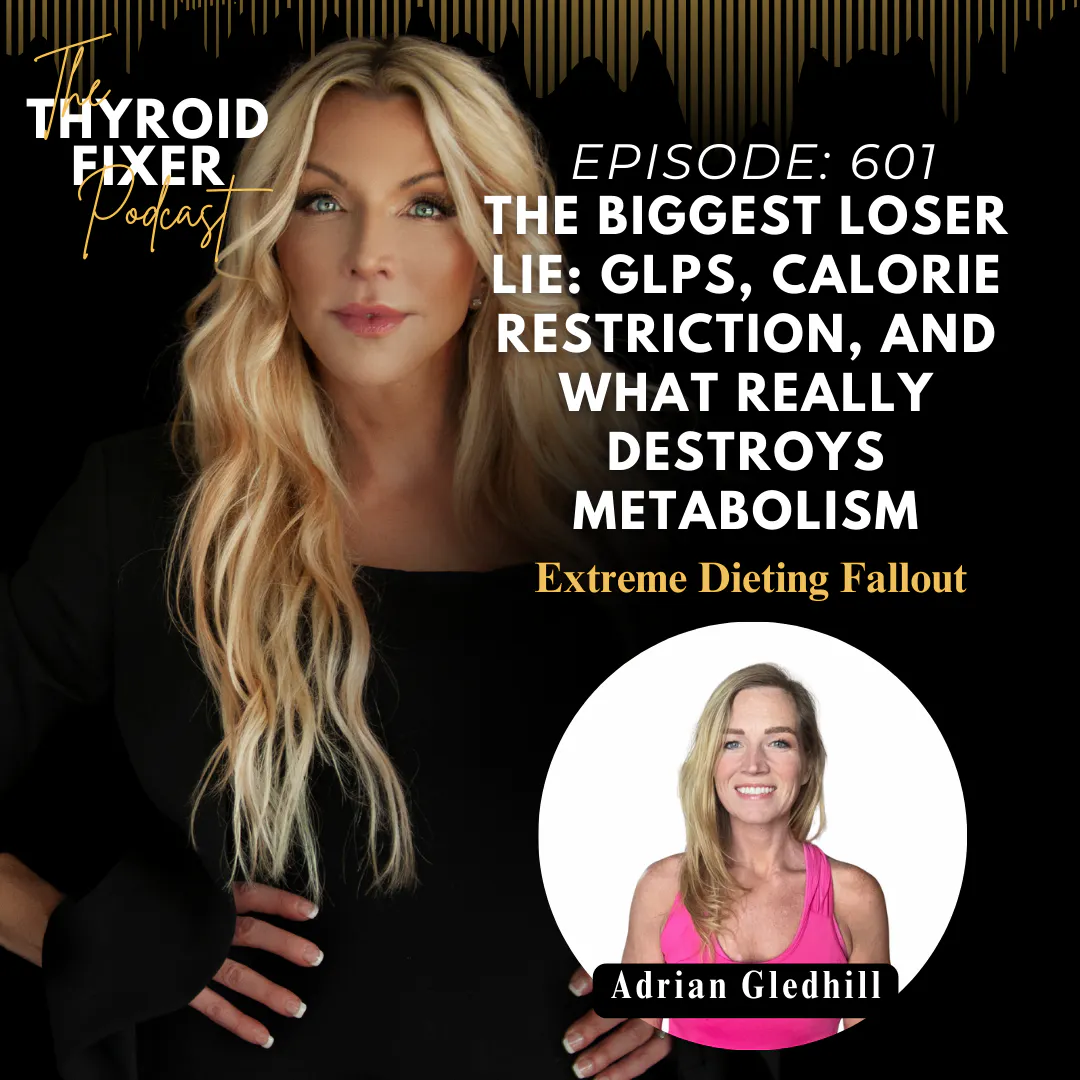
The Thyroid (and Hormone) Fixer Podcast: Thyropause, Menopause, Metabolism and How to Fix It
601. The Biggest Loser Lie: GLPs, Calorie Restriction, and What Really Destroys Metabolism
01:10:33
Loading summary
Transcript122 lines
- [00:00]
A
Everything looked normal, but I know that it wasn't communicating because I was being told to eat every three minutes, Every minute. I mean, it was intrusive how much I was being told to eat until you get GLP1 in there, orchestrating the other hormones that are already there. And it's like they're like a necklace and they just can't be strung together unless you got the string. And it seems like the GLP one is the string.
- [00:21]
B
Welcome to the new and completely reimagined Thyroid Fixer Podcast, A podcast that refuses to sound like every other health show out there. We're here to disrupt this entire space, and now you are part of that disruption. If you're listening right now, it's because you've hit your breaking point. And I'm here to tell you good. Because this is where everything changes. This is where you finally say, no more. No more being dismissed by your doctor. No more being told your labs are normal. No more recycled medical advice. No more recycled biohacking advice. No more being told to accept what you know isn't right. Here we do things differently. This podcast gives you information you can actually use. Real tools, real direction, real answers so you can take back your energy, your metabolism, your hormones, and your life. Every episode will leave you with something actionable, something that moves you forward, something that reminds you that you're not crazy. You're finally being heard. This is Thyroid Fixer Podcast. And this. This is where you rise. If your labs are normal, but you're exhausted, you're foggy, gaining weight, or you just don't feel like yourself, listen to me. Most women are told they're fine based on one number. Tsh. No context, no explanation from your doctor, no real plan. If you've been listening to me for a while, you know. But I am Dr. Amy, the thyroid Fixer, and I have reviewed tens of thousands of labs, and I can tell you this. Most people don't actually understand what their labs are saying. That's why we created the Fixer Lab Test plus Consult. You will get comprehensive thyroid and hormone testing plus a one on one consult where we explain exactly what's happening in your body. This isn't treatment, it's clarity. We help you identify whether there's a real problem, what's actually tied to your symptoms, and what your next best step should be. So if you're done being dismissed and ready for answers, you are done begging your doctor for labs that they don't even know how to interpret. Once they come back, book the fixer lab test. Plus, consult now, click the link below or go to fixerpowerlab.com that's F I X E R P-O-W-E-R-L-A-B.com and order your test book. Your call today. I feel like I'm in a theme right now of uncomplicating this whole fat loss topic. Of course, yes, it's the beginning of the year and everyone is in this new year, new you mode. And we all start back at the gym. We start on different diets. But in talking with my colleagues and I completely and totally agree with this, there is so much noise and confusion out there. And if you listen to the episode I did a few episodes ago with Natalie Jill, we kind of talked about that confusion. But finding the right path for you is a unique journey. And finding what's going to work is a unique journey for you. Just like it was for my guest today, who, by the way, was in season three of the Biggest Loser and she reveals some hard truths about that show. What you think you saw, what you think happened and what really happened behind the scenes. She's going to talk about her journey of rebound weight gain of 160 pounds. And then she's also going to tell you how she took it off and is maintaining it the right way, doing the right things. Yes, we dive into the topic of GLP1s, the good, the bad, the ugly and where they should come in as well. And the detrimental effects of calorie restriction over exercising, all the things that the Biggest Loser contest contestants were put through. So you are going to, I promise you, love this episode. I have been so excited for this interview, I can't even tell you. And maybe y' all listening aren't going to geek out as much as I am right now, but I have been so excited to bring Adrian on to talk to you all because she has completely transformed her body. But in doing so, she's walked a long journey, y'. All. She was one of the contestants on season three of the Biggest Loser. I was obsessed with that show. I don't know about you, but I was obsessed. Now, even way back when, I was looking at it going, how right? With everything I know about the human body, everything I know about calorie restriction, everything I know about exercise, all the competitions that I've done, taking my body from 20 to 30 pounds heavier, down 20, 30 pounds back up, back down. I know how the body's supposed to respond. I know how it's biologically made. When I was watching the show I would always think how they losing that much weight so quickly. And I got to tell you the truth, behind the scenes is a little bit eye opening, and that's what Adrian's going to share with us today. In addition to everything that she learned, how she took the weight off and took the weight off again and literally transformed her body to a beautiful, healthy, stable weight to where now she helps other people with their weight and to get radically healthy, and she teaches them her techniques as well. So all that to say, Adrian, thank you so much for coming on today. Thanks for having me.
- [06:26]
A
You're gonna make me cry.
- [06:30]
B
Well, we've known each other. I'm using air quotes because we kept running into each other at all these shows, and we kept talking and connecting. And it's funny because the last show I saw you at, I literally shouted to you, like, across the way, adrian, come over here. I literally called my husband. I said, I want you to go into my closet, and on my dresser, there is this little Biggest Loser card. Need you to set it out for me, because I got to contact this girl. It's been on my mind. I need to bring her on the show, and then I see you at an event. So that was so exciting, and I'm so happy that we connected, and I've been wanting to have this discussion for years now.
- [07:08]
A
That's funny, because when you said my name, I was like, is there a different Adrian? Amy. Dr. Amy, you're talking to me. So, girl.
- [07:17]
B
Oh, man. I. This is one of those. You know, usually I'm really prepared with, this is how we're going to start. The podcast is how it's going to flow, and then we let it go from there. But this was one. Literally all day today. I'm like, I don't know where I'm going to start. This is going to be an open conversation, but I'm not quite sure where I'm going to start. But now that we're on, let's start all the way back. My God, when was season three of the Biggest Loser? What year was that?
- [07:41]
A
2006. I was 21, and I was chronically struggling with obesity even at 21.
- [07:47]
B
Okay, so I'm sure I watched you, because I was definitely watching. I mean, I gave it probably a good, like, board seasons before I fell off. I was like, all right, I'm over it. But, you know, seeing the same thing happen over and over again. And then you kind of started. Little things started eking out. Probably right around the third, fourth, maybe fifth season of Where Are they now and everybody's gaining the weight back. So, you know, people really started scratching their heads going, okay, what are they doing to these people? So tell, tell us about that experience because anyone like me who's watched it, we want to know kind of the whole process. Like even you applying what, what prompted you when you were in that obese state to go, you know what, I'm just gonna throw myself on TV and, and see if that helps me with the weight loss.
- [08:36]
A
I had been overweight my whole life, and I was an athlete, I was a triathlete. I, I was the captain of my teams. I was a letter winner and I still was overweight the whole time. And when I went to college, I just bloomed up and it completely sabotaged my self confidence and it just. I wasn't dating, I was lonely and I saw these beautiful transformations and I was like, that's what I need. Yeah, I need that. And I had a dream. I don't know if you believe in the dream thing, but I had a dream I was going to be on the show. And it was vivid. It was very vivid. And so I was like, okay, I've never applied to things like this. I feel unworthy, but maybe they'll pick this girl from a small town. And they did. Like, the application process for me was smooth, quick and easy. I was a shoe in. But I got there and it turned out there was one person from every state and that 36 of us were going home. So my heart was broken. My dream was right there. And. But what was cool was I ended up with Dr. Huizenga. He was just on the documentary. The doctor behind the scenes led our program. So I had a doctor, a nutritionist, and a psychologist. We had community because there was 36 of us. We had a plan. They gave us body scans so we knew what everybody's BMR was. We knew how much to eat. They told us to eat well rounded, break it up into, into five to three meals and two snacks. He told me when to have the snacks around my workouts. We did two workouts a day as at home contestants. So whoever lost the most weight at home got to come onto the show. And I won. And I was shocked. I was shocked because I had, you know, being the meticulously type a person I am, I'd written down all the previous seasons how much they lost each week, and I was not even close. So I was shocked to find out not only had I lost more weight than everybody at home, I lost more weight than everybody on the show as well. And so here I am doing two A days, eating my five meals and losing more weight than the people who were with these trainers on the set. And that made me enemy number one. They absolutely hated me. There was lots of drama, lots of personalities. The set itself, you would think it's like a weight loss camp, but it's actually a set. Literally a set. Our gym was made out of canvas. There were, you know, microphones and cameras everywhere. Everything was kind of fake. We would film sometimes 24 hours a day. So it wasn't conducive to, like, when you're actually losing weight. You need to sleep and rest and have routine. There was no routine. You know, obviously, you watch the show. They had these hardcore workouts in real weight loss that causes inflammation, that causes fatigue, and it caused rebound eating. Uh, but they really focused on that mostly. When I got on the set, it was a totally different program. I wasn't allowed to talk to Dr. H anymore. I now was subject to the producers and the trainers, and they were great people, but they really were there. When the cameras were there, you were really on your own. And that caused a lot of disordered things to happen. Because this is a competition. You don't want to go home a loser. There's a camera in every corner watching everything you do. It was a lot of pressure. I mean, imagine how disordered that could cause if people are staring at you eating every day. Dr. Amy, they're like, you just put that in your mouth. I'm gonna make a commercial out of it and film it across the country for two weeks, you know?
- [11:48]
B
Right.
- [11:49]
A
So there was a lot of fear. There was a lot of, when you're losing weight, you compress all that, those hormones out of your fat cells, and that's flowing. You're sequestered from your family, and it's just you compile all those things. Does make for good drama, that's for sure. Well, that's true, but I. What? What, what? The reason I wasn't keeping up with the previous seasons, the reason I didn't realize this, is because you saw these people losing £20 in a week. It was actually £20, three or more weeks. I don't want to get sued for saying how long some weeks were, but they were a long time. And then you have people playing with water weight to play the game. And so, guys, there's no such thing as losing £30 in a week. If you do, you're dying. That's not good. That was just tv.
- [12:35]
B
Well, thank you for clarifying that because I, I even myself, I thought it was odd, but I justified it in that. Well, you know, okay, if you're 300 pounds, I guess if you radically go from eating donuts and pizza and not moving to movement and clean food, okay, could the body shed that much? But I could see that shed happening one time, like when the person initially cleans up their diet or starts movement. But to continuously £20, £15 every single week, that's what made me kind of stop and go, hm, you know what's happening here? So, and I remember those at home contestants, I remember now that you're saying that, I remember watching going, wow, it is so hard for these people because they're still at home, they're still living life with families and jobs. The people on the set are, like you said, sequestered, but they're only doing that. There's no kids, there's no husband, there's no wife, there's no friends, there's no work. There's just, you eat, maybe sleep or not film and work out and that's it. So you had it so much harder being at home. I can absolutely see them giving you the stink eye once you entered the set.
- [13:54]
A
Yeah, it was also, you know, looking back, now that we know what we know, I was 21. Some of these people were 40, 50, 60. We are not the same. That was my second time losing a ton of weight. This is people's 20th attempt. They're not losing at the same pace as a 21 year old. So now I look at the show like, that's totally not fair. Also, like, how many women got voted out during the luteal phase? Oh, just wondering, you know, it's a good call.
- [14:20]
B
Yeah, absolutely. Yeah. We can't help it. We're bloated. We got a little bit of, you know, PMS going on, for goodness sake. Okay, so you're on the set, you're seeing this happen. What happened in season three? Because I don't remember. So how did that all unfold? How much weight did you end up losing total and who was the winner?
- [14:39]
A
So I ended up losing 66 pounds and I started out about 2:30. I never got to my goal and I actually still look at the people who take it all the way after losing that much. You know, I lost 66 pounds in like four and a half months. How did their body's metabolisms allow them to get down as far as some of the people did at the end? Because my body, the second I went home from the set and then there's like good three, four months or so until the finale. My body said no. I started like fighting it from the second I went home. But some people were able to just take it all the way to the finale. And it honestly still is mind blowing. But me and you know, like I can give people my at home plan, work out twice a day, eat this calorie deficit, eat low fat, eat low calorie, eat low carb and you will lose the weight. But then your body's going to fight you. And that's the part the show does not talk about. And to this day they still say they just needed therapy. They should have just kept working out eight hours a day. That's the problem and that's not real life. We have to work and we, and honestly, why do people struggling with obesity, why aren't we allowed to live? And I only learned that after what I learned from you now. But it's taken me, it's been 20 years, taken me 20 years to learn that we all deserve to live and that that's no way to live.
- [15:57]
B
No, it's not. And it's very much aligned with what I did in competition. You know, it's almost like the, the competition label made it okay as opposed to if someone were to eat the way that you did, eat the way that I do did during competition, I'm very much retired now. During competition they would say you have an eating disorder. You know, they would be like you need some help because you're not eating enough calories. Or if they watched us work out twice a day. Oh, two a days were part of my life for 12 weeks in contest prep. So it's very, very similar. And when you're talking about the other side of that abso freaking lutely rebound weight happens. So when you take your body through a deprivation, you know that whole starvation theory that we heard so much about in the 90s is real. Your body basically says screw off. You haven't fed me properly for weeks, if not months. And you really think I'm going to continue giving you energy from these fats, the little bit of fat stores you have left? No, in fact, I want more for the next time you pull this, I want more energy. So I'm just gonna pack on the pounds and put on more fat so I have it in storage. The next time you decide to, to, to do this kind of workout and eating regimen, do you want to know the biggest health secret that nobody is talking about? Everything. I mean everything starts in your gut, but every day your Gut is fighting the silent war against all the processed foods and the stress and the pesticides and the toxins in the air that you breathe. And then when your gut's in trouble, your whole body feels it, not just your gut. So here's where it gets a little bit crazy. Most people are spending money on probiotics that don't even work. I see this every day in the practice. Why? Because 99% of those traditional brands die in your stomach acid before they even reach your gut. So you might as well just flush them down the drain. That's what makes Just Thrive spore based probiotic completely different. I have tried it and I am sold. I am totally sold. And when I learn more about it, after I interviewed the founder of Just Thrive, my eyes were opened up. I said, this is why I see no change in patients when they throw in a typical probiotic that they got at the grocery store or at the nutrition shop. You need these live probiotic strains in order to do anything in your gut. Just five is the only one clinically proven to arrive at 100% alive in your gut. That is crazy. 100%. And it does something no other probiotic can. It turns your gut into an antioxidant factory, creating protective compounds exactly where you need the most. So that means better digestion, better immunity, more energy, a lot easier weight management. Just Thrive probiotic comes in capsule or berry flavored gummy. So there's an option for everyone in the family. So if you're actually ready to transform your health in 2025, you gotta take this 90 day challenge, love the way you feel, or get a full product refund, no questions asked. So to join the gut health revolution and take control of your health today, visit justthrive.com and save 20% on your first 90 day bottle of Just Thrive Probiotic with the promo code Dr. Amy D R A M I E. So don't forget to check out all their other natural, clinically proven products too, like their newest product, digestive bitters. Focus and memory. Gluten away and more. So that's Just Thrive. J U S T T H R I V E Health H E A L T H.com promo code Dr. Amy D R A M I E. Yeah, yeah.
- [20:08]
A
So after that I gained my weight back almost immediately, but it didn't stop there. Oh, I ended up gaining 160 something pounds. I ended up 330 pounds at my highest.
- [20:22]
B
Oh my gosh.
- [20:23]
A
And that is when I just said enough is enough. I will have to do Anything, and we'll get to where I got to. I'll literally just eat sardines and walk all day if that's what it takes. I never for the rest of my life want to be 330 pounds. I'm five foot four. It hurt to move, it hurt to breathe, it hurt. It was embarrassing to leave my home. You know, I mean, this is chronic. It's. I don't look chronic anymore because we figured some things out, but it is chronic. And one thing, I recently emailed Dr. H, the doctor from here, and he said that I was the most determined contestant that the show ever had. So this whole, like, you just need to fast more. You just need to restrict more. We'll get into that. But it's not true. You could be the most determined person in the world, and if you have a condition that's not communicating in your body, it's not going to work.
- [21:12]
B
Yeah, that's so true. It's so true. Okay, we'll keep going. So now you're £330. Now what?
- [21:20]
A
Now I went back into biggest loser mode and I started running half marathons and restricting again, counting all my food, portioning everything. All the stories come up of all the meals. I made stacks and stacks for the week, doing everything perfect. And I lost £100 on my own. So I got back to that 2:30. But after losing £100, after losing £66 and previously I'd lost like £40. We're doing this over and over again. At 230, I started going back up, and I was like, what? I'm running, I'm tracking. Why am I going back up? And that is the first indicator right there when I knew there was something wrong and it wasn't just me. So I went to medical and I was like, I need medical help. And the big thing then was the gastric bypass. And I say that with like a dun, dun, dun, because I'm currently actually getting consultation to have it reversed. Oh, you can have it reversed. The gastric bypass, you can. The other ones, you cannot really. So I did lose some weight, but about six months after the weight loss, which, again, I am, like, running and tracking and restricting and so was it the gastric bypass or was it Adrienne's effort? I don't know. But about six months in, the reactive hypoglycemia started to control my life. Where I'm passing out, I'm. My blood sugar can't be regulated. It's up, down, up. I didn't know back then we didn't have CGMs like we do now, right? It was up, down, up, down. I was getting sick all the time, could barely leave the house. When you have this reactive hypoglycemia, you can have hangovers from the stress that it put on your nervous system for days. So I know right out of the get go, I can't eat carbohydrates because of this blood sugar issue. So I spend the next eight years going lower and lower and lower carb, trying to control this blood sugar. But also I'm having chronic weight gain. So I'm still doing all the things and I'm still chronically gaining weight. And the next eight years was hell. And eventually I end up so sick, probably from the stress of the up downs, the chronic exercise, the chronic restriction, the chronic low carb that I can't hardly drive. My arms and legs are going numb, my brain is, my memory is gone. I'm having food reactions every time I eat. So then enter the carnivore diet and the mold protocols. I don't know if you do the mold thing, but I realized we had a pretty significant mold issue. So we moved out of that house and I started eating just carnivore and that really helped with the blood sugar and it really gave me hope for the first time in a long time. I initially saw some weight, weight loss and I started feeling better and I stopped having food reactions. And I was like, this is the ticket. Plus, you probably know the community is like a 10 out of 10.
- [24:05]
B
It is. It's a great community. So supportive.
- [24:08]
A
About 10 months in, I lost more hair than I'd ever lost in my entire life. It was the saddest. My hair used to be down to here and it used to be really thick. I look at my daughter's hair and I'm like, that's what it used to be. And it all fell out. Even though I was doing the thing, the right thing, and super cold having started chronic weight gain. And so that's when I started joining the challenges and the groups. And so I did, you know, the different macros. I did the lion diet for two months where you eat nothing but beef, salt and water. I did sardines, which on YouTube is still getting hits of me eating nothing but sardines for weeks at a time. And I would feel better while I was doing it, but eventually it would stop working. Everything I did, eventually it would stop working. And after the lion diet, I did that for two months and I got incredibly inflamed. The food Noise got crazy, I got fatigued, and I got the cringes. That's when I really started digging into your podcast. And I started with thyroid and hormones. I think that's the best place for people to start. So I started some bhrt, started some thyroid medicine that slowed down the problems I was having, but I was still having them. And In August of 2024, you had a podcast that changed my life. Total cognitive dissonance. Because me and you were causing cognitive dissonance across the country.
- [25:30]
B
Okay, which one?
- [25:31]
A
Because you said, did you know that GLP1 is a miracle? And what is it? I didn't believe you. Well, I did believe you. I was like, Dr. Amy said it, so it must be true. Like, what is? She wouldn't like, cheat and tell us to take toxic drugs. Like, she said it was a hormone and some people are deficient in it. And the problems are the meat not eating enough protein and not lifting. And I'm doing those things. So I should look into this. So I looked into it and at midnight I hit submit on an order. And it's been completely life changing. I had no idea. My whole life I was struggling with such insulin dysregulation, digestive hormone dysregulation, and then the surgery made it worse and it was affecting my adrenals. It's affecting my overall health since I started that I've been able to actually eat food and not gain weight before. Every time. If I even added a couple tablespoons of measured creamer to my coffee, I would gain eight pounds. If I didn't walk a half marathon a day, I would gain eight pounds. After the line died, I just kind of kept carnivoring, but I stopped tracking and I gained 30 pounds in a couple of months. Like, my body was so off and this was the communication my body needed. And now I've been maintaining for about a year, Honestly, almost effortless. I do spot checks to ensure that I am eating enough protein. And I recently checked and I was eating between 23 and 2,800 calories a day, over a hundred grams of protein. Like, I'm eating and I'm not gaining weight. For the first time in my life, I've been able to add foods back because everybody told me the whole time, oh, it's because you're eating this, you're eating this. It's always there was a food to blame and it was constant. Like, well, what else can I remove? Until you got down to beef and water and you were like, what do I remove? And they're like, the salt. And you were like, are you kidding me? This. Like, there's something wrong. And so I've been able to add foods back for the first time in my life. When I get hungry now, I'm like, yes, it's go time. Like, this has completely changed my quality of life. And you might not know this, since I don't have to walk a half marathon a day and I don't have to watch podcasts about endless diets. I am now going back to school to become a doctor.
- [27:52]
B
No. Oh, my gosh. You sprung that on me on the show. That's awesome. That is freaking awesome. I am so proud of you.
- [27:59]
A
Thank you. I would love to help people with metabolic conditions.
- [28:03]
B
Yes. I mean, you're called to this with everything that you've gone through. Okay, with the GLPs, let's table that. I want to circle back. Let's go back, though, because as you were telling your story even before you said, you know, and then eventually, I check thyroid and hormones, I'm thinking the stress that this woman's body has been through had to have triggered a thyroid problem. Because we know with Hashimoto's, you know, you go through any kind of stressor or just from extreme exercise, extreme dieting, that's enough to either turn on Hashimoto's or just to completely destroy your thyroid. And even without autoimmune being present, one of those two scenarios had to have happened to you. And then, yes, in addition to the sex hormone piece, where, I mean, we know with eating disorders or disordered eating. So even though you didn't have an eating disorder, you had disordered eating. That's what I always say about competition. I never developed an eating disorder, but, wow, did I have disordered eating afterwards. So with that, even we see the. The decrease in hormones, sometimes early menopause, early perimenopause. And then you basically said, yeah, my hair's falling out, I'm cold, I'm gaining weight. Well, that screams thyroid, so I'm so happy that you tested that. When you're looking back, do you think that. That the thyroid and the hormone issues were kind of a cause of the rebound weight gain? And then some like, it was there already, but you just didn't discover it till further down the road.
- [29:42]
A
I think that I've had poor GLP1 or digestive function my entire life, because I've struggled my entire life. And then I think the chronic dieting, the biggest loser, the hundred pounds I lost before the gastric bypass, then the gastric bypass, all of that destroyed my thyroid and my hormones. We did have some thyroid stuff and hormone stuff run along the way. And it was normal for standard labs that they were running the vague labs, but those numbers were okay throughout time. But then towards the end, there they were completely in the tank. So I think I had a deficiency from the beginning, and because we didn't address, caused the other issues. Now if I could look back and go, when should I have? At least someone should have helped me when I went to the gastro or when I went to endocrinology. After the gastric bypass, I'm having reactive hypoglycemia. I'm having chronic weight gain. And so they send me endocrinology, and my antibodies are435. And he told me to come back when I didn't have a thyroid. Oh.
- [30:47]
B
Oh, that's nice. Okay. Wow. Okay. That. That. That's at the top of the list of crazy BS things that I've heard people be told by their doctors. So he's basically telling you, just let the autoimmunity slowly destroy your thyroid. You'll probably gain another 50 pounds, be bald, and not be able to get off your couch. And that's when you should come back and see me, and we'll give you some treatment.
- [31:12]
A
Yes, yes. And as far as the hormones, I look back and I think that second hundred pounds, I. You know, I don't know if we're supposed to talk like this, but I'm gonna. You know, there was no orgasms.
- [31:26]
B
Yeah.
- [31:27]
A
There was no lubrication. There was no desire for that. And so. And we were just told, because I think this is so rampant, that there was this thing going around that, oh, it's normal not to have orgasms in your 20s. That comes in your 40s and 50s. Like, what? Shouldn't we be rabbits when we're in our 20s? Like, so my hormones have been tanked for a very long time.
- [31:51]
B
Yes.
- [31:52]
A
And I'm learning that now with some supplementation, realizing that there's supposed to be more feeling down there. There's supposed to be lub, and there's supposed to be a lot of orgasms. And that's really important for our overall health.
- [32:04]
B
Absolutely. And I think that's an important message even for women in their 40s, 50s, 60s. Like, y' all should still be having orgasms, and you should be nice and lubed up down there. And if you're not, you have to look at your hormones, even if that's one of the first signs and signals that your body gives you that is a sign to address your hormone profile. Something has tanked. And, you know, I give this message all the time on the podcast. You don't have to live that way. You know, we now know from the government that hormones aren't going to cause cancer. I've had multiple podcasts on that one that just released recently. The. It's. It's a huge mashup of all the top gynecological oncology experts in the world talking about how hormones don't cause cancer. So I'm glad you mentioned that because I think that that's a. That's a. Like you said, it's a not talked about enough symptom that we can easily push off. Like, oh, well, you know, I'm stressed, I'm not in the mood. You know, I'm a woman. I'm not supposed to want sex all the time. I'm not supposed to orgasm like a guy. But no, we. We are supposed to enjoy that part of life as well. So I'm glad you mentioned that. Okay, I do want to open the GLP1 box since you mentioned the deficiency, because that was going through my head as well when you were talking. I was going to ask you, do you think that you are one of those people that truly had a GLP1 deficiency? Because we have a lot of people using GLP1s that don't, and they probably shouldn't be using them. And then we have the subset of people that. These are lifesavers.
- [33:39]
A
I was always the fat kid. I was always the one that didn't get the cake. Don't let that girl have that. Why isn't that girl moving more ever? I mean, and they were saying it in love, but I talk to my kids very differently now. You know, to place in my mind this whole time, my whole life, that I actually shouldn't be eating like a human being, but the rest of us can. You know, I've struggled my whole life. I mean, even playing three sports, which nowadays isn't considered big, but I could never really beat the 170s in high school. But for 5 foot 4, that's still pretty overweight. Borderline obese, actually. Yeah, I've had this deficiency my whole life. And the second that I could no longer work out full time like I did in high school and I went to college, all the weight just bloomed on. And it's unnatural to be able to gain £60 in a year. That's. Something's wrong.
- [34:30]
B
It is. I mean, that's that's a huge red flag that something is off in your body. So now you actually help other people with the use of GLP1s to do it the right way. Right?
- [34:44]
A
Yes. So we're working on, are you eating your protein? Are you eating real protein or are you eating built bars? Are you, are you drinking all your food? Because I have people come to me all the time. They're like, I don't know, I have no appetite suppression. I'm like, well, what have you been eating? They're like, well, I had a protein shake and then I had yogurt and then I had cottage cheese. And I'm like, that doesn't feel me either. There's no dose for that.
- [35:11]
B
Right, sorry.
- [35:12]
A
Eat real protein. Are you getting some lifting in the. You know, primarily, I'm kind of, you know, there are a subset of people in the keto and Carnivore community, specifically women who've been doing it, who've been joining the groups, who've been doing all the things and it never moves or they have to be absolutely perfect or they gain all of their work back. And so there's a lot of people coming in here and then if they feel comfortable ever, we talk about why you might want to add some whole food carbs back if that's something that you mentally are okay with. But it's really hard because we've. You came to Carnivore for a reason. The foods you were eating were affecting you. It wasn't just that you're a disordered person, they were affecting you. So it's hard to tell you, well, they're not gonna affect you the same now.
- [36:00]
B
Yeah.
- [36:00]
A
So maybe you could have a sweet potato, maybe you could have some rice, maybe you could have some berries because your body knows what to do with them now where it didn't before. And maybe it could give you some energy. And I don't know if we should talk about this, but I have a theory that eating zero carb causes metabolic adaptation, just like eating a calorie deficit does in a lot of people. I think your body kind of knows.
- [36:20]
B
Talk to me about that because I literally just had a podcast, did a podcast with Natalie Jill where we were talking about the different fads out there from everything from reminiscing about fat free and eating snack wells and drinking tab to the, the implementation of ephedra and the stimulant fat burners. And then we talked about Carnivore and how, you know, it's like, man, it's. It's there for a reason for sure. Just like you said, when you bring it in, oh my gosh, I'm not reacting to food anymore. Right, you're not going to react to, to protein. Most of us won't. But at some point of time you got to bring it back in. I mean, I guess if you are chronically sick and carnivore is working for you, sure. But I'm looking at the, the majority of the population who jump into the carnivore diet. Maybe we need to add some carbs back in. Like even Paul Saladino's eating honey and berries and dark chocolate and whatnot. So talk to me about that theory.
- [37:22]
A
I think that we have different energy pathways and in the carnivore community we talk about specific energy pathways as like these positive ones, but there are some negative ones that stress the body out. And when the body is stressed, it down regulates. It does. And we don't get to pick which energy pathways we're going down. And for some people, maybe you got the good pathways while you were younger, but then you got older and your body got tired and it said that's just too exhausting for me. My understanding, which this is why I'm excited about doctor school, is that protein and fats are a very energy expensive way to get energy. It's, it's expensive to your body to create energy out of protein and fat versus just getting some berries. Your body can whip that up real quick. Um, so there's that and just, just the number of people like me who have success for 10 months and feel like a million blocks and then struggle for the rest of time. And then there's the labs that we've seen. I don't read people's labs because I'm not a doctor, but people will share them with me and I will give them the disclosure. I'm not reading your labs and I can't give you medical advice, but they'll share. And just over and over and over again, the reverse T is through the roof. The liver is not looking so good over and over and over again. So I have a couple thoughts. One is, did the diet do it? Or two, were you low carb and then you went keto and then you went carnivore? Because none of the other ones worked because we weren't addressing what was actually going on with you. It wasn't that you weren't low carb enough. It was that your body isn't communicating to that food properly.
- [38:56]
B
Right.
- [38:56]
A
And so we eventually, I think eventually we have to get to a point where we have to recognize we need to address why your body's not reacting properly to food.
- [39:04]
B
Yep, exactly. And find that, you know, oftentimes, obviously in the practice, we're finding broken metabolisms from in the toilet, thyroid all the time. And then we can go over to the hormone piece. Low testosterone is going to affect body composition, muscle loss, fat gain, the whole thing. So usually we find that now as of right now, there's no way to test for a GLP1 deficiency. Maybe eventually we will have that, that assay available at LabCorp, but right now we can't. Maybe it is a GLP1 deficiency. In your community, what do you do with the people? Because this is kind of the dark side that I'm starting to see now. More and more as GLP1s are promoted by tennis celebrities. You know, like multi level marketing companies are doing GLP ones now. So they're becoming more readily available without the education piece next to it. And people are overdoing it and they're slowing their gastric emptying, they're not eating enough food, they're looking like Skeletor because they're losing their facial fat. They got no butts, they got no legs, they're losing muscle left and right. And sometimes even when they're exercising, they're doing the resistance training. Maybe they're getting in protein liquid wise because that's all they can tolerate. They can't eat a piece of steak, but they're still losing the muscle. And that's the scary part because the education isn't there. And it's almost like this is now becoming an abuse drug that we have to be cognizant of.
- [40:41]
A
So I'm really fortunate that people watch my YouTube before they join my group often. So they know that we go low and slow. We know that you can only dip into calorie deficits. You cannot stay there. I think people in my group are scared to death to show ozempic body because we are still part of the keto and carnivore community. And they'll all know, they'll go, ooh, they're part of Adrian's group if you get too skinny. And mostly my people are freaking buff. A lot of people are staying like really low dose. And we also have it in our brain in our group that and it takes some deprogramming that they're cheating if they go too high of a dose. And so people are afraid sometimes to even take a therapeutic dose. In my group, a lot of people really emphasize lifting in our group. So I'm pretty fortunate then. Also, the very first talk we often have is, this isn't gonna do crap for you in the long term if you didn't get your thyroid and your hormones checked.
- [41:41]
B
So true. I'm so happy.
- [41:43]
A
Just about everybody in the group is working on all of it because they wanna succeed. So I attract a group of people who are very hardworking and who are already doing all the things and all they want in the freaking world is to succeed. We also have a talk recently of, since the gastric bypass, I had no idea that it can disrupt your gut motility. So I've had chronic constipation and gut motility issues, and I had no idea. And I would go in with all this pain, and they would just, like, send me home and say, oh, you might have gallbladder sludge. I definitely had gallbladder sludge, and I definitely had no bile production. And we only recently realized that now, because when I went on GLP1, it disappeared. And then I went. I was like, you know what? I want to. Because I'm the leader of the group, I want to do experiments. I'd like to see if Adrian, who's chronically been deficient, if I can go off of this, and what would happen. So I slowly titrate down and off, and the issues come back really, really bad. So I wait a whole month because I was like, it's gotta be the GLP one that caused the issue. It's gotta be. So I stay off it for a month, issue stays. I go back on it, issue completely resolves. So all to say, if you dig into not semaglutide, Semaglutide is slowing your digestion. That's causing issues like too high semaglutide, that's causing you digestive issues. But tirzepatide and retatrutide. I don't know if we're allowed to say that word. They have more hormones that actually help coordinate digestion along the whole digestive tract. But if you go on too much, it will also screw up your digestion.
- [43:11]
B
Yeah.
- [43:12]
A
So we're learning. It can help or it can hurt. You have to find the right dose for you. You have to watch your stools, you have to watch your symptoms and just find the right spot for you.
- [43:24]
B
I love that. I love all of that. I love that you're attracting those people that want to do it the right way and that you can just impart your knowledge onto them and that you dug into this experientially and you know, it just educationally too, learning more and more about these different hormones that are, that are disrupted. So we talked about GLP1. You talk a lot about leptin, ghrelin, CCK, PYY, words that people haven't even heard before. And, and, and as they tie, there are those glucagon peptides because as we know, tide is a glucagon like peptide and a. What's the second gip? Help me out. It's the, it's a GLP and gip.
- [44:10]
A
I just call it gip.
- [44:12]
B
So all of those other, all those other three letter words, cck, pyy, left and grill. Can you talk to me about those? And how, how do they tie into our hunger signals into our ability to lose fat?
- [44:23]
A
All I know is that I've had some of those things checked in my mold illness and my leptin came back normal. Everything looked normal. But I know that it wasn't communicating because I was being told to eat every three minutes, every minute, every. I mean it was intrusive how much I was being told to eat until you get GLP1 in there, orchestrating the other hormones that are already there. And it's like, it's like they're a, they're like a necklace and they just can't be strung together unless you got the string. And it seems like the GLP one is the string.
- [44:53]
B
Yeah, okay, that makes sense because you, when you say you were being told you were being told by your brain to eat. So that's going to be the, the ghrelin signaling, but the, the leptin. Yeah, we do talk a lot about leptin resistance, just like we talk about insulin resistance. With leptin resistance, you're never going to get that satiety single signal. You're always going to be hungry. But that wasn't even there for you. It was more the lack of the GLP1 being produced properly by, by the gut. So what about insulin? Where was Your insulin, your A1C? Were you borderline diabetic?
- [45:31]
A
My insulin, my A1C has always been fine, which is so weird. But my insulin is high, especially since gastric bypass. So this is where the testing is, is very off. I believe where the testing is going to go in the future is, I would like to know. And you can be born with this. You can have enzymes on your receptor sites that block the absorption of glp. You can also have enzymes in your gut that stop the GLP1 from being produced or even losing, leaving your gut So I wonder if at some point we're going to have better enzyme testing or better genetic testing that can show where is the clog? Because some people are short in the glp, some people are short in the gip, some people are short, they're having amylin issues. The cagralinotide. You know, there's a lot of different signaling that can be off here that can affect your dopamine and your reward signaling and your hunger cues. And I think I want, I can't wait for that testing because then we can also get the gym bros to stop saying just fast, just go to the gym more like me.
- [46:30]
B
Okay, fasting. What is your theory on fasting? And we're gonna start there and then go into caloric restriction. The two are different, but yet sometimes can be similar if you do fasting the wrong way.
- [46:43]
A
I love fasting, actually, but I don't do it anymore, especially not with a glp. I haven't heard anybody else talking about this. I love Dr. Jones D.C. he talks about eating carnivore, eating keto and fasting along with the glp. And it is very effective for weight loss. But every time I fasted on tirzepatide, my brain chemicals tanked. Like just sadness, tears. I am not a sad human being, I'm a happy human being. I would just be bawling out of nowhere while I was fasting. The other problem with fasting that I have is that it's like drinking a beer. The first one might be fine, but then you're like, I got, as an alcoholic, I got this. And then next thing you know, you're having 10 beers. So at first I was fasting, I was like, look at it, I feel so good. Next thing you know, I'm fasting for four days and I'm afraid to eat again. So fasting, if it works for you, great. But you can't overdo it. You'll have metabolic adaptation. And is it necessary if your gut hormones are actually communicating and your hormone and thyroid profit sufficient?
- [47:48]
B
Well, yeah, I mean, I guess for cancer prevention, you know, there's the autophagy thing. But honestly I, I don't recommend, especially women, I don't recommend anything over a 16 hour. 16 is max. Like if you want to do 16 hours of fasting, 8 hour eating window, that's fine because we know our ladies and they don't eat enough protein. So what are they going to do if they do an omad. If they, if they eat one meal a day, they're not going to Eat enough protein because you physically can't. You're not going to eat a hundred grams of protein in one meal. So you're going to be deficient in protein on those days that you're fasting. Now again, if you're doing it for therapeutic purposes, cancer, cancer treatment all day long, you can give up the, the protein intake for the reduction of a, of a cancer cell. Right, the killing of a cancer cell. But, but if we're doing it for weight loss, it's probably gonna be that's necessary anymore.
- [48:45]
A
And I love my keto and my carnivores. That's primarily what my group is. But I don't think that's even necessary on a GLP one now. You know, maybe that's why my group is so successful. We're not eating triggering foods. We're not eating something that slides through the gut quickly. You would need more GLP1 medication to have appetite suppression with those foods that just slide right through, you know, so, and then it's nice and heavy. So it's just, you can stay on a lower dose and you're not eating triggering foods and you're getting your protein in. So people do really well on Carnivore but I don't think it's necessary like if you're not carnivore, I would not go Carnivore just to lose weight because you can lose weight doing what you're doing and if you're not, then we can make little tweaks or we could track or we could find out what's going on. Maybe you're eating too much fat, their carb. I don't know if there's a lot of tweaks that can happen that will be more manageable and less stressful to your body.
- [49:35]
B
Yes, absolutely. And going back to something that you, you touched on earlier about if you are not metabolically, foundationally sound, your thyroid and hormones balance, a GLP1 will not work. I tell this story all the time. One of the standout patients in my mind with this was, her name's Barbara. She came into the practice, forget her starting weight, but we'll definitely obese her. A1C was like an 11.4. She was full blown type 2 diabetic, was prescribed a GLP1 and it wasn't working. It wasn't working at all. Well, she also was diagnosed with hypothyroidism. She was on T4 only, which we know doesn't work. Her reverse T3 was through the roof. So not only was the T4 bumping up her reverse T3. But all of this stress of carrying extra weight and, and constant dieting, that doesn't work. Push her reverse T3 up. Well, we get her on the right thyroid medication, by the way. We also put her on hormones that she's not on. And she's a woman in her 50s. Her A1C went to a 5.4. She lost. I don't know what she's at now. £150, something like that. The GLP was actually working with the thyroid, with the hormones, with everything else that she was doing. And that's just, I mean, that blew my mind to see someone on a therapeutic dose, prescribed therapeutic dose of a GLP1 not even touching her A1C. And that's what it was designed for.
- [51:09]
A
Yeah, we, we have a group member who honestly, she only had 30 pounds left. She had keto and carnivore it off. But it was driving her crazy because she just wasn't in a healthy range yet. She had gone all the way up to 10. She was our first person to ever do that because the rest of us are like 2.5.
- [51:25]
B
Yeah.
- [51:25]
A
So scared. So she was like, I'm gonna pioneer. I didn't feel. She was like, I feel nothing. And she wasn't losing weight. She went on BHRT and she's about 60. Went on VHRT, went on some thyroid. All the weight came off and she titrated down. So that's one thing. The other thing that we see is now I'm not anti alcohol if you can moderate it, but when you're taking gop, it ups the enzymes in your gut that block the GLP signaling. And so it really is kind of negating your medication.
- [51:58]
B
Yeah, yeah, exactly. Well, I mean, that's why Vegas is now having to, to advertise, Come to Vegas. Which they never had to do before because people are losing their appetite for anything kind of dopamine related. Alcohol, gambling, you know, it's like they're kind of, they're, they're flatlining a little bit. Not a horrible thing, but just something to be aware of that you might take the edge off an addiction as well by using a glp.
- [52:26]
A
Carnivores have the biggest cross addiction into shopping. So if I were to start a business, I would start a carnivore business because they need their fix somewhere. And the crazy part is the carnivore is like buy meat, you know, so if you can come up with something, carnivores need their fix. And I would find, I Would get these packages in the mail because I needed my fix somehow. And I'd get these packages in the mail of like 20 different kinds of keto chow. And I'm like, what am I going to do with this? You know? And since starting the GLP one, I kind of dread shopping. It's like, oh, I'd rather keep my money. Do I really need that? The only thing that we still seem to cross addict a little into is just buying the peptides. Because once you find GLP1, you realize that there's so much great stuff out there and next thing you know you have a peptide buying addiction.
- [53:17]
B
Well, that is true. And all peptides, it doesn't even stop at GLP1. You're like, I want to try the BBC and the mod and the C.
- [53:23]
A
And my other addiction. And you've had him on here. Is Dr. Scott sure. He's that troscriptions. Oh, such good, effective stuff.
- [53:32]
B
Yeah.
- [53:33]
A
So I got a closet full of that.
- [53:34]
B
That's awesome. There's a little plug for transcriptions. I love Scott.
- [53:37]
A
He's great.
- [53:38]
B
He's great.
- [53:38]
A
He's great. It's good. It's effective stuff.
- [53:41]
B
Hey, it works. It absolutely works. It does.
- [53:44]
A
I love them.
- [53:44]
B
I love them. So, okay, back to the caloric restriction, because I think this is a really important piece and it's. Yes, even though we're in 2026, women are still over dieting. And I really think people who track. And I don't know if you see this in your group, but what I find is when, when you actually write down what you're eating, even if you're doing it for a week, like it might be triggering if you've had a knee disorder. But sometimes you just got to do it, do it for a week so you can visually see what you're taking in. Two things occur. Either the woman that says, oh, yes, I'm eating 100 grams of protein and like 25 grams of carbs isn't she's eating like 100 grams of carbs and 25 grams of protein. Or the woman that that says that she's eating that much is eating like 10 grams of protein. Like the other way, not needing enough, she's taking in 900 calories, starving herself. What is that going to do to the body? If you're starving yourself, what is that going to do to the body if you are over consuming what you think is a, is a lower macro count, meaning the carbs are through the roof, proteins down.
- [54:54]
A
I do work with people locally so they're not part of my carnivore community. And I do see, like, there's this thought across the nation that you just shouldn't be eating. And also, beef is like, meat is bad for you. We should be eating tofu or like some processed thing. And I definitely see that. And I always still try to encourage. But this is where, you know, they say carbs are not required, they're not essential, whatever, right? Well, if you don't eat carbs, your body has to create them. If you don't eat calcium, your body has to create it. If you don't eat protein, your body's gonna pull it from your own body. I mean, you are aging in the reverse. You are aging yourself very, very, very, very badly. The worst thing we have in our group is like a little extra skin because you can't do that. What can you do? But I see it. You are robbing your bones. You are going to make yourself weak. And honestly, I have friends and family, they don't like the way they look. They always thought, this is where I want to get, and they get there and they absolutely hate their bodies. So don't hate your body. If you ask people who are on GOP one, they'll say, the thing I wish I would have done is start weightlifting sooner. I wish I wouldn't have waited until I got to my goal weight to start lifting weights because I don't like the way I look, you know? So stop robbing your body. Your body's going to grab what it needs from where it needs to. Here's the next thing. The more you rob your body, it's going to rob your brain, too. And you're going to end up not as cognitively sharp as you want to be. And it's difficult to repair the brain. It's very difficult. And it's also very scary. As a person who has had brain issues, probably due to all the dieting and the lack of hormone and thyroid when I needed it. It's a scary thing. So don't rob your brain, don't rob your bones, don't rob your muscle. You're robbing your future.
- [56:35]
B
And do you see people who calorically restrict or maybe even go too high on a GLP who naturally calorically restrict because they have no appetite? Do you see them gain the weight back, too? Like, the GLP can't even override the caloric restriction. They. Their body just says, piss off. Like, no, we're just going to put the weight back on.
- [57:00]
A
So that's not happening in my group. But I do end up with people in my group who are like, I'm on the top dose. I've been stalled for a year and I never got to my goal. So you've got to keep in mind you might not get to your goal if you stay at 900 calories every single day. You might not. I accidentally went on cruises during my weight loss period. Like it just family things and my husband does the casino things. We get free cruises. And I ate on those cruises and I gained two pounds and they came right back off. But I believe that because I really, really nourished my body when I was at. When I was done with weight loss for the first time in my life, I wasn't eating 1100 calories and gaining 30 pounds. I was able to eat and not gain weight. So if you don't take breaks and if you don't nourish yourself in the end, you're going to end up like every other diet we've ever done. The biggest loser diet, the gastric bypass diet, all of them. You're going to end in the same exact spot. Don't turn this into a fad for you.
- [58:01]
B
Okay, so speaking of turning into a fad, well, this kind of bounces off of that topic. There is talk right now and I'm starting to see it online where GLPs from the like research sites where many people get them, they're going away. And I heard a rumor and I don't know if this was the catalyst. I literally just got a text message from my friend today. She's like, yeah, I went to this site and it's no longer there. I'm like, yeah, it's not on that site, that site or that site either anymore. Heard a rumor that DEA came to a 4m handed cease and desist letters to every company they knew were there. And I don't know about the compounding pharmacies, but every research peptide site got a cease and desist and basically told that it's going to be a felony if they sell it. So where are we at with this? Do you know?
- [58:50]
A
I heard really bad things for the year of 2026 that they're going to come, we're going to have like a peptide apocalypse. And it's very disappointing because I personally work with American made companies that are doing all three tests on every batch. And you know, it's a little different than literally ordering from China. And if it's really cheap, they're not doing the testing. No, you could totally have endotoxins in there. You might not even have what you think you're having. Yes, but those aren't the companies that I've been working with and I think it's a, I think it's a pity. I'm all about like, I think. Well, it's tough but it, what helps is that they cost money and so people aren't just like buying everything in the world. But you know, again we have to do research with every single thing we put in our body. So hopefully people are. But I haven't heard of too many people having injury from BPC157.
- [59:39]
B
No, I know, I know. They're coming after that too. Well, that's already been, been taken away from compounding pharmacies now that you can still get on the research sites but you can't get it on the compounding pharmacies.
- [59:50]
A
So yeah, I've heard bad things.
- [59:54]
B
It's scary. It's scary that they're going to possibly take away something that is helping so many people and pretty much force them into the pharmaceutical version. Right. Because God forbid big pharma loses any money off of this fantastic effective drug and, and, and give the money to the little compounding pharmacies or the, the guys that are third party testing, making up, making it available to more people. I, I think it's really going to come down to follow the money trail as to what happens to our access to GLPs.
- [60:28]
A
I think it's really sad because you know, even semaglutide at a compounding pharmacy can be 180 bucks. What if you have three people in your family that need that? You know, it's, it's still not affordable for much of America and unfortunately something is happening to us where this is being depleted in our system. Whether it's the viruses or the moldy homes or the, the processed foods or. I don't know exactly what it is, but this is becoming an epidemic of people having this problem and that's just not accessible. It's very disappointing. My understanding is that more things are going to become compounded. But I remember I've been taking LDN for years and when I started LDN it was like $30 a month. And because I take two different doses after the government got involved, it became $180 a month through compounding pharmacy, same exact medication. So I'm concerned BPC is going to go from 80 bucks to 380 bucks through compounding.
- [61:28]
B
Yeah, yeah.
- [61:29]
A
Or, or whatever. You know, it's just, it's disappointing. These things are so amazing to really get your body to communicate. I've never taken a vitamin D that was this effective, you know? Yeah. And life changing. I don't know if we're allowed to talk about this, but like the thing that's been life changing for me is SS31. And that's gone.
- [61:47]
B
Oh, wait, wait, what did that do? I haven't even heard of that one.
- [61:50]
A
SS31 rebuilds the structure of the mitochondria. And they say 80% of America has dysfunctional broken up mitochondria. If your mitochondria is broken, the energy can't make it through. So you're chronically fatigued, you're chronically brain fogged, you're having issues. So if we can repair the structure of the mitochondria, you can have that energy again.
- [62:06]
B
And that's gone.
- [62:08]
A
And it's gone. And it's very therapeutic. Eli Lilly has a patent for. There's a rare genetic mitochondrial dysfunction where you're born genetically with broken mitochondria and it's FDA approved to fix that. So it's proven even in the craziest, most genetically broken thing that it can repair the mitochondria. So it's, it's game changing. I don't think without SS31, I would have, I would have went to college again because I just cognitively could not do it.
- [62:34]
B
Well, I mean, you said it though. Eli Lilly has a drug, a period, but it just put a pin in it right there. That's where you got to stop. And that tells you everything, you know, as to why you can't get it anymore. Yeah, exactly. Yeah.
- [62:48]
A
It's done, done, done. The good news is, you know, we see Strive Pharmacy, one of the largest compounded pharmacies. They just sued Eli Lilly and Novo Nordisk for antitrust because they were breaking up the card processing, manipulating social media, spreading rumors that their products are not good and that they're illegal. And so we'll see how that goes. You know, there are good players in here fighting. I only wish, like some of our American made research, peptide companies had more of a say in the game. But they said they don't even have a chair at the table.
- [63:17]
B
They don't, they don't. The compounders do. The research doesn't. But that's okay. We still support the little guys. We still support them. Okay, so back to. Because I want to finish out. Circling back to your experience with Biggest Loser. What about all of your other colleagues on there? Have you kept in touch with them? Has everybody Pretty much gained the weight back. Did some people follow in your footsteps and. And manage to get back down to a healthy weight and stabilize? What have you heard?
- [63:47]
A
So I have a little playlist on my channel, and I. I interview different Biggest Loser alumni. And there's two things going on. Either people will talk because they figured it out, or they have gone into hiding. And I, When I was 330 pounds, I went into hiding for eight years. I wouldn't go back to my hometown. I didn't want to leave my house. I was so, so ashamed. And that there's unfortunately, people who are traumatized and ashamed and in hiding. So you can't count or figure them out because you can't find them. The people who will talk, a lot of them either had bariatric surgery or on GOP1, whether or not they've disclosed it or not. There was a recent one. Jillian Michaels did a show about a year ago. None of those people mentioned whether or not they were on GOP one. And Jillian had inferred that they had just kept their weight off and slowly, over time, have come out that they were on GLP1 during that. That podcast. So I'm not against it. I just. I think that if you were on that show, you probably need it. Well, you know, and so let's just be honest about it. But, yeah, most people have gained all their weight back and more, and. And it's hard because you talk to them and they still have it in their mind, if I was just more perfect, I want to gain my weight back. It's so heartbreaking to hear him say that. And it's like, no, I mean, many of the people started fitness business, coaching businesses, they wanted to help other people, and they still gained the weight back, even though they were at Orange Theory every single day. Even though they were doing the things every day, they still gained their weight back. So, yeah, I mean, it makes physiological sense. It doesn't make physiological sense that you wouldn't gain your way back anymore. Right, True. It wouldn't make sense that you go on this crash diet, your metabolism stays and everything is fine. That doesn't. That doesn't physiologically make any sense.
- [65:28]
B
And were they. Obviously, they were in control of your food on the show, so you only ate what they gave you to eat. Right. And Was that around 900, 1100 calories?
- [65:40]
A
We didn't get to talk about that. We actually got to pick what we ate. And it was. It was extravagant. Honestly, it was very extravagant. Like the craziest. Nice bottled water on My season, we lived in this mansion. I mean, that they film weddings and different reality TV shows, that it was kind of glamorous, actually. I mean, if we wanted like, you know, organic sea bass from Alaska. I don't know if sea bass even live in Alaska. Whatever food we wanted, they ordered and they brought it. And California food is really good, you know, like the best produce in the world. So we ate really good. Each person, even on the show, was handed a sheet by Dr. Eisinga. He. He really wasn't allowed to be involved in those beginning seasons very much. It really was these trainers. And throughout time, they have both admitted that prior to the show, they had never worked with obese people. They'd helped some celebrities lose five, ten pounds or tone up. They really weren't obesity specialists. And it was solely in their hands. In those early seasons, you know, they weren't that helpful. They were there when the cameras were there. In the later seasons, they had a better control of what might work, what might not work more in people. Doctors influencing what they should say to their clients. More research, I think, on what they should eat. But you talk to people. They were eating. Women were eating 800 calories, men were eating 13, and then walking or working out eight hours a day. When I entered the set, I was the only person who didn't have a overuse injury. Everybody else had bursitis. I was me and Jaron, because he was my partner that came back. So they were overusing, getting injured. Then they would make TV out of that, which is a little like. Like, you're so weak. No, I have bursitis because I'm so freaking strong.
- [67:23]
B
Right? Yes. A little. Little drama moments for reality tv. I mean, we all see that, you know, that's why the Real Housewives flip tables and whatnot. So.
- [67:32]
A
Yeah, and the other. You know what people also don't realize when they feel that emotion is there was not. At least on my season, there was no therapist on set. I got that as an at home. On set. There was no therapist. There was just a guy that was a former trainer. He was a former taper for one of the football teams. He was our therapist and our doctor, and he did all he could really offer was an ear and some tape for your foot.
- [67:57]
B
Oh, gosh.
- [67:58]
A
Okay. So we were alone most of the time with the production assistants and you could hear the cameras in the corner as you walk. And it just. I don't know, it. It was much more TV than people realize, but we did get to eat like kings and queens if we wanted to. But here's what we would eat. We would eat like, fish and chicken and lettuce popcorn with fake butter spray. I remember that nothing, nothing was allowed to have salt on it. Then whoever was the. Whoever sponsored the episode, we would eat a lot of that. So my, My episode was Jenny O. Turkey and sugar free jello. So we had like endless turkey and.
- [68:37]
B
Jello, nitrites, nitrates, and artificial sweeteners. That's awesome.
- [68:43]
A
Yeah, we. We were told Splenda was good, so we had tons and tons and tons. And I don't know, I actually still kind of like Splenda. But yeah, so. So it was very low calorie, very low fat. They didn't have a protein. I remember being told all I needed was my handful or. Or smaller. It was what I needed for protein. And then fill the rest.
- [69:04]
B
Yeah.
- [69:05]
A
Is what I remember. You know, like, you know, they blame the biggest loser and they're like, that's so evil. But the truth is, who has heard everything that I just said? That's the advice we were all given. And to this day, if you're struggling, you go to your doctor. You're like, I'm eating low calorie. I'm eating low fat. I'm exercising five days a week. They will tell you to do more because it's not working. Like, there's still people out there who don't understand. It's not. More and more equals stress and more equals hormone and thyroid issues.
- [69:33]
B
Yes.
- [69:34]
A
So I don't blame the show. I think they were doing what we were told we were supposed to at the time. The thing that irritates me is that today they still. They deny today's science.
- [69:46]
B
Yes. Okay. So you'd respect them more if they came out and said, we probably didn't do that the right way. Sorry, sorry, y' all gained all the weight back. If we had done it this way, maybe things would have been better. And I agree. I mean, I think that they should have checked everyone's thyroid and hormones. I mean, you got the money to treat these people, you know, do that alongside whatever else you're doing to their nutrition and exercise regimen and put it all together so that these people have a fighting chance to keep it off when they exit the show.
- [70:20]
A
You know, Dr. H, he was so thorough. I bet he has all the thyroid numbers, all the cholesterol numbers. But then to just assume that if we just exercise and restrict you, that'll all just clean itself up instead of saying, oh, actually, this right here is why you are so obese. This number right here. And if we could work on that number, you wouldn't be so obese instead of just assuming diet and exercise was the problem.
- [70:48]
B
Exactly, exactly.
- [70:50]
A
Wow.
- [70:51]
B
This has been like fascinating and eye opening all at the same time. It's just, it's crazy to hear the behind the scenes of a show that I readily watched, that my audience probably readily watched as well back in the day. And just to hear you, how your story unfolded and how you overcame so much, it really is an inspiration. And now what you're doing with your life, going back to get your, your doctorate degree. Are you going to med school or are you going to PhD?
- [71:22]
A
I am doing the postbac pre med, but very determined. I'm very determined. And I hear that if you are a non trad with a good story and a good. I mean, even if they denied me like five times, I'd be like, you don't understand. When I go to the gym, I'm like, hey, you got really dry skin. Have you had your thyroid checked? You know, it follows me everywhere I go. So even if they deny me five times, I'll just have to keep applying.
- [71:47]
B
Yep, there you go. You'll get in. You'll get in and you'll power through and you have a job waiting for you on the other side with me if you want it. So I'm just putting that out there. All right, girl. Tell people where they can find more about you. Your YouTube channel, your. Your community. If they want to join you. What can they do?
- [72:08]
A
Adrian K. Gludhill on Instagram, YouTube, Facebook and Radically Healthy.com for the website. So thank you so much for having me.
- [72:16]
B
Oh my goodness. I absolutely love it. We're going to put all that in the show notes. So anyone that wants to join her amazing community, anyone that wants to just follow her, watch the YouTube videos, absolutely follow her on Instagram. Adrian, this has been amazing and I, I know that we'll do more together. So we'll be seeing each other off and on here. So I just appreciate you, I appreciate your time and I appreciate you sharing your journey.
- [72:40]
A
Thank you for having me because I don't know if I say this, but it all wrapped around to hormones, thyroid and body communication. So thank you for all you do.
- [72:49]
B
Oh my goodness, I love you. Thank you so much and thanks everyone for listening. The information shared on the Thyroid Fixer podcast is intended solely for informational and educational purposes. It is not a substitute for professional medical advice, diagnosis or treatment. Always consult with your physician or other qualified healthcare provider with any questions you may have regarding a medical condition treatment or before making changes to your healthcare regimen, including medications, supplements or other therapies. Use of the information provided in this podcast does not establish a doctor, patient or client provide a relationship between you and the host, or between you and any other healthcare professionals featured on the show. Any medical opinions or statements made by guests are their own and do not necessarily reflect those of the host or affiliated parties. Statement regarding dietary supplements or health related products mentioned in this podcast have not been evaluated by the fda. These products are not intended to diagnose, treat, cure or prevent any disease. Some episodes of the Thyroid Fixer podcast may include sponsorships or affiliate links. The host may receive compensation for discussing or promoting certain products or services. Any such sponsorships or affiliations will be clearly disclosed during the episode. All opinions expressed are those of the host or guests and do not necessarily reflect the views of any sponsors. The inclusion of a product or service does not imply endorsement by any healthcare professional featured on this podcast.