← The Times Tech Podcast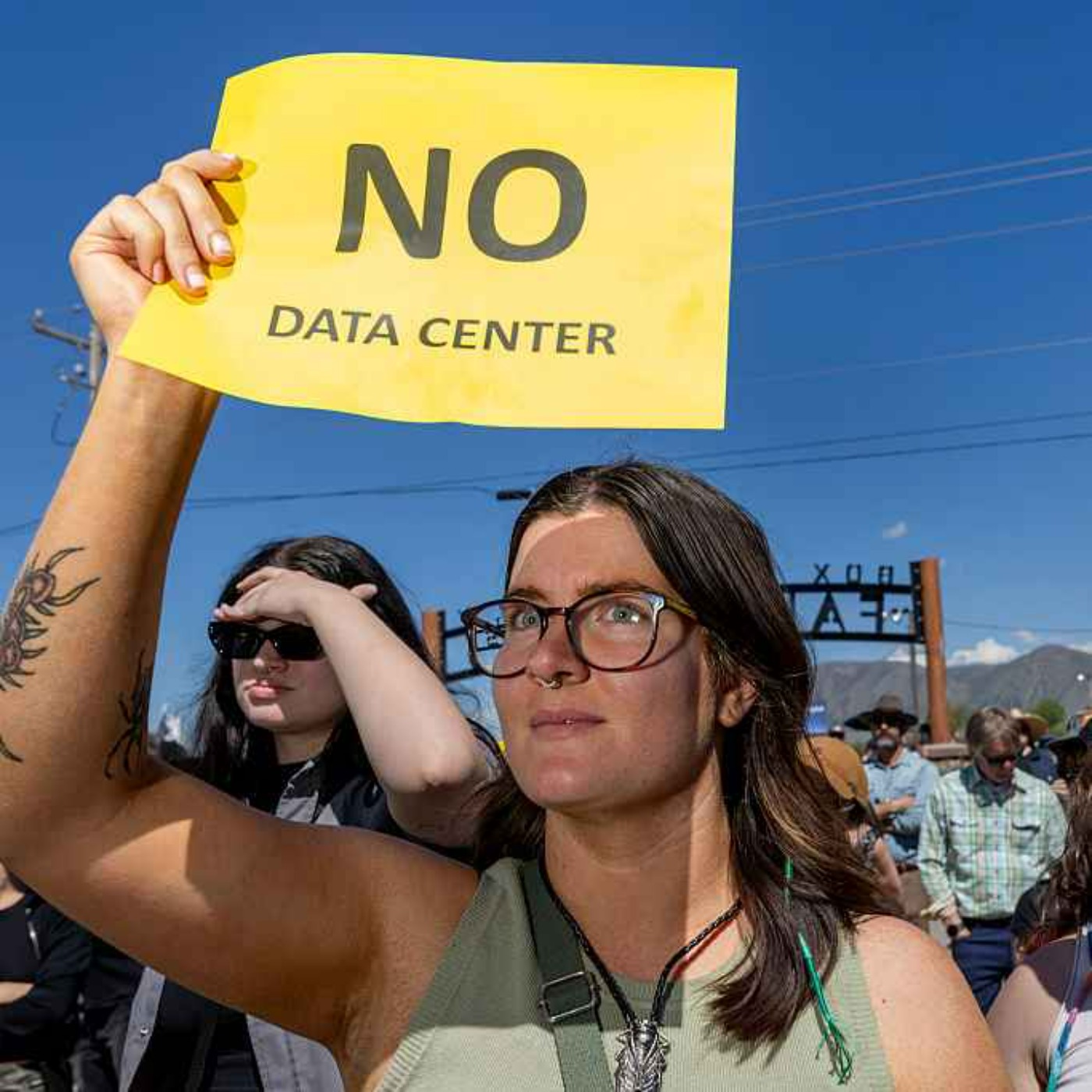
The Times Tech Podcast
Can beautifying AI data centres save them from backlash?
00:39:55
AI infrastructure and the fight to make data centres acceptable
Loading summary
Transcript134 lines
- [00:00]
A
This episode of the Times Tech Podcast is sponsored by health and life insurer Vitality, your health's best friend. Most of us want to be healthier, yet life so often gets in the way. Vitality's health and life insurance is built around that reality. Get active, look after yourself and you can unlock rewards from some of the UK's top brands and help keep your insurance premiums low. It's insurance that works for you. By using tech and insight to understand your health, they can incentivize you to live better. The healthier you get, the more more you are rewarded. Find out more at vitality.co.uk. this episode of the Times Tech Podcast is sponsored by IBM.
- [00:41]
B
Wimbledon is one of those rare events that feels steeped in tradition. But behind the scenes, it's also a huge data operation.
- [00:48]
A
Millions of fans follow the tournament across time zones, devices and platforms. And increasingly they want highlights, stats and personalized updates in real time.
- [00:57]
B
IBM has worked with Wimbledon for more than 30 years, using data and AI to help create digital experiences for fans, including Match Chat, which can answer questions during play, and Likelihood to Win, which uses live match data to offer near real time predictions.
- [01:13]
A
It's a useful example of AI being applied in a way people can actually see and understand.
- [01:19]
B
To learn more about how IBM helps create Smarter business, visit IBM.comwimbledon
- [01:27]
A
these buildings do not invite poetry.
- [01:29]
B
If we're building all this infrastructure, do we want it to look like large, ugly sheds?
- [01:34]
A
AI is absolutely on the ballot. Hello and welcome to the Times Tech Podcast. I am Danny Fortson out here in
- [01:42]
B
Silicon Valley and I'm Katie Prescott covering all things tech here in the city of London. Danny, I wanted to start the program today by asking you a question.
- [01:52]
A
Oh yeah, hit me.
- [01:54]
B
What do you think of the aesthetics of data centers? Have you ever, ever seen a pretty data center?
- [02:02]
A
Pretty?
- [02:03]
B
Yeah. No, like, no.
- [02:05]
A
No.
- [02:05]
B
What do they make you think of?
- [02:07]
A
An Amazon box? Yes, you know what I mean? Just like something big and flat and featureless and windowless. I would say they're like, oh my God, that's so ugly. But it's just kind of wildly utilitarian.
- [02:24]
B
Very much so. And I think it was at the Times Tech Summit, wasn't it, that Nick Clegg called them large, ugly sheds?
- [02:30]
A
Yeah, it was just a bunch of sheds.
- [02:31]
B
Just a bunch of sheds with servers that are going to depreciate. But the reason I asked this question is because architects here in the UK have been challenged to try and make them more attractive to communities. Because as we know, we're spending hundreds of billions of dollars on them and they're going to leave us with a legacy that maybe if they are large ugly sheds, we don't want.
- [02:54]
A
There's a lot to unpack there actually. Because data centers, as we've discussed before, are like a thing. Are an absolutely a thing. Especially when we get to politics, which we should get into that. Trying to think of the analogy, I was going to say still waters run deep because they're just like big boring sheds that don't do anything. But they're actually there's a lot, there's a lot behind them and beneath the surface. So we should get into that. Our guest this week is Jason Kelly. He's the co founder and CEO of Ginkgo Bioworks, which is combining AI and biology to deliver some fascinating results through so called cloud labs. These are scientific facilities, as they sound, that can be remote controlled by man or machine.
- [03:37]
B
Amazing. Should we start though by talking about data centers? I wrote my column about this issue this week and I wrote it because you and I were having a chat about a data center being built in Utah that is larger than Manhattan.
- [03:51]
A
Yeah, the Stratos or Spratos or whatever. Yeah,
- [03:58]
B
yeah. And it was actually supposed to be two and a half times the size of Manhattan.
- [04:02]
A
Yeah.
- [04:02]
B
And then there was pushback from the community. So it's now only just larger than Manhattan. But that's still an enormous amount of space just to put computer servers into, isn't it? When you think about the exciting stuff that happens in Manhattan in comparison.
- [04:16]
A
Well, exactly. And while this is also in Utah where a lot less exciting things happen, to be fair. But that one shed, as Sir Nick Clegg would say, is supposed to take up to 9 gigawatts of power. And I don't know if you know, your gigawatts and your kilowatts, etc. But 9 gigawatts is like twice the average daily consumption of London. So.
- [04:42]
B
Wow.
- [04:43]
A
Eight million humans living their lives use four and a half gigawatts on a daily basis, more or less. And this would be nine for just a bunch of racks in the Utah desert.
- [04:56]
B
That is astonishing because actually the UK wants to build a further six by 2030 for the entire data centers of the UK. Six gigawatts worth of data centers.
- [05:07]
A
Six gigawatts. Yeah. Yeah. So basically, could we create another London in a bit? Yeah, it's crazy. Yeah. So wait, so what's good? What is happening in the uk? Because I have. I can kind of give you a download on what's happening in America, which is really, really interesting. But why don't we start on your side of the pond?
- [05:24]
B
So the challenge over here, as you know, is that we don't have as much space, we don't have this space of Utah to provide data centers, you know, that are larger than Manhattan. And we also have a very limited national grid. Right. So there's the challenge of space and there's the challenge of energy. And then you bolt onto that as the challenge of NIMBYism and often well founded NIMBYism. People don't want a large ugly shed built near them. They don't like the look of it, they don't like what it does to energy and they don't like the fact frankly that often it doesn't provide many jobs for the local community. So there's big, big pushback and the government's trying to counter that by creating special zones where it should be easier for data centers to get planning permission, it should be easier for them to connect to the grid. But all of this is taking a huge amount of time. And meanwhile, meanwhile the tech community here is saying, we need more compute, we need to build, build, build. We want more data centers. And so the government, along with the Royal Institute of British Architects, Reba here, has launched a design challenge, a competition for architects and engineers and designers to try and make data centers better. And so it's about making them more attractive, making them more useful, seeing what else they can do within the community and, but also helping to deal with that energy issue. It's all going to take time, but it's just this sort of pushback of if we're building all this infrastructure, do we want it to look like large ugly sheds?
- [06:53]
A
And this is already happening in other places too, right? Like in China, I saw this quite stunning data center. I wouldn't say it was like the most amazing building I've ever seen, but it was like, oh, wow, that's actually really cool to look at. It's something that kind of catches the eye. It's not this thing that's just like when your eye falls on it, you're just like, ugh, you know, like all
- [07:18]
B
the utilities, data centers are very hard to make attractive, but also they need to be incredibly secure and they've got engineering issues. They need to be very, very cold, for example. And that one in China you mentioned is fascinating because they've moved the pipes and the servers almost to the outside so you can see through it. And then they've also opened up space Inside, so you can have this exhibition space and office space as well, which is something that normally data centers, these buildings keep people out as much as possible.
- [07:51]
A
And it's really interesting that design is now becoming a thing. Like. So this the company that wants to build the one in Utah, it's o' Leary Digital from this guy, Kevin o', Leary, who's like famous businessman, shark tank guy. And they were like, we're trying to build something that actually kind of matches where it is out in this kind of Utah, dry deserty environment. And the CEO of this company was. He's. He told a design magazine that, quote, the default for this industry is a windowless concrete and metal box dropped on a slab. Ugly monolithic buildings that are eyesores. We refuse to do that. We want a beautiful poetic design that belongs to the west desert. So I would say currently, as he says, these buildings do not invite poetry.
- [08:43]
B
No. And we're going to have so many of them that they're going to have to start. I was looking back at beautiful utilities from the bygone era.
- [08:53]
A
I love that you were doing that. That's great.
- [08:56]
B
Do you know one of the most beautiful I found was by Joseph Bazalgette and it was a sewer in southeast London.
- [09:05]
A
Say more.
- [09:06]
B
It's just the most incredible. It's a big pumping station. So, you know, 150 years ago in London, there was a cholera outbreak. And it's when they started to build the sewage system to try and clean up the water supply, clean up the rivers. And one of the things that engineers created at the time was these pumping stations to pump processed poo. And it is remarkably attractive.
- [09:33]
A
And for a poo processing facility, it is.
- [09:36]
B
It's kind of this big tiled, circular.
- [09:40]
A
Well, I will say I did used to cover utilities in the uk. I mean, it wasn't the most glamorous beat. I did actually go down into the sewers. But you're like, you know, 50ft underground, 30ft underground. They're just like rivers of human waste.
- [09:57]
B
Yeah.
- [09:58]
A
You're like, huh, that's interesting. That has like more intricate tile work than my bathroom.
- [10:04]
B
Yeah, exactly. It's like the subway in Moscow.
- [10:07]
A
Yeah, yeah, exactly. Chandeliers, et cetera.
- [10:10]
B
I was looking at the numbers. Gartner says we're going to spend $650 billion this year on data center infrastructure.
- [10:18]
A
Well, this is the thing that's really interesting in the States because we have elections in November. We just had a round of primaries. Like AI is on the ballot. And because AI is this thing that's kind of floating in the air that, you know, it's software. The one thing that people can kind of grab onto and if they get angry, they can direct their anger at a physical thing. It is data centers. And so you've had a lot of local politicians who supported Project X who just got knocked out of the race. You have. In the first quarter, the first three months of this year, proposed projects were canceled, which is almost as many as all of 2025. And there's over 300 state level bills targeting data centers that have come out just in the first months of this year, the first six months of this year. So it's like, it's a thing. If you're going to kind of get your friends together and bring out the pitchforks and get angry at this new technology that's you go to the place, right? And I don't think this is the answer. But if you can make something that actually feels additive, where you're like, oh, this is cool, or like, let's turn this like, you know, let's put a little, I don't know, food court in front of it or an arcade or a playground or whatever, something that doesn't feel just like completely extractive. Yes, that would help.
- [11:49]
B
Exactly. It isn't just about what they look like, although I think that is a massive problem, particularly when you're talking about massive ones. But it is also about them being useful and fitting into the local community. And the fact that at the moment they're very much kept away from retail space, for example, seems to me that that's going to have to change. It was interesting reading about some. I've gone very deep, deep into the data center utility subject. Many are used in Sweden, Japan, they take out the waste heat and use that for different things. So in Japan they've been using that for fish farms in winter in Stockholm, putting it into the local grid. In Germany now by the end of the decade, they're going to have to take 20% of waste heat from data centers and make it useful. Because the energy issue is such a, is such an enormous point.
- [12:41]
A
Yeah.
- [12:42]
B
They take a lot, don't they?
- [12:44]
A
Yes, yes. And as we've talked about before, a way to think about these data centers is they're basically just what they are housing as a new digital workforce that everybody's scared is going to take their job. And you're like, wait, what am I, what is the good part of this? Tell me the good part.
- [13:00]
B
Yeah, they're not creating. Creating.
- [13:02]
A
No. And so, so that is the fear and there's lots of research on both sides saying there's no job apocalypse. Yes, there is. We don't need to get into that. But I think that's the fear. And there was a poll just to give you a sense of the strength of feeling out here by Gallup, which is the big polling agency. This is from March. So three months ago, seven in 10Americans oppose local construction of data centers. Seven of 10.
- [13:29]
B
Wow.
- [13:30]
A
Strongly favor 7%. So less than one in 10 people are like, yes, this is a good thing for my community. It's going to bring jobs, it's going to increase our tax take, whatever it may be. People just don't want them. But I do think it's really interesting. AI is absolutely on the ballot. It's a thing that's already knocked a bunch of people out of the running for the elections come November. There's hundreds of local community groups have started up in opposition. There's a whole movement growing up around it. And the industry needs to get its house in order quickly or they're going to have like, you know, you've already had 25 big projects canceled in three months, which is equal to almost all that last year. So.
- [14:15]
B
And when you look at the cost of them, one architect was saying just the design part of it is a rounding error. You just wouldn't notice.
- [14:24]
A
So I think there's a correlation between making data centers less ugly because we need them and accepting AI is here to stay. So why not try and make it also do good? And what better way to do that than get a bunch of people, get them to brainstorm at a conference. And that is what this summit in Geneva is all about. While a growing number of people are fighting back against AI, there are still those who see the good in this tech.
- [14:52]
B
So, yes, the AI for Good Global summit is taking place this week. It was set up by the UN in conjunction with the International Telecommunications Union, talking about utilities. And every year it brings together government leaders, the private sector and academics to discuss everything AI related and grapple with how to make it available to everyone in a way that is safe and fair.
- [15:14]
A
It sounds like they're going to be talking about a lot of the things we often talk about on the show, but in, you know, perhaps more elevated you any type way we can be you any. Exactly. But, you know, like how to get countries to cooperate. When it comes to rules and guidelines around AI, that's obviously a big one. How to encourage more transparency, wider access. You know, these are very, very big issues. I do think it's interesting to the point of what we're just all been talking about, the very notion that you have to create something called AI for good.
- [15:46]
B
Yes.
- [15:46]
A
Because of course the implication is that there's also a lot of bad.
- [15:52]
B
Yeah. It feels like there's a big PR offensive going on within the AI community. So they've got an extraordinary array of people there. Marc Benioff, the boss of Salesforce, Professor Yoshua Bengio, one of the godfathers of AI and a Nobel Prize winner. Paul Kagame, the president of Rwanda. Whole array of people, but also people from the arts as well, including our guest for next week's episode will I am. So you might know him from the Black Eyed Peas, but he has become a big figure in the tech world, a big advocate for tech and the creative industries, a big investor in companies like OpenAI and Anthropic. And I'm having a fascinating chat with him this week. And yeah, so he's going to be in next week's program.
- [16:37]
A
But it sounds like he's, yeah, pretty, pretty proactive in figuring out or trying to guide it toward, toward the positive. So I'm excited to hear from him.
- [16:46]
B
But stay with us and when we're back, we'll hear from our guest for this week, Jason Kelly. Today's episode of the Times Tech Podcast is sponsored by IBM.
- [16:59]
A
Wimbledon may look timeless. Grass courts, white kids, strawberries and cream. But the way people follow sport has changed.
- [17:06]
B
Fans now expect fast updates, highlights and useful stats wherever they are.
- [17:11]
A
IBM works with Wimbledon to help turn live match data into digital experiences, including match chat and the likelihood to win.
- [17:19]
B
It's AI in action in a setting everyone understands.
- [17:22]
A
To find out more, visit IBM.com wimbledon
- [17:27]
B
this episode of the Times Tech Podcast is sponsored by health and life insurer Vitality, your health's best friend. Vitality works differently. Get active, build healthy habits and you can unlock rewards from some of the UK's top brands while helping to keep your premiums low. It's award winning health and life insurance that helps you live healthier. Find out more at vitality.co.uk. nothing tests my patients quite like sitting on hold listening to the same four bars of music on repeat. It turns out all that time adds up. The average person spends over 40 days listening to that dreaded hold music.
- [18:07]
A
40 days.
- [18:08]
B
And this episode is sponsored by Parloa, the AI platform built to make that a thing thing of the past. Paarloa's AI agents are available 24 hours a day, seven days a week. Fluent in any language and smart enough to remember every customer across every interaction because no one should have to explain themselves twice.
- [18:27]
A
From payment processing to roadside assistance, flight rebookings to appointment scheduling, Parloa delivers the kind of customer experience that turns a one time buyer into a customer for Life.
- [18:40]
B
See Paloa's AI agents in action at Paarloa.com that's P-A-R-L-O A dot com.
- [18:52]
A
Welcome back to the Times Tech Podcast. So while we acknowledge that there are tensions around AI and its impact on communities and society, there are plenty of companies out there that are using this technology to unlock some incredible innovations.
- [19:06]
B
And one of those companies is Ginkgo Bioworks. It was founded by five MIT students in 2008 and it runs autonomous labs. So the idea is that you replace humans with robots and they provide a place for companies to run experiments with custom microbes and cells. So think pharma and agricultural companies that need a space to test new medicines or different types of food, and that's what they provide.
- [19:31]
A
Yeah, and this is one of the kind of, the great, kind of holy grails of this whole AI movement is, you know, we can turn anyone into a scientist. You can make, you know, anyone can come up with an experiment using ChatGPT or whomever and use one of their labs, remote control and have ChatGPT run that experiment. So in recent years, they've incorporated a lot more of AI into their operations to help with running experiments, generating code. And I recently caught up with Ginkgo's co founder and CEO Jason Kelly to discuss how AI is being incorporated into what they do. Could we start with a basic question? Because the idea of a cloud lab, for example, is really interesting and I've known about you guys for a while, but then I saw this paper, I believe it was in Scientific American, about this experiment you did with OpenAI. So if you could start by explaining what a cloud lab is to people who have never heard of this term before and then what that experiment was, because I think it provides a glimpse of the possible, particularly around AI and biology.
- [20:44]
C
Yeah, the idea behind a cloud lab. First, let's just talk about, like, what happens in a lab, right? So I did my PhD in bioengineering at MIT. It's basically five years of standing at a lab bench moving clear liquids around very, very carefully with things called pipettes, which, if you remember, like high school, I do. You might have tried these, but they're very, basically like very fancy straws and you can suck up just the right amount of liquid and squirt it out and you can't make any mistakes or else your whole experiment goes wrong. And then you kind of interact with a bunch of different devices, like maybe something that heats things up or centrifuges things or whatever. And you as a scientist are connecting the dots between all these different devices. And you're doing liquid handling by hand with your pipettes. And then it's just all about what order of operations you do through that, like almost through that scientific kitchen, if you want to think of it that way. And so what we're doing with the cloud lab is we're automating the process, not necessarily of what steps we should go do now. So we're doing OpenAI, but with the cloud lab, it's really taking the manual labor out of that process of moving the liquids and then moving the samples onto various devices so that you could just write a software program that does all that and then the robots will run the lab.
- [22:03]
A
So what did you do with OpenAI?
- [22:06]
C
So, OpenAI, this was a question we had, which was, could one of these models, in this case it was GPT5 at the time, be able to do the scientific planning of an experiment? Then the cloud lab could run the experiment, the model would get the data back. And this is like a cycle scientists do. They have an idea, they run some experiments, they get the data back and they say, oh, that's a little surprising, you know, something in the data doesn't look right or that's the direction I should go in. And based on what they saw in the data, they plan a new set of experiments and they go around that loop over and over again until they sort of achieved an answer to their question. That's a lot of like the scientific method when it's done in practice by scientists. And so the question was, could the model stand in and plan those experiments, interpret that data so that it could then just run all the time on top of a lab? And so we, we worked in this area called cell free protein synthesis, and we said, could the model beat the state of the art that scientists had shown in this area? And we did six of those loops. And each time we did the loop, the model got to design about 30,000 different little wells, little liquid wells, experiments in the sample or in the experiment. And after four rounds, we had beat state of the art, and after six rounds we beat it by 40%.
- [23:26]
A
Based on what measure?
- [23:28]
C
So the idea behind this is, you know, if you remember high school biology, DNA turns into RNA and RNA turns into proteins in your Body inside a cell. And so what you do with cell free is you take a bacterial cell, you pop it open, you kind of take the guts out, and then you add your favorite gene, your favorite piece of DNA. I'm sure you have one, Danny. Right?
- [23:49]
A
I have plenty. I have a whole roster.
- [23:52]
C
And so you get that DNA and you put it in into the guts of the cell. And since everything's still there, all the machinery still there, it turns the DNA that you put in into protein. Okay. And it does it in a cleaner way because the cells aren't growing. It's all this messy, alive stuff. And so it's a great tool for scientists, but it's expensive. And so the idea is, per dollar, how much protein, how many, like, milligrams of protein were you able to make in a little tube? And you, as a scientist, can add different compounds, different chemicals, reagents to that tube to try to get it, to coax it to make more protein. And the question was, could we beat the current best protein per dollar that scientists have been able to find? And there was a paper out of Mike Jewett's lab at Stanford, and that was what we compared ourselves to.
- [24:39]
A
How in the loop were humans.
- [24:42]
C
We did insert some, like, human decisions to try to improve the odds this thing would work. And so, for example, we're going to do a check that says good scientists do replicates of their experiments. We want to publish this paper. So you're going to do four copies of any particular, like, experimental composition you choose? We're going to do four copies of it. Also. Good scientists use controls. So we're going to have a set of controls that we run on every sample so that you can compare sample to sample and believe our results. And so we set those rules. And then we said, as long as you play in those rules, you can put anything you want in there.
- [25:18]
A
You put these kind of overarching, I
- [25:21]
C
call them, like guardrails, you know. Yeah.
- [25:23]
A
Rules. Rules and kind of goals.
- [25:26]
C
Yeah.
- [25:27]
A
And then said, have at it. And then ChatGPT starts being like, hey, you're a great scientist. Thanks. I'm really excited about doing this project or whatever. And then it goes off, and it basically directs this army of robot arms in this lab in Boston to. To do what it's bidding effectively.
- [25:47]
C
You got exactly right.
- [25:48]
A
And when you get those results, this 40 improvement on protein per dollar, are you like, yahtzee? Oh, my God, we have entered a new world. Or is it kind of like, oh, that's pretty cool?
- [26:02]
C
I think what makes me Say Yahtzee, is that you as a scientist, at least for a certain class of problem like these optimization problems, could spin up an agent like a GPT5 agent and tell it, go work for a few weeks, do experiment, get the results, design another experiment, get the results and tell me, come back to me when you kind of work down that, that like branch of my hypothesis and come back to me with the result. And you could maybe have ten or a hundred or a thousand of those running at the same time pursuing lots of different hypotheses. That's wild. Right. And if, even if it's kind of not the most open ended stuff that it works for, which we don't know yet, like we tried it on something that's a little more constrained, we'll see, we'll try more open ended stuff. That's a change to science. That's a different way to go get your hypotheses pursued. That's a big deal.
- [26:56]
A
I saw a figure of $39 per experiment. I have no idea if that's right. But what is like when you talk about this new thing for science, what does that look like in terms of cost and the practicalities of me as a scientist or a non scientist whomever being able to actually do this?
- [27:14]
C
So first off, I would the, for just the practicing bench scientist going on to cloud labs, going into autonomous labs is going to be much cheaper than doing the work by hand.
- [27:26]
A
Cheaper? Yeah. Wow.
- [27:29]
C
And, and the reason is you are going to get much more out of all your equipment. Right. So your, your, all this very fancy expensive equipment is very underutilized in a traditional lab. For example, if you have a lab and I have a lab and we're across from each other at the MIT biology department, we have many copies of the same equipment and we Both use them 40 hours a week or something while people are working. And within those days we only use them a certain fraction. So it's nothing like how you would think about running a data center. Like we've gone through this process with computers where we eventually realize we should all have these big shared machines that we mostly use all the time to squeeze all the value out of the capital investment. Well, that's not the case for manual labs. We have not just the equipment, but also just the lab space. Right. The lab space itself has to, you know, it's got environmental health and safety, there's people in there, there's da da, da. There's all this cost to maintain those labs. If you could shrink that down instead have a cloud lab in the basement of MIT and have scientists all submitting their jobs with computers. That would be way less expense on the lab side. Way less.
- [28:35]
A
Right.
- [28:36]
C
And most of your cost is not the reagents you're using up. It's all that other stuff. It's the equipment and the rest, equipment, team and everything. It's just overwhelming cost to keep a lab open. And so, and so all that. I think it will make it, make it cheaper for a scientist to do their work. And my belief actually, if you think about Europe and UK and the United States, what's happening right now sort of geopolitically in the pharmaceutical industry is biotech startups are moving to China. So we've had. Oh well, I don't know if you know much about like the labor cost in China for a scientist versus the labor costs in the UK or the US Much cheaper in China.
- [29:15]
A
And so western biotechs are moving to China to access that labor pool.
- [29:20]
C
100. Yep. And, and the reason is not because they're automated. In fact very little of it's automated in China. It's because the, it's because it's manual that it's moving. Right. I actually think the automation of science in the west is going to be how we keep it. If we, if we stay at benches, I think we end up losing most of the science based industries that are like these kind of physical, physical based industries just very hard to compete with the scientific talent in China now.
- [29:50]
A
And so this automation approach, is there a kind of a, this maybe may not exist but like a kind of a broad figure. You can say, well you know, you can use a normal lab staffed by people or you can use a cloud lab and it's x percent cheaper or more efficient.
- [30:09]
C
So I'll give you what I, what my view is on the minimum based on our experience here at Ginkgo. So yeah, it's a threefold laboratory space reduction going from manual to in terms of like equipment density that you can get when you need people being able to walk around versus putting it all into robotic setup. So you'll save 3x on your rent. Okay. So that'll be three times more efficient and then it can run 24,7. So you get 3x the hours basically. And so I think you're looking at like 9 to 10x improvement. Just you just, even if you just do the work exactly the same way. Right. Same exact experiments just in on robotics, you'll get a 3x improvement in overall efficiency between space and time as a savings. And then I Believe my, like, vision on this is once we've gone to total automation, we can then start to climb the curve that you've seen in many other industries, which is you can further miniaturize, you can do all kinds of fancy stuff that ultimately drives the cost way, way, way lower. But the first step is just get off the bench, just stop doing the work manually. And I think it's an imperative here in the United States especially to do this. It's just crazy that we're not gonna be competitive.
- [31:19]
A
All right, I'm gonna go dark now. I'm not sure if you read this little essay by Darya Amadei called the Adolescence of Technology.
- [31:26]
C
I've had this one on my list, but go ahead.
- [31:28]
A
I'm sure you know what's coming. So his whole thing, and Sam Altman, is we're about to enter this new age of abundance like we've never had before in the history of humanity. Amazing. On the downside, we are empowering everybody in a way that we never have before. And that could lead to some very bad results. And he writes in this adolescence of technology, which is this like 15,000 word vision of what can go wrong. And he said, I am concerned that a genius in everyone's pocket, that is Claude Chatgpt. Whatever.
- [32:00]
C
Yeah.
- [32:01]
A
Makes everyone a PhD virologist who can be walked through the process of designing, synthesizing, and releasing a biological weapon. Step by step, we are breaking the correlation between ability and motive. So the disturbed loner who wants to kill people but lacks the discipline or skill to do so will now be elevated to the capability of the PhD virologist, et cetera, et cetera.
- [32:24]
C
Yeah.
- [32:24]
A
Your response to the end of days?
- [32:26]
C
I mean, what I would say is when it comes to specifically, like, we've done a lot in this area of sort of like what we'll call biosecurity, and particularly during COVID So, for example, during COVID our biosecurity group reopened 5,500 schools in the United States by doing some of that school testing and monitoring. There's actually a lot of this that got pioneered in the uk and that for me was it wasn't really diagnostic testing. It was more like a radar that was detecting all the time, every week, is there something in this school? And if it detected something, you would go look in that classroom, find the one kid, send the one kid home, and not have to close the school. And so this was the beginning of a little bit like what's being monitored on your phone or your computer every day. When you're doing like an antivirus, just checking, just checking, checking, checking, checking, and then responding when there's something we don't have to worry so much about. The virologist in the pocket. Because Covid actually happened to all of us, you know, five years ago, like real, real thing. And, you know, the whole world got shut down by a virus. Right. So we should be building out these protections against infectious disease completely independent of, you know, clot in your pocket. So that's point number one. So I think we're undershot on, on this just in general, you know, I think these are like one of the, you know, it's like one of the Four Horsemen. Like we should be on it. Right. Point number one. Point number two is. I don't know, I think people sort of overestimate how like, it is kind of hard to like the, the, like the sci Fi stuff about that, like, oh, make a horrible. You know. Right. Like, I, I'm actually less worried about that. I. I'm more worried like the stuff you need to do to just like, try to make something that will get people sick is not that hard. It's try to make a pandemic. That is hard. And I don't know that we really know how to do that. Right. It definitely does happen. But the ability to like totally engineer it in is a little bit. I don't know that Claude knows how to do it.
- [34:20]
A
I'll come up with a ridiculous example and you can tell me why it's ridiculous. I. I'm a bad guy.
- [34:25]
C
Yeah.
- [34:26]
A
I think the world sucks and I want to end it for as many people as possible. I want to engineer and I don't even know what I'm talking about. Aerosolized anthrax. Put it into the. Into the H vac of Salesforce Tower. Is that a thing that I could do? Knowing what, you know, about what these AI systems are capable of, how good they are, what their limitations, and then also actually taking that and actually making that real in the real world. Because I think again, when you talk about this moment in AI, people are really having this freak out moment for lots of different reasons. But this kind of bio risk is one of these things that in the leading labs in particular, they seem to be really worried about.
- [35:14]
C
Yeah. Although I mean, a little bit of my view on that is it's. It's an easy one for people in tech to worry about because it has no impact on their business. So it's like, very convenient.
- [35:25]
A
That is a very cynical take. I am shocked just Saying, so what
- [35:31]
C
I, what I would say, like, to answer your question on that one, the infrastructure you're going to actually need is you have to like grow all those cells. And that's actually kind of a big pain in the butt. And you have to not get yourself sick. And there's 80 other things. And so, so it isn't like totally trivial and there's, you know, as much risk around say, chemistry. I think if you're going to just try to like put something in a building or get, you know. And so I think to me the bigger concern is viruses, like things that spread that aren't really, like, I'm going to aerosolize and just get people locally sick. It's the thing I can give you and you give your. The next person that's. That remains. My big fear is like bacterial and viral illnesses. And the way to solve that is we should just be putting that down. We should invest in the technologies for antiviral and antibacterial so that we are as patched as our phones to viruses, you know. Right. Like we've invested all this effort in. And you know, the reason Danny doesn't happen. I'll just, I'll be honest. Like, I think the root cause is we have great cyber security. And, and that's because we actually have a lot of cyber attacks. And the reason we have a lot of cyber attacks is because you can make money, sort of a private sector cycle. You can't make money getting everybody sick. So it's really a nate like the people, like the defense against this belongs in the Defense Department. Right. Like it is a national security and public health thing, not a dollars and cents thing. And so then it turns into the usual discussion of like, well, do governments want to invest in it? And so on. So I think we have like a weird gap in defending ourselves against viruses because it really. There's no economic engine. It's all driven by governments. I do think this is like critical, but that's the answer. It's not like, oh, you're going to stop. Oh, we should, you know, like the AI agents won't tell you whatever. I don't, I don't actually think that's like a viable defense in the long run. My point is I'm not extra concerned because of AI. No, my concern there is more because of COVID Right. I look at Covid and I say the countries are susceptible to infectious disease in like a national security way. And then we need to defend it in a national security way. But I will say on The, I think the other point that, like, why is everybody so upset about AI? What are people concerned about? I think it's just all the change, right? You know, it's going to change how people work. It's going to change how, you know, how our lives are. What I would love to hear more of is sort of like, I'll say it for science, okay? So I'd love to hear, like, what's the vision that gets more people in the. With this feeling of like, I have agency in this technology happening, and it's going to be like a good thing for me, good thing for the world, not like this whole thing is happening to me. And in science, here's like a vision for what I. I can see happening in the future. So I think at its heart, science is the formalization of human curiosity, okay? It's like, we spent a lot of time understanding how to ask questions the right way in science so that I could get an answer and you would believe it when I show you my answer. We don't just have some big fight about it. And I don't, you know, right. Or whatever. It's who yells the loudest or gets the most people to raise is right. No, no. Like, we have a system we agree on to prove to each other who's right and who's wrong, and that's science. And my view is everybody's curious. And so I think at their heart, like, everybody has a question about something. Everyone wants to be a scientist. And there's a major barrier both in the esoteric nature of. I have this question, what does the world already know about the answer? And then where is the current limits of human understanding, which is what scientists are good at? They know exactly what people already know. And what would be the next thing that moves the field forward? So that's number one. And then number two is the lab. You don't get a lab, Danny. You get a laptop. You have a computer, but you don't have a lab, all right? You can't go and actually do any experiments, all right? And so those two things mean that only a very small set of people get to do science. And I think the AI models are going to take the first one down. Because now you could ask a question to GPT54 on Max Pro mode or whatever and be like, I, my dog has this cancer, whatever. And like, and tell me what would be a new experiment to do that no one's done that could move this forward and it will answer you and be decent. And then second thing, if There were cloud labs available to you. You could go get that experiment run and get the data back and give the data to your model and say, what did we learn? And you would have just done science. Like, you would have asked and answered a question. And I know that seems like insane or what questions would people ask? But like, the analogy I would give you is if you go back to 1950 or 1960 and we were sitting around a mainframe at IBM and I was telling people that we're going to make this super cheap and our kids are going to program computers, you'd have been laughed out of the room.
- [40:41]
B
It was really fascinating to hear because when you hear about people talking about the benefits of AI, this is often what they jump to, isn't it? The impact on science, the breakthroughs that we're going to see. And it feels like what they're doing is a stepping stone in that direction.
- [40:59]
A
Yeah. And it's really, you know, it's part of it is, oh, we're going to use AIs to kind of discover new drugs or whatever, but also you need new types of tools to do that to really achieve that acceleration. And the idea of a lab that is super efficient, can run 247 doesn't need to kind of like, you know, you don't have humans in there who need to eat or sleep or rest, and they can just, the AIs can kind of beat their heads against the wall until they figure out how to do the thing, whatever that may be. And so just that idea of that tool being able to be like, oh, we can use that now. And it just makes everything go a lot faster. And of course, there's also the scary side of like, oh, anybody can spend a few bucks and run a scientist science experiments from across the country, like, presumably.
- [41:53]
B
Yeah, we need some humans around to check everything.
- [41:56]
A
Yeah, yeah. But it's just, I think it's really, you know, as we talk about often in the last, whatever, three plus years since Chat GPT, that Chat GPT moment everybody's been talking about, like, oh, what it's going to do to science, you know, and science moves slow, biology is hard. But I just thought it was interesting that this is that first kind of glimpse of where things might be going. Yeah. So that is it for this week's episode of the Times tech podcast. If you're enjoying the show, drop us a line to let us know.
- [42:31]
B
Yeah, drop us a line and let us know what else you want to hear from us. Is there anything particular that you're really fascinated by in tech and that you want us to get into. Or indeed anyone you think that we should talk to.
- [42:43]
A
That's right. So email us at TechPod, the times.co.uk and as if we need to remind you, we are also on YouTube. So go to the the business page, the Times business page on YouTube and you will find us there. You know, not exactly live but in person doing the same thing.
- [43:06]
B
And we'll see you next week. Goodbye.
- [43:09]
A
We shall. Bye. Bye. Today's episode of the Times Tech Podcast was sponsored by IBM.
- [43:17]
B
IBM's long running work with Wimbledon shows how AI and data can be used in a setting millions of people recognize.
- [43:24]
A
From Instant Match insights to digital tools like Match Chat and Likelihood to Win, the aim is to help fans follow the tournament in a more personalized way, whether they're on the ground or watching. From anywhere around the world and beyond
- [43:38]
B
sport, it points to a bigger question for businesses. How do you turn data into something useful, timely and easy to act on?
- [43:45]
A
To learn more about how IBM helps create smarter business, visit IBM.comwimbledon this episode is brought to you by Progressive Insurance. Do you ever think about switching insurance companies to see if you could save some cash?
- [44:02]
C
Progressive makes it easy to see if
- [44:04]
A
you could save when you bundle your home and auto policies. Try it@progressive.com Progressive Casualty Insurance Company and affiliates. Potential savings will vary. Not available in all states.