Loading summary
Transcript176 lines
- [00:00]
Danny Fortson
This episode of the Times Tech Podcast is sponsored by Adobe Acrobat Studio.
- [00:05]
Katie Prescott
A lot of us lead very busy lives, including the tech bosses you hear from. On this podcast, we're dealing with more information than ever before, often across disconnected tools and working in hybrid teams.
- [00:16]
Danny Fortson
If this sounds familiar and you're someone whose life involves scrolling through contracts, reports or pitches with important data buried in long documents or different sources, then you'll know it can sometimes be a struggle
- [00:27]
Katie Prescott
to keep up, or at least to do so in a timely way.
- [00:30]
Danny Fortson
Adobe, the company that invented the PDF back in 1993, is changing that with Adobe Acrobat Studio. It's a modern workspace designed to help you work smarter and save time.
- [00:40]
Katie Prescott
Acrobat Studio isn't just for essential PDF tasks like editing or signing documents. It's an AI powered space built to help you use simple language prompts to get information quickly from multiple documents and sources, including PDFs, Office 365 files and web pages.
- [00:56]
Danny Fortson
It's for people with busy, demanding jobs who want to spend less time on
- [01:00]
Katie Prescott
admin and more time on the work that really matters.
- [01:03]
Danny Fortson
Check out Adobe Acrobat Studio and its new features now.
- [01:06]
Katie Prescott
This episode of the Times Tech Podcast is sponsored by PwC.
- [01:11]
Danny Fortson
How do you use AI in ways that drive real business value? It isn't just about the tech. It's a new way of thinking, going further, faster. This is where PwC comes in. Shaping AI to fit your business to help you innovate with impact, empower your people and accelerate growth. Working with you side by side, bringing deep industry know how with expert change management to unlock real value and drive lasting impact.
- [01:37]
Katie Prescott
PwC knows how your business works so you can put AI to work for your business. Discover more at pwc.co.uk okay, before we get into this week's episode, I've got a quiz for you.
- [01:55]
Danny Fortson
I love a quiz.
- [01:56]
Katie Prescott
You ready?
- [01:56]
Danny Fortson
Did you know that I was a spelling bee champion when I was a kid?
- [02:00]
Katie Prescott
Hold the phone. Really?
- [02:02]
Danny Fortson
Yeah.
- [02:02]
Katie Prescott
So that means People. What, they fire words at you?
- [02:05]
Yann LeCun
Yep. Okay.
- [02:06]
Danny Fortson
And I won. Not only our school, but our district went all the way to the county finals. So, anyway, okay, this is.
- [02:15]
Katie Prescott
This is really one for you because it's the Collins Dictionary Word of the year. They just announced it. What do you think it is?
- [02:23]
Danny Fortson
Okay.
- [02:24]
Katie Prescott
Any ideas?
- [02:25]
Danny Fortson
This is a tech podcast.
- [02:27]
Katie Prescott
Well done.
- [02:27]
Danny Fortson
Thank you. They haven't turned AI into a word.
- [02:30]
Katie Prescott
They haven't? That's a very good idea. No, they haven't. I'll tell you at the end, let's keep Everyone in suspense.
- [02:35]
Danny Fortson
I'm a ruminate. I'm going to ruminate on it.
- [02:37]
Katie Prescott
That's a good one. I have to say. There was another word which isn't the winner, but it's an absolute corker.
- [02:42]
Danny Fortson
Oh, yeah, what's that?
- [02:44]
Katie Prescott
Clanker.
- [02:45]
Danny Fortson
What's a clanker?
- [02:46]
Katie Prescott
It is. It's a derogatory term for computers, robots or sources of artificial intelligence. Intelligence. That's such a clanker.
- [02:54]
Danny Fortson
Oh, I love that. That's like a sick burn nerd version.
- [02:59]
Katie Prescott
Great word, isn't it? If you see a rubbish attack. Bit of a clanker. Apparently popularized by Star wars, the Clone wars, it went viral on social media and is often used to express people's frustrations with and distrust of AI, chatbots and platforms.
- [03:16]
Danny Fortson
We're coming in hot. We're covering the most important issues in tech right now. Hello and welcome to the Times Tech Podcast. I'm Danny Fordson out in Silicon Valley, where, in case you didn't get the memo, the race for computing power is on.
- [03:30]
Katie Prescott
Oh, it certainly is. I'm Katie Prescott here in London, and every week seems to bring another billion dollar AI deal, which is, you know, where we come in. Maybe not doing the deals trading in billions, but we're trying to make sense of how tech is reshaping business, culture and everyday life.
- [03:48]
Danny Fortson
That's right. We're your AI tour guides and that's why we're here. One big story, one big guest, and this week we're looking at OpenAI, the company behind ChatGPT. Don't know if you've heard of it. They signed yet another big deal, this one worth nearly $40 billion. 38 billion. With another big cloud provider, AWS, also known as Amazon Web Services.
- [04:12]
Katie Prescott
Not clankers, either of them.
- [04:14]
Danny Fortson
No, no, it's fair to say.
- [04:17]
Katie Prescott
So we're going to look at what this all means for OpenAI and for the global power grid. Plus what Sam Altman and Satya Nadella from Microsoft revealed in a new joint interview that got a bit tense here and there. Yeah, the two people, part of the biggest bromance in tech, talk about the next phase of AI.
- [04:40]
Danny Fortson
But of course, before we do all that, the main event, Katie, is your interview with the man at the very center of all of the action. That's, of course, Jensen Huang, the CEO of Nvidia, the company making the chips that power this whole boom. And as of recording, he is now the eighth richest man on the planet. Net worth $180 billion. No big deal, thanks to the company's stock price, which has Gone up so much that last week the company became the first company on planet Earth worth $5 trillion.
- [05:12]
Katie Prescott
So from trillion dollar valuations to trillion watt ambitions. Which brings us to the big question this week. Are we running out of power? The chips, the electrons, the data centers to power AI? Well, let's get into it. And Danny, I should set the scene. I got a call earlier this week from the team in the Department for Science, Innovation and Tech saying, would I like to interview Jensen Huang and Liz
- [05:38]
Danny Fortson
Kirk now I'm busy.
- [05:39]
Katie Prescott
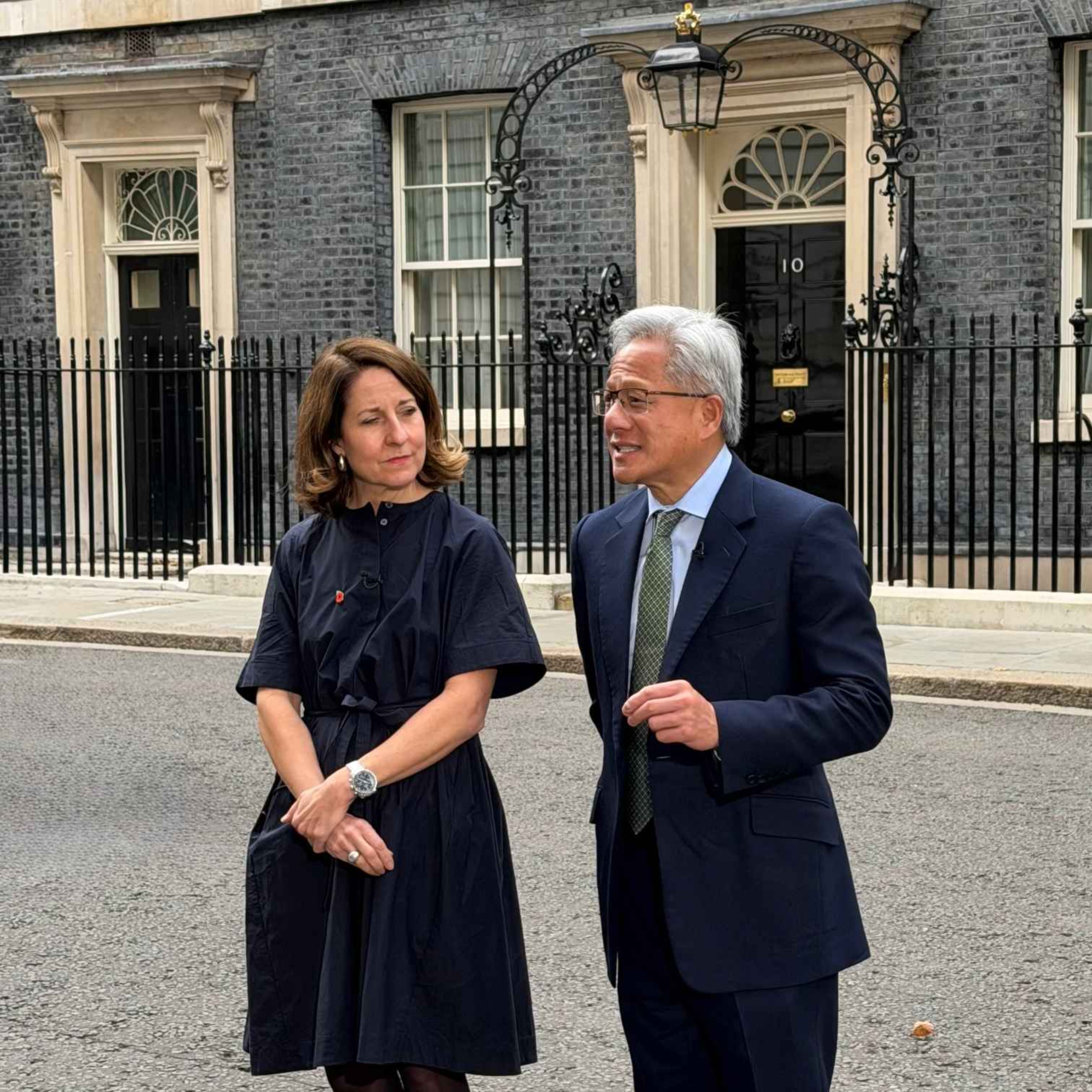
The Secretary of State for Tech. Yeah, exactly. Oh, I don't know about that. So Priyanka, the producer of this podcast, and I went to 10 Downing street the first time for both of us. We had to work out how to get in past the man.
- [05:54]
Danny Fortson
I was gonna say, did you actually go in? Because all I ever see of 10 Downing street is people standing in front of the door.
- [05:59]
Katie Prescott
Oh, no. When I say we went in, we just went through the barriers to stand outside the door.
- [06:03]
Danny Fortson
I.
- [06:05]
Katie Prescott
But it took us a while to work out how to get round the barriers through the scanner to stand outside the door. But anyway, it was, it was very exciting, as usual with these things. We didn't have a huge amount of time for the interview, but Jensen Huang was in town picking up the Queen Elizabeth Prize. He was one of several winners of this prize, which is a very prestigious award for. For engineering, which he is receiving from the King. And there were all sorts of other people there who are key figures in AI. Yann LeCun, the chief scientist of Meta, Geoffrey Hinton, Yoshua Bengio Fei. Fei Li often talked about as the godfathers, godmothers of AI, along with the Secretary of State for Science and Tech in the uk, Liz Kendall. So you can imagine Frank and I are studying outside 10 Downing street, watching that famous store open and close. We went and got a selfie outside it. So I should say, did all of the prize winners, when they came out, saw Yann Lecun holding up his mobile phone, taking a selfie as well, outside the famous door.
- [07:14]
Danny Fortson
That's very cool.
- [07:14]
Katie Prescott
It was very cool. So we got, we got a brief amount of time really. You may have seen, Chip stocks were down quite dramatically on Wednesday. So that was one of the things that I wanted to talk to him about. And we asked, is this investment boon sustainable? And of course about the bubble.
- [07:31]
Danny Fortson
I have a very important question before we get to the interview.
- [07:34]
Katie Prescott
Go on.
- [07:35]
Danny Fortson
Was he wearing his black leather jacket?
- [07:37]
Katie Prescott
No, I don't think he was actually. Oh, I don't think he was. It's a really good question. And when I've seen him speak before. So when I was in Paris at gtc. Yeah, yeah, he's there in his jacket. I mean, this was a. A big state event and he's receiving the prize from the king later.
- [07:54]
Danny Fortson
I've just never seen him in anything other than his black leather jacket. And kind of no matter where he is.
- [08:00]
Katie Prescott
No, they're all in suits. Jan Lecun had a lovely blue bow tie on and of course, was wearing meta glasses.
- [08:06]
Danny Fortson
Of course he was. Of course he was.
- [08:09]
Katie Prescott
Sadly, I was not wearing mine.
- [08:11]
Danny Fortson
Oh, you guys could have given, like, a little, like, nod across the room, be like, what's up, fellow dork? You know, here's my.
- [08:18]
Katie Prescott
Here's my clankers on my face. No, not at all. I'm big fan, actually. Yeah, actually, it's very striking.
- [08:27]
Danny Fortson
Well, I can't wait to hear what he had to say. It's awesome that you managed to nab a bit of time with him, even though it was short. Basically, he's the most important person on the planet. Him and Sam Altman, I think, in terms of this whole crazy boom in which we find ourselves.
- [08:43]
Katie Prescott
So we managed to get a little bit of time with Jensen Huang, along with Liz Kendall. Jensen Huang, congratulations on the award.
- [08:52]
Jensen Huang
Thank you.
- [08:53]
Katie Prescott
Just looking behind you, standing outside number 10. What an extraordinary gathering.
- [08:57]
Jensen Huang
It's really terrific to be here with my friends and my colleagues. I happen to be able to work with some of the brightest minds in the world, and I'm so proud of them, my colleagues, and work together to invent this new industry. If you take a step back and reflect on what has happened, we have reinvented the single most important instrument of humanity, computers. For the first time in probably about 60 years, maybe 100 years. And now we're seeing a complete platform shift and build out to this new way of doing computing called artificial intelligence. The capabilities have developed so quickly and in fact, so amazingly in the last year that we're now using it effectively in drug discovery, in health care, in, of course, my industry, engineering, transportation, and logistics. And we're going to see this technology impact every single industry in a very positive way. One of the surprising. It wasn't surprising to me, but it was surprising to a lot of people. That AI doesn't change your job, it changes the work of your job. And so your responsibilities and the responsibility. Your job fundamentally is still necessary, but it's been enhanced dramatically by the use of artificial intelligence. Companies are becoming more productive, and as a result, they're growing. When they grow, they hire more people. It's also the case that artificial intelligence requires infrastructure and the building of infrastructure has created mounds of jobs, really important, high trade skills, the very high paying jobs that are necessary to build these factories, data centers, and all of this is creating lots and lots of jobs. I'm quite excited that the UK is going to push into the artificial intelligence sector. This is a new industry that you must take advantage of.
- [10:45]
Katie Prescott
But you have said before this is, I think, your third visit to the UK this year, certainly the third that I can remember, that the UK is the world's biggest AI ecosystem without its own infrastructure. That's right. What are your reflections on that? And kind of the direction of travel.
- [10:58]
Jensen Huang
That was a challenge that we took upon ourselves. And in just several months we have created two very important companies here in the UK that are scaling up very nicely. One of them is N Scale. A year ago N Scale didn't even exist. Today N Scale is about to become a multi billion dollar infrastructure.
- [11:18]
Katie Prescott
To learn more about it very quickly,
- [11:20]
Jensen Huang
N Scale is really doing terrifically. I'm really proud of Josh. And another company that's now building in the UK is nvs. And so I think that we need to motivate and activate the infrastructure parts of the AI stack, because without it, there's no way to build the application layer and the companies on top of it.
- [11:41]
Katie Prescott
That's absolutely right. We need to build those data centers to get that infrastructure, but then we need to create the ecosystem around that, the companies who will adopt and come up with new ideas. And the truth is this, we do not lack for the brilliant minds, the great scientists, the great ideas. But we have got to do more to get from startup to scale up. That's one of the reasons why we're putting through right now legislation, the Pension Schemes Bill, which I introduced when I was Secretary of State at Work and Pensions, which is to get more pension fund investment into UK companies. There's more, more we need to do there, we need to build the data centers, we need to get the capital to get startups to scale up, we need to make regulation easier. But critically for me, you know, I'm a Labour Secretary of State, I am a local mp. I want kids in my constituency to think there's a great job, there's a great opportunity for me. That's why today we announce in our reform of the curriculum that we are changing the computer system science, GCSE now to include AI. We are going to prepare our kids for the future. That's better for them and it's better for the economy because they're the ones who are going to come up with the ideas and the great businesses that are going to build a better future for Britain. I'm delighted to hear that from my two daughters who are just at the age where that would impact them. I've got two more questions because I appreciate you have got have got to go, but there is a lot of talk at the moment about an AI bubble. And we saw chip stocks come coming off this morning. Obviously the US markets aren't yet open. Do you think this is the sign of the correction that people have been talking about?
- [13:20]
Jensen Huang
I actually believe we're in the beginning of the AI buildout. It just happens to be a very large number.
- [13:26]
Katie Prescott
I notice you don't use the word bubble.
- [13:28]
Jensen Huang
We're all in a bubble. The question is, where are you in that phase? And so I believe we're in the beginning of the build out. It just happens to be very large numbers. But the way that to think about AI is the ecosystem and the economy that it's going to impact is so large that these numbers in percentage pale by comparison. And so we're in the beginning of the build out. We have decades of old computing infrastructure that's being modernized. And so we're trying to modernize it as quickly as we can so that we can bring AI to a lot more people. That's number one. Number two, AI has become profitable. It's effective and profitable, which is the reason why everybody's accelerating their build out of artificial intelligence. When something is profitable, people want to make more of it. And this is applying to just every single technology company and every single computer company so that we can build into the AI era. This is just in the beginning.
- [14:26]
Katie Prescott
It is certainly a very exciting time. My last question is about power. We're standing outside the door of number 10. Your company was recently valued at $5 trillion. First company in the world to be worth that much. The UK's GDP last year was $3.6 trillion. How do you reflect on that?
- [14:45]
Jensen Huang
They're measuring two different things. One is turnover and the other one is valuation. And obviously our valuation as a company reflects the work that we do, but the impact on the number of industries. Ultimately, AI is the first technology in history that has the opportunity to directly benefit the total $100 trillion of the world's economy. Everything from health care to financial services to all of technology, transportation and logistics. Almost every single industry, manufacturing, will be benefited, will be impacted. And so we're in the beginning of that and just reflects the opportunity ahead.
- [15:24]
Katie Prescott
How do you feel about that power?
- [15:27]
Jensen Huang
I feel a great, great honor to be part of this important technology. This is probably the most impactful technology of all time. And the ability to manufacture intelligence is quite an extraordinary thing. The benefit to society is quite extraordinary. And it's a great privilege to be working in the company at the center of that, and it just causes us to work harder than ever.
- [15:55]
Katie Prescott
So, yeah, in terms of the bubble, he was very much like, this is just the beginning of the investment.
- [16:02]
Danny Fortson
Yeah. And he kind of has to say that. Right. Because where his company is and where it has got to. I mean, I like the idea of the way he framed it of manufacturing intelligence and putting it in the frame of like, we've got all these old computing infrastructure that now we have this new paradigm. We need to kind of move it all. You know, it's going from like landlines to mobiles. Like, we need to just switch all of this out. I mean, it is crazy. This was just a company that just a few years ago, like, nobody really cared about. They were making chips for video games and now they're worth $5 trillion. He's getting every ward on the planet. He's. He's now one of the richest people on the planet. And it just keeps going up and up and up and up. I mean, it just. He must have whiplash.
- [16:49]
Katie Prescott
And every time I see him, he's with a very senior politician. You know, when I was out in Paris, he was on stage with President Macron, he was on stage with Prime Minister Keir Starmer. Back at London Tech Week, he was over for the state visit, of course, with Donald Trump. Liz Kendall this morning with the King later. Which is why I asked that question
- [17:08]
Danny Fortson
about power, because it really gets to this idea of, like, it feels kind of crazy right now. And the question is, is like, is this sustainable? Are we in a bubble? Is this about to burst? When will the bubble burst? What will that mean, all of that stuff? Or is it really, like he said, he's like, we're just at the beginning of a very long new infrastructure build out, like whatever railroads or telecoms or whatever it may be. And we are genuinely just getting started and this is all going to be a good investment.
- [17:35]
Katie Prescott
But we also managed to grab Yann Lecun, Meta's chief AI scientist, who made it very clear, actually, that he was a professor first and foremost.
- [17:43]
Danny Fortson
Well, he's super interesting also because he's the one who's been like, look, this is basically just math. It's just really clever math and like, everybody needs to take a big swig of settle down juice when it comes to, like, the existential worries from folks like Geoffrey Hinton. So the fact that both of those two guys were in the room, I would have loved to sat down and just like between them be like, let's talk this out.
- [18:07]
Katie Prescott
Yeah.
- [18:08]
Danny Fortson
Because they both know what they're talking about, but they're coming at it from diametrically opposite positions.
- [18:14]
Katie Prescott
There's a big discussion at the moment again about when we might hit AGI and the light of OpenAI's new relationship with Microsoft. And you know, that will. It changes when OpenAI officially hits aggressive and they've got an independent board apparently to look at when that happens. I wonder what your view is at the moment of when that moment might be reached. You've got strong views on this.
- [18:37]
Yann LeCun
I have very strong views on this. So first of all, it's not going to be a moment, it's not going to be an event.
- [18:42]
Katie Prescott
So you don't think the board will be able to just. I mean, it's quite an interesting concept that they've got this board to sort
- [18:47]
Yann LeCun
of evaluate it, but that's based on a completely wrong assumption. Which is. Which really comes from science fiction. Like, there's going to be an event and, you know, one day before that event we don't have human level AI and the next day we have superhuman AI.
- [19:02]
Katie Prescott
Right.
- [19:03]
Yann LeCun
So first of all, I don't like the phrase AGI because the G stands for general. Right. Artificial General intelligence, by which people really mean human level intelligence. Human level AI. And human intelligence is not general at all, it's very specialized. And so calling it AGI is complete nonsense. First of all, there's no question that at some time in the future we're going to have machines that are as smart as humans in all domains where humans have intellectual abilities and more. It's not going to happen next year, it's not going to happen in two years. It's certainly going to take more than five years, probably more than 10, because there is a lot of breakthroughs that need to happen before we can get to that point. Now there's generation after generations of AI scientists and engineers who in the past have thought that the latest technique they invented was going to be the ticket to human level AI, and that proved to be wrong every single time. And it's still wrong today. Right. So LLMs are very useful. They should be worked on. There should be investments in them. It's great. There's going to be a lot of products that are going to help people with that, but they are not a path to, to human level AI. And what I think is prevalent in Silicon Valley at the moment is that it is a path to human level AI. I just don't believe this at all. And I think we need a few breakthroughs before that happens. And the evidence for this that you can immediately recognize is that we have AI systems that can pass the bar exam or solve some math problems or code. They're really useful for that as long as they are under the leadership of a human. But where is our domestic robot? Where is our Level 5 autonomous car? We don't have any system that understand the physical world. LLMs are not good for that. We know they're not good for that. And so that's the next revolution. The next revolution in AI, which may happen within the next three to five years, is AI systems that can understand the future physical world, have persistent memory, can plan, can reason in ways that go beyond the current abilities of AI systems. That's what I'm working on. That's what I'm working on.
- [21:14]
Katie Prescott
Meta famously has been offering enormous salaries to new scientists to bring them into your AI team. How's that going?
- [21:22]
Yann LeCun
Well, mostly to engineers, actually, also scientists. But the focus here was to hire the best in the industry to, to bring the technology to the level of the competitors, basically. Right. And so this is within the current paradigm, you know, just get to the best level within the paradigm of large language models and adjacent technologies. What I'm talking about, what I'm working on is really going to be on that. And again, you know, there are people who have different opinions about the way to go. There's a lot of people in Silicon Valley who believe you just need to scale up LLMs, train them on more data, maybe synthetic data, and then fine tune them for sort of various things. And human level AI will emerge from this. I just don't believe this at all. So I think we need a number of breakthroughs in that respect, actually. I mean, other people in the industry have similar opinions, people who are more kind of on the side of the research more than the industry. People who are in the areas of robotics or computer vision know that AI systems to be really intelligent, need to build what we call world models, basically mental models of the world, if you want. Humans have this, most animals have that. And that's a big challenge. I think for the next few years. It's still a scientific research problem. It's not Just scaling up technology and investing billions.
- [22:44]
Katie Prescott
And are you getting the engineers that you want? Are the big salaries tempting them over? Is that working?
- [22:50]
Yann LeCun
Ask me again. Six months.
- [22:51]
Katie Prescott
Okay, I will. Yeah. Another different philosophy on reaching.
- [22:59]
Danny Fortson
Yeah, and he's totally right, by the way, around this idea that, and I think I've mentioned it before, you know, Eric Schmidt, the former Google CEO, calls it the San Francisco Consensus. This idea that in two years, three years, four years, five years soon we're going to have AGI. And it is simply just like just scaling up these current systems to the point where these, these systems are just smarter than any human at everything. And it's really interesting that San Francisco Consensus is the thing that's driving all of this insane investment, which, you know, Jensen Wang just says it's not insane at all. We're just building the infrastructure for this new paradigm. But it is like that idea, that notion of AGI is the fuel for this machine that has revved up. So it's really interesting that you have folks like Yan at Meta who's spending hundreds of millions of dollars per engineer to hire in these people to build like this new generation of stuff. It's really interesting. It's amazing that you got them both in the same spot.
- [24:03]
Katie Prescott
It was very lucky. Shooting AI fish in a Downing street barrel. You've heard him speak a lot as well. Very open about his views. Extraordinarily so for someone who works in a big tech company who are normally so careful about what they say. Yeah, you know, he's very much, as I said, he described himself to us as a professor. You know, he sees himself as an academic first and foremost.
- [24:27]
Danny Fortson
What he said sounds right to me. This idea that like we're not just going to wake up one day and have AGI. It's not like there's like this, whatever this third party is between OpenAI and Microsoft that's going to decide when it is and when it isn't. I think it's good to have a third party to do it. But the notion that like on we've done it is a little ridiculous. That's going to be a lot more kind of gradual and a lot more nuanced than that idea, that science fiction idea that he called it. Let's pause there for a moment to talk about today's sponsor, Adobe Acrobat Studio.
- [25:01]
Katie Prescott
Acrobat Studio helps documents work harder, organizing projects, extracting insights quickly, and creating professional content from the files you already have.
- [25:10]
Danny Fortson
It's designed for individuals, teams and businesses who need AI powered tools that are easy to deploy and use.
- [25:16]
Katie Prescott
And Adobe says your data stays secure and isn't used to train its AI models.
- [25:22]
Danny Fortson
So if you want to rethink what PDFs can do, check out Adobe Acrobat Studio and its new features now.
- [25:29]
Katie Prescott
This episode of the Times Tech Podcast is sponsored by PwC.
- [25:33]
Danny Fortson
Every leader is looking for that next opportunity for growth, but as technology and AI reshapes entire industries, the path forward isn't always clear. This is where PwC comes in, helping you put AI to use in ways that drive real business value. Working alongside you, bringing the deep tech expertise, AI capabilities, strategic insight and industry knowledge you need to innovate with impact, empower your people and accelerate growth.
- [26:01]
Katie Prescott
PwC knows how your business works, so you can put AI to work for your business. Discover more@pwc.co.uk
- [26:13]
Danny Fortson
Howdy, howdy ho, and welcome to Fantasy Fan Fellas. I'm Hayden, producer of the Fantasy Fan Girls podcast and your resident lover of all things Sanderson.
- [26:21]
Jensen Huang
And I'm Stephen, your bookish Internet goofball. But you can call me the Smash Daddy.
- [26:25]
Danny Fortson
And we are currently deep diving Brandon Sanderson's fantasy epic Mistborn. But here's the catch. Stephen here has not read Mistborn before.
- [26:34]
Jensen Huang
That's right.
- [26:35]
Yann LeCun
Hey hey.
- [26:35]
Jensen Huang
So each week you'll get my unfiltered raw reactions to every single chapter.
- [26:39]
Danny Fortson
And along the way we'll do character deep dives, mag explainers, and Steven will even try to guess what's next.
- [26:45]
Katie Prescott
Spoiler alert.
- [26:45]
Danny Fortson
He'll be wrong.
- [26:46]
Jensen Huang
News flash. I'm never wrong. Episodes come out every Wednesday and you
- [26:50]
Danny Fortson
can find Fantasy Fan Fellows wherever you get your podcasts.
- [27:00]
Katie Prescott
It was interesting to hear Yann Lecun talk about dates and times because it is 2032 that Microsoft exclusive access to OpenAI's models ends. Unless this AGI thing, you know, they reach it before.
- [27:14]
Danny Fortson
Unless it happens before, which is a
- [27:17]
Katie Prescott
mere seven years away. Does this feel like a good time to move on to talk about that Sam Altman and Satya Nadella interview? This has been the moment where their relationship feels like a reconciliation in some ways, doesn't it?
- [27:30]
Danny Fortson
Last week, Sam and Satya went on the BG2 pod and BG2 is for Brad Gerstner and Bill Gurley. They are two. Very well, I get it. You get that BG times two and they're both investors. Bill Gurley is like a Silicon Valley legend. He's one of the partners at Benchmark. He was the one who like led the charge into Uber and also ended up leading the coup against Travis Kalanick, and he ended up being in the series about that. And then Brad Gerstner, he runs this company called Altimbre, which invests both in private tech companies, so OpenAI and Stripe and all these other companies, as well as public companies. And so he manages a bunch of money and knows all of these people. And so basically they really know of what they speak. You know, they know Sam and Satya and all these people personally. And so they brought them onto the pod, like days after they had this kind of agreement that was announced that kind of set the path forward for this relationship between OpenAI and Microsoft, which has been like, like we said, probably the most important relationship in this whole AI boom. Because Microsoft took a big bet on OpenAI early when it was really kind of still a crazy idea. They ended up putting $13 billion in total and really helped them get off the ground. They OpenAI used Azure, their kind of cloud service, to kind of run these models and train them and all that stuff. So it's really been this kind of symbiotic relationship that it's gotten more tricky as OpenAI has become bigger, has become
- [29:10]
Katie Prescott
bigger and started building relationships with the
- [29:13]
Danny Fortson
players and doing deals and doing deals with other companies like Oracle. And as was announced this past week, with AWS and spreading their risk, spreading their relationships around the industry. And so kind of this bromance got a little tricky around. Okay, is OpenAI is this weird structure we need to kind of restructure this company? What does that mean for Microsoft's holding in the company, et cetera? Anyway, they've announced this deal. Under the new deal, Microsoft owns, I believe, 27% of OpenAI. So 13 billion is now worth 120 billion. Not bad returns. And they also have, as you say, exclusive access to all of OpenAI's tech for the next five years or until someone decides this kind of third party kind of jury or panel decides that AGI has been reached.
- [30:08]
Katie Prescott
They've managed to create some sort of
- [30:10]
Danny Fortson
human intelligence that is the kind of context for this really interesting conversation that they had last week.
- [30:16]
Katie Prescott
Satya Nadella has described this deal as like having a frontier model for free, because Microsoft gets to embed OpenAI's tech directly into its products, things like Copilot, and then it sells them on to customers.
- [30:31]
Danny Fortson
And the theme they kept coming back to, of course, it's kind of the theme of the day, the theme of the month, the theme of the year was compute. They're both running up against physical limits, not enough power, not enough data center space. And Nadella even said, my problem isn't chips anymore. It's finding what he called warm shelves to plug them into.
- [30:50]
Katie Prescott
Wow, that's such a great phrase. More sheds, more sheds, please.
- [30:54]
Danny Fortson
Yeah, need more sheds.
- [30:55]
Katie Prescott
So we used to think this was all about silicon, but actually it's just sockets and shelves.
- [31:00]
Danny Fortson
And Sam Altman reckons OpenAI is going to spend over a trillion dollars on compute in the next few years. So something like 500 billion with Nvidia, 300 billion with AMD and Oracle, 250 billion with Microsoft itself. Very big numbers.
- [31:16]
Katie Prescott
He says it's just a necessary risk. I mean, one of the phrases that stuck out for me was if we don't have the compute, we can't make the models. And so he thinks that there'll be too much capacity in five or six years. But this shortage is just holding everybody back at the moment.
- [31:32]
Yann LeCun
Yeah.
- [31:32]
Danny Fortson
And they also hinted at, you know, what's next, which I find super fascinating, which is, you know, AI moving from chatbots to autonomous agents, which is like this holy grail. The whole industry is chasing these things that can go off and, you know, just do things on your behalf sometimes over many days. And of course they're also keep talking about this AI device, the mystery device that is being designed by Sir Johnny. I've. And then surprising no one, they also said regulation's getting too messy, especially if every state has its own AI laws and we just need one, one rule
- [32:05]
Katie Prescott
to rule them all, not to mention what happens globally. I mean, yeah, anyway, so you've got trillions of dollars being pushed into compute this bizarre patchwork of regulation and the world's most valuable companies racing to own the future of intelligence. So the clip of this interview that really stood out for me was a question that you keep asking repeatedly about OpenAI's cash flow and ability to fund all of the big investment promises that they've made. And that's the question that Brad Gerstner asked.
- [32:43]
Danny Fortson
So I think the single biggest question I've heard all week and hanging over the market is how can a company with 13 billion in revenues make 1.4 trillion of spend commitments? And you've heard the criticism, Sam. First of all, we're doing well. More revenue than that. Second of all, Brad, if you want to sell your shares, I'll find you a buyer. I just enough like, you know, people are. I think there's a lot of people who would love to buy OpenAI shares. I don't, I don't think you would. Including myself. Including myself who talk with a lot of like breathless concern about our compute stuff or whatever that would be thrilled to buy shares. So I think we, we could sell, you know, your shares or anybody else's to some of the people who are making the most noise on Twitter, whatever about this very quickly. We do plan for revenue to grow steeply. Revenue is growing steeply. We are taking a forward bet that it's going to continue to grow and that not only will ChatGPT keep growing, but we will be able to become one of the important AI clouds, that our consumer device business will be a significant and important thing. That AI that can automate science will create huge value. So, you know, there are not many times that I want to be a public company, but one of the rare times it's appealing is when those people are writing these ridiculous OpenAI is about to go out of business and you know, whatever, I would love to tell them they could just short the stock and I would love to see them get burned on that. So the thing I think is so fascinating about this is like for the mathematicians at home, 13 billion compared to 1.4 trillion is less than 1%. So they are bringing in less than 1% of what they say they're going to spend over the next four or five years.
- [34:27]
Katie Prescott
Well, first of all, they're doing way more revenue than that.
- [34:30]
Danny Fortson
Exactly. So that might be 1.2%. My point is I think it's a totally valid question that people are asking and I think it's really interesting that that reaction of like enough. And it reminds me, and I'm dating myself here, of the dot com boom, because I remember, I distinctly remember being here as a 20 something thinking I was going to get rich working at a dot com company. And then all these people, all these super smart, very savvy investment professionals being like, don't look over there, don't look at the obvious thing that everybody's like, none of these companies are making money. Oh, this feels all a little bit illogical and irrational and maybe we've gotten over our skis a little bit. It was this kind of, you don't understand. Yeah. And it was a collective delusion. And if you questioned it, you were kind of like, oh, you just don't know. You just don't get it. You don't see the future. And I'm not saying that's what's going to happen here. But like, that vibe is so real now again. And there's a lot of reasons why AI is different. And it could just go on the path that Jensen Wang and Sam Altman and all these folks say, we're early
- [35:44]
Katie Prescott
in the build out, that investment needs to be made. These companies are generating money. They're doing something valid.
- [35:50]
Danny Fortson
Yeah, but the notion that like, hey, you make less than 1% of what you say you're going to spend and those spending commitments are the thing that are sending these companies to trillions more in market value. Those seven magnificent seven companies are now a third of the US stock market. One third. So that's people's pension funds. That's like the whole stock market boom is those seven companies. And at the center of it all is this company that is OpenAI, which has created something that is really extraordinary, but is losing tons of money, will continue to lose tons of money.
- [36:29]
Katie Prescott
And there's a huge amount of nervousness in the market. I mean, when chip stocks were down, when I woke up this morning in Asian trading, the headlines were like, is this the end? Which is why I asked Jensen Huang about that. Is this the moment? Because we've now had the imf, the bank of England had the World Economic Forum today talking about it. Everybody is absolutely freaked out about if this bubble is going to burst and when it's going to burst. And this idea that Nvidia in particular is too big to fail and that the repercussions of something going bang would be massive.
- [37:08]
Danny Fortson
Again, when you step back and look at it, I mean, all the whole edifice is built on some very large IOUs from a couple startups. Basically, it's like, it's what it is. It's anthropic, it's open AI. And they're saying we're going to spend hundreds of billions of dollars with you companies. They put out an announcement, the share prices of those public companies go through the roof. And then everybody's like, well, how's that? How are you going to pay for that? You know, like that's when you're kind of like, you have that response of like, enough, stop asking the most obvious question. But it is, it's one of the
- [37:46]
Katie Prescott
few times I've heard him riled.
- [37:48]
Danny Fortson
Yeah, for sure.
- [37:48]
Katie Prescott
Actually a very calm, pragmatic interviewee.
- [37:53]
Danny Fortson
Yes. And. But even anthropic, they're saying they're going to bring in $70 billion by 2028. That is like two and a half years from now, this company that didn't exist four years ago. So it's not just chat GPT, it's the whole industry saying like, we are just. And they know more than we do. Like they see what's coming in and how people are using their products. So maybe they're all right. But I just call me a cynical journalist, but I think, you know, I just think it's such a fascinating time as like almost like an. Anthropologically it's a really fascinating time.
- [38:29]
Katie Prescott
And there are parallels with the dot com boom, but obviously some real differences as well, you know, which makes it.
- [38:34]
Danny Fortson
Yeah, I mean there's 5 billion smartphones on the planet. Like we all have supercomputers with us now. It's not like before where it was like, you know, dial up modems and if you had a page with too many graphics, it would take two minutes to download, you know, or to kind of open, you know. So there's a lot of reasons.
- [38:48]
Katie Prescott
Results last week. They're making a lot of money.
- [38:50]
Danny Fortson
Making tons of money.
- [38:51]
Katie Prescott
7. It's not like, you know, sort of just hope and prayer.
- [38:57]
Danny Fortson
Well, good on you for getting your selfies at Downing Street. I've. That's one thing I never got while I was living in the uk, which is a bummer. And. Yeah, and getting those like, you know, nabbing some time with, you know, a few of the people right in the middle of it all. But in the spirit of the pod, we did, we did ask the big question. I don't feel bad about not having a clear answer because I think you have like the dot com boom. You have some very, very smart people taking the opposite bets. So nobody really knows. But I think it's worth kind of like dredging it up and digging around on it because I think it's just, it's, it's kind of the question as, as we get further into this boom.
- [39:34]
Katie Prescott
Do you know what I do know though? I do know what the word of the year Colin's dictionary is.
- [39:39]
Danny Fortson
Hold on, hold on, hold on, hold on. Bragawatts. Is it Bragawatts?
- [39:44]
Katie Prescott
No, it's not, it's not Bragawatts. I'm really. It's. It's Vibe coding.
- [39:49]
Danny Fortson
Wait, hold on. That's not a word.
- [39:51]
Katie Prescott
You're right. It is actually two words. Yeah. And if you were doing your spelling bee, you'd need a space in between Vibe and coding.
- [39:57]
Danny Fortson
Oh my goodness.
- [39:58]
Katie Prescott
Yeah.
- [39:59]
Danny Fortson
So what is the actual, what is the actual definition?
- [40:02]
Katie Prescott
Vibe coding? Noun. The use of artificial intelligence prompted by natural language to assist with the writing of computer code.
- [40:10]
Danny Fortson
Use it in a sentence. Danny Vibe coded an amazing video game called Meatball Mania, which is going to make him rich when he loses his job to AI that does his job for him.
- [40:27]
Katie Prescott
Today's episode of the Times Tech Podcast was sponsored by Adobe Acrobat Studio.
- [40:32]
Danny Fortson
Acrobat Studio is about more than just the PDF.
- [40:35]
Katie Prescott
It's a collaborative workspace designed to make working with colleagues across teams and time zones faster and easier.
- [40:43]
Danny Fortson
One of the features is PDF Spaces, which brings PDFs, Microsoft 365 files and websites together in shared spaces.
- [40:51]
Katie Prescott
It helps centralize notes and draft documents so you can see the full picture of a project or all on a secure platform.
- [40:58]
Danny Fortson
There's also an AI Assistant which can summarize information, pull out key insights and help you understand what's in your files without reading everything manually, which helps if
- [41:07]
Katie Prescott
you're dealing with a lot of information but are short on time.
- [41:11]
Danny Fortson
And with integration with Adobe Express, you can turn documents into presentations or branded content without switching tools.
- [41:18]
Katie Prescott
So it's not about creating more paperwork, it's about making your paperwork work harder.
- [41:24]
Danny Fortson
Check out Adobe Acrobat Studio and its new features now.
- [41:28]
Katie Prescott
This episode of the Times Tech Podcast is sponsored by PwC, AI that delivers
- [41:34]
Danny Fortson
it isn't just about the tech. It's a new way of thinking and it's empowering your people to create value in new ways. This is where PwC helps you shape AI to fit your business, delivering real value Working with you combining strategy, industry insight and deep tech expertise to help you innovate with impact, empower your people and accelerate growth.
- [41:57]
Katie Prescott
PwC knows how your business works, so you can put AI to work for your business. Discover more@pwc.co.uk.