Loading summary
Transcript43 lines
- [00:03]
Podcast Host 1
The Crime Desk Arresting Podcasts welcome back.
- [00:07]
Kayla Brantley
To the Trial usa, the show where we follow the criminal cases unfolding inside American courtrooms, the ones shaping headlines, power and politics in real time. And as we begin a new year, 2026 is already lining up to be one of the most consequential years for criminal trials in recent memory. Will be tracking cases that will dominate the national conversation, from the prosecution of Rex Heuermann, accused of committing the infamous Gilgo beach murders in New York, to the looming case against Luigi Mangione, charged with killing UnitedHealthcare CEO Brian Thompson, a case and an individual that has already gripped the country even before a trial date is set. So if you want to understand what's coming before verdicts are reached, now's the moment to follow the show so you don't miss a thing. We'll be back in just a moment.
- [01:17]
Progressive Insurance Announcer
This episode is brought to you by Progressive Insurance. Do you ever find yourself playing the budgeting game, shifting a little money here, a little there and hoping it all works out well? With the name your price tool from Progressive, you can be a better budgeter and potentially lower your insurance bill too. You tell Progressive what you want to pay for car insurance and they'll help you find options within your budget. Try it today@progressive.com, progressive Casualty Insurance Company and affiliates price and coverage match limited by state law. Not available in all states.
- [01:46]
Blue Apron Announcer
When you think about meal kit companies, what do you see? Probably long, complicated recipes and subscriptions you can't escape. But with the new Blue Apron, we're doing meal delivery differently. No subscription needed, faster, easier meals and the same dedication to quality we've always had. Shop 100 plus meals@blueapron.com, get 50% off your first two orders with code apron50. Terms and conditions apply. Visit blueapron.com terms for more.
- [02:15]
Christy from Back to the Bar
Hi, this is Christy from Back to the Bar. You've probably heard about GLP1 weight loss medications and the side effects that can come with jumping in too fast. That's why I love Noom makes getting started easy. Their microdose GLP1 program begins with a smaller dose and gradually scales up based on how your body reacts. The Noom GLP1 microdose program starts at $99 and is delivered to your door in seven days. Start your microdose GLP1 journey today at noom.com that's n o o m.com Noom micro changes big results average weight loss.
- [02:49]
Back to the Bar Disclaimer
8 pounds in first month meds and personalization based on clinical need and not available to all individuals. Medications are not reviewed by FDA for safety, efficacy or quality. Pricing based on first month only.
- [03:04]
Kayla Brantley
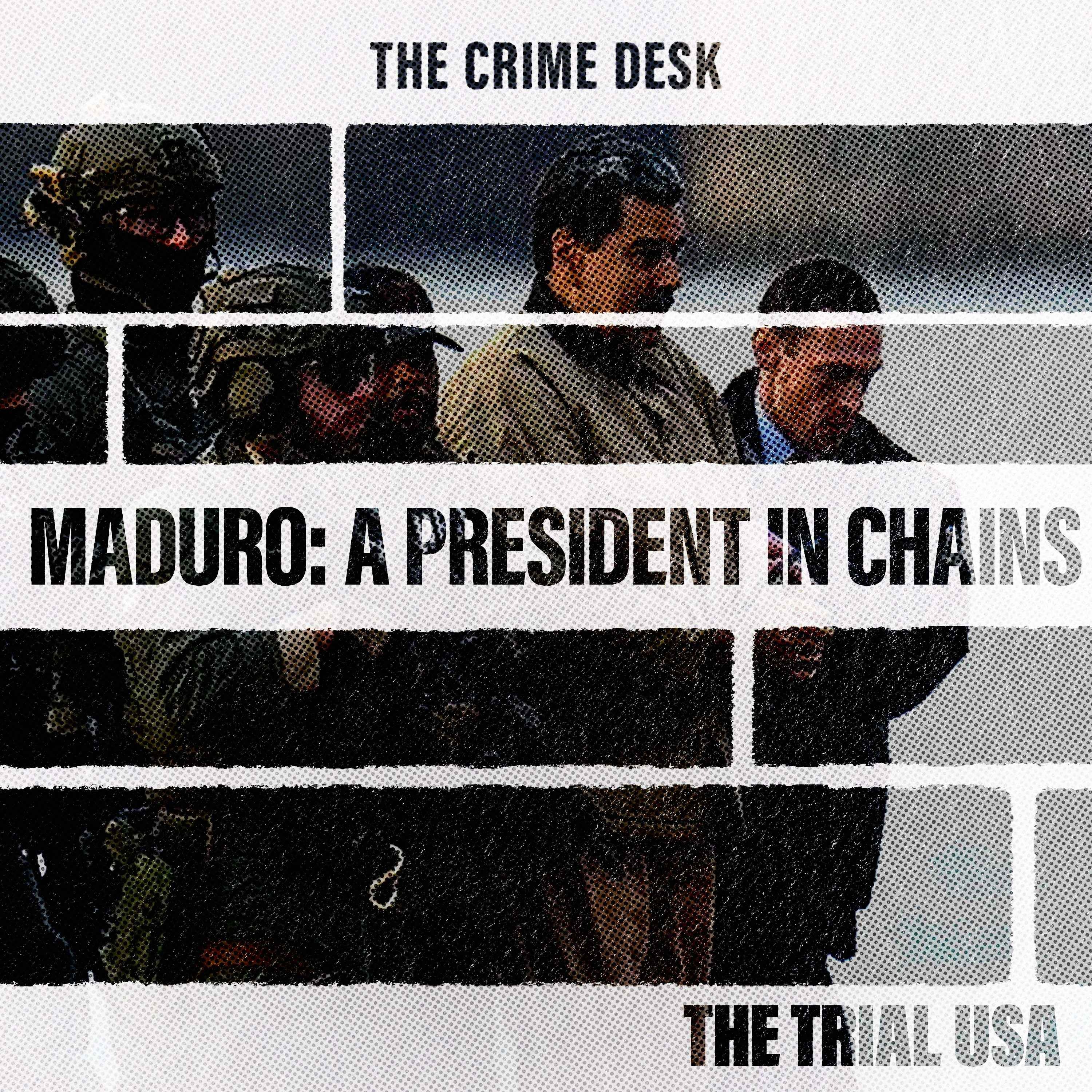
First, the week in crime this year has begun with a story that stunned the world. Former Venezuelan dictator Nicolas Maduro was captured in a covert US OPER and brought to court on American soil. An extraction so audacious it's raised urgent questions about power, secrecy and security at the highest level. We spoke to elite security expert Will Geddes to understand how an operation like this is even possible and how it stays hidden. Also this week, a fatal ice shooting in Minneapolis and a brief court appearance in Los Angeles for Nick Reiner. But first, our interview with security expert Will Geddes.
- [03:44]
Will Geddes
Will geddes, Security Specialist and Managing Director at the International Corporate Protection Group, thank.
- [03:50]
Kayla Brantley
You for being here with me today.
- [03:52]
Will Geddes
My pleasure. Thank you for the invite.
- [03:54]
I want to know your initial reaction when you heard that one, the US has gone into Venezuela and two, that they have captured the leader and his wife.
- [04:07]
Well, in two parts. When we look at this particular operation, Absolute Resolve, as it was termed, we're seeing something which has been escalating over the preceding months, obviously up until this actual assault itself and extraction of President Maduros and his wife. And what we've seen is some exercises being Undertaken by the 160th Special Operations Aviation Regiment, who are renowned for assault operations, particularly with Tier 1 Special Forces units within the United States. So there was some anticipation that we might see certainly a land based assault of some type, whether that be a precision strike on specific facilities and military capabilities within Venezuela, or whether it be something slightly more ambitious, as we saw, with the extraction of the President himself. The reason why the United States certainly see Venezuela as a viable option is really twofold. The first on a very low level is the fundamental insertion by Venezuela and certainly by cartels within the criminal underworld who have been exporting and transporting narcotics into the United States, which has been a prolific problem for many, many years. And this, if you like, trade stream of, of drugs and narcotics being smuggled into the United States has had a dramatic impact certainly on the United States itself. And something had to be done. And although many international special forces units, including those from the United Kingdom have been involved in counter narco operations, the weight and the sheer mass of drugs that are being moved over this was a highly organized trading stream which was being utilized and had to be stopped. But in addition to that, there is a far greater macroeconomic situation and consideration that needed to be taken under advisement by President Trump and by Peter Hexworth and the team were very much towards the infiltration into Venezuela by hostile states that we could include within China as well as Russia and also potentially Iran, who have been ingratiating themselves into Venezuela, which is naturally in contravention to the sanctions which are currently in place against Venezuela and the enormous oil reserves and precious metals and mineral reserves that are available within Venezuela. These were being exploited by these foreign states which would put them in a very capable position for a number of other actions that they may consider in the future.
- [07:02]
And you have a securities background. Can you explain what it takes to.
- [07:08]
Kayla Brantley
Execute something of this scale to go.
- [07:10]
Will Geddes
Into another country and extract their leader?
- [07:14]
There is a number of different parts to an operation like this, and the complexity of each of those parts brings its own weight and brings its own risks and issues. The first of which is obviously the planning and the feasibility and viability of undertaking an extraction operation. And having been involved in a number of extractions, nothing of this profile, I should add myself over the years, one has to look at the ability to be able to extract your HBT or high value target. Now when it comes to an extraction, you are very reliant on local intelligence, whether that be individuals that within closer proximity to the hbt, whether it be other assets that have been cultivated by intelligence agencies. And therefore it's highly likely in this particular operation the CIA had recruited a number of individuals that were going to assist in this effective extraction of President Maduros, especially when one considers how quickly this operation was undertaken within. The second thing is looking at the viability of actually getting your assault team within the country safely and within a secure corridor where you can disable any kind of countermeasures, whether that be ground forces, aviation defenses and various other different means of defense which the country might use to try and repel any intruders or invaders. So there would have been many, many months of planning of this particular operation to see the levels of detection on close proximity to the country. And this certainly is believed to attribute to those recent 160th saw operations which were running off the coast and certainly in the interventions and interdictions of some of the drug boats which were moving out of Venezuela. Now we know that there was a ground force of approximately 200 military that were inserted, but prior to that they had to disable obviously the ground to air defenses of Venezuela, create that safe corridor for three types of aircraft to potentially penetrate. And that includes obviously Chinooks which would take in the 75th Ranger Regiment, the were providing the ground support. Then you had Black Hawks, which no doubt were carrying the Delta Force team members, the Tier one operators that would actually carry out the assault and extraction of President Maduris and his wife and repel any individuals or obstructions that would stand between them and that extraction. And then Little Birds, which are the small helicopters which I've seen many of in my time, which would provide dominance of Overwatch by ensuring that it could repel obviously again, any additional hostile forces which would try and intervene or prevent Delta Force carrying out their task.
- [10:12]
One report I saw that was interesting is that these elite forces actually had mock houses of Maduro's house where he was staying, and that was something that they practiced on, on how to extract him. Is that something that's normal in these cases?
- [10:27]
A standard modus operandi for Tier one Special Forces, whether it be an extraction or a hostage rescue for that matter, or the assassination of a high value target, will carry out intrinsic research in building life size models of the environment that they're looking to attack, whether that be a residence or whether that be, for example, a military base. They will work to the finest details. And again, the intelligence that's being gathered on the ground and through satellite operations and other covert technology would enable them to build to scale that environment which they will be choosing to infiltrate. It is rare that they will go in blind to an operation because again, the chances or probabilities of success are going to be greatly diminished without being fully prepared. And that detail goes down to even the types of locks that are on the doors, the thickness of the walls, the types of windows, whether it's reinforced glass or secured or concentrated glass, which would prevent again, insertion. So that the Tier one operators can even determine the type of parabellum that they may be needing to use, the types of ordnance or explosives that they may choose to use and how they will do their entries, whether it will be using shaped charges on doors to effect entries, or whether it be just simply booting the door in.
- [11:54]
Can this be considered a failure of Venezuela's defense or did they just not even stand a chance against the US.
- [12:02]
Well, there are some serious questions that need to be asked and it's very unlikely we're ever going to get the answers to, which is how this operation was affected within such a short operational window. Especially when we look at the extraction itself, which is believed to have been less than 30 minutes in the infiltration by the Delta Force operators to the removal obviously of President Maduris and his wife, the movement onto the aircraft, onto the Black Hawks, and then obviously the extraction out of the area because it's believed that President Maduris was within his palace, which is fortified. He would have had his own personal bodyguard. So whether he was complicit in this extraction or not, or there were parties within the palace that were going to assist and enable to ensure, for lack of better words, certain doors were unlocked and opened which would expedite this operation.
- [13:00]
Yeah, when you say that, it is really remarkable how quickly and how easily things appear to have happened. Of course, we don't know every detail, but now Maduro is being held in prison in New York. Is there a chance that Venezuela will pull a reverse tactic and try to now extract him from the U.S. is it possible? And how does the U.S. prepare for that and really defend that from happening?
- [13:27]
The likelihood of a counterextraction of President Maduris I think will be slim to zero. He will be held within a secure facility. He will be secured by very likely either current or former special forces operators who will be more than prepared to for any intrusions or any attempts that might be to free Maduras. Where it's going to be interesting from now is the processing. It's highly likely that the first stage of the movements of the extraction was to Miami and then from Miami up to New York and again from New York. He will potentially be moved to another secure location, again where he can be guarded and held until such time as he he's followed that process.
- [14:12]
Kayla Brantley
We're taking a quick break after this.
- [14:22]
Progressive Insurance Announcer
This episode is brought to you by Progressive Insurance. Do you ever think about switching your insurance companies to see if you could save some cash? Progressive makes it easy. Just drop in some details about yourself and see if you're eligible to save money. When you bundle your home and auto policies, the process only takes minutes and it could mean hundreds more in your pocket. Visit progressive.com after this episode to see if you could save Progressive Casualty Insurance Company and affiliates. Potential savings will vary. Not available in all states.
- [14:49]
Christy from Back to the Bar
Hi, this is Christy from Back to the Bar. You've probably heard about GLP1 weight loss medications and the side effects that can come with jumping in too fast. That's why I love Noom. Makes getting started easy. Their microdose GLP1 program begins with a smaller dose and gradually scales up based on how your body reacts. The Noom GLP1 microdose program starts at $99 and is delivered to your door in seven days. Start your microdose GLP1 journey today at noom.com that's n o o m.com Noom micro changes big results average weight loss.
- [15:23]
Back to the Bar Disclaimer
8 pounds in first month. Meds and personalization based on clinical need and not available to all individuals. Medications are not reviewed by FDA for safety, efficacy or quality. Pricing based on first month only.
- [15:38]
Will Geddes
It is interesting because I'm based in New York and he's being held right in Brooklyn where I could take a train over and see the facility in which he's being held versus kind of being held in one of these more secretive places or a Guantanamo Bay or something like that. Do you think that was strategic to put him in the prison where we have Luigi Mangione and other high profile inmates?
- [16:05]
It is an interesting choice that they put him in a general state federal prison to be held, but then again, this is a highly secured federal prison, so it already had the infrastructure in place. The risks that you have using a black site, for example, means that again, there's huge amounts of resources that need to often be applied to this. There is a greater chance of a potential counteraction. But again, it's discovering where that black site is, which is generally, one would hope, virtually impossible. But to hold him there, again, it may be due to the due process of the judicial system of how he's going to be processed and where he's being processed, which will mean that his locating in Brooklyn probably makes the most viable sense. And the movements between the prison and wherever, whichever court he will be processed in will probably be a very short distance and falls under what we call the journey management, which is where they will secure the route from the prison to the courthouse or the facility where he will be processed will be very, very easy to control.
- [17:15]
A question here that's on everyone's mind is, you know, according to international law or domestic law, is this extraction legal?
- [17:26]
That's a good question. Is it legal? That's a very difficult one to answer. And I'm probably not your guy for that. I'm more of a security guy than a lawyer.
- [17:36]
I appreciate your honesty. Thank you. But it is the question that everybody's wondering. How can you go in and break into someone's house, bomb a country and pull out their leader? If that happened to the US we would be up in arms. But then you look at the celebrations of the people in Venezuela and that really kind of bolsters, you know, the Trump administration's decision to go in and having that type of morale is very interesting. I do wonder if there are any other security insights that you could give us. Whether it's the equipment that was Used. I know you gave some great insight on some of the helicopters. I'm not well versed in weapons and things like that, but yeah, if you had any other insights or anything that you found very interesting.
- [18:23]
Well, I think in terms of this kinetic operation, and we have to recall or certainly remember that these kinds of operations are going to make huge reverberations around the world. They are a very loud statement. And it is a statement which Peter Hexworth and also President Donald Trump will no doubt want to communicate to their foes and to hostile states. They want to send a very clear message that if we want to come and get you, we can come and get you. And that should, to a certain extent, put those hostile states on the back foot. Now, in terms of this operation itself, there is a lot of information that won't come to light, but we have to look at how quickly this operation was conducted. And to remove and disable the ability of a country that had significant ground to air capabilities to repel invaders, to be completely nullified and disabled within a really short period of time shows the level of ground intelligence that had been gathered and coordinated in advance by and on the day of this mission. But secondly, the technology that the United States had used to disrupt those air defenses, because although we saw some explosions, there will be some very, very sophisticated technology that will have been used to interrupt and disrupt radar, for example. Now, we know that the 160th Special Operations Aviation Regiment are highly, highly experienced at running the gauntlet on high risk operations, inserting Tier one operators. And what we saw there quite often, and we saw on the day was that they will come in exceptionally low so that they are trying to defeat radar wherever possible. But they still, even by doing so, will need a corridor, a safe corridor to be able to get to their target. Now, that requires the research to know what aviation defenses there are around that corridor or around the choice of corridor that they may be seeking to utilize. And therefore, these could be technologies that wouldn't necessarily be implemented from aviation, like drones or from aircraft. They could very well have been implemented by human sources and capabilities on the ground that needed to get close enough to those aviation defenses to be able to disable them.
- [21:00]
Christy from Back to the Bar
Wow.
- [21:01]
Will Geddes
I mean, the extraction took, as you said, about two hours, you know, 30 minutes just to get him out. But this did take a lot of planning. If you had a estimate how long this planning was and how many resources, how many people it took to pull something like this off, what would you say?
- [21:22]
That's a good question. I would Say this has certainly been a minimum of six months in the planning. I would say it's more likely even potentially a year or more. And certainly it would have been a growing intelligence brief by the CIA as to what was happening on the ground. And there is also the recruitment of local assets that are going to provide intelligence back to the United States and to the intelligence agencies to inform them of particularly hostile state actors that were having meetings with Maduras and members of his government team, whether it be the defence or the Interior ministers. And again, looking at how those assets might be potentially measuring the volume of activity. And as we know, there is a container ship that is trying to escape from Venezuela to try and head, as we believe, towards Russia. And they have used a number of what we call ghost ships to try and smuggle oil out of Venezuela. And the United States is looking to interdict this vessel, not to destroy it, but to potentially to confiscate it and obviously its cargo. So the timing that would have been involved would have been extensive, the planning would have been extensive. And then it was looking at the right moment, the right opportunity. And it is believed allegedly that Maduris deputy did meet with United States officials in the Middle east to discuss a potential succession plan and about Maduris potentially being removed. There have been situations, whether this applies in this particular case or not, where dictators or leaders that have been undemocratically positioned in those points of power or those leadership roles have been told, you have two choices, you either leave willingly or we will remove you. And again, it's down to what that removal might interpret to be. It could be either extraction, as we've seen, or it could be assassination.
- [23:29]
And we clearly have our answer here of how that went. Well, thank you so much, Will.
- [23:35]
Kayla Brantley
Thank you for being here.
- [23:35]
Will Geddes
My pleasure.
- [23:36]
Now that we've broken down how the.
- [23:37]
Kayla Brantley
Operation unfolded, here's where Nicolas Maduro stands in the eyes of the law. The Maduro and his wife, Celia Flores, were arraigned this week in federal court.
- [23:46]
Will Geddes
In Manhattan on a superseding indictment that.
- [23:49]
Kayla Brantley
Includes narco terrorism, conspiracy, cocaine importation conspiracy and weapons related offenses tied to drug trafficking. At their first hearing, both pleaded not guilty and remain in federal custody at the Metropolitan Detention center in Brooklyn. Flores appeared with visible bruising and her attorney said she may need medical evaluation. Their next scheduled Court date is March 17, when pre trial proceedings will begin, including likely defense motions challenging the prosecution's authority and possibly asserting Maduro's claim of sovereign immunity. As of now, no formal trial date has been set. The March hearing will help determine whether this case moves forward toward a full trial or whether legal arguments over jurisdiction or immunity will narrow the path ahead. In other words, the arraignment was just the start, and the legal battle shaping this unprecedented prosecution is only just beginning. We'll be back in a moment with the other crime stories dominating the headlines this week. First, an important development in the case of Nick Reiner and one that could significantly shape what happens next. The 32 year old appeared in a downtown Los Angeles courtroom charged with two counts of first degree murder in the December killings of his parents, Rob Reiner and Michelle Reiner. Reiner remains held without bail in Los Angeles county custody. He has now been taken off suicide watch and no longer appeared in a protective smock, an indication that jail officials believe he is stable enough to proceed through the court process. Then came the moment that stunned the room. His defense attorney, Alan Jackson, abruptly withdrew from the case. Jackson is among the most prominent defense lawyers in the country, known for handling some of the most complex and high profile criminal trials of the last decade, including representing Karen Reed. His departure this early is rare and strategically significant. It points to several possibilities. First, money. Elite criminal defense at this level can cost millions, and the move strongly suggests the Reiner family is no longer privately funding Nick's defense. Second, strategy. In cases involving mental illness, addiction or a potential insanity plea, disagreements over how to fight the case can fracture a legal team quickly. And third, once early discovery is reviewed, the strength of the prosecution's case can dramatically alter how defensible a case appears. From here, Reiner will be represented by a public defender, marking a major shift in resources and direction. His arraignment has now been scheduled for Feb. 23, when he's expected to formally enter a plea. Prosecutors are pursuing first degree murder charges, meaning Reiner faces the possibility of life in prison without parole and potentially the death penalty. This is where the shock fades and the legal consequences begin to harden. Now to Minneapolis. A woman was shot dead this week by an ICE officer during a federal immigration enforcement operation in south Minneapolis. Homeland Security has described the operation as one of its largest to date. Federal officials say the officer fired in self defense, alleging the woman used her vehicle as a weapon. But Minneapolis police have publicly disputed parts of that account, confirming that shots were fired before the vehicle crashed and that the FBI is now investigating. The shooting has ignited immediate outrage in a city still defined by the killing of George Floyd, where any fatal use of force carries deep historical weight. As the investigation continues, the case has reopened. Urgent questions about federal authority, accountability and the use of lethal force, questions that are unlikely to fade anytime soon. The woman has been identified as 37 year old Renee Nicole Good, a mother of three, a beloved wife and daughter. That's it for today's episode. But these cases are moving fast and the next hearings, filings and decisions could change everything. So join us next week as we continue tracking the trials that will define 2026. From first appearance to final verdict, you won't want to miss what comes next. This is the Trial USA and I'm Kayla Brantley. Thank you for listening. Foreign.
- [28:11]
Acast Ads Academy Announcer
Upskill on one of the most effective ad channels out there with Acast Ads Academy, you can learn everything you need to plan and run podcast advertising campaigns completely free. Whether you're new to audio or ready to sharpen your skills, our self paced courses fit your schedule and finish with an industry recognized certification. So if you want to grow your expertise and stand out in a competitive industry, head to go.acast.com academy.