← The Twenty Minute VC (20VC): Venture Capital | Startup Funding | The Pitch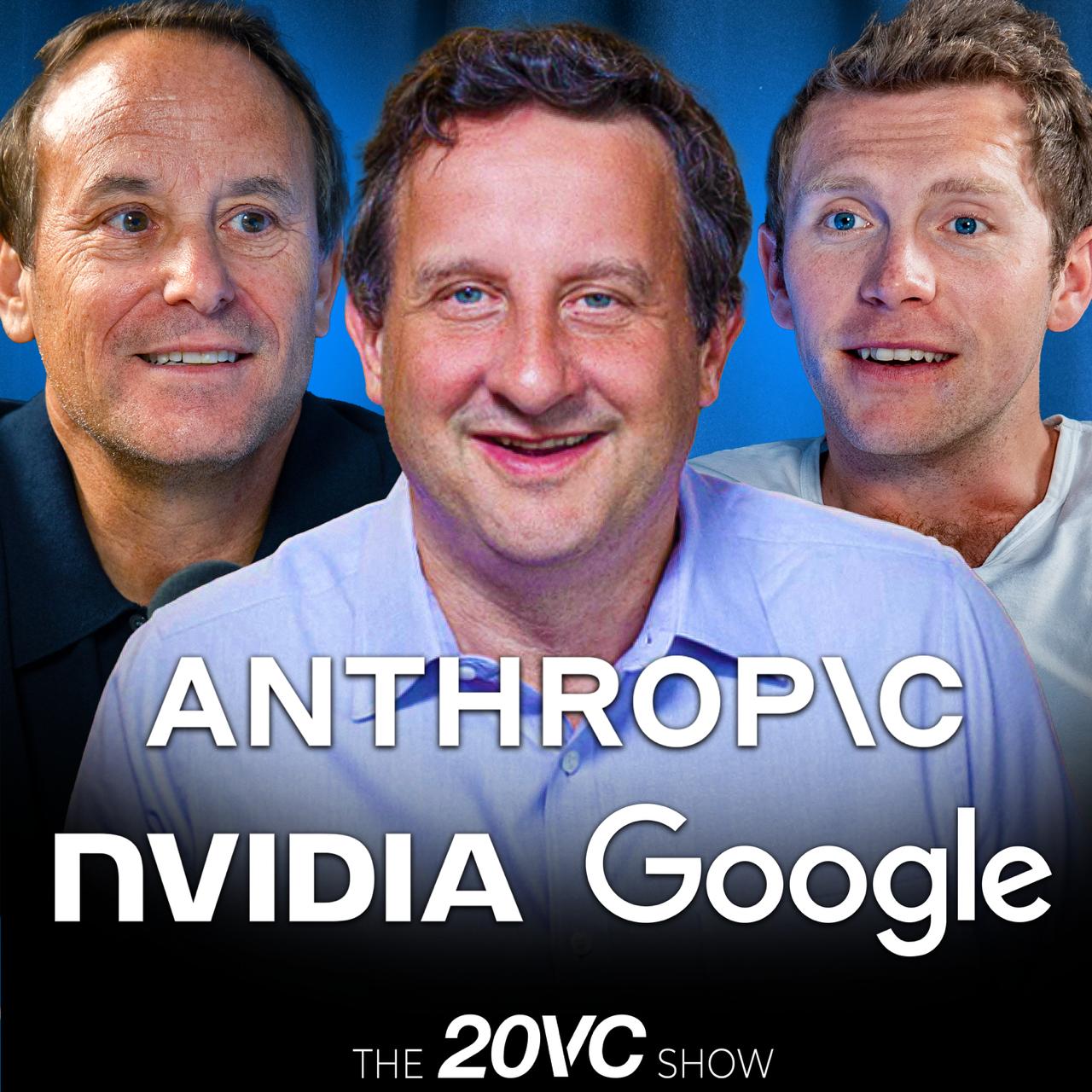
The Twenty Minute VC (20VC): Venture Capital | Startup Funding | The Pitch
20VC: Anthropic Raises $30BN from Microsoft and NVIDIA | NVIDIA Core Business Threatened by TPU | Sam Altman's "War Mode" Analysed | Sierra Hits $100M ARR: Justifies $10BN Price? | Lovable Hits $200M ARR & Rumoured $6BN Round
01:30:10
Loading summary
Transcript224 lines
- [00:00]
Rory
The PE on Nvidia to give that sound bite that I love. It's lower than the PE on Costco.
- [00:05]
Jason
I don't care about your talk. I don't want to hear about your pilot. I want to smell that your team is in hyper aggressive mode. If it is, I think you can come back. I do not think you can push your team too hard. I think you should push them as hard as the business needs to go. And if they leave, it's great. Salesforce could be the next Google. It could be in 18 to 24 months. We could be like oh my God, Asian Forest crushed it all. These startups, we didn't need them because. Because Agent Force is so good.
- [00:30]
Rory
The Great American Tech Mag 7 suck more of the world's profit dollars out of the rest of humanity. Go team.
- [00:37]
Harry
But before we dive into the show today, now, most people who get scammed never talk about it. And if it can happen to tech savvy professionals, CEOs and investors, it can happen to anyone. But the problem isn't just losing money. It's that today's scams, they're built differently for a very new world. One where AI can generate convincing messages in seconds and fake sites look more sites than the real thing. Traditional tools were not built for this future. And that's why Guardio exists. Guardio is this incredible predictive and proactive engine. It leverages advanced AI threat detection to block highly targeted, socially engineered scams before they ever reach you. From phishing emails and fake login pages to financial fraud, Guardio protects you across the ways people actually live and work online. And security shouldn't be complicated. Guardio continuously monitors across all your accounts and devices, uncovering risks in real time and guiding you to close gaps before attackers exploit them. Trusted by over a million users, Guardio is setting the new standard for personal cybersecurity. Visit guard.IO 20vctoday to start your seven day free trial. Because the threats of tomorrow, they're already here. And Guardio is built to stop them. After Guardio protects you from what's out there on the Internet, Squarespace helps you put your work out there. Every dream needs a domain. Bring it to life. With Squarespace, your custom domain comes with everything it should. Powerful, built in security, award winning support and tools that help you grow. For an upfront transparent fee, no matter where you are in your journey, do more with a domain. Go to domains.squarespace.com 20VC and get 20% off your dream domain with coupon code VC20. That's VC20. And finally, we have to speak about our newest sponsor, it's Intercom. If you're looking for a way to transform your customer service, let me introduce you to Fin, baby. Fin is the number one AI agent for customer service resolving up to 93% of customer queries automatically. There is no other agent that can do that.
- [02:54]
Owen
Not 93% of customer queries. Okay.
- [02:56]
Harry
No other agent can do that. So why choose fin? Fin is the best performing AI agent for cs. Fin doesn't just answer questions, it takes actions. It automates the most comple complex customer queries like refunds, transaction disputes, technical troubleshooting with speed and reliability. I wish my team was speedy and reliable. Beats every competitor in every head to head bake off, completely configurable and code optional setup.
- [03:22]
Owen
My word.
- [03:22]
Harry
I mean the benefits just go on and on. It's easy and efficient implementation. It works on any help desk with no tedious migration needs. It's trusted by over 6,000 customer service leaders, including top AI companies like Anthropic, Lovable, Synthesia, Clay Vanta. So if you're ready to transform your customer service team, scale your support and give team members time to focus on the really high level strategic work. Learn more about FIN at FIN AI20VC.
- [03:51]
Rory
You have now arrived at your destination.
- [03:54]
Jason
It is very exciting to be at the new upgraded 20 VC studios. It's exciting here.
- [03:59]
Owen
I mean, thank you, Rory.
- [04:00]
Harry
We miss you.
- [04:01]
Owen
It's not the same without you here, but thank you for joining us.
- [04:04]
Rory
You're welcome. You'll survive.
- [04:06]
Harry
You know what?
- [04:07]
Jason
We will.
- [04:07]
Owen
But we want to start with the.
- [04:09]
Harry
News of the day. So Anthropic secured up to $15 billion.
- [04:13]
Owen
From Microsoft and Nvidia, pushing valuation to 350 billion with commitments for $30 billion in Azure. Compute. You can see I'm learning from prior episodes in setting the context.
- [04:27]
Harry
Let's start there.
- [04:28]
Owen
How did we analyze that?
- [04:30]
Jason
It was pretty funny watching Twitter this week where like a week ago they were like, OpenAI is dominant. Three days ago it was like Gemini 3 Pro Mark Benioff's like, I'll never go back to ChatGPT again. And today it's Cloud 4. 5 has crushed everything. My point is like there's just no stability. There's no stability in seed investing, there's no stability in Anthropic. So my meta learning, which I wouldn't have even had a couple of weeks ago, is more power to them because I think you need infinite capital when there's no stability. It's just so funny. I mean, Literally three days ago it was Gemini. Today it's Anthropic, what will it be next week?
- [05:07]
Rory
But there was a bunch of stuff in it in the announcement, I mean first of all you glossed over the key fact it was from Microsoft. This was the Nvidia Microsoft commitment to Anthropic and Microsoft was the, you know, was in a monogamous relationship with OpenAI and then OpenAI wanted an open marriage and Microsoft said well if you want an open marriage, I want one too. Right? Yep. So this is probably inevitable in the context of that. That's probably the first big piece of news from it which is it's the Microsoft and then the structure of the deal. It's the usual thing, you get $15 billion, you promise to spend $30 billion. That structure we've seen before. And then the other interesting thing, you didn't mention it, but in the same announcement I think Anthropic also said they're going to break ground on a physical data center. So that's another one of the model companies saying it's not enough to rely on compute from your service providers, be it Azure, be it aws. They also are looking at doing physical data centers themselves. So it's another chapter in the infinite capital and everybody's sleeping with everybody war.
- [06:11]
Jason
Have we just decided we just don't care about round trip revenue? Like many things in this era, we just given up caring. There's so many things we used to care about in the past and now, now we just want to get rich with AI. We don't care.
- [06:22]
Rory
In a bull market nobody cares about everything. And then in a bear market everybody discovers why you were meant to care. And now we're in the don't care part of the trade.
- [06:29]
Owen
Don't care, right.
- [06:30]
Rory
And again, as we said before, provided it works, it's all fine. And for what it's worth, if you're a chip provider and you have to stick some money in one model provider, this one feels like a pretty good bet. So zooming out of all the round tripping deals, I would argue a Microsoft entropic Nvidia deal probably has better principles and upside than most. I mean some of the other round tripping deals look like they're already a bit shaky.
- [06:56]
Owen
Totally get you that you said about the importance of verticalization in terms of the data center play that's added onto that deal. Another very important bit of news was Google trained Gemini 3. Obviously people very impressed with the quality of Gemini 3, Benioff included, saying that it's trained on its own TPUs their own chips. For people that aren't aware of TPUs, Elon's AI company, XAI, developing its own AI inference chips. Question of verticalization, as we said there, with owning the data center layer, does everyone now need to own the chip layer as well? As we see more and more with.
- [07:29]
Harry
TPUs, with Elon Musk, is that the.
- [07:31]
Owen
Next phase of verticalization?
- [07:33]
Jason
As you guys know, I use repl.it two hours a day. A little less on my London trip. No, but it is. But it's good to learn, right? I'm in the top 1% of users. Lovable is great too. You know they added Gemini 3 Pro the day it came out, as did everybody. Right. I instantly used it. It was great. It actually wasn't so much better. What everyone said is it's better for design. Lovable said it rebel. Everyone said I would say it was 20% better for design, but that wasn't. The interesting part is I used it, it worked great. And then in my next prompt I roll, I roll back to Claude. It was fine. So not only are there different models, but abstracting a couple layers above, we're switching between TPU's and models. And I don't care. And I'm not saying these aren't huge issues, but the idea that Nvidia is unstoppable because of the software and hardware connection, because we have to have GPUs. I know there's a lot of truth to that, but literally, as an end user, I went right back and forth from today. No, no issue. GPUs, GPUs, LMS, all in the space of 60 seconds or maybe three minutes.
- [08:27]
Rory
The big picture question is you're. Does every large vertical integrated company have to do their own chips versus buying from Nvidia? And the reason you pose that question is Google obviously has their own TPUs, which is an internal chip, which I believe for what they do is faster. I think the interesting thing here is what you got to DO is separate 90% by customer count of Nvidia's customers. If you're spending a million, 2 million, 5 million, 10 million with Nvidia, it's in the noise. And you're not going to design the mount and build your own chip. That would be madness. The odd thing about the Nvidia business, unlike most other businesses, is 4 or 5 of their customers account for 80% of the revenue. Something like that. 70, 80%. Looking at the other side, if you're spending. Google is spending 90 billion this year on Capex rough rule of thumb is around 40% of the total dollars are on compute. So if they were buying Nvidia chips, they'd be spending, what's that, $36 billion on compute, literally just on chips. If you're spe $36 billion and then that $36 billion is knowing Nvidia at 75% plus gross margins, which means you're handing Nvidia, if you were buying all that from Nvidia, you're handing them north of $20 billion a year of profit at the margin. At that point you say to yourself, well, it's hard to build a chip and if I was spending 10 million, I wouldn't bother. It's probably going to cost me back. When venture guys did chips, it was 200 million bucks to get to a chip. Probably today it's a billion dollars. But if you're spending 20, if you're giving someone $20 billion of profit a year and you can say to yourself, maybe I can invest a billion, maybe a billion a year for five years. Get a compelling chip, you got to look at that. And the reason all that makes sense is just how concentrated the customers are. And it's the old rule. The more customers you have, the easier it is to charge them a little more and the harder it is for them to take your margin. Back when intel was winning in the CPU wars, they had, you know, pick a number, 100 billion customers. 100 million customers. Because we were all customers. We all gave them 200 bucks for our Pentium. Nobody cared. In this case, Nvidia has five or six customers that are spending the vast bulk of the revenue with Nvidia. They're making 75% gross margins. So every one of those big customers should be saying it's damn hard to build a semiconductor. I probably a little bit disagree. One point Jason made, I don't think that it's easy to build a TPU that can also be rolled out to everyone with all the queueda support that Nvidia has. But even if it's just used internally, first of all, and I can save that $20 billion of profit, hell, I gotta look at that if I'm Google, I gotta look at that if I'm Amazon, I definitely gotta look at that if I'm Tesla. So yeah, I think that's an interesting medium term pressure point on the Nvidia profitability story. It's not overnight and it's not gonna make sense for most people. You have to be pretty damn smart technically to ship a comparable chip but in a world where you only have six customers that matter, having one of them say I got a better product myself is a significant event.
- [11:33]
Jason
Especially if I'm OpenAI which is burning even more money. Anthropic. I've got to be thinking, man, if I could cut 2/3 of the cost of my compute, think about my business. I go from one of the biggest cash hemorrhaging businesses of all time to a profitable business. Maybe 2/3 isn't quite the number, but I'd be relentless about the bar keeps going up, we talk about it, but ultimately, if I can cut 20 billion, 30 billion, all of it, it's a big deal.
- [11:58]
Owen
Replay what we've just said in the last five minutes. It is the most obvious threat to Nvidia's business. What are Nvidia thinking about this internally? Jensen must see this very clearly.
- [12:08]
Harry
How does he respond and how do.
- [12:10]
Owen
They protect their business in the wake of being so concentrated and losing those customers?
- [12:15]
Rory
Yeah, first of all, there's a reason why they sponsor the core weaves and the next generation of Neo clouds, because they're like, those guys ain't going to build their own chip. So, you know, a simple, humble 20 billion market cap company does not have the capacity to build their own chip. So it suits them to have the market for cloud, compute and AI be a little more diversified than concentrated. So anything that can make that happen is in their favor to some extent. That's all they can do. They don't have a ton of leverage over Google. And obviously now Google is starting to talk about selling those TPUs to others. So it's a threat. Now what they would say, and they would be correct, is for most uses because they have such dominance, such validation of the CUDA software layer for most customers, it's going to be too much brain debt to switch from the gpu, you know, and love to something new. Right. Because there's probably a significant activation energy. Right. And that's going to be true for most customers. The long tail of Nvidia customers aren't going to do it. But you're right, Harry, the threat is all you have to do is peel off one or two of those big margin cows and you're done. The only thing that perhaps, and this will be interesting to watch, that perhaps protects them is the biggest potential alternative customers for the Google TPU are Google's sworn enemies. Yeah, Microsoft, Amazon, maybe OpenAI to the extent they want to do, data centers would be the obvious next places to go because they're the other people who are doing so much compute that it will be worth their while to try and digest tpusc. That's interesting. From Google's game theory perspective, do they do that, take the capital, or do they continue to just keep it in house and have a structural cost advantage? Don't have the answer there, but it's outside Nvidia's control, I think, Harry. I ramble a little, but to your point, it is to some extent. There's only so much you can do if you only have five customers and one of them wants to diversify away from you.
- [14:07]
Owen
It's the core risk of Macaw, of surge, of Turing, of all of these data providers being that they have all two customers that are more than 50% of their revenue for all of them. And the bet that you're taking on the risk that you're willing to underwrite there is that actually it's not a core function of matter or Amazon or Microsoft, and they won't go after the data acquisition market themselves because they can just spend the money with them and it's good enough.
- [14:30]
Jason
I actually think we're just ignoring the risk because Nvidia's numbers are just too good. No, that's what we're all doing. We're ignoring it. This is. This is systemic risk. I mean, back in the day, Twilio losing Uber as a customer, 12% of its revenue gone. This would be much bigger. But when the numbers are there, we're just ignoring it. We're just ignoring it. You don't wish you invested in Nvidia five years ago? I mean, of course you do. You got to play the game on the field. Even public market investors have to play the game on the field.
- [14:55]
Owen
So do you think Nvidia is overvalued today?
- [14:58]
Jason
No. The amount of compute. I mean, what did Google's head of infrastructure say this week? Google needs a thousand times more compute in five years than it has today.
- [15:07]
Owen
1000X in four to five years.
- [15:09]
Jason
It's difficult to believe Nvidia won't be a leader in that time. So, I mean, oversimplifying where all the chips will go and Blackwell will go, that's a lot of growth to invest in 1000x on compute, if not chips. 1000x, that's better than most SaaS companies right now. I don't know many SaaS companies predicting 1000x growth at scale.
- [15:27]
Rory
I actually want to go back to the first question you asked the customer concentration, because I often think it's interesting for people who listen to get a sense of not just in the public markets, but how we all think of it as investors. Because you're absolutely right, Harry. The big question on all the data labeling is a good example. Any of the AI compute co attach bets was there's only four or five customers here. And the logic you had to use was in the hyper growth period, your customers, be it OpenAI or someone else, isn't going to have time to optimize for efficiency. They're going to be running fast. And in that period of time you can create huge value. And we saw scale AI created huge value. And then you're right. The fear would be when things slow down and people start moving from optimizing effectiveness to optimizing efficiency, then those businesses get tough. And as an investor, you're always tempted to do them. I mean, I will admit I was scared of the data labeling companies and I was wrong. There was a period of a couple of years where they clearly worked and worked really well. The interesting thing will be, will they continue to work for the next three to four years if in fact dollars get a little more scarce? How do you think about investing a company that logically only has four or.
- [16:40]
Owen
Five big customers specifically on the data labeling market? This is one where I've interviewed the founders of Turing Scale Macaw Invisible. I've pretty much interviewed all of them, Serge. And the one thing that made me actually feel incredibly comfortable investing in the category was understanding the specialized data requirements that the large providers need. I hadn't quite thought about the very verticalized data requirements, whether it's surgical data, whether it's bookkeeping, accounting data that all of these different players are going so deep into and it's so specific and in some cases strange and weird that.
- [17:15]
Harry
The large customers are never going to.
- [17:17]
Owen
Churn or pull away from them because they are so verticalized. And when I got comfortable with that, I was like, oh, I'm okay to take this risk and underwrite it, because I don't think they're going to churn.
- [17:27]
Rory
That's super helpful and insightful. How? Yeah, because you're right. If you only have a small number of customers, then you know at some point they're going to optimize. So then you get into, you have to have something they can optimize around. And then after, if you have that, then the last skill you need to have, the next skill you need to have as a CEO is an ability to play extremely good poker because you got to look them in the eye and say, I know that your $20 million contract is my biggest contract. But I also know that my data is your most important data. You're right. There's drama, there's tension, but you're right. You wouldn't want to be doing a commodity data labeling play when they start to get to efficiency. ASML that sells primarily to TSMC is the same dynamic. One seller, one buyer to a rounding Erro. And it's not like you can't build businesses in that space, but you have to have something really unique to avoid them pounding you all over. The kind of deciding factor, the swing vote in favor of taking the risk and those kind of deals is the speed at which the underlying market is moving is kind of the get out of jail free card that says, yeah, because in theory you could say you've only got three customers, they will grind you down. But if they've just got other shit to do for the next five years growing the business, they never get around to it. Right. It's interesting. So I think that's to some extent what's happened in the last four or five years, both in the data layer and then zooming out the Nvidia business at a higher level. Yes. Maybe in some logical world, maybe all of Microsoft, Amazon and Google should already have had their own TPU equivalent because they should have known to do this. But there's bigger fish to fry for a long time. And in a run fast world, if you're Nvidia and you're saying, but I have the product now, it's ready to ship, you want to get your compute rolling, you can make money for a long time. Even in a concentrated market, it's only when it slows down. That's why if I look back on the David Label thing, Howie is the earlier you are, the more hyper growth you have ahead of you, the easier it is to be undifferentiated. And by the time the growth slows down, you better either be differentiated or as Jason was, you better be exited.
- [19:31]
Jason
All that matters is growth today, right? I mean, even Palantir is extremely concentrated at its scale compared to what we're used to. It's part of the AI world. Palantir has triple digit customers, doesn't it?
- [19:41]
Rory
I want to go back though to the Nvidia overvalued question. I phrase it differently. I mean, it gets to the same thing. If you look at today's revenue, it's not overvalued. The PE on Nvidia, to give that sound bite that I love, it's lower than the PE on Costco. We talked last week about the earnings before they came out and we recognized it was an odd time because the show had come out after. But it all played out exactly what we thought, which is there was no surprise on the earnings because all the hyperscalers had announced the quarter we a month beforehand and they'd all said, right now we are buying more stuff. We are constrained by capacity. So there was actually no data in the Nvidia earnings of any significance. The question is the valuation of Nvidia is effectively a function of the end demand for compute. So if you want to figure as long as the demand continues roughly where it is today, Nvidia is far less aggressively priced, as I say, than Costco or than Cisco in 99 on a PE basis. The question so effectively is Nvidia overvalued? Question really translates to is the demand for COMPUTE as it manifests in 2526 a steady state demand, or is it a cyclical peak and two, three years from now we're not going to be spending $90 billion? That's the primary question. You're right. The secondary question is the whole TPU and substitutes question, but I would argue the first one is the primary one. As long as the hyperscalers and the model companies continue to invest massively aggressively in compute, then with the exception of the substitute risk, Nvidia's business is safe. So you're really saying at the margin, what you're saying is, is Microsoft going to increase another 30% next year? Is anthropic going to invest in compute? And right now all those answers to those questions are yes. My takeaway on this recent you can call them convulsions. When things only move by 5% is not some kind of great correction. It's more the market's doing a pretty decent job of saying, all you companies that are investing, who's doing it well, Google, you can invest more. Your stock goes up, who's doing it badly? Oracle, you, Your stock goes down and the market is doing what markets are meant to do, which is send a signal. And right now the signal is not sending, is my God, don't invest in anything. Which obviously would be catastrophic for Nvidia and for all of us because it's 7% of everyone's s and P. The market's sending a sign that says, those of you that have good businesses investing are doing just fine. Go team, Go Google, Go Microsoft. And those of you that are a bit out there on the risk continuum probably should be thinking about that as.
- [22:09]
Owen
A duolingo shareholder I'm feeling the pain.
- [22:11]
Rory
Yeah, it's been brutal. 70%.
- [22:13]
Owen
Before we move on from this kind of core debate on the core incumbents, Sam Altman did a memo internally within OpenAI and he said that we were in war mode against Google regarding their increasing capabilities and the increasing competition in the space. Does this incitement of war mode ever work? And how did we feel about Sam catalyzing the troops into this proactive state?
- [22:39]
Jason
I've never seen it work. Folks doing this, all the leading public companies say this, we've got to work harder. We're in war mode. It's AI. And listen, I just have always wondered, who are they talking to? Who are they talking to? There must be a handful of folks that it works on who really cares enough to go into war mode. They're already working as hard as they wanna be. I've just wondered. It's not to Wall street is the message, I don't think. Right. Is it to let VPs know they're gonna get fired? It's just something that cos wanna say, right. They wanna tell folks it's time, we've gotta step up. I've just almost never seen anybody react.
- [23:14]
Rory
To that war mode as a metaphor for rallying the troops. I don't know if it works or not. I always find it a little odd. Have you been in peace mode until now? Did you just suddenly discover there was a war? It raises all sorts of weird questions. I also, for what it's worth, don't love the metaphor. Let's be honest, we're a bunch of pampered west coast elite computer people. If you want a war, the US Marines are still taking applicants and you can have a real war. Otherwise. Save the metaphor for someone who cares. So I'm not a fan of the war mode thing, but I think, Jason, you're exactly what are you trying to achieve? Whether it works or not, in my view, is independent of the metaphor. So maybe the better question, to Jason's point, is forget the metaphor, forget the war, forget the work harder. Because you're all working hard. What exactly are you going to do today that you weren't doing yesterday? That would be an interesting question.
- [24:03]
Jason
Well, I will say across every professional experience I've had, from startup to scale up to VP at a Fortune 500 tech company, nothing happens when you're not in hyper aggressive mode. Nothing happens. You think it does and you get releases out, but it's only when you find a way to get that. You can call it war mode, but nothing happens when you're not in hyper aggressive mode. It seems like it happens, but just keeping up with the release, with the TPU schedule, with the bug fixes, with the patches, I mean, if you've ever worked in a tech company, especially a software company, fixing the bugs could take all year. We can't do it. Rory, I know you want to launch that feature, but we have 12 years of technical debt. What about the OAuth? Doesn't work well, you get endless excuses from the team, okay, because it's true. Because you have decades of technical debt and 100 features and you just promised a big customer you'd have this feature that still hasn't come out. And now Numbnuts, Lemkin or Stebbings wants us to do even more. So you can't get anything done unless you're in hyper aggressive mode, like mobile for Facebook. I just don't know if telling the troops works. I've never seen it work. But you do gotta go into hyper aggressive mode. Because I think what he's saying is if we, if we evolve at our current pace, we're going to fall behind. It's just that simple. That's what he's saying. We're going to fall behind. When I meet with startups, especially when you invest later, because your money's already in. Right when they're not in hyper aggressive mode, I don't want to say I lose confidence in case anyone's watching, but I lose confidence because you're just not going to get anywhere. I need to see, especially today when folks are falling behind in AI, when you have companies at scale falling behind. I don't care about your talk. I don't want to hear about your pilot. I want to smell that your team is in hyper aggressive mode. If it is, I think you can come back.
- [25:41]
Owen
What are.
- [25:41]
Jason
If I don't smell it, you have no chance.
- [25:43]
Owen
What are signs or smells that suggest hyper aggressive tea?
- [25:48]
Harry
Founders will be listening to this going the management team.
- [25:51]
Jason
There's a tension in the management team to move faster. Every single person in the management team says, we are shipping product faster. I am selling harder, I'm getting on the road more, I am generating more leads. Every single person on your management team is sweating it and they're executing faster. You can just see, they come to your board meeting, they come to whatever and there is velocity in every area. We just don't see. How many times do you truly see velocity increase in a board meeting? Not that common. Right? That's hyper aggressive mode. Everyone is aligned on this somehow. This makes a great CEO. This is very hard for CEO to do. Everything is anti inertia. Everything slows down even in an early stage startup, right? And then when you come in and everyone's sweating and they're like, you know, we shipped twice the story points, twice the software as last quarter and we're still falling behind. And I'm pissed these days in the area of great job. I just don't see it enough. And that's what you need. You need to make your team hyper aggressive. It is an unnatural state. It is unnatural.
- [26:49]
Owen
If I push you both, who will win? The consumer? Is it OpenAI and the app rollout that they are clearly going to do over the next few years or will Google retain the consumer, the search layer and the app layer that they have today?
- [27:02]
Jason
I think Sergey brought back hyper aggressiveness to Google. He's clear in the interviews. He just said, I came in, we weren't even allowed to use our own tools. We weren't allowed to use our own coding tools, we weren't allowed to use our own chips. He's like, I got rid of that in a week. I heard arguments. I got rid of it in a week. That's what you need. Sergey had to come. As great as the leadership is, I think Sergey had to come back and make it hyper aggressive. I don't think it was the only point. But you need that, you need that. And most of the startups that I see that aren't found to run are unable to get back to hyper aggressive mode. They're just, it is impossible for them. I'm not saying it hasn't happened with Satya, but look at our how many folks in your portfolio without a founder can switch into hyper aggressive node? So you're saying Google, this is a 20 VC. I have to pick between the two.
- [27:45]
Owen
Will Google retain the consumer, the app suite that they have, or will OpenAI continue to eat more and more and more of Google's core business and we will see a much more shared landscape?
- [27:56]
Jason
Listen, I think the same thing most people on X do. I think the Google products are great. I use it every day. I use AI. In fact, I don't even care whether I use AIO overviews or ChatGPT or Anthropic, but I actually prefer AI overviews because I don't have to leave Google. That's a great product. So is Gemini 3 Pro. These are great products. You're not giving me any reason to leave. They're truly great software.
- [28:16]
Rory
I'll answer this question. I actually do Want to come back to the leadership thing, because I want to chat a little bit about that and maybe learn something. But going back to the first question, the Google question, if you listen to the Overwatch stuff a while ago, Google, six, nine months ago, it's like, oh, my God, Google's dead. I was all overbought. Obviously executed really well in cloud and the model. And fundamentally, the core search business has not declined nearly as much. There was an interview with, I think, the head of search in the Wall Street Journal, and she talked about how search. Yes, some places, but search volume is going up as people ask more questions. So it's clear that the decline of search isn't going to be precipitous. That's my clear takeaway.
- [28:55]
Jason
You got that one wrong.
- [28:56]
Rory
Exactly, I got that one wrong. And they're going to be able to get some such. At the same time, I do believe there has emerged a new and separate consumer category of paid subscription for advanced AI. And I think ChatGPT is a good position in that place. I mean, they have, what, 800 million users, 5% of them are paying. I don't see all those users, quote, unquote, going back to Google. I think they've carved their big niche in the attention economy. I don't see it as an either or. Even if the search business slows down growth, I think ChatGPT can build a defensible, large, enormously large consumer business to minor extent, to the extent of Google, and to a more macro extent, a few dollars from everyone. I do think the advertising dollars. We're getting close to the point where the digital advertising spend across Google, Facebook and Amazon, even before ChatGPT exists, is becoming a super high percentage of the total ad spend. So if ChatGPT is going to get their share of that, either we're going to have to grow the pie overall or someone's going to have to lose a little bit. Net Net. I don't think it's an either or. I think Google's proven reports of that debt are greatly exaggerated. I saw in the memo, leaked in the memo that Altman made a reference to grow to falling to 5% in a year or two. And obviously the therapists call that catastrophizing. When you postulate something that's so awful, like this company's growing north of 500% year on year, if it went to 5% year on year, that would be the single most catastrophic growth decline in history. But in terms of likely outcomes, independent of the human dynamic, the likely outcome for me is ChatGPT continues to build this compelling consumer product can command differentiated market while at the same time Google search does not quote unquote go to zero. The pie expands the great American tech mag seven suck more of the world's profit dollars out of the rest of humanity. Go team.
- [30:55]
Owen
Okay, well, speaking of expanding PIs, do you want to add anything?
- [30:58]
Jason
No, no, let's hit pie.
- [31:02]
Owen
Speaking of expanding pies, I'm going to.
- [31:05]
Rory
Go back the leadership thinkers because I just say for me, because I'm not a good rah rah type leader. I was interested in Jason's comp and I'm reflecting on it because I tend to be more the step back person, which I think is why I'd be a mediocre CEO and I'm okay as an investor. It was a great question. What are the signs? You know, as an investor, when do I look at my companies and go, God, this guy's running hot, Right? And I've been thinking about it. It's a simple question. And it's generally when at least once or twice a year, I think to myself, Mr. CEO, and I have one or two in mind. Are you pushing your team too hard? Even though I don't love the war metaphor mode, you are correct. It's only the wildly intense ones, the wildly driven ones that really have excellence. And I'm reflecting on my very best excellent companies. And every once in a while the CEO would just lose his shit. He or she would be just so exasperated by the lack of progress and the drive they felt to win that you'd have that tension. And the bigger the team, the more people you have, the more simply you have to communicate. And therefore you probably use simpler metaphors and therefore you probably have to go for some kind of it's a war we got to win. Because that's what it takes to motivate 5,000 people and point them in the one direction.
- [32:18]
Jason
Well, I don't know if it's the five thinking on it. I actually don't think. You said you sometimes advise your cos to go easier on your team. I don't think you have to go easier on anyone great. Ever. Everyone great. Every great leader, every great VP executive. And they're rare. They're rare. They're going just as hard or in some ways harder than the CEO. The CEO's job is harder. A lot of executives don't get how hard it is to be at the top, but in their own domain, right? CTO, CRO, they are going harder than the CEO. And so if this was 2021. Everyone would say, I'm being toxic saying this. It's not okay. We're going to 2026. I do not think you can push your team too hard. I think you should push them as hard as the business needs to go. And if they leave, it's great, it's terrific because they're not gonna get you there. And maybe that's what Sam's doing. He's saying to us there is complacency is set in, everyone's getting to sell 20 million at a time, turnover is high and it worked for a while and now the competition is up and maybe he's talking to 20 people and he's saying, I need you guys to go even harder and maybe half will leave and half will do it. I think that may be the whole message, but I honestly think the founders, my number one bit of advice is do not go easy on your team. Love them, back them up, don't pick at them, don't back where they're good. Let them run where they're good, but push them even harder. The best ones will always step. They might cry or lose it for a couple days, but they will step.
- [33:40]
Rory
Up or they'll go. And you're right, Jason. Generally in your best companies, you're exactly right. Some people crash out because they just can't take it. My point is, how do you know the motor is running at full speed? The answer is you hear an occasional gear grind and your job as a board member is to check in on the gear grind and go, oh, okay, I can live with that. Go grind. It's okay. They're doing the right thing.
- [33:59]
Jason
Let them all go for 2026. Let them go because they're not going to get you anywhere. They're not going to get you anywhere. The folks that it's too hard, like the job's too hard, right? I mean, literally in my, my fastest growing portfolio company now, the last board meeting, the CRO stood up and said, I want to do more than the stretch plan next year. Calmly, not in a friend of I want to do more than that and gave a data driven reason why no one asked him to do it. You want that out of your team in the age of AI or you're just going to fail?
- [34:24]
Rory
I wonder. I'm going to disagree. You can't push to the point of delusional. You can push to just one level, just below that. I actually think that's the technique to just really drive the team to the point where this is not realistic. And then just take it down one notch because look, it doesn't work if you lose your entire team and actually it could segue off. You made this discussion on the war thing. As you point out, in the last two years since the OpenAI board change, you have lost an entire team at OpenAI.
- [34:49]
Jason
Well, not all of them. You kept Greg.
- [34:51]
Rory
Yeah, you don't want to lose your entire team. So the question is how hard can you push while not blowing the whole thing up.
- [34:56]
Jason
You'd rather not create an anthropic when your team leaves too, let alone thinking machines and all that. You don't want to force two of your best people out and they build your top competitor.
- [35:06]
Owen
We said about war mode, there is no category more competitive today it would seem than the customer service customer support market. Brad Taylor, formerly co CEO of Salesforce, started Sierra reached 100 million ARR within two years it announced over the last week. The last round was at $10 billion. It raised 350 by Green Oaks in September. It's 100x ARR as of today. How did we analyze this? Very fast scaling to 100 in ARR. Does it justify the price paid and does it show that customer support is going to be so much of a bigger market than any of us previously thought?
- [35:43]
Jason
Well, I'll tell you what, I can tell you from the street, having a lot of investment in this space. It's not a criticism of Sierra or Decacon or others, but the whole category, the enterprise side of it is massively overselling what they can deliver today. Now so did Replit and Lovable at the start of this year. Replit, lovable, Microsoft, everyone said give us one line and we will build you Salesforce. Okay, that is closer, much closer to truth today. In the early year it bordered on fraud. Now it's becoming reality. So many folks I know have bought next generation AI support tools and have not deployed them at all or barely deployed them or there's no AI working. And so it's not that it can't happen. I believe in it. And there's few categories AI can disrupt more than support. But I will tell you if you dig deeper you'll find a lot of deployments haven't even happened or half there are untrained or broken. So it's a lot of getting CAO's and others excited. And this is as oversold today as vibe coding was earlier this year. But I'm not saying it won't catch up. I'm not being cynical. I've just, just man, it's oversold.
- [36:45]
Rory
It is clear that support alongside coding is one of the two largest and most obvious market for LLM. So this is kind of a big, huge category that can totally work. So you start with that. Brett Taylor is obviously wildly talented and Sierra has a great name, especially at the high end. I actually think the category is working. And Lily did a reference call with someone and they said, look, we evaluated Sierra, we evaluated all these other names and before LLMs, and I had an investment in a company that was pre LLM customer support, our resolution rate was around 23%. In other words, we could solve 23% of calls, maybe up to 30 with LLMs. With these new modern things, you can solve 60%, which means on a number of call bases, you can significantly reduce your customer support. So I think there was some meaningful value there. I'm sure at times it's overstated, but if this isn't the market for LLMs in the enterprise, then nothing is. Let's leave that to one side. The real question, I think is how does the math work? From here it's 100 million and it's trading at 10 billion. And what would it take? I just laid it out in my head. It's like you went from 10 million to 100 million in the last year. So you 10x say you 5x next year, that's 503x the year after 1.5 billion. 2x the year after 3 billion.
- [38:05]
Jason
Wait, when do we have to get to 3 billion? ARR. Again, slow down.
- [38:09]
Rory
And then you go 4.5 billion and then 5. So over the next five years you've got a 10x 5x 3x 2x 50% growth and then slow down a little to 20% growth and you're at 5 billion in five years. For context, service cloud today, which is the largest cloud within Salesforce, is 8 billion. You're getting 5 billion out of that marketplace. At that point, if you're valued at the Salesforce multiple of five or six times, you're worth $25 billion. So it's a 2.5x. What it highlights is the amount of growth you have to underwrite to make the math work. Then you zoom out a level. It's something we said last week that I believe when you're dealing with hyper growth markets, it's all about the tam, the crude math I just did, which is if this company goes faster than any other enterprise software companies, in five years it's doing $5 billion, which passes the sanity test of service cloud doing eight today. What that says to me is if all you are is a next generation software play, you're probably not going to get that growth because that would have to come dollar for dollar from service cloud. It goes back to what Jason says. The only way this math works is if you eat a huge slug of the labor. And because you eat the labor, Instead of the $20 billion software market for services, you eat the $200 billion a year services market for customer support agents.
- [39:28]
Jason
It's got to go from 100 million error to a billion to justify the valuation on its face. It's got to go 100 billion a year. Can you even deploy in the enterprise at that pace versus self serve? We'll see. We'll see. If they go from 100 now to a billion at the end of next year, we can make a Kalshi bet.
- [39:44]
Owen
Has any company done 100 million to a billion?
- [39:47]
Rory
Well, I think yes, anthropic, easy, casa and anthropo.
- [39:51]
Jason
But how much of that revenue is self serve too? There's a certain amount of human capital. You also need to deliver this amount of revenue in the enterprise. Right?
- [39:58]
Rory
Yeah, agreed.
- [39:59]
Jason
Because let me tell you, if Brett Taylor walks into a Fortune 500 company and says give me $10 million and I can replace half your support team, trust me, he will leave the building with a $10 million contract. Marc Benioff was great at this too. He would go in back in the day when Enterprise SaaS was booming, he would go to big company, would say what's your number one problem here? It's. And Harry would say, well I can't get this website, this E commerce. And Mark would say just give me $10 million and I will get this for you. That was the price and he was magical at it. And Brett's going to be even better. Even though Mark's the best there ever is because he was the CTO of Facebook and the co CEO of Salesforce. He's got. There's no one got a better package than Brett. So he can get $10 million checks, but can he get 100 next year and deliver training and FDES? It'll just be interesting to watch, right? It's a lot to deliver.
- [40:41]
Rory
I think Jason, you're exactly right. Going from 100 to a billion on an API business is very different than going from 100 million to a billion in a business where each $10 million contract is a huge amount of change management in a large corporation in America. I think the physics of diffusing this technology into the enterprise will be the rate limiter on how fast this company can grow. It won't be raw demand, it won't be the talent of the CEO. It won't be the product. It will literally be. Can you really roll out, what is it? 110 million dollar customers or $1,000? $1,000,000 customers in a year where each one of them has their own special sauce, their own dynamics, their own integrations. I think there's a physics to how fast you can grow in enterprise software even with huge demand, when that's amount of change management has to happen. I think that would be the rate limiter.
- [41:35]
Jason
Yeah. If people haven't sold to the enterprise, they might not realize how true. I mean literally, I think if Brett Taylor could sell 10 million to anybody.
- [41:41]
Owen
Agree.
- [41:42]
Jason
It's not just that he's so smart or charismatic, it's that literally enterprises are complex to change. They're looking for the best person in the world that can solve their problems. Like what's my big problem? And if you can dramatically increase the KPIs and support for me and Brett is the guy, I will give you the 10 million bucks. For you and me, it'd be hard to get $10 million. You and I might have to start with a 10k contract or 100k. But literally, I'm not being facetious. Brett can get multiple $10 million checks. So as goofy as this sounds, the hundred million almost to me isn't impressive. It's not impressive because I think he can will it out of the ether with his background. A billion next year with 1000 FTES. Somehow he's got to go higher and deploy that. That to me it was magic. That will be magic because they will give him $100 million. He might even be able to walk into one of the biggest Fortune 50 companies and get 100 million contract from one like Palm. If he promised the moon, they would give him 100 million bucks.
- [42:35]
Rory
The Zoom out comment you're right about and it's something you learn as you see a lot of enterprise software over time is this big companies and big leaders have big problems. And there's only a small number of people they can take their problems to. And if you look at large technology companies over the last 40 or 50 years, the ones that become dominant in an enterprise wave are the ones who one way or the other project to the CEOs and CIOs of the largest companies in America. If you have a problem in this sector, we will make it go away. Like Cisco, they started off with routers, but over the next 10 or 15 years, they bought pretty much anything you needed for the network. I think when Chambers was running his thing, the big picture value proposition was, hey, Mr. CIO, if you have any networking problems, we'll just buy whatever we need and make it go away. Therefore, you can safely give me 50 or 100 million bucks. IBM back in the day, same thing. And you're right, Jason. I think someone as talented as Brett Taylor in the new world of AI can do what I think C3 tried to do and failed. Palantir is doing, which is walk into a CEO and say, dude, you told your board that a top two initiative for 2026 is Make XYZ Corporation AI enabled, and I can help you with that. Give me a $20 million check. I absolutely agree. I think that is a thing, and it's frustrating because all the little companies who are run by, like, ordinary folks can't do that. But that's the magic of being a successful, proven enterprise leader for 20 years. So I agree. I think you can access that kind of business, and it's a very powerful positioning. I think it's all about the physics.
- [44:08]
Owen
To me, the assumption you have to make as an investor with this goes back to a very wise statement that you said, Rory, many shows ago, which I think do literally every single day. Which is the bet within AI is will we see the transition from human labor to software spend? And if we see that and we see call centers go and all of the call center costs go, then it will go to these players, and then we have $100 billion.
- [44:30]
Rory
Sierra, the question is, as is always the case when something is obviously true, valuation expands to recreate risk. In other words, there's a point at which you do any of these deals all day, every day. The real question is, at 100 times run rate revenues, can you make the math work? That, I think, is a lot harder.
- [44:49]
Owen
Are you ready for an uncomfortable question for Rory and he can throw it back on me when we move to lovable? Okay, you mentioned Intercom there. Intercom doing, say, 300, 400 million in revenue at two and a half. You don't need to comment on these numbers, but two and a half billion. Three billion in price versus Sierra doing 100 million at a $10 billion price. But the growth rates are wildly different. How do you think about which one you'd rather be?
- [45:15]
Rory
I think both can make a ton of money, and I think I'm very happy with my bet in that company. I think they've done an amazing job in A way that very few SaaS companies have of transitioning to an AI first world and the growth rate of their AI product is frankly comparable to Sierra's without kind of revealing details that the company should choose to reveal. So I'm not sitting here. In fact, I feel broadly speaking pretty smart as having got Some very nice AI growth rates alongside an existing SaaS business at a very attractive price. So I feel pretty damn good here. Thank you. But there will be more than one winner as this market segment, I will.
- [45:48]
Jason
Say at a higher level. Nothing against this bet, but man, today having to support an installed base versus getting to invest just in AI native customers, it's a drag. It is a drag. And I was literally with a portfolio company, it's got 45 million of AI revenue growing about 100%. Okay, now listen, and that's not loveable, but it's pretty good. Okay, and then it's got 50 million of pre AI revenue growing 0. So what do you. And the problem is they are, and I think this is probably true at Fin and Intercom. They are inexorably linked but they're not the same product. It kind of sucks. We may change our mind in a year and say, my God, that installed base was the greatest thing ever to leverage for AI. But right now, man, it feels like a drag to have to have a couple thousand pre customers to make happy. It feels like a drag.
- [46:35]
Rory
Recording my profound opposition to that. I disagree. I actually think every incumbent in these markets has one huge advantage and one huge disadvantage. And I'm going to say it clearly here. I think the advantage is the customer base and the data structures and the access to the data on your existing what the company is doing. Because I think for something like sales or customer support, the truth is it's going to be a combo package for a long time to come. Some automation and then some human agents and being able to move seamlessly between them both has huge advantages. I think the disadvantage that every large existing incumbent has is they can't get out of their own fricking way and therefore they can't leverage the asset they have while at the same time embracing the AI technology. And I think that's frankly something that Intercom did really well.
- [47:19]
Jason
Well, I think it's more subtle than that. I hear your point. In theory it's an asset, right? In theory it's great to have an install base, all of its data rather than an AI new AI company hoping to have that data. In theory. The problem isn't that that is an asset and that's why I might change my mind in 12 months. The problem is all the technical debt, all the feature debt, all the features you've promised those thousand customers, those 5,000 customers that don't give a rat's ass about your shiny new AI feature, the fact you have to keep them happy, okay, and not let them deteriorate, that can consume the majority of your engineering and development time. It really can. I'd love to hear Owen's. I'd like to hear his honest thoughts. I suspect what they did at Intercom, you would know better than me. I suspect they did what you have to do, which is they don't get so much because there's only so many engineers. 100, 500, 1050. Your existing customers can consume all of your story points and all of your engineering time. All of it. You have 10 years of debt and if you're a new AI company, you don't have the data. It's a huge negative, don't get me wrong. But the ability to run. When VCs talk about endlessly about how native AI customers are better, I want to gag with a spoon. Sometimes they're better because they're for really smart people. Sometimes they're just better because they don't have a thousand complaining customers to support. I'm just saying right now I feel like it's a liability, but in a year I may think it's the greatest thing. Like looking at Agent Force right now, it's early, right? But Salesforce could be the next Google. It could be in 18 to 24 months. We could be like, oh my God, Agent Force crushed it. We, all these startups, we didn't need them because Agent Force is so good. I know, it sounds crazy, right? I may change my mind, but right now, the startups I've invested in with large installed bases, I feel like it's a frigging cement shoes.
- [48:56]
Rory
I understand what you're saying, but again, I would disagree. I think that the great advantage, like you made a comment on, you have a company that has $45 million of AI revenue and then a whole bunch of customers who don't care about the AI revenue at all. And that was the revealing sentence. I don't think that's the experience you're seeing in some of these cases where when you have an obvious. Anyone who is running a customer support organization knows they're going to be embracing AI, right? And a successful company goes in and says, we're going to help you on that journey. It's unimaginable. To me to think of a customer support executive who's running their business and saying, no, I'm not going to do any of this AI stuff. I just really like paying people in the Philippines to answer phones.
- [49:32]
Jason
But the debt is real, right? And how much you can do for them is real. I mean, I did an interview for G2 with the CEO of Zendesk and every customer has AI at Zendesk. I'm not an expert in Zendesk, but he was very direct. Because they're private now is right. But the base version of Zendesk which you get with AI, it's about 20% automated. That's about as. As well as you can do without training. And to get this fin level of experience or better or decagon or Sierra, you gotta train the thing for a month or three weeks with FD's and the rest. And so it's not that they both don't benefit, it's just. I think it's an asset and a hindrance. I think if we look at some of our fastest growing companies, they don't have, they don't have cement shoes. I'm not. Intercom's the exception of the rule, but they just don't have cement shoes. Right.
- [50:12]
Rory
I agree. I think it takes, frankly, I think, I think really excellent management and a certain. Going back to the. Oh God, I can't believe it. Going back to the War Mode comment, which again, I didn't love, but I'm changing my mind. It takes a lot of product leadership and clarity of vision to make it happen. And I think you're seeing in Benioff trying to figure out how to do that. The bigger the organization, the harder it is. I think the team at Intercom's done a really nice job of doing that. It's hard.
- [50:37]
Jason
Well, let me put it differently. Intercom did it. Let's stipulate Owen did it and it's great. This is why I think most of our unicorns will fail. Because you got to be as good or better than Owen to make this transition. Most of them are going to fail. When I look at so many of these B2B unicorns, it's so hard to do both. It's so hard. I've got 200 million arrory. I'm growing 20%. I know I have to do AI, but I just, I can barely get the team to do what I'm doing. Unless you have this aggressiveness. War Mode, great co. There's just no way you can do both. There's no Your typical PE company can barely get a release out a year.
- [51:10]
Rory
Agreed. I think there's two things that stop you. And I think, as is usual, when you and I talk, Jason, you emphasize one and I emphasize the other, which is okay. The two challenges you typically have is what I call it the management challenge, which is what you emphasize. Oh, you got all this old stuff, you got to do this new stuff. It's hard to do. It's hard to do both. So you just gotta be a good manager. But then the second thing I would argue the predecessor thing is there's gotta be some obvious linkage between the two. But if you've got this SaaS company in the old world that does X and there's no obvious X +AI equivalent, you're just on an island and then deciding, oh, I'm going to do something new in SaaS, you're screwed. If all you have is, I have customers who might want to buy AI in the future and they buy SaaS today, you're screwed. The only time you have even a chance to do it is when both kind of organically go together. I'll give you another example of that. I think Gong is a very interesting company that was pre GPT AI call recording. And I think they're doing a decent job of navigating that terrain and adding all the LLM stuff on top. But it's not because they're management geniuses. Maybe they are. It's more fundamentally because there was an obvious path from here to there in some other areas where the SaaS thing doesn't have an AI equivalent, you're on an island. And then you're right, there's nothing you can do. You could be God's gift to management and you're screwed. And you know, I'm trying to think of examples of that without throwing anyone under the bus. But there are deals where you look and you just go, hmm, hmm, I'm not sure we need you in this AI first world, baby. And that's not good.
- [52:34]
Owen
You said the fastest growing companies and how it's tied to kind of AI native customers, one that's really tied to this Sierra Hit revenue milestone. Does it justify price lovable hit 200 million in ARR2X. What it was in just four months, rumored $6.3 billion round in terms of new price valuation being $6.3 billion. Is that justified when you see the growth rate hitting 200 million in ARR4 lovable?
- [53:01]
Jason
I don't know. But I will tell you, for folks that are critics this is like an old Saster lesson I really think we have to do. In the age of AI, you've got to segment your customer base. So what I mean is I assume at the low end the churn approaches 50% or higher. Okay. The one Menlo just did in music, what's it called? We use it Suno. Suno, Right. They just said they only retain 20% of their customers in a year at the level. But I just did a presentation, a replica that showed all my apps at all hands and when I was there they closed a pretty large seven figure deal when I I was there. So the point is there's no way that's going to churn as a multi year seven figure deal. Anything less than a couple of years mathematically is it? What I would almost want to do is take lovable and repl it and segment them and say listen, there's a high end here that's probably got 140 to 160% RR. I'm pretty confident of it. There's a classic mid pack that my guess is with upsells and stuff is approaching 100% retention. And then there's the part of the bottom is worse than we're used to. It may have 40% retention or 30% but that's not unprecedented. Like almost every mobile subscription app has like we know from revenue, CAT is like 20 or 30% retention. So I just think I would almost want to put a not only bar chart mine but almost draw a black line through the bottom if I were and just call that marketing spend like that. Bottom is just marketers. They're just folks to get the word out and they're all over social media. And I'm betting in the next two, right, the 100% and 160nr. And even if that's half of Lovables, I think it's a decent bet. Right. As these guys grow, their NRR will go up and the churn will go down just because for classic enterprise reasons those big customers are going to be stickier. They're just going to be stickier.
- [54:33]
Owen
I'm just always thinking about the opportunity cost of cash and where I put my money to make the most money. To Rory.
- [54:38]
Rory
To Rory's.
- [54:39]
Jason
Shut up.
- [54:39]
Owen
To Rory's. Brilliant point on Harry, that's great. But what about me? It's now worth more than Wix 2 billion in error. Admittedly the growth rate for Wix is 14% year on year but they have base 44 which is growing very, very fast. Just announced it hit 50 million in ARR.
- [54:55]
Harry
So you have to believe that either.
- [54:56]
Owen
WIX is very undervalued or lovable is very overvalued.
- [55:01]
Jason
It's a tough one. You know what the tough part is for all public company leaders? It shows you're not getting credit for checking the AI box. Hooray to Wix. You went from nothing to 50 million in vibe coding. If that means you're this percent of Wix or I mean of repliter level, you should be worth a couple extra billion. The market's saying no, it's not enough. As a public company you're being judged. As a public company, you're not being judged as cross era. It's tough because every public company is out there hustling their AI story. I'm not sure it's working at all. I think it's necessary but not sufficient. You need to be Palantir. That's what the public markets want. And they're saying Wix ain't Palantir. 50 million is not enough. Show me 500 million.
- [55:35]
Rory
But I would caveat that all you can conclude is right now the public markets aren't giving it full credit. Which is different than saying the strategy is right or wrong. I mean, I mean as we just discussed, everyone's dumping on Google nine months ago and now the stock's up 2 point something X. Right? Markets are fickle things. They change their mind. I mean the question is, is it the right strategy for wix? If you're in the website building business, which is what they have been, it seems almost inevitable you have to add this, otherwise you're not relevant. Agreed. That's kind of step one. And then the question is, so directionally they're doing the right thing, let's start with that. And then you can measure how well they're doing it in terms of adoption. What percentage of their customers are using this product? Is it out on the side and just a game or is it a core part of their product measuring kind of with industrial logic, not financial logic, how well they're doing? And then you can start saying how do you compare that bet to the lovable bet?
- [56:31]
Jason
Right?
- [56:31]
Rory
And that's the way you have to do it. It's a $2 billion business versus $200 million business. It's probably got better churn retention, but only a small percentage of it is AI. And then on the other hand, you have lovable. It's all AI, but you have massive churn. It could well be that the public markets are undervaluing one and the Private markets are overvaluing the other. In the short term. It's the old cliche. In the short term, markets are a voting machine, and in the long term they're a weighing machine. If Wicks pulls off their strategy, they'll get valued for it in the end. Dead or lovable. If they don't. If you can't overcome the inertia, if you just tick the AI box but don't actually make it code of what you're doing, then you fast forward five years and it'll be lovable is the king of website generation. And who was wix? They didn't make it through the turn.
- [57:17]
Jason
It's just a reminder to founders and everybody, 2 billion ARR growing 14% as we do this, Harry and I, the market cap, 5.24 billion for Wix. Yeah. So generally, once you descend into low growth, and that's different for public companies and private companies. I mean, if you're worth anything, you might be worth nothing as a startup. You're worth in the 3-5x ARR range. And this isn't even that. This is less than 3. I just got back before this. I was over at one of our joint LPs at Horsley Bridge and we were talking about the Pulse and I'm like, man, it's the best of time and ever in startups, but man, going public and IPO and it's tough out there. And this is two and a half times revenue for Wix. It's just. I'm not saying it's worth more on a DCF basis or whatever. Rory can help me there. But it's brutal to be worth less than 3x ARR and SEMrush. Just you look. Oh, my God. It got acquired for What? Adobe for 1.9. Yeah, that was three times revenue with a 50% premium or 100% premium, I think. 100% premium, right. It doubled. That's what the massive premium. Because Adobe paid up. It's now as a bootstrap company. So it's a fun story, but it's a reminder to founders that are hiding or they got the 2023 message that all that matters is getting profitable. It's just a brutal world. When growth slows, it's a brutal world. And even if you inject AI and even if you add base 44, Rory's right. It may be a great story in 2027. Right. You can draw the math, but it's not a magical solution day. It's brutal and it's brutal across our Portfolios that have a little bit of AI that hasn't led to lovable growth. It's brutal.
- [58:43]
Rory
What are they doing? I mean, WIX is doing about 2 billion a year and it's 50 million of base 44. Base 44, thank you very much. So, yeah, it's 2% of revenue. At 2% of revenue, it's to a rounding error discard. Because the odd thing is at that point, you discard. Now, the interesting thing is if they could upsell 10, 15% of their business to that where they're adding 200, 300 million. You're right, Jason. The multiple for companies doing 10 or 15% is pitiful. The multiple for public companies doing north of 25 is compelling.
- [59:12]
Jason
Yeah, it could double. If they do 250 next year, it could double their market cap.
- [59:17]
Rory
Yeah, more than double your market cap. They have to be saying to themselves, can I drive 15% penetration of this AI product across my customer base? And if I can make that happen, it's great.
- [59:26]
Jason
Let's be clear to our public traders, Harry. If base 44 really can ape lovable and replace it, everyone should pile into Wicks because all things being equal, the multiple should radically inflate. If it can do 250 million, and this is ARR, I guess this isn't GAAP, but if you can do 250 million of ARR next year, that's massive. Over growing 14% of 2 billion. Right. It's massive. You should put as much of the 401k into Wix as you can. This is the great undiscovered public company.
- [59:53]
Harry
It is.
- [59:54]
Owen
Unless the public markets continue to not give you credit for it, as they've not given you credit for the 0 to 50 in base 44 that you've just done.
- [60:01]
Jason
No, no. We're always making the point that you go into the interim tier. Okay. If you look at multiples, you go from the 3 to 4x tier and then actually in the public companies, you get a really good deal if you're in the middle tier. And if you're in the top tier, like Rubric and Palantir, you get the deal that Cliff from Canva wanted. He wanted that deal because it's better than the primary. But I think that middle one is still around 8 to 12x ARR. This middle group of like in the 20s. So getting above 20 as a public company, it's easier said than done. But it's so worth it. You should buy anything you can to get yourself into the 20s.
- [60:31]
Rory
Agree. Because, Harry, I just Reject the whole give you credit. I mean, in the short term, maybe the public markets quote unquote, don't give you credit, but I dislike that expression because it implies that it's some merit thing. In the end, everyone's just a set of discounted future cash flows. If you point the revenue line up and the P and L line goes up with it, in the end the market will re rate you and get give you value because that's just the way capitalism works.
- [60:53]
Harry
But sorry, if you look at something.
- [60:54]
Owen
Like Palantir, which is detached from rationality and detached from a DCF model, then it proves you wrong.
- [61:01]
Rory
In the short term, things can be wildly wrong and one of two things will happen. It'll grow at 70% for the next 15 years and grow into its market cap or the price will correct. In the short term, prices are often wildly wrong in capitalism, but in the end it trues out. My point is this. You can't chase the pricing. You have to run your business and in the end you know the markets will catch up with what you're doing.
- [61:25]
Jason
Well, I think, I think to go to Harry's point, Rory, and I think you'd agree, I just don't think the market believes base 44 is going to accelerate. Wicks right in my little Tier on Sassard. AI. If you're growing less than 20% of a cherry pick basket, 5.1x is lower. It's not in my basket. 20 to 30, 11.8x RR. And then the 30% plus which is Rubrik, Palantir and Figma average 23.7xAR. But Palantir and Rubrik push that up. You want to go from 5x to 11.8x, but the markets are saying we don't buy. Either we don't buy it or possibly they don't care. Like show me the money, I don't care.
- [62:00]
Rory
Other than video. They're just saying, when you do, call me and we'll give it to you.
- [62:03]
Jason
Yeah, call me when I see it. Yeah, call me next year.
- [62:05]
Rory
I totally agree. I think markets pay up for growth and it's why all these people who in 2000 just get profitable. They're wrong. It's a necessary but not sufficient condition. In the end, we're in the growth business and you got to be growing. The question gets back to can they make that happen? It's funny, you mentioned Semrush there, which for the listeners is a company that does search engine optimization. It's a bootstrap company. Been around a Long time was public and pretty much a sleepy company. Adobe just recently bought them for what was about 2 billion JSON. Yeah, 1.9 billion. My guess is, and it's funny, it's top of mind, my guess is that was because there's this whole new emerging market now for LLM, you know, answer engine option.
- [62:50]
Jason
Yeah, that's the reason they bought it.
- [62:51]
Rory
Yeah, exactly. Basically optimizing your equivalent of your search results. But on LLMs, which I think is a great market and one we've looked at and clearly Adobe said let's buy the old school player, maybe allow us to, to parlay entry into that new market. Which was just super interesting. I remember thinking that because I'd been looking at that market and hadn't ultimately been able to get an investment done and I remember thinking if I was a public investor, I'd look at Semrush, I'd buy one of those GEO products and I try and do the same trick of jamming it through the channel and at two times run rate revenues, it wouldn't take a lot to make a pop. But lo and behold, Adobe got there first and said no, we'll take that.
- [63:31]
Jason
Well, the interesting thing is what they said was publicly they didn't buy it to jam it through the channel, they bought it because it was the number one thing the customers were asking them for.
- [63:38]
Rory
Yes, agreed.
- [63:39]
Jason
Obviously I'm dating this up, but when I was at a VP at Adobe, remember the marketing cloud is a huge amount of revenue and their typical customer is not a 20 VC portfolio company startup. It's a pretty mature CMO that is trusting Adobe to execute their marketing strategy and they're worried about LMS and GMs. They don't know what to do. I actually, I know Harry's invested in it and I love Harry. I actually think this is a horrible category. But the demand at this moment, it's just like a lot of things. Now I need an sdr, I need a GEO solution. So the demand is off the charts. So Adobe needed a solution today and they bought what they could get. Right.
- [64:13]
Owen
But I think it's a horrible category.
- [64:15]
Jason
Okay, you agree with me.
- [64:16]
Harry
I am actually totally with you.
- [64:17]
Owen
My bet is this company peak is a complete founder bet. To be fair, the traction's insane. I mean it's like 15x.
- [64:25]
Jason
Yeah, the demand is off the charts.
- [64:26]
Harry
Off the charts. But what you're seeing is like the.
- [64:28]
Owen
Commoditization of the pure discovery and analysis segment because there's really two segments. There's discovery analysis where you Rank. And then there's like, hey, what you should do as a result, how you can improve it. And then we'll do that for you. And you're seeing the commoditization where you've seen Spencer at Amplitude release their product, which now is the same.
- [64:46]
Jason
Yeah, they vibed it.
- [64:47]
Harry
And so my question to you actually.
- [64:49]
Owen
Rory, which is weird given that I'm an investor in this, but me and Jason are agreeing. Why do you not think we're gonna see the commoditization of this category?
- [64:57]
Harry
And why do you like it?
- [64:58]
Rory
I'll tell you why. I think commoditization is, with all due respect, not a useful word because it's an implied statement of wrong badness, of economic badness about it. And as I remind people, oil is a commodity, but as the film series Landmine tells me, we make 3 billion of profit every damn day making oil. So I don't think commoditization conveys something. I like that market because I think what you see in markets that really work are a wedge product that has high urgency to spend, which means in the near term you get explosive growth. And then over the medium term, there's a set of expansion opportunities beyond the original point product that allows you to grow with your customers and expand. And I think that's exactly the case here. Discovery upfront is the core need. And you've got a bunch of companies like Profound and Evertune and all those guys doing that. And then you're going to add on over time, content generation and all it takes to make sure you show up. And I think there's just a lot to be built on top.
- [65:54]
Jason
Well, I'll tell you, listen, for what it's worth and sorry, what's your portfolio?
- [65:57]
Harry
Company called Peak AI.
- [65:58]
Jason
Okay, Peak, I love. It's an exception to the rule. There is a category of snake oil AI, of which GEO is one of them. And I'll tell you why it's snake oil and it's going to die in 26 or 27. I'll tell you why it's snake oil. Just bear with me. Okay, so listen, Saster itself, we're not as big as 20 VC, but we're multi channel. We have a lot going on. I get about 5 million to our blog, okay, about 5 million views a year from SEO. Traffic is up 50% this year and our SEO is down 8%. So I've tried all the tools. I don't have time. I don't have a team like Harry's. My team is all agents now, like it's shrunk, okay? But I care enough about SEO that I'll try the tools, especially the self serve. Nothing's frigging actionable. Nothing's useful to me. Now when I was at Adobe and I would sit in these meetings and the marketers would come in and they'd be like, like, well, let me tell you how we did this year. We could Adobe with 7 trillion impressions on Facebook. Like, when it was just like performative metrics. I get why everyone's going to buy a G tool, okay? I get why you can sell 50 million, 100 million of this. Because you need to walk into the meeting and show what's going on. I cannot find a single thing that is actionable. Put more things on Reddit doesn't help me and AI tool to write content. I have 10,000 pieces of content. Your crappy AI content is not going to. And I know, maybe I'm an extreme example, but. But I literally, I've tried all the tools that let me. I literally cannot find one thing that's actionable. I'll tell you the really bad sign with this category with AI, if you have to put in your credit card immediately, this is a bad sign, a terrible sign today. If your AI is good, okay? And you don't need fdes in like a massive army, give me a few credits. What's the music one again? Sona Sinai. We used it all at Saster. I forgot. So I went to use it again today. I forgot I used it. They gave me another 50 credits and I upgraded. But I did three songs for free. How come I can't geo for free if it's so great? How come I can't geo for free? This is a terrible sign. If I can't try your AI app for free. You're a fraud. You're trying to get my credit card before you can provide any value. And if you look at all the ones that are exploding, half of them, not the mercurials, but half of the ones we talk about are massive PLG plays, right? And you can't take their credit card in 60 seconds and grow this weight. You can't. You got to let them do a couple lovable prompts. You gotta let me do a song. You gotta Let me try ChatGPT free. And so I think all these scams are gonna make a lot of revenue. It's like the old SDRs pre Cloud 4. They're all terrible too. As you know, they didn't work. And so we're gonna see a bunch of Things that have massive budget and don't work and they're just gonna churn. I think geo's a scam.
- [68:22]
Harry
I'm gonna make a bet here, Rory.
- [68:23]
Owen
I'm Gonna put a $5,000 bet on that. Peak is gonna be his one. Okay, five grand.
- [68:29]
Jason
I'll even help them. If I can help them, I'll help them. And I wanna learn.
- [68:34]
Owen
I have introduced some. The biggest CMOs. The biggest, the hardest companies. They fucking love Peak.
- [68:39]
Rory
Yeah, they love Peak.
- [68:41]
Jason
Do they even know what they're talking about? I find a lot of females don't even know what they're talking about in AI.
- [68:44]
Rory
I disagree, Jase. I actually. Genuine comment here. I understand your point about how actionable is the information. But look, you were at Adobe Marketing stepping back another decade before you were there. I was an investor in Omniture, which is the company that became the Adobe Marketing cloud when they bought it in 08 or 09.
- [69:03]
Jason
Yeah, and there's some snake oil there.
- [69:04]
Rory
Too, but you call it snake oil. Let me encapsulate the point you're making because there's some truth to it. But then let me make the counter argument. What you're basically saying is at some level these tools just tell you how you're showing up on the LLMs. Just like way back in the day analytics told you what was going on in your website. You're like, what do I do with this information? The thing is, you have to know the information, especially in a larger corporation, even if initially you can't do anything with it. Step one is if you're the VP of marketing at a large corporation and your CEO comes in and says, I typed in L' Oreal into ChatGPT last night and they said 10 mean things about us. What the fuck? Right? You better have an answer to that. Right? And initially for that first year, just giving that high priced VP of marketing an answer is worth 30 grand. Because it's hard to explain. But the one thing I've internalized about all these media types is every marketeer knows in the end you just have to go where the people are. And you have to show up where the people are. And when the people went to Yahoo from tv, you had to show up there. Or when they went to Google from Yahoo, they had to go there. When it went to Facebook, you had to go there. The people are going to use, they're using answer engines, they're using LLMs, and you have to know how you show up there. And it's different. It's not like you can advertise. So there's going to be a market.
- [70:26]
Jason
For still selling snake oil when it's unactionable. But you're right, I have no doubt you can do 50 million here very quickly.
- [70:32]
Rory
But you're right. What's going to have to happen and all these companies are going to do it. The opportunities you have to then figure out what do you do with that information? How do you make it actionable? Because let me tell you what they're not going to do, Jason. No marketeer on the planet is going to say, I now know I show up shitty on LLMs, but it's not actionable, Mr. CEO. So we're just fucked. Settle in and die. No, because the thing is going to come in and is going to say I don't give a damn how you do it. You figure out how to get us on the front page of ChatGPT saying L' Oreal or whatever product is, whatever it is is awesome. Are you going to lose your job?
- [71:06]
Jason
I agree with you. Maybe just one point. I think there is a billion dollar error opportunity here. I think there's a billion dollar opportunity in AI sales, in marketing. I haven't seen it yet and it ain't geo. There is. If you do all of this for real, I'll give you 100 grand and you actually increase the number of qualified visitors to my website by 50%. Everyone in the world will give you 100 grand. Like if you can do the cursor. I know we all hate the cursor of whatever pitch. A lot of folks say they built the cursor of marketing. I will buy it. I have not seen it. As soon as they do, this will be a billion dollar ARR opportunity in 36 months. But the snake oil isn't gonna do it. Little tiny point solutions that get you 5% of the way there that amplitude clones isn't gonna do. But there is a bill of like there is so much money for actually making it actionable. There is so much. Everyone is. Their SEO is down.
- [71:55]
Rory
There's going to be in my opinion two levels of actionable. There'll be actionable right now where it's like, oh my gosh, this is what the LLMs are saying about you figure out where they're deriving that information, which is typically via the search that the LLM does and then figure out how to get nice things said there. That's kind of the actionable today. And you're right, that's. That's loosely coupled at best. But look, the big shoe that's going to drop and it goes back to the first conversation is when ChatGPT starts allowing advertising, then the dynamics of this business change a lot. If there's going to be advertising, there's going to be monitoring of advertising and then you're right, then the wall of money is going to hit here and then people are going to want to know how to measure it and how to track it and how to influence it. I think that's the big picture bet here. And again, I like the space I take on board your comments on the product. But go.
- [72:44]
Owen
When ChatGPT allows advertising, Rory, what happens to the players in this market? Are they hurt or are they helped?
- [72:51]
Rory
Look, you can imagine a world where you could go either way. I mean, if you look at one of the interesting we talked about, Semrush, the outcomes in search engine optimizations haven't been amazing. SEMrush is actually the biggest outcome at 2 billion in a way that all the other stuff like web website analytics and email analytics all had much bigger outcomes. So you could argue that if the ChatGPT version of advertising is similar to Google, then the platform gets all the money and doesn't allow a ton of kind of ancillary products to thrive. And maybe it's only a so so outcome. Maybe that's the case. A lot depends on how ChatGPT, whatever ChatGPT implements between advertising and commerce, how much of a role is left for ancillary platform? That's what you don't quite know that at this stage. You can argue that the midterm question on these companies is there's some element of platform risk. Will they allow enough? But on the other hand, it's a complex enough problem that if you're a large corporation spending a lot of money to improve how you show up in AI, intuitively there's going to be spend there. Will it be 200,000 per company or 2 million per large corporate? I don't. No, that's the risk in the deal. Obviously you can tell from the way I'm muttering. I don't have clarity on that. But intuitively I go back to my first principles. If all the people are showing up in the LLMs, then all the advertisers are going to want to show up in the LLMs. And if you can help them get there, you can probably clip some of that money. That's the very unsubtle thesis final one.
- [74:22]
Owen
Before we do a Would you rather Roy? Because I know you love that. Where do we want to go? We've got figma, obviously IPO price and where they are now. Oracle down 40%. We can do Kalshi's new round. Any preference there?
- [74:36]
Jason
We could talk about figma's definitely. Maybe we should talk about. I just feel like it's a Debbie Downer. I mean Figma IPO was so exciting, right? It was just everyone was captivated by it almost beyond what it deserved, right? Almost at a consumer level, almost at a Google or Facebook level. And to be a broken ipo, at least for a while, it's just a big bummer for. I know we talked about a little bit last week for just the feeling that liquidity was back and IPO is back. It's just a bummer. Maybe Bill Gurley thinks it's great because they got a good deal, but a super active IPO market is great for everyone from VC down to founder. It's just a big plus. Having a meh IPO market is not going to help any of us.
- [75:12]
Rory
I don't think it's meh. I mean, I think. Look, I would argue that it goes back to what I said earlier. Voting versus a weighing machine, right? The professionals all look at the stock and said we should transact at 35, which is roughly the same valuation Adobe offered two years ago, which totally makes sense. You generally bid forward a year or two in an M and A and then all the retail madness took over and it was valued at 100 and something. And now over time the voting stops and the weighing begins and now it's pretty much priced exactly what they thought it was worth six months ago. I would argue it's in the end the markets are efficient and it's a great outcome. Lighten up everybody. It's 17 $18 billion market cap for an awesome company. Yeah, you're right. The process has been a bit of a Debbie Downer to your point, Jason. But the intrinsic, again, intrinsic valuation wins out in the end. Capitalism works.
- [76:01]
Jason
It is a reminder though, if you turn down a deal, you better want it to go public because it's not just down from Adobe. You got to take in dilution and time value of money. I tried to write it up on Saster. I think it's 30 or 40% lower than Adobe Deal adjusted for time dilution and risk, 30 to 40% lower. So you better. When you say no, you better. And granted, they didn't say no, they said yes.
- [76:22]
Rory
They said yes and yes and yes.
- [76:25]
Jason
So who knows what really is going through everybody's minds. But it's just tough to not be above that number. And we've already forgotten about Wiz. It seems like three generations ago. Right, and it seems almost quaint compared to cursor, but maybe it ends up being one of the great smartest deals of all time.
- [76:43]
Rory
To be clear, you're talking about the Wiz decision to sell for 32 billion, which deal is still pending, but it's got us still pending. Yeah, it's got us regulatory clearance now, unlike poor Figma who didn't. Indeed, much worse, poor little iRobots Roomba who didn't get clearance and then pretty much went bankrupt because they couldn't sell their company. So yes, antitrust has had an invidious influence.
- [77:06]
Jason
It just would be nice if everyone could IPO next year that needs to ipo. And I'm not being facetious, it would be nice if the market was overheated, if it didn't quite make sense, if figma was trading at twice its IPO price and it could actually lift some folks that were a layer below figma. It would be nice if folks at 200 growing 30% that are still in that second tier nominally that we talked about. It'd be nice if they could calmly IPO next year with over demand IPOs, over oversubscribed IPOs and just free up liquidity in our portfolios. I'm not being facetious, it would be great if we just had a little more froth in the market.
- [77:40]
Owen
Do you think we are going to see any opening of the IPO markets next year?
- [77:44]
Jason
I don't think we earned it this year. I don't think we earned it. I don't think we have so many. You're better than figma, you're better than netscope. It's a high bar in IPOs.
- [77:53]
Rory
It tends to be Pavlovian. People do things when the last thing they did felt good. And Jason's right is that these IPOs don't feel good. So it won't be easy to have. Now the way you make things easy is price. I mean, price is one way to make things easy. The other is the kind of companies that go public. So if the overall equity markets stay roughly okay, then there's lots of companies that can choose to go public if they want to because they're above the bar. The question is will they want to? And that's more a function of individual company decisions and whether they want to or not. But I'm with you Jason. It would be great. A more wide open window would be good for many, many different dimensions.
- [78:34]
Jason
I Just feel like in venture we're acting as if these liquidity windows are way open and I get challenged, but I don't see it. I don't see the IPO market way open. I don't see billion $M&A deals from PE firms and everyone happening every week. The limited visibility I have on billion dollar M&A in my portfolio or with friends. It's happening, but it's stressful. No one's sitting there just writing, throwing billion dollar chips into the middle of the table because it's the age of AI. Like in some ways they did in 2021. So there is more stress and liquidity in the system than we think with these OpenAI and Stripe secondaries. I think there's. And it's just a bummer. We didn't de stress it this year, but that's our job. I mean, we still have our fees to get us through these rough patches. Right?
- [79:13]
Rory
But I'm not going to let that happen. No, I didn't take fees.
- [79:19]
Owen
We didn't take fees.
- [79:20]
Jason
It's good. It's success only at 20 BC, right? We're a 0:30 fund. We go big on the carry.
- [79:25]
Owen
Rory's the same. Rory told me they don't do fees either. So I just fully.
- [79:29]
Jason
It seems dated, doesn't it?
- [79:30]
Owen
Yeah, no fees.
- [79:31]
Rory
I mean, look, in the end, for most normal fund sides, despite the cynicism, the truth is you make your big money on carry A, for all the obvious reasons and B, it's tax advantage. So yes, it would be really great if the window opened. And the scary thing going back to linking it to the AI thing is with every year that goes by, the probability is that the next crop of IPOs will be AI first companies from 2022 or pre 22, companies that have clawed their way into AI land. And the probability goes down that those 3, 400 companies that are unicorns pre2022 that aren't making the transition will ever get out. And every year that goes by as the tech debt mounts, as the new world order becomes clearer, the probability of most of those companies getting out has to decline. That's the scary thing.
- [80:19]
Jason
Do you think you can maintain a 2021 mark if you haven't seen massive AI progress? How are you thinking as we come to the end of the year at.
- [80:25]
Rory
Scale, it's very hard to imagine any 2021 mark that's been maintained, that hasn't been validated or anywhere close to it, and we wouldn't.
- [80:32]
Jason
And haven't you think they've all been marked down.
- [80:35]
Rory
I think they have. I mean I can't imagine. Look, I regularly for my bedtime reading I eyeball the list of unicorns by year and you just look at it and you go oh that's good, that's good. Oh no, no, no, no. You're just like yeah, I'm not even close. I mean I think there's enough data that says the various surveys, the secondaries mightn't be representative. But yeah. If you have a 21 mark that hasn't been validated since then, if you're trading at six times revenues and you've grown into it, then yay you. If you're still trading at 20 times revenues, you might want to think about it.
- [81:05]
Jason
Do you think 6x is okay? If you've grown into a 5 or.
- [81:07]
Rory
6X, it's growth adjusted. It's all the things you talk about. It's. Look, the truth is if you're in a boring. I mean we've seen it in SEMrush three or four times. You cited Wicks at three or four times. On the other hand, with 25% growth you get to 12. I mean the interesting thing is how fine grained it is. Small percentage points of revenue growth here between 15 and 25 have massive consequences in terms of value, which actually is a whole theme for some of as you talk to CEOs, how easy it is to move to from not great to awesome with just a little bit of re acceleration.
- [81:40]
Jason
You're right. But you know why it's so much harder than it looks? Because if you're growing 15% or so or in the teens, probably the majority is from price increases in today. That's, you know, it's fake growth. It is price increases or stuff jammed down the channel and maybe It's a couple percent from new logos, but if you're increasing effective pricing 8 to 9% a year, even with some retention issues, the truth is it could be half the growth. Right, right. It's not that that doesn't count. It just makes it much harder to get into the 20s.
- [82:07]
Rory
No, in the end. Exactly. You're not going to get into 20s on price increases. You're going to get into. You're not even going to get into 20s probably on NDR. You're going to get into the 20s because new people want your product. Which is why, you know, going right back to Grove and all that, if you cut R and D in the downturn, you're probably screwed if you don't have that compelling second product that you built in 22, 23, 24. You're just in a tough place.
- [82:30]
Owen
Okay, we're gonna do a quick fire. Roy, this is your favorite. Would you rather. Yeah. Would you rather be in WIX or would you rather be in Lovable?
- [82:38]
Rory
That's a good question.
- [82:39]
Owen
This is from a make money perspective.
- [82:41]
Rory
Oh, just to clear what. Not from an. Yeah, I'll go with Lovable at the margin. Boat company's interesting. I don't have clarity on how wix's Vibe code product does roll out across the rest of the organization. If I had clarity on that, I would take WIX all day, every day. Because I think you can make make a 4 or 5x that would be liquid. But I don't have a thesis on it. You saw it in my intercom investment. I had a clear thesis there. I don't have a wix. If I spent the time, maybe I would. But in the absence of data, it's the presumed guilty. Presumed innocent. In the absence of data to the contrary, the prior is that the AI first company has the edge in terms of growth. So I'll go at Lovable at the margin. But I'm a bit nervous at 6 billion. Just to be clear there a bit.
- [83:26]
Jason
Well, my. So listen, I watched your interview with the base 44 guy. He's pretty good. I mean we knew he was good, right?
- [83:30]
Owen
Did you think it was good?
- [83:31]
Jason
Yeah, he's pretty good. Yeah. I feel like I know this space pretty well. Now listen, of course he's a founder. He should know all this stuff. But his fluidity in the space and his knowledge of where it's going to go and how to play it like, pretty impressive. So here is my question, Harry to you. Is he going to stay? If he's going to stay for. Because it felt like he's going to stay. Okay. But if he's really gonna stay 24 months, I'm going WIX just on financial engineering. Nothing against Lovable. If he's gonna stay, if he's gonna leave, I'm putting my money in Lovable.
- [83:58]
Owen
If I have to pick unwavering that may or will stay.
- [84:01]
Jason
Yeah. So I'm not sure I'm gonna do it. But if you promise me he'll stay for 24 months because that arbitrage to that second bucket is so palpable. But he's gotta stay. He's really good. I didn't know when they bought it. I've used base 44, but he's, he's.
- [84:15]
Rory
If I was on his Comp command. And I've done this with some of my existing companies. I would have that guy on an accelerated equity grant program based on upsell of the new AI product across the existing customer base. That would make him wildly wealthy. Double or treble, he's already hit if he got that penetration up to 20%. And if he's as good as you say, because that's the mission here. If you can get penetration of this product up to 20%, you probably jump two buckets. Jason. You probably jump to the 25 bucket.
- [84:44]
Jason
The problem is he could probably raise it a billion now on a new startup. That's the problem. So you got to compete with that now. That's not liquid. Right. But how do you, if you're running Wicks, how do you compete with the fact that in a sense, he sold really cheap? Right. Looking back on at the time, it seemed like an Internet time. It seemed like a fair deal. Right?
- [85:00]
Owen
It did. The only thing I'll say, and I'm not sharing anything, because I don't know anything, I do know from him directly, that there is a variable package.
- [85:08]
Jason
Yeah.
- [85:08]
Owen
And so he unwaveringly has upside if he hits.
- [85:11]
Jason
But instead of starting over in the old days, like 24 months ago, a guy like him would start over and instead of raising it 10 pre, he'd raise it 50 pre for his next company or 60. Now he can raise it a billion pre for his next startup. I'm not saying it's liquid, but it's a siren call for. He's aggressive. A billion. We'll give you 150 to start from Andreessen. It's a tough one to say no to if you're ambitious. It's a tough one to say no to.150 million to start base 45.
- [85:38]
Rory
I don't know a lot about a lot, but I know how to design complex. You could give that guy a package at Wix that makes it worth his while. Absolutely you can. Because there's only one thing that matters in that damn thing. It's like get that Damn penetration to 20 or 30% and you have a thing. And if not, you have a 2x revenue growth, 4x revenue growth thing. So it's pretty going back to where we started. This mission clarity. I mean, call it war mode, call it what you like. Mission clarity is worth a lot. The mission clarity for that company is take this existing customer base who should be using vive coding to build their stuff. You have the product, you've bought the product, you have the founder make it happen.
- [86:12]
Jason
But here's the question. If they're worth 2 billion today, and if he does 250 next year, then let's say they're worth 5 billion because of multiple inflation. Which it's worth, right? You got to pay him 300 million because he's added 3 billion to your market. You got to give him an Elon package to stay. You got to give him 10% of it.
- [86:26]
Rory
I'm not going to devolve down to numbers that I will get thrown back in my face by every one of my CEOs. And I got to run to.
- [86:34]
Jason
Seriously, I would quit if you didn't give me 300 million.
- [86:36]
Owen
Rory, we miss you in London, my friend. You need to make it out here next year.
- [86:40]
Jason
In fact, there's still time. There's still time for next week.
- [86:43]
Owen
There's still time.
- [86:44]
Jason
There's still time. Okay, guys, we'll fly you out on our nickel.
- [86:47]
Rory
God. I will join early next week so we can make sure this stuff works. It'll be crazy.
- [86:51]
Owen
You're a star, dude.
- [86:52]
Jason
I'll steal the pasta.
- [86:55]
Harry
But before we leave you today. Now. Most people who get scammed never talk about it. And if it can happen to tech savvy professionals, CEOs and investors, it can happen to anyone. But the problem isn't just losing money. It's that today's scams, they're built differently for a very new world. One where AI can generate convincing messages in seconds, and fake sites look more like real sites than the real thing. Traditional tools were not built for this future. And that's why Guardio exists. Guardio is this incredible predictive and proactive engine. It leverages advanced AI threat detection to block highly targeted, socially engineered scams before they ever reach you. From phishing emails and fake login pages to financial fraud, Guardio protects you across the ways people actually live and work online. And security shouldn't be complicated. Guardio continuously monitors across all your accounts and devices, uncovering risks in real time and guiding you to close gaps before attackers exploit them. Trusted by over a million users, Guardio is setting the new standard for personal Cyber Security. Visit Guard iO20VC today to start your 7 day free trial. Because the threats of tomorrow, they're already here. And Guardio is built to stop them. After Guardio from what sounds HubSpot. You want to grow your your company. Instead of having the time to get to the next level, you start maintaining the status quo customer platform. No, it is not a refresher. This is next generation emails. It qualifies leads, it answers common customer questions and even help create content. Also your market service teams focus on what matters most and the impact is undeniable. Teams say we have to 750 hours. There is no other agent that can do that games no other agent. Are you still jumping between update your website unifies design. Technical troubleshoot with reliability. I wish my team was speedy and ready website in how we design for the web with the recent launch of design pages. Easy and true works on any social icons all the way to our customer service. Rate and scale all in one place.