← The Twenty Minute VC (20VC): Venture Capital | Startup Funding | The Pitch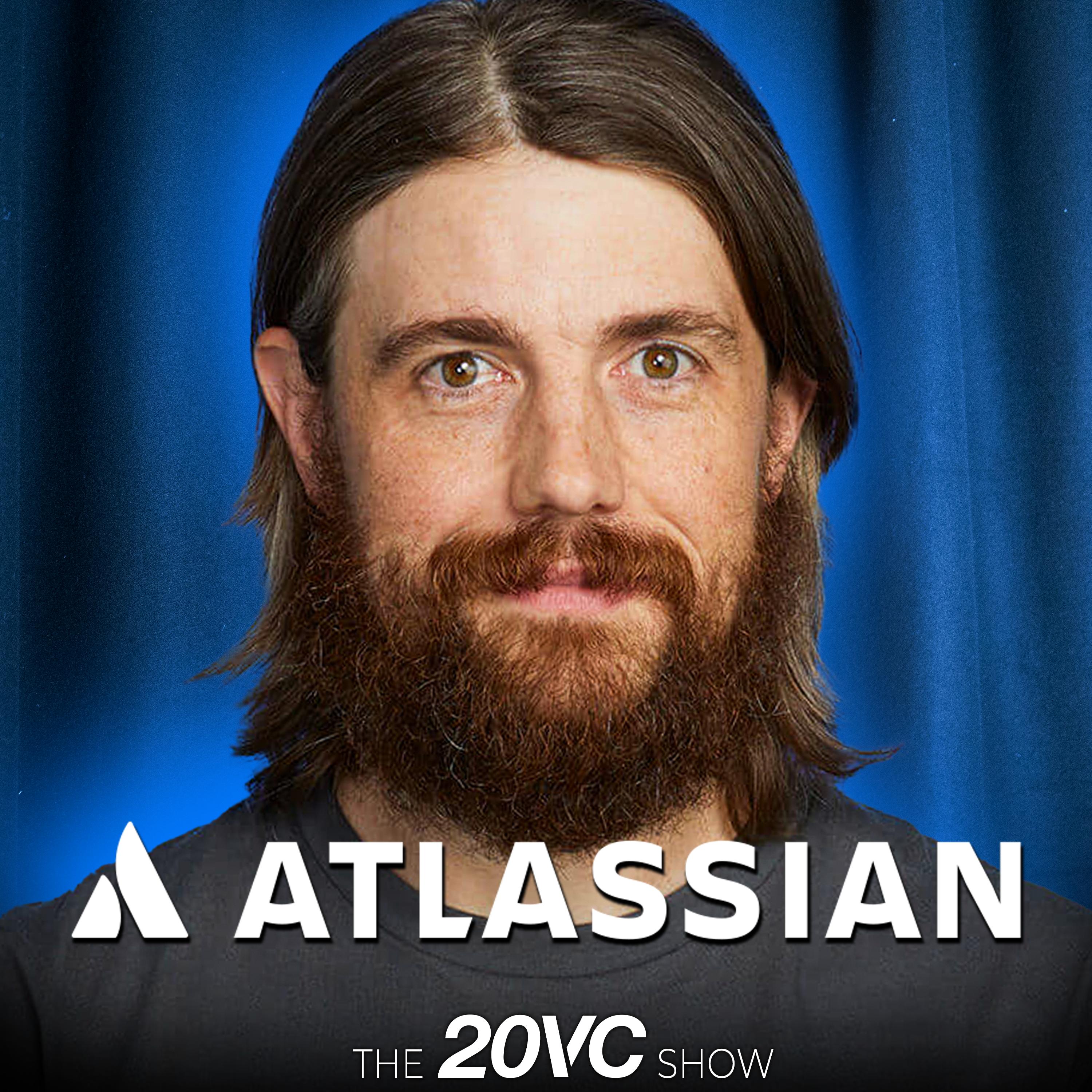
The Twenty Minute VC (20VC): Venture Capital | Startup Funding | The Pitch
20VC: Atlassian CEO on Why Everything is Overvalued & Are We in an AI Bubble | Do Margins Matter & Does Defensibility Exist in an AI World | Is Per Seat Pricing Dead & The Future of Vibe Coding with Mike Cannon-Brookes
01:03:16
Mike Cannon-Brookes is the Co-Founder and Co-CEO of Atlassian, the $50BN software giant behind products like Jira, Confluence, and Trello. Since founding the company in 2002, he has scaled it to over 300,000 customers globally, generating more than...
Loading summary
Transcript121 lines
- [00:00]
Mike Cannon-Brookes
Reasonable men sort of live within the boundaries and so you need unreasonable men to change things and move the world forward. One of the only predictions I think I would make accurately is 10 years from now we'll look back and say, man, you remember that era? That was crazy. Most of the things are vastly overvalued. Five years from now we'll have more engineers working for our company than we do today. More software developers working for our companies. We will create far more. They will be more efficient. My favorite quote of Tobes is he once told me that the founder's job is to fight the entropy of ambition.
- [00:29]
Harry Stebbings
This is 20 VC with me, Harry Stebbings now. I started 20 VC 11 years ago to have the chance to interview incredible entrepreneurs like the one we have sitting.
- [00:38]
Podcast Co-host or Interviewer
Down with us today.
- [00:39]
Harry Stebbings
He is one of the greats. Mike Cannon Brooks, co founder and CEO of Atlassian, the $50 billion software giant behind products like Jira, Confluence and Trello. Since founding the company in 2002, he's scaled Atlassian to over 300,000 customers, generating more than 5 billion DOL for the year of 2025 in annual revenue. Atlassian now employs over 10,000 people and is one of the most successful bootstrapped IPO stories in tech history. He's also this super active climate investor and co owner of several major sports teams. This was so much fun for me to do and a real childhood tick the box moment in my journey. But before we dive into the show today, I love seeing the team come together to make this show happen. What I don't love is trying to keep track of all the information, the data and the projects that we're working on across doz, dozens of platforms, products and tools. That's why we use Coda, the all in one collaborative workspace that's helped 50,000 teams all over the world get on the same page. Offering the flexibility of docs with the structure of spreadsheets, CODA facilitates deeper teamwork and quicker creativity and their turnkey AI solution. The intelligence of Coda Brain is a game changer. Powered by Grammarly, Coda is entering a new phase of innovation and expansion, aiming to redefine productivity for the AI era. Whether you're a startup looking to organize the case chaos while staying nimble, or an enterprise organization looking for better alignment, Coda matches your working style. Its seamless workspace connects to hundreds of your favorite tools including Salesforce, Jira, Asana and Figma, helping your teams transform their rituals and do more faster. Head over to Coda iO20VC right now and get six months off the team plan for startups for free. That's Codacoda iO20VC and get six months off the team plan for free. Coda iO20VC and speaking of tools that give you an edge, that's exactly what AlphaSense does for decision making. As an investor, I'm always on the lookout for tools that really transform how I work. Tools that don't just save time, but fundamentally change how I uncover insights. That's exactly what AlphaSense does. With the acquisition of Tagus, AlphaSense is now the ultimate research platform built for professionals who need insights they can trust fast. I've used Teagus before for company deep dives right here on the podcast. It's been an incredible resource for expert insights. But now with AlphaSense leading the way, it combines those insights with premium content, top broker research and cutting edge generative AI.
- [03:18]
Mike Cannon-Brookes
The result?
- [03:19]
Harry Stebbings
A platform that works like a supercharged junior analyst, delivering trusted insights and analysis on demand. Alphasance has completely reimagined fundamental research, helping you uncover opportunities from perspectives you didn't even know how they existed. It's faster, it's smarter, and it's built to give you the edge in every decision you make to any VC listeners. Don't miss your chance to try AlphaSense for free. Visit AlphaSense.com 20 to unlock your trial. That's AlphaSense.com 20 and if AlphaSense helps you spot the winners, Angellist helps you hire them. If you're listening to 20 VC, you know we have a really freaking high bar. Well, Angellist is the modern platform used by the best in class venture funds where over 40% of top endowments and banks are LPs. Their customers include a top five venture firm, 20 VC and the now have, check this out, $171 billion of assets on the platform. They combine an all in one software platform with a dedicated service team that moves as fast as you do. One manager said this awesome quote, angellist feels like an extension of my fund. Another said angellist gives me total peace of mind. The attention to detail, lightning fast response time and just real sense of ownership from the team are exactly what I need to stop worrying about back office ops. So if you're starting a new fund, don't be a Moron, just use AngelList. They're incred. Head over to AngelList.com 20VC to learn more.
- [04:45]
Mike Cannon-Brookes
You have now arrived at your destination.
- [04:49]
Harry Stebbings
Mike, I'm so excited for this dude.
- [04:50]
Podcast Co-host or Interviewer
I am like one of the biggest Atlassian fans. So thank you so much for joining me today, dude.
- [04:55]
Mike Cannon-Brookes
Thanks for having me on, man.
- [04:56]
Podcast Co-host or Interviewer
Now, Scott calls you, and this was from one of your team members that I heard he calls you the unreasonable man. He does he call you the unreasonable man as a starting point?
- [05:08]
Mike Cannon-Brookes
I mean, I know it's after. I think it's George Bernard Shaw, his sort of famous quote, that all progress depends on the unreasonable man. Because the unreasonable man is the one who doesn't believe in boundaries, makes changes, et cetera, sometimes for the better, sometimes for the worse. But reasonable men sort of live within the boundaries. And so you need unreasonable men to change things and move the world forward. And it's always been his nickname for probably two decades now.
- [05:30]
Podcast Co-host or Interviewer
Do you think you're an unreasonable man?
- [05:32]
Mike Cannon-Brookes
I think it's not an unfair term. It sounds very negative, doesn't it? So I think in the way that he means it, yes, it's probably pretty apt. I tend to get frustrated when things don't work the way I think they should and then just try to change them because it seems like the logical thing to do rather than accepting that they can't work. Right. Sometimes that leads you into trouble, and other times it leads you into doing things that hadn't been done before.
- [05:55]
Podcast Co-host or Interviewer
I am a massive fan of David Goggins, the Navy SEAL who basically tells you to just continue through suffering. And he says that the worst thing is to become civilized. A civilized person is mediocre lethargy, which is very strange for a European to be saying this.
- [06:09]
Harry Stebbings
So I totally agree with you in.
- [06:10]
Podcast Co-host or Interviewer
Terms of benefits of unreasonable men.
- [06:12]
Harry Stebbings
You said that you, like, get frustrated when things don't work the way you think they should.
- [06:16]
Podcast Co-host or Interviewer
What is most pressing to you that doesn't work the way you think it should today?
- [06:22]
Mike Cannon-Brookes
Oh, man, so many things. Look, I could talk about household appliances all the way through to global political problems and plenty of things in technology. I think the people who come with a systemic mind and create technology or get into technology because they see its creative potential, right? They're inevitably thinking, can take this thing and that thing and put them together and make that. Why hasn't anybody done that yet? And then they just kind of go and make that thing. Sometimes it works wonderfully, sometimes it's horrible and nobody knows about it. So I think there are plenty of things that don't work in the world. It doesn't necessarily mean they don't work. That could be better, right? And Atlassian's in the business of building technology, and we're trying to make better technology every single Day. There's plenty of things that we haven't done yet that we want to go do. We're obviously in the AI era. There's lots changing there, lots changing in the global energy world, climate world. And I still don't understand why my dishwasher is so complicated. So we can go any which way.
- [07:14]
Podcast Co-host or Interviewer
Dude, I've got no idea how to turn on the dishwasher. So you're still ahead of me.
- [07:17]
Harry Stebbings
So it's fine.
- [07:18]
Podcast Co-host or Interviewer
You and Scott were two of the most famous co CEOs and really kind of pioneered the structure in tech for a long time. Now, obviously you're solo CEO. I'd just love to hear your reflections on what were your biggest lessons from being such successful co CEOs for years and what worked and what didn't. With the benefit of hindsight, I hope.
- [07:38]
Mike Cannon-Brookes
Anyone would say it's worked extremely well. There's no doubt Atlassian wouldn't be where it is without Scott. Probably without both of us, without the relationship. Really hard starting a company. It's really hard building something. It's probably even harder doing it on the far side of the world from most of the other people who are doing similar things. And so having two equal parties, I think in motivation, experience, we've always talked about this is a really important part of what made it successful. And by equal, yes, equal. I don't know, shareholding wise, equity wise, but equal in terms of age, life stage, equal in terms of naivety and experience and wisdom. I think that really helped. Cause there's not. You'd go into a room and be like, oh, I don't know how to do this. And he goes, I don't know how to do it. And well, we've got to figure it out. But you have someone who's at a very balanced, let's say, stage of all of those sorts of things. I remember when we both started having kids, it was around the same age. We both got married around the same time. That really helps. Cause when you have a kid, you're like, oh my God, this is really hard. I didn't get any sleep last night kind of thing. And that goes for a long time. It's really helpful to have someone else who's in a similar situation and you can sort of talk through it and work through it. And we've juggled and balanced for decades. I think that's one thing that really made it work is the equality and the balance. I think the second is he's far better at this than I am. And I know he said the Same thing. I think it really helps to think the other person is just far better than you are at pretty much everything because you're both stretching to try to be as good as the other person, if that makes any sense. Right. I know it's been said long of partners, you want to believe your partner's out of, out of your league because then you're like, oh, I better show up. And if both partners believe the other person's out of their league, it really makes sense. David Goggins is a good analogy for Scott in terms of his ability to tolerate shit, get through and keep going. The man works so hard, like he lifts a high bar. So you felt for 20 plus years I had to keep that high bar, right? I'd say lastly, good friends. I mean, you gotta, you gotta, you gotta laugh a lot about these sorts of things. You're gonna go through all the ups and downs over many, many decades. I think we're both pretty grounded people and just had a lot of fun with it. We've been on the ride of a lifetime and you just gotta enjoy that, right? That really helps to be able to just have a beer and hang out and enjoy it.
- [09:47]
Podcast Co-host or Interviewer
So two of my dear friends, Alex Nordstrom and Gustav Soderstrom, who've just become the two CO CEOs of Spotify in a really interesting new structure, obviously replacing Daniel. What advice would you give to them entering this structure knowing all that, you.
- [10:01]
Mike Cannon-Brookes
Know, oh, knowing, knowing a bunch of those people, I'm getting myself in trouble. I, I think the advice would be that you've got to be as open as possible dealing with conflicts, dealing with perceived conflicts. You've got to be very careful to try to keep balance. Right. You've got to have balance of the force. There's a yin yang kind of element to any of these partnerships that has to work at the same time. You have to have a swim lane. The magic is somewhere in the both of those things, right? I once described it that Scott and I are probably somewhere between 60 and 80% overlapped. If we're 100% overlapped, like we do exactly the same thing. Well, there's not much point in having two of us. If we're 0% overlapped, you're going to have a lot of conflict. So you need to have enough sort of shared spot in the middle where you understand what the goals are. But also time when you're just like, well, I'm doing my thing and you're doing your thing. Right. In the Atlassian history, you know, at various Times both of us were in the whole business where someone was off on sabbatical or getting married or something else like this for, I don't know, periods of up to maybe six months. And at other times we moved the various functions around. I think both of us probably ran all the functions for various times. Anywhere from a few years to, you know, I ran probably sales and marketing for 13 years was probably the longest of any single function, staying with a single person. Right. And then I moved to Scott for four years. And so there were swim lanes. You have to have an understanding and roles and responsibilities to make it work. But you also have to have quite a lot of shared context, shared understanding, and that equality was really important.
- [11:27]
Podcast Co-host or Interviewer
When did you most vehemently disagree and how did it resolve itself?
- [11:32]
Mike Cannon-Brookes
Oh, well, look, firstly, our first shareholder agreement did have actually in there that if we couldn't agree on something, we'd go to a game of scissors, paper, rock, best of three. We never got into any bigger disagreements when that shareholder agreement was actually governing the company. Don't worry, as a large public company, there's no longer in the bylaws, but it was for probably well over a decade. I always knew I'd lose this as a paper rock game, best of three. So therefore we never got into any disagreements that required use of that clause. I think, look, we've disagreed over acquisitions, we've disagreed over strategic directions, et cetera. I've always lived by the maximum. If I can't convince him that something's a good idea, it's probably not. That is a really good marker that something is probably not a good idea and vice versa. I think he would say probably the same thing, which meant, you know, if you did disagree, maybe you tried to lobby the other person, convince them for a while. If you couldn't convince them it was a good idea, we didn't do the thing. And it worked pretty well. There was no real, I would say major, major disagreements that were sort of epic singular points that business went one way or the other. We've been in the same boat for a long time.
- [12:33]
Podcast Co-host or Interviewer
I remember him telling me the story of him actually being on honeymoon and being in like a safari and being completely off grid and you having to get hold of him, I can't remember what for. And like, Kim had to go to like, some random ass village. And I was like, geez, this is why I don'. Leave London. I get hives when I leave a delivery zone. So it's not a good thing for me.
- [12:51]
Mike Cannon-Brookes
Entirely true. Yeah, we had a We had a security incident, our first sort of major security incident, decades ago now. And I needed to contact him for various legal reasons. He had to. To be notified. And so he landed in a bush plane somewhere in Africa and got a radio message, I believe, saying, when you can call Mike. And he was like, I'm just gonna. Anywhere. So look, we sort of. That's a good example of where, where you need co founders. Better to have two of us in that situation. We had a replacement and going back.
- [13:19]
Podcast Co-host or Interviewer
To the unreasonable man. And you now being the sole CEO. You know, when I reflect on your last 18 months, respectfully, and I hope this isn't rude of me, it's probably the most aggressive but also obvious example of like founder mode in action. Do you think that's a fair description and was it a deliberate. I want to make some big bold moves to show the market I'm here to really play.
- [13:42]
Mike Cannon-Brookes
No, I don't. I don't. I'm going to violate the old media rule. Never disagree with journalists. But you said you're not a journalist. That's right.
- [13:48]
Podcast Co-host or Interviewer
Hey, you disagree with me, please.
- [13:50]
Mike Cannon-Brookes
Yeah, I don't think so. I mean, it's interesting. I don't think I've seen it characterized that way. There's certainly no intention to be like, let's go make some bold moves. If anything, I ring him all the time and be like, hey, what do you think about this idea? I get all the credit and all the debit now. So that's interesting. Anyone who knows about technology companies knows it's a little bit like when a new prime minister comes in in England or Australia, right. Suddenly the interest rates go up or down a month after they've come in and it's their fault and they're like, oh, yeah, I wasn't here for the last five years of running the economy, so suddenly I get the credit. Or, you know, many of the things that we've obviously done over the last 18 months were planned many, many months, years, quarters in advance of that.
- [14:27]
Podcast Co-host or Interviewer
But if I, if I push you, then again, you disagree with me. I'm not a journalist, so you can tell me. I'm a vc, so you can legitimately tell me, I don't know what I'm talking about. And then you would be right. But like, you know, the sports investing with Williams, love Williams, by the way, we just did a show with James. He's fantastic. Awesome dude. But like Williams, the acquisitions browser company dx, some of the smaller ones, pretty big, bold strategic decisions that I imagine were not Longer term planning?
- [14:54]
Mike Cannon-Brookes
Yes and no. Some of them are certainly longer term planning. Other ones, I would say again to the characterization that it's a desire to sort of stamp some sort of like, oh, now Scott's out, I can do the things I've never able to do beforehand. Like there's literally zero of that. Right. There's no doubt the AI era, whatever in the last couple of years has been a little bit busy and there's a little bit going on in technology. So I think for every company, it's probably a more active period. If you're really trying to compete, if you're really trying to create, this is the time when A, you should love it and B, it's a little bit of chaos. Right? It's not a linear period. It is a period where you need to invest in things, you need to make some bets. It's a very creative period. I tell people all the time, this is the reason we got into technology. This is amazing. This is like one of the most exciting periods. We will all look back at this, I guarantee you. One of the only predictions I think I would make accurately is 10 years from now, we'll look back and say, man, you remember that era, that was crazy. That three, four, five year period was just a complete up and down turmoil. And there'll be some things where people will say, remember that thing, man, we all thought that was gonna be huge and it was nothing. And everyone else being like, yeah, no one saw this thing coming and it was massive. So. So I do think it is a verdant, creative, kind of Cambrian explosion period which will create change. I do think it's a time when founder driven businesses, you need to make some decisions, make some real actions. That is certainly true. I do think some of those decisions have been in planning for a while. Again, in terms of acquisitions, we acquired Loom three years ago now. It was a massive acquisition. It was a bold bet. I don't think it's particularly any different than the two we've just done. It's done very well. It's a fantastic product, fantastic team, and it's been a fantastic thing for the AI era. Right. As we said at the time of acquisition, it was one of our more prescient choices.
- [16:40]
Podcast Co-host or Interviewer
You said there about the craziness of this time. It is, and I find that quite hard because I'm looking at this as an investor going, what is sustainable? What is not sustainable? And I'm trying to assess durability in a world of complete unknowns. How would you advise me Mike, look.
- [16:55]
Mike Cannon-Brookes
I think you've got some very difficult choices as an investor in the current time. Most of the things are vastly overvalued. Probably true. Some of the things will be worth far more and are undervalued and the far more is probably overweight. All of the things that are overvalued, like as classically happens, right. For all the dot coms that went bust, Amazon turned out to be quite a good business. That makes it particularly hard in this era to be an investor. Secondly, we aren't in an era where we have a durable business model for a lot of these things. So the old argument that some AI company, let's just call them, give $100 million to a model company, who then give $150 million to a cloud provider, who then gives $200 million to Nvidia to buy chips. And everyone's like, look how much revenue we've all got. And you're like, yeah, but you're all like losing 50 million bucks on the way through. It's a pretty good adage, but maybe they'll make it up in scale. Right? I don't think anybody really, really knows. We know that it's a foundational technology. We know that it changes so many things where the monetary value and the fundamental value lies on the far end of it. In terms of how the business models shake up. If you think about the search era and advertising and all these things, I don't think that's known. I think anyone who tells you that they know it is probably not telling you the truth. It does not mean that there isn't real value there. Right. It does mean it makes it very hard for you to be an investor. I'll agree with that.
- [18:15]
Podcast Co-host or Interviewer
How does that then reflect on how you behave? Because you have to play the game on the field. You have to make bold bets. How does that reflect on what you do?
- [18:24]
Mike Cannon-Brookes
I think what we've tried to do is a couple of things. Firstly, we've said for two and a half years now we need to make bets. Not in the same way you just used the word. Sorry. We need to make choices or opinions about how we think things are going to evolve, but we need to be willing to change those. So we have various hunches. I would say that we've made that. We said, hey, we think over the next three years this is going to be what happens. But about every quarter we reassess those sets of fundamental choices. I can go through a bunch of them, but I think that's one that you have to do as a business, you have to be willing to walk away from those hunches that you have, but at the same time, you have to make them. You can't be in this era of, oh, I'm not really sure what's going on in all these different areas. Secondly, I think you have to listen to your customers very deeply, because in an era where everything's swimming around and there's a lot of noise, let's just say, in the world about what is and isn't. Oftentimes you gotta find the stable thing, which is to go back to the customers and say, do you feel this way and talk to enough of them that you get internal conviction about what is or isn't happening? You've got to talk to the right customers, you've got to talk to enough of them. That is definitely true, but those are the people that fundamentally, for whatever business you're in, they will hopefully tell you and help be a rock in a storm, let's just say, of change. And I think you have to make some bets in the way that you did use it. You have to take some risks and try to change your position.
- [19:43]
Podcast Co-host or Interviewer
You said about kind of having a thesis or a belief on a market or an evolution and then revisiting it. What belief did you have that proved to be wrong? How so? And what belief did you have that proved to be right? I'd just love to understand one on each side of the table, a couple.
- [19:58]
Mike Cannon-Brookes
That I think are proving to be right. I don't know. In AI, anyone could say that they've been proven to be right. That's probably a little bit arrogant at the current time. Firstly, very early on, we thought there would likely be multiple foundational models that were competing. Hence we've built our technology to be multimodal on purpose in almost every way and that we were not going to make foundational models. It's unlikely we'd be able to compete to train our own models. However, we have to get good at something. And what we are good at is adopting and delivering the value of that model in software to our customers very, very quickly. So if you think, okay, there's going to be a new model about every three months and there's going to be four to six companies competing. What we need to be able to do is pick up a new model, test it, work out whether it's better in a certain case, deploy it and get it out to customers. That is an expertise that we need to build and we have built, and that's proven to Be, I think a really good bet. A second one for us is that it's really all about design. Yes. Data is really important. Yes. Models and fundamentals and all these different things are important. I think what is underwritten is the importance of design. If you look at any lowercase d, and I don't mean graphic design, like how the colors. When you have any major technological transition, we're back to an era of fundamental design. We are rethinking entire swathes of the world. Trite example actually is pull to refresh on your phone. Right. We never really had this design device until we had phones. And then suddenly people are like, you know what? One app did it and everyone copied it because it worked really well. In AI, we're facing that very much more. Right. I don't believe the world will just end up as a chat box, otherwise we'd all just use the terminal on our computers. But it is an entry point and so there's a lot of foundational design being done. Really fascinating. Good design all over the place. Even where some of it fails, like most good design, you're like, I see what they were trying to do. We have very, very heavily invested in design in the AI era. In an era where arguably software gets cheaper to create. We can argue about that maybe, but there will certainly be far more software. It's probably a fairly safe assumption. Far more technology. What differentiates it is probably how it feels and how it works. And that's very hard to copy. Right. So I think that's another one of our sort of big bets that we've made internally. We've really beefed up the size, the quality, the talent on our design team, which was already pretty world class to start with, and really doing a lot of foundational design around delivering AI to end users and customers that don't have to understand what the words probabilistic and deterministic mean and what a model is and all these other things. They just want to do something.
- [22:28]
Podcast Co-host or Interviewer
When I hear you talk about the centrality of design there, I think about Satya Nadella's statement, business applications will collapse.
- [22:35]
Mike Cannon-Brookes
Right?
- [22:35]
Podcast Co-host or Interviewer
In the agent era, they are essentially CRUD databases with a bunch of business logic. How do you feel about that? That reflecting on your centrality of design?
- [22:44]
Mike Cannon-Brookes
Possibly. It's very easy to make big statements in the current era because you can't be proven wrong. Hence those statements could theoretically have some value of right. Do I believe that all business applications, maybe all applications, full stop. I guess you could argue every piece of application is just A crud piece of software. Email's just the same thing, right? I still believe there is a role for software to solve certain purposes. There's an old adage in enterprise software that every single piece of enterprise software can be replicated with email and Excel. Quite true, right? You can do any application you want with email and Excel. You can replicate any communication app, you can replicate any business process app. You can make it. Now, there's a reason we don't all just sit there and email. Excel still very used, very popular, right? But at the same time, they are not used for large scale things. We have HRS systems and CRM systems and project management systems and lots of communication systems from Zoom and Slack and all the things, right. They're all very specific versions, you might argue, of email and Excel, but they serve a very specific purpose. What we've seen over the last 10 years is the opposite. We've had a Cambrian explosion of SaaS apps to do more and more and more specific tasks. But they do the task much better. I don't think we know in the AI era if all those apps just disappear into some godlike Siri agent that we just talked to. I'm not a believer in that worldview. I don't think it's likely to happen. I do think AI is going to have to change all of those applications in massively fundamental ways. That may mean some of them end up disappearing and others end up profiting. I can believe in that worldview. I don't think they're all just simple crud apps. I think that's usually someone talking their.
- [24:13]
Podcast Co-host or Interviewer
Book I very much buy into. I think it's Alan Roosevelt's statement that kind of bad discussions are about other people, mediocre ones are about events and smart discussions and good discussions are about the future and ideas when we look forward. You said that you don't believe the chatbot is kind of the interface of AI in the future. What do you think is the interface for AI in the future with that in mind?
- [24:35]
Mike Cannon-Brookes
Ah, good question. Look, I think that's what we're all trying to create. One of the fascinating questions around today, it's the reason why fundamental design is such an important skill and talent. I would argue in the next few years, maybe forever, but right now it's hugely important. I think that interface is going to be probably, it's safe to say, far more evolutionary. So I don't know if there will be an interface. It might be that AI is rewriting the interface. In theory, AI can generate some code Write the code to create a new interface for every single screen you look at. I don't think we'll probably see that. It'll be too discombobulating for users. They'll get lost. They'll be like wait, everything's moving all the time. Like I, if you watch users in any user study, they like knowing that I go to this button, I click the thing that happens and I go to this thing and that happens. So they're going to want stability in their interfaces. They're not going to want this dynamically changing always interface. But we can generate new interfaces pretty quickly. I suspect it might look a lot more like today than we think, but it will be a lot smarter. It will do very different things and there will be a lot less click to value ratio. There is no doubt that a lot of software requires you to click or type to indicate what you want to do. A lot. Take the other extreme, prompting and writing into a text box. At some point my prompt gets so long to be specific to the thing I want, I'm like just gimme a damn button that I can click. And you know, a slighted move. In some new UI interfaces, somewhere between the two is probably where it is, right? It may be a combination of modern existing software, UI and prompt based layers. Right? We've seen lots of people playing with this sort of terminology where you can customize software with a prompt. Imagine you had Microsoft Word has a lot of buttons at the top of it and you said, you know what, I want to be able to edit a prompt in Microsoft Word that says what type of person I am and that changes the ui. I don't understand the whole, some of the toolbars there, I'm just like completely lost as to what they do. I never use them. But I'm not a lawyer, I don't live in that world. And I'm like, well just turn all that stuff off because I'm going to tell you who I am and then I'm going to, it's going to redesign the interface for me. I can see that totally happening. But again, this is back to all where we need fundamental design in so many of our day to day applications. And what makes it such an exciting era to be building technology?
- [26:42]
Podcast Co-host or Interviewer
Does the democratization or the cheapening of software creation make software more or less valuable? Does it make design more or less valuable? How does it change discovery with an infinite supply?
- [26:55]
Mike Cannon-Brookes
I do think it makes design more valuable. Good design scarce resources probably get more valuable. And I think good design is quite scarce there's no doubt in my mind that we will create far more technology. Right? We often get asked this is do you think all software developers are going away? I said no. I was on a panel with or speaking right before, I should say Matt from aws and we both violently agreed that five years from now we'll have more engineers working for our company than we do today. More software developers working for our companies. We will create far more, they will be more efficient. But technology creation is not output bound. The demand supply is very off the charts. We don't have a shortage of ideas for new technology that we want. Find me a software company or a technology company that gets to the end of its roadmap. Like the roadmap is unlimited in length and we will keep coming up with new ideas, human creativity. We will come up with new ideas for things that we want to build into our software. Maybe crap ideas, maybe good ideas. We'll have to build them and test it and see. I like to be an optimist and think we will end up with far more technology. Firstly, and secondly, far better technology. Because I can afford, if things are cheaper to build, quote unquote, or more efficient, maybe I can build them two or three times to get it right. Plenty of technology is built once and you kind of use it. It doesn't really work very well, but it works well enough. And some team somewhere was like, man, I got to move on. I'm out of time, I'm out of budget, I have to move on to building something else. Maybe if they'd had three attempts at it, they would have made it better, right? So we'll all live, I'm hope with a world of better technology and far more technology.
- [28:27]
Podcast Co-host or Interviewer
I do want to jump on a lot of that, but we see your Cloudflares, your Salesforce, Microsoft, even adopt Vibe coding environments that replicate a lovable or a ratlet. Have you internally discussed doing the same with Atlassian?
- [28:40]
Mike Cannon-Brookes
Do you mean using those Vibe coding environments?
- [28:42]
Podcast Co-host or Interviewer
No. In terms of like creating an environment where within an Atlassian home people can Vibe code within large enterprises, sure.
- [28:49]
Mike Cannon-Brookes
I'm in Barcelona and we're launching one at the moment. So yes, I don't think this is going live in the next 24 hours. So that's fine. Yes. There's no doubt that that's there. But again, it's about focusing.
- [28:58]
Podcast Co-host or Interviewer
What's the thought process behind that? Because you've got to then believe that Vibe coding as a category will be a sustainable and enduring category in software creation.
- [29:06]
Mike Cannon-Brookes
Do you believe that it might depend on our definition of Vibe coding. I believe that there is a large group of people who we may or may not call software developers who will want to be able to create technology of a certain quality or level or that meets a certain set of standards. Maybe their design standards, software security standards, whatever it is. I'm not sure whether we'll call these people software engineers. I don't think it really matters. I think it becomes one of these annoyingly not useful debates, if you ask me. In Atlassian, I will end up with far more generalists, I will end up with a wider organization and people will do far more things and their jobs will hopefully be more fulfilling because of it. Right. I will have people in finance who are quote, unquote, Vibe coding an application to solve a financial problem for themselves where previously they might have tried with Excel or they might have filed a ticket with it, or they just wouldn't have bothered. They're writing Python code to do crazy complex analysis. The cost of that code is so small that they maybe do it three or four times, maybe throw it away because it didn't work. Right. That is not what I would argue is software development. That is a financial professional who's trying to get their job done and has a new set of tools to go get it done. Marketers making websites, you might argue, is kind of the same thing. There's lots of these examples where it's like people whose job wouldn't say, I'm a developer, but I'm now making technology. That's a great thing. I don't think it means there's less role for the core technologists to do. In fact, they're probably building more and more platforms. So we are trying to build for our maker audience. Again, we have a huge community of app vendors and creators and customers who make technology apps that run on top of the Atlassian platform. We want to help them make high quality applications that solve business problems on top of the Atlassian platform at the lowest cost possible. Now, you can do that by writing code for a very complex application that does a lot of things. Or you might Vibe code something really simple. If by Vibe coding you mean largely writing prompts and spitting out an application. If it fits into the design language of Atlassian and it runs well and it's secure and it's compliant, that's great. It'll probably mean our customers make far more apps or more apps per customer than they ever did beforehand. But a lot of them maybe they're throwing away, right? And that's okay. That's fine. That's great. It's going to be a big spectrum.
- [31:14]
Podcast Co-host or Interviewer
The spectrum is a barbell in some respects between what we wouldn't consider traditionally developers and then the really valuable engineers and developers. The question becomes, you said we will have more software engineers. Will we? Will we have the entry level? Will we have the kids studying CS who come in? They're decent, but they're definitely not a 10x engineer and they're not specialists. What does the future look like for them?
- [31:37]
Mike Cannon-Brookes
I think we'll have far more of them. Maybe that's a bold bet. We're hiring more grads this year than we did last year, more than we did the year before. If you think about it, it's purely an economic question, which is dangerous when it comes to talent. If someone was going to be a 10x engineer 10 years ago, I would argue that person is probably still a 10x engineer today. Maybe they're 100x engineer because they've got all these new tools. That's probably down to the person, their learning style, their ability to ingest information and how they solve problems, etc. Maybe the average engineer is going to be a 10x engineer and those 10x engineers are now 100x engineers. It will come down to how they solve those problems, firstly. Secondly, I still have a bandwidth constraint of the number of people I have in R and D and engineering to build the ideas that the business could profitably build. That is still a constraint and I think will be, I believe, forever. But it's certainly a constraint that we've lived with for a long time. It's not going away today. Lastly, we've seen this with Loom fascinatingly in a. In a very different context. There's a good chance that those graduates come in with a different view on what it means to be a software developer and shake up the existing world of talent in a positive way for my business, where the existing talent either figures out, man, these grads are doing things better than me, I better copy that, or maybe I should go do something else, right? The reason I say we saw this with LOOM is one of the ways that Loom gets into businesses. Loom being a video and communications tool is through graduates because young people coming into businesses use a lot of business tools and are like, man, this is so inefficient. Young people that TikTok Snapchat generation, I can't count myself, unfortunately, in that generation. I don't think anymore. I've never really understood Snapchat, but I try to they are natively used to FaceTime and video calls and voice notes. This is a very common communication factor for them that maybe you might argue someone who's been in the workforce for 34 years is not used to. When they come into a business and they use loom to communicate, the business goes, man, those people are more productive and the entire business starts communicating that way, or a majority of it, it becomes a norm and a standard. Right, because they come in with a different expectation. I do wonder if the grads, if you're a grad today, so you've been in, you're halfway through your university degree, you're about to finish computer science, you're surely using all of the coding, AI assistance and everything else. You are hyper productive compared to what a grad would have been 10 years ago. You're going to go into a business, that business is going to say, well, that talent is amazing. I need to do more like that. So they're going to bring in those skills to businesses.
- [33:58]
Podcast Co-host or Interviewer
When you look at the engineering team today in Atlassian, what are the dominant tools that have changed productivity meaningfully?
- [34:05]
Mike Cannon-Brookes
I have to talk my own book, but Rovo Search. Look, we use our own tool, Robodev. We have many, many code creation tools. So we use Robodev, we use Cursor, we use Copilot, we use a lot of things. We've been very liberal. They're quite cheap, these tools.
- [34:18]
Podcast Co-host or Interviewer
Would you pay 10x the price of those tools?
- [34:21]
Mike Cannon-Brookes
No, probably not.
- [34:22]
Podcast Co-host or Interviewer
Why not? I've asked 10 CEOs this at least and you're the only one who said no.
- [34:27]
Mike Cannon-Brookes
Because I think the competitive vector between them is not going to let you do that.
- [34:31]
Podcast Co-host or Interviewer
Firstly, in terms of the switching costs.
- [34:33]
Mike Cannon-Brookes
If one of them charged 10x, you just switch to the other one. Secondly, they're all good at different things. So there's a reason our engineers have access to all of them. And they choose to pick up a tool for certain reasons. Sometimes it's preference, sometimes it's for the task at hand or the type of thing they're trying to do. Most of them are pretty good at greenfield development. I'm blank and I want to start something. Some of them are very bad at long form. I want to manipulate this piece of code across 500 repositories around my organization. Some of them are very bad at ingesting a large code base and they will all get better at different things, but they will be like anything preferences and styles and strengths and weaknesses. Secondly, coding is a pretty small part of a software developer's job like different surveys. 10%, 20%, 30% of the week is spent writing code. Right. You might argue in the best companies, it's close to 50% of the week spent writing code. There are meetings and finding things and finding people and finding APIs and understanding the code base search is probably about the same amount of time as writing code for most software developers as a professional debugging quote unquote. At the large scale, something's gone wrong in production. Getting an alert, an error. Okay, let's figure out what's going on. Yes, there'll be AI tools for that as well. There are plenty of AIOps tools. We sell one. There are many others that are trying to help you with the operation of software, the running of systems and services. And I think that will get even more because if you have far more technology instead of running, I don't know, say you're a medium sized startup and you have a hundred different services running, you're going to have a thousand services. So the permutations and combinations and finding problems in gremlins is going to get that much more complicated. The answer to all these questions can't just be throw more AI at it. You end up in this weird Gordian loop of just like AI is going to solve the problems AI created with AI that continues down the AI path.
- [36:18]
Podcast Co-host or Interviewer
Well, that's what venture investors are telling our LPs at the moment. So just don't ruin, don't ruin the money train for us, if that's okay.
- [36:25]
Mike Cannon-Brookes
We've never had a technology disruption or generation before that wasn't going to solve every problem in the world.
- [36:31]
Podcast Co-host or Interviewer
You mentioned the switching costs being low to the extent that you wouldn't pay that 10x. There's a great book by Hamilton Helmer 7 Powers. If you haven't read it, please let me send it to you as a gift. It's the best business book you'll ever read. And bluntly, one of them is that it's incredibly difficult to switch from a service as a core trait of a great business. So it could be Salesforce. It's a fucking nightmare to switch from Salesforce. That's why no one does, despite it being shit. Mark's a friend, so if you're listening, Mark, I'm so sorry, don't kill me. But it's true.
- [37:03]
Mike Cannon-Brookes
He's built a great business then, right?
- [37:04]
Podcast Co-host or Interviewer
He's built a great business.
- [37:07]
Harry Stebbings
Yeah, but if, if this is true, that switching cost is actually incredibly low.
- [37:11]
Podcast Co-host or Interviewer
Are these fundamentally good businesses?
- [37:13]
Mike Cannon-Brookes
Look, I think like a lot of things in AI. Most of these businesses have been built very fast, both in terms of the creation of the technology behind the business and the customer base and everything else, which almost by virtue of that means the switching costs are quite low at the moment. You cannot build a business fast that has high switching costs. It doesn't. It like logically makes sense. Do they have high switching costs in the future? Is a. Is a very different question than are there high switching costs today? One of the fascinating things for me about AI as we navigate this disruption, this period of creativity, the large language models have been dropped on the whole world at the same time. It's like someone just went, you can all have these for free, go. Which is something I don't believe we've seen in technology before. It's very unique. It took a long time for mobile phones to permeate the world. It took a long time for PCs to permeate the world. It took a long time for these things. It's very different to have, you know, a billion technically literate people get access through cloud providers to. It doesn't matter. OpenAI anthropic, you know, Gemini Llama go. That's why you're seeing such a verdant creativity, which is fascinating. It also means again, the switching costs of almost everything being built right now are quite small. They will have to build up, one would argue, to build sustainable businesses. How those switching costs build up though, is much harder to see. We don't really understand that because if everyone can copy everyone really quickly, you're going to kind of keep those low. The switching costs are going to end up being value delivered to customers, data to some extent, workflows, familiarity, maybe the interface, like similarity, you know. Again, why do you use a certain app on your phone? I'm just used to it. Do I go look for a better one? No, it's good enough. And so I don't think we really know where those switching costs are yet in some of these particular AI driven businesses like the old sort of was it does HBO become Netflix before Netflix becomes hbo. Kind of a loop. You've got a lot of these existing businesses like us. I think we're arguably an existing business of 20, 20 plus years in existence that have a high R and D investment and the same access to all the models. And it's about how much we can infuse AI into our core platforms and experiences to the 300,000 customers and tens of millions of end users we have faster than these new companies can come along. Right. It's Again, a classical technology race.
- [39:23]
Podcast Co-host or Interviewer
The best statement ever is can the startup acquire distribution before the incumbent acquires innovation? And I think that's this kind of continuous cat and mouse game that I often think of.
- [39:32]
Harry Stebbings
People often throw that, oh, there's no switching cost between X or Y.
- [39:36]
Podcast Co-host or Interviewer
Once you get past that and go, okay, well then the fundamental question is how do you build defaction sensibility? Post that phase, the next criticism is.
- [39:43]
Harry Stebbings
Well, Mike, come on, they've all got shit margins.
- [39:46]
Podcast Co-host or Interviewer
They're all negative margin businesses. They're crap. They can't be good businesses. How do you respond to the critique of the low margin nature of relatively all of the AI tools that we're using?
- [39:58]
Mike Cannon-Brookes
We're too early to really understand what those margin profiles are. We don't understand the monetization models for a lot of them yet. They keep changing pricing schemes every three months. So not understanding the monetization model, not understanding really where the relative value is the time degradation of model value. So the whole sort of like, hey, I've trained a model, it cost me a billion dollars, am I going to get that billion dollars back in the nine month period before the next model's better? And it cost me another billion dollars to train. These have all got to be sorted out. I can't tell you how the world's going to sort them out, but I can tell you that they will be sorted out in some form. And margins are probably built in these businesses with customer value delivered. There is a partnership and a relationship with your customers and a faith that you will continue to deliver value that in some ways build margin over time in different seven powers manners than just pure switching costs, which is often about a somewhat a captivity kind of a notion. And then you get to, well, where does the fundamental value live? In any technological change the value can shift around. You might argue, well, the chip vendors are going to capture all the value. Some investors believe this at the moment. Possibly you might argue the power producers that are upstream from the chip vendors are the people doing really, really well. Right? If you're selling electricity right now, it's kind of a good business to be in. I don't suspect it all ends up flowing all the way up to like the power companies kind of making all the money in the world. That doesn't seem to make any sense to me because there will be again, design, aesthetic style all the way down the other end that do build switching costs. Right? There are lots of applications I use that maybe I pay more than a sheer economic value because I prefer the design of that application. I prefer the way it makes me feel. I prefer the way it makes me productive. It's not all down to kind of, I think spreadsheet value. Like some of the people would have you say the old classical. If you're just an OpenAI rapper as a startup, I do think you're in trouble. But we might look back and think that was a good way to start some of these businesses. But they end up being very different. Plenty of businesses made money on mobile without being iOS and Android.
- [41:50]
Podcast Co-host or Interviewer
In terms of the making money, I think the core question and not picking on Salesforce but picking on Salesforce question that remains is like the pricing model. We've got so used to a per seat pricing, it's what predicates Salesforce's growth. Now it's just an expansion in seats. Bluntly, does the per seat pricing model die in the next wave of SaaS and how do you think about navigating that successfully?
- [42:12]
Mike Cannon-Brookes
I think the only logical replacement out there. Well, there's two logical replacements. One is per value delivered some unit of value and the other one is some sort of consumption based model. Back to my prior point, go talk to customers about how much they love consumption based models. They don't love them very much because they're not quite sure how much they're going to consume. They don't want to be in control of their employees. The world does trend to a non consumptive based model in many areas, not in all areas. Right. AWS is obviously consumption based. At some point those consumption based models tend to flip where it's not clearly transactional like a stripe or something or you know, where you can clearly measure consumption into another form of payment. You know, we give away kind of unlimited storage. Many vendors do. It doesn't mean the storage doesn't cost us money. But it's our job to get enough money from a customer that we can on average pay for the storage and we have the right controls of exception limits and stuff like that. I do wonder if AI ends up that way around. Value based pricing I think is fascinating. On a delivered outcome basis, pay me for every X I deliver. The problem with that becomes twofold. I suspect number one, you've got to measure X very accurately, that both the seller and the buyer are prepared to agree with the measurement of X, which is a big problem in a lot of these scenarios where people give these pricing schemes. And secondly, if it's I can do X cheaper than you could, that works for one loop, one lap of the world as soon as it's cheap, everyone, like I'm going to cut your. I don't know, let's take a classical support argument. The cost per support ticket's 100 bucks. If I could get it to $80, you'd give me $10. You'd say yes in year one, I would. And I'd pay you $80. I'd pay you $90 to get the $80. And in year two, I'd be like, but it only cost me $90. Now I already gave you the $10, ergo I can't keep charging you for the discount because we're gonna end up at negative. You know, you're gonna pay me for support tickets. So I think we'll end up with some blended model. The answer is probably a nuance and subtlety like always. I don't believe per seat or singular models like that are going to go away, but we'll probably have to get used to a little bit more of a consumption based pricing. I think it's the safest world at the moment.
- [44:16]
Podcast Co-host or Interviewer
Imagine I'm Scott, we're sitting down together, okay, by a fireside, you've got a whiskey or a brandy or whatever it is. And we're talking about the threats to the business. Again, we mentioned Salesforce. I think the Percy is a big threat for that, for him.
- [44:29]
Mike Cannon-Brookes
That's a Southern Comfort, by the way. So you're drinking a Southern Comfort, I'm.
- [44:33]
Podcast Co-host or Interviewer
Drinking a Southern Comfort. We're in a beautiful pad. I'm really trying to visualize this one. And we sit down, we go, what is the thing that we have to protect against? This is mine and your thing that we've built for 20 years. It's a new world. What do we have to protect against together?
- [44:47]
Mike Cannon-Brookes
That's a great question. I'd probably thank him for the size of his brain and his great question. I can sip with my beer or Negroni and think a little bit. I think the thing that we have to protect is from an Atlassian point of view, our creativity. One of our earliest maxims about the business is we want it to be a multi decade technology company. Some of the companies we looked up to to the most as nerdy students of technology were like Microsoft, Adobe, Intuit, because they survived multiple decades and now they're all still around. We have fantastical Adobe and Intuit people on our board, maybe not coincidentally, and we still look up to these companies. They're still competing today, 20 plus years after we made up this maxim. The reason you want to be a multi Decade technology company, I would argue, is you have to survive technological disruptions just like now. Right. We started kind of, you'd argue, at the very beginning of the Internet kind of SaaS era. We survived the transition to SaaS and we survived the transition to mobile where the crypto happened or didn't happen, I don't know. Other people can debate that. And now we're in this AI transition. Right. Those are kind of our three decades. Put super simply, if you look back to Adobe or Intuit, well, they had to navigate DOS to client server, to Windows, to the Internet, to mobile, to all these things. What sets them apart, I think those type of companies is they are always creating. It's very hard in technology to survive multiple decades with just like a really good thing that you can sort of protect and defend. You have to create, which means you have to destroy, you have to move on, you have to change and adapt that. I think Atlassian's done pretty well for 23 years. If there's something we have to protect, it's doing that. It's not going to be like winning in AI. That's going to be the next five to 10 years. And I think we can greatly improve our position. Right. I think we're really well set up for the AI era, but we have to go prove that and we have to do a bunch of stuff to actually show that that's the case. But in the long arc of time, it's going to be whatever's next after AI, which seems so far away to think about, I guarantee you we're going to need to create our way through it. Right. We're not going to be able to defend our way through it. We're going to have to create it. And that probably comes down to people who want to do that creation, who have a place that they want to work, who have culture that they like, who want to defend the place through creativity, who have the openness and the environment where they can say, we need to kill this thing, we need to go build that thing.
- [47:06]
Podcast Co-host or Interviewer
What would you most like to do? But because of resource constraints, you're not able to.
- [47:12]
Mike Cannon-Brookes
I don't know that I think unconstrained is useful. I'm not trying to challenge the question either. I think unconstrained thinking is not particularly useful. Right. Constraints are what makes everything happen. They're what makes games more fun. A football game with no 90 minutes on the clock that ends would just be boring. We'd just be like, all right, it's 405 goals to 403. And we just keep playing forever.
- [47:33]
Podcast Co-host or Interviewer
It's called task cricket, my friend. Five days and it's a fucking draw. Pat Cummins is still bowling.
- [47:44]
Mike Cannon-Brookes
Well, Ashes was great last time around, I think. Look, I think if we weren't constrained, it would be around talent, talent acquisition, finding more and more people. There are lots of constraints when it comes to creative, wonderful people in the world. There are a lot of great places for them to go work. But I don't feel like we are a particularly constrained at the moment as a business. Like, I can't complain like any startup, I tell people all the time, I'm like, look, we've been here for a while. Think about Atlassian as a company with well over 10,000 people, hundreds of thousands of customers, millions of end users, billions of dollars in the bank, 10,000 people in R and D who are amazing and can build awesome stuff. Now let's go build something. Like if you started from that point you'd be like, oh my God, we can't complain about anything in terms of our ability to get stuff done. I remember being three people and we're like, shit, someone's got to pick up the phone today. Someone's got to write some code, someone has to take out the trash. So those are real constrained businesses. We don't have constraints in that way. It doesn't mean we don't have trade offs, but we don't have the constraints in the same way. I think, and it's more useful to think that way, that we can go and build anything we want to go build, but we still have to trade off and build the right things.
- [48:50]
Podcast Co-host or Interviewer
The way that you just said that was incredibly inspiring, like the scale and the size and then now let's go build something. And it made me think of a quote once that a brilliant founder told me. I think it was Toby at Shopify that said, like, this is a game of who can survive the longest. My question to you is, you speak with such vigor and energy today, 23 years in, it is a game of who can survive the longest. Has there ever been a time when your energy or enthusiasm waned? And how did you get through that? And what would you say to founders who maybe are waning in energy?
- [49:22]
Mike Cannon-Brookes
Great question. My favorite quote of Tobes is he once told me that the founder's job is to fight the entropy of ambition. And I wrote it down and I was like, fuck, yes, that is exactly what I have to do. Because at the moment we stop being ambitious as a business, all those numbers and things that I just said we are freaking tiny as a business. We are minute and we have to feel like we are minute. We have to feel like we have to fight for every customer and every user and we should. And we are on the scale of the global economy. We like to like we're like tiny, which means we've got a long way to go. There are certainly times in 23 years for sure, where you get tired and exhausted. There's a physical tiredness and a mental tiredness. Maybe they're a little bit different. Physical tiredness, yes. You've got to take breaks, you've got to be careful on the old classical. You're running a marathon, not a sprint, those types of things. You've got to figure out how to be there, deal with little bits of sleep or whatever it is. Some people are wired for doing that, some people aren't. I've always been pretty wired to do it. But mental tiredness, I think you have to think about things in sort of eras and you have to take breaks mentally as well. Maybe I'm not a very good person to answer this question. I'd like the best job in the world. I've always thought, I have the best job in the world. I go do something else. I'd probably do largely the same thing. It doesn't feel tiring. But I think you have to be, as a founder, you have to be very self aware about what it is you actually enjoy. And if you don't enjoy canonically the journey, quote unquote, and the ups and downs of the founder journey, it may not be a journey that you want to be on. Right. I think there are a lot of people who want to be founders. It's tough. There's no. There's no sugarcoating it. Right. There are like days, weeks. It's bloody hard. You have to enjoy that. Not in a sick, weird way, just in a. This is what you are learning from. This is the way that it rolls. Right.
- [51:06]
Podcast Co-host or Interviewer
Do you think you've become a better leader? Respectfully, the richer you've got. And the context I give for that actually is like, I don't worry so much. So I'm less emotionally volatile. I'm more neutral now because, like, downside's a bit capped and I see upside much more.
- [51:21]
Mike Cannon-Brookes
I don't think it's monetarily related, to be honest. I think one of the. You asked what Scott and I had in common. Neither of us are particularly monetarily motivated. I used to love the old quote that I didn't become an entrepreneur to make money. It doesn't mean I can't count. And neither of us, neither of us are particularly like. Every time we do those personality surveys and stuff, I remember we did one and some guy's like, you're the weirdest founders ever. And we like why. That's like, well, importance of money to both of you is like off the charts at the bottom. So I don't think monetarily, No. I do think if I twist the question, the richness of my life, I think has made me a better leader. Having kids has made me far more empathetic to employees. All sorts of things, wisdom, pain, difficulty, all the suffering, whatever Jensen likes to say, going through all of those journeys, I think as long as it doesn't make you kind of gnarled and hardened and it makes you wise in a thoughtful way, I think that is what probably makes you a better leader person, whatever. It's a richness of the experiences that you've been through than it is some sort of capped downside. I mean, I don't have to look at the right hand side of a menu. Great. Beyond that, whatever you said there about.
- [52:27]
Podcast Co-host or Interviewer
Jensen, Jensen said if he knew how hard it was, he would never have done it. And my heart broke as an Nvidia fanboy and a Jensen fanboy. It was like, you know, the shattering of Father Christmas not being real, which he obviously is. For anyone listening who's under the age of 10. If I asked you that, what would your response be?
- [52:43]
Mike Cannon-Brookes
Nah, I would have done it. I don't know if I believe people who say that. Maybe. Look, there are certainly times where you may have felt that way. I think if I took the average of all of the days in the last 23 years. No, I do it again every single day. Like, we've been. I still say we a lot. I have been. We have been, both of us, incredibly lucky. Like, we've had so many lucky breaks go our way. We've worked hard. We've got to work with amazing people. Like, I think to your question on the founders as well, I would add that because I do think it's really important. If you don't enjoy the people you work with, all the rest of it doesn't matter. I have an awesome exec team, I have some amazing colleagues at work that I'm inspired by, that I love working with, that I love turning up to work with. The old dinner party conversation, I think is really important. If there's one seat left and you're like, ah, your last person arrived you go sit down. Do you look at the person on the left and right and think, oh, I don't want to sit there? Then you're working with the wrong team. And as a founder, it's my job to make sure that there's no seats at the dinner table that I do not want to sit in, right? But at the same time, that's where the joy comes from. Like, what are we doing it for? A company is a group of people trying to achieve something in common, right? A team, a group that, like, we have some sort of goal. That's the fun part, surely. It's like a sports team. It's like anything else. We're trying to achieve something and at the end of the day, you achieve it. If your bank balance goes up or down or something happens, those are kind of good monetary markers or external scoreboards. But as they say, you can't take it with you, right? You're going to enjoy the memories that you made so many of the old timers. At last thing we talk about, like, it's just the hard times you've been through, the teams you've things, the things you've built, the funny things you thought would work and didn't. You're like, this is going to be amazing and it totally flops. And other times you're like, man, we didn't see this one coming. So that's all about the people you work with, right? All technology is built by people. If you don't enjoy that, man, you're not going to enjoy the founder journey.
- [54:24]
Podcast Co-host or Interviewer
Dude, I've got to do a quick firearm with you because I know you have to get on with your day too. But I've got to start with that. What's the biggest flop that you thought would be amazing that turned out not to be, I don't know.
- [54:34]
Mike Cannon-Brookes
A long time ago, we added status updates to confluence. This is 20 years ago when Twitter was all the rage. Just because we thought this was going to be huge and nobody understood it didn't work. It's probably not the biggest.
- [54:45]
Podcast Co-host or Interviewer
I don't know what have you changed your mind on most in the last 12 months? So for me it was like the magnitude of OpenAI and Anthropic. I didn't see them being 3 to 4 trillion dollar companies in any world. And now I think if you squint you, you can look.
- [55:00]
Mike Cannon-Brookes
I think that's a good answer. I think they will both be very big companies. How big? I don't think anybody knows. But they are, they will be big. And important and impactful companies. That's probably true. I think the maybe like many people, the speed with which AI can be understood and deployed successfully by companies, customers is something that is going to take a lot longer to really play through because the delta between magical demos and actual value delivered is quite high in a lot of cases and that that's more work to do.
- [55:33]
Podcast Co-host or Interviewer
Why is that? Is that adoption and education? Is that data cleanliness and availability? Is that security and permissioning in large enterprises?
- [55:41]
Mike Cannon-Brookes
Why every single one of those and more? It's experience, it's understanding. You have to understand your problem well, you have to change the way you look at the problem often the workflow, the business process. You have to understand the technology and what it is and is not capable of at the current time. You have to have the security, the data, you have to have the cleanliness. You have to have all these things. The magical demo of just like a push a button and like some app pops out or this thing happens. It doesn't exist. It doesn't mean the technology is not useful at all. But I think there's a lot, there's a lot more work to do to really deliver on the promise. Like most technical disruptions, we've got a hype cycle going on.
- [56:19]
Podcast Co-host or Interviewer
What advice? My brother's just had a little baby girl. First one. What advice would you give to a parent of a first time newborn baby?
- [56:27]
Mike Cannon-Brookes
Holy. I would tell them that newborns are pretty hardy, right. So just to relax a little bit. It really reduces your world down to this tiny thing and then you get incredibly stressed about it. But I have four kids. They're all amazing human beings. They're all vastly different. They're all a total pain in my ass sometimes and other times they're the most amazing people in the world. I wouldn't give them back for anything. So I think just enjoy it. Try to appreciate the ups and downs and don't stress about the little things. It really does reduce your entire visibility to this one little thing. Yeah, they're pretty amazing creatures.
- [57:01]
Podcast Co-host or Interviewer
Do you believe your greatest strength is your greatest weakness?
- [57:04]
Mike Cannon-Brookes
Yeah, probably. Yeah. I think it's really.
- [57:06]
Podcast Co-host or Interviewer
Yeah.
- [57:06]
Mike Cannon-Brookes
True.
- [57:07]
Podcast Co-host or Interviewer
What would yours be?
- [57:08]
Mike Cannon-Brookes
Probably being unreasonable. Full circle. I think almost always your strengths are your weaknesses. They are almost always two sides of the same coin. Right. If you're optimistic, you can be naive. If you're unreasonable, you can be difficult. If you're blindly loyal, you can make it very hard to move on from things. They're always there. It's all about understanding the nuance and.
- [57:27]
Podcast Co-host or Interviewer
Subtlety in the middle, penultimate one, you got an oh shit moment. Here's your first call.
- [57:33]
Mike Cannon-Brookes
What sort of oh shit moment? Give me one more line of context. What are we calling someone for?
- [57:38]
Podcast Co-host or Interviewer
It's a professional. So this is Atlassian. Something very bad has happened within Atlassian.
- [57:43]
Mike Cannon-Brookes
Got. If I'm stuck in jail somewhere, it's probably still Scott. Very different problem at that stage. I don't know, one of my kids is having a problem. It's probably, you know, it's probably my ex, I guess. So it's very different. Different on the context, but yes, if it's work related, it's probably Scott. If it's a real oh shit moment.
- [57:58]
Podcast Co-host or Interviewer
A final one, what do you most want to be remembered for?
- [58:02]
Mike Cannon-Brookes
I have no idea.
- [58:03]
Podcast Co-host or Interviewer
I can change the question. If we paint a picture for 10 years away, which is Atlassian 2035, where's Atlassian then?
- [58:11]
Mike Cannon-Brookes
Look, I hope we're still fighting, we're still creating, we're still. I hate the American term, but we're still a player, right? We're still fighting for customers, trying to build new things. If we're still doing all that stuff, we've done the right things, right? If we're still able to attract great talent, if we're still doing all those things. I'm not sure if you say, what do I want to view remembered for? I'm not even sure if Atlassian's it. I probably shouldn't say that. Probably being a good dad. I don't know, it's like probably four people. I really want to remember me in the long arc of time. But sure, it'd be nice if they thought Atlassian was a great place to work and we'd done some good things from Australia and, you know, put a little dent in the world. But on a personal level, at some stage, Atlassian has to live on without either Scott or I. I love what I do. I'm not, I'm not going anywhere at the moment, right? I'm really enjoying things. But will I be here in 50 years time? Probably not. Probably won't even be on the planet 50 years time, right? So if Atlassian lives on and is competing, you don't want it, you don't want your company to live on as some sort of weird zombie, you know what I mean? You want it to live on as a vibrant competitive place that is trying to deliver some value, solve some problems, create things. And if it's living in that state, then I'm pretty happy. I think you look back and say, cool it's still going, Mike.
- [59:23]
Podcast Co-host or Interviewer
I'd heard so many great things. As I said, Miles Clements, Rich Wong, Scott, Heather Fernandez. Dude, I stalked the shit out of you. Really. Right. Okay. But I so enjoyed this. Thank you for being so open and for putting up with some very wayward questions. You've been fantastic.
- [59:39]
Mike Cannon-Brookes
No problem. Happy to. Happy to do it anytime.
- [59:45]
Harry Stebbings
But before we leave you today, I love seeing the team come together to make this show happen. What I don't love is trying to keep track of all the information, the data and the projects that we're working on across dozens of platforms, products and tools. That's why we use Coda, the all in one collaborative workspace that's helped 50,000 teams all over the world get on the same page. Offering the flexibility of docs with the structure of spreadsheets, Coda facilitates deeper teamwork and quicker creativity. And their turnkey AI solution, the intelligence of Coder Brain, is a game changer. Powered by Grammarly, Coda is entering a new phase of innovation and expansion, aiming to redefine productivity for the AI era. Whether you're a startup looking to organize the chaos while staying nimble, or an enterprise organization looking for better alignment, Coda matches your working style. Its seamless workspace connects to hundreds of your favorite tools including Salesforce, Jira, Asana and Figma, helping your teams transform their rituals and do more faster. Head over to Coda IO 20 VC right now and get six months months off the team plan for startups for free. That's Coda C o D A IO 20 VC and get 6 months off the team plan for free. Coda IO 20 VC and speaking of tools that give you an edge, that's exactly what AlphaSense does for decision making. As an investor, I'm always on the lookout for tools that really transform how I work. Tools that don't just save time, but fundamentally change how I uncover insights. That's exactly what AlphaSense does. With the acquisition of Tagus, AlphaSense is now the ultimate research platform built for professionals who need insights they can trust fast. I've used Teagus before for company deep dives right here on the podcast. It's been an incredible resource for expert insights, but now with AlphaSense leading the way, it combines those insights with premium content, top broker research and cutting edge generative AI. The result? A a platform that works like a supercharged junior analyst, delivering trusted insights and analysis on demand. Alphasance has completely reimagined fundamental research, helping you uncover opportunities from perspectives you didn't even know how they existed. It's faster, it's smarter, and it's built to give you the edge in every decision you make to any VC listeners. Don't miss your chance to try AlphaSense for free. Visit AlphaSense.com 20 to unlock your trial. That's alphasance.com 20 and if Alpha Sense helps you spot the winners, Angellist helps you hire them. If you're listening to 20 VC, you know we have a really freaking high bar. Well, Angellist is the modern platform used by the best in class venture funds where over 40% of top endowments and banks LPs. Their customers include a top five venture firm, 20 VC and they now have, check this out, 100 $171 billion of assets on the platform. They combine an all in one software platform with a dedicated service team that moves as fast as you do. One manager said this awesome quote, angellist feels like an extension of my fund. Another said angellist gives me total peace of mind. The attention to detail, lightning fast response time and just real sense of ownership from the team are exactly what I need to stop worrying about back office ops. So if you're starting a new fund, don't be a mortgage moron. Just use Angellist. They're incredible. Head over to angellist.com 20vc to learn more.