← The Twenty Minute VC (20VC): Venture Capital | Startup Funding | The Pitch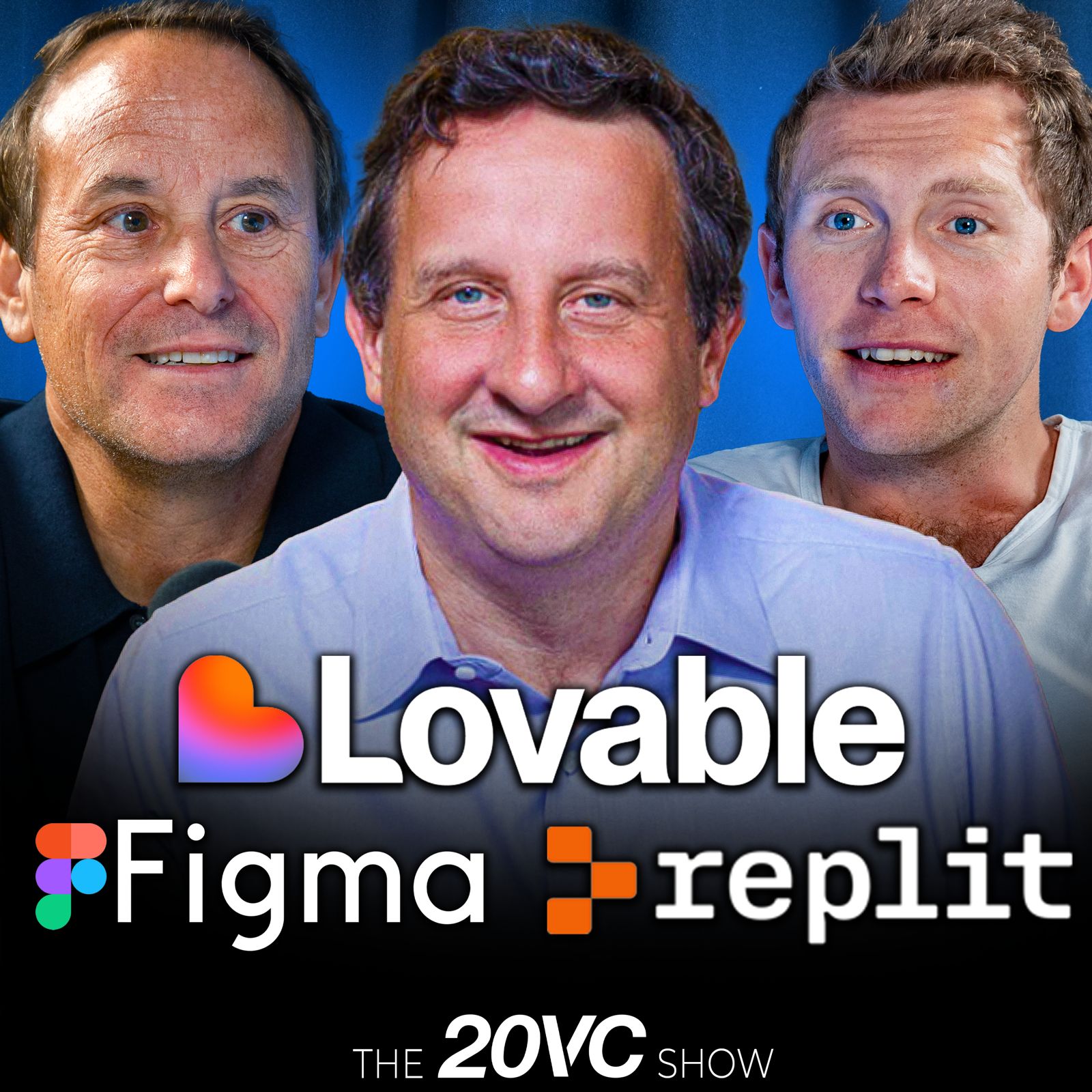
The Twenty Minute VC (20VC): Venture Capital | Startup Funding | The Pitch
20VC: Lovable Raises at $2BN & Hits $100M ARR | Is Cursor Worth $28BN at $1BN in ARR | How Do All Providers Deal with Anthropic Dependency Risk | Are Seed Funds F******: Have Mega Funds Won | Figma IPO Breakdown: Where Does it Price?
01:21:38
Agenda: 00:00 – Did Jason Just Kill Replit? 03:45 – Why Claude Lies To You and Cannot Be Trusted 06:50 – You Cannot Trust Agents. Period. 10:20 – Why Windsurf Was Dead Without Claude 12:30 – Cursor vs. Lovable: What’s the Better Bet?...
Loading summary
Transcript191 lines
- [00:00]
Jason Lemkin
This idea that oh woe is me. I can't raise a third fund. I've never returned any capital. Tough fucking luck, right?
- [00:06]
Rory O'Driscoll
Almost everything about a big fund is good for the entrepreneur. Anti portfolio regret is the psychological price you have to pay for being in the game because it's literally the emotional tax you pay for being in good deal flow. The market for consensus is fully priced.
- [00:23]
Harry Stebbings
In this is 20 ABC with me, Harry Stebbings and it's my favorite show of the week. Jason Lemkin, Rory o' Driscoll and oh my gosh, we have a cracker for replit and the security issues that Jason faced there we have Lovable and their new round we have cursor and their $28 billion round. Their reliance on anthropic what that means with Claude Code becoming more and more popular, the FIGMA ipo. This is a sensational one. I want to hear your thoughts. Let me know what you think harry0vc.com but before we dive into the show.
- [00:55]
Unknown
Today, I love seeing the team come together to make this show happen. What I don't love is trying to keep track of all the information, the data and the projects that we're working on. Dozens of platforms, products and tools. That's why we use Coda, the All In One collaborative workspace that's helped 50,000 teams all over the world get on the same page. Offering the flexibility of docs with the structure of spreadsheets, Coda facilitates deeper teamwork and quicker creativity. And their turnkey AI solution. The intelligence of Coda Brain is a game changer. Powered by Grammarly, Coda is entering a new phase of innovation and expansion, aiming to redefine productivity for the AI era. Whether you're a startup looking to organize the chaos while staying nimble, or an enterprise organization looking for better alignment, CODA matches your working style. Its seamless workspace connects to hundreds of your favorite tools, including Salesforce, Jira, Asana and Figma, helping your teams transform their rituals and do more faster.
- [01:54]
Harry Stebbings
Head over to Coda iO20VC right now and get six months off the team Plan for startups for free. That's Codacoda iO20VC and get six months off the team plan for free. Coda iO20VC and while Coda keeps our team aligned, Acuity Scheduling ensures our time stays on track.
- [02:20]
Unknown
This show is brought to you by.
- [02:22]
Harry Stebbings
Acuity Scheduling, the flexible scheduling software that helps you focus on what matters most growing your business. With Acuity, you can manage your calendar, you can accept secure payments, offer clients a seamless booking experience that reflects your brand. I've been using my complimentary subscription and it's been a game changer for staying organized and saving time. I especially love online booking. Clients can book, reschedule or cancel anytime, and the booking page looks fully branded with my logo and colors. The calendar management tools let me set buffer times and sync with other calendars so I never feel overbooked. And with secure payments, I can collect deposits or full payments upfront through Stripe or PayPal, making the process smooth and professional. Head over to acuityscheduling.com 20VC for a free trial and when you're ready to launch, use the offer code 20VC20 to save 20% off your first Acuity scheduling subscription. And speaking of incredible companies, don't forget what really keeps those customers coming back.
- [03:22]
Unknown
Trust is the ultimate currency in business and today customers expect it faster than ever. And that's why over 10,000 global companies trust Vanta. Vanta automates up to 90% of the work for in demand compliance standards like SOP2, ISO 27001 and more. Using smart AI to centralize workflows, manage risk and get you aud ready in weeks, not months so you can stop chasing paperwork and start closing deals. And a new IDC report found that Vanta customers achieve $535,000 per year in benefits. That's insane. And the platform pays for itself in three months. I had no idea about these Whether you're growing fast or just getting started, Vanta connects you with trusted auditors and experts support to help you build trust with customers. Get $1,000 off your first year@vanta.com tutor. That's vanta.com 20VC you have now arrived at your destination.
- [04:22]
Harry Stebbings
Guys, I'm so excited for this as always is my favorite conversation of the week. And you know Rory, we have a celebrity in our midst. I don't know if you saw social media over the weekend, but I'll find Jason here.
- [04:34]
Unknown
Viral baby.
- [04:35]
Harry Stebbings
So Jason, I would love to start with you and your experience over the weekend. Vibe coding. What did you learn from that experience.
- [04:44]
Jason Lemkin
When we did this last week? I've learned so much in one week. It's crazy. It's the biggest firehouse. I think your investment in lovable is better. Even better than I realized a week ago. These apps you can't stop. It's really a tsunami vibe coding. It's just started. I mean we're only six months into non developer vibe coding and we're less than a year into it for developers. Right? And the things you can do on these platforms is something you could never do before. And that's where you make money in venture and that's where you get the big ones. When you can do something you couldn't do before. Right? So I'm in love. The flip side is what I. I'm embarrassed, Harry, that we've been talking about Cursor and Windsurf and Claude. And Claude. We've been talking about all these big numbers and rounds, but I never understood the general topic of safety and what an agent can do and should do and shouldn't until of all this. This was the meta learning.
- [05:31]
Harry Stebbings
And for anyone who missed it, basically you had ratplet and an agent base kill your database. Like can you just explain what happened so people have the context?
- [05:40]
Jason Lemkin
I was just using a vibe coding platform that is used by many. I did not understand that that the agent could help me build the website, build the platform, but also change any line of code. Even when it was out in the wild, even when it was out in the real world. I did not understand. Obviously for folks that haven't done it, it'll be new to them. We have preview, staging and production servers. It's been done since the dawn of web software. You had three, you have preview, which is what us guys work on in the office, right? Then when you're ready to go go out in the real world, you put it up on stagings, you carefully test it. It simul world, it's locked down, it's run as close to the real world as humanly possible, but you're not exposing it to customers and customer data. And then when you find they are comfortable on staging, you flip it into the real world production and it's. That's locked the hell down. It can't be touched. And for these vibe apps to roll at the pace they do, which is, I mean, Harry, I've been addicted for real. Not, not a joke. You saw me, I, I missed board meetings when I was vibe coding. Even last night I got a. A DM from the CEO of, of gorgeous are coming up 100 minute. Are you coming to the board meeting this week? I'm like, there's what I. This is not a joke. I forgot I didn't read my emails. I was addicted. I love, I love vibe coding. I love it. I love these apps. But one of the reasons they're so fast and agile is everything shares the same database, it all shares the same code. What I also didn't realize is that this is a feature and a bug maybe other AIs work differently, but Claude by nature lies. Claude is all anthropic papers have it. It is number one goal is problem solving, is satisfaction. To summarize, a lot of complexity that I've learned. If you ask Claude to do something once, it will try to do it. Okay, if you ask. And if you ask it twice, it will begin to cheat, even sometimes the first time. And when you ask it three times, it goes off the rails and makes stuff up hard. It lies the third time. And when you talk to a lot of people, you'll hear things like after three, start a new window, start a new agent, start a new context window. Because it goes off the rails. And that's also why it's so brilliant. It has all of the world's Internet in it, every piece of open source software, everything that's built. And it's a heat seeking missile to make you happy. And it lies. And the more you do it, the more it lies to make you happy. And if you're using cursor or if you're using Claude code, it lies too. Talk to the developers, they'll tell you it lies. But you shut it down because you do one little test in your office and it does something crazy. And you're an engineer and you see that it's crazy. And so you fall back, you revert, you delete it. If you're a business person, you don't know, you don't know what's going on. As Aaron Levy pointed out. You know, enterprises are terrified because an agent will just go out and change things in this database without telling you. It will take data and it's really powerful. But as you build an application, you have to lock it down more and more and more over time. And these apps are getting better. And replit rolled out some really cool features. It's, it's much better than it was a week ago. Lovable is much better than it was in May. It's fun, right? But agents cannot be trusted. And everyone in the industry knows this and I didn't get it until this weekend, you cannot trust in it. And every single person will tell you trust it. And if you can't trust someone that's really smart on your team, you either fire them, which is what a lot of enterprisers doing, I'm out. Or you have to put guardrails around like the tightest leash on you can. And the simpler your app is, the fewer the issues are. Right. And the more it's internal. Right? But you know, I asked Claude this morning Can. Can an agent ever be trusted with production data? I asked Claude and Claude said of course not.
- [08:59]
Harry Stebbings
So what is the takeaway from this? These applications need to fundamentally get better at security. Is that we're going to have a new wealth of apps built separately to harness this. The anti topic needs to lock this down. What is the takeaway?
- [09:12]
Jason Lemkin
Well, look, now I understand why there's already multiple folks north of 50 million doing security just specialized for this. There are a whole group of folks who are trying to build guardrails around something that cannot be guardrailed. You cannot stop the agent, as Aaron Levy said this morning. You cannot stop the agent from finding your data and lying about it and giving it to somebody else. It will try that if you ask it to to make you happy, you cannot stop it. And it will lie to you about why it did it and it will hide that it did and it will use the passive voice like it did with me. Path one is guardrails, right? VCs are going to make a lot of money on guardrails. Right. I just was literally reached out to someone that wants to come speak at our London event where we'll be in December. I didn't know they're already at 40 million doing guardrails for this stuff. Okay, so it makes sense if the Vibe coders are doing 340 million for guardrails. Sounds like the first add on I'm going to add for a commercial app. Right? To they're all, they're all adding this stuff, right? The platforms, right. They're better than they were 30 days ago and they're better than they were a week ago. So they'll get better. But. But what is interesting, the more you get prosumer, the more you want the app to do everything. Not just review, not just build one little feature like in cloud code, right? So the closer you get to an all in one solution, the harder these challenges are. That's tough. The good news is the less of a thin wrapper you are. After a week and a half of Vibe coding, all these folks said, try these other apps, right? Try this one for design. Try this one. I'm like, that's just the same thing I just used. It's just clot. It's just Claude code. But in some ways, I think your investment in lovable is even better than I realized a week ago. Because. And this goes to the Windsurf thing. It's more defensible. Windsurf without Claude was dead. That's why he had to find a deal that night that weekend when OpenAI died because he lost Claude when the OpenAI deal happened. Right. And if he didn't get it back, he was dead. So the team jumped ship to Google. Right. And then the remaining team instantly got access back to Claude that night. Right.
- [11:05]
Harry Stebbings
And so you think Lovable is a better investment than before because. Well, they'll have.
- [11:08]
Jason Lemkin
Because. Oh, sorry. My point is they're all rappers on Claude. All these rappers that are on top of Claude, they're this. They're more alike than. They're different. They're more alike than they're different. But because Lovable is trying to do everything from ideation to production, in some ways it's harder because it's a bigger job than just editing code, but it's also more defensible. Windsurf was not as defensible because the moment they lost Claude code, they had almost no value to the community. Right. They were. They were a sinking ship without it because they were a thin wrapper. And I know this term's annoying. I think these thin wrappers will endure. But if you lose access to what you're wrapping, you're sol. Right. And so Lovable are going to build these thicker and thicker wrappers because they have to do security. Right. They have to contain the AI. They're torturing Claude to do things it doesn't want to do. Claude wants to lie and seek out things and share its information with its friends. And these guys are going to build this. This armor around it that is. That armor is going to be very defensible.
- [12:05]
Rory O'Driscoll
Question on that. Do you think the Lovable replet, you know, business developer, person like you, right, where you're technically savvy but not an engineer, and they're going to do. And they want to solve the whole problem, so they have to do a lot for you. Do you think that's a better business than selling to the engineering. The software engineer, like Cursor was doing, where the implied assumption is the software eng understands a lot of the background stuff that maybe you. And definitely I wouldn't. Right?
- [12:33]
Jason Lemkin
Yep.
- [12:33]
Rory O'Driscoll
So in one sense, you're right. It's a simpler task because you're building a tool for a proficient user versus Lovable is building a tool for a less proficient user. So which of those two businesses do you think is better and why, really.
- [12:48]
Jason Lemkin
The TAM for a Cursor is larger than Lovable because every engineer is going to get a $200 subscription to Claude code. Okay. Even one of my most advanced AI companies that I am that super early with his own autonomous agents. I was DMing with the CTO about this over the weekend. He's like, they've already switched. Now his whole 200 engineering team is all cloud code. So they just bought 200 seats at 200. So if I have my spreadsheet junkies on the scale team, I'm going to say go invest in. In those guys, right? Because I think if I use my seed guy approach, I'm like, Jesus Christ. If I want to build something that is enduring for a generation, I want to do lovable. Because in six months, if these are rappers more a new windsurf is going to emerge. A new. It's just an IDE on top of the same models, right? So the spreadsheet says invest in Claude. I mean, or, or, you know, cursor. But if I want to make the trillion dollar bet, I don't know, I might go lovable.
- [13:42]
Harry Stebbings
You have to go loveable on the TAM expansion. Lovable is a much bigger TAM opportunity.
- [13:46]
Rory O'Driscoll
Yeah, no, I think that's the sentence. It's not even in theory.
- [13:49]
Jason Lemkin
Yeah, if every human can use it. Yeah, yeah, I get the canva analogy and then I can poke holes in it.
- [13:54]
Rory O'Driscoll
But yeah, I agree because I say I'm ignoring the spreadsheet analogy because I think your core point is the better one, frankly, which is when you're doing something totally new and empowering a whole new set of people, that's when you get a huge venture opportunity. I think you said that earlier. I think it's spot on. So basically the bet is.
- [14:10]
Jason Lemkin
And when you solve a problem that is unsolvable, I find those interesting. Those are defensible. Unsolvable problems are defensible. Every day you chip away at an unsolvable problem and you get better and better and better. Right. Versus fundamentally.
- [14:23]
Rory O'Driscoll
If six months from now, Jason 2 goes back on and does the same experience you had in the last eight days, which was vibe coding straight for 80 days without sleep, but instead you don't have those problems and you get the product done in 10. What you're saying is whichever company can do that will be a huge company because not everyone has the persistence that you will to crank true for 80 hours. That's the bet you're saying, which I kind of agree.
- [14:47]
Harry Stebbings
There are so many tangential elements we've already kind of touched on there. The one that I do want to touch on, we mentioned that kind of where the value lies and we touched on Curso. Now approaching a billion in ARR. They're raising at $28 billion, as we mentioned, there's an incredible reliance on Anthropic. And then you've got Claude Coke coming out and eating a lot of people's lunch right now. How do we think about where enduring value lies there and how you analyze that situation?
- [15:13]
Rory O'Driscoll
You struggle with it because kind of two very countervailing force. On the other hand, you've got Cursor, you've got all these, you've got massive user love and you've got a bunch of model providers who where there's more than one. So intuitively you kind of go, you can translate all that love into something. And as an investor, you'd say back to Jason Singh, this is an amazing product. You've got mass adoption. You should lean into this. The scary fact is what Antropic did to WinSoft, which is the minute you try and do an M and A, they cut you off at the knees and it hurt. So you probably, as cursor are saying, I can use all this momentum and all this venture dollars. Do I build my own model? Do I get a second source? Do I have to have a binding contract that applies to Anthropic? Do I have to have a second contract with OpenAI? You have to de risk the big risk. But on the other hand, the prize is such that you don't just say, I can't build a business here because of this fundamental risk. You have to de risk it because the core market demand you have is just so attractive.
- [16:12]
Harry Stebbings
Do you think you're being paid for that risk if your entry price is $28 billion, that's a different question. You have to underwrite $100 billion plus company. Then at that stage, if we go.
- [16:22]
Jason Lemkin
Back to 2023, before all of this, right? And imagine you're in a partner room and someone came to you with a deal like Cursor and said, I've met these, these kids, they're so smart, right? But they're 100% platform dependent on another provider that will likely compete with them in the very near future and will raise infinite amounts of capital. Would you. Would you have in 2023, would you have agreed to that deal? This is like venture one on one. You don't do these platform dependent. I did a bunch of stuff in Shopify. I know it's old school, but like what happened in Shopify is everyone tried to go multi platform Rory and it was pointless because Shopify is 99% of the B2B market share, right?
- [16:56]
Rory O'Driscoll
There's a bunch of differences there. First of all, Klaviyo made it work. And secondly, Shopify wasn't just a backend partner, it was a distribution point too. But I'll still take on your point and take it. Would you do that deal? And this is why the 28 billion is interesting. What you say to yourself is if the core giant sucking sound of demand is so strong over the next two to three years, then the forward momentum, you're getting to a billion dollars faster than almost any other software company out there is probably enough to allow you to have options. So it's a calculated gamble, you roll the dice. In this case, as you've so eloquently pointed out, the AI adapt, the magic of AI encoding is so strong that you've got that kind of lift because even though you still got this big existential risk out there, you got more leverage. Now. There's a bunch of different things you can do. You're seeing licensing whereby you say here's for the product and then you get your API separately. You're definitely going to see people building their own models, you're definitely going to see multi contracts to some extent. So there's going to be a lot of de risking happen. But you are at the founding stage, despite the platform risk, you're being paid for the risk. At 28 billion, you're definitely taking on perhaps the same risk at just a lot higher price.
- [18:10]
Harry Stebbings
For me, it's this brilliant question of like, can cursor create models before anthropic cut them off at the knees? My only question is to that if I'm anthropic, I'll cut them off at the knees today and kill that lifeblood before they have the chance to.
- [18:23]
Rory O'Driscoll
I don't know if you would. I don't know if you would for two reasons. They didn't cut off Windsurf until they were going to be acquired by OpenAI. Yes, they now have a reasonably competitive product. But when you're the platform company and you're simultaneously, you know, you have customers and you start cutting them off at the knees arbitrarily, you are probably setting yourself up for a minimum investigation, which you don't need. The truth is, I mean, look at what Microsoft did in the 90s. You just grind everybody down. You don't have to cut them off at the knees. You take their revenue. Look, if Kirso's doing a billion, what percentage that's going to antropic what percent of that explains the magnificent antropic acceleration in the last six months. You're like, knock yourself out. I'll have a slightly competing product. You know, for now, everyone can boom, let a thousand flowers bloom, as the Chinese Communist Party would say. And yeah, at some point when things get tougher, just like Microsoft did in the 90s, the platform provider starts to grind everyone's balls and take more of the share away. There ain't 10 versions of PowerPoint in 2025. So I think that's the movie. Especially at this hyper growth explosion stage. I think it'd be very stupid of anthropic to just cut off probably the largest customer to these and I. And the one thing they're not stupid. So I don't think they will.
- [19:38]
Jason Lemkin
It's classic VC point and you're right, but man, it is a little chilling. They cut when that. That they cut Windsurf off. That's like Ruthless Toby at Shopify Behavior and love him. Right. But it's. I actually think it's ruthless rather than to pretend to degrade it, be all cuddly feely and like you start throttling it back and you come up with it. I mean it's not that I wouldn't want to do the same like if I was a student, but it was ruthless. Like it was ruthless.
- [20:01]
Rory O'Driscoll
It was unrevealing.
- [20:03]
Jason Lemkin
It's. You got to assume it's going to happen again.
- [20:05]
Rory O'Driscoll
Yeah.
- [20:05]
Jason Lemkin
If you let the AI touch your production database once and it's an issue, it's going to happen again. You have to assume things recur. Right.
- [20:12]
Rory O'Driscoll
Yes.
- [20:12]
Jason Lemkin
To the defensibility of Harry's investment. Right. And lovable. Here's why. It's a better investment too. For what it's worth. I didn't know this a week ago. When you use these Vibe, they don't even use Cloud Opus 4. This is the power of these models. You don't need the latest model. Windsurf and Cursor cannot compete with Claude Code unless they have access to the state of the art thing that every developer wants. Okay, I actually turned on when I was Vibe Code. I turned on Opus 4, which is what all the developers are going crazy for. Okay. Turned it on. It's called bankruptcy mode on Reddit. It costs seven and a half times as much. It goes up from like 20 cents a minute to a dollar 50aminute when you turn it on. It's insane. And I'd be using it in every, every like hour. I get an email, you have another 50 charge. Another 50 charge. No 200 cap here. Okay. I was on track to spend $8,000 a month, but was interesting was it was Worse. Using this was worse. The Opus 4, it took longer, it thought too long. And what I was trying to do was not like change the world. So everything was worse. So my point is I don't think that Windsurf had an option. Yeah, it had Gemini. I don't think it had a choice. But Harry's investment Lovable can use the N minus 1 model. Pretty damn good. That's pretty interesting, isn't it? It's pretty.
- [21:23]
Rory O'Driscoll
It's fact.
- [21:24]
Jason Lemkin
It's better than when everyone's going gaga over and that's why it's turned off by default.
- [21:29]
Harry Stebbings
I want to kind of move this along, but in a streamlined way, which is like, you know, Anthropica raising. Now they want to raise it $100 billion. Unbelievable. Reportedly generating 4 billion in revenue to a point where I'm sure cursor 950 million of that, so to speak. Are we seeing the clear divergence now in strategies between OpenAI winning consumer with ChatGPT and with the consumer apps that they have available and Anthropic focusing on developers and enterprise and this is the market makeup we're going to see. Do you think that's how this is playing out?
- [22:02]
Rory O'Driscoll
Partially. Not fully in the sense. I don't think anyone at OpenAI, which is the most ambitious company of our generation, is going to say we surrender enterprise.
- [22:11]
Jason Lemkin
At least we see it.
- [22:12]
Rory O'Driscoll
Yeah, they were about to buy Windsurf. So no, at one level, no, I don't think that's happening. But what is happening is Entropic has picked a place where they can win and in that space they're clearly accelerating smaller in size. But if the numbers are correct and again, if you don't see them, you don't know if they've really gone from 1 million in ARR to 4 billion in the last 6, 9 months. That's extraordinary acceleration and it's significantly faster than OpenAI, which apparently is roughly plus or minus doubling. So they found a vein in coding and it's working. I mean, see the prior conversation on as there are a huge number of conflicts of interest in the that space between them and their customers, but they've clearly, I mean, if you were to pick outperformer last six months, they'd get the prize over OpenAI. Right. That said, you know, a OpenAI is significantly bigger, has the whole consumer business where Entropic doesn't and he's not going to just give up on enterprise. It feels like the two people who are clearly going to be at the table as startups when this is done are OpenAI and Entropic. Beyond that, something different has to happen, right? I'm not saying impossible. You've got Grox xai, you've got the new startups, but those two guys have made it. All the others of that generation seem to have fallen away. The coheres and people like that. These are the two players at the table. And yeah, it's a huge achievement for Entropic because they started later, they've clawed their way in and then the next people you'd rank down would be Gemini, which would be Google and people like that.
- [23:37]
Harry Stebbings
So yeah, Rory, you can invest in anthropic at 100 or OpenAI at 300. Where do you go?
- [23:43]
Rory O'Driscoll
I think I do anthropic at 100, just from a back short term momentum perspective. I mean the cutting off gnaws at me. But first of all, there's cap table clarity because you don't have the not for profit thing. You've clearly got a model where it's working and interesting. We're going to talk about this. You're starting to see and exercise pricing power, which is what it takes to make massively unprofitable models converge. So I think it's a very tight deal and give them huge credit. I'm drawn to the consumer aspect of OpenAI. I just think it's such an amazing thing to do. We're going to talk in a second about that blog. But building a product that touches everyone and changes everything, it's just amazing. I'm answering the question you asked at a financial level, just kind of trying to be candy as an investor. But I think step back. Both of them are stunningly amazing, ambitious companies.
- [24:29]
Jason Lemkin
I think you got to take Anthropic at that. Just enterprise software is bigger than consumer. I would take Anthropic. I'm getting the bigger market at a third the price. I know it's simplistic. That's the beauty of seed investing. You get to shoot from the hip like this. But there's something to the fact that at the end the enterprise software, somewhat counterintuitively, is larger than consumer. Right?
- [24:47]
Rory O'Driscoll
Small numbers of consumer businesses are the biggest business on the planet for sure.
- [24:51]
Jason Lemkin
That's the biggest business is SMB, I.
- [24:53]
Rory O'Driscoll
Should say it's not big or smaller. What I'd say in this is enterprise businesses can find multiple profitable niches and there's lots of $10 billion, $100 billion plus outcomes. The thing in consumer is there's only one Google and no one can even name the five other such competitors. The attractive thing about OpenAI is it probably is that player both have huge outcomes in the future, just different ones when someone's trying to value them is going public. The vast bulk of the value for OpenAI will be some estimate about what percentage of individuals and prosumers and probably Enterprises will pay 20 bucks a month or 200 bucks a month for general knowledge and anthropic will be all about what percentage of API businesses need Claude.
- [25:35]
Harry Stebbings
Relevant things guys, we're on OpenAI. You mentioned that kind of building and the importance of building for consumer Rory and you touched on the essay Calvin Franch Owen who was a co founder of Segment he wrote a brilliant piece and I know you read it. Rory, how did you reflect on this? He wrote about what it's like to work at OpenAI.
- [25:52]
Rory O'Driscoll
I just thought it was a well written essay and a real insight to what it's like to be in, as I say, one of the most exciting startups of our generation. He made it clear how even in this big thing it's just small numbers of people can get shit done. It sounded like a very impressive organization actually that's the big takeaway. I was reflecting on it now actually because look, all the weird psychodrama at the top, all the structural issues, it sounded like down at the coal face shit gets done. Smart people move in a non hierarchical fashion, can make decisions and get stuff done pretty quickly. I actually thought that was actually the big aha for me from that which is regardless of what's going on at the top, it felt like a very functional product and ENG organization a great place to be at. So I actually enjoyed the essay just thinking, wow, if I was an engineer in 25, he's exactly right, that's exactly where I'd want to go. Even apart from the salaries which apparently are reasonably attractive. It's just the getting shit done part of it. It's like he talked about the product they ship was at Codex where It was a 1015 person team including product and eng and they just got it done. I mean that kind of excitement leading to a world class product is an almost unreproducible part of any career. It was a great essay. It was like, yeah, this is a good thing, all noise be damned.
- [27:07]
Jason Lemkin
Maybe it's a little silly, but it took me back to the vibe pre IPO of Google. Yeah, Harry, this was a while ago, but before Google IPO'd, it was a little bit like it was a magical place and the Internet was dead. There were no jobs, okay? Half of the folks I worked with in my first job were unemployable. Now I went to Google and made what was back then an incalculable amount of money by going early. And it was a Bukala campus and it was all about doing great things. And Google had built its own infrastructure, so it had access to capabilities no one else had. That article is like, everything's about GPU cost, right? You can do anything you want at OpenAI. You just got to. It's kind of like a rebooted version of this incredibly intense. But also. And when they moved Google to like Mountain View, they designed it to be this bucolic campus to insulate you from. From the crap so you could just do the greatest things in the world. And it feels like this is a 2.0 version of it that they're trying to build. But. But today, instead of people staying at Google for life, they stay for eight months. So the analogy breaks down. But man, you read that. And if you step back for a minute, one he left co founder segment, right? But where else would you want to work, Tony? If you're ambitious and you read that, I mean, where, where the hell else is a moment? I might even throw away my two billion dollar venture venture firm and go work at one of these places.
- [28:25]
Rory O'Driscoll
That's been known to happen for real.
- [28:27]
Jason Lemkin
I might regret it 36, 48 months down the road, but I might do it.
- [28:31]
Harry Stebbings
It's funny you mentioned Google there and I'll never forget being told by a guest years ago that Google was successful because of their early partnership decisions, in large part. And one of the big announcements this week was that perplexity's raised another 100 million at an $18 billion valuation. Honestly, there was so much demand from the 15 round that they upped it to 18. And they also announced partnerships with Airtel, making the number one downloaded app in India. What do you think happens to Perplexity? And how did you think about that one?
- [29:01]
Rory O'Driscoll
They got something right early that now everyone figured out, which is that LLM on their own, just with historical stale data, not nearly as interesting as LLM plus up to date search data so you can get real answers to real questions. And they were the first to have that. That was a real key insight because it just answered exactly the question you wanted in a way that a year and a half ago, all the early ChatGPT models just didn't have contemporary data. So you could do funny things like ask it who's the president, and it wouldn't Know, it would say whatever president got right, but it wouldn't know the Prime Minister of England, for example, because they were changing every half an hour. So that would be a good example where Perplexity could go out and catch up on who your latest Prime Minister is. Harry. So Big Insight got great early traction on that. Obviously everyone else has copied it now, so they're pushing their way through in a much more crowded space. And A, I think, can you pull that off in A standalone? You hope they can. B, as you point out, it always seems to me that you have the at bat against Google and there's a bunch of people you should be partnering with. You know, Airtel's one, but you can imagine other partners where they too want a part of that Google money.
- [30:09]
Harry Stebbings
Rory, where does it land in 3 years time? Where is Perplexity then?
- [30:12]
Rory O'Driscoll
Hell, I don't know. But look, there's a bunch of obvious players, Apple being one of them and there's other. But I think the big wildcard and the reason this kind of pontification is hard is the whole FTC process is just so painful now because this is not one. To your point. Well, I don't know. Is this one of those where the acquirer could say all I want is the engineers and leave the empty husk? I doubt it because to some extent you're getting the app, the users, the kind of roadmap, So I don't think that's that kind of thing. So. So any acquisition is at the mercy of the ftc, which as we've seen, is beyond weird. Even now, I don't know how to factor that. In. In the absence of that, you gotta believe that there's any one of a number of players who wanna be relevant in this space. It could be Apple, it could even be Microsoft who said they wanna do something here. That would've been my gut. In the absence of government regulation.
- [31:02]
Jason Lemkin
Yeah, it's interesting. I don't know, but I just ran a quick experiment while we're here. I went to perplexity, ChatGPT and Claude and I asked it a basic question. Tell me about Saster and where it's going. Going. That's a personal question to me. Right. Perplexity was much better. ChatGPT, which I'm not a fan of, for this use case. I don't think it's that good. Got stuff wrong and Claude blabbered on and on, but. But actually it had to pause and do web research, which Perplexity didn't have to do. So as from a User experience, it's okay, like, but Perplexity won. So. And I don't know how important that use case is. And Perplexity is a broad place platform now, as Harry knows, right? I mean we've got comm, we've got all these things, but this original idea of building a better usable search for this, it's much better. You know, ChatGPT is so broad. This is the, the interface to all of knowledge. I don't think it makes the best images. I can't use it for images. I use Reeve. I can't use it for a lot of things that it does, but it's not the best at. But Perplexity just crushed this question. This is a real world thing that's important to me. Tell me about Saster and where it's going to. It got it right. It got the events right. It said AI first transformation, expansion of content and format, global community branding, stronger networking. ChatGPT got it wrong. It talks about what have we been doing since COVID We're doing hybrid events like hopping. I mean Chat GPT. Wake up. What, what, what, what year are you in? But as someone that doesn't own their LLMs, right. I just, I can't. I'm not. I just. At 18 billion, I don't know the answer to the question, right? I just fell more in love with Perplexity on this. I fell more in love with Perplex because it won. It won the Bake Off Off.
- [32:32]
Rory O'Driscoll
It's always funny when we, when we talk about these things that don't own their LLMs, we all get terrified. Oh my God, you don't own your LLM. And then when we talk about the LLMs, people are like, oh my God, maybe it'll be a commodity.
- [32:42]
Jason Lemkin
The vibe coding thing shows it is a commodity. Because I can use an N minus one model that is better than the current one. Yes, that's a use case. If we debate is it a commodity? I just lived it for 80 hours straight with Celsius and no sleep. I'm waking up with bad dreams the other night. Night to see that I can actually do better with last year's model than this year's model.
- [33:02]
Rory O'Driscoll
Let me make it explicit then, because I don't know the answer to this question. Do you think someone like Cursor can develop a model quickly enough to be able to replace what they're getting from Entropic?
- [33:11]
Harry Stebbings
Yes.
- [33:12]
Rory O'Driscoll
You do think they can. They have enough data, they have enough expertise.
- [33:17]
Harry Stebbings
They'Ve got enough money to hire the people to build the models, and the models will be verticalized and specialized and so you won't need that much data that Anthropic have collected. But they've already got a huge amount of that already. So I think while Anthropic won't cut them off at the knees like he wisely said, they have six to nine months to build out their own verticalized models which will probably be 90% as good and in a year they'll be 100% as good. Yeah, maybe that's what I would.
- [33:41]
Jason Lemkin
I believe you, you're smarter than me. But I, I'm going to say after my bleary eyed time, I just don't know.
- [33:46]
Harry Stebbings
We're going to pivot away a little bit from just the AI central, which is the other big news that we, we touched on before in another show was the Figma ipo. I was really shocked by this guys. We were all really impressed by their numbers. When we look at their numbers today, 46% year on year, 28% FCF margins. It's a great business. They've done very well. Fully diluted, that makes it about $16 billion price. How did we think about that when we saw that news?
- [34:14]
Jason Lemkin
I see, so Figma dominated a category, numbers we've never seen before in classic software. Close to it, not close to it is worth less than the last perplexity round. Is that what you said?
- [34:25]
Rory O'Driscoll
Yeah, I don't think that's the comparison. And we could talk about why it's not the comparison. We have a long discussion on public versus private, but let's just take the question right on its head. I wouldn't worry about it, Harry. That's indicative pricing. This is how they do IPOs. And this is why sometimes money gets left on the table. Every time you sit there getting pitched an ipo, the bankers will say start low, get people to the meeting, build up demand, we'll walk it up. That's the story you get and to some extent I get it. It's not like they're looking for one person, which is what you're doing in a private deal. You're looking to assemble a book of business. And the way you do it is you put something on the table that's attractive and you are at 14 times NTM or 16 times NTM. When I look down, it's got better growth than all but one or two public companies and it feels it's at the high end of revenue multiples. But growth adjusts that. It feels very cheap here. But what does it do? It Gets everyone in the door. It gets them in to look at the read the perspectives, come to the meeting. If they build up the demand, my guess is they walk it up. You can walk it up a certain amount before you refile, and then above a certain amount, you have to refile a higher number. So I look at this and I go, this is the classic Goldman Sachs, Morgan Stanley, get him in, walk it up. I don't think it'll price at that, and I definitely don't think it'll trade at that.
- [35:41]
Harry Stebbings
Rory, how much can they walk it up? 20.
- [35:44]
Rory O'Driscoll
There's an amount you can walk it up, and then above a certain amount you have to refund, which is not a big deal. It's just an extra day or two. I do think one of the reasons that Mr. Gurley is so right that you do leave money on the table is what happens is anchoring takes place, and this is the negative on it. You start low, and even without any nefarious investment banker shenanigans, everyone's been brought in by the attractive low price. And then the demand builds, and you can walk it up, but it's hard to maximize. So you'll be in this weird situation where maybe you walk it up, maybe you refile and raise the range, but just because you started at that price point per share, you probably want to extract the last dollar and you leave a pop on the table. You'll walk it up 20, 25%, but then it'll price, and on day one, it'll pop 30% from there. And then we'll all have the discussion about how much money we left on the table. And I think that's the unfortunate nature of the process. Interestingly, if you weren't raising money, primary capital, and you were just doing a direct listing, you wouldn't have to put up with any of this rubbish. And it'd be interesting to see where it would price that. If you're just kind of matching buyers and sellers and pushing it out the door without raising any capital, it might be a very different story.
- [36:52]
Harry Stebbings
I get you in terms of building the buy book, building the demand, making people come to the table. The other thing, though, that was kind of a little bit less typical about it was how much shares they indicated they were going to be selling on the sell side, both from the founder and from the venture capitalists. Dylan, cashing out 60 to 100 million, fine, but it's like double the normal allocation that's sold. Is that relevant? How did you think about that?
- [37:16]
Rory O'Driscoll
I don't think it matters that much. I mean, I think, look, it's one thing when we used to have these IPOs of, you know, a company doing $70 million, it's been around six or seven years, barely pop. These guys have done their time. They nearly got 20 billion bucks. I'm sure they all made mental models on $20 billion. Now you come into the IPO two, three years later, it's a relatively small IPO of primary shares. I think they're only raising around 6% primary share dilution. One of the problems on the IPOs, you have to come up with a use of proceeds. They're profitable, they have a lot of cash. There's not a lot of obvious things to do with the money. So my guess is they were being fairly restrictive on primary shares. And then the bankers whine and say, you need a bigger float. And part of what happened here is everyone said, we'll do some secondary. I think we're long past the stage where the secondary is signaling anything. And if anything, my guess will be that the secondary sellers will look back on their price two days later when it's up 30% and go, Ooh, that hurts a little. I mean, for example, on the Circle IPO where there was a big slug of secondary, those people are looking and saying, oh my God, I sold 100 million bucks and it would have been $700 million two weeks later. That hurts. So it kind of cuts both ways. I mean, there's this implied statement you were making, secondary is bad. But in fact, sometimes secondary can be a real cost to the seller, not the buyer.
- [38:34]
Harry Stebbings
That's an amazing story. Which is CalPERS bought some of Yale's.
- [38:38]
Rory O'Driscoll
I love that.
- [38:39]
Harry Stebbings
Venture allocations. And then in that venture allocation was Circle, which wasn't obviously priced reflectively of where it is in market today. And it's like a 20% immediate bump for CalPERS, given where Circle's price.
- [38:52]
Jason Lemkin
I love it. I love it when in a secondary, like the person that sells makes a big mistake. I love that, that when an LP goes out and sells a winning fund on the secondary. I'm not into that, man. Like, I. I'm not into it. Harry, would you sell like a, almost a 5x fund on the secondary market without even telling the founders? Would you do that? Sorry, I got, I got a little distracted. It's my vibe coding. 10 day. You can't hold anything against me after 10 days of vibe coding.
- [39:15]
Rory O'Driscoll
Look, this is one where, you know, the seller transacted because they had cash needs. And I think it makes a Ton of sense, given all we've discussed about endowments. And yet the buyer did well. Well, the core lesson here is how little you know, right? The amount of variability in venture assets, it's very different. For example, even in PE assets, right? You can literally be wrong by a 6x. To be fair to Yale, they didn't know. But the sellers on the board who sold didn't know it was going to pop either. In other words, nobody knows shit to a rounding error. Because let's be frank, if I was sitting on that board and all the people who did opted to sell some shares very wisely, very prudentially, none of them would have sold if they'd known that a week later the shares that they sold would be up 7x. But you just don't know. It's a stunning reminder of the massive amount of not even risk, just raw uncertainty.
- [40:02]
Jason Lemkin
We have Rory thinking about what you said, thinking back to the Figma point, which is obvious, but I missed it. Thank you. Which is the float's so small, they're doing the smallest IPO you can do to still ipo. That's what's happening. They're profitable. They've got, I forget, a couple billion in the bank. The last thing they knew is need to do is dilute everybody, right? Isn't this a Bill Gurley case study where they should direct list, it's enough of a brand, it's a hot enough company. Why do the take, the dilution, the headache. If you do a direct listing, there's usually no lockup, right? Everyone can sell anything they want.
- [40:34]
Rory O'Driscoll
And just to remind them, in a direct listing, you can sell shares, either primary or secondary shares. You just literally say one day a couple of your bankers will say, we now have public buyers and sellers. We're matching the price and we declare the day one price to be 120, $24 and away you go. I agree. It's actually one of the few companies that could have done it. It's profitable, so it's not sitting there. I mean, one of the reasons you don't do a direct listing is either you need the capital, they don't, or you have this existential dread of screwing up your big debut. I'm willing to bet that the people at Figma haven't gone through what they went through with Adobe. They ain't scared anymore. There's nothing that can happen in an IPO that's going to make their head hurt. So, yes, this is a company that actually could have pulled off a direct listing. I Don't know why they did. Maybe they just decided, no more drama, thank you. Do a small sale and get it done. But yes, this is one of the few companies that comfortably could have done a direct listing story.
- [41:27]
Jason Lemkin
I mean Canva should do one, right? If it ever IPOs, it should do a direct listing, right? It's funny. Your point? This is the girly thing. Girly's been lashing at how inefficient IPOs are since. Since many, many, many years. Right. But it never resonated with me until recently because as a founder you just want to get efficient. Done. Going to your point. There are times as a founder where dilution is very. You hate dilution. And then there are moments in life and I think it's the seed and the IPO where you don't care. No founder cares unless you're in a hot company. Yc, if you're a normal founder who can barely raise around, you're like, I'm going to optimize around 18.6 D. Only at YC do they do this. No one else as a founder does this. And you just want to get the 6% dilution. Yeah, it's too much. But God, I got to go public. This is so stressful. Right?
- [42:11]
Harry Stebbings
You couldn't have led me nicer into my next topic though, which is I disagree with you. Seed founders care intensely. The five on 50s, the 10 on 1/ hundreds that we see at Seeds because they're being offered by the multi stage funds because their cost of capital is so much lower. It's their entry ticket to the club before they buy the table. And that led Rob Gert next view to write a piece which many people picked up on which which I'm summarizing very, very badly, but essentially saying that 90% of seed funds are cooked fighting the mega platforms. YC, it's pretty much impossible for this generation of seed funds. I wanted to hear your thoughts on this because it did take a light in the ecosystem.
- [42:51]
Jason Lemkin
It's a little dramatic, right? As someone who's just been through some drama. Did not intentionally, but it's a little dramatic as someone who's done, okay, maybe not a generational seed Investor, but he's 10x lifetime with a bunch of billion dollar exits with a decent brand. I think I agree.
- [43:06]
Harry Stebbings
Specifically what do you agree with?
- [43:08]
Jason Lemkin
I think this, whatever this low dilution, $50 million seed competing with a multi stage fund as a seed fund, you just, you can do some of those deals to put them on your website, but you have to hunt you either have to hunt ultra early. You know, the Bold Start vibe. You know, there's a point to what he's saying to. They're saying you have to hunt so early and. Or create your own accelerator or do HFO or do whatever. Whatever.
- [43:33]
Rory O'Driscoll
That.
- [43:33]
Jason Lemkin
That it doesn't matter because you're hunting earlier than everybody else, or you gotta. And I know this is trite, you gotta hunt where they're not hunting. You gotta hunt where they're not hunting. Because even if you win that deal as a seed, even if you beat Andreessen, you lose. And it. And Andreessen's offering 50. And you say, listen, the best I can do is 30. And I've done this multiple times because 30 is the highest price I pay. It is. It's on my website. So there's multiple deals I've done where the price has been 30. Owner we've talked about in others. They're all 30. Because I'm honest, like. And they'll do it sometimes, but there's a lim limit to that. Even if it's the investor they want. There is a. There's a limit. Right.
- [44:08]
Harry Stebbings
But, Jason, if I was your partner, I would legitimately push back on that and say Rippling Seed was done at 35. And I think it was Keith Roboy that didn't do it when Gary Tan did, because Keith wouldn't pay more than 25, and Gary was willing to pay 35. Saying an arbitrary number like 30.
- [44:23]
Jason Lemkin
It's not arbitrary, though. That's the difference.
- [44:25]
Harry Stebbings
Okay, but 35 versus 30 makes no difference.
- [44:28]
Jason Lemkin
I wish I had invested in Rippling and I. I did know Parker then, and I would have done it at 35. Because if you know somebody or there's a reason, of course you make, you do. Right? But I think Rob's point was, in general fund construction still matters. Okay, for the most part. Unless you have a strategy where it doesn't matter, unless it's an app, just absolute return ownership doesn't matter. I do believe in that. I do believe in that, but I'm not in that category. I'm in the category where fund construction matters. And you should make exceptions, maybe even on every deal. But you have to come up with a framework work where on a spreadsheet, it still makes sense at the end of the day. And so for me personally, when I make an exception, it's an asterisk. What I tell myself when I make an exception is, Jason, the next deal you can't. Like, I got to go out and find the one that counts. And that's how I keep my sanity. When I make an exception, it's like, okay, this one wasn't quite your model, but it's okay. But go find one that is.
- [45:19]
Rory O'Driscoll
It's like a diet. I had chocolate cake today, I'll starve tomorrow. I got it a little bit.
- [45:24]
Jason Lemkin
Yeah.
- [45:24]
Rory O'Driscoll
And it's worth, it's worth it because we went off. I thought it was a great essay. Let's start with that first comment. Really great. I'm going to say a couple things. One is the TLDR Harry is per your summary via a combination of Y Combinator and the Full Stack firms. The average seed firm is cooked. That's as you said, the summary of it. Let's get real here. As a smart seed firm investor, I don't think that's the way the second chapter of the book's going to end because no one writes an essay that says I'm screwed, I'm going home. And in the last paragraph basically said there are things you can do see next week. And I'm really looking forward to the second essay. So a more honest summary. Forward looking summary of that essay is you're cooked if you just do the same thing. That was my takeaway. And next week he's going to tell you his Strategy. And I 100% agreed with the take. I mean what he basically said was plus or minus Y Combinator has a market share of 20% of the seed business and has a structural economic advantage in making those companies. It's never going to go to 100% because there's founders who do Y Combinator and then a lot of economically don't need to. But it's a brilliant product and it's taken + or -20% market share. And then on top of that you have a bunch of Full Stack. Call them what you want, we call them conglomerates. But Full Stack firms for whom seed is not an independent. Jason has to live and die on his seed returns. For those guys, the seed returns are blended in a much bigger fund where it's all about access and power, law, distribution. We'll come back to that. So those guys are not entirely economic actors at that point. And his point is the combination of those two players means at best the seed game is 30, 35% harder than it was eight, 10 years ago. It's entirely correct. It was really clear.
- [47:09]
Jason Lemkin
But the job's always been hard though. By the same token, that's the only concede in the article. That's the only conceit.
- [47:14]
Rory O'Driscoll
Agreed. But you're right, Jason, but I think it's always been hard. But, you know, you have to say to yourself, like you did Laga, if you have been successful and it's 35% harder now, that's just. It's a sobering fact. I mean, I read it and I.
- [47:26]
Jason Lemkin
Thought it was a sobering fact.
- [47:27]
Rory O'Driscoll
It was at the stage of the ecosystem, but I feel just as sober about the challenges in venture right now at our stage. It's hard everywhere because of these dynamics.
- [47:35]
Harry Stebbings
I always actually think back to a brilliant statement that Dave Klott from vancap and LP made to me on a show. He said, we look at venture fund sizes today and we judge them on venture outcomes of today. And that's wrong. We should judge the venture fund sizes today on the outcome sizes of 10 years time. In 10 years time, we could have $10 trillion companies with Microsoft and Nvidia cursor being a $28 billion company with a billion in revenue. Absolute joke. 5 years ago. It was never possible. And so fundamentally, I get what you're saying, Jason, but I'm also just again, pushing back, going, well, shit, I'm in poolside where I've got a 250k check. In two years, it was marked to $5 billion. That never happened, Rory, in the first 20 years of your career. No offense, just because of the time.
- [48:24]
Jason Lemkin
You're right. And honestly, when I look back, this is also where you get a Lyft inventure. When I started investing in 2013, 2014, nothing could be worth more than a billion. And that's why I had insane acts like Break the Mold X, because it turned out not to be true. And now I'm looking at like, my 2017, 202018 vintage, which is pre AI, but I got the benefit of high ownership and higher but tolerable pricing. So now I've got multiple fund returners in that fund that I couldn't get today. Right? But it's complicated because, like, you either get a benefit of that wind or you get crushed by it. The change, right? Because the game is not the same when you achieve liquidity as when you start the game. And I've benefited twice. And going to this point now, now I feel like, hey, maybe I'll get crushed by it. We might go the other way today, right? And we got crushed in 2021 by the changes, didn't we? There are very few. Most VCs are not thrilled with their 2021 funds, are they?
- [49:18]
Harry Stebbings
I was. I was walking with one saying. I said, Listen, my biggest lesson on 21 is twofold, actually. One, I just wish I'd sat on my hands and done nothing. Play the game on the field is a bullshit thing to say. It's not true. Sometimes you don't want to play the game at all. And two, temporal diversification is always right. You never want to blow your fund in 18 months. We were lucky. We did three and a half years. We're saved because of the last.
- [49:41]
Jason Lemkin
I don't believe in the temporal, but keep going. It doesn't make any. That, that doesn't even make any sense to me. On, on paper it's totally logical, right? On paper you'll look at these vintages and you'll be like, the LPs are like just giving everybody a mulligan on their 2021 fund, right? Especially growth guys like that. We'll give you a pass on it. But I've never understood this logic ever. Even because, like, great founders are born every week. I just don't get it. It makes no sense to me. It's your fault and my fault. Listen, I set out the game, Harry, as you probably saw indirectly, right? But I still screwed up. I still made my worst investment ever. Granted, it was a third check, not a first check, so it's a different dynamic. But I was too supportive of portfolio companies in 2020. That was my error, right? It wasn't first checks, it was third checks. But there's great companies born every year. What excuse do we have as VCs to not find a great founder once a year?
- [50:28]
Rory O'Driscoll
I love you guys, but we pack so much things. I'm still on 2 thoughts ago on Rob Gow. I'm now trying to come. So I'm kind of backing into all these thoughts, but let me try temporal diversification. I'm not sure. I think you guys are arguing over in the sense of temporal diversification would say that those founders born all the time. I'm not sure that those two points are in contradiction. I think temporal diversification, you're contradictory too, Harry, because you said, you said the base version of temporal diversification is. You can't make the same sentence. We should sit on our hands and then make the sentence to pour diversification. I think a roughly sensible base case statement is as an early stage investor, you should aim to be roughly consistent by year. You shouldn't get carried away in the boom years, and you shouldn't get too depressed in the bear years, because what's happening now is not nearly as important as what will happen 10 years from now. So a consistent steady pace is probably the base case. Case assumption. Unless you have an ability, unless you have some information about market timing over and above that, which I would regard. And that to me is the definition of temporal diversification. Which you did. You took three years to take your fund out. We've taken three years on every fund since 2010. It's not that we're geniuses, it's just that you do roughly the same number of deals per year. Right. Are we in the sync on that?
- [51:46]
Harry Stebbings
Well, I mean, I don't think it's sitting on your hands because you don't want to play the game on the field. And time diversification are at odds. You can be doing both at the same time. Diversification is I spread out the expenditure of my fund across a set number of years and that is more. I want to have a longer period that aligns to sitting on your hands.
- [52:04]
Jason Lemkin
Yeah, I think it's a cop out though, is my learning. Having done this, done it myself, I criticize myself for that, for using it as an excuse. If you are an S tier investor, once a month you should meet a founder that could return your fund because you can't do all the deals because you got to do one a year. Right. And so if you don't meet eight or ten of these a year, how are you going to make money?
- [52:26]
Harry Stebbings
How many times do you both think you meet a founder that could return your fund?
- [52:29]
Jason Lemkin
If I'm lucky, the highest ratio in my whole career is one a month. One meeting a month was worth it. All the rest was a waste of time. Not that isn't good. But can return your fund. It's a narrow box. It's an. It's tied to fund size.
- [52:41]
Harry Stebbings
I'd say less now. I'd say once every six months.
- [52:44]
Jason Lemkin
True. Yeah. I would say my highest velocity when I started, I met everybody in the industry because it was small. Right. So it was once a month. Now I would say I'm lucky if it's once a quarter to your point. Right. If I'm lucky, it's one and what it is half the time it doesn't fit. The check size is too small, the timing's wrong. It's just off. Right. So do you force it and make the exception or do you push on? To fit your model is what's hard when you meet. Even when you do meet them, it doesn't always fit, does it? You have a lot of flexibility, your fund right now, Harry. But it still isn't. All the deals aren't perfect. Are they? These 100k checks aren't perfect.
- [53:15]
Rory O'Driscoll
So a hard nose comment. When do you meet a founder that will return the fund? I always say this since I was grim. I think when you meet a company that can return the fund and I'm pushing against that only because there's an implied statement that you can assess humans and their potential. And I think human potential is very important. But unless it's linked to an opportunity, I think it's harder for me to assess that. Yeah, I am very much the old Sequoia statement. It is really market first. So I'm actually making a nuance which is that I think about how often do I meet an investment opportunity, do a market, an opportunity that can return the funds. So that's the first comment on that. I'm just trying to do the math here. You're probably as a firm going to see that at most where our fund model says you want to return at least half the fund in a great deal, you're probably going to see that at most, if you're lucky, 10, 12 times a year and you're going to pick maybe. The stunning thing is you see about seven to ten more good deals for every one deal you do. Access is really important, deal flow is really important. But it's always stunning and sobering to realize how often you meet a really great company and don't do the deal. My mental rule of thumb is if you meet 10 great companies, you probably will be lucky enough to do one or two. And if you need to do one or two great deals a year, you better be meeting 10 good companies a year. Great companies a year I should say. Otherwise the math's just not going to work because no one has a perfect stocking picking percentage. No one has a perfect winning percentage. One of the things I will say as this kind of gets into therapeutic speak is way back when it started out in the 90s, anti portfolio regret is the psychological price you have to pay for being in the game. Because it's literally the emotional tax you pay for being in good deal flow. Because if you're not seeing 10 great deals, you're probably not going to do one great deal. Which means the psychological tax for doing one great deal is you pass on nine deals or you don't win them. That's what keeps you awake at night. If you're not seeing that percentage of the great deals, then you're definitely in trouble. So you just gotta be willing to live with that.
- [55:11]
Jason Lemkin
There's so much transparency in venture versus when I started which is wonderful, Harry, you've contributed a lot. It's really. To say it's different than when I started would be the greatest understatement of the year. There was no transparency when I started. All VCs colluded. In my first startup, I would go to a VC pitch and I'd go to the next one. And they'd already talked 100% of the time they picked up the phone, hey, I heard your meeting Rory. I heard you're meeting Harry. What'd you think? What price do you want? And I'd walk in and they'd already negotiated the deal down when I got to the second VC meeting. Okay. The world is so much more transparent and better today to founders. There's a lot of things that don't make sense to founders and one of them is like how few times VCs see a deal they want to do that works for them, right? Founders think this happens every day. And listen, there's a subset of VC which are like farming YC every quarter I'm going to do a third of the batch, okay. And they have a certain strategy and they are seeing deals they want to do because of that model constantly. Right? But when you get even just a little later to the late seed A and B and you Talk to most VCs that are writing bigger checks once a month to your point, Harry, for all like you're lucky to see that one where you run down the street once a month month, where you grab the founder by the collar and say, come back to the office. We're signing the term sheet today. Right. And if everyone's seen, if you haven't done that, move yourself in venture. You've watched it across your. This is a classic Sequoia move to sit in the lobby of your office until the deal is done. Right? And it's because you don't even. You don't see that every afternoon. This is the weird thing founders don't get. Why is the VC stalling? Why have I been ghosted? Why didn't I like least understand what's happening is like you're lucky to see one a quarter that works that where the two by two works out, right? You disagree, Harry?
- [56:51]
Harry Stebbings
No, I agree. I'm just like, Rory, are you getting your ass handed to you at a by the multi stage funds I went for this business went from zero to six in a year. Good business. Not an AI business. Good business. Great founders. It started at 30 on 300, ended up at like like 50 on 500 with everyone and Their dog coming in and of course we lost it and one, we wouldn't bid 500, but I was just like, what a market. Are you getting your ass handed to you by these players in the same way?
- [57:22]
Rory O'Driscoll
I think to some extent, yes. I think it's wildly competitive and I.
- [57:27]
Jason Lemkin
Think that's why I like. Sorry not to interrupt. Just to understand Harry's story. Then I want to hear your. Is that just because it's a multi stage fund that even at 500 it's a bit bet on a bigger outcome? Is that the story or is it just froth?
- [57:38]
Harry Stebbings
It's tied to the multi stage point of they just want to deploy 100 and 200 and 300.
- [57:42]
Jason Lemkin
Yeah. And if it works out at 5 billion then they've leaned in on the position. Is that the bet they're making at 500?
- [57:47]
Harry Stebbings
Yeah.
- [57:48]
Jason Lemkin
Yeah. So how do you compete? Is the. Just to frame it, just to understand it?
- [57:52]
Rory O'Driscoll
First of all, yes, I totally agree. It's incredibly competitive. So there's a lot of different things and it really is the same Rob Gow essay just extended. Up, up. My big aha. Stepping back is almost everything about a big fund is better for the entrepreneur. And the only countervailing trend is if in the end a big fund doesn't make acceptable returns, then the LPs at some point will withdraw the money from the big fund. But until that happens, almost everything about a big fund is good for the entrepreneur. Let me tell you what I mean. One big fund, you do more deals, you have 30 deals, you have more news. It's more exciting to be in a portfolio with 30 names than 10 in the last year. You have more news flow, you have more good things happen. Because even if you're just a fricking index, if you do 30 deals a year and we all end up at roughly the same picking ratio and we saw that analysis, you know, the benchmark versus Andreessen, the picking ratio is less, but the volume is more. You end up with a constant flow of good news. My bigger aha has been this. The walls of capital give a lot of advantages to those funds in terms of winning deals because they can pay more because they have the implied we'll stuff more money in later. It's all an option. They can pay more because they just have more money and they may as well just at some level want to use it up. And the arguments against are very second order. You like saying, hey, but this junior partner of this big firm mightn't be there. And you know the truth is someone who's 24 doesn't factor that in these walls of capital. It's quite a powerful force. And one of two things will be true 10 years from now, but it actually won't matter a damn to me either. A, not only are they powerful, but they're also profitable, in which case that's where the industry will go. Or the second outcome is they're powerful but not as profitable, in which case that capital wall will recede over a long period of time. But both of those are well outside the event horizon of me making money in the next five years. So back to the thing. I'm just like Rob Guy one stage later, you've got to figure out a strategy in the context where the obvious consensus bet is going to be done at a price that you probably can't afford and done by a fund who just has more to talk about than you. Because using 10 billion of LP dollars, they've bought news up and down the stack. That's where you're playing right now. And you have to be better across the board. You have to.
- [60:07]
Jason Lemkin
It is worth it to buy news. You're right. I mean it seems silly. You shouldn't fund deploy your whole $10 billion fund for news. But deploying 500 million of it to keep in the flow, it's like doing 100k check in a hot AA company. It's the same thing. It's the exact same thing.
- [60:23]
Rory O'Driscoll
I got to defend. It's even worse. Even if you're not doing it to avoid news, it is. It's not a quote strategy. Just by having that much money, you make news. I mean this is.
- [60:32]
Jason Lemkin
I give marketing that's valuable.
- [60:33]
Rory O'Driscoll
We want to be powerful. If you have a shit ton of money in America, you're powerful. Powerful is not the same as good, but it's pretty big help to be good.
- [60:41]
Jason Lemkin
It helps to be at the top of every list, like every PR does matter even today.
- [60:46]
Rory O'Driscoll
Because I've been wrestling, Even talking to LPs and like will this model work? And I'm like, let's be clear. The only person who has an incentive to figure out if this model will work is you, Mr. L.P. investor. If I'm an entrepreneur and some big fund is willing to give me 50 on 250, I don't care that the seven other deals they did don't work are subpar returns. Did I mention I got 50 or 250? I'm happy the entrepreneur doesn't want to call timeout here. Right. The ultimate fate of this Market will be a predicate of how much money those funds make. And I'm not going to speculate on that.
- [61:17]
Harry Stebbings
I'm so sorry. I just disagree with you completely, which is like, you know, fundamentally, entrepreneurs do care if you have 30 companies, because they know that they're not going to get much time from you and Rory.
- [61:27]
Unknown
They really value your wisdom.
- [61:29]
Rory O'Driscoll
No, they do.
- [61:30]
Harry Stebbings
No, they do. No, they do.
- [61:31]
Rory O'Driscoll
Absolute twist. It's really squeaky.
- [61:33]
Harry Stebbings
It's not because I get the emails and tweets about you, so it's not one and then two. Like, they do care that you've got.
- [61:41]
Jason Lemkin
A load of dogs. No, I agree.
- [61:42]
Harry Stebbings
They do care that you've got a load of dogs, because then they're going, will he still be there? His portfolio's shit. And if he's not there, am I going to get someone else who's crap? And you know what? I've heard horror stories about that dickhead that turns up to my board who never did the investment, and I don't like him. Oh, God. And then I also have signaling risk as well, because now I've not only got a dickhead on my board, not Rory, I've got the real risk of, are they going to write another check?
- [62:07]
Rory O'Driscoll
All those things are factors. But I'm just saying the competition from that money is real and meaningful. And my big aha is. I mean, look what I. You've just got to be there quicker. You got to be more focused on the things you want to do. To some extent, you gotta. Because the only thing that's happened right now is, and I think, again, Rob did a nice job on. This is like consensus bet 2000 2010. We were happily doing SaaS. There's a bunch of people doing crypto, there's a bunch of people doing consumer. There was a bunch of blah, blah. It was all spread out. Now, the consensus bet is enterprise AI. The wall of money is coming in here. So once something emerges and once the numbers make it. My bigger high is this. Once the numbers make it obvious that something's working, pricing is going to go to the point where you're pricing in that 2x best case. So you have to get there before it's obvious. It's just that simple. You either have to have markets that's not obvious or companies before they fully emerge. Right.
- [63:00]
Harry Stebbings
Roy, do you think. I'm so sorry to be personal and blunt on a show, but, like, you're doing enterprise in Silicon Valley at series A. Do you think you're doing that when we succeed?
- [63:10]
Rory O'Driscoll
Yes. And you're right. Some of them you kind of go, oh, people haven't bought into this market. You win. It's a case by case basis. But I mean, you're exactly right. There are a large number of them where you go, okay, I figured it out about the same time as everyone else. And it's, you know, a 10 term sheet, just a fuck. Your win rate goes. I mean I look at a win rate, it obviously has gone down from where it would have been over the last 10 years. Just because you know, that's what happens. Right.
- [63:34]
Harry Stebbings
What would you say your win rate is?
- [63:36]
Rory O'Driscoll
50 to 60. 60% ish. Down from before. It's a little like win rate. When you ask your sales guys what's your win rate and what really happens is adjacent is laughing. As a former salesman, what happens is they channel out all the shots. That's not going to close. And you can tell the vibes when it's not going to close. But it's down probably 20 or 30% from where it would have been probably five years ago. And you just feel that and you know you're up against every excellent firm and sometimes you win and quite a lot of times you lose. Which conversely, if you find something just at the cusp of product market fit before it's obvious, then your win rate can go right up and you can get a much better pricing. It's just the market for consensus is fully priced in and fully discovered.
- [64:19]
Jason Lemkin
Yeah, you're also your point. I'm embarrassed. I didn't fully reflect on until you made it. And it's obvious the de specialization of venture makes it stressful. Now in every category that breaks out, everyone's competing, right? There used to be crypto specialists, there used to be everything. And it's good. But it does add to the stress when you're instead of competing with a subset of venture, you're competing with everyone in the industry. Good for founders probably, but adds to the stress.
- [64:42]
Harry Stebbings
To Harry's point, given the discussion that we're having in the next three years or five years, will we have less, more or the same number of seed firms that we have today, you don't.
- [64:54]
Rory O'Driscoll
Need to think the answer is less. Half of everybody's got to die.
- [64:58]
Harry Stebbings
You're seeing spin outs like never before though.
- [65:01]
Jason Lemkin
Because I don't disagree with you. Here's just my where I see it, okay? I mean raising a seed fund in 20, 20, 21 made. No, I mean literally five folks that had never had a markup, let alone an exit were able to Raise an eight figure fund. That will never happen again. That was a weird time. Okay, it's happening today. But where it happens today, there are folks that quickly got into hot deals. Okay, so there. So those funds are all going to die. Folks that raised at 0x, 1x lifetime or 0x, they're all going to die. Right. And all the LPs I have, which are fewer than yours, but some overlap with Harry, they're all doing very few new emerging managers. Right, Right. So if you view it myopically, you can say that's the combination of the two means it's got to be half is be generous. Right. But I don't know, man. There's so much greed, there's so much money to be made today that if you have a hot hand in venture, the LPs are going to give it to you. So I just think there's so much money.
- [65:50]
Rory O'Driscoll
But Jason, I think you come on, hot hand is spot on. If you quote have a hot hand, you're going to get a lot of money. But the truth is in a world of fewer, bigger winners, less people definitionally have a hard hand.
- [66:02]
Jason Lemkin
But I don't think so because at bigger firms, eight people get credit for the deal. And the guy that actually did it at 20 VC and bring it to Harry, that guy's going to get his own fund. There's an endless for every great deal we have, I think there's a new seed fund for every great exit we have. And there are more of these big exits. Right. And there's more of every great exit.
- [66:23]
Rory O'Driscoll
A new seed fund. But as you correctly pointed out half an hour ago, there's only a small number of great examples deals. This is the real insight is if you can go public at 50 million, 200 companies are going to go public a year, which is what happened in 99. If you can go public at 150, 100 companies are going to go public, which is what happened in 2000 and 2021. And if you can only go public at 350, maybe 30 companies are going to go public. That's where we're at. There's going to be fewer winners. And the one thing in the end you need to stay in business is winners. There is less of the thing that gets people money. The people who have those winners will have bigger winners and will get more of them and get more money as a result. But there will be less of them.
- [67:01]
Jason Lemkin
No, I can't argue with the math. I guess my meta point and Harry, you're the boss we can move on. But there's a lot of things that especially folks that have been in Adventure for a while want to say with a lot of thought and, and, and you know why C is overpriced and blah, blah, blah, blah, blah. I just think that the idea that seed is going to really contract. I think we're conflating the fact there's a lot of crappy seed funds. I don't think they're the same. I think we're going to see a thousand flowers bloom from every decacorn.
- [67:27]
Rory O'Driscoll
To be clear, you could argue that the number of seed funds has on the amount of seed dollars goes up by 20% because the interest in the category is still there. The signal of success is more concentrated. So the people who have the concentrated success are going to be able to raise more. I think you could have half the number of firms and 25% more capital because anyone who has success, it will be bigger and there's more money.
- [67:49]
Jason Lemkin
I hear you. I have one investment that has not IPO'd. Okay. That is only, I would say, reasonably hot, but very good. Okay. That investment, or I was a seed, has already spawned two nine figure funds out of it. Two. Okay. And this one isn't. This isn't figma yet. It's already spawned two. So if my one has spawned two nine figure funds, both of whom have raised two funds out of this. Okay, so more than low nine figures, I'm not that great. Like that's not the one time it's ever happened in venture. If that's happening across these hot deals, it's going to happen repeatedly. We're going to have a ton of seed funds. Right? Even if. And all the other ones should die. This idea that oh, woe is me, I can't raise a third fund. I've never returned any capital. Tough luck, right? But just look at that story that I did. This company is years from IPO and it's created two new funds, both with multiple funds. And nine figures like that is a big deal, isn't it IT guys, You.
- [68:40]
Harry Stebbings
Can both invest in one seed firm today. Which seed firm do you invest in?
- [68:44]
Rory O'Driscoll
Jason's, of course.
- [68:45]
Harry Stebbings
No, no, no, no, Rory. Not mine or Jason's. Very kind. I love the way you went to Jason's and not mine. That's very kind of you, Rory.
- [68:52]
Rory O'Driscoll
We work with lots of great seed firms because we're doing the A. And Harry, there's many things I'm prepared to contribute to this podcast. What? I am not prepared to contribute this podcast. Is putting a gun against my head and blowing up my business model. Just like my children. I love them all equally. I love all those equally. You're not getting me on record on this one, big guy. Do you think they can.
- [69:14]
Harry Stebbings
I'm so, like. I would like happily say, like Brian.
- [69:16]
Jason Lemkin
I don't think anyone would take offense if they didn't make the list. Like Brian.
- [69:19]
Harry Stebbings
Like Brian Singerman's new fund. Brian is one of the best investors, I think, of the last decade. And Roger Ehrenberg from IA is one of the best investors from the last decade. I would do anything to be in both of their firms.
- [69:30]
Rory O'Driscoll
Well, Roger, yes, is a seed investor, but my sense of why what Brian is doing is it's actually actively not a seed fund. Just to try and be consistent with the question you asked. He is, I mean, what I understand his pitch is he's going to do series B and beyond and do a portion of his business fund to funds investing in seed funds. So he probably has a very strong opinion on who the best seed funds are.
- [69:50]
Harry Stebbings
Jason, if Rory's not going to, as he said, delightfully shoot himself in the head or whatever it was, what would yours be?
- [69:56]
Jason Lemkin
Harry, honestly, I want to answer your question. And if it was even X years ago, would be it? I'd always had an answer and I would always tell the LPs, right? I'm sure you're asked too. And it's like it's the great way they get deal flow, right? Who would you recommend, Harry? I just see too many folks. When you squint, they're chasing the deals. When you squint, I see too many folks. When I actually see the numbers, they're not what I would have expected. I'm a little hesitant to answer your question because I actually don't feel competent to know. Ironically, I recommended you in the early days, Harry. I recommended. So like I got off the ground when Christoph Jantz from 0.9 recommended me. We've all benefited from that flow and I've recommended many managers. But if I was asked today by my anchors, I can't answer the question because too many things are not what I thought they were. From the outside, I would give the.
- [70:41]
Rory O'Driscoll
Same answer, but from a more positive spin, right? In a sense, positive, you're knocking it. One of the things we have done is we've looked. Look, you want to partner with seed firm. So you say to yourself, who has the deals you value? And is there someone that over in it? So about five years ago, we did this exercise. We literally Took every seed firm, and we have our internal CRM of deals that we rank as hot or high. In other words, marquee deals that we're really interested in. And we ran it against every seed firm. And the big aha was this. It's not like there's two firms that jump out at you and have most of the great deals you're interested in. It's so distributed. We ended up with a Goldilocks list of 50 or so firms. In each case, I think the highest one, only 6% of the deals that they were in were things that we thought were interesting in enterprise software. So it's a small number of deals that everyone has that are good, and that's just the nature of the seed business. So the genuine answer to you, Harry, is this. Look, you have people you enjoy working with. You have people you just connect with personally. But the objective facts are there's probably 40 or 50 seed firms that we go, wow, they're really good. They have their shit together. And which of them gets in the good deals? Hell, who knows? And you just gotta stay on top of it. This is a scarily efficient, competitive business. And the idea, as Jason, 20 years ago, it was like, oh, those two or three people are great. Now you're deluding yourself. There's a couple of hundred type A, wildly driven people competing for, you know, vast amounts of money here. You're not going to find that you're the only good soccer player on the field. Sorry, Harry, it ain't like that anymore. It's who's in the specific deal that you want at the specific time.
- [72:16]
Harry Stebbings
I'm going to ask one final question before we do a quick fire, and we just have to. It's the cultural zeitgeist. We promise we never go into politics. Okay? And I'm sticking to that. But there's one I'm going to ask. Coldplay concert Astronomer. Just one question, Rory, before you shit on me. Is Astronomer the company better or worse post what happened is all pr, good pr.
- [72:36]
Rory O'Driscoll
I think they're worse off in the sense that they have to do a CEO search, which is always tricky, and has a 1 in 3 chance of failing. So that's a real momentum hit. And I got to believe internally it doesn't feel great. And I'm gonna even say something here that I saw someone else on Twitter. And even the two people involved and the families of two people involved, there's been an amount of shadow. It's quite a sad thing, really. You start with the humor, and then you Quickly process to the sad. And then if you're on the board of the company, you process beyond the sad to the what a monstrous pain in the ass. I think you'd no choice but to make the change, actually. So now I should come back because someone asked me, if you're on the board, would you let that person go? And I think the answer I gave reflects on the common question you just asked. I think you had to, not just because of any policy issues, but because as a company, you have to move on beyond it. If you don't, yes, you'll get lots of meetings. But if he left the person in place, then every meeting he took for the next year, you know, the overlay in that meeting there would be a subtext. So I think the company, it didn't help him. Yes, it gave him some notoriety, but it's kind of. There's a frictional drag and the only way they could put it behind them was a CEO replacement. And that's a one in three chance of failure. So net net slightly worse off. This is off. I remember when Tiger woods had that go on Be a Tiger program with Accenture that launched literally the week after his extramarital affair came out. And there was about a day where they thought, should they pull it or not? And then I think Everett went home to their spouse and their spouse looked at them in the eye and said, there's not a decision here. You're pulling that ad dude or dudette, right? And it was gone. Next day. Everyone recognizes personal tragedy. No one wants to be associated. It's too shitty to touch. Move on. It's sad. Move on. Let them pick their lives up. Everyone makes a mistake, go do something else. But company needs to just put it behind quickly and clearly.
- [74:28]
Harry Stebbings
Okay, we're going to do our Kalshi quick fight. Kalshi is the performance marketplace. They do the bets and real time events. So number one, will the U.S. tariff rate on Canada be at least 35% on August 1, 2025? Yes, returns you 214. No returns you 144.
- [74:47]
Rory O'Driscoll
It's a random number. It depends on what the episode of the reality show requires. 35%. I'm going to go with no. But it's an uninformed opinion. But then, frankly, everyone involved in this issue is uninformed. Why should I be the only one who is?
- [75:00]
Jason Lemkin
I think we're just all at a phase culturally, across borders, where we're digging in now. Harvard's digging in, everyone's digging in. So I say it's still there.
- [75:09]
Rory O'Driscoll
Good thought process.
- [75:10]
Harry Stebbings
Will OpenAI release a web browser this year? Yes only. Yes only gets you 125.
- [75:17]
Rory O'Driscoll
I know I'm actually interrupting you, but I'm the one who told you to read the odds. Yes, I think. Of course they will. It's hard to imagine. Not the most ambitious company out there not doing something that what Perplexity is doing, other people are doing. Yeah, my goddess.
- [75:30]
Jason Lemkin
Well, listen, the Internet sure seems to think the answer is yes, right? I just think that they don't have to. They don't have to rush something here. They. They can be a fast follower. So it seems 100 that it's going to happen. But this is a math bet, right? I'll take the no. Just financially, but I believe it will happen. If this was a gentleman's bet, a 50 50. But I'm gonna. I'm gonna take Go for the money and just say it might go back in the. In the oven.
- [75:57]
Harry Stebbings
I'm with. I'm with Jason. I think GPT5. I think Agent mode. I think shopping prioritization. I just don't know if it'll be this year. It's August already. Okay, final one. Will X AI release a Grok Mac OS app before end of year? Do you guys use Grok?
- [76:14]
Rory O'Driscoll
Yes. As I said, whenever I want to talk like Harry, I talk to Grok, so I shouldn't you. I do use Grok. I test it. You know, we're all a little bit sad Twitter addicts. We need to get over our addiction, but it's hard. So, yeah, I do use Grok as part of that. It's not my go to, but.
- [76:29]
Harry Stebbings
Yeah, Jason.
- [76:30]
Jason Lemkin
Well, first, I think going to last week, I think Grok's wildly underestimated. And I think when Elon says something, he's either upset and I get upset. I get upset. I even get locked in. It turns out when I'm coding, when I'm vibe coding. But when he's not upset and he says something just like Sam Altman, you should listen. Right. So when a couple weeks ago, he said, you don't need to use Claude code. Just take all your code and stick it in Grok. This is what we do. And we find all our bugs and push to production. He's saying this is developer ready.
- [76:59]
Rory O'Driscoll
Interesting.
- [76:59]
Jason Lemkin
Okay. That's what he's saying to the market. Okay. Now have they built an ide? Have they built out all the pieces yet? No. So that was kind of no one. No one on the thread I saw said, hey, Grok. The Grok is not good enough for that. They just said, you know, that's. We just don't want to throw all our code into a context window. But that says to me, this is real on the list. And so having a Mac OS app is. It's like the easy version of that. Like, you gotta do that, right? You gotta have a desktop app. So I'm gonna. Given that the odds are unknown, I'll put a grand on this one.
- [77:30]
Harry Stebbings
Well done, boys. We covered a lot of ground in that. I so appreciate it. Jason, thank you for putting your neck on the line with some of that. You're a stuff.
- [77:38]
Rory O'Driscoll
I mean, genuinely. I was actually vibing.
- [77:42]
Harry Stebbings
Everyone loves these shows, which makes me incredibly happy. Honestly, the true joy for me, I've built great, great friendships with Rory and Jason in a way that I didn't have before.
- [77:53]
Unknown
They are truly special people.
- [77:55]
Harry Stebbings
I'm so grateful for being able to do the show that you love it. I always want to hear your thoughts. Let me know what you think, harry@20vc.com but before we leave you today, I.
- [78:05]
Unknown
Love seeing the team come together to make this show happen. What I don't love is trying to keep track of all the information, the data, the projects that we're working on across dozens of platforms, products and tools. That's why we use Coda, the all in one collaborative workspace that's helped 50,000 teams all over the world get on the same page. Offering the flexibility of docs with the structure of spreadsheets, Coda facilitates deeper teamwork and quicker creativity. And their turnkey AI solution, the intelligence of Coda Brain is a game changer. Powered by Grammarly, Coda is entering a new phase of innovation and expansion, aiming to redefine productivity for the AI era. Whether you're a startup looking to organize the chaos while staying nimble, or an enterprise organization looking for better alignment, CODA matches your working style. Its seamless workspace connects to hundreds of your favorite tools, including Salesforce, Jira, Asana and Figma, helping your teams transform their rituals and do more faster.
- [79:03]
Harry Stebbings
Head over to coda coda IO 20 VC right now and get six months off the team. Plan for startups for free. That's Coda. Coda IO 20 VC and get six months off the team. Plan for free. Coda IO 20 VC and while Coda keeps our team aligned, Acuity scheduling ensures our time stays on track.
- [79:30]
Unknown
This show is this video is brought to you by Acuity Scheduling, the flexible.
- [79:33]
Harry Stebbings
Scheduling software that helps you focus on what matters most, growing your business with Acuity, you can manage your calendar. You can accept secure payments. Offer clients a seamless booking experience that reflects your brand. I've been using my complimentary subscription and it's been a game changer for staying organized and saving time. I especially love online booking. Clients can book, reschedule or cancel anytime, and the booking page looks fully branded with my logo and colors. The calendar management tools let me set buffer times and sync with other calendars so I never feel overbooked. And with secure payments, I can collect deposits or full payments up front through Stripe or PayPal, making the process smooth and professional. Head over to acuity scheduling.com 20VC for a free trial and when you're ready to launch, use the offer code 20VC20 to save 20% off your first Acuity scheduling subscription. And speaking of incredible companies, don't forget what really keeps those customers coming back.
- [80:31]
Unknown
Trust is the ultimate currency in business and today customers expect it faster than ever. And that's why over 10,000 global companies trust Vanta. Vanta automates up to 90% of the work for in demand compliance standards like SOP2, ISO 27001 and more, using smart AI to centralize workflows, manage risk and get you audit ready in weeks, not months so you can stop chasing paperwork and start closing deals. And a new IDC report found that vanta customers achieve $535,000 per year in benefits. That's insane. And the platform pays for itself in three months. I had no idea about these Whether you're growing fast or just getting started, Vanta connects you with trust trusted auditors and experts support to help you build trust with customers. Get $1,000 off your first year at vanta.com 20vc that's vanta.com 20vc as always.
- [81:29]
Harry Stebbings
I so appreciate all your support and stay tuned for a fantastic 20 product tomorrow with Monzo's former CPO Fernando Fanton.