← The Twenty Minute VC (20VC): Venture Capital | Startup Funding | The Pitch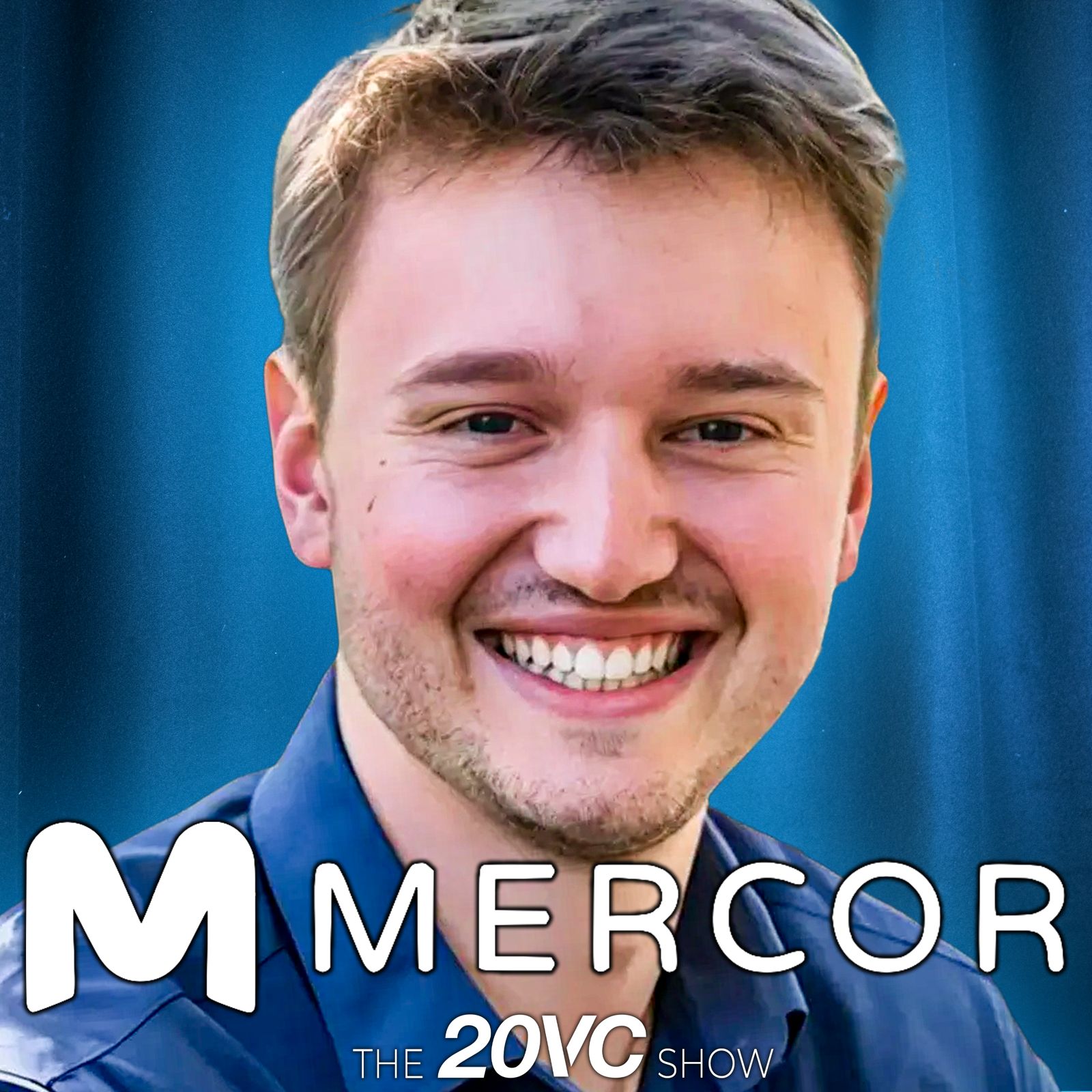
The Twenty Minute VC (20VC): Venture Capital | Startup Funding | The Pitch
20VC: Mercor: From $1M to $500M in 17 Months: The Fastest Growing Company in the World | How to Think About Margins and Revenue Sustainability in AI | Why Evaluation Benchmarks in AI are BS Today with Brendan Foody
01:01:16
Brendan Foody is the Co-Founder and CEO @ Mercor, the fastest growing company in history. The company solves talent allocation in the AI economy and they have scaled from $1M to $500M in revenue in just 17 months. With a rumoured new funding round...
Loading summary
Transcript180 lines
- [00:00]
Brandon Foody
We were already at a nine figure revenue run rate and the company quadrupled since the Scale acquisition. We scaled the business from 1 to 500 million in revenue run rate in the last 17 months, which is the fastest revenue growth of all time. One month faster than cursor's time. From 1 to 500, we have the demand to like double overnight. If we can meet capacity, RL environments will subsume the entire economy.
- [00:29]
Harry Stebbings
This is 20 VC with me, Harry Stebbings. And today we have the fastest growing company in history on the show. So they've scaled revenue from 1 million to 500 million in just 17 months. Their business has quadrupled since Scale was acquired. This is an insane story and I'm thrilled to welcome Brandon Foody, co founder and CEO Maccaw to the hot seat. Now. I did not pull any punches in this show. Brandon was amazing, answering some very direct questions here. This one was fantastic. But before we dive into the show today, I love seeing the team come together to make this show happen. What we don't love is trying to keep track of all the information, the data and the projects that we're working on across dozens of platforms, products and tools. That's why we use Coda, the all in one collaborative workspace that's helped 50,000 teams all over the world get on the same page. Offering the flexibility of docs with the structure of spreadsheets, Coda facilitates deeper teamwork and quicker creativity. And their turnkey AI solution. The intelligence of Coda Brain is a game changer. Powered by Grammarly, Coda is entering a new phase of innovation and expansion, aiming to redefine productivity for the AI era. Whether you're a startup looking to organize the chaos while staying nimble, or an enterprise organization looking for better alignment, Coda matches your working style. Its seamless workspace connects to hundreds of your favorite tools, including Salesforce, Jira, Asana and Figma, helping your teams transform their rituals and do more faster. Head over to Coda iO20VC right now and get six months off the team. Plan for startups for free. That's Coda. Coda IO 20 VC and get six months off the team. Plan for free. Coda IO 20 VC and talking about precision, that's exactly what Brex brings to your finances. So when Brex was founded, it wasn't just about creating another financial product. It was about solving the really gritty challenges that founders face daily. Let's be honest, building something from the ground up is hard enough without dealing with clunky, outdated banks that pile on Fees and leave. Your cash idol Brex is different. It's the financial stack that scales with you no matter where you are in your journey. From corporate cards to maximizing your Runway to earning yield on your cash. Brex was designed with founders in mind to make every dollar go further so you can focus on building. And here's what really stands out to me. Brex combines the best of checking treasury and FDIC insurance in one powerhouse account. You can send and receive money globally at lightning speed, earn Yield from day one and still access your funds whenever you need. Plus with 20 the standard protection through program banks, your cash is not just working harder, it's working safer too. It's no surprise that 1 in 3 venture backed startups in the US with companies like Anthropic, Coinbase and Robinhood. My God, these companies are incredible. Trust Brex to help them grow. If you want to join the smartest startups on the planet, head over to brex.com startups and see what they can do for you. And talking about trust today, customers expect it faster than ever. And that's why over 10,000 global companies trust Vanta. Vanta automates up to 90% of the work for in demand compliance standards like SoC2, ISO 27001 and more. Using smart AI to centralize workflows, manage risk and get you audit ready in weeks, not months so you can stop chasing paperwork and start closing deals. And a new IDC report found that Vanta customers achieve $535,000 per year in benefits. That's insane. And the platform pays for itself in three months. I had no idea about these. Whether you're growing or just getting started, Vanta connects you with trusted auditors and experts support to help you build trust with customers. Get a thousand dollars off your first year@vanta.com 20VC. That's vanta.com 20VC.
- [04:31]
Interviewer (possibly Harry Stebbings or a co-host)
You have now arrived at your destination. Brandon.
- [04:35]
Harry Stebbings
Dude, I've been so looking forward to this.
- [04:36]
Interviewer (possibly Harry Stebbings or a co-host)
I just had the best chat to Victor who gave me the best intel. So you should be really quite nervous at this point. But thank you for joining me.
- [04:44]
Brandon Foody
Thank you for having me on. I'm not sure what to expect with that, but I'm excited to jump in.
- [04:49]
Interviewer (possibly Harry Stebbings or a co-host)
I think mothers are the most important things in the world and Victor told me that I had to start with your ability to sell early and why your mother was nervous about it. Can we just start there?
- [05:01]
Brandon Foody
Absolutely. So I had a dozen different side hustles when I was growing up. Selling things in one form or Another, but one of my favorites is that in eighth grade, I love selling donuts. Where I saw that Safeway was selling donuts for $5 a dozen. And so I would buy Safeway donuts. I would bike to my middle school and sell them for $2 each. And I saw it was working, so I wanted to scale it up. So I asked my mom to drive me to Safeway. She said that she didn't want any giveaways, so she would charge me $20 to drive me in her minivan to Safeway, buy 10 dozen donuts, go to my middle school, sell them for $2 each. I had all sorts of things happen where competition popped up. Selling Chuck's Donuts, which, if people aren't familiar, has like a $1 cost basis, but they're higher quality donuts. And so I dropped my prices to $1 for two weeks to run them out of business because I knew that middle schoolers would care more about price. As the comparative advantage I had, my principal called me into their office to try to shut down my donut stand, saying that, you know, I wasn't allowed to sell food on school campus. And so I moved my donut stand 20ft over off of school campus so that they couldn't police me, so to speak, and tying. Back to your question, Harry. After my mom saw all of this when I was in eighth grade, she was very nervous that I would start selling drugs, right? Because it's like, you know, a small jump from donuts to drugs. And so she insisted that while I'm not Catholic, I should go to Catholic high school to make sure that I stayed in touch with my values and met my co founders there. So I guess she was right all along.
- [06:39]
Interviewer (possibly Harry Stebbings or a co-host)
Was that actually why she sent you.
- [06:40]
Harry Stebbings
To Catholic high school?
- [06:41]
Interviewer (possibly Harry Stebbings or a co-host)
Because she wanted you on the straight and narrow?
- [06:43]
Brandon Foody
That was exactly why. Because I'd gone to public school through eighth grade. My siblings had all gone to public school all the way till college. But the primary motivation was that she didn't want me to get into trouble.
- [06:53]
Interviewer (possibly Harry Stebbings or a co-host)
As a principal, you're just. You're the child that just pisses you off no end, aren't you? You're like the nodal who moves it just outside the boundaries. Can I ask, Brendan, did you always know you'd be successful? And what I mean by that is, very specifically, when I interview the best founders, they have a duality, which is they have this superiority complex. They think that they are better than everyone. They don't admit it because it sounds dickish, but they do. And then they have this inferiority complex where they are not happy with their current state and they want to do more and more and more. Do you have that?
- [07:25]
Brandon Foody
I would say that I definitely had grand ambitions growing up of all the things that I wanted to do, but I don't think it was nearly at the scale of what we're doing today, nor how fast it would happen, because those two dimensions are nearly impossible to predict. I was definitely ambitious. I don't think that I had a perfect sense for what that would look like though.
- [07:49]
Interviewer (possibly Harry Stebbings or a co-host)
Victor told me about your not wanting to go to college before we dive into macaw and the market itself because there's so much to unpack. I'd just love to understand how you thought about college not wanting to go and how it informs how you advise other young people on college.
- [08:04]
Brandon Foody
I'll start with the other story that I like to tell around my side hustle in high school, which tees up why I didn't want to go to college. But I initially was reselling sneakers, as a lot of people my age would do in that generation. And I realized that all of these sneaker resellers were eligible for AWS credits, but they weren't claiming the AWS startup promotions and they were instead just paying big AWS bills. And so I started a consulting agency where I would help the sneaker resellers create websites for their startups, help them apply to get credits. And some of those became actually like venture scale companies. And I made hundreds of thousands of dollars when I was in high school. And so when I was starting to think about whether I wanted to go to college, I was thinking, why would I go to college to get some job and like a faang company or in consulting or whatever it is where I'm making way less money. I would love to just like go full time on the things that I love doing. And so I had a big argument with my parents about whether or not I should go to college. And eventually I appeased them and applied to colleges like 10 days before the application was due.
- [09:12]
Interviewer (possibly Harry Stebbings or a co-host)
How do you advise other young people today on the value of college, given what you've seen and experience now in.
- [09:19]
Brandon Foody
Reality, so much of the reason that college is no longer valuable from an educational standpoint is that that information is all available online. Like my parents preconceived notions is that they didn't have YouTube, they didn't have have the Internet and all of this access to information at their fingertips. And so they needed to learn it from professors, right? Versus for me, like I Listened almost every Stanford GSB lecture when I was in high school and I just like loved consuming information online and like listening to all of your podcasts. Harry, I've been doing that since I was little and I think that AI only exaggerates that and making it easier to organize that information, to understand it, to learn. So there's still value to college from a social standpoint. Like, I had a lot of fun, but I don't think there's too much value from an education educational standpoint.
- [10:08]
Interviewer (possibly Harry Stebbings or a co-host)
Listen, I totally agree. I went to university for about four weeks before I dropped out.
- [10:13]
Brandon Foody
Oh, I didn't know that.
- [10:14]
Interviewer (possibly Harry Stebbings or a co-host)
Yeah, I went for four weeks and then a sponsor offered me a hundred thousand dollars and I went to my law professor and I was like, how much do you earn? And he was like, $82,000. And I was like, great, I'm out of here. Like, this is not. And I, I hated law as well. Dude, I want to start with something that Edwin said on the show. He said that everyone in the space is simply body shops. Is that a fair summisation of the space or do you push back and say maccor is not just a body shop?
- [10:44]
Brandon Foody
I don't think it's fair at all. I mean, we operate as close research partners to all of our customers and helping them to mobilize some of the highest caliber people in the world to push the frontier of model capabilities. But I think so much of our insight on the market is radically different in understanding how important high caliber people are rather than leaving them out of the narrative. And I'll give the backstory of sort of how we really got involved in the market in the first place. Scale AI came to us, they used our platform to hire thousands of people. And we realized that there was this enormous transition underway moving away from this crowdsourcing paradigm that scale and search pioneered of how do you get low and medium skilled people that write barely grammatically correct sentences for early LLMs? And very quickly moving towards this sourcing and vetting paradigm of how do you find the Goldman bankers, the McKinsey analysts, the FANG software engineers, the top doctors and lawyers that can work directly with researchers to help them build the highest complexity data on earth and understand what that data is. Because when we were dealing with undergrad level math problems, it meant that the researchers could easily look at the math problem and understand why the model was making a mistake. But when we're dealing with the kind of work that a Goldman associate would do in their fifth year, it means that the researchers can't interpret the evals and they can't interpret all of the data that they need to hill climb and ultimately improve model capabilities. So it was really that trend around a different engagement model and higher caliber work that caused us to take off and really catalyze this meteoric growth.
- [12:24]
Interviewer (possibly Harry Stebbings or a co-host)
If we extrapolate that out further and further with the advancement of models, your supply side becomes narrower and narrower. If you think about it, as models become smarter and smarter, the ability to do what you do requires smarter and smarter people. And there are just by nature less and less. How does that evolve to its ultimate destination then as we run out of really smart people?
- [12:45]
Brandon Foody
The total addressable market is limited by the amount of things that humans are better at than models. And so I'll give an example that helps to contextualize this. I remember when we started working on a high complexity RL environment project where the model would use one tool and interface with it in a task that would take a human a few hours to do. We start this became a famous product eventually. But we started out with a hundred people and it was easy to stump the model. It was easy to find mistakes that it was making, and over time only 20 people could contribute to it, the exact dynamic that you're describing. But then we started adding other degrees of complexity of how do we get the model to use other tools, like accessing your Google Drive, like accessing your calendar, your Gmail, your slack, all these different things. How do we get it to do the trajectories that, you know, a human might spend 10 hours, 100 hours on, and all of a sudden everyone else could contribute to the project again because they could stump the model. And what it goes to show is that so long as there's things that the human is able to do, the model's not able to do. And we want those capabilities in the model, whether it's to schedule a meeting or write emails for you or whatever it is, we need humans that help to create those verifiers and help to measure that frontier to ultimately improve model capabilities.
- [14:02]
Interviewer (possibly Harry Stebbings or a co-host)
I had the founder of Cohere on the show the other day and he said that we are absolutely seeing the reaching of scaling laws being questioned and that GPT5 focusing on efficiency really is an embodiment of that. Do you agree that we're hitting scaling laws being achieved and we're reaching a period of plateauing, so to speak, in terms of progression?
- [14:22]
Brandon Foody
I don't think that models are plateauing. Like if we look at the last 12 months of progress in models I've been blown away to his point. We're definitely seeing a difference in the way that people improve model capabilities in that it's no longer shoveling a lot of low caliber, medium scale data into the model. It's much more these curated data sets with extremely high caliber people that are built in a thoughtful way. And I think that that transition towards RL environments and all of this high complexity data has been one of the most important things underpinning the trajectory of Mercur.
- [15:02]
Interviewer (possibly Harry Stebbings or a co-host)
When we think about the supply side of that data, you're obviously one of the providers. There are many providers now, it would seem, including your Turings, your handshakes and surges. And how do you differentiate on the supply side of data in this way?
- [15:16]
Brandon Foody
We saw the market shifting dramatically away from crowdsourcing towards sourcing and vetting. And once this happened, there were all these other labor marketplaces that caught onto that transition. Right. They saw our growth and they wanted to chase after that, saying the same things in podcasts and trying to position themselves in a similar way. But I think one of the largest things we've realized is that the outcomes of data and the people that contribute to it are extremely power law, similar to a company where if you have a hundred people on a project, oftentimes majority of the model improvement is coming from the top 10 to 20% of people. Right? Just like sort of majority of the value in a company will often come from the top 10 to 20% of people. And what that means is that when we're able to build proprietary advantages in the way that we have, not only our supply base in the referral network to access them, but also the way that we match those experts with the opportunities where they're going to do phenomenal work. It creates so much value for customers that it's extremely difficult to compete against. Right. When we're able to find those people that are the 10x contributors, it's very difficult to recreate.
- [16:28]
Interviewer (possibly Harry Stebbings or a co-host)
A lot of people have cited a criticism of the space being they're very good at facilitation, but not great at measuring the efficiency of the data that's produced. The challenges of being first on a show is you say all the quotes and then I can use them. Edwin said that none of the competitors have algorithms to measure the quality of the data that they're producing. Is that right?
- [16:48]
Brandon Foody
That's not true at all. In fact, we use all sorts of models and algorithms to assess the quality. We train on data to see how it's improving model capabilities, and we do function as a deep research partner to our customers. I think the difference is that I think about our business as at the intersection of labor marketplaces and AI research and how do we leverage our core competency in finding world class people and pair that with the fact that we work with all of the top research labs at the frontier of model capabilities. And we're not like the crowdsourcing companies in that we try to hide all of the people on the platform, platform, pay them low rates, etc.
- [17:29]
Interviewer (possibly Harry Stebbings or a co-host)
One of my friends is on the board of one of your competitors and they said that labs are incentivized to ensure that no one company dominates and so they intentionally spread business around to ensure no one becomes too powerful. Is that true? And can you just help me understand that dynamic?
- [17:46]
Brandon Foody
I think that that has definitely happened in some cases. But ultimately the thing that labs care about the most is how do they improve model performance? How do they get those top 10 to 20% of people that are driving the vast majority of the model improvement? And so that's how their spend allocation and investments ultimately get allocated is what are the vendors and strategic partners that are able to deliver those outcomes and how do they work as deeply as possible with those partners. And we've definitely found there's stories of customers where I think they start out multi vendoring, working with a bunch of different vendors, but ultimately get to the point where they realize that they're going to be making a trade off in the performance of their model and the performance of the data sets if they are trying to diversify too much and lean very significantly into moving almost all of their work to us.
- [18:39]
Interviewer (possibly Harry Stebbings or a co-host)
That's so interesting. So you expect a multi vendor approach that then concentrates over time. Is that how you think about spending?
- [18:46]
Brandon Foody
I do. And if you look at a lot of the analogs and markets, they often start very fragmented with many different players, but consolidate over time. And so much of that reason for consolidation is that there's structural advantages and economies of scale to being the first player and having this fixed cost investment in having the best professionals in the world, the Goldman bankers, the McKinsey analysts, the network associated with them, as well as all of the matching infrastructure of understanding exactly what tasks and jobs are these people going to do well at. And so it doesn't make sense for so many different companies to be making those redundant investments. And I think that the market being hot is what gives a lot of those companies more funding and more fuel. But consolidation generally happens as markets come back to earth a little bit and Levels up.
- [19:38]
Interviewer (possibly Harry Stebbings or a co-host)
One thing that I worry about often is concentration of revenue. You saw it with Nvidia where I think it was like 51% of revenue was two clients in one certain segment of their business. I think it was 36% in another segment of their business. What's your largest customer in terms of concentration of your revenue?
- [19:54]
Brandon Foody
Our largest customer. I can't share the exact percentage, but the breakdown is relatively similar to Nvidia. And part of the reason is that concentration is relevant. But the high order bit is like building a phenomenal business that's creating a lot of value for the most important customers. Right. And ultimately Nvidia is worth trillions of dollars. And some of the best empirical evidence that it's okay to have a business that leans into a handful of customers, especially when those customers are the best customers in the world.
- [20:26]
Interviewer (possibly Harry Stebbings or a co-host)
You don't understand, Brandon. I'm the Brit who basically takes incredibly talented Americans with insanely great businesses and then critiques them. It was when I said to Benioff the other day, mark, the single digits growth is just not good enough. And Mark's like, dude, I have a $42 billion company. What do you have? And I'm like, you know, that's a very fair response. I right to respond with that. Can I ask you, when Skale got bored, did your phone just go off the hook? Did demand just go through the roof?
- [20:57]
Brandon Foody
It did. I mean, we were already at a nine figure revenue run rate and the company quadrupled since the Skale acquisition. To put that in frame of reference, you were 100.
- [21:11]
Interviewer (possibly Harry Stebbings or a co-host)
And then I saw yesterday you're 450 now.
- [21:13]
Brandon Foody
Well, there's all sorts of news articles that have come out without complete information. But I didn't mean that as a spoiler. No, but what we're sharing imminently is that we scaled the business from 1 to 500 million in revenue run rate in the last 17 months, which is the fastest revenue growth of all time. One month faster than cursor's time from 1 to 500.
- [21:39]
Interviewer (possibly Harry Stebbings or a co-host)
How much of that do you think was fueled by scale AI being bought? Was that a real tipping point where you saw an acceleration?
- [21:46]
Brandon Foody
It was definitely a tipping point where we saw meaningful acceleration. In fact, the company is growing faster now at 500 than it's ever grown before. And so the growth continues accelerating. I mean, we had already been growing extremely quickly. And the fact that we were already such a deep partner to all of the frontier labs was one of the key things that positioned us so well when the scale news Happened to expand those relationships and support customers.
- [22:12]
Interviewer (possibly Harry Stebbings or a co-host)
When I speak to people in the space, they all kind of say that they knew Skale was shit for a while. I'm British and very direct, which is quite anti British to be honest. But they say that they kind of all knew it for a while and that actually it wasn't a surprise seeing now that other people think that they're shit too. Did everyone kind of know that they weren't a great quality provider?
- [22:32]
Brandon Foody
I think people broadly knew. I think Alex was phenomenal at so many things and distribution and sales. But in some ways scale lost the focus on product, on scaling quality. And that was one of the largest challenges of the business. But actually, if I had to choose the most important thing, it would be the internal link to quality, which is that having phenomenal people that you treat incredibly well is the most important thing in this market. And getting those people to refer all of their friends and actually help to improve the frontier of model. And so I think that Markur started out really with this obsession on phenomenally talented people. Our average marketplace pay rate is $95 an hour, to put that in frame of reference, whereas scale and search generally pay about $30 an hour. And so it's just a radically different approach to the way that we think about what kinds of capabilities we want models to achieve and how we want to treat the people that ultimately help to achieve those capabilities.
- [23:40]
Interviewer (possibly Harry Stebbings or a co-host)
When we think about kind of the hourly rate there on the supply side from human created data, one thing that challenges the model in my mind is the synthetic data creation and how that supplants the need for human created data. How do you think about the future where synthetic data creation removes the need for human data creation?
- [24:00]
Brandon Foody
Well, it ties to what I was saying earlier about how the total addressable market is bound by the amount of things that humans are better at than models models, which is that of course there's going to be synthetic reviews and there's going to be synthetic augmentation to make it more efficient to engage with humans. But ultimately, if you want to push the frontier to get the model to do something that the human knows how to do that the model doesn't know how to do, then you need some human stasis point to measure that. Every single time that there's been questions around are we going to have super intelligence that's just able to teach itself and do everything that's turned out to not be true? And we've turned out to continue scaling up the amount of experts that are contributing to Improving these models, especially in all of the professional domains that are most economically valuable in 10 years.
- [24:49]
Interviewer (possibly Harry Stebbings or a co-host)
Do the models still need humans to help train them?
- [24:52]
Brandon Foody
I very much believe so. And the reason is that the question comes down to when we'll have superintelligence. Once we have superintelligence and models are better than humans at everything, then of course that means that humans won't be able to contribute to models and measure that frontier that models aren't able to do. But I still think it's a very long road. These models have gold medals in Olympiad math and they're better than the best PhD at reasoning. But they can't draft an email for me, they can't schedule a meeting, they can't do so many of the basic things of just using a handful of tools to do a task that takes me a few hours. And that entire road to automating the entire economy and building agents for everything is paved with humans creating evals for all of those workflows.
- [25:39]
Interviewer (possibly Harry Stebbings or a co-host)
Do you think the current method of evals is bullshit? How so? We train or we assess the effectiveness or efficiency of models based on humanity's last test and all this other crap which doesn't actually determine practical usage in society.
- [25:56]
Brandon Foody
We're releasing a lot of announcements on this soon, but I think that one of the largest inefficiencies in all of AI research is that the evals that people have been going on of humanities Last exam and PhD level reasoning or Olympiad math are wholly disconnected from the outcomes that consumers and enterprises actually care about. Where they want the model that is able to build a financial model like a Goldman Banker or or build consulting research decks like a consultant would do, or build a web app in the way that you would expect a thing engineer to be able to do. And so I think that that transition is going to be very meaningful and one of the most exciting shifts in AI actually being useful in the economy.
- [26:42]
Interviewer (possibly Harry Stebbings or a co-host)
Okay, get you there. So then we think about evaluations are bullshit. What is the right way for evaluations to be done then? If I gave you a magic wand on evals, what would you change to make assessment more effective?
- [26:57]
Brandon Foody
The number one thing is bridging the divide in the real to sim gap. Like how do we make sure that the tasks that we're building evals over and hill climbing as closely as possible reflect the distribution of the capabilities that people care about. So what I would say Harry, is think about the things that you do in your day to day job and how that that could be evaluated for a model. Say you do research of investment opportunities that you're considering where there's all sorts of online research of cross referencing their pitchbook data and using their product, all these different things. Imagine you could create a rubric that, similar to how a professor would grade an essay, grades how well the model is going about doing all of the online research and using the tools associated with doing that. And so I think that that will be one of the most important trends as we move away from the era of academic evals towards measuring the real capabilities that users care about.
- [27:58]
Interviewer (possibly Harry Stebbings or a co-host)
When you think about the scaling to $500 million in revenue and you said the speed, just being much faster than anyone could have anticipated, you have to change as a leader very significantly. How have you changed most significantly as a leader? I'm relatively young. How old are you?
- [28:12]
Brandon Foody
I am 22. I turned 22 in April. 20.
- [28:15]
Interviewer (possibly Harry Stebbings or a co-host)
Fuck. Okay. When you raised at 2 billion, people thought it was particularly crazy. If I'm being honest in investors, that was a punchy price. Now I mean it looks ridiculously cheap. How did you think about valuation when raising.
- [28:29]
Brandon Foody
Too many people think about valuation through the lens of market comps and revenue multiples and not enough through the lens of what's possible with this company. What, what extraordinary thing can this company achieve, especially when you have such meteoric growth. And so I'll give you like a couple of revenue numbers in each of our valuations. When we met Victor, we were at $1.5 million in revenue run rate. He gave us the term sheet and we were at a little over $2 million in revenue run rate. So over 100x multiple on revenue. He paid 250 as the valuation. I'm sure the benchmark partnership thought that was insane at the time. At the Series B when fleeces gave us the term sheet, we were at 20 million in revenue run rate. So it's 100x multiple on the revenue. But what they saw in talking to customers was the phenomenal experiences that we were creating and that that growth that we had was going to continue. And so now we're 25 times larger in revenue scale than we were at the Series B. But in a spot where the business is so profitable that we don't, don't need to go out for financing or spend too much time thinking about financing while we get a lot of offers and interest.
- [29:42]
Interviewer (possibly Harry Stebbings or a co-host)
Dude, that is hilarious because I obviously met Adarsh and he very kindly let me put in a small check. I had no IDEA you're at 20 million. I thought you were way bigger.
- [29:52]
Brandon Foody
I think we, I think we let you put in a small check a little bit later because the company keep in mind we were growing over 50% month over month. Like, we average 54% month over month growth for a while at that time period. And so it wouldn't shock me if, you know, it was a couple of months after the round and we were at a meaningfully higher revenue scale.
- [30:12]
Interviewer (possibly Harry Stebbings or a co-host)
Dude, I'm thrilled. Otherwise, I was massively off to my partnership when I was like, yeah, yeah, yeah, way past. They'll be looking at me, what do you need to raise more money? Then again, I am direct to a fault. The rumors of a $10 billion valuation. You're like, if you're a 500 million dude, that's only 20x and given your growth rate, that would be cheap.
- [30:33]
Brandon Foody
It's definitely what I've been thinking about too. We honestly haven't given it much thought. We have gotten a bunch of offers from existing investors. We haven't really shared any materials on the business. There's just been sort of outside indulgence and offers based on that.
- [30:49]
Interviewer (possibly Harry Stebbings or a co-host)
Is it a nice feeling or is it a, hey, let me just focus and do my work?
- [30:54]
Brandon Foody
I think there's parts of both. Like, there's parts of it feeling validating, but also parts of it feeling distracting in that we just want to focus on creating phenomenal experiences for our customers and for the experts in our marketplace. But I think that it's likely we'll do a financing soon, to answer your question, with low dilution, largely because there's a lot of benefits to signaling ourselves as the market leader in RL environments and all of the high complexity data that we produce. And so we'll keep you updated.
- [31:27]
Interviewer (possibly Harry Stebbings or a co-host)
Harry, do you think a big financing will do it? If you think about it, I'm just intrigued. Like, as you said, surge, they have big revenue numbers. They're at over a billion now in revenue. Is it the financing that'll do it?
- [31:39]
Brandon Foody
Obviously the financing will so called do it, but I think it can definitely play a part from a signaling standpoint. Making a little bit more noise about that and what we do and how we see the market developing over time could be interesting.
- [31:54]
Interviewer (possibly Harry Stebbings or a co-host)
If you had truly unlimited resources, what would you do differently?
- [31:58]
Brandon Foody
This is a tricky question because I feel like we're at a point where we're trying to invest as aggressively as possible, but the business is still profitable and we're not trying to be profitable. And so I don't think that having another few hundred million in cash would meaningfully change the way that we're investing. But I do think that having a fortress balance sheet has its benefits, having sort of like the new mark of the company, et cetera. And so I don't think it would change the way we're investing too dramatically.
- [32:28]
Interviewer (possibly Harry Stebbings or a co-host)
You're going to go, whoa, Harry, what are you talking about? But at 500 million and growing at the rate you are, you'll soon be at a scale where an IPO is very possible. Given public pricing now being better than private pricing in a lot of markets. Do you want to go public sooner rather than later?
- [32:45]
Brandon Foody
It's not something I've given too much thought to because it's sort of surreal considering we started the company in January of 2023 and all of my college classmates just graduated in. But there's a lot of benefits to staying private. It's funny, like I remember when I was talking with Jack Dorsey before he invested, one piece of advice he gave me was that we should stay private as long as possible.
- [33:07]
Interviewer (possibly Harry Stebbings or a co-host)
What was his reasoning for that? Super interesting.
- [33:10]
Brandon Foody
It allows you to stay very long term oriented. Like public companies get so caught up. Even though founder led companies tend to be more resistant to it, I think public companies still get more caught up in the quarterly numbers and aren't as focused as they maybe should be on all of the long term drivers of value and moats. And so I think that that is one of the core reasons allowing us to stay very long term oriented, especially when there's also so much access to capital in the private markets.
- [33:43]
Interviewer (possibly Harry Stebbings or a co-host)
Do you think there's too much cash in the private markets today?
- [33:47]
Brandon Foody
I mean, I don't know because it's sort of like a supply and demand question. If I were an investor, I would definitely think that there's too much cash in the markets.
- [33:55]
Interviewer (possibly Harry Stebbings or a co-host)
You could say there's a load of shit competitors who are getting funded to the tune of hundreds of millions that shouldn't be getting funded.
- [34:02]
Brandon Foody
I think that's definitely the case. My heuristic for this is the age old saying of how or ties to the idea of it at least that it's probably overestimated in the short term and underestimated in the long term. If we're evaluating things on a three year time horizon, it would shock me if like we feel like things are frothy and it's a crazy time. But if we're evaluating things on a 10 year time horizon, all of these extraordinary businesses that are being built will look like a discount. And the challenge right now is just saying are we in 1996, 1997 or some other time.
- [34:39]
Interviewer (possibly Harry Stebbings or a co-host)
Dude, you weren't born then, so you can't talk about that. That's when I was born. Okay? I have a FIFA game. That was when you were born. That really makes me feel old. Did you see the MIT study or release? What did you make of that?
- [34:55]
Brandon Foody
I think it ties the exact point you were making earlier about how evals are bullshit. Right? It's like when we start showing that we have Olympiad gold medals or PhD level reasoning, that doesn't mean that it's going to be useful to enterprises. In fact, in 95% of cases, we're seeing these failure cases. And the answer is that. But we'll need evals for every one of those implementations and examples, because evals are the way that we measure the truth, that we have a stasis point of understanding what the models are capable of. And if we think about the model as the product, then the eval is the prd. And so many people have been vibe spending on AI without actually writing the PRD of what do they want to implement and how do they measure that it's going to be successful. Successful.
- [35:40]
Interviewer (possibly Harry Stebbings or a co-host)
Dude, I need your help. You said vibe spending on AI. The revenue numbers that we see from some players in the application layer are just awe inspiring, like in scaling in a way that we've never seen before in my history. Anyway, how do you think about the sustainability of revenue for the majority of AI companies? And how would you advise me, a friend and investor?
- [36:01]
Brandon Foody
I think the most important thing is looking at the numbers and anecdotes around retention to see the revenue health and whether there's real value. Right. If you meet an application layer company where 95% of their pilots are failing, it's probably not going to be a good investment. But if you meet a business that has extraordinary unparalleled retention numbers, and you talk to those customers and you hear about how much they love the product, then of course it's a really exciting opportunity. And so I think that those signs of true market fit are the most important when there's sort of a lower friction to accessing initial pilots or contracts.
- [36:40]
Interviewer (possibly Harry Stebbings or a co-host)
The other element is margin. And the margins are pretty terrible in a lot of cases, especially when you take into account free user giveaways, which there's a lot of. Should we give a shit about margin structures given how early we are in the cycle, or yes, we should. It's always fundamental.
- [36:55]
Brandon Foody
The answer is yes, like both of those matter and it's very contextual. On one hand, I am a huge believer in capital efficiency. We have very positive gross and net margins unlike most AI companies. But on the other hand I also see the case that if you're able to distill models and make them an order of magnitude more efficient in 12 months, then it could make sense to run really aggressive margins on serving models. It really comes down to the stickiness and whether those subsidies today are driving large LTVs that make sense long term. But I think the case where I would be hesitant is when there's very competitive markets with low switching costs so that people are pumping hundreds of millions in subsidies, maybe billions in subsidies and then all of a sudden the customers are switching over to a competitor if those subsidies dry up.
- [37:50]
Interviewer (possibly Harry Stebbings or a co-host)
Often banker concern that the level of capex is concerning because of the requirement on revenue generation that's required to make up that capex. Do you share that concern or do you think this is a super cycle? Of course the investment is required and the revenue will show itself like Masterson believes it will.
- [38:11]
Brandon Foody
I'm less concerned about the broader CapEx because I think that if you have a 10 year investment horizon the market generally will look like it's at a discount. But I think that. But there are definitely cases of exuberance. Right. People need to just be thoughtful about which investments are going to have those positive 10 year horizon ROIs and which don't make as much sense.
- [38:34]
Interviewer (possibly Harry Stebbings or a co-host)
What segment do you think is most overhyped? Over exuberant, not company, just like segment.
- [38:40]
Brandon Foody
Nothing jumps out to me on that because obviously I think the things with the most hype are code and foundation models and maybe starting to be use cases in finance. And I feel like the, the value being created is also very real. The amount of utility that our engineers get from cursor and cloud code and cognition is incredible.
- [39:04]
Interviewer (possibly Harry Stebbings or a co-host)
Do you use all three internally?
- [39:06]
Brandon Foody
Yeah, we let people choose and so various people use different products.
- [39:10]
Interviewer (possibly Harry Stebbings or a co-host)
What's the distribution?
- [39:12]
Brandon Foody
I think it's a lot, especially the most cursor usage closely followed by Claude code. But it's hard because it's very dynamic. Like the market is changing so fast, the products are improving so quickly that I think some of that distribution will change over time.
- [39:29]
Interviewer (possibly Harry Stebbings or a co-host)
Do you think there's switching costs between those?
- [39:31]
Brandon Foody
There are surprisingly low switching costs. Definitely some of these products are moving the direction of adding more switching costs. Right. With understanding how you interact with the platform and having data fly wheels around that or custom models for your code base. But I think a lot of those sources of defensibility are taking more time to develop. And right now the market is very competitive, which has framed a lot of the negative gross margins that we've seen companies have in the coding space.
- [39:59]
Interviewer (possibly Harry Stebbings or a co-host)
In five years time, will you have more or less engineers?
- [40:03]
Brandon Foody
I think more. And the reason is that engineering is such an elastic role, right? Where if we could build 100 times more software, or say we make engineers is 10 times more efficient, we would probably build 100 times more software. Right. Insofar as maybe not unique platforms, but the amount of features those people would ship and the iterations on every ranking algorithm, et cetera. And so I'm a huge believer in the fact that AI, especially in domains like software engineering, will be an amplifier in making people more productive and making people more valuable rather than diminishing their value.
- [40:43]
Interviewer (possibly Harry Stebbings or a co-host)
You mentioned code there being one, you mentioned models being another. Do you think the biggest model providers have been created already or do you think some of the biggest in the future are yet to be created?
- [40:54]
Brandon Foody
The largest model creators already exist, but I'm not 100% sure about that. I definitely have some error bars about it. My expectation for why the largest model builders exist is just obviously the extraordinary capex in terms of both data and compute investments that go into that, as well as building out all the teams of researchers. That has quickly become phenomenally expensive. But at the same time I think that there may be other breakthroughs that help to enable more model progress and those could play a role coming from startups.
- [41:30]
Interviewer (possibly Harry Stebbings or a co-host)
I love the kind of dual sided mindset there. You mentioned the expense of talent. Is the expense and the economics around talent today in AI in sf, just nuts?
- [41:42]
Brandon Foody
It definitely is. I mean, certainly also beyond my wildest imaginations a couple of years ago. But I think what it's really amplifying is the importance of having a really strong purpose, more so than just paying people well, because lots of companies can pay people well. And I think that I really like you, Brandon.
- [42:04]
Interviewer (possibly Harry Stebbings or a co-host)
You look awesome. But like, come on, dude, when Zuck puts 100 million down, you're like, okay, yep, I'm out of here.
- [42:11]
Brandon Foody
Look, I agree you still need to obviously reach parity with respect to like the economics of things. And of course giving people a lot of upside in the business. But part of purpose isn't only the mission of the company, but also the economic upside associated with that mission. And not sure startups can't pay someone $100 million in liquid cash, but we can give people equity grants that are appreciating extraordinary quickly as part of the vision of the company to help People capture upside in this purpose and so I do think that that is increasingly important and having an employee base of missionaries, not mercenaries and people that are in it for the long haul.
- [42:56]
Interviewer (possibly Harry Stebbings or a co-host)
Will Zuck's spanned work, do you think he's got all the mercenaries together, which are very talented, brilliant people? Does that work?
- [43:05]
Brandon Foody
I think so. I think that there's an extraordinary team there and so it'll be fun to see what they build. But these things are always hard to.
- [43:13]
Interviewer (possibly Harry Stebbings or a co-host)
Say which team do you think is underappreciated that doesn't get the love that it deserves?
- [43:19]
Brandon Foody
It's interesting because OpenAI gets a lot of the love of ChatGPT being the brand that everyone talks about. I feel like Anthropic gets a lot of the love around Code and Claude Code XAI definitely much more so on the consumer side as well. I definitely feel like a lot of the Gemini Flash models are also extraordinary and underappreciated on evals, especially their small models I'm always amazed with. So if I had to choose, maybe not a company, but especially sat of models, I think the DeepMind team did a really phenomenal job on a lot of those smaller models.
- [43:52]
Interviewer (possibly Harry Stebbings or a co-host)
Totally agree with you there. I think Google's massively underestimated. Do you think we live in a world of many unbundled specialized models or fewer monolithic generalised models like the providers you mentioned?
- [44:04]
Brandon Foody
I used to be more in the camp of a lot of specialized models, very much in the camp of a lot of specialized models. Now I think it'll be a lot of both.
- [44:12]
Interviewer (possibly Harry Stebbings or a co-host)
What changed to cause that change of.
- [44:15]
Brandon Foody
Mindset, the amount of generalization that we're seeing, especially 03, blew my mind. And just how phenomenal a model it was and how well it generalized and GPT5 as well as a phenomenal model. And so I think that when there's still so much headroom in these foundational capabilities, it feels structurally more efficient to have those as individual investments to improve model capabilities. We're just in the first inning of model customization of every enterprise wanting models to know how to use their own set of tools, of knowing how to use all of their own knowledge bases, et cetera, and the processes that that they've codified. And that'll be another huge area of investment over the coming decade.
- [44:57]
Interviewer (possibly Harry Stebbings or a co-host)
Do you buy sovereignty as a reason why a model provider wins? You know, we've got Mistral in Europe, you have Cohere in Canada. Is sovereignty a reason why a model provider wins?
- [45:08]
Brandon Foody
Maybe wins in scoped part of the Market Like I could see why, for example, there would be a lot of benefits to having Mistral be an expert in European law that might have nuances from other kinds of law. And they've just invested far more in having the best model there where it doesn't make sense to use other models. But I don't think that the largest companies per se are going to be those that invest in a specific geography. I think it's going to be a broader set of capabilities and the general purpose models that people use every day to code or to build products or do their day to day work.
- [45:49]
Interviewer (possibly Harry Stebbings or a co-host)
I don't know if you know this, but I'm particularly disliked in Europe because of my affiliation or affection towards the996 work culture. No, truly, my DMs are basically a war zone nowadays. 996 is a model that you very much espouse too. Can you talk to me about why you are 996 bullish first?
- [46:11]
Brandon Foody
Well, not exactly. I need to offer key clarification which is that we've actually never mandated hours. It was more so when we were talking about 996. It was a description of how the early team worked. In fact, the reason we talked about 996 was because people were working so much more than that that we wanted people to go home a little bit early so that they could be well rested, et cetera. That intensity is of course extremely important in building a generational business. But at the same time I think we've become less, less focused on the in person elements of that intensity and recognizing that it can be expressed through outputs. Because when the market for talent is so competitive, it especially makes sense to just optimize for working with the best people. Less so than optimizing for FaceTime.
- [47:02]
Interviewer (possibly Harry Stebbings or a co-host)
Fascinating. So now you're at the stage where you need to bring in execs, where you need to make the language with which you speak more conservative.
- [47:10]
Brandon Foody
Well, I don't know exactly.
- [47:12]
Interviewer (possibly Harry Stebbings or a co-host)
I love it. I work with so many companies where they're 996-996-996 and then suddenly it's like, shit, we need to bring in that CPO. And he's never going to be 996 because he's like Stellar CPO from Big Company. And you're like, wow. No, no, no. It's all about impact. It's about impact and the language changes to be a lot more neutral. My lesson is that you need to do that.
- [47:34]
Brandon Foody
The thing is, when we were all, you know, there was like 20 of us in a room, working with our India team as well. It was just like everyone loved what they do and if people left to like go home for dinner or had something else going on, like we wouldn't bat an eye.
- [47:51]
Interviewer (possibly Harry Stebbings or a co-host)
No, you just fire them, give them their box and say you don't need to come in tomorrow.
- [47:58]
Brandon Foody
I think the truth is that all along it's been much more about hiring people that like give a shit and love what they do and, and are obsessed with it and the way that we are rather than specific hours. And early on those were highly correlated. But I think that as the company expands they're not always as perfectly correlated and there's definitely exceptions.
- [48:20]
Interviewer (possibly Harry Stebbings or a co-host)
I just want to ask one final one before we do a quick fire. I got asked this brilliant question the other day that's really just stuck in my head. What would you do if you weren't scared? An example for me, just so you have a framing would be I'd move to Silicon Valley. I'd compete in the coliseum of technology rather than sitting in London being happy, being a big fish in a small pond. What would you do if you weren't scared?
- [48:43]
Brandon Foody
It's an interesting question because I feel like I live in a very risk on way of always trying to make big bets. Maybe one ties to capital efficiency and maybe it's for better or for worse, right? Part of the reason that we've run the business in a very capital efficient way is that that I've always been very thoughtful about how will markets develop over time and how do we ensure that we're building a super durable sustainable business that will be around in 10 years. But I often wonder if maybe we should just start burning hundreds of millions of dollars a year.
- [49:20]
Interviewer (possibly Harry Stebbings or a co-host)
But my question to you is like, could you?
- [49:23]
Brandon Foody
I think we could find a way.
- [49:25]
Interviewer (possibly Harry Stebbings or a co-host)
But how?
- [49:25]
Brandon Foody
You'd spend it on talent, on subsidizing either supply or demand side of the marketplace of how do we get great people on the supply side or how do we subsidize customer projects. I think the business certainly doesn't need to do these things and we have the demand to double overnight if we can meet capacity. And we have a supply base that loves us and is growing phenomenally quickly. But at the same time I do think that if I were trying to, to burn $100 million, I could figure out a way to do that.
- [49:58]
Interviewer (possibly Harry Stebbings or a co-host)
We can go away for a weekend, I'll show you how to burn.
- [50:02]
Brandon Foody
What do you think? As an investor, how would you handle that? Would you be scared and capital efficient? Or would you be maximally aggressive about burning money?
- [50:10]
Interviewer (possibly Harry Stebbings or a co-host)
I don't live the competitive landscape that you do. If I'm feeling continuous pressure from competitors that I feel are good and I have an ability to undercut them in a way that they don't undercut me, I would absolutely leverage cash reserves to subsidize it, be a loss leader until I can bluntly strangle them out of market.
- [50:29]
Brandon Foody
Interesting.
- [50:30]
Interviewer (possibly Harry Stebbings or a co-host)
But it depends. If you don't feel that competitive pressure, which it's clearly not showing in your numbers, I would not. Cash can actually be a bit of a problem at certain stages. When you look at large companies, you need to make your cash work for you and you really have to buy the growth. In a lot of cases you just don't want to get to that stage.
- [50:51]
Brandon Foody
I totally agree and I think that's why we've always erred on the side of capital efficiency and fundamentals.
- [50:57]
Interviewer (possibly Harry Stebbings or a co-host)
What does Peter say?
- [50:58]
Brandon Foody
I think Peter is more on the side of capital efficiency. He's seen how these things play out and the ups and downs of markets. So yeah, he's been more in that camp. And don't get me wrong, I'm still incredibly bullish on the market and AI. I think we're much more 96 or 90, 97. But focusing on fundamentals at least does buy you a lot of durability and long term just having the right values and culture that it can be easy to lose sight of in this one way door of not being efficient.
- [51:29]
Interviewer (possibly Harry Stebbings or a co-host)
Final, final one. I promised. Then the quick. You said you could like there was double the demand and the supply. It's that much of a constraint supply that if you had the resources or reserves on the supply side of data, you could double the business.
- [51:42]
Brandon Foody
Definitely. We turn down projects every day and the reason is we're very focused and disciplined about working with the best customers in the world and doing phenomenal work for them. And so the capacity is. How do we scale up our ability to do that? That's my biggest focus right now.
- [51:59]
Interviewer (possibly Harry Stebbings or a co-host)
Dude, what does your mom say?
- [52:02]
Brandon Foody
It's evolved over time. When I dropped out, she was very upset. Now I think she's come around.
- [52:07]
Interviewer (possibly Harry Stebbings or a co-host)
Have you done secondary school?
- [52:09]
Brandon Foody
Very small amount.
- [52:10]
Interviewer (possibly Harry Stebbings or a co-host)
Do you advise founders to take them, not take them.
- [52:13]
Brandon Foody
I think the most important thing is making sure it's not distracting. Right. Because ultimately the vision that we're selling the company, selling everyone, is that we are fully committed. And I want to demonstrate that in every aspect of the word that this is our life's work and the thing that we plan to spend the next decades on showing that on every dimension.
- [52:36]
Interviewer (possibly Harry Stebbings or a co-host)
I want to do a quick fire round, so I'm going to say a short statement. You're going to give me your immediate thoughts. Does that sound okay?
- [52:41]
Brandon Foody
Sounds great.
- [52:42]
Harry Stebbings
What's one widely held belief about AI?
- [52:45]
Interviewer (possibly Harry Stebbings or a co-host)
That you're like God. That's so wrong. Just please stop that.
- [52:49]
Brandon Foody
We'll have superintelligence in three years. That's better than humans at everything. I think it's totally wrong.
- [52:55]
Interviewer (possibly Harry Stebbings or a co-host)
You can be the CEO of OpenAI for a day. What would you do that they're not doing?
- [53:00]
Brandon Foody
I think model customization is a really exciting opportunity because API will have low switching costs, not much pricing power. It's not a good business. And focusing more on model customization is a really exciting opportunity.
- [53:16]
Interviewer (possibly Harry Stebbings or a co-host)
Do you think OpenAI win the consumer? Have ChatGPT as their Trojan horse and anthropic? Win business and enterprise and have Claude code and win that segment?
- [53:25]
Brandon Foody
Certainly seems like that. That.
- [53:27]
Interviewer (possibly Harry Stebbings or a co-host)
What question should every AI company be asking themselves that they aren't?
- [53:32]
Brandon Foody
I really like the things Sam Altman says of will models being dramatically better in one to two years improve your business or worsen it? I think that that is in so many ways the most important question to see if you're building a business that's durable and well positioned for the future.
- [53:49]
Interviewer (possibly Harry Stebbings or a co-host)
He said it first on our show.
- [53:51]
Brandon Foody
Oh, really?
- [53:52]
Interviewer (possibly Harry Stebbings or a co-host)
Yeah. And that was the show where he took a 20 VC jumper and he put it on Brandon. I was like, yes. This is like, unbelievable brand.
- [53:59]
Brandon Foody
Well, Sam wore one of our arborkor jackets the other week, which I was over the moon about.
- [54:05]
Harry Stebbings
Yeah, I was, too.
- [54:06]
Interviewer (possibly Harry Stebbings or a co-host)
Okay. And then he gets on camera, Brandon, and do you know what he says?
- [54:10]
Brandon Foody
What'd he say?
- [54:11]
Interviewer (possibly Harry Stebbings or a co-host)
Startups, we're going to steamroll you. And I am a startup investor. Okay. My job is to inspire entrepreneurs. I'm like, oh, no. Oh, no. But yes. Dude, what have you changed your mind on in the last 12 months?
- [54:26]
Brandon Foody
You know how I talked about how I thought there would be. This is a little contradictory. I thought there'd be a lot of model customization. I think I've indexed more on a lot of generalization. And just like foundation models will be huge, huge businesses, while I still think they should invest more in the customization as well.
- [54:44]
Interviewer (possibly Harry Stebbings or a co-host)
What investor do you not have that you would most like to have? It doesn't need to be a fund. It could be a person. It could be anyone, I think.
- [54:51]
Brandon Foody
Jeff Bezos. I've admired Amazon so much and just the early clarity of thought in the business and long term focus and I think there's a lot of analogues. So I would love to learn from him.
- [55:03]
Interviewer (possibly Harry Stebbings or a co-host)
Why do you not have him with the cap table you have, getting him would not be impossible at all.
- [55:08]
Brandon Foody
I haven't met him. I'll have to. I haven't put too much time into that. I've been meaning to.
- [55:12]
Harry Stebbings
You can give yourself one piece of.
- [55:14]
Interviewer (possibly Harry Stebbings or a co-host)
Advice going back to January 2023, starting most core. What do you know now that you wish you had told yourself back then?
- [55:23]
Brandon Foody
I would say focus on Foundation Model Labs. I didn't understand the scale of the opportunity with Foundation Model Labs in January of 2023 and I think being the first company to realize that, especially in how our marketplace fit into it, was one of the most impactful things. And if I'd realized that nine or 12 months sooner, that would have been even more exciting.
- [55:44]
Interviewer (possibly Harry Stebbings or a co-host)
How penetrated into their spandol? When you look at them, they are absolutely destroying a lot of their economics to win this race. They can only do that for so long. How penetrated are we into their spend?
- [55:57]
Brandon Foody
So there's different buckets within their human data spend. There's the RLHF buckets which we don't do as much of. Like Surge is the largest player in RLHF. But then there's the new data types that everyone's moving towards called RL environments where we call it rough estimate is like 50 to 60% of the market and so doing quite well on that and expanding market share quickly.
- [56:18]
Interviewer (possibly Harry Stebbings or a co-host)
And do you think market share is still continuously expanding? How much room does the market itself there have left to expand?
- [56:25]
Brandon Foody
I've talked to multiple executives, CEOs at leading labs that believe that RL environments will subsume the entire economy because it doesn't make sense that humans would be doing monotonous, redundant work redundantly researching different companies each week or guests for your podcast. It makes way more sense for humans to build the framework of how to do that so that models can then learn how to do it and do it for us. And so I think that that is going to be a ridiculously exciting transition.
- [57:00]
Interviewer (possibly Harry Stebbings or a co-host)
Dude, I've so enjoyed having you on the show. This is why I don't send questions. We have all this ahead of time and none of it has been covered because this was way more interesting. Thank you so much for being so flexible with my questions and you've been fantastic, dude.
- [57:14]
Brandon Foody
No, I love it. Thanks for having me on Harry.
- [57:17]
Harry Stebbings
Honestly, I think I just have the.
- [57:19]
Interviewer (possibly Harry Stebbings or a co-host)
Best job in the world I get.
- [57:20]
Harry Stebbings
To sit down and learn from incredibly.
- [57:22]
Interviewer (possibly Harry Stebbings or a co-host)
Talented leaders in the space and just.
- [57:25]
Harry Stebbings
Follow my curiosities and interests. I hope you like the show. Please let me know how I can.
- [57:29]
Interviewer (possibly Harry Stebbings or a co-host)
Make it better for you.
- [57:30]
Harry Stebbings
You can email me harry0bc.com but before we leave you today, I love seeing the team come together to make this show happen. What I don't love is trying to keep the track of all the information, the data and the projects that we're working on across dozens of platforms, products and tools. That's why we use Coda, the All In One collaborative workspace that's helped 50,000 teams all over the world get on the same page. Offering the flexibility of docs with the structure of spreadsheets, Coda facilitates deeper teamwork and quicker creativity and their turnkey AI solution, the intelligence of Coda Brain is a game changer. Powered by Grammarly, Coda is entering a new phase of innovation and expansion, aiming to redefine productivity for the AI era. Whether you're a startup looking to organize the chaos while staying nimble, or an enterprise organization looking for better alignment, Coda matches your working style. Its seamless workspace connects to hundreds of your favorite tools including Salesforce, Jira, Asana and Figma, helping your teams transform their rich and do more faster. Head over to Coda iO20VC right now and get six months off the team plan for startups for free. That's Codacoda iO20VC and get six months off the team plan for free. Coda iO20VC and talking about precision, that's exactly what Brecht brings to your finances. So when Brex was founded, it wasn't just about creating another financial product, it was about solving the really gritty challenges that founders face daily. Let's be honest, building something from the ground up is hard enough without dealing with clunky, outdated banks that pile on fees and leave your cash idle. Brex is different. It's the financial stack that scales with you no matter where you are in your journey from corporate cards to maximising your Runway to earth. Earning yield on your cash Brex was designed with founders in mind to make every dollar go further so you can focus on building. And here's what really stands out to me. Brex combines the best of checking treasury and FDIC insurance in one powerhouse account. You can send and receive money globally at lightning speed, earn Yield from day one and still access your funds whenever you need. Plus, with 20x the standard protection through program banks, your cash is not just working harder, it's working safer too. It's no surprise that 1 in 3 venture backed startups in the US with companies like Anthropic, Coinbase and Robinhood. My God, these companies are incredible. Trust Brex to help them grow. If you want to join the smartest startups on the planet, head over to brex.com startups and see what they can do for you. And talking about trust today, customers expect it faster than ever. And that's why over time, 10,000 global companies trust Vanta. Vanta automates up to 90% of the work for in demand compliance standards like SOP2, ISO 27001 and more. Using smart AI to centralize workflows, manage risk and get you audit ready in weeks, not months so you can stop chasing paperwork and start closing deals. And a new IDC report found that Vanta customers achieved 500 $135,000 per year in benefits. That's insane. And the platform pays for itself in three months. I had no idea about these Whether you're growing fast or just getting started, Vanta connects you with trusted auditors and experts support to help you build trust with customers. Get $1,000 off your first year at Vanta.com 20VC that's Vanta.com20VC V scene as always, I so appreciate all your support and stay tuned for an incredible episode.
- [61:09]
Interviewer (possibly Harry Stebbings or a co-host)
Coming on Thursday with the one and only Jason Lemkin and Rory o'.
- [61:12]
Harry Stebbings
Driscoll. My favorite show of the week to do, I have to admit.