← The Ultimate Human with Gary Brecka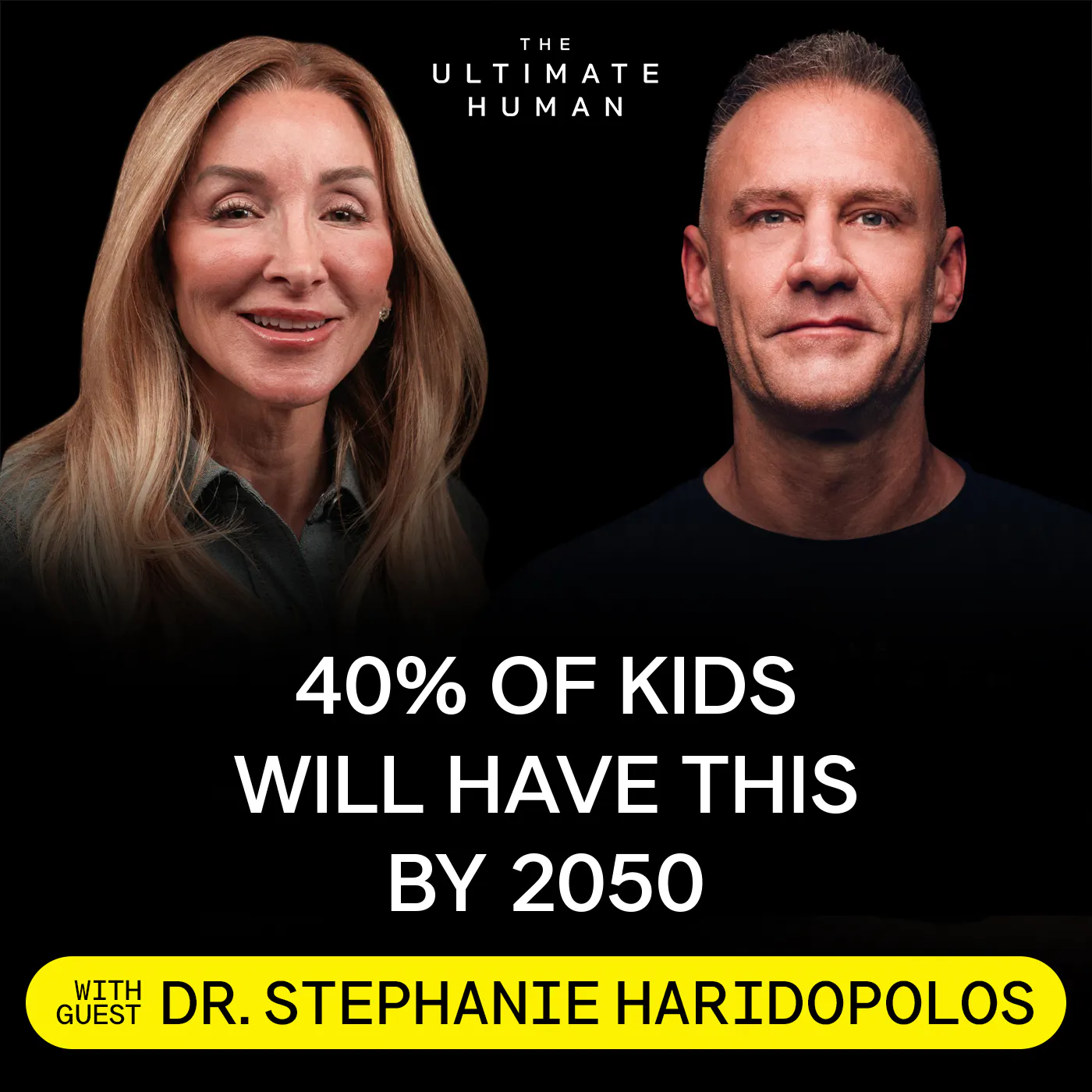
The Ultimate Human with Gary Brecka
271. Dr. Stephanie Haridopolos: On Screen Harms in Kids & the Surgeon General's New Advisory
00:43:05
Loading summary
Transcript138 lines
- [00:00]
A
If you are exposed to screen time at a very young age, before 18 months, it could affect the full development of the brain. And so it's not just about how much screen time quantity, it's also the quality of it.
- [00:14]
B
Hardly a parent in America today would say, I have no concerns at all about what my child is consuming on social media or the amount of time that they're spending on their phones.
- [00:23]
A
In the office of the Surgeon General, you have such a huge megaphone to discuss very pertinent health, emerging threats to the public. And how then do we amplify that message to increase health and wellness in
- [00:39]
B
a perfect world holding all of your experience, what would be the utopia of success for you if what was accomplished?
- [00:47]
A
Believe it or not, this is probably the most surprising. Ultimate Human.
- [01:03]
B
Hey, guys, welcome back to the Ultimate Human podcast. I'm your host, human biologist Gary Brecke, where we go down the road of everything anti aging, biohacking, longevity, and everything in between. And as you know, lately I have been very involved in the MAHA action, which is essentially this public private partnership between health and human services and the general sector, talking about and influencing and, and having interaction with health and human services on the direction of healthcare in America. And most of all, looking at initiatives to keep people out of the system. Not everything that they're doing in HHS and the U.S. fDA is designed to fix the healthcare system. A lot of it is designed to keep people out of chronic care. And today's guest is one of those thought leaders. She is a practicing physician, she's a mother, she ballroom dancer. She is an absolutely wonderful human being. Dr. Stephanie Heridopoulos is now the acting chief of staff and senior advisor to the US Surgeon General's office. Her role is updated, so I'll allow her to update us on that tune. But thank you so much for coming on the Ultimate Human podcast.
- [02:11]
A
This is truly an honor. I appreciate the invite. Thank you.
- [02:15]
B
I'm so, I'm so happy to have you here. You know, you know, one of the things I've noticed about this administration, at least as it relates to health care and healthcare policy, is they're asking hard questions, they're challenging some of the status quo, they're shaking things up, all to have a positive impact on American's healthcare. They are not accepting the fact that we are spending nearly $5 trillion a year on healthcare and the outcome has been some of the sickest, fattest, most disease ridden human beings on the planet. And I think, you know, I would love first of all for you to correct Your title, because I know I left some of those out.
- [02:58]
A
Recently I was promoted to principal Deputy Assistant Secretary of Health at HHS and I've been there for 15 months. I had a calling to make a bigger impact than I could just seeing the direct patient care. I miss it. I'm missing my patients. And for over two decades, being able to see generations of families, families of all life, the whole lifespan from womb to tomb. But with that, womb to tomb.
- [03:29]
B
I love that. I've never heard that saying. I like that.
- [03:31]
A
Cradle the grave. But, you know, we can, we. We're in a big shift in healthcare right now, and I wanted to be a part of that movement. You know, with Koon's Law, we talk about a, you know, sometimes you have crises and then adrift. But then now we're in a paradigm shift. And with that paradigm shift, we can, with a broad brush, change the trajectory of so many lives in America. And so I said, I want to serve. And it was just such a true honor for President Trump to entrust this huge responsibility in me as one of his political appointees during this time.
- [04:16]
B
You know, I wonder if we might just. For most people that are watching this podcast, everybody has heard of the Office of the Surgeon General. The Surgeon General for sure. And states have Surgeon Generals as well. But can we just kind of demystify the office for a minute and like, what is the role of this in the government and what are some of the initiatives that are going on in the Surgeon General? Why should my audience draw their attention or care about what's going on at the Office of the Surgeon General?
- [04:43]
A
My goodness, such long history of the Office of the Surgeon General. You've heard from previous Surgeon generals in the 60s that brought attention to the harms of combustible tobacco to Everett koop in the 80s with HIV and AIDS. In the office of the Surgeon General, you have such a huge megaphone and you have a platform to discuss very pertinent health, emerging threats and harms to the public. And how then do we amplify that message to increase health and wellness? So there are many different ways in which the Office of the Surgeon General can communicate. It could be a call to action, it could be an advisory, and it could be a commissioned Surgeon General report, which takes years and longer period of time. In the Office of Surgeon General, we also oversee Public Health Reports, which is a peer reviewed journal that's been in existence for 148 years.
- [05:49]
B
Wow.
- [05:50]
A
It's the longest peer reviewed journal in the nation's history. And we also oversee the operations of the Public Health Service Commission Corps that has been in existence for over 200 years. So right now we have 5,500 commissioned corps officers. They're military, uniformed, unarmed health care warriors that are all over the United States and some international posts that are there to help with natural disasters, outbreaks if there is, you know, a problem with illnesses coming into our country. Ports of entry, they work in every department of the US government and it's so it's a true honor to serve alongside them in the office.
- [06:43]
B
Wow, that's, I mean, because I think, you know, very often we don't humanize these departments and one of the things I, I've loved about getting to know you is you had 25 year history as a physician, raised a family, you're a wife, you're a mother, you're a practicing physician in family family medicine, you've had hands on patients for dec and you're just bringing that day to day decades of knowledge of having been a practitioner into the office of Surgeon General. So I feel like you have a really good handle on real world problems. Right? I mean what is everyday mom and dad in America? What are they suffering from? What ailments do they have? Where are the issues where the government can possibly intervene and give support, guidance, help create awareness? And so I, I, I'm very fond of, of a lot of the folks in the administration because they do seem to be very, at least, you know, related to Maha because they seem to be very purpose driven and passionate. And we talked earlier about your drive to become a physician and I wonder if you might just share that story with my audience because I find it really compelling.
- [07:55]
A
Thank you. I was born with a congenital heart defect called the atrial septal defect. And I was lucky to have access to care and lucky to have astute physicians that heard the murmur and got a plan of action and care and eventually having open heart surgery.
- [08:13]
B
At what age?
- [08:14]
A
At age 4, I know Columbia Presbyterian Hospital and it closed the hole and I have been able to live a healthy, normal life since then where I won't eventually have right heart failure which could happen if the shunt was not closed. I had a 4 to 1 shunt which was a big hole. And so I'm very passionate about making sure that people have access to care and to health, but also preventative medicine in the sense that what drove me at that age I set my north star, that I wanted to be a
- [08:53]
B
doctor at four years old. That's just so awesome. I think at four years old I wanted to be a police officer, a cowboy, and I also also wanted to be an Indian. I think I wanted to be a fireman and an astronaut and I'm none of those. So. So for you to set your North Star 4 and be sitting here now in the office of the Surgeon General, that's pretty, I mean that's, that's commitment.
- [09:17]
A
Thank you. I, by the way, you're making such a big impact with your work, so I commend you for that. You really have a huge reach.
- [09:25]
B
Thank you.
- [09:26]
A
I am just so blessed to be here and I am grateful every day and I feel compelled to live a purpose driven life with God given talents.
- [09:38]
B
Yeah. When we were having lunch earlier today, we talked about just some of the basics that go missed in, in, in modern medicine. And you know, one of the things I really enjoyed about our conversation was we started to talk about community connection, how children are becoming isolated. You know, they're missing that real human connection because, you know, we, we've developed a dependency and the sense that we're connected through our screens and our phones and our laptops and our iPads. And that's actually not true. And I think a big concern of par, you know, my children have spending so much time on screens, but what is coming through those screens and what are they learning? What are the threats? How is this helping or hurting the developmental cycle of their brains? And I know this is a big passion project of yours and I wonder if you might just talk about what is the Office of the Surgeon General doing with respect to screen times.
- [10:45]
A
Well, I'm going to back up a little bit. And last August, the White House released the Baja Strategic Plan. And it had many different action items and deliverables. And one of them was delineated for the Office of the Surgeon General to bring awareness to the harms of screen use in youth. And the actual conversation had started with the previous Surgeon General talking about social media and mental health, but I decided to pull it a little broader than that. Let's talk about harms of screen use and also what it could do to not only mental health, but neurocognitive development, your physical and metabolic health and social interaction and health and well being and mental health. So this is so exciting that this was one of the, you know, prerogatives of the MAHA Strategic plan. And we developed a wonderful advisory from the Surgeon General. So I'm so excited to talk about that with you today.
- [11:59]
B
Yeah, I'm really excited to talk about it because I think that, you know, hardly a parent in America today would say, I have no concerns at all about what my child is consuming on social media or the amount of time that they're spending on their phones, or you know, what they're communicating, what's being communicated to them. And you know, there's so many stories about scary issues around predators. But, but even without the direct dangerous risks of, of social media, you're talking about the amount of time they're spending on screens and neurodevelopmental issues.
- [12:37]
A
Yep. So we decided to release an advisory on the use of screen harms in both adolescents and children. And so with that, advisories will not only give you the best scientific evidence that's available, all in a wonderful nugget. 25 pages, well cited with up to date research that were obtained from nih, cdc, aspe, all within these divisions within hhs. So we came together and we gave the best available information. But not only that, toolkits, what could be done about it? What can advice could be given to parents, educators, policymakers and the youth themselves, as well as what could tech companies do to make it better at this point? So I highly.
- [13:38]
B
You seem to be a big willing participant in that company.
- [13:42]
A
Well, you know, we, we just put what's out there and what's scientifically available for everyone to read. So what I could tell you is from our findings that this has affected brain development. So it can actually affect your executive functioning skills. If you are exposed to screen time at a very young age, before 18 months, it could affect the full development of the brain. And so it's not just about how much screen time quantity, it's also the quality of it. So we need to think about what actually they are watching. You'll see states around the country and I think there's like 37 of them that have some bell to bell policy. What that means is during schools they're actually eliminating some districts and some statewide that you cannot use cell phones in school.
- [14:46]
B
I love that. Look, I mean, you and I grew up in an era with no cell phones and we did just fine. And when there are emergencies, parents can get a hold of the school, school can get a hold of the parents. You don't need to constantly be in communication. I mean, maybe there's some rare exceptions, someone has a halter monitor or something where they actually need to be connected to a phone. But I can't imagine what my high school and collegiate years would have been like if I had this screen constantly pulling my attention away. Because you know, when you're, when you're Learning and you're trying to take in information, you're constantly being distracted by whatever you're doom scrolling about. But what surprised you in, in your findings? Was there anything that surprised you in the evidence or your findings?
- [15:32]
A
Well, I can go into some of that, yes.
- [15:36]
B
Well, I'm glad you asked.
- [15:39]
A
All right, well let's talk about the physical findings. That's different from the last general report. So we're finding we know the risk, we know obesity rates in children are so high. We understand so many children are not qualified to serve in the military if they wanted to. We're talking like almost 70% because of some health.
- [16:00]
B
Poor metabolic health.
- [16:02]
A
Poor metabolic health. So the more sedentary we are, the more we are going down a rabbit hole of doom scrolling and we are looking at a screen, the less active we are. What we want to be is get moving. So just if we're looking at doom scrolling late at night, we're not sleeping, that's affecting our overall health. We're less active, we're less socially engaged. So that's not surprising. But it's worth saying that there, can we say causation versus correlation? We think that the more screen time that you're on, the less active you are. Therefore it is a multifactorial cause.
- [16:46]
B
Certainly a correlation there.
- [16:47]
A
Right.
- [16:48]
B
I mean if you're sitting and you're on a screen, you're not moving.
- [16:50]
A
That's right. And not to mention if you're on a screen inside, you're not outside. So the more you're on a screen, what could that do to something called nearsightedness? Myopia is also a name that means that you can't see far and it is estimated by 2050 that 40% of kids will have myopia. So we really need to bring that up. That's a harm, that's a hazard from being on screens too much and not
- [17:22]
B
going outside the distance that you can focus and sort of observe your outside environment because you're bringing your, your outside environment 15 inches from your nose.
- [17:32]
A
That's right.
- [17:32]
B
Right. And I don't think evolutionarily we were designed to, to live within 15 inches of our face.
- [17:40]
A
I don't think so. I think that, you know, we're, we're the Gen Xers, Right. I am a mother of three gen zers.
- [17:49]
B
What, what do you do after Gen Z? Do you go back to A? Oh, we're back to the beginning. It's like naming hurricanes. We're going to go through the whole Alphabet and start over again.
- [17:58]
A
It's like a demographic cohort. Right. When you talk about from baby boomers to Gen X, millennials, Gen Z and then alpha. And so you're following a population from when they were born and that's what they have. That's a common denominator. So believe it or not, this is probably the most surprising NAEP National Academic Evaluation Progress is something that's been used since the 1970s that evaluates math and reading since 2010. So over a decade we have seen precipitous decreases in both of those metrics.
- [18:44]
B
Math and reading scores.
- [18:45]
A
Yep.
- [18:45]
B
So competency level.
- [18:47]
A
Yep. So in 13 year olds you'll see a 7% decrease or 7 point decrease in the reading and a 14% decrease in math. What started in 2010 ubiquitously.
- [19:08]
B
Screens. Yeah, yeah, yeah. It's the screen revolution factor.
- [19:13]
A
So this generation doesn't know life without it. So really we were blessed to be able to grow up without it and be able to be young enough to navigate with it. But this is an experiment with this generation, both the Z ers and Alphas that what is going to. What harms are they going to have because of it? And I think that history will judge us not only about the actions we take and the steps we take, but the inactions that we let happen. So I feel like we have a moral and ethical duty right now to bring this to the surface. Yes, there's more research that needs to be done, but our children don't have time for us to tease all of that out.
- [20:05]
B
Is there any data coming from these, some of these states where they're actually doing this bell to bell policy? Are you seeing positive data emerging from and what does that look like?
- [20:18]
A
Well, first of all, can you imagine being a teacher in a school where you're trying to teach and someone is just looking at their screen on their cell phone and ignoring you? So my hat's off to teachers in the United States that work so hard to do the right thing. And this is, and none of this is a dis on parents. We want to elevate parents ability to have the tools they need. But the thing specifically, you'll see kids actually talking at lunch to each other. You see academic scores improving, you see less disciplinary actions in the schools, you see that kids are more involved in sports and other activities. So overwhelmingly and in other countries that have adopted some sort of bell to Bell policy, you're seeing the positive trends going in the right direction.
- [21:08]
B
I love that.
- [21:08]
A
Yeah, I think that something to that and I commend the states and individual Districts that have adopted those type of policies. But kids are about being exposed outside of that. I think that we have the responsibility as physicians, when we see them at a physical with the parents, ask about it in anticipatory guidance. How much screen time, know your number, how many hours a day are you on a screen and. And bring it to their attention. Yeah. So there are evidence that kids are now on their cell phones more often than they sleep or in school.
- [21:47]
B
Wow. Yeah. So then where are they getting their education from? If they're absorbing data from their cell phone more than they're absorbing data while they're in school, then where are they really getting their education? Right. Where are they? What's shaping them? Right.
- [22:02]
A
And what are they social media goes to when they are on? And there are definitely some major harms that we probably should discuss at some point.
- [22:10]
B
Yeah, let's discuss it.
- [22:11]
A
Yeah. I mean, we know that there has been some mental health issues, increased depression,
- [22:21]
B
increased anxiety since 2010 with this having the screens. Okay.
- [22:25]
A
Body dysmorphia, you know, wanting to be perfect, wanting, you know, almost like a fear of missing out. You know, I think that that has driven a lot of mental health, especially in girls. But what are they being exposed to as far as exploitation? Right. So I think that children and youth should have also some. I'll call it digital citizenship. Being aware of what they.
- [22:56]
B
Digital citizenship. Oh my God. Yeah.
- [22:58]
A
What they should put out there, you know, because it follows you. It could be follow you in a positive way, but it also can follow you in a negative way. But there's also sometimes even a sports picture of an athlete out there on the Internet could be a deep fake that's put into a nude. And then people are being exploited financially. And unfortunately there's been suicides coming from that cyberbullying or exploitation. So that is a real harm that we need to talk more about. And what maybe a chatbot could do in saying massaging a conversation that unfortunately has led to suicide instead of the other direction. These are real things we need to be talking about.
- [23:47]
B
So in a broad sense, what does this initiative on screens coming out of the Surgeon General's office, in a perfect world, what would it accomplish? Would more states adopt these bell to bell policies?
- [23:59]
A
I think so. I think policymakers could be empowered with some making data, some data, but also more money and research. Possibly going forward. They could ask tech companies possibly to make sure that they protect the well being of youth. I can see parents coming up with a wonderful plan, a digital plan for the kids, maybe Delaying technology modeling behavior with a do. Like show them how they should be like. So that's a delay, a do divert. If a kid is looking like that's all they want to do. Divert them to a positive activity. You know, maybe a digital disconnect. It doesn't. We call it a detox. But having an environment where you have like at meals. We are not going to have that cell phone, have digital free zones in the house and five discuss, discuss the plan so the kids understand and buy in. Like I don't want adolescents to feel we're talking down to them. I want to empower them.
- [25:16]
B
Right.
- [25:17]
A
I want them to be the sound restriction in their life.
- [25:20]
B
Yeah, it should be. It should sound empowering. So is this some of the guidance that is coming out and okay.
- [25:26]
A
Yep.
- [25:27]
B
And so you'll have guidance for parents, guidance for educators. Are you going to publicize some of what your research has shown to linked to some of the harms so that.
- [25:40]
A
Absolutely. So within the advisory encompasses the harms that we've delineated. But then the toolkits are for the different stakeholders, parents, educators, policymakers and the youth and tech companies. So it's all nicely packaged for it to be hopefully cited in the future when people are trying to pass laws or change their behaviors but use it for health care providers also to educate and in a way where it's public facing and it's easily digestible.
- [26:19]
B
Why don't you think more states have adopted did these policies?
- [26:23]
A
Well, 37 have in some capacity and I think about 20 have full state to state. It's a shift, it's a paradigm shift that is moving in that direction. You're going to see more and more. There's always a delay in what we know and action that follows.
- [26:39]
B
Okay.
- [26:40]
A
Right. So I think that it could be in progress. You have to wait for state legislatures to convene and then you pass it and then the governor signs it and then it's an implementation phase and is there a fiscal attached and are you know, is there the ability to do it in a way that is streamlined? So I mean there's, there's many factors but I mean overwhelmingly it's going in the right direction.
- [27:04]
B
That's so good to hear. Is there, is it. I don't purport to really understand who has the legislative authority over public school systems, but is so the federal government can't legislate this in and pass something at a federal level that says hey we need these bell to bell policies. That's really left up to the States
- [27:24]
A
it is, I do believe in the 10th Amendment and giving patients the autonomy to do that. But we can present, you can give the guidance. The guidance, and then they can see that as an adoption. They could adopt the recommendations. It's just like the recommended uniform screening panel for newborn diseases. When the baby's born at the second day of life, they get the little heel stick with the blood, and they could check for all these rare diseases so they know ahead of time. And so we, we can pass it at HHS through hrsa and then the states are either aligned and can adopt or they don't. So there's 14 states that automatically will adopt in some fashion with rare diseases. Very proud about what HHS did in December in creating two new recommendations to add to the recommended uniform screening panel. That's metachromatic leukodystrophy. MLD and Duchenne leukodystrophy. That was both added. So now the states are in the implementation phase that want to adopt it.
- [28:34]
B
That's great. You know, we also talked about gut health.
- [28:39]
A
Oh, yeah.
- [28:39]
B
At lunch today. And, and I was, I was, I was so inspired to hear you talking about that. And like, wow, the office of the Surgeon General is really thinking about gut health. We're in a new era. This is really good because, you know, clearly in my work and my community, I mean, we, we know the detriments of, of having gut dysbiosis and, and all of the downstream consequences from behavioral disorders to what we call mood and mental illnesses to tension deficit and all, all kinds of consequences just from having a really disrupted gut microbiome or really poor gut function. Gut dysbiosis. So are there initiatives surrounding gut health that you're working on?
- [29:25]
A
Well, I wanted to let you know about those too, with the public health reports that we have. We did a call for papers to researchers on a lot of MAHA related topics. One of them was gut dysbiosis, which is great. So I'm asking researchers to submit their manuscripts for publication on that subject because we want to know more. There are, at the nih, one of the institutes at nih, there's a division that is working specifically on that.
- [29:59]
B
On gut health.
- [30:00]
A
Yep.
- [30:00]
B
Wow.
- [30:01]
A
And ARPA H as well. So they're. Look, we know that it's the engine of our overall body.
- [30:12]
B
We make neurotransmitters there. I mean, we absorb all of our nutrients.
- [30:16]
A
Gut brain access. We know that we have inflammation and gut dysbiosis. It will lead to something called leaky gut syndrome, which then can pour Toxins into our bloodstream that should have stayed in our colon and then what does that do to our immune dysregulation and festering for chronic diseases?
- [30:42]
B
Yeah.
- [30:42]
A
So we need to have a healthy gut and we need to put that in the forefront. Because if we have a healthy gut, a lot of times whatever we are being exposed to in life, our body should be able to handle it. But not if we don't have a healthy gut.
- [30:57]
B
I would totally agree with you. Are there initiatives or guidance coming out of the Surgeon General's office around this? Are you working on?
- [31:04]
A
Well, I'm working in collaboration with others. You probably. It might not be in a report coming out. Exactly. From our office like an advisory, but we're definitely going to bring attention to that. But within hhs, this is embedded within one of the main priorities of this secretary.
- [31:23]
B
So in a perfect world, you know, sort of pulling all of your experience as a mother, 25 years as a physician, especially in family medicine, what would be when, when, when you exit this role, what would be like the utopia of success for you if. If what was accomplished?
- [31:49]
A
Well, yeah.
- [31:51]
B
Your vision for.
- [31:52]
A
What's my vision. I will tell you that if it all ended today, I'm so proud of the work that we've already accomplished with the aiding in adding two of those rare diseases to the recommended uniform screening panel. That means, and I just want to highlight this again, that for generations, parents and children will never know the hurt of having to die by age 5 because they were not screened for something that could be treated with a one time gene therapy. And then they live a normal life.
- [32:29]
B
Wow.
- [32:29]
A
And if these children are not screened at birth and they develop the symptoms of the neurodegeneration that this leukodystrophy does, they're not eligible for the one time gene therapy that's FDA approved.
- [32:43]
B
Wow.
- [32:44]
A
So you have to catch it.
- [32:45]
B
I was unaware of that.
- [32:46]
A
Yeah.
- [32:47]
B
Wow.
- [32:48]
A
And so just. And think about the first child's never caught the second child. You fight for their life because you find out what happened to the first one. And so we parents won't ever have to know that hurt.
- [33:05]
B
Right.
- [33:05]
A
For generations.
- [33:07]
B
I didn't realize it was a single gene therapeutic intervention. Wow. For mld. How different, how rare is that?
- [33:14]
A
I. It's. It's quite rare.
- [33:16]
B
Well, look, one is too many, but that's true. Yeah.
- [33:20]
A
I'd say about 1 in 40,000 live births. But in the Native American population actually the incidence is much higher. I believe one in 3,000 in a certain tribal. There's Like a genetic bottleneck there. And you know how Secretary Kennedy is just so passionate about helping our tribal nations and Indian health services. So especially when he heard that statistic, he was all in. But when you diagnose Duchenne's at birth and you. There are so many treatments now that will diminish the progress of the muscular dystrophy, so they can live a longer lifespan and a more quality lifespan. So really it met criteria to add that on. And I hope that this podcast helps states adopt it more readily.
- [34:16]
B
I hope so too. I mean, so. So right now, this was guidance from the office and it's up to the states to say we're going to implement this in our public school system.
- [34:25]
A
Yes.
- [34:25]
B
Or not. Public school system. Sorry. We're going to implement this in our,
- [34:28]
A
in our system labs.
- [34:30]
B
State labs.
- [34:31]
A
And just adding to the newborn screen is done with the heel stick with just a drop of blood right after, you know, at birth and then send to the state lab. And so it's already being done. The newborn screen also includes hearing and a pulse oximeter, which can check for oxygen sats. So if the oxygen sats are low, it would be indicative of possible heart congenital defect. Which brings me around to why it's so important for me to highlight the recommended uniform screening panel in newborn screens. Because when you screen early, then you can help either fix or prevent the progression of disease. Yeah, so that is where my passion is. But as far as other initiatives go, I'm super excited about our roundtable that we had in December on Lyme disease.
- [35:24]
B
Yeah, that's. That was a big one for me too. I was so happy to see it because, you know, I've had physicians tell me that that's just completely made up.
- [35:33]
A
Well, I think they need to get with the time. So too there's infection associated chronic illnesses. And Covid. Long Covid actually helped with that thought process. We know long Covid exists and so it's being recognized. And really that helped with the medical community realizing that the same version of an infection associated chronic illness with chronic Lyme exists too. Not all will persist to a chronic Lyme, maybe about a 20%. But. But a majority of the ones that do go to the chronic Lyme are women because of autoimmune issues. So there's something again, maybe with the X chromosome that increases their likelihood to have autoimmune deficiency problems as well as problems with their gut. So if, and you know, the crazy part is we, for treating Lyme disease, we might have to do antibiotics for a Long period of time yet. There's no standardized recommendation on how to put pre and probiotics in the gut to mitigate the effects of the antibiotics. Effects of the antibiotics.
- [36:45]
B
Wow.
- [36:46]
A
So, you know, coming up with new standards there, you know, even with, these
- [36:51]
B
are huge, huge issues because I, you know, we, we.
- [36:54]
A
By the way, Lyme disease month is in May.
- [36:56]
B
Is it? Yeah, I didn't know that either. Okay, so it's coming up, it's Lyme disease month. I'll have to do something online because, you know, I've, I've had a number of, I'm very familiar with Lyme and it's chronology and its etiology and the co infections, you know, the bacterial and the parasitic co infections which very often go missed. And some of these people suffer these low grade infections for a decade. You know, it's not the kind of symptoms that drive them to the er, so they just suffer with it.
- [37:26]
A
That's right.
- [37:27]
B
It misdiagnosed mimics arthritis. It mimics, you know, migraines, you know,
- [37:32]
A
so CDC is updating their guidelines and they'll, we'll be doing some social media blast on, on that prevention, of course, and you'll, you'll see Secretary Kennedy talking a lot about this. He's very passionate about it. You know, he suffered as well as his family from, I didn't know he had, well, his children.
- [37:54]
B
Oh, children.
- [37:55]
A
His sons. And he just, this is just near and dear to his heart. So we, when he said that to me, I said, you got it, sir. And we're gonna get all policymakers and physicians and patient advocates and researchers all in one room.
- [38:14]
B
The fact that we're bringing awareness so they can test for it. You know, I talk a lot on my platform about mold, mycotoxins, parasites, viruses, heavy metals, like the things that don't show up on a standard lab, you know, because some Lyme patients maybe, except for some liver enzymes or those things, they're not on standard panels and they just go missed. And so if there's no awareness around
- [38:40]
A
it, then the biomarkers specifically are poor for the test. And research is being done for increasing a very, hopefully a point of care biomarker. But, but you know, the Lyme disease as Parochet really likes to get out of the blood and into the tissues and create a biofilm. And that's why it's so hard to detect. That's part of the problem.
- [39:05]
B
So just in sort of wrapping things up, how much did your practice as a family practitioner? How much has that impacted your, your role in the Surgeon General's office, having
- [39:20]
A
a front row seat to humanity every day and seeing generations of families. I worked in the same community for two decades and seeing what how education, empowering them with knowledge to give them the tools they need to take care of themselves. Because they only see me a few times a year, I needed to take the time and sit with them and talk to them about what they're eating, how they're exercising and thinking upstream. So I always had a preventative medicine thought process with them because I knew that if I empowered them with the knowledge to live healthier, then they would come back with better blood work, lower blood pressure, lower weight, more energy and feel better and we were going to just improve their lives. So for me to be able to take that experience on the real world side and then bring it up to with a little public health perspective at HHS and making mass changes in a very above conjecture, above criticism way, then I was compelled to do it. And it's an honor every single day to serve with Secretary Kennedy and and for this administration.
- [40:43]
B
That's great. So Dr. Heridopoulos, first of all, thank you for coming on the Ultimate Human podcast. It's amazing. Where can my audience find out more about what the Office of the Surgeon General is doing?
- [40:55]
A
Well, right now we do have a lot of social media on X Instagram and Facebook. Office of Surgeon General, you can also on our website on hhs, every time we put out an advisory, you can find it on the Office of the Surgeon General website within hhs. And those are the best vehicles to be able to view what we're doing.
- [41:23]
B
I saw that there's current priorities of the US Surgeon General. So I'm going to put a link to that. Reports and publications, I'm going to put a link to that and leadership changes that impact public health. So I'm going to give links to those on your site. I always wind down my podcast by asking my guests the same question and there's no right or wrong answer to this question. But what does it mean to you to be an ultimate human? You're on the Ultimate Human podcast.
- [41:58]
A
My goodness. I think being a humanitarian in loving other human beings, I think that lifting others up, being positive, how do we make the world better and how do we leave the world a better place than we found it, I think would be really a life well lived.
- [42:22]
B
Yeah, that's being an ultimate human. Well, Dr. Harold Alpous, thank you so much. We're going to follow your path and your work. I wish you all the success in the world. I think you've got a great team around you. I think you've got a great bunch of health warriors and some of these agencies like yourself, that are really fighting for the American people. And I. I applaud that. I know it hasn't been easy, because anytime that you want to create change and make progress, you create enemies. And it seems like your heart, like, like a lot of the folks in this administration is in the right place. And I appreciate your work.
- [42:59]
A
Thank you so much for having me on your show.
- [43:00]
B
You're welcome. Until next time, guys, that's just science.