← The Victor Davis Hanson Show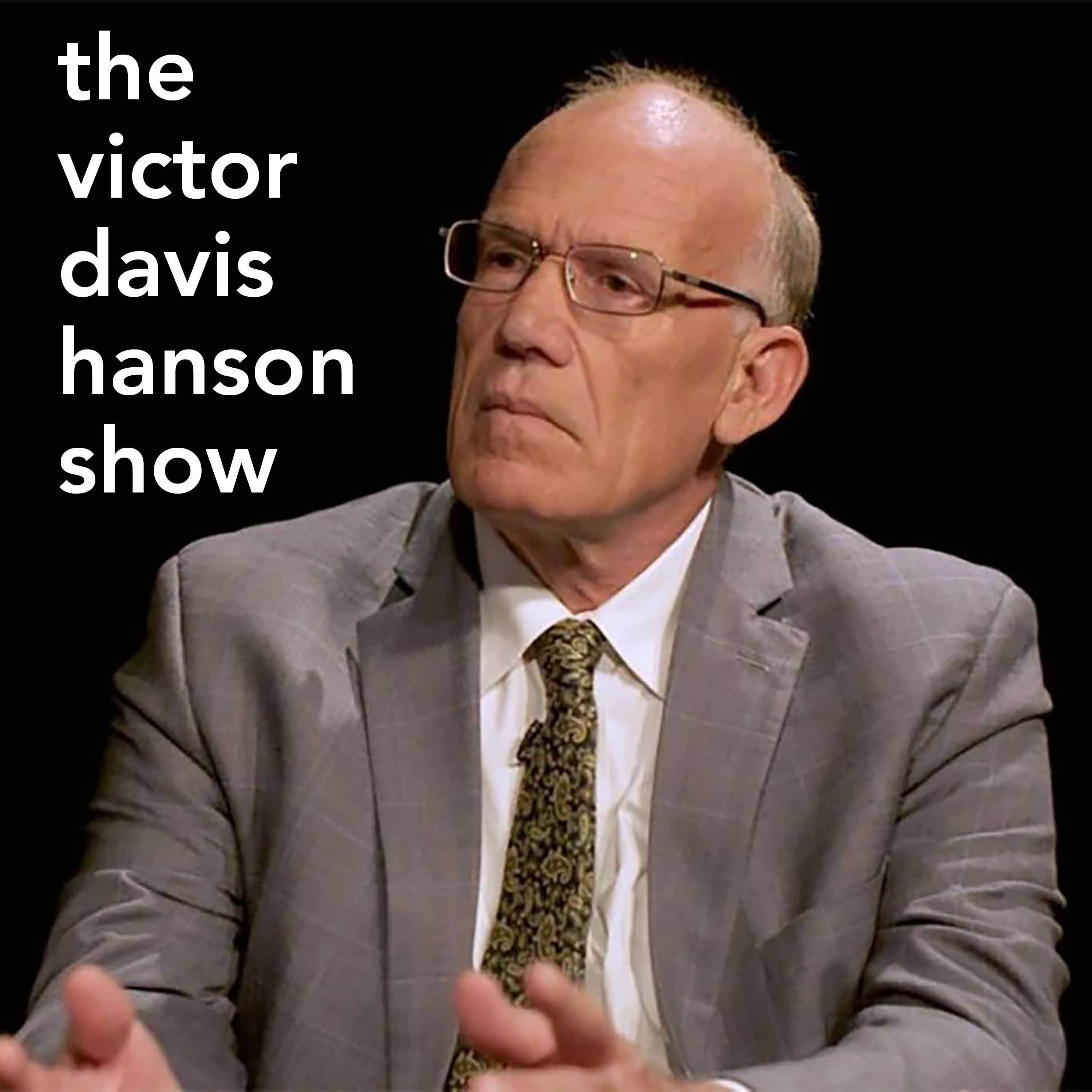
Loading summary
Transcript90 lines
- [00:00]
Shopify Narrator
Shopify helps you sell at every stage of your business. Like that. Let's put it online and see what happens.
- [00:05]
Victor Davis Hanson
Stage and the site is live.
- [00:08]
Shopify Narrator
That reopened a store and need a fast checkout. Stage thanks. You're all set. That count it up and ship it around the globe.
- [00:14]
Barry Strauss
Stage this one's going to Thailand.
- [00:17]
Shopify Narrator
And that Wait, did we just hit a million orders? Stage Whatever your Stage Businesses that grow grow with Shopify. Sign up for your $1 a month trial@shopify.com Listen.
- [00:31]
Victor Davis Hanson
Hello, this is Victor Davis Hansen with the Victor Davis Hansen Show. I'm solo today because we're doing one of our interviews. And today we're interviewing Barry Strauss. He is the Corliss Dean Senior Fellow at the Hoover Institution. You know him from some 17 books he's written on the classical world. He wrote a book on rowing. He writes both on Roman and Greek history throughout antiquity. Early Antiquity, Late Antiquity. He was a professor. What? Barry for 45 years at Cornell.
- [01:05]
Barry Strauss
Roughly. Yeah.
- [01:06]
Victor Davis Hanson
Yes, we're roughly the same age, 71, I think.
- [01:09]
Barry Strauss
That's right.
- [01:10]
Victor Davis Hanson
And we knew each other when we were 25 at the American School of Classical Studies. Yes. And now he's a colleague at the Hoover Institution. Some of you have seen that he writes opinion journalism on contemporary topics, but here today, because on August 19th, his new book, and it's very timely, the Jews versus Rome will appear from Simon and Schuster and the subtitle is Two Centuries of Rebellion against the World's Mightiest Empire. And he's the author as well as the War that Made the Roman Empire. So we'll get right back to the interview with Professor Strauss in a minute after we hear from our spons.
- [01:58]
Vibrance Sponsor
If you're like me, you have a lot of product on your bathroom counter. Well, I have found the secret serum and its Vibriance Super C Serum. The ingredients in this one bottle can replace your day creams, eye creams, night creams, neck creams, wrinkle creams, and even dark spot reducers. Made in the USA with the highest quality ingredients including vitamin C, hyaluronic acid, vitamin B5 and vitamin E. Super C Serum delivers noticeable Simplify your skin care routine, get a healthier complexion and minimize wrinkles and age spots with vibrance. I just began using Super C serum last week and I love it. My skin feels so much better, soft, moist and fresh. And by the way, it smells beautiful like the orange blossoms outside my kitchen door. Give it a try and you'll love it, too. And if you don't find it better than your Current skincare routine. You'll get a full refund. Go to vibrance.com victor to save up to 37% off and free shipping. That's Vibrance V I B R I A n c e vibrance.com Victor and we'd like to thank Vibrance for sponsoring the Victor Davis Hansen Show.
- [03:20]
Victor Davis Hanson
And we're back. Barry, this is your 17th book. Did you, you, you've written about Jewish history and tangentially in all of your books about the Roman Empire, but did contemporary events, when did you start to think of this and start to write it? And did it have anything with the turmoil in the Middle east, or was that just something that occurred while you were writing it?
- [03:43]
Barry Strauss
Well, you know, I started writing this book in 2020. And by the way, Victor, thank you very much for having me on. It's great to talk to you, as always. So I started writing this book in of the reasons I wanted to write it was the, the then, you know, below the surface war between Israel and Iran. And one of it struck me in looking back in the earlier history, that Iran, the ancient Iranian empires were actually very friendly with ancient Israel and very friendly with the Jews. Cyrus the Great, of course, but also in the period of the revolts, the Parthian Empire was an ally of the Jews, and then later on, the Sassanians were also an ally of the Jews. So I realized, and I read a little bit about Iranian history later on, that the current regime, the Islamic Republic and its hostility, you know, it's deadly hostility to Israel is not in the mainstream of Iranian history. So I wanted, I wanted to look at a different period and see that.
- [04:45]
Victor Davis Hanson
Yeah. And I think you're right. And even the Shah was, of all the people in the Middle East, I thought the most reasonable with Israel.
- [04:53]
Barry Strauss
Yes, he was.
- [04:54]
Victor Davis Hanson
He was. And one of the things that struck me in some of the signature battles and I think everybody should read, especially the siege and destruction of Jerusalem, it's pretty harrowing. The Masada incident is there, the Bar Kova. But what struck me is that many of the revolts were taking place at a time when we, I don't know, we would call them the good emperors, but the emperors were people like Vespasian or Titus or Hadrian that were not really the more deranged, sinister, pathological types.
- [05:30]
Barry Strauss
Yeah, well, of course it's true. And it's certainly a stain on Hadrian's escutcheon, especially that, you know, the most bloody revolt and suppression of the revolt, Bar Kokhba revolt, took place under Hadrian. But, you know, the great revolt begins because of Nero, who is a deranged emperor. And it's Nero who. He's not friendly towards the Jews and he instructs his governors basically to squeeze them until the pips squeak. The temple in Jerusalem was fabulously wealthy and Nero wanted to get his hands on that money. His local governor will also Judea as Israel's coldness period. It had a large Jewish population, but it also had several gentile populations among them, in particular Greek speakers. They were hostile towards the Jews and the governor tended to favor the Greeks against the Jews. And he didn't just favor them, he actually massacred civilians in Jerusalem as part of his policy. So that tipped the scales towards revolt.
- [06:35]
Victor Davis Hanson
When you talked about the revolt that sent Titus and Vespasian to subdue the Jews in 70 Jerusalem, except for, I think, as I remember, one section of the wall was almost considered impenetrable. It was kind of like Constantinople later. So there was. It wasn't just a feudal idea. They thought that they really could outlast Rome, didn't they? And maybe the Parthians might help or something. It wasn't like the Third Punic War that was doomed from the begin.
- [07:06]
Barry Strauss
No, I don't think it was doomed from the beginning, and most people think it was doomed. But there are several other scholars who think the Jews had a chance. They cut their own throats because the rebels inside Jerusalem came from several different factions and they preferred to fight and kill each other rather than fighting the Romans. Until finally they got their act together and united against the Romans. It's a bit too late. The other thing they did was they destroyed the grain supply. They burned each other's grain, and in the end there wasn't enough food. They could have lasted a very long time. Instead, the siege lasted for five months, which is not much longer than the earlier sieges of Jerusalem that took place. So they did it to themselves in a real way.
- [07:53]
Victor Davis Hanson
It's really dramatic when we think of this first result of the destruction of the second temple. It was a huge temple, 30 acres, and we see it today when you go to Jerusalem on Temple Mount. Tell us a little bit, what was the effect on Jews after the destruction of the Temple? I noticed that when you go to Jerusalem today, you can go into places and see the Third Temple project, where people in their dreams think they're going to build again. What was the effect and what was on the Jewish people after the destruction of the second Temple?
- [08:30]
Barry Strauss
Well, I think that it's a great question Certainly many people despaired, but there are others who said, look, this is not our first rodeo. The first Temple was destroyed. The biblical promise would be that it would be restored within 70 years. And it was. And so they believed that the second Temple would be. Had been destroyed and would also be repaired within 70 years. We have some apocalyptic writings from this era that talk about the hope that the Temple will be destroyed, the people of Israel will be redeemed, and Rome will be swept away. Of course, another group of Jews had different reaction. These were the followers of Jesus, and they felt that the destruction of the Temple showed that their way was the right way, and they still consider themselves to be Jews.
- [09:23]
Victor Davis Hanson
But.
- [09:24]
Barry Strauss
But they thought that Jesus's message, which was in some ways a message that you don't need the Temple, that there are other ways to have redemption. They thought the destruction of the Temple showed the time was ripe for this message. So it's an important step in what scholars call the parting of the ways between Judaism and Christianity.
- [09:43]
Victor Davis Hanson
There was never any likelihood that the Romans would ever allowed it, you think?
- [09:50]
Barry Strauss
Well, you know, probably not, because the Romans understood that the Temple really was the heart of the rebellion, the heart and soul of the rebellion. And so I don't think they were likely to let it survive. I think they underestimated the resilience and the tenacity of Judaism, however, and they underestimated the importance of the Torah alongside the Temple. And they thought once you got rid of the Temple, we didn't have to worry. Actually, I take that back a little bit. They were worried. And one sign of it is that they impose the notorious Jewish tax on Jews, not just in Judea and not just on rebels, but on every Jew around the Roman Empire now had to pay a tax to the chief God of Rome, to Jupiter of the Capitoline Hill. It was humiliating, but also a way to keep the rebels in line and prevent future rebels rebellions from starting. Or so they thought. So they thought.
- [10:46]
Victor Davis Hanson
What was it about the Jews in the sense that the Iberians, the Spanish, the Gauls, the Carthaginians, all of these peoples that were incorporated into the Roman Empire, I mean, there were periodic outbreaks, especially in Scotland, along Hadrian's Wall, et cetera, and along the Danube and the Rhine. But what was it? What was unique about the Jews that made them. Because they weren't the most numerous of peoples and they didn't have the greatest assets. But why were they the most reluctant to bend the knee to Rome in the way that other peoples who had more resources and Manpower felt that it had been feudal. What was it about this? Was it a messianic idea that they were God's chosen people?
- [11:34]
Barry Strauss
Partly an apocalyptic messianic idea. And lots of groups of people among the Jews who propagated this idea. Not just the Christians, the early Christians in their own way, but also the Essenes, people who wrote the Dead Sea Scrolls at Qumran. And you have the Torah and you have a group of leaders, religious leaders, the people who become the rabbis who create new ways for Judaism to survive. The service of the temple is replicated in a series of daily prayers exist to this day. So there is that. But on a practical matter, the other thing that's really important to remember is there's a huge Jewish diaspora outside of Judea, both within the Roman Empire and even more important outside of the Roman Empire, in the Parthian Empire. Those Jews are out of Rome's grasp, out of Rome's reach. And they can help their brethren in Judea to recover and to continue. Think about future revolts. The other factor we have to point out is the Romans really mishandled the situation. First of all, this humiliating tax, second, the refusal to allow the Jews to rebuild the temple. And third, they mishandle their relationship with Parthia. Trajan invades the Parthian Empire and this is the signal for Jews mostly outside of ancient Israel, mostly in Egypt, Libya, Cyprus and also in Mesopotamia, Iraq. They rebel at this very time, causing big, big problems for the Romans. And the Roman's response to that is to say after they, they give up on their invasion of Aparthia as a failure, they have to withdraw from Mesopotamia. The ruler Trajan dies and a new ruler comes in, Hadrian. And Hadrian's response is to say, we haven't forgotten what the Jews did and we're going to show them. We are going to rebuild Jerusalem, but not as a Jewish city. We're going to rebuild it as a pagan city with pagan temples. And to stand in replacing the Jewish temple, that is not a signal of reconciliation, it's just the opposite. And it spurs the Bar Kokhba revolt.
- [14:01]
Victor Davis Hanson
You touch on it in the book. What did the ascendants of Christianity in Judea have in the first, second and third century on these revolts? There were not Christian Jews that actively participated or were there?
- [14:19]
Barry Strauss
There may have been. I mean, you know, we depend on the church fathers and Christian sources to talk about this. And the picture they give is that the, the followers of Christ did not participate in the revolt. Perhaps that's true. Certainly the followers of, of Jesus believed that he was the Messiah, and so they weren't going to follow Messianic figures. And we know that there were Messianic figures in these revolts. So by and large, they wouldn't. There might have been some Christians who joined in the revolt, but the church fathers are not going to want to emphasize that. They want to show that the Christians are loyal Romans.
- [14:57]
Victor Davis Hanson
We're talking with Barry Strauss. He's the author of the forthcoming the Jews Versus Rome. It comes out from Simon Schuster. It's available now on Amazon. Subtitle is Two Centuries of Rebellion against the World's Mightiest Empire. And we'll be right back after a word from our sponsors. And we're back with Barry Strauss, and we're discussing the Jews versus Rome. At this time in the empire, was there a sizable Jewish Christian presence in the Holy Land that rivaled traditional Judaism, or was it more a diaspora already of Christianity into North Africa and Italy, etc.
- [15:44]
Barry Strauss
It's certainly a diaspora phenomenon, and it also extends into the Parthian Empire. By the way, there don't seem to be many Jewish Christians after, in. In Judea, after, after these revolts at least. But there were Christians. Whether they consider themselves Jews, that's another question. Certainly among the Greek speakers, there were Christians in this period. There probably were some Jewish Christians who survived the Bar Kokpa revolt as well.
- [16:12]
Victor Davis Hanson
You're one of the chief sources for at least two of these revolts. And maybe it was Josephus. What was unique about him, I know that he almost died in a shipwreck and that he was considered an apostate, but he was from a very wealthy family, he was very well connected and he had these contacts with Rome. He was kind of a Polybius character, that.
- [16:36]
Barry Strauss
He was like a Polybius character, except that even more than Polybius, he actively fought against Rome. So he's an important general in the Great Revolt. And he personally leads the defense of a small city, the city of Yotapata in northern Israel in the Galilee. And they hold out for, he says, 47 days against the Romans. And he gives a long story about the defense of the city, of course, making himself look heroic. But the city was excavated in the 1990s. Terrific archaeological story which confirms a lot of the details in Josephus. So here he plays this big role, leading this defense of the city heroically against the Romans. And then there's this very infamous experience event in which the survivors decide to commit suicide, killing each other. There's a lottery, and by hook or by crook, Josephus is One of the last two guides standing. And he says to his fellow, on second thought, let's survive and go over to the Romans. So they do. And Josephus then changes his tune. He says he's had a dream, a vision from above that Rome is fated to win and to survive, the Jews should go over to the Romans. Which he does and eventually ends up in Rome as a client of the imperial family of Vespasian and Titus. And there he devotes the rest of his life to writing books about Jewish history. They're partly a defense of himself, they're partly a defense of the Jewish people, and they're partly a warning to Jews, don't do it again.
- [18:18]
Victor Davis Hanson
Masada. When you go to Masada and there's this ritual that I guess is famous of IDF people who take an oath, right? And what is it about Masada? Is it the last stand or the collective suicide that makes it such an iconic moment, not just in Israel's history, but. Yeah, well, just history.
- [18:37]
Barry Strauss
Yeah. Josephus, we owe this to Josephus. You know, as I said, even though his own career was kind of suspect, he still is patriotic and loyal to, as he sees it, to the Jews. And so he takes this incident, Masada, which frankly was a relatively small incident in Roman military history, and he glorifies it, he heroizes it, and he puts speeches in the mouth of the Jewish leader there, the leader of the rebels. These are the speeches, are some of the greatest defenses of freedom that survived from the ancient world. And Josephus wrote in Greek, so I'd say there's some one of the greatest defenses of freedom that survive in the Greek tradition. And it's an eerie thing in his book. And then to go to Masada, as you know, it's extremely dramatic site, hardly a more dramatic one from the ancient world. And so much of it has survived and it was excavated by the Israelis. They see it as a symbol. There's a famous poem written in the 1920s by an early Zionist that says, has the line in it, masada will not fall again. And so Masada is seen as a rallying cry of Jewish resistance, a rallying cry of Zionism and a symbol of what's at stake if the Jews do not take up arms and defend themselves.
- [20:05]
Victor Davis Hanson
One of the messages, or maybe unintentional effects of reading the book, and I think our viewers will, when they read it, will have the same effect, is that the narrative of anti Israelis, that Israel was a settler or colonial power or it came in through Zionism, I mean, when you look at what you're writing about not just in the first or second millennium, but I mean, we're talking about the first, second, third A.D. this was an entirely Jewish country. I mean, there was no Arab migration in there until the 7th or 8th century. And it just resonates Jewishness. The names, the places, the people. And it really reminds everybody that it was for thousands of years the historic homeland of the Jews. Absolutely, yeah. And you don't get that in modern journalism to the same effect.
- [21:05]
Barry Strauss
No, I think people are either ignorant or ill disposed towards, towards Israel and towards the Jewish people. But the reality is this, it is the historic Jewish homeland.
- [21:15]
Victor Davis Hanson
Yeah, it really is. And the artifacts see it. When you, I know you've been to Israel, but when you were researching it and you were in Israel, what was the reaction when you met Israeli historians or government people to see these sites in connection with your research?
- [21:32]
Barry Strauss
Well, Israeli historians were very open and they were extremely helpful. As I said, this archaeologist who excavated the place where Josephus fought Jotapata, he gave me a personal tour of the site. Another one of my colleagues led me to Masada. I'd been there before, but it was great to have his take on it. And we also went to Qumran where the Essenes were and many other Israeli guides who I worked with, they were very happy to show me around. I think a lot of Israelis feel that the revolts were a mistake, that they were tragic, they were quixotic, and that if the Jews had simply gotten along with the Romans, swallowed their pride, gotten along with the Romans, that they never would have been exiled from their homeland. And I guess my response is to say, who can know? Who can really know if that's true?
- [22:27]
Victor Davis Hanson
Look at the Carthaginians.
- [22:28]
Barry Strauss
Yeah, look at the Carthaginians.
- [22:29]
Victor Davis Hanson
They did everything. They, they dismantled their army, they told they, Scipio, Aemilianus, they said everything, they met every condition. And then they wanted to destroy the city and move it 10 miles inland. And they couldn't finally do that.
- [22:42]
Barry Strauss
Right.
- [22:43]
Victor Davis Hanson
Yeah, it's. How about the Bar. Tell us a little bit about Barcova. That one of the, the most dramatic of the revolts.
- [22:51]
Barry Strauss
Yeah, Bar Kokhba. So that was his, that was his nom de guerre. His real name was Bar Kosova. And Barkoka means son of the star. And that's one of the symbols of the Messiah. So clearly they're a messianic. If he didn't call himself the Messiah, some of his followers did in messianic aspects of the revolt. But very smart guy. What he does is totally different than the first revolt. He builds underground shelters, tunnels, caves, uses for pre existing fortresses and springs. The revolt on the Romans completely shocks them. They're unprepared and the blow is, is devastating. In order to suppress the Bar Kokhba revolt, the Romans have to send armies from other provinces and they have their best general is the governor of Britain. So they have to take this guy from Britain and send him to Judea. And it takes them years to put down the. Years to put down the revolt.
- [23:50]
Victor Davis Hanson
Yeah. And when you, when, when do you think we have all these diasporas? But when, at what moment was Judea considered too hostile or inhospitable to Jews? And we started to see the great diasporas that went into the other, the north part of the empire that later became, you know, centers of Jewish culture learning in Eastern Europe, the Middle east in Western Europe. At what point did that fragmentation happen? At the ends in the empire, you.
- [24:27]
Barry Strauss
Know, it's already starting in this period. But it's important to point out that for a number of centuries after the Bar Kokhba revolt, there is a large Jewish community in northern Israel, in particular in Galilee and Golan. And while the Talmud, the most famous Talmud is the Babylonian Talmud, comes from the area that's now southern Iraq, there's also a Jerusalem Talmud which is written by these scholars and rabbis and sages in northern Israel, mostly in Tiberia. So in the Galilee, it's a number of centuries until after the Arab conquest, before the Jewish population in, in, in Israel becomes very, very small. It never peters out entirely, but it comes quite small. So by the high Middle Ages, the center of the center of action has moved, as you say, to Western Europe and to Mesopotamia.
- [25:31]
Victor Davis Hanson
We're talking with Barry Strauss. He's the author of the forthcoming the Jews versus Rome. It comes out from Simon Schuster. It'll be, it's available now on Amazon. Subtitle is 2 of Rebellion against the World's Mightiest Empire. And we'll be right back after a word from our sponsors. And we're back with Barry Strauss and we're discussing the Jews versus Rome. Barry, this is really the first book I know you've written on all periods of Roman history, but this is the first that you've dedicated to the Jewish experience, isn't it? Right, yeah, it is, yeah. And did you when you were writing about Actium and Cleopatra and Roman leadership, all of that seems to have been incorporated in this book. It gave you a lot of insights. I found that from your earlier work and You've written.
- [26:31]
Barry Strauss
Thank you.
- [26:31]
Victor Davis Hanson
Sixteen or seventeen books on antiquity. Are you thinking of going back to Greece again? I know you've written about the Trojan War. You've written about the Battle of Salamis again, because I remember you're primary like me. A Hellenist.
- [26:46]
Barry Strauss
Yep. I started out as a Hellenist, but I always had a fondness for Italy and for Rome. I think it's because my father was a combat soldier in the U.S. army in Italy in World War II, and he marched into Rome on the day that Rome was liberated in June of 1944. He had a book on his bookshelf called the Road to Rome. I think that had a big impact on me.
- [27:09]
Victor Davis Hanson
One of the advantages, when you read these books, Barry is known and among classicists as having a wide variety of language facilities. And you read or speak French, German, Turkish even, don't you?
- [27:25]
Barry Strauss
Just a little Turkish.
- [27:26]
Victor Davis Hanson
Modern Greek. Your modern Greek is always better than mine.
- [27:29]
Barry Strauss
I don't know, Victor, but thank you. Italian. Also Italian. And I can. Certainly reads Spanish and Hebrew. So. So some Hebrew.
- [27:41]
Victor Davis Hanson
And when we were young, some 50 years ago, we to. To conduct classical scholarship, you really needed to know German and French. And I guess now that's less true that there's automatic translations online and things, but it doesn't seem like I don't see people using these European languages to the great the same degree that we had to.
- [28:05]
Barry Strauss
Well, they don't, but they should. I mean, there's a lot of stuff that isn't translated. It depends what you're going to do. For instance, if you want to write about Caesar in Gaul, there's no way you can do that without knowing French. Forget it. You really have to do that. And likewise with other local things. If you want to do the Romans in Italy, you really have to know Italian. Yeah.
- [28:25]
Victor Davis Hanson
And I don't think classical great histories of. I mean, George Grote is a great history, but Baylock and Busola are not translated and they.
- [28:34]
Barry Strauss
They're not translated.
- [28:35]
Victor Davis Hanson
Great histories of Greece.
- [28:36]
Barry Strauss
Yeah.
- [28:37]
Victor Davis Hanson
And we all had to read them. Tell me, tell us what your next. What's her next book? I know we're getting into our receptagenarians now, but.
- [28:50]
Barry Strauss
But what do you. You know, I'm going to keep writing as long as I can hold a pen.
- [28:54]
Victor Davis Hanson
That's good.
- [28:54]
Barry Strauss
That's good. My next book is going to be on classical leadership and the. The lessons to use, if I may, from the leaders in the ancient world. It strikes me that classical leaders are the two things about them. They tend to be transformational leaders. They have a vision and they tend to be great orators and great communicators. And I think that they're really terrific models.
- [29:20]
Victor Davis Hanson
Which ones are you looking at if you know yet?
- [29:23]
Barry Strauss
Peregrine Obviously, I don't know entirely, but I, you know, two clusters have occurred to me. From the Greeks, I like the leaders around the Persian war. So Leonidas, Themistocles, then compare that to Xerxes. And I also can bring in Queen Esther, who there is real reason to think that she existed in. Was Xerxes queen for the Roman period, for the Greeks. I haven't decided yet what I'm going to do about Pericles and Demosthenes, who I'd also really like to bring into the story. So that doesn't chronologically work so well, but I think they're just too important to leave out the Romans. Chronologically it works really nicely because if you're looking at the generation of Caesar and Augustus, you have Caesar, you have Augustus, you have Cicero, you have Agrippa, and you have Herod. I mean, that's quite a. I'm Cleopatra. How could I leave her out? So it's quite a cast of characters that you can do.
- [30:27]
Victor Davis Hanson
That's good. I. I hope, if I can, I have this book on trump and then an ag book. But I want to write, if it's possible, a history of Epaminondas, who I think was, you know, Cicero said that he was Princeps Grecae, the first man of Greece.
- [30:43]
Barry Strauss
Yes.
- [30:44]
Victor Davis Hanson
But I think a lot of the damage was done to his name when Xenophon didn't mention him by name and hated him. And then Plutarch's Life of Epaminondas, which apparently is one of the most popular in the Middle Ages, is lost.
- [30:58]
Barry Strauss
I know.
- [30:59]
Victor Davis Hanson
So he didn't get a good deal. I wrote a novel once about him, but I'd like to write a history about him. There's no main history that I know.
- [31:07]
Barry Strauss
Of that would be great. Yeah. There's some in Italian, but yeah, he's a fascinating character. He is. Really. Yes.
- [31:13]
Victor Davis Hanson
So he would be somebody that I think was a great leader. And so a couple of other things just to wrap up. So you're now at the. The Hoover Institution and you're designated as a senior fellow. Military history. History in general, Contemporary culture. You remember the Military History Working Group.
- [31:35]
Barry Strauss
Yeah.
- [31:36]
Victor Davis Hanson
And you often write, you know, for strategica about contemporary wars and tactics and strategy. To what degree do you incorporate all of this knowledge about ancient warfare into contemporary exegesis? About these ongoing wars in Ukraine or the Middle East. Seems like you've done that pretty well.
- [31:56]
Barry Strauss
Well, thanks. I mean, I think it's crucial. I don't really think you can understand war unless you've read the classics. Thucydides from our period, Clausewitz. There's a lot in sun tz. So I always try to incorporate those ideas in what I'm writing. And I think hardly anything that I write is not marked by but the lessons that they have to teach us.
- [32:19]
Victor Davis Hanson
Well, thank you, Barry. Where we're going to take a final break and we'll be back with Barry Strauss, Hoover fellow author of the Jews in Rome that appears on August 19th. It's available at Amazon. We'll be right back. And we're right, we're right back here, Barry. Where, where's the best place Amazon to.
- [32:43]
Barry Strauss
Buy the book or just Amazon, Barnes and Nobles? There's something called indie bound. You can buy that book in any of those places.
- [32:51]
Victor Davis Hanson
And you're headed, aren't you, pretty soon in the near future to Israel?
- [32:55]
Barry Strauss
Yeah, I'm going to Israel at, at the end of the month. I'm going to be teaching a, a two week course there, a mini course on the Roman way of war in Jerusalem.
- [33:05]
Victor Davis Hanson
Oh, good. And are you going to be talking about the Jews versus Rome, obviously?
- [33:11]
Barry Strauss
Yes, I am. And I'll be speaking in public about the book there as well, so.
- [33:15]
Victor Davis Hanson
Oh, good. Yeah, good. And I hope there's a Hebrew translation coming out very soon.
- [33:21]
Barry Strauss
I hope so. 10 Caesars was translated into Hebrew, which really tickled me pink.
- [33:27]
Victor Davis Hanson
Well, that's great. Well, everybody, we've been talking to Barry Strauss and I'll urge you to buy the Jews versus Rome. It's got fascinating first hand descriptions about the destruction of the second Temple, about a cast of Roman characters, Hadrian, Titus, Domitian, Silva, Masada. Everything is in there. And it's very relevant to contemporary and often divisive arguments, controversies about what's going on now with Israel and its various enemies. And if there's one thing I took away from this book, Barry, is if I were the Iranians or the Hezbollah or, or the Hamas people or the Houthis, I would be very careful about attacking Israel because they have a long history of defiance. Yeah, I know they can be squabbling in antiquity, but if they are united, they're almost indomitable.
- [34:22]
Barry Strauss
Yeah.
- [34:22]
Victor Davis Hanson
Yeah.
- [34:23]
Barry Strauss
Thank you, Victor.
- [34:23]
Victor Davis Hanson
Okay, thank you everybody for listening. This is Victor Davis Hansen for the Victor Davis Hansen podcast and we've been interviewing Barry Strauss.