← The Victor Davis Hanson Show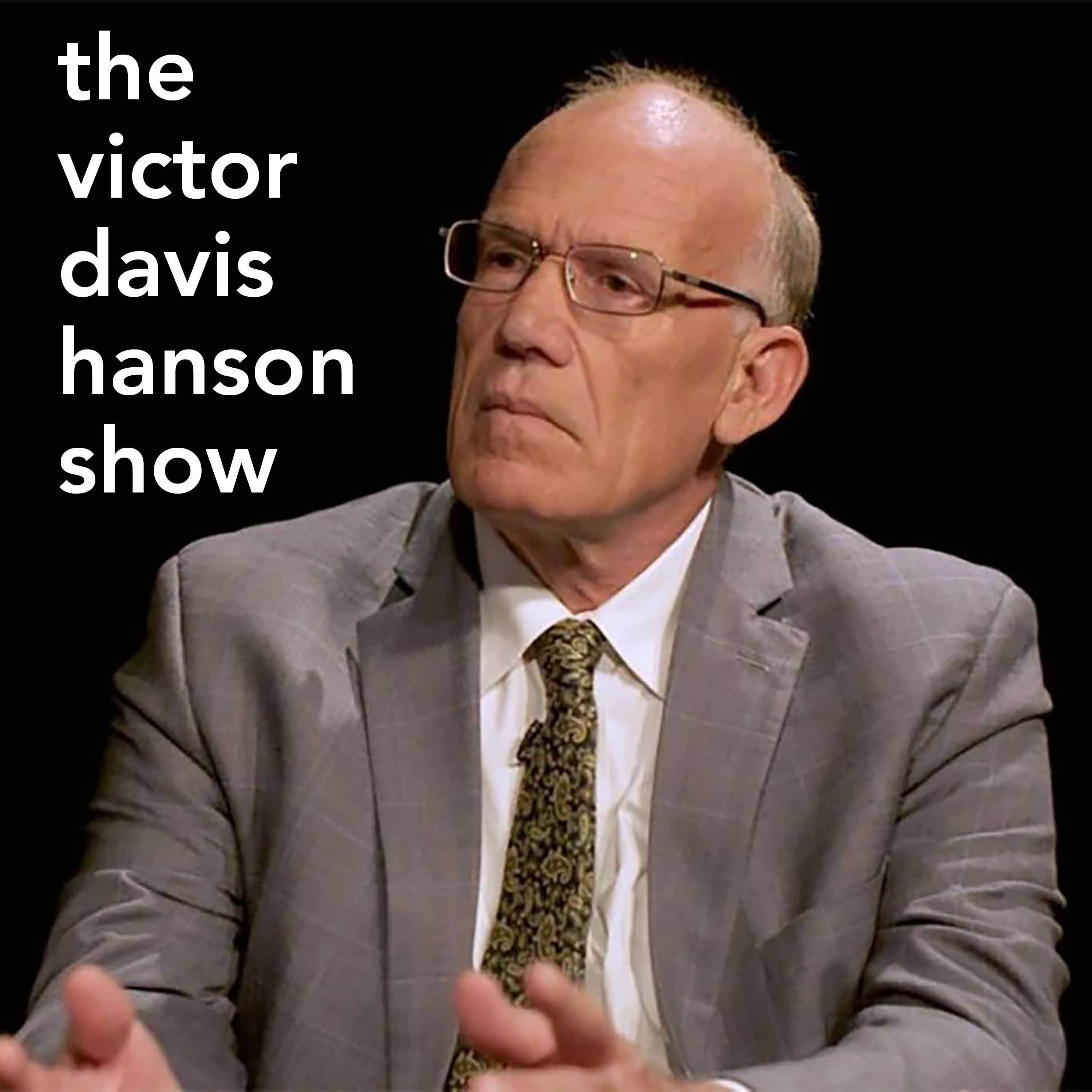
Loading summary
Transcript91 lines
- [00:00]
Victor Davis Hanson
Did you know you can get the photos on your phone, printed for free and delivered straight to your door? Do it with Freeprints, the world's favorite way to print photos. Just visit freeprints.com to get the Free Prints app and get your free photo prints. Now that's freeprints.com Freeprints has millions of five star reviews and has printed literally billions of photos.
- [00:22]
Jack
It's easy.
- [00:23]
Victor Davis Hanson
Just visit freeprints.com and get premium quality photo prints in your mailbox in just days. Go to freeprints.com or download the Free Prints app directly from Google Play or the App Store. Hello, ladies. Hello, gentlemen, and welcome to the Victor Davis Hanson Show. We are recording on Monday 28th July. It's a hot and stinky day here in Milford, Connecticut. And I assume it's hot out there in Selma, California.
- [01:05]
Jack
It's always out in the San Joaquin Valley, even when it's cold. But it's dry. It's dry hot.
- [01:11]
Victor Davis Hanson
Oh, well, there you go.
- [01:12]
Jack
Good. The tires are 106 is tolerable in a way that your 90 is not.
- [01:18]
Victor Davis Hanson
Yeah. But your tires melt, right?
- [01:21]
Jack
Yeah.
- [01:21]
Victor Davis Hanson
Ours don't. So Victor is the Martin and Ely Anderson Senior Fellow at the Hoover Institution, the Wayne and Marcia Buskey Distinguished Fellow in History at Hillsdale College, and he's the possessor of a really cool, important website, the Blade of Perseus. Its address is victorhansen.com Go there early and often like they vote in Chicago and subscribe. And I'll tell you why later. You should be subscribing. Victor, some breaking news today. Again Monday the 28th, Donald Trump has had it, well, close to having had it with Vladimir Putin. Will get your take on that on the trade deal he negotiated with the European Union. We have this really troubling race fight. Well, I think it's race. In Cincinnati late last week, Dan Bongino, the FBI has issued another troubling statement about the whole Epstein affair. And there's some more European matters to take on. And we'll get, we'll start off with Putin and we'll do that when we come back from these important messages.
- [02:32]
Sponsor
Folks, I don't know how anyone can get a restful night's sleep with a CPAP mask strapped to their face all night. Even with it, breathing is disrupted. And we all know how important a restful night's sleep is for our health. If you snore now, you're at a heightened risk of requiring a CPMAP machine later. Now is the time to stop snoring One of the smartest, fastest, easiest ways to stop snoring is zpa. The ZPA is the comfortable doctor designed mouthpiece that can stop snoring as fast as the first night. Don't be fooled by imitators. ZPA was proven in a 600 patient clinical trial and with over half a million units sold, XIPA is the stop snoring device I trust. No more being nudged awake for snoring. No more sleeping in separate rooms. No more feeling tired and foggy all day due to lack of sleep. Look, this may be your last best chance to solve your snoring problem now or face having to wear a CPAP mask later. Zipa that's happy Z spelled backward. I want you to try it with our special discount. Get 20% off and free shipping. Visit zipa z Y-P-P-Dot.com and use the promo code snore. Again that's promo code snore.
- [03:52]
@Zepa.Com Shopify helps you sell at every stage of your business. Like that. Let's put it online and see what happens.
- [03:59]
Jack
Stage and the site is live.
- [04:01]
Sponsor
That reopened a store and need a fast checkout. Stage thanks. You're all set. That count it up and ship it around the globe Stage this one's going to Thailand and that wait, did we just hit a million orders? Stage Whatever your stage Businesses that grow grow with Shopify. Sign up for your $1 a month trial@shopify.com Listen.
- [04:28]
Victor Davis Hanson
Back with the Victor Davis Hansen show. So Victor, Donald Trump was, I saw a clip a little bit ago. He was with Prime Minister Starmer. I guess maybe he's in Scotland still, but he was. He said he's talked to Vladimir Putin frequently. He's gotten the impression things would be done. 50 days was a deadline of sorts that Trump gave to settle this. That 50 days is still some number off. And Donald Trump said today, you know what, Putin is not doing anything to advance a peace and I'm going to give it 10 to 12 days. And by the way, 10 to 12 days is August 7 to August 9. What will happen those days? Not sure. Anyway, Victor, that's the new background. Your take.
- [05:17]
Jack
Well, that's a reduction of remember the 50 day deadline. You know, in a weird way this is going to work out for Donald Trump because his MAGA base was restive after the Iran 27 minute or 30 minute incursion and the Epstein flip flop. But he can legitimately say that he risked a lot of exposure by bending backwards to Vladimir Putin. That includes the blow up with Zelensky and the oval office with J.D. vance, et cetera. So his fides to the base are pretty clear that I tried to do everything I could to get a settlement and be neutral in it. When most people in the west thought that he should not have been neutral, that he should have tilted for Ukraine. I'm not going to get into that. But my point is he's basically saying, you can't. I'm an art of the deal guy and you can't deal with this man unless you have cards to play. And I'm not going to give up my cards anymore by saying that we're going to have an agreement. An agreement. But notice what he also did was really smart. Whereas Biden didn't talk to Putin and call him a killer and a murderer. Trump said it was very clever what he said. He said, you know, we had great conversation, he was so nice, we got along. And then he killed people right afterwards. And he had said that essentially earlier with Malenia, said, well, he doesn't listen to you. He kills people. So he now can say to Maga, I did everything I could and I took a lot of heat. Remember, it was people like John Brennan who said he was a traitor over the NATO thing and then kissing up to Putin years ago. And then Clapper, who's unfortunately back in the news, called Trump a Russian asset, basically called him a traitor. So he had a lot of exposure also, if I could use that term again, from the Russian collusion hoax, that he really couldn't, you know, be a disinterested negotiator with Putin because everybody on the left had fabricated all these charges that he was Putin's puppet. So now the whole thing is now resolved. It's very clear he gave Putin every single chance possible to cut a deal. So then the question is, why didn't Putin cut a deal? And the answer that we've discussed before is he's lost a million dead, wounded and missing Russians. There's stories almost every day in the media about young people who were used as cannon fodder. They only get two weeks of training. Our guys get six months. They're put in impossible situations. And even though Ukraine only has about 28 million people, Russia has 144. At some point, Putin apparently feels that he has not justified the special military operation in the eyes of the military and the apparat, the oligarchic class, it runs Russia. And what that means is they're saying, if I could just ad lib a minute, if I was an oligarch, or a Russian general, I'd say Vladimir. So what have you got for the million dead and world pariah status? What have you got? Just tell me. Dead and wounded a million people for the special military operation. What have you got? There is no more Wagner group. We got rid of them. They were useful. We had Crimea. They were never going to get back Crimea, may you say that. They institutionalized it, but we were never going to give it back. We didn't need this. We were never going to get back the Donbass. And I know that now. They said they promised that Ukraine will not be in NATO, but we knew that even the NATO members quietly had contacted us and Russia and said, you know, they're not going to be in NATO. We don't want them in NATO. So what did we get? And Putin's saying, well, I'm 40, 60, 80 miles westward. You got a million people for 80 miles. And so the point I'm making is that he has a magical point on the map where he can justify to the Russians that in a cost of benefit analysis, this was worth it. And he's not there yet, he thinks, and he's not going to get there. And then Donald Trump is basically telling the MAGA people, I have to continue to supply them weapons, even though I don't want to. And I want to get this thing over with for two reasons. Number one, as I said, I have no leverage with Putin. He does not respect magnanimity. He interprets magnanimity as weakness to be exploited, not kindness to be reciprocated. And number two, do you really want an Afghan Kabul pull out on my watch? Because if I cut them completely off, Russia is going to go back westward all the way to Kiev, and we're going to lose this and we're going to get an albatross around our neck, just like Biden did with Afghanistan. So I'm not going to be the guy who lost Ukraine. So that's where we are right now. And the question is at what point? There's a third thing I should mention. He just cut a big deal with the Europeans and we can get into that later, but it was a very important deal and it's all predicated on what he did with the Japanese and South Koreans. And that is that all these people that were running these asymmetrical surpluses and Europe was up to 250 plus billion with us, I think. Or maybe it was 200. The point is that they had a magic profit margin that we didn't even know what it Was, but we guessed that if it was 25% tariff, they wouldn't make any money and it would never work. 20, they wouldn't. But right around 15, they felt in a cost of benefit analysis, they could pay the 15%, stay in this huge consumer market, invest more money to assemble things here and still make a profit. And part of that deal was that they came to the table in part because Donald Trump was much more reasonable about NATO. They had called him daddy. They had gone up to 5%. And the last thing that Trump wanted to do after cutting this deal was get back on the bad side of the Europeans and get in a big fight over Ukraine and cut Ukraine off, because that would have destroyed this trade deal. It really would have. So what he's saying now is the Europeans and we and us are good friends on Ukraine and on trade. I will have leverage now to pressure Putin and MAGA people. Just stick with me because I'm not going to hang Kabul around our necks and be the one. And that's where he is. Yeah.
- [11:56]
Victor Davis Hanson
Let's talk about that trade deal.
- [11:58]
Jack
Victor.
- [11:58]
Victor Davis Hanson
And here's the headline from the Daily Mail, which this was reported on Yesterday, Sunday, the 27th. President Donald Trump announced a sweeping trade agreement with the European Union on Sunday, setting a baseline 15% tariff on European imports, including automobiles, while keeping existing 50% duties on steel and aluminum in place. As part of the deal, the EU committed to purchasing $750 billion in US energy products. Trump announced the agreement during a press conference with the European Commission President, Ursula von Der Leyen. The EU will purchase 3/4 of a trillion dollars in U.S. energy while also investing 600 billion in America on top of existing investments. Additionally, EU countries will be setting tariffs on U.S. goods at 0%. And Europe agreed to, quote, purchase a vast amount of military equipment. Trump said, end quote. Maybe Victor, in part plying. I mean, the deal's a good thing in itself, but the energy thing may be also applicable to the Ukraine situation.
- [13:07]
Jack
Part of the reluctance of Frackers to expand their product on federal leasing, because Doug Burnham has been really good about it. You know, it's not going to take you two years to get a federal lease. I can do it in a month or so. And EPA is the same way. But the Frackers are saying, well, you know what, prices are not all that great now, and we put all this money in it and we'll have an oversupply. We need markets. So I think part of it is Trump is telling them what we're going to have a huge export liquefied natural gas, export to Europe and you'll have a steady customer for a long time and you can make a profit on that. And that's so that was very important. And then it's part of the idea that Europe we know under the table or in the case of Germany openly is still buying natural gas in various ways, methods from Russia. So it's a very good, it's all connected. And it brings up a larger point. You know, Jack, I don't want to beat this horse to death. I know everybody's listening, getting tired of this. But I'm very disappointed in the Wall Street Journal's news, not the op ed. I really like Holman Jenkins. I love Gerald Baker. I think Kim Strassel is unrivaled. I like them all. I like Barton Swaim a lot. But the news division, when I read these articles, I look at the writers and then I double click them and see where they came from. And they all come from Politico, Washington Post or New York Times. And so when you read these and sometimes the editorial board itself, they can't give him any credit at all. Today there's an op ed about how bad the immigration, how cruel it is. And what's cruel is letting in 12 million people a year. But this op ed writer is a guest writer, Neera Tandran, I think her name is. But my point is, when you read the Wall Street Journal, even when there's this great news, they're attacking the European trade thing today and they're saying, oh, it's not such a great deal. He didn't get this. He didn't get that. And when you look at March and April stories, we should be in a recession now. The stock market should have crashed, we should have been in stagflation. Real wages should be down, the deficit should be ballooning. There will be no reven from tariffs. And then you read the actuality Scott Bassant, he's forecasting a third of a trillion dollars in tariff revenue and job growth is good and inflation is not spiring out of control. And it looks like there'll be good gdp. So all of this is good news and nobody will recognize it. And I have the utmost respect for my colleagues at the Hoover Institution whom I've learned about economics for the 20 years. But all of the economic orthodoxy was that Trump was going to blow up the economy because tariffs are terrible. What's really strange is I want to make two points very quickly. One is the same people who are damning tariffs are for secondary Boycotts of Russia, which would be effective to pressure Putin. But if you want a trade war, you want to blow up the economy, then you tell India, we're not going to have. We're going to have zero trade with you. And you tell China zero trade and you tell Germany zero trade unless you stop every drop of Russian oil. We know they're getting Russian oil and we know it's central to their economies. So I can't understand how you can square that circle and say, oh, this terror 15% and then, oh, let's have a worldwide global secondary boycott. Doesn't make any. That will destroy the economy. The second thing is, and I've said this before, too, we're on uncharted territory with all these things. I recently listened to something that Doug Burgum said. He suggested that we might have $15 trillion in promised foreign investment. Remember, everybody, everything in Silicon Valley, Facebook, Google, if you count X, all of those places together, Oracle, you name it. $9 trillion in market capitalization. So what we're basically saying is almost double a Silicon Valley will be spread out over the whole United States. What will be the effect of that? If you ask an economist, they have certain formulas that for every billion dollars, you get maybe 500 to 5,000 jobs. Not specific. But $15 trillion as far as jobs go is incredible. Especially we haven't calibrated AI and robotics that are now making quantum leaps. We haven't factored in a third of a trillion dollars in tariff revenues. We have not factored in, we have 1 million less illegal aliens on state, local and federal entitlements, and there's going to be a lot fewer. We have not. We haven't factored into that equation. If you go to EPA or as I said, Interior or the Department of Energy and you want to drill a well, or you want to make a pipeline, or you want to make a highway instead of two years for a permit, you can probably get it in a month or two. All that has economic ramifications that are. No one knows. No one knows what they will be because we've never done it before. No president has ever done this. No president has ever had all these trade deals. No president has both deregulated and cut taxes and had these types of trade deal and this level of foreign investment or cut government this much. So the only thing I'm critical of is when Trump was pointing out that we could have this huge revenue of one third of a trillion dollars, he said he would like to think about a tax rebate or tax cut I wouldn't do that. We have $1.9 trillion trade deficit, maybe 37 trillion in aggregate debt. If he could lower the interest rate by a point and a half, he would save a billion dollars, maybe a day or a third of a trillion per year. And with another third of a trillion for tariffs, he's still, then he's got two thirds of a trillion dollars and he's, you know, he's a third of the way cutting the deficit. So that's what he should be doing. And if he could get, if he could cut the deficit in one year by a trillion dollars, that's an amazing achievement and that's what we should. I don't think it does any good after you've already signed tax cuts to give people more rebates.
- [20:05]
Victor Davis Hanson
Yeah, well, we have a little. I'd like to ask you another uncharted waters matter and something else about where to spend the revenue. But first, Victor, for our listeners and viewers, you know, there were over 200,000 people watching your most recent episode with the great Sammy Wink. It's amazing. Thank all the new people who have come to the show. Okay, Total control over your money. It's closer than you think. Right now, 134 countries representing 98% of the world's economy are building central bank digital currencies. These systems are designed to make every transaction visible, trackable and controllable by government authorities. It's a level of financial oversight that mirrors the tactics used by authoritarian regimes throughout history. And look at China. 260 million citizens are already using the digital I say it yuan. I may pronounce it wrong, but the digital yuan that can expire if not spent by government deadlines. And it's not just theory. The IMF admits these currencies can be programmed to decide what people are allowed to own. Once cash disappears, so does the last real protection individuals have had against financial control for thousands of years. That's why our friends at American Alternative Assets put together a must read guide, the Digital Dollar How CBDCs Threaten your Financial freedom. This free report explains how digital currencies represent one of the greatest threats to personal liberty and why physical gold and silver maybe the last line of defense. Call 8332 USA Gold or visit victorlovesgold.com to claim your copy. Now. That's 833-287-2465 or victorlovesgold.com History has shown us what happens when governments gain total control. Don't let it happen again. We thank the good people from American Alternative Assets for sponsoring the Victor Davis Hansen Show. Victor, two things about unchartered territory.
- [22:19]
Jack
No. 1 thing.
- [22:22]
Victor Davis Hanson
Is all these tectonic plates are shifting while we have this really deepening fertility and demographic, I think crisis. And the other matter is where to spend money. We're going to talk about this at greater length on the next episode, but we have just gotten some some very grim news about how close the Social Security system is to collapsing. So any thoughts on that before we head into the break?
- [22:53]
Jack
Well, as to we were about 2.0 at the Millennium during the end of the Clinton and the beginning of the George W. Bush. And I don't know whether it was a 2008 recession or the whole climate change AOC narrative that you don't have children or the bicoastal blue state model that you're an upscale metrosexual, that life is so wonderful and you're so brilliant and moral, you don't need to have children. Who'd want to waste your life changing diapers are up all night. But we're in a crisis because the latest fertility said it's not even 1.6. We're down to European levels the last few months. It's like 1.4, which is catastrophic to a civilization. It means your population is aging and it's shrinking. And the problem with that is related to Social Security because then you have a larger and larger pool of older people and a smaller and smaller people who are still in the productive workforce that pay the taxes. So what's the solution? I don't think it's politically acceptable to just raise the payroll tax, which you'd have to do, you know, up to 8 or 9% given that you can't deduct the salt deductions in these blue states. And there are conservative voters in these congressional districts. And when you look at California, it's not very hard to pay 13%, 10%, 12% plus the 38 federal plus the payroll. So you're really getting high. So what's the solution? The solution is you're going to have to I think if you look at the number of people who are on the Social Security payrolls for so called disability, it's gone from 7% skyrocket and you have people who are not here lawfully on it. And we give Social Security disability to people who say they have attention deficit disorder. So we're going to have to clamp down on that to people who are truly disabled. Number one, I say that, you know, I grew up with my mother's sister Lila that was living in the house that I'm living. She had polio at the age of seven. They took her to the Shriners Hospital. She had 18 surgeries. It made it worse. They broke every bone in her body and tried to reform them in a straight line. It was a crazy theory. But my point is, I can remember she could not walk. She was humped over. If I could use such a horrible simile as the hunchback of Notre Dame. She was so in such pain. She was a wonderful person. And I remember my grandfather having me put her into a wheelchair and going to the Social Security office in Fresno and trying to explain that she was disabled. And they said things like, well, maybe you should get a power wheelchair and she can go get a job and go buy. It was crazy. It was so hard for her to get disability each year. And the idea, you just hand it out now, that's one thing. And then the other people who are affluent. I don't know how you define affluent. $500,000 a year, 200,000. You can come up with an acceptable number. You could say to them, once everything that you put into Social Security has been paid back to you, plus a interest on your money, you know, 5%. At that point, you would have to pay a very high tax on it. If you were that affluent. And if somebody said, well, that's not fair. It's against the spirit of free market. Why should you punish the successful. I agree with that. But come up with a better idea then. Unless you think that cutting these people off who are gaming the system on disability. But if somebody said to me, well, you're 71 and you're getting Social Security, and in three years, all the money you paid when you were dirt poor will be paid back to you plus 5%. And from now on, that was a good investment for you, Victor. And from now on, if you want more money from the government to pay out to you when you have a pretty good salary, and I would say, well, how do you know I'm going to have it next year? And there's all these intricacies and complexities, but you could have a tax on it as long as your salary was at a certain level. If it's a choice between me and somebody in East Palestine or Selma, California, who's on Social Security and they're flat broke and I have to pay a higher tax, if I were to stay at the income, I would be willing to do it to save the system. But my point is, I'm willing to hear anything, but I Do not think the idea. We're just going to keep increasing the benefits and without. That's the problem. Everybody's talking about we're going to give this and we're going to cut this and we're going to give this person that and cut this person. And nobody's talking about civilizational lessons that you can't keep doing that or the society will collapse from default. Yeah.
- [28:05]
Victor Davis Hanson
The point you make about the. I'll call them loafers, the disabled who probably could be able bodied or working. And I used to be on a housing authority here in Milford, Connecticut and it was poor and then it was seniors and then the senior housing became senior and disabled. And what was disabled? Well, a drug dealer, 29 year old drug dealer was disabled.
- [28:33]
Jack
I agree with you. I just got back from. I won't mention where or what, what town or what, but when I go to a pharmacy and I get in line to get a prescription filled.
- [28:48]
Victor Davis Hanson
I.
- [28:48]
Jack
Would tell you that one out of every two people is turned down because their documentation is either fraudulent or multiple or they're trying to use somebody else's Medi Cal card. And then when you have 40% of all Californians are on Medi Cal and 50% of all births are on Medi Cal and you have the highest number of what they call undocumented. We used to have half of all undocumented in California. Then what happens is the system is broke. There was a very funny story yesterday. Not yesterday, last week in the Fresno B. You know what it was?
- [29:34]
Victor Davis Hanson
No.
- [29:35]
Jack
You know the McClatchy. Yeah, very left wing. Yeah, very left wing. Sacramento, Modesto, Fresno B. They're almost defunct now. There's no news. It used to be a wonderful newspaper, although it was hard left, but today it's just, it's nothing. But anyway, online they were lamenting the fact that due to Donald Trump's deportations and self deportation incentives, there was not enough people at the local emergency rooms and health centers. And this was very disturbing because people were not getting enough care. In other words, all you American citizens out there, you can go into the ER and you can go to your provider and it's not as crowded as it was. And this is terrible because it means that we're not giving care to illegal aliens.
- [30:24]
Victor Davis Hanson
Giving it to the suckers instead. Yeah.
- [30:28]
Jack
Well, Victor, it's been easy to be moral on somebody else's dime or somebody else's health. But you know, I can tell you that before Biden, if I went to a particular specialist, I won't say what kind of specialist. I would go into the office. There were three people in the waiting room and I spent 15 minutes talking about general health. He gave me 25 minutes. Complete thing. Now you can't find a seat in the waiting room. Most people do not speak English as their native language or if at all. And when you go in there, you get three to five minutes and tell me that doesn't impact or influence the health care of citizens. It does, but it doesn't if you're Nancy Pelosi or you're Chuck Schumer or Elizabeth Warren with concierge or federal top flight health care.
- [31:22]
Victor Davis Hanson
Well, Victor, we're going to talk about Dan Bongino.
- [31:27]
Jack
What else?
- [31:29]
Victor Davis Hanson
Black on white crime. And we're going to do that when we come back from these important messages.
- [31:38]
Sponsor
If you're like me, you have a lot of product on your bathroom counter. Well, I have found the secret serum and it's vibrant Super C serum. The ingredients in this one bottle can replace your day creams, eye creams, night creams, neck creams, wrinkle creams and even dark spot reducers. Made in the USA with the highest quality ingredients including vitamin C, hyaluronic acid, vitamin B5 and vitamin E, Super C serum delivers noticeable results, simplify your skin care routine, get a healthier complexion and minimize wrinkles and age spots with Vibrance. I just began using super C serum last week and I love it. My skin feels so much better, soft, moist and fresh. And by the way, it smells beautiful like the orange blossoms outside my kitchen door. Give it a try and you'll love it too. And if you don't find it better than your current skincare routine, you'll get a full refund. Go to vibrance.com victor to save up to 37% off and free shipping. That's Vibrance V I B R I A n c e vibrance.com Victor and we'd like to thank Vibrance for sponsoring the Victor Davis Hansen Show.
- [33:02]
Victor Davis Hanson
We're back with the Victor Davis Hansen show recording on Monday the 28th and this particular episode will be up on the 29th. Hey Victor, I know you're. I know you're. Well, you've talked about your own health so frequently and you are heading to hopefully have the last treatment for your prolonged. Prolonged.
- [33:27]
Jack
I don't want to. I'm not going to name who my surgeon, but he's very good and it was just an unexpected bone growth and then I've had immune problems. So it's been seven weeks today. Since my surgery. And I've had another procedure in between, but I'm confident. Always. I have a wonderful wife who says to me, you're going to be fine. One day you're going to wake up, and your sinuses are going to be like air tunnels. You're going to have no pain. You're going to be a renaissance. And then the Eeyore says, oh, I heard. So I can't sleep. I haven't said, oh, that. Get over it. You'll be sleeping like a baby soon.
- [34:08]
Victor Davis Hanson
Well, let us. I wanted to. I'll give you two Catholic things here, Victor, and then we'll move on. You know, I was just at that Napa Institute, the big Catholic annual gathering up in Napa. So, the patron saint for safe surgery is Saint Luke. Saint Luke. And the patron saint for healing is Saint Raphael the archangel.
- [34:30]
Jack
I did not know the Archangel Raphael. There's four, right? You've corrected me on this before.
- [34:35]
Victor Davis Hanson
Yeah. Raphael, Uriel, Michael.
- [34:39]
Jack
Yeah, I think Michael was the one that was supposed to come down to the 7,000 trapped in Hagia Sophia on Black Tuesday, May 29, 1453. They waited for him, but he didn't come.
- [34:53]
Victor Davis Hanson
Well, he's the one that kicked Lucifer's Heine.
- [34:58]
Jack
He won't say.
- [34:59]
Victor Davis Hanson
Yeah, he did. Yeah. And he was a lesser angel. Archangels are lesser than the level that Lucifer was at. But anyway, we're praying for them, too, to take care of you. Now, let's talk about Dan Bongino. Okay. Because this is the Epstein story, and this is another Daily Mail story. Embattled FBI Deputy Director Dan Bongino revealed he has discovered matters that have, quote, shocked me down to my core. End quote. During his time in office, Bongino shared a cryptic message to his social media in which he vowed to uncover the truth. Amid mounting criticism of his handling of the Epstein files, he added, we cannot run a republic like this. I'll never be the same after learning what I've learned. We are going to conduct these righteous and proper investigations by the book and in accordance with the law. We are going to get the answers we all deserve. As with any investigation, I cannot predict where. Where it will land, but I can promise you an honest and dignified effort at truth. Not my truth or your truth, but the truth.
- [36:08]
Jack
And he's talking not cryptically, but directly and explicitly in reference to the Epstein files, right?
- [36:14]
Victor Davis Hanson
Yes. Correct.
- [36:16]
Jack
Yes. I don't. And he's also defending himself from unjust criticism from the mega base that he had promised to complete transparency and they didn't do that. We discussed this before, that we thought that the light. And I think that's been confirmed, that there were people that came in contact with Jeffrey Epstein that appear in his own communications, emails, texts, phone records, or the two criminal prosecutions that convicted him. Names came up. Bill Gates, everybody came up. Donald Trump, Bill Clinton. The question is, how many people actually went on the plane down? I guess what I'm saying, there's gradations. Anybody who comes. I mean, the most 170 names means nothing. I mean, all you go to the airport and somebody takes a picture of you without your permission, and then it's on the Internet. That's happened to me a bunch of times.
- [37:12]
Victor Davis Hanson
Yeah, the thing you mentioned with.
- [37:14]
Jack
I was on your cruise once, Jack, if I could interject this.
- [37:17]
Victor Davis Hanson
My cruise?
- [37:18]
Jack
Yeah. Yes, your National Review. Well organized cruises. And. Thank you.
- [37:22]
Victor Davis Hanson
Thank you.
- [37:23]
Jack
You had the speakers, as every cruise does, speak with people, remember? And there was a guy there and he said, what do you think about this person? What do you think about this? And he was recording it, and I didn't know that. And the next thing I knew, he put it on the Internet. Victor Hansen, I had dinner with him. He said this and this and that, and I never knew the person. And then the Internet people criticized him. But the point is, you can find yourself in those situations all the time. So if Bongino is correct, what he'll tell us is that the following people were more like, these people went to the island, these people were on the airplane. These people just interacted with him. These people had this to the degree that he can do that without violating privacy or court statutes or court orders, and then let us all figure it out ourselves, let us all just chase this thing if you're interested in it. But I really do believe that, and I'm not vested with anybody in the Trump administration. I don't talk to people in the Trump administration regularly or if at all. So my point is, I do think that to the degree there was a conspiracy, he, Jeffrey Epstein, killed himself because he was looking at 30 years in prison as a child molester, pedophile, which meant that he was not going to live very long in a state or federal prison. And he used his influence, money to somebody didn't watch him hang himself. And that was. Did you ever.
- [38:56]
Victor Davis Hanson
Did you ever appear on any of Bongino's?
- [39:00]
Jack
I did. He's a very good podcaster, but his brand is tough, hard hitting, uncompromising, kind of investigative potting. And so when he was now member of the establishment. I think that made it uncomfortable for him, especially that he of all people would be charged with complicity in a cover up which, that, which he threatened to resign, as you remember, and he had a big fight with Pam Bondi. But just if he's asked about it, instead of saying the Democrat, the Democrats remember, had people on there like Bill Clinton that were mentioned and Bill Gates and they did not, I want to repeat that, they did not want to release anything under Merrick Garland. They could have done this. They could have, could have been all over by now. And second, if they had one iota, they had to make up an entire fake dossier about Trump just to get him urinating on a prostitute's bed in Moscow. That shows you how desperate they were for that fantasy. If they had one little bit on Donald Trump and Epstein, they would have released it. You can guarantee it. It would have been leaked like James Comey leaked everything else. And it didn't. So what Trump should do, I think he should just say we're going to let it all out. And I trust the American people will eventually come to a sober and judicious conclusion. As for me, I as a New York business person met all kinds of people. I met Diddy, I met this, I met everybody. Some were good, some were bad, some I didn't know any about. I kicked him out of Mar A Lago when he came over, when I found out he was inappropriately touching a friend's daughter. And more importantly, I did this before he was indicted and convicted twice. So I didn't know what his actual status was. When I did know, I was done with him. But if you're asking me why did I even know the guy or why did. Because I knew everybody. And that's the type of business that you do in New York and Manhattan.
- [41:12]
Victor Davis Hanson
He went to Hillary Clinton's daughter's wedding, right?
- [41:15]
Jack
He did, absolutely. So that's what he needs to do if he comes up rather than just say forget it. And I think that's why in the polls that are rebounding for him on the economy, et cetera, but he's still a little bit down with independence. And I think that's part of it, Epstein, because there's no other explanation. The other thing is that he's vulnerable. And we've talked about that before. If you look at the polls, they all support deportation, they all support secure borders, they all support legal only immigration. But the left wing has demagogued this so much about people being put in cages and Auschwitz, that deportation are hurting Him. Tom Holman's a great guy. He just says if I see a felon and I'm after him and he's hanging out at Home Depot and he's with four other illegal aliens, what am I supposed to do? Oh, oh, by the way, you four people because you're not a felon but you're lawbreakers, I'm just going to let you go. Can't do that. But I think it would be good if he just said, as I said before, if you've been here five years, if you have no criminal record, if you're not on public assistance, if you're able bodied, if you're willing to pay a thousand dollar fine, if you're willing to get a green card every year and be renewed and have a background, shut up. But we'll give you a green card. And that might be 5 to 6 million people. And that would take out the criticism that would help Trump because then he could say after he did that and the left continued the criticism and they would, he would say, oh well, given that if you were not a lawbreaker or you were not on federal assistance or state assistance, you're supporting people who broke the law and they're still here and you don't want me to deport them and you want people who are on the welfare dime, you want to support them. Because I gave an outline of people who could get a green card and once everybody made that decision, the people who didn't make that decision are either on welfare or they don't want to admit that they have a criminal record. So you're defending it. So it would really strengthen the moral case for, for illegal immigration, deportation, etc.
- [43:36]
Victor Davis Hanson
Well Victor, I just want to take a moment for our sponsor, OpenPhone. OpenPhone is the number one business phone system that streamlines and scales your customers communications. It works through an app on your phone or computer. So no more carrying two phones or using a landline. With OpenPhone your team can share one number and collaborate on customer calls and texts like a shared inbox. So whether you're a one person operation drowning in calls and text or have a large team that needs better collaboration tools, OpenPhone is a no brainer. And see why 60,000 businesses trust OpenPhone. OpenPhone is offering listeners and viewers of the Victor Davis Hanson Show 20% off your first six months at openphone.com Victor that's OpenPhone O P E N P-H-O-N-E.com Victor and if you have existing numbers with another service, OpenPhone we'll port them over at no extra charge, open phone, no missed calls, no missed customers. And we thank the good people at OpenPhone for sponsoring the Victor Davis Hanson show. Victor, it's really blown up today, this story about the rumble, quasi riot, black on white crime. And that seems to be what definitely was on Friday night after a, I think a jazz concert festival in downtown Cincinnati. A mob of was a black white guy, I think close to middle age. He wasn't a teenager and he wasn't 50.
- [45:16]
Jack
He looked like about 50 plus.
- [45:17]
Victor Davis Hanson
I thought, well, okay, well then a woman and they were just surrounded, beaten up, kicked, head stomped, woman sucker punched. So on social media there was some guy, I think the X handle is end wokeness, put out a video of it and then no reporting. He listed major news sources, zero reports, zero. Actually, I looked at the Cincinnati, the old Cincinnati Inquirer, their space on X, there was nothing about it. The Cincinnati police have a page on X. They put up things all the time. Nothing about this. So Victor, yeah, hey, let's be honest. If it was a white mob beating up a black man and a black woman, this would have been, yeah, I.
- [46:08]
Jack
Think everybody massive story, exasperated about this because they remember not just the rioting or the racial discord over past incidents, but they have a memory. We go back to Tawana Brawley supposedly raped or treated badly by an innocent and that was all a fake that Al Sharpton never really accounted for, atoned for. They remember the Duke lacrosse people that were destroyed by that and all the Duke faculty that championed the so called stripper who then shot her boyfriend and confessed that she had made that all up. They remember the Covington kids and the Native American Vietnam veteran who was not a Vietnam veteran and had prompted that whole confrontation. And the Covington kids were successful in court at least the prime person was. They remember George Floyd and they remember tragedy that he died, but they don't remember that he was a career felon, that he put a gun into a woman's pregnant stomach and a home invasion, that he'd been stopped for the same thing a year before. He was high on fentanyl. He had a record that he, had he not been trying to traffic counterfeit currency, he would have never been stopped. Had he not resisted arrest and just said, you know, officer, I'm going to get into the car and just got into the car, he would have been fine. If he had not been on fentanyl, he would have been alive. I think that doesn't excuse necessarily the behavior, but even that where it was cloudy about whether that was an accepted practice and what degree his knee was on it. They remember George Zimmerman and they remember the white Hispanic label so that the media could turn that into white on black when it was a Hispanic man and a black man, young person. They remember the photoshopped picture that made his real injuries look cosmetically okay because they didn't want the idea that poor Trevon pounded the guy's head. They remember Michael Ford and they remember all of the CNN and MSN people walking out of the studio shouting hands up, don't shoot. They remember that that was found to be completely made up. So my point is that there were not anything like this on the other side. They were all concocted or there were circumstances in the case of George Floyd that didn't warrant him having angel wings and a halo, as you saw in murals. But this thing could have just been isolated, if it was isolated between a black man and a white man. And there are people in the left who saying that's what it was about originally. And somebody said that he used a racial expletive. Somebody said well no, he was spit on and pushed the guy back and then the guy doesn't matter. That's a one on one encounter. But what we're talking about are all these people, a dozen or so who then jumped in. And there were three things that bothered people about the videos. One was by and large all of the black attackers were young. And two, all of the people who were their victims were middle aged. Three, in some cases a woman was sucker punched, knocked down. Four, when these people hit the pavement, people then body slammed themselves on top of them. They kicked their head, they were trying to kill them when they were defenseless. Number five, women jumped in and were just as culpable as men hitting a woman on the ground. And males six, there was glee in the background while people were high fiving and cheering this on. And so we'll see the mayor, the vice mayor I think was culpable. And she said to the well this is just, you know, a private fight and I don't think it's going to work this time. I really don't think they're going to work. People are going to say if the roles are reversed this would been a riot by now. And the FBI, it's not going to work because Harmet Dillon is the head of the civil rights thing and she's going to watch this. And it's very clear from that video there's a racial component to it and they're Going to watch that. And two, three. We're at the end of the DEI era. What do I mean by that? I think we've gone as far as we can by identity politics. So we are 70% white, 30% non white, and we're all trying to identify at least the 30% in some tribal fashion. I am speaking as a Latino, speaking as a black, I'm Asian, I'm this, I'm that, I'm gay, I'm trans. It doesn't work. Look at India, multiracial democracy, Brazil. It doesn't work when you have caste and tribal rivalries and dissension. So once you go down that tribal path and you say that you're not responsible for your behavior because critical legal theory, critical racial theory says you steal a pair of sneakers, that's only against the law because rich white people don't have to steal sneakers. So when I steal it in the San Francisco store, it's not shoplifting. Or I can say this and that about you, and I can say white this and white this and white this because I'm victimized. We're 60 years into the civil rights movement and affirmative action. We got two generations of people who grew up under affirmative action, dei, et cetera. So they're not aware of the immediate systemic racism. And I know people say it still exists, but it doesn't in the way that it did. And the idea that you're going to say that you are a protected group of people and you're not going to be accountable for your behavior in the way that other people are, it doesn't work anymore. So if you're Stanford University and you're listening to this and you have the audacity to put on your website three years in a row that you let in 9% white males when they make up about 34% of the demographic, that doesn't work anymore. Or you're going to call your graduation an affinity graduation ceremony. Oh, it's not racist because it's 99% targeted at one race because they can go to the regular. Try that with European graduates. Oh, we're going to have a European American affinity that would last about 1 nanosecond. And you say, well, that's the majority. No, in California, so called European Americans are a minority. It doesn't work. And theme houses are segregated dorms and safe spaces are segregated spaces. And the hyphenation salad bowl approach did not work. And what it did is it gave exemption for certain groups to feel that they would not be subject to, to the Full force of the law. And it trickles down. It really does. Once you say to somebody, I'm going to let you into this university on the basis of your race. Somebody's going to say, well, why did you let them in? On the basis, oh, because they have suffered, their grandfather suffered. Or we think there's systemic racism or insidious racism. Oh, so then you're going to drop standards, give them special preferences. Then the person next on the economic, well, how about me, I'm not going to go to college, but I need to get special preferences. And then the person below that, I need special. And it filters down that you will not be subject to the full force of the law because of your race or tribe or gender or sexual orientation. It doesn't work. And so what they need to do is they don't need to single these people out. They just need to say, who is this woman who kicked this man in the head? Who is this guy who tried to rifle through this guy's wallet? Who's this guy who body slammed him? Who are these people? Eight, ten, you're gonna be charged with felony assault and in some cases attempt to commit murder. That's all it was when they tried to kick a person in the head.
- [54:43]
Victor Davis Hanson
Who'S out stomp his head on the street. Yeah. What do you think is gonna happen?
- [54:47]
Jack
And then we'll see what they do. Even J.D. vance, I was surprised he weighed in on it. He really did. And he said, I don't know what started this and I don't know who's to blame to triggering this, but I do know who's to blame when you start to sucker punch a woman. And he said, where I come from, that's the worst of all things to do. So they need to throw the book at them to re establish deterrence. And believe me, the media can suppress the story and they can say all they want, but they're on the wrong side, as they use that word, on the wrong side of history on this one, because people have come to the point, everybody, 26% of black males voted for Trump, 55% of Hispanic males. And part of that vote is they're sick and tired of this. It's not a racial thing, it's a message to particular groups that you have a blank check and you're not going to face. At the same time this happened, we had a Walmart. White guy went in homeless, another protected group of people apparently, and he stabbed and almost killed six or seven people and wounded another four. And a black Marine was There. And he just took out his gun and he pointed it and said, drop it. And he saved a lot of people's life. And that guy is a hero. But so it's not a racial thing per se, but it is when you have people of a particular racial group committing acts that are felonious in the middle of the public with the expectation that it's neat and they're laughing about it and nobody's going to do anything. And as soon as you see a white person on the ground, you're going to swarm them. And I think too many people are going to say, if the roles are reversed, we would have a riot right now. And they're not going to put up with it anymore. And I don't mean just white people. I'm talking about conservative blacks. I'm talking about moderate blacks. I'm talking about Latino. They're sick of it. They're sick of what the left has done with race.
- [56:43]
Victor Davis Hanson
Yeah. And it's a lie against the reality of what life is like. I think if you and I had been born maybe 50 years earlier than we had been born, our nieces and nephews and grandchildren would have been the same as us. But we were born when we were born. My nieces. I don't have any grandchildren, not yet. But my nieces and nephews are. Are black, Filipino, Dominican, Japanese. Well, I'm missing a few. I'm missing United. More representatives of the United nations there. But it's what America is like.
- [57:20]
Jack
My older brother was married to a Mexican woman who's now deceased. My twin brother has two children that are half Hispanic. My wife's family, my gosh. One of her brothers was married to a black woman. One of her brothers is married to someone from the Philippines. One of his brothers is married to someone who's Hispanic. And that's true of everybody. Now, you'd have to have a DNA card to establish your actual fides. And the problem is that, that there's too many victimized oppressed for the number of oppressors and victimizers. In other words, everybody wants to have a con and say that I am a victim because of this ancestor or this thing or this thing, and therefore I deserve special attention. Nowhere, by the way, is this more clear with Mr. Mamdami. This is a guy who is a member of a very successful ethnic group and I have the greatest admiration from people from India, but they are the most affluent group statistically on per capita income. And he has been privileged beyond belief with his mother. A documentary multimillionaire filmmaker and his father an endowed professor. And he has the gumption to say that he's going to target whiter neighborhoods. Why doesn't he say, I'm going to target Indian American neighborhoods and go down the list of affluence till I get to number eight, which is average white per capita income. And he has the gumption to claim that he's an African American because he grew up in Uganda as a non African American citizen. So he tried to game the system. If a guy like that will play the race card in a cynical fashion, in a make believe fashion, and you can see how corrupt the whole thing is. It's completely corrupt and there's not enough the damage that was done. If you look at just what Mark Milley did and Lloyd Austin and that Senate testimony, when they said that they were going to look at Professor Kendi, they were going to look at systematic racism, systemic racism, white rage, white privilege, white supremacy. And then timidly, quietly, the Pentagon issued a complete report where they found no such evidence of those accusations. About a year and a half later, I think it was in December. And my point is, suddenly they said, wow, we're down 55,000 recruits. People are obese, people are drugs, people are gangs, we're competing. No, no, no, no, no, no, no, no, no. You targeted a particular demographic that we've talked about. It has a heroic record disproportionately to their demographics in combat. And you basically accused them when they were not guilty of anything and they didn't want to join. They wanted no part of you until you got rid of it. And then they came back, this multi generational group of people basically from rural. All the statistics show they're from rural America. And so my point is that I think we're in an age now that we either have to do we want to be India or we want to be Brazil or we want to be the United States, because it doesn't work when you self identify by your race. And after the George Floyd thing, I could not believe where I work and associations that I belong to and friends that I knew this was the phenomenon that I detected. I'm not going to mention institutions, names, boards or friends, but it was something like this. Well, did you know that I was suffering all this time? Did you know that, Victor? Did you know that? No, I didn't. You make a very good salary and you're very happy and you're married to someone of a different race. I didn't. Well, did you know what it was like to be this and that. And I said, well, you're in California. The group that's the oppressor is the minority. Oh. And I said, don't you think it has something to do with economics? Maybe not just do you really think somebody from the Oklahoma diaspora is your enemy because they happen to be white who's dirt poor? And so I was shocked about that. Everybody came forward to cash in on the post. George Floyd, I am a victim. And it was amazing to see all these successful upper class people who had been fully integrated and happy and we were all moving toward making race incidental, not essential to who we were, suddenly revert in a very retrograde fashion to their tribe. I had a very good friend, I won't get into it, that I'm not close to anymore, because suddenly they gave me a litany of all the things that were wrong that I had not observed. I have another person, I won't mention it, but they were Asian. I won't mention anything about them. And they said, did I realize how racist the United States was? I said, well, you know, Asians, if you look at the top five ethnic groups, Japanese Americans and Indian Americans, then Japanese Southeast, there are Chinese, Americans, Taiwanese, they're all at the top income groups. Apparently they feel that this is the best way place in the world to be because they are the richest, most successful of all Americans and they have been subject of only discrimination by dei. The DEI people do not want Asians to qualify.
- [63:07]
Victor Davis Hanson
Try being a black guy in China.
- [63:09]
Jack
Yeah. And they have sued with the subtext being that you are prejudicing us so that you can give exemptions for other minority groups because we are deemed too successful. So anyway, this person was telling me all of this about. And you know, and then we got into Hiroshima, then we got into Nagasaki, Japanese internment, then we got into, you name it. And finally I just said, oh, so I'm named after a person who was just from a farm. They had nothing, they were poor, and he was just minding his own business. He tried to go to college on a scholarship. And then after Pearl harbor, suddenly the government says, we need you in the Marine Corps to go fight these people who have been at war for 10 years in China and attacked us and will kill 15 million Chinese civilians and are butchering people and beheading them if they catch them prisoner. And you're going to go over from your little farm all the way across the world and fight them after they attacked you. And I'm supposed to feel sorry for that, that he somehow did something wrong? Because he got killed on Okinawa. I'm not going to put up with that. I think everybody's going to have to just say, you know what? I don't judge people by the color of their skin. I can demonstrate that I do not judge them on their tribe, their sex, their sexual orientation. Now, you can make anything you want out of that and you can call me any name in the world. It has zero effect. It reflects on you, the racist. You're the racist, not me. And if everybody did that of every different race, it would disappear. Amen. They tried it with Donald Trump. They said he was a racist, racist, racist. And he, you know, he knew Sharpton, he was friends, that Diddy, he was anybody. He didn't care. It was all business to him. And they kept saying that. And then all of a sudden, you know, Mitt Romney is. He's the voice of moderation. John McCain is the voice of moderation. The Bushes are the voice of moderation. And all of a sudden, Donald Trump out polls them in the election with blacks and Hispanics. How's that possible? Maybe he just treated people like people.
- [65:38]
Victor Davis Hanson
Maybe the Wall Street Journal will tell us.
- [65:40]
Jack
Victoria Talk about the Wall Street Journal. I just read it today and I had a big article about, really, Jack? Really, really, really, really, really, really. The European trade deal really, really is a bad deal because we didn't get this. And the recession and trade war we talked about could still happen. New York Times had an article today. Poor Europe we'd have to feel how Europe, we were mean to Europe. And gosh, the Wall Street Journal, when you, as I said, like a broken record. I know people are going to write me and say, victor, we get it. But I have the utmost respect for the opinion writers. I love Holman Jenkins. Gerald Baker's one of the smartest guys I've read. Read Barton Swaim. Is that it? Swaim, Swaim.
- [66:35]
Victor Davis Hanson
Don't forget Bill McGurn.
- [66:36]
Jack
Yeah, Bill McGurn is wonderful. And the queen of all of them is Kim Strassel. And they're great. But when I look at the news and I think I always click the name Jack. And I say to myself, when I click this person's name, am I going to find Politico, Washington Post or New York Times? And I'm never wrong, really, that they, that's who they've imported in their news. So today, you know, it's, oh, this thing is not going to work. Or the immigration was very cruel. It was so cruel. I don't quite get it. I Mean, at one point, won't somebody at the Wall Street Journal won't some blue chip economist come forward and said, I want to apologize to the American people. We are in uncharted territory. I told you in March that we would be in a recession now. I told you that the stock market would hit bottom by now. I told you there would be a decrease in job growth. I told you we'd have rampant stagflation or inflation. I would. Told you there would be no revenue coming in from tariffs. I told you. Told. No, you were wrong. Just tell us. Tell us that you were wrong. They won't. And we're in uncharted waters, as we keep saying. We don't know what the. We don't know what the profit level for the Chinese or the Japanese or the Germans was on American market, but apparently it was more than enough for them to pay a 15% tariff and get this big market and still make a profit without jacking up the price. We don't know what the effect of foreign investment, but as I said earlier, Silicon Valley is 9 trillion in market capitalization. Then what is 10 or 15 trillion in foreign investment going to do the economy? Victor, we are in chartered waters for.
- [68:22]
Victor Davis Hanson
This podcast, so we have to, we have to close down. We're not going to close down just.
- [68:27]
Jack
Yet, but we're going to take one more. We're running late.
- [68:29]
Victor Davis Hanson
Yeah. One more announcement and then one more question and we'll get to that question when we come back.
- [68:34]
Jack
I ran it too long. I was.
- [68:36]
Victor Davis Hanson
You can do whatever you want to.
- [68:37]
Jack
Hear about all these things.
- [68:39]
Victor Davis Hanson
It's the Victor Davis Hansen Show. You get to do whatever you want. All right. We'll be right back. And we are back with the Victor Davis Hansen Show. Quick thing, Victor, about the reporters and then I want to ask you about European Union's war on farmers is there are not. We are far gone from the days of the front page or Gal Friday when the reporters were just guys from common America, not the products of the most elite schools, Columbia School of Journalism, which is. Oh my gosh, they're so freaking left there. Okay, here's the last question. Oh, wait, wait. Victor's website, the blade of Perseus, VictorHansen.com, do subscribe, $65 a year, $6.50 a month. And when you subscribe, you'll get to read the two exclusive articles Victor writes every week and the one exclusive video he does just for the Blade of Perseus. So if you're a fan of Victor's Writing and fan of his wisdom. You got to subscribe. Victorhansen.com Victor here's the headline from the European conservative great publication, the EU's War on Farmers.
- [69:56]
Jack
Quoting from it.
- [69:57]
Victor Davis Hanson
Presumably it's difficult to understand the importance of dusk till dawn dirty hands on labor when your only brush with soil is the potted plants in your climate controlled office in Brussels. Yet the decisions drafted, drafted by out of touch eurocrats, have the power to wipe out not just the livelihoods but also generations of family legacies. On a more practical note, the EU's careless treatment of farmers also threatens the continent's food security. Where does the EU think dinner will come from if Europe's farms have all been driven out of business or forcibly shut down? There's much more here, Victor, but there are some onerous regulations and we've talked about this in the past, real efforts to actually shut farming down in Europe. So any thoughts on that?
- [70:49]
Jack
As a farmer we have a stereotype that, you know, the Europeans are quaint with their little farms. I can tell you that I went to Europe the last 21 summers in a row and probably if you add off the year maybe 40 times, and one of the things I always do is look at farms and I look at the equipment and then I farm myself. And I can tell you that if I had a sulfur machine here in California, Gustafson, it was a nightmare. If I had an Italian simple sulfur machine, it was brilliant. If you want to get an excavator that lays drip pipe, you go to Holland. If you want in Napa Valley and you want to have six foot wide rows, you can get a sophisticated excavator. My point is Jack, is that they're very sophisticated farmers and they're very dependent because labor is so high and so scarce on labor saving devices. So in some ways there are equals or even in some areas even more advanced mechanically than we are. And they're importing a lot of top flight farm equipment. They're very good farmers. And that means that as in the United States, about 1 or 2% of people, the population, we have about 3 million people here in the United States producing food. So what happens is nobody knows what they're doing. They just expect this cheap food to be everywhere and in Europe the same thing. And then they keep making laws or they keep demonizing. They're trying to tell them what to do, but they don't know what farming's like because nobody does it anymore. And as someone who, who did it full time for 5 years and then for the first 18 years of my life worked for my grandfather and parents on the farm, and then another 15 years I taught school and farm. I think I've done every task there is on farming, from driving a MA. I drew a. I drove a Massey 265. So I was going nuts with a tandem disk. I put on Paraquat, I put on Defend, I put on Diazon, I put on any kind of. You talk about herbicides, I won't even get into them. I did everything. There was pruning, I could prune. I did everything. And I can tell you that my admiration for farmers is unmatched because I did it. And how these people. It's the only profession in the world where you do not know what you're going to make. You have no control over your cost. You only know that you're at the bottom of the rung so that every person, your broker can raise the cost. The supermarket can turn down a load of your fruit, but you have no. You have no options. Every day you have to pay a premium for insurance, or you have to pay this regulation and you can have everything wiped out in one moment by the weather. You have to deal with the weather, you have to deal with labor, you have to deal with the bureaucracy, regulation. And you're the ultimate person that everybody tries to regulate or you're the one that takes the hit for the farmer. You know that when you put 3,000 boxes of packed fruit and you ship them to New York from the Central Valley and some guy is in a cool truck and he's in Indiana and he tries to go into a motel to relax after driving 10 hours and he forgets to turn on the cooler on the. On the trailer, and it all goes bad, you know whose fault that is? Yours. Or do you know that if the broker tells you to pick persimmons or he tells you to pick pomegranates and he wants 7,000 flats, and all of a sudden you don't get any notice. And six weeks later he says, you know what? I decided that wasn't such a good thing at all. You come and get them. And I said, what do you mean, come and get them? Well, they're gone. They're gone. They're rotten. So that happens to farmers. And that's just. I don't know how they do it. And my point of all this rant is they should be treated as the most valuable element of our society because they're the ultimate producers of life and food, and they don't get a lot of credit and they're self employed. They remind me of self employed truck drivers or 711 our guys that are independent landscape. All of these people are very important to consensual society because they're independent, they're autonomous, they're outspoken and they accept risk. Yeah, they take risk and they don't make a lot of money. I mean maybe the big corporate act do, but I really admire them. And I'm just saying that because this morning I took my morning walk and there was a neighbor and he, I won't get into the description so in case he's listening, but he was a little overweight and he was trying to save money by using old furrow irrigation rather than the drip system because it was ditch water. And he looked so sweaty and he was out there shoveling at 6:15 in the morning. And my gosh, I thought, I looked at the crop and I thought, you know, given the price of raisins and given what I see on this vine per vine, you're not going to make any money. And here you are out here killing yourself so that we can have a sun made raisin in the supermarket at an affordable price. I can't stand that. I can't stand the regulators when they do that. And Europe especially, they should get down on their knees and beg those farmers to keep doing what they're doing.
- [76:26]
Victor Davis Hanson
Learn more about European farming than American by watching that Clarkson's farm.
- [76:31]
Jack
And it's I just got back from the. You did too, Jack. You just got back from the Napa area. But anybody that drives through those little roads in Napa on either side of 101 or Sebastopol area or Heidelsburg or any of those areas and they see that, those beautiful vineyards and how advanced and sophisticated they are and the people that run it, the winery, I know a lot of them are outside capital but are the same thing as on Highway 46 near the Central coast. It's amazing what farmers do. They are so far advanced in their technique and how they produce food and they don't get a lot of credit. And the idea of a guy sitting in an office just telling these poor farmers in Holland or Belgium or France, this is what you're going to do and this is what you can't do, miss this and they're going to take it. It's just mind boggling.
- [77:28]
Victor Davis Hanson
You have given us a great eye opener here, Victor. So hey, we've come to the end. We're going a little over. I want to thank folks who leave comments on all the platforms. The Victor Davis Hansen show now appears. Victor and the great Sammy Wink did a show the other day where they talked about Vietnam.
- [77:50]
Jack
And.
- [77:50]
Victor Davis Hanson
And I just want to read one comment that somebody left on YouTube. It was from Zephram0911 who wrote my parents. This is in response to your podcast. My parents were Vietnamese refugees after the war and escaped by boat. My pregnant mom survived at sea for months. I was born in a refugee camp in Hong Kong. We entered America legally in Sacramento 1981. Eventually moved to Chicago where I've lived for 45 years. My family left Hong Kong with two suitcases and $200. Only in America could they raise two kids who could contribute to the country and make hundreds of thousands of dollars a year. A true rags to riches immigration story. America is the greatest country that has ever existed. Don't let anyone tell you otherwise. What a great comment.
- [78:41]
Jack
We were very lucky to get such wonderful refugees that the communists tried to kill off. Yeah.
- [78:47]
Victor Davis Hanson
Hey Victor.
- [78:48]
Jack
I want to ask her that. That's another story. We talked about the whole 75 denouement to that war.
- [78:55]
Victor Davis Hanson
I do want to thank folks who subscribe to Civil Thoughts. And if you don't go to civil thoughts.com sign up every Friday My week, my every Friday weekly email newsletter comes and it has 14 recommended readings. Great articles I've come across the previous week totally free. We're not selling your name sybilthoughts.com thanks, Victor. You've been terrific. My headphone went out a little bit there. I apologize for whatever I was doing. You've been great though. Everything I did here was terrific. Thanks so much. Thanks folks for listening. Thanks folks for watching. We'll be back soon with another episode of the Victor Davis Hanson Show. Bye bye.
- [79:35]
Jack
Thank you for listening everybody.