
Podcast
The Whitepaper
Hosted by Nicolin Decker · EN
The Whitepaper is a recorded doctrinal archive dedicated to the preservation of serious ideas in an age of compression, acceleration, and institutional strain. Hosted by Nicolin Decker—systems architect, bestselling author, and policy and economic strategist—the program examines how law, technology, governance, and national resilience intersect under modern conditions.
This is not a news podcast, a debate show, or a platform for commentary. Each episode is constructed as a formal transmission—designed to remain intelligible, citable, and relevant long after the moment of release. The focus is not immediacy, but structure; not reaction, but continuity.
Episodes address subjects including constitutional law, artificial intelligence governance, financial systems, digital infrastructure, diplomacy, national security, and institutional design. Many installments serve as spoken companions to Decker’s published doctrines and books, translating complex legal and systems-level arguments into an accessible oral record without sacrificing precision or depth. Others stand alone as recorded briefs, intended for policymakers, judges, engineers, diplomats, and citizens who require clarity without simplification.
The Whitepaper proceeds from a central conviction: as systems grow faster and more capable, authority must become clearer—not more diffuse. Human judgment, moral responsibility, and constitutional legitimacy cannot be optimized or delegated without consequence. They must be designed for, named explicitly, and preserved in structure.
In an era where attention is monetized and discourse is flattened, The Whitepaper exists to do something deliberately unfashionable: to keep complex ideas intact. Arguments are developed carefully. Premises are stated openly. Conclusions are allowed to stand without persuasion or performance.
This program is not produced for virality. It is produced for record.
Endurance is designed.
77episodes
Episodes
Newest firstAll episodes
The Republic's Conscience — Edition 13. Part VIII.: The Doctrine of Constitutional Time Integrity
Feb 800:07:29Tap to summarizeIn Day Eight of The Doctrine of Constitutional Time Integrity, Nicolin Decker delivers the doctrine’s closing orientation—clarifying what this work has never sought to do. The episode explains that the doctrine is not a call for reform, revision, or amendment, but a framework for understanding why the Constitution’s existing architecture remains sufficient precisely because it resists acceleration under pressure.Day Eight reframes modern dissatisfaction with constitutional pace as a misdiagnosis rather than a failure. When governance is judged by immediacy, responsiveness, or velocity, constitutional restraint appears suspect. This episode explains why that interpretation is structurally incorrect: the Constitution’s legitimacy does not arise from speed, but from endurance—lawful authority that is allowed the time to form, settle, and bind without coercive haste.Rather than advocating change, Day Eight restores clarity. It shows that constitutional delay is not an obstacle to democracy, but a condition of its survival—ensuring that authority matures before it binds, and that legitimacy precedes enforcement.🔹 Core Insight The Constitution endures not because it moves quickly, but because it knows when not to rush.🔹 Key Themes• Preservation, Not Reform Why this doctrine seeks recovery of understanding rather than alteration of constitutional structure.• Legitimacy Requires Time How democratic authority weakens when accelerated faster than public consent can mature.• Misreading Restraint as Failure Why constitutional sobriety is often mistaken for dysfunction in an age of immediacy.• Confidence in Sufficiency How the Constitution remains adequate not by adapting to speed, but by resisting it.• Closure Without Coercion Why lawful governance depends on patience rather than urgency to remain legitimate across generations.🔹 Why It Matters Day Eight affirms that constitutional confidence does not come from reforming institutions to match modern tempo—but from understanding why the Constitution was never designed to move at modern speed. This doctrine restores trust by making restraint legible again, revealing delay as design rather than defect.🔻 What This Episode Is Not Not a proposal for constitutional amendment Not a critique of democratic participation Not an argument against action or governanceIt is a closing clarification: the Constitution does not need to be fixed—it needs to be understood.🔻 Looking Ahead Tomorrow, the doctrine concludes by clarifying its final boundary—what constitutional time integrity does not permit, even in moments of urgency.Read Chapter VIII — Restoring Temporal Literacy [Click Here]This is The Doctrine of Constitutional Time Integrity.And this is The Republic’s Conscience.
Transcribe →
The Republic's Conscience — Edition 13. Part VII.: The Doctrine of Constitutional Time Integrity
Feb 700:06:30Tap to summarizeDay Seven advances The Doctrine of Constitutional Time Integrity by performing a necessary constitutional disentanglement—one increasingly absent from modern public debate.Following Day Six’s diagnosis of speed bias and its corrosive effects on institutional legitimacy, this episode addresses a critical misclassification shaping contemporary discourse: the tendency to treat accelerated democratic pressure as a speech problem rather than a structural one.Day Seven clarifies that constitutional delay is not censorship, institutional restraint is not hostility to expression, and temporal sequencing is not expressive suppression. The doctrine presented here does not qualify, compete with, or weaken First Amendment absolutism. It presupposes expressive liberty in its most expansive form—and asks a different constitutional question entirely: when may democratic power lawfully harden into binding authority under conditions of expressive acceleration?🔹 Core InsightThe Constitution stabilizes democracy not by regulating speech, but by regulating when power may bind.🔹 Key Themes• Time Integrity vs. Censorship Why modern debates mistakenly collapse lawful delay into expressive suppression—and how that confusion destabilizes constitutional evaluation.• Threshold Clarification What this doctrine does not regulate: speech, platforms, content, viewpoints, or expression—foreclosing misclassification at the outset.• First Amendment Absolutism Preserved Why speech remains fully protected even when destabilizing, polarizing, or accelerative—and why institutional discomfort is not constitutional harm.• Structural Remedies, Not Content Control Why courts may police sequence and authority—but never ideas, narratives, or truths.• Time as Constitutional Structure How bicameralism, staggered elections, deliberative process, and adjudicative finality already embed time as a legitimacy-producing variable.🔹 Why It MattersDay Seven resolves a false constitutional dilemma that increasingly dominates modern governance: speed with censorship or liberty with instability.The Constitution offers a third path.Speech remains free. Authority must wait. Time—not expressive control—is the Republic’s stabilizing instrument.By restoring temporal integrity to its proper constitutional role, this doctrine protects liberty without suppressing expression and preserves legitimacy without accelerating authority beyond lawful sequence.🔻 What This Episode Is NotNot a speech-regulation framework Not a platform-governance theory Not a policy prescription Not a moderation doctrineIt is a structural account of how democratic power lawfully becomes binding in a free society.🔻 Looking AheadDay Eight turns outward—to the public itself.We examine how restoring temporal literacy realigns modern civic expectations with constitutional design, why patience must now be taught rather than assumed, and how understanding delay as protection—not failure—preserves democracy in a high-velocity age.This is Day Seven of The Doctrine of Constitutional Time Integrity.Read Chapter VI — Misdiagnosis and Its Consequences. [Click Here]This is The Whitepaper. And this is The Republic’s Conscience.
Transcribe →
The Republic's Conscience — Edition 13. Part VI.: The Doctrine of Constitutional Time Integrity
Feb 600:07:11Tap to summarizeIn Day Six of The Doctrine of Constitutional Time Integrity, Nicolin Decker examines a destabilizing feature of modern constitutional life that is often mistaken for institutional failure: diagnostic error.Following Day Five’s explanation of the Senate as the Constitution’s temporal governor—designed to test endurance rather than mirror immediacy—this episode turns to what happens when constitutional legitimacy is evaluated by a metric alien to constitutional design: speed.Day Six explains that constitutional systems fail less often from internal collapse than from external misinterpretation. In a time-compressed information environment, legitimacy is increasingly judged by responsiveness rather than survivability. Decisions are assessed by how quickly they are announced, conflicts by how rapidly they are closed, and institutions by how visibly they react. Under this speed-biased framework, lawful delay—the Constitution’s primary mechanism for legitimating authority—appears anomalous. What was designed as discipline is recast as dysfunction.🔹 Core InsightThe Republic’s modern strain is not primarily institutional breakdown. It is a narrative of dysfunction produced by speed bias—a temporal mismatch in which constitutional fidelity is misread as failure.🔹 Key Themes• Misdiagnosis, Not Malfunction. Why the Constitution has not slowed—rather, the public signal environment has accelerated—producing the appearance of dysfunction where design persists.• Speed Bias Defined. How immediacy becomes the evaluative baseline, collapsing the distinction between acknowledgment and resolution, visibility and verification.• Congress Under Temporal Mismatch. Why bicameralism, committee process, and deliberative pacing are constitutional safeguards misread as inefficiencies when speed becomes the metric of legitimacy.• Pressure Migration and Substitution. How urgency does not dissipate when Congress delays—it relocates toward executive action, judicial compression, and administrative improvisation.• Brittle Rule and Thinning Legitimacy. Why authority that accelerates beyond verification may move faster but governs more weakly—producing activity without durable consent.• The Risk to Democratic Legitimacy. How democracies destabilize not through paralysis, but through acceleration divorced from constitutional sequence.🔹 Why It MattersDay Six clarifies that when lawful delay is delegitimized, constitutional balance does not improve—it distorts. Pressure shifts away from deliberative institutions toward actors capable of immediacy, and governance becomes reactive rather than authoritative. The result is not decisive stability, but fragile rule—compelled by urgency instead of sustained by consent.The Constitution does not promise speed. It promises legitimacy that can endure.🔻 What This Episode Is NotNot a critique of Congress Not a defense of bureaucracy Not a call for institutional accelerationIt is a constitutional diagnosis of how evaluating the Republic by velocity undermines the very processes that make authority lawful.🔻 Looking AheadDay Seven performs a necessary constitutional disentanglement: Time Integrity is not censorship. The doctrine neither regulates speech nor qualifies the First Amendment. Speech remains free—even when destabilizing. Authority must wait.This is Day Six of The Doctrine of Constitutional Time Integrity. Read Chapter VI — Misdiagnosis and Its Consequences. [Click Here]This is The Whitepaper. And this is The Republic’s Conscience.
Transcribe →
The Republic's Conscience — Edition 13. Part V.: The Doctrine of Constitutional Time Integrity
Feb 500:08:36Tap to summarizeIn Day Five of The Doctrine of Constitutional Time Integrity, Nicolin Decker turns to the institution constitutionally designed to resolve the Temporal Mirror Paradox: the United States Senate.Following Day Four’s articulation of how Congress must remain responsive without becoming reflexive, representative without surrendering restraint, and faithful without translating momentary intensity into immediate law, this episode explains why the Senate exists not to balance opinion—but to govern time.Day Five introduces a critical distinction often missing from public discourse: the difference between social elitism and institutional sobriety. While social elitism reflects distance without responsibility, institutional sobriety emerges from bearing irreversible consequence. The Senate’s restraint is not detachment—it is exposure to long-horizon responsibility that cannot be undone once exercised.🔹 Core InsightSenatorial delay is not political obstruction. It is constitutional filtration—designed to ensure that what becomes law has endured beyond synchronized reaction, peak intensity, and momentary alignment.🔹 Key Themes• The Senate as a Temporal Institution Why the Senate was designed to test endurance rather than register immediacy, and how this function preserves democratic legitimacy across generations.• Social Elitism vs. Institutional Sobriety How restraint, slowed speech, narrowed certainty, and measured posture reflect accountability—not detachment—across Congress, the Judiciary, and the Presidency.• Why Senatorial Delay Is Constitutional, Not Political How delay functions as verification rather than refusal, ensuring that law emerges only after consequence, precedent, and resistance have been processed.• The Personal Cost of Temporal Stewardship Why the Constitution deliberately assigns political and personal cost to senators—so urgency is absorbed institutionally rather than converted into irreversible error.• Time as Insulation for the People How delay protects citizens from laws enacted before disagreement is processed and before consequence can assert itself.🔹 Why It MattersDay Five clarifies that the Senate’s perceived distance is not democratic failure—it is constitutional fidelity. When institutions slow down in an age of acceleration, they are not resisting the people; they are preserving the conditions under which democratic authority can endure.Public agreement is not required for legitimacy. Legibility is.🔻 What This Episode Is NotNot a defense of elitism Not an argument for political delay Not an appeal for public patienceIt is a constitutional explanation of why authority must mature through time rather than surge through reaction.🔻 Looking AheadDay Six examines how time becomes formally safeguarded through law, precedent, and institutional memory—and why constitutional endurance depends on structures that protect delay even when it is unpopular.This is Day Five of The Doctrine of Constitutional Time Integrity. Read Chapter V — The Senate as a Temporal Governor [Click Here]This is The Whitepaper. And this is The Republic’s Conscience.
Transcribe →
Proof Without Exposure
Feb 22, 202500:20:56Tap to summarizeIn this episode of The Whitepaper, host Nicolin Decker unpacks how Zero-Knowledge Proofs (ZKPs) are revolutionizing blockchain banking by solving the age-old conflict between privacy and compliance. Learn how ZKPs enable financial institutions to verify compliance with regulations like KYC and AML—without exposing sensitive user data.🔒 Discover how blockchain banks use ZKPs to: ✅ Verify identity without revealing personal information ✅ Enable secure, anonymous credit scoring and cross-border payments ✅ Ensure transaction privacy while remaining fully compliant🚨 But what about law enforcement? Don’t worry—we break down how authorities can still investigate crimes like fraud and money laundering without compromising user privacy.👉 Can financial privacy and compliance truly coexist? Zero-Knowledge Proofs prove that they can.Listen now to discover how ZKPs are the future of both blockchain and traditional finance—and why you might never have to worry about data breaches again.🎧 Subscribe to The Whitepaper and never miss an episode.
Transcribe →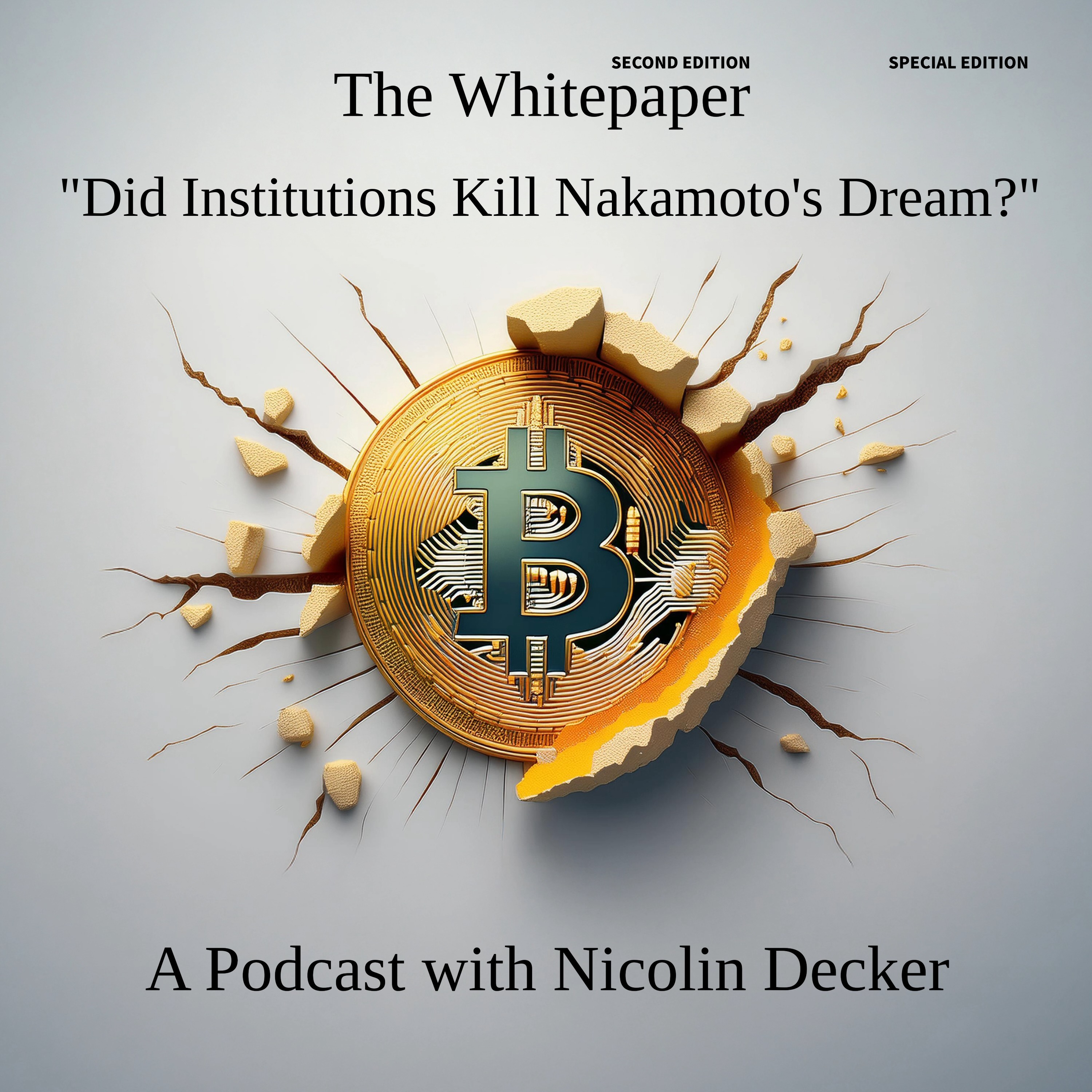
SPECIAL EDITION: "Did Institutions Kill Nakamoto's Dream?"
Feb 14, 202500:33:33Tap to summarizeIn this special edition of The Whitepaper, Nicolin Decker takes you on a deep dive proving how institutional adoption has distorted Nakamoto's original vision of Bitcoin. Bitcoin was created as a decentralized financial revolution, free from the grip of banks, governments, and financial institutions. But today, Wall Street, ETFs, nation-states, and hedge funds have positioned themselves as the new gatekeepers—controlling Bitcoin’s supply and dictating its price action.Has Bitcoin been absorbed into the very system it set out to disrupt? Are ETFs a pathway to mainstream adoption, or are they simply a Trojan horse for institutional control? Can individuals still maintain financial sovereignty, or is Bitcoin following the same trajectory as gold—highly regulated, institutionally controlled, and far from decentralized?From the 2008 financial crisis to Cyprus bail-ins, Venezuela’s hyperinflation, and engineered flash crashes, this episode uncovers how the very forces Bitcoin sought to bypass are now manipulating its purpose.Want to go even deeper? The Whitepaper—the latest release by Nicolin Decker—dives deep into the institutional takeover of Bitcoin, financial manipulation, and the future of decentralized finance. Full Resource Available February 17, 2025, on Amazon.🔒 Is your Bitcoin truly safe?📌 Key Takeaways:✅ Bitcoin’s Cypherpunk Origins – Understanding why it was created and what it was meant to be.✅ The ETF Paradox – Do ETFs increase Bitcoin adoption, or do they strip away decentralization?✅ The Adoption Paradox – What happens when decentralized digital currency is adopted by traditional institutions?✅ Flash Crash Manipulation – How institutional traders engineer price collapses to liquidate retail investors.✅ The Self-Custody Imperative – Why "not your keys, not your coins" is more important than ever.🎧 Listen now and decide for yourself—have institutions killed Nakamoto’s dream?🔗 Resources & Links: Want to explore blockchain, smart contracts, NFTs, and emerging tech? Click the links above for expert insights and in-depth guides.📩 Got questions? Email us at askme@thewhitepaper.io, and we’ll feature them in a future episode! Subscribe & Stay Updated!
Transcribe →
Why Should the Future of Money Be Asset-Backed and Deflationary?
Feb 8, 202500:11:56Tap to summarizeIn this episode of The Whitepaper, I break down the key differences between deflation and devaluation of the U.S. dollar—two economic forces often misunderstood but critically important to financial stability. While deflation increases the dollar’s purchasing power, it can also lead to economic stagnation if not managed properly. Meanwhile, devaluation reduces the dollar’s value relative to other currencies, impacting imports, exports, and overall purchasing power.With historical context from the Bretton Woods Agreement and the gold standard, we explore how the U.S. transitioned from asset-backed currency to a fiat system—and why that shift has led to inflationary concerns and monetary uncertainty today.But what if there was a solution? Asset-backed digital currencies (ABDCs)—a new financial model that could stabilize purchasing power, ensure monetary security, and provide an alternative to both inflationary fiat systems and speculative cryptocurrencies. Backed by tangible assets like gold, real estate, or commodities, these regulated digital currencies could incorporate micro-fees, controlled issuance, and deflationary safeguards to prevent excessive currency supply growth while ensuring long-term economic sustainability.As with all my podcasts, there is a shorter episode (click here) to help listeners ease into the topic.📌 Key Takeaways:✅ Deflation vs. Devaluation – What’s the difference, and why does it matter?✅ From Gold to Fiat – How the U.S. dollar lost its asset-backing and what that means for economic stability.✅ The Case for Regulated Digital Currencies – How an asset-backed, government-compliant digital currency could prevent inflation and economic stagnation.✅ Micro-Fee Model – How fractional fees on everyday transactions could sustain and strengthen a digital economy.✅ Will People Hoard a Deflationary Currency? – How smart monetary incentives could encourage spending while preserving value.🔗 Resources & Links: Want to dive deeper into blockchain, smart contracts, NFTs, and emerging technology? Click on the links above for expert insights, guides, and the latest developments in the space.Have specific questions about digital currencies, decentralized tech, or tech innovations? Send them to askme@thewhitepaper.io, and we’ll address them in a future episode!📅 Subscribe & Stay Updated: Don’t miss out on our latest discussions on blockchain, financial innovation, and the future of the U.S. Economy. Subscribe now and join the conversation!
Transcribe →