← Runaway Country with Alex Wagner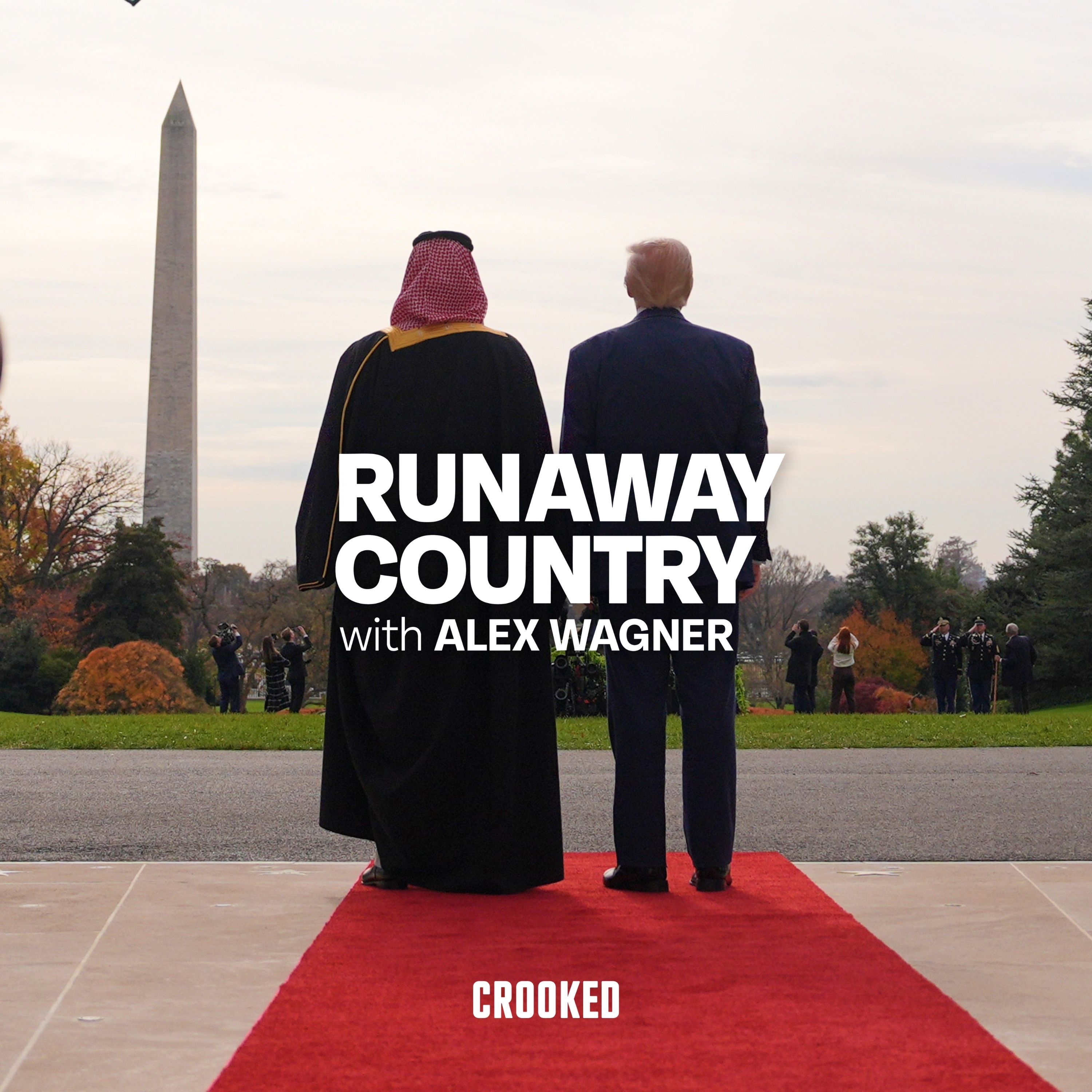
Loading summary
Transcript165 lines
- [00:00]
Alex Wagner
Alex here. Sometimes it feels like red and blue states are drifting so far apart they might as well be different countries like post World War II east and West Germany. If you also feel this way, check out the Signal Award winning podcast the Future of Our Former Democracy from our friends at More Equitable Democracy. Back for a brand new season, the show examines what the US can learn from Germany's political history and how the aftermath of Nazi Germany shaped a more resilient democratic system and what that might mean for America's current current challenges. Co hosted by Heather Villanueva and Colin Cole, the podcast blends sound, rich history and contemporary analysis to explore how lessons from Nazi Germany shaped a resilient political system and what America's current democratic challenges expose. So go ahead, follow the future of our former democracy on Apple Podcasts, Spotify or wherever you're listening.
- [00:52]
LifeLock Advertiser
Now it's tax season and at LifeLock, we know you're tired of numbers, but here's a big one you need to hear. Billions. That's the amount of and refunds the IRS has flagged for possible identity fraud. Now here's another big number. 100 million. That's how many data points LifeLock monitors every second. If your identity is stolen, we'll fix it. Guaranteed. One last big number. Save up to 40% your first year. Visit lifelock.com specialoffer for the threats you can't control. Terms apply.
- [01:24]
Alex Wagner
Hi everyone. After another week of deadly and seemingly senseless warfare in the Middle East, President Trump is claiming great progress in discussions with Iran's leaders. On the other hand, Iran's leaders say there are no actual negotiations happening with the United States. And as these negotiations are or are not underway, Trump is also threatening to obliterate Iran's electrical grid, its desalination plants, and other civilian infrastructure, all of which could be in violation of international law. Which is really weird diplomacy. As is the new threat this week of a possible US Ground invasion. Again, not your typical route to winding down a war. Meanwhile, over 1,500 Iranian civilians have been killed. Tens of thousands more are wounded or displaced, the Iranian government has turned the Strait of Hormuz into a toll road, and the national average cost of gas in the United States has officially reached $4 a gallon. Things do not seem to be going well on any front, which is maybe why Trump is trying to make this whole thing someone else's problem. Here's men's grooming expert and Secretary of War Pete Hegseth, hoping out loud that some other country comes to the rescue.
- [02:41]
Colin Cole
Last time I checked There was supposed to be a big bad Royal Navy that could be prepared to do things
- [02:45]
Jon Lovett
like that as well.
- [02:48]
Alex Wagner
As of this recording, the big bad Royal Navy was not steaming towards the Strait of Hormuz. But there are a few countries who are in the fight mostly because they have no other choice.
- [02:57]
Heather Villanueva
They are fighting back. Saudi Arabia is fighting back hard. Qatar is fighting back. UAE is fighting back. Kuwait's fighting back. Bahrain's fighting back. They're all fighting back.
- [03:09]
Alex Wagner
As a matter of fact, these Gulf nations have become targets in Trump's war. So their involvement here isn't exactly a surprise. But the New York Times and the Associated Press are reporting this week that Saudi Arabia is pressuring Trump particularly hard to continue the war in Iran until the regime falls completely. So will Trump listen to the Saudis, or does he just pretend that the war is over and this whole thing never happened? Well, to understand what Trump is thinking, to the extent that he is thinking at all about how and whether to end this war in Iran or maybe just scale the whole thing up dramatically, we have to look at the only thing bigger than Donald Trump's ego, his corruption. I'm Alex Wagner, and this week on Runaway country, we're talking about how corruption shapes Trump's motivations in the Iran war, as well as our strategy overseas, including the President's unprecedented friendship with Saudi Arabia's Crown Prince Mohammed bin Salman, and how all of this fits into the larger pattern of Trumpian self dealing and enrichment. We'll be unpacking the grift with Crooked's own Jon Lovett later in this episode. From Trump's pay to play ballroom pledges to his money making meme coins. But first, I want to get granular on the president's dealings with the Gulf states and how they inform this current and very messy predicament. Over the past several years, Saudi Arabia and other countries, including the United Arab Emirates, have been bankrolling American businesses and specifically Trump Circle Ventures. The Saudi public Investment Fund gave $2 billion to Trump's son in law, Jared Kushner's private equity firm, and then another billion to former U.S. treasury Secretary Steve Mnuchin's private equity firm. Then there's Steve Witkoff, who with Jared Kushner, is the top Middle east envoy for the Trump administration and who has had some seriously suspicious crypto dealings with the UAE. And let us never forget the Boeing 747 that the government of Qatar gifted the president last year. But most notable in all of this, Saudi leader Mohammed bin Salman. Or mbs, if you're Cool. Who has been personally cultivating a close alliance, if not an actual friendship, with Trump himself. Last fall, MBS was welcomed with great fanfare to a state dinner style feast at the White House. In case you forgot, this is the same MBS who US Intelligence revealed had ordered the brutal killing and dismemberment of of Washington Post journalist Jamal khashoggi back in 2018. Trump would prefer it if you did forget, though.
- [05:51]
Sara Lee Whitson
The US Intelligence concluded that you orchestrated the brutal murder of a journalist. 911 families are furious that you are
- [05:58]
Jon Lovett
here in the Oval Office.
- [05:59]
Sara Lee Whitson
Who are you with?
- [05:59]
Colin Cole
Who are you?
- [05:59]
Sara Lee Whitson
Why should Americans trust me?
- [06:01]
Heather Villanueva
Who are you with?
- [06:01]
Jon Lovett
And the same to you, Mr. President.
- [06:02]
Heather Villanueva
Now, who are you with?
- [06:03]
Alex Wagner
I'm with ABC News, sir.
- [06:04]
Jon Lovett
You're with who?
- [06:04]
Sara Lee Whitson
ABC News, sir.
- [06:05]
Heather Villanueva
Fake news. ABC Fake news. You're mentioning somebody that was extremely controversial. A lot of people didn't like that gentleman that you're talking about. Whether you like him or didn't like him, things happen. But he knew nothing about it and we can leave it at that. You don't have to embarrass our guests by asking a question like that.
- [06:23]
Alex Wagner
You kind of have to tip your hat to mbs. He's been burying allegations, buying up capital and buttering up presidents and their sons in law in the hopes that it will pay off politically down the line. Well, it is safe to say that we are now down that line to explain this particular corruption. And what has Gulf states privately cheerleading a war that is spilling blood on their soil? I'm talking to Sara Lee Whitson. Sara Lee is the former executive director of Democracy for the Arab World now, or dawn, an organization that she founded with Jamal Khashoggi. And she is the former director of Human Rights Watch's Middle east and North Africa division. She's also the co author of From Apartheid to Democracy, A Blueprint for Peace in Israel, Palestine. So there's no one better to talk about the intricacies of Middle Eastern politics and Trumpian corruption. Here's our conversation. Sara Lee, welcome to Runaway Country. Thank you so much for helping me understand a little bit more of this strange world we are thrust into as a result of the President launching a war of choice with little thinking about how it's all gonna play out. I guess one of the things I'm interested in is who and what Trump actually cares about as far this war and ending it. We know he cares about the financial markets. He seems to be telegraphing a lot of messages based on trying to stabilize the markets. But it also Appears like he's thinking about the regional allies he has. And I want to talk about the Saudis because we've talked a lot about the Israelis and it seems in recent days that the Saudis are, are clearly engaged in this and clearly want a certain outcome. And I wonder if we can start with you, given your vast wealth of understanding about the region, what the relationship is between Trump and Mohammed bin Salman at this point.
- [08:25]
Sara Lee Whitson
Yeah, sure. First of all, I should just say I don't think anything is perfectly clear or makes a great deal of logical sense. And many of us are scratching our heads saying, how did he decide to go into this war when the risks and consequences are so predictable? How is this possible when it appears to be not just against America's interest, but against Trump's own political interests? So there's a lot of bafflement here in terms of the relationship between the Crown Prince and President Trump. It is extremely close. Close. And the recent visit, the first visit of Mohammed bin Salman back to the United States in November of 2025 was the first red carpet rollout since the murder of Khashoggi. And it produced promises from Saudi Arabia for up to a trillion dollars in investments in the United States. I don't know that any of those promises have actually materialized in exchange for these very high level semiconductor chips, American semiconductor chips promises to be allowed to purchase F35s, the most advanced defense aircraft, as well as a security agreement that was not quite the security agreement that Saudi Arabia wanted, which is a bilateral promise, NATO level treaty guarantee that the United States would come to Saudi Arabia's defense. But it was an enhanced security agreement that elevated Saudi Arabia to a so called major non NATO ally and expanded intelligence and security cooperation. So it is a mercantile transactional relationship where Saudi Arabia is the largest purchaser of American weapons in the world and has been so for quite some time since not just the Biden administration that preceded Trump, but the Trump administration before that. And Saudi Arabia and the rest of the Gulf states have long been the largest purchasers of US Weapons, going back decades really, since the revolution in Iran and the sort of large scale marketing campaign of Iran as the greatest threat to the Gulf states, which created a bonanza for American weapons suppliers and European weapons suppliers, turning the Gulf into the largest dumping ground for American weapons in the world. So it's a mercantile one, but obviously there are political dimensions with Trump sort of advertising himself as the man who saved Mohammad bin Salman from accountability for the murder of Khashoggi.
- [11:32]
Alex Wagner
Right. And I want to get to that, especially given your personal and professional history with Jamal Khashoggi. But first, let's just talk about, you know, where the Saudis sit. You mentioned the sort of, you know, the Gulf states for decades being, you know, arming up effectively against this threat in Iran and now we have outright war with Iran. And I'm a bit, I'm eager to get your thoughts on how the Saudis have, I don't want to say played this, but their position in all this. Right. Because initially the reporting was that the Saudis were angry that they weren't given notice. Join the rest of the world. But yes, they were angry that they weren't given notice. Then they become targets for Iran. But this week we have reporting that mbs, the Crown Prince Mohammed bin Salman is behind the scenes urging Trump not to cut bait, to stay in there, to, you know, see through the job, whatever the job is, presumably regime change. I, we don't even have to touch how that's tactically possible at this point, but that the Saudis want Trump to stay and to not retreat. How do you understand the situation given the fact that, of course, there's historic rivalry, Sunni and Shia Muslims. There's what you talked about in the more contemporary lens. As you know, Iran is a major geopolitical threat for the Saudis. But, like, where do you think MBS stands on this war with Iran and the degree to which he's actually pressuring Trump to do one thing or another?
- [13:04]
Sara Lee Whitson
I think MBs, like the rest of the Gulf, stands between a rock and a hard place. Every public indication from the Saudis and the Qataris and the Bahrainis was they did not want this war and they tried everything to stop it. In fact, in the wake of the attacks on Saudi Arabia during the first Trump administration, it led to Saudi Arabia actually reestablishing diplomatic relations with Iran through Chinese brokered negotiations and wanting to have diplomacy and calm, had been involved in the back channel and then more front channel negotiations between the United States and Iran, but really did not want this war to happen because, as we were saying, the consequences, the devastating consequences are so predictable. This has been terrible for Saudi's economy. Not nearly as bad as what the UAE economy has been suffering and has sort of ruptured all normal trade, investment, business and so forth. But having started this war, that has made them targets. Now, with UAE enduring the most Iranian strikes after Israel and Saudi Arabia behind them, of course, they now see the prospect of leaving the Iranian regime in control, particularly of the Strait of Hormuz, where it's now designated itself as the tollbooth operator there as something that they can't walk back from. And they know that the state of tension and the state of near war will persist so long as the Iranian government persists, so long as it doesn't completely give in to Israeli and American demands. So I think it's calculating that it's the better of two bad options to see the United States and Israel, quote, unquote, finish the job, which is completely not going to happen. I had to predict based on the current trajectory and what comments are making. But the other thing I would say is that there are no confirmed sources, there are no public sources of Saudi Arabia actually endorsing this war or pushing Trump to maintain the war or keep up the war. All of the articles that have been published so far, the first in the New York Times, relied exclusively on American sources. The Guardian said it had some sources from the region, all anonymous. And then the AP story that came out, I think, think yesterday, all anonymous sources. So it's very hard to see through this fog of war. What we know, as a matter of fact is that Saudi Arabia and the UAE and all of the Gulf states have unequivocally said that they have not allowed the US to conduct any strikes on Iran from their countries or using their airspace. And they have repeatedly called for diplomacy in terms of their public statements. So whether they are whispering one thing and saying something else publicly, frankly, like the United States has been and how Israel has been, would not be terribly surprising.
- [16:35]
Alex Wagner
I can't, I feel like we can't really have this conversation without mentioning the role of Jared Kushner right here. We, we, the two sort of lead negotiators, insofar as there are any negotiations to speak of, are Steve Witkoff and the President's son in law, Jared Kushner. So Jared Kushner is supposed to be negotiating an end to this war in Iran, but he's also someone who has significant ties to the Saudis, financial ties. Right. He receives $2 billion at the outset of the second Trump administration from the Saudi Public Investment Fund. Those $2 billion against the sort of strategic advice of the advisors from the Saudi Public investment fund. Those $2 billion go into Jared Kushner's private equity firm. Can you talk to me about, I mean, there, as you say, there's so much haziness here. But the idea that MBS and the Saudis have probably an outcome they would like to see, even if they're not hardcore advocating it, now have in some ways in their control. One of the lead negotiators in all of this on the part of the United States, Jared Kushner. Can you talk about that dynamic and whether or not you think. I would argue that compromised position could potentially affect the negotiations that Jared Kushner is being tasked with.
- [17:55]
Sara Lee Whitson
I think that this is not quite a scenario of the Saudis controlling Jared Kushner, but the Saudis needing Jared Kushner, wanting to reward Jared Kushner for a job well done under the Trump administration, number one, rewarding him with $2 billion, which is also a form of protection money, and now, I think, discovering that their investment, that the Emirati investment, that the Qatari investment, which was meant to say to the United States, you have more reward coming from our side if you tamp down the war rhetoric, end the war in Gaza, restrain Israel a bit. And in the wake of that November trip to the Gulf region and the gift of this massive plane from the Qataris, the trillion dollars promised investments, there was a sense that they could outspend AIPAC and the Zionist billionaires who are so strongly responsible for Trump's policy decisions and Biden's policy decisions in the Middle East. But then the war happened anyway. But then Israel managed to yank the United States into the war anyway, and the invasion of South Lebanon is underway, and there's no reconstruction in Gaza. And now there's this war in Iran, which has been so damaging, more damaging to the Emiratis and the Saudis and the Kataris and the Kuwaitis than to Israel in terms of hard numbers. So it seems like their efforts to compete with what they offer, which is, you know, money, money.
- [19:46]
Alex Wagner
You know, you just keep lots of money.
- [19:49]
Sara Lee Whitson
Israel is not investing a trillion dollars in the US Economy. That it was, you know, not. Not an investment that. That has brought the returns that they were hoping for. Now, does that, you know, is. Is. Is MBS and Jared Kushner, are they close? Obviously. Are they still having, like, daily WhatsApp chats?
- [20:12]
Alex Wagner
I don't know.
- [20:14]
Sara Lee Whitson
But, you know, the Saudis are continuing to cultivate where they see power residing in the United States and power is residing with Jared Kushner.
- [20:25]
Alex Wagner
I should say, in the grand scheme of things, this is not a big deal. But in sort of, as we speak about some Saudi influence in the United States, it's just worth noting that the Saudi Kingdom is giving a $51.6 million gift for a new exhibit at the National Zoo for an exhibit of endangered Arabian snow leopards. This is not just about snow leopards. This is about, as the Washington Post reports, soft power. Right. The Saudis, as you say, as you point out, are always looking for ways to, to sort of move the current in their direction, whether it's through the unvarnished bribery of the President's son in law or an exhibit of snow leopards in the National Zoo where tourists can go and see the sort of wonder of the country, perhaps be more encouraged to visit or at least it will warm the cockles of their heart. But the Saudis play this kind of medium and longer term game. I think that we are not necessarily as American news consumers that wise to. I'd love for you to talk about the net effect of all of this. Right. Regardless of whether the Saudis are influencing exactly what the US does in Iran, the fact is they have their claws in. And what is the net effect of that given the history of Mohammed bin Salman and the person he has revealed himself to be or the person the tactics he's willing to use to silence dissent and to embrace like the most violent authoritarian tactics. And by this, I really would love for you to talk about this in the context of your friend and former colleague Jamal Khashoggi and someone who was brutally murdered at the direction of mbs. Like what does this all mean in service of, I guess basic sort of fundamental human values that the Saudis play this I think instrumental role regardless of what actually happens with Iran.
- [22:35]
Sara Lee Whitson
Yeah, you know, I think that the Saudis really were playing a catch up game in terms of deploying soft power, namely money to buy influence and control and support in the United States. You know, before them, the Emiratis had excelled at this. And of course the role model for everybody is Israel and its supporters here in the United States of deploying money to gain political influence. And so the Saudis have been doing this in earnest since Mohammed bin Salman's rise to power. This is not just about Jared Kushner or Steven Mnuchin, a secretary of the U.S. treasury, getting a billion dollar payout from the Saudi regime, but hundreds military officials, former State Department, NSC officials who are in one capacity or another doing business for Saudi Arabia, gaining, tying their economic interests, their economic futures, their compensation to Saudi Arabia and the UAE and Bahrain and Qatar. This is a wide scale. So what the Gulf states learned is that the way to get power and influence in the United States is with money. And so they've expanded that and Saudi Arabia has expanded that into a broad swath of the American economy. So that what happened in the wake of the murder of Jamal Khashoggi with so many businesses pulling out of Saudi Arabia or not participating in the desert and the Davos conference and being too embarrassed to be seen associating with Saudi Arabia, they are not as independent as they once were because they are so much more tied to Saudi Arabia and Saudi investments in banking, in trade, in gaming, in sports, in movies, in all,
- [24:32]
Alex Wagner
in media, and now
- [24:35]
Sara Lee Whitson
the zoo as well. Right. So it's a wide scale influence campaign and this is what has allowed the Saudi regime to sanitize itself and for MBS to triumphantly return to Washington red carpet, despite the fact that everybody in the world knows that he is the red handed murderer of a leading journalist in the world who was living in the United States. To say nothing of the political prisoners inside the country or the political repression inside the country. That being said, at this moment in time, Saudi Arabia's conduct as a government, as an authoritarian government and just seems like small fries, seems like small potatoes compared to what Israel has been doing.
- [25:25]
Alex Wagner
Yeah, right.
- [25:26]
Sara Lee Whitson
I mean, it's just, there's just no comparison. When you have a genocide underway in Gaza, when you have the invasion of a half of Lebanon, south Lebanon, when you have, you know, these unbelievable assaults and atrocities being taken by Israel, you know, just look at, just look at the west bank. If nowhere else, then it's hard to point the finger at Saudi Arabia because they've executed hundreds of people over let's say the past year. And so, you know, what's normalized authoritarianism, what's normalized brutality is as much what Israel has done in the region and now the United States is doing in the region as well.
- [26:12]
Alex Wagner
You think the Saudis would have done.
- [26:13]
Sara Lee Whitson
Yeah, had done.
- [26:14]
Alex Wagner
Well, that's just like, I mean, isn't that depressing that we've out, we've, we've out authoritarian them in the region through our bedfellows and our direct actions.
- [26:28]
Sara Lee Whitson
You know, one observation I've had as someone who's been working in this space for decades now is that, you know, for, for so long the rhetoric of the United States was we're democratizing the world, we're going to democratize the Middle East. You know, we're bombing you Iraq because we love you and we want to bring democracy to you. But rather than the United States democratizing the Middle east, the Middle east has autocratized the United States. Yes, their authoritarianism, the very practices that Israel uses to suppress dissent are now adopted by the US Government. In terms of speech about Palestine, the United States and the US Government acts more like the Trump monarchy than it does a Trump democracy. It's modeled itself more after Saudi Arabia's monarchy and autocracy than the other way around.
- [27:19]
Alex Wagner
Right. In fact, what you have is not just a friendship but a source of inspiration that the Trump family operates more like a Gulf monarchy than any other model that we see the US Engaged in. And that is a sign of the times, isn't it?
- [27:37]
Sara Lee Whitson
It's breathtaking.
- [27:39]
Alex Wagner
Did you just. Before we let you go, the idea that the template has shifted so dramatically and that we're now looking at a world in which the US Looks more like what you see from mbs, both in terms of the corruption and the essential threats to free speech and, you know, a functioning society. Like, how does that make you feel as someone who worked? I mean, you know, you worked with Jamal Khashoggi. You know, you knew the man you started dawn, which is democracy for the Arab world now an organization with him. I mean, to see kind of where we are now versus where we were then, I mean, how does it make you feel?
- [28:25]
Sara Lee Whitson
I mean, terrible, I would say, because in fact, I started my human rights advocacy work in Iraq in 1991, challenging the US war in Iraq in 1991, where the United States destroyed nine out of 11 of the country's electricity generating plants, causing mass spike in infant mortality in the country, waterborne disease spread throughout the country because if your electrical plants don't work, you can't purify your water, run your hospitals. And now this is exactly what the United States has threatened to do in Iran, as if no lessons were learned from what the United States did in Iraq. So it's pretty damn depressing. I would say. My only hope is that if our democracy survives and our democracy functions, that the American people will rise up against this and say they've had enough. So at least there's possibility of hope and change.
- [29:28]
Alex Wagner
There's always hope. There's always another day left to live, inshallah, as they would say in the Arab world. Saralee, it's. You're such a wealth of information and perspective on all this. It's really great to have you on the podcast. Thanks for taking some time.
- [29:44]
Sara Lee Whitson
Thanks for having me.
- [29:48]
Alex Wagner
After the break, how this fits into a larger pattern of Trump enriching himself off the US Presidency with POD Save America's Jon Lovin Runaway country is brought to you by Mosh. The old adage you are what you eat rings very true to all of us in the modern age. And I am always looking for an on the go protein snack that satisfies me. And now I have found one that helps me live intentionally too. Mash Protein Bars MASH was founded by Maria Shriver and her son Patrick Schwarzenegger with a to spark a conversation about brain health through food, education and research. After Maria's father was diagnosed with Alzheimer's, they set out to create something bigger than just a protein bar. Mach Protein bars are made with ingredients that support your brain and body like Ashwagandha, Lion's Mane and Omega 3s Plus. Mash is the first and only food brand boosted with Cognizin. Say that again. Cognizin, a premium form of citicoline that helps support focus, memory and mental clarity. And they taste amazing with nine delicious flavors including plant based options in Chocolate Chip Cookie, Hazelnut Chocolate Chip and Peanut chocolate Chip. Now you can save on Mosh while making your wellness routine effortless. Get 25% off plus free shipping on your first 15 count variety pack and then 20% off for life on your monthly subscription. You can swap flavors anytime based on what you like best. Keep your go tos on repeat or hey, try something new. Your favorite functional fuel is delivered directly to your door so you never run out and supporting your brain health becomes a simple habit you can feel good about. I like the fact that I can get my protein numbers up and put it in my bag and roll out that kind of convenience plus health plus feel good stuff. That's all I'm looking for. You can find your favorites and build your boxes or keep things fresh with the variety pack. Mosh bars are the best way to customize your health while giving back. Head to moshlife.com runaway and subscribe today and get 25% off your first variety pack and 20% off your monthly subscription with code RUNAWAY. That is 25% off your first pack and 20% off your subscription of brain boosting bars delivered straight to your door. Start building brain health into your everyday with Mosh bars. Thanks to Mosh for sponsoring this episode. Runaway country is brought to you by Oneskin. We have talked before about why Oneskin really stands out as a skincare company. It's not hype or just fancy packaging, it's actual real science. The founding team are longevity researchers who asked a deceptively simple question. If many visible signs of aging like wrinkles, fine lines and loss of elasticity are driven by so called zombie cells, what if you could actually reduce those cells to slow the aging process down instead of just covering it up? That research led to OS1.1 Skin's proprietary peptide. It's the first ingredient proven to switch off those damaged senescent cells actually slowing aging skin directly at the source. This is serious science that can fit easily into anybody's existing routine. It can give your skin a clear signal to repair damaged cells and support collagen and strengthen your skin at its barrier. Listen, this is a company that is female PhD scientists founded and ladies know a lot about skincare. I'm not trying to be genderized about this, but we do. It's rooted in rigorous and scientific research and like, you know, if you're a biohacker, as I am an armchair biohacker, this is the kind of stuff that gets me excited to try. So let it excite you. Try it. Oneskin's products are backed by extensive lab and clinical data, including four peer reviewed clinical studies to validate their efficacy and safety on all skin types. Plus They've got over 10,000 five star reviews and have been recently featured by Bloomberg as a leader in skin longevity. It really shows you don't need a complicated routine to achieve healthier, younger looking skin. Born from over a decade of longevity research, OneSkin's OS1 peptide is proven to target the visible signs of aging, helping you unlock your healthiest skin now and as you age, for a limited time, try OneSkin with 15% off using code Alex at OneSkin co. Alex, that's 15% off OneSkin co with code Alex. After you purchase, they'll ask you where you heard about them. Please support this show Runaway country and tell em Alex sent ya. Making his Runaway country full episode debut. Clarification. It may seem clerical, but it's significant. The man upon whose back this whole show rests, my friend and colleague, Jon Lovett. Thank you for joining me.
- [34:41]
Jon Lovett
Wow, a lot of pressure. Thanks Alex. Hi.
- [34:43]
Alex Wagner
You're gonna deliver. You always.
- [34:44]
Jon Lovett
Thanks for having me.
- [34:47]
Alex Wagner
John. I'm so eager to get your thoughts on all this stuff. We are focused on the ways in which Trump's calculations in Iran are not just about ego, but also the insanely corrupt ties he has to the region and corruption in general being a hallmark of this administration. So like let's just first start with, I mean I think it bears refreshing everybody's memory. We think a lot about the bromance, the toxic and deadly bromance between Bibi and Trump. But Trump has a real intermingling, shall we say financial and other eyes with the Gulf states. Right. So Jared Kushner, lead negotiator in the Iran war talks, to the degree that there are any, is Trump's son in law. He got $2 billion from the Saudis for his private equity fund. There's Steve Mnuchin and Steve Witkoff also get on board with that money for private equity via Gulf bankrollers. There's the Qatari jet, of course, that Trump received and then signed what has been described as a NATO like security guarantee with Qatar as nearly in the same timeframe that he got a free but used Boeing 747 Jet. When you think about all the sort of cash and valuables that Trump has amassed from eager Gulf states, do you think he forgot about all of that when he launched his war in the Middle East? How do you think about that level of corruption and what he's doing right now?
- [36:21]
Jon Lovett
Yeah, so I think this is more about the kinds of company Trump keeps. Right? Because Kushner, Witkoff, these are people with their own equities in the region, their own business in the region. Their relationships are not in the public interest. And that's not even, I think, like a subjective way of describing it. They have business relationships with these countries and with these leaders. They are, you know, Kushner is a private citizen. He has no official role with the government. And one thing you see in authoritarian countries is there's this murky distinction between when what is a private act and what is a public act. Jared Kushner is, you know, his emails are not FOIA able. He's not part of the government. Right. He's not part of the government, but he's acting on Donald Trump's behalf. And so when does Donald Trump's interest end and the countries begin? So to me, why did we go to war in Iran? I actually think it's not so simple as Trump is corrupt. Right. I think it's more complicated than that, especially because Donald Trump has made so much money off the presidency. He has profited in so many ways, far beyond anything we could have conceived of. Forget the first term, anything we could have conceived of in a democracy on the planet of earth, that he's playing with the house's money. Right. This war in Iran fucks over some of his business allies and maybe screws up a deal or a relationship. He doesn't care. He can't be touched financially for the rest of his life by any decision that he makes that runs counter to his personal interests. And by the way, all of this is just whatever he does on a policy level is just another opportunity for another way to make money. Right. Or to look elsewhere to make money. Do I think Qatar is pleased that bombs are falling on their luxury Hotels do. I think they're getting a great return on that jet?
- [38:27]
Colin Cole
I don't know. But it doesn't really matter to Donald
- [38:30]
Jon Lovett
Trump because Donald Trump, Trump is a short term actor who completely discounts the
- [38:35]
Colin Cole
price of his words turning out to be lies. He just does not value that. And that, to me, is what we're seeing right now.
- [38:42]
Alex Wagner
Yeah, I think we all laughed and shook our heads and maybe cried a little bit inside our souls when there was talk of the Gaza Strip being developed for Trump real estate adventure. And I don't know if that's gonna come to pass, but it's very hard for me to imagine even in the moment we find ourselves in, which as of this recording, is a war with no seeming off ramp. A war that's killed thousands of people and destabilized both the global economy and an entire region. There is no way that I don't think there's some grift that's gonna happen along the way as Trump either gets out of this or continues the war. There is definitely someone in his circle who's gonna make money on this. And I would point you to, like, you know, the strange things that happen on the margins as, as this war unfolds. Right. Like 15 minutes before Trump's true social post about Iran and Iranian peace talks on March 23, oil futures trading spikes dramatically and there were $170 million worth of bets placed in a single minute. I just feel like someone who made some millions there. It wouldn't surprise me if they were in some way related to Donald Trump or in his administration.
- [39:57]
Jon Lovett
Yeah, well, this is, to me, this is like, it gets at it, right, because we're talking about the, like, the individual act of profit taking from public office, which is a specific kind of gross, brazen corruption. But it all flows from the deeper corruption of Donald Trump being president. You must be corrupt to say Donald Trump should be president. You are corrupted when you make such a declaration as Republicans, many of whom, including those in his cabinet who said how unfit he is. So you've already corrupted yourself. You are corrupt. What makes it possible for someone to think they could trade on oil futures or on futures on the market without being afraid that you'll get arrested and go to jail? You have to have no fear of the sec. You have to have no fear of the Department of Justice. You have to have no fear of the administration itself being angry that you would do something like that. You have to have no fear of Congress taking any kind of action. You have to have so many guardrails not hold for you to believe that that is something you can get away with. And so all of this corruption, it's unprecedented in American history. It's shocking. It's, it's a complete departure. It's a quantum leap even from the first term and from any other president. It is more akin to something you would see in Putin's Russia or Imelda Marcos's closet full of shoes from the.
- [41:31]
Alex Wagner
I mean, doesn't that seem quaint?
- [41:32]
Jon Lovett
I don't.
- [41:33]
Alex Wagner
Just a bunch of shoes.
- [41:34]
Jon Lovett
Just a bunch of shoes.
- [41:35]
Alex Wagner
I mean, honestly, don't you feel like the Chaney Halliburton thing is like amateur hour compared to what we're talking? Remember, it was like, oh, the real reason we're going to war in Iraq is cause Cheney wants the oil. Well, Trump just says he should have gotten the oil. I mean, he doesn't even make any bones about it. It's just, he just announces it. He announces the corruption and it's okay. I mean, it apparently is okay with people.
- [41:55]
Jon Lovett
Well, yeah, but the part of it too is corruption is also in, I think in Trump's brain. The way you get out of this stuff too. Right? Like, you can see your, like, because Trump views everything as transactional. He can, we can imagine, like I, I can also imagine Donald Trump sitting in the Oval Office with some third string ayatollah that managed to survive the fourth Israeli bombing, announcing some kind of a financial partnership, and Eric and Don talking about a great new resort on the Strait of Hormuz, like, it's not inconceivable. All things are possible when you have this level of corruption out of the White House.
- [42:27]
Alex Wagner
Third string ayatollah. A phrase I didn't think I'd hear this year. And here we are. I think it bears mentioning as you talk about the just an unprecedented amount of grift that's happened in this administration. The New Yorkers, David, David Kirkpatrick did a deep dive into all of Trump's profiteering since the start of the year. And he estimates that the Trump family has made more than $4 billion, I believe that is since the start of the second administration. Do you, John, have a grift that's your favorite? There's so much. And you can include the first term. It could be little, it could be big.
- [43:07]
Jon Lovett
I do think the meme coins are like, as an example, just so shocking and silly and embarrassing for all involved because it is just trying to just make money off your most ardent supporters. And I put in that category the meme Coin goes to me in the category with the watch. Remember that watch that came out where they were?
- [43:33]
Alex Wagner
It was made in China.
- [43:34]
Jon Lovett
Made in China with some kind of way they could claim it was a Swift movie. He had a tourbillon or whatever those things are called. Very fancy. Some Trump watch, like the Trump shoes. But I put the Meme Coin in that category, which is just trying to get every dollar from the Die Hard MAGA people and from people that think they're actually naive, but they think they're cynical. So they think they're kind of like buying something that's gonna be worth something someday. But. But that to me was incredible because it's just so. It's just so embarrassing.
- [44:05]
Alex Wagner
Well, this is. I really. I did wanna get your thoughts on this. Asking you to play an armchair psychologist for a moment. Like, why is it that the Meme Coin is so popular with Trump's Die Hard adherence? Right. Like, it's just self enrichment. And they're like, sign me up. Like, why doesn't the brazen corruption of all that not only not resonate with them, but like, why, why would you buy into that? Like, here's a guy who's a con man trying to make money off of me. Let me give him my money. That's the part of it that I don't really understand. I mean, I think it's one thing to applaud him avoiding taxes or hustling his way into a free Air Force One, but like to bring cash into his own pockets to line his own bank account with your own money. With his supporters money seems like. I mean, we talk about liberals being cut. That's like the ultimate cuck move.
- [44:58]
Jon Lovett
Yeah. So is intel giving the federal government 10%? It's people that think they're. They think they're the. They think they're part of the scam, but they're actually the mark. That to me, is what's happening. It's a lot of people, they think they're in on the scam, but they're marks. Mike Johnson, he thinks he's in on the scam. He's a mark. John Thune thinks he's in on the scam. He's a mark. These people are fucking marks. And there's an old saying, you can't con an honest man.
- [45:25]
Alex Wagner
Yeah.
- [45:26]
Jon Lovett
It's 2026, I think. You can't con an honest person personally.
- [45:31]
Alex Wagner
Respect.
- [45:32]
Colin Cole
Yeah.
- [45:33]
Jon Lovett
So that, to me, is what all of this boils down to. It's a lot of people who think they're getting won over that they're part
- [45:42]
Colin Cole
of the syndicate and really they're just
- [45:46]
Jon Lovett
tools for Donald Trump to exploit until they're no longer useful.
- [45:50]
Colin Cole
Which is why I think people that
- [45:51]
Jon Lovett
are suddenly finding themselves on the outside of the circle can't believe how cold it is.
- [45:55]
Colin Cole
They just simply cannot believe how cold it is out there.
- [45:58]
Jon Lovett
There's nothing to me, like, you'll see this with, like, I think it was Marjorie Taylor Greene saying how she can't
- [46:04]
Colin Cole
believe how much Fox News is pumping out misinformation to the boomers.
- [46:10]
Alex Wagner
You guys talked about this on Pod America and I'm so with you. It's like a welcome, welcome to fucking reality, lady.
- [46:16]
Jon Lovett
Right? Like, oh, oh, do you think they
- [46:18]
Colin Cole
started this week, ma'? Am? Like, this is what you're welcome to. What it feels like.
- [46:22]
Alex Wagner
This is the business model, lady.
- [46:24]
Colin Cole
Truly.
- [46:24]
Jon Lovett
Like when Donald Trump turns on people,
- [46:26]
Colin Cole
insults Thomas Massie's family, goes after Joe Kent, who is a conspiracy theorist and talks all kinds of anti Semitic nonsense, but Trump insults him for getting remarried after his wife is killed in, in Syria. It's like, hey, this is what he does. You're just on the losing end of it.
- [46:47]
Jon Lovett
You think you're gonna be the.
- [46:48]
Colin Cole
You think you're the first person on the wrong side of a right wing government that thought it couldn't happen to you? This is what he does. And so all these people, they feel like they're part of it and they feel like they're getting something out of it. Meanwhile, Mike Johnson gets to keep his speakership. Corey Lewandowski tries to squeeze a commission out of a marketing contract at dhs. Trump is making billions.
- [47:16]
Jon Lovett
Yeah, billions.
- [47:18]
Alex Wagner
More of my conversation with Lovett in just a minute. But first, this year, Vote Save America is zeroing in on the races that will decide the midterms and whether Donald Trump holds on to his Republican trifecta. Vote Save America has takes and tips on where to donate so your money goes the furthest. How to confidently talk to the people in your life about the midterms and key issues and opportunities to take action in your community, in real life. Sign up@votesaveamerica.com to make sure you are up to date with the latest. Then send the sign up link to five friends paid for by VoteSave America. Learn more at votesaveamerica.com this ad has not been authorized by any candidate or candidates committee. Runaway country is brought to you by miracle. Made ever wake up sweaty, freezing or just uncomfortable? The temperature in your bedroom can make or break your sleep. Don't we know that that's why I switched to Miracle made sheets. They are inspired by NASA technology and they use silver infused temperature regulating fabric to help you sleep perfectly all the night long. Miracle made sheets are crafted with NASA inspired silver infused fabric that helps regulate your body temperature. So are you a hot sleeper? Are you a cold sleeper? Doesn't matter. These sheets help keep you in the comfort zone all night long. Thanks to their antibacterial silver technology, Miracle made sheets stay cleaner and fresher up to three times longer than the regular sheets. That means fewer odors, fewer wash cycles and way less laundry. They feel just as good if not better than the sheets you'd find at a five star hotel, but without the steep price tag. Smooth, breathable and ridiculously comfortable. All that hidden bacteria and regular sheets. It can clog your pores. It can cause breakouts. Miracle Maid's antibacterial design helps you sleep cleaner and clearer night after night. So upgrade your sleep or give the gift of better rest. Go to trymiracle.com Alex to try Miraclemade sheets today you'll save over 40% and when you use promo code Alex you'll get an extra 20% off plus a free three piece towel set. They make an amazing gift and with a 30 day money back guarantee, there's no risk. That's trymiracle.com Alex Code Alex@ checkout thanks to Miracle Maid for sponsoring this episode. We have a new sponsor, MSI Reproductive Choices. They are one of the biggest providers of contraception and safe abortion access across Africa and Asia and they serve women who have little to no options for care. They want to remind you that women with limited choices don't stop being women. They don't stop ovulating and they don't stop deserving autonomy. They need control of their bodies so they can stay in school, make decisions about how many kids they want, take time to recover after one birth before getting pregnant again. MSI Reproductive Choices is one of the few women's health organizations that's still going strong despite all the cuts in foreign aid because they planned ahead and started reaching out to regular people like all of you, my generous listeners. This is a legit opportunity to do some good. For $30 you can give a year of contraception to six women. That is real impact for the dollar. Text my last name Wagner. That's W A G N E R to 511-511 and make a donation to MSI United States today. You can also learn more on their website msiunitedstates.org or again you can just text Wagner to 511-511. That's M for modern. S for safe. I for informed. MSI United States.org text fees may apply. You brought up Kristi Noman. No, we're not gonna talk about her husband on this podcast. We'll leave that for your podcast.
- [51:09]
Jon Lovett
Mm.
- [51:10]
Colin Cole
Okay. You don't wanna talk about it?
- [51:11]
Sara Lee Whitson
Well, we're gonna.
- [51:12]
Colin Cole
Look, we don't need. Look, we don't need to talk about Kristi Noem's husband and his magnificent yabos. We just don't need to talk about it. You don't wanna talk about it? We're not talking about it.
- [51:21]
Alex Wagner
We're definitely not talking about the balloons.
- [51:24]
Colin Cole
Those. Those gorgeous bazooms. We're not gonna talk about it.
- [51:28]
Alex Wagner
Not even gonna say the word. Kristi Gnomes husband. Bazooms.
- [51:33]
Colin Cole
Is his name Bryon or is it just. Is it just Brian? What's going on with B R Y O N?
- [51:42]
Alex Wagner
I just know him as B R Y A N. But maybe I'm dealing with him in a different handle than other people on the Internet. But I do want to talk about Kristi Noem.
- [51:52]
Jon Lovett
Okay.
- [51:53]
Alex Wagner
Because the Office of the Inspector General has launched an investigation into DHS contracts that were awarded under Kristi Noem's brilliant shepherding of the agency. Like a lot of corruption here, the US government was apparently overpaying contractors by millions of dollars. Corey Lewandowski, I'm sure, had his sticky fingers involved with this. Does it give you hope that corruption can still be ferreted out if the president hates you enough or if you're foolish enough to get on his wrong side by spending $220 million on his self promotional ad campaign.
- [52:29]
Jon Lovett
You know, the problem is the pardon power combined with a DOJ that's fully co opted means like, no, I don't have a lot of faith in anything that happens while Donald Trump is president. To investigate what happened while Donald Trump was president. I just don't. As long as Kristi Noem is in good standing in some way and presumably because is she. Well, she's been given a really.
- [52:54]
Alex Wagner
Is the shield of America?
- [52:55]
Jon Lovett
Yes. Is the shield of the Americans?
- [52:57]
Sara Lee Whitson
Is there a thing.
- [52:57]
Alex Wagner
Is that really. Is there a shield?
- [53:00]
Jon Lovett
But this is what makes it all so sinister. Because the question is not, was there wrongdoing at Department of Homeland Security? There was. We all know that. It's just, is she in good standing with the boss or not? That's what to determine. Whether or not she faces any consequences. But I don't think he would allow Any kind of criminal case against Kristi Noem. I mean, maybe, look, who knows? But it seems unlikely that he would allow that to go through because it reflects poorly on him. And everything is about how things reflect on him. Like, there was a story out of ProPublica that in order for resources to be shifted towards immigration, DOJ dropped 23,000 other criminal investigations. 23,000, right. Like this is. DOJ is not gonna focus on anything, on anything that runs counter to Donald Trump's very specific personal wishes, whether it's internal corruption or external priorities. White collar crime, you can get away with it. You'll even maybe potentially, if you go to the right dinners, you can get a pardon. Even non political, non ideological investigations are falling, by the way. Corrupt nursing homes, all kinds of terrible things that are done just so that they can refocus resources on Donald Trump's priorities. So is this Department of Justice gonna do anything to go after Donald Trump's former head of DHS? Like, it's inconceivable.
- [54:28]
Alex Wagner
I wanna say one thing about ProPublica. If anybody is listening to this podcast and doesn't give them money, you should start giving them money now because their reporting has been super essential. And they have another story out this week that reminded me of when I was a child and in like second grade and you'd go to recess and there was like a law on top of the mulch that was at the bottom of the playground and you lift the log up and it was just like there were creepy crawlies and it was absolutely disgusting. You never wanted to lift the log up because there was God knows what was under it. I feel like we are due when Trump leaves office for a gigantic log lift in which we realize the level of disgusting, nefarious fucking behavior that's been happening. While we've understandably had our eyes trained towards, like, you know, disastrous wars of choice and like, you know, the shredding of the U.S. constitution. But like, ProPublica did a report on looking at the financial disclosures of 1500 Trump appointees, and it's all up there on their website for you to see. And the ties between the Trump administration officials and the industries they now regulate will, like, shock the conscience. Right? Like, Steve Feinberg, deputy Defense Secretary, is handing out defense contracts to a company that he used to run and still has ties to. Pam Bondi made conveniently well timed security trades, including selling stocks just before markets plunged because Trump announced new tariffs. I mean, the broad picture is that Trump has appointed more than 200 people who collectively Owned either by themselves or with their spouses, between 175 million and 340 million doll in cryptocurrency investments. And now those people hold positions influencing or overseeing the regulation of the crypto industry, including Todd Blanche, like the number two at doj. We haven't been able to focus on it. Like, we're sitting on top of the log right now. Right. These are the, like, what are they even called? They're not called trilobites, those little roly polys. Like, these guys are operating in the shadows, just siphoning cash from the American public and putting it in their own pockets. And I kind of wonder like, what you think needs to happen in the great course correction that I am confident will happen in 2028 or even in 2027 and the degree to which Democrats and progressives should really follow the corruption and reveal this to be an administration that is not only like morally bereft, but, you know, potentially criminal.
- [57:01]
Jon Lovett
Yeah, but are they happy? So, so here's, here's my, like, I agree with what you're saying. There is going to be a tremendous amount of pressure to move on, to look towards the future. And I can just see a lot of Democrats seeing polls that will show, if you ask people do you think that it is the job of a Democratic administration to investigate the past or do you think it's important for the administration to focus on the future? I am sure you are going to see lots of polls that tell Democrats who are, you know, you know, like dogs can be food motivating. A lot of, a lot of Democrats are poll motivated and like that will be, that will show them that they need to not call for a bunch of investigations into the administration, that we just have to move forward. And then they'll say, well, aren't you worried about this happening? We have to like, you know, they'll have some sort of way of talking out of looking into the past too hard while saying we need to look towards the future and focus on the future. And, and I think it is important for us to tell a story in which we kind of defeat that way of thinking like before it takes hold. And to me that's about saying we need to attack white collar crime and corruption not just because of what had happened under the previous Trump term, but because of all the damage it could do in the future and the danger it poses. The lesson of the Trump administration is not just that with Republican control you can get away with brazen corruption, is that that corruption doesn't just allow a Few people to steal a bunch of money, it actually hurts you. It actually leads to policies that are bad for all of us. Whether it's the proliferation of betting markets that lead a bunch of people to go bankrupt, or the fact that we have passed legislation to gut healthcare while passing massive tax cuts for the richest people on earth, or we are doing
- [58:59]
Colin Cole
a war that is causing gas prices
- [59:01]
Jon Lovett
to go up for consumers, but actually fossil fuel companies and defense contractors may make out like bandits.
- [59:08]
Colin Cole
All of this is about the future.
- [59:10]
Jon Lovett
And Democrats need to gird their loins and understand that. The top line polling may suggest that Americans don't want big backward looking investigations into what went wrong. But what Trump understands and has, I
- [59:25]
Colin Cole
think sometimes a more sophisticated reading about
- [59:27]
Jon Lovett
polls than a lot of Democrats is sometimes you have to demonstrate what it means to, to kind of, you have to signal both to your friends, your opponents and those that are indifferent or
- [59:40]
Colin Cole
open to you, that what you really believe sometimes means doing something that on
- [59:45]
Jon Lovett
the surface looks like it's kind of
- [59:47]
Colin Cole
whatever in the minority, but demonstrates a value that people want in their leaders. And one value people want in their leaders is a people that are so angered by corruption and abuse of power by the elites that they'll run through a brick wall to try to stop it. And that, that's like the vibe, like so many, like our debates about Democrats. Like, it's like, oh, should they talk
- [60:09]
Jon Lovett
to this person or they shouldn't go
- [60:10]
Colin Cole
on this show, or should they go home for recess or stay in Washington?
- [60:14]
Jon Lovett
All of it.
- [60:15]
Colin Cole
It is a debate about why do I not feel as though the Democrats are as mad as I am? And so that, to me, is what this boils down to. And there's a story you can tell about how making sure that we have big hearings, truth and reconciliation style hearings into what happened isn't just about the past, it's about the future. And if Trump does blanket pardons and lets all these people off the hook, all the better, because now they don't know the Fifth Amendment and they have to come and say what they knew and what happened. And by the way, that's going to mean threatening people with contempt, real contempt, with real teeth. Unlock that room at the bottom of the fucking Capitol. Put a lock on it. Like, we have to, like, get serious about what legitimacy really means in a democracy. And it means a Congress that is willing to actually go to toe to toe with the administration. That's how I feel about that. Alex.
- [61:05]
Alex Wagner
Preach. I'm with you. I also think it's very understandable like Pam Bondi making a buck in a way that she shouldn't be. And Todd Blanche and Steve Feinberg, all these guys profiting off their positions in illegal and unscrupulous ways. People get that. People understood that Kristi Noem shouldn't have spent $20,000 on horses for her ads, right? That is not what is the normal or accepted behavior of a Cabinet official.
- [61:36]
Jon Lovett
And look, maybe we're long past the days when people drove back to the bank to return the extra 20 they received in the envelope. But there's something between where we're at now and that where people believe that people that are instinctively open to corruption are afraid and people that are instinctively more desirous of a world in which following the rules is the right thing to do believe that they won't be suckers for doing it. That's all. Where doing the right thing doesn't make you a fucking sucker anymore. That's where Trump came from. He said the rules don't work and nobody's following them. And then he made it true. And we have to attack that cynicism. And one way you do it is by holding people accountable, even if the politics don't seem exactly right for the moment.
- [62:25]
Alex Wagner
Totally. We'll have more with Jon Lovett right after a quick break. Runaway country is brought to you by ZBiotics pre alcohol I gotta tell you about a game changing product I use before a night out with drinks. It is called Pre Alcohol Zebiotics. Pre Alcohol Probiotic drink is the world's first genetically engineered probiotic. It was invented by PhD scientists to tackle rough mornings after drinking. Here's how it works. When you drink, alcohol gets converted into a toxic byproduct in the gut. It is a buildup of this product, not dehydration, that's to blame for rough days after drinking. Pre alcohol produces an enzyme to break this byproduct down. Just remember to make pre alcohol your first drink of the night. Drink responsibly and you will feel your best tomorrow. Every time I have pre alcohol before drinks, I do actually notice a difference the next day. Even after a night out, I can confidently plan on going to physical therapy for my hip surgery, taking care of my rambunctious children and otherwise functioning as a professional. As a podcasting professional, I can do all of that without worry. From the fairways in Augusta to the first pitch of baseball season and the start of festival circuits, Womp womp. April is the sprint for outdoor celebrations. Don't let a rough next day keep you on the sidelines Drink pre alcohol to stay ahead of the game and make the most of every sunny Saturday. Go to ZBiotics.com AlexX to learn more and get 15% off your first order when you use Alex at checkout. ZBiotics is backed with 100% money back guarantee so if you're unsatisfied for any reason, they will refund your money, no questions asked. Remember to head to zbiotics.com AlexX and use the code Alex at checkout for 15. Speaking of corruption, I do have to ask because this is one of my favorite things to talk about, both because it's so awful and because it, I think, is gonna create problems. Well, it already is creating problems for Trump, which is the ballroom. He had some really interesting ballroom news this week, John.
- [64:35]
Jon Lovett
Yeah.
- [64:35]
Alex Wagner
Federal district judge ordered Trump to halt his White House ballroom project and secure congressional approval for it. The lawsuit alleges that Trump exceeded his authority when he demolished the east wing in preparation for his monstrosity. He has defended his plans by saying, I'm building this ballroom with private funding, so fuck off. Trump has also conveniently called for a crime bill that would prosecute rogue judges who hand down decisions like this, stopping his ballroom development. I, I first of all want to get your thoughts on the ballroom itself and the renderings that we've seen more of this week. I believe there are stairs to nowhere and there are columns that will block the main view from inside the ballroom. And it otherwise seems like, you know, I've said this before, but I'll say it again. It's like Mussolini was better at the fascist architecture than Trump is. He's got a long way to go.
- [65:35]
Jon Lovett
So I remember when they first announced that they were doing a 90,000 square foot ballroom. I don't know exactly what square footage they landed on, but I thought, oh, that can't be right. That can't be right because the White House is smaller than that. The footprint of the White House, which is also three stories, is much smaller than that. That's an airplane hangar. That's a big. That's a Costco. You're talking about putting a Costco on that lawn. Like not even, like a city center. Like not even a small target, like the city targets. No, like this is like a big old Costco and it's just massive. And you can decorate an airplane hangar with Corinthian columns, but you're still looking at an airplane hangar sitting on that piece of land. And to be honest, I've never been one about the pomp and Circumstance of the buildings. I've never. I don't have any great attachment to neoclassical architecture.
- [66:27]
Alex Wagner
That historical preservation. Taste.
- [66:29]
Jon Lovett
Taste I'm a big fan of. I'm a huge fan of taste. But I don't, you know, like, we've decided that Greek and Roman architecture symbolizes something majestic to us, and I think that's fine. But I actually think there's all kinds of architecture that can signal that if you get the right hands on the controls, we're on our second architect. That's never a good sign for a project because we haven't even so much as laid a foundation. I'm glad it's being stopped. Here's the thing. He's a renter, and they don't usually advise renters to do a lot of big construction projects because they don't reap the value of it. We, the landlords, will reap the value of it. So I'm glad it's being stopped. Of course Congress should have a say. You don't get to knock down the White House because you're not using any congressional money and did it by selling access to the presidency. He's only supposed to be there for another two years. At this rate, I don't know that he'll get to spend much time in his ballroom. So I'm sorry he's having problems with his hoa. The HOA being the United States of America and its citizens. But that's why we have an HOA down there at 1600 Pennsylvania Avenue.
- [67:40]
Alex Wagner
Do you think, like, if you're one of the many corporations that donated money towards the ballroom, you're like, are you happy that it's paused, or are you bummed because you're not getting quite the return you expected?
- [67:55]
Jon Lovett
I think all these people, they view this as a tax. I mean, it's a tax a local fucking sandwich shop pays to a mob in the neighborhood, which is just. They're paying for security. They're paying a tax to stay out of his evil eye. They don't give a fuck what happens with the money. The money is nothing to them. The scale of the money they donated for the ballroom, it's nothing. I mean, intel gave Donald Trump 10% of intel. That's real money to them.
- [68:21]
Colin Cole
That's real.
- [68:21]
Alex Wagner
That's massive socialist takeover of a private company. But I digress.
- [68:25]
Jon Lovett
But a few hundred million to have Donald Trump thank you for being part of his project and to keep him from saying bad things about your company or unleashing regulators on your company, that's a great deal I get why they pay it. I mean, they're morally fucking bankrupt. But as far as morally bankrupt acts goes, it makes a lot of sense.
- [68:46]
Alex Wagner
Let me ask you one more question. Just bringing it back to the initial topic of the war and the corruption that swirls around around Trump and his moves in and around the war itself. He's been really blustery this week, right? He's threatening to pull out a NATO. He's just calling our European allies every name in the book, at the same time asking his men's grooming expert slash Secretary of War to get them to bring the big Royal Navy in to open up the Strait of Hormuz. There's just, you know, I don't think it's an issue of the boy who cried wolf, because it's not that that Trump is totally defanged here. He can make life bad for Europeans. The tariffs are a lever. Even if he can't execute the way that he had hoped, America still has a lot of power in the world. But I just kind of wonder, and it's not the taco scenario, but it is like he keeps. You can only shoot your gun into the sky so many times before someone's like, meh, I don't really know that I need to respond to this. And I think that that trickles down. To do I really need to give $400,000 to a ballroom project or $2 million, or however much it is. I wonder if we're on the downslope of his potency as far as squeezing people for money or concessions, because by virtue of the fact that he's Donald Trump, President of the United States. Or do you think American might is so, so significant that he gets to basically shake people down for another three years?
- [70:21]
Jon Lovett
Yeah, I think it's that one. The problem is the ratchet, because. And you see this with the way the markets react to his various assurances and threats. So why is Donald Trump issuing these sort of bellicose threats to Iran while also claiming negotiations are going well? Well, because he's using strategic ambiguity to keep his options open. It signals to Iran that it'll be therefore at fault for an escalation and he'll pay a lower price. It signals to the markets that he actually wants a deal and that he's, that he's being quite reasonable. That helps keep the markets in check, which helps him with his leverage for an eventual hopeful deal with Iran. The same thing is applying with how he threatens NATO. You have Rubio last week say, after this conflict is over, we're gonna have to deal with the Strait of Hormuz. Okay, hold on a second. Wait, wait. What'd you just say?
- [71:13]
Alex Wagner
Go back.
- [71:14]
Jon Lovett
Go back, Rubio. You're saying that so you're gonna end the conflict. You said we were gonna stop Iran from projecting power before the conflict. The Strait was open after the conflict. The Strait has a toll on it. That doesn't seem like projecting less power. That seems like projecting more power. But it's the Europeans problem. Why? Because we have our own helium. Okay. But clearly that wasn't getting them the leverage they need.
- [71:35]
Colin Cole
So you now need Trump to go
- [71:37]
Jon Lovett
further to ratchet up the pressure on European allies, because that tells you that while Trump knows or on some level is trying to signal that he understands that the US can leverage, can weather a closure of the Strait of Hormuz better than some of our European allies,
- [71:51]
Colin Cole
it'll still cost us a great deal.
- [71:52]
Jon Lovett
And the fact that the collective. The pain that will be collective means
- [71:56]
Colin Cole
the Europeans still aren't stepping up. So he needs to find another way to bring the hammer down on our allies now. Now to get them to somehow view this as their problem. That Trump's not bluffing. He's not bluffing. Now, the problem with this is there are clocks on every threat and every assurance. And if people start to doubt, right? If people always think Trump is gonna chicken out, he has to go further and be crazier, right? And if people think he's actually gonna. If people start to doubt, and then the other direction, people doubt that he's gonna actually do something terrible, he loses the leverage of the threat there, too. So then he has to take the action. He has to send people to Kharg island or bomb an energy plant or what have you, to reset the clock to zero and signal that he's really serious. So that's what's dangerous about having someone so unreliable, both in terms of his temperament and in terms of being able to trust his word, because it requires the actions to back it up. So do I believe right now that Donald Trump is gonna pull us out of the. Of NATO? I'd bet against it. I wish I'd take more odds on it. I'm a little bit nervous about it. Like, I don't think the odds are as good as they should be that Donald Trump won't back out of NATO. But if you're thinking about this in some European country, you know, in some warm room without the, you know, set to 76 or something, thinking about this, you're concerned, and you're hoping he doesn't go through with it. And each time we go through this, the threats get more extreme and maybe more likely to. So that's what's dangerous about someone like Donald Trump. And all of what makes it possible is he gets to spend the resilience of the American economy and the goodwill we built up over 75 years, and he spends it, and he spends it and he spends it. At a certain point, those accounts will run dry and
- [73:44]
Alex Wagner
it'll be a Democrat's job to fix it.
- [73:46]
Colin Cole
As always.
- [73:47]
Jon Lovett
For sure.
- [73:47]
Alex Wagner
As fucking always. Well, on that up note, I gotta say, we set the bar high for you.
- [73:55]
Colin Cole
Okay.
- [73:55]
Jon Lovett
How'd we do?
- [73:56]
Alex Wagner
I think you exceeded.
- [73:59]
Jon Lovett
Yeah, look, I think that in a way, the magnificent bazooms are the friends you make along the way, you know,
- [74:10]
Alex Wagner
but we're not talking about Brian gnomes. We're not talking about gigantic face tits.
- [74:16]
Jon Lovett
No, I will say, I think as a signal scandal of the Trump era. And by the way, I don't want to shame Brian.
- [74:25]
Alex Wagner
I was just gonna say, like, I want him to have whatever size breasts he wants.
- [74:30]
Jon Lovett
Have a breast and to live in peace. Now, I think there's some stuff.
- [74:33]
Alex Wagner
It's the 21st century, go get it.
- [74:35]
Jon Lovett
But, oh, Kristi, Noem, what a story you wanted us to believe about who you were, this tough person, this real American, all American, real person. Sanctimonious. What a show you put on about what your life was about who you are, what you care about and what you leave behind. Because you know what? Whatever's broken in here, whatever thing is in here, no amount of money. This is true. I really do believe this, and it is some solace. And maybe this will be a solace for our dear listeners. Oh, are they making money? Is Pam Bondi walking away with millions? She's fucking miserable because she has to look at Pam Bondi in the mirror every goddamn day. Christine Ohm made some money off of DHS wearing that hat and taking those pictures. Oh, my God. Does she have a Rolex Daytona in front of Sakat? Wow, that's disgusting. I don't think she's happy. I think there's no amount of money that can solve for the fucking darkness in these people's souls. How about that? Does that do anything for you?
- [75:32]
Alex Wagner
I think stooping Corey Lewandowski is punishment of an extraordinary sort. So I'll leave that there.
- [75:39]
Jon Lovett
No plane in the world. No plane in the world.
- [75:42]
Alex Wagner
No blankie in the world's gonna make that bed warm. Okay, on that note, Jon Lovett, my friend and colleague. I loved having you on Runaway Country. Thank you for your time and brilliance. That is our show for this week. If you are not sick and tired of me, please check out my substack how the Hell with Alex Wagner. And please do not forget to check out the show and our rapid response videos on our YouTube channel, Runaway country with Alex Wagner. We have a bunch of YouTube exclusive content up there like this week's rapid response video with Crooked Zone. Ben Rhodes.
- [76:20]
Colin Cole
He says he's ended eight wars and he's never asked what the fuck he's talking about. And and I will tell you, one of the eight wars he says he ended up was the last time he bombed Iran. Another of the wars he says he ended ended in the 90s it was Serbia and Kosovo.
- [76:41]
Alex Wagner
Last but not least. If you have been impacted directly by the Trump administration and its policies, please send us an email or a one minute voice note@runawaycountrycrooked.com and we may be in touch to feature your story. A huge and sincere thank you to everyone who has written in already. Runaway country is a crooked Media production. Our senior producer is Ilona Minkovski. Our producer is Emma Ilick Frank. Production support from Megan Larson and Lacey Roberts. The show is mixed and edited by Charlotte Landis. Ben Hethcote is our video producer and Matt de Groat is our head of production. Audio support comes from Kyle Seglin. Our theme music is by Breakmaster Cylinder. Adrienne Hill is our head of news and politics. Katie Long is our executive producer of development. Our production staff is proudly unionized with the Writers Guild of America East.