← The World with Richard Engel and Yalda Hakim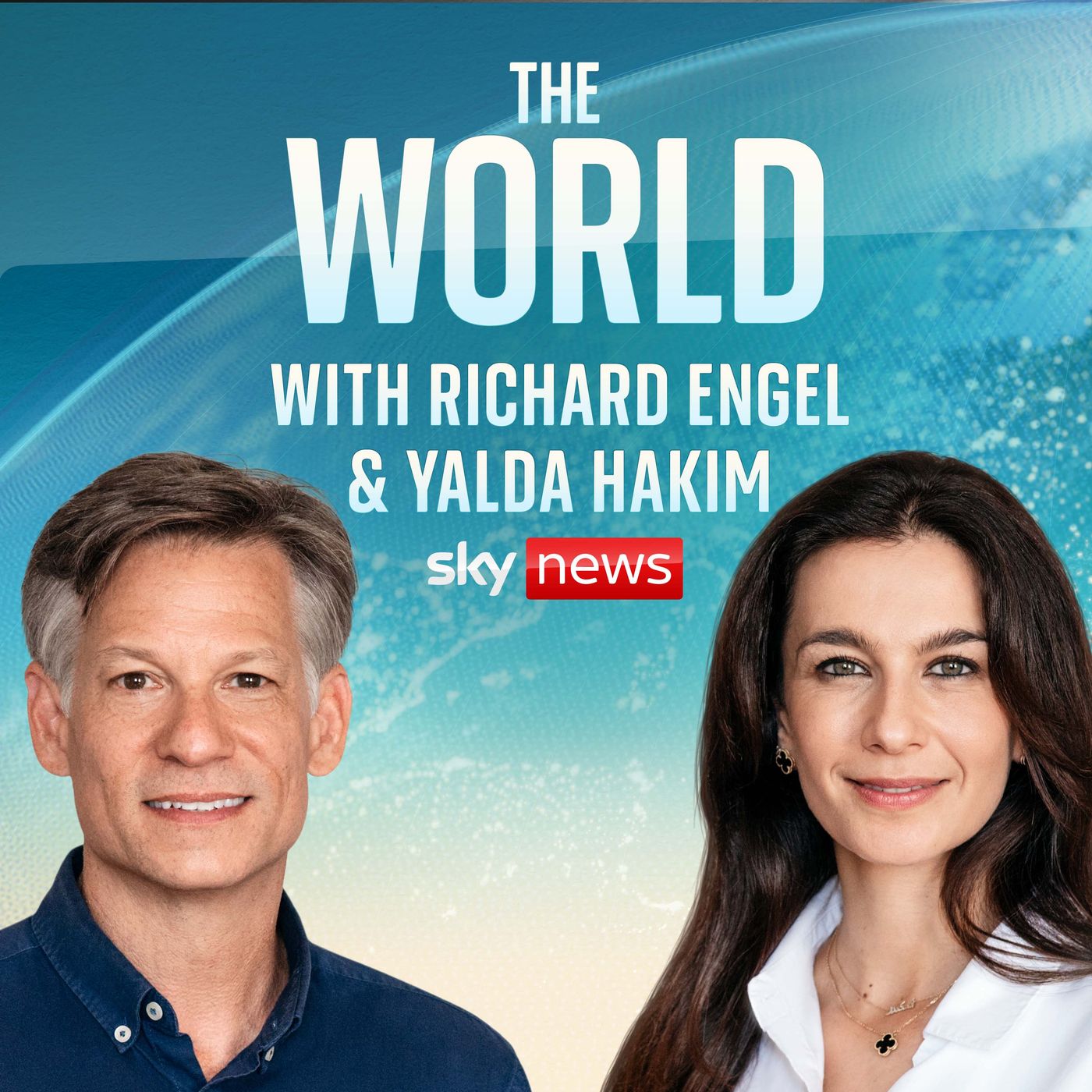
The World with Richard Engel and Yalda Hakim
'A Golden Age of the Middle East'? Trump visits the Gulf
00:34:55
This week, Yalda is in Riyadh and Richard is back in Tehran as they discuss President Trump's trip to the Gulf states. He hails a "Golden Age of the Middle East" and vowed to stop sanctions on Syria and repeats his desire for a nuclear deal with...
Loading summary
Transcript61 lines
- [00:08]
Richard Engel
The golden age of the Middle east can proceed right alongside of us. We will work together, we will be together, we will succeed together, we will win together. And we will always be friends.
- [00:37]
Yalda Hakim
Hello, and welcome to the world. I'm Yelda and I'm currently in the Saudi capital, Riyadh.
- [00:42]
Richard Engel
And I'm Richard Engel and I am in Iran. It is great to see you, Yalda. I missed you last week and it's amazing you're in Saudi Arabia where this meeting, this big foreign policy speech happened from President Trump. I'm here in Iran. It was a big part of the speech. So much to talk about this week. And look at this, look at this, the setup. We're both right, right where we, I think, where we need to be.
- [01:08]
Yalda Hakim
Yeah, absolutely. We're both, as you say, at the heart of it. President Trump has arrived here in Saudi Arabia for what will be a four day trip across a number of Gulf states. He'll be here in Saudi Arabia until tomorrow. Then he moves on to Qatar and then the United Arab Emirates. And frankly, you know, we don't know where we're going to end up by the end of the week because, of course, there's that challeng to Vladimir Putin to show up in Turkey as well. Donald Trump says he might go there if President Zelensky and President Putin meet face to face. So lots to talk about.
- [01:41]
Richard Engel
And I, you know, I wasn't here last week. I'm sorry about that. Sorry, everyone. I was away, I was in Syria. And today they just, Trump just lifted sanctions on the new Syrian government. So I'm gonna tell you what I was doing in Syria. Interesting. And I'll describe what this is gonna mean for Syria and the future. Let's dig into it.
- [02:00]
Yalda Hakim
And before we get going, of course, follow us wherever you get your podcasts, Apple or Spotify. Send us any of your questions and thoughts and Richard and I will discuss it here on the pod at the usual place, the worldky.uk Richard, as I said, I've arrived here in Saudi Arabia because, of course, Donald Trump is back to make his first diplomatic tour of his second presidency. First of all, lavish welcome, the kind of welcome that Donald Trump expects from the Middle east and frankly, the sort of welcome that the Middle east likes to offer foreign dignitaries and certainly one as important as Donald Trump. Saudi F15s offered him an escort in the skies before he landed. And at the end of this lavender carpet, Mohammed bin Salman, the young Crown prince, was waiting. And you know, so much has changed, Richard, in the course of the Last eight years, these two men have changed. And Donald Trump said, we're a little bit older, they're a bit wealthier, so therefore, I'm going to get more money out of them. So this really was about economics and security, big deals, big investments, and that Donald Trump was seeking. But as you say, this extraordinary, momentous, historic speech that he gave, and I was listening to here in. In Riyadh about the changing shape of the Middle East.
- [03:35]
Richard Engel
So he came. This was clearly a, you know, I don't want to say a business trip, but I would say the trade was. Was a major focus of it because he brought all these tech leaders and he, you know, what did he. He spoke for about an hour, something like that, Maybe a little longer.
- [03:49]
Yalda Hakim
Yeah, about 45 minutes.
- [03:50]
Richard Engel
45 minutes. Okay. So a lot of it was about how much trade is coming, how investment. He talked about Biden, he talked about the election. So some of it is stuff that he always, that. That he always talks about. And then he was presenting kind of the Gulf as the model. You know, the Gulf, you guys are doing it, right? You're building. You're. You're building the future, that you're the best. No mention of. Of democracy. No mention of human rights. No mention of the murder of that Khashoggi, the murder of the Saudi journalist. Very different kind of relationship that the US And Trump has with Saudi Arabia than, say, President Biden. You know, Trump was saying, I leave my moral judgments. I let the moral judgments happen to God. I'm just here to do deals, Right? So he was like, I'm here to do deals. These guys want to do deals. Let's make a deal. Let's all get rich together.
- [04:46]
Yalda Hakim
Well, here's the thing, Richard. The U.S. saudi relationship has always been transactional, always. But other U.S. administrations have been slightly uncomfortable with that. But Donald Trump is in his. The most comfortable place for him is this. The pomp and ceremony, the gifts, the investments, the big money, the being able to tell Americans the reason I come to this faraway land and choose it as the first place of my trips is because it's going to bring more money back into the United States. And frankly, he's saying, if you offer us large sums of cash and over the course of the next few days, we're going to see trillions invested in the United States. How much of it is flash and how much actually comes into fruition and is delivered is unclear. But the headlines is what Donald Trump is seeking. And so this region, this country is quite comfortable with Donald Trump's transactional approach to business. I don't know how recently you've come to Saudi Arabia, but I haven't been. Saudi Arabia has transformed. There is no morality police. Young people, women are out on the streets. You know, things have changed. Last night I was with a bunch of male colleagues and some male contacts, and they said to me, you know, just a few years ago, this would not have been permissible.
- [06:05]
Richard Engel
So in Saudi Arabia right now, I could go out to dinner with you and sit at the same table in the, in the, in any issue. We're not married, obviously. You know, we're friends, but we don't have to play that game where we pretend to be a married couple and go sit in the family section.
- [06:21]
Yalda Hakim
Not at all. There's no segregation. There's no family sections. This is a place that is trying towards modernity. Well, no, people can sit very. They're not being abided in restaurants, in coffee shops. They can walk in the streets. They can be with men who aren't necessarily their husbands or partners or a.
- [06:40]
Richard Engel
Relative, because there used to be, you know, if you were a group of men, you sat in the sort of the general section and then family section were for women or families with kids and stuff, but single men couldn't be in that section. Now it's kind of open, open seating plan.
- [06:55]
Yalda Hakim
Yeah. And, and those questions around human rights, democracy, women's rights that has always plagued this nation, including the brutal murder of Jamal Khashoggi, the contributor to the Washington Post. It feels like alongside Donald Trump's trip, this country is trying to, you know, reframe the way the world views it, that it is marching towards modernity. It is making massive strides in technological advancements. It's asking for weapons from the United States. It's asking for more security. And the big question, as you say, normalization. The Abraham Accords, which was seen as this deal that Donald Trump put together to normalize relations with Arab states. The big crown in the, in the jewel was Saudi Arabia, as you say, because of the, the war in Gaza. While people don't publicly talk about it here in the kingdom, officials say they don't have the authority to talk about it. It is felt and it is a condition now for the kingdom that without Palestinian statehood, we're not going to give you normalization.
- [07:59]
Richard Engel
Yeah, I watched the speech. You were, you were listening to it and reporting on it. I was watching it on a monitor from, from here in Tehran. And it wasn't, by the way, broadcast on, on local TV live. I had to get it On I, we like an internal system so I could get the feed. And so I watched a reaction in the room. There are lots of applause lines. You know, he talked about the investments, he was talking about mbs, the Crown Prince Mohammed bin Salman, every time he praised the room went wild. You know, because it's his, you know, it's friendly. He's the host, right? But when he talked about the Abraham Accords, how Saudi should join the Abraham Accords, which is that Saudi should make a peace deal and normalize relations with Israel, pretty silent. And then he said, well, Saudi is going to do that on its own time, which we want. But when he talked about that one, the room was kind of, kind of dead. So I didn't get the impression that they're going to be signing that Abraham Accord anytime soon as long as the massive bombing campaign in Gaza continues. And what he did say about Gaza and that the situation there needs to improve and that it's hell on earth or I don't remember exactly the words. He got applause on that part, but not when he said that one day we hope that Saudi joins the Abraham Accords and how it will be a personal favorite for him. If Saudi did it. That was the one time there was some pin drop in the room moment.
- [09:24]
Yalda Hakim
There is no doubt that over the course of the next three or four days whilst he is in these Gulf states and meeting with Arab leaders, there is going to be a lot of behind the scenes, behind closed doors conversations around Benjamin Netanyahu, how he has prosecuted this conflict, how the Arab street has felt about the conflict. You know, someone young, in his early 30s said to me last night that on a October 6, 2023, the day before October 7, we were ready and about to sign the normalization deal. And for the Saudi youth, the, the, the young people of this country, the Palestinian issue wasn't the core issue for them. And they couldn't see why they too couldn't have a normalization. And, and Muhammad bin Salman was hearing this and responding to it and of course October 7th changed all of that and changed the dynamics of what Saudi now requires for that relationship to be normalized.
- [10:25]
Richard Engel
I came here because I had a feeling that Iran would be a big focus of his speech. And it was, and it was pretty tough. You know, he was saying Saudi Arabia, you guys, and the Gulf in general. He praised the Muscat and he praised Doha as well as like examples of where they're doing, you know, major building and modernity and investing in the future and that Iran is the problem Iran is the core of all the issues. Iran is, the Iranian regime is responsible for the backwardness and destruction. And he talked about the rolling power cuts. By the way, there was a power cut in Tehran today, just a few hours before he spoke. I mean, this country wants a deal. And they were, people were, were. They were. I don't want to say they were afraid of a speech like this, but they're afraid if they don't get a deal that they're going to be in real, real troubles. I mean, this country's, this country's broke. I mean, the people are, are. They need money, they need a deal, they need sanction relief. And Trump, what he said was, you know, Iran, you're responsible for, for everything. You're the worst. But I don't want to only talk about the past. Let's talk about a brighter future. But the moment is now. You gotta decide, this is it, take it or leave it, make or break moment. And so far, we haven't heard any response from Iranian officials. I've been trying to get one. I'm supposed to get a response maybe tomorrow, maybe the next day. I think they're, they're calculating what they want to say very carefully. Actually, I was told that they say we don't want to give an immediate response. We want to come up with a coordinated response because they know what they say next is going to be really serious. So they didn't want to give me just sort of a quick sound bite on the phone or even agree to a quick interview tomorrow. They want to think about it. But they, the pressure was put on them hard. And Trump came out and said, you guys were responsible for sort of all this terrible things in the Middle East. You could debate whether they were or not, but you wrecked you, Iran wrecked the Middle East. And look at the alternative, look at the Gulf, look what they're doing here. You can be like that and we get them a new future or the US Is going to destroy you and sanction you like you've never gotten before. And people here would, would suffer under that because already they're suffering a lot. So it's a pivotal moment for, for the regime. It's a pivotal moment for the, for the, for the, for the people. And if the Revolutionary Guard and the Supreme Leader look like they're just totally capitulating, that could be a real problem for them for their whole legitimacy. So Iran is in a, is in a tough place right now. You know, he just threw, Trump just threw down the gauntlet. Take it or leave it.
- [13:18]
Yalda Hakim
Yeah, and I do think that's, that's interesting. You know, he is the transactional leader. He is the president who talks about the art of the deal, and when he puts out these statements on truth, social, or gives a speech sending a clear warning to a state like, like Iran, and talks about the fact that they backed the Houthis, were still launching rockets, even though Donald Trump said, you know, that's been resolved, they'll stop doing that. You know, even, even today there were, there were sirens in Tel Aviv because of the Houthis, so that necessarily hasn't stopped. Or he talked about decapitating Hezbollah, the Israelis decapitating Hezbollah. But that was something, a group that, that destroyed Lebanon. He said, you know, and this is now a real opportunity for the Lebanese. But of course, the backing, the fund of that came from the Iranians. So the Iranians are not only facing, and we've talked about this on the podcast before, domestic pressure, but their whole access of resistance, you know, and access of evil, as it's known in some circles, has been decapitated across the region. So as you say, they need this deal. What I think is really quite fascinating is how far the Saudis have come. You'll remember eight years ago, when Donald Trump ripped up, up the jcpoa, the nuclear deal that Barack Obama put together.
- [14:40]
Richard Engel
The Obama era.
- [14:41]
Yalda Hakim
Correct. The Saudis celebrated that and Mohammed bin Salman celebrated that. But how far has Saudi Arabia now come with its rival Iran, where it's saying to Donald Trump, you know what? We want peace in this region. We don't want instability. Sign this deal, this nuclear deal with Iran, do it your way. But actually, we no longer want you to rip these deals up. We want you to come up with something with the Iranians. And then we heard words of wisdom from Donald Trump in that speech where he talked about not making this region a region that's full of strife and conflict and turmoil, but making it a place of, of opportunity?
- [15:23]
Richard Engel
I think some of the, the quotes, yeah, I wrote them down. He's like, we want was trade, not terrorism. And, you know, he had this speech was, was, was, was crafted. You know, there was, it wasn't just all off the cuff. He talked about how in the past, clear references to, to Bush and Obama, there's been the neocons and the nation builders who destroyed more nations than they ever built. And he doesn't want any of that business. He just wants to do deals. And look what, what's going on in Saudi Arabia in the Gulf. They're making deals. They're making money, everybody's getting rich. And Iran, you can get, you know, you can join this too, but you got to do it now. And as you said, Iran, I, I, we'll get to our predictions later. I, I think there's, I think we're going to get to a framework of a deal here because Iran does, does need this deal.
- [16:12]
Yalda Hakim
I just want to talk about before we go into Syria. You know what has been an extraordinary development as well, Richard, in the last couple of days has been this notion that the United States and Hamas are talking to each other via intermediaries. And so the big question then is where is Benjamin Netanyahu in all of this? And of course, we saw the American Israeli hostage being released as a gesture of goodwill or whatever it might be. The last remaining American Israeli hostage, Idan Alexander, coming out of Gaza, being handed over to the Israelis, greeted by his family. And this was I guess, an attempt by Steve Witkoff, Donald Trump's special envoy, who's been zippering around, trying to come up with the nuclear deal with the Iranians, trying to get the Ukrainians and the Russians round a negotiating table and also trying to restart the cease fight in Gaza.
- [17:09]
Richard Engel
Pressure on Netanyahu. That side deal put a lot of.
- [17:11]
Yalda Hakim
Pressure, puts a huge amount because Benjamin Netanyahu at the moment is being seen and a very clear message is being sent to the Israeli people via Steve Witkoff, via the Americans, that Benjamin Netanyahu is unnecessarily dragging this bloodshed and conflict on without any real strategy or without a real purpose. That deal that took place then within a few hours, Idan Alexander was released by Hamas. Just goes to show how easily the other 20 or so hostages can be released if Benjamin Netanyahu comes to the negotiating table and does this properly. But a clear message was sent to the Israeli people that Benjamin Netanyahu is there to surge to serve his right wing MPs and not actually the Israeli.
- [18:02]
Richard Engel
People in that square. Those families have been angry at Netanyahu saying, you're dragging your feet, do a deal, get these people out. You're not doing a deal because you're trying to appease the right wing extremist members of your government. So you're needlessly dragging on this bloody war. Just do a deal and get those hostages out. And the fact that the Trump administration did a side deal and that Hamas did it pretty easily. He's like, sure, you want the guy here? And they handed him out without the theater. They didn't give him the stupid goody bags. They didn't put him up on a stage. They didn't do all that stuff that they've been criticized for doing, which has been awful. And as this spectacle, it was just, okay, you want him here? Goodbye. Have a nice day. And that sends a message to all the people who've been criticizing Netanyahu that says we were right. You can do a deal. We can get these people out and just, just do it. So therefore, why aren't you doing it?
- [19:04]
Yalda Hakim
The Israeli people are now focused on, on a election that could come up. And, you know, Benjamin Netanyahu is backed up into a corner. And frankly, this week, he will feel incredibly isolated with all of these Arab leaders rallying around the US President. And Benjamin Netanyahu is nowhere to be seen. But let's, so let's take that break. And when I come back, I want to hear more about your Syrian trip, what you saw, what you heard, and link it back to what is happening here in riyadh.
- [19:42]
Richard Engel
The first 100 days might be over, but President Trump is showing no signs of slowing down. America will soon be greater than ever before. So we're continuing to follow every twist and turn of this remarkable presidency and.
- [19:57]
Yalda Hakim
Trying to make sense of what it all means for the US and for the rest of the world.
- [20:02]
Richard Engel
So join me, James Matthews, me, Monica Kelner, and me, Mark Stein for Sky News TRUMP 100, wherever you get your podcast.
- [20:24]
Yalda Hakim
So, Richard, as we were saying, a lot's being discussed around the Middle east, foreign policy, from Iran to the situation in Gaza, Saudi Arabia. Donald Trump talked about Muhammad bin Salman in sort of a, you know, like, he really admired him and talked about this great leader, called him an extraordinary.
- [20:43]
Richard Engel
Man, like, oh, what I do for you, I love you too much. I like you too much. He kept saying that is sort of.
- [20:49]
Yalda Hakim
The nature of Donald Trump and the relationship that he's built. And he does see Mohammed bin Salman, Vladimir Putin, Xi Jinping as his equals on the international stage. The sort of respect he has for these strong men is not the sort of respect that he has for European allies and partners.
- [21:05]
Richard Engel
Certainly not.
- [21:06]
Yalda Hakim
But one of the things that got a huge amount of applause at this, the speech that he gave here in Riyadh, standing ovation was the lifting of sanctions on the Syrian leader Ahmad Ali Shara. And Syria, on all of Syria, it got a standing ovation. What Donald Trump said was, the things I do for the crown prince. Just talk us through, because Ahmed al Shara is due to meet Donald Trump tomorrow, you know, here in Saudi Arabia. But just talk us through what you saw the energy in, in Syria and the hopes for the, for the Syrian people.
- [21:43]
Richard Engel
Can you imagine that this guy was an Al Qaeda leader? This job is fascinating and how things change. So we did one of our first shows from Damascus was about six months ago when Damascus was falling and the government of Syria was falling. So there was the government of Syria. And I'm not going to retell the whole story of the Syrian civil war, it's too long. But basically there was this decade long civil war against Bashar Al Assad. They did one, it was more or less over. Bashar Al Assad had won. There was just one little pocket that was right along the Syrian border, the Turkish border, excuse me, that was held by a group of pretty hardcore Islamist rebels led by Ahmed Al Shara, who used to be known then as Al Julani. We didn't, you know, he didn't use his real name. And then about six months ago, after Hezbollah was defeated and Hezbollah had been propping up Bashar Al Assad and after Iran was, was, was severely weakened, the Assad government instantly collapsed. And these, these rebels who had been confined to, to was one pocket of Syria started marching out and marching out and taking territory, taking territory. And the regime just fell in front of them. And when we were there in Damascus, you saw people had just, the soldiers had just abandoned their uniforms in the streets and there were tanks that were just sort of parked by the roadside. The regime didn't fight, it collapsed. They ran away and the rebels swept into power. And for the last six months they have been in charge and they've been trying to arrive at this moment. They've been talking about how they want to open a new page, that they're not just Islamist hardcore rebels, that they want to engage in international diplomacy. So Ahmed El Shara was once a senior Al Qaeda leader named by Aymid Al Zawahiri. He was then the number two, he's now dead number two leader in Al Qaeda just below Osama bin Laden. He says he's changed, you know, he's changed his tune and by all accounts he has sort of changed his tune and he's, he was meeting with Macron and he's traveling the world and he wants the sanctions to be lifted and he wants the, the Syria to be sort of welcomed back into the international community.
- [24:07]
Yalda Hakim
But, but you were just with, you were just with, with these guys in Syria.
- [24:11]
Richard Engel
So I was just with these guys. So let me tell you what I was doing in Syria and they, they, I wish I were with Them right at this moment, because they. They would be. They're going to be dancing and really, really, really happy because they were. They were looking for this moment. So these. This movement, hts, which is now the new Syrian government, Islamists, they've been consciously going out of their way to tell Syrians, and there's some problems with the old Alawite community, and there's some problems with the Druze community. It's not all settled, but I would say the. The overwhelming message that they have been projecting and acting on is that they want to start a new page. They couldn't have been nicer to me. I was in Syria on this special mission to try and find and recover the remains of foreign hostages. Americans, Brits, Japanese man, all the foreign hostages that were held by a particularly brutal group of ISIS members known as the Beatles, in an area that had been inaccessible before. And the new Syrian government brought us there, and they brought a team of international investigators, the Qataris put on the plane and sent all the equipment, paid for the whole expedition. We landed in the C17, you know, the huge military transport plane full of search and rescue team, full of crime scene investigators, full of SWAT team. They. They arrived, they had their equipment, ground penetrating sonar. These. There was a group called the Sufan Group. And you may. You may know the. You, I'm sure you know the group.
- [25:52]
Yalda Hakim
Yes.
- [25:52]
Richard Engel
And they do sort of investigators, and they've been working pro bono on behalf of the families of the hostages to try and locate their remains for years. And they had pinpointed this spot that I went to outside of Aleppo as an area of interest. And they've been trying to go there, but they couldn't get there because of the active fighting. They got to the scene. The new Syrian government, which is now being recognized, provided a lot of the security, escorted us there. And it looked something like a cross between an archaeological dig because they put stakes down and lines. And we're going grid by grid looking at this hilltop where ISIS had filmed some, at least one video showing the partial remains of an American hostage. So they knew they wanted to go there. And then they started digging with excavators, sometimes with. With shovels, pickaxes, paintbrushes. And they found remains. They found remains where they thought they were gonna find them. And they're doing DNA analysis right now, and it may have been the spot. We're not gonna know who they found until the DNA analysis is done, but they're hoping that they find the remains of at least one or maybe several of the foreign Hostages who were executed brutally by isis.
- [27:28]
Yalda Hakim
And is that report coming out soon, Richard?
- [27:31]
Richard Engel
Well, I put, there's you, I've written, I've written one piece, I did a TV piece about a four minute piece and we'll put the links to both of those and then we'll be following up on the story as we get the DNA analysis because it would give the families so much closure because not only were their loved ones kidnapped, treated horrendously during the captivity, there's the story of this, this young American aid worker, Kayla Mueller, who became the bride. Bride's not the right word when you're forced and you're kidnapped, but that's the way they considered her to Baghdadi to the leader of isis. She became his personal.
- [28:14]
Yalda Hakim
Wow.
- [28:14]
Richard Engel
She became his personal property. And so each one of these stories has a, has a, has a fascinating but, but horrific backstory as well. It's a story I've also been following for, for quite a few years. So I'm going to be doing a lot more on that coming forward. I've been, I've interviewed several of the family members. It's, it's, there's more to, to come. But we're starting to roll out some of that material as we get it. And, and the mission is now underway to actively find the remains for the first time since these people were executed a decade ago.
- [28:53]
Yalda Hakim
Extraordinary. And we'll definitely, as you say, put the links of those stories to this podcast so our listeners can have a look at some of your reportage from Syria and of course, Iran. But Richard, let's get to our predictions now because there's so much going on in the region. You are in Iran at the moment. I've been doing, you know, a couple of weeks of reporting on the, and we've talked about it on the podcast, the, the war with the escalation and the tensions between India and Pakistan. A series of interviews that I did that, that really exploded.
- [29:30]
Richard Engel
You were really on top of the.
- [29:31]
Yalda Hakim
Region in the beginning. Yeah. And I think that one of the things about the India, Pakistan conflicts in the past and the fact that Kashmir is always a flashpoint is that people don't really have a firm understanding of it. So I think that's why it was perhaps, perhaps the pieces, the interviews I did did quite well. But what I think I find most alarming and this is kind of my prediction of, you know, the, the situation between India and Pakistan, which by the way, Donald Trump stepped in and, and described himself as a savior which Pakistan welcomed and India found Michael Rubio, stand.
- [30:08]
Richard Engel
Up and take an applause.
- [30:09]
Yalda Hakim
Yeah. You know, India absolutely opposed the idea of Donald Trump stepping in and publicly declaring that he def, he was the one to defuse, because India sees itself as a great power, both regionally and internationally. Pakistan is much weaker. So it wants other great powers to be, you know, tangled up and telling India to step back from the brink. Of course, India found this incredibly frustrating. And, and now Donald Trump is saying, hey, you guys have to come up with a deal when it comes to, to Kashmir and putting them both on equal footings, which have, has completely incensed the Indians. But I think what my prediction is is that while at this moment in time this situation has been diffused, the red lines have moved and the baseline has moved and certain red lines were crossed in this particular escalation, which means the next time that these two nations confront each other, these two nuclear rivals confront each other, it could become a more dangerous conflict. So I think we've put a lid on it for now now, but there is no doubt that the tensions are simmering under the surface.
- [31:21]
Richard Engel
All right, all right. My prediction, and I'm sort of putting my, my feet where my prediction is, is why I came here. I think they do come up with some sort of framework agreement on Iran there. It's, it's too close. And the, there's too many reasons for the Iranian leadership on all different levels to take it. There's too many reasons for the, that the Iranian people want it. It. Trump can get a better deal than the one that President Obama got. He could get them to enrich to a lower level than they had before. He could get better. More observers. There have already been teams from the international organization, the International Atomic Energy Agency here, talking about how they could do they resume their, their observations. And the money thing, There are about $7 billion of frozen Iranian assets and they're held by Qatar. They're just sitting there. And last time when Obama signed the deal, a lot of there were frozen assets then, too, the money went back to Iran. And it's something that President Trump keeps talking about. He talked about it again today, how the pallets of money went back to Iran and what did they do? They bought weapons with it. And he thinks that that led to October 7th, that led to Hamas and led to the disaster in the Middle East. So he doesn't want to be blamed for that. To sign a deal and then have this, the $7 billion go right back to the regime, back to the military here, let's say. But you could easily find A framework where the money is unfrozen and then says, and then the clause says, okay, that money will be spent in the U.S. and that money will be unfrozen and buy things that Iranians need, like medical equipment or airplane parts for their civilian aircraft or whatever it is. And then Trump can go back and say, not only did I get these hundreds of billions of dollars in trade and opened up Syria, but we at least got a framework agreement on Iran.
- [33:37]
Yalda Hakim
Yeah.
- [33:37]
Richard Engel
So I think I can see a deal like that emerging over time. I'm starting to see the framework kind of emerging in the dust.
- [33:50]
Yalda Hakim
Really fascinating, Richard, and no doubt we'll probably find you again in Tehran in the near future as this deal evolves. But great to see you again. We haven't spoken in the last week or so, so I was totally in.
- [34:05]
Richard Engel
Communication of this place in the middle of no place.
- [34:08]
Yalda Hakim
I know. Extraordinary. I'm really looking forward to, to seeing your pieces and hearing more about your trip to, to Iran when I see you next.
- [34:17]
Richard Engel
And it was the site of the Islamic apocalypse. You know, it's a symbolic reason. There's all sorts of, it's cool stuff. It's a fascinating, it's a fascinating place. And you got to sort of get into the ISIS mentality. The reason they picked that spot is they thought it would be where there would be a final end of days battle between the armies of Islam and the armies of, of the Crusaders. So that's why they thought this spot was particularly significant to, to execute people, because it was sort of the Armageddon site. Gosh. Until we meet again.
- [34:49]
Yalda Hakim
Yalda, always a pleasure.
- [34:51]
Richard Engel
Great to see you.
- [34:52]
Yalda Hakim
Thank you to our listeners for listening. Send us your thoughts at the usual place the world@point sky.uk and follow us wherever you get your podcasts, Apple or Spotify. Goodbye for now.
- [35:25]
Richard Engel
The first 100 days might be over, but President Trump is showing no signs of slowing down. America will soon be greater than ever before. So we're continuing to follow every twist and turn of this remarkable presidency and.
- [35:41]
Yalda Hakim
Trying to make sense of what it all means for the US and for the rest of the world.
- [35:46]
Richard Engel
So join me, James Matthews, me, Marta Kelner, and me, Markstone for Sky News Trump 100. Wherever you get your podcast.