← The World with Richard Engel and Yalda Hakim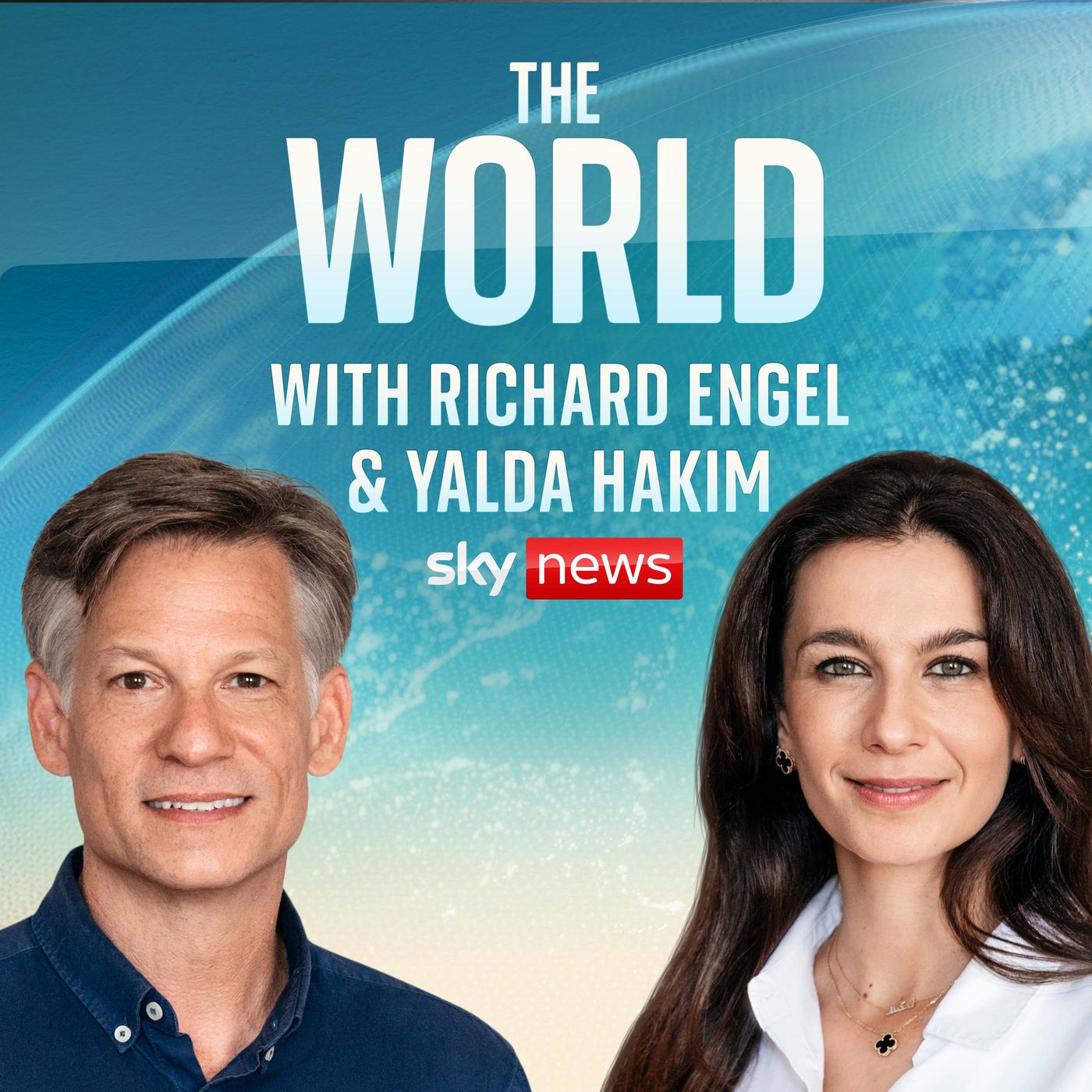
The World with Richard Engel and Yalda Hakim
After the crackdown: what is happening on the streets of Iran?
00:21:04
Loading summary
Transcript37 lines
- [00:03]
A
Sky News, the full story first. Hello, it's me, Yalda, and I'm in Riyadh in Saudi Arabia.
- [00:20]
B
And me, Richard, and I am in Iran right now. After weeks of protests which saw thousands of people out on the streets calling for regime change and then a brutal government crackdown, I'm now here in the capital, Tehran, and we are expecting talks later this week between Iran and the United States.
- [00:41]
C
They are negotiating. They'd like to do something and we'll see if something is going to be done. They had a chance to do something a while ago and it didn't work out and we did Midnight Hammer. I don't think they want that happening again, but they would like to negotiate. We are negotiating with them right now. Yes.
- [00:59]
B
And Yalda, I've been here for two full days now and I can tell you there are no longer any demonstrators on the streets. The government has, at least for now, succeeded in crushing these protests.
- [01:14]
A
Yeah, Richard, I'm really looking forward to getting all of your analysis and what you've heard and seen on the streets of Tehran because of course, it's next to impossible to operate as a journalist in Iran. So welcome to the world.
- [01:37]
B
So, yes, I'm here, Yalda, in the back of a van right now and I have a little bit of Internet connection, so we may have a couple of drop offs. Connectivity is a major problem in this country. It was totally blacked out for about three weeks. It is now coming back online for many people, but it is still tightly controlled. And I'm on the roadside in the back of this van with the door closed. I'm sure it looks very suspicious. I look like some sort of secret police force about to go out and arrest people. But hopefully we won't have any issues. And I must say, Yelda, the authorities have been relatively free with me. I don't have a minder. I'm driving around on our own. When we do interviews on the streets, there's nobody standing next to us. I've been able to just walk up to people and film. I have not had to ask for permission to film on the streets. We can just put down our camera and do live shots. So it has been quite extraordinary, the amount of access that we have been given here. It's not total access. We can't go to military sites. Several requests that we've put in for government officials are still pending approval. But I would say it is more than I anticipated. I thought every move would be watched, that we'd be escorted every step of the way. And so Far that just hasn't happened.
- [03:05]
A
Yeah, Richard, really fascinating stuff. We're also going to be talking this week about my interview that I did with the FIFA boss, Gianni Infantino. I spoke to him, there were a lot of headlines around some of the things he said. I also just want to give a quick plug to an interview I did last week. I spoke to the Iranian Canadian woman, Mahsa Ali Mardani, about the Internet shutdown in Iran. And I can see, as we've said, you're connected. So she gave some really cool research and insights into how the protesters were working around the Internet ban. So you can listen to that on Spotify, Apple, you can watch it on YouTube as well, and you can send us any of your thoughts at the usual place, the world@sky.uk let's get going. So, Richard, you're in Tehran. I want to hear absolutely everything. The journey itself, the kind of process of letting you into the country. So soon after those protests basically came to a halt. You got your visa approved in the last few days and, you know, you left basically immediately. I got a text from you from Lisbon Airport. Talk us through that journey and then obviously getting into the country, the process of entering.
- [04:27]
B
So it was remarkably easy. I expected it to be more complicated during the 12 day war that was this last summer. It was much harder to get in because the war was still kind of going on when I, when I came in. So last time, and I'll use that to compare to what it was like this time. Last time this summer, I had to fly to a remote airport near the Afghan border and then drive across the country and we were stopped along the way by very nervous intelligence services and Revolutionary Guard. And they went through all our stuff and they were going through our phones and I thought at some stage we were going to be arrested because of, of all the hassles and the, the, the many security agents who were asking us questions and going through our stuff. This time, got the visa, went immediately to the airport, went to Istanbul, which still has direct flights going to Tehran. It's one of the few countries that, that operates and, and flies to Tehran. Gala ticket. The plane was packed almost entirely of Iranians who had been out of the country when the protests began or escaped and went to Turkey as they were just sort of ramping up and they were going home and you could see the looks on their faces. They were a little bit nervous. The passengers on the plane, some of them had shopping bags from their trip to, to Turkey, but they were going home to a Kind of an uncertain country, an uncertain future. We landed at the airport with our visas and it was relatively easy. They, they stamped us in. We collected our gear. There was no government official to greet us. We went to our hotel, checked in, and we've been driving around and I've been had the opportunity to interview several Iranians. We went to the Grand Bazaar the, the other day, which is the famous market center here, where they sell everything from spices to carpets and to clothing, and spoke to several government officials as well, had long briefings. So I would say we've had quite extraordinary access.
- [06:44]
A
Richard, what's the mood like?
- [06:46]
B
The protests have been put down. There aren't any protests. You don't hear shouts at night, which is an Iranian tradition. When people are angry with the government, they'll sometimes call out their windows anti government slogans or just Islamic slogans, Allahu Akbar, things like that. We haven't been hearing those at night. People are afraid. This government crackdown was extraordinarily bloody. As we've reported before. It was mostly on the 8th and the 9th and people were scared. People are afraid to go back out onto the streets because they know they could get shot and that the government crossed that Rubicon and was able, was, was, was willing to use live fire on a massive scale to crush the demonstrators.
- [07:32]
A
What's the government saying now?
- [07:34]
B
The government has a version of events of what happened. And three different government officials outlined this same version of events. This is how they justify what, what happened here, particularly on the 8th and 9th. The government says yes, this protest movement began organically. It began because of economic frustration. There was a currency collapse here and the economic woes continue in Iran. It is very difficult to do business here. ATM machines barely give out any money. Many of them will only give out $2, the equivalent in the Iranian toman of $2 a day. So not even two pounds a day. A lot of debit cards will only allow you to transfer tiny amounts of money. So no international credit cards, international phones here don't work. So the government says yes, there were these protests like they've seen before because of economic frustration, which they say is understandable and is a result of years of sanctions. But then according to the government's version of events, at around 8pm on the 8th, so 8, 8 of January, this
- [08:39]
A
is when the Crown Prince Reza Pahlavi called on protester to come out into the streets. You know, we heard those kind of calls from him and his supporters.
- [08:51]
B
Exactly, exactly when that call began. The government says everything switched, that it suddenly went from peaceful demonstrations over economic issues to an armed insurrection, and that the demonstrators they now were. The government is calling them terrorists and insurrectionists. Not all of them, just a group of them, started attacking police stations nationwide.
- [09:19]
A
And what's the government saying about the death toll?
- [09:21]
B
They said there were 900 different attacks more or less simultaneously, and that the government at that stage reacted and reacted strongly, cutting off the Internet, sending the security forces in the streets and opening fire on what they describe as terrorists. And even the government's official account acknowledges that most of the people who were killed were not insurrectionists, were not terrorists, but were people who were caught up in the gunfire. According to the official count here, which has been widely disputed and is not accepted by human rights groups and activists, the government's official count is that about 3,100 people were killed, and they say only about 600 of those people were armed insurrectionists, and that the rest of them, they consider martyrs. People who were accidentally caught up in this movement and got shot as a result of the chaos on the streets. That's the government's version of events. And they say that this armed phase of the protest movement lasted about two days, the 8th and the 9th, until it was put down and pro government supporters came out onto the streets. That's what we're hearing from the government, that consistent line that it started out normal, then when the Shah's son, Prince Pahlavi, Crown Prince Pahlavi, called for these demonstrations, then it suddenly turned armed and the government had no choice. Government officials also say right now that they are keen to enter into negotiations with the U.S. they want negotiations. They don't want another. And here in Iran, people I've been speaking to also say they don't necessarily want another war. They don't want a war that will just bring more isolation and hardship. Unless. And there is this unless. Unless it is a war that is decisive and definitive and topples the regime and replaces it with something better. How you do that, however, is a very open question. This is a big country. There are a lot of ethnic divides here, but the mood on the streets is tense. A lot of shops remain closed. A lot of people are still kind of staying out in the streets. People aren't talking about politics, although it is the only subject that people are thinking about. But they are afraid to openly discuss what's going on. It's still too soon, too fresh. I mean, this really just ended. The Internet was just turned back back on. I'm surprised we're able to have this kind of consistent connection Even last night, I could barely get a phone call out. And we have lots of different communications devices that are trying to help us here. We're, you know, in. In the media business. And even with all of our equipment, we've barely been able to get a signal out.
- [12:29]
A
Unfortunately, Richard has dropped off. It was, you know, quite extraordinary to hear his insights from Iran at the moment, from the capital, Tehran. It's also been difficult to access the Internet. There has been a blackout for weeks, and the Internet isn't up across the country fully. And as Richard said, people are still terrified to come out of their homes. The shops are still closed. The government does have its line. They have started to invite some media, international media, back into the country. And Richard was able to speak to them. And we have been able to get the government side of things. And as you heard there, they have their side of the story, their narrative, which is that most of the protesters were attacking police stations, were attacking security forces, and they retaliated. They retaliated in a bloody and brutal crackdown. Now, human rights groups that have been monitoring the situation on the ground, speaking to protesters, they were using Starlink at the very beginning of the protest to get some of the material out, have painted a very different picture. They have said at different times that 5,000 people have been killed, 10,000, 20,000. They have even used the number 30,000 protesters killed over the course of the last few weeks, especially during that weekend of January 8 and 9. We've spoken to doctors who have described, you know, hospitals full of body bags, the injured being pushed off beds by the security forces that have been coming into the hospitals. But all of this is very difficult to still verify for us. And having journalists like Richard in the country is. Is important for verification. But of course, he is saying he doesn't have minders. But the government is carefully watching those journalists who are entering the country, and they are trying to put their side of the story out there as well. But just separately from the situation in Iran, I have also been speaking to the FIFA president, Gianni Infantino, and I asked him about Donald Trump being given this peace prize by FIFA. Of course, many people are questioning that peace prize because of Venezuela, because Donald Trump continued to threaten Greenland, because he continues to threaten Iran as well. So have a listen to that interview with Gianni Infantino. Why did you feel he was worthy
- [15:16]
D
of that peace prize? Why did you think that it was important to give it to him?
- [15:21]
E
And this is our slogan, our motto. FIFA is Football unites the world. So the fact that we Unite everyone goes hand in hand with peace. So whatever we can do to help peace in the world, we would be doing it. And for this reason, for some time, we were thinking about, you know, we should do something to reward people who do something. And when this whole situation recently also we, with Gaza last year happened, I mean, how many 60,000 people were killed, died in Gaza? And then it stopped. It did stop.
- [16:14]
B
Well,
- [16:17]
E
you have to. We have to stand. We have to support everyone who does something for peace.
- [16:26]
D
So you, despite the tensions inside the United States, domestically, you think that's one issue. And globally, the sort of conflicts that he's resolved is the reason why you gave him this peace prize.
- [16:43]
E
Yes, we gave him the peace prize because he did. He was instrumental in resolving conflicts, in saving lives and saving really thousands of lives. And to me, there is nothing more important than stopping killings and stopping this kind of sufferings.
- [17:02]
D
Do you think he should be getting the Nobel Peace Prize?
- [17:07]
E
I think he will get it and then it will be the second after the FIFA Peace Prize,
- [17:14]
A
you know, because
- [17:15]
D
again, I mean, of course, but of
- [17:17]
E
course he should get it.
- [17:18]
A
But you say that with so much
- [17:20]
D
certainty, Gianni, you know, but because I
- [17:22]
E
met, sorry, I met so many leaders around the world in these last 10 years. I meet every president of every country wherever I go. And, you know, for me, this kind of, it is a force of President Trump to, to break borders, to, you know, just, I don't know how to say he doesn't care. He just puts people in a room together if you don't speak. I mean, in Ukraine, Russia, we spent four years. Now in Europe, four years just, you know, sanctioning Russia, criticizing Russia? How do we think we can solve a war if we don't engage, if we don't speak, if we don't try to understand, if we don't put people in the room. That's my conviction.
- [18:16]
D
But so, you know, earlier you said that we should re. Engage with Russia. Are you saying that you would look at lifting the ban on Russia?
- [18:25]
E
Oh, definitely. We have to, yes. At least at youth level, you know,
- [18:29]
D
for children, at least there are some who are calling for the World cup in the United States, you know, for fans to ban it. What are your thoughts around that? Because of safety issues, because of the immigration issues that, you know, President Trump's immigration policy, what we're seeing ICE do, for example, there is a lot of concern right now about engaging on that level with the United States.
- [18:55]
E
Let me say that I'm always against, I'm against bans, I'M against boycotts as well. I think they don't bring anything, actually the country. They just contribute to create more hatred. But let me ask you, I mean, we are here in England or in the uk If I'm not mistaken, the most important commercial partner of the UK is the US 300 billion, 330 billion a year trade volume. Is anyone proposing that the UK should be stopping doing commerce with the US? I didn't hear that. Same as for the Arab countries, by the way, Qatar or others in the past. I never hear this. I never hear there should be a boycott from doing business or there should be a boycott from political or diplomatic relationships. So why football? Why football? We are actually by definition the opposite of anything that is boycotting. We have to unite. We have to bring people together. And thanks God, you know, the vast, vast, vast majority. I mean, these 500 million people want to come to the World Cup. They think differently and they just want to come and enjoy and spend time with each other.
- [20:30]
A
Well, that was Gianni Infantino. We're hoping to get much more from Richard and his time in Iran next week. It is, as I said, so rare to get insight into the country. Richard is one of a handful of journalists allowed inside Iran at the moment, so it'll be extraordinary and interesting to hear what he has to say. But for now, thank you so much for listening. Goodbye.
- [21:04]
F
As the day wraps up, get the scoop on what's been happening with here's the Scoop, a new podcast from NBC News, with me, your host, Yasmin Vesugi. We'll take a deep dive into the day's top stories with NBC News trusted journalist. It's a fresh take that's sharp, thoughtful and it's informative, bringing you closer to the headlines and conversations that are shaping our world. From the front page to the zeitgeist, here's the scoop from NBC News. Listen daily wherever you get your podcasts.