← The World with Richard Engel and Yalda Hakim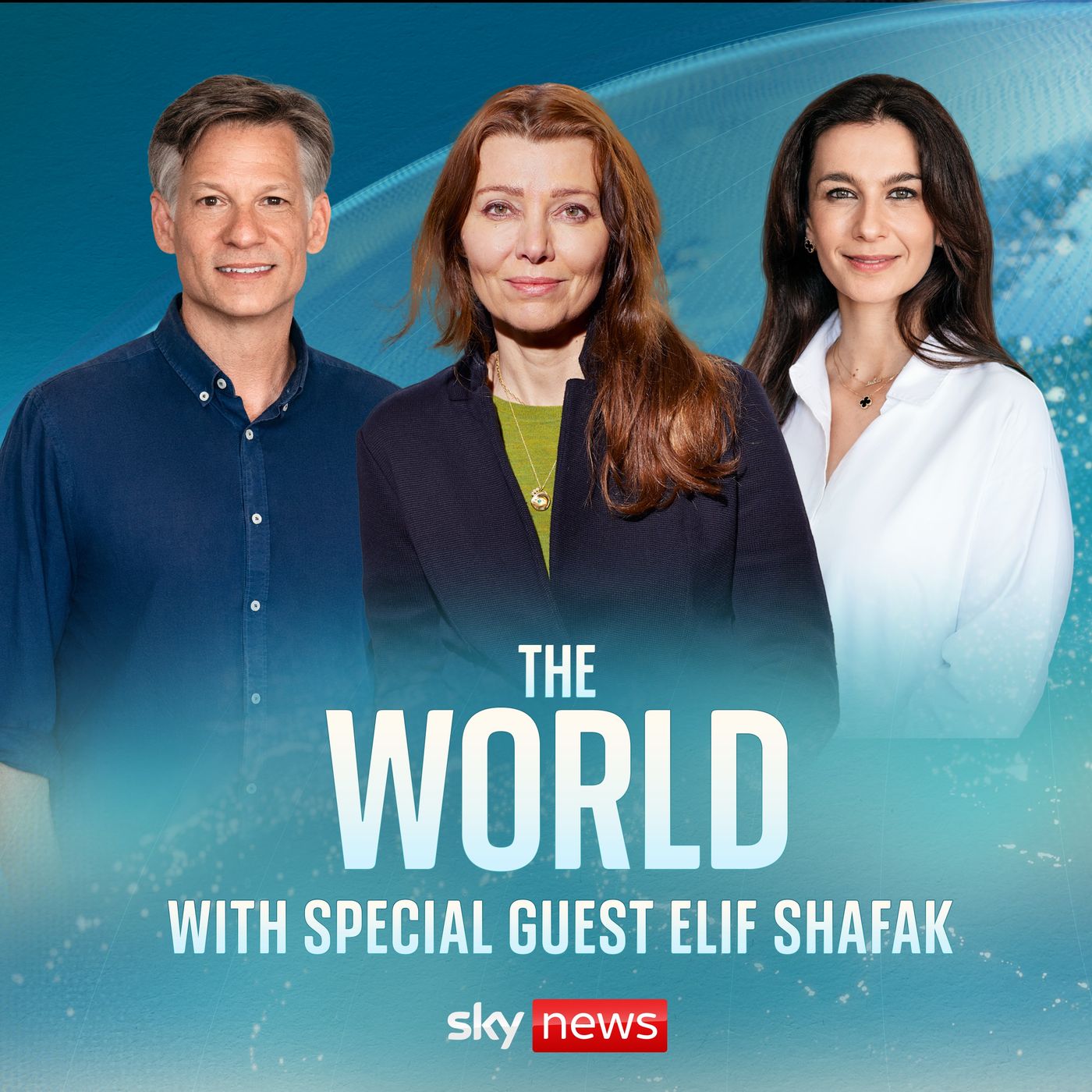
The World with Richard Engel and Yalda Hakim
"Democracy is in Decline”: On Turkey, Trump and the Truth with Elif Shafak
00:47:27
This week Richard and Yalda interview international best-selling author Elif Shafak. Elif - who was once put on trial for "insulting Turkishness" - issues a stark warning. She tells The World that in countries across the world women’s rights,...
Loading summary
Transcript57 lines
- [00:06]
Elif Shafak
I was put on trial after the book was novel was published. So I found myself in this very surreal situation in which the words of fictional characters were used as quote unquote evidence in the courtroom. There were groups on the streets burning EU flags, spitting up my pictures, burning my pictures and calling me a traitor. When you're a novelist, you need freedom of speech just like you need oxygen.
- [00:36]
Richard Engel
Hello, I'm Richard Engel and welcome to the world.
- [00:39]
Yalda Hakim
Hello, I'm Yelda and I'm really excited about our guest today because of course we are speaking off the back of International Women's Day.
- [00:48]
Richard Engel
We have an amazing guest, the renowned award winning author Elif Shafak. She, she's been attacked in Turkey, her home country. She lives in somewhat exile in the United Kingdom. She's written more than a dozen books, she's been described as one of the best writers of our times and she's a major voice on democracy, authoritarianism, women's rights, the rise of populist demagogues. And it is an absolute privilege to have her here with us today. And a reminder before we get started, please follow us wherever you get your podcasts and write to us at theworld sky.uk.
- [01:29]
Yalda Hakim
We are such huge fans. Elif, thank you so much for joining us here on the podcast. As Richard was saying there, you're an award winning novelist, among the best in the world, and you write so beautifully about so many important issues, but you also bring to the forefront issues that you know, sometimes once they leave the headlines, often people don't necessarily think about. And of, of course we're mainly discussing your books, but world affairs with you today as well. The latest book, There Are Rivers in the Sky. It's a beautiful book and I just want to begin by asking you about how it came about. What were you thinking about? Because there are so many different issues and strands in the book and I just wanted to get your thoughts on why you decided to write this book in this moment.
- [02:22]
Elif Shafak
Well, first of all, I so appreciate your words. It really means a lot to me and thank you for that very generous and kind introduction. There are rivers in the sky, perhaps at first glance, might seem to be like an epic novel, if I may use this word, in the sense that it does span countries and centuries and cultures and, you know, across a broad stretch of time. But actually everything came to me via a single small drop of water. So that's how, that's how it started. Just this raindrop, almost like a mystical question. Can we see the world, the universe, in something as small and seemingly as insignificant as a raindrop. But this is something that I find very important in so many ways. When we talk about climate crisis, we're talking about freshwater crisis, and it's very easy to forget this in today's world, Obviously, sea levels are rising, particularly across Europe, we have seen flash floods one another. And so it gives us the impression that we have an abundance of water all around. But the irony is, in the midst of this abundance, there's fresh water scarcity. And for those of us coming from the Middle east, this is not some abstract theoretical question, it's an acute reality. Of the most 10 water stressed nations in the world, seven are in the Middle east and in North Africa. So our rivers are dying. And I think this has, of course, massive consequences for everyone, but particularly for women. Women are water carriers, and in a way, water joins the dots, because when there's water scarcity, the distance that a young woman has to walk increases, unfortunately, increasing the possibility for gender violence. The mind puts these issues in different boxes. But the world we're living in requires us to see the connections. And I think fiction is a great, great way to understand those connections.
- [04:23]
Richard Engel
So I have two quotes from you here, both about water. One is, water is the consummate immigrant trapped in transit, never able to settle. And then, as you were linking this to women. So women are expected to be like rivers, readjusting, shape shifting.
- [04:40]
Elif Shafak
Yes, all the time. We have to renew ourselves. And I think water is an amazing metaphor to understand life, but also to see how connected we are not only with each other across borders, but also with nature. We tend to think there are different bodies of water, you know, the one in the river Mississippi or the river Ganges or the river Seine. But it's always the same droplets circulating again and again. It's the same water that exists inside us that we might have shed as tears, or the same water that we're drinking right now in our glass. So I think that constant migration of water was an important metaphor for me as an immigrant author myself. I am an immigrant author not only in the uk, but also in the English language. I'm writing fiction in my third language. As you can hear in my accent. I'm not a native speaker. This is an acquired language for me. And like many immigrants, I think I experience constantly this gap between the mind and the tongue. The mind always runs faster, doesn't it? The tongue, in its own clumsy, awkward way, tries to catch up, but never quite can. And, yeah, so these are things that I think about a lot. Belonging non Belonging, roots, and identity in a much more fluid and multiple way. Yeah.
- [06:02]
Yalda Hakim
And I think you've also spoken and written about the importance of memory in all of this, that people carry things with them, and the role of the writer, someone like yourself, is to almost document that. So I think, you know, if we can bring it back to your current book, you know, there are certain characters certainly from the Yazidi community, and you see their plight and you hear about their plight, and both Richard and I have covered the persecution of this minority group as well. Just talk us through that a little bit why you decided to focus on them, this group of women within that and their struggle.
- [06:40]
Elif Shafak
Yes. And I do know that both you and Richard have covered the enormous suffering that the Yazidi communities have went through. But at the same time, of course, amidst the world news, unfortunately, many people have not focused on this still continuing suffering. As you know, the Yazidis are one of the most persecuted, misunderstood, maligned minorities in. In the world throughout history, not just today. The Yazidi lore talks about at least 72 massacres and the one in 2014 initiated by ISIS fanatics. Of course, it happened in front of the eyes of the world, but again, perhaps not many people noticed at the time that it started with water. What the extremists did was to kill the water first. So they killed the. They poisoned the fountains and the wells, leaving no water to drink for communities. Then the second thing they did was to kill the elderly. And in a community like the Yazidis, where everything is transmitted via oral heritage, oral storytelling, if you kill the elderly, basically you're killing collective memory. And when you kill collective memory, you kill collective identity. Then they attack the men and boys, and they kidnapped women and younger children. As we are speaking right now, there are more than 3,000 Yazidi women still missing, unfortunately turned into sexual slaves in quote, unquote, ordinary neighborhoods across the region, Purely by coincidence, one of these young women was saved from a house in Ankara while I was writing this book, which is literally two streets away or a few streets away from my maternal grandmother's house. So it really struck me hard. How is it possible that a human being is kept in a house under these circumstances for years, and the entire neighborhood doesn't know, doesn't see? In that sense, I think the Yazidi genocide is still not over.
- [08:43]
Richard Engel
The Yazidis are a population, a small population, an ancient population, relatively, I don't want to say closed, but a society that keeps to itself in northern Iraq. And they are, as you say, Maligned and often misunderstood. They don't follow an Islamic religion. They have their own religion. And in that religion they have an. An archangel who rules the earth. And that archangel is referred to in Iraq mistakenly as the devil. So I remember when I lived in Iraq, Iraqis would tell me, oh, those Yazidis, those are the devil worshipers. Of course they're not devil worshipers. When ISIS took over, and ISIS are fanatics, I met some of these ISIS fighters. These were not intellectual people. They were absolute pig headed bullies. When ISIS took over, they immediately decided that population needs to be exterminated because they are quote, unquote, devil worshipers. Even though they're not. They just have their own ancient pre Islamic religion. And they attacked them in August 2014, sending hundreds of thousands of people out of their homes. Several. Dozens of thousands of people. Tens of thousands of people got trapped on a mountaintop in the mountain of Sinjar. And as you were saying, when ISIS came, they didn't just poison the water and herd the people away and try to ethnically cleanse them, they captured the women. So men were given a choice, convert or die. Oftentimes they weren't even given that choice. They were just executed. And the women were taken as. Which was the, the word that was used, spoils of war brides. And they were raped and they were abused, and some are still missing. So the Yazidis, to go back to another quote from you, is ours is a history of pain and persecution. 72 times we have been massacred. The Tigris turned red with our blood, the soil dried up with our grief, and they still haven't finished hating us. So what is the plight right now of the Yazidis?
- [10:47]
Elif Shafak
Yes, this is a community that has experienced unthinkable, unspeakable atrocities and suffering. As you, as you pointed out, the women who went back to their communities, of course, carry that trauma with them. There's a lot of healing that needs to be done, both individually and collectively, than there are the children who were born as a result of all these rapes. So it is an incredibly complicated situation. I feel very grateful as a novelist to the people who have opened their hearts and their memories to me, even when those memories were extremely painful. I think as writers, we need to be two things all our lives. We need to be good readers. Of course, we have to read across the board, fiction, nonfiction, you know, we need to keep learning, we need to be students of life, but also we need to be good listeners. And I did a lot of listening before I started writing. This book, particularly in Germany, as you know, there's a big Yazidi community. In that sense, I feel sad that the UK did not accept Yazidi women as refugees at the time when they went through this horrific experience. But in Germany, there's a big community. And I also listen to survivors and human rights activists. One of the, for instance, things that I would love to share with you, it really stayed with me was how on Mount Sinjar, we're talking about over 50 degrees temperature, no tree, no shade, nothing, and families running away from the extremists waiting, and they have no water. And so they were telling me how they had to ration even a drop of water. And that's how, you know, that was crucial for me in writing this novel. But having said all of that, I also want to point out that there's enormous resilience in this community. I mean, what these people have gone through over the centuries, you know, misunderstood by so many different communities, out of fear, out of ignorance, through sometimes very much deliberately, but they survived. And so that resilience, that the beauty of the spirit, is also very important. And I wanted to show that this is a very ancient culture that is very much connected to the land and the water. So different parts of the novel are written in different literary styles. There are three main characters in this novel. The Yazidi component, or story, is the third. That part is written mostly via dialogues, you know, following an oral culture. What I'm trying to say is with their stories, ballads, songs, and the spirit that they carry, I think we need to see this is a very rich culture, and it can't be reduced to one single story.
- [13:44]
Yalda Hakim
I think one thing, Elif, that is a real takeaway for me from your novels is that no one has a monopoly on freedom. You know, we think that some of these things happen in faraway places, but actually, when you look at the state of the world, the impact that certain policies have on women in even places that we think may have, you know, made progress in terms of women's rights, actually, you know, you see that they. They might take, you know, one step forward, two steps back. And I just want. I wondered if you could put that, you know, the things that you've learned about women and the stories that you've told in today's context.
- [14:22]
Elif Shafak
Yeah, I really appreciate this question, because I think it wasn't that long ago, you will remember, late 1990s, early 2000s, there was so much optimism in the world, but maybe the wrong kind of optimism. And back then, I think the Biggest optimists were coming from the world of technology. They were telling us that thanks to the proliferation of digital technologies, everyone. I mean, if you spread information, everyone would become informed citizens and they would make informed choices. Thus democracy was going to be everywhere again. Back then, there was so much trust in technology that I remember a young couple in Egypt, they named their firstborn daughter Facebook. I think about that girl a lot, you know, Facebook in Egypt, fast forward, what kind of a life and what kind of a world have we given her? We're living in an age in which we're bombarded by snippets of information. I'm not even talking about misinformation or disinformation. Right. And we cannot process this much information. That's the truth. It doesn't stay with us. But despite this abundance of information, there's very little knowledge in today's world and even less wisdom. So we need to change this ratio. Let us spend less and less time with morsels of information, but instead focus on knowledge and hopefully ultimately focus more on wisdom.
- [15:48]
Richard Engel
You have, and this book is wonderful in that it takes water and it allows you to go back, not just across, back to different places to Mesopotamia, but you can go back thousands of years and you time travel in this as well. But you come back to this theme of memory of women, of a connectedness to the ground and to the world. You have this one quote that I think is really interesting, and it brings us to a little bit of. Of today. It says, history does not necessarily move forward. Sometimes it goes backwards. And do you think that's where. Where we are right now? Are we going backwards? Because we are absorbing the world, so many of us anyway, in little snippets, and we're not having the time to process it, are our children going to be in a worse position than. Than we were necess, potentially? Which direction is history moving in? Is it moving forward or is it moving backwards?
- [16:48]
Elif Shafak
I think this idea of a linear, progressive history is an illusion of the mind. We have invented this and we believed in it. When you follow the history of a river, of a tree, you know, it shows us that actually history can move in a much more cyclical way. There are repetitions. But I guess what I'm trying to say is earlier we refer to this optimism of late 1990s and early 2000s. Back then, the world was almost divided in our minds into two territories, solid lands versus liquid lands. The Western world was depicted as solid, safe and steady. With all the good intentions. I had people telling me that it was very understandable for me to be a feminist because I was Turkish. So what that implies is, you know, of course, if you come from one of those liquid lands over there, of course, understandably, you will be worried about women's rights, LGBTQ rights, human rights, or freedom of speech, or the future of democracy. But you do not have to worry about any of these if you're living in the west, because all of these have been achieved. It's done and dusted. Well, fast forward now. We know that there's no such thing as solid lands versus liquid lands. We're all going through liquid times, like the Polish British philosopher thinker Sigmund Bauman told us, actually, early on. So what does that mean, liquid times? There's no guarantee that tomorrow is going to be more developed than yesterday. What happened in one country can actually happen elsewhere. And I think we all need to worry about the future of our democracies because democracy is much more fragile, delicate. It's a very delicate ecosystem that requires checks and balances. If I may add this, I have a lot of respect for the ballot box elections. But in itself, elections doesn't make a country a democracy. You know, if in addition to the ballot box, we need rule of law, separation of powers, no party, no human being, no tech company should have extreme power. That is not healthy. So those checks and balances are incredibly important. Free and diverse media, independent academia, minority rights are so important for a democracy to survive and thrive together with the ballot box, all these components should be healthy. Now, if the other components are broken, and if you end up with just elections, that system is majoritarianism. It's not democracy. And from majoritarianism into authoritarianism, it's a very quick fall.
- [19:24]
Yalda Hakim
One of the things I find, and I'm curious to hear from you, is that when there is sort of major upheaval or chaos in a place, it feels like the first thing that disappears are the rights of women. Whether that's in an Afghanistan where girls. Girls are prevented from going to school, or women are pushed out of the public eye. Or even in the United States, where suddenly reproductive rights are part of the debate about whether they should exist or not. Or in Ukraine, where we saw women fleeing for their lives. Over a million people, women saying goodbye to their husbands and their fathers and their brothers and taking their children and becoming refugees and asylum seekers to safety. And then they're forced to sort of restart again.
- [20:07]
Elif Shafak
Absolutely. Just a few days ago, United nations published a report indicating how there has been a very alarming decline in women's rights all across the world. One in four countries, actually. And it's much more than that, because there's also a backlash against women's rights. We are being told, and I think this is where the danger lies, that this is a zero sum game, that if you give women additional rights, these must be taken from someone else, namely from men. Now, all these dualistic, A very polarized way of thinking is what populism thrives upon. There's a reason why all around the world, populist demagogues love it when societies are divided. So the challenge for people who truly believe in pluralism and democracy, the challenge is how do we communicate across ideological borders and find shared ground, common ground, shared values. Because deepening these dualities is not going to help anyone. And I think, as you pointed out, wherever in the world we see countries going backwards, the very first right will be. The very first thing that will be curbed and attacked will be women's rights and minority rights. These are the weakest chains. I think it's also a very important crossroads for feminism, for women's movement. We need a new narrative. Sorry, I'm giving you maybe a longer answer, but it really stayed with me. I've always believed that we need to talk about young men today, especially young men coming from disadvantaged backgrounds. It's also a very difficult world for them. We need a new kind of feminism that opens up conversations rather than a tribalistic way of retreating. And so it's a very crucial moment, I think, for global solidarity and global sisterhood.
- [22:07]
Richard Engel
And why do you think it is that we talk about dictatorships or authoritarianism? And the first thing we think about is the pullback of rights, pullback of freedom of expression, the lack of the ability to assemble or hold a protest. But I think most people think of them as being applied somewhat universally. Oh, a dictator took over in a country, and now that country is no longer free men and women. But it's not, as you and Yalda were just describing, it's generally the women who lose their rights first. And because as you get populism, the dictator sort of invents a culture. And that culture generally holds back people who are not just women, but anyone who's considered the other, anyone who's going against the populism of the tyrant. Why do you think that is? Why do you think it's women and the other who suffer most when a dictator comes over? Because one would think, okay, here's the dictator, like a jailer. He's just locking the door to the house. Everybody's now a prisoner. But it doesn't quite work that way.
- [23:11]
Elif Shafak
Yeah, I mean, you said something so important. The other. Anyone who is othered as a writer, I always want to understand their point of view or their story. I think when you're a storyteller, you don't only chase stories. You're also interested in silences, the periphery, you know. So I try to see this issue from different points of view and try to join the dots in my mind. I think we're living in an age of deepening and widening inequalities. The problems are real. And one of the biggest ironies is unfortunately, oftentimes populist demagogues are better at connecting with people's emotions than their liberal counterparts. This is an age of anxiety. You know, there's an existential angst that cuts so deep, young and old, Eastern, where so many people understandably are worried right now. I think the only difference is some people hide their worries, worries and emotions better than others, but that's the only difference. So we need to see what's at the root of this anxiety and we need to talk about inequalities, whether it's regional or class inequality. So I guess what I'm trying to say is we cannot be single issue people if we care about gender inequality. We have to care about racial disparity or regional or class and so on. And of course, we need to care about the destruction of our planet. So that kind of interdisciplinary approach, I think has become all the more important today.
- [24:51]
Yalda Hakim
You know, Elif, I'd love to hear about your own personal sort of struggle in Turkey and why you had to leave. But before we go onto that, I thought a point you just made there about a different kind of feminism that brings in disadvantaged men as well. And I think, you know, in certain societies, certainly when you look at the electorate in the United States, United States, you know, often there's a discussion, a discourse around why young white, non college educated men decided to vote for or back a Donald Trump and his rhetoric and can relate to that because they feel left behind. And you know, I wonder what your thoughts are about this idea that perhaps mainstream media has let them down, so they've gone elsewhere. And then within that you find consensus, conspiracy theories and sort of a darker underbelly that people are finding sort of trust in other sources because they feel left behind or it's sort of a greater war against them.
- [25:52]
Elif Shafak
Yes, I do hear you. There is unfortunately, a very dark side to the Internet and there are so many extremist formations at the same time. This is a huge spectrum. There are many other people who feel confused and lonely. And that's one of the biggest paradoxes of our time because we were promised that thanks to, again, digital technologies, everyone was going to have a voice, everybody's voice was going to be heard. What happened is amidst this noise and cacophony, people feel like they're not being heard. And there is truth in that. So we have to focus on these inequalities. We have to focus on these emotions. Some of the problems that the populist demagogues are pointing out are true. What is not true is the solutions they are promising. They're promising us simplicity, fake solutions. So we need to question the demagogues and their approach, but at the same time connect with people who might be coming from different life stories.
- [27:05]
James Matthews
Donald Trump is heading back to the White House.
- [27:08]
Richard Engel
Together we can truly make America great again. We are in for an unpredictable but fascinating four years and we're going to.
- [27:16]
James Matthews
Be following every twist and turn for the first 100 days. We'll be bringing you the latest updates and analysis first thing every morning. So join me, James Matthews, me, Martha.
- [27:27]
Richard Engel
Kalnick and me, Mark Stone for Trump.
- [27:30]
James Matthews
100 every weekday at 6am, wherever you get your podcast.
- [27:45]
Richard Engel
Your 2006 best selling novel the Bastard of Istanbul was very controversial for the Turkish government. The Turkish government raised a case against you accused the book of insulting Turkishness, whatever exactly that meant. And you wrote about this bizarre experience where your novels and your fictional characters were being cross examined, effectively that these, the words of a made up person in a made up place in a made up scenario were being put in a witness stand. And you wrote an article in the Guardian about it and you said as a result, my Turkish lawyer had to defend my Armenian fictional characters inside the courtroom. The whole thing was surreal. So what was it like to be an author sort of watching your characters on trial? And we're not talking 500 years ago or 50 years ago, we're talking a few years ago.
- [28:43]
Elif Shafak
It was surreal. It was unsettling, to be honest. The Bastard of Istanbul My novel tells the story of a Turkish family and an Armenian American family through the eyes of women. And it does talk about memory, it does talk about amnesia. And it spoke about the Armenian genocide, which is still the biggest taboo or one of the biggest taboos in Turkey, as you pointed out. I was put on trial after the book was novel was published. This was quite unexpected. We have an article in the Constitution which protects Turkishness against insults, even though nobody quite knows what that means. And this article was used against journalists and historians, but never before against a fiction writer. So I found myself in this very surreal situation in which the words of fictional characters were used as evidence in the courtroom. And that went on for over a year, during which time there were groups on the streets burning EU flags, spitting up my pictures, burning my pictures and calling me a traitor. After that, I wanted to have a base also outside, and I started commuting between London and Istanbul. More and more, UK became my home again. Years later, again, I was not prosecuted, but investigated for two other novels, this time for the quote, unquote, crime of obscenity. So I guess what I'm trying to say is when you're a novelist, you need freedom of speech just like you need oxygen. And when democracy is in decline, whatever you write about, from politics to sexuality to humor, can be regarded as offensive.
- [30:29]
Yalda Hakim
Elif, that must have been a sort of scary, terrifying time for you, that you were being persecuted like some kind of medieval witch or something, you know, that you, because you had a voice and you were a woman who was, you know, telling stories in this way that somehow you were going. Going against the grain of the society. Was that sort of quite scary for you and your family?
- [30:53]
Elif Shafak
It was scary. It was unsettling also because I was pregnant at the time, so it was a difficult process. The whole. Yeah, the. The whole trial. At the same time, I do not want to paint a completely bleak picture, because Turkey is such a complicated country, you know, and there are so many people there. Maybe they don't make the international head lines. We don't hear their voices, but women, youth, minorities, they're there. They want a proper democracy. So I would never associate or identify automatically a government and the people. And I think it's very important that we connect with the civil society and realize what a diverse population it has. Nevertheless, I wanted to migrate afterwards. And as I mentioned, over the years, more and more UK became my home.
- [31:49]
Richard Engel
So, speaking of how we can all learn from each other's experiences and not sort of fall victim to the desire to have a collective amnesia about our own past, you said that Turkey, or you wrote, I should say Turkey, has become a shocking example that the ballot box in itself is not enough to sustain a democracy. If there is no rule of law, no separation of powers, no media freedoms, no academic freedoms, and no women's rights in a country, democracy cannot thrive or survive. You wrote that about Turkey. I think it applies clearly more generally. But do you think it applies right now to the United States. Do you see any parallels between what Turkey has gone through and this rise of populism, which went after women, went after writers, went after many different segments of society. Tens of thousands of people were jailed. Do you see any parallels to what's happening in the States under Donald Trump?
- [32:40]
Elif Shafak
I do see big echoes, actually, and similarities with what's happening in America right now, or what happened in Hungary, in Poland, although Poland has voted differently afterwards. But the point is, it can happen anywhere. As we spoke about earlier, democracy is much more delicate. There's no guarantee that every day it will be going forward. We have to become more engaged citizens. And I think in the public space, it's very important to hear women's voices, the voices of people coming from working class people coming from different parts of the country. That kind of inclusive public space is very essential. The civic space and civil society. These are very, very essential for the health of a democracy. In America. Right now, as the Pan International and Pan America are documenting every month, we are seeing an alarming rise in book bans and book removals. Since the time of McCarthy, we haven't seen anything like this. It always starts like that, or some words are regarded as too dangerous or unwanted. Words are being discarded, and I think we need to pay attention to this. What kind of words? Words like multiculturalism, diversity, even the word empathy is now being frowned upon. And I think always everything. You know, when history takes a darker turn, it always starts with words or the omission of words.
- [34:16]
Yalda Hakim
Elif, I wonder, you know, we just spoke there about collective amnesia and a society not being fully aware of its own history. I mean, other than sort of being more active in society, how does one help young people, for example, understand their history and how they have the gains that they do, the freedoms they have, the democracy they have, and an awareness that things that happen somewhere else, you know, again, isn't sort of isolated to those places. It can impact them where they are.
- [34:47]
Elif Shafak
Yeah, I really find this question so important, and I think it comes back always to how we think of identity. We are being told that we can have identity as a monolith, and always at the expense of something else, us versus them. But actually, this is not very close to our nature as human beings. Like Walt Whitman reminded us, we do contain multitudes. Personally, when I look at myself, of course, I'm Turkish, and this is a big part of who I am and my writing. But equally, I feel attached to the Balkans. Put me next to a Greek author, Bulgarian, Romanian author. I have so much in common with them. Equally, I feel, you know, I carry in my soul elements from the Middle East. Again, put me next to a Lebanese, Syrian, Iraqi author. I have a lot in common with them. I consider myself European, the values that I share by birth, and I've become British over the years. And despite what politicians in this country have been telling us during this Brexit saga, I would like to think of myself as a citizen of the world. That does not mean you're a citizen of nowhere. And the second thing I want to quickly add is we are living in a moment of massive global challenges. From climate crisis to global terrorism, to widening inequalities or financial crisis, everything is interconnected. We cannot respond to these global challenges with the language or the energy of isolationism, jingoism, or ultra nationalism.
- [36:23]
Richard Engel
So if we're getting or entering a world where there's more information, less wisdom, where there's less freedom, and with less freedom, the people who are most immediately attacked are women or those who have ideas that are outside the majority. Where the majority is thought to be right even if they're wrong. The majority is thought to be wise, even if their ideas aren't particularly thoughtful or wise. So if that's the world we're heading into, unfortunately, and you said the solution is to podcasts thinking, slow it down. The slow mind. The same way the sort of slow food movement was to revive cooking and culinary experiences. How do we do this? How do we live a thoughtful life? How do we help fight this current.
- [37:14]
Elif Shafak
The question is not whether we feel angry. Of course, from time to time we do. But the question is, what do we do with our anger? What do we do with our anxiety? Toni Morrison has this beautiful essay, very simple, but she says, sometimes I feel so angry. And then the next line is just, I love it. She says, and then I go and sit down at my desk and I write, that is what she does with her anger. Someone else makes music. Someone else becomes an active politician. But we have to turn these emotions that we find debilitating into something much more positive and constructive, both for ourselves and for our communities and for humanity. And the only way to do that is by reconnecting. We have to reconnect with our fellow human beings, connect with nature, and realize that we are not above nature. We have become so arrogant. We are now consumers of nature, whereas, in fact, we're only a small part of an ecosystem. And the third connection that we have to make is within. Whether we call that spiritual or something else, I don't know. But we need to keep the inner Garden alive because this is a very difficult world to exist. And so we need hope, a healthy dose of optimism, a healthy dose of resilience. And for all that, the inner garden has to also be alive.
- [38:34]
Yalda Hakim
Elif, what would you say? Because it's always so fascinating hearing you speak, but what would you say to people who think, you know, these are the views of the elite, it's the views of the intellectuals, it's the views of those who have time to think about these things and analyze the world. And actually, where I come from, you know, I don't have the, the luxury of this and I just need to put food on the table or think about having multiple jobs and, and I still want a sense of belonging in my community and society, but I feel resentful about where I am.
- [39:11]
Elif Shafak
And I think that voice is so important. So many people feel that way. You know, they feel understandably with the cost of living crisis, with again widening and deepening inequalities, very understandably. People are working so hard, and yet it doesn't produce a good result. My point is, when I look at past generations, including my own grandmother's generation, these women and men went through incredible hardships post second World War financial crisis and all of that. But what they never lost was this faith that tomorrow would be better than yesterday, that if you could give your kids a proper education, their lives would be better than yours. This is what is lost today. So the problems are real. It's just what the populist demagogues are pointing out. Those are not the real solutions.
- [40:04]
Richard Engel
So there's the scapegoating of vulnerable people, easily identify and say they're the problem. And then you also have the elevation of sort of elevating those and overvaluing what people already know. I remember I lived in Egypt and there was this sense that what the common person knew without any education was more valuable than what somebody who went to school or went to a university studied, let alone somebody who may have read your controversial books, but that somebody, what they already knew was the right way to think. President Trump says his mantra is restoring common sense to America. That's what he needs to do. He just wants to bring common sense. Is there a line there between people who say that there's war against the intellectuals and just sort of restoring common sense to America? Do you see a line connecting those or not?
- [41:04]
Elif Shafak
You know, I find this conversation so important. I think there are some. There's a pattern there. Wherever we see a rise in populism, this anti intellectual rhetoric will be on the rise history has shown us time and again. And intellectuals will be called betrayers, traitors, you know, and so on. I find it very dangerous that knowledge is being targeted in this way. Sometimes jokingly. In the uk, I hear people using the word intellectual as if it's an arrogant term. This is not necessarily the situation in France or Russia or in Turkey. We incarcerate our intellectuals, but we recognize that they're important. For me, an intellectual is someone who devotes their life to books and ideas and is passionate about their society, passionate enough to try to bring those ideas into the public space. And there's a value in that. And instead of targeting the intellect, I would love to diversify the conversation. Have more working class intellectuals and respect their voices, have more minorities and women and people from all walks of life and see what they are telling us, the stories that they are sharing. So I find it very dangerous, this kind of attack against knowledge.
- [42:24]
Richard Engel
You wrote one thing before we let you go is that in Turkey, most people who read novels are women. And you also wrote, and I thought this was really interesting, that books in Turkey. I lived in Turkey for about four years and loved it and loved living in Istanbul. And I saw some of this myself, but I hadn't really thought about until I read you, you mentioned it is how most women, most readers of non fiction, of fiction in Turkey are women. And that Turks don't necessarily view books as private property. So that one woman will read a book and then she'll pass it on to her friend and then on to another friend, not to another friend. So reading is free if you have the interest. And that women become the guardians of memory. So that if one book that is sold and read by a woman in Turkey may be passed along to seven, eight of her friends, that is, it creates a dynamic in society where you have the women who are the readers, the women who are thinking about these big issues, the women who have these sort of voices, but they aren't necessarily being asked their opinions on things. So how can this be turned into an asset if you have all of these women all over the world who are potentially reading these things and thinking about these things, but are being excluded by demagogues who see a zero sum world that they want to play up to the fears of the men who think that these women are just coming for their rights and coming for their privileges in society?
- [43:53]
Elif Shafak
Yeah, what a beautiful question. I think it's so precious when books are being shared, that kind of word of mouth, talking about books. And even in countries where we don't have proper democracy or freedom of speech. If books, novels, literature continue to survive and thrive, we owe it to our readers because readers are the ones who keep that tradition of storytelling alive by sharing it. As you said, in Turkey, a typical reader would not just put the book back on the shelf after reading, she would share it with her aunt, the aunt would share it with her neighbor. And books in this way, travel. I've seen so many copies of my novel when they bring to me on book signing days, underlined by different colored pens because different people have read the same story. But if I may very quickly add this, I've been observing immigrant families or any family who has experienced some kind of complexity, displacement, or felt deracinated. It's so interesting. There are generational differences. So the elderly are the ones who have experienced the biggest hardship, but they don't necessarily talk about the past. They haven't forgotten the past, but they don't know how to talk about it. It just sits inside their chest, unspoken. The second generation, usually they don't have time or energy for memory because they have to be forward looking, future oriented, tabula rasa. They need to build a new life. But that leaves the third or the fourth generations in these families, the youngest in these families who are now asking the biggest questions about memory, ancestral heritage, not only family stories, but also family silences. My point is, in every family there's at least one memory keeper. And I think writers are the memory keepers of their societies. One thing that makes me very happy is that the novel, even in this age of hyper information and instant gratification, the long form of the novel continues to thrive. And we are seeing more and more young men coming to literary events and reading novels. So there's, I think, enormous hope in that too.
- [46:04]
Yalda Hakim
That's such a beautiful way to end.
- [46:06]
Richard Engel
It and encouraging to hear. Thank you.
- [46:08]
Yalda Hakim
Thank you. That's so wonderful.
- [46:10]
Elif Shafak
Thank you so much.
- [46:11]
Yalda Hakim
Thank you. Thank you. Really great to have you on.
- [46:20]
Richard Engel
Yalda. She was fabulous. So interesting. And one of the things that struck me the most was she was hitting on the idea that we had together to launch this podcast. We were saying, you know, people are increasingly tuning out from the world. The world looks so scary out there and people are afraid and fear leads to apathy, leads to doubt. You're just sort of burying your head in the sand. And that only helped demagogues, that only helps people who want you to be ignorant, who want you to be power, make yourself powerless.
- [46:53]
Yalda Hakim
Yeah, absolutely. I mean, Elif is just one of the most thoughtful people and, you know, really sums things up. But also one of the things she talked about was having empathy. And I think it comes through in her novels, in her, the way that she presents herself. You know, she doesn't sort of think about people who are struggling as the other. She wants to talk about society, the issues that we face in society. And, yeah, it was a real privilege, I think, talking to her.
- [47:19]
Richard Engel
Thank you everyone for listening. A little different this, this time. We'll be back again soon, focusing more on current events as we, as we normally do. But what a privilege that was. Yalda, great to see you and everyone, thank you for listening and please keep writing in your questions. We have. We are seeing them, we are reading them and you can write to us@theworldky.uk.
- [47:42]
Yalda Hakim
And of course, you can listen to us wherever you get your podcasts. Spotify, Apple. Thank you so much again for listening.
- [47:57]
James Matthews
Donald Trump is heading back to the White House.
- [48:00]
Richard Engel
Together, we can truly make America great again. We are in in for an unpredictable but fascinating four years and we're going.
- [48:08]
James Matthews
To be following every twist and turn for the first 100 days. We'll be bringing you the latest updates and analysis first thing every morning. So join me, James Matthews, me, Martha.
- [48:19]
Richard Engel
Kelnick and me, Mark Stone for Trump.
- [48:21]
James Matthews
100 every weekday at 6:00am Wherever you get your podcasts.