← The World with Richard Engel and Yalda Hakim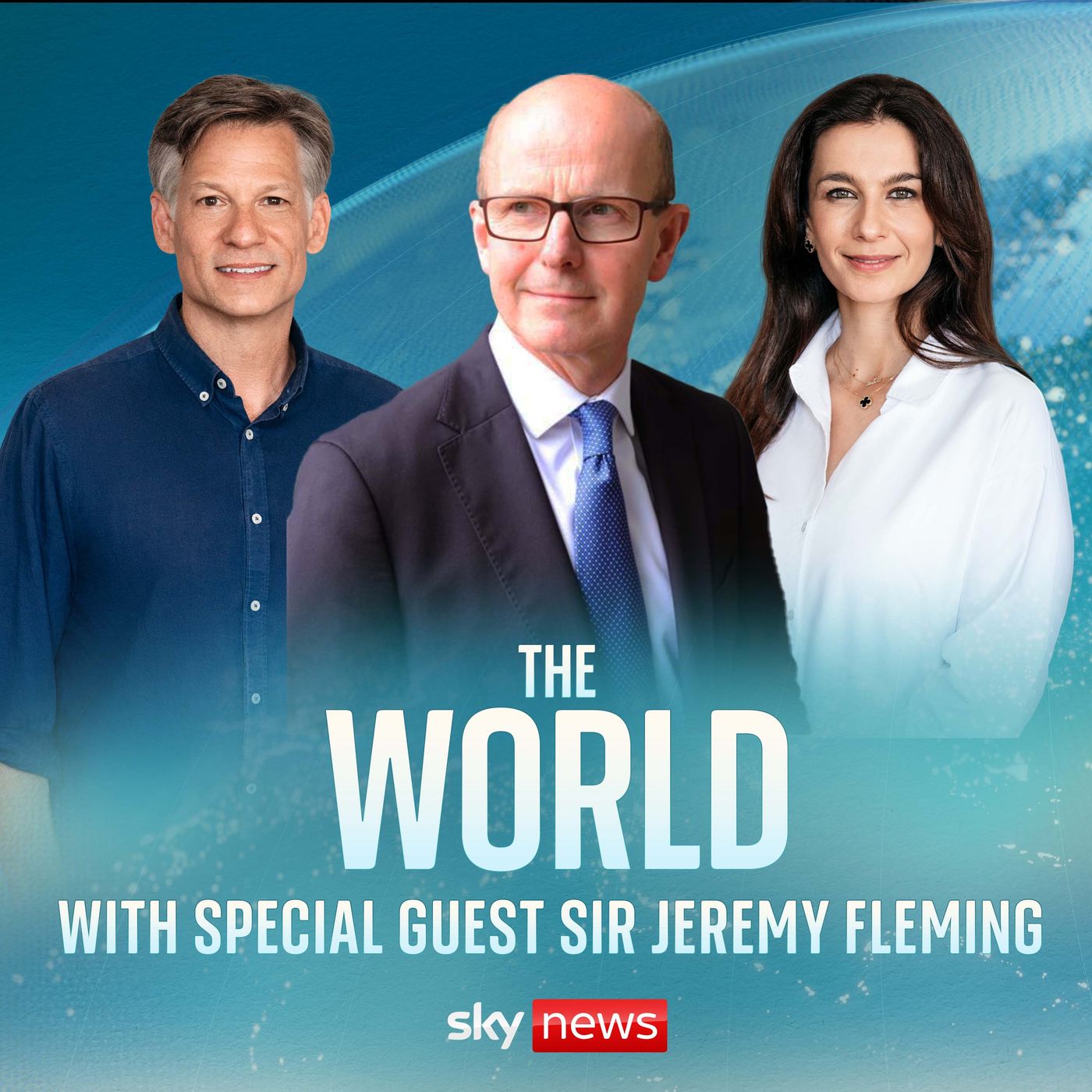
The World with Richard Engel and Yalda Hakim
Former spy chief on Gaza, China, and cyberwarfare
00:43:19
Former GCHQ director Sir Jeremy Fleming joins Richard and Yalda for a wide-ranging conversation covering the war in Gaza, Donald Trump’s foreign policy, the threat of China and the dangers of AI. What does the former spy chief think will happen in...
Loading summary
Transcript80 lines
- [00:08]
Yalda Hakim
Hello and welcome to the world with me, Yalda. I'm in London and I just got back from the Gulf.
- [00:14]
Richard Engel
And me, Richard Engel, I am in Portugal right now, just back from Iran.
- [00:19]
Yalda Hakim
So, Richard, this week we're joined by a very special guest to talk us through the week's big news, as well as, of course, the broader themes that we often talk about. On this podcast. Today we have the former head of GCHQ on Sir Jeremy Fleming. And for those who don't know, GCHQ is the UK's intelligence and security agency.
- [00:39]
Richard Engel
A lifelong spy, Sir Jeremy was at his job at this top post for six years and just left in 2023. He was there during President Trump's first term, was head of the agency as Russia launched his full scale invasion of Ukraine. He was there during the Salisbury nerve agent attack, which was quite horrific and it got a lot of attention in the uk, not as much internationally, but I was sort of nearby and responded to it pretty shortly after it happened. It was really devastating with these Russian spies dropped this nerve agent and ended up killing the wrong people and it was dumped in a dumpster. A really horrific story. And he was in office during the Manchester arena bombing. That terrorist attacked during the Ariana Grande concert that killed so many young concert goers.
- [01:25]
Yalda Hakim
Yeah, massive career. And as we said, we're both back from the Middle east and I think we can start on talking about what's going on there. And then, of course, we will be discussing the war in Ukraine, what the latest is in terms of the conversation between President Trump and the Russian leader. We'll be talking about hybrid wars, cyber attacks and AI.
- [01:48]
Richard Engel
I want to ask his opinion on AI. I think it's going to be the end of the world. I mean, I'm very. I try and avoid it as much as possible and we can talk about. I'll tell you why. And as always, make sure you are following us wherever you get your podcasts, subscribe to our YouTube channel and of course, write to us@theworldky.uk.
- [02:14]
Yalda Hakim
Welcome to the podcast. Sir Jeremy Fleming, how are you?
- [02:18]
Sir Jeremy Fleming
Very good. Nice to see you. Thank you for inviting me.
- [02:21]
Yalda Hakim
Thank you so much for joining us. I've just come back from the Gulf. I was following President Trump around from Saudi Arabia through to Doha in Qatar. Big developments in the Middle east in terms of conversations he was having. But I also spoke to a senior representative of Hamas and we'd love to get your thoughts on the current situation in the Middle East. And Richard was speaking to a senior aide and advisor to Ayatollah Khamenei in Tehran. So we'd love to talk to you as well about the nuclear deal, but I just wanted to get your perspective on how you think Israel has been prosecuting this conflict.
- [03:03]
Sir Jeremy Fleming
Well, this is the issue on everyone's lips at the moment. It's a very hard watch. And I would note that the prime ministers of the UK, France and Canada have come out and with the strongest possible language, said that what Israel is trying to do at the moment is not proportionate and there must be a change in behavior to allow basic humanitarian aid into the country. And I frankly think that's a little bit overdue. And I strongly support that sentiment. I think it's what most of the world has been thinking now for some time. But that said, what we face is an incredibly difficult situation where we are looking at a military conflict that has no political process behind it. And we know from conflicts all over the world, many of which you both have covered, that one without the other doesn't work in the longer term. So I am at the moment quite pessimistic.
- [04:03]
Richard Engel
So that's where I was going with this, understanding that right now there's no real political solution, there's no peace process of any, of any substance. There's this talk that President Trump is apparently considering, according to NBC News's own reporting, that there's a plan floating around there to deport a million Palestinians to Libya. I don't know why. I guess because the Libyans need money and they have space in theory. But when you, you see Israel retaking over this area after it had a ceasefire and then retaking it over and now debating it going back and forth, being condemned by major European allies and the President and the Trump administration talking about this proposal, I don't know if it's ever going to see the light of day. How would you assess this? You said pessimistic. Can you give us more detail of your assessment, given your many years in the top, one of the top intelligence jobs in the world?
- [05:00]
Sir Jeremy Fleming
Well, I think that that proposal, if it's real, I haven't seen that, by the way. But if it's real is just madness. The practicalities alone are mad, let alone the implications. The human cost of all of that and actually, increasingly, I think the longer term impact for both Israel and the region of ideas like that. I mean, I would note that in the, in the 2000s, when we first started to face Islamists inspired terrorism in the UK, there was always a little bit of backstory in every one of the people that we round up that had Palestine somewhere in a sentence. Now, often they didn't understand what that meant. Sometimes they were a bit more exposed to it, sometimes they had a distorted view of it. But it was always in that narrative. And my concern as we look to the future is that that is increasingly going to come to the fore and we won't just see the implications of this in the region, we'll see it beyond the region, we'll see it in Europe and beyond.
- [06:04]
Yalda Hakim
Jeremy, I just wanted to ask about that because, you know, there are, as you say, when we think about radicalization process and we've all covered the sort of rise and fall of ISIS and how Al Qaeda recruits and you know, online recruitment and the sort of in the cyber world, how it's done, the Palestinian cause is often used by these extremists to rile communities and people up. So do you fear that what we're seeing now is going to be used to create homegrown terror networks in places from the UK to France and the United States?
- [06:46]
Sir Jeremy Fleming
Of course, depending on where we end up here. But I'm pretty sure that it will be part of the radicalization process for some people. It will provide an additional trigger, if you like, to move down the track towards violent extremism. And of course beyond that, it doesn't need to be violent extremism for people to take a position which ends up being difficult for Israel in the long term, being difficult for its allies. And so the longer term implications of this are incredibly difficult. And the absence of a political process makes it really hard to stomach. And of course on the other side, inside Israel, you've got a coalition led by Netanyahu that is extremely fragile and where his room for manoeuvre is so small too. So when I said I was pessimistic, Richard, that's what I meant. Inside Israel, little room for maneuver. Inside Gaza, a military only solution. Beyond that, the ramifications of this spreading far and wide. And of course, where you've just been, Yalda, an approach to, to America's foreign policy, which is, which appears to be all about the economics, all about deals, rather than thinking about the longer term security and stability of the region itself.
- [08:07]
Richard Engel
So I wanted to ask you about that. So here, just while you were talking, I looked this up. This is the article from NBC News a couple of days ago by Courtney Kuby, Carol Lee and Gordon Lobold. The Trump administration is working to on a plan to permanently relocate up to 1 million Palestinians from the Gaza Strip to Libya. Five people with knowledge of the effort told NBC News. Continues the plan is under serious enough consideration with the administrative that the administration has discussed it with the Libya, with Libya's leadership, two people and a former US Official said. So that's a kind of deal making. I think it would be unworkable and horrific to watch. I don't know how anyone would even imagine to carry it out. So this is an administration that's looking for deals. It seems like they're throwing everything up against the wall. They're looking for business deals. And is that one, is that the impression that you have? And two, where does that lead the world when you have an administration that's doing this, that's looking for all kinds of deals, good, bad and different or crazy?
- [09:15]
Sir Jeremy Fleming
Yeah, obviously I recognize the language. The language of the administration itself is about deals. We knew that from President Trump's first term and we're seeing it on steroids this time round. And to a degree, foreign policy is always about deals. I don't think that we should be shy or naive in thinking that there hasn't always been real politic at the base of loads of foreign policy in history. So the fact that there are deals to be had, that is a fact of life. The fact that they are coming at the speed they are, but also in a way which at least some people believe is not connected to a grander strategy that could cause problems down the track. And there are no doubt that some of these deals were needed, that we needed a rebalancing in some areas. But in other areas, it can leave friends and foes a bit confused about what's going to happen next. And if you're talking about it my wheelhouse on national security, then that uncertainty can become an issue in itself. It can be an issue that drives behaviors of allies as well as those who we might think are adversaries.
- [10:33]
Yalda Hakim
Jeremy, just on the whole idea of the art of the deal, foreign policy, I guess, does that mean that in that sense you end up screwing friends? And we can see that with the transatlantic relationship now under a great amount of strain because President Trump is doing what he feels is the right thing to do when it comes to how he deals with Russia, which is frustrating the Europeans and the Ukrainians, just to steer your attention a little bit away from the Middle East. And if we look at the situation with Ukraine at the moment, your assessment in terms of how you think this might end?
- [11:15]
Sir Jeremy Fleming
Yeah, I think in the way you describe this, I think frustration would be the word that I would alight on I think it is frustrating not knowing with certainty where things are headed and perhaps not understanding the strategy. I think the underpinning question is to what extent does that undermine the alliances themselves? And there I'm a bit more optimistic. I think we're, we're not just fair weather friends and allies. We have decades of working together and systems that well understand each other and want to support each other. And at the base of it, we still share a set of common values, approaches and systems. But when you look at Ukraine, then I think there is frustration here, but there's frustration from the US Administration too. You know, I suspect you could say, looking at their own proclamations on this, that actually they've been very frustrated and possibly a bit surprised, maybe a bit naively, but possibly a bit surprised by the extent to which it isn't possible to strong arm the parties here to a deal. I welcome the phone calls that are happening. I think it's, it's important that President Putin and President Trump have a conversation. But it's equally important that Europe and Ukraine are around the table determining the future of this continent that I'm sat in at the moment. And my longer term view on all of this is that that's where it's going to have to go. You don't get a long term solution. Even if we get to a situation where support is withdrawn, you won't have a longer term solution unless you've got all of the parties around the table for that sort of conversation. I don't think that we are headed towards an immediate ceasefire. I don't think that's going to happen. You know, President Putin's language yesterday, was it going to take step towards producing a memorandum? I mean, this is, you know, everyone ought to understand by now that the way Putin does this is to string things out. And that's what we're seeing again now.
- [13:24]
Richard Engel
And Yalda and Jeremy, one thing I just totally don't understand and if I'm in Putin's position, I do nothing. President Trump keeps saying, if I, if, if, you know, if I don't like what I hear from Putin, I'm just going to walk away. But that's what Putin wanted from the very beginning. You know, he's like, oh, this is a deal. I'm the customer and therefore if I don't like the terms, I'm going to go shop in some other store. It's not like that. The United States is the main supporter of Ukraine. He walks away. Putin gets what he wants. So his threat is to say, I'M just going to walk away. I'm going to go, you know, look in the other shop to see if I can get a better bargain. There is no other shop. This is the job. The US is depending on Ukraine or it's not, or the US abandons Ukraine. I don't understand what walking away means. When you're in Ukraine. I've been in Ukraine a lot. When they say, oh, we're just walking away from negotiations, like you're not some third disinterested partner. You're the main person keeping the army going. So if you're Putin, doesn't that good news to you?
- [14:19]
Sir Jeremy Fleming
Well, it is and it isn't. I mean, short term, you could say, arguably it is, you know, it would, it would undoubtedly weaken Ukraine's ability to defend itself. In the short term, it would undoubtedly allow the Russian military machine to grind out a few more kilometers or more quickly, some kilometers. But longer term, it can't be what Putin wants because it's going to force Europe to follow through on what you've been doing around creating itself a real military and defence and security capability. It's going to close off any sorts of Western economic avenues that Putin might think that he can have access to to recover the disastrous effects on the Russian economy over several years, to reduce rampant inflation, reduce its economic debt. So Putin, if we know anything, Putin is very long term in how he thinks about these things. He has shown in the last couple of days that he will take the losses and keep taking the losses rather than move back from any of his red lines. And America walking away, which, by the way, I don't think is going to happen, but America walking away would give him a short term gain, but even he would understand that long term that is probably not in his interest.
- [15:40]
Yalda Hakim
Jeremy, someone tried to explain to me how Donald Trump sort of views the Ukraine, Russia conflict. And let me know if you think this is accurate, that he sees Putin as sort of the local thug and it's not really something that is his issue. It's Europe's problem and it's really China that is the major national security threat for the United States and perhaps the west as a whole. So detangling themselves from the Ukraine war so they can focus on China is the ultimate sort of goal and plan here. And that it's just for the Europeans and Russia to settle their differences over Ukraine and nothing more than that, rather than perhaps how the Europeans view it, is that, you know, Russia remains this kind of existential threat to them. And beyond that, you know, that it's not just about Ukraine, it's about territory beyond Ukraine. And that's why Europeans should be worried.
- [16:40]
Sir Jeremy Fleming
I don't necessarily recognize the language there, but this administration has more or less said that this isn't their fight. So this is wherever you look. That has been a consistent theme. So if you take that at face value, I think there is something behind the argument that if you get beyond this, if you're able to create a deal around all of this, then you leave Europe that understands that it has to take responsibility beyond the umbrella that America has provided for so long and create its own, you know, military and security power. And you leave an America that is more free to, to focus on the Pacific and what it might consider to be its, its major foe. So I think there is something in that as an argument. I mean, my, my view is that on, you know, Russia, Russia beyond Ukraine, I think even if Russia was able to make, say America withdraws and Russia makes significant progress in Ukraine, it is in no state to be able to go beyond that. Its military is severely undermined. It would take years, maybe as much as a decade to pose a significant military threat beyond Ukraine's borders. It, of course, can continue to escalate what it's doing in a hybrid basis. And we could, we could and probably should talk about that. There's a load going on in that space, but I'm not in the camp that thinks, well, this is just a war machine that rolls on. I don't think that'll be the case. And I think the longer term issue is still China. I mean, I've talked in the past about Russia giving us some really difficult weather in the continent, but the long term climate change coming from China. And I still think that's the case from a national security perspective.
- [18:29]
Yalda Hakim
Jeremy, I just want to pick up on a couple of things you said there about China remaining the number one national security threat. Just if you can expand on that a little bit. And you also mentioned there about hybrid warfare and what's going on. You said there's a lot going on in that space. You know, just in terms of the kind of cyber attacks that the public should be expecting. Every now and then when something happens at Heathrow or elsewhere, people go into this whole idea that, oh my God, is this, this cyber attack from, from the Chinese, you know, how often, or the Russians, frankly. I mean, how often are these things actually happening and the public doesn't necessarily find out about it and, and you know, you guys are sort of behind the scenes documenting it. Clocking it and saying, right, they're doing this and this and this and you know, this is what the, the future is likely to look like in terms of cyber warfare, the kind of hybrid warfare that you're talking about.
- [19:30]
Sir Jeremy Fleming
Yeah, let me focus on the hybrid aspects of that question, Yalda. So firstly, we've seen across Europe.
- [19:41]
Richard Engel
A.
- [19:42]
Sir Jeremy Fleming
Rash, an escalation in hybrid techniques, mainly from the Russians across Europe. And we've seen it in the last couple of days. We've seen the Polish Prime Minister attributing the destruction of one of the biggest shopping centers to Russian link top operatives. We've seen it in the way in which devices have been deployed through the post. We've seen it here in the UK with a, with a Bulgarian connected group just arrested to in total, I think 50 years.
- [20:14]
Richard Engel
You have a very specific term when you mean hybrid. Tell everyone what you mean by hybrid. A cyber attack that sends a bomb in the post is not a cyber attack anymore, it's a hybrid attack. So tell us about that.
- [20:24]
Sir Jeremy Fleming
Okay, so by hybrid I mean using things that are way beyond normal military techniques or beyond what we have come to expect of the norms around, you know, intelligence competition. So this is assassination plots. If I was to go in the UK we've had 20 assassination or kidnap plots from the Iranians since January 2022. Now that is at a level and a pace that we haven't seen frankly that sort of let me know. Those sorts of numbers are the sorts of numbers that we used to talk about in MI5 as the numbers of disrupted Islamist extremist plots in the first decade of this century. This is at a level which is unprecedented. A cyber attack is using just cyber means. And you could say that that is part, and people do say that's part of this hybrid competition too. And that can form, that can span at the one end something which is deliberately pre positioning or intended to be disruptive. You've seen the Americans talk about the Chinese ability to intercept, I guess what you could take to be any American's phone by tasking the intercept capabilities of the US telcos when they're required legally and lawfully to do so. Those sorts of things, they're pretty easy to allocate. At the other end you're into disinformation space when you're right in the middle of this. Well, what is free speech? Who can talk about these things is amplifying a wedge issue? Who supports what football team? Or much more seriously, what's happening in Gaza at the moment or what's happening on Campuses in the US Universities. Is it okay for a foreign adversary to go in and amplify views on both sides of those issues just to undermine trust? Now that, for me, that forms part of hybrid competition and maybe warfare. By the way, I'm really careful about militarizing cyberspace. I don't like talking about in military terms, but there is an aspect of it that is military. You're right at the heart here of what is a very current debate. Where is freedom of expression and speech if you are just promoting one side or another? And there's a live debate in the UK and in Europe about that too.
- [22:59]
Yalda Hakim
Jeremy, just on just want to sort of ask you just another question on the concerns around China. When you describe China as the number one national security threat, is it because of the great power competition realm that we've gone into? Is it because they're a formidable enemy? Is it because you feel that they're constantly preparing for war? The sort of timelines that we hear that Xi Jinping has put out in terms of a takeover of Taiwan, what is the reasoning behind you placing China as the number one national security threat for the UK and the west as a whole?
- [23:36]
Sir Jeremy Fleming
But China is a peer level superpower to America. I still found myself taking a bit of a deep breath when I say that. But it is, I mean economically, what is it? Number. Number three? Number two? Three in the world. Now militarily, it's very close now to the scale of America. You have to say that it is doing a pretty good job at the moment at expanding its circles of interest. And you also have to understand that the way in which it's governed, the fundamental under ideology which underpins PRC is I don't think, aligned with our national interests or with our national security. So we have to be very understanding that when we deal with China, we're dealing with a big and powerful country that operates in a different way. And we better have our eyes and ears very open as we, as we deal with them. Go back to the beginning of our conversation when we're talking about frustration and uncertainty in this sort of context. Well, you have to say that this is actually a good moment for China. They can take advantage of this. And we in the west need to decide what we want to do about that. I don't suspect that there is a grand deal that will result in that threat going away. So we better be thinking about this from a long term perspective.
- [25:00]
Richard Engel
So since we're moving into cyberspace right now, and if the world is hybrid at this moment, I Mean, the Ukraine war is a traditional war, but it's also a drone war. And those drones are increasingly, their targeting systems are increasingly smart and automated and they've been making a lot of sort of strides in that category. And the intelligence war in Gaza, the Israelis, you know, have every eye, every drone, every intelligence capability that they can think of over the Gaza Strip right now. So it is in, you know, a real traditional war with guns and tanks and bullets, but also there's a lot of bits and bytes that are going in there. But on the strictly information war and the strictly, you know, what, what has happened in the last few years, I mean you served for six years at the top of sort of British signals intelligence and let's call it non digital intelligence. I think that would be an easy way to put it. Since then AI has really gone mainstream. That was probably something that was only really known in your realm, but now it is coming to the public realm. How do you see it? As someone who spent years and years holding the most top level security positions, dealing with cyberspace, watching the evolution of cyberspace. This thing has happened and is now out there. We're all interacting with it all the time. Is this a good thing? Is this going to lead to the end of humanity? And I'm not being flippant here, it's such a transformative thing that has just happened. So what do you, how do you get your head around it? Aside from Hybrid? What about this new arrival of this thing that has just landed upon us? It feels like something hit us for, you know, Martian men came out.
- [26:44]
Sir Jeremy Fleming
Yeah, yeah. I mean so yeah, Martian men have come out. And I think you are right in, in in pointing to the importance of this, you know, for society as a whole. We've been talking about security and foreign affairs and, and national security, but this is the biggest single thing that will have happened in my lifetime. It's going to change our economy, it's going to change our societies, how we interact with each other and of course it will change security too. So I think you're right to highlight the importance of all of this. Does it mean the end of the world? No, I'm not in that camp. I'm really not in that camp. But I am really clear that it requires us to act very differently in government, in the private sector and in society as we seek to understand what it's going to be like to. I think I recently heard someone talking about co evolution of these capabilities alongside us. And actually I don't think that's too much of A stretch. I mean, these capabilities are evolving very quickly. And at the moment, we have some sort of way of understanding the trajectory of where they're going. We don't completely understand how they work, by the way, but we have some sort of understanding where it's going. But the next couple of iterations of this are going to see us move away from that. And we in governments, we at the top of business, need to understand what it is going to be to coexist with these sorts of capabilities. Ultimately, our economies are going to be dependent on the success of them. Our security will be dependent on the success. And the way in which we interrelate as humans is going to be dependent on how these things and their character, the values upon which they're built and how they're overseen and delivered. So I'm completely with you on all of this. Just one further word on this. Having said already that I'm not in the this is the end of the world camp, I do think that there are some threats from the way in which adversaries will be able to use these capabilities that could hit us quite hard. And in amongst all of that, I am really worried about the debate around open sourcing of these capabilities. I don't think we're very far away from people who aren't experts being able to develop capabilities using some of these large language models that could have and could cause harm.
- [29:17]
Richard Engel
Alexa, build me a chemical weapon.
- [29:19]
Sir Jeremy Fleming
Well, biological, chemical, I think is close.
- [29:24]
Richard Engel
Do you use AI? Do either of you use it on a daily basis? Do you engage with it and ask it things and ask for it to do things for you and to ask its opinion on anything?
- [29:32]
Sir Jeremy Fleming
Yeah, of course I do, Richard, but everyone does.
- [29:35]
Richard Engel
I don't.
- [29:36]
Sir Jeremy Fleming
Yeah, you do. Have you got a phone?
- [29:38]
Richard Engel
I don't. I. I don't actively. I've never asked it anything. I have a phone.
- [29:42]
Sir Jeremy Fleming
I know.
- [29:42]
Richard Engel
And I'm an outlier on this virginity test. I want to be an AI virginity pledge. I don't want to use it. I don't want it in my head. I want to use it as a calculator. I will use it, but don't tell me anything. I don't want your opinion on anything because you are not a person. You are not a thing. So I don't ask it anything. I've decided my whole life I'm gonna go and I'm never gonna ask it anything. It will be a calculator to me if it wants to count how many genes and how genes match up. And I don't I mean, I'm thinking about this because I think it really. You think globalization ended the, ended individuality, or most people think like, this will really end individuality, you know, across, across the world. I'm not interested. I think it's a net minus. It's going to bland us all out. It's going to turn us all into, you know, IKEA flatware. I'm really not interested in it. As little as possible. I just don't want it, I don't want its opinion.
- [30:35]
Yalda Hakim
Jeremy's like, okay, cool.
- [30:37]
Sir Jeremy Fleming
No, look, you don't want its opinion, but you do want its services and you do want the advantage that it can give you. And you want the convenience. And you know that you, you are getting that already and you cannot avoid that, whether you like it or not, unless you're going to go be a hermit in a woods somewhere. You will live in a society where you are affected by AI. The question you're answering, your challenge here is to what extent do you want to allow it to have an opinion? And how are you going to make sure that you are only taking account of that when you want it to or you understand why it's doing it?
- [31:14]
Richard Engel
Well, my car does what I tell it to do, right? I park it, it stops, it does what I tell it to. It's not that I want to live in the woods. Oh, that sounds pretty nice. I just want the technology to do what I tell it to and not come up with ideas and tell me what, how, what a great thing. I have a car, I'd like a car. I'd like a fast car that's fuel efficient. Great, I'd love that, you know, and I want technology, I want better tools, I want better science, I want better medicines. I just don't want its opinions. I think AI has lots of, of intelligence without any wisdom and it doesn't have any humility. It doesn't know when it's wrong.
- [31:47]
Yalda Hakim
Jeremy's like, go on, go ahead.
- [31:50]
Sir Jeremy Fleming
Look, one, one final thing. Look, I think it was, it was Yuval Noah Harari who said that only humans should have human rights. And I completely agree with that. So, you know, these things cannot have human rights. They might have rights, by the way, but they can't have human rights. So.
- [32:17]
Richard Engel
The first 100 days might be over, but President Trump is showing no signs of slowing down. America will soon be greater than ever before. So we're continuing to follow every twist.
- [32:30]
Sir Jeremy Fleming
And turn of this remarkable presidency and.
- [32:33]
Yalda Hakim
Trying to make sense of what it all means for the US and for the rest of the world.
- [32:38]
Sir Jeremy Fleming
So join me, James Matthews, me, Malte Kalma, and me, Mark Stone, for Sky.
- [32:43]
Richard Engel
News, Trump 100, wherever you get your podcast. So I just got back from Iran and I met with senior officials, including one of the top advisors to Ali Shamkhani, if you know the name. He's one of the top advisors to Ayatollah Khamenei, one of the most powerful four or five men in all of Iran, military advisor, nuclear advisor, political advisor to the Supreme Leader, an older guy, so he has a lot of credibility behind him. And he sits down and says, after saying America can't be trusted. And Trump has got it all wrong. A lot of saying what you would expect to say. Then he was like, look, at the end of the day, we want a deal, and we will agree to a deal under certain conditions. And he laid them out. They said they would move away or no longer be in possession of the highly rich uranium, which is the stuff that can make a bomb eventually, that they would only enrich to a very low level. And in exchange for doing that, they would want lifting of all sanctions. He's like, we're ready to go if we do this. And Trump then put it out on truth social media and then referenced it in a speech directly saying, looks like the Iranians are pretty close. So do you think we're close to an Iran deal? And what, did what I just tell you surprise you in any way?
- [34:09]
Sir Jeremy Fleming
No, I don't think it's surprised me because it's been clear that Iran would like a deal. It is. Over the last couple of years, it suffered a reversal in its regional ambitions, a severe undermining of its power through its proxies. Economically, it's been in a bad place. It's just. Just about kept a lid on the social unrest in the country. And I think I'm with you when you say that Iran wants to do it. So that bit of it isn't a surprise. In fact, quite a lot of it's Groundhog Day for me. I mean, I can't tell you the number of Whitehall tables I've sat around before I retired a couple of years ago, where this sort of conversation was happening. At what point will Iran have to come to the table? How resilient, really, is it? Where do we really think they are on nuclear enrichment? How can we make sure they adhere to previous agreements? And by the way, with your summary of what sort of deal you said they would expect, that's very close to the JCPOA that Trump walked away from in his first presidency. So, you know, there's all this sort of going, going on here and, and we need to have something that tips it over the edge. Remember, the thing that did for the JCPOA was that there was nothing in there that provided any sort of sanction over Iran's regional proxies. And so it was the IRGC's activities and the way in which Iran was funding the military fight in the region alongside the military deal that just made it look so absurd. I have noted that whilst you said that they'd accept a deal that allows them to do something from a domestic nuclear perspective, I suspect that really is their red line. I suspect. But the American administration is saying 1%, not more than 1%. Well, that doesn't give them any domestic nuclear. So this is, I think a deal is possibly on the table. Are the two sides close enough yet to negotiate it properly? I don't know and I can't tell from here. In fact, you have been much closer to it than I've been, Richard.
- [36:17]
Yalda Hakim
Jeremy, can we put some questions to you? We've had an overwhelming sort of number of people, right, and they want to ask you all sorts of things. Dor Duka says, does being bold make a better spy?
- [36:30]
Sir Jeremy Fleming
Yeah, but being bold, but not being stupid. I mean, so spies have to take risks, but you do it within a very specific context. And I hope I don't need to say this to your listeners, but at least in our societies we operate within the law. So yeah, be bold, take risks. And I certainly look for people who are innovative, but you've got to toe the line to.
- [36:55]
Richard Engel
Okay, another one of these questions, this one from Visum Thakur. What is the next big digital war? Question mark?
- [37:04]
Sir Jeremy Fleming
Yeah, that's a really hard question, isn't it? I mean, so my personal view is that war is not the word I would use here, but I think harm is going to come at a societal level from the way in which pretty basic AI capabilities will allow the tailoring of fraud and crime. So you can see that already the crime you're most likely to suffer in the UK is a cyber fraud. And these capabilities allow these from a behavioral science perspective to be much better targeted. And I think that the harm you get from that is going to be more noticeable at societal level. And that worries me.
- [37:45]
Yalda Hakim
Jeremy, Prabh Sakaria says, what is your spy master take on the India Pakistan conflict? Obviously we saw these two nuclear rivals almost go to war, which felt confined to the region but should be concerning to everyone.
- [38:01]
Sir Jeremy Fleming
It definitely should be concerning to everyone. And Yalda, you probably ought to answer this question that they together reached a solution. I think probably you would have on the balance of probabilities, that's where you would have gone. But it seems to me that it has pushed a bit further this time and we are in a situation where both powers are nuclear powers and where one is. You might have said there was a balance of power, a clearer balance of power in the past, but India's economy and its direction is outstripping Pakistan's at the moment. And so you can see perhaps a shorter time period between now and the next time. There's some sort of conflict and I don't think that can be left to the region. This needs, you know, friends and allies of both countries to step in and make sure that there's proper conversations around the issues at stake. But also the channels are open for de escalation when mistakes happen.
- [39:01]
Yalda Hakim
Ashu Singh says, who is the next 007?
- [39:07]
Sir Jeremy Fleming
God, wouldn't we love to know. I thought he was killed off in the last movie. So they're making another movie, aren't they? When we find out. And by the way, you know, love them as I do, there is, there is nothing about those films which is accurate.
- [39:25]
Yalda Hakim
Oh no. So it doesn't have the sort of element of the elements of glamour that we associate to it.
- [39:33]
Richard Engel
British government bureaucrats are not that well dressed and that cool and that well paid and have that many yachts.
- [39:38]
Sir Jeremy Fleming
I mean, can't you tell? I mean, I'm shocked.
- [39:44]
Yalda Hakim
Jeremy, before we let you go just on Signalgate, would you think twice now if you were in the position that you were once in, in terms of intelligence sharing, in terms of the five eyes, how you would deal with your counterparts in the United States?
- [40:03]
Sir Jeremy Fleming
No, no, this is. There was some naivety around using publicly available platforms to communicate stuff which is started, I can see, look pretty sensitive. So you know, that, that, that happened. I suspect they've learned some lessons from that, but I don't think that has a bearing on the, on the broader alliances or the closeness of intelligence cooperation. And I'm pretty, you know, whilst I'm not on the inside anymore, I'm pretty sure that that will be working as it's always worked. Which means that where are our interests align, where we share our values, where we share our legal systems, we'll continue to share as closely as we ever have done. A common misconception on the five eyes is that it's this sort of agglomeration, a federation of companies that are operating to a single strategy and it's just not like that. I mean it's a club of those like minded nations, all happen to be English speaking, who have 80 years of, of sort of DNA and experience of working together, who have always shared bilaterally, trilaterally, sometimes all five countries together. But to think it's this sort of always functioning in one way and institution is just not. It's a very powerful, perhaps the most powerful ever security alliance and it will continue to operate in that way.
- [41:28]
Richard Engel
Yalda, should we let Jeremy go? It's been an absolute pleasure to have you.
- [41:32]
Sir Jeremy Fleming
Well, my pleasure too and very nice.
- [41:34]
Yalda Hakim
To see you Bev, thank you so much. Really, really appreciate it. Jeremy, thank you. Thank you so much. Bye bye.
- [41:48]
Richard Engel
Well, that was great, Hilda. That was fascinating.
- [41:50]
Yalda Hakim
That was amazing.
- [41:51]
Richard Engel
From geopolitics to I let him into my paranoia about AI, which I don't think is totally off base and always interesting to, to hear from someone who's lived his whole life on the inside.
- [42:02]
Yalda Hakim
Absolutely. And we did get a real insight into the paranoia of your AI. Paranoia which I've heard before, I can't say.
- [42:10]
Richard Engel
And I think it's going to be the end of us all because I remember, I think my kids one day are going to look back at me and say, oh, you know, my dad grew up, you know, before the Internet and before AI and I'm really excited about him knowing that. So I don't want to engage in it for that. I can spoil that for him. He remembers someone he used to think before this sort of whole computer decided to do it for you. You know, when I tell someone I thought of something, it's because of a book I read, usually off the shelf or it's something I saw or something I thought about or I talked about with you and I can feel pride in ownership of that. Or you borrow ideas, sure, but you didn't just sort of get it spoon fed to you for some computer, of course. Seems like a cheap shot to me. I and I, and I, I, I, I'm looking forward to those days ahead. And I'm thinking, God, our kids, they won't have this opportunity to be the last people who say we're not gonna give me my own thoughts for a little while for as long as I can hold on to them before they get all laundromatted and put through the ringer and all come out looking the same.
- [43:12]
Yalda Hakim
Yeah, no, I, I hear your concerns, you know, I'd like to know about it, be aware of it, but obviously it's like, you know, the these poisonous bats that have been handed to us, and we're like, we don't want it. And they have been thrust in our faces.
- [43:24]
Richard Engel
Yalda, another fascinating show. It's great to, great to be with you.
- [43:28]
Yalda Hakim
So good to see you, Richard. And thank you to our listeners for listening. Goodbye for now.
- [43:50]
Richard Engel
The first 100 days might be over, but President Trump is showing no signs of slowing down. America will soon be greater than ever before. So we're continuing to follow every twist.
- [44:02]
Sir Jeremy Fleming
And turn of this remarkable presidency and.
- [44:05]
Yalda Hakim
Trying to make sense of what it all means for the US and for the rest of the world.
- [44:10]
Richard Engel
So join me, James Matthews, me, Malte Kalma, and me, Mark Stone for Sky News Trump 100. Wherever you get your podcast.