← The World with Richard Engel and Yalda Hakim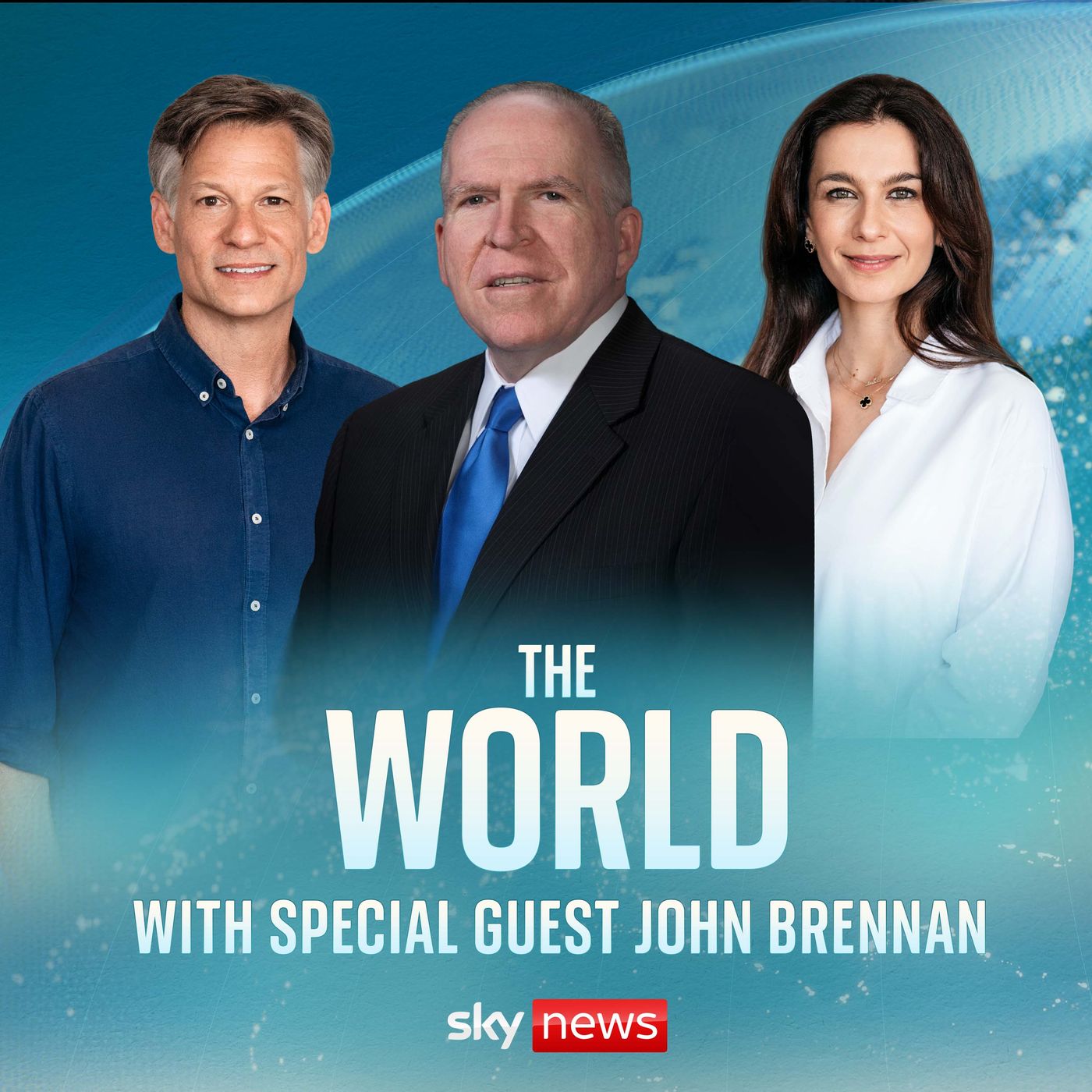
The World with Richard Engel and Yalda Hakim
Is Ukraine winning the spy war? In conversation with ex-CIA chief
00:44:11
This week, Richard is in Ukraine, recording just hours after the country was hit with 500 drones from Russia. He is in Mykolaiv and brings Yalda up to speed with what the city is like, over two years into the conflict. Yalda then takes Richard behind...
Loading summary
Transcript69 lines
- [00:05]
Yalda
Hello, this is the world.
- [00:08]
Donald Trump
Well, we're gonna have troops everywhere. We're not gonna let this happen to our country. We're not gonna let our country be torn apart. Many protests across the city have been.
- [00:17]
John Brennan
Peaceful and we thank the community for expressing their views and their frustration in a responsible manner.
- [00:23]
Yalda
I'm Yalda and I'm currently in London.
- [00:26]
Richard Engel
And I'm Richard Engel and I am back in Ukraine. Yalda.
- [00:31]
Yalda
Several buildings have been hit in Kyiv, in Odessa. It comes just days after Russia launched its biggest overnight bombardment of the war so far. It's been another huge, eventful week. We saw the bromance between Donald Trump and Elon Musk. That's now over.
- [00:52]
Donald Trump
I'm very disappointed in Elon. I've helped Elon a lot and he hasn't said bad about me personally, but I'm sure that'll next. We have it with others too. They leave and they become hostile. I don't know what it is. Someday you'll write a book about it and you'll let us know.
- [01:07]
Yalda
Climate activist Greta Thunberg set sail with aid into Gaza. My name is Grifa Tumbe and I am from Sweden. If you see this video, we have been intercepted and kidnapped in international waters.
- [01:21]
Richard Engel
She didn't make it. And there have been those protests in la. And for the first time, President Trump is taking an extraordinary step. He's not just sending in the National Guard to put down these protests, he's sending in the National Guard despite the insistence of the Governor of California, a major, major development in the United States. And of course, I'm back here in Ukraine. So I want to tell you about what I'm seeing, what I'm hearing here after two records breaking nights with Russia firing nearly 500 drones at this country, which is an extraordinary number, more than has ever happened since the start of the war.
- [02:08]
Yalda
Richard, as you say, you're in Ukraine at the moment, so we want to focus on Ukraine this week. I also spoke to the Russian ambassador to the uk. He said some really interesting stuff. And also, also later on we'll be speaking with the ex CIA director John Brennan, who, like Elon Musk, has had a very public falling out with the President and he'll be joining us a little later on the program. But first, Richard, as you mentioned, the LA protests, they started over the weekend because of Donald Trump's immigration crackdown and the National Guard has been called in and they certainly seem to be escalating the situation. We also saw the Australian Channel 9 journalist Lauren Tama. She was hit by a rubber bullet while live on air. Did you see that? Because both of us have covered all of these sorts of protests in the past.
- [03:05]
Richard Engel
I did, and I've been hit by rubber bullets myself in the West Bank. They. They hurt. They're. They're not really bullets. They're. Think of them as like round pebbles or marbles. Marbles is probably the best way to imagine them. So imagine a really hard marble that is covered in plastic or a rubberized material, and they hurt like, like, like, like hell when they, when they hit you. And you don't want to make, you want to make sure they don't hit you in the eye, because if they hit you in the eye, they can take your eye out. They could kill you.
- [03:39]
Yalda
Yeah, I mean, I've. I haven't really dealt with rubber bullets, but I've dealt with tear gas a lot. And, you know, when that goes into your eyes and your nose, it really stings and, you know, you sort of feel like you can't breathe. I have had it in Turkey, in Ankara and Istanbul, when they were protesting against President Erdogan.
- [04:01]
Richard Engel
So Yalda people, I think, should understand a little bit how the US structure is. Government is structured when it comes to domestic unrest or civil unrest. The governor has the power. If the local police forces and the local emergency services aren't able to handle a situation, there's a natural disaster, there's a riot, there's something extraordinary. And the local cops, in all of their different varieties, the traffic police, the beat cops, everybody, if the local system can't handle it, they can call up the National Guard. So it's a domestic force that can be summoned. It's not like the regular standing army. You might even describe them a little bit as weekend warriors. They overrank, but they're not the most elite US troops in the world. They're called together in an ad hoc way when is necessary. What happened in this case, there were these demonstrations, ongoing demonstrations in la, and President Trump, he called in the National Guard, going over the head of the local governor. By the way, he was a Democrat who's opposed to him. His name is Gavin Newsom. And then the governor has said, we don't want these National Guard here. It's just going to inflame the situation, pull them back. And President Trump is not pulling them back and is showing no signs of backing down. So this is a really important space to watch because it could escalate into, into, into real riots, and it could escalate in a situation where you seeing the President of the United States effectively pushing aside the governor and saying, you don't mean anything. You don't run your state. I've, as president, run, run every state. I run every aspect of this country. And that's not how the way the United. That's not how the United States was set up.
- [05:51]
Yalda
Yeah. And Gavin Newsom, you know, made it very clear that, that California doesn't need or want the National Guard to step in. And what was quite interesting is actually Donald Trump put out a statement on Truth Social on Saturday thanking the National Guard for their efforts. And in fact, they hadn't even arrived at the scene at the time, which Gavin Newsom talked about. But, you know, what's interesting about Donald Trump is he's the master of the wedge, you know, and what he has done now to Gavin Newsom is effectively said, if Gavin Newsom agrees to the National Guard stepping in, you've got the left and all of their potential supporters saying, you brought in the National Guard on us. You know, you are supporting the MAGA crowd, Donald Trump, and what they're doing to us. If he doesn't, you've got the other side saying, see, he wants to see riots. He wants to see this thing escalate. He has no control over the situation. So we're really seeing Donald Trump, who almost thrives on the idea of the left being out on the streets and protesting because he can then step in and be the law and order president, which is often talked about being. And you know, that is where he feels he has most amount of control.
- [07:04]
Richard Engel
President Trump believes that these images can help him. If you look at who's showing up, how they're dressing, the slogans, I can understand why President Trump would see this benefiting him. So, first of all, it's a demonstration or series of demonstrations that were launched in order to stand in solidarity with migrants. Right. Who are generally not a popular community in the United States. It's sort of a niche thing. So that's one thing that, where the. Where the protesters might be out of sync with the rest of the United States. And Trump could see that as an advantage. Two, some of these guys, some of these men and women who are protesting, a lot of them are carrying Mexican flags. And when I saw that, and I've been to a lot of demonstrations, I was like, that's a terrible idea. It's the worst idea. You want to show that you're representing if you're going to have an effective protest. I've seen lots and lots of them. You want to show that you're representing the country that you're in, that you're patriotic, that you're not representing some foreign interest. So I can see why he would be watching these feeds late into the night and getting excited about how this is going to play, play out in the international airwaves.
- [08:19]
Yalda
Yeah, absolutely. But just as reporters, I guess, you know, having both of us having covered riots and protests all over the world, certainly during the, the Arab uprisings and, and in various other places, you know, you realize it's like the fog of war. You know, in the chaos, it's really hard to kind of get to the heart of what's going on, especially when there are things like the, the rubber bullets and tear gas and the authorities and you know, in this case, the National Guard stepping in and the fact that so many people are saying we have the right to peacefully protest. Why have you escalated the situation? Why have you unleashed the National Guard on us? And then you've got the US Defense Secretary saying, you know what, the National Guard might not be enough. We'll bring out the Marines. I mean, this is, it's almost like a tug of war situation that could.
- [09:10]
Richard Engel
Really escalate and probably will escalate when you send in troops, National Guard or Marines or any kind of militarized force. Peaceful protests tend to get non peaceful very quickly. And that happens everywhere. You talked about Turkey. I always remember, I was covering the group of miners, right? They were miners protesting because there had been a mine disaster. And these miners were angry at the Turkish government because the conditions were poor and the rescue effort didn't work. And so they were out. And that's a, I think anyone could understand that's a legitimate kind of grievance. They go out on the street and they're angry because their mind collapsed and caught fire and lots of people were killed. So they were angry. Okay, fair enough. We get it. I was there watching it happen. I just happened to be there. And then I saw the police come in in force, in black with their body armor and their rubber bullets and their tear gas and the next thing you know, clashes, massive arrests, police start dragging people away. You know, police work is, can be really violent. So when the, when the police force come in, it almost always goes violent very quickly. And then those images of the violence are used by the state to justify their actions. Well, we had no choice. Look, there's chaos in the streets, there's pandemonium. And the dangerous thing here is that it's happening in a situation where the President of the United States is stepping over his jurisdiction by so many degrees. So I think it's not just has the potential to escalate on violence. I think it has its potential to escalate in a, in a major sovereignty way, in a question raising questions of sovereignty in the United States.
- [10:59]
Yalda
Yeah. Well, we'll be watching very closely over the course of the next few days and weeks to see where this, you know, how this unfolds. And we'd love to hear from all of you. If you're in LA or in, you're somewhere else that's seen civil unrest, send us your thoughts. Usual please the worldky.uk and if you don't already, follow us on your podcast app. So, Richard, you're currently in Ukraine. You're in the south of the country in my. Just tell us a little bit about what's going on there.
- [11:30]
Richard Engel
A few weeks ago, maybe a couple months, Ukrainians were very nervous, very panicked because President Trump had just cut off intelligence and punished this country because he didn't like the way that Zelensky apparently was behaving in the Oval Office. He was, quote, ungrateful. And you remember that humiliating moment with J.D. vance. So there was a real sense of nervousness. Now I'm seeing more confidence, more people out on the streets, more smiles. There were about 500 attacks just overnight, almost all of them drone attacks. The Ukrainians were able to shoot down almost every single attack that came from within. They're quite, they're feeling quite encouraged because of this. The secret operation, Operation Spider's Web, which was a Ukrainian operation, whether it had some outside help or not, is something we're going to discuss more when we talk to the former CIA Director Brennan. But I would say right now, Ukrainians are feeling pretty good, feeling like we don't need to give up and surrender 20% of the country and millions of Ukrainians, because that was always going to be an act of desperation for them. If they lose that territory, it's gone. The people will become part of Russia. There'll be new language, new culture, that they'll lose a part of their country for good. And they, and they're not willing to pay that price. So I would say right now Ukraine is feeling, Ukrainians seem to be feeling quite, quite a bit better than they were a few weeks, even a few months ago.
- [13:13]
Yalda
Richard, just tell us briefly what Mykolaiv is like as a city. I've never been. I've traveled, you know, around Ukraine, but never to Mykolaiv.
- [13:22]
Richard Engel
So it's in southern Ukraine. It's not far from Odessa, it's not far from the city of Kherson, it's not far from Crimea. So that's the. It's where the Dnieper river sort of ends and drains down into the Black Sea. And every time I'm becoming this city, I almost always pass through here. So I know Mykolaiv pretty well at this stage. And when I first came here, I don't know, early days in the war, there was nobody out, it was desolate. There was one bar called the Rakhata that was the only bar. Of course, I found it. It was the only bar operating. It's actually not far from where I'm staying. And people would go there and, you know, you talk how they have lock ins in the uk. This was a real lock in. They sold the soldiers or whoever was in town would go there. There'd be air raid sirens out outside and you could get a drink and relax. And it was a rock and roll bar. So people would come there and they would listen to rock and roll or they would perform. And it was the only watering hole in town. That was about a year ago. Now. Restaurants are open, people are out, ice cream shots are open, new cafes are opening. If you want to get a great latte or a flat white with the little design drawn on top. There are many places in Mykolaiv right now who will serve that to you. And the macaroons and all of the different pastries and things that go with it. So it's still an active war zone. The Russian front line is not very far away, but it doesn't feel like a city under siege. Yeah.
- [14:55]
Yalda
And, you know, Ukraine is sort of deceiving like that, because Kyiv feels like that as well, and many other parts of Ukraine. And, you know, these. These drone attacks that we're now seeing Russia unleash on the. The Ukrainians almost, you know, still waiting for this massive revenge attack to take place. And Donald Trump said that what we saw in terms of Operation Spider's Web was that it gave Putin a reason to bomb the hell out of Ukraine. And. And I had a conversation.
- [15:25]
Richard Engel
Richard, I want to hear. Tell me more. What was it like? You interviewed the Russian ambassador. Where did you. This was in London. And tell me more about this. Set the scene for me. Where did you go? How was he dressed? What was the place like? Did he serve you food? Did you drink it?
- [15:40]
Yalda
Did he serve you tea? I didn't drink the tea, just for your information. But the Russian consulate is in Kensington Gardens and it's A gated community with extraordinary embassies and consulates and residents as well. And you have to pass through security to get in there. I've been there now three or four times over the course of the last year or so. I've met the ambassador a number of times and we've sat down at different twists and turns when things have really escalated between the Ukrainians and the Russians. We have an ongoing, long standing interview request with the ambassador and you know, whenever they want to sort of speak to the world, speak to the British public, he picks up his office, picks up the phone and they give us a call and they ask me to come and I get summoned to the consulate and you know, they, I have to show my passport to get through this gated community. I arrive, I get screened. It's like going through the airport in this space that the Russians have had since the late 1920s. And, and it's, you know, covered in gold and, and extraordinary artwork as well. And it's, it has this sort of this wonderful wooden staircase that the ambassador, his team always makes me wait at the bottom of the, the staircase for him to, to arrive. And at exactly 12 the dot, he emerges and, and he has a team of his own camera crew. They put the entire interview on YouTube. So, you know, nothing is as far as they're concerned, edited out or edited in, you know, that they, they do it their way, but, but they descend.
- [17:19]
Richard Engel
Down to the staircase like Cinderella going to the ball as you're waiting there for him.
- [17:23]
Yalda
Yeah, very much so. And I greet him at the bottom of the staircase. And then we go in, we sit down on these golden chairs and then we have about half an hour of this sparring. And each time there is something that, a message that he wants to give, whether it's to the British public, to the West. This time it was about Operation Spider's Web. Do you. And does Moscow view what happened at the weekend as a humiliation?
- [17:48]
Russian Ambassador
No. Well, there are some people who are saying that of course there should be more precautions taken about the airfields, and that is correct.
- [17:58]
Yalda
But I said, you know, five air bases were hit. This came completely out of the blue. And he said it was you, it was London, it was the British military. The, the head of the Octopus. You know, as he describes it, he believes that, that Britain is the head of the, the, the Octopus of, you know, sort of the, the leader of the, of the Western European nations that's driving this, this.
- [18:19]
Richard Engel
As an American, I take a little offense that I thought we were the head of the evil Octopus.
- [18:23]
Yalda
Come on.
- [18:23]
Richard Engel
Well, well, you know, my whole life I've been the head of the evil part of the evil octopus.
- [18:28]
Yalda
Allegedly they have now switched tact because of course in the last interview President Trump had reached out to Vladimir Putin and, and they had seen this, the sort of, you know, Donald Trump say, you know what, I could strike a deal here on Ukraine with, with the Russians. So the attitude towards Washington has softened in a strategic way and they want to point the finger of blame on, on Britain and blame Britain for everything.
- [18:56]
Russian Ambassador
I don't believe that Americans. That has been denied by President Trump definitely, but it has not been denied by London.
- [19:04]
Yalda
And in many ways he blamed Britain and the British military and London for Operation Spider's Web. He said that it was the Brits that were behind it because of the intelligence, because of the support that they've been giving the Ukrainian military. And the Ukrainian military doesn't have the capabilities. So it was Britain that came up with this idea and helped the Ukrainians launch it.
- [19:26]
Russian Ambassador
Our hope that we will get a reaction from London as well because I will tell you, such kind of attack involves of course provision of very high technology, so called geospace data which is only can be done by those who hesitate possession. And this is London and Washington.
- [19:48]
Yalda
What I think he was trying to do was scare the British public. He was trying to say to the British public that you've been drawn into this conflict. That has nothing to do do with you. It's a local regional issue and you are now what what your government is doing by getting involved in this way. He, he talked about World War III and he said strategic stability was being destabilized by the British. This is an agreement that the Russians and Washington have and it's the British now destabilizing this. So he was trying to scare the British public by saying, you've been dragged into this conflict and you will live to regret it because it could escalate into a greater war, into World War iii. Allow it to be issue us and the Ukrainians, we will deal with it. We will win this war. Stay out of it. So that was the messaging that he was giving in that interview.
- [20:38]
Richard Engel
I'm sure there are people in the UK who will agree with him and who think that what the UK is doing is risky and could lead to a slippery slope that leads to World War 3 or some sort of conflict with Russia. There are certainly Americans who believe that. Do you think he was also trying to sort of downplay what Ukraine had done? Downplay Ukraine's capabilities?
- [21:02]
Yalda
Yeah, absolutely. I mean, he was downplaying not just the damage done. And I was saying to him, here's the evidence. You know, five air bases have been hit, billions of dollars worth of damage. And I said, right now you've lost a million men. Right now you've lost over 100,000 tanks. You are using North Korean soldiers. You are using Iranian drones. You are not winning this conflict. And you did not anticipate it going on for three years.
- [21:27]
Richard Engel
He must have loved that.
- [21:28]
Yalda
Why are you relying on North Koreans? And the.
- [21:34]
Russian Ambassador
North Koreans, yes, they have been praised for their participation, but it is very limited.
- [21:39]
Yalda
Why are they there? He completely, you know, brushed it to one side and downplayed the operations by the Ukrainians and said that they are focused on winning this conflict.
- [21:50]
Richard Engel
There was this amazing study a week ago that said that Russia has lost, killed or injured a million or around a million troops since the start of the war on a level not seen since World War II. So when you look at that number, I mean, Russia's big, sure, but it's not that big. So are they winning? Can they really keep this up? As long as he. As long as he thinks. In Ukraine, they don't think so because they think that in Russia it's a war of choice, and here, that the defense is a defense of necessity, that Putin could stop the war and nothing really happens to Russia, that if the Ukrainians stop fighting, they lose their country and the people become enslaved. And that ultimately Ukrainians believe puts long term, puts the conflict in their favor.
- [23:02]
Yalda
So we've been talking about Ukraine and about my interview with the Russian ambassador to the UK and we now have a very special guest joining us, someone who knows everything about U.S. intelligence and security.
- [23:17]
Richard Engel
And he is the former director of the Central Intelligence Agency, former CIA director. And he's been described as one of the most important figures in the American national security scene over the past several decades. And he was at his post. He's been at the CIA for decades during some of the most consequential events of our times. The September 11 attacks and the response to them. The wars in Iraq and Afghanistan, the Arab Spring, the assassination of Osama bin Laden. And he's with us now. Welcome former CIA Director John Brennan to the podcast.
- [23:53]
John Brennan
Thank you, Richard Yalda. It's good. Good to be with you.
- [23:56]
Richard Engel
So I don't know if you remember that we met in your. I came up to your office on the seventh floor at the CIA and did an interview with you. I know you've done quite a few interviews. I don't come to the seventh floor of the CIA building as often as you do. So I probably remember it more. And I remember one of the most, most sort of distinct things was the clocks in your office. I don't know why it stuck with me, but it definitely stuck with me. And how, you know, I check in, maybe it's because I check into a lot of hotels and behind the first front desk at the hotels. And I always found it interesting. There are the different clocks, and they're usually, you know, Singapore or New York or Bangkok or wherever it happens to be. But you had different clocks in your office. And if I remember, if my memory serves me correctly, one was Pyongyang, the other was Islamabad, Damascus. What were the other ones?
- [24:51]
John Brennan
Well, I think it was an array of the different time zones and areas of concern. So it was East Asia, sort of Central Asia, Europe, just so that I knew what was happening at any point in the day and what time it was overseas, because frequently I would be in touch with either my counterparts or CIA officers who are serving around the globe. So it just helped me put into context exactly what they might be doing at a particular moment during. During their day and my day.
- [25:22]
Richard Engel
So what would you put, where would you put the. Your clocks right now? I want to talk to you a lot about Ukraine, but if you had to pick the clocks, which clocks would you have in your office today? What would you say are the most important spots that you'd want to keep front and center in your mind?
- [25:36]
John Brennan
I think I'd have Beijing, I'd have Kyiv. I probably would have London, Washington. And then maybe those would, I think, be the enduring ones. And then I would have ones that were more maybe dynamic depending on what was happening. The recent dust up between India and Pakistan, I certainly would want to know what was going on there in the Middle east in terms of Gaza. And maybe at this point I would have Damascus on there, given what's going on in that part of the world.
- [26:14]
Yalda
Richard and I have been speaking a lot about Ukraine, and Richard is currently in Ukraine. I just a few days ago interviewed the Russian ambassador to the UK and he pointed the finger of blame squarely on London, on the British military. He said that, you know, he didn't think Washington was involved, but he knew that, you know, the British military had for years been training and working with Ukrainian forces, and therefore they were the ones that had given them the technology and were responsible for it. Do you also believe, though, that perhaps, you know, there might be some truth in what he's saying and that the Americans were also involved in assisting and supporting the Ukrainians in launching this kind of attack.
- [26:59]
John Brennan
Yeah, I watched that interview. It was quite good. It was quite, I think, illuminating in terms of what, you know, Russia's view is right now on this conflict and the most recent audacious attack by the Ukrainians. The Russians like to pick on the Brits because the Brits have been a really deep irritant to the Russians for many years, despite the small size of their security services, intelligence services, as well as military forces. I think the Brits have been very successful in terms of fending off Russian intelligence activities as well as just being able to gain insight into what's happening inside of Russia. And I know that he was saying that he believed that the UK was involved somehow in the planning or that operation. I must tell you that my experience working with the Ukrainians over the years, early on, when I was CIA director, the Ukrainians, my Ukrainian counterpart, would bring to my attention some plans that they had to carry out operations inside of Russia, Russia. And we always wanted them to avoid doing that. We wanted them to hit the Russians inside of Ukraine, but we didn't want them to do something that would really lead to the escalation. And the time that they brought something to our attention, we said, no, do not do that, which really frustrated them. Subsequent to that, it's my understanding that they have decided not to raise with us and I would argue the Brits as well, their plans because they didn't want to be denied the opportunity they thought that they needed to take in order to strike against the Russians. So. So again, I would be very surprised if there was any type of coordination, much less some type of pre notification of Washington or of London of those attacks, because the Ukrainians wanted to keep it very tight. They didn't want to be told no, and they carried it out in a very, very effective and successful manner. So we and the Brits give the Ukrainians the capabilities also sometimes the intelligence that enables, enables them to carry out these strikes. But I do not believe that those types of strikes are done in any way in coordination, collaboration with either US or British counterparts.
- [29:17]
Richard Engel
We talked a lot about that operation on this podcast, Spider's Web. And just to remind everybody what happened on the 1st of this month, Ukrainians, after spending months and months preparing, smuggled in hundreds of drones in modified containers. They drove them across the border or had them driven across the border into Russia. So they had operatives on the ground in Russia moving containers with hidden drones inside, parking them right outside of Russian Military bases, including ones up by Siberia, including ones off by the Mongolian border. And then in a coordinated moment, the drones flew out of these containers and went on the attack and destroyed, according to an NBC analysis, at least 10 aircraft and damaged others, strategic bombers. What was your assessment? How do you rate the operation? Did it, Was it more provocative than it needed to be? Do you consider a success? As an intelligence professional, what did you make of it?
- [30:23]
John Brennan
I thought it was very effective, successful and appropriate for a variety of reasons. One is that it was targeting weapons of war. They were not going after civilian targets. They really tried to go after those Russian military capabilities that have been leading to the deaths of thousands upon thousands of Ukrainians. And those strategic bombers are the ones that carry the ordnance, the munitions into Ukraine. It's exactly, I think, the type of thing that they need to do in order to ensure that Russia understands that Ukraine is not going to relent and is not going to give up this fight. So it showed, I think, tremendous intelligence capability, tactical planning, as well as the ability logistically to carry out this operation. And I don't doubt for a moment that they were given some additional assistance from Western intelligence and military authorities and capabilities, because to carry something like this out shows tremendous technological advancement. The Ukrainians have done a lot on their own, but again, I think a lot of this is initially enabled by some ideas or thoughts that come from their Western allies.
- [31:44]
Yalda
John, help us understand the CIA's involvement in Ukraine, because there are reports going back almost a decade when you were director of the sort of training and support that the CIA was giving the Ukrainians. So I, you know, I guess the question is, how much assistance is the CIA now giving Ukraine and would there be active missions currently taking place?
- [32:09]
John Brennan
Well, from an intelligence standpoint, the United States intelligence community, as well as British as well as other European services, continue to provide tremendous intelligence support to the Ukrainians to allow them to understand exactly what Russia might be doing or planning, planning or planning to carry out. So I think that intelligence support has just grown over time. I've not been in the government for the past eight years, but I'm sure that the initial type of intelligence support and security training that was provided has just grown over time. And the Ukrainians now are a far, far superior force than they were when the Russians moved into to Crimea back in 2014. When I visited out there in 2014, shortly after the invasion of Crimea, the Ukrainian forces were still riddled with a lot of the Russian services that had control of Ukraine's technology, information technology systems, databases, other types of things. And there was real uncertainty on the part of Washington about whether or not the Ukrainian forces were going to be able to stay together, together and be able to rid themselves of that Russian interference and those Russian intrusions. But over time, over the last 10, 11 years, the Ukrainians have really developed into, I would say, a world class fighting force that pound for pound punches, I think, above the weight of virtually every other military on the globe, I would say, including the United States, given the tremendous, tremendous experience that they've gained on that battlefield field.
- [33:53]
Yalda
John, I wonder if you have any regrets in terms of when you look at the way the war in Ukraine has unfolded, you know, whether back in 2014 when the annexation of Crimea happened, whether, you know, that was something that happened under your watch, President Obama's watch, and very little was done, you know, to sort of send a warning signal to Vladimir Putin that that was just not okay other than condemning nations. Do you think the west, the United States, could have handled Vladimir Putin differently? And if so, in what way? How would you do things differently? In hindsight, yeah, it's hard to really.
- [34:37]
John Brennan
Take a look at those hypotheticals because if we pursued a different course, we don't know what the future would have looked like. Back in 2014, there was active discussion within the National Security Council about how we're going to respond to Russia's invasion of Crimea and its movement of the forces into eastern Ukraine. And the US Military decided against giving any type of sophisticated lethal weaponry, such as javelins, to the Ukrainians at the time because they felt as though it would just be seen as almost a provocation to Russia and that the Russian forces then would have moved into Ukraine en masse and that the Ukrainians would not been able to withstand any type of Russian assault. And I remember President Obama saying that Russia is there right on the board border of Ukraine. They have the capabilities to move forces in very, very quickly. And are we ready then to go to war in Ukraine with the Russians? And I think the sense was, no, we're not. So provided different types of assistance. That's where the intelligence was really quite important to provide to the Ukrainians, try to strengthen their institutions of governance, their security, their intelligence, their military services, which took time. But it's so hard to say what would have been a better course of action either in terms of the support we provided to Ukraine as well as the rhetorical position that we took as far as potential NATO membership. But I wouldn't blame at all the west for what the Russians and Putin have done. Clearly this was something that I think Putin was aiming to do long before 2014 happened.
- [36:19]
Richard Engel
How do you see this conflict ending? Do you see a world that Russia can accept some sort of negotiation, that Putin can accept some sort of negotiated solution, that Zelensky, that there's an option out there that he could possibly accept? Or does this just keep going until the world changes, until Vladimir Putin dies, until something changes dramatically on the battlefield? Is there an end game? Are we heading toward one? Or does this just keep going and going and going?
- [36:49]
John Brennan
I think right now, the trajectory that we're on, absent some type of major, major event, it's going to continue with the battlefield bloody, with incremental gains, maybe by both sides. Ukraine is a very large, sovereign, proud country that I don't believe will ever agree to subjugation on the part of the Russians. They will continue this fight. Now, there are some things that could happen. The Russians have tried to kill Zelensky many times, and it's only because of support from intelligence services from the United States and the west that those plans were stopped. But if Zelensky were to be removed from the scene, I do wonder about how then the Ukrainians are going to maintain this very, very strong, strong position vis a vis Russia. Zelenskyy has been just a phenomenal statesman. He's been the glue that's kept this country together. But I could see the Russians continuing to try to eliminate him, somehow push him aside, which would be, I think, a new factor, obviously. But at this point, I think it's just going to continue. I do not think that the Trump administration really has any type of. Of plan or insight that is going to lead to some type of breakthrough in the talks. Putin is not going to give up his plans to maintain control over a sizable portion of Ukraine. The Zelenskyy government is not going to agree to give up its sovereign territory to Russia. So I think we're going to be in a, unfortunately, a long and protracted war that already has claimed millions of people in terms of deaths and injuries. I could some type of maybe protracted ceasefire that both sides can basically lick their wounds and try to refurbish their military war machines. But I'm not very optimistic right now in terms of the prospects for a viable and durable peace process.
- [39:04]
Yalda
John, before we let you go, I'm curious to know then, what you think Donald Trump will do. Do you think he will abandon UK Ukraine?
- [39:13]
John Brennan
Well, I certainly think that Donald Trump doesn't know what he will do. I think his policy is sort of day to day. He has a very sort of naive and unsophisticated understanding and appreciation of the situation in Ukraine, as well as what motivates Vladimir Putin, as well as what motivates the Ukrainian people. So I think he is more in a reactive mode to the daily developments and setbacks. I think he really is quite frustrated that he's not getting his way. He's facing, I think, still a fair amount of pressure within Congress to maintain support to Ukraine. I think if he had his druthers, he probably would pull the plug on it and walk away from it. He doesn't like these conflicts, but I do not believe that he really has a plan at this point that is going to somehow relieve the suffering and the pressure on Ukraine. But again, I think there's still a lot that he needs to experience before there's going to be some type of strategic approach to this that really makes some sense. I'm hoping that the United States is going to continue to provide the support, because the fight is against Russia. The fight is against what I think most intelligence professionals think is the key strategic opponent, the United States, certainly in the military, right at this point. So I think it's going to be messy, and I don't see a clear path forward in terms of how the United States is really going to use what I think is significant influence to bring this conflict to a close.
- [40:55]
Richard Engel
What do you think about what's happening in la? Do you see this as a executive overstep of Donald Trump trying to play king, take over every aspect of American society and take over, effectively, the, the state of the. Of California? Do you think this leads to martial law? Is this setting down that path to an executive takeover of the United States? Or is this just an event that required some sort of action because there were some violent clashes in, in la? What do you, what do you take about what, what's your take on what's happening?
- [41:33]
John Brennan
Well, you know, I served during President Obama's first term as his Homeland Security advisor, and whenever we'd had to deal with some type of domestic issue, the primary thing to do is to make sure you're coordinating with state and local authorities and law enforcement. And from my perspective, I think the Trump administration acted very prematurely, very arbitrarily, and it was an intensely provocative move because of the, I think, animosity that exists between the Trump administration and a lot of the blue states and certainly California. And so I think bringing the national or federalizing the National Guard in this manner, in sort of almost a very unprecedented way, was provocative. And it, I think, caused the situation to escalate. Situations like this will bring in outside provocateurs and agitators, making the situation worse. So, again, I think it was the Trump administration's effort to demonstrate muscle. And for Donald Trump to say that he's going to make the decisions irrespective of the law, irrespective of precedents and irrespective of what makes most sense. I think he's trying to show as much muscularity that he can because that's sort of his mo.
- [42:49]
Yalda
John Brennan, we're so grateful for your insights and for sharing your thoughts with our listeners. Thank you so much for joining us.
- [42:57]
John Brennan
Thank you.
- [43:06]
Yalda
That was a really fascinating conversation with John Brennan, and I look forward to seeing more of your reports coming out of Ukraine and giving us an insight into what's going on.
- [43:18]
Richard Engel
Great to talk to you, as always. Yes, it's interesting. It's fun to talk to these former intelligence directors because, you know, we did the head of the British intelligence gchq, and they can talk to more now that they're out. They can, you know, they're not that, you know, they're not going to reveal everything, but they certainly can talk more now that they're not in this position. So it's, it's, it's great that we have sort of keep, keep featuring them and, and his, he, he delivered. I thought it was a really interesting conversation.
- [43:45]
Yalda
Richard, really good to see you. And thank you so much to our listeners for listening to this week's Sam.