← The World with Richard Engel and Yalda Hakim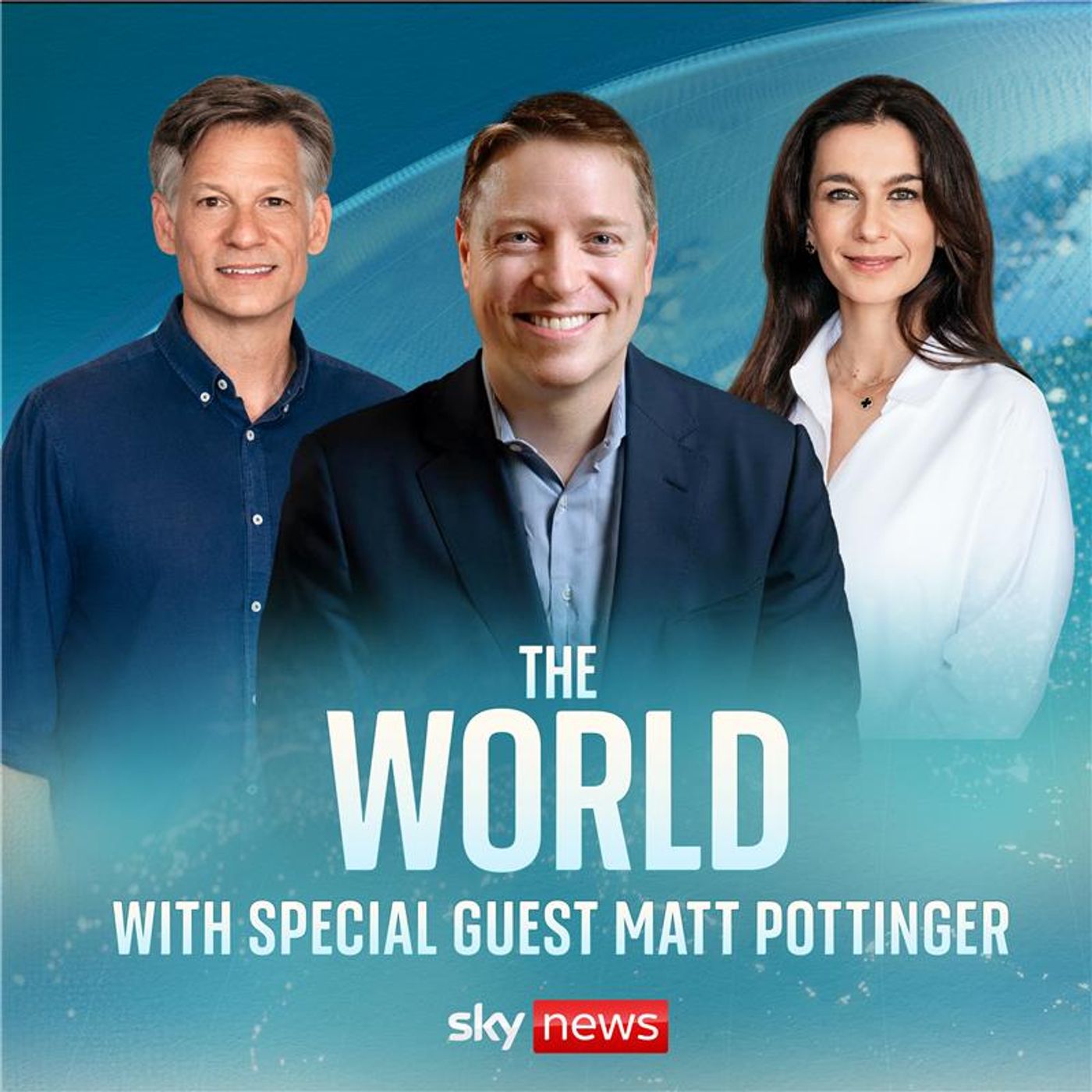
The World with Richard Engel and Yalda Hakim
Peace in Europe, War with China?
00:51:49
This week Richard and Yalda sit down with Matt Pottinger, former Deputy National Security adviser to Donald Trump and one of the leading US experts on foreign affairs. With an insider’s knowledge of the president’s decision making, Matt lays out what...
Loading summary
Transcript65 lines
- [00:00]
James Matthews
Donald Trump is heading back to the White House.
- [00:03]
Mark Stone
Together, we can truly make America great again. We are in for an unpredictable but fascinating four years and we're going to.
- [00:11]
James Matthews
Be following every twist and turn for the first 100 days. We'll be bringing you the latest updates and analysis first thing every morning. So join me, James Matthews, me, Martha.
- [00:22]
Mark Stone
Calneck, and me, Mark Stone for Trump.
- [00:24]
James Matthews
100 every weekday at 6:00am, wherever you get your podcast.
- [00:39]
Yalda Hakim
Hello, I'm Yalda and you're listening to the World with me, Yalda Hakim, and I'm currently in London.
- [00:46]
Mark Stone
And with me, Richard Engel. And it's great to have another exciting guest. I am on the road right now. I'm in Italy at the moment. I just came back from Ukraine and I'm traveling again very soon. And today, Yalda, should we tell, should we tell everyone who we've got with us? It's someone we've talked about before and we have a lot of things to talk about with him. Yalda, you want to do the reveal?
- [01:10]
Yalda Hakim
So we're very excited to have a very special guest on this week's podcast, Matt Pottinger. He is the former Deputy National Security Advisor under Donald Trump the first time round. He's an expert of foreign policy and with a particular focus and interest on Asia and China. And of course, you can follow us wherever you get your podcasts on Apple or Spotify. Send us your thoughts as well, or questions at the usual place, the world sky.uk we really want to start by talking about this very moment because there's a lot of big news that's come out. Of course, we saw the big blow up at the Oval Office on Friday. We recorded a couple of emergency podcasts. I met with Zelensky in London over the weekend and just in the last 24 hours, we've heard that the Trump administration will be temporarily halting aid to Ukraine. We just, I mean, given you've been in the room so much with him and you know him, you've worked with him, just your reaction to everything you've been seeing and hearing.
- [02:28]
Matt Pottinger
Yeah, yeah. So, Yalda, Richard, it's great to be with you both and looking forward to the conversation. Look, I'm going to start with a provocative idea, which is that, and I sure hope I'm right about this, I think that we're going to end up with a deal between Zelensky and Trump on this minerals thing and we can talk about what that looks like. I think that this is an easier deal for Ukraine to do than one would Think after the blow up in the White House on Friday, and that as a result of that deal, President Trump, European leaders are going to end up more unified in. In their approach to Ukraine than anyone would have thought after the fireworks on Friday. And then as a result of that more unified position, we will essentially see Vladimir Putin having his bluff called. Right now, President Trump is harboring some, what I think are wrong assumptions about Vladimir Putin. False assumption number one is that Vladimir Putin wants peace more than he wants total victory. I think Vladimir Putin wants total victory, not peace, that he is the obstacle to peace. He's the one who started this war. The second false assumption is that China and Russia, that a wedge can be driven between those two countries, that Vladimir Putin could be peeled away from his embrace with Xi Jinping. I think that's also a false assumption. The important thing, though, is to let Xi Jinping and Vladimir Putin reveal their true faces to Donald Trump. Zelensky, of course, knows that these things are true. Much of the world does. President Trump is testing the proposition that a ceasefire can be achieved that is sustainable. Let's let him test that proposition rather than, you know, lecturing him and telling him how it's going to turn out. Let him see for himself. And in doing that, I think that we'll end up in a more realistic position, and one that allows Ukraine to continue receiving military support, that will allow them to have enough leverage, God willing, to actually persuade Vladimir Putin that he's not going to achieve total victory.
- [05:03]
Mark Stone
So, Matt, help me understand this more. Convince me. I'm not totally convinced you're right here. You said, okay, I'm gonna throw something out. It's gonna sound controversial. I'll take it. So you worked with President Trump during his first administration, you don't work for him now. And what gives you any confidence that what he's doing now is some sort of negotiating strategy? Is that what you're saying? Is that what you're saying, that what he's doing now is all basically theater and that he's going to get there and Ukraine is going to be stronger, the US American alliances will be stronger, and Putin's gonna be weaker? Right? Yeah, that's what you just said. Right.
- [05:44]
Matt Pottinger
So.
- [05:44]
Mark Stone
So what possibly gives you any reason to hope that is the case, when every time Trump opens his mouth, it is to insult Zelensky, say he's basically a loser, say that the Europeans are more or less worthless and all the people around him are now feeding into that echo chamber? Why are you so optimistic?
- [06:05]
Matt Pottinger
So I. I think that President Trump has five things that matter to him and that, that are fairly consistent. And, and for simplicity's sake, they all begin with the letter R. He likes words that start with the letter R. So let's, let's, let's take a fast tour of President Trump's worldview. At least the five Rs. The five Rs, as this is, this is at least how I.
- [06:30]
Mark Stone
And they're not viewing, reading, writing, arithmetic.
- [06:35]
Matt Pottinger
No, it is, it is reciprocity, this idea that if a country, in terms of both its national security interest and also its trade approach to trade with the United States, if that country treats the United States the way that the United States treats that country, things are going to work out okay. And so President Trump carries around this sense of aggrievement that he feels that the United States has unfairly opened its markets or has heavily subsidized other countries security without those countries carrying enough of the burden. So reciprocity is number one. The second one is re industrialization. And you hear him using this word and people around him using this word a lot. We used it in the first term, but you hear it even more now. It's this idea that the United States hemorrhaged too much of its industrial base to other countries, particularly America's number one adversary, the People's Republic of China under the Chinese Communist Party, and that he wants to draw foreign direct investment back directly. It's not good enough just to go to friendly nations. So called friend shoring. He wants on shoring of this industrial investment. Number three is reimbursement. Okay, now I'll tell you how I learned this word. When we were preparing to go to the national assembly in Seoul, Korea In November of 2017, President Trump, we'd written a very nice speech for him and President Trump was getting ready, ready to go to this speech. And he wrote in a line in the middle of it saying that South Korea needs to reimburse the United States for everything that US has spent going back to 1950 to, to defend Korea. We persuaded him not to use that, that line in that speech at that particular moment because it would have been the only thing that would have been reported about the speech and it would not have been taken well by the host. It would have been rude. But it's still his belief that every country that the United States defends or has provided for defense for that the United States needs to be reimbursed in some way. And by the way, it doesn't always have to be cash payments. It's it can sometimes be the fourth R word, which is real estate. And so now what you have is with this deal. And by the way, the fifth one is respect. Just, he wants to be treated respectfully. And he's actually quite gracious as a host. When he feels that he's being treated with respect, he'll treat his counterpart with respect. I've been in the room in scores of meetings with foreign leaders and that's usually how it's worked out. So, so, so take a step back. Those, those five Rs. Why is this minerals deal so important to President Trump? Well, it, he thinks that it is a form of reimbursement for the hundred plus billion dollars that the United States is, has spent helping Ukraine with its defense. It's not $300 billion. The number keeps going up when President Trump talks. But, but it is, it is a little bit north of $100 billion. He wants to be treated respectfully. That would allow him to think that if he has a stake in the development of minerals in Ukraine. And by the way, this is not such a hard give, I don't think, for Ukraine because there's an immense amount of investment and work that goes into developing mineral deposits. Who knows if it even ever happens. But in President Trump's mind, it is like he's being paid back and shown respect and reciprocity for providing for Ukraine's defense. So the other thing that it does, if this deal gets done, is it then, and President Trump said as much right before the blow up on Friday with Zelensky. He said now the United States is a backstop because we haven't, we're invested in the success of, let's call it the 80% of Ukraine that is still controlled by Ukrainian soldiers and that hasn't been bulldozed by Russian invaders. Most of those mineral deposits are in free Ukraine, not in occupied Ukraine. And so President Trump says, look, now we've got American workers crawling around in hard hats. And as he put it, Putin's not going to play around if there are Americans there. So what I think you have here is a proposition from President Trump that is a lot less expensive to Ukraine than I think President Zelensky may have believed in his mind. And I'm actually optimistic that it will get done because the logic of it is actually quite good for Ukraine.
- [11:17]
Yalda Hakim
Matt, before the blowup, I had someone say to me, just listen very carefully to what President Trump said just before the blowup. So as you say, he said he'd now have a stake in Ukraine As a result of the minerals deal, he didn't rule out, you know, putting boots on the ground, US Boots on the ground, as a sort of security guarantee. So they, to me listen very carefully to what he said, and that deal was almost signed if, if, you know, that didn't happen. So this idea that this, that, you know, the future of the minerals deal is up in the air. I mean, as you say, Donald Trump wants it. The other thing that I wanted to discuss and talk about was, let's not forget, A, he said this is temporary, but B, we saw aid halted to Ukraine once before when we saw the infighting between Congress. So, you know, Ukraine has actually been in this position before.
- [12:13]
Mark Stone
Yeah.
- [12:14]
Matt Pottinger
And I would say, look, if I read the headline right this morning with my bleary eyes, you know, before the sun came up this morning, it looked like President von der Leyen has proposed a 150 billion euro defense package, you know, a fund to help fund munitions manufacturing and air defenses and all kinds of other things for Ukraine. I don't think that that fund would have come together but for the precarious American support for Ukraine. So I'm giving you an optimistic view. I'm not giving you an inside view. I'm just giving you, based on what I know of President Trump, based on what I know of the logic of strategy and the hand that Ukraine holds, I actually think we're going to end up in a more unified place transatlantically between the United States and Europe and Ukraine fairly soon. And then that will be the moment when, in essence, a best offer has been made to President Putin. And a lot of people have sort of pulled their hair out at the concessions that the Trump administration has made preemptively, right? Saying, look, more or less, we're going to draw the line like, like in the Korean War in 1953. We're going to draw the line where the battlefront currently is. We're also, as the Trump administration said, not going to bring Ukraine into NATO. So those are two massive concessions made to Putin, and that was painful for a lot of people to hear. On the other hand, if this minerals deal comes through and President Trump and the European leadership start to am tens of thousands of European troops, maybe some, some form of American support which, which would be well warranted to, to, to back them up, suddenly you have a security guarantee that starts to look more serious. You have, you have major concessions made to Putin, and, and then you've, you've basically put an offer on the table for the world to see all the negotiation between the Western powers was out there in the open. It was on TV in the Oval Office, you know, so it's not like there's anything murky here. It's all out in the light of day, all the warts and all of, you know, negotiation between allies. And then Vladimir Putin has to respond to what will look like a rather generous deal. Now, if I'm right, and Vladimir Putin doesn't want that deal because he likes war more than he likes peace. If war is going to get him, you know, conquest, we're going to, we're going to find out about that. But it's better for, for Putin to reveal his hand to Trump than for Vladimir, or rather than for Vladimir Zelensky to say, hey, hey, guys, you don't get it. You don't understand this guy. I'm gonna lecture you in front of the cameras in the Oval Office. That approach violated the respect rule of President Trump's five Rs.
- [15:22]
Mark Stone
But a question about these five Rs, and I understand those five Rs, I think they kind of apply in human nature. People, everybody wants to be respected. Everyone wants to have sort of a degree of reciprocity. But Zelensky was there to sign the deal. He was there to sign that agreement. That's why he went to Washington. So then what was the problem? It seems like it wasn't the five Rs, it was the three O's. Obey my orders obsequiously or else to add in a fourth lc. But it's close, you know, so I, what I'm, my question is based on that, Those sort of five Rs and a logic. Do you think that's what you gleaned from working there in the first administration? Do those still apply? Or is now the 5R has been replaced by several O's. Obey orders. Now I am convinced and keep groveling.
- [16:18]
Matt Pottinger
If you watch the full almost 55, 0 minute press conference in the Oval Office before President Zelensky and President Trump were supposed to sit down to lunch and to sign this deal. If you watch the full 50 minutes, you will have a higher chance of being persuaded, as I have been, that that was not intended, it was not a trap that was set for President Zelensky. I mean, it wasn't until the last moment when the Vice President spoke up to address a reporter directly, not to address President Zelensky. And even after Zelensky and Vice President Vance started going at it, President Trump was, was sort of sitting that one out until he heard something from Zelensky. That really triggered him, that really annoyed him where, where Zelinsky was basically poking President Trump in the eye with respect to President Trump's view that the United States is, is safely defended by two oceans. Now, President Zelensky was right on the, on the, on the facts. He was right that, that this axis that includes China and Russia and Iran and North Korea, Venezuela, that these, these guys are not going to stop at conquest of Ukraine. They're just getting warmed up if we don't stop them. Zelensky is right about that. Zelensky is also right that diplomacy has not worked in the past, even when there have been offers of a ceasefire to Vladimir Putin. He's right about that. His problem was one of style, where he ended up lecturing the President in the Oval Office before cameras. This is very unusual in any diplomatic context and it rubbed President Trump the wrong way. I think it also did a real disservice to Zelenskyy in the following sense. President Zelensky persuaded President Trump that Zelensky is the obstacle to peace. Now, I don't think that's really the case. It's obvious that Vladimir Putin, backed by Xi Jinping, I mean, they're North Korean soldiers on the battlefield. There's some rumors right now that there might be Chinese soldiers now involved in the conflict on the Russian side as well. Certainly all of the material that's flowing into this war on the Russian side is coming from China and Russia, or rather from Iran and China and North Korea. So Zelensky's right on the points. It's just that he, he bashed himself in the nose by offending the President. United States, by the way, American. The American people are not siding with Zelensky. In terms of the optics that came out of the Oval Office, more people were troubled by, you know, President Zelensky's approach than by President Trump's. That's important for people to understand. So, and finally he persuaded President Trump, at least for the moment, that Zelensky is the one who's resisting peace. So let's, let's, let's re. Cock. Try to put the pieces back together, maybe end up with an even better security guarantee for. Because I think that is essential, by the way. I don't think that a cease fire is going to be sustainable at all if the security guarantee, it isn't sufficient to persuade President Putin that he'll be at war with NATO, essentially, even if it's individual NATO members backed by the United States.
- [19:41]
Yalda Hakim
You know, Matt, we're sort of got about 20 minutes left. So I just want to steer your attention towards China because, of course, you're a massive voice on this. But I want to touch on a couple of things. I mean, you know, the idea that we've heard just in the last 24 hours of the Trump administration inviting Russia to be a power broker in the Middle east, for example, could potentially create this split in transatlantic alliance and relations, which frankly, we could find ourselves, China exploiting that. Would you agree with that? I mean, if we were just to focus on China?
- [20:19]
Matt Pottinger
Well, look, the reality is I'm still hopeful that strategic necessity will assert itself in ways that trump all of these, no pun intended, all of this turbulence in the transatlantic relationship. And the fact is the United States has no alternative to Europe as a close ally and Europe has no real alternative to the United States, not if Europe wants to remain a free entity, a liberal rules based rule of law, free speech, all the good stuff that comes with being a liberal democracy. Europe cannot have those things without the support of the United States. And eventually the United States will find that it is in deep trouble if it allows Europe to be steamrolled by aggressive dictatorships. And I agree with you. If that transatlantic relationship ruptures, I don't believe we're at a rupture right now. I think we are at a reckoning. Not a rupture, more R words for you. Right. And if it, if it holds and we end up actually in a, in a better place through this stress test where Europe really does step up and begin, you know, that's a great start. If Ursula von der Leyen is able to get $150 billion moving to Re industrialize, you know, German and other factories to produce the munitions necessary to keep Russia either at bay or to make Russia, you know, to set the mood music for Vladimir Putin to say, you know, I don't think total victory is in the cards for me anymore, I'm going to have to make a peace. I think that we will end up in a better place, that we're having a reckoning. We're not yet at a rupture, God willing. This reckoning actually makes us stronger.
- [22:15]
Mark Stone
A lot of our words there, reckoning, rupture, rapture, we haven't mentioned yet, but we'll keep going. So if we'll stay on China, that's really your sweet spot. That's really your field of expertise. If you, if we look at China through the framework of what's happening right now, I'm not sure, like you are that that meeting erupted just in the, in the, you know, people got their personalities rubbed out of whack. I mean, Yalda, you were talking with Zelensky and your opening remark was, you've had a bad couple of weeks. You know, because first President Trump said, oh, by the way, Ukraine caused the war. Personally, Zelensky caused the war. He's a dictator. He's got 4%. You know, there was already animosity that kind of was laid bare out in the White House. The reason I'm saying this about China is that sending a message to China that China can then just go and take Taiwan, that if you're a big power and you have a sphere of influence and Taiwan is right off the Chinese coast, the same way Crimea and Donbas and Eastern Ukraine are right off the Russian border. Is Trump a believer in spheres of influence? We have our. We. I'm American here, but the US has our sphere of influence with the Gulf of America, also known as the Gulf of Mexico. Russia's gonna take its piece. Logically speaking, Greater China would include Taiwan. Or am I wrong on this?
- [23:41]
Matt Pottinger
The way I would put it is that President Trump is open minded to the idea, by the way, and I think this isn't a good idea, but he's open minded to the idea that the world could reorder along the lines of spheres of influence. You know, the Europe, well, it's really about a balance between Europeans and Russia, and they're kind of on their own to figure that out. When it comes to China. Well, you know, China is a major power, world's second largest economy, even though it's in serious recession, greater recession than, you know, the IMF is reporting yet. They'll eventually catch up, but nonetheless, it's a major economy and maybe they just need to throw their weight around in Asia and the United States will reassert its primacy in the Americas, and you'll have these three major poles in the world. I think President Trump is not committed to that outcome. He's open minded to it. I think he's less troubled by that possible outcome. But the way to avoid that outcome is to satisfy the five R's, Right? It is, again, help the US Re industrialize, deal with the US with greater reciprocity. That means carrying more burden sharing for defense. This idea of reimbursement, you know, paying the US More for the defense, which. Which can often be ameliorated by simply spending more as a percentage of gdp. When I would brief President Trump before he would meet one of our allies, he always had two questions, always. One was, what is our trade deficit with said ally and number two is what percentage of GDP are they spending on their defense? Those are both reasonable questions to ask. I think he overindexes the trade aspect of it, but that's, you know, a lot of Americans would disagree. He was just elected handily and for the second time. So when it comes to burden sharing, what about simply going to President Trump and saying, okay, we're going to do that. Now look at, look at the, the approach that Taiwan has just taken. I just met with Taiwan's president. I've just come back last week from spending a week in Taiwan meeting with their National Security Cabinet and others. The President of Taiwan has just announced that he is going to meet or exceed U.S. defense spending as a percentage of GDP. That is to say, he's going to go above 3% of GDP from his current 2 1/2 percent. He's in a fight with his parliament. The President of Taiwan doesn't control the parliament. I met with parliamentary leaders in the opposition, explained to them how important of a signal it is to the, to President Trump personally and to the United States generally, and also how important it is as a signal to Xi Jinping who just thrives on the weakness of his neighbors to send the signal that Taiwan is getting stronger, not, not treading water, certainly not retreating through its defense expenditures. And so that, that is a fabulous message that the President of Taiwan lighting the president William Lai just made announcing that he's going to exceed 3% of GDP. Now the onus is on the United States to be to actually deliver weapons systems that Taiwan is now willing to purchase. It already buys a lot from the United States, but he's willing to increase the budget massively if the United States will deliver what he, what he orders in the way of weapons. So that, that's the right message. That is a message of, look, we're shouldering our part of the burden. We're serious about our own defense. We're not expecting you to take care of us. And then what happened yesterday? Taiwan Semiconductor Manufacturing Corp. The world's leading maker of chips, just announced a $100 billion new investment in the United States to build three more fabs to make cutting edge semiconductors, you know, as well as the packaging that goes around these semiconductors. So, so now he's saying, look, I'm helping you with re industrialization. I'm, I'm not criticizing you. I'm showing you basic respect as a leader. I am also treating you with reciprocity. You're helping have our back but we're also spending more on our own defense. And heaven helps those who help themselves. That's a, that's a phrase that Admiral Lee Si Min, who's a terrific thinker on Taiwan's defense, a retired admiral, often uses. Taiwan, Heaven. Heaven will help Taiwan if Taiwan helps itself. And so there you have. In the space of a week, the president of Taiwan has satisfied three of Trump's five Rs. Right. He hasn't offered him a real estate deal.
- [28:21]
Yalda Hakim
Not yet.
- [28:23]
Matt Pottinger
Right, exactly.
- [28:24]
Yalda Hakim
And Matt, I just wanted to pick up on those points. Cause you talked about, you know, when Richard was talking about the spheres of influence and whether, you know, and you said President Trump would be open to sort of the re. Sort of ordering of the world. You have said in your congressional testimony from a couple of years ago that, and you've just sort of alluded to it now as well, that Xi Jinping thrives on the weakness of his neighbors, but he also believes in, you know, the ideology is that the west is in decline. You've said this. We've got a question here from, from a listener on Instagram RPG Skynet to you. And, and this listener says, on a scale of 1 to 10, how likely does Matt think it is that China invades Taiwan?
- [29:15]
Matt Pottinger
Yeah, So I actually think this is. We have. We are in the most dangerous period in decades with respect to the Taiwan Strait. And that is because Xi Jinping right now does not believe that the west will hold itself together, that the United States will remain strong. He thinks that the west is in decline. In fact, he published another speech. The speech was delivered in 2023, but it was kept secret for a year and a half. On New Year's Day, President Xi released in Chinese language only. He doesn't want us reading his internal speeches, but he does want the speeches to get out, to inform the party broadly. Remember, he's got all the time.
- [30:03]
Yalda Hakim
Lucky. You speak fluent Mandarin.
- [30:05]
Matt Pottinger
Yeah, well, it's gotten rusty. But, yeah, I do still spend a lot of time reading primary source documents and in Chinese. And sure enough, what does he say? He says the situation right now in the world can be described as the west is in chaos and China remains stable. And also the west is in decline and the east is rising. So, so this is his, this is Xi Jinping's big. You know, he's counting on that becoming true, even though it's, it's not strictly speaking true. Right now we've got our problems. Right now. We're litigating them out in the open, sometimes in the Oval Office with foreign visitors. Nonetheless, China's economy is in retreat. Their biggest export now is entrepreneurs. People are leaving China. Anyone who can afford to get out is even leaving a lot of money behind in order to get out to make sure that their children are not raised in a totalitarian society that has no rule of law. But it is still a very, very dangerous moment because Xi Jinping is part of the reason that China's economy is failing is precisely because he's turning it into a wartime economy. He's preparing his economy for war so that it can withstand the shocks of war. That means he's willing to undergo massive inefficiencies in the economy. He's willing to stockpile food that otherwise would flow easily and more cheaply in from foreign vessels. He's stockpiling copper and all kinds of inputs into the economy. He is making sure that the private sector is wholly aligned with his broad goals, which are about increasing the Chinese Communist Party's control over the economy and creating a bigger batter defense industrial base. He's preparing for war. So I actually think, I don't know where I'd put it on a 1 through 10. I would tell you that right now there is already a pressure campaign underway where Beijing has been cutting the undersea Internet cables leading to Taiwan. That's happening as we speak. Over the last nine weeks, five undersea cables have been cut by Chinese military controlled vessels. They're all disguised as, you know, these are civilian vessels with civilian crews that the Chinese government has instructed and trained to conduct this campaign. And the Taiwan Coast Guard just detained for the first time ever, one of the crews, as it was in the act of dropping its anchor, dragging it along the bottom and cutting an Internet undersea cable. There aren't that many of these undersea cables, by the way. This is one of those things where it hasn't yet disrupted Internet access. But once you cut a certain percentage of these things, things start to go dark. This looks to me like the beginning of a quarantine that they're already beginning to start with an information quarantine. If you read Chinese People's Liberation army doctrine after Vladimir Putin's catastrophic invasion of Ukraine, full scale invasion three years ago, they have said one of the key lessons to learn from the mistakes of Vladimir Putin was he didn't cut off Ukraine's access to information and ability to broadcast information to the outside world. So we are now in maybe the first phase of a quarantine.
- [33:33]
Mark Stone
And that's exactly where I was going with this. The general prediction made by people like you and other experts in the field had always been, what was it, three to five years. That it would take a few years, I think three to five, for China to sort of get its military up and running, get its economic reserves in order, and that it, it was going to come, that sort of a strangulation takeover was going to come. But down the road, it seems now with Trump too, that anything that was three to five years is now three to five days or weeks at the most, that the timelines have just shrunk so immensely. So are we now in a stage where we're not talking that this is going to happen? A strangulation style takeover in three to five weeks? Is it starting now? And you're seeing that the semiconductors companies putting money in the US to sort of say, don't do well, Ukraine to us, don't just throw us over the, over the side of the ship, don't bring us to the Oval Office and humiliate us.
- [34:43]
Matt Pottinger
Yeah. So look, we don't know exactly what's in Xi Jinping's mind. What we found is that there's a very consistent thread through his internal speeches and messages, which is we will unify Taiwan. In fact, everything that Xi Jinping is doing domestically and globally, which is encapsulated in his bumper sticker phrase, the Chinese Dream of the great rejuvenation of the Chinese nation, he has said the essence of the great rejuvenation is unifying China. So, so I think we should take that very, very seriously. I don't think he's bluffing there, but I also don't think that Xi Jinping is reckless. That is to say, I don't think he's going to move forward unless he thinks he can get away with it. What are the two major sort of preconditions that would satisfy his calculus that, that he can get away with it? One is, does Taiwan have significant capability to, to make, in a pretty rough crossing, you know, that Taiwan can turn the Taiwan Strait into what I call a boiling moat that, you know, even though China's invested hundreds and hundreds of billions of dollars into building the world's biggest navy, those ships are extremely vulnerable in a, in a amphibious assault scenario. And relatively cheap weapons can be used to sink a modern navy. We saw that from Ukraine, Ukraine use jury rigged, you know, remote controlled jet skis with explosives to sink, you know, a significant percentage of the Black Sea fleet of, of Russia. So, so you can actually take out really expensive weapon systems in this scenario using relatively cheap Asymmetric type weapon system. So if Taiwan is rapidly building out its unmanned aerial vehicles, it's surface unmanned vehicles, coastal defense missiles that you can drive around in a truck or move them around in Taiwan and then sink expensive warships using those. I actually think that that is going to, that is going to make Xi Jinping think thrice, to use the Chinese phrase sansi. So, so that's one. The other calculus is, is the United States, is there a decent chance the United States will have Taiwan's back? This is why I think it's so important for the United States not to pull back and say, well, geez, you know, this isn't, this isn't our problem. That's not where most American people are. By the way, if Taiwan falls because it's coercively annexed through a blockade and invasion, Americans will be actually a no longer a rich country. Overnight you will see the US Stock market collapse. I'm not talking about a correction. I'm talking about 1929. Okay? And that's because a massive amount of American wealth is concentrated in a relatively small number of companies. You've heard of them all. It's companies like Nvidia and Apple and Amazon Web Services. All of these companies depend on Taiwan Semiconductor Manufacturing Corp. For their livelihood. There is no alternative to tsmc. Samsung can't do it. Intel is, is a very troubled company right now that can't come close to doing what TSMC does. So that means that the US Technology economy begins to collapse. And that is most of that is the, that is the major part of the US Economy. So if, if America simply through neglect or through stupid signaling persuades Xi Jinping that now's the moment to go in, the United States will be a much poorer country, 1929 style Great Depression. And President Trump will have that legacy to carry to the end.
- [38:36]
Yalda Hakim
Matt, I know you have to scoot off, but before you go and we could talk to you forever, let's talk about, just briefly about Iran, because for you personally, I know there's the policy and we've just heard Donald Trump talking about bringing Putin into the fold. But you know, you yourself personally have also, you know, been impacted by threats from Iran because of, you know, the killing of assassination of Qassem Soleimani, of course, he was the top general leader of the Iranian Revolutionary National Guard. Can you just briefly just tell us a little bit about that?
- [39:14]
Matt Pottinger
Yeah, sure. Well, so when President Trump made the decision to strike Qasem Soleimani in early 2020, one of the results of that is that People who worked at the White House at the time or who worked in senior national security roles were placed on Iran's assassination list. I wasn't actually even involved in the decision. There was a news report that falsely claimed I was. So I ended up on the list. I think, you know, the Iranians aren't that great at intelligence operations. They basically read Yahoo News and they think that that's sort of the world. Nonetheless, look, I will say this. When I learned that President Trump had made that decision and struck President Soleimani, I was extremely worried about what the consequences would be in terms of blowback in the region and so forth. I think that President Trump actually made the right decision. I think that it was a brave decision. It was not one that he was pushed into making. From what I've heard, it was really his own call. And his calculus was we have an arch terrorist who is personally responsible for the deaths of hundreds and hundreds of Americans, especially American soldiers who were fighting sort of in the Shia dominated areas of, of Iraq by doing that. And by the way, he was also responding to intelligence that Qasem Soleimani was planning attacks on US Diplomatic posts around the world. So he was actively in the process of preparing to kill more Americans. I think he. I think this was a very brave decision on his part. You know, when you go into national security jobs, you can't say, well, look, I get to make hard decisions about war and peace sometimes in favor of war in order to make the American people safer and expect that there won't be any consequences for that. That said, I do think that the United States should protect its officials and its former officials. I think it can do so much more cheaply than was being done by requiring Secret service protection or State Department, diplomatic service bureau protection. You can do it with private solutions that are much cheaper and are actually also quite effective. I'm under protection now from private services, and I'm safer as a result. But I do think that over the long term, it doesn't matter what administration you served in. Remember, you know, the Biden administration killed the leader of Al Qaeda. I think we should protect former Biden administration officials from being being attacked by radical jihadists, you know, seeking to avenge Al Qaeda. But so. So we need some kind of a plan, some kind of a pool of public money, reasonable amount of money to go to private solutions to protect former officials. I think that that would be a good model going forward.
- [42:22]
Mark Stone
Matt Pottinger, always a pleasure. We had a deal. You've got to jump and grab a phone call. As Yalda and I both know, sometimes those calls cannot wait. But we want to keep this conversation going and fascinating. And I don't think people spend enough time thinking and actively trying to figure out what's going on vis a vis China, Taiwan. Taiwan is involved in all of our lives, whether we know it or not. I was in Taiwan and I didn't realize then to everything in your pocket, your laptop, your cell phone, none of it works without the semiconductors made in Taiwan. The sort of world revolves around that little island economically, certainly in the tech world. Something to watch. Great to talk to you.
- [43:09]
Matt Pottinger
You, too, Richard, Yalda, it's great to be with you both.
- [43:12]
Yalda Hakim
Thank you so much.
- [43:12]
Matt Pottinger
Looking forward to the next one.
- [43:14]
Yalda Hakim
Thank you so much, Matt. We'd love, love, love to have you back. Thank you very much. Never enough time. Thank you. We'll be back after the break.
- [43:31]
James Matthews
Donald Trump is heading back to the White House.
- [43:34]
Mark Stone
Together, we can truly make America great again. We are in for an unpredictable but fascinating four years.
- [43:41]
James Matthews
And we're going to be following every twist and turn for the first 100 days. We'll be bringing you the latest updates and analysis first thing every morning. So join me, James, Matthew, me, Martha.
- [43:53]
Mark Stone
Calneck and me, Mark Stone for Trump.
- [43:55]
James Matthews
100 every weekday at 6:00am, wherever you get your podcast.
- [44:10]
Mark Stone
Welcome back. So, Yelda, what did you make of that? Let's unpack a little bit about what we just heard.
- [44:15]
Yalda Hakim
You know, I find Matt Pottinger just, you know, one of these great. And I think the Trump administration, the first time round were lucky to have him. He hasn't gone into the administration this time around, but he really helped focus the first Trump administration's policies when it came to China. I think that he's a China hawk. And so he firmly believes, you know, about the sort of, he understands the Xi Jinping ideology. And we just heard there, you know, about the, the sort of how he trawls through Chinese documents and statements made by Xi Jinping and the concerns he has. And he wants that concern to be front and center of, you know, any administration. And so I find his thinking, he's an original thinker as well. So I thought it was interesting that he took a more optimistic approach to how Trump is dealing with Zelensky right now. And he clearly thinks that Europe, the United States, Ukraine will be better off as a result of this. I don't think he gave us the more darker side of things that, you know, if, if this thing does collapse and if Europe doesn't sort of get, you know, if we do see a split between the transatlantic alliance, that things could get exploited by Russia and. And China. But I do think he's also a realist. So we got there just a snapshot of Matt Pottinger's thinking.
- [45:45]
Mark Stone
So I wonder, is he trying to apply too much logic to. To Trump, who seems to make decisions also very personally. And, you know, he talked about these, these five Rs as if they were holy tablets. You know, he's always follows these guiding lights, and I, obviously, he's oversimplifying in order to. To make a point which, which is great and immensely useful, and I will remember it from this podcast. Say, hey, here's a good way of thinking about Donald Trump. Very happy to have it. But what about his. His ego? What about his personality? You know, people have always asked me, what do you think about the comment by some cabinet member or the Secretary of state or the defense minister? As far as I can tell, none of them matter. They didn't matter very much in the first term. They were jettisoned out of the administration as soon as they said anything that would upset Trump. And now Trump has come back more confident than ever. So is this ghost in the machine, his ego, his personality, does that now override his sort of five basic principle, his logic that he knew. Has that been overtaken by this sort of. I don't want to. Yeah, by his ego, by the id, the inner part of Trump that is uncontrollable and that seems to control him.
- [47:06]
Yalda Hakim
Yeah. And, you know, I interviewed a couple of days ago, Michael Wolff, who's essentially become the Trump biographer, and he basically, basically told me, look, you know, trying to understand Donald Trump's thinking is difficult because, you know, he is focused on sound bites and headlines. And, you know, I think Matt was trying to help us understand how he was. How Donald Trump essentially approaches things. But I think for me, the big takeaway from the conversation we just had was that ultimately, whatever happens with Ukraine, in terms of geopolitics and the handling of Russia, that the formidable power here for the United States is China. And, and when he said that, you know, we're in a very dangerous phase right now and perhaps phase one of a potential. This idea that China is essentially, you know, on. On the wolf on a roof footing.
- [48:04]
Mark Stone
Starting its strangulation campaign, cutting them off from the emperor.
- [48:07]
Yalda Hakim
That is, I think we can go back and forth on where Donald Trump is right now, but we are in this kind of dangerous moment that people like Matt Pottinger are seriously thinking about now.
- [48:18]
Mark Stone
Yalda, we could keep going and going and going and. I know. So do you have another sit down with Zelensky? That was great, by the way, seeing you. Thank you there. Such great timing. And I was like, wait a second. She's sitting right next to him. How fabulous. The man of the moment. He'd just been sort of bounced out of the Oval Office. He's heading to Europe. Did you, did you, did you hear what Trump said about the UK you're in the UK Said about the British troops that are potentially going there as he. Well, if some random country wants to send 20,000 troops, some random country, that's, that's, that's the UK right now, by the way.
- [48:53]
Yalda Hakim
Yeah, I mean, you know, and JD Vance sort of reiterated that.
- [48:57]
Mark Stone
That was JD Vance.
- [48:57]
Matt Pottinger
Excuse me. That was JD Vance.
- [48:59]
Yalda Hakim
Yeah. I hadn't heard Donald Trump.
- [49:01]
Mark Stone
No, no, it was J.D. vance saying, well, if some random country wants to send 20,000 troops, we'll see.
- [49:07]
Yalda Hakim
I mean, he also tried to tell Keir Starmer that, you know, there was no free speech in the UK And Keir Starmer had to. To correct him. So, but, but let's do our predictions really quickly before, before you jet off.
- [49:20]
Mark Stone
All right, I'm gonna go, I'm gonna stay on Ukraine. I, I think last time when I, when I said it, because I was thinking when I was talking with Matt about that last week on the show before the emergency broadcast, I was like, Trump is going to give him nothing. He's gonna, he's not gonna get security guarantees. He's gonna get nothing. Instead, not only get nothing for now, Pottinger's right. He gets something down the road and maybe I think this gets worse. I think he starts treating Zelensky truly as an enemy, that he makes Zelensky out to the American people and to the world that he's the problem, he's the enemy, he's the bad guy. He's the corrupt one. So I'd imagine they're going to start talking about corruption in Ukraine and start rolling out documents alleging that all the money that the US has been spent, sort of a Doge tactic. So anytime you want to kind of justify what you're doing, you say that was waste and fraud and mismanagement. So I think that's what we're going to hear more and more from, that there's going to be this campaign that not only did we. Did the United States spend all this money in Ukraine, but all the money was stolen and sent to Swiss bank accounts and that it was a. That Zelensky's a bad guy, a warmonger, and I think he's going to start treating him like a real enemy. Whether that's some, as in the Pottinger world, is that some strategy that lands us in a good place? I don't know. I, I think it's really dangerous. You know, the people always, optimists have this philosophy that, oh, you know, sometimes you need to go through pain to, to get onto the other side and you go through tremendous suffering, but it'll be worth it at the Arab at the end, end of the day, sometimes the patient dies on the table too. You know, sometimes the pain is. Will kill you.
- [51:07]
Yalda Hakim
Yeah, I think, I think we've gone into sort of week five of the Trump administration, and every week it's been. It's almost like he goes to Mar a Lago on a Friday evening, he comes back on a Monday and says, what. What are the headlines I want to make this week? And, you know, the first week it was Colombia, and then we saw the sort of tariffs on Mexico and Canada and then, of course, Gaza and then Ukraine. I think all of these moves, these fast moves that he's making is going to impact the markets and we're going to start to see the markets, you know, it's crashing again at the moment, and I, the business world is really going to sit up and start questioning a lot of this. And so perhaps that's my prediction, that we should watch the markets going forward, see how they react and respond to, you know, every time Trump sort of, whether it's trade wars and whether it's China reacting or, you know, anything that we're seeing, any of the moves in Ukraine or elsewhere. I think we need to, as a podcast, keep an eye on the markets and speak to economists as well and see how it's actually going to impact global markets. Well, Richard, we will have to, you know, keep this conversation going. Thank you so much to all of our listeners for listening and, of course, you know where to find us. Follow us wherever you get your podcast, Apple or Spotify, and send us your thoughts, anything that we've discussed on the emergency podcast or today's episode. It's at the usual place, the worldatsky.uk Wonderful, wonderful.
- [52:35]
Mark Stone
Subscribe, subscribe. Describe. Thank you everyone out there. It's been a real pleasure and I hope you, I hope you're enjoying the podcast. Until next time.
- [52:49]
James Matthews
Donald Trump is heading back to the White House.
- [52:52]
Mark Stone
Together we can truly make America great again. We are in for an unpredictable but fascinating four years and we're going to.
- [52:59]
James Matthews
Be following every twist and turn for the first 100 days. We'll be bringing you the latest updates and analysis first thing every morning. So join me, James Matthew, me, Martha.
- [53:10]
Mark Stone
Kelnick and me, Mark Stone for Trump.
- [53:13]
James Matthews
100 every weekday at 6aM wherever you get your podcast.