← The World with Richard Engel and Yalda Hakim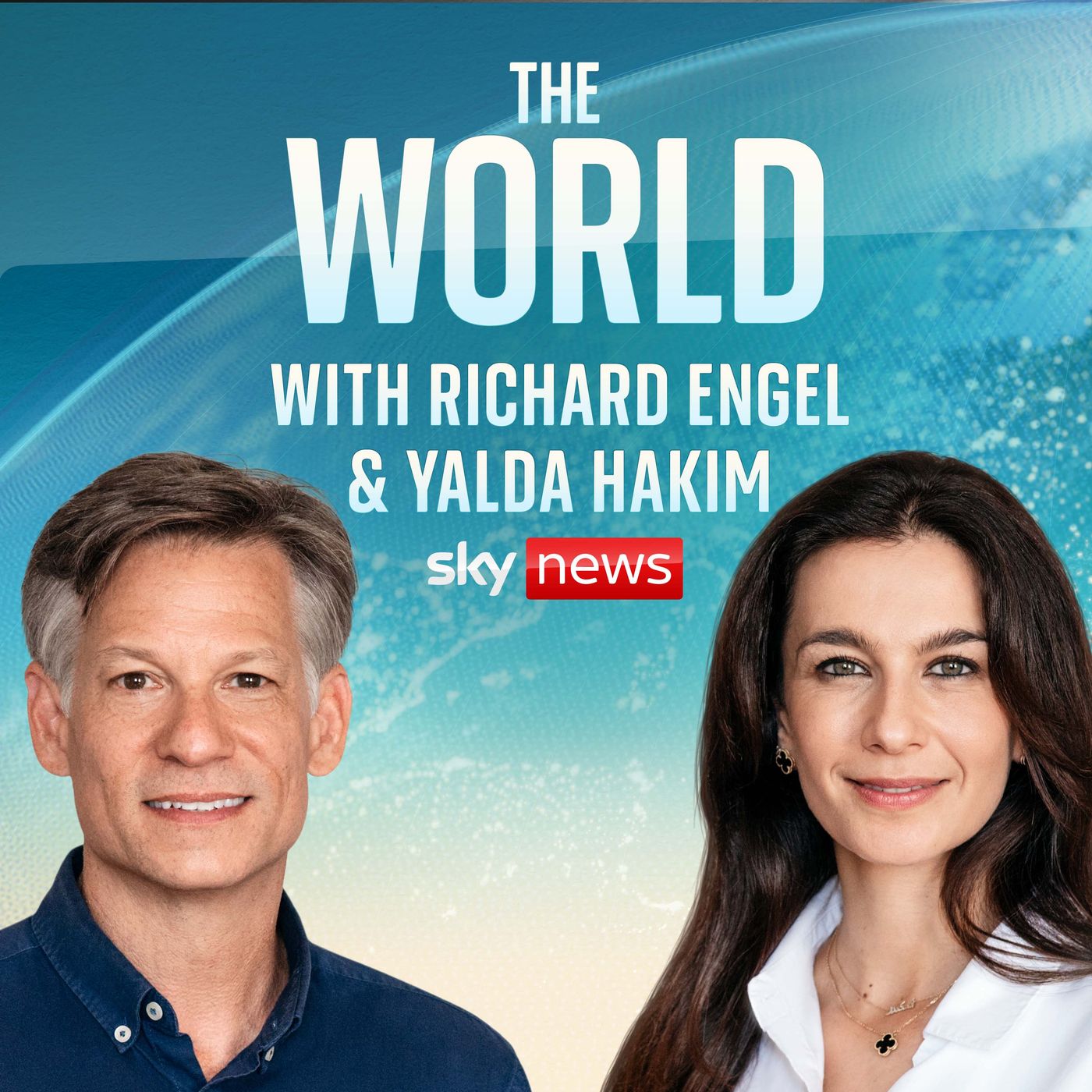
The World with Richard Engel and Yalda Hakim
What Trump’s win means for the world
00:18:41
They said it was too close to call, but Donald Trump won decisively and is now set to return to the White House. In his victory speech he repeated his claim that he is the man who "will stop wars" and make the world a safer place. This week Richard...
Loading summary
Transcript53 lines
- [00:00]
Donald Trump
They came from all quarters, Union, non Union, African American, Hispanic American, Asian American, Arab American, Muslim American. We had everybody and it was beautiful.
- [00:14]
Yalda Hakim
Hello and welcome to the world. This is me, Yalda Hakim, and I'm currently in Washington D.C. i've just come off air where we did a 12 hour stint covering election day.
- [00:27]
Richard Engel
Great to see you, Yalda. This is Richard Engel. I'm in New York. I'm in the newsroom of NBC News covering the biggest story in the world. And it looks very likely that Donald Trump has been elected a second term. And today we're gonna be talking how that happened and what it means for the world.
- [00:44]
Yalda Hakim
So make sure you're following us wherever you're listening and you can of course, watch us on our YouTube channel. And if you want to send us a question, it's theworldsky.uk thanks for all.
- [00:56]
Richard Engel
Of your questions so far and if you haven't subscribed yet, please do. Yalda. Actually, I'm looking over my shoulder right now. NBC News, Donald Trump elected president. So NBC just called it at 276 electoral votes for Trump for now and 2 19. So they just called it. Here in this building there's a cordoned off area separated by sort of opera ropes and you're not supposed to go behind it unless you have business there. That's where they're doing the very serious business of looking through the numbers and they just called it. So as far as NBC News is concerned, he's president for the next four years.
- [01:44]
Yalda Hakim
Yeah. And you know, Richard, we at Sky News here, using NBC studios in Washington D.C. that's where we were for 12 hours and really dependent on your tabulations on the data that NBC was compiling alongside all the other networks. Next to me, to my right, I had the editor at large of the Wall Street Journal, Jerry Baker, who was getting so frustrated with me and the team and saying that, you know, you guys are deliberately not calling it. Fox News has already called it. And I really had to explain to him that there is methodology in this, that, you know, there is a reason why this is so slow because it's so critical to get this right. Even though by that point we knew that Donald Trump had or less, you know, it was a sweep.
- [02:28]
Richard Engel
And Yalda, was there a moment when you were doing your marathon coverage that you realized he's won it, he just something, something flipped. Was it a particular state, a particular county? Was there a time that you remember when you thought this has happened?
- [02:42]
Yalda Hakim
You know, we weren't surprised when North Carolina and Georgia weren't called and we were told it's too close to call, too early to call. It was when a state like Florida, when we started to see the volume of, of votes that, that he was getting, certainly in the Hispanic community, we realized actually something here is shifting with the demographics.
- [03:04]
Richard Engel
And they were turning quickly. These states were turning red quickly. Really, people here were expecting it's going to be a long, drawn out process. Maybe it goes to the Supreme Court recounts. Those states were turning red fast.
- [03:16]
Yalda Hakim
What's interesting when you talk about the demographics, I mean, one of Donald Trump's strategies was to go after the bro vote, you know, the African American vote, the Latinos, the, the men, frat boys.
- [03:29]
Richard Engel
Frat boys, college frat boys lined up.
- [03:31]
Yalda Hakim
For him, the Joe Rogan podcast listeners.
- [03:34]
Richard Engel
And they mentioned that on air, they mentioned, mentioned that in exit polls. They watched Joe Rogan and they're like, oh, this guy's a, a bro. He's a tough guy. We like him. You know, they liked his personality.
- [03:43]
Yalda Hakim
So it's, you just realize the diversification of his base. Now we often describe Donald Trump's base as white, non college educated men, mostly from rural areas. But in fact, he seems to have bled into Kamala Harris's, you know, suburban vote and those on the outskirts of.
- [04:03]
Richard Engel
The main cities and a working, what you call working class vote. You know, before it used to be working class whites and now it's just working class. He got working class Latinos and he got young men. And the women vote proved to be not as, as consequential, not as many women, white women or women who, young women, which is women in general, came out to tip the balance.
- [04:26]
Yalda Hakim
Donald Trump, this is the third time he's on the ballot and this is now the only time in these last three elections where he has won the popular vote as well. Of course, Hillary Clinton beat him by 3 million votes. Joe Biden beat him by something like 6 or 7 million votes. This time round, from what we've seen, it's well over 5 million votes more that he's gotten. I can't see what the total final numbers are when I let, left when I came off air, but you know, it's whether the world now is grappling with this.
- [04:58]
Richard Engel
Zelensky just came out with a tweet and he actually wrote this before the official announcement or before NBC at least called it to make sure that, okay, this is coming, at least I could maybe get on his better side. But what Zelensky wrote back is, congratulations, Donald Trump on his impressive election victory. I appreciate President Trump's commitment to the peace through strength approach in global affairs. That is exactly the principle that can practically bring just peace in Ukraine closer.
- [05:31]
Yalda Hakim
There you go. I mean, he doesn't believe that.
- [05:33]
Richard Engel
I mean, he wrote it. I assume he's believing it. But that's very different from what I've, I've heard from Zelinsky in the past where he was in a cold sweat about what Donald Trump is going to do.
- [05:41]
Yalda Hakim
What choice do they have at this point in time when so much rests on the decisions of the United States and whether they can carry on fighting Russia in the way that they have? And what we know from the statements that Donald Trump has made is he says, I'm not paying for some, somebody else's war. And so he has to see a benefit in, in what he's doing. And, and he's described Zelensky as, as the best salesman on the planet. He said every time he comes to the United States, he goes away with billions of dollars. And, you know, that's not something we're going to trouble.
- [06:12]
Richard Engel
Ukraine is in.
- [06:13]
Yalda Hakim
Well, the question now is, does Ukraine become, you know, Biden's Afghanistan? Because if Donald Trump and the United States now decides not to support and fund Ukraine's war against Russia, Russia, following that invasion two and a half years in, where does that leave Ukraine? Does it become Afghanistan? Does it become abandoned?
- [06:33]
Richard Engel
I've been speaking to in the last several days. I've spoken to a prime minister, a senior Middle Eastern royal, at least two, and a couple of other European officials. I've spoken to friends and colleagues and journalists around the world. Most of them expected this. I think it was more obvious from the outside looking in. And to be honest, that's often the case where people who are covering a story domestically don't necessarily see the, the forest for the trees. They're focused on all the sort of micro details and they miss the, the bigger picture. And they were deeply concerned about where this would, where this would take us before we get into what this means for the world. And I wanted you, you have a network of contacts, and I would love to hear what your people are telling you and what you think about this. Do you want to hear a little bit about how President Trump described what he's going to do in his, in his victory speech?
- [07:29]
Donald Trump
We want to have borders, we want to have security. We want to have things be good, safe. We want great education. We want a strong and powerful military. And ideally, we don't have to use it. You know, we had no wars. Four years, we had no wars except we defeated isis. We defeated ISIS in record time, but we had no wars. They said, he will start a war. I'm not going to start a war. I'm going to stop wars.
- [07:55]
Yalda Hakim
Picking up on that, on that statement on stopping wars. I mean, one of the first people to put out a note of congratulations, of course, was Israel's Prime Minister, Benjamin Netanyahu. And he wrote, more or less at the same time, Volodymyr Zelensky, he wrote, congratulations on history's greatest comeback. Your historic return to the White House offers a new beginning for America and a powerful recommitment to the great alliance between Israel and America. Of course, Donald Trump was the president who moved the US Embassy from Tel Aviv to Jerusalem, and of course, the Abraham Accords that he signed with a number of country Gulf countries and, you know, sort of strengthened ties between them. And so, of course, Benjamin Netanyahu is now looking to Donald Trump and he's probably quite pleased with this outcome.
- [08:52]
Richard Engel
Oh, I think he's very pleased. Unlike Zelensky's note, which I think was written under duress, you know, he has no choice but to say, hey, you know, we're gonna be great and we're on the same page. We love each other. When that's not clearly the case. I think Netanyahu means this. He's excited about this. I think he'd been banking on this and counting on this. He just fired his defense minister. And Netanyahu is going to feel like his mandate is now going to be fully endorsed by President Trump, by son in law Jared Kushner, who hasn't been front and center, but who's still deeply involved in the Middle east and has access to President Trump. So, yeah, I think for Netanyahu, this is a very big day.
- [09:34]
Yalda Hakim
Although, Richard, Donald Trump has also told Benjamin Netanyahu to wrap things up in Gaza quickly. And we've also seen in states like Michigan, that key battleground state where there's a large Arab and Muslim population. You know, there were Muslim representatives that came out in support of Donald Trump, and we'll have to see the breakdown of the vote there to see how many Arabs and Muslims in places like Michigan, where the war in Gaza was front and center for them. And they said that they had been, you know, felt let down by the Democratic Party and that their vote had been taken advantage of and that they had been taken, you know, for granted, that they move towards a Donald Trump and whether Donald Trump will now be able to deliver for them. That will be what's interesting now in this next phase.
- [10:22]
Richard Engel
Yeah, I heard about that. And a lot of the sort of Arab Americans thought they couldn't bring themselves to vote for her in protest to Biden's support for Israel and arming Israel and giving Israel political cover for the war in Gaza. All indications are that Trump and Bibi are gonna walk in lockstep. It sounds like Netanyahu has no interest in, you can end the war in Gaza by declari it over. It doesn't mean you end military operations, but you want to do a little walkthrough about what this could mean for the world. We talked about Ukraine. What else do you think will be the international knock on effect?
- [10:57]
Yalda Hakim
You know, last night I was at a dinner and the former Prime Minister of Australia was there and now ambassador for Australia to Washington D.C. kevin Rudd. And he was asked at the dinner whether China preferred a Kamala Harris or a Donald Trump. And he said, you know, he, he sort of reflected and gave a very thoughtful answer. But his end conclusion was that the Chinese, in the interactions he's had, in the conversations he's had, have said that they don't feel comfortable with how unpredictable Trump is and that for them, the, the worst possible thing in the world is unpredictability and chaos and erratic behavior. And we talked about that madman theory that Donald Trump thinks he's adopting.
- [11:45]
Richard Engel
I've never liked the madman theory. The madman theory. I've always found the madman theory really dangerous. But the madman theory is I'm so unpredictable. I'm so any. You could, whoever the leader is, I'm so unpredictable. I'm so radical. I'm so tough and volatile. Don't mess with me. Otherwise I could explode. Now, if we just look at Ukraine, he's going to try and end that war. I can imagine the war in Lebanon escalating. I can see Putin and Russia being very happy about this. China, I think, has mixed feelings.
- [12:17]
Yalda Hakim
One thing that Kevin Rudd also said last night was that Donald Trump, just before the Republican National Convention earlier this year, after that assassination attempt on his life, gave a very unhelpful interview. And he talked about, you know, they were asked whether America would stand with Taiwan, for example, if, if China invaded. And he said, taiwan, not my problem, not my business. I wouldn't, I wouldn't stand with Taiwan. This is not my issue. I don't care. Then Kevin Rudd came back in and he said, the Chinese asked me, you know, this is good. If we move on Taiwan, Donald Trump doesn't care. He Said, well, he's also, don't forget someone who considers himself a strong man. And the minute you humiliate him or make him look weak within the United States and globally, he could actually that madman theory where he could actually strike. So just be careful what you wish for with this guy because you just don't know which way he's likely to go. So I do think that there were moments where people question themselves, even the Iranians, for example. I mean, Donald Trump is on a hit list for the Iranians. The FBI has even said that Donald Trump is on a, that he's so.
- [13:27]
Richard Engel
Dangerous, everyone has to play nice or, or at least act with, give, give pause and second thought to actions and that it might restrain the Iranians. Yes, that's what you're saying.
- [13:38]
Yalda Hakim
Well, I think the Iranians right now are very, very concerned. They're concerned about, you know, they were hoping for a new nuclear deal with, with a, with another administration, a Harris administration. They're just not sure how Donald Trump will approach them.
- [13:55]
Richard Engel
Oh, I think, I guess we're heading into predictions time, but I think it's very possible that now Netanyahu does that strike on Iran's nuclear sites, does the strike on Iran's oil industries pursues a war of regime change that Donald Trump would likely back. He wants to be a hard line on, take a hard line against Iran. So Ukraine, I would say, is in deep trouble. Iran is in deep trouble. Taiwan's future is uncertain. NATO's future is, is uncertain.
- [14:27]
Yalda Hakim
If we talk about NATO, I guess, you know, the question is Donald Trump all those years ago demanded that NATO partners up their defense spending and not be so dependent on the United States. And actually, yeah, think about pay up.
- [14:42]
Richard Engel
Or pay up or we're out.
- [14:43]
Yalda Hakim
But actually, was it not the right move? They did, they did pay up. And what happened when, when Russia did invade Ukraine, they suddenly realized that they needed to actually continue to up their.
- [14:54]
Richard Engel
Defense 100%, shaking them down for, for money and putting their feet to the fire. Probably a good idea. And the end result was actually we have a much stronger NATO than we did before because of Russia and Ukraine and maybe the spending budgets. So there's an argument that him coming back will force NATO countries to actually put their hands deeper in their pockets and spend for their own defense and not piggyback on the United States, which NATO has been doing really for decades. It's possible. But if he doesn't fundamentally believe in the organization, thinks it's a waste of time and might not commit to protecting another NATO ally, then you can shake them down for money. But if you don't believe the organization, you could actually cripple it.
- [15:37]
Yalda Hakim
Yeah. And I guess what I would say, my prediction is that, I guess as worried as Iran is this evening, I think that perhaps maybe European leaders should be worried too, because Donald Trump, from what we've seen, is concerned mostly about transactions and deals and what he can get out of. You know, he likes deals. And so he isn't going to look at this sort of playing field and think allies and adversaries. He's thinking, where can I get the best deal from?
- [16:08]
Richard Engel
So, Yalda, who's happy tonight in, in the world and who's. Who's sad?
- [16:12]
Yalda Hakim
Well, I think that you're right that Benjamin Netanyahu is probably happy because he's got his eyes set on Iran and he's going to find a more powerful ally in the United States. I don't know if Vladimir Putin is happy tonight, regardless of everything that we're saying about Ukraine. I think that, you know, I think they're just not sure about which way he could go. And I think that the Chinese are probably quite nervous as well.
- [16:37]
Richard Engel
I would say Putin is very happy and I would say that the Chinese are probably happier than sad. Even though he could be really dangerous. He has the potential to create so many divisions in this country. And China has a big, long term, very ambitious project and sees the United States as its strategic rival. If its strategic rival, the United States suddenly implodes into a domestic mess and morass, that would benefit China and would benefit its global project. But it doesn't want to go broke in the process. It owns a lot of dollars. It owns a lot of interests in the U.S. it's part of the global economy. It doesn't want to see a global economic meltdown. But I think from its strategic point of view, as seeing itself as in this, in this cold war like battle, I think that generally they're pleased with this outcome because of the implications that it could have for the United States.
- [17:33]
Yalda Hakim
We are all up for quite a ride. Richard, really great to see you.
- [17:38]
Richard Engel
So are you going to nap right now? Are you back on air?
- [17:41]
Yalda Hakim
I'm back on air in about seven hours, eight hours time. So I'm going to try and go back for a quick nap and then wake up.
- [17:48]
Richard Engel
Easier said than done. You're all jazzed up. You've been having information coming flying at you for 12 hours straight how you're just gonna be able to close your eyes and go to bed. I couldn't do that.
- [17:56]
Yalda Hakim
I know. I think I'm gonna have to. It's gonna take about an hour, I think, to wind down and kill the adrenaline.
- [18:02]
Richard Engel
Well, good luck. Good luck.
- [18:04]
Yalda Hakim
Thank you.
- [18:04]
Richard Engel
Zen and I hope it works. I'm jealous. If you get just in an hour, you could get into that state. I am terrible at insomnia. I would never be able to do that. But good luck. Thank you. May you have. May you rest up and we'll have a lot to do.
- [18:16]
Yalda Hakim
We'll talk soon. We have so much to do.
- [18:18]
Richard Engel
Good to see you.
- [18:19]
Yalda Hakim
Good to see you.