← Therapy and Theology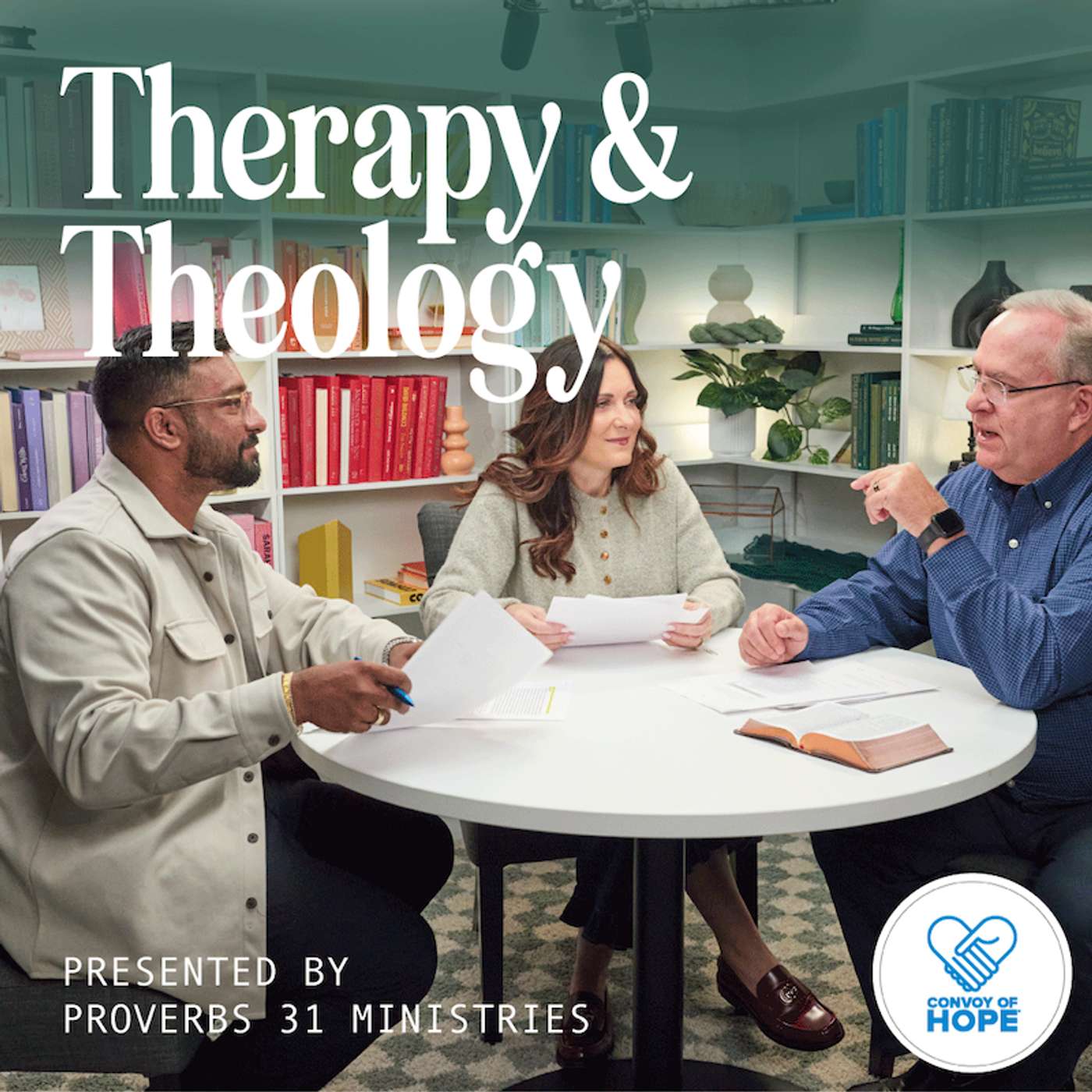
Loading summary
Transcript64 lines
- [00:01]
Shay Hill
Proverbs 31 is proud to partner with Convoy of Hope to sponsor this season of therapy and theology. For over 30 years, Convoy of Hope has helped vulnerable communities around the world, and empowering women and girls is a key part of that mission. Convoy of Hope partners with women so that they can start their own businesses to better support themselves and their families. They also help young girls realize their worth and find their voice, because when women are empowered, entire communities are transformed. You can empower women and girls today by visiting convoy.org p31 that's convoy.org p31 Friends, welcome back to the Therapy and Theology podcast brought to you by Proverbs 31 Ministries, where we help you work through what you walk through. I'm your host, Shea Hill, and I'm so glad to have you here today. Can I just say that this season of episodes has been so good, and I'm so grateful for the groundwork that we're cover here together. I know this topic of divorce, no matter how you may be entering in, can be daunting and heavy and confusing, but these are such important conversations to have. So I just want you to know I'm really grateful that you're here. I just have one quick announcement before we jump into this conversation today on how we can forgive, even when it feels incredibly unfair, and that's that I want to make sure you're subscribed to receive new episodes straight to your inbox. So by visiting the link in our show notes, we'll send those over to you. And there's no better time to do it than now because we've got new episodes released every week. Now let's jump into today's conversation.
- [01:37]
Lisa TerKeurst
Today's topic is on forgiveness. Now, look, I know that right when you hear the word forgiveness, you might be tempted to cross your arms, push back, and go, okay, I'm gonna skip this episode.
- [01:50]
Dr. Joel Mutamali
In fact, Lisa, I think this is the one that you and Jim are doing by yourself.
- [01:54]
Lisa TerKeurst
Really?
- [01:55]
Jim Kress
Do not leave this table.
- [01:57]
Lisa TerKeurst
Well, of course, we have with us Dr. Joel Mutamali and Jim Kress. Forgiveness can feel like such an unfair gift that we have to give to the person who hurt us the most. And often when we hear the word forgiveness, we attach that word to some of the hardest stuff that we've ever walked through. So I don't want to start with forgiveness today. I want to start with the resistance that is natural to feel around forgiveness. You know, some of my resistance was that I felt like the other person had not said that they were sorry they hadn't really owned what they had done. And they were still hurting, you know, they were still saying hurtful things. And so I just thought, I can't forgive because I have to wait until they acknowledge what they've done, right? And Jim, you so brilliantly helped me understand that if I waited for the other person, the person who hurt me, if I wait for them to own what they did and say their sorry, I may attach my well being to the person who's hurt me the most for the rest of my life. And the severing can only happen is if I detach my ability to heal and move forward and recognize forgiveness is not so much giving a gift to this person. Forgiveness is God's prescription for the human heart to heal. It's much more about me and God. And look, forgiveness, sometimes that forgiveness conversation, the epic conversation that we all desire, when someone finally falls on their knees and says, I realize what I've done and it was so wrong and I want to make up for all the hurt that I've done, chances are in a lot of situations, either because that person passed away or they walked away and they don't even feel bad about it, that conversation may never happen. And if we wait to heal until that conversation that may never happen occurs, then we may never heal. And so, so at some point we have to stick a stake in the ground and we have to say, I have suffered over this enough, I deserve to heal. And forgiveness is my choice. Forgiveness is my choice and it's between me and God and it's for the purpose of cleaning out my heart.
- [04:25]
Dr. Joel Mutamali
Yeah, that's so good. I think just a way to maybe capture why forgiveness is such an important aspect of the spiritual life for Christians. Particularly, I think of Romans chapter 12, when Paul is talking to the church in rome. In verse 18, he says, if possible, which is kind of fascinating because Paul starts off by a conditional clause letting.
- [04:45]
Lisa TerKeurst
Us know it might not be possible.
- [04:47]
Dr. Joel Mutamali
It might not be possible, right? But if possible. So like, okay, if possible. And then he says, as far as it depends on you. So again, like when we teach this at Haven Place Ministries, like usually at the retreats, I kind of point out, like, how many of us feel like this is unfair, right? Like, why does it always have to be me? How come I'm always the one? And then it says, if possible, as far as it depends on you, live at peace with everyone. So the goal here of the Christian life is peace. You want to have peace with everyone. The ownership is on us to pursue it. But there's a conditional clause that says, if possible. And back to that idea of, like, is this an unfair ask of God? Right. Imagine if what Paul said was, if possible, as far as it depends on them. Now what happens?
- [05:31]
Jim Kress
Big difference.
- [05:32]
Dr. Joel Mutamali
Massive difference. And actually, what Paul's doing here is he's giving you agency. He's putting you in a position to be able to know the situation, the circumstance, and he's the only one that knows that you've done all that you can. And I want this to be a verse that we jump off of, because the goal here is peace. And this is what the goal of forgiveness is. Forgiveness is an act that you and I can participate in that will produce peace, and it does not demand peace with the other person. First and foremost, it's peace internally. I often think about forgiveness, Lisa, in terms of this analogy. It's like you said, forgiveness feels like this unfair gift that we have to give to the other person. We were studying this together, and I kind of said, just in the moment, well, actually, unforgiveness is the gift that you give yourself, which is a cyanide pill. And everybody's like, whoa, Joel, that's kind of a lot. I was like, well, maybe I shouldn't say that. But the more I think about it, I'm like, no, that really is what unforgiveness is. And once again, at Haven Place retreats, I'll do an illustration when we teach unforgiveness, which is. Just imagine that. That you're in this place and you're like, you know what? I need to protect myself. And I feel like unforgiveness is a way that I can protect myself. And I just want to acknowledge that. So honest. Like, I understand that. I intimately understand it.
- [06:46]
Lisa TerKeurst
I understand it, too.
- [06:47]
Dr. Joel Mutamali
Okay, so let's just play it out, though. Forgiveness is a thing to. Unforgiveness is how I'm going to protect myself. So we go, here's a relationship, and this thing has hurt me, and I'm going to live in unforgiveness, because that's not fair. Great. And then you go over here, and here's the situation, and that's not fair. Great. And you build up a wall there. And then, you know, that's not great. And you look over, that's not great. And the one behind you, that's not.
- [07:06]
Jim Kress
Walk into prison.
- [07:07]
Dr. Joel Mutamali
That's what you just built yourself, a prison.
- [07:09]
Jim Kress
No doubt.
- [07:10]
Dr. Joel Mutamali
And unforgiveness will eventually leave you isolated from the people of God and from others. And it starts in an Honest place of self preservation. And you want to protect yourself, but it ends in detaching you from everybody else. And that is a daunting place to be. And so I really do think that sometimes we just need to reframe the way that we look at forgiveness and unforgiveness. And I actually see that there is a much more devastating cost to unforgiveness. And it really is in some form and fashion, death.
- [07:41]
Jim Kress
Let me add that you'll isolate yourself. Well done, by the way, sir. You'll isolate yourself from yourself, from your deepest self. To connect to Socrates. Know thyself. To really know who I am. Solomon talked about the self deceived person, and he himself died self deceived nonetheless. But there's a level of who am I in Christ? The imago dei, which we've talked about too many times on this program. And I'm literally disconnected from myself. I can't even see, feel. It's like a classic dissociation from myself.
- [08:15]
Lisa TerKeurst
You know, one of the things that I held onto for so long, which is closely related to maybe it'll, you know, like protect me or whatever. But for me, a big part of my unforgiveness was also if I stayed angry at this person who hurt me, then I wouldn't be. I wouldn't have such propensity to keep going back and getting hurt over and over and over because I have such a tender heart. So then I started thinking, okay, well, the antidote is for me to have a hard heart because my tender heart has really gotten me in trouble. Do you see this in counseling?
- [08:54]
Jim Kress
Yeah, it's very logical. It's kind of this monochromatic way of seeing it. Either I have this angry heart. Remember, anger is like a lightning bolt of anger, like a drug against my pain. This guy, Bob Bennett, Christian Singer, wrote that in a song, anger is very functional, especially that unhealthy anger, because there's a righteous anger for sure, but there's a sense that I will numb myself out or I can just be. We've used that word many times of codependency. But I can be there where I'm just maybe trying to blame myself or rescue the other person or whatever. Or I just say I'll just have wall off to. But I'm going to wall off from God and myself too, when I'm walled off. Boundaries, as we've talked, I think. Did you write a book on that?
- [09:37]
Lisa TerKeurst
I did.
- [09:37]
Jim Kress
I'm pretty sure there was. But boundaries are.
- [09:40]
Lisa TerKeurst
And you actually are contributing at the End of each chapter.
- [09:43]
Jim Kress
In each chapter.
- [09:44]
Lisa TerKeurst
So we wrote it together.
- [09:45]
Jim Kress
Yeah. Well, okay. Well, thank you. But it's really. It's so important because inside is. Walls are. And I get it, all three of us, are we not human? We love Jesus. We're in the Word, but we're human and we're human. Walls are. I will focus on pushing you out versus boundaries. It's a nuance. Are about keeping myself safe inside. I don't want. I want to. Some people in life have a hard heart and soft skin, and that can be a victim mentality, which is in the new book on unwanted divorce, Surviving Unwanted Divorce. Others, which I want to be more of. I do want to have a soft heart and. And at times, a thicker hide so that every little thing doesn't dysregulate me.
- [10:28]
Dr. Joel Mutamali
I love that. A really quick detail about that as we're talking about walls is that in the ancient world that the difference between a prison and a city is that cities had watchtowers and gates. It was a way to let the right things in, but to protect ourselves from wrong things going in. And the watchtower was very important because the watchtower was able to identify, here's an ally, here's an enemy. And I think there's also a biblical.
- [10:52]
Lisa TerKeurst
Motif about this and to identify it when they were coming towards them so that either they would prepare for battle or prepare for a party.
- [11:00]
Dr. Joel Mutamali
That's right. Yeah, there's. And so that's even brilliant, Lysa. That's like also the preparation of the heart. Right? So your heart can be prepared to, in the right times, be safe and secure, which might require that tough skin a little bit. But your heart can also be prepared to be soft and sensitive to the right people in our lives. And so I just think that's one of the those important details that we identify. And obviously, we want God's word to inform that. We want the Holy Spirit to inform that. And like you often point out, Lyse, we need some brothers and sisters in our life that can identify warning signs, red flags when our hearts are becoming hard in a wrong way or we're opening ourselves up in an unsafe way.
- [11:42]
Lisa TerKeurst
That's right. I want to turn to Ephesians, chapter 4, verse 26. It says, in your anger, do not sin. Do not let the sun go down while you are still angry, and do not give the devil a foothold. You know, I used to read this verse and think, in your anger, do not sin. Don't let the sun go down while you're still having an argument. So you better go to that person. You'll be up all night and say, we're not going to bed until we settle this. Right. But it actually doesn't talk about the other person at all. It says, in your anger, do not sin, do not let the sun go down while you are still angry, and do not give the devil a foothold. You know, Joel and I spent over a thousand hours studying forgiveness in the Bible. And we poured over every passage, just about. And not only where the word forgiveness was, but where forgiveness was pictured as well in the Bible. And before you think I'm just here shining my halo over the number of hours that we studied this in the Bible, I want to be honest, and I want to say about 75% of that time at the beginning was spent me looking for a loophole because I felt like, surely, surely God does not intend that we're to forgive everything. And what I discovered is that forgiveness is an absolute command by God. And remember, forgiveness is God's prescription for the hurting human heart to heal. It can have very little to do with the other person. Now, if you're in a relationship with that other person, it can be a great thing to repair the relationship and have good conversations around forgiveness. But if you're no longer in a relationship with that person, then that's important to remember. But while forgiveness is a command by God, reconciliation is very conditional.
- [13:37]
Dr. Joel Mutamali
That's right.
- [13:38]
Lisa TerKeurst
Over a lot of things. And so when Jesus taught forgive 70 times 7, I don't think that Jesus meant stay in close proximity so that that person can keep hurting you over and over and over, and you just have to forgive and forgive and forgive and forgive. And that would give the impression of perpetuating some kind of abuse. Right. I think what Jesus was saying is create enough distance between you and that other person that if they never change, you can forgive 70 times 7 without getting destroyed in the process. Look, Jesus laid down his life, right? And he commanded us to lay down our life. But I want to point out something so important. Jesus laid down his life to accomplish a high and holy purpose. He did not lay down his life to enable bad behavior to continue. So forgiveness should never be in the context of enabling another person to just keep hurting and hurting and hurting without.
- [14:39]
Jim Kress
Any kind of consequence, may I say, add to that. And you, and certainly the good doctor over there will correct me. You know, we. We prepare for these. We prepared all day yesterday. One of the beauties of this is we're also live. We rarely edit anything here. So we're not scripting what I'm about to say. Little disclaimer there. The idea of holding resentments toward people, which that's just, you know, you drinking poison and expecting the other person to get sick, that's resentment based. And that could be unforgiveness. But I really believe that this is the part to check in with a good doctor. Here is if I willingly, as a believer, a Holy Spirit indwelled Christian, the power of Christ in me. If I'm saying, no, I will not forgive you, and in that peace, forgiveness sets the prisoner for you, only to realize the prisoner was me. So in that I believe I am sinning against that other person more than just now, this isn't good. I'm sinning against that person, violating agape love, and I'm sinning against God. Be very careful. You guys know me well. I'm not saying forgive right now and get over it. No. But if I'm on a process, as we've talked about, forgiveness being a volitional choice and then a process, of course, the impact, fact and impact. Didn't you know? There's a lot to work through there. But if there's a sense I will never forgive. And maybe a good time to talk about that Duke University study that was many years ago, which was again, the number one killer they found in America was unforgiveness. We talked about a whole nother story.
- [16:16]
Dr. Joel Mutamali
Well, you said that so fast. I think we have to slow down for a second.
- [16:19]
Lisa TerKeurst
And that's usually my role.
- [16:21]
Dr. Joel Mutamali
I know, but that one just is like, whoa, Jim, you got to slide. A Duke University study that found. Say it again.
- [16:28]
Jim Kress
The number one killer they found in America was unforgiveness. Studying people longitudinally to say, I will never forgive that person. Now the other person's out having who knows what kind of life. Fine, whatever. But the idea they had to agree. I don't care. You don't understand how that person hurt me. I will never forgive them. So then you get into cardiovascular issues, you get somatic. We call it the body soma, where I am stuffing stuff inside, and what I don't work out there, I will act out in my body.
- [16:59]
Lisa TerKeurst
I think that's interesting because as we look at this verse that I just read From Ephesians, chapter 4, verse 26, in your anger, do not sin. Do not let the sun go down while you are still angry. And then why? Why is that so important? So that you don't give the devil a foothold. You know, as we were studying unforgiveness in the Bible, which, of course, you have to study both what forgiveness is and what forgiveness is not. But the unforgiveness part, the resistance part, is so crucial. All through the Bible, starting in Genesis 4 with the Cain and Abel story, the Lord came to Cain before he killed his brother. He was angry, his face was downcast. And the Lord has a conversation with Cain. The Lord himself has a conversation with Cain and says, why are you so downcast? Like, why? If you will, just make the right choice, you know, just. Just make the right choice. And then the Lord says something at the end. Sin is crouching at your door, but you. It desires to devour you, but you must rule over it. And so many times in Scripture, when I find passages about unattended to anger, resentment, unforgiveness, there is a mention of the enemy being right there, like the enemy crouching. Like we just heard in Genesis 4, do not give the devil a foothold in Ephesians chapter four. And so I think it's very, very apparent that unforgiveness is like dropping blood in the ocean and the sharks draw near. I think it's just a call for the enemy to come right in and have a heyday. And then it goes on down in verse 29 of Ephesians 4. Do not let any unwholesome talk come out of your mouths, but only what is helpful for building others up according to their needs, that it may benefit those who listen and do not grieve. The Holy Spirit of God with whom you were sealed for the day of redemption. And now we have our instruction, okay? So we must tend to our anger, and this is how we're going to tend to it. Get rid of all bitterness, rage and anger, brawling and slander, along with every form of malice. Be kind and compassionate to one another, forgiving each other, just as in Christ, God forgave you. You know what's fascinating? When I take these verses and I cross reference it to the Lord's Prayer, and I start looking at the dailiness of how we're supposed to handle forgiveness in the Lord's Prayer. I know it's a daily prayer because the Lord says, give us today our daily bread, right? And then he spends so much time talking about forgiveness. Now, this is the prayer that Jesus gave when the disciples asked, how should we pray? So this is a really important prayer. It is titled the Lord's Prayer, right? And if I was charged with writing a prayer that would carry that level of importance, I don't even know that I would have included forgiveness. Right, right. But because the Lord says, give us today our daily bread and then talk so much about forgiveness and also deliver us from the evil one. Right. So forgiveness and the enemy are right there together. I think forgiveness is supposed to be as much a part of our daily life as eating, breathing, sleeping. And I think when. Connect these two verses in the morning, sweep your heart clean. Sweep your heart clean of any residual that's in there. Get rid of all bitterness, rage and anger, brawling and slander, along with every form of malice. And then before you go to bed, as the sun is setting and we see the sun setting, that should be our clue. Hey, tend well to anything that's left over in your heart. Bring it before the Lord. Ask the Lord to help you tend well to this.
- [20:56]
Shay Hill
Hey, therapy and theology friends, this is Shay. Just a quick pause to tell you more about our partner for this season of therapy and theology, Convoy of hope. For over 30 years, Convoy of Hope has helped vulnerable communities around the world, and empowering women and girls is a key part of that mission. As a therapy and theology listener, you're probably familiar with the conversations Lisa, Jimmy and Joel have had about why no one wins when a woman is devalued. The Bible has so much to say about this, but the problem is actually bigger than us. That's why we're so thankful. Convoy of Hope is stepping in to help break the cycle of poverty by partnering with women so they can start their own businesses to better support themselves and their families. They also help young girls realize their worth and find their voices through girls empowerment. Empowering women and girls to advocate for themselves themselves creates opportunities that last for generations. When women are empowered, entire communities are transformed. If you have a heart for hurting and marginalized women and girls, you can put your compassion into action by partnering with Convoy of Hope. Visit convoy.orgp31 to support women around the world and help break this cycle of poverty. That's convoy.org P31. Every gift makes a difference.
- [22:11]
Lisa TerKeurst
So I think forgiveness is for me. What started out as such an unfair gift that I thought I had to give to another person has now become for me a decision and a process. It's a decision in a moment in time. And Jim, you were so brilliant when we worked on this together, because when you first said, like, today's a good day to work on forgiveness, I was like, absolutely not.
- [22:39]
Jim Kress
Never asked you before, do you want to heal? That's a Jesus question. The man in the pool of Bethesda. Do you really Want to be? Well, it's not a bad question or a dumb question. Do you want to heal? And then came, yeah.
- [22:52]
Lisa TerKeurst
And you said, do you want to heal? And I said, yes, I do want to heal. And he said, well, today is a good day to start working on forgiveness. And I was like, absolutely not.
- [23:02]
Dr. Joel Mutamali
You're like, I owe my money back.
- [23:03]
Lisa TerKeurst
Yeah, absolutely not. And so then you sat with that for just a minute. And then you said something so profound. Let's don't start with forgiveness. Let's start with your hurt. And Jim had me write on three by five cards evidence of how I'd been hurt. You know, just like one hurt after another. Things that have been said, things that have been done, ways that I'd been betrayed.
- [23:28]
Jim Kress
Time I couldn't stop you writing. I mean, that is a story. I see my office, you see it where it snaked back around and went, wow. Because when you. You can protest and go, wait a minute. Which is authentic. And then you are just like jumping off a high dive. You're like, I mean, it was like, whoa. And it was like the flow began to go on.
- [23:46]
Lisa TerKeurst
And so then when I finished writing the cards, I looked back and I thought, wow, the floor is full of these three by five cards. No wonder I felt so confused, so chaotic, so unable to focus, so stuck, because I've been carrying this. What a heavy weight. And so Jim then gave me a script and said, you know, let's make the decision to forgive. And you can just start at the first card. And the script he gave me, which was so important, was I'm now choosing out of obedience to God, to forgive this person for this way that they have hurt me.
- [24:28]
Jim Kress
Fact and impact, as you know, well know. Yeah.
- [24:32]
Lisa TerKeurst
And whatever my feelings will not yet allow for in this moment, the blood of Jesus will surely cover it. And then what did you do? You gave me these little pieces of.
- [24:42]
Jim Kress
Red felt, red felt that I just purchased. I thought, when I'm going to use these, I'll never forget. And I had never thought about it. I mean, I bought them at Target, to be honest. And I just reached over and grabbed those. They were sitting on the shelf right there. And what did you do with them?
- [24:55]
Lisa TerKeurst
And so then after I. I went through each card, I just laid a piece of red felt over each one. And when I finally got to the last card and said the script for the last time that day, you know, out of obedience to God, I'm choosing to forgive this person for this way that they have hurt me. And whatever my feelings will not yet allow for the blood of Jesus will cover it. And I covered it with red felt. Then I scanned the room, and it was such a beautiful picture that the hurt wasn't staring back at me anymore. It was the evidence of the work of Christ staring back at me. And so Jim taught me that that day I was obedient to God and I forgave for the fact of what happened. But now, please hear me, you also must work through the process. And it may be a long process, and it is okay if some of those triggers come up and you feel angry again and you may even have the bitterness rise up again. Because when you get triggered in pain, even after you've forgiven, that just indicates that there's more healing. You're becoming aware of how this affected you, the impact, like Jim said, fact and impact, the impact that that had on you. So please don't ever have someone rush you and say, you must forgive right now. Yes, God does want us to make the decision to forgive for the fact of what happened to us. Absolutely. But his grace allows for this to be both a decision and a healing process.
- [26:28]
Dr. Joel Mutamali
Yeah, I love that, Lysa. And I think just a way to conceptualize this, because I think some people might still be like, okay, I get it, but what about reconciliation? And how do we navigate all of this? I just want to point us to. And you guys teed it up so perfectly. Jesus is literally kind of last words on the cross. What does Jesus say? Father, forgive them for they know not what they do. And I kind of just love that Jesus is so human in that moment and also so divine, like here. And he's. And it's like the condition of forgiveness is not an awareness of what they have done. Like right there, Jesus says it, forgive them. Why should God forgive? They don't even know what they're doing. And so it's like, okay, I think we have to create a clarification here, which is here on the cross, Jesus gives the free offer of forgiveness. It's offered to everybody. Right. And this is the call that he's given to you and I to freely offer forgiveness. And Jim, you know this, and Lisa, you know this, that in the Greek, there are really two primary words that are used for afiami and charizomi. And one, Jim, you often refer to it as a legal clearing of the debt. It had kind of fiscal banking background to it. And the person who's being clear of the debt, where I think some studies show in the New testament world, like, 80 to 90% of the people were the ones indebted, they're the ones in debt. And so to have somebody come and say, you are clear of your debt, they would be like, I didn't deserve, like what? And that's the picture of afimi clearing the debt. The second one is charizoma, and it's a word that is a compound word that's made up of the Greek word charis, which means grace. And together it creates this definition of a grace laced kind of forgiveness. It is a forgiveness that was not deserved and yet is given anyways, you know? And when you take those two things and you put them in the context of the cross, what you have is Jesus saying, I'm going to give the offer of forgiveness for everybody. And yet the possibility of reconciliation is truly conditional. In what sense? For Christians, you and I know that in order to be reconciled to the Father, though the forgiveness is offered to all of humanity. Reconciliation is very much contingent on repentance, on turning away from our sin and turning towards Christ. So you've got these series of things that are contingent for reconciliation, and the same is true in human to human relationships.
- [28:56]
Lisa TerKeurst
Absolutely.
- [28:57]
Dr. Joel Mutamali
There's the offer of forgiveness that is freely offered. And yet the possibility of reconciliation is going to be conditioned on a whole host of things. And I just think what a tragedy for the one who was offered forgiveness to not take him up on it, you know? And I know there's so many more questions, but I'm really excited because in Surviving an Unwanted Divorce, we've got a couple chapters that are truly dedicated to this with scripture references and kind of a practical guide to work through some of the complexities of forgiveness.
- [29:28]
Lisa TerKeurst
And I talk very honestly in there about how hard it is to forgive when someone has hurt you, betrayed you, lied to you, you know, and it's just, it can feel again, like I said at the beginning of this, like an unfair gift that you have to give to the person who hurt you the most. We've talked a lot about what forgiveness is and why it's important. But. But as we end today, I wanna talk about what forgiveness is not. And in Surviving an Unwanted Divorce, the book, I list out some of these because I think these misunderstandings can really trip us up in our forgiveness journey as well. So the first point, there's four points here. The first point is please understand that forgiveness is not you letting them get away with what they did or you giving a nod of approval toward their sin. That's not it at all. People need to be held accountable for the choices they Make. Sometimes it'll feel like they're getting away with it because we're the ones suffering. You know, it may look like they're out having the time of their lives, and now we're left at home carrying the weight of a hurt and broken family. Right. And so it really feels like sometimes that we're suffering the consequences for their choices more than they are. And that can really make it a tough pill to swallow when we say, okay, so now all of this is on you. Now you have to be the one to forgive. But please understand, you are not releasing them from God, holding them accountable when you forgive. That is not you releasing them from their consequences. That is not you releasing them from whatever God needs to do to address the sin in their life. Sin always comes as a package deal. It does. It comes with pleasure. Right. And we all know sometimes, you know, it's just like we're very familiar with the pleasure of sin, but we forget that there's a painful consequence already built into the sin, whether we see that playing out in another person's life or not. And God will address this. God will not be mocked by the sins that have been committed then. The second thing, number two, is you aren't minimizing what they did. Forgiving them does not mean that you now think what happened was no big deal, because it is a big deal. And the actions that have been done, like their actions that have been done to you, they have had a profound impact on you and many others. And it is okay to still acknowledge that, but you can acknowledge it without bitterness entangled around it. The third thing is that forgiveness is not. Is you aren't declaring that you've decided to forget all they did and drop the necessary boundaries you put in place. That's not it at all.
- [32:18]
Jim Kress
No amnesia or no lobotomy there. Like, I don't even remember it. Yeah.
- [32:24]
Lisa TerKeurst
And, you know, sometimes it's like, you know, if a married couple is trying to reconcile, which we've already talked about, forgiveness and reconciliation doesn't always hold hands. But one of the most hurtful things that the husband can say to the wife if he's the one that has been destructive in the marriage is, you know, are we still talking about this? Like, are you bringing this up again? That's so destructive. Because it takes a long time. It takes a lot of repair work for someone to really get through the healing necessary. The healing work necessary.
- [33:02]
Jim Kress
And forgive me, I just say that happens a lot. I know you know that. I think Joel knows that. But it happens a lot. Are we over this yet? Okay, I did it. I did it. That's a very toxic negative sign. But I'm telling you, I hear that that a lot. Sometimes months later, could be a year later, and there's a flashback or just something. Right. And it's like, I thought we were past this. Like, the way out is through.
- [33:23]
Lisa TerKeurst
That's right.
- [33:23]
Jim Kress
And then when you walk through things, it may take five years.
- [33:26]
Lisa TerKeurst
That's right. And if they are not repentant, it is okay for you to have boundaries in place that keep you safe, sane, and able to hold yourself together while you're continuing to heal. And then number four is you aren't saying that you want to reestablish a close relationship. And obviously we have already talked about that, that forgiveness and reconciliation doesn't always have to hold hands. It may mean that the boundaries you have to put in place, that you have some relationship, or it may mean that you have very limited relationship, or it may mean that that relationship is not going to be possible to continue any longer. So do you have any closing thoughts, Joel?
- [34:11]
Dr. Joel Mutamali
The only thing I would say is you might be wondering, like, what are the conditions? How do we know when it's possible or it's not? Earlier, In Roman Romans 12, it says, Paul says for you and I to live in harmony with one another. I think that word harmony is so very, very important in a musical setting. A harmony is a series of notes that are ordered by a key. And so we're all playing the key of G. You know, I've got a worship leader background. So it's like G, C, D, E minor, A minor, we can all play, and it's going to work together. There's these notes that harmonize together. But if somebody walked in, you know, our friend Shay, she walks in and she's like, I'm going to play in B flat. And we're like, yeah, we're all playing in the key of G. You're playing in B flat. What's that going to create? Dissonance? Disharmony? Chaos? We're going to say, really show. You got two options. One is, you can conform to the key of G with all of us, or you can play your B flat somewhere else. But the option is not to stay in that level of chaos. And so what Paul is saying In Romans chapter 12 is, you and I must be in harmony. Well, the only way that we can be in harmony is if we are all conformed to a key. But what is that key that we have to be conformed to? It's the key of Christ. So when we're conformed to the key of Christ, then there's the possibility of peace and harmony. And this is typically when reconciliation is possible. And again, typically, I'm just using kind of some generalities here. When it is not possible, it's where the vices of the flesh are present. Selfish ambition, vain conceit, addictions, adultery, lying. I mean, you can go on and on and on. And in the presence of those things, there is no harmony because that is not an individual or situation or circumstance that is conformed to the way of Jesus.
- [35:49]
Lisa TerKeurst
That's right. Let me leave you with one last thought, friend. You deserve to stop suffering because of what another person has done to you. Forgiveness is your choice, not contingent on anything they do or don't do. It's your choice and it's you putting a stake in the ground and saying, I am going to forgive because I want to live. I want to move on, I want to be healthy and I don't want this to hold me back. That person who hurt you, they've already hurt you enough. Don't allow them to hurt you all the way into your future. I hope this has been helpful. Thank you, Jim. Thank you Joel.
- [36:29]
Shay Hill
Thanks for tuning in to today's conversation. Here's a few things I don't want you to miss. First, we want to to hear from you and would be so honored if you took the survey you can find by accessing the link in our show notes. Your feedback is crucial for shaping future therapy and theology conversations and experiences. Also, make sure you secure your copy of Surviving an Unwanted Divorce co written by Lisa, Dr. Joel and Jim. You can find that link by visiting the show notes as well. Therapy and theology is brought to you by Proverbs 31 ministries where we believe if you if you know the truth and live the truth, it changes everything. We'll see you next time.
- [37:10]
Lisa TerKeurst
Hi friends, this is Lisa Terkers and I am so excited to share that from November 3rd through November 14th, 2025, I'll be on the Trustigan tour with my friend and worship leader Tasha Layton. Here's what I've come to know. None of us gets to live this life unmarked by hurt. So none of us gets to live this life without trust. My goal for these nights is to help you see that having your trust broken may be life altering, but it doesn't have to be life ruining. Check out TPRLive Co to get your tickets and we'll see you soon.