← Think AI Podcast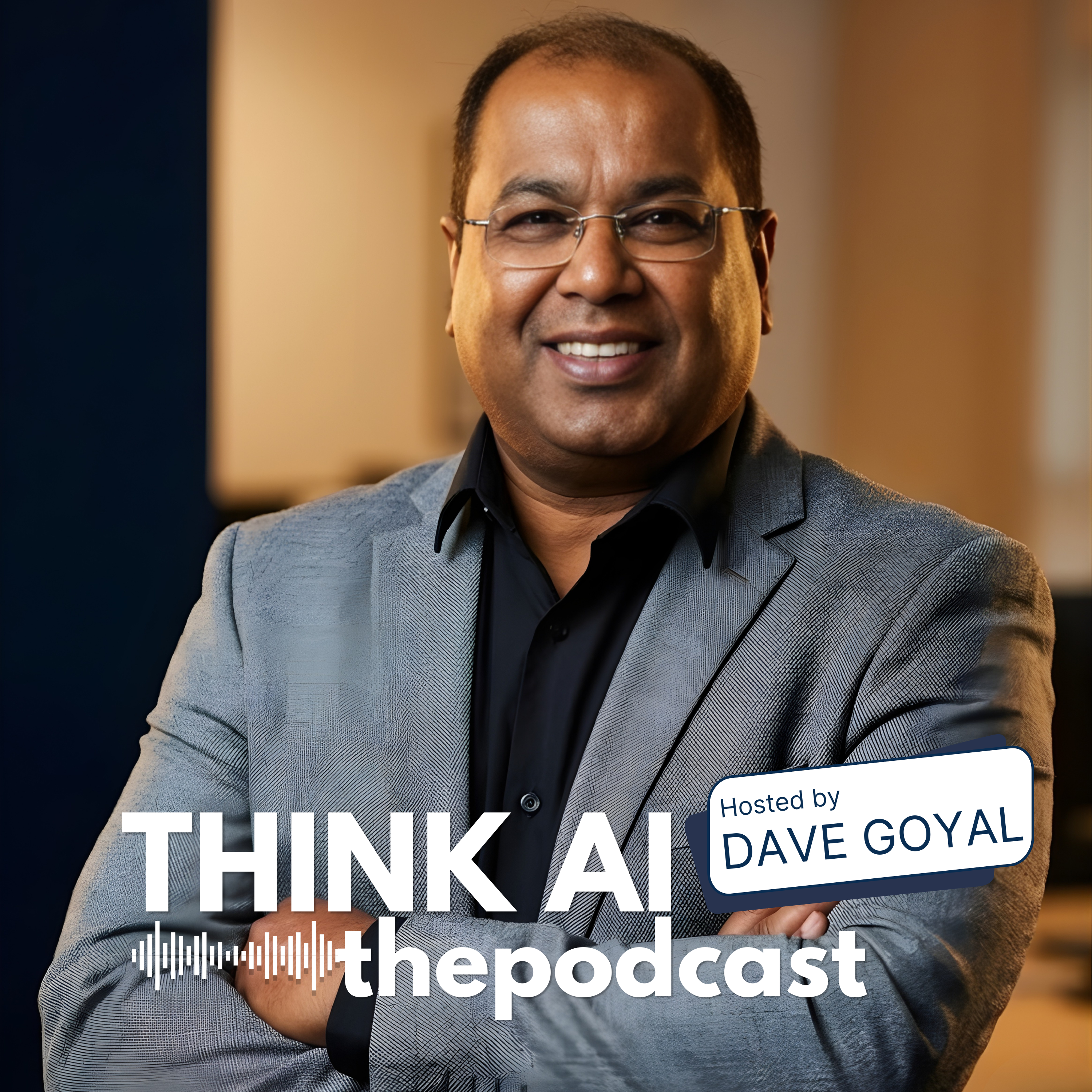
Loading summary
Transcript1 lines
- [00:00]
A
Let me tell you something that most people don't know about me. When I was a kid growing up in India, I didn't walk. Not I didn't walk well, I didn't walk at all. My father used to carry me around to school, to the market, everywhere. And the kids at my school, they didn't exactly roll the red carpet. They beat me up regularly. So if you're sitting there thinking, who's this guy talking about data and AI? I get it. What does a kid who was timid have to do with leadership, entrepreneurship and artificial intelligence? Everything. Because the same resilience that made me strip on leg braces and to learn to walk in middle school, the same drive that got me into modified two wheeler with my best friend riding besides me in the same fire that pushed me through engineering, an MBA, a CFA program, nine companies, 25 countries, and eventually being nominated as one of the top five AI consulting firms in the country three times in a row. That fire is what I bring to every conversation about technology, especially data and AI. Welcome to the ThinkAI podcast. Each week we talk about the most exciting AI research tools, case studies and more. I'm your host Dev Goyer and I've been working behind the scene in data and AI for over 30 years. Whether you are an AI expert, skeptic or something in between, this podcast is for you. And that's exactly what this podcast is all about. Welcome to Think AI podcast. I'm Dev Goya and over the next 35 minutes or so I'm going to walk you through with my journey. How I went from a small city in India to building a company that helped organizations go from zero to $170 million in revenue using data and AI. And more importantly, I'm going to show you why AI is just not a technology play. It's a human story. Whether you never touched AI, whether you have tried it and failed, or whether you are an enthusiast trying to figure out how to make it work inside your company. This episode is for you. Stick with me. So let me take you back. I grew up in central India, a city called Indore. If you have not heard of it, think of it as one of those mid sized Indian cities where everyone knows everyone and where your parents reputation matters more than the resume. And where a kid with a physical disability people look at you either pity or indifference. Neither one helps. My early years and I say this plainly painful. I couldn't walk. My father carried me everywhere. He loved me fiercely and he let me do whatever I needed to do to find My own way. But that mattered more than any therapy, any brace, any medical intervention. He. He gave me permission to try in school. I would sit in my classroom, eat lunch right there at my desk while other kids ran outside. But then a couple of friends came along. The kind of friends who don't care what your limitations are, they just want you to sit with you at a table. They started carrying me out to the lawn and we could eat together. Small thing, right? Pretty big for me. But for a kid who felt invisible, that was the word. Here's the thing though. Even when my body wasn't cooperating, my mind was on fire. And I have. I was always in the top three in my class. Always. Not because I was a genius, but because studying was one of the most difficult area or one of the most easy area where my disability did not matter. The scoreboard was fair. So I leaned it into hard. By middle school, my father got me into leg braces. And slowly, slowly I started walking. Not gracefully, but easily, but I was moving under my own power. And that changed everything about how I saw the world. And if I could teach my legs to walk, I could teach myself anything. By the time I hit 11, something happened. And I think that planted the very seed, everything that I'm doing today. So my dad got me a modified two wheeler. Think of it as a Vespa scooter that has been adopted so that I could operate it. And one of my best friend at the time, his name is Baljinder Singh, he rode with me, taught me how to handle it, give me the confidence to drive on an actual road with actual traffic. And in India, if you have driven in India, traffic, you know how that's not a metaphor for courage, that is courage. But here's what that moment really gave me. Independence. For the first time in my life, I could go somewhere without someone carrying me. I could choose where to go. And that feeling because the foundation of everything I built later. Now academically, I was dead set on becoming an engineer. In India, if you know, if you're smart, your parents want you to be an engineer or a doctor. So I chose to be an engineer. That was the choice. I studied math, I cracked the competition exams, I got into good college, but honestly, the top tier one didn't really work out. The hazing culture, if you know, which we call ragging in India, was brutal. And I said, you know what? I'm going back home. I'll study electronics and telecom engineering in Indore, which is my home city. And that decision, which felt like a Failure at the time turn out to be one of the most rewarding thing that had happened to me. Because it put me in a place where I could build deep friendship, start playing music, perform on stage. And for the first time I was thinking about business. See, I had this friend, a blind friend. He passed away unfortunately. Incredible musician, an orphan. My mom and I loved him. He taught me music. But he then had no friends to find students. So what did I do? I became his marketer. This is the first seed of entrepreneurship. I went out and found him students. 100 to 200 rupees per student. I let him keep all the money, every rupee. But experience gave me something that money can't buy. The entrepreneurship. I will call it entrepreneurial itch. That realization that I could see a gap, fill it and create value. I was maybe 20 years old and the seed was planted. So now if you're expecting me to tell you I went straight from that moment to building an AI empire, I'm going to disappoint you. Because real entrepreneurship doesn't work that way. The real entrepreneurship is messy, it's non linear. It's a lot of. I'll figure it out by. Okay, it did work out or it did not work out. After engineering, I did an MBA in international business with a focus on business finance. I started CFA program, I think it's called Chartered Financial Analyst Program, affiliated with the US Institute. I didn't finish the last part of the cfa, but I did finish the mba. And more importantly, I met someone who changed the trajectory of my life. My friend Jay. I called him the sole partner of my life. Even though his family didn't come from business. They understood money, they understood the risk, they understood how to build something from nothing. And through Jay, I got my real world mba. I helped Jay secure funds for a chemical factory. I learned everything about Microsoft project to build financial models. Now my dad bought me a computer. A Windows 3.11 machine. Those who are old, they know 60,000 rupees. Quite a lot at the time he couldn't afford it, but he did it anyway. And through that machine I learned how to build project reports, apply for loan or structure a startup. Not from textbook, but by doing it I got my first real job at a company that came out of Silicon Valley to set up operations in India. They hired me as an operation manager. But then they also put me on the development team. I had never really done coding before, but a friend, his name was Devashish, taught me C and I faked it until I made it I was the sixth developer on a six person team building biotech software. But here's the pattern you will see in my life I got restless. I always wanted to prove that I can survive on my own despite physical limitations. So I started interviewing everywhere. Delhi, Bombay, Bangalore. Not just to get more and more job offers, but to build confidence. In the span of, let's say four to six months, I went to 400, yes, 400 walk in interviews every weekend, relentlessly. I got a job with a French company in Singapore working with smart card technology. And this. Pay attention. Here is where my AI journey quietly begins. I started building algorithms, testing security systems, white hat hacking. And to make sure everything worked, they sent me to 20 plus countries. I was solving complex business problems, I should say with data and logic. And before anyone was calling it AI. Eventually I came back to India. I started my first software company, SOL Informatics. I trained college students, built my own team from ground up, took government projects, started developing a reputation as a serious technology consultant. Now some of those students I trained and I say this with a pride, they are running their own companies today. Some of them are CEOs in large organizations, vice presidents and so on. That gives me more pride than any revenue number. Over the next few years I went through multiple companies, mergers, partnership. I came to the US in I think early 2000, got married, waited for my green card. While I waited, I worked as a consultant with major healthcare organizations. I managed large programs and teams. I learned enterprise IT inside and out. And I was itching, waiting for the moment I could build my own startup again. So let me tell you something about the company that changed everything. After my green card came through, I took a position in an insurance company working on business intelligence and a tool called Cognos. That world opened my eyes to the power of data. I then moved to a consulting company focused on business intelligence through. That's where I cut my teeth on pre sales, sales and consulting all at once. I worked with Fortune 500 brands, billion dollar companies in coffee, banking and semiconductors. I saw firsthand what happens when an organization gets data right and what happens when they don't. But the moment that crystallized everything, I started my new venture as an independent consultant. I was working with the medical device organizations to build claim processing systems from scratch, from zero using all the Microsoft technologies I had mastered. And so we did it. We built a solution that took from zero to more than $100 million and hundred thousand claims a month from a system we built. Pretty proud of it I would say. That's When I knew I just don't want to consult. I want to build solutions that fundamentally change how companies operate. So I co founded Think AI with my friend Manish who I knew since early 2000. And we built it into something special within Think AI. We became Microsoft Premium Solution Partner, Advanced Solution Partner, Specialized Solution Partner. We were ranked with the top 1% out of half a million or 500,000 Microsoft partners globally. Not the top 10%, not 20%, but the top 1%. Let me repeat, out of half a million partner across the globe we were in top 1%. Our focus data and AI specifically we help mid sized companies in manufacturing and healthcare take the leap from traditional business intelligence to modern architecture. AI driven decision making. We also build no code or pro code solutions. Pro code means with a lot of code we could serve clients who had deep technical teams and also the clients who had none. We partner with top integration platform companies such as Boomi. We implemented hundreds of client solutions and here's the number I'm Most proud of. 95% success rate on project delivery. In an industry where the average enterprise software has a 50 to 70% failure rate, we were at 95. Now how? How did we do that? Three things. First, we never sold technology. We sold outcomes. Every engagement started with what business problems we are trying to solve and not what tools you want to use. If a client came to us saying we want AI, our first question was why? And they could answer that. We helped them figure it out before we wrote a single line of code. Second, we invested in people. Not just hired them, but invested in them. Now one of my core passion is taking someone with one skill, say software development and growing them into a leader. Teaching them deep listening skills, communications and how to run a meeting. How to think strategically. I have done this dozens of times. And those people became the backbone of our delivery. Third, we went global post Covid era. We built a team in India, grew to 220 people, added resources in Philippines, resources in Canada, and obviously in US too. Not because Offshore is cheap, but diverse. Global teams see problems differently. They bring different lenses and in AI lens matters as much as the algorithms. But here's how I'm going to be real with you. The consulting business started getting harder post Covid. Talent retention became a nightmare. People who would join, we would invest months training them and they would leave it for a higher salary elsewhere. The loyalty equation broke. And that forced me to ask myself a question I think every entrepreneur eventually has to face. Am I building this company for the business or am I building it for the mission. And here's what I realized and this might resonate with some of you, especially if you are building something right now. I had built a successful consulting company. We were growing. We had awards, the partnerships and the client one. But I wasn't doing what I was most passionate about. So I took coaching. Not once, three times. The first coach was one on one and he helped us tighten up the operations. Very useful but incremental. The second was on a group coaching focused on a business mastery. Nine months of process and operational optimization that was solid. And the third one? Life changing. I learned how to take a company from being a commodity, just another consulting firm bidding on projects, to being a brand. I learned that a marketing engine, when done right, is more powerful than a sales engine. That thought leadership isn't just content, it's positioning. So I started writing. I wrote blogs. I wrote my first book, Real Time Business Intelligence Mastery. I started speaking on stages. I also did a three day speaking boot camp. I was reinventing myself at 50 plus years old. I'm 54 now and in 2026 I launched Data and AI Studio. Now here's what Data and AI Studio is all about and why I'm doing this podcast three Pillars Pillar one Community I'm building a learning community. A school if you will, where freshers and career changers can learn data and AI free tier for those who need it paid engagement for deeper learning. Because I believe the biggest barrier to AI adoption isn't technology, it's education. Pillar two Package Solution Think of these as AI product for small businesses. An AI receptionist for a dental office as an example. AI powered lead generation system for realtors or anyone who needs it. Or an AI sales development rep that can qualify leads for any business. These are not custom builds, they are ready to deploy because small businesses deserve AI too and they should not need tens and hundreds and thousands of dollars budget to get it. Pillar three is coaching. I help business owners now build their own AI systems, even in AI clones for themselves to save time, scale their expertise and work on what matter most to them. In this podcast, this is the thread that ties all this together. This is where I share my stories, my lessons and the mistakes to the real world applications that make AI feel less like science fiction and more like your competitive advantage. Alright, before I let you go every episode, I'm going to give you an AI tip of the day. Something practical, something you can try in the next 24 hours. Whether you are an AI curious, an enthusiast or a skeptic, this tip is for You Today's tip. Build your first AI assistant in 10 minutes. Now if you know something like this you can skip it. Here's what I want you to do. Go to any major AI platform, ChatGPT, Claude, Copilot, Gemini, Grok, whatever, whichever one you have access to. And I want you to type this prompt, write this down or come back to the show notes. You are my personal assistant. I run a and fill in your type of business. My biggest challenge right now is and then you fill in your biggest pain point. Every time I ask you a question, I want you to give me three options. One quick fix, one strategic solution and one innovative idea that I have not considered. Always ask me one follow up question to refine your suggestions. Now this is the prompt. That's it. Save that prompt. Use it every day for a week. What you will notice is that the AI prompt to feel less like a search engine and more like a thought partner. It's not replacing your judgment, it's expanding it. And here's the skeptics version of this tip for those who don't trust AI. Try it for one week with low stake decisions, not your company strategy. Start with what should I include in my next meeting or agenda? Help me draft a follow up email to a client. Small stuff, safe stuff. Let the results speak for themselves. That's your tip. 10 minutes, 0 risk. Try it now. Here's what coming next In Episode two, I'm going to do a deep dive into something I've spent years in working healthcare. I'm not going to give you a theory. I'm going to walk you through real stories from real projects. I will expound on the story I was telling you earlier where a mid sized medical device company building a claim system from scratch generated nine figures in revenue. I will talk about working with diagnostic companies processing tens of thousands of patient samples and how we use data to catch patterns that human eyes were missing. I'll share what happens when you take a healthcare organization that's drowning in data and I mean drowning. Give them tools to breathe. Healthcare and AI is not a future conversation. It's happening right now and most leaders are either moving too slow or moving in the wrong direction. I'll tell you why and what to do about it. That's episode two. Don't miss it. If this episode resonated with you, if something I said made you think, okay, this guy gets it, here's what I would love for you to do. Subscribe Share this with one person who is curious about AI but doesn't know where to start. Drop me a comment or a message. I read it. Every single one. You can find me on LinkedIn. Dev Goyal orave goyal.com I'm Dev Goyal and this is Thinkai podcast. I'll see you in the next one. You have been listening to Think AI podcast with Dave. Take one idea from this episode and turn it into action.