Podcast
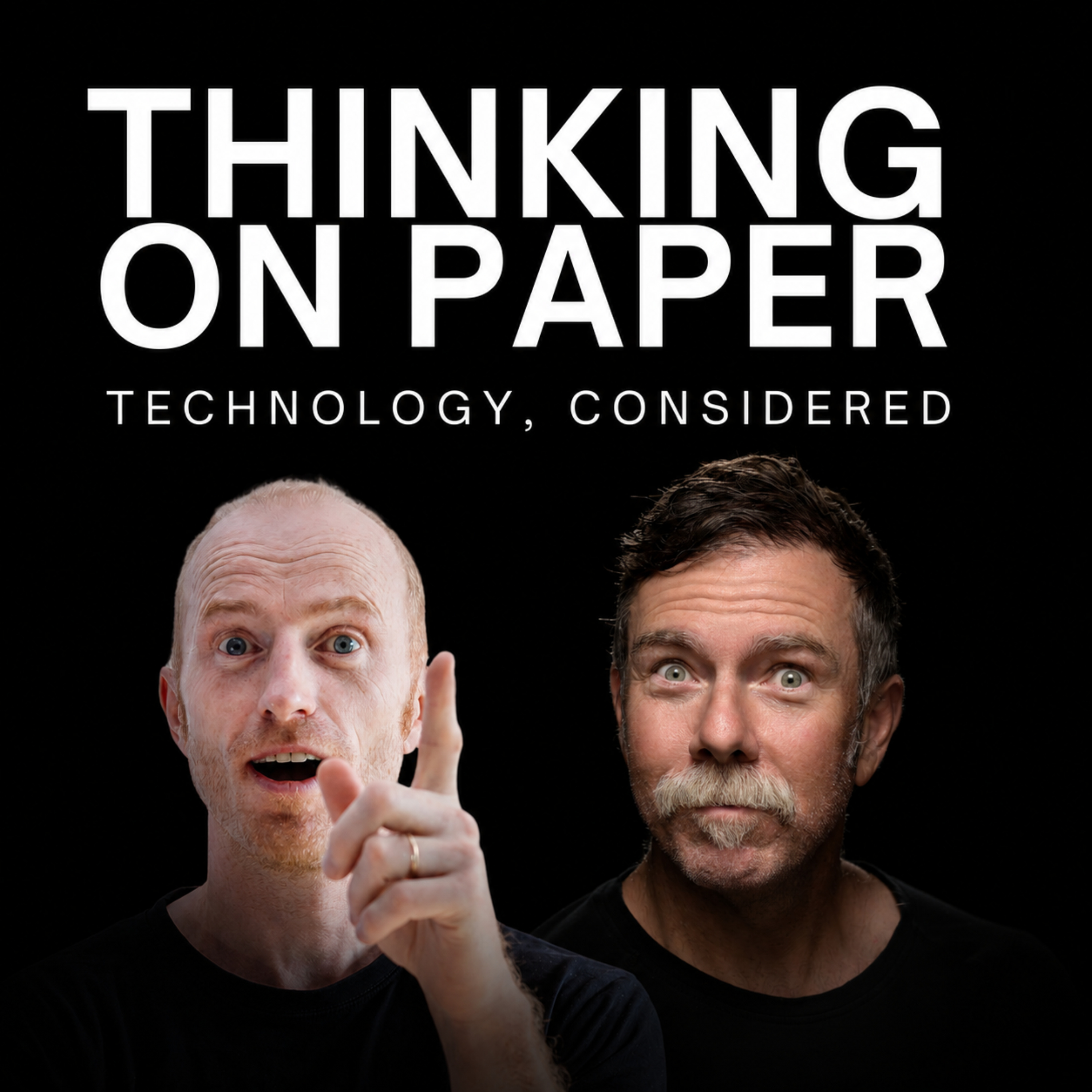
Thinking On Paper
Hosted by Mark Fielding and Jeremy Gilbertson · EN
Technology is moving faster than you can make sense of it. How do you keep up without surrendering your judgement to the people selling you the future?
Thinking On Paper brings you inside AI, quantum computing, robotics, space, energy and biotechnology with the founders, scientists, engineers and CEOs building them. Then we follow the money, infrastructure, power and human consequences.
See how the pieces connect, which promises survive contact with reality and where change is really heading, so you can prepare for what comes next and form your own view.
51episodes
Episodes
Newest firstAll episodes
The Real Reason We Stop Asking Questions
2w ago00:04:51Tap to summarizeWhy do we stop asking questions as adults? Philosopher Pia Lauritzen has analysed 30,000 of them, and says nothing was ever lost.The ability stays. What changes is the price. Every question admits you don't know something, and nobody gets promoted for ignorance. Ask in the wrong room and curiosity starts to feel like an interrogation, which is why most of us learn to keep the question to ourselves.She proves it in keynotes. One minute, two rules, and every person in the audience writes one. They could do it the whole time.Full episode with Pia Lauritzen on questions, curiosity and whether AI can think at www.thinkingonpaper.xyzBe curious, stay disruptive.--Thinking on Paper is a technology podcast about AI, Space, quantum computing, science, and the systems shaping your life. 🏠 Buy us a beer on Substack🫵 Choose your own technology adventure 📺 Watch our beautiful faces on YouTube 🎧 Remember Steve Jobs on APPLE📺 Get clips and exclusive videos on Instagram
Transcribe →AI Music: What Will Be The Last Song We Listen To Together?
2w ago00:05:32Tap to summarizeNicholas Ponari says AI music makes live performance more valuable, not less. Mark Fielding calls the same future a hellscape.Ponari's scenario: by 2045 his son types a script into a generator, gets a feature film in the style of Kubrick crossed with Tarantino, and hits publish. Everyone becomes a creator in every medium. Nobody can consume a fraction of it, so AI becomes the largest curator in history.Mark's objection is that shared culture dies with it. No song anyone else has heard. No film anyone else has seen. Nothing left to talk about.Ponari's answer is scarcity. When everything is generated, the things that cannot be, a room, a crowd, live music, become more valuable than ever.Who's right?Full episode at thinkingonpaper.xyz.Be curious, stay disruptive.--Thinking on Paper is a technology podcast about AI, Space, quantum computing, science, and the systems shaping your life. Thinking on Paper is a technology podcast about AI, Space, quantum computing, science, and the systems shaping your life. 🏠 Buy us a beer on Substack🫵 Choose your own technology adventure 📺 Watch our beautiful faces on YouTube 🎧 Remember Steve Jobs on APPLE📺 Get clips and exclusive videos on Instagram
Transcribe →The Hard Question of AI
3w ago00:50:40Tap to summarizeThe US and China are racing to build AI systems that could lead to superintelligence before any enforceable global rules exist to inspect them, limit them or verify what they can do.Mark and Jeremy Think On Paper about The Hard Question of AI, an essay by Planet CEO Will Marshall. Marshall argues that AI governance now needs the same kind of verification, trust and global protection as nuclear weapons.That means more than voluntary safety tests and China and America laying down their AGI swords. And since that is unlikely, it could mean monitoring chips, tracking data-centre construction and energy use, inspecting frontier AI labs, protecting whistleblowers and agreeing international red lines around recursive self-improvement.But the nuclear comparison has many challenges. Weapons-grade material is scarce and difficult to hide. Just ask Iran. AI software can spread quickly and cross borders. Any Tom, Dick or Harry could end up being the first to create superintelligence. At the centre of the episode is one question: what would AI’s Cuban Missile Crisis look like? What event would force the US and China to cooperate? Really cooperate. Lip service won’t calm existential risk. We also discuss Sam Altman, Dario Amodei and Demis Hassabis, the incentives behind AI safety warnings, the limits of voluntary regulation, the RAND verification framework, recursive self-improvement, the Fermi paradox and whether governments can build the institutions required to manage AI superintelligence.Hint: they can’t.Please enjoy the show. And don’t have nightmares.--Thinking on Paper is a technology podcast about AI, Space, quantum computing, science, and the systems shaping your life. 🏠 Buy us a beer on Substack🫵 Choose your own technology adventure 📺 Watch our beautiful faces on YouTube 🎧 Remember Steve Jobs on APPLE📺 Get clips and exclusive videos on Instagram --Chapters00:00 Trailer 01:38 AI And Existential Risk02:40 OpenAI, Anthropic & Google04:40 Nuclear meltdown or sharks?05:50 Why is everyone speaking about the end of humanity08:00 RSI - Closed loop recursive self improvement10:00 A ghostbuster copyright interlude19:39 Why America And China Are In An AI Race23:51 The AI Cuban Missile Crisis28:07 The AI Supply Chain35:09 USA And China And The AI DeadEnd40:36 The Nuclear Framework
Transcribe →Why AI Companies Keep Wasting Billions On Idle GPUs
Jul 1400:41:19Tap to summarizeAI companies are splashing billions on more GPUs before they use the ones they already have. Many sit idle, others use a fraction of their potential. For the hyperscalers, cloud providers and AI companies, buying more GPUs does not solve much if the GPUs already in the rack spend too much time waiting for the rest of the system.The next battle in the AI infrastructure wars is efficiency: GPU utilization, NICs, memory movement, networking, CPUs and software that keeps expensive hardware doing useful work.Moshe Tanach runs NeuReality AI, a company building infrastructure for AI inference. In this conversation, he explains why the next wave of AI infrastructure depends on GPU utilization, NICs, memory movement, networking and software efficiency, not just buying more chips.This is a technical conversation about AI inference, infrastructure efficiency and the hardware layer beneath ChatGPT, Claude, Gemini and the AI tools now being built into business software.Please enjoy the show.Thinking on Paper is a technology podcast about AI, Space, quantum computing, science, and the systems shaping your life. 🏠 Buy us a beer on Substack🫵 Choose your own technology adventure 📺 Watch our beautiful faces on YouTube 🎧 Remember Steve Jobs on APPLE📺 Get clips and exclusive videos on Instagram --Chapters(00:00) The GPU challenge(01:27) Training Vs Inference(05:45) Memory & Keeping The GPU Busy(07:31) Deep Seek, Blackwell & Ruben(09:03) How Ripe Is CPU For Reinvention?(11:03) AI Agents Run On CPUs(12:51) Do We Need All The Computation?(14:35) GPU Utilization Rates(16:50) Tokens In A Context Window(20:59) Data, Knowledge & Wisdom(23:56) Why Are Your GPUs Busy? (A Truck Analogy)(29:07) Hyperscalers(31:59) The Decode Phase(36:47) What More Efficient GPUs Means For The User
Transcribe →Cultivated Meat: Could It End Industrial Animal Farming?
Jul 800:53:02Tap to summarizeCould cultivated meat replace industrial farming without asking billions of people to change what they eat? And save all the cows on the way?Bruce Friedrich, founder of the Good Food Institute and author of Meat, explains why the future of food may depend less on changing human behaviour and more on changing how meat is produced.For more than 12,000 years, humans have relied on animal agriculture to produce meat. Bruce argues that this system is reaching its limits. We explore how cultivated meat is made, why it is attracting support from governments and major food companies, and why some of the biggest meat eaters are also the most open to the technology.Along the way, we discuss the environmental cost of livestock, antibiotic resistance, food security, infrastructure, consumer psychology, regulation, and whether this technology could become as transformative as renewable energy or electric vehicles. We also examine what happens to farmers, why culture may be harder to change than technology, and whether cultivated meat can ever reach price parity with conventional meat.If the next agricultural revolution is already underway, it may not begin on a farm.Thinking on Paper is a technology podcast about AI, Space, quantum computing, science, and the systems shaping your life. 🏠 Buy us a beer on Substack🫵 Choose your own technology adventure 📺 Watch our beautiful faces on YouTube 🎧 Remember Steve Jobs on APPLE📺 Get clips and exclusive videos on Instagram --Chapters(00:00) Who Eats Cultivated Meat?(02:37) Cultural Significance of Meat(06:09) What Is Cultivated Meat?(08:25) The Science Behind Cultivated Meat(10:48) How Much Does Cultivated Meat Cost?(14:46) What does cultivated meat taste like?(17:10) Emerging Companies in the Lab Meat Industry(19:08) Industry Support for Alternative Meats(21:06) Government Role in Innovation(24:40) The Future of Animal Agriculture(28:25) Agricultural Policies for Sustainability(31:41) What Are Fermented Meats?(35:48) Meat And Antibiotic Resistance(39:32) The Invisible Costs of Meat Production(42:26) The Future of Cultivated Meat
Transcribe →Asteroid Mining: Why It's More Lucrative (And Easier) Than You Think
Jun 2300:51:48Tap to summarizeAsteroid mining sounds insane until you speak to AstroForge CEO Matthew Gialich. Then it makes perfect sense.Matthew’s team at AstroForge builds spacecraft to mine metallic M-type asteroids for platinum group metals, the unglamorous but essential metals inside phones, cars, chips, electronics and much more.AstroForge is one of the few companies trying to make space mining real, targeting metal-rich asteroids that could contain platinum, palladium, iridium and other PGMs.Why? Earth’s resources are getting harder, deeper and more expensive to reach. The good stuff is not sitting neatly on the surface. A lot of it is buried, depleted, regulated or uneconomic.In this episode, Matthew explains why asteroid mining may now be technically and economically possible, why Planetary Resources may have been too early, how SpaceX changed the capital story for space startups, and why AstroForge’s first deep-space spacecraft failed after travelling nearly a million miles from Earth.Please enjoy the show. --Thinking on Paper is a technology podcast about AI, Space, quantum computing, science, and the systems shaping your life. 🏠 Buy us a beer on Substack🫵 Choose your own technology adventure 📺 Watch our beautiful faces on YouTube 🎧 Remember Steve Jobs on APPLE📺 Get clips and exclusive videos on Instagram --Chapters(00:00) Asteroid Mining Trailer(02:51) The Economic Necessity of Asteroid Mining(08:37) Lessons from Planetary Resources(10:43) Risk and Innovation (15:26) Deep Space Two (19:05) The Quest for Asteroid Exploration(22:20) Aliens & Life Beyond Earth(24:17) Ownership and Ethics in Space Mining(26:21) The Next Challenges in Asteroid Mining(27:56) Changing Earth's Economy (30:13) The Role of Capital(32:32) Matt's Vision for Space Exploration(35:06) The Drive to Explore the Universe(36:55) NASA's Evolution (39:17) Inside Astroforge(42:53) The Complexity of Space Engineering(44:25) Data Centers in Space(47:30) The Limitations of AI in Space Engineering
Transcribe →Quantum Computers: Truth, Facts And Hype
Jun 1900:57:49Tap to summarizeQuantum computers could change medicine, material science and AI. Unfortunately, it's impossible to know how because the industry is buried under hype. In today’s show, Dr. Bob Sutor takes us on a masterclass through the hype and conflicting headlines to the reality of quantum technology today. By the end of the show you’ll know what’s fact and fiction, where the industry is heading and how to protect yourself from AI slop masquerading as insight.We also learn about:Why “quantum supremacy” and “quantum advantage” claims should be treated carefullyWhy quantum computing is still in its prehistoryHow engineering discipline is changing the fieldWhat IBM and Cleveland Clinic’s protein simulation work shows about quantum chemistryWhy money, sovereignty and technology are driving the quantum industryHow governments are funding quantum computing in the United States, France, the UK, Finland and elsewhereWhat China may be doing in quantum computingWhich industries are doing serious quantum researchWhy there are many quantum hardware approaches and no clear winner yetWhether helium-3 supply matters for quantum computingBob also explains why quantum computers will be useful for specific classes of difficult problems where classical computers struggle, especially once systems become larger, more reliable and fault tolerant.The conversation ends with practical advice on separating the quantum noise from the Thinking On Paper signal.Please enjoy the show.--Thinking on Paper is a technology podcast about AI, Space, quantum computing, science, and the systems shaping your life. 🏠 Buy us a beer on Substack🫵 Choose your own technology adventure 📺 Watch our beautiful faces on YouTube 🎧 Remember Steve Jobs on APPLE: 📺 Get clips and exclusive videos on Instagram (00:00) AI Quantum Slop(00:40) Welcome To The Show(06:04) When Quantum Computers Finally Become Useful(10:13) Why Governments Are Throwing Money at Quantum(15:53) Is China Ahead in Quantum? (18:48) Where Quantum Might Actually Matter(27:11) Can Quantum Help Fix Climate Change?(28:35) Why Battery Companies Care About Quantum(30:31) Why Quantum Doesn’t Belong in the IT Department (31:53) Who’s Doing the Real Work in Quantum?(32:40) Why Quantum Companies Need Real Customers(38:19) The Funding Problem Behind Quantum Progress(45:22) Does Quantum Computing Need Helium-3?(48:01) Will We Need a Quantum Computer Matchmaker?(50:38) How to Spot Quantum Hype Before You Share It
Transcribe →GEO: How AI Decides Which Brands You Should Buy
Jun 1200:44:34Tap to summarizeHave you used Google Search recently? Exactly. Most companies, and most people, still think about Google when they think about search. They’re still spending heavily to rank there and paying for the ads around it.But more people are asking ChatGPT, Claude and Gemini what to buy, read, use or trust.SEO isn’t disappearing. It’s evolving into GEO.Awad Sayeed, co-founder and CTO of Parsnipp AI, joins Thinking on Paper to explain generative engine optimisation, or GEO, and how companies can become more visible inside ChatGPT, Claude, Gemini and other AI answer engines.Traditional SEO focuses on keywords, backlinks and rankings. GEO is more dependent on context: who the user is, what they’ve already asked, what they’re trying to achieve and how an AI system retrieves and combines information.In this episode, we discuss:How generative engine optimisation differs from SEOWhy context matters more than keywords in AI searchHow ChatGPT, Claude and Gemini use information differentlyWhat persona-based agents reveal about brand visibilityHow structured data helps AI systems understand websitesWhy comparison pages and clear product information matterWhat black-hat GEO could look likeHow AI-generated content could pollute the internetWhether brands should create separate experiences for humans and AI agentsHow advertising may develop inside AI assistantsAwad argues that GEO doesn’t replace SEO. Strong websites, useful content and clear structure still matter. But companies now need to think about whether AI systems can retrieve, interpret and recommend their information in the right context.And as this is Thinking On Paper, we ask about the human impact, the wider change in the structure of the internet, trust, data and consumerism. Please enjoy the show.--🏠 Buy us a beer on Substack🫵 Choose your own technology adventure 📺 Watch our beautiful faces on YouTube 🎧 Remember Steve Jobs on APPLE📺 Get clips and exclusive videos on Instagram --Chapters(00:00) Introduction to Generative Engine Optimization (03:36) Understanding Persona-Based Agents (06:23) The Transition from SEO to GEO(09:06) Context in LLMs and GEO(11:41) Black Hat Strategies in GEO(14:22) The Future of the Internet(16:58) Advertising in the Age of GEO(19:37) The Impact of GEO (28:22) The Evolution of AI Models (29:03) Integrating AI into Business Strategies(29:52) Agents vs. Humans(32:10) The Future of SEO and GEO(34:08) Tools for Visibility and Analytics in AI(36:00) Customer-Driven Development(39:23) The Role of Storytelling in GEO(42:04) Model Transparency and the Future of AI
Transcribe →Robotics: Can The UK Compete Against The US And China?
Jun 1100:46:05Tap to summarizeThe UK produces world-class technology and is home to exceptional tech entrepreneurs. All too often it watches them scale in America.Rory Daniels, Head of Emerging Technology and Innovation at techUK, joins Thinking on Paper to discuss whether the United Kingdom can remain competitive as quantum computing, robotics, photonics, AI and advanced computing begin to converge.The UK has strong research institutions, deep technical talent and globally significant companies. Its recurring problem is scale. Promising technologies are often developed in British universities and laboratories, then commercialised or funded elsewhere.In this episode, we discuss:What makes the UK robotics industry different from the US and ChinaWhy British companies often focus on specialised robots for nuclear sites, wind turbines and industrial environmentsHow autonomous driving companies such as Wayve combine AI, sensors and connectivityWhether robotaxis can coexist with London’s black-cab industryWhy UK technology companies struggle to scale after the startup stageHow access to long-term capital affects quantum, robotics and semiconductor companiesThe role of universities, technology-transfer offices and regional innovation clustersWhat is happening in Coventry, Edinburgh, Milton Keynes, Barnsley and other UK technology centresHow digital twins and simulation are used to train robots and autonomous vehiclesWhy photonics matters for quantum computingHow quantum, photonic, neuromorphic and biological computing could convergeWhether AI can develop the judgement and wisdom required to solve complex technical problemsHow techUK connects companies, researchers and policymakersWhy public trust and adoption matter as much as technical performanceRory argues that the UK’s advantage may not lie in dominating a single technology. It may come from combining existing strengths in AI, chip design, robotics, quantum computing, photonics and connectivity.The conversation examines what government, industry, universities and investors must do if the UK is to convert strong research into companies that can scale globally without leaving the country.Please enjoy the show.Thinking on Paper is a technology podcast about AI, Space, quantum computing, science, and the systems shaping the future. 🏠 Buy us a beer on Substack🎧Get Up Close On YouTube 🎧 Remember Steve jobs on APPLE📺 Get the clips and outtakes on Instagram --Chapters(00:00) The UK Technology Landscape(03:14) Robotics: A UK Perspective(05:54) Autonomous Vehicles in the UK(08:39) The UK's Innovation Ecosystem(11:05) Challenges and Opportunities for UK Tech Entrepreneurs(13:27) Regional Innovation and Government Initiatives(16:33) The Role of Universities in Tech Development(19:15) Barnsley: A Blueprint for Tech Towns(21:53) Government Initiatives in Robotics(24:20) Digital Twins and the Future of Robotics(27:12) Quantum Computing and Photonics in the UK(29:24) The Role of Education in Emerging Technologies(30:55) AI and Human Wisdom: A Complex Relationship(38:02) Neuromorphic Computing: The Future of AI(38:23) Convergence of Technologies: Opportunities for the UK(42:42) The Human Element in Technology Adoption
Transcribe →AI Is Automating Engineers Out Of A Job
Jun 1100:34:37Tap to summarizeThe Vij brothers join Thinking on Paper to discuss Neo, an autonomous machine learning engineer designed to automate parts of the AI development process.As demand for AI systems grows, companies and governments are competing for a limited pool of experienced machine learning engineers. The challenge isn’t only access to data or computing power. Many organisations also lack the technical expertise required to build, test and deploy effective models.Neo uses a multi-agent system to perform tasks normally handled by machine learning engineers, including analysing datasets, selecting modelling approaches, running experiments and evaluating results. The aim is to automate repetitive technical work while allowing human engineers to concentrate on higher-level decisions and more creative problems.In this episode, we discuss:What an autonomous machine learning engineer isHow Neo’s multi-agent AI system worksWhy skilled machine learning engineers are in such high demandWhich parts of AI development can be automatedHow autonomous agents compare with traditional machine learning workflowsWhy Kaggle Grandmasters are considered leading practitioners in applied machine learningWhether AI agents can match expert human performanceHow automation could affect machine learning jobs and salariesThe evolution of GPUs from graphics hardware to AI infrastructureWhat the Vij brothers learned from working at CERNHow autonomous AI systems could change business, creativity and technical workNeo is intended to expand access to machine learning expertise rather than simply generate code. Its development raises a wider question: what happens when AI systems can perform the specialised work required to build other AI systems?This conversation examines the technical capabilities of autonomous machine learning agents, the shortage of experienced AI talent and how automation could reshape the role of engineers--Timestamps(00:00) Why Are There So Few Machine Learning Engineers?(01:54) Meet Gaurav Vij and Saurabh Vij(02:57) Lessons Learned from Working at CERN(04:45) How to Explain The Importance Of A.I. to Your Parents(07:24) The World’s First Autonomous Machine Learning Engineer: What AI Problem Does NEO Solve?(08:17) AI Competitions and Kaggle Grandmasters(11:06) How Many A.I./ML Engineers Do We Need?(17:30) Fixing The A.I. Hallucination Problem(18:09) Hot Buttons: 5 AI Questions In 30 Seconds(18:46) Hollywood: Doomed by A.I, or Reborn?(20:26) AI News: Nvidia Digits Explained(21:51) Moore's Law And Could AI Models Be Motivated by Rewards?(25:42) AI And Quantum Computing(29:45) The Thinking on Paper Carry-Over Question(30:16) After Hours: Backstage Extra--Check out NEO: https://heyneo.so/Learn more about the show: www.thinkingonpaper.xyzFollow Thinking On Paper On Instagram: https://www.instagram.com/thinkingonpaperpodcast/
Transcribe →