← This American Life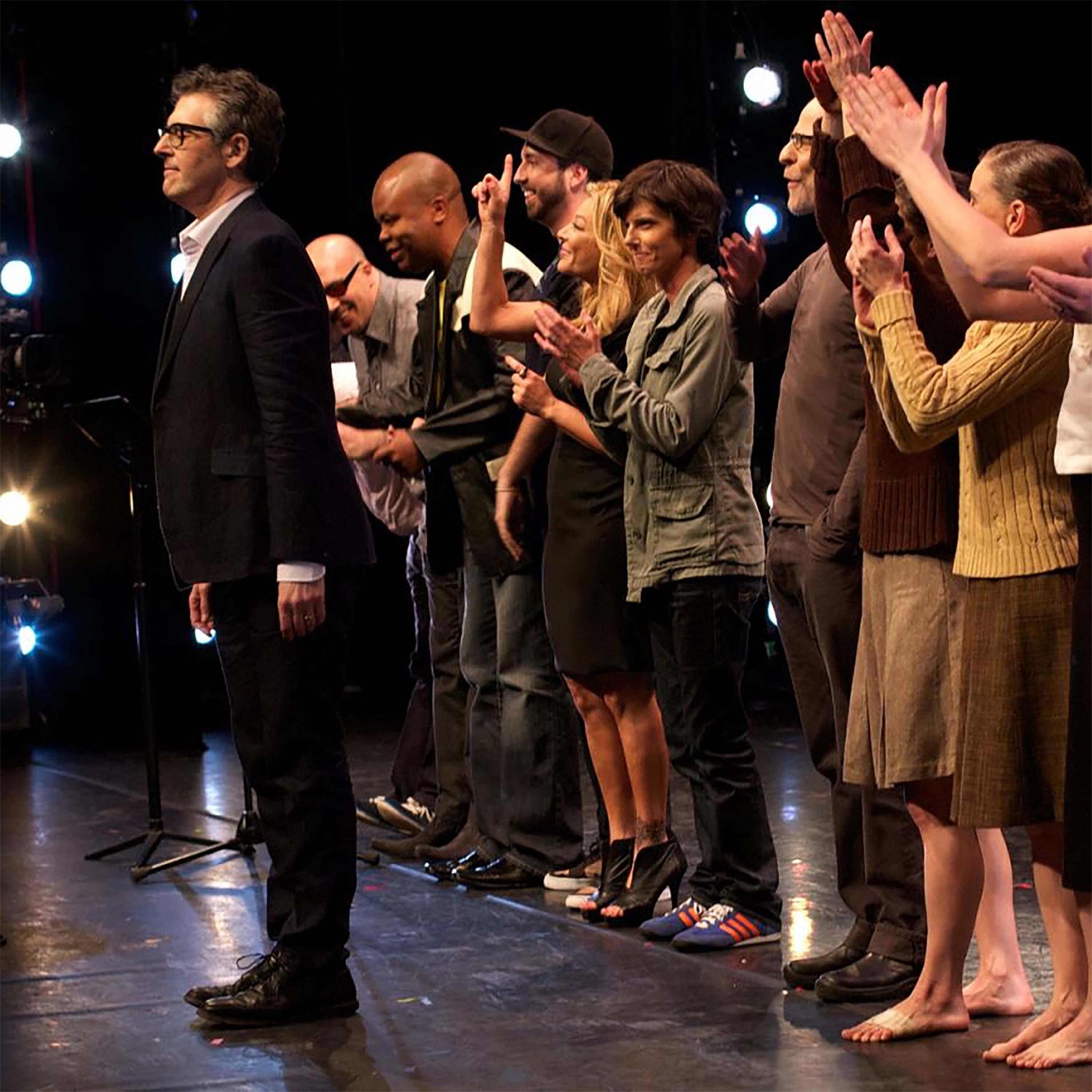
This American Life
464: Invisible Made Visible
01:00:03
David Sedaris, Tig Notaro, Ryan Knighton, and the late David Rakoff in his final performance on the show.
Loading summary
Transcript74 lines
- [00:01]
Ira Glass
Support for this American life comes from Squarespace, the all in one website platform with features. To help you start a fully custom on brand website. Use Squarespace's latest AI enhanced website builder, Blueprint AI. It can transform basic information about your brand or business into an elevated online presence with curated premium quality content automatically added and matched to your profile and aesthetic. Head to squarespace.comamerican for 10% off your first purchase of a website or or domain. Ryan started going blind when he was 18, so it's been a long time now that he can't see. And one night he flies to Chicago for this work thing and gets to his hotel room and he wants to call his wife back home in Canada to let her know that he's arrived safely. So all he needs to do is find the phone.
- [00:52]
Ryan Knighton
And so I walk into the room and I find the bed. And then to the left of the bed I feel along and I find this nightstand, which is where I expect the phone to be. And so I feel up the nightstand and there's no phone. Fine. So I reach across the bed to the other side and find the other nightstand and I feel that one up and there's no phone.
- [01:16]
Ira Glass
That's unusual, right?
- [01:17]
Ryan Knighton
It's a bit odd, right?
- [01:22]
Ira Glass
So Ran can shuffle cautiously around till his knees graze into things. And that's how he finds a sofa, which orients him.
- [01:31]
Ryan Knighton
And so I turn to where I think there might be a table and poof, there's a coffee table. So I grope this coffee table for a while and there's no phone on it.
- [01:41]
Ira Glass
Grope is kind of a funny word to use for this.
- [01:43]
Ryan Knighton
It sort of feels that way though, you know, you just sort of. Because you don't know where anything begins or ends, so you really maul it.
- [01:50]
Ira Glass
He says that as he moves around any new place, he doesn't exactly draw a map in his head. He says that it's more like wandering around in a first person video game, one where nothing is visible until he touches it. So he figures, okay, let's see what is on the other side of this coffee table that he's found. And he edges forward in the room.
- [02:10]
Ryan Knighton
And I find there's a desk. And I'm like, aha, the desk, right? So I feel around on the desk and there's a lamp and there's the notepad I'll never use. And there's stuff, but there's no foam. So I'm left to my last sort of blind guy resort, which is I go back to the beginning, you Know, back to the bed, and I find the wall, and I start Marcel. Marcel. Ing the walls. You know, I'm wiping them up and down, and I round the fourth corner and I get to the bathroom, and I go past the bathroom and there's nothing. And I feel behind me again, and the bed is back behind me again. So I've circled this room, and, I mean, I even thought, well, maybe it's like a super fancy hotel, and maybe there's a phone in the bathroom. And I go in there and there's nothing. So I circle the room two more times this way, wiping it down. And I check the coffee table again, I check the desk again, and I just figure, forget it. I'll just go to bed and try again tomorrow.
- [03:20]
Ira Glass
So he goes to bed, doesn't call. His wife sleeps. And in the morning, he wakes up to the sound of something curious. A phone ringing. And groggy. He follows the sound and finds somehow, now there is a phone in this.
- [03:39]
Ryan Knighton
Room, and the phone is on a coffee table. Now, I know I felt that thing up to an illicit degree, like I mauled that coffee table, and there was nothing on that table last night. And so I answer the phone and it's my wife. And she says, why didn't you call me last night? And I said, well, there was no phone, but there is now.
- [03:59]
Ira Glass
She doesn't believe him that there was no phone, but this is kind of par for the course when you're married to a blind guy.
- [04:05]
Ryan Knighton
And so we talk, and then I hang up the phone and I go to get back into bed. And there's now a wall there.
- [04:13]
Ira Glass
A wall where the bed should be is now a wall. He feels for the sofa. Sofa's right where it should be. The wall behind the sofa is right where it should be, right there in place. He feels along the sofa again, inches towards where the bed should be. And yes, it's still a wall.
- [04:31]
Ryan Knighton
And I'm totally disoriented at this point. Like, it's. It's funny and it's also sort of terrifying because I know the bed was there and now there's a wall. And I keep touching the wall, thinking maybe this time it'll go away. And I go to the left. And there's another wall now, and I'm a grown man and I'm lost in a hotel room.
- [04:55]
Ira Glass
So what's your next move? What do you do?
- [04:59]
Ryan Knighton
I ended up, like, doing the Marcel Marceau thing. I start wiping the walls, feeling my way along the edges, and it wraps back around till I Find the bed is actually behind me.
- [05:08]
Ira Glass
He was in a part of the room that he hadn't encountered the night before. This was an alcove on a side of the bed that he just never discovered.
- [05:17]
Ryan Knighton
So here's what the room actually looked like. There are two coffee tables and two sofas on the left and the right side of the bed.
- [05:25]
Ira Glass
The mistake that he made the night before was this. When he was Marcel Marceauing the walls, he got three fourths of the way around the room and got to the last wall. And he didn't actually feel all the way along that wall until it met another wall. Basically, he went a little ways down that wall, felt that the bed was behind him. And when he realized that the bed was behind him, he figured he was done. He stopped feeling that wall. He just assumed that the wall continued for another eight feet or so, but it didn't continue. It stopped. And there was this alcove.
- [05:57]
Ryan Knighton
And this is the problem when you're blind. You just can't assume anything. And the problem is you get a picture in your mind, and if you get it wrong, you just live inside the mistake.
- [06:07]
Ira Glass
This kind of thing happens to him a lot. Way, way more than you would think. Two weeks before our interview, he got lost in another hotel room, this one in Los Angeles. He couldn't find the door to get out of the room. He says that during the decade that he slowly went blind, it took me.
- [06:25]
Ryan Knighton
A long time to come to understand that blindness actually wasn't the main problem. The main problem was embarrassment that, you know, I had to sort of give myself over to the slapstick of things.
- [06:37]
Ira Glass
To state the obvious. Sometimes it is just a lot easier to see things. Clears a lot of things up. And today on our radio show, we have all kinds of stories of people trying to take things that are normally invisible to them and make them visible. I'm talking about unspoken feelings. I'm talking about people's secret lives. I'm talking in a very literal way about me and the other people doing stories on today's radio program. As people on the radio, usually we are invisible. But today we are bringing you excerpts from the show that we did on stage in front of people in New York City and then beamed into movie theaters all across the United States and Canada and Australia. Some of the stuff on the show, in fact, a lot of the stuff on that show was way too visual to put on the radio. But the rest of the show consisted of stories from David Sedaris and David Rakoff and Tig Notaro. And others. We have a really nice show for you today from WBEZ Chicago, it's this American Life. I'm Ira Glass. Stay with us. This message comes from Apple Pay. Everyone knows that credit card numbers can be stolen. But you know what's harder to steal your face with Apple Pay. Your purchases are authenticated by you thanks to Face id. Just double click smile and tap to pay the app away with each Tap your card number and your purchases stay secured. Compatible devices required terms apply. Support for this American Life comes from Charles Schwab with their original podcast Choiceology. Hosted by Katie Milkman, an award winning behavioral scientist and author of the best selling book how to Change. Choiceology is a show about the psychology and economics behind people's decisions. Hear true stories from Nobel laureates, historians, authors, athletes and more about why people do the things they do. Download the latest episode and subscribe@schwab.com podcast or wherever you listen. Support for this American Life comes from Amazon Business. Every business starts with an idea. How can you go from daydreamer to industry leader? Amazon Business accelerates your journey with smart business buying. Get everything you need to grow in one familiar place. From office supplies to IT essentials and maintenance tools. Amazon Business takes the familiar Amazon buying experience and adds tools that help you save costs and make insights based decisions. Ready to bring your visions to life. Learn how@AmazonBusiness.com this is American Life. Myra Glass Today's show is a rerun from years ago that Gwen does, a bear hit in the woods. So let's go to the first story that I'm gonna play you from the cinema event that we did. The guy who you just heard, actually Ryan Knighton, he has this story that is not about what is invisible to him as somebody who can't see. It's about being invisible. Here he is. Ryan Knighton.
- [09:46]
Ryan Knighton
I couldn't wait to tell my daughter that I'm, you know, a blind guy. And I'm not saying I was excited to tell her, I'm saying I couldn't wait to tell her in a way that she could actually grasp the basic concept of blindness. The trouble is, a two year old can't imagine what it's like to be another person, let alone imagine an entirely different physical reality like blindness. I'd say to her, papa sees what you see when you close your eyes, but mine are open, which makes no sense to anybody. So the miscommunications began to pile up between us. One day I'm standing in the hallway of our house and Tess either kicked or rolled this foam soccer ball to me. Foam soccer balls are really quiet. You see my problem? And it rolled by. Yes. And I ignored it, but I didn't know it was there. And she got upset. She wanted to know, why didn't I kick it back to her, why didn't I want to play with her? And she began to cry. Now I don't know what's going on at all. So I'm just saying things like, what's wrong, punkin? And like, hey, why don't you go get your ball? Or later on, my wife did see this happen later on, and only then did I learn how I was rejecting my kid all day. And part of me felt useless as a father, and another part of me just felt really angry at Nerf. Another time, I picked up Tess at a daycare. And you know, papa, Papa. She screams as I walk in. And she sees me, and I squat down and I open my arms and I wait for the hug, because you know it's best that I wait because the floor is dotted with babies between us, and nothing ruins our sweet moment like me stomping on babies. So her body slams into mine and she wraps herself in a monkey hug. And I tell her how much I missed her. And of course, to that she cries. But she cried on the other side of the room. And suddenly I feel this body, and it's not familiar, and in fact, it's a little boy. And Tess is crying, papa, Papa. As if the word itself hurts on the other side of the room. And so she just can't understand why I've hugged another child. And I chase after the sound of her, and I'm sorry about the babies. So the miscommunications piled up, and they were mostly just little heartbreaks, but sometimes they were dangerous. You know, there's times when I would walk her to the daycare in the morning, and I work at a university, and we'd walk across campus together in the morning, and she'd be in one of those NASCAR roll cage backpack things, which are great for blind fathers. And we'd make our way across campus, and it's beautiful. It's in the mountains and it's forested. And I say this just so you can understand my legitimate panic when from her backpack, she said to me one of her few words, she said, bear. And I froze. What's that, pumpkin? And I turned because I can still see some smears. So I looked for a big black one. Bear. And I said, there, like, we're going over there. And she's Bear, Bear. And she's getting more upset very clearly. Now, this is Canada. We're in the forest, this is the mountains. And the bears love our dumpsters. They dine frequently. The security guards just tell us, you know, which entrances and exits to avoid. And they even just lock down the daycare and let the kids bust out the goldfish crackers and watch the bears from the windows like some demented drive in movie. And now Tess is watching one from the comfort of my back. And where it is, I have no idea. Now I can feel she's upset and she's sort of leaning. So I reached behind me and I grabbed her hand and she was pointing right behind us. So I reeled around to face the bear and I smelled for it. And I have no idea what bear smell is. Now, I didn't know if I should run or if it would startle the bear to charge us or if I would just run into the bear and that would be ironic. So I said, let's just go this way, punkin. And I started to run and she got really upset. So I said, actually, let's go this way. And she got really upset. I thought, well, you know, and I'm running, I'm pinballing around this parking lot like with a baby on my back like a Geiger counter. And then it occurs to me, and I reach back with both hands and yeah, she dropped her teddy bear. And yeah, she'd grown a little frustrated, but everything changed when she was three. And I remember the exact moment we were sitting in the kitchen and I asked her to pass me a cookie and she did. And I reached for it and did my usual dumb crab pinching the air thing. And she said, papa doesn't see. And I thought, that's what I've been saying. We said, yes, Tess, Papa doesn't see. And then she had to check. Mummy sees. And we said, yes, Mummy sees. And she said, tess sees. And we said, yes, you see. And one week later, we were sitting in the living room and she was watching Sesame street or something, and she said, papa, who's that? And I said, ah, Papa doesn't see. And so she grabbed my hand and she put it on the screen and she drew it over whatever she was looking at. Thank you.
- [16:20]
Ira Glass
Ryan Knighton. He's the author of the books Come On, Papa and Cockeyed.
- [16:30]
Tig Notaro
I've been waiting for months Waiting for years Waiting for you to change oh.
- [16:39]
Ryan Knighton
But there ain't much There ain't much.
- [16:43]
Tig Notaro
That'S dumber than pinning your hopes on.
- [16:46]
Ryan Knighton
A Change in another and you still need you. What good's that going to do?
- [16:58]
Tig Notaro
Needing is one thing and getting getting's another.
- [17:09]
Ira Glass
This, by the way, is the band. Ok, go playing a song on handbells with the audience who are all playing bells on a special app they downloaded to the phones for the live show for this song. Act two, Groundhog Day. So some people are supposed to stay invisible out of our lives, not pop up during our daily routines. And specifically, the people I'm talking about are famous people. We are not supposed to run into Angelina Jolie at the cvs, but sometimes that kind of thing happens. Tig Notaro has witnessed it.
- [17:46]
David Sedaris
So I live in Los Angeles and I went to this party with my friend Pam and we were going to leave the party and she said to me, do you know who that was standing by the door? I said, no. She said, that was Taylor Dane. Do you know who Taylor Dane is? No. She's a pop singer in the late 80s, early 90s. She sang Love will lead you back. She sang tell it to my heart. Anyway, I love Taylor Dane. And not ironically, I love Taylor Dane. So I went back into the party and I went up to her and I said, excuse me, I'm sorry to bother you, but I just have to tell you, I love your voice. And she just turned and said, yeah, I don't do that anymore. Then I looked over and this other friend of mine was doubled over laughing at me. She's like, yeah, you just got dissed by Taylor Dane. Didn't feel great. So I left the party. Then like nine months passed and I happened to be out to eat with that same friend of mine, Pam, and there was a party of 10 seated right behind us. You guys are not going to believe who was sitting there. Any guesses? Just think about. What's that?
- [19:51]
Taylor Dane
Taylor Dane.
- [19:52]
David Sedaris
That's correct. It was Taylor Dane. Pam said, oh my gosh, you have to say something to her. And I said, no question, because I still love Taylor Dane. But I didn't know what to say to her. And then I realized the best thing that I could say to Taylor Dane would be the exact same sentence that I said the first time. So I turned around and I interrupted her entire dinner and I said, excuse me, sorry to bother you, but I just have to tell you, I love your voice. And she said, my speaking voice? And I said, yes. I was sitting here with my friend. I heard someone talking behind me. I said, I need to turn around and compliment this person on their speaking voice. And what I didn't realize at the time was that Taylor dane was pursuing an acting career, which I guess is why she was no longer accepting compliments and her singing voice. Then like a year passed and at this point, I've told all of my friends about my run ins with Taylor dane and how she's the easiest person in the world to run into. Like, I'm not even convinced that she's not here tonight. So I was at my riding partner Kyle's house and my phone rang and it was Sarah silverman. And at the time, Sarah was dating Jimmy kimmel. And Sarah called and said, guess who's promoting a new CD on Jimmy's show tomorrow night. You guys will not believe who it was. Yes, it was taylor. Dang, you're good with patterns. Sarah said, I want you to come down to Jimmy's show tomorrow night and I want you to say those exactly same words that you said the other times. And I said, no question. But I didn't end up having to go to Jimmy's show the next night because that same day that Sarah called me at Kyle's house, Kyle and I took a lunch break. We ordered lunch to be picked up. We walked across the street to the strip mall where the restaurant was. Kyle was walking in front of me, I was walking behind him. We walked up to the restaurant, he opened the door, he looked at this table, Then he looked back at me. Then he looked back at the table. And I was like, oh, yeah, yeah, yeah, of course she's here. Then Kyle and I walked over to the cat where our food was waiting for us. And kyle was just pacing back and forth about to have a stroke. And I was like, what is your problem? And he said, nothing, I'm just really uncomfortable right now. I said, why? And he said, because I know it's about to happen. And I said, yeah, and I can't wait to do it. I said, this has nothing to do with you. I said, this is between me and Taylor dane. I said, but what I do need you to do when I go up and interrupt her lunch, I want you to take my cell phone and just point it in the general vicinity and videotape me talking to Taylor dane just so I finally have proof. And Kyle said, okay. So I walked up to Taylor dane's table and I said, excuse me. Sorry to bother you, but I just have to tell you, I love your voice. And she said, thank you. And I was like, oh, that was weird. But the best part was when Kyle and I went back and looked at that video footage. You didn't hear me talking to Taylor Dane. You just heard Kyle in an imaginary conversation going, oh hey, hey man, what's going on? I'm having lunch at the chicken Cafe at the California Chicken Kitchen. Pizza Kitchen Cafe. So the person that Kyle made up in that conversation was the world's most difficult human being that will not let the easy stuff slide. The person on the other end of that call is going, whoa whoa, whoa, back up dude. Where are you having lunch at the Chicken what cafe? Nah man, I've never heard of that place. This conversation is going no further until you make it clear to me where exactly you're having lunch right now. And I feel confident that I'm the reason that Taylor Dane ended up putting out another record. Because you know, she called her manager and was like my fans miss me. They love me. I mean sure, they're a bunch of he she looking robots. Excuse me, Sorry to bother you but I just have to tell you I love your voice. Excuse me, I'm sorry to bother you but I just have to tell you I love your. Excuse me. Just as a side note, I left out other times that I ran into Taylor Dane. Anyway, thank you.
- [28:42]
Ira Glass
To Kataro. Now ladies and gentlemen, please welcome Taylor Dane. Oh yeah, the B. Well I always love you for the rest of my day. Okay, this is me live in the studio. I should probably describe what is happening here. Taylor Dane in a sequined mini dress is singing to Tig. Tig is sitting on this stool on stage, her arms are crossed, she's looking sort of skeptical and Taylor's trying to win her over. And I always love you for all that you are. All that you are. You know the words. You have made my life complete.
- [29:55]
Ryan Knighton
Because you're my lucky star.
- [30:00]
Ira Glass
And you are the the world I see in diners and coffee beans and my speaking voice. Cause you are my everything. Tell me who could ask for more. So it's around here in the song that Taylor does start to win. Take over I'll always I love you. Cause I'm so happy that your mom she's with me now. Show them what you got Tig.
- [30:51]
Ryan Knighton
Let's go.
- [30:52]
Ira Glass
So Tig does some dance moves. They're laughing because she busts out vintage Michael Jackson movies. You like that singing voice?
- [31:13]
David Sedaris
I love it.
- [31:42]
Ryan Knighton
Cuz it's always. Oh.
- [31:52]
David Sedaris
Taylor, I love your voice.
- [32:00]
Ira Glass
Taylor Dame. Thank you Taylor Dame. Coming up, David Ratkoff's seven step process for for grating cheese. David Sedaris and other highlights from the show that we did on stage and beamed into movie theaters back in 2012. That's in a minute from Chicago Public Radio and Public Radio International. When our program continues. Support for this American Life comes from Mint Mobile. Tired of spending hundreds on your monthly wireless bill? Enter Mint Mobile. Mint has plans starting at 15 bucks a month with high speed data and unlimited talk and text shop plans@mintmobile.com American upfront payment of $45 for 3 month 5 gigabyte plan required. New customer offer for first 3 months only, then full price plan options available, taxes and fees extra. See Mint Mobile for details. This message comes From NPR Sponsor, 1Password Secure access to your online world from emails to banking, so you can protect what matters most with 1Password. For a free 2 week trial, go to 1Password.com NPR this message comes from.
- [33:14]
David Sedaris
Sony Pictures Classics presenting the Penguin Lessons, a new comedy starring Steve Coogan as a teacher whose life is upended after he rescues a penguin from an oil slicked beach. Starts March 28th, only in theaters.
- [33:29]
Ira Glass
This is American Life. Myra Glass, today on our program the Invisible Made Visible, we're bringing you stories from the episode that we did on stage all the way back in 2012 in New York and beamed into movie theaters all over North America and Australia. Half of that show, I have to say, was way too visual to ever put on the radio. There was dance, there was animation. There was a short film by Mike Birbiglia starring Terry Gross from NPR's Fresh Air. You can see this. It's two hours long. We've organized it so you can skip the stuff that you've already heard and just go straight to see the stuff that you have not. It's fun. It's free. Go to thisamericanlife.org we have now arrived at Act 3 of our program. Act 3. Stiff as a board, light as a feather. In our bodies, blood moves. Cells appear and cells die off. Proteins form and are consumed all invisibly to us until the moment that something goes wrong and we see the effects. This next story from our live show is from David Rackoff.
- [34:42]
Tig Notaro
It hardly merits the term dream. It's such a throwaway moment. But I've had it three times now. The dream, or dreamlit, goes like this. I say to an unidentified companion, hey, watch this. It's the punchline to that old joke, what are an idiot's last words? Except in my case, it is already too late. The idiot has already acted upon his idiot brag. The shallow part of the quarry has been dived into the electric fence down by the rail yards, unsuccessfully scaled and My Trans Am has already failed to make it around Dead Man's Curve or down Killer's Hill or off of, I don't know, prom night Suicide Cliff. I had surgery last December, my fourth in as many years, to remove a tenacious and nasty tumor behind my left collarbone. I've also had radiation and about a year and a half's worth of chemo and counting. This last operation severed the nerves of my left arm, which relieved me of a great deal of pain. I'd spent three years prior to that popping enough oxycontin to satisfy every man, woman and child in Wasilla. But the surgery also left me with what's known as a flail limb. It is attached, but aside from being able to shrug Talmudically, I can neither move nor feel my left arm. It now hangs from my side, heavy and insensate as a bag of oranges. But this is a dream, after all. So hey, watch this, I say, and up goes the left arm. The resurrection of the dead limb feels both utterly logical and completely magical. But it is precisely that magical feeling that lets me know immediately that I have moved in error. And the jig, as it always is, is soon to be up. I either literally pinch myself or snap my fingers in my ears, trying to establish some reality. Or I ask someone, is this real? But I already know there are some questions in life the very speaking of which are their own undoing. Am I fired? Is this a date? Are you breaking up with me? Yes. No. Yes. The voice, my voice that is asking, is this real? Is the sound that is waking me up to the world where, alas, the dream's a total cliche anyone with one working limb would dream at which, frankly, yawn. The one difference I might point to is how I move in the dream. The limb floats up like a table at a seance. I am one of those empty windsock men outside of used car lots who suddenly billows up into three dimensional life. The arm rises, and there at the top of my gesture, my fingers frill like a sea anemone caught by an unseen current. There is no functionality to it. I am not reaching for something, pulling the pin from a fire extinguisher or hailing a cab. Mine is an extremely graceful, and I'll just say it, faggy gesture. Unmistakably a gesture from ballet class, a gesture of someone who danced, which is very different from having been a dancer. I danced a lot all through my childhood bedroom. It's an incredibly generic trait for a certain type of boy, like a straight boy being obsessed with baseball, except it's better. And after that I danced fairly seriously in university, but I was never really that great, and it's close to three decades ago now. I took classes across the street at the Women's college, not the most rigorous of places, and as a boy, one of at most any three males in any of the classes. The standards were even laxer. Any illusions I might have had about my scantabilities were blown to smithereens by the occasional class I took at a proper dance studio down on 55th Street. In the real world, where actual New York City dancers came, it was an exercise in humiliation and trying to make myself as invisible as possible. The only saving grace in indeed, the only reason I really went at all were the 20 minutes in the men's changing room, before and after. There's almost no way to explain it to a younger person, but you cannot imagine the rare thrill it was to see beautiful naked people. In those pre Internet days of the early 1980s, I would walk slowly to the subway, undone, clinging to the sides of buildings like someone who'd just come from the eye doctor. If I retained anything from dancing, it's a physical precision that certainly helps in my new daily one armed tasks. They're the same as my old two armed chores. They're not epic or horrifying. Some of them don't even take that much longer. But they're all, to one degree or another, more annoying than they used to be, requiring planning, strategy and a certain enhanced gracefulness. Oral Hygiene hold the handle of the toothbrush between your teeth the way FDR or Burgess Meredith playing the penguin bit down on their cigarette holders. Put the toothpaste on the brush. Recap the tube. Put it away. You really have to keep things tidy because if they pile up, you'll just be in the soup. Then reverse the brush and put the bristles in your mouth. Proceed washing your right arm. Soap up your right thigh in the shower. Put your foot up on the edge of the tub and then move your arm over your soapy lower limb back and forth like an old timey barbershop razor. Strop Grating Cheese Get a pot with a looped handle. The heavier the better. This will anchor the bowl that you want the cheese to go into. Put the bowl into the pot. Now take a wooden spoon and feed it through the handle of the grater and the loop of the pot, and then tuck the end down into the waistband of your jeans. Clean underpants are a good idea. Jam yourself up against the kitchen counter and go to town. Special Kitchen note. Always, always, always have your bum hand safely out of the way, preferably in a sling, since you now have a limb that you could literally, no joke, cook on the stove without even knowing. Which makes me feel not like a freak exactly, but, well, actually like a freak. At dinner with friends recently, the conversation turned to what about yourself was still in need of change. They all seemed to feel that they were living half lives. One fellow hoped that he could be more like the God Pan, unabashedly lusty and embracing experience with gusto. Another wanted to feel less disengaged at key moments, able to feel more fully committedly human and less like that old science fiction B movie trope. What is this wetness on Triton 3000 faceplate? Why, space robot, you're crying. We were going around the table. So the natural progression of things demanded that I eventually get a turn to weigh in as well. Suppose you're out to dinner with a group of triathletes, all discussing their training regimens. Oh, and you have no legs. They can't flat out ignore you. And they also can't say words to the effect of, well, we all know what your event is getting all that marvelous, wonderful parking. You lucky thing. It was uncomfortable, I suspect more for me than for them, I have no idea. But thanks to my rapidly dividing cells, I no longer have that feeling, although I remember it very well, that if I just buckled down to the great work at hand, lived more authentically, stopped procrastinating, cut out, sugar, then my best self was just there, right around the corner. Yeah, no, I'm done with all that. I'm done with so many things like dancing. I have no idea if I can do it anymore. I've been, frankly, too frightened and too embarrassed to try it, even alone in my apartment. There was a time, however, as recently as about a couple of years ago, when I was already one course of radiation, two surgeries into all of this nonsense, when doing the simple bar exercises while holding onto a kitchen chair achieved what they always used to do, what they're supposed to do, as best as I can describe it, it's the gestures themselves, their repetition, their slowness. It all hollows one out. One becomes a reed or a pipe, and the movement in the air. Pass through and you become this altered hummingbird, dare I say, beautiful working instrument of placement and form and concentration. But like I said, that's a long time ago and a version of myself that has long since ceased to exist before I became such an observer. I'm sorry, I am wondering Who?
- [45:30]
Ira Glass
So at this point, David Ratkoff walks away from the microphone. And just when it seems like he might walk off stage, like he quit, he turns, turns again and then raises his right knee and then places that foot down again and then traces a half circle on the ground with his left foot. And then he lunges, he arches his back, swings his right arm in an arc from low to high, all totally graceful. And then he dances.
- [46:12]
Ryan Knighton
When I'm alone.
- [46:16]
David Sedaris
With only dream Dreams.
- [46:22]
Ira Glass
Of you that won't come true.
- [46:31]
Tig Notaro
What'Ll.
- [46:32]
Ira Glass
I do.
- [46:38]
Ryan Knighton
When I'm alone with only dream?
- [46:53]
Tig Notaro
Look, mine is not a unique situation. Everybody loses ability. Everybody loses ability as they age. If you're lucky, this happens over the course of a few decades. If you're not. But the story is essentially the same. You go along the road as time and the elements lay waste to your luggage, scattering the contents into the bushes until there you are standing with a battered and empty suitcase that frankly, no one wants to look at anymore. It's just the way it is. But how lovely those moments were gone now, except occasionally in dreams, when one could still turn to someone and promise them something truly worth their while just by saying, hey, watch this.
- [48:01]
Ira Glass
David Rackoff. His dance was choreographed by Monica Bill Barnes. David died three months after this performance from the cancer that he talks about in this story. We dedicated a full episode to him, which you can find on our website. And before he died, he finished one last book, a novel in rhymed couplets. And it's great, called Love, Dishonor, Marry, Die, Cherish, Perish. A novel by David Rackoff. We have arrived at Act 4. Turn around, bright eyes. In his writing, David Sedaris can be kind of sharp tongued, but when you talk to him, when you meet him, he's really kind of a sweetheart. When my sister Karen met him at a reading, I remember she said to David, she said, you're a lot nicer than I thought you would be, based on your books. And I remember David said, oh, I'm not nice, just two faced. So I'm pleased to that tonight you're really going to see a story. You're going to see David how he really is tonight in real life, the real guy. And the story that he's telling is about feelings that often go unexpressed. At least unexpressed at the moment they happen. Welcome, David Sedaris, please. Okay. An important fact about what the audience is seeing right here at this point in the show. David Sedaris takes the stage in full clown makeup, red nose, white face, baldwig.
- [49:29]
Taylor Dane
To those who don't travel very often, the Courtyard Marriott might seem like a decent enough hotel. It's clean, sure, and the staff is polite. I wouldn't give you two cents for its pillows, though, and the tubs are far too shallow for my tastes. In the deserted lobby of the one I stayed at not long ago in New Hampshire, there was a coffee bar. Not a Starbucks, but, but a place that proudly served Starbucks and sold it alongside breakfast cereals and prepackaged sandwiches. I noticed that on my way back from lunch, and just as I decided to get a cup of coffee, someone came around the corner and moved in ahead of me. I later learned that her name was Mrs. Dunstan, a towering doe colored pyramid of a woman wearing oversized glasses and a short sleeved linen blazer. Beside her was a man I guessed to be her husband, and after looking at the menu board she turned to him. A latte, she said. Now is that the thing that Barbara likes to get, the one with whipped cream, or is that called something else? Oh, I thought. I can do a latte with whipped cream on top, the young woman behind the counter said. She was fair and wore her shoulder length hair pushed behind her ears. Tiny moles were scattered like buckshot across her face, which was bare but for a bit of eyeliner. I can do them with flavors, too. Really? Mrs. Dunson said. What sorts of flavors? In the end she settled on caramel. Then her husband squinted up at the board, deciding after a good long while that he'd try one of those mocha something or others, and could he get that iced? As I groaned into my palm, he wandered off. His wife, meanwhile, leaned her bulk against the counter and began her genial interrogation. Are you from this area? She asked. No, from Vermont. Well, that's interesting. What brought you here? I learned that the coffee person used to work at the town's other hotel, which had recently closed for remodeling. So after it's done, will you stay put or go back over there? Mrs. Dunson asked me. I have a son at the college, so that's what I'm doing. Just checking in. He's my second boy, actually. The first one went here, too. He's not working in his field yet, but with unemployment as high as it is, he should be lucky to have anything at all. If I've told him that once, I've told him a hundred times. But of course, being young, he's impatient, which is natural. Wants to set the world on fire. And if it can't happen by Tomorrow morning at 9am Then life's just unfair and hardly worth living. What about you? Did you go to college? After what felt like weeks, the young woman finished with the orders. Two cups the size of waste paper baskets were placed upon the counter, and then Mr. Dunson reappeared and pointed out the plate glass window toward a cluster of grim buildings on the other side of the parking lot. What are those? He asked. The young woman said, they used to belong to the college. Of course, that was before they expanded the west side of the campus. And when was that? Mr. Dunson asked. He was a good 10 years older than his wife, mid-70s maybe, and he wore a baseball cap with a tattered brim. I beg your pardon, the young woman said. I said, when did they expand the west side of the campus? Was it recent or did they do it a long time ago? Who the hell cares? I wanted to shout. What are you, the official historian of who Gives a Damn college? Do you not notice that there's someone in line behind you? Someone who's been standing here rocking back and forth on his heel for the last 10 minutes while you and that brontosaurus run your stupid mouths about nothing? I was this close to walking away, to marching off in a huff, but then Mrs. Dunston would have turned to her husband and the girl behind the counter, saying, some people. I'd gotten a similar reaction the previous morning when I'd squeezed past a couple standing side by side on the moving walkway connecting concourses A and B in a great big hurry to meet that heart attack. The man called after me. I wanted to remind him that this was an airport and that some of us had a tight connection, if that was okay. But of course I had no connection. I just couldn't bear to see him and his wife standing side by side, blocking the way of someone who might have a tight connection. The Dunstan's bill came to $8, which everyone agreed was a lot to pay for two cups of coffee. But they were large ones and this was a vacation. Sort of. Not like a trip to Florida, but certainly couldn't do that at the drop of a hat, especially with gas prices the way they are looking to go even higher. While talking, Mrs. Dunston rummaged through her tremendous purse. Her wallet was eventually located, but then it seemed that the register was locked, so the best solution was to put the coffees on her bill. That's how I discovered her name and her room number. My only question then was what time I should arrange her wake up call for. Let's see how chatty you feel at 4am I thought. Then it was all about returning the wallet to the purse and getting that all safely zipped up before picking her drink off the counter and starting in on her long goodbye. When the two of them finally lumbered off toward the elevator, I approached the counter, hoping the woman behind it would roll her eyes, acknowledging that something really needed to be done about people like the Dunstans. She didn't, though, so I decided I would hate her as much as I had hated them. When she told me that her little stand didn't serve regular brewed color coffee, I hated her even more. I can do you a nice cappuccino, she said. Or a nice latte, maybe. This last word was delivered to my back as I stormed out the door. Then it was up the street and around the corner to a real coffee place. The pierced and tattooed staff members scowled at my approach and I placed my order, confident that they would hate the Dunstans as much, or possibly even more than then. They already hated me.
- [56:15]
Ira Glass
David Sedaris Again ok, go.
- [56:40]
Tig Notaro
So you were born in an electrical.
- [56:43]
Ryan Knighton
Storm Took a bite out the sun.
- [56:45]
Tig Notaro
Saw your future in the machine but.
- [56:48]
Ryan Knighton
To now you're raised Made me kind of go crazy Shocking just a dick.
- [56:54]
Ira Glass
Or decorating me but something was wrong.
- [56:57]
Tig Notaro
When you tap dance on the air in the night screaming at the top.
- [57:01]
Ryan Knighton
Of your lungs you say come on, come on do what you want what could go wrong? Come on, come on, come on, come on do what you want oh, come on, come on what could go wrong?
- [57:15]
Ira Glass
Do what you want, yeah, come on well our program was produced today by Seth Lind and myself. Our live cinema event was directed by David Stern. Annette Jo Less was the associate producer. The entire crew here. Incredible. They're like NASA scientists. The executive producers for Cinema are Robert and Julie Borchard Young Lenny Laxer was the technical manager. Emily Condon was the associate producer for Today's Show. Mickey Meek helped produce the show. Today's show was recorded live at NYU's Skirball center for the Performing Arts. Amy Coombs, technical director Jason Adams, production managers. Claire Keene coordinated all the illustrations and animations. She did the poster art. Just incredible Station outreach by Sean Nesbitt, Kathy Twist, Roger Gamal and Heidi Schultz. Thanks to the many, many public radio stations who participated and brought people out. Our staff. The greatest radio production staff ever. Alex Blumberg, Ben Calhoun, Sarah Koenig, Jonathan Manhibar, Lisa Pollock, Brian Reed, Robert Semion, Alyssa Schiff and Nancy Updike. Our senior producer, Julie Snyder, production help. Yeah, from Matt Kilty and Elna Baker. Adrian Mathewicz runs our website. Okay, I have to come in live for this part. This American Life is delivered to public radio stations by prx, the public radio exchange these days. Ryan Knighton, who you heard at the beginning of the show, is a writer for the TV show Brilliant Minds on NBC. Tig Notaro's latest stand up special, hello again is on Prime Video. You can find more about Tig's tour schedule at tignataro.com David Sedaris is hitting the road for a national tour at the end of this month. To get tickets for when he comes to your town, go to davidsedarisbooks.com his most recent book is Happy Go Lucky. Taylor Dane is still touring in the United States and abroad. For the dates, go to taylordayne.com help on today's rerun from Michael Comite, Catherine Raimondo and Angela Gevrasi. Our website where you can see the extra hour of visual stuff that we could not put on the radio, including, can I say it's really worth seeing. Mike Rubiglia's movie with Terry Gross. Also full on dance numbers this americanlife.org WBEZ management oversight for our program by our boss, Ms. Tory Maltea. You know, how did I end up in this job? How did it happen? He came to me over and over, walked up to me in restaurants and on the street saying the same thing over and over again.
- [59:51]
David Sedaris
Excuse me. Sorry to bother you, but I just have to tell you I love your voice.
- [60:01]
Ira Glass
You mean my speaking voice? I'm Ira Glass. Back next week for more stories of this American life. Do, do what you want.
- [60:17]
Tig Notaro
Do do.
- [60:18]
Ira Glass
What you want want do, do what you want do, do what you want.
- [60:28]
Tig Notaro
Do, do what you want do do.
- [60:31]
Ryan Knighton
What you want do what you want.
- [60:51]
Ira Glass
Next week on the podcast of this American Life, we present the Museum of Now, filled with artifacts of this particular moment our country is living through. Like, for instance, the transcript of a judge who's questioning an executive order that seems to be based on statements that are completely untrue. Or a piece of a street near the White House that construction workers are tearing up because it had been painted with the words Black Lives Matter. This is a huge piece. Okay, I'll take this. That's next week on the podcast or on your local public radio station. This message comes from Doctors without borders. Over 80% of doctors without Border staff are from the countries they work in because local residents know their communities best. When a crisis strikes, they can respond immediately because they have resources strategically warehoused around the world and teams on the ground who know what their communities need. Support Doctors Without Borders local teams and make a global impact. Learn how to donate today at doctorswithoutborders.org NPR.