Loading summary
Transcript157 lines
- [00:01]
Capital One Ad
This message comes from Capital One. Banking with Capital One helps you keep more money in your wallet with no fees or minimums on checking accounts. What's in your wallet? Terms apply. See capitalone.combank for details. Capital One NA member FDIC Hey There podcast listeners.
- [00:18]
Ira Glass
Ira here to announce that I am helping kick off the Tribeca Festival with a live event in New York City on June 10th. That's Tuesday night, June 10th. I'm gonna be on stage with Ira Madison III, the host of the podcast. Keep It. What we're gonna do is we're gonna take a little eras tour through 30 years of this American life. Visit different periods of the show with clips and stories. Tickets are on sale now@tribecafilm.com this American Life Again, that is Tribecafilm.com this americanlive if you're in New York, I hope you can come out. I think it's going to be fun.
- [00:56]
Unknown
A quick warning. There are curse words that are unbeeped in today's episode of the show. If you prefer a beeped version, you can find that at our website, thisamericanlife.org.
- [01:06]
Ira Glass
My dad's ATM password was 1119 till the day he died. 1119 was also in the password for his home wi fi network. 1119 was shorthand for 1119 Bayard street which is where his grandfather, my great grandfather, owned a tiny grocery store on the ground floor of a house in downtown Baltimore in the 1920s, 30s, 40s, 50s. Picture a neighborhood bodega and you've got the general size of this thing. The family lived upstairs, worked downstairs. So much happened at 11:19 Bayard. So many things about our family were set in motion there. But my sisters and I only got little scraps of stories about the place. This handful of family defining origin stories that get trotted out now and then. Like for instance, there was the one about the chickens. My dad and his brother Lenny both worked in the store from the time they were little kids and chickens were slaughtered at the store which freaked them out, both of them to the point where decades later, as grown men, neither of them ate chicken and they'd explain this was the reason why. Or there's the story about my great grandfather's bookkeeping skills. I'm actually named for my great grandfather, Isador Friedlander. My parents chose Ira instead of Isadore because Isadore Glass is a parsable English sentence. Isadore Glass. My mom once told me that they picked Aira over the alternatives because it sounded less Jewish to them. It just goes to show how Completely, utterly Jewish their entire world was back then. I've heard all my life what a kind hearted man Isadore was and a soft touch. Which brings me to this next story we would hear now and then. During the Depression when everybody in the neighborhood was broke and buying on credit, Isadore set up a system where every customer would have a little book like this flimsy paper thing where he would write down what they owed. But the thing about the system was the customer kept the book. Maybe you see the problem with this. All the time customers would show up at the store and say I lost my book and is it over? Say that in math it's okay, what do you think you owe? And then they'd say some not very high number and he'd write it down and hand them a new book to take home. Years later my dad became a certified public accountant. And this became one of those the day Peter Parker got bit by the radioactive spider sort of origin stories. What bad bookkeeping he saw his grandfather do at 11:19 Bayard and how he was going to do better. I'm sure some good things happened at 1119 Bayard. But those stories didn't get passed down. We heard painful things. My dad was miserable working there. So was his brother, his mom, my grandma Frida got out of the store, went to college, taught Latin in junior high school but then got dragged back into the family business against her will like Michael Corleone when her dad Isadore got sick. I visited 1119 Bayard. I don't know, maybe half a dozen times in my life. A dozen times. Usually it would happen when my uncle Lenny came to town. He and my dad would drive us all downtown. We'd stand outside 1119 Bayard and the two of them would marvel at the place, at the fact of it, I think at the distance they'd come from there. My dad with his accounting firm out in the suburbs. My uncle who became a surgeon and moved to San Diego. Their kids raised in the kind of middle class comfort that we ate all the chicken we could ever want. I always found those trips disappointing. We take a picture, hang around there on the sidewalk. It's not a store anymore, just somebody's house. Doesn't look like anything. A row house in a block of row houses. Somebody, a few years ago somebody painted a cheerful Christian mural on one side of the building. The quote from the Book of Mark. Every time I've gone to 1119 Bayard and stood on the sidewalk, I tried to picture it. My family there long ago. Frida in her 30s, at the cash register against her will. My dad is a little boy opening boxes and putting stuff on shelves. I'm not great at that kind of thing. It's like trying to summon ghosts with a Ouija board. The little pointer refuses to budge. We've all got these spots from our family's past. We go to them. They're like Civil War battlefields that have been washed of blood long ago. We pause there, look at the trees and the grassy fields, and we want what? Some connection to something. I am who I am partly because of this place. But now it's mute. So we take a selfie and try to tune into the past, like a distant radio station whose signal we can just barely make out. Today on our program, we have a story of somebody else who heads out to a place like that from his family's history looking for answers. And he gets so much more out of it than I ever did at 11:19 Bayard about who he is. From WBEZ Chicago, at CIS American Life, I'm Aaron Glass. Stay with us. Support for this American Life and the following message come from Audible. Listen to the new Audible original the Big Fix, a Jack Bergen mystery inspired by a real life battle in Los Angeles. Conspiracy abounds as a Mexican American community is pushed out in order to build Dodgers stadium. Fellow Private Jack Bergen, played by Jon Hamm, as he investigates this latest case of murder and mayhem. Go to audible.com thebigfix and listen now.
- [07:15]
Unknown
Support for this American Life comes from Charles Schwab with their original podcast Choiceology. Hosted by Katie Milkman, an award winning behavioral scientist and author of the bestselling book how to Change. Choiceology is a show about the psychology and economics behind people's decisions. Hear true stories from Nobel laureates, historians, authors, athletes, and more about why people do the things they do. Download the latest episode and subscribe@schwab.com podcast or wherever you listen.
- [07:45]
Capital One Ad
On Criminal, we tell true stories about people who've done wrong, been wronged, or gotten caught somewhere in the middle.
- [07:52]
Bowen Wong
I never did anything wrong.
- [07:54]
Bowen Wong's Mother
I never had a speeding ticket. So I think I just saved all my stuff up for just one thing.
- [07:59]
Capital One Ad
From lotto scams to black market whiskey to the accidental death of a rare and beautiful fish, we bring you stories about the most curious crimes around. Listen to Criminal every week. Wherever you get your podcasts.
- [08:17]
Ira Glass
It's American Life. Okay, so we're devoting today's entire program to this one story. Today's show is a rerun, by the way. It's by Bowen Wong, who we've had on our show before. He's a producer whose work has its own very distinct sound and feeling. That's one of the things that we on our staff really like about him. Here's what he put together today for you.
- [08:38]
Bowen Wong
August 1989. My dad is in an airport. He's flown from Beijing to Tokyo to San Francisco to Denver to Oklahoma City, almost missing his flight multiple times because he can't understand the announcements in English. He is here to get a PhD from the University of Oklahoma. He's here for a new life. A life where he doesn't sit chain smoking cigarettes at his boring job in a Jeep factory while living in a tiny room with no running water or heating or cooling. He wants a life where something changes. It's the middle of the night in the Oklahoma City airport. He had sent a letter to the university with the date and time of his arrival so that someone could pick him up. He scans the crowd looking for someone holding a sign with his name on it, but finds no one. One by one, the crowd thins out until my dad is stuck in the middle of this airport, in the middle of this foreign country, a stranger in a strange land. So you were alone?
- [09:47]
Bowen Wong's Father
Yeah, I was alone. And I was looking for someone to pick me up, but all the passengers left and no one stayed around and no sign for picking me up. So as I was trying to leave, thinking what I'm going to do, and then this nice gentleman approached me.
- [10:16]
Bowen Wong
This nice gentleman, the first white American my dad ever talks to, introduces himself as Dave. Dave isn't his real name. I changed it to protect his privacy.
- [10:26]
Bowen Wong's Father
And he comes here to pick me up. He's about the same height and he wears glasses.
- [10:37]
Bowen Wong
He has a very warm smell, a warm smile.
- [10:41]
Bowen Wong's Father
Yeah, he smells warmly and said he's going to take me. So I was so happy to see him.
- [10:52]
Bowen Wong
Dave takes my dad to his car and drives half an hour south to his home in Norman, the college town that surrounds the University of Oklahoma. My dad meets Dave's wife and finally, having reached the end of his trans Pacific ordeal, he told me to.
- [11:09]
Bowen Wong's Father
Sleep in this room. So I took a shower and went to sleep.
- [11:16]
Bowen Wong
Dave is a Christian, the leader of a local church's Chinese ministry. Dave gives my dad a Bible, the first English language book he studies from COVID to cover, and invites him to a weekly Bible study and Sunday service. In time, my dad will accept Christ. So will my mom after she arrives in America later that year. My parents will raise me and my older sister as Christians, we. We will attend church every Sunday in Oklahoma and then in Philly, where my dad finds a job and where I grow up. It's the perfect conversion story. The sort of testimony you'd share in front of an audience at church. My parents grew up during the Cultural Revolution when the Communist Party suppressed any expression of religion. They were atheists by default. Their conversion here in America goes against everything they learned in China. The only problem with this story is me. After 22 years of Christianity, I left and never came back. Have you ever felt depressed? Perhaps a bit blue? Did you ever have an existential crisis and start to question the very foundation of your faith? I am raised in the church. I go to Sunday school and worship service and youth group and Bible study, which I come to lead. Every break. I go to a retreat that's held at a camp near Lancaster out in Amish country. When I'm 17, I make this promo video for our upcoming spring youth retreat. Maybe you have doubts about your faith. Maybe you've been a Christian for many years, but you're still uncertain about some things. Maybe you're new to Christianity and have a lot of questions. Either way, you should take the opportunity to go to the spring youth retreat. Don't believe me? Just listen to these satisfied customers. At first I wasn't too sure about.
- [13:06]
Ira Glass
This like, retreat thing, you know, I.
- [13:08]
Bowen Wong
Mean, like people going to woods, singing, worshiping. Isn't that what cults do? But like, then I went to it and it was like, really interesting. Like we went singing, we worshiped, and it wasn't a cult at all. I mean, you should definitely go. In retrospect, this sounds like a cry for help. I'm totally not trapped in a cult. Haha. Being immersed for decades in this not cult didn't just shape my behavior, it rewired my brain. Like, even today when I'm washing the dishes, I'll be thinking about how this scrub daddy I'm using is falling apart and I should probably get some new sponges from the supermarket and Jesus Christ. Remember that time at the food Bazaar in Flatbush when I almost ran my shopping cart into that old lady and she yelled at me, God, I'm such a worthless piece of shit. But anyway, I should probably go to Giant Eagle to get some sponges and Jesus Christ. Remember that time when I met up with the Arts Council guy at the 61C Cafe across the street from the Giant Eagle and we said goodbye, but then we were walking the same way and awkwardly made more conversation until we reached his car God, I'm such a worthless piece of shit. But anyway, I should email the landlord about how the dishwasher doesn't work so I don't have to hand wash these dishes. It hasn't worked this entire time. And Jesus Christ, it's been almost a year since I moved into this apartment and I still haven't emailed him. God, why am I such a procrastinator? I'm such a worthless piece of shit. Sometimes I whisper it to I'm a worthless piece of shit. I hate myself. This is the main thing I learned from Christianity, that I'm a worthless piece of shit. And listen, I know that that's not the main message of the gospel. I know Jesus teaches us that we're redeemed by his sacrifice, that we're all children of God. But all that nice, feel good stuff bounced right off of me. What was drilled into my mind and what I really internalized is that while I'm a child of God, I. I'm also a child of Adam, who ate the forbidden fruit offered to him by Eve and whose original sin I inherit. Christians remind you of it all the time. I was at a wedding where the groom's brother told the newlyweds they need to never forget that they're broken sinners at a celebration of the couple. So I learned to hate myself. I need to punish myself every moment of every waking hour of every day for my sinfulness, which morphs into a need to punish myself for anything I've ever done that's vaguely embarrassing. For years, I hated talking about myself because I hated myself. If I'm at a social event and meet someone new, I'll be like, so where do you live? How long have you been there for? How do you like it? Where are you from? What school did you go to? And if someone asks me a question like, what I do for a living, I'm like, oh, oh, well, you know, I make, like, podcasts or whatever. It's stupid. And then I do rhetorical jujitsu and redirect back to the other person. What do you do for a living? How'd you get into that? How do you like it? Humility is a big part of Christianity. The good are humble, quiet, and meek, while the evil are loud, boisterous, and proud. As Solomon teaches us in Proverbs, when pride comes, then comes disgrace. But with humility comes wisdom. So if I don't want to disgrace myself, I need to make sure the attention is always on the other person. I need to stay humble and never answer anyone's questions about me, because if I talk about myself, they'd soon discover my fundamental worthless piece of shitness and be as disgusted with me as I am with myself. Besides, who would want to talk to me in the first place? Who would possibly want to get to know me, befriend me, or, God forbid, date me? Sex was out of the question even as an adult living on my own. As Jesus says in the Sermon on the Mount, anyone who looks at a woman lustfully has already committed adultery with her in his heart. So not only is it immoral to have sex, to just think about sex is a sin. I held onto that even after I left the church and graduated college. I simply cannot imagine myself ever dating. When I thought about the future, I pictured myself getting frozen fish nuggets from Trader Joe's, frozen hash browns and tartar sauce from Giant Eagle and eating them together as the saddest fish and chips in the world while watching through all of Twin Peaks, which is what I did. My first semester in grad school, living with Craigslist roommates in a single room in Pittsburgh. I read an interview in the cut with a 58 year old virgin who said that the worst part about his life is laying alone at night, falling asleep, and then getting up in the morning and remembering you're alone. I read that and I was like, yep, all right, here we go. At age 25, I started dating my partner and now fiance, Grace. They're the first person I ever dated. We saw the movie Challengers the other day. The Horny Zendaya Tennis Movie, about three tennis players who fuck each other while fucking each other. Over on the drive back from the theater, Grace was like, wow, Horny Zendaya Tennis movie sure was horny, don't you think? And I was like, uh, well, I just really like the soundtrack by Trent Reznor and Atticus Ross of Nine Inch Nails. They also did the music for the SO Network and Gone Girl and the Watchmen TV show. Right, but the movie was also, like, really horny, right? Did it make you horny? Uh, maybe. I don't know. It's just that Nine Inch Nails actually released an album of instrumentals in 2008 entirely through a Creative Commons license, so you don't have to pay any licensing fees. I actually use some of their songs in my podcasts. Bowen, did the Horny Zendaya tennis movie make youe Horny? Why are you. Why are you being so immature about this? I don't know what exactly happened in this moment, but I felt Like a child, I felt swallowed by an overwhelming feeling of shame. Shame about sex, about sexual desire and simply being a sexual being for having a body. For a long time I wish I didn't have a body. That I was a floating consciousness freed from the shame and guilt of the flesh. It's been seven years since I left Christianity, but the effects are still there. These mental grooves are so well worn at this point, it's basically instinct. Where does my fucked upness come from? Well, I think I can trace all of this back to my dad at the Oklahoma City airport. The story of my dad waiting for someone to pick him up at the airport has taken on an almost mythological significance to me. This moment that sealed my fate years before I even existed. Because as he stood in the terminal, he also stood at a crossroads. Is there an alternate reality where Dave doesn't pick him up and someone else does instead? Someone who isn't a Christian? And my dad never converts and my life is so much better as a result. I was born in Oklahoma and moved away when I was 2. I have no memories of living there or of Dave. What was it about this place and these people that made my parents choose Christianity? If I went there myself, if I talked to Dave and the people who knew them, visited the places they spent time in, attended the church they worshiped at and tried to imagine what their lives were like 35 years ago. Maybe then I could finally understand why things went the way they did. Okay, I'm standing in the Oklahoma City airport. I had this idea where I would like stand where my dad stood looking around for someone to pick him up. But I don't know exactly where that would be. I seem just tired and want to lay in a bed. I think I'll go do that. Rolling my suitcase across the parking lot. I think about how my dad flew in from Beijing as an alien, to use the official terminology, while I arrived from Pittsburgh as a US citizen. How my dad was at the mercy of strangers for transportation while I have a license and rental car. How I would now retrace the route my dad took from Oklahoma City to Norman. And how the one thing we share is a sense of exhaustion, of wanting nothing more than a warm bed in a private room at the end of a long day in a strange place. Do you remember what you saw looking out the window?
- [21:48]
Bowen Wong's Father
I think it's just highway. It's dark outside.
- [21:52]
Bowen Wong
Red Lobster, chick fil, a McDonald's. Just naming chain restaurants here, all lit up in neon signs, highway signs.
- [22:04]
Bowen Wong's Father
Get off, get on exit. I 35 south, 13 miles.
- [22:11]
Bowen Wong
There we go. University of Oklahoma as our exit.
- [22:14]
Bowen Wong's Father
And then we went along and we got to Mount Norman. I think I was very tired. I fell asleep quickly.
- [22:46]
Bowen Wong
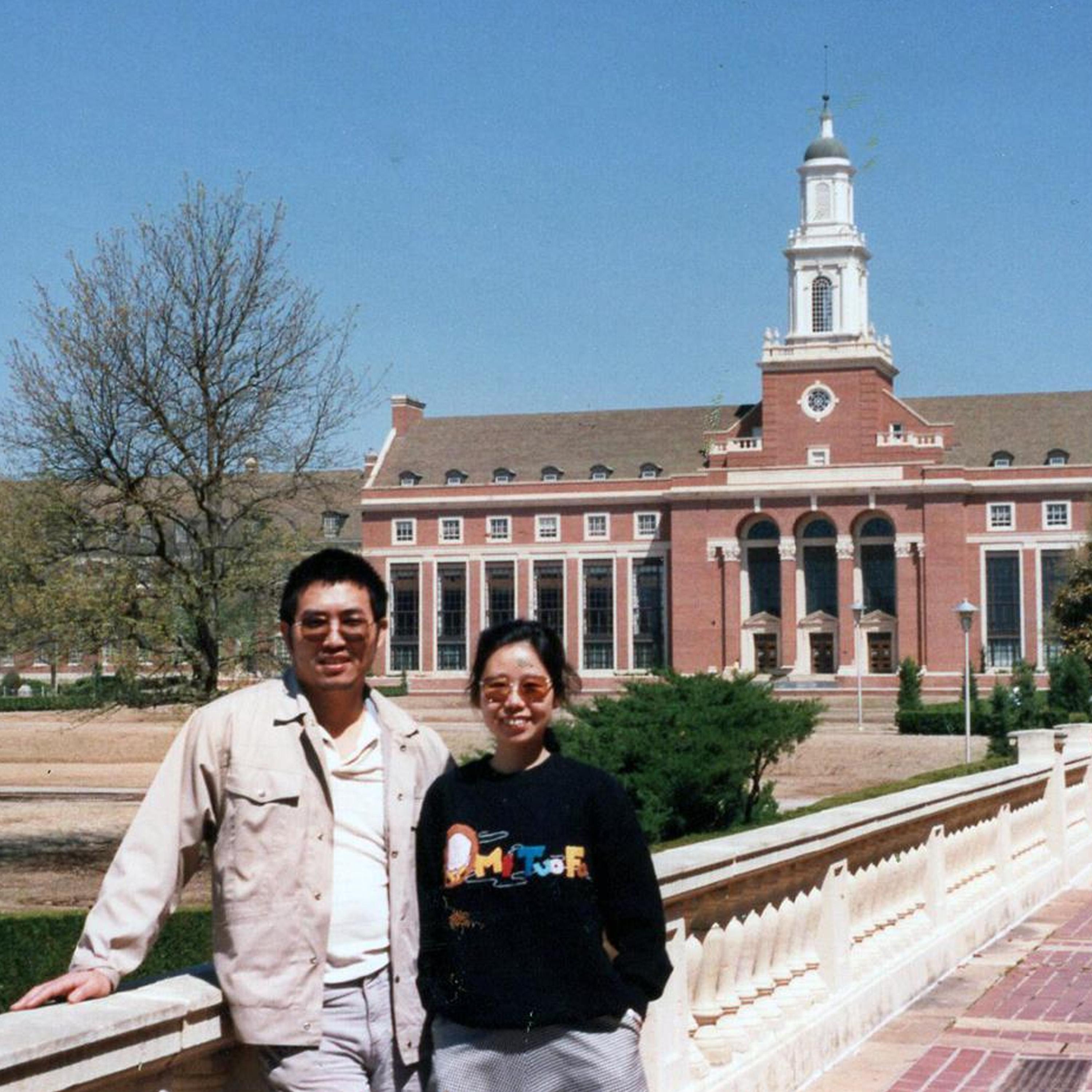
The next day I go to my parents first apartment. I just want to see it with my own eyes. The building is two stories and painted a pale yellow with a big porch a guy is sitting on. All of a sudden I guess that's some sort of warning. Maybe like a tornado warning. Is there a tornado coming? No idea. Anyway, I'm gonna do my parents commute walk to the old chemistry building that they used to stay at.
- [23:20]
Bowen Wong's Mother
It's very quiet.
- [23:21]
Bowen Wong
Nobody.
- [23:22]
Bowen Wong's Mother
When you walk on the street you even can hear your own footsteps and your own breathing. We came from Beijing and such big city, so many people everywhere is crowded. All of a sudden you went to a place just opposite. So you can imagine that kind of shocking feeling.
- [23:50]
Bowen Wong
This might be the chemistry building. This is the old chemistry building. It's called the chemistry building annex.
- [23:56]
Bowen Wong's Mother
I kind of feel very lost and have no sense of being anchored to any spot because I feel I'm just a parachute to the place in the middle of nowhere. I don't know anyone. You start with a zero. I mean you are on ground zero.
- [24:14]
Bowen Wong
Three or four stories, kind of like faded yellow brick, some like castle like turrets on the top. Interesting. Some of the outside is pretty corroded. Now when you said like you just like parachuted into this place and you had zero, you started at zero, you had nothing. Do you think that's why like you relied so heavily on the church?
- [24:44]
Bowen Wong's Mother
I think so. Because you all of a sudden lost.
- [24:46]
Bowen Wong
Yah.
- [24:48]
Bowen Wong's Mother
You don't have a gravity. You don't have a gravity. Life is so fragile. That's how I felt things could be happening in a second just turning upside down.
- [25:03]
Bowen Wong
I visit the campus library and find physical copies of my parents PhD dissertations. My mom's is titled Formation and Characterization of Anchored Part Polymer Coatings on Illumina. There's a Cheetos bag sandwiched between the front cover and first page. No idea why. I ask my mom about this later. Did you leave a Cheetos bag in your dissertation? Maybe as some sort of message to future readers? She's like, what? No. In the acknowledgments, which is the only section I can understand, she writes, I shall give all glory and honor to God. All caps. He all caps is my strength. I throw away the Cheetos bag on my way out. The first person I talk to in Oklahoma is Dave, the nice gentleman with the warm smile who took my dad in and brought him to Christ. Dave knew me as an infant and visited us in Philly, which I have no memory of. My parents always referred to him as my Yeye, my grandfather, perhaps in place of the Yeye in China I never met. This would probably be my first and only chance to talk to him. At least since I gained consciousness and the power of speech. I wanted to know, who is this man? How did he end up in charge of this Chinese ministry that changed the fate of my parents lives and my life? Hello.
- [26:40]
Dave
Good afternoon, Boland.
- [26:42]
Bowen Wong
Hi. Nice to finally talk with you. How are you?
- [26:46]
Dave
Well, I'm well. Excuse me for. I'll be 90 next February.
- [26:54]
Bowen Wong
Oh, wow. You're okay with me recording this?
- [27:00]
Dave
You're recording it?
- [27:01]
Bowen Wong
Yeah. Is that okay?
- [27:04]
Dave
It's okay.
- [27:05]
Bowen Wong
All right.
- [27:05]
Dave
But let me say this.
- [27:07]
Bowen Wong
Sure.
- [27:07]
Dave
I found that if you publicly identify somebody, the devil really can come in and try to take away their testimony. I would just urge you that if you do write this, that's honoring to your mom and dad, but you don't want the devil jumping on them. So do you understand that?
- [27:36]
Bowen Wong
I do, yeah. The way I understand what Dave is saying here is that since I'm publicizing my parents story, I need to make sure not to dishonor or slander them because the devil is lying in wait. Dave worked as a campus minister in colleges across the US and the world, in Nebraska and Maryland and Nairobi, Kenya. But he spent the bulk of his career ministering to Chinese international students at ou, as the University of Oklahoma is confusingly nicknamed, starting in 1987, two years before my parents arrived. Did you have any sort of like, prior knowledge of like China or Chinese culture or the language or anything like that?
- [28:17]
Dave
Well, no. When the Chinese started coming over here from mainland China, they had never been in a church. They had never met a Christian, they had never seen the Bible. But they came over here wanting to know our culture.
- [28:35]
Bowen Wong
It sounded like he almost stumbled into this role. He saw a new population at ou, many of whom were already curious about Western culture and Christianity, and he was happy to oblige. It was clarifying for me to learn that Dave had been a missionary in Kenya. I've come to think of him as a sort of domestic missionary, serving people from outside the U.S. within the U.S.
- [28:57]
Dave
I think somewhere close to 450 Chinese, closer maybe even to 500 during that time, over the years, we didn't rush them. We didn't want them to become Christians to please us. But we would love them we'd take them on trips, we'd have Bible study with them.
- [29:21]
Bowen Wong
Among these acts of love were practical things like picking my dad up from the airport. My mom came four months later. Dave picked her up as well. At that point my dad was ready to convert. Dave and his wife came to my parents apartment. My dad got on his knees, prayed to accept Jesus into his heart.
- [29:40]
Dave
And then your dad looked up and smiled and he said this wasn't as hard as I thought it would be. And he was really happy. And I looked over at your mom and she was crying and I said what's the matter? And she said, well, you're a Christian. And now my husband's a Christian, but I'm the only one that's not a Christian.
- [30:06]
Bowen Wong's Mother
I just feel now it seems as there's line between me and daddy and so that make me mix feeling, really mixed feeling.
- [30:19]
Bowen Wong
You felt like there was a line like a dividing line between you and dad at that moment?
- [30:24]
Bowen Wong's Mother
Yeah, because he became a child of God. I'm not yet. So it feels like we are now in a different path.
- [30:34]
Dave
And I said, well be patient, we'll get to that. But you need to know what it's all about first. Oh, I loved your parents.
- [30:44]
Bowen Wong
How long after my dad came to Christ, until my mom came to Christ as well?
- [30:50]
Dave
Oh, it was only maybe a month.
- [30:53]
Bowen Wong
Or two or three weeks over the phone. I didn't have the courage to tell this kindly old man who led my parents to the path of Christianity, who then raised me on that path, that I rejected all of that and that I'm still recovering. But then when I go to him in person, I resolve to tell him the full truth. Dave is in an assisted living facility now. In the lobby I meet his son and daughter in law who had asked that I not record the conversation. Dave had fallen recently and broken a vertebrae. He sits in an armchair in his room and wears a neck bracelet. If he sneezes or laughs too hard, he can hurt himself. After a softball question, I force myself to come clean. I'm no longer Christian. How does he feel about people he tried to lead to Christ who either didn't believe or later left? Dave smiles. He asks if I'd heard the story of the prodigal son. It's a classic one of Jesus most famous parables where a failed son disobeys his dad and later returns to him penitent and willing to accept any punishment. But instead his dad forgives him and welcomes him home. Dave then explains that he has a daughter who Left the church in high school. She angrily confronted Dave with tears in her eyes and told him, dad, please apologize to me for being a Christian. I think I understand what she meant by that. It's a way of saying, apologize for making this decision for me, for raising me with this belief I didn't choose and that I don't agree with. In a sense, I'm asking him the same. Yeah, yeah. Why did you convert my parents? His daughter left the faith. Dave didn't try to convince her of anything, just kept loving her and praying for her. And after 20 years, she, like the prodigal son, returned to the faith and to her father. These days, she visits him every week in the assisted living facility. Dave emphasizes again that he never forced anyone to believe anything, that if someone chooses to reject Christianity, they need to be loved, whatever their decision is. But he also tells me there'll be nobody going to hell who didn't have an opportunity to accept Christ. He says it in a way that isn't angry or spiteful, just sad, almost kind. It's getting late. Dave needs to take his medication. We stand up. I love you. He tells me. Give my love to your parents. We hug. And I get it. I get why my parents converted. This man is filled with so much love and gives it so freely to my parents, to me, to all the people he picked up from the airport and fed and sheltered and helped get on their feet. Where does his love come from in the moment? I'm convinced that it must be something beyond what any human is capable of. It must come from God on the receiving end of his unconditional love. I consider being the prodigal son. For the briefest flash of a moment, I consider returning.
- [34:06]
Dave
Can I pray for you?
- [34:07]
Bowen Wong
When we were on the phone, this is how Dave ended the call. I didn't feel like I could say no. I didn't want to disappoint my white grandpa. Sure.
- [34:17]
Dave
Okay. Lord, thank you for this wonderful invention, the phone that Bohan and made join our hearts at the throne of grace. And, Lord, I just thank you for Bowen calling. And I pray that the rest of his life that he will walk with you till he draws his last breath in Christ's name. Amen.
- [34:46]
Bowen Wong
Amen. I talked to Dave on Saturday night. Come Sunday, it's obvious where I have to go. Quick voice memo because I'm already late, but I'm at the church. Kind of tired. Woke up at 8:30. Stayed up too late last night. Already late, but. But gonna go to this Mandarin Sunday school. We'll See how it goes. This is the church where Dave led the Chinese Fellowship, the one my parents attended and that I attended as an infant until we moved away when I was 2. What did this place mean to them? These are people who had zero experience with organized religion. What do they get from going? The Chinese Fellowship is now run by seven people. Seven deves, in other words, three of whom are Chinese and four of whom are white. I spoke to one of the new White Daves over the phone who told me that I could record the service. But a few days later, while I was cooking butternut squash risotto, he called again and told me he had found a podcast called Jesus Wept. Jesus Wept is a podcast my fiance Grace and I make where we analyze and, to be honest, make fun of the various topics related to evangelical Christianity. We process our respective religious traumas through humor. In the most recent episode, I went to a Chinese church and recorded the service. Afterwards, Grace and I critiqued the speakers and again, to be honest, made fun of them. I told Grace about how one of the speakers said that because Paul writes that women shouldn't have authority over men, she won't teach men in the church. So then basically she is like, well, in the church, I will teach women, I will teach children, but I will not teach men except in specific circumstances. Like what? I don't know. But change a diaper maybe. Doesn't she have a fucking PhD? She has a Master's in divinity. Yeah, from the seminary. Which you can't teach. Yeah, I don't know. Mrs. Div. New Dave tells me over the phone that after listening to the podcast, he's changed his mind and won't allow me to record anything in Norman, which is reasonable. I recorded a church service and made fun of it and he doesn't want me to do the same thing to his church. In the podcast, I talk about how I don't believe in God. And as we wrap up the conversation, New Dave says he needs my word that I won't record anything. He says, I know you don't believe in God, but there must be something you can base your word on, like your Chinese heritage. Which is kind of a weird thing to say, but I'm like, sure, you have my word. See you Sunday. When I enter the church, New Dave is waiting in the lobby. I shake his hand and tell him I'm not recording. That was a royalty free sound effect from freesound.org although I do have the pink notebook I'd bought from Target for $3. We walk past an armed guard to the gymnasium where the Mandarin Sunday School is held. It seems notable that the Mandarin Sunday School isn't in a dedicated classroom, but an echoey gym with a basketball court. New Dave introduces me to a group of Chinese immigrants sitting around a folding table. They ask if I can speak Chinese. I say I can understand it okay but not speak it that well. New Dave is like, ah, there's that phrase abc. And I'm like, yep, that's me. American born Chinese. As a side note, I really hate the phrase abc. Just call me Chinese American. Anyway, New Dave says that since he can't speak Mandarin, he's going to leave us to it. It's nice to be away from white people, at least for a little bit, to talk among ourselves in the language I associate with family home love. My parents must have really craved that when they first came here. Where else could they find a Chinese community in this small town in Oklahoma? Someone later tells me that this church is usually the first stop for new Chinese immigrants. People from church are willing to give rides to the supermarket, furniture for apartments, help with taxes, and all sorts of essential services. My mom still uses a set of bowls that Dave got for her. When the service begins, we sing hymns in Mandarin. Again, this is not a recording from Oklahoma. It's YouTube. The speaker, an older white guy, delivers the sermon in English. And like most sermons, it's boring. I picture my parents in these same seats, praying the same prayers, singing the same songs that I would grow up singing.
- [39:41]
Ira Glass
Bowen Wong Coming up. Bowen flies home and considers the question. Maybe it wasn't Christianity that messed him up as a kid. That's in a minute on Chicago Public Radio when our program continues.
- [39:57]
Unknown
Support for this American Life comes from GoodRx. Stop seasonal allergy symptoms in their tracks with Goodrx. Pay as little as $15 for common allergy medications, plus find savings on everyday prescriptions for you and your family. Pets, too. GoodRx compares prescription prices at over 70,000 pharmacies and instantly finds discounts of up to 80%. GoodRx is not insurance, but may beat your copay if you are insured. Stop allergy symptoms before they start. Go to goodrx.com tal this message comes from Midi Health.
- [40:31]
Capital One Ad
If you're a woman over 40 dealing with hot flashes, insomnia, weight gain or brain fog, you don't have to accept it as just another part of aging. The clinicians at Midi Health understand what you're experiencing and know how to help. Midi Health provides specialized care for perimenopause and menopause covered by insurance. Book your visit today@joinmidi.com that's joinmidi.com this.
- [40:54]
Ira Glass
Message comes from Capella University. The right support can make a difference. That's why at Capella University, learning online doesn't mean learning alone. You'll get support from people who care about your success and are there for you every step of the way. Whether you're working on a bachelor's, master's, or doctoral degree, you can learn confidently, knowing you'll get the dedicated help you you need. A different future is closer than you think with Capella University. Learn more@capella.edu this is American Life from Ira Glass Today's program Children of Dave, Bow and Wong's pilgrimage to finally understand why his parents decided to become Christians when they arrived in America. Today's show is a rerun. We pick up our story where we left off before the break.
- [41:42]
Bowen Wong
When I fly home to Pittsburgh and tell Grace about going to my parents church and meeting Dave, they point out that maybe I'm just blaming Christianity for my own problems. Maybe Christianity is just my excuse to hate myself. It gave myself loathing a shape and structure, but it isn't the root cause. Maybe I would have hated myself no matter what. Maybe it doesn't matter what path my dad chose at that crossroads in the Oklahoma City airport. If he never met Dave and never believed, maybe I'd still have the same self loathing. If I grew up communist like my parents, maybe I'd be like, ugh, I'm such a bourgeois capitalist worthless piece of shit. I need to write another self criticism and do another struggle session. Thankfully I can answer the question of whether I'd hate myself if I hadn't been raised Christian by comparing myself with my high school friend Andrew. Andrew grew up in the same suburb of Philly as me. His parents are highly educated Chinese immigrants. We attended the same school district and have the same circle of friends, but he was raised by atheist parents who were never interested in Christianity or church.
- [42:50]
Andrew
I asked my mom one time, have you ever been to church? And she's like oh yeah, of course we've been to church. And then what she really meant was that we walked into a church one time and then walked out.
- [43:00]
Bowen Wong
So I sit Andrew down and tell him that I want to conduct a science experiment where you're the atheist control group and I am the ex Christian test subject. Okay, I understand that we have a sample size of 2, but just humor me. Andrew has lived the life I always imagined. A life without church or youth group or Bible Study or retreats near Lancaster out in Amish country. And so my question is, in this alternate atheist reality that Andrew was raised in, does he also struggle with self loathing? Does he not like himself?
- [43:34]
Andrew
I don't like myself.
- [43:36]
Bowen Wong
Okay, alright, well fine. But does he dislike himself the same amount as I do in the same way? Does he do the thing where I ask someone endless follow up questions and if they ask me something I do verbal jujitsu and redirect it back to them? Because I hate talking about myself, because I hate myself so familiar I could.
- [43:55]
Andrew
Say those exact same words. That's exactly what I do.
- [43:57]
Bowen Wong
Like if Andrew is meeting one of his colleagues for the first time, he'll be like, what department are you in?
- [44:02]
Andrew
How long have you been in the university for? What kind of research are you doing? What's your lab like, who are you working with?
- [44:06]
Bowen Wong
And if someone asks Andrew a question like what his research is, he'll be.
- [44:11]
Andrew
Like, oh, I work in biostats. And then I just call it a day. I just make sure as hard as possible that they don't ask me any questions. I don't want to talk about it.
- [44:18]
Bowen Wong
Andrew didn't even have to grow up Christian to hate himself and for his self hatred to manifest in the exact same way. So where is this coming from? Andrew doesn't believe in sin or God. Why do we hate ourselves even though we were raised with such different beliefs? Well, Andrew thinks the answer might be right in front of us.
- [44:38]
Andrew
I wonder, you know, with the science experiment maybe the main thing that's balancing us, that makes us comparable is a second generation upbringing.
- [44:48]
Bowen Wong
Our parents are from a very specific cohort of people who grew up during the Cultural Revolution, went to the best colleges in China, went abroad to get STEM PhDs and got well paying jobs in academia and pharmaceuticals and biomedicine.
- [45:02]
Andrew
And I think that to me make me always kind of feel inadequate in a way, right? Like I'll never be able to do that. I'll never be able to achieve that kind of, you know, rags to riches kind of story, you know, because I was never in rags, because my parents, my parents were the ones that kind of struggled through that.
- [45:24]
Bowen Wong
So we're more or less on the same page when it comes to self loathing. But what about the shame I feel about sex and sexuality? What about my inability to talk about the horny Zendaya tennis movie with Grace? Does Andrew feel that same immense shame? So then how did you feel about sex morally?
- [45:41]
Andrew
There's nothing wrong with it. I think this is all somewhat funny that a lot of Christians will marry early, right? Because they have to marry before they have sex. But for people that don't grow up Christian, a consensual act of sex, sex is just like, not a problem.
- [45:52]
Bowen Wong
Andrew started dating when he was 15. I didn't start until a decade later when we tried to isolate the effect Christianity had on me. That's the word we kept returning to shame. The shame I feel about having a body, about being a wretched sinner in need of redemption. Andrew feels none of that. The shame goes to my very core in a way that Andrew can't relate to. I told him about how even today, when I remember something embarrassing I said or did years ago, I'll still say out loud to myself because it's such a reflex at this point of like, oh, I hate myself. I should kill myself. Like, I verbalize that.
- [46:33]
Andrew
You still say that?
- [46:35]
Bowen Wong
Yeah. You act surprised. Have you ever done this? Have you ever said, no? No, but I've.
- [46:43]
Andrew
Yeah, that's intense. That's intense reflex. I don't have that reflex.
- [46:46]
Bowen Wong
Are you telling me that you've never said out loud to yourself, I hate myself. I want to kill myself? You never said that, Andrew.
- [46:53]
Andrew
I've never said that. That's the Christian difference, man.
- [46:56]
Bowen Wong
That's the Christian. Yeah. The Christian difference is a belief that my existence is fundamentally wrong. The Christian difference is a need to punish myself for my existence. I don't regret being raised Christian. I wouldn't be who I am today otherwise. And I'm incredibly grateful for everything my parents have done for me. But in this one aspect, I know I would have experienced less pain if my dad had stood at that crossroads in the Oklahoma City airport and chosen a different path. I never told my parents about the damage Christianity caused me. I didn't want to make them feel bad or think I was blaming them. I didn't want to seem ungrateful. But now it's what I finally decide to do. At this point, it's the only thing I can do. I was actually damaged by going to church and being raised in church. Does that make sense? Like, do you understand that.
- [48:06]
Bowen Wong's Mother
It'S heartbreaking to realize. And of course, whatever happened in the past, it's gone. It's past. Right. But I just feel that we could have done better. We could have done better.
- [48:23]
Bowen Wong
Really? Why do you feel that way?
- [48:25]
Bowen Wong's Mother
Because we really didn't check and how you receive the information. We didn't really talk to you that much, and we just received automatically without checking, and we just Blindly believe everything what church teaches is right.
- [48:43]
Bowen Wong
You felt like you blindly believed?
- [48:45]
Bowen Wong's Mother
Yes, because I mean that blindly not believe what church is teaching the way they teach. Yeah.
- [48:53]
Bowen Wong
So then do you have any regrets then about raising me and sister in the church?
- [49:01]
Bowen Wong's Mother
Yes. But after you said that to me, yeah, I do feel, I do feel I didn't really pay too much attention to what. How they taught you. How they taught you and how that has print on you and how that manifest in your overall well being. Yeah, I feel. I do feel very sorry.
- [49:27]
Bowen Wong
I was not expecting this. I always thought my mom and dad were a united front, true believers. When I first interviewed my mom about converting to Christianity, she described it as this happy moment when she joined my dad in the same.
- [49:42]
Bowen Wong's Mother
I feel we are same people now. We are same people, we are equal footing. We are children of God.
- [49:51]
Bowen Wong
But when I came back to her a few months later, actually I was.
- [49:55]
Bowen Wong's Mother
Thinking that the time I decided to become a Christian, I think I'm very premature to make my decision because I really do not know much and I just got here and the things have been changed dramatically for me in every aspect. And I don't really have that kind of self confidence to my own belief. So I feel there are a lot of outside factors.
- [50:23]
Bowen Wong
My mom wants to be clear about this here on the radio. She will always be thankful to the people from church who helped her get on her feet. In the same way that I want to be clear that I'll always be thankful to my parents. But looking back, my mom sees that the kindness of Christians can be transactional. We give you free stuff and in return you go to church.
- [50:45]
Bowen Wong's Mother
This is how church tried to get those people to become believer. No, if you really believe, you don't. You are not bribe that person to become a believer.
- [50:57]
Bowen Wong
You think it's bribery?
- [50:58]
Bowen Wong's Mother
Yeah, I think that's a bribery.
- [51:01]
Bowen Wong
That's a strong word, Mom.
- [51:02]
Bowen Wong's Mother
Yeah, I do feel. No, I do feel that's a bribery. You bribe those people, you give them free lunch, free ride, free stuff.
- [51:12]
Ira Glass
Yeah.
- [51:13]
Bowen Wong
Well, how about all the free stuff that you and dad got when you were first in Oklahoma?
- [51:18]
Bowen Wong's Mother
I didn't really think about that way at the moment. Now I feel.
- [51:22]
Bowen Wong
Yeah. Over the years my mom's been really hurt by people from church. She'd raise questions about the Bible. Like if God created everything, why did he also create Satan? Why would he allow Satan to tempt Eve into eating the forbidden fruit? Why would he even create forbidden fruit in the first place? No one at church would ever fully engage with her they'd give her surface level platitudes that never satisfied her. There was also a period when she was depressed. I remember coming home from school and seeing my mom lying on the couch with the lights turned off and the curtains closed. My mom tells me that while some people at church helped during this moment, others weren't so kind. And some actually seemed happy that she was suffering.
- [52:04]
Bowen Wong's Mother
I think now they believe they already labeled me as a non believer.
- [52:10]
Bowen Wong
Wait, really? At church? Why do they think that you're a non believer?
- [52:16]
Bowen Wong's Mother
Because I don't go to church anymore. I do not participate in any kind of church activities.
- [52:23]
Bowen Wong
Why did you stop participating?
- [52:25]
Bowen Wong's Mother
Because I don't get anything from participating in all those activities. And if I ask them questions, they give me standard answers. I just feel I'm in a circle, not going anywhere. I don't really get enriched or enlightened by doing all those activities.
- [52:44]
Bowen Wong
She hasn't been there since the pandemic shut everything down and is much happier for it. But as my mom withdrew from church, my dad got even more involved. He became a deacon and spent more and more time at church functions and less and less time at home with his family. If someone needed a ride to the supermarket, he would do it. If someone needed a ride to the airport, he would do it. My mom was not happy about this.
- [53:07]
Bowen Wong's Mother
I feel he's like a robot. He just does it automatically when I was someone from all directions. So one point to the point that he completely crazy. So that is time. I think the church can destroy family. Church can really destroy family. Because when you are not really thinking on the same level, at the same level, on the same page and you kind of just go apart.
- [53:38]
Bowen Wong
So do you feel like church almost destroyed our family?
- [53:41]
Bowen Wong's Mother
To the point.
- [53:42]
Bowen Wong
Really?
- [53:43]
Bowen Wong's Mother
Yes. I was really, really upset at one point.
- [53:48]
Bowen Wong
So my mom finally put her foot down and gave my dad an ultimatum.
- [53:52]
Bowen Wong's Mother
And I told Daddy, you quit your deacon now. Otherwise we are not going to have the same live life under the same roof. So daddy sent a letter to church, said he's going to resign.
- [54:07]
Bowen Wong
It was almost comforting realizing I wasn't the odd one out in my family. I thought I was the only one who was damaged by Christianity and who left the church. I thought it was me against them. But it turns out that my mom was actually on my side this whole time. Who knew? I wasn't surprised that my dad gave in to my mom, though. When it comes down to it, he puts family first. I asked him once if he ever had any regrets and he told me this Story about how when my sister was a baby, he discovered that she'd torn up an important piece of mail. My dad yelled at her and made her cry. And then he thought to himself, why did I do that? She's just a baby. She doesn't understand what she's doing. And he remembered that moment forever. So he's always been a kind, thoughtful, reflective person who wants the best for us. He's also always been a true believer, going back to the very beginning. June 1989. My dad has been accepted to the University of Oklahoma. He applies for his passport and visa so that he can leave Beijing. On the evening of June 3rd. My parents watch the news on their landlord's TV since they don't have one of their own.
- [55:40]
Bowen Wong's Father
There's TV announcement say, don't go to Tiananmen Square.
- [55:50]
Bowen Wong
They go to bed in the middle of night.
- [55:53]
Bowen Wong's Father
We heard some gunshots.
- [55:56]
Bowen Wong
And on the morning of June 4, they wake up in the morning.
- [56:00]
Bowen Wong's Father
We were planning to visit a friend to bicycle to her home. On the way, we saw a lot of buses, you know, they will turn around and block the road. And also a lot of huge trucks, like armored vehicles, just parked along the highways, blocking the road.
- [56:25]
Bowen Wong
All the government offices are shut down. The entire city is shut down. To get his passport, my dad now needs a letter from his workplace saying he didn't participate in the demonstrations. But there's a problem. He had to quit his job to apply for the passport. And they're saying that since he doesn't work there anymore, they can't provide him with that letter. My dad is freaking out. He staked his entire life on studying abroad. This was his plan, his future, his chance to leave his boring job in a Jeep factory, living in his tiny room in Beijing with no running water or heating or cooling. Now his future is crumbling before his eyes. In this most desperate hour, my dad does something he's never done before.
- [57:11]
Bowen Wong's Father
So I prayed to God, oh, Sang Di, ask Sang Di to help me. That's how I think I prayed for the first time.
- [57:24]
Bowen Wong
Were you specifically praying to the God of Christianity at the time or.
- [57:30]
Bowen Wong's Father
We don't have the habit of praying growing up. We don't have the habit of praying or talking to a God or something. So it just came natural, you know, I just lying on bed and say, oh, God, help me.
- [57:55]
Bowen Wong
I never knew this story. I thought my dad's first encounter with God was in America. But two months earlier in Beijing, my dad naturally and spontaneously cried out to a God he didn't yet know or Believe in. And then when his workplace finally gave him the letter that allowed him to leave China, it had to be God answering his prayer. So my dad was already primed to believe. And when he came to America, he would have encountered a Christian eventually, inevitably.
- [58:24]
Bowen Wong's Father
So I think in my case, I will meet someone else and I will come to the faith. Yeah.
- [58:33]
Bowen Wong
You would have eventually been exposed to Christianity and you would have always, after having considered it, accepted it. Is that right?
- [58:45]
Bowen Wong's Father
Yes. Yes.
- [58:46]
Bowen Wong
Why?
- [58:51]
Bowen Wong's Father
I think it's a fundamental truth God revealed to us in the Bible. And then everyone has to make a decision either to accept it or reject it.
- [59:05]
Bowen Wong
And you choose to accept it?
- [59:08]
Bowen Wong's Father
Yes.
- [59:28]
Bowen Wong
When my dad stood at the Oklahoma City airport waiting for someone to pick him up, I always thought that he stood at a crossroads. That if Dave hadn't appeared, my dad wouldn't have become Christian. But I understand now that he was ready to be a Christian. Norman's a small town. He probably would have run into Dave and his Chinese ministry eventually. And even if my dad didn't go to Oklahoma, there are kind Christians with warm smiles in every city in America. So the airport didn't matter. There was never a crossroads. It was a straight line. Do you realize that you have the most beautiful face? Do you realize we're floating in space?
- [60:38]
Ira Glass
Do you realize.
- [60:46]
Bowen Wong
That happiness makes you cry? Do you realize D.
- [61:13]
Ira Glass
That story by Bowen Wong. He's an audio producer and adjunct instructor living in Pittsburgh with his fiance, Grace Gilbert. You came up with a title for today's episode. Bones website is Boen Cool. That's B O E N Cool. In the years since we first broadcast today's story, Dave has Died. Well, Roman was produced today by Lily Sullivan. The people who put together today's show include Thea Bennen, Michael Comite, Henry Larson, Seth Lynn, Catherine Raimondo, Safiya Riddle, Ryan Romery, Alyssa Shipp, Elise Spiegel, Christopher Sotala and Matt Tierney. Our managing editor is Sara Abderrahman. Our senior editor is David Kestenbaum. Our executive editor is Emmanuel Berry. Help on today's rerun from Stone Nelson and Angelo Gervasi. Also, Adam Kozma at Biton Studio in Budapest. Special thanks today to Rebecca Curtis at the University of Oklahoma, Ahsin Hua, Jenny Lin, Man Hong Liu and Jessie Nas and Greta Ziwi at Red Cayman Studios. Our website thisamericanlife.org where you can stream our archive of a over 850 episodes for absolutely free. This American Life is delivered to public radio stations by PRX, the Public Radio Exchange. Thanks as always. Joe Brigham's co founder, Mr. Tory Malatea. You know, he is the worst babysitter I have ever seen. Baby won't go to bed, starts crying. Tori's technique. He leans into the crib, looks into the baby's eyes and says, why are.
- [62:36]
Bowen Wong
You being so immature about this?
- [62:38]
Ira Glass
I'm Eric Glass. Back next week with more stories of this American Life. Do you realize.
- [62:52]
Bowen Wong
That you have the.
- [62:54]
Bowen Wong's Father
Most.
- [62:56]
Bowen Wong
Beautiful face to.
- [63:12]
Ira Glass
Next week on the podcast of this American Life. Alicia was out of a job when she started making wigs for pets and she decided this is going to be my thing, which worked.
- [63:23]
Bowen Wong
He said, okay, let me see him, and I put him on the desk. The first thing he said was, great, I'd like to make place an order. Let's launch at Halloween.
- [63:32]
Ira Glass
That good news turned out to be not entirely good news. Next week on the podcast on your local public radio station.
- [63:47]
Capital One Ad
This message comes from Sony Pictures Classics presenting Jane Austen Wrecked My Life starring Camille Rutherford, a new romantic comedy about a Parisian woman who dreams of becoming a successful writer and experiencing true love while attending a Jane Austen writer's residency in England. Jane Austen Wrecked My Life opens only in theaters select cities May 23 and nationwide May 30. For more information and tickets, visit JaneAustinReckedMyLife.com.