Loading summary
Transcript118 lines
- [00:01]
Ira Glass
Support for this American Life comes from Squarespace, their AI enhanced website builder. Blueprint AI can create a fully custom website in just a few steps, using basic information about your industry goals and personality to generate premium quality content and personalized design recommendations. And get paid on time with branded invoices and online payments. Plus streamline your workflow with built in appointment scheduling and email marketing tools. Head to squarespace.comamerican for 10% off your first purchase of a website or domain. A quick warning. There are curse words that are unbeeped in today's episode of the show. If you prefer a beeped version, you can find that at our website thisamericanlife.org.
- [00:46]
David Kestenbaum
One thing I didn't know about delivering mail. You're not supposed to walk down to the sidewalk after each house. You're supposed to cut across the lawn to the next house if you want to finish the route on time.
- [00:55]
Grace
I mean, they time us. We're not supposed to go down to the sidewalk every time if we can.
- [00:59]
David Kestenbaum
Avoid it and just walk across people's grass.
- [01:02]
Grace
Grass. Yes. Everybody wants the government to be efficient except for the mailman to walk across their grass. But people like these guys built a path for me.
- [01:13]
David Kestenbaum
So yeah, there's a little dirt path in between these bushes.
- [01:17]
Grace
Cause they're nice.
- [01:18]
David Kestenbaum
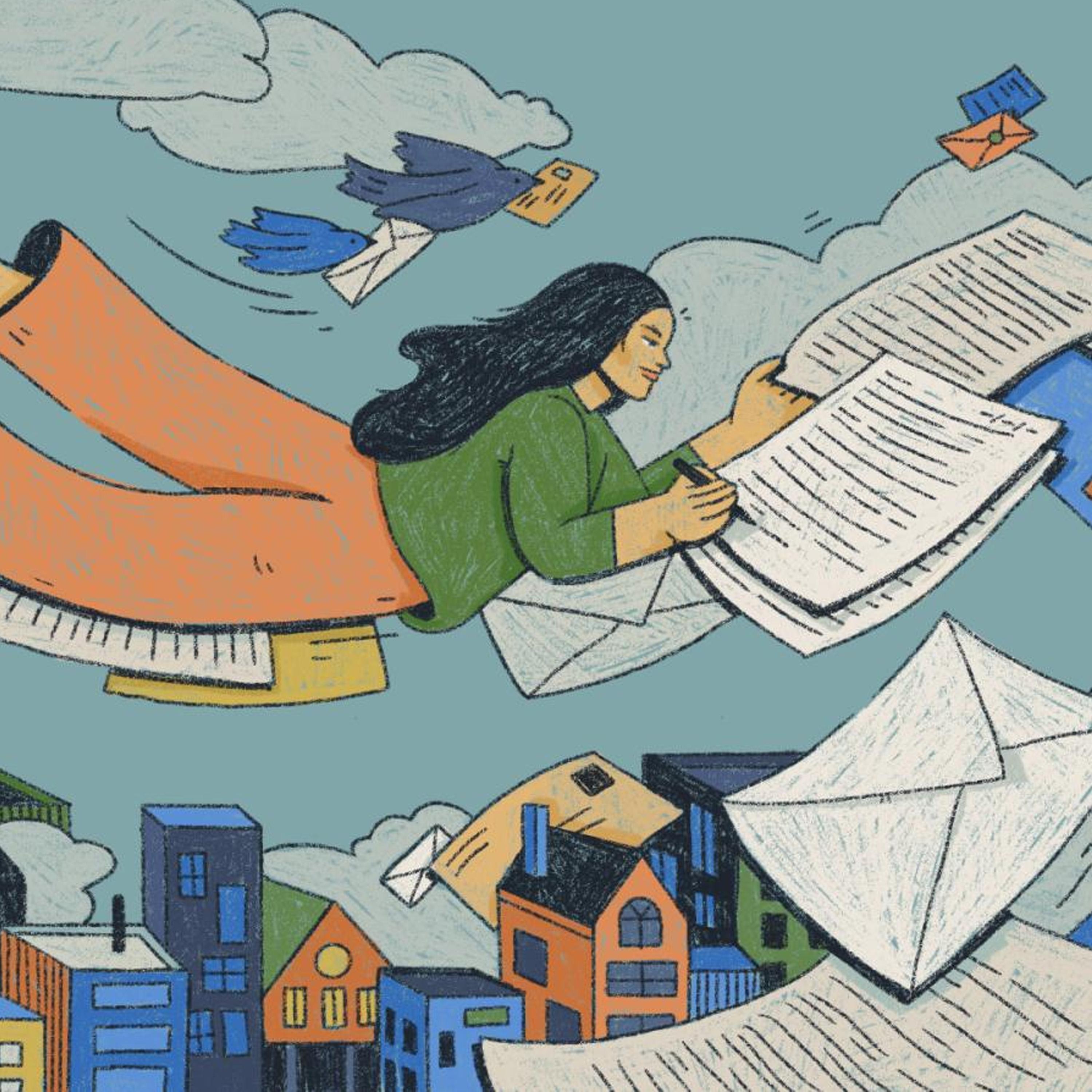
I went out with a letter carrier named Grace. As she walked around. It was a pretty day in a leafy, lovely neighborhood. Grace carried a shoulder bag with flats and catalogs and parcels. And of course, somebody built a path for her to cut to the house next door. She can talk to anybody. She's interested in other people. So at this point she knows at least a little bit about most of the people on her route. Most of them. She's actually seen their faces. She'll walk up to a house sometimes.
- [01:44]
Grace
It'Ll be like the cousin out front or whatever. And I'll even know that I'll be like, you have the same face as the wife. And I know she has family in Denmark. You're the Denmark sister. I'll just know it when I'm walking up and they're like, oh. And I'm like, I told you. Like I'll just know a lot about people.
- [02:02]
David Kestenbaum
There's the house with the stay at home mom whose son makes drawings for Grace. The public defenders who get public defender mail but somehow also have an insanely posh house with gorgeous landscaping. There's the hardcore Christians whose dog always lunges at the door like he's going to break through the glass. There's the dad who Organizes the kids softball league that Grace's daughter's in. And the guy with pancreatic cancer, he seems like he doesn't have much time left at all.
- [02:24]
Grace
And nicest guy. And I'm. It's just, you know, can't help but think about it every day.
- [02:32]
David Kestenbaum
Does he get a lot of visitors?
- [02:34]
Grace
Yes. And lots of mail started coming from like old friends and stuff.
- [02:38]
David Kestenbaum
Yeah. I'm not using Grace's real name or telling her anything about where she works. So this private information can stay private like it should. Our show today is about the mail and Grace's understanding of who's who. And her route is like a pilot. Knowing the weather they're dealing with is very helpful to doing her job. Like with this couple on the route where the woman moved to the apartment across the hall and filed a forwarding address and the guy did not. Grace knows the guy's still with her so she forwards his mail also even without the form. At one house this particular day, there's a postcard for the landlord who Grace knows does not live at that address. And so what are you going to do?
- [03:15]
Grace
I'm going to dispose of it in what we call the undeliverable bulk business mail bin Ubum.
- [03:22]
David Kestenbaum
She could toss it out like that because it's not first class mail.
- [03:25]
Grace
So it doesn't get returned to sender and it doesn't get forwarded. It just goes to waste.
- [03:30]
David Kestenbaum
Oh, it's junk mail.
- [03:32]
Grace
That's correct. We don't use that term.
- [03:35]
David Kestenbaum
What do you say?
- [03:35]
Grace
We're forbidden from saying that. Bulk mail or standard class mail?
- [03:40]
David Kestenbaum
Because junk mail implies a value judgment.
- [03:41]
Grace
That's correct. And this is what pays our salaries, this so called junk mail.
- [03:47]
David Kestenbaum
Grace has an ex girlfriend on her route, somebody she was with decades ago. And earlier in the day she tossed out a piece of bulk mail at her house. She pauses for a second before she tells me about it.
- [04:00]
Grace
She lost a child several years ago during the pandemic. And that kid got a piece of bulk mail today. So I was able to throw it away without her seeing it, you know, because I know and I was really grateful for that, you know, being able to discard that piece of mail for her today. So she didn't have to see her dead kid's name when she got her mail today.
- [04:20]
Nicole Pisecki
That felt really good.
- [04:25]
David Kestenbaum
Of all these customers in a route, there's some that do this thing. It just gets under Grace's skin.
- [04:30]
Grace
So this situation.
- [04:33]
David Kestenbaum
Yeah, she opens a mailbox jammed full of mail.
- [04:36]
Grace
So this never gets none of this mail will ever get picked up. See how much?
- [04:41]
David Kestenbaum
Now just describe what you just pulled out of that mail.
- [04:43]
Grace
So this is a whole bunch of what one might call junk mail coupons.
- [04:50]
David Kestenbaum
Shows up a stack of these thick weekly advertising mailers.
- [04:53]
Grace
So this is five weeks worth. And like I've definitely put packages in here and they come out. So they're checking, they look in to see if there's anything they want and then if there's something they want, they take it out. But it makes it kind of hard to deliver mail when it's packed full. You know, who do you expect to clean up after you? Who's going to call your mom and empty your mailbox for you? Like just get your mail and I just find it very inconsiderate.
- [05:20]
David Kestenbaum
On another street, we walk up to a house with a hand painted sign in the window saying Palestine will be free. It also usually has mail stuffed in its mailbox for weeks, gooding their mail in ballots.
- [05:31]
Grace
And they would walk by every day for a week and a half, walk right by the ballot, sticking right out of the mailbox.
- [05:38]
David Kestenbaum
That mailbox right there.
- [05:39]
Grace
That mailbox right there.
- [05:40]
David Kestenbaum
So you could see it from the street, you could see the ballot.
- [05:41]
Grace
You can see it from the street. You can see it when you walk by. It's very, very easy to grab on the way in. But they didn't manage to do that for weeks.
- [05:52]
David Kestenbaum
And what did you think of that?
- [05:55]
Zoe Chase
I don't know.
- [05:55]
Grace
I wonder what it's like to go through life not seeing things around you.
- [05:59]
David Kestenbaum
But it's very possible that they see. But just the mail is not important.
- [06:03]
Nicole Pisecki
To them at all.
- [06:04]
Grace
And I understand that if it was full of crap, but they obviously care about politics and like I consider my ballot like a sacred object kind of. And they just kept walking by, walking by. It's not like it's heavy, it's not like, you know, it's cumbersome. It's just a matter of not caring at all or not seeing it. I don't know which.
- [06:26]
David Kestenbaum
Does it make you mad sometimes?
- [06:28]
Grace
Yeah, I can actually. I was telling someone the other day that I can kind of gauge my mood by a specific mailbox that I get to because it's always full. And if it doesn't bother me that much, I know I'm doing well that day. But if I get into a rage about it, I know that like something's bothering me and I, you know, saying I can like sort of check back in my life and figure out what's making me so mad. Because that mailbox will really anger me.
- [06:55]
David Kestenbaum
Grace has been doing this long enough. Over two decades. Started before the Internet really kicked in fully. And she remembers when everyone's relationship to their mail was different. Before so much was on the email. There were tons of business letters, first class mail, magazines. Back then she was carrying way more of that instead of what she carries now.
- [07:13]
Grace
As far as what I consider a crap that's just ads, I guess it's probably 85, 90% of what I deliver. If you exclude the Parsons. Because they're just the crap that people bought because the ads told them to.
- [07:30]
David Kestenbaum
I mean, it's funny because when this country was founded like the mail was the Internet.
- [07:35]
Grace
Yes.
- [07:36]
David Kestenbaum
You know, Benjamin Franklin could get any job he wanted in the new government. And he's like, I want to be the postmaster.
- [07:42]
Grace
Communications. Yeah.
- [07:43]
David Kestenbaum
Because it's like being like Steve Jobs or something.
- [07:45]
Grace
It is, right? It was. And there's still vestiges of like that self importance this agency still has. Like they tell us in training that if an ambulance, a fire truck, a police car and a postal truck all come to a four way stop at the same time, who has the right of way? The postal truck. That somehow that's actually true in the Constitution, which is hilarious.
- [08:07]
David Kestenbaum
Do you have this feeling of like you have this job that used to be a kind of like noble calling and you know, snow, no rain, no gloom of night. And then it moved from delivering stuff that people really, really wanted and needed and was essential to just delivering a lot of garbage.
- [08:24]
Grace
Yeah, totally. It's kind of achingly true that a lot of what we deliver is just garbage that people don't want. And like you have to make your peace with the theory that that's the revenue that sustains the important work of. Because what we actually offer is dependability. We come every day. So if you have a return or whatever, you just put it out there, we take it right there. We know who you are. We know the name, we know the people who used to live there. I know where to take their mail, Grandma sends them something, then move three times in between. I can get, get it to them. We do that all the time at work. We know people so much better than any other delivery services.
- [08:59]
David Kestenbaum
You feel proud of your job?
- [09:02]
Grace
Yeah, yeah, yeah. I mean, I really do like it. I really do think it's important. You have to. Cause it's every day for years and years and years.
- [09:16]
David Kestenbaum
You know, when it comes to the mail that we think of, when we think of the mail that we want to get it's letters. Personal letters. The old fashioned kind where somebody pours out their heart to somebody else by hand. I asked Grace to comb through the 25 pounds of stuff she was carrying for this one block swing on her route to see if she could find even one handwritten personal letter.
- [09:38]
Zoe Chase
Let's see.
- [09:40]
Grace
Financial. Financial. Secret to wealth. I guess we call that financial. That's a bill. Send a bill. Insurance. Reminder bill. Political. No. Zero fun mail on this block.
- [09:58]
David Kestenbaum
Today, this day. Over the course of the entire day, over 350 homes, she delivered only three personal handwritten letters. Do you write letters?
- [10:10]
Grace
No. Every once in a while I do. I feel so proud of myself. Probably like once every five years. I really wish I was more of a letter writer.
- [10:19]
David Kestenbaum
Wait, why do you wish you were a letter writer?
- [10:22]
Grace
Because it seems like such a great hobby. Like when I do write one, I feel extremely good. It's a nice exercise. It's nice to imagine the person getting it. It's wonderful if they write you back. It's one of those things I'm like, oh, I should do more of this. But I just don't, I don't know.
- [10:37]
David Kestenbaum
I feel like I have the same impulse sometimes to write somebody, but then I really just type it and send the email, you know, and that seems to be the same.
- [10:46]
Grace
It's not though. Try writing a letter sometime. You'll see how different it is. Different parts of your brain come out, you say things you wouldn't say. And plus getting the physical thing from the other person, it's more. There's a connection that the physicality of the letter brings, a connection.
- [11:03]
David Kestenbaum
I don't have sentimentality for that part of it, but it's undeniable that getting a letter, a real letter, is exciting. It's rare. The kind of letter where somebody sat down, dear you from me, really tried to say something that needed to be said. Whether putting something into words for the very first time or correcting the record, or trying to persuade. And they know it's going to go better if they do it in writing. Today on our show, we dive into all sorts of dramas laid out on the page. Today we have sincere letters, funny letters, and one letter on a big life changing mission from WBEC Chicago, it's this American Life. Sincerely yours, Ira Glass. Stay with us. Support for this American life. And the following message comes from Sierra Nevada Brewing Company who want you to taste their trailblazing spirit. A spirit infused with things that matter, like pure ingredients, sustainable brewing practices, a commitment to community and a world of flavor. From their classic pale ale to the citrusy and smooth hazy Little Thing. It's a flavor that takes its time so you can make the most of yours. See for yourself where refined beer is sold. Sierra, Nevada Taste what matters. Please drink responsibly.
- [12:25]
Taron Egerton
This message comes from Apple Card. Some credit card companies sell your spending data. Apple Card doesn't Reboot your credit card subject to credit approval. Apple Card issued by Goldman Sachs Bank USA, Salt Lake City branch terms and more@applecard.com.
- [12:42]
David Kestenbaum
This is American Life. Today's show is a rerun. Act 1 Dear Alice so we start with this letter, which is very much somebody trying to figure out something that has been hard to figure out. It's written by Nicole Pisecki about something that happened when she was in high school.
- [12:58]
Taron Egerton
Here's Nicole Dear Alice 1. I've started to write this letter at least 20 times in as many years, which is way too much time. I need to find a way to finally be done with this. The only way I've ever gotten close is by writing in fragments. 2 When I first walked into your high school English class in Chelsea, Michigan, school had been a struggle for me. Every class felt focused on how fast you could do something and how right you could be. Yours wasn't. I still remember the one afternoon, senior year, we'd finished a vocabulary quiz. You said, open your notebooks and close your eyes. We looked at you strangely at first, but we trusted you enough to follow along. You dimmed the lights. Imagine you're walking alone through the depths of a woodland forest. You said we could hear you slowly pacing and your long, sensible skirt swaying with each step. You guided us along a path in the woods, pointing to tiny mushrooms, a toad at the water's edge. Eventually you told us to open our eyes and to start writing, to keep describing whatever wilderness we'd conjured in our minds. No teacher had ever asked me to write something from my own imagination, and I loved it. I started keeping a journal. Everyone, if they're lucky, has at least one teacher who changes their life or makes them feel at home in school. That's who you were to me, my favorite teacher. 3. I had never given much thought to my teachers lives outside of school. You were a fixture in that corner classroom, a woman who seemed to exist wholly there. I never would have imagined that you were married to a man who kept a gun beneath his pillow. 4. I took Chemistry 1 with your husband in 1992, when I was a sophomore. He wore that plaid and wool hunting jacket and drank coffee out of that small plastic cup that doubled as a lid to his tall vacuum thermos. His hands sometimes shook when he lifted the cup to his lips. He kept his haggard ponytail pulled back with a thin rubber band. I remember that he played loud rock music on the stereo while we did experiments. Though I interpreted his personality as arrogant and strange, I didn't dislike him as much as I quietly despised the subject of chemistry. You should know that I've always struggled with solving complicated formulas. 5 My dad never told me things that a teenager didn't need to know, and I never thought to ask very many questions. He mostly kept his work life separate from his home life. I didn't know what a school superintendent did all day, and I never thought to ask him. One night, though, when I was standing in our kitchen by the sliding glass door, my dad walked up to me with his hands in the pockets of his faded weekend jeans and said, hey, Nick, when you went in early for chemistry help, did Mr. Leath ever act weird around you? I looked at my dad for a few seconds and wrinkled my brow. Then I defended your husband. What are you talking about? I replied. My dad dropped the subject without explanation and I quickly forgot about it. Even when it was just the two of us, your husband and I, in his chemistry lab, he had never said anything inappropriate to me. I wasn't a pretty girl. I was self conscious and tomboyish. Acne spotted my jawline and chin, my chest was as flat as a boy's, and I was the boss's daughter. 6 Earlier that year, the mother of a quiet, long haired senior girl called our home telephone at an unusually late hour. I answered the call in the kitchen. Dad, it's for you, I said in the direction of the living room. He took the call in private. 7 One of my favorite photographs of my dad is the one where he's sitting next to my hospital bed at St. Joe's in Ypsilanti right after my knee surgery during my senior year. He sat in that uncomfortable chair, staying day and night as my left leg moved, bending and straightening in a constant passive motion machine. He only stepped out of the room when the nurse arrived to help me use the bedpan. In the photograph, he's wearing jeans and a blue sweater with a tired, loyal smile on his face. Back then I never saw his commitment to me as remarkable because it was all I had known. 8 Surely you know all about the giddiness that your high school students felt on the Thursday before Christmas break. My energy that day felt boundless. I practically bounced from seventh period across the grass and straight to the outer window of my dad's office. I knocked on his window and he tilted it open. He was eating an ice cream sundae from McDonald's out of a small clear plastic cup. He smiled his full faced smile when he saw me and I returned a grin. He reached out and dropped the car keys into my hand so I could drive to physical therapy. As I turned to walk toward the parking lot, my dad said, have fun, see you later and tip the window to close it. At physical therapy, my friend Carrie and I both rode Stairmasters and we listened to the Lemonheads album It's a Shame About Ray on the stereo. We moved our arms like we were dancing. The snow fell quietly outside. The cold windows had white paper snowflakes scotch taped to them. Mid workout we overheard someone say there had been a shooting at Chelsea High School. We stepped off the StairMasters and huddled around an AM FM radio to try to learn more. At first we were worried about our friends who might have been at a game in the school gym. We imagined that the shooter must have been a kid from another school. It never crossed our minds that the shooter could have been your husband or the victim could have been my dad. 9 When the details of that afternoon that your husband killed my dad slowly leaked out from police reports and school employees, I learned that your husband had been reprimanded for sexually harassing female students in the hallways. I learned that he was on the verge of losing his job. I learned that your husband had stormed out of a grievance meeting with administrators not long after the school day had ended. I learned that you and your husband carpooled home from school together that day. I learned that you were with him in his anger for the 20 minutes it took you to drive home. I I learned that when you arrived home, your husband disappeared upstairs. He returned with a 9 millimeter semi automatic pistol in his hand. He asserted he is going to die. I learned that your husband got back into the car alone and sped toward the school administration building where my dad and two others continued the meeting. Twenty minutes. That's how long it took your husband to drive back to the high school. I learned that you didn't call the police, whose small town headquarters were less than a five minute drive away from the school. You didn't call the administration building to warn the three men whose lives were at stake sitting ducks. Instead, you called the teachers union office in Ann Arbor 20 minutes in the opposite direction. Your husband wore a long coat with pockets of ammunition. He he squealed his tires in the school parking lot he told someone who approached him that he had unfinished business to attend to. He walked into the administration building, turned the corner into the doorway of the small office. He lifted the gun and pointed it first at my dad. Daddy, dada pops. My 47 year old dad's last words or Steve, you don't have to do this. Your husband fired round after round. He killed my dad. He injured two others. You didn't call the police. Ten. Why Alice? Why the fuck didn't you call the police? Why? Why? Why? 11 after your husband shot my dad, a pocket of time existed where my dad was gone and it was still just a Thursday in December. I was still just a teenager happily riding the StairMaster at MedSport, looking through icy windows with paper snowflakes taped to them. My brother Brian was still just a fresh faced private first class wrenching bolts on the engines of fleet vehicles at a marine base in North Carolina. My mom was still a wife of 25 years and a middle school special education teacher at a neighboring school district. And you were still just my favorite teacher, the one who let us write about an imaginary forest. 12 I can't remember if it was you or I who initiated the meeting a few days after your husband murdered my dad at our school. I hadn't slept since I found out. I had been desperately pulling his photographs from sticky plastic pages of family photo albums and taping them to the bathroom mirrors. Still, I was worried about how you might be feeling. I was eager to believe in you, to affirm that we were both unknowing victims of your husband's violent actions, to tell you that I didn't blame you. I sensed some hesitation from my mom, but she took me to meet you anyway. The story was still developing. I couldn't imagine any scenario wherein you were not the hero she could. We learned that since the shooting you had been staying with your friend and colleague Pam. When we arrived at her house, Pam took our damp jackets and I saw you sitting alone in a wingback chair at the far corner of the large room. You didn't rise to greet us when we entered the Christmas ready living room. Your face displayed a low, distant gaze. Your fingertips fidgeted with a pinch of fabric on the bottom of your sweater. I don't know what kind of a welcome I had expected, but it wasn't this. Finally you approached me. You said something like this is for you and your tone was solemn. You reached out and handed me a hardcover book and a handwritten letter. Do you remember the title? Did the book have a tree on the COVID I never read the book I meant to. My head was too clouded with grief in those days to concentrate for long. I stuffed the book into a drawer in my bedroom and never looked at it again. I did read your short letter. Your words were scrolled diagonally across a yellow legal paper that you'd folded like a business letter. The one thing I'd always remembered about that letter was the part I understood the least. Maybe we can make a circle someday, it said. I've been wanting to ask you for years. What does that mean? 13 I returned to school only three weeks after my dad died, often arriving late and unprepared. Driving up to the school in the used Chevy Corsica that was still registered in his name. My other teachers offered me unspoken allowances for my unimpressive academic performance. During the second half of my senior year, my government teacher passed my late, biased research paper that took a stance against the death penalty. I called capital punishment an option that doesn't warrant enough suffering. I was scheduled to return to your English class, but the counselor intervened instead. I met with your student teacher in the library every day. I don't remember her name, only that her severe psoriasis frightened and distracted me. I was afraid it was contagious, and I couldn't bear any other complications in my life. We read Hemingway's the Old man and the Sea as an independent study. I remember how tired Santiago was while trying to reel that large marlin into the boat. I wouldn't have had it in me to keep going like he did the final semester of high school. I don't remember speaking to you. Surely I must have seen you in the hallways. Did you see me? 14 it was confusing to see you in the courtroom, on the opposing side, sitting next to your mother in law, then taking the stand, making a case for your husband's insanity defense, trying to keep him out of prison. The defense attorney led you through a detailed account of your husband's bizarre actions. I remember the story of your husband killing your pet bird, how he broke its neck with his bare hands. You recounted a holiday when he curled himself beneath a piano and sobbed like a baby. You explained his obsession with guns, how he usually kept one within reach. An aisle in the courtroom divided my family from his. Yours. You never once looked across, at least not while I was looking. And you didn't look when the verdict was delivered guilty. Life in prison without parole. 15 I know exactly where I was when I learned you lost your battle with cancer. I stood courtside in the main Gymnasium at Adrian College I wore my jersey, baggy white shorts and a bulky knee brace. I had just finished playing a Division 3 basketball game. My mom came to watch my game because it was the second anniversary of the day your husband killed my dad. It seemed that we should be together. I have some news. Mom said she had done the right thing by waiting until after the game was over to tell me Alice died when I asked. Her funeral was today. 16 did you ever attend the National Council of Teachers of English convention? I've barely missed a year since I began my own career as an English teacher. You're gone, so I don't have to worry about running into you there in the elevator, going up, or the cafe at lunch. But I must admit that sometimes I think I see you places. I see a modestly dressed woman with shoulder length brown hair and downward pointing chestnut eyes and my breath catches in my throat. Then I remember. If only it was just in those moments that I thought of you. But I have a classroom like you had a classroom. And the books I sometimes turn to in my thoughts. I I first read in your class. 17 the last time I saw you in the flesh. I was a freshman at Adrian College and you were still an English teacher at Chelsea High School. In a moment of capriciousness, I drove the hour north on Michigan 52 and parked in a visitor space in front of the high school. All the students sat in class, which left me alone to walk the cement pathways. It still seems strange that life just continued on in that place. A different teacher stood in front of your husband's old classroom. A new superintendent sat at a desk in my dad's old office. New kids replaced those of us who had graduated. I entered the English building and walked down the locker encased hallway to your classroom. I peeked into your classroom window, a thin rectangular pane of glass. I saw you leaning on a desk just a few feet from the door, helping a small group of students. I stared through the window until you saw me. When you looked up, your body froze for a moment. I wonder what you were thinking then. I hadn't told anyone that I was coming and still find it hard to explain my motivation to see you that day. You looked weak, frail, sick, a dimmer version of your former self. I remember that you stepped into the hallway and faced me. You looked me straight in the eyes. You wore an expression that I decoded as a combination of compassion and fear. Even with your full attention, I couldn't speak a single word. All I could do is stand in the hallway and look at you, standing three feet away. I searched your face and eyes and you searched mine as if all the questions were written there. You never asked me why I had come. You seemed to understand, maybe more than I did. How long did we stand there saying Nothing at all?
- [30:24]
Zoe Chase
18.
- [30:25]
Taron Egerton
I never figured out what you meant when you wrote maybe we can make a circle someday. In the letter you handed me over time I got angry at you for saying something so cryptic to a 17 year old. Did you plan to tell me something later, after the trial? Something that would have closed the space between us? I can't, even after all these drafts, imagine what that could be, what words could possibly have accomplished that. Maybe you never figured it out either. Sincerely, Nicole.
- [31:05]
David Kestenbaum
Nicole Piescki. She's a writer and also an assistant teaching professor, teaching writing at the University of Colorado, Denver. A version of her letter was first published in Hippocampus magazine. The radio version of her letter was produced by Chris Benderev. Act 2 Dear Miss so there's this thing that's been happening now and then on stage for over a decade in London and elsewhere called Letters Live, where this publisher Canongate gets performers, including some ridiculously famous actors, to read old letters written by people like Dickens and Gandhi, David Bowie, James Baldwin, and lots of unfamous people as well. His next letter is one of those somebody who is not famous. It was written back when letters were king, before telephones even, in 1866 in Yorkshire in the north of England, from a farmer named Simon Foulfield to a woman named Mary Foster. It's read by the actor Taron Egerton, who's maybe best known for Kingsman and for starring his Elton John in Rocket Man.
- [32:04]
Simon Fallowfield
My dear Miss I now take up my pen to write to you who hoping these few lines will find you well, as it leaves me at present, thank God for it. You will perhaps be surprised that I should make so bold as to write to you, who is such a lady, and I hope you will not be vexed at me for it. Hardly dare say what I want. I am so timid about ladies, and my heart trembles like a hespin. But I once see'd in a book that faint heart never won fair lady. So here goes. I am a farmer in a small way, and my age is rather more than 40 years, and my mother lives with me and keeps my house, and she's been very poorly lately and cannot stir about much, and I think I should be more comfortable with a wife. I have had my eye on you a long time, and I Think you are a very nice young woman and one that would make me happy if only you think so. We keep a servant girl to milk three coy and do the work in the house and she goes on a bit in the summer to gather wiccans and she snags a few turnips in the back end. I do a piece of work on the farm myself and attends Pately market and I sometimes show a few sheep and I feeds between three and four pigs again. Christmas and the same is very useful in the house to make pies and cakes and so forth. And I sells the hams to help.
- [33:41]
David Kestenbaum
Pay for the barley meal.
- [33:43]
Simon Fallowfield
I have about 73 pound in Knaresborough bank and we have a nice little parlour downstairs with a blue carpet and an oven on the side of the fireplace and the old woman on the other side smoking the golden rules claimed up on the walls above the settle. And you could sit all day in the easy chair and knit and mend my kittles and legumes and you could make the tea ready again. I come in and you could make butter for Pateley market and I would drive you to church every Sunday in the spring cart and I would do all that be's in my power to make you happy. So I hope to hear from you. I am in desperate and yearnest and will marry you at May Day or if my mother dies. A four. I shall want you A four. If only you will accept of me, my dear, we could be very happy together. I hope you will let me know your man by return of post and if you are favourable I will come up to scratch. So no more at present from your will wisher and true Love, Simon Fallowfield. P.S. i hope you will say nothing about this if you will not accept of me. I have another very nice woman in.
- [35:08]
Nicole Pisecki
My eye.
- [35:12]
Simon Fallowfield
And I think I shall marry her if you do not accept of me. But I thought you would suit me mother better, she being very crusty at times.
- [35:32]
David Kestenbaum
Taryn Edgerton reading at Letters Live. Apparently Mary Foster, who got that letter turn down this proposal of marriage. You can find videos of Olivia Colman, Benedict Cumberbatch, Brian Cox, Edie Falco, Jude Law and so many other great actors reading Letters at the Letters Live YouTube channel or at their website letterslive.com their next show is going to be at the Royal Albert hall in November. Act 3 Dear Dr. Kestenbaum, they tell you to never meet your heroes, but can you write to them? Not long after David Kestenbaum left his old job in particle physics, which he has a PhD in, and became a reporter. He tried just that.
- [36:11]
Nicole Pisecki
When I was a young science journalist, I sent an email to one of the most famous physicists in the world. I was nervous about it. I was new to journalism. I did not know how to find stories. I still don't really, but I figured this is how real reporters operated. They developed sources. My goal was to get him on the phone. The physicist was a man named Peter Higgs in Scotland. Higgs was famous because way back in 1964, he'd written this paper proposing the possible existence of a new subatomic particle. Everyone in the field called it the Higgs particle. Well, except for one who wrote a book calling it the God particle, though people kind of hated that name. Anyway, it was a big deal. If it did really exist, it could explain why other subatomic particles had mass, which you want them to. If electrons were massless, they would fly off. You couldn't have atoms. We would not be here. I'd been a physics grad student a few years before. One of the things we had been searching for with this massive experiment was the Higgs particle. So my goal was to get Peter Higgs, who maybe had seen this deep truth about the nature of the universe, on the phone. I needed some excuse, so I wrote that I was curious how the Higgs had come to have his name. Not a great question, but the only one I could think of. Would he have a few minutes to talk? I sent the email the next day. No reply. A week went by, two weeks. And then after about a month, the mailman came with a letter. A letter, actually. It was this thing called an aerogram. Had been popular during World War II. A single lightweight page that folded over. Lightweight because, you know, airmail, which is a funny thing to hand write. An overseas letter in response to an email. But he was an older guy at that point. I imagine his assistant printing out his emails for him. I opened it up. It begins, Dear Dr. Kestenbaum, thank you for your email message dated 9th December 1997. I remember being excited to get it, but also pretty quickly disappointed. It is a very boring letter. He did answer my question in a very detailed and technical way. The earliest reference to Higgs bosons that I know is in the late Ben Lee's talk as rapporteur at the 1972 Rochester Conference at Fermilab. End quote. It was filled with stuff like this, names and dates. It is possible, however, that the terminology was being used before the 1972 conference. Following Tehooft's rediscovery of the Anderson Brott Anglais, Higgs et al mechanism the previous year. It was the kind of frustrating experience I was having with a lot of scientists. They gave you tons of detail that no one else would care about or could possibly remember. And as to my request to talk on the phone for a few minutes, which is my real hope, nothing. I pinned the letter up in my cubicle with a thumbtack, then after a while moved it to a drawer. Fourteen years went by. In 2012, nearly 50 years after Higgs wrote that this particle might exist, we learned it really did, just as he had said it might. Giant teams of physicists managed to make and detect some Higgs particles at the CERN laboratory in Europe. It was a massive, multi billion dollar effort. Peter Higgs won the Nobel Prize for it. The following year. The letter still sat in a drawer at my house. I got married, had kids, and last year I came across the letter again. Finally stuck it in a frame. Should I say where it is? It's in the bathroom. And then a few months ago, Peter Higgs died. He was 94 years old. I went back and read the letter again, really for the first time since I'd gotten it almost 25 years ago. And I got very emotional reading it. There's something in there that the younger me had been unable to see or appreciate. What Peter Higgs was doing in this letter was going out of his way to try to give credit to everyone else. Some scientists spend their lives angling for a Nobel Prize. Higgs was trying to downplay his role in everything, to put it in its proper context. It was generous and humble. He'd taken the time to write it all carefully out and send it to a reporter across the ocean that he'd never met. I went online and found a recording of Higgs talking at a press conference after he won the Nobel. Actually, he shared the prize with another guy in the press conference. He's doing the same thing he was in that letter.
- [40:56]
David Kestenbaum
People seem to. A lot of people seem to think that I did all this single handed. It was actually part of a theoretical program which had been started in 1960. The man who really initiated it was Yoriichiro Nambu, originally from Japan, who is now back in Japan.
- [41:18]
Grace
So.
- [41:19]
David Kestenbaum
So it's part of a story which goes back at least to 1960. And 1964 was just what turned out to be a rather successful episode.
- [41:31]
Nicole Pisecki
In that story, in the press conference, Higgs also mentions this thing I never knew, which is that he only wrote about the particle in the first place, sort of by chance. His first draft of his now famous paper was it was actually rejected by the journal he tried to publish it in. So he went back and basically added a few lines mentioning that if all the other stuff was true, there might be a new particle also, one people could find someday. Higgs wasn't the only one who could have done what he did, but what he did was remarkable and at the end of the day, he was the one who got to carry the baton over the finish line. When I look back at the letter now, I think seems like a nice guy for that to happen to. I'm glad it was him.
- [42:24]
David Kestenbaum
David Kestenbaum is senior editor of our show. Coming up, somebody has an urgent and deeply personal request for the US Army. Also other letters. That's in a minute. Chicago Public Radio when our program continues.
- [42:41]
Taron Egerton
This message comes from Amazon. When you're on hold with a doctor's office or pharmacy and the operator says your call is very important to us after the 10th time, well, suddenly your call doesn't seem very important to them at all. AmazonOne Medical has 247 virtual care and Amazon Pharmacy delivers meds right to you fast without any horrible hold music. Thanks to Amazon, Healthcare just got less painful.
- [43:07]
Ira Glass
Support for this American Life comes from Squarespace, their AI enhanced website builder. Blueprint AI can create a fully custom website in just a few steps, using basic information about your industry goals and personality to generate premium quality content and personalized design recommendations. And get paid on time with branded invoices and online payments. Plus streamline your workflow with built in appointment scheduling and email marketing tools. Head to squarespace.comamerican for 10% off your first purchase of a website or domain. Support for this American Life comes from Capella University. Sometimes it takes a different approach to pursue your goals. Capella is an online university accredited by the Higher Learning Commission. That means you can earn your degree from wherever you are and be confident your education is relevant and and recognized. A different future is closer than you think with Capella University. Learn more about earning a relevant degree@capella.edu.
- [44:06]
David Kestenbaum
This is American Life. Myra Glass Today's program letters, actual letters in which we hear the vast variety of things that can happen when you put your thoughts and feelings down on paper. Today's show is a rerun. We have arrived at Act 4 of our program, Act 4 Dear US Army. So letter doesn't have to be long to get its point across. This one read by the actor Crystal Clarke at the Royal Albert hall in London for Letters Live does its job with admirable efficiency.
- [44:34]
Zoe Chase
November 1943 Draft Board Poinsett County, Arkansas Dear United States Army My husband asked me to write a recommendation telling you.
- [44:46]
Grace
That he supports his family.
- [44:49]
Zoe Chase
He cannot read, so don't tell him.
- [44:53]
Grace
He ain't no good to me.
- [44:58]
Zoe Chase
He ain't done nothing but raise hell and drink lemon essence since I married him eight years ago and I gotta.
- [45:04]
Grace
Feed seven kids of his.
- [45:07]
Zoe Chase
Maybe you can get him to carry a gun. He's good with squirrels and eatin take him and welcome. I need the grub and his bed for the kids. Don't tell him this, but just take.
- [45:24]
Grace
Him and send him as far as you can. Mrs. Cassie Murdoch.
- [45:43]
David Kestenbaum
Crystal Clark Reading a letter For Letters Live Act 5 Dear Zoe, they're the letters you get, and then there are the letters you wish you got. And the gap between those two things can say so much. Here's producer Zoe Chase.
- [46:01]
Zoe Chase
My dad wrote a lot of letters. He wrote them to me and to everyone in his life. After my parents got divorced, he would write to me at my mom's house even though I'd see him that weekend. He'd send postcards that just said, for instance, punch buggy blue, no punch back. It was 1989. I was 8 years old. He was almost 60. He treated letters sometimes like text messages because he wrote so many for big and small reasons, sometimes two a week. Sending an inside joke between us. Or always he'd send along his plans. Here are the plans. Come with me for the weekend after you get back. You can come to my office on Friday and then we have dinner with Sylvana. We might also see a movie called El Cid about a famous warrior in the Middle Ages in Spain. I have to bring you home on Sunday of that week about noonish because I have to teach. Even though there is a holiday on Monday, Labor Day, semicolon. At this point we can go to the harbor. The following weekend I pick you up at school and off we go. That was August 1993. He'd often add in a P.S. i am writing to you without using capital letters because I like to write letters that way because it is time consuming and boring to make caps. You should not do this because it is a bad habit until you are grown up. As I grew up, the letters grew up. They took on a different tone. Here's one from May 20, 1995. Dear Zoe, this is another letter from dad. All of those can be kept over the years and then re read and then used in your memoirs, this is the tone. Grandiose. He's offering important words of guidance to his child. It goes on. It is important to understand the nature of work and how it will affect your life, whether schoolwork or something else. What you will find out in most work situations is the way in which work helps one to get through hard times. I know that when I split up with both Jean and your mother, it helped me to have a job to give me structure so that I could survive okay and look forward to a better time when. When things would be better for me. So work helps a lot in that respect. If you have ups and downs at school and social matters, for example, well, the work, schoolwork, but also in your case, sports, helps to get one through a rough period. I don't mean that work, whether it be sports, what you take seriously and should, replaces human values, friends, lovers, whatever. But it helps complete the roundness of life. Believe me, I was in 6th grade. P.S. don't use lowercase when you type. That's just for me. Otherwise you will get into bad habits. Dad was a writer, a historian, magazine editor, professor, foreign policy guy. A dry subject, maybe, but he was not a dry person. He was warm and loving and excited, and so were his letters. What they weren't, really, was vulnerable. They weren't peer to peer. They were father to daughter, which I loved. I didn't want it to be different. I liked being taken care of and guided and mentored and fussed over. And he was just clearly enjoying playing the role he was playing. June 30, 1999. I was 17. 12th grade. Dearest Zoe. The opening lines of the Divine Comedy. In the middle of the road of our life, I found myself in a dark wood where the straight way was hidden. In any case, sometimes one does find oneself in a dark wood. And the right way, the straight, is lost. And one has to find the path again and sometimes again and again. How was camp? The last missive I received from dad came two days after he died in 2004. It was a postcard he'd mailed from Paris. I can't find it now, but I remember he recommended against opening a credit card. Just stick with a debit card for now. I was 22. I didn't get another letter from him until this year. In June, as his friends have died, their families found these old letters. My dad had written to them and sent the letters to my sisters and me. I got one from dad from 1960. He was 28 years old. I was 42. Reading was the first letter I'd ever read where he was younger than me and the first where he was writing to another adult. It was very different from the ones I used to get. No lessons or grand gestures or guidance. It was about his first book, which was a novel. He wrote it in his 20s while living in Paris, serving in the army. Looking through the book, it was clear Hemingway was very much on his mind. It was called the Rules of the Game, a novel of love and folly. It was published in 1960. It was not received well. I gather the letter was to his brother in law at the time, Jack. Dear Jack, thank you so much for your letter about the book. It was so good to have someone discuss the book in terms of its moral implications rather than stylistic or technical fault. The fact is, of course, that I am only too aware of of its shortcomings. Or indeed more aware than ever before. To counterweight my own despair about this, I'm working harder than ever on my next book, which I hope will be richer and fuller than the Rules. At the moment, I am enveloped by critical silence. A hard lesson, but maybe a good one. A tough outer skin is something I need. I'm learning to grow one. He never wrote to me about his insecurities. In my 20s and 30s, I would have loved to know that he had this feeling. To hear him talk about the weight of being a newish adult, so disappointed with yourself after imagining greatness and trying really hard and seeing the lack of greatness. Even at 42, it was a comfort to see him questioning everything he was doing. That kind of self doubt and self criticism is a huge part of my personality that is every day. And apparently it was a thing we had in common, my dad and me. I didn't know. I got a letter he wrote to someone else, a close family friend known to me as Aunt Maggie. It was 1966. He was in his 30s. He was dating someone new. Before my mom. Dear Maggie. The novel proceeds apace and my agent is happy with it. Finally, I have met a woman who I am very fond of. We have been going out. Is that the word? Since the end of October. And it is very nice indeed to have someone who cares a lot about one. Dare I use the word love? Life seems to me so insubstantial, so filled with eggshells that I will predict nothing. But she makes me happy. And she is very kind, straight, and quite remarkably beautiful. Also, she is 33 and has not been married. Her hang ups, whatever they are, strike me as minor. She is so loving and giving En fat. Who knows? Maybe my luck is changing. And then again you see the old distrust for happiness. He had that too. The feeling that things would always go wrong. That even if it feels good in the moment, it's a trick, it won't last. I didn't know. There's another letter to Maggie in which every single feeling in it is new to me. Not to my experience, of course. Frustration, heartbreak, hopelessness. Just new to my experience of my dad. He was in the middle of his first messy divorce. He had two young kids, my sisters. Dear Maggie, a mad chase letter because I can't really call up. Sometimes it is good to get things down on paper. No reply called for. I have realized you can't just move out when things get too hot. No one's life is that bloody good anyway. No one has it knocked yet. I do not look forward to the future. I see breakdown and trouble and pain. And no matter how one tries, one cannot be indifferent. Take care of yourself. I'll be leaving June 6 and back June 27. Hang on by your thumbs. A parent keeping their hard earned bitterness from you is a gift. It's generosity, not selfishness. I'm grateful for that. Still, I remember our last conversation. We were at a bar in Fall River, Massachusetts. The old mill town where my dad grew up. The TVs were on the Olympics, I think. People striving to perfect perfection. In the background. I was talking to dad about my new job, first post college job. How cool the people were who worked there. How afraid I was they wouldn't like me. That's the old Zoe. Dad said you don't need to spend time worrying what people think about you anymore. Okay? I looked away and didn't say anything. I wasn't looking for advice at that moment. Maybe if I'd known this was the last conversation we were ever going to have, I would have asked a question. Have you ever felt this way? Tell me about it. Tell me everything about that. I wish he'd told me more about second guessing himself. About errors and uncertainty. But really there's not any specific thing I wish he'd told me. It's not that I always wanted to know. Am I like you? Are you like me? Are we the same? It's that we were interrupted when he died. That's what I hate. I wanted our conversations to continue and to change and expand. The letters are great. I love the letters. The letters are what I have. But the letters are fixed. They leave me se ma, as dad might say, still hungry. They end. Endless love. Dad it's not the same as having a conversation. It's nothing like what a conversation would be.
- [57:29]
David Kestenbaum
Zoe Chase is the producer on our show.
- [57:35]
Taron Egerton
It's 6am and the sun is getting high. He picks up the mail from the slot. He feels the rush of excitement as he holds it in his hand.
- [57:47]
Simon Fallowfield
Another love note no one got.
- [57:53]
David Kestenbaum
Some.
- [57:53]
Simon Fallowfield
Postman is grooving to all our love.
- [57:56]
Taron Egerton
Letters Some postman is gonna cry Some.
- [58:01]
Simon Fallowfield
Postman is grooving to all our love letters Some postman is gonna cry Gonna cry, gonna cry.
- [58:14]
David Kestenbaum
Our program is produced today by Bim Adewunmi and edited by our executive editor, Emmanuel Barron. People who put together today's show include Gendai Bonds, Sean Cole, Michael Kamate, Aviva de Kornfeld, Hana Jaffe, Walt, Henry Larson, Tobin Lowe, Catherine Raimondo, Nadia Raymond, Ryan Rummery, Elise Spiegel, Lily Sullivan, Frances Swanson, Christopher Sultala, Matt Tierney, Nancy Updike, Julie Whitaker and Diane Wu. Our managing editor is Sara Abderrahman. Help on today's rerun from Suzanne Gabber, Angela Gervasi and Stone Nelson. Special thanks today to Rebecca Chase, Sarah Chase, Susan Chase, Frank Close and Victoria Victoria Martin to support our show as a this American Life partner. You get ad free listening. You get regular bonus episodes. You get hundreds of greatest hits episodes right in your podcast feed. Go to thisamericanlife.org lifepartners. The link is also in the show notes. Thanks to DataLife partners Luke Tallant, Matthew Rotz, Amy Epstein Swayze and John M. Swayze. This American Life is delivered to public radio stations by P prx, the Public Radio Exchange. Thanks as always, Joe program's co founder, Mr. Tory Malatea. His new get rich quick scheme. He lights incense, sets a dollar bill on fire and then slowly chants financial.
- [59:23]
Grace
Financial secret to wealth.
- [59:27]
David Kestenbaum
I'm Harold Glass. Back next week. More stories of this American Life.
- [59:32]
Taron Egerton
Some postman is grooving to all our love letters Some postman is gonna cry Some postman is moving to all our.
- [59:43]
Grace
Love letters Some postman is gonna cry Gonna cry yeah, you trust pain promise with stamps.
- [60:04]
David Kestenbaum
Some postman you turned out to be. Next week on the podcast this American Life, a man and his car. You know, like some people also use the pronoun it for the car.
- [60:18]
Grace
I use the pronoun she for her like.
- [60:20]
David Kestenbaum
And people say you are in a.
- [60:22]
Grace
Relationship with this car.
- [60:24]
David Kestenbaum
In the small community where he lives, this guy Ali has the only car, making him the unofficial taxi driver, delivery guy and school bus driver. The so what happens when his car makes an enemy. That's next week on the podcast on your local public radio station. This message comes from Amazon Pharmacy. Ever been so sick that thinking of going to the pharmacy made you more sick? With Amazon Pharmacy, meds are delivered fast right to your door. You just have to make it to your door. Amazon Healthcare just got less painful.