← This American Life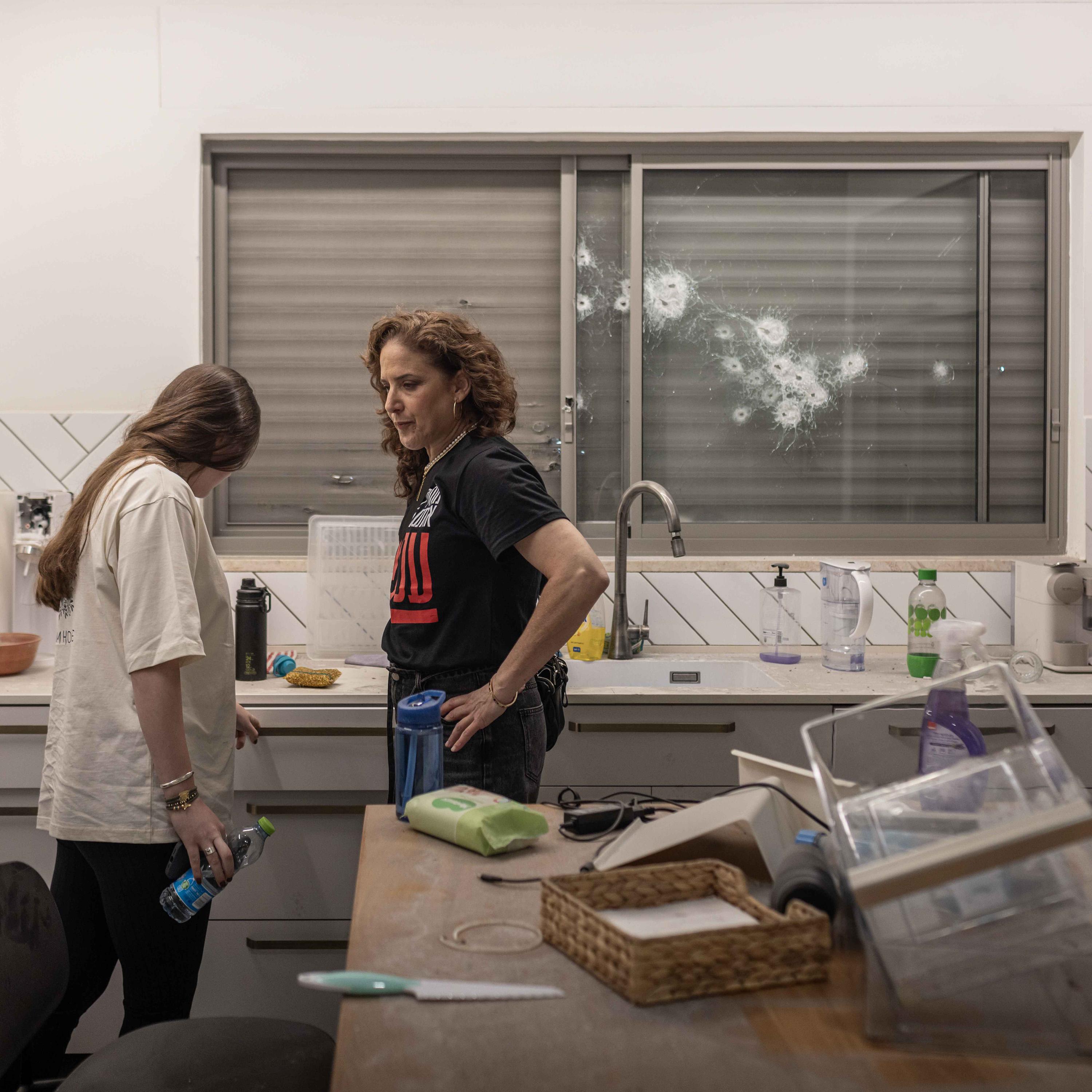
This American Life
842: 51 Days
00:58:38
Chen Almog-Goldstein tells the story of life as a hostage in Gaza.
Loading summary
Transcript132 lines
- [00:01]
Eric Glass
Support for this American life comes from Indeed. People are driven by the search for better. But when it comes to hiring, the best way to search for a candidate isn't to search at all. Don't search. Match with Indeed. Use Indeed for scheduling, screening and messaging so you can connect with candidates faster. Get a $75 sponsored job credit to get your jobs more visibility@ Indeed.com American terms and conditions apply. Need to hire? You need Indeed.
- [00:32]
Lee Naim
In Israel last week, Elie Elbag wanted to do something about his daughter Leary, who had been captured by Hamas a year ago when she was 18 and is still hostage somewhere in Gaza. And so he took a bullhorn and went to stand outside an event that was being held by the prime minister's political party, Likud. Basically, he wanted the people running the country to make some kind of deal with Hamas and bring his daughter home. And so, okay, he's standing there with his bullhorn, this grieving, worried parent who doesn't know if he's ever going to see his child again, and someone throws an egg at him, and another egg, somebody yells and calls him a cancer on Israel. Somebody else accuses him of being funded by Yahya Sinwar, the head of Hamas. This is not unusual in Israel. The country is bitterly divided between people like these hostage families who are saying, stop the fighting, make a deal with Hamas, bring home the hostages. And on the other side, the prime minister's supporters and his coalition people running the government who want to press on with the war and get to a more complete victory over Hamas. I have an Israeli friend who said to me that this war is different from ones in the past in Israel, because in the past, he said, once the war started, everybody united. This time it's driven people further apart to the point where even these anguished families who you think would have universal sympathy in a country at war are the target of all kinds of hate. A real estate mogul who's also a big Likud supporter writes tweets that call for the death of the mother of one of the hostages. Or here's a video that was posted online of an Israeli right winger on a motorcycle who pulls over next to a group of hostage families and tells them, you're going to be murdered. I'm going to murder you. Mark my words. So in Israel, supporting the hostages for so many people has come to mean that you oppose the Israeli government and the way that they're conducting the war, and you want a ceasefire and a deal with Hamas. I think here in the United States, we have a Different picture of the hostages and what they stand for here. I think there's this feeling that if you support the hostages, you support the war and the current Israeli government and the way it's conducted that war with all the bombings and death. The hostages are a symbol, but a symbol that means different things to different people in the US and Israel. It's been a year since the hostages were taken. The current conflict with hamas began last October 7 with the killing of 1,200 people and the kidnapping of 251 others. So much has happened in Sen, of course. Israel killed over 40,000 Palestinians, 90% of the population, almost 2 million Palestinians have been displaced from their homes. This past week, Israel expanded the war to Lebanon with a ground invasion. Iran sent missiles in response. And the White House has been scrambling to try to stop a full out regional war. At this point, this war is about so many other things than the hostages. But those 251 people, 117 of them released or rescued, 70 dead and 64 who were presumed alive and in captivity, are still this symbol. They're on posters that people put up and other people tear down. They're on bring them home bracelets. But they're also, you know, people each having their own personal and specific experience of this war. An experience that politics flattens and wipes away. Just two weeks after the Hamas attack, very early on, an 85 year old hostage named Yochevet Liefschitz was released and sent home. The Israelis were pretty excited. They did a press conference from the hospital. She was put on live TV in a wheelchair. Her daughter helped her hear the questions and give answers. Somebody asked, when Hamas released you, why did you shake the Hamas guy's hand?
- [04:25]
Chen Almog Goldstein
Because they treated us very nicely. My mom is saying that they were very delicate and gentle with them and took care of all their needs.
- [04:36]
Lee Naim
Television commentators and newspaper columnists jumped in calling this press conference a disaster, a propaganda win for Hamas, an embarrassment for the hospital, mind you. Liitz also said a lot of awful things about Hamas and her abduction attackers running rampant, beating people young and old. They hit her in the ribs with a wooden pole. But the story that came out of the press conference was that she said something nice about Hamas. Within a month, the hospital spokesman who organized the press conference was out of the job. There are certain things that Israelis just did not want to hear right then. Here at our program, throughout this year we've tried to document what this war has been for Palestinians and also for Israelis. And this week, a year after those people became hostages. We thought it might be a good time to hear about their actual lived experiences, all the complicated parts that don't fit neatly into some symbolic picture of them. There are these long interviews that an Israeli journalist, Lee Naim, has been doing with hostages has been released on a daily news podcast called Echad B'yom one a day. In these interviews, you get to hear them just talking at length. They're not a soundbite, not an image on a poster. You hear what really happened, the complexity of what they went through and what they saw and felt. One of the things that's especially interesting, I think, to hear is the hostages stories about their interactions with the people holding them captive, who I have to say, they come across with way more dimension than I might have guessed. So most of this hour we're going to be hearing from one of the Khad Bayam interviewees, a woman named Khen Almog Goldstein. And then when we get to the second half of the show, we're going to hear from a few of the other hostages who were interviewed. I hope you stick around. From WBEC Chicago, it's this American Life. I'm Eric Glass. Stay with us.
- [06:33]
Eric Glass
Support for this American Life comes from Indeed. People are driven by the search for better. But when it comes to hiring, the best way to search for a candidate isn't to search at all. Don't search match with Indeed. Use Indeed for scheduling, screening and messaging so you can connect with candidates faster. Get a $75 sponsored job credit to get your jobs more visibility@ Indeed.com American terms and conditions apply. Need to hire? You need Indeed. Support for this American Life comes from Capella University. Learning doesn't have to get in the way of life. With Capella's game changing flexpath learning format, you can set your own deadlines and learn on your own schedule. That means you don't have to put your life on hold to earn your degree. Instead, enjoy learning your way and pursue your educational and career goals without missing a beat. A different future is closer than you think with Capella University. Learn more@capella.edu.
- [07:30]
Lee Naim
Throughline is a podcast where we tell stories about a place shrouded in mystery, the past. And to really understand it, we take you there.
- [07:40]
Margalit Moses
Something happened to our collective psyche after the atom bomb.
- [07:45]
Lee Naim
Listen to hear us reopen stories from the past and find clues to the present on Throughline, the history podcast from NPR. This American Life Part 1, the Abduction. Just a heads up if you're listening. With kids, some of this gets intense. So Chen Omal Goldstein lived in a kibbutz called Kfar Aza, about two miles from the Gaza border with her husband Adav and their four children. She and Adav met in junior high school. She worked as a social worker for a while, but then focused on raising her kids. The the morning of October 7, sirens went off and they went to the safe room in their house. One of the things a lot of people talk about in these interviews is how mystified they were that the army did not show up. For many Israelis, that is the second astonishing thing that happened that morning that the military forces Israelis trust to keep them safe didn't arrive for over eight hours for reasons that still haven't been formally investigated. Khan's family stayed in the safe room for five hours. Then men entered the house, reached where they were shot her husband and DAV in the chest, she says, right in front of them. Soon after that they shot her oldest daughter Yam in the face. Yam was 20 and home on leave from her mandatory military service. Chen says the last time she saw Yam, she was flailing on the floor. Then chen and her three other children were led outside. There was her 17 year old daughter Agam, and also her two sons who were younger, 11 and 9.
- [09:18]
Chen Almog Goldstein
They led us to Nadav's car, first in a Daf's car and then to my car. They, they tried to start Nadav's car, but his car, when it's starting, it's very quiet. If you don't know the car, you probably wouldn't understand. So they probably thought it's not working. And they brought the keys to my car and we got into my. And I'm looking to the bushes still hoping that maybe someone will signal to me with their finger. Maybe I tell the kids to escape. But on the other hand it was dangerous. I remember realizing this is very crucial what I decide right now. I was afraid they had us. Now I remember the kids faces on the way to Gaza, very deep, terrified looks at me. I remember they asked me what happened to my lips, the boys. My lips were probably white. I was, I was shocked. I was completely shocked. And I'm in the car with the kids on the way to Gaza and I need to like understand and figure out that it was really important for me to tell the kids first that Yam is not with us anymore. And a dove probably isn't as well.
- [10:33]
Margalit Moses
Do the terrorists say anything?
- [10:36]
Chen Almog Goldstein
They're happy. They're very happy. I remember the driver and the guy next to him, they're filming us. I Remember we're putting our heads down, Agam and me. Then they stopped near the fence. It was their fence already because it was after some drive through the field and they piled dead bodies on my car. I remember Agam telling the boys to look away. And after seven minutes we're in Gaza. It's unbearable. How easy it was and how fast. I mean, first of all, we were in shock. I was in shock.
- [11:13]
Lee Naim
Ghan said this a couple of times in her interview. The part of what was so stunning about being taken hostage was how quick it was. One minute she was in her home, minutes later she was in Gaza, in captivity.
- [11:27]
Chen Almog Goldstein
I remember like a deserted area, there are papers flying in the air. And then they stop my car, they put us in another car. We drive, follow more. And then a gate opens. The car goes in and the gate closes.
- [11:50]
Lee Naim
They're at a private home. That's where the car stops. Clint says that are kids till then.
- [11:55]
Chen Almog Goldstein
Had held it together that entire time. The kids were just so, so level headed. Their conduct was so. It was amazing. Like they didn't cry, they didn't do anything dangerous, they didn't yell, they didn't try to hold on to my clothes. I think they even tried to talk to the terrorists, like talk to them in English.
- [12:15]
Lee Naim
But now next to this private home, they see the entrance to a tunnel.
- [12:25]
Chen Almog Goldstein
And this is the first time that Tal. Tal was nine at the time. This is the first time he's crying. He saw this black hole and he got scared. Tal cried a bit when he stared at this tunnel, but he calmed down. They brought him water and that's it. We're going down this tunnel. It's not very deep. And we meet other hostages from Kfar Azan, an elderly couple, a young guy. And each is telling their own kidnapping story. And we can't believe we're in Gaza.
- [13:03]
Margalit Moses
Can you describe the condition in the tunnel?
- [13:08]
Chen Almog Goldstein
Sand. There was sand everywhere. And also in our mouth there was a hallway that leads to this small room with some mattresses. There's constant sweeping because there's constant sand. And it's pretty hot there. 27 degrees.
- [13:25]
Lee Naim
27 degrees. That's 80 degrees Fahrenheit.
- [13:29]
Chen Almog Goldstein
27 degrees and very humid, very damp.
- [13:33]
Lee Naim
Khan and her kids, plus the three other hostages from the kibbutz were kept in the tunnel for two nights. She says at one point, one of the guards brings a deck of cards to keep the kids occupied. The boys remember we're 9 and 11. Agam's the oldest, 17.
- [13:52]
Chen Almog Goldstein
And Agam got some sort of panic attack. She started hyperventilating. She couldn't breathe. And so they attempted to calm her down. They said, you'll be back in Israel by Tuesday. Tuesday, you're back. And this was said on Monday. We were kidnapped on Saturday. And the truth is, I thought so, too. I thought, we'll be back by Tuesday. We're in Gaza with children. Israel is not going to attack. Israel is not going to do what it always does. First they're going to free us, and then they're going to figure out what they're going to do.
- [14:27]
Lee Naim
On Tuesday, they do leave the tunnel. Not for Israel. They're taken to a house next to the tunnel.
- [14:34]
Chen Almog Goldstein
And it's a house that is full of the sounds of kids, babies, women. And there we can already hear the attacks. Gaza is being bombarded at this point. And then they start prepping us for.
- [14:48]
Lee Naim
Another move, any move through the streets where they would be surrounded by Gazans. Just random civilians was always a production because their captives were hiding them from the Israelis, from the general public, from everybody. They didn't want people to know that there were Israeli hostages walking right beside them on the street. So they put Agam and Klan into fooling jalabiyahs and hijabs. Two boys, Gagan Tao got hats. Then they move them outside. It's five days into the war. Israel is bombarding Gaza. Hernande and her kids see Israeli jets flying overhead. Ren says she and Agam take all this in and say fauda to each other. Fouda's big Israeli TV series, an action show about military special ops in the west bank and Gaza. They end up in an apartment where they spend the next five weeks, most of their time in Gaza. Part 2 Daily life in Captivity so different hostages say they were held by different militant groups in all sorts of locations and all sorts of conditions. Some hostages who have been released said they were beaten or sexually assaulted. Klen's family is now in a residential apartment building guarded by two men who very much wanted to keep them a secret from all the civilians living around them on all sides, which had lots of consequences for the way they lived. Klein remembers it being really hot in that apartment. They had an electric fan, but electricity was only on for an hour or two a day.
- [16:23]
Chen Almog Goldstein
So it's very hard without the fan when the windows are pretty much closed. There are heavy curtains on the windows, and we weren't allowed to go near them. We weren't allowed. They keep opening them, closing them. Open, close. They don't want anyone to hear us. Even people just in the building, or of course, people on the streets. I remember it was very hard for me to fall asleep there. I was always the last one, always tossing and turning because you're sweating there the whole time. Everything is wet. You're just soaked in sweat. And there are bombings at night. And at that stage in this apartment where we were, they were still like explaining to us, like, this is bombing coming from the sky, this is from the sea, this is artillery. And when the house shook, they would move with us, sway with us. We were in, I don't know which four, maybe fifth at that stage at least, they would say by the baida, like, it's far. Like you hear the whistle, you know, the fall is going to be far. They were trying to tell us it's going to be okay, it's far. They tried to calm us down. They wanted us to be okay.
- [17:34]
Lee Naim
Living among the Palestinians, the Israeli hostages suffered through some of the same hardships of the war. Many hostages in their interviews, talk about how hungry they were. The Qatars tried to give them two meals a day. As the Israeli bombing campaign progressed, of course, and the army rolled in, food and water got harder and harder to get in Gaza to the point where now Gaza is on the edge of famine, according to the United Nations.
- [17:56]
Chen Almog Goldstein
My water, they try to provide drinking water. You can't drink water from the tap, first of all. There isn't like a steady flow of water. Sometimes there's just a drip and it's basically salt water. Bathroom. Very difficult bathrooms. You can't just like flush the water. Maybe, maybe we had it in the first two days, but then we couldn't flush the water. There was a really bad smell in the bathrooms.
- [18:23]
Lee Naim
When power would come on for an hour sometimes, she says, they'd get running water and then they had to decide who could shower. Guards or some of them. The gam, the teenager really wanted to wash her hair. With all that competition, Gwen says she pretty much gave up on showers for herself.
- [18:43]
Chen Almog Goldstein
I felt very strange in Gaza physically, the whole stay in Gaza. I was very weak. And I kept thinking about what happened at home. I forced myself to remember how I left Soyam after she was shot. Like it was like a form of torture, of self punishment. Fortunately, over time, as time passes, that image gets blurry. And I remember Yam is beautiful and happy. But I remember at first I was really forcing myself to not forget how I saw her. I mean, the whole thing just took seconds. And I ran outside, I ran outside to the kids. I didn't go down to Help her. I didn't check on her. I was terrified. Looking back now, I realize that in a way, I chose life like I went outside to Agam and Gal and Tal.
- [19:56]
Lee Naim
Now in this apartment with those three surviving kids, Han says she was in a constant state of alert to protect them. She says she cried every day, but the captors did not like seeing them cry. She says they wanted them happy, not sad. So she tried to conceal all that. One night, she says the apartment started shaking from a bomb that fell nearby and the guards had them evacuate. They all go into the street.
- [20:24]
Chen Almog Goldstein
There's total darkness. It's 7pm and Gaza is destroyed. It's devastated. And we're walking outside. We didn't walk long, but we were outside, me and the kids, and all of a sudden there's fire on us. I see the red lasers and the balls of fire and shooting on us. Fire.
- [20:46]
Margalit Moses
From airplanes.
- [20:48]
Chen Almog Goldstein
That's how it looked like it came from above, from the air. And they discuss with us many times the absurdity of the fact that they are protecting us from our own military. We had many conversations with them about it, about how absurd it is. And they would really put it in our faces and kind of laugh about and smile about it and would be like, do you understand what is going on here? We are watching you. We are protecting you. There was one night we spent the night in the supermarket and it was the first time there was an attack right near us on the street and the supermarket. The whole place shook and it's like crazy jackhammers are just getting closer and closer to you. We already saw all the rocks coming our way. And it's so scary, it feels like the seconds before death. And they are with their bodies. The terrorists that sell that watch us, they're with their bodies on us, covering us on the mattresses, protecting us from attacks of our own military.
- [22:05]
Lee Naim
The complicated relationship they have with their captors, that's the subject of part three, the guards. In general, the only Hamas members who talk to the media are official spokespeople and leaders. One of the things about these hostage interviews is that they give a glimpse of lower level operatives, some Hamas, some with other militant groups operating in Gaza who were keeping Israelis hostage. Here's Lee Naim, the interviewer.
- [22:33]
Margalit Moses
At the end of the day, these are the people holding you and your life depends on them. So with all the hates, I assume it was very uncomfortable situation. I imagine myself, I want them to like me so I can survive. So how did you manage it?
- [22:54]
Chen Almog Goldstein
Yeah, we realized our lives are in their hands, we realized they were just a cog in the system, that they're not the people making the decisions. Sometimes we would ask them, if someone gave you the decision to hurt us, would you do that? And they would say, no, we are going to die before that happens. Worst case, we're all going to die together. And that was pretty encouraging to hear.
- [23:19]
Lee Naim
Han says that eventually there were four men guarding her family who told them they were 28, 30, 37 and 44 years old. Three married, two with kids. The youngest had a failed engagement. The oldest was the most religious. Lenses he would read the most. One of them was learning Hebrew and would ask a gam if she could help him study years or dates.
- [23:42]
Margalit Moses
What was the most surprising thing that you discovered about them?
- [23:49]
Chen Almog Goldstein
Their sensitivity at times, how much they miss their wives. At some point, one of them wrote a letter to his wife, and it was, like, contagious because then another one wrote a letter to his wife.
- [24:02]
Lee Naim
I'm just going to interrupt here because I just want to point out the intimacy of this. These people locked together in a dark, hot, stuffy apartment, planes dropping bombs around them, who cannot help but notice what the others are doing in this cramped space. It's so personal. But at the same time, they are not on the same team. There's a distance. So when Gwen and Agam see them all writing letters to their wives.
- [24:29]
Chen Almog Goldstein
And it made us really nervous, Agam and I, we were like, why do you need to write letters to your wives right now? Is something going on? Is there something about to happen? One of them said he had an agreement with his wife to put the letter in his pocket. So if they found his body, they find it in the pocket. We saw their pain. Sometimes we could see their pain. We saw them breaking down and cry.
- [24:56]
Margalit Moses
What did they cry over about the.
- [25:00]
Chen Almog Goldstein
Uncertainty of what's going on with their family, whether. Whether their family was hurt or. No, that. That was the main thing.
- [25:09]
Margalit Moses
Did they see you as human beings?
- [25:12]
Chen Almog Goldstein
Yeah, it seems so, yeah. Yes. I mean, I. I felt like they really liked Galintal despite all that was done, and there was harm done. Beyond their activity in Hamas, they also had a business of perfumes. And they really showed us they brought a box with all the perfumes. They wanted Agam and I to check it out, to try it and tell them what we thought, what we like. They really showed us the syringes, how they make it with the percentages of the alcohol, how they put it all together. We also started having conversations about the roots and the depth of the conflict from their perspective. We were the first ones who murdered. We were the ones who deported and murdered their parents.
- [26:04]
Lee Naim
In 48, 1948, their Israel became a state. The violence in that period resulted in the deaths of 15,000 Palestinians and the displacement of over 750,000 others.
- [26:16]
Chen Almog Goldstein
When the conversation reached those points, that's when we would stop, because it would just get two tets because we didn't agree with them. But on the other hand, we also didn't know all the facts to argue with them. So we didn't want to upset them too much. We wanted to be okay with them.
- [26:33]
Lee Naim
Sometimes, though, Ren couldn't help herself. Like she says, every time they were moved from one apartment to another, pass from one group of captors to the next, the nuance would always ask, is this the family?
- [26:48]
Chen Almog Goldstein
And then I needed to explain to them that, yes, you murdered my husband, you murdered my daughter, so this is the family. And then sometimes after that, there would be like a silence. And sometimes they would say that if the person who murdered Yama Nadav did it in vain, like if Yamin and DAV weren't a real threat, that person on the day of his death, he will be judged. If he killed him in vain, he'll go to hell. If not, he'll go to paradise. Sometimes there was this moment of silence, or they would apologize when they realized that their own people, their brothers, killed Nadavanyam.
- [27:32]
Lee Naim
Generally, though, her captives were pretty unrepentant and open about their hopes for the future.
- [27:37]
Chen Almog Goldstein
They also told us, we like you. You're a good family. Don't go back to Kfa Aza. We'll come back there again. How many were we last time? Like 3000. How many people you think we have in our organizations? They ask me in Agam Agam and I would try 20,000, 40,000. So we'll come, they say, in three years. In three years we'll rebuild, and then 40,000 will come again. They were in euphoria. In the seven weeks that we were there in Gaza, our impression was that they were in. They were elated over their success on October 7th and that they planned to come again. We never got the impression that their spirits are being hurt because of the attacks.
- [28:29]
Lee Naim
Part 4 News from home There was a radio in the apartment, and sometimes the guards would let Chen and her family listen. But it was an ordeal to get them to agree to that. When the news came on, they would beg to be allowed to listen to 10 minutes worth.
- [28:47]
Chen Almog Goldstein
A newscast where they didn't talk about the hostages really broke our hearts. We just couldn't accept that they are talking about deepening the fighting and they don't talk about us. And when we came back, we actually talked about it. And we noticed that ever since, they are making an effort to always, at the top of the hour, to mention the hostages, because we really waited for it every time.
- [29:12]
Lee Naim
Listening to the radio, they started to piece together how big the attacks of October 7 had been. They had no idea of the scope. Other hostages said this too. One told the interviewer that she was shocked to hear that 75 people from her kibbutz, a fifth of the kibbutz, had been taken hostage. She thought it was just her and the three other people who she'd met in captivity. Chaim was listening to a broadcast when her own father came on the air talking about them.
- [29:41]
Chen Almog Goldstein
And the radio host is saying goodbye and saying, we're sorry for Nadav and Yam. That's when I finally realized that they're not with us anymore.
- [29:52]
Lee Naim
Up until then, she'd held out hope that maybe the army had come right afterwards and saved Nadav.
- [29:59]
Chen Almog Goldstein
That was the first time that gal, who's 12 now is 12, cried. We're really moved to hear my dad on one hand, and on the other hand, very, very sad. And still we kept asking for the radio.
- [30:16]
Lee Naim
One day on the radio, they heard about the dramatic rescue of a hostage named Arim Egiddish by the Israeli military. That news really seemed to get to their guards. The guards started acting very differently.
- [30:28]
Chen Almog Goldstein
They started going crazy. They wore their bulletproof vests and they put their uniforms like they became more like soldiers. Their stress immediately affected us, was projected on us. I remember at some point they were also taking out some sort of grenade in case someone is going to break the door. And they told us, if they're going to break the door, we're all going to hide in the bathroom together. It was just awful stress.
- [30:57]
Margalit Moses
And the news about Ori, did it encourage you or stress you in any way?
- [31:04]
Chen Almog Goldstein
I mean, we were jealous of her. We were jealous that they were able to get to her and rescue her. But we also, we saw what it did to our guards. That's why after they rescued the last three hostages two months ago, I immediately thought, I mean, it's a happy thing. Each one is a universe, it's a life. But I immediately thought, what does it mean for the people still there? Are there being guarded more intensely? Are they being transferred from one place to another now? I was scared. Maybe they're hurting them more Maybe they're doing something to them now.
- [31:54]
Lee Naim
Renemark Goldstein being interviewed by Lee Naim. The story continues and we hear from other hostages, including one who met the head of Hamas in a tunnel. That's in a minute from Chicago Public Radio when our program continues.
- [32:11]
Eric Glass
Support for this American life comes from GoodRx. Did you know GoodRx offers 20 popular diabetes medications for under $20? Check GoodRx before heading to the pharmacy and get up to 80% off your prescriptions. GoodRx is free and easy to use. Search any medication, get your coupon and start saving. Even if you have Insurance or Medicare, GoodRx could beat your co pay. See how much you could save on diabetes and everyday prescriptions@goodrx.com Tal support for this American Life comes from BetterHelp. It's important to take time to show gratitude towards others, but it's equally important to thank yourself. Life throws a lot of curveballs and being grateful isn't always easy. Therapy can help remind you of all that you're worthy of and all that you do have. Let the gratitude flow with BetterHelp. Try@betterhelp.com tal today to get 10% off your first month.
- [33:04]
Lee Naim
This is American Life. Amira Glass, today's show, 51 days a year after the Hamas attack on Israel that started the current war, we're hearing the story of Han Ahmaud Goldstein, who was held hostage with three of her kids for 51 days. And before we get back to her story, I wanted to play you a few clips from some of the other interviews that Lee Naim did with hostages for the Israeli news podcast Echad Bayom one a day. One of the interviews she did gave a glimpse of life in a tunnel that's very different from Gwen's experience. This is somebody who spent her entire time in captivity in the tunnels, a 78 year old named Marguerite Moses. And to give you a sense of her personality, her captors at some point started calling her the captain because in that particular group of hostages, she would be the one to suggest things to the guards like don't cook the potatoes in the morning and then serve them to us hours later. Cook them shortly before we eat them and bring them warm, put them on a plate with a bit of salt. People like salt on their potatoes. Marguerite says when she arrived in Gaza, they walked deep into the tunnels an hour and a half or two hours before they arrived at the rooms underground where she and about 15 people from her kibbutz were held. There were mattresses on the floor and chairs.
- [34:22]
Ada Sagui
Oh, we had an elegant room, really. We had a room that was covered with ceramics. Both the floors and the walls, except for the ceiling that was both curved and painted white with lime. The walls were decorated with a beautiful delicate design. And high up above, there were drawings of tulips with beautiful green leaves.
- [34:55]
Margalit Moses
How organized and prepared did the tunnels there seem?
- [35:03]
Ada Sagui
Oh, the tunnels were very, very organized. I walked around even at night. I didn't have that much to do unless somebody wanted to go to the bathroom. And I helped them.
- [35:15]
Lee Naim
Marguerite was up all night because she's somebody who needs a CPAP machine to sleep. She brought one with her, but her captors took it. And then she asked a doctor for another one. She said he smiled and laughed and said, we don't have those here. So she says she didn't sleep for more than five or ten minutes at a time for nearly two months. So at night, up anyway, she would walk people to the toilet.
- [35:38]
Ada Sagui
So I was walking around at night in the tunnels. And generally we were only allowed to get to a certain point beyond which they said, you can't go. And I constantly was wondering, what is there that they don't let us go there? Do they have some weapons there? Or I don't know what. So one night when I saw that they were all asleep, even that person that was supposed to be awake supposedly watch over us. So I said, I really have to go see what's there. And then I arrive and I see that there was a splitting of a few tunnels. So I pick to see into each one. What's there.
- [36:34]
Chen Almog Goldstein
Here?
- [36:35]
Ada Sagui
There is this one tunnel full to the brim with lots of six packs of mineral water. So straight away, one bottle here, one bottle there.
- [36:47]
Margalit Moses
You hid them?
- [36:49]
Ada Sagui
Yes, and that's how we had mineral water, at least for a few days.
- [36:55]
Lee Naim
She said one tunnel she looked down had mattresses. Others had electrical wires and water pipes. Near the room in the tunnel, there was a kitchenette with shelves for canned food. And there was a group of hostages that were in a room that was mostly open, but had some cages, she said, like for prisoners on the side.
- [37:16]
Ada Sagui
So it was really organized from their point of view. The tunnels numbers each floor a different color. They sometimes had to walk around with notes that explained to them where to turn, because the place is huge.
- [37:32]
Margalit Moses
Maps.
- [37:34]
Ada Sagui
Maps. Yes, maps. We reached minus 5, sometimes minus 5.
- [37:40]
Lee Naim
Five horse down.
- [37:41]
Ada Sagui
When they were afraid there might be soldiers outside, they called us to come quickly, quickly. So we went downstairs quickly and then we saw minus five. So just imagine kilometers and kilometers and five Floors.
- [37:57]
Lee Naim
Incredibly, one day, the second day of their captivity, Marglade says they had a visit from the man responsible for their kidnapping and the deaths of their loved ones, the head of Hamas himself, Yahya Sinwar. Like I say, I find this to be a completely believable story because nothing dramatic happens in this story at all. Like, if you made up a story like this, the head of Hamas would say something fascinating and revealing, or she would get off some great line. None of that happens. It just seems like he ordered people to bring back hostages. They did. It's the next day, and he wants to see some of them for himself. Here's Marguliet's account.
- [38:37]
Ada Sagui
He entered the room with his entourage. He asked us, do you know who I am? So I said to him, yes. So he opened his eyes big. He was surprised I knew his name. And he said, yes, it's true. I'm Yihesinoir. He speaks fluent Hebrew very well. And he said not to be afraid and they will give us anything we need, and that we are only there to be bargaining chips for prisoner exchange.
- [39:14]
Margalit Moses
How did it feel to hear that from him?
- [39:17]
Ada Sagui
Horrifying, the audacity with which he said it with his nose up in the air. For me, it was an unpleasant moment, this arrogance of his. It humiliates you. And most of us were older people. What is the point of kidnapping older people and putting them there?
- [39:48]
Lee Naim
So that's Marguerite Moses, who was released around the same time as Chen and her family. I want to play you some stuff from one other interview before we get back to Chen. Ada Sagui is 75 years old and from the same kibbutz as Margalit. Her life in captivity was very different from Margalit's or Chan's for a few reasons. And one of them is that she speaks Arabic, taught it in middle schools, partly out of an idealistic belief in coexistence and wanting to speak with her neighbors. And so she understood what was being said around her when she was in captivity, understood where she was. October 7th, when she was driven south to the city of Khan Yunis.
- [40:33]
Amira Glass
We arrived at the vegetable sorting warehouse at the eastern outskirt of Khanes. They unloaded us, took from us some jewelry I had from my mother, wedding band, my glasses, and I begged them to leave the glasses, because without them, I completely lose orientation. They took it because they claimed that it has a tracking chip in it and they are petrified by chips.
- [41:08]
Margalit Moses
Did you try to explain that?
- [41:10]
Amira Glass
Yes, I tried to explain to them, what do I have in Common with the chip. Well, they said you used to be a soldier.
- [41:17]
Lee Naim
They said that to a 75 year old woman because there is mandatory military service in Israel. So she served.
- [41:24]
Amira Glass
But when I was a soldier, there was no computer and there were no chips. They explained that every soldier has a chip. And I said, I wish it was true. If it was true, we would know where everybody is. In that warehouse. Somebody stood and did the check in. He was English speaking person. He asked for first Name, Last Name, ID Number from where we are. And he also was asking for the phone number of the children. Naturally I invented phone numbers. I said it's like check in into a hotel.
- [42:04]
Lee Naim
Another fact about Ada, she left her home without putting on shoes. Her captors told her, don't put them on. So she spent her entire captivity barefoot, though she was given a pair of socks. In November, when it got colder, Ada was held captive with another woman from her kibbutz, Meilav Tal, who's in her 50s, 20 years younger than Ada. Not somebody she knew well before this. But the fact that there was somebody else to share this with really defined her time as a hostage made it easier.
- [42:37]
Amira Glass
They put us in the children's bedroom. There were two bunk beds. They gave us the lower beds. I had the drawing of Angry Birds and Merav had the drawing of Sweet dreams.
- [42:52]
Ada Sagui
Sweet dreams.
- [42:56]
Margalit Moses
How did you pass the time you in Morav?
- [43:01]
Amira Glass
Hours and hours of logic games and we were playing a crossword puzzle in our heads. We were talking about our family, every child, grandchild. We got to know each other family as if the two of us were sisters.
- [43:23]
Margalit Moses
Did you also share your worries?
- [43:26]
Amira Glass
Yes, we were very, very much partners in our worries.
- [43:32]
Lee Naim
They also talked to their guards. One guard spoke some English and Ada of course spoke Arabic. One of the guards in particular, she says was very loyal to her and Milav, he listened to Al Jazeera and tell them what was happening in the news.
- [43:46]
Amira Glass
He said all the time that I'm treating you as if you were my mother. I felt that there is some respect. We know that his wife is a midwife at the NASA hospital in Khan Yunis. He has four kids. He evacuated her and the kids from the home to her parents home.
- [44:09]
Margalit Moses
Oh, he really told you about himself?
- [44:12]
Amira Glass
Yes, he told us a lot. At one time while he was telling that, he said I'm not involved. And I said, what do you mean not involved? And he said, I'm neither Jihad nor Hamas, but I want money. I asked him, but myself and Merov are at your place in the kids room. You took away our freedom, our basic right. And you say that you are not involved. And he said, I want money. I want money for myself and my wife to get visa for us and the kid and fly away from here because there is no future here.
- [45:05]
Lee Naim
Okay, back to Chen and her family. We are at part five, moving around. One of the things you realize listening to Chen is just how much of the experience of being hostage can be just being moved from place to place, no idea where you are or where you're going or why. Chef's daughter Agam, worried every time they were moved that this was the time they were going to be taken somewhere to be killed. When they walk through the streets, they're supposed to keep their eyes down and blend in. The captors gave them fake names to use if anybody tried to talk to them, and they would practice the pronunciation of the names with them to be sure they got them right. That night, they thought they might die in that supermarket. Ren and her kids were moved to an apartment above the supermarket till that building started shaking, didn't seem safe. And they moved to a mosque for shelter. And then they headed out on what Chen remembers as a long journey through the streets of Gaza. Part of it on a donkey cart.
- [46:04]
Chen Almog Goldstein
Eight of us on a donkey. Like on a cart attached to a donkey. And the donkey is stumbling and bombing all around. Bombings. Yeah. And roads that would end. And they would have to ask the locals whether we can pass through or not. And then a donkey would need to make a U turn.
- [46:21]
Lee Naim
Finally, they reached an apartment which he says was still under construction maybe a month and a half into their captivity. Not long before the end, one of the guards takes Chen and her kids out of the apartment and onto the street.
- [46:37]
Chen Almog Goldstein
Very long walk in the streets of Gaza. We're outside, and for the first time, we see the sundown. And then we get to a school.
- [46:47]
Lee Naim
All around the school were Palestinian civilians who were seeking shelter. Inclined her kids in their disguises apparently looked like just another displaced Palestinian family needing help.
- [46:57]
Chen Almog Goldstein
People were putting all these sheets and putting together these impromptu tents, and there's a lot of people there. And they approached the guy from the cell and they offer to house us, to host us. He kept saying that people are offering help because they see family with kids. So they offer to help where for the first time, after six weeks, we're sitting outside and we're seeing the moon. And Tal is telling me, hey, mom, look, this is. This is the moon. And there was excitement in the air, too, because there was a feeling of like, A ceasefire might be coming.
- [47:38]
Margalit Moses
Did you believe it?
- [47:43]
Chen Almog Goldstein
Yeah, it looked like. It looked like, yes, I wished for it. And then I look at the sky and I show Tal and I tell him, look which stars are moving and which stars are staying still. Because the skies were packed with planes. And then all of a sudden, people near the school launched rockets. And they were so thrilled with every rocket they launched. I was immediately scared, like, maybe now the planes are going to bomb the school.
- [48:13]
Lee Naim
Then she says, the guard who was with them, who'd been with them for weeks, said goodbye to Khan, wished them a quick return to Israel, told her to take good care of Agam, and handed her off to the next group of captors. They were told there's no safe place above ground anymore, and got taken down into a tunnel where they met six other hostages, two kids, four women, two of whom were young Israeli soldiers.
- [48:37]
Chen Almog Goldstein
They had just finished basic training and a course and they didn't even start doing their job. Kids there are like 18 and a half, 19 year olds. Some of them were alone until they got to that tunnel, and some were physically injured. Alone. Yeah, some of them went through a lot. There was something really powerful about that week in that tunnel. Even though, with all the difficulties and even though they seemed to be on edge, we were really there for one another. There was some sort of feminine energy, strength in that tunnel.
- [49:12]
Lee Naim
The two kids, Ela and Daphna, were sisters, 8 and 15. Their dad and his partner were killed on October 7, and the other women had been taking care of them in Gaza.
- [49:26]
Chen Almog Goldstein
And they were amazing. They showed so much emotional strength also towards the children, the FNA and Ella. And that's something I couldn't handle. To be there for other kids, Yes, I couldn't. But the young women, they were there for them. They were with them even before we arrived. So they were the authority for those girls. And I was in awe, truly, at how they managed to handle them and be there for them with their physical injuries and with their emotional injuries and still try to function, to cook whenever possible, to be there for each other. I remember one day, one of them had this, like, panic attack and she started hyperventilating and she started going up the stairs and she sat there on the stairs and she was crying her heart out. And she was crying and she just like. It's like she couldn't breathe and she wanted a moment to herself because all this togetherness can be really intense too. And of course we're there for one another, we're helping each other, but it can Just be suffocating too, and you end up craving your privacy and just a moment for yourself and some air and some space.
- [50:40]
Lee Naim
This is where Chaim and her kids spent the week before they're finally released. They were told during that week, it's going to be soon.
- [50:46]
Chen Almog Goldstein
They kept saying, Friday, oh no, it's going to be Saturday. Oh no, now it's going to be Sunday. I remember thinking to myself, it's not a big deal. Like the absurdity of it, it's not a big deal. If I stay here one more day. Getting out, I realize I'm going to have to face something very difficult that I lost. Yama Nadav.
- [51:07]
Lee Naim
Yama Nadav. Her daughter and husband, of course.
- [51:14]
Chen Almog Goldstein
And the day of our release came. It was a very nerve wracking day. Saying goodbye to the girls was difficult. They were like, who's going to be released next? Is it going to be the civilians first? The soldiers? I mean, the soldiers kind of understood that it will take a little longer. I mean, they didn't realize it's going to be that long. But they would never imagine they would still be there.
- [51:37]
Margalit Moses
But there were two other women with you.
- [51:39]
Chen Almog Goldstein
Civilians, yes, they're wounded, but they're still there. Yes, they're still there. It was a difficult farewell. Also deciding what to say to their parents, what not to say to their parents. They asked us to fight for them. They asked us not to forget them, to go to protest that we speak to their parents. That we did immediately. They also told us what to say and what not to say. But everything was with the assumption that they would be released right after us. That still hasn't happened. They're still there.
- [52:17]
Lee Naim
Khan and her family were released as part of a deal negotiated by Qatar, Egypt and the United States, where 80 Israelis, mostly women and children, lots of older people, were swapped for 240 Palestinians, mostly women and children, held in Israeli prisons. Klein's transfer was broadcast on Israeli tv and the first stages of it look pretty chaotic, actually. There's a random mass of people crowded on some sidewalk. Cars with hostages pull up one after another. Each hostage is ushered down the sidewalk, past all this confusion to another waiting car is frightening. Ren says.
- [52:54]
Chen Almog Goldstein
We walk a while from the Hamas vehicles to the Red Cross vehicles and it's all, we're being filmed. It's all staged. And it's like their moment of glory. They're wearing their best uniforms. We never saw these uniforms before. And I remember asking myself, how did Israel allow this? How could Israel allow our transfer to happen in such A public exposed place when tons of people were there. Like, we were scared. We were so scared until the end. We already survived this. We're already about to get released, and we're still, like, they had to make it scary for us all the way to the end.
- [53:33]
Lee Naim
Then the red car's vehicles take off in a convoy and drive all the way to the border.
- [53:42]
Chen Almog Goldstein
And then all of a sudden, like magic, we are being moved to our military. And it was very, very moving. That moment was the saddest happiness of my life. I knew Nadav wouldn't be there to hug me. I just wanted someone to be there and hug me and tell me, that's it, you're safe now, after everything we've gone through.
- [54:14]
Lee Naim
Ada, the hostage, who'd been an Arabic teacher, also talked in her interview about that moment right at the end of captivity, when she finally made it out and reached the Israeli military forces. It got to her in a very different way.
- [54:31]
Amira Glass
There was a group of officers there. There was a white shining tent with everything you could wish for. I walked in and they took me in and I screamed, where were you on the 7th of October? Not that they deserved it, because it was not them, but where the hell was their army on the 7th of October? And I started crying, and they caught me the moment I was falling down. And I'm not one of those fainters. It was a very difficult moment.
- [55:13]
Lee Naim
Glenn and her family were filmed on the helicopter that brought them home, talking to the crew, getting a tour of the cockpit. Glenn says it was hard getting this very respectful treatment, not to think about how this was the same military that she and her kids had been so scared of in Gaza for so long. During the airstrikes, these rescuers were in the same army that might have killed them.
- [55:36]
Margalit Moses
Did you say anything about it?
- [55:42]
Chen Almog Goldstein
I started talking about when I first came back because when I was in Gaza, I promised myself that I would talk about it, that I would talk about that complexity. But then you come back and they tell you don't talk about it as much with the media, not with the international media, of course, because it. It's not a good look. And you see here how hard it is. Like, you see people who did a bunch of operations in the military and got to very senior positions, and they're not able. It's like they can't. They're unable to come and just say, we're sorry. We're sorry for what you went through on the 7th when you were inside your shelter. We're sorry that we bombed in Gaza when you were there with your kids.
- [56:35]
Lee Naim
Marglie Moses, the woman you heard earlier, who was held in the tunnels the entire time, was released two days before Chen. She got invited this summer by Prime Minister Netanyahu to meet with him and some other released hostages. She wrote this letter as her reply.
- [56:52]
Ada Sagui
Hello, Mr. Netanyahu, thank you for the invitation, but I will not participate in a meeting for the sake of photos and public relations. While my friends are rotting in Hamas tunnels in Gaza. With my own eyes I saw them alive in captivity. And now, Due to their second abandonment since October 7th, we are receiving them in coffins. In light of reports that you have thwarted yet another deal to release the captives, I see no reason to attend a meeting with somebody who has demonstrated through his actions that the release of the captives is not a priority and who is abandoning them to their death. I would be happy to meet you at the welcoming event for the 109 captives upon their return to their families. Thank you. Margalit Moses.
- [58:03]
Lee Naim
Our program was produced today by Dana Chivas, Diane Wu, Yael Evan Orr and me, with editing help from Nancy Upd, based on interviews from the Israeli podcast Echad B'yom, a production of N12. The staff of Echad B'yom who produced these interviews are Lee Naim, Sheila Erel Rom Atik, Yair Bashan and Gay Imbar. Our Hebrew interpreters were Ya'el Evin Orr, Amira Jolson and Miriam Kaplan. The people who put together our show today include Bim Adewunni, Sean Cole, Michael Kamate, Aviva DeKornfeld, Emmanuel Jochi, Hani, Ha Wasley, Hana Jafi Walt, Valerie Kipnis, Henry Larson, Seth Lynn, Kathryn Ray, Mondo Stone, Nelson, Ryan Rumory, Alyssa Shipp, Ike Shrish, Kondaraja, Horace Starcheski, Lily Sullivan, Christopher Sotala, Marisa Robertson, texter Matt Tierney and Nancy Updike. Our managing editor, Sara Abdurrahman. Our senior editors, David Kestenbaum. Our executive editor is Emmanuel Berry. Special thanks today to Noe Yachot, Daria Shuali, Edgar Kellett and Sam Klein. Also thanks today to the rest of the Echad Biome staff, Erad Simkhayov, Adi Khretzroni, Daniel Shachar and Danny Noodleman. Our website thisamericanlife.org where you can stream our archive of over 800 episodes for absolutely free. This American Life is delivered to public radio stations by prx, the Public Radio Exchange. I'm Eric Glass. Back next week with more stories of this American Life. This message comes from Schwab. It's easy to invest in ideas you believe in. With Schwab investing themes like online music and videos, artificial intelligence and electric vehicles. Choose from over 40 customizable themes. More@schwab.com.