← This American Life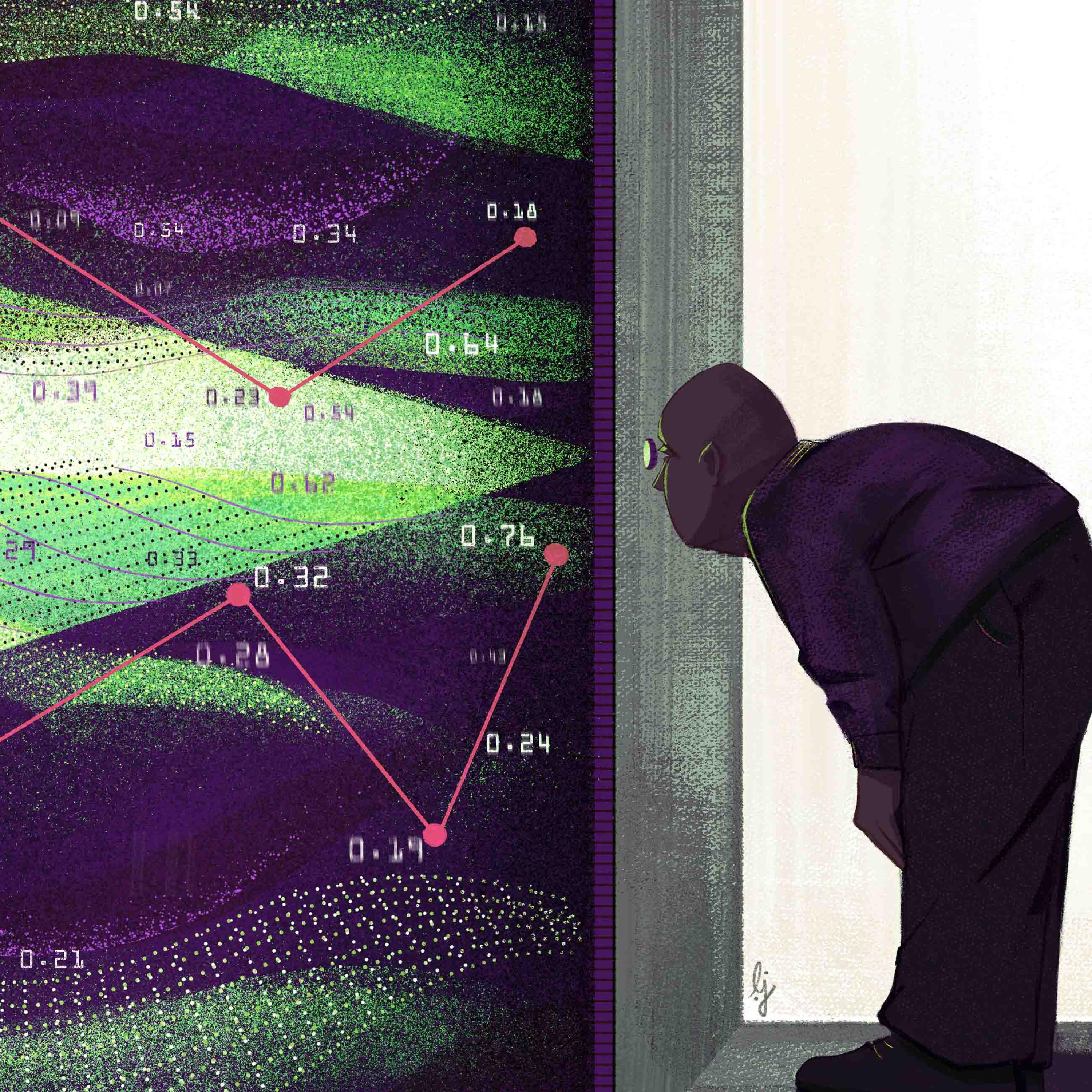
This American Life
859: Chaos Graph
01:07:29
People immersed in chaos try to solve for what it all adds up to.
Loading summary
Transcript152 lines
- [00:01]
Ira Glass
This message comes from, have you ever gotten sick on a very expensive, very non refundable family trip? AmazonOne Medical has 24. 7 virtual care so you can get help no matter where you are. And with Amazon Pharmacy, your meds can get delivered right to your hotel fast. It's kind of like the room service of medical care. Thanks to Amazon Healthcare just got less painful.
- [00:25]
Chana Jaffe Walt
Hannah it's this American Life. I'm Chana Jaffe Walt, sitting in for Ira Glass. I've been talking to someone here and there over the last couple months about a situation she's in and I think she typifies the thing we're going to try to do in this episode. So I'd like you to meet her. Her name is Annika Barber. She's a scientist, a molecular biologist at Rutgers University, a runner. She's got purple hair and a particular way of organizing the world around her. Her books organized topically and then by height. Her lab color coded labels.
- [00:59]
Annika Barber
I also track how many days of the year my husband eats pizza and I make a chart of it. He's really into pizza, so sometimes I just like to have.
- [01:06]
Chana Jaffe Walt
Wait, wait, wait, why? Why do you do that?
- [01:09]
Annika Barber
So my husband really can't go 24 hours without talking about pizza. So last year I accused him of talking about pizza every day and he swore he didn't. And I was like, I really think you do. And so starting in January of this year, I said that for 2025 I was gonna that I heard him say the word pizza as well as every time he ate pizza for the year. He actually eats less pizza than I would expect for the amount he talks about pizza like the consumption to discussion ratio is not what I expected it would be. He's only had pizza 14 times this year.
- [01:41]
Chana Jaffe Walt
Lately, Anika has been trying to get her mind around a new situation that is deeply confusing for her and lots of people. She's tracking scientific meetings that are not happening. When President Trump was inaugurated, he put a freeze on research grants. This meant the meetings where scientists like Annika get together at the National Institutes of Health to assess new research. They're called NIH study sections. Those meetings were off, but then a judge said the administration couldn't pause all research grants, so the meetings were theoretically back on. They were listed on an NIH website as scheduled, but Annika says they did not seem to be happening. The website showed they were, but scientists were saying they weren't. Scientists who had submitted grants literally had no idea if their grant had been reviewed and moved on to the Next step of the funding process. But Annika learned there was a place you could get a way better picture of whether a meeting was going to happen or had already happened.
- [02:48]
Annika Barber
I had never even heard of the Federal Register in my American, taxpaying, voting life.
- [02:55]
Chana Jaffe Walt
What is the Federal Register?
- [02:57]
Annika Barber
The Federal Register is where all notices of open public meetings that may be happening in the federal government are required to be posted. And for some reason, NIH study sections do have to be posted to the Federal register at least 15 days before they meet.
- [03:11]
Chana Jaffe Walt
And if they're not posted to the Federal Register, they cannot meet. It's a strange feeling knowing you're in the middle of an upending, knowing that something fundamental to the way that you live is changing, but you can't understand or see the scale of change as it's happening. You just can't. You have to wait. What I like about Anika is she rejects this. She is not waiting. Anika immediately begins scraping data from federal websites, finding all the meetings that were supposed to happen, cross referencing them with the Federal Register, reaching out to scientists to see if the supposedly scheduled meetings did in fact occur. Compiled all that into a Google spreadsheet and posted it online. Anxious and confused scientists all over America began consulting Annika's spreadsheet and passing it around to see, is my study section actually happening? Has my grant been reviewed? Is there any point in submitting my next grant? Will I be able to keep my lab open?
- [04:12]
Annika Barber
There's tens of thousands of scientists whose grants depend on this happening, who are all wondering what's going on, how much.
- [04:21]
Chana Jaffe Walt
Science has not happened.
- [04:24]
Annika Barber
So let's see. Right now, we are at 182 meetings that have not happened.
- [04:33]
Chana Jaffe Walt
182 meetings. How many grants is that?
- [04:37]
Annika Barber
You know, if we assume roughly 100 grants would have gotten reviewed at each meeting, you know, we're talking about at least 18,000 grants that didn't get reviewed.
- [04:49]
Chana Jaffe Walt
Wow.
- [04:50]
Annika Barber
And that's 18,000 grants across all kinds of things. I mean, you know, very basic science. You know, just scrolling through here, I've got things like adaptive immunity and bacterial virulence. But then we also have things like addiction, risk and learning and memory and decision making and therapeutic immune regulation. We have training neuroscientists and physician scientists, and we have studies looking at dentistry and eye diseases. Those aren't meetings.
- [05:19]
Chana Jaffe Walt
For five weeks, there were no NIH study sections till it was 205 study sections that did not meet. All of those proposals sat waiting, and all the ones that came after stacking up behind them a long Traffic jam of uncertainty and science not happening. And then in March, a meeting appeared on the Federal Register, an NIH study section, and then another and another. Now the meetings to assess new research grants seem to have mostly picked back up. Scientists are doing peer reviews, but it's not clear if the government will actually cough up the money. And a few of the grant proposals that were supposed to be reviewed at these meetings, they're being quietly disappeared from the lists. They're not being reviewed at all. They seem to be the grants with DEI words or other thought crimes in them that are no longer allowed. It's unclear if the scientists who submitted these grants even know that their proposals have been dropped. Anneke went to a meeting herself. It was two months late, pulled together at the very last minute. But it did happen.
- [06:28]
Annika Barber
We all made the time and people were there and people gave the same quality of review that I have always experienced in these meetings and the same level of scientific discussion. But it felt so weird to be having these scientific discussions in this climate where you could only wonder, we have all these amazing scientists in this room reviewing the future of the next five years of research in the areas of molecular neurogenetics. But is any of this going to be funded? Are any of these studies going to go forward? Is the NIH going to give these people any money?
- [07:02]
Chana Jaffe Walt
Did anybody ask? Did anybody ask?
- [07:05]
Ira Glass
No.
- [07:06]
Annika Barber
No. Every grant gets 15 minutes for discussion. And we needed to get through 50 odd grants, so there's no time to think about anything else.
- [07:14]
Chana Jaffe Walt
So will that stuff that you reviewed get funded?
- [07:20]
Annika Barber
I don't know.
- [07:25]
Chana Jaffe Walt
Was there a part of you that felt like, are we chumps? Are we just like, yes, absolutely.
- [07:31]
Annika Barber
You know, it feels like we're, we're fiddling while Rome burns talking about some cool genes and worms and mice and all the interesting genome wide association studies that we could do if money keeps existing. And yeah, are we chumps? Are we participating in furthering something or nothing? Are we just wasting our time?
- [07:54]
Chana Jaffe Walt
The thing that is killing her is not knowing the shape of the new normal. How many grants will now be funded compared to before? Half a quarter. Which scientists will get funding? What kind of research there's no data she can turn to that will tell her that.
- [08:12]
Annika Barber
And so I need the data of how bad is it? You know, I think a lot of us are used to approaching problems as something that we can not necessarily solve with data, but that we can find the edges of with data and get our arms around the problem and define the problem by figuring out what the data are and what the but it.
- [08:37]
Chana Jaffe Walt
Might be possible that that's not going to happen in this case. That there might not be.
- [08:41]
Annika Barber
That does say, yeah, I'm starting to get that vibe.
- [08:46]
Firoz Sidwa
Yeah.
- [08:46]
Annika Barber
You know, it becomes one those things where you know, can you graph chaos? Maybe not. Can you feel better trying to graph chaos? Also maybe not.
- [09:00]
Chana Jaffe Walt
Will she continue to try to graph the chaos? Yes, she will. Today's show is full of people who do not wait for the chaos to settle. People who run toward it, who will take whatever little data they have available to them and try to make it make sense. Sense. These are people who get answers. Stay with us.
- [09:33]
Ira Glass
Support for this American Life comes from Squarespace, their AI enhanced website builder. Blueprint AI can create a fully custom website in just a few steps, using basic information about your industry goals and personality to generate content and personalized design recommendations and get paid on time with branded invoices and online payments. Plus streamline your workflow with built in appointment scheduling and email marketing tools. Head to squarespace.comameran for 10% off your first purchase of a website or domain. Support for this American Life comes from Indeed. Indeed Sponsored Jobs helps you stand out According to Indeed data, sponsored jobs posted directly on indeed have 45% more applications than non sponsored jobs. Speed up your hiring right now with Indeed and get a $75 sponsored job credit to get your jobs. More visibility@ Indeed.com American terms and conditions apply. Hiring Indeed is all you need.
- [10:32]
Chana Jaffe Walt
It's this American Life. The questions people are trying to answer in today's episode, they are basic. Where and why? Act 1 Solve for why. One of the hardest places to see through chaos in the middle of a war, fog of war, all that. This is especially true for the war in Gaza. There is very limited information moving in and out of Gaza. Israel has banned international press from entering the strip for nearly 18 months. Except for a few brief trips accompanied by and under the control of the Israeli military, one rare outside group has gotten a view on the ground of medical workers. Since the start of the war, over a hundred American doctors and nurses have traveled to Gaza, treated patients there for weeks at a time, and come back out. Producer Ek Sris Kundaraja talked to a dozen of them who volunteered there.
- [11:28]
Ira Glass
Dr. Mark Perlmutter had been on about 40 medical missions all over the developing world before he went to Gaza. He's a white guy, almost 70, a hand surgeon in rural North Carolina when he's not doing humanitarian work and when he found out patients in Gaza needed an orthopedic specialist like Himself. He signed up and flew there in March of 2024. He'd worked in some pretty violent places, but never an active war zone and only knew the basics about the conflict between Israelis and Palestinians. I went there only because my twist is to operate on kids who are hurt. And I knew that Gaza was 50% kids, and that's all I knew. I thought Infetada was a type of Mexican dish. I mean, I knew nothing. Intifada is the word for Palestinian uprising against Israeli occupation. But Mark was about to get a crash course from one of his fellow doctors. We got on the van, and I heard Feroz talking casually to somebody else. He's got this deep baritone voice, and, you know, you meet somebody for the first time, and within minutes you can tell that somebody's a whole lot smarter than you. And my first message was, there's absolutely no way that I'm gonna get on this van and not sit next to this dude or behind him or with an earshot of him. Dr. Firoz Sidwa, a trauma surgeon from the U.S. he's also volunteered as a doctor in the war in Ukraine and with Palestinians in the West Bank. He's closely studied the Israeli Palestinian conflict, though his family's from a small ethnic minority in what is now Pakistan.
- [13:16]
Mark Perlmutter
You know, when people look at me, they assume I'm Palestinian or something, but I'm not. I lived in Haifa, that was from 2004 to 2005. And I worked with, like, an Arab Jewish cooperative that doesn't exist anymore. And during that time, I tore around in the west bank, was never able to go to Gaza, but toured around in the West Bank a lot.
- [13:32]
Ira Glass
So Mark sat next to Feroz, and when they arrived at the European hospital, that's the name of the hospital in Khan Younis in Gaza. Their team dropped off their thousands of pounds of supplies. European hospital was built for just over 200 beds, but is taking care of over a thousand people, and families are living in every corner of the hospital. Mark hadn't seen anything like it froze, had neither. But he told me he didn't linger on that long. A nurse took them on a quick tour, let them know where everything was, the operating room, the icu.
- [14:07]
Mark Perlmutter
The nurse that was showing us around didn't really speak English very well. And she just pointed at these two kids and just pointed at her head and said, shot. Shot. There were four kids in the hospital with gunshot wounds to the head. I just thought that that was unbelievable, and I just assumed that she was just wrong. I didn't think she was lying, but she was just incorrect that probably it was a shrapnel injury or something like that. But then I looked at these kids and they didn't have any evidence of an explosive injury. And then we pulled up their CT scans and sure enough, it did look like they had been shot in the head. And then we went on and found two more kids also shot in the head in the other ICUs.
- [14:39]
Ira Glass
This is like minutes into your initial tour of the hospital, you see two kids with gunshots to the head and then two more kids with gunshots to the head.
- [14:48]
Mark Perlmutter
Yeah. For me, what struck me about it was just the fact that it had happened. I work in a pretty rough part of the country, so I do see children who get shot in the head froze.
- [14:58]
Ira Glass
Works at a hospital near Stockton, California, which has higher rates of violent crime than most of the country.
- [15:04]
Mark Perlmutter
But to see four kids with gunshot wounds to the head already admitted to the hospital when I get there, it certainly struck me as being very unusual.
- [15:14]
Ira Glass
I mean, it was a war zone, but still, this was a lot. And then he moved on. There were so many people that needed medical attention. The only way he could keep track of his patients was to make notes on his iPhone. Just to warn you here, the details are graphic here.
- [15:34]
Mark Perlmutter
This is from March 28th.
- [15:37]
Ira Glass
He pulled up an entry from a random day. Just to give me a sense of what it was like.
- [15:42]
Mark Perlmutter
Overnight, we had another mass casualty event. EMS told us a building with a large number of people in it was bombed and then two children arrived dead. The one I saw was 12 months old and the other was reportedly 2 years old. Next bullet. I took care of a 7 year old girl with a blast injury, pneumothorax to the right lung and a bad contusion to the left lung. Next bullet. I took care of a three year old child who had a massive aspiration after a head injury. Next bullet. I took care of a 20 year old woman with a left hemopneumothorax and depressed open skull fracture. Next bullet. I took care of her sister. She had almost identical injuries. Next bullet. Finally, I took care of a 25 year old man with a frontal skull fracture and small associated subdural hematoma.
- [16:22]
Ira Glass
That's like an 18 hour day.
- [16:24]
Mark Perlmutter
No, that was. All of that probably happened in one hour.
- [16:27]
Ira Glass
That's one hour.
- [16:28]
Mark Perlmutter
That probably took about an hour or an hour and a half.
- [16:30]
Ira Glass
Yeah, 90 minutes. It's intense. But in that endless stream of traumatic injuries, there's one that jumped out at him every time Kids getting shot in the head. Whenever he saw this, he'd make a note of it on his phone.
- [16:46]
Mark Perlmutter
And what I wrote down is that I was going through the ICU and I found an 8 year old girl shot in the head overnight. Her pupils are fixed and dilated. It's a transcranial gunshot wound. Definitely non survivable.
- [16:57]
Ira Glass
This is a 8 year old girl with a bullet wound that went through her head.
- [17:02]
Mark Perlmutter
Yeah, the bullet didn't stop. And then let's see the next day. So the next day the eight year old girl had died and in the same bed as a 14 year old boy, shot in the right chest and the head. The next day I said I went through the ICU afterwards. The 14 year old boy turns out to be 12 when his family arrived. So then let's see, two days later he's been replaced by a 13 year old boy shot in the head. I wrote, he'll also die. So then on that same day I wrote I took care of a two year old girl who was brought to the ED after being shot in the head. She arrived with bilateral fixed and dilated pupils. Also a non survivable brain injury. We then had a mass casualty event a few minutes later at the same.
- [17:44]
Ira Glass
Time that Froze was starting to document this mark. Working with his patients, he was seeing the same thing. He vividly remembered the day he saw two kids brought in who had both been shot in the head and the chest. One of the kids was there with a family member. I ripped up his shirt and there was a bullet entry wound right over the heart. And then I picked up the dressings on his forehead and second bullet went in right in front of his left ear. Hole in front of his ear and out of his neck. What was the kid doing when this happened? Walking with their adult to get water. Was there a street battle happening? I didn't ask if there was a street battle going on, but it happened twice in the same day. Could you say the second time? Yeah. Right next to that kid was another kid who got shot in the head and the chest. And that child had no adult with him, so I couldn't get a story. It's hard to. Hard to see it. These weren't kids injured by collapsing buildings. They were kids who'd been shot. Direct gunshot wounds into 12 year olds, 8 year olds, even toddlers. Oh, over a dozen combined. Two injuries. Only two, head or chest. Dozen others almost every day. You were there? Yeah.
- [19:21]
Mark Perlmutter
By the time I left, I'd seen 13 children shot in the head total or at Least that's what I recorded in my journal. I probably saw more, but I tried to stick to what I actually documented.
- [19:30]
Ira Glass
13 children in 14 days. Even with all the other traumatic injuries and deaths they saw, the kids who were shot really stuck with Mark. It was haunting him. Early on, I thought it was just an isolated jerk, you know, carrying out because every. Every army has jerks. War changes people. And so you can absolutely have rogue people behaving inappropriately. That's as far as Mark thought about it at the time. The detail of 13 kids, all with gunshot wounds to the head and chest. It just got added to the long list of things they saw in Gaza and couldn't fully understand. He didn't come back to Faroese until they were back home and got invited to speak at a conference in Dearborn, Michigan. The panel had another American doctor who also volunteered in Gaza. He worked in two different hospitals a couple months before Firoz and Mark arrived.
- [20:29]
Mark Perlmutter
He's a Palestinian American in Chicago named Thayer Ahmed. And we were just sitting next to each other talking before our panel started, and I said, you know, I couldn't believe how many kids I saw shot in the head. I just went through my journal recently, and it was 13. And he said, oh, yeah, I know. Me too. Almost every day I saw a kid shot in the head. And I was like, oh, okay.
- [20:50]
Ira Glass
And then Feroz texted me, hey, you know, this guy saw other kids shot. We have to find out who else saw other kids shot.
- [20:58]
Mark Perlmutter
So I started asking other people who had been over there. Physicians, nurses, midwives, nurse practitioners.
- [21:04]
Ira Glass
I got a call from Feroz Sidwa. I think, like, sometime in mid July, he called me. Dr. Adam Hamowi is a plastic surgeon from New Jersey. And he said, like, did you take care of anyone with any gunshot wounds to the head or face? And I said, yes. And he said, really? How many? Because of Adam's specialty, he would have only seen children who survived a gunshot to the head long enough to make it to reconstructive surgery. Not many did. He saw one. It was still shocking to him. Adam had served in Iraq as a surgeon in the U.S. army. He treated lots of injured people. But what he was seeing in Gaza was different. When I was in Iraq, there were civilians that were injured, there were children that were injured. And that's called incidental collateral damage. All the terms that we use to cleanly justify what's happening. But the scale was. I mean, not even close to this. I mean, I probably took care of, like, five, six children the whole time. I was in Iraq and I wasn't there for three weeks. I was there for eight months. I mean, it didn't look, you know, it didn't appear that they were intentional targets. Those, you could really say that they were. Wrong place, wrong time. I didn't see, you know, targeted gunshots to little kids that were 5, 6 years old or 10, 15 years old in fact. I mean, I'm thinking back, I mean, I don't think I saw a gunshot wound to a kid at all when I was there. There were documented cases where Americans did kill Iraqi children, but nothing near the scale that these doctors saw in Gaza. As somebody with US military experience, do you have a perspective that could explain the circumstances that lead to, to a kid getting shot? How do you answer that? These are little children that are being shot and these aren't stray bullets. These are aimed, they're precise. So a stray bullet will explain one or two of them. It's not going to explain the string of precise targeted shootings that are being done on children since October. The medical worker I spoke with who spent the most time in Gaza also saw the Most kids shot 50. She showed me a picture she took of a scan of a five or six year old skull. There's a bullet in the middle of it. She was told this child was playing with their friends when an armed quadcopter drone came overhead and shot the child. Dr. Alia Kattan also responded to Feroza's call out. She's an anesthesiologist from Southern California. She went with her husband and between the two of them saw 15 kids who had been shot in the head or chest. The one that really stuck with her also happened to be the youngest case I'd heard of.
- [24:15]
Chana Jaffe Walt
One day I got called in for a mass trauma in the emergency room. They said we need help. So I assumed it was just from bombings and this 18 month old got thrown into my hands. Her name was Liliana. I knew she was dead but her mom was screaming so I knew we had to do something and show her. We tried.
- [24:34]
Annika Barber
So I didn't see any blood frothing.
- [24:36]
Chana Jaffe Walt
Out of her mouth and doing chest compressions.
- [24:39]
Annika Barber
And I looked up at her head.
- [24:41]
Chana Jaffe Walt
And I saw there was blood and I asked was there any imaging? They handed me a CT scan and there was a bullet shot to her head and you could tell it was like a shot tried to her temple and I was just like in shock to like never have I been done this many kids, but I've never done.
- [24:57]
Annika Barber
Chest compressions on a Gunshot wound to an 18 month old.
- [25:02]
Chana Jaffe Walt
And the mom was just screaming. The mom, this was her only daughter and she had tried for nine years to have her and she was just hysterical, obviously.
- [25:14]
Ira Glass
Furoz reached out to as many American medical workers as he could. Doctors, nurses, paramedics. He created a survey to send out and compiled all the answers. The results stunned him.
- [25:27]
Mark Perlmutter
Almost everybody had the exact same experience. Almost universally, they said the same thing, which I really was surprised by.
- [25:34]
Ira Glass
Out of the 53American medical workers surveyed who did emergency care for children in Gaza, 44 said they saw kids shot in the head or chest. Here's Mark. 83% said they saw a child who was shot in the chest or head. 83%. So it's not just my finding. Could you describe that moment when you saw just how many. Oh, I cried, yeah. Because they gave a number to the tragedy. Feroz published an op ed in the New York Times with the results of the survey. A group of the doctors wrote two letters to then President Biden outlining what they saw. Froze, thought that would mean two things. They'd get a call from the White House and there'd be an investigation.
- [26:28]
Mark Perlmutter
I thought that any sensible Biden administration would take that New York Times article as a major opportunity to feign ignorance about what had been going on in Gaza and to say, oh, my God, we can't believe American doctors saw this. And if this is true, then we're going to have to seriously reevaluate the arms that we send to Israel.
- [26:48]
Ira Glass
I talked with three people who worked at the U.S. state Department and reviewed allegations like this, including the person who until recently was the Ambassador at large for Global Criminal justice, a position that used to be called the war crimes Ambassador. They all agreed the doctor's report sounded credible and significant enough to investigate. Each of them said the next step should be asking Israel for answers. One who was involved in vetting U.S. weapons transfers told me, if this had been another country other than Israel, this is what would have happened. A few years ago, a senior member of the House Foreign Affairs Committee received reports that Mexican Marine units were executing and disappearing people. The US Stopped the shipment of machine guns for more than two years while they investigated the allegations. Eventually, Mexico agreed that American weapons wouldn't go to those units. But that isn't what happened here. The Biden administration never met with for Rosenmark. They didn't investigate these claims or make any public statements asking Israel to stop shooting kids in Gaza. They didn't try to get to the bottom of these allegations. I read These doctors accounts and had the same question they asked in one of their letters to President how could this be a series of accidents, such widespread shooting of so many young children over course of an entire year? But I've also reported on war crimes before, and I know that cases that seem to a bystander or even a doctor on the ground like clear acts of atrocity. They can be explained as a tragic but expected part of war allowable under the rules of war. The Gaza Strip is a small, densely populated place. It's nearly 50% children. Hamas is hiding inside that population. Any fighting between Hamas and Israel will have civilian casualties, including children. So we asked the Israel Defense Forces how they explained the reports from American medical workers. They declined both my interview requests, but sent a statement saying the IDF does not target minors and takes extensive measures to prevent harm to civilians, including children. The IDF is committed to mitigating civilian harm and operates in full compliance with international legal obligations. For security reasons, we cannot elaborate on operational policies. Which doesn't explain why so many kids were getting shot. So I went looking for an Israeli soldier who'd served in Gaza who could tell me what it was like on the ground and what the rules were on who they could shoot in what circumstances. And we found one who would talk with us. He's a reservist in his early 30s, a grad student whose unit got called up at the beginning of the war. He asked us to just call him M. He was worried about retribution. So we had an actor read his responses to my questions.
- [30:07]
M
It varied a lot, but a typical day was we'd have some missions looking for weapons, looking for tunnels, and if we see anybody engage them. And my role was the front machine gunner, light machine gunner.
- [30:22]
Ira Glass
His company started in the north of Gaza, not near the hospital where Firoz and Mark and most of the doctors were. He said there was a humanitarian road running north and south. And near the humanitarian road, the rules of engagement were don't shoot unless there's an immediate threat. But once you got away from the.
- [30:43]
M
Humanitarian road, everything besides that, we're told no one's supposed to be there. The orders to evacuate have been made. Anyone who is there is not supposed to be there. For us, basically, the guidelines was men of fighting age, shoot. It doesn't matter if they're armed or not. They're not supposed to be there. And the logic being that Hamas operators, they don't walk around armed. They keep weapons caches in different homes. They walk around, they run to the nearest house if they need a Weapon. So any, basically men, you shoot on sight and that's. And it's shoot to kill.
- [31:23]
Ira Glass
Shoot to kill.
- [31:24]
M
If it's a woman and child, use the standard kind of non war procedure where you just detain them, try to detain them. This is how we heard it from the commanders. Don't shoot women and children unless they're a threat. Try to just detain them.
- [31:40]
Ira Glass
He says there was one incident where his unit did see two young people they thought might be a threat one day when two teenagers, 14 or 15, were part of a convoy going south. They sprinted away and ran into a building. A Hummer and a tank followed them and ordered them to come out. The army thought the teens might be luring them into a trap. When the teens didn't come out, they fired at the building, killing them. He says his unit never fired on any other teenagers or little kids. But he says different units operate differently.
- [32:20]
M
The Israeli army is not the US Army. There's much more kind of DIY element. It comes down to your commander, how he decides the standards he sets. And our company commander happens to be a kibbutznik who is a little bit more cautious and doesn't want to essentially create a storm.
- [32:42]
Ira Glass
It matters who your commander is.
- [32:44]
M
Yeah. I can tell you there are soldiers in the unit who are hardcore right wing settlers who if it was up to them, we could be doing much more damage. I remember there was another company in the battalion, their company commander very much not like ours. I was at an observation post and he comes by just to look through my binoculars and he sees a Gazan family passing by, some Shaldak soldiers. And he sees them giving the family bottled water and he goes on the radio to yell at them, saying what are you doing? You want to open up a lemonade stand too? And he starts looking through my binoculars and calling in order to some bulldozers saying, see that line of trees over there? See that? Take him all down. Destroy all of that. And I ask, oh, are you doing an operation there later for security, you don't want them to have any kind of like sniper positions. And he said no, just don't let them live. He was pretty much operating from make it as difficult for their lives as possible going forward.
- [33:57]
Ira Glass
So according to M the broad permission to fire and the types of units led by more aggressive company commanders, he can see how that could result in soldiers shooting Palestinian children. He didn't see this himself. This is just his opinion, he told me. But he believes that Israeli soldiers have probably shot some children on purpose.
- [34:21]
M
At least some of these cases I can see being intentional. It wouldn't shock me. They're in the situation and they get desensitized really fast and develop a hatred really fast. So in no way to justify that. I do understand the mentality at first, shooting unarmed people was horrifying to us. It's like, I can't believe we did that. And then it was like, ugh. Like you get desensitized to it and after you lose some friends, you start thinking, why even take the chance our lives are more important than theirs? I won't bet my life on it that they're Hamas, but I'll bet their lives on it that they're Hamas, essentially. So regarding these American doctors, seeing the children, no, I can only give my take that, you know, some soldier took it upon themselves, said, okay, they're an age like this that, you know, I can rationalize to myself that they're potentially combatants. Why take the chance?
- [35:25]
Ira Glass
I could just tell you, based on the dozen conversations I've had, they're talking about children who are as young as. This is hard to say, but 18 months who have been shot.
- [35:39]
M
Well, the 18 month old, there's no question there. And I don't think anything. I can't give a reason. I mean, the simple one of, you know, crossfire, etc. That's one. But if they're saying there was one shot exactly and no other wounds, then that goes out the window.
- [36:11]
Ira Glass
I asked M for other possible explanations. What if the soldiers didn't know they were kids? It's a chaotic, tense environment full of people and places to hide. That could happen. But he and another IDF soldier I spoke with, someone who didn't serve in Gaza, but whose job was to identify targets for snipers, said it wasn't hard to distinguish a child from an adult. It wouldn't explain an 18 month old being precisely shot in the head or toddlers or other grade school age kids. Were the kids being used as human shields by Hamas or even victims of Hamas in a false flag operation to blame Israel and draw sympathy? M hadn't heard of that happening in Gaza and hadn't seen it. He says when he tries to make sense of what happened, there's been a societal shift in Israel that he thinks is a factor.
- [37:10]
M
I hear enough attitudes and opinions that would have shocked me 10 years ago. Now it's like, yeah, this is how people feel here. I have a friend whose dad said in an interview he was in the Mossad and basically said that no one in Gaza over the age of four is innocent. So this isn't a fringe mentality among Israelis known in Gaza as innocent. They all support Hamas of all ages where the draw the line varies. But they'll say, you know anyone that self war in Gaza is a Hamas supporter.
- [37:51]
Ira Glass
The Israeli army has not announced any investigations into the shooting of children in Gaza. In the meantime, the Trump administration just authorized another $12 billion in arms sales to Israel. That's in addition to the reported $17.9 billion the US has given Israel in military aid since the war began. The kids getting shot like this are a tiny part of the large number of casualties in Gaza. At least 65,000 people have been killed, more than 15,000 of them children. An expert who investigates war crimes described it as a haystack of needles. Most of these allegations will never find their way to court. So sometimes in cases like these, war crimes investigators look for emblematic crimes, clear instances of violence outside of the rules of war that tell us something about the war. Like the My Lai massacre, Srebrenica, the chemical weapons attacks in Syria. What do these deaths tell us? The hundreds of kids American medical workers saw shot in the head and chest, what are they emblematic of? They tell us it's likely that an Israeli soldier can shoot a child in Gaza on purpose with no consequence, and the US Isn't going to try to stop it.
- [39:34]
Chana Jaffe Walt
Ike Sriskhandaraja is a producer on our show. Avi Viktor is the actor who read for M. Coming up, a woman discovers she is a central data point in a story she did not know was unfolding. That's in a minute from Chicago Public Radio when our program continues.
- [39:55]
Ira Glass
This message comes from Midi Health. If you're a woman over 40 dealing.
- [39:59]
Chana Jaffe Walt
With hot flashes, insomnia, weight gain or.
- [40:01]
Ira Glass
Brain fog, you don't have to accept it as just another part of aging. The clinicians at MitiHealth understand what you're experiencing and know how to help. Midi Health provides specialized care for perimenopause.
- [40:11]
Chana Jaffe Walt
And menopause covered by insurance.
- [40:13]
Ira Glass
Book your Visit today@joinmitty.com that's joinmidi.com support for this American life comes from Mint Mobile. Tired of spending hundreds on your monthly wireless bill? Enter Mint Mobile. Mint has plans starting at 15 bucks a month with high speed data and unlimited talk and text shop plans@mintmobile.com upfront payment of $45 for 3 month 5 gigabyte plan required. New customer offer for first 3 months only, then full price plan options available, taxes and fees extra. See Mint Mobile for details. This message comes from Capital One.
- [40:52]
Chana Jaffe Walt
Banking with Capital One helps you keep.
- [40:54]
Ira Glass
More money in your wallet with no.
- [40:55]
Chana Jaffe Walt
Fees or minimums on checking accounts.
- [40:57]
Firoz Sidwa
What's in your wallet?
- [40:58]
Chana Jaffe Walt
Terms apply. See capitalone.com bank for details.
- [41:02]
Ira Glass
Capital one na.
- [41:03]
Chana Jaffe Walt
Member FDIC. It's this American Life. I'm Chana Jaffi Walt, sitting in for Ira Glass. Today's show, chaos Graph. People trying to make sense of things, trying to map what is happening around them and see the bigger picture. We've arrived at Act 2, solve for where in this next story. The bigger picture has become very clear to the rest of us over the last couple weeks. It's in the news all the time. But the woman at the center of this story, she experienced it up close. She learned each fact in the most personal, direct way. And making sense of those facts, understanding how they all fit together for her, was urgent. Nadia Raymond has her story.
- [41:50]
Mari
When Mari shows me this video, it feels like something I'm not supposed to be watching. On the screen is her fiance, Mikaela. He's shirtless. He's crisply lined up. He's young, 23, bright green eyes, wild curly hair tucked under a baseball cap. And he's holding a tattoo gun, giving himself a tattoo on his stomach while she teases him, says he's never gonna tattoo her again. He looks up and laughs, his mouth full of braces. Mari is always sort of dragging Mikael about his tattoos. He has lots of them, some which Mari finds offensively dumb.
- [42:32]
Firoz Sidwa
He has a Mickey Mouse, but the Mickey Mouse is smoking. He used to smoke and he used to do ridiculous things like that because to me, they're ridiculous things. But yeah, and then behind that, he has like a little hand. Like a little hand with an eye. And he tells me that eye sees everything. And I was just like, bueno, o.
- [42:49]
Ira Glass
Que ta bien, Tien bieno tro.
- [42:53]
Firoz Sidwa
And he has something else there, like, just like an ugly doll. Like, it looks like a toad. It has big eyes.
- [43:03]
Mari
It's E.T. smoking a blunt. Mari is not her real name. She's from Venezuela. She's here applying for asylum, which is legal, but that seems to matter less and less nowadays in terms of who gets deported, hence the alias. Mari and Mikael are the kind of couple who wear matching outfits. Her idea, but she insists he's also into it. Shows me a picture where they're wearing matching pink shorts that he chose. Mikael is a barber. Mari works cleaning hotels, so they work opposite hours. She gets up early, goes to bed early. He gets up later, goes to Bed. Later, when their schedules do match up, they're usually so tired that they sit at home and watch TV on their fuzzy pink bedspread. The morning it happened, Mari left early like she usually does. She noticed a bunch of men outside. They were dressed in black. She says one of them spoke Spanish. They came up to her, her roommate and her landlord.
- [44:01]
Firoz Sidwa
The owner of the house stands up and he looks out the window and he sees, you know, a few police outside. And they show him a photo. And they ask him for muchacho, for a guy. And he says, no, he doesn't live here. But other three other people live here.
- [44:17]
Mari
It seemed like they were looking for someone. One of them showed her the photo on his phone. He was like, do you know this person?
- [44:28]
Firoz Sidwa
He was a dark skinned person with dark hair. He had big eyes. He had a beard. We didn't really know who he was. And they tell us that he's Dominicano. And he tells us that they're going to check the house to just make sure and to verify, to make sure it's true that that person that they're looking for doesn't live here. I really didn't see a problem with it because we haven't committed any crime. We're not hiding anything.
- [44:54]
Mari
Mari figured she and Mikael had applied for asylum. He had his first court hearing already. His next one was coming up. They didn't think they were in any danger. So Mari sees no problem with letting any sort of law enforcement in. So she opens the gate, leads them down these narrow gray steps and into her basement apartment where Mikael was still asleep.
- [45:18]
Firoz Sidwa
So they went downstairs, and obviously I went first because I was there to wake him up. He was half asleep. And he says, what's happening? He sat up. And when he sat up, well, he usually sleeps naked. I hand him a towel and I tell him, put the towel on, because the police is coming. They came in, they pushed the door. They put me in handcuffs. They put him in handcuffs. And the moment that happened, I said, well, what's happening? Why are you putting us in handcuffs? And then I started crying. I started crying. And he would tell me, nina Tranquila, Nina, calm down. And I kept on crying. And I was asking, why are we in handcuffs? Why are they doing this? But they didn't tell me anything. The only thing they were saying, stay calm, because things can get worse. And if he moved, whatever movement he made, they would, like, sit him down. I mean, he couldn't do anything. He couldn't move.
- [46:13]
Mari
Did they, like, identify themselves? Did they tell you they were from ice?
- [46:17]
Firoz Sidwa
No.
- [46:24]
Mari
The men in black, Mari would later learn, were maybe ice, Immigration and Customs Enforcement, or maybe police working with ICE and the dea. For some reason, we don't know for sure, because they won't answer any of my questions. What we do know is that Mikael ends up One of the 238 men who are in the news now almost every day. Men who were sent away to a prison in El Salvador where no one can reach them. And the President has refused to try to get them back, despite a court suggesting he should. But that's all in the future. On that day in February, Mari says there was one of them, one of the men in black, that spoke Spanish. He started talking to Mikael. He was calmer. He was like, it's okay, man. Just be cool. Don't move too much. It's going to be fine. He translates for the rest. He tells Mari that they are taking Mikael, that they need to question him, but that she's free to go. Mari is in a daze. She doesn't know why they are taking him, but letting her go. They uncuff her. They let Mikael get dressed. The one that speaks Spanish tells Mari that they're taking him to Federal Plaza, an ICE office in Manhattan. And then it's over. The men in uniforms take Mikael away, and Mari is left looking around, wondering what just happened.
- [47:42]
Firoz Sidwa
I didn't know what to do. So the first thing I did was. I don't know, I went to work.
- [47:47]
Mari
You wanted to work after that? Why?
- [47:53]
Firoz Sidwa
I didn't know what to do. I thought to myself, look, I'll go to work. I'll look for help. I just didn't know what to do. I didn't know everything. Felt stuck. I've never gone through something like this.
- [48:06]
Mari
Not going to work is not an option for Mari. She's been working since she was about 16. No matter what's happening around her, her boss told me that she's never met someone so young, yet so serious, Reliable. She's the only one in her family who has left the country. The problem solver, the one her mom likes best, she said. I asked her, would your mom agree? And without missing a beat, she said, I will FaceTime her right now, and you can ask her yourself. Mari met mikael in Colombia three years ago. She was 21. He kept hanging out at the boutique where she worked, and one day she mentioned she wanted a tattoo. He was like, I'll do it for you. She was skeptical, but agreed. From the moment they started Dating. They were inseparable. Mari told me she has a temper and liked that Mikael could handle it. She says he's funny and charming, a little more shameless than she is. When they traveled up to the US if they needed to ask for food, Mari always felt embarrassed. Not Michael. He made friends with everybody. When they got to New York and their hours didn't match up, they spent what seems to me like basically their whole day video calling when she get off the train in the morning, call for Mikael. When he got out of the shower, call for Mikael. At lunchtime, call for Mikael. While he's cutting hair, call for Mikael. They knew where the other was, what the other was doing, what the other was eating all the time. Until now. Mari is at a loss. She doesn't understand why Mikael would be in trouble. So she turns to the first person she trusts that knows this crazy system to see if she can help her make sense of what's going on. Her boss at the hotel, a woman from Ecuador who's also an immigrant but a citizen. Her boss always told her employees if they were ever in trouble with immigration, come to her, no problem. So even though it made Mari feel a little embarrassed to ask for help, she did it. Mari's boss helped Mari find Mikael online through an ICE website, and it shows that indeed, Mikael is being held in New York that afternoon. He calls and tells Mari that they had to hold him there, even though there was no criminal record of him that night. Mari tracks him online again and sees that he's now in Pennsylvania. She thinks, why are they moving him? Mari's boss tells her, get a lawyer, like yesterday. So she starts to look for one. She needs one that she can afford and that speaks Spanish. It took her a week to find one. The lawyer looks into Mikael's case right away, trying to figure out why he got detained in the first place. Much to the lawyer's distaste, Mari, a true Gen Z er, starts to post a lot on TikTok almost overnight. Her feed morphs from dancing reggaeton videos to photo collages of Mikael set to cheesy Spanish ballads, laying out their story, asking people to make it go viral. Mari is particularly concerned with Mikael being moved to Pennsylvania like that without him consenting to it. The lawyer tells her, don't worry about that part. The government can move him around detention centers all they want. They just can't deport him. A judge has to decide that. So for the next few weeks, all of these moving Parts become Mari's new normal. Tiktoks about Mikael calls with the lawyer. Video calls from the Pennsylvania detention center.
- [51:39]
Firoz Sidwa
Four or five times a day was him calling me, me calming him down, me telling him he was going to get out of there, to have faith.
- [51:50]
Mari
And then one day in March, she doesn't hear from him for hours.
- [51:58]
Firoz Sidwa
And then he called me. He called me at four in the morning. And he tells me, crying desperately. Nina. They transferred me again to El Valle, to Texas. I was the whole time on a plane. They didn't tell me anything. I didn't eat, I didn't drink water. They didn't give us anything. I haven't been able to sleep. They're going to process me here and me. Bueno nino. Calm down. Be strong. You're going to leave. Remember that on Monday you have your court appointment. If we have to pay bail, we'll pay bail. But you're going to leave. You're going to get out of there.
- [52:36]
Mari
Mari checks the website and indeed there he is in Texas, so much further away from her, from their little basement apartment. She's like, why are they taking him further away? She calls the lawyer, who tells her again, don't worry, they can move him, but they can't deport him. Which is true, at least legally speaking. Mari had a bad feeling, but she pushed it down and went to work.
- [53:09]
Firoz Sidwa
I worked as much as I could because honestly, when you're nervous, when you're anxious, it's really, really hard to get things done. I arrived really late to my house that day. I arrived at 8 o'clock. I arrived on the bus. When I get down off the bus on the corner of my house, my boss, she was the one that sent me the video. She tells me more. I sent you this video. I think I saw your husband there. Take a look and let me know if it's him.
- [53:38]
Mari
She sent it to your phone. Like a video on your phone.
- [53:40]
Firoz Sidwa
See, yeah, it was a news clip from Telemundo. And I, you know, I click on the video and, you know, the beginning is there were. There were airplanes getting to El Salvador and a bunch of Venezuelans people getting off the planes and all of that. But at the end, when the video was almost done, there's a moment where there's people kneeling down, getting shaved.
- [54:09]
Mari
There at 38 seconds in, on the screen was Mikael. Profile. Sharp curls falling around his face. His head held down while someone shaves his head. It lasts just a few seconds. And then the camera cuts to someone else. It was chilling Like a scene in some perverse movie.
- [54:30]
Firoz Sidwa
I recognize him immediately. The second I saw him, I knew it was him. He has a tattoo and it's a Chinese phrase, like on his sideburn. And obviously when they were shaving him, you could see it. And he has long, curly blonde hair. And he's the only one who had hair like that. I mean, it was him, it was him. When I saw him, I, I went into crisis. I, I started shaking, I started crying. I. I was with another girl that lives with me because we work in the same hotel. And I tell her, josefina, it's him. Josefina, it's him, it's Mikael. They took him. And I just. It was very bad. I was telling her, jose, it's him, it's him, it's him. And the first thing she told me was, calm down, because something could happen to you. And all I could say was, jose, it's him. They took him. I just felt so, so sad when I saw his face. Like he was suffering. His eyes were swollen. He must have cried so much. And then immediately I went home. I turned on my computer and I started to look, and immediately I saw that he was no longer in the US system.
- [55:54]
Mari
At that moment, Mari unknowingly became a data point, part of a group of people who figured out their loved ones were taken to a notoriously bad Salvadoran prison. Through a video. A mom in Venezuela had the same experience at around the same time as marijuana. She saw a close up of her son, Mervyn Jamarte Fernandez's face on screen in the same Telemundo report. And that's how she knew where he was. Another mom, same thing. Seeing a brief glimpse of his tattooed arms was the only marker of her son, Francisco Garcia Cacique, and his whereabouts. Without these videos, they would have simply disappeared. I know people say unprecedented a lot, but I really can't think of another word to describe this swift and secretive removal of 238 Venezuelans. It happened so quickly. Within four hours of the Trump administration invoking the Alien Enemies Act, Michael and the other 237 got removed, moved. Mari described it to me as a kidnapping. And this move of shipping people who are in the US abroad to some dank prison is unlike anything I've seen in U.S. immigration. We've sent hundreds to the mega prison Secot so far, and we're paying the Salvadoran government $6 million to hold them. It's described as a prison no one leaves alive. And it's next to impossible to talk to people who Are there not even lawyers can. The government is saying Mikael was sent there because he's a gang member. Trend. So is he. The New York Times and CBS have made these lists with all the men taken there, looked into whether they could find any criminal activity here in the US In Venezuela and in surrounding countries. And so far it looks like almost 90% either have no record or have been charged with minor offenses like driving with a suspended license or trespassing. I talked to a professor named Dorothy Kronik who's making one of these lists. She studies crime and policing in Venezuela. I asked her specifically about Mikael. She hasn't found anything suspicious. I also asked a local reporter in his hometown, this small island off the coast of Venezuela. She told me that there is no Trend activity there. Mikael lived in Colombia for a while. I did a criminal records search there using his Venezuelan government ID number. Nothing. This lack of information connecting Mikael to Trendiaragua, that doesn't seem to deter our government. Robert Serna, an acting field office director for ISIS removal operations, said something that stuck with me. The lack of specific information about each individual actually highlights the risk they pose. It demonstrates that they are terrorists with regard to whom we lack a complete profile. So according to the government, no proof that you're a criminal is the greatest proof of all. Mari is convinced that Mikael's tattoos. That's the only reason the government thinks he's a gang member, which is not crazy. The government is looking at tattoos. They have a list of Trendiarago's suspicious tattoos, and it is broad. Trains, crowns, roses, clocks, a star, a Michael Jordan. If this is a list of gang tattoos, everyone under 50 is in a gang. Rona Rizquez, a Venezuelan reporter who has been following Trendia for 10 years and wrote the book about them, told me two things. One, as far as she knows, there are no Trenderague specific tattoos. So basing anything on tattoos is ridiculous. To be fair, the government says they're relying on more than just tattoos, but it's unclear in a lot of cases what else. And two, Rona confirmed what the local reporter said, that the place Mikael is from has no Trend Aragua activity at all. Mari scoffs at the idea that Mikael is some secret Trender agua operative who could hide from the biggest snoop of all. Her.
- [60:23]
Firoz Sidwa
I mean, when you're with someone, you're going to notice if he's into something weird or not. And you know, I'm a very toxic person. Bueno. Not. Not toxic. Like I'm not toxic when it comes to women. But I. I like to be on top of what he's doing all the time. I go through all his things. I go through his phone. I spent a lot of time with him at the barbershop. We were always making video calls while he was working, while I was working. It was always 24 hours a day. We were in communication, we were in touch. And he's the same. He was more toxic than me.
- [61:02]
Mari
What Mikael is, is an asylum seeker. Regardless of what his asylum claim is and whether or not you think he should get asylum, I want you to put that aside for a mom. He's in the middle of a legal process that he followed our laws to participate in. I cannot overstate how crazy it is that he and others got picked up and chipped away. Like we just pretended due process doesn't exist anymore. Normally, someone like Mikael would present all his evidence to a judge, documents, testimony, and then the judge would decide if, under our law, Mikael could stay or if he should be deported. That's what due process is. Getting to stand in court and prove who you are, where you should be. Without it, the government could send anyone to secot. Without due process, you have no say. Immediately after seeing the head shaving video, Mari gets herself together and calls for help. Calls Mikael's lawyer. She's like, the lawyer will know what to do. The lawyer does not know what to do. The lawyer is in shock. She told me she's never seen anything like this in over 20 years of legal practice. She can't get a hold of Mikael at all. The next day is his next hearing with the judge. The lawyer told me that during that hearing, the judge kept calling Mikael's name. Subero. Subero. Where is Subero? The detention center didn't know. The ICE attorney didn't know. Mari was there, listening in on Zoom.
- [62:48]
Firoz Sidwa
They were waiting for Mikael to come on the video call that they were doing for the correctional facility where he was, which is in Pennsylvania. Mikael never came out. The cops would say nothing. The cops wouldn't give a reason. All they would say was that they were looking for him.
- [63:04]
Mari
Whoa. So no one in the court knew where he was either?
- [63:07]
Ira Glass
No.
- [63:09]
Mari
Throughout this story, I felt a lot like Mari. Turning to scholars, to lawyers, to think tanks that track immigration for decades, to ask, what exactly is this? What's happening? And the response over and over again was, they have no idea. Everyone is wading into new water. Mari hasn't heard from Mikael in over a month.
- [63:40]
Firoz Sidwa
Sometimes I get to work and I'm doing whatever, and I'm like, oh, I feel like calling Mikael to see what's going on at the barbershop. And then obviously, I remember that he's not here anymore, that I can't do that.
- [63:52]
Mari
When was the last time a moment like that happened for you?
- [63:58]
Firoz Sidwa
Literally every day that I go to work in the mornings, it's always the first thing that comes to my mind. Because every day when I get to work, it's, you know, the time he would call me always to say, are you okay? Did you have breakfast? To see if I had breakfast. I always, like, I wait for the call. I hear the phone ringing, and I'm like, it's. It's Mikael. And like that. And that's what it's like. And it's like the hardest thing.
- [64:33]
Mari
She can't stay in their apartment anymore because the raid was so intense. She didn't want to touch his stuff because she kept thinking he'd be back someday. She says she doesn't know what to do with herself. She feels angry all the time. Tricked. Disappearing people in the middle of the night, taking them someplace where you can't see them or talk to them. That's not a us thing. She never thought something like this could happen here. Many people didn't.
- [65:10]
Chana Jaffe Walt
Nadia Raymond is an editor on our show, interpreting for this story by Anianci Diaz Cortez.
- [65:23]
Firoz Sidwa
I want there to be.
- [65:26]
Chana Jaffe Walt
A book of our names.
- [65:30]
Ira Glass
None of them missing, none quite the same. None of us ashes, all of us flames. And I want us to read it aloud.
- [65:53]
Chana Jaffe Walt
Our program was produced today by Valerie Kipnis. Our executive editor, Emmanuel Berry, edited the show. The people who put together today's program include Thea Bennen, Mike Comite, Aviva DeKornfeld. Amanda Daniel Jochi, Angela Gervasi, Cassie Howley, Seth Lind, Tobin Lowe, Kathryn Raimondo, Stone Nelson, Ryan Remery, Marisa Robertson, Texter, Alyssa Shipp, Lily Sullivan, Christopher Zwatala, Lara Starcheski, Nancy Updike, James Williamson and Diane Wu. Our managing editor is Sara Abdurahman. Our senior editor is David Kestenbaum. Our executive producer is Ira Glass. Special thanks today to Yael Evan Orr, Jeremy Ashkenaz, Erin Riklan, Melnick, Mustafar Kishti, Steven Yell Lair, Julie Turkowitz, Carolina Arias, Ipiz Dara Lind, Yozbel Gonzalez Meijas, Galia Walt, Breaking the Silence and the Chronicle for Higher Education casting help from Sabrina Hyman. This American Life is delivered to public radio stations by PRX the Public Radio Exchange, our website, this americanlife.org if you become a this American Life partner, you will get bonus episodes ad free listening and more. The latest bonus episode is an Ask Me Anything episode where Ira Glass answered questions sent in by subscribers. To hear it and get all the other perks and most importantly, help us keep making the show, go to thisamericanlife.org that link is also in the show notes. Thanks as always to my boss, Ira Glass. Hugh went to a Hugh Grant convention this year. Everyone dressed up. Four Weddings and a Funeral. Hugh Notting Hill, Hugh Love actually, Hugh.
- [67:38]
Annika Barber
We'Re talking about at least 18,000 grants.
- [67:42]
Chana Jaffe Walt
I'm Klana Javi Walt. We'll be back next week with more stories of this American life.
- [67:47]
Ira Glass
And I wanna read it aloud.
- [67:54]
Chana Jaffe Walt
I wanna read it aloud. This message comes from Sony Pictures Classics.
- [68:15]
Ira Glass
With On Swift Horses, a woman embarks on a secret life, a love she never thought possible. Daisy Edgar Jones, Jacob Elordi, Will Poulter.
- [68:23]
Chana Jaffe Walt
Diego Calva and Sasha Calliet star.
- [68:26]
Ira Glass
Now playing only in theaters.