← THIS CAR POD! with Doug DeMuro & Friends!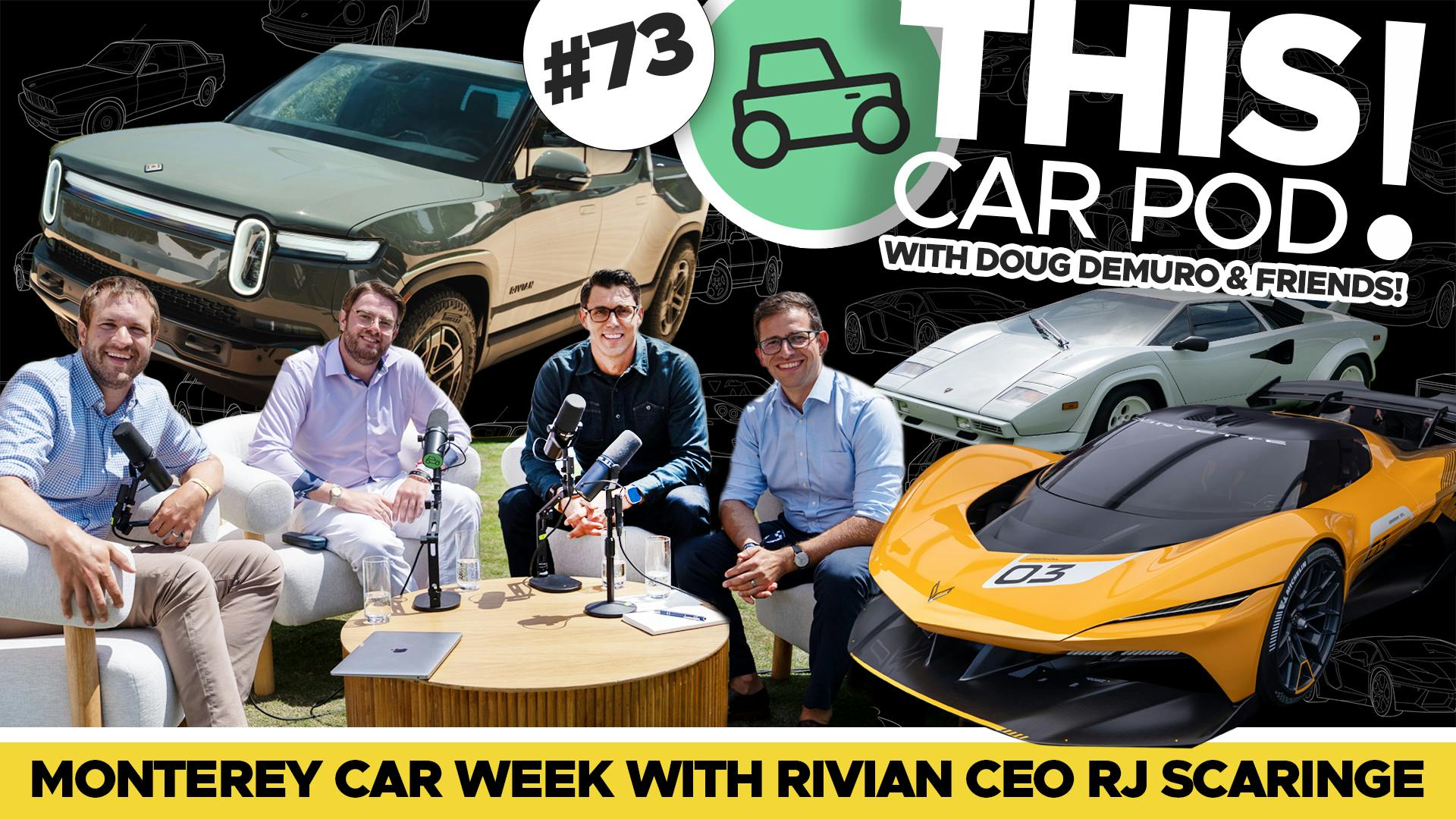
THIS CAR POD! with Doug DeMuro & Friends!
Rivian CEO RJ Scaringe on the Future of Rivian, EV Sports Cars, and Depreciation! THIS CAR POD! EP73
01:16:15
Loading summary
Transcript664 lines
- [00:04]
A
Hello and welcome to this car pod. I'm Ken.
- [00:08]
B
And I'm Filippo.
- [00:08]
A
And today we have a special guest, Rivian CEO and founder, RJ Scaringe.
- [00:14]
C
Thanks for having me.
- [00:15]
B
Welcome, rj.
- [00:15]
A
Thank you for joining. This is a big deal for us.
- [00:18]
C
Huge same.
- [00:20]
A
We're sitting here at the Quail Motorsports gathering or something, and we're at the Rivian booth, where we have all sorts of Rivians around us, and we're going to talk about cars and we're going to talk Rivian. So thank you for talking Rivian. We got a whole big show probably, and we're going to start, as we always do, with the news. You want to start? Yeah.
- [00:40]
B
First, we're going to talk about the Quail in general. We've been walking around all morning. Are there any good reveals so far that you've seen?
- [00:46]
D
Well, first point I want to make is this has kind of become like the new Geneva Motor Show. There are so many reveals that are just happening. This was just kind of an enthusiast show for a long time, and now it's like the place. There's so many different manufacturer releases.
- [00:57]
A
There's Bugatti, there's an Acura Bugatti.
- [01:00]
B
Chevrolet revealed the CX concept, which is the future of the Corvette.
- [01:03]
A
Future of the Corvette. It's got a cockpit that comes off. Rj, have you seen anything that you like here so far, aside from the Rivians, which we'll get to, of course.
- [01:10]
C
Yeah, the Rivians look nice. It's funny, I was walking with my three sons. Nine, seven, six. Age. And they're looking around, they're saying, hey, dad, is that cool?
- [01:20]
B
Is this cool?
- [01:21]
C
And I'm like, that's not cool.
- [01:23]
A
Okay, now, so what do we tell them now? Now we gotta get into it. What do we tell them is not cool? Other electric car, there's some beautifully, you.
- [01:33]
C
Know, there's like, wonderful historic vehicles that are here, and they're just, you know, the kids just walk by it, and I'm like, hey, that's.
- [01:39]
B
That's right. Yeah.
- [01:40]
C
275 GTB. Like, take a second look at it, right? And then they'll see some highly modified thing and ask me about that. And I'm like, no, that's something I want to pay attention to, man. Man.
- [01:50]
D
After my own.
- [01:51]
A
That's great.
- [01:51]
B
Did they. Were they excited about seeing 17 different Ferrari F50s or, like, after one or two? Were they bored?
- [01:56]
C
Yeah, after one, I think they were, to be honest.
- [01:59]
B
I was, too.
- [01:59]
D
The F50 thing is crazy.
- [02:01]
B
There are legitimately 17. On the other side of the line.
- [02:03]
A
There'S also, like, 17 Shelby GT350s, which I know is more up your alley.
- [02:06]
C
Yeah.
- [02:07]
A
Okay, so. But we want to. We're talking news here. And have there been any specific debuts? There was the Bugatti.
- [02:13]
C
Yes. So the.
- [02:14]
D
Yes. So the Bugatti is actually more the reveal of a program. So it's called their solitaire program, where they're making one off cars, which they've done before. But the thing that was interesting to me, this one's called the Bouillard, which is. But it's based on the engine is the W16. So the new car has the V16.
- [02:29]
A
But they're continuing this W16 stopped the previous car.
- [02:32]
C
Yes.
- [02:32]
D
And they're. But they're going to continue to use that for this program, which I think is very interesting.
- [02:36]
A
There is a new Lamborghini.
- [02:38]
B
Is there? I thought it was like a special edition wto.
- [02:40]
A
It hasn't been revealed yet.
- [02:41]
B
Well, yeah, I mean, it has an hour ago there.
- [02:45]
A
We bumped into the Lambo guy this morning, and he said, here's what it is. Here's what it's called. But don't tell anybody I told you that for another hour.
- [02:51]
C
Right.
- [02:51]
A
I guess it's.
- [02:52]
B
But. But what is it? This, by the way, doesn't come out till Sunday, so you're good.
- [02:55]
A
Oh, okay.
- [02:56]
B
All right.
- [02:56]
C
There's no embargo on this.
- [02:57]
B
Just. Just for clarity, what is it called?
- [02:58]
A
The Phenomeno?
- [02:59]
D
I think so.
- [03:00]
B
Oh, wow.
- [03:01]
A
We haven't spent enough time.
- [03:02]
D
We were busy. I was distracted by f.50s.
- [03:04]
B
The reveal that I'm most excited about, of course, is the Acura rdx. No, I'm so sorry.
- [03:09]
A
Rsx.
- [03:10]
B
No, not the rdx. Rsx, which is a small EV SUV concept. You must be very frightened as the maker of EV SUVs.
- [03:18]
C
I don't know. Frightened. I think it's great to see. Great to see things coming out. Yeah.
- [03:22]
A
This is a special event where there are a lot of very cool cars being shot. And those are a few of them. There are others I haven't checked out this Corvette thing. They Liter just pulled the wraps off it, so we'll have to do that later. But that is kind of our interesting vehicle news at Quail. And there's still more happening.
- [03:37]
D
Well, it's fun to be here. It's like, again, it's kind of replaced motor show, so it's cool to see it up close and be around for it.
- [03:42]
B
My first time here, and it's wild just to see both the cars that are here, generally, your countach included. And then what they're revealing. And it's automakers that I don't care about. Like I care about the Peruvian sand, the Acura stand.
- [03:54]
A
Fluke only likes the regular brands.
- [03:56]
B
He's not into the supercars.
- [03:57]
D
I'm into supercars. He's into regular stuff. And Doug is into.
- [03:59]
B
And therefore this is not my event. But it is wonderful nonetheless.
- [04:02]
C
Yeah, the parking lot here.
- [04:04]
B
The parking lot.
- [04:05]
A
Very special.
- [04:05]
D
That's the best.
- [04:06]
C
It's really enjoyable.
- [04:07]
A
Yeah. In fact, there is actually a parking lot best in show award, which you can vote for. You go out of the parking lot, you take a look out there and you can write in a thing and submit it somewhere.
- [04:16]
D
May have cast my vote for an E39 M5 out there.
- [04:18]
B
Your uncle.
- [04:21]
C
There's a white two door Mercedes wagon with a blue interior.
- [04:24]
B
We saw that again.
- [04:25]
A
It's so bizarre. It's like a wagon, but it's a two door. Some sort of custom thing. Okay, so this is quail news. Let's talk industry news. Filippo, can you give us some interesting industry news?
- [04:35]
B
We have some real questions for you. So last week on the podcast, we talked a little bit about. We filmed it right after Q2 results were announced for Rivian. And we figured we have you on the podcast this week. You're the right man to ask, obviously some increase in revenue year over year. Q2 also a little bit more burn. What is the story that you all are telling around it? What led to that quarter to Q2. To Q2? Yeah.
- [04:58]
C
Q2 is a challenge for us because we had a significant drop in production where if you look at Q1, we produced around 14,000 vehicles. In Q2, we produced around 6. And the reason for that significant drop was a lot of really abrupt changes to the supply chain. And in our case, we produced 100% of our cars in the United States. And of course 100% of those are electric. So the export controls are on heavier earth metals. Magnets really hurt us because we only make electric cars and every electric car needs magnets to make the motor. So we had to do a lot of work to come up with a new supply chain and really like dramatically shift how we were sourcing a lot of materials, our motors. And so we just had like a abrupt slowdown in production. And, you know, the nature of our business is high fixed costs. So the cost went up, the cost stayed the same, but we weren't, you know, we're spreading costs across a lot more volume. So you Know, we guided that the second half of the year. We're going to actually produce more vehicles in the first half. We think Q3 is going to be a really strong sales quarter, just in part because of the ending of the 7500 tax credit. So a lot of folks are going to be pushing to get their EVs right now.
- [06:08]
B
Are these trucks eligible? The R1T and the R1S?
- [06:10]
C
No, they are. Okay. So under, if you lease an R1, you qualify. Okay.
- [06:16]
B
But.
- [06:16]
C
Yeah, so a bunch of sort of compounding factors, but look, we couldn't be more excited. We're coming up on the launch of R2 and R2s. For me, you know, R1 is like a labor of many, many years of love. R2S benefits from an organization so much more mature. And so everything from how it's manufactured to how it's serviced to the performance relative to its cost. It's really, really cool.
- [06:42]
B
Yeah, I remember hearing whether. I was reviewing the Q2 results that you guys predict that tariffs will impact about what cost about two grand or three grand per vehicle you sell, which is wild. And I think we often think about tariffs as impacting cars that are imported, but as you said, they're all made in the U.S. but it's still a, what, 3%, 5% to 5% impact, depending on the model. That's notable.
- [07:02]
C
The other thing about auto is, I mean, these you guys know so well, it's not. I think a lot of times we talk about tariffs and we sort of equate the economy to. As if we're like buying and selling T shirts and coffee cups. Like really sitting. Simple supply chain.
- [07:14]
B
Yes.
- [07:15]
C
These are really complex supply chains. So we buy, you take like our headlight, we buy that as an assembly from a US Manufacturer and it comes, you know, it's built in the US it has about 20 suppliers into it, and those 20 suppliers and each have about 10 to 15 suppliers. So there's hundreds of companies involved with making our headlight, and many of those companies are getting materials that come from outside the United States. And that's a one part.
- [07:41]
B
Right, right.
- [07:41]
C
And so the, the ripple across something with such a complex supply chain is, Is hard to fully appreciate.
- [07:48]
B
Right.
- [07:49]
C
We buy 3,000 parts, put them together, but there's actually more than 10x that in terms of discrete components that are going into the car because we buy assemblies.
- [07:58]
A
Right?
- [07:59]
C
Yeah. So it's, you know, it does. Despite the fact that we're very US Centric and we're very vertically integrated, it still adds a Few thousand dollars in cost.
- [08:07]
B
One of the things that we struggle with is like we care a lot about the market, we read a lot about the market, but we're not deep in it. And I feel like one of the hard parts is from the outside is how do you actually figure out what is tariff, what is not. There's a lot of changing rules and I imagine as you're thinking about suppliers you've tried to focus on as everybody, every tech company did do I move production to India instead of China, but now there's additional tariffs there. Have you been, how have you been managing that?
- [08:31]
C
I mean to your first question.
- [08:34]
B
Is there better guidance?
- [08:35]
C
There is a daily stand up meeting we have within Rivian that says like what's changed in the last 24 hours? Which I didn't anticipate having. But every 24 hours we review what has changed in terms of trade policy tariffs and so that informs, like what are we doing that day, that week to react. And then there's a longer term strategy that we're building and some of these decisions are really hard. So take wiring harnesses. Very labor intensive. Almost all of the wiring harnesses businesses for cars built in the United States are manufactured in Mexico because the much lower cost of labor and because till.
- [09:08]
B
About four months ago that was and.
- [09:10]
C
Because we had to trade across multi decade North American Free Trade Agreement. And so when that changed everybody's like wow, should we start building wiring harnesses in the United States? But then you don't want to like invest a bunch of capital to build production capacity, then have the rules changing in a couple of years and then have a really expensive wiring harness production line.
- [09:31]
A
Right.
- [09:31]
C
So there's in many cases there's decisions where we're essentially saying we're going to continue to source from a lower cost location and just pay the tariffs in the, in the short term. Short term meaning next few years.
- [09:44]
B
Yeah.
- [09:44]
C
And then in some cases we've made the decision to bring in, you know, bring into the United States but it's these are hard trade offs.
- [09:50]
A
Is the assumption that in a post President Trump world some of these things go like are you operating under that assumption generally that maybe you're not going to have to worry about this stuff soon and so it's not worth that big investment for some of this?
- [10:02]
C
Yeah, it's a, it's a good question. I'd say there's, there's a, we actually have a, like a live working memo and there's a few categories in it. One is what are the things we think are going to stay like what's, what are changes that are going to be, you know, sticky and then what do we think is going to move around? So one of the things that we think is, is going to be persistently with us in terms of like the US Economy is trade policy. That makes it very hard to do a lot of business with China.
- [10:31]
B
Sure.
- [10:31]
C
And so it's one of the few categories of topics where the left and the right agree there's a very, very strong anti China trade mentality. And so of course we're not building supply chains that have any reliance or dependence on China. One of the ones we think is going to be moving around a lot over the next few years is trade within North America. And it's been such a, a pillar of our economy and so much capex has gone into Canada and Mexico.
- [10:57]
B
Yeah.
- [10:57]
C
That it's hard to imagine a world where we don't return to friendly trade relationships with our northern and southern neighbors. And I think that's generally the point of view. Most companies believe that.
- [11:11]
A
So you're kind of operating with that.
- [11:12]
C
And so we're not replacing Mexican supply chains with US supply chains, but we are very much making sure we don't have China dependent.
- [11:19]
A
Yeah. Which seems like the story we're hearing from other companies and other automobiles.
- [11:22]
B
You guys are also one of the few EV manufacturers that hasn't developed a China market product or a real focus on the Chinese market generally. Generally we.
- [11:29]
C
Yeah. So we actually didn't have a lot of content out of China to start. And you know, we'd done a lot of the sourcing activity in R2 in like a lot of the contracts being written in the summer of 2024. And it was pretty clear then six months too soon, nobody, you could say, like regardless who wins this election, like we're not going to go become really close buddies.
- [11:51]
B
Yeah, yeah.
- [11:51]
C
You know, the US and China. So we, we already made the decision to not really rely.
- [11:56]
B
Never mind that at the moment turfs are not that much more significant than they are some other countries where you may expect a different.
- [12:01]
A
Yeah, obviously chair's been a big story for us, but we want to move on to other stories.
- [12:05]
B
Sorry, sorry.
- [12:05]
A
Let's talk about Ford and Ford's recently announced EV platform.
- [12:09]
B
Yeah. So last week Ford has announced that they're planning on building a $30,000 pickup truck. And much more importantly, they are also they've announced this kind of new production methodology where instead of there being a single production line, there's a bunch of different Inputs that then create one that flow into one thing. Huge news for Ford, obviously. Right. A $3,000 pickup truck, electric pickup truck will be huge. They refer to it as their Model T moment in reference to how popular this price will be and to the factory line. What do you think? First of all, Slate. I have bad news for Slate in that that might kill their market. But how are you guys reacting to this? How are all of you reacting to this?
- [12:46]
C
Yeah.
- [12:46]
A
What are your thoughts? I mean, I mean, obviously this is. It's an interesting thing to hear about. You know, the Mach E was kind of already. Ford sort of entering in the segment, but it seems like they want to go even higher volume and even lower pricing.
- [12:57]
C
Yeah, look, I say this all the time. I think it's really important we have choice, you know, as a. As a car enthusiast and as someone that wants to see electric vehicles be really widely adopted, where people are excited to be in them. The only way we're going to get there is if we have more than a handful of, you know, highly compelling choices. And we see today at the sub $50,000 price point, I'd say there's more than one, less than five highly compelling choices.
- [13:25]
A
Right?
- [13:25]
B
Yeah.
- [13:26]
C
And you could.
- [13:26]
B
I won't ask you. Which is.
- [13:27]
C
Yeah. Two of them, you would clearly say are the Model 3 and the Model Y and they command together around 50% market share. And that's not actually a good thing. It's like.
- [13:38]
B
Right.
- [13:38]
C
That's reflective of an underserved market when you have hundreds of compelling choices in the ice world. And so I think it's great that Ford's working on, you know, a product that's going to, you know, from the specs. Sounds really compelling. Yeah. I think to do it, you do have to rethink architectures, you know, and there is a lot of focus on the manufacturing architecture. I think another element that we're going to see that needs to change is how we think about the network architectures. So the topology of compute and how software is architected in the vehicles, I think going to change dramatically over the next next five to ten years. And we, of course, are driving that within our vehicles.
- [14:14]
B
Right. I mean, the biggest takeaway for me from that news story is a lot of their, what they described as minimizing wiring work, changing the architecture for the car itself, despite it being 400 volt instead of 800 volt, is that that's exactly what you all did with the gen 2. So I imagine you're all moving that direction.
- [14:28]
C
Totally. I mean, so we we have a, we have a large joint venture we put together with Volkswagen. So it's a $5.8 billion deal. And we're licensing our, what we call our zonal architecture and our software stack. But what that's really doing is it takes what is on the order of, call it 75 to 100 little ECUs, little electronic control units that are domain based. So they may be having a window mechanism or an H VAC system and instead consolidating all that compute into a very small number of computers and then having all that decisioning and controls driven by a single software OS offering system. And so I think that's obviously the future state, but it's gonna take some time to get there and it's very hard to do.
- [15:11]
D
All right, we've gotta talk about the shirts of the summer. True Classic. You've probably seen them everywhere lately and there's a reason they nailed the perfect fit. Tailored where you want it, relaxed where you need. Not tight, not boxy, just right. I've been wearing them now for a while and I'll be honest, when you throw one on, the rest of your closet feels a little outdated. The fabric's soft, it holds its shape and you don't have to baby it. And the price, that's the best part. This isn't some $90 designer tee or $130 polo. You get the same premium look without emptying your wallet. These guys started with one goal. Make clothes that look right and feel amazing without the crazy markup. And it's clearly working. Over million shirts have been sold, more than 5 million customers have bought them, and over 200,000 five star reviews are on their site. They've got more than just T shirts now too. Polos, hoodies, jeans, you name it. It all follows that same True Classic formula. Great fit, great feel, great price. Grab your True Classic at Amazon, Target, Costco, Sam's Club, or just go straight to trueclassic.com cars and try them yourself. Trust me, once you do, you're going to start phasing out all the old stuff.
- [16:26]
B
Ye. I have a lot of additional questions, but I don't want Kennen to literally fall asleep. So I want to talk about the exact opposite of this.
- [16:32]
A
Yeah. Which is Chrysler, which is Chrysler and Dodge.
- [16:34]
B
Right. So Dodge announced this week or finally revealed, we've known it's coming for a long time, the Charger 6 pack, which is the Hurricane V6 powered Charger. And they've also announced that the Dodge Durango is coming back with only V8s exclusively V8s, despite the fact that they all. They claim that it's going to go out of production.
- [16:51]
D
Well, boy, that was quick.
- [16:53]
B
Yeah. So Ken's excited again. Yeah.
- [16:56]
A
This is an interesting situation that's kind of been brewing in addition to what we're talking about with regards to tariffs. Now you have this sort of sentiment in the consumer world sort of shifting back. I don't want to say away from electric vehicles because obviously there's still a lot of interest there. But, you know, the Chrysler was. Seemed to be kind of going all in Stellantis on electric cars. And now, okay, we want again electric vehicles. Maybe we want engines again, Maybe we want V8s again, which is an interesting thing to see. And it's also kind of driven by what might end up being a temporary shift in sentiment and in policy and whatever. But nonetheless, this is kind of happening.
- [17:32]
D
I do feel for the manufacturers because that level of whiplash is. I mean, product cycles are designed so far in advance and, you know, it really has. Obviously electric has become a way of the direction that things are going. So to have to then all of a sudden change the question again, it's kind of crazy.
- [17:49]
B
By the way, they. It's not like they're shifting. I mean, the Hurricane V6 is new, but for a different product initially for the Ram, they're not bringing out a new V8 for the Durango or a new model for the Durango.
- [17:58]
A
No, but I would argue people don't want the new stuff. They. They actually. What they specifically wanted was the old engines that made the big power and the big torque and sounded like they do. What are your thoughts on sort of a shifting world of. Of consumer demand? Is this permanent? Are we going back in the direction of combustion engines?
- [18:13]
C
When I'm seeing a V8 in the ribbon and we're not planning any V8s in the Rivian. Alas, I think you're on the edge of your seat.
- [18:21]
A
Someone will do a swap it. Someone will do that at some point. Someone will figure it out. There is enough YouTube dollars out there. Someone can't kill. Figure it out.
- [18:31]
C
That's a good first.
- [18:32]
A
Someone put the V8 on a Cybertruck.
- [18:34]
B
Yeah, but when you have 10, 50 horsepower, it's hard to beat that.
- [18:37]
A
Well, no, you wouldn't be beating.
- [18:39]
B
You'd be downgrading the floor.
- [18:41]
A
But. But what do you think? I mean, it's an interesting situation. Obviously you're noticing this as well.
- [18:44]
C
Yeah, you said it. It's in the list of things. I didn't expect which there's a lot, the list is growing. I wouldn't have expected a lot of the manufacturers that had started to really lean into electrification to so quickly lean back out and then reinvest in engine programs, vehicle programs built around engine architectures. And you said it. I'm sure it's challenging for the teams on those programs. I can't imagine. But you can see why they're optimizing around the short term. There's clearly customers that can be picked up through that. The hard question, you know, for the manufacturers and I think for us as a country and as like an industry is what is the 2030s look like? So the end state is very clear. And if you underinvest in electrification and rely in terms of profitability and product desirableness on sort of your classic old hits, if you will, are you going to find yourself unable to compete when the world inevitably does make that full shift? And so I say this all the time, I really hope everybody continues to lean into electrification. I think more competition is really healthy.
- [19:50]
A
So you view this as a temporary shift. You view this as this isn't going to be something that lasts and sticks around, but nonetheless it's happening. Currently they're going after this, but maybe they're making the wrong decision, chasing short term customers and short term revenue and not focused on the long term.
- [20:04]
C
Yeah, I think. And these are big shifts. I mean it's a shift especially for someone who's think if you've been driving cars for 30, 40 years, it was hard to lose the manual transmission.
- [20:16]
B
And then we have not accepted that, by the way.
- [20:18]
C
So that was a hard thing for.
- [20:19]
B
Some people, just to be clear.
- [20:20]
C
And then it's like, okay, well I lost manual transmission. Then you lose the engine. And so there's, there's a lot of nostalgia, enthusiasm, but that's quickly shifting away. And like now my kids are very biased, but my kids are like shocked when they're in a car that you have to like change the gears. Like dad, this is so cool.
- [20:37]
A
Interesting. Wildly, the next generation is already growing up normalizing this.
- [20:41]
C
Yeah. To them it's like, wait, you have the thing you have to do with your left foot, right thing. And like boy, like in a Rivian, it's so much faster. Just go.
- [20:49]
A
Nonetheless, we do hear and it is, it is a lot of manufacturers who are saying, okay, Porsche saying Macan EV is not selling. Taycan is not selling. Mercedes Benz EQ is apparently being pulled out of the the market except for the thousands of unsold Cars that they're going to still have to try to put down. Is, is that, does it make you at all nervous that, you know, you're too early like that? The EV is still not quite ready for the widespread world that we were thinking maybe five years ago we would be at.
- [21:13]
C
Well, let me say this. I think it's, I actually think it's bad for the country and it's bad for the US Competitiveness to have.
- [21:20]
A
I agree. We've had this point on many times.
- [21:22]
C
US manufacturers not need to innovate. Like when you can rely on the crutch of V8 SUVs or what you've made a lot of money with historically, you're just not going to build the muscle and the, and the capabilities that you need to in this, this state, in this future state that's going to be needed to be globally competitive. So I think that's bad.
- [21:41]
B
70S again.
- [21:42]
C
Yeah.
- [21:44]
A
The US auto industry actually learned this lesson once before, but all those people are gone.
- [21:48]
C
Yeah, yeah.
- [21:49]
A
So they're going to end up having to learn it again. Pretty. I mean, when the Japanese came in and then eventually the Koreans came in and started really having a big effect because they knew how to build a type of car that the Americans weren't building. Which is a point that we've tried to make a million times on the show because we get a lot of comments, oh, EVs are crap and screw, who cares? Well, if China ends up showing up with these cars that are far better than our cars, that's a problem.
- [22:09]
D
Our cars float and they bounce.
- [22:11]
A
We're going to get to that.
- [22:12]
C
I think. Well, it's bad. I think it's like, I'd say I wish this wasn't the case. But it's hard to ignore that it means less competition in the short term. And for pure play evs, especially pure play evs that the brands are built around electrification. So Tesla, Rivian, it's definitely going to create a positive tailwind. And so, and I think you see it perhaps most pronounced just with what's happening right now, there's a lot of manufacturers have made cars that are electric but that are not super compelling. And as a way to get zero emission vehicle credits or to lower their corporate average fuel economy rather than buy credits from Tesla or from Rivian. And they've incentivized those sales very heavily. So you see like very wonky lease deals you can lease. There's some electric cars you can lease.
- [23:01]
A
Trust us, we know incredibly well aware Charger ev. Have you not Thought about going and picking up a charger for 99 bucks.
- [23:07]
C
It's like, sort of like, wow, for like 50 bucks, I get a whole car. But that's going to go away.
- [23:11]
B
Right.
- [23:12]
C
And so then you're going to be stuck with a more like, call it natural market that's behaving based upon real economics. And then I think that the gap between the folks that are not building EVs.
- [23:23]
A
Yeah.
- [23:24]
C
So that's going to grow.
- [23:25]
A
And so the subjects in your answer is you're not nervous about that. You're too early. Quite the opposite. You think you're well positioned for what will inevitably happen. And these other automakers are maybe the ones who are kind of screwing things up.
- [23:37]
C
Transitions like this are always tough. And it's. There's no. Of course, there's no direct analogy that's has all the exact same things, but if you go back a long time, Peak horse was in the 1920s. And so, like, right before there was no horse. Yeah, right before there was no horse.
- [23:52]
B
Yeah.
- [23:53]
A
Peak horse.
- [23:54]
C
Yeah, I like that. That's a great phrase.
- [23:57]
B
And we are, by the way, Peak V8. I think Peak V8.
- [23:59]
A
As we should be. Okay. I'd say we're Peak V8. That's the news. Interesting takes on the news. Interesting to get your perspective on some of this stuff that's happening. But we got to move on to the Talk Cars segment, wherein we talk about cars. Now you're thinking, we were just talking about cars. It's true.
- [24:13]
C
I want to really talk about cars.
- [24:14]
A
Yeah, we're going to really talk about cars.
- [24:15]
B
Can we still talk about wiring harnesses?
- [24:16]
A
No, we want to talk about rj. We want to talk about rj. Rj. In addition to the whole Rivian thing, which there's more to cover there. RJ is a car enthusiast.
- [24:25]
C
Yeah.
- [24:25]
A
All right. What are. What are your. We want to know, what are you interested in? What do you like? What are you driving?
- [24:31]
B
You don't know manuals? His kids don't know about transmissions. Do you own one?
- [24:35]
C
I do own one manual.
- [24:36]
B
Okay. What is it?
- [24:37]
C
I have a Volkswagen Corrado.
- [24:41]
B
That's awesome.
- [24:42]
A
You got a V6.
- [24:43]
C
Okay. It's a. And that's a. It was the first car I owned. And so cool. When I was, like, when I first had it, I modified the heck out of it. Is it still beautiful? No, I sold it and then I bought a crowd of VR6 again.
- [24:56]
B
Nice.
- [24:57]
A
Wow.
- [24:58]
C
So the kids enjoy it. It's noisy. It's, like, so crude. And they're trying to understand the crowd.
- [25:04]
A
Of VR6 had active arrow.
- [25:05]
C
Yeah.
- [25:07]
A
Okay. That is interesting. That is.
- [25:09]
C
I wouldn't say that.
- [25:10]
D
Not expecting that one.
- [25:11]
B
Wouldn't have had that one.
- [25:12]
A
No. If I had made a list of cars I thought he would have. That would have been near the bottom of the list. Certainly. What else do we drive? Obviously you got rid of.
- [25:18]
C
You're taking your kids R2s. R1s.
- [25:20]
A
You're driving around R2s.
- [25:21]
B
Wow.
- [25:22]
C
Yeah. There's camouflaged arches.
- [25:24]
A
How come I can't drive? He's driving. What am I?
- [25:27]
B
You saw one in person, though.
- [25:28]
C
I did.
- [25:28]
A
I haven't. So is that it? You got Rivians and a Corrado?
- [25:31]
C
Yeah.
- [25:32]
A
Is that true?
- [25:33]
C
It's true.
- [25:34]
A
What. What cars have you owned in the past?
- [25:36]
C
I've owned all kinds of things. I had a Lotus Elise. Oh, really? Which was an awesome.
- [25:42]
B
You were also a taller gentleman. Do you fit.
- [25:44]
C
It was hard to get in and out of. You know, it's. But that was just a really, really fun car. 944s. 2. Great car. Really fun car. Let's see. A 914 Porsche.
- [25:55]
A
Wow. Okay.
- [25:56]
C
That I was doing. So I. I grew up restoring classic Porsches and working on classic Porsches. And so the 914. Because I could not afford the 356s I was working on. So I bought the thing I could afford the 914.
- [26:08]
B
I think that's most. 914. Yeah.
- [26:11]
C
I was doing this. It started as a driving car and I made it not a driving car. Meaning it did not function because I was in the process of doing a 993.3.6 conversion.
- [26:22]
B
Oh.
- [26:22]
C
So I had 911 turbo brakes on it. All the suspension pickup points on a 914 are the same as a 911 through 1989.
- [26:29]
A
I didn't know that.
- [26:30]
C
Yeah. So it's very easy to do it like a turbo brake kit because you just take out the spindle. Anyways, I stopped that whole project when I started Rivian. I started a much bigger car project. So since I started Rivian, I haven't Car. Yeah. I haven't had any of those kinds of car projects.
- [26:44]
A
And you probably don't have a lot of time to go out and actually pursue these sports cars. And plus your whole life is these cars. And so just the Corrado.
- [26:50]
C
Yeah. But I mean, like, I'm like, as a Porsche fan, like a Porsche 993.
- [26:55]
A
The running theme of all these cars, though, is kind of smaller, lighter weight.
- [26:58]
D
More manual transmission, analog.
- [27:01]
A
However, the Rivians are kind of the opposite.
- [27:02]
B
£7,000.
- [27:03]
A
So what happened here? You saw what the market demanded instead of what you yourself maybe were interested.
- [27:10]
C
Well, when I first started Rivian, we were working on a sports car.
- [27:12]
B
Yeah.
- [27:12]
C
And realized a couple years in that it wasn't the right product strategy. And when you build a product, you have to have, like, what's the story? What's the brand? How does it resonate? And so we shelved the sports car, recognizing it wasn't the right thing to build around. And. And that had been tried, of course. Tesla built its brand launching roadster.
- [27:31]
B
Yeah.
- [27:32]
C
And then spent a lot of time really digging deep to say, what do we want to build? What's the brand want to stand for? And I'm a big adventure enthusiast. And so started to scratch on this idea of a product designed to enable adventure in the broadest sense. Like, it can fit your kids, your gear, your stuff. And if you look at the types of vehicles that are typically in that space, they're very inefficient.
- [27:54]
B
Yeah. Yep.
- [27:54]
C
They're not fun to drive.
- [27:56]
B
Yeah.
- [27:58]
C
You have to have basically a lot of compromises in order to do those things. And so we said, what if we made a vehicle that was designed to enable adventure but also is super efficient, incredibly fun to drive, had storage in ways you didn't think about storage, you know, so like a gear tunnel that goes right through the side. And so we landed on this idea of building products around adventure.
- [28:18]
A
When was this? What year was this?
- [28:20]
C
This started in some point. You'd like this, Doug. I'll have to show you guys the. All the things that happened along the way, but started in, like, 2013. And then we had many iterations. It's not like we, like, first sketch.
- [28:32]
A
Was specifically going after truck like that would. You started focusing on truck in that era.
- [28:36]
C
Yeah. So we. We recognize that trucks had become big, and a lot of the positioning of them was around, like, who can haul more concrete and who can haul more stuff. A lot of the uses of the trucks are very far from that. So most people are using them actually to put their. Maybe they put a sofa in the back, but they're largely using, like, lifestyle. Right. So your gear, your bikes, your.
- [29:00]
B
Nothing at all.
- [29:02]
C
And so the first thing that we developed that's actually still on this was this idea of a gear tunnel, because there's the lack of a trunk In a trunk is a classic scenario where you have a big bed, but you don't want to put your groceries in the rain. And so we Put a big front trunk and then a big middle trunk.
- [29:20]
A
It's interesting to me that this idea was being developed that early. Obviously in the years since then it worked out. In the years since then the 4Runner and the G Wagon and the Raptor and Covid happened and adventure became an even bigger thing. And you guys were unbelievably well positioned in a way that is quite more than your competitors. Right. Like a lot of your competitors debut with sedans, probably because they had years of lead up of developing that sedan. But what turned out to be not what the consumers were interested in. Like you were perfectly ready with like an electric forerunner. Like it was why it was, it was, it was like ready to go when people wanted it at the. And as a result, Rivian has kind of been the most desirable. I mean aside from Tesla and Rivian are like, this is what people want. This is like you think about EVs people actually want.
- [30:05]
B
Right.
- [30:06]
C
Heavily incentive brands really resonated.
- [30:08]
D
Exactly.
- [30:09]
A
Which was in those vehicles specifically. I mean it turned out to really work out. Like you must have thought, this is, this is perfect.
- [30:15]
C
Well, what was wild is we in like 2017, when things started to come into real focus and the vehicle started to have look something like this, we, we made all these charts and we'd write down like what do we want the brand to stand for? And you know, you do these like is is not. And you'd ask yourself these hypothetical questions, would a Rivian do X? And we were really precise on it. And then we launched in end of 2018 and then we products are on the market end of 2021 and it's actually come together a lot in the way that we thought. Like we wanted the vehicles to be used actively.
- [30:49]
B
Yeah.
- [30:50]
C
We wanted people to connect with them and like get inspired to go do things that they may not do in their existing vehicle. And so I get these emails from customers that will say, hey, I, I some you did something to me. I bought your car. I hadn't skied in 10 years and somehow me buying your car.
- [31:07]
B
That's really cool.
- [31:07]
C
Has me skiing again. Like, what, what did you put in the air filter?
- [31:11]
A
That's cool.
- [31:11]
C
Yeah. Which is like, oh, it's like so cool to see your brand connect in the way you'd hoped.
- [31:15]
A
And now R2 is going to bring it to more people.
- [31:17]
C
Yeah. And R3 active and R2 has some features that just. Oh, I'm so excited. The rear glass drops.
- [31:23]
A
Yeah.
- [31:23]
B
Four Runner style. And the only feature my wife wants in a car actually that in Carplay. So it hits one of the two.
- [31:28]
C
And there's rear windows that pop out, which as a car enthusiast, that's so cool. Cool. Really cool. Sort of like a fresh air mode. You press the button, use the negative.
- [31:35]
B
Pressure, like the rear 3/4 window.
- [31:37]
C
Yeah. And then you pull air from the. Through the car.
- [31:40]
D
We've got to talk boots. Brunt Workwear Boots. They've been a great partner to this car pod. But I have been called out in the comments for not being a boot Kai. Well, recently I headed to Belgium for the Grand Prix at Spa, a notoriously muddy place when it rains. I decided to take my pair of Brunt Marin boots. And everything I said about them in the last podcast is true. They didn't take long to break in. They were very comfortable and they kept my feet warm and dry when the heavens opened at Spa. I also wore them at the Bojac Forest, the site of the famed stand of the Easy Company of the 101st Airborne during battle of the Bulge. These boots allowed me to get around the foxholes with ease and pay my respects to the men who served there. They helped me create a memory that I will genuinely carry forever. The founder, Eric Girard grew up blue collar, worked alongside his buddies in the trades and kept saying that the big brands had stopped caring. They had turned into fashion brands and hadn't changed in a hundred years. So Eric built Brunt from the ground up for real hard working people. Every boot is named after one of the guys that he grew up with. Real people, real jobs, you can literally wear them to work, beat them up, and if they're not right for you, send them back. Who else does that? Brunt was tired of the workwear brands that were cutting corners. You work too hard to be stuck in uncomfortable boots that don't hold up, so they built something better. Boots that are insanely comfortable and are built for any job site. So for a limited time, our listeners get $10 off at Brunt when you use the code cars. That's C A R s at checkout. Just head to bruntworkware.com and use the code cars and you're good to go. And after you order, they'll ask you where you heard about Brunt. So do us a favor and tell them you heard it from me and this car pod.
- [33:28]
A
There was must have been enormous pressure to launch R1 given all the how long it took, you know, and the investors and all that. R2 though, is going to be the real. I mean, these are expensive cars. R2 is much more affordable. R2 is going to be the big volume, I imagine for sure.
- [33:43]
C
So these have a average price of over $90,000. And so.
- [33:47]
A
So there must be just, I mean, do you feel just as much pressure trying to launch R2 or like this is the big moment where it's a big moment.
- [33:54]
C
Yeah. It's also next year, early part of next year. And so with R1, it was our first product and out of the gate it resonated really well. Like Truck of the Year last couple years in a row, Consumer Reports does this brand appeal study and we've been at the top of the list, highest rate of repurchase, all these amazing things that we only dreamed of. And so now the hope is we can take this really strong brand success we've had at this premium price point at the, you know, at the flagship level and take it into the price point where you see things like a Model Y. You see like things like even as sort of normal, if you will, is like a Honda CRV.
- [34:32]
B
Yeah.
- [34:32]
C
You know, Toyota 4 Wranglers, 4 runners, certainly. Yeah, 4 runners, of course. So you pick up just this huge amount of market that's, you know, folks are going to be cross shopping with a lot of different things. And so because the price overlaps so much with the Model Y, we often think, we often get asked like, is this like directly trying to compete with the Model Y? Of course there's going to be cross shop because the price is there, there, but really it's, it's going to be addressing the, you know, the vast majority of folks that are actually not buying an ev, but when they see this, it's like, boy, that thing's like faster than a Porsche 0 to 60. It's got this incredible off road capability. I can put my kids in it. Their window drops.
- [35:09]
A
It is almost amazing the things that the Caribbean vehicles combine into one.
- [35:17]
B
This is not an ad for Rivian, by the way.
- [35:18]
A
No, I mean I was my car of the year. Both the SUV and the truck were during the years they came out. And I think it's pretty amazing the things they combine into one. It's, it's kind of an interesting thing that you can do with an electric car is kind of make them be fast and off road and luxurious and all that. But nonetheless there's, you know, there's, is there an enthusiast component of electric cars that's missing? This is, this is our friend Kenan's thoughts here.
- [35:38]
D
So, yeah, so you mentioned that initially you were considering, you conceptualized having a sports car and realized that was the wrong product strategy, which makes sense. And obviously Rivian's focused on like you.
- [35:46]
C
Said, more adventure stuff.
- [35:47]
D
Yeah, but how do you feel about the electrification of sports cars in general? Someone who said, you know, you like the analog cars, you love old Porsches and experience they own a Corrado at least like looking at, you know, the future of the sports car. You know, mate, Rimac has said very famously, he's like, no, you need an engine for that experience. It's what customers of the ultra high end stuff want. You're going to pay over a million dollars for a car. You want to go when you start it, you want to feel like, feel it. What are your thoughts on that?
- [36:12]
C
Well, I think the customer for a million dollar car is very different than the McFerry. So what do you think?
- [36:16]
A
Porsches, I mean Porsche is a great example. Obviously there's a lot of cool cars that are electric. But are, are you as an enthusiast you grew up restoring, are you like worried about the loss of manual. The manual flat 6, the air cooled the.
- [36:28]
C
In that segment at least it's a different flavor. And so, so an electric. If you dream of like what is an electric Porsche sports car look and feel and drive like it's not going to have all the same, it's not going to hit all the same buttons that you know, manual transmission Porsche is going to hit in the same way frankly that like a 993 hits different buttons than a new GT3RS.
- [36:52]
B
Right.
- [36:53]
C
Like they're, they're very different cars. Right. So I think depending on your own history with cars, you may be drawn more to things that are more nostalgic or older. Like so I'm actually drawn to like some of those older cars just because they're things I grew up with, things I grew up dreaming about. You know, I know you're a big fan of your courage t that like one of the last analog really supercars. And so there's something about that and I think when you look at the sports car space, putting aside like the hypercar space, because I think it is a different customer, I think in the sports car space people are going to find new ways to enjoy electric vehicles. And like regen is a really interesting thing. And so you start to think about like what role can regen play in creating another driver accessible way to control the, the, you know, the vehicle and you know, coming into a corner. And so there's I think just things we're going to start to see that people think about and Dream about.
- [37:46]
A
Have you driven that ionic 5N that has this fake shift? We were, we drove it and were astonished by how honest it was feeling. Like a dual clutch shifting. And it really hit me that like if the automakers start putting this in these cars that it kind of, it doesn't replace a manual transmission experience, but it sort of replaces a dual clutch experience.
- [38:07]
C
Yeah, I think, I think what's funny about that is it's replicating a less capable system. I think for, for people like that are maybe enthusiasts. Enthusiasts in the classic sense.
- [38:17]
B
Yeah.
- [38:18]
C
That works. I think there's going to be new modalities though of, of things that are going to emerge on electric vehicles. I think especially when you start to look at like multi motor. Multi motor per axle. I mean have you, you guys have just drove up in the car.
- [38:32]
B
Yeah.
- [38:32]
C
Even done any off roading it. But, but the new quad has some torque vectoring features that are so fun.
- [38:39]
A
Yeah.
- [38:39]
C
Like laugh out loud fun. We call it Kicksteer, where you're like driving on a trail and with like, it's like, it's like Gran Turismo easy. You just like press the buttons and the car pivots on its axis. Right. You can make these right angle turns in a way that you're just like, you're like wow. I feel like I'm a, you know, a groupie rally driver here and it's so much fun and it's safe and, and it's, it's stable.
- [39:02]
A
Does simulated shifting and torque vectoring capabilities, does that play that same role for like the next generation of enthusiasts?
- [39:10]
B
I mean, I don't know.
- [39:11]
D
I think Lamborghini is already looking at that. They were testing the Ionic 5 at the factory to go see how it was put together. I think there is definitely something there. I felt like that was the future of it for. But I don't know, like it's. I don't know because I'm a dinosaur already. I like V12 manuals. Like that's what I like that. But your kids like you said, grew up and they like.
- [39:32]
C
But that's man, we talked about horses jokingly. There are lots of horse enthusiasts still. People that own horses. It's an. It is not the best way to move around. No longer. There's much faster, more efficient ways to move but people enjoy them and so they still own them. And I think, you know, hyper cars I think are more in that category which we're gonna. If you're on a million dollar car, you know the. This is, it's far from practical, like that's not a practical choice. And so you're not implicitly by buying a million dollar car, you're already making a decision that this is an impactful purchase. And so I think when you're making an impractical purchase, there's all sorts of things that are maybe not practical. Yes. And so in our case for like R2 or even R3 and R3x, which.
- [40:15]
D
I think I'm very excited, very excited.
- [40:18]
C
For the channel, you're like.
- [40:21]
D
Yeah, I am really. R2 is very important. And I, I think that R3 is like my cherry on top.
- [40:27]
C
I'm waiting. When you go off roading, whether it's low speed up a trail or higher speed on like a gravel trail, electric is really enjoyable. The instant torque is nice. You're never, you never find yourself in the wrong gear on a rock, like, oh geez, I'm rolling backwards. It's just like instant torque.
- [40:45]
B
The danger.
- [40:46]
C
Yeah it's.
- [40:47]
B
But I'm half joking.
- [40:50]
C
Deep enthusiast, deep danger. One of the challenges with off roading is, does have a barrier to entry that historically because it takes, yeah like knowledge of like what does a differential do? What's a center locking differential? What's a rear differential? And suddenly you get into a, like a quad motor R1 and you just.
- [41:05]
B
Tap the off road button.
- [41:06]
C
You're just like, you just can do it. And suddenly you're like, you know, on.
- [41:09]
A
That subject, one thing people talk to us a lot about, not necessarily in terms of Rivian, although maybe more with quad, but the Hummers is just the sheer size of these vehicles and the sheer acceleration level.
- [41:19]
B
We've been driving the R1S quad, the Gen 2 quad run, it's insane.
- [41:24]
C
It's really quick.
- [41:25]
A
Is there any 2.6 seconds, like we think it's awesome. Is there any. Do we have any response, like corporate responsibility fears about people having people. I actually get asked this question a lot, particularly when the Hummer came out, which I was pretty into and I still am.
- [41:40]
D
Well, I love that they always said, are you afraid that a little old lady's gonna. It's like, well, if there's a little lady driving a Hummer ev, that's one thing.
- [41:45]
A
But the other thing, these cars are really fast and really big and it doesn't require any special. You know, when we were kids, you had, you were really legit to have access to a car that was anywhere near this.
- [41:55]
C
Right.
- [41:55]
D
But electric cars have democratized speed and so.
- [41:57]
C
Oh, I remember when the, when the 993 Turbo came out and it hit 0:60 in three seconds. And it was like the top of the chart for 0 60. And I was like, wow, I keep break four seconds right now.
- [42:07]
B
You can do it.
- [42:08]
C
And now I can be with my kids in the back and like a lawnmower in the vehicle. I can do 2 1/2 seconds in an R1T.
- [42:14]
B
Yeah.
- [42:15]
C
And so. So yeah.
- [42:16]
B
Is that a good idea? It's a 7,000 pound vehicle.
- [42:19]
C
Yeah.
- [42:19]
B
So I mean you guys have done great safety system. Like it seems so safe to do that 0 that 2 1/2 second 0 60. But is it wise?
- [42:26]
C
It's very safe. There's a whole bunch of.
- [42:27]
B
Yeah, but is it wise?
- [42:29]
C
Is it wise? I think it's important, like why does a car like that exist?
- [42:34]
B
Yeah, sure.
- [42:34]
C
Why do we make a 2 1/2 second 0 to 60 SUV in truck?
- [42:38]
B
Yeah.
- [42:39]
C
We think it's important to answer some of your questions which is like you can still have fun. An electric vehicle. And it's like, you know, you see the badge on the back for the quad is this little gear guard figure that Ferris being blown back. Like we're having fun with it.
- [42:54]
B
Yeah.
- [42:55]
C
We're embracing the silliness of a 2 1/2 second 0 to 60 SUV. And it's a brand building vehicle. It's not going to be the highest volume vehicle but it really helps people get excited around. Maybe they get a tri or a dual motor. And of course it opens up the door for people to say oh wow, I want to consider this R2.
- [43:15]
B
Right. Can I ask about that? All right. So the only visual differentiations of the quad motor are the brake calipers.
- [43:22]
C
Yeah.
- [43:22]
B
And the. And the R1S badges has quad.
- [43:25]
C
And the gear guard with his hair.
- [43:26]
B
Sure.
- [43:26]
C
Yeah. What is. Why not more.
- [43:28]
A
We're astonished by this. When we were kids, you get an M3 and it's got rocker panels and it's got badges, wheels and it's got a ring and it's got. There's all this stuff because you want people. Do you want your neighbors to know I got the expensive one?
- [43:42]
B
I don't. So I love the subtlety. But Canon 75 is special because it looks visually distinct.
- [43:47]
A
Most people who are spending more over a regular one want to show why not 5 fenders?
- [43:52]
B
Why not spoiler.
- [43:52]
A
We have some flared fenders on this thing.
- [43:54]
B
I mean that question seriously, legitimately.
- [43:57]
C
I think given infinite time resources we probably would have done maybe different front and fascia. Oh, this was. We like the subtlety of this one. And I think over time, you may see, like, our next gen 3 quad maybe have something that's a little bit different than the tri. But it was a lot of debate around this, like, how aggressive do we go? And we went with subtle here. Over time, we think its personality around quad could continue to evolve.
- [44:27]
B
I was telling a producer yesterday that I love it, and therefore it's probably not the right product.
- [44:34]
A
Well, you see with like, G Wagon, right, which is a competitor. The regular one looks like the regular 1. The 63 has the big wheels and the.
- [44:40]
B
Although the brush garner and hard to tell at a glance.
- [44:42]
A
Well, a lot of them are 63s, but they really do sell it, right. They really. And. And I think that probably appeals to people, and you still see that a lot.
- [44:49]
C
For our brand, we also have. There's a degree of subtlety to. To. I mean, you walk around this lot, that SUV is faster, I know, to 100 miles an hour than almost everything on this lawn.
- [44:59]
B
Insane.
- [45:00]
C
Which is really wild. And so the fact that you're starting there, it sort of says, okay, we. We don't actually need all these, like, scoops and all this, but it just doesn't need it.
- [45:10]
A
Yeah, but that was probably always true, right? We knew that the M3 didn't end the. It didn't need a rear wing.
- [45:15]
C
Yeah.
- [45:15]
B
The Corrado didn't need activate Active Air, but it had. Fair enough. But it had it.
- [45:21]
C
I need that extra downfall.
- [45:22]
B
Can I do one other question? Going online without ExpressVPN, it's like putting all your passwords and credit card numbers on a huge billboard for. For the whole world to see. Especially when you're traveling like I am right now. Every time you hop on a public WI FI network at the airport, the. Or at your favorite coffee shop, your data is just floating out there for the taking. Totally unprotected hackers on the same network can scoop it up. Passwords, credit cards, even your bank logins. I'm in Monterey for car week, and even though this is a nice hotel, the only reason my data is safe is because of ExpressVPN giving me the confidence to travel with my data. Your data is worth something. Hackers can make up to a grand per person selling your info on the dark web. That's where ExpressVPN comes in. It locks down your connection for a secure, encrypted tunnel between your device and the Internet. Basically, it turns your online activity into Fort Knox. A hacker with a supercomputer would need a billion years to crack ExpressVPN's encryption. And best of all, it's stupid simple. You just fire up the app, hit one button and you're protected. Secure your online data today by visiting expressvpn.comcars that's expre SSVPN.com cars to find out how you can get up to four months for free. Expressvpn.com cars so in a bunch of drag tests or drag races, the Rayvion is fastest off the line, but then loses out to some other cars because of the speed limiter.
- [46:46]
C
Yep.
- [46:47]
B
I assume you guys have done some testings. Without it, what do you get?
- [46:50]
C
Well, you asked the question for on safety. That's it. So we made the. We made the decision on the non quad we limited to 110. And then in the quad we limit it to 130. Really? Just because otherwise it would just kill the quarter mile time.
- [47:04]
B
Right.
- [47:04]
C
And in fact, the 130 is only enabled when you go into sport mode.
- [47:07]
A
How fast could this thing go?
- [47:09]
C
If we let it run a lot faster. But the reason we don't on your.
- [47:14]
B
R1s, which I assume maybe has some special features.
- [47:17]
C
I've got a lot faster than those. Yeah.
- [47:19]
B
So on a close, close track. But look, what were you guys into?
- [47:24]
C
You could go a lot faster, but I mean, these are not cars you can hack. So nobody will ever unlock.
- [47:30]
B
Well, no, but you know, there's got to be a benefit to being the CF.
- [47:33]
C
But the reason is at 130, you're committing a felony on every road in the United States.
- [47:38]
B
Yeah, but not on this Bonville Salt Flats.
- [47:41]
C
Sure. Yeah, but. But again like this, if you're going to the Bonneville Salt Flats, you're probably not taking this. So. I don't know. I like it. It was like a corporate separate decision.
- [47:50]
B
It's a good one.
- [47:51]
C
Let's err on the side of safety. And the cars are so quick. I mean, you're on the throttle for a second. You could be going 150.
- [47:58]
B
Yeah.
- [47:58]
C
Way faster than you realize.
- [48:00]
B
All right, so that was at least 150. That's the news item for the day.
- [48:05]
A
Capacitor and F40. We don't know yet. All right, I lied.
- [48:07]
B
I have one more question. What is special about your R1s, your R1t? What can regular people not get that you have?
- [48:13]
A
What features are you demoing that you're not allowed to reveal yet?
- [48:16]
B
The Porsche family is famous for having special one off models built of cars.
- [48:21]
C
Yeah.
- [48:22]
B
You're the founder and CEO. What, what do you. What do you have in your, you.
- [48:25]
C
Know, not particularly different. I, I drive like the R2, of course is.
- [48:29]
B
Yeah.
- [48:30]
C
Just because it's a, you know, it's on out. But the R1, I'm usually a software release or two ahead of everything else, which is just part of my, my job.
- [48:38]
A
Yeah. And other people are too, in the company, I'm sure.
- [48:40]
C
Yeah. Like a lot of our team is on early release and so. Yeah, that's fun. And it's also because you're on a release, you spot things you can change. That's one of the things I really enjoy is because we do a soft release every month, we can be continually adding features and it is very dynamic. So I'll get like emails from customers with an idea and you know, call our head of software. I'll call with cmo like, hey, let's get this.
- [49:03]
A
Really?
- [49:04]
C
Yeah. Cool.
- [49:05]
A
How legit is that?
- [49:05]
C
That is very cool. Like, my dad was bugging me for the longest time on the car wash feature, the way it was activated and what in the way the mirrors folded. So I, we changed it and in the release notes I was like, thank you, dad for the advice like. And I something like, please stop asking.
- [49:24]
A
On that subject with regards to founders and we're going to move on to market report next quickly and then we'll move on to questions. A lot of people ask questions they have for you and we want to talk to it. But I do have one other question which is regarding your sort of the face that you are for the business versus say Elon. Elon chose to make himself kind of like the, you know, Tesla and Elon are inextricably linked in basically everybody's minds. The result of that was a cult of personality kind of formed around him. And I think that that probably had a huge benefit for the success of.
- [49:59]
B
That brand for a long time and risk now.
- [50:02]
A
Now we're seeing maybe some of the drawbacks of that. You have never been kind of as, as outgoing in terms of tying yourself to this brand. Elon, was that intentional? Do you regret it? Were you looking at Elon saying, hey, I'm cool too, during this process? Like, yeah.
- [50:19]
C
I think, I think like if you start a company, there's always. Or if you're like the core part of running a business, you're going to be linked to it. I think for me we've been more reserved just in how we've come across as a company. I'm more reserved as a person. And I think we've been intentional in trying to be as inclusive as Possible. And so as a brand, I say this all the time. We have a wide spread of demographics. We have Republicans that buy our cars, we have Democrats that buy our cars. We want to be appealing to buyers both and have tried really hard to make sure that the environment is like, is the broadest possible welcome mat to all customers. I think Tesla did that for a while. I think the brand they built is still really strong, but my personality is much different than.
- [51:13]
B
Yeah.
- [51:13]
A
And that's what it came down to, you think, is that you didn't just. You weren't the guy who was going to be out there tweeting the president.
- [51:19]
C
Yeah. And I think just like my social presence is much smaller and intentionally, like.
- [51:24]
A
You feel that that's just who you are. More.
- [51:27]
C
Yeah, it's. It's more. It's not. It's not as designed as maybe you're thinking. It's more of, like the resultant of just two very different personalities.
- [51:34]
B
Got it.
- [51:34]
C
Not that one's right or wrong. I think it's been super productive for Tesla, as you said, for creating tons.
- [51:39]
A
Was there ever any push from your PR folks or for your marketing side, get out there from your shareholders, do more crazy stuff.
- [51:45]
C
Yeah, I don't know if there's been a push. I think, I mean, jokingly, people are like, you know, say, rj, you're not gonna go do this, are you?
- [51:56]
A
We don't need to get into what.
- [51:57]
D
I mean, you're on a podcast. We don't. For you.
- [52:01]
C
Drugs on the podcast. No, nothing like that. I mean, it's. I think sometimes some of this stuff gets taken so seriously.
- [52:08]
B
Yeah.
- [52:08]
C
Like, I. I've owned two Teslas. I think there's a perception that one company has to. One, for one company to be successful, everyone has to fail. And what's so wonderful about, like, the auto industry and. And for. As a car enthusiast, is many companies can be successful. It's very different than tech.
- [52:27]
B
Yeah.
- [52:27]
C
Like, if you think of, like, big tech, there's like, generally there's like one or two dominant players in a segment for a market. And in auto, you can have all these different flavors, different personalities. Right. And the personalities maybe have some. Some echoing effects from their leadership or their founders. And so our products have a lot of my personality in them, in some of their subtlety and quiet confidence. Yeah.
- [52:52]
D
There's one last question I want to ask just based on that. Are there any other automotive CEOs you look at and you admire what they've done with their vision for their companies? Along those same lines, that what you've done with yours?
- [53:01]
C
Yeah, I mean, it's such a small world. It is. You know, so we, I have great friendships with a lot of different CEOs, and yeah, it's fun to trade notes. And a lot of times you find yourself, you know, y' all send them a text, be like, hey, I really like this. You'll get a text like, hey, nice job. You know, so it's sort of, it's, it's more, you know, it's more collaborative behind the scenes, I think, than you think, you know, and especially in the last few months with all the significant changes, you know, certainly I've talked to other CEOs and said, hey, like, how are you guys thinking about wire harness supplier? Just to think about how we're all responding to trade tariffs and things of that nature.
- [53:40]
B
Texting Mary Barra asking on a group tech with Jim and Jim Farley.
- [53:44]
C
And you mentioned mate. He's a friend of mine, good friend of mine. I think he's outstanding. He's done some really interesting things. Great technology. Both started companies around the same time. So we've known each other over the.
- [53:57]
A
Years in that world too.
- [53:59]
B
I'll mention, just because it happened off camera earlier, you did say that the ethernet M5 is the greatest car ever made.
- [54:05]
C
I didn't say greatest car made. I didn't even say the best M car. But best M5.
- [54:10]
B
What is the best M car?
- [54:12]
C
Oh, the E46.
- [54:14]
A
Oh, wow.
- [54:14]
B
We'll accept that.
- [54:15]
A
Wow.
- [54:15]
B
Sorry.
- [54:18]
D
The E46 M3 is more like what BMW is about. Straight six is their core competency. Historically, car is perfect. 50, 50 weight distribution, small, lightweight, high revving. It's like what an M car is supposed to be. Traditional, the M5 is just the best.
- [54:33]
C
But the E30 conversion, where he's putting a E46 that'll make that thing a board. It's funny, he's like, I should have just bought a GT3 RS cheaper.
- [54:47]
A
Yeah, but it would have been.
- [54:48]
D
But that's. But that. Anybody can just do that. He built something cool.
- [54:51]
A
I want to talk market report, and specifically since you're here, we want to talk EV market report, which is typically where we talk about used car values and what used cars are, are sold strong, recently sold poorly, what's cheap, what's expensive. We haven't actually talked in the market reports segment that much about EVs. We talk in the news segment a lot about EVs because they're in the news. But in the market report, we don't cover it all that often. But it is an interesting topic because there is some crazy EV depreciation. Are you aware already that Rivian's. What did we say?
- [55:19]
B
High mile R1TS. We've seen 55,000 mile R1TS are in the 50s now.
- [55:23]
A
In the 50s. I mean this is going to be a car in the 40s pretty soon. That's a pretty appealing car from a used perspective.
- [55:28]
B
I want to go back in time a little bit. In 2022 and 2023 we saw a ton of interest in the R1T and then the R1S.
- [55:34]
C
Yeah.
- [55:34]
B
For a long time. Like I remember that first R1T sale. Do you remember Doug?
- [55:37]
A
Yeah.
- [55:37]
B
2022, right after it came out we were 30 grand because nobody.
- [55:40]
A
We were making. We were making big money.
- [55:45]
C
We were losing money on the cars at the time and like all these people were buying and selling money.
- [55:48]
B
Yeah.
- [55:49]
A
We were making more money on Rivians than you were.
- [55:50]
C
I think that's true.
- [55:53]
B
But now obviously there's a little bit depreciation. They seem to depreciate like normal Vienna that as the CEO of the company, how do you think about what the used market looks like, how to maintain a Ferrari as an exotic car manufacturer obviously has to think a lot about how do we treat our customers. What do they expect? Is that true as the CEO of a new company?
- [56:11]
C
Yeah. I mean you might be surprised. We spend a ton of time talking about depreciation. We're very, we track it very closely.
- [56:17]
B
Is there a fear? Is there a goal? Is there a target?
- [56:19]
C
The ribbens are actually relative to.
- [56:22]
A
They're incredible. It's amazing how much shows the level of interest and excitement. I think more than any other individual thing, depreciation kind of proves what the actual interest is. Right. Because you can put a sticker price wherever you want to. But we know transaction prices for a lot of cars are lower Maserati and then, and then what ends up happening in the used market is really where they're priced right. And I think the fact that Rivians have held up relatively well.
- [56:46]
C
Yeah.
- [56:47]
A
Is a pretty good marker of demand. But so, so, so you put a lot of thought into it. You're thinking about this.
- [56:52]
C
So I mean so the obvious things is like what happens and when we did the Gen 1 and Gen 2, you think about like what happens to the Gen 1 vehicles. And so as you reference like a $55,000 2021 high mileage Gen 1 R1 four year old car, it's actually not bad.
- [57:10]
B
65% of MSRP. Yeah.
- [57:12]
C
So it's doing pretty well.
- [57:13]
A
It's doing well. But it is starting to get, I mean two, two, three more years. We start to see this thing in the 30s. That's pretty cool.
- [57:19]
C
I think it's a good thing. So, so I mean before I jump to that because that's an important point. The other thing we spent a lot of time thinking about is pricing changes.
- [57:27]
B
Yeah.
- [57:28]
C
And so when you move your pricing a lot and we've had an experience where we did move pricing before we. Right as we were launching and it had a whole bunch. We didn't go down there.
- [57:36]
B
Oh we remember.
- [57:36]
A
No tears to go down that road.
- [57:39]
B
But we'll forget.
- [57:40]
C
Save that next. But, but we made a, you know, we made some tactical errors and how we did it. But just recognizing the sensitivity to movements and price up or down. What it can do to people who just purchased a car. Sure. What it can do to the secondary markets or depreciated value. So we have a whole pricing process. We have like I hate the word committee. We have a pricing committee that makes sure that we're not sort of knee jerking around with pricing.
- [58:03]
B
Yeah. And then Tesla call out there.
- [58:06]
C
Well and then what we do and the pricing is if you do that really well and you do maintain a residual, it helps you get to much better lease rates.
- [58:13]
B
Yeah.
- [58:13]
C
And so if you look at the Rivian lease rates, they're, they're quite attractive. And a big part of that is that our residuals are so strong.
- [58:19]
B
You might be the only EVCO that can say that. I think it's a lot of EV has been based on residuals that have not been reality.
- [58:26]
C
Yeah.
- [58:26]
A
On that topic I want to talk about your thoughts on the other market report topic is the other thoughts on other EVs. You look at used market, it's wild how cheap some of these EVs are.
- [58:36]
B
Model S's are sub 10 early. Early model S's that are 13.
- [58:39]
A
But even fairly recent you can get a model 3 performance now for under 20.
- [58:43]
C
Right.
- [58:43]
B
Under 25 for like a high mile early one twenty.
- [58:46]
A
These are cars that do zero sixty in three seconds that are, that are only a couple years old. I mean it's absolutely unbelievable the depreciation.
- [58:51]
C
Well this is, I was just going to say I think one of the exciting things for me as much as we don't want our vehicles to depreciate the, you know, the, the passage of time leads to the vehicles price coming down in part because the technology becomes a little older. But they're really important for building the brand to get people exposure, pleasure.
- [59:09]
A
Sure.
- [59:10]
C
So you know, I, I'm, I grew up a Porsche enthusiast. I've never bought a new Porsche, I've owned multiple Porsches and like the ability to get exposed to a brand that you aspire to through a vehicle that's 10 or 20 years old is really powerful. And so you know, with R1 it's going to do that with you know, five, six year old cars, you're going to start to see people be able to afford it they couldn't before. And then R2 will do that as well. And so what's really fun for us is you typically when you look at let's say Porsche or existing brand, a legacy brand, they don't have any participation really directly in that used marketplace because once they sell the car to wholesalers, to dealers, it sort of becomes out of the world.
- [59:56]
B
Right.
- [59:56]
C
And so in contrast we get to play in that role for a long time. We're active participants in our used marketplace. In the long, in the fullness of time, I hope and anticipate being able to participate. So like transacting on these, so buying our own cars back, creating a really smooth, seamless experience for first time Rivian customers. Buying a used Rivian. Because so much of these vehicles depends on software, our ability to keep those vehicles current is really powerful.
- [60:24]
B
Remove self driving and stuff like that. Yeah.
- [60:27]
A
Okay, we got to move on to questions from our audience. We told.
- [60:31]
B
I know, right?
- [60:33]
A
You were going to be on. We asked them to ask questions. They asked a lot of questions, some of which are very, very interesting, directed at you. And we have a few minutes for them starting with the first question from our user. Buick.
- [60:42]
B
Oh, Buick RJ which by the way only makes EVs and most of mostly for China.
- [60:46]
A
Now do you think there could be room for a Rivian? Everybody wants future product information which he's.
- [60:53]
C
Not going to hear.
- [60:55]
A
Do you think there could be room for a Rivian with a removable Riv roof or perhaps maybe even more doors to direct or maybe even removable doors to directly compete with the Wrangler and Bronco. That has been a shockingly strong segment. Wrangler, Bronco.
- [61:08]
C
Yeah. Yeah.
- [61:09]
A
Are we thinking.
- [61:10]
C
Sounds like my dad.
- [61:13]
D
He'S got some great.
- [61:15]
C
So we've never shown it. I might as well just say it here.
- [61:18]
B
Wow.
- [61:19]
C
When we developed R1 we originally had in fact like tooled it and there, there are some of these still in, in our fleet that had a removable carbon fiber roof.
- [61:30]
A
Really yeah. Like removable. In what way you can take it.
- [61:33]
C
Off if, I mean you can't see it on camera. But there's a Rivan like this. So the whole glass roof was replaced with a three piece carbon fiber like.
- [61:42]
B
Like a targa top almost like, like.
- [61:44]
A
It would be removed and like taken away from the vehicle.
- [61:46]
C
It removed and fit nicely into the front trunk.
- [61:48]
B
Wow.
- [61:48]
A
Wow.
- [61:49]
C
And we decided, decided to not do it because it was adding a lot of complexity to production. We had all kinds of challenges but it, but it, it was actually a really neat thing because you could drive in an open top setup. So I wouldn't say never. It's. We, we certainly recognize the appeal especially for an adventure vehicle being able to take the top off. You know in R2 we've already talked about how the glass goes down some. We've, we're thinking about.
- [62:15]
A
There are some thoughts. They're in the mind. They're in the mind.
- [62:18]
C
We are enthusiasts that recognize the, the coolness of removing glass from the car.
- [62:22]
B
Okay, you're going to set up a, like a concept car tour for us. Right. We'll come to your right behind.
- [62:28]
C
We got all on a similar subject.
- [62:31]
A
Thank you from Hemoglobin rj. Would you ever consider and I think this is especially an interesting one. Would you ever consider offer gasoline range extender versions of Rivian trucks like Scout plans on doing with theirs?
- [62:43]
B
No, never.
- [62:44]
A
This is not a, this is never going to be a thing.
- [62:46]
C
Are 0.0.
- [62:47]
A
Do customers ever ask like the, the obviously Scout thinks there's a market for.
- [62:52]
B
It and you guys are a part of that development.
- [62:54]
C
Yeah.
- [62:54]
A
And there's and there is a going to be a lot of overlap between crossover between your vehicle and their vehicle. Similar sort of situation. Do you, do customers ever ask for it?
- [63:03]
C
Not really. And I, I, you know I recognize some brands are going to do that and we, we've seen, seen that range extended EV do really well in China but for us it just, it's not something we'd focus on. It's. You're not going to do it's. I think it is an intermediate solution. And so it's a lot of effort to develop capabilities that are unavoidably throwaway capabilities. And so if you're an existing manufacturer that already has a team, maybe you could see why. But we're so clearly, you know, focus on pure EV play.
- [63:37]
A
Right.
- [63:38]
C
Right.
- [63:38]
A
It's a lot, it would be a lot of work to get into the combustion engine and it doesn't align with.
- [63:42]
C
What like how to Think about products and you make a bunch of different decisions around vehicle architecture.
- [63:47]
A
Sure, sure. Okay, next question from CX Niner. Question for rj. How are you going to make sure that Rivian stay fun and exciting? Tesla made a ridiculous truck. That got everyone's attention. Hyundai has a manual transmission. Somehow Chinese EVs can jump. One of the interesting things we talk about a lot is now, in the past, cars got. Were distinguished heavily based on their powertrains.
- [64:07]
C
Yeah.
- [64:07]
A
And now with EVs, that won't be the case anymore. And so automakers are going to kind of have. It seems to me, it seems to us that automakers are going to have to keep doing kind of more unusual stuff to. To get like, you see this jumping Chinese ev, I'm sure.
- [64:20]
C
Yeah. Yeah.
- [64:21]
D
The Chinese in general have really gone there just doing what kids would do.
- [64:26]
A
With cars and it's. And then they've got some weird stuff is. I'm sure you're thinking about, like, if, especially as cars can drive themselves, what can, what can we do for the driver?
- [64:36]
B
Jumping Rivians. I'm here. That's what I'm hearing.
- [64:38]
C
No jumping Rivians. I mean, like the kicksteer feature I talked about, that's. You have to use it. It's sort of, it's, it's crazy. It's like really cool. The whole car rotates on its axis and you can, you know, you can spin. It's all kinds of things. But, you know, is that something you're going to use going to the grocery store? Probably not. So it's, it is a feature. Feature like that. That's exciting. I think across every vehicle we, whether it's R2 or R3 or even thinking about things beyond that, we actually are very structured in saying, like, what are the things. If you had to show your friend, hey, check this out. What are the things you'd immediately point to and you know, you talk about his quirks and features. Like, what are some of the things that just like, stand out, leave an impression? And every car will have. Have some collection of those. Some will carry between vehicles. Like we have a flashlight in R1.
- [65:26]
B
Yep.
- [65:26]
C
Flashlight in R2.
- [65:27]
B
Speakers.
- [65:28]
C
Yeah. And then some will be unique to each vehicle. R1T has this gear tunnel.
- [65:34]
A
Is there, Is there thought of just like, weird stuff? Like, should we be thinking about like, fish tanks in cars or. Oh, like, you know what I mean? Like, are you thinking, are you trying to think about where is this going to go? The windshield.
- [65:44]
C
Speaking of fish tanks, did you see the, the cars In. There's some people in China that are doing racks. Wraps.
- [65:49]
D
Yes. With the fish.
- [65:50]
C
With fish and actual fish.
- [65:51]
A
Okay. Are we thinking about fish fish wraps?
- [65:54]
C
That is not in our model. But I couldn't believe that that was a real thing. I was like, I know.
- [65:59]
D
It's like is it AI or is that real?
- [66:01]
A
Is, is there thought about like weird like do you have futurist type people working on like what weird crap is going to be out there that we have to be ahead of?
- [66:08]
C
Yeah, I mean it. A lot of, A lot of. Some of the most interesting wild ideas is run up against what you can do from a regulatory point of view.
- [66:18]
B
Yeah.
- [66:19]
C
And so link to that is when you design the car a lot of thought goes into what becomes a projectile. So in the event of a collision, like if you have a fish tank it looks cool until you get into like a, a bad accident. You got like a fish tank in your face.
- [66:33]
D
There's just not enough room on that line to like the insurance form to write.
- [66:37]
A
Exactly.
- [66:38]
C
Fish tank not start to like become something. Is flying coins everywhere.
- [66:42]
A
Okay. Question from Joe Silver. Rj. If you could drop a rivian skateboard platform under any classic vehicle body like a restomod, what would it be and why? What would you choose?
- [66:55]
C
I have the answer to that. But I wouldn't take the whole platform because it's bigger than the vehicle.
- [67:00]
A
But, but okay, pretend it would be.
- [67:02]
C
I would take the new dual motor, so two motor per axle. That's in the quad. It's also in back of the tri and put it on a 21 window bus.
- [67:11]
B
Nice.
- [67:12]
A
That sounds like terrifying.
- [67:13]
C
It sounds perfect because it's like 600 horsepower in the back of a, of.
- [67:17]
A
A Volkswagen has done something sort of.
- [67:20]
C
Power in the back.
- [67:21]
A
What are your thoughts about this Volkswagen ID Buzz situation?
- [67:24]
B
It's a little different, but it's a.
- [67:26]
C
Different idea than what I'm talking about.
- [67:27]
B
It's different.
- [67:28]
A
It is different but they've, they've modernized it a little bit.
- [67:31]
C
It's cool. It's in the list of vehicles. If I was going to buy a non rivian it'd be one the of my like list of things.
- [67:37]
A
What else on that list?
- [67:39]
C
What else is on the list? I think the Taycan's a like a fun car. It's, it's, it's like a four door 911 that's electric. So it's a lot of things.
- [67:47]
B
Yeah.
- [67:47]
A
It drives like that too.
- [67:48]
C
Yeah. And I think it's a car that I often when people ask me about that car, I say you have to look at it through the lens of. This is a sports car that has four doors.
- [67:55]
B
Yes.
- [67:56]
C
It's not trying to be a like an everyday luxury sedan, but I think it's.
- [68:00]
B
Is there a gas powered car on the that list or Diesel power? Yeah.
- [68:05]
C
One what, a 911.
- [68:07]
B
Yeah.
- [68:07]
A
Yeah.
- [68:07]
D
You seem like a. The 911ST would be one car.
- [68:11]
C
Yeah. That's the only. I think every enthusiast.
- [68:14]
B
Yeah. Wants 100%.
- [68:15]
C
It's like every enthusiast and every car company CEO either wants one or has one and will never talk.
- [68:21]
A
That's true.
- [68:22]
D
Hide the 911s in the vein of.
- [68:25]
B
Your father to make a request. I love many vans.
- [68:27]
C
Okay. Yeah. 21 or 23 window bus.
- [68:33]
B
Yeah. But I want like a modern regular looking mini. I just want the utmost practicality.
- [68:37]
C
Can we do like a 19R187 caravan? Yeah.
- [68:41]
B
Or just an R1V. Can we make that happen? Sliding door on the side. Lower.
- [68:46]
C
Lower height too. I mean clothing. So we're not something to consider. Yeah.
- [68:50]
B
Small market, but yeah.
- [68:52]
C
Not in the.
- [68:55]
A
Vans are long list. Okay. One more question from Joe Silver. Rj. If you gave Rivian's design team zero budget constraints for a halo vehicle, what would they build or maybe what would you direct them to build? To build like a halo car at the top of the range.
- [69:08]
C
Yeah. So we do a lot of exercises and the design team, someday we may have to show all this. That like when you're designing, when you're going through like R2, where R2 is today, the team gets like pulled into like, like painful details. You're like designing the inside of a headlight, like reflecting surface. And so your brain gets so locked into sketching R2s and every detail in R2. And so we need like ways to reset thinking and so to like get your brain remixed. And so we actually do a lot of things that the design team will do like a two week sprint on an exercise just to get our brains reset set. And so that has meant we've designed all kinds of things. Like what would Rivian look like if it was a, a movie character, like in a superhero movie. But one of the exercises which was a particularly fun one and directly to that question is what would Rivian look like if we made a hypercar?
- [70:04]
B
Yeah.
- [70:04]
C
And so internally that that design effort, design project call what would the R1R look like? So it was like the R1Guts in terms of performance.
- [70:13]
A
Right.
- [70:13]
C
With a completely different body, you have no constraints. Like imagine like carbon fiber Monocoque tab. And it looked freaking awesome. It's like the thing you really want.
- [70:23]
A
Is it like off roady, focused or.
- [70:25]
C
It was so good that like at the end I was like, let me go talk to Click Clark. So what do you think if we get all the numbers in the right place, 20, 29, I think we want to slip this like 500 unit production thing in. And it was like, yeah, not yet. Forever a car enthusiast, no question. But yeah, we have an idea what we would do.
- [70:43]
A
Interesting. So it's been.
- [70:45]
C
But it's not. When you're making high volume, it's really hard financially to rationalize doing something like that.
- [70:52]
D
R1R sounds pretty good.
- [70:53]
C
Sounds pretty awesome.
- [70:54]
A
What have you done with the old, like old concept or old cars that you've had as test mules and things like that? Do you have like personal affinity for like the first Rivian that drove the first.
- [71:04]
C
We have them all. They're in a warehouse. Warehouse. We have a warehouse full of all these.
- [71:08]
A
Is this ever going to be like someday these things get out?
- [71:10]
C
And I think the thing that would blow people's minds is to see the evolution of this.
- [71:14]
B
Yeah.
- [71:15]
A
What it used, what it once looked like.
- [71:17]
C
Well, there's like three distinct errors of R1. R1 started as a much smaller truck.
- [71:24]
B
Really.
- [71:25]
C
And then it grew and then it went a very different route in terms of aesthetic. And it looked interesting. It didn't look at all like it needed to look.
- [71:32]
A
Have you ever shown these? Have you ever shown.
- [71:34]
C
Never, Never. So it. Before R1 it was called A1. And then before A1 it was called P1.
- [71:40]
B
Huh?
- [71:41]
C
P1 looked very different. It's really cool.
- [71:43]
B
You as enthus.
- [71:44]
C
You guys all love it.
- [71:45]
A
Yeah, I'm sure.
- [71:46]
C
But. And then A one, it's actually probably less cool. It was like we became. It was too theoretical. It was like all. It looked like engineers had too much control and the design team was like shoved and locked into a closet. And then this was like every. Everything was balanced. Yeah. Makes sense.
- [72:03]
B
I will say we've talked to a lot of your design team, including the interior design team. And I want to say the interior of the R1s that we've been driving around is the single nicest.
- [72:10]
D
It's saying that because you're here, like.
- [72:17]
B
For my aesthetic, you need to get that I've been in.
- [72:19]
A
No, cuz it's simple.
- [72:20]
B
It's a lot of natural wood color. Are you in the same. Is this like the light blue leather and the light. It truly is my favorite interior.
- [72:28]
D
For the love of God, just buy one already. Just like get one. Come on.
- [72:32]
B
No offense.
- [72:33]
A
He never buys a car.
- [72:35]
B
$20,000 only.
- [72:38]
A
Do we have any, do we have any final words for rj? Do we have any final thoughts or comments?
- [72:41]
B
Thank you so much for doing this with us. I'm sure. I. I loved going deep on the mechanics of running a car company. So thank you for, for engaging that and for agreeing with Canon that BMW E395 is the best M5.
- [72:52]
A
The greatest M5. 5.
- [72:53]
D
Best in 5.
- [72:55]
B
What are you hoping to see the rest of the day here? I know you're with your kids.
- [72:58]
A
What's.
- [72:58]
D
Yeah, what's something cool you're going to.
- [72:59]
C
Go look at as a responsibility I have, I feel like with my kids is to make sure that they're properly exposed to all the right things. So walk around and, and help. Help explain to them why cars are the cool cars to look at.
- [73:15]
B
I. I know somebody with a coontop. Take them by a. Right there.
- [73:17]
C
Yeah.
- [73:17]
A
That's where the really cool stuff stuff is. Aside from the rivan booth of course.
- [73:20]
B
Of course.
- [73:21]
C
There was a Diablo SV that drove by before and then right behind it was a really like zero taste modified new Lamborghini.
- [73:32]
B
Okay.
- [73:33]
C
And my son says he asked about the Diablo fee. He's like is that nice? I'm like that's pretty cool. Then the next morning he's like how about that? I'm like no, horrible.
- [73:41]
A
Horrible.
- [73:42]
B
And.
- [73:42]
C
And so I was trying to spend a while.
- [73:44]
D
I wish I had a dad who was stuff on my own.
- [73:47]
A
What you tell him? How'd you. You said this. This person has no taste.
- [73:50]
C
Well, the Diablo is an interesting car. Cuz it was. It's become more loved recently.
- [73:56]
B
Correctly. So.
- [73:56]
C
Yeah. And. And you know we. For me I grew up, you know Diablo is like the car that I think. I think Diablo is interesting because of the story of it too. There's like, you know it's like a tube frame car.
- [74:08]
B
Yep.
- [74:09]
D
That weird transition into the Volkswagen ownership.
- [74:12]
C
Before the cars were really fully developed like from a car company when they were still right like parts fell off and you know now they're still putting.
- [74:22]
B
Wings on in the back of their.
- [74:25]
D
Especially the rear wheel drive ones.
- [74:26]
A
Get out there and show them all the cool cars, not just the Rivians which are also cool cars. Thank you so much for coming on. We sincerely appreciate it and all the insights and thank you for watching this car pod.
- [74:38]
C
Best episode we ever have done.
- [74:39]
A
Best we've ever done. Goodbye everyone.
- [74:41]
B
Bye.
- [74:41]
D
Goodbye.
- [74:42]
A
Heaven.
- [75:02]
C
You say you'll never join the.
- [75:03]
A
Navy, that you never track storms brewing in the Atlantic.
- [75:09]
C
And skydiving could never.
- [75:11]
A
Be part of your commute. You'd never climb Mount Fuji on a.
- [75:16]
B
Port visit, or fly so fast you.
- [75:19]
A
Break the sound barrier. Joining the Navy sounds crazy.
- [75:24]
C
Saying never actually is. Start your journey at navy.com, america's Navy, forged by the sea.