
Podcast
"This Is Fine" with Hunter Strategy
Hosted by Hunter Strategy · EN
Welcome to "This Is Fine" with Hunter Strategy, because who doesn't need another podcast, right? But hold on, this isn't your typical corporate spiel. "This Is Fine" dives deep into Cloud security and agile methods, but with a twist of humor, sarcasm, and a sprinkle of dad jokes. Instead of boring PDFs, we bring lively discussions to life, offering a peek behind the curtain at our quirky team. Join us for a roller coaster ride through tech talk and more. Trust us, it's going to be fine... probably!
18episodes
Episodes
Newest firstAll episodes
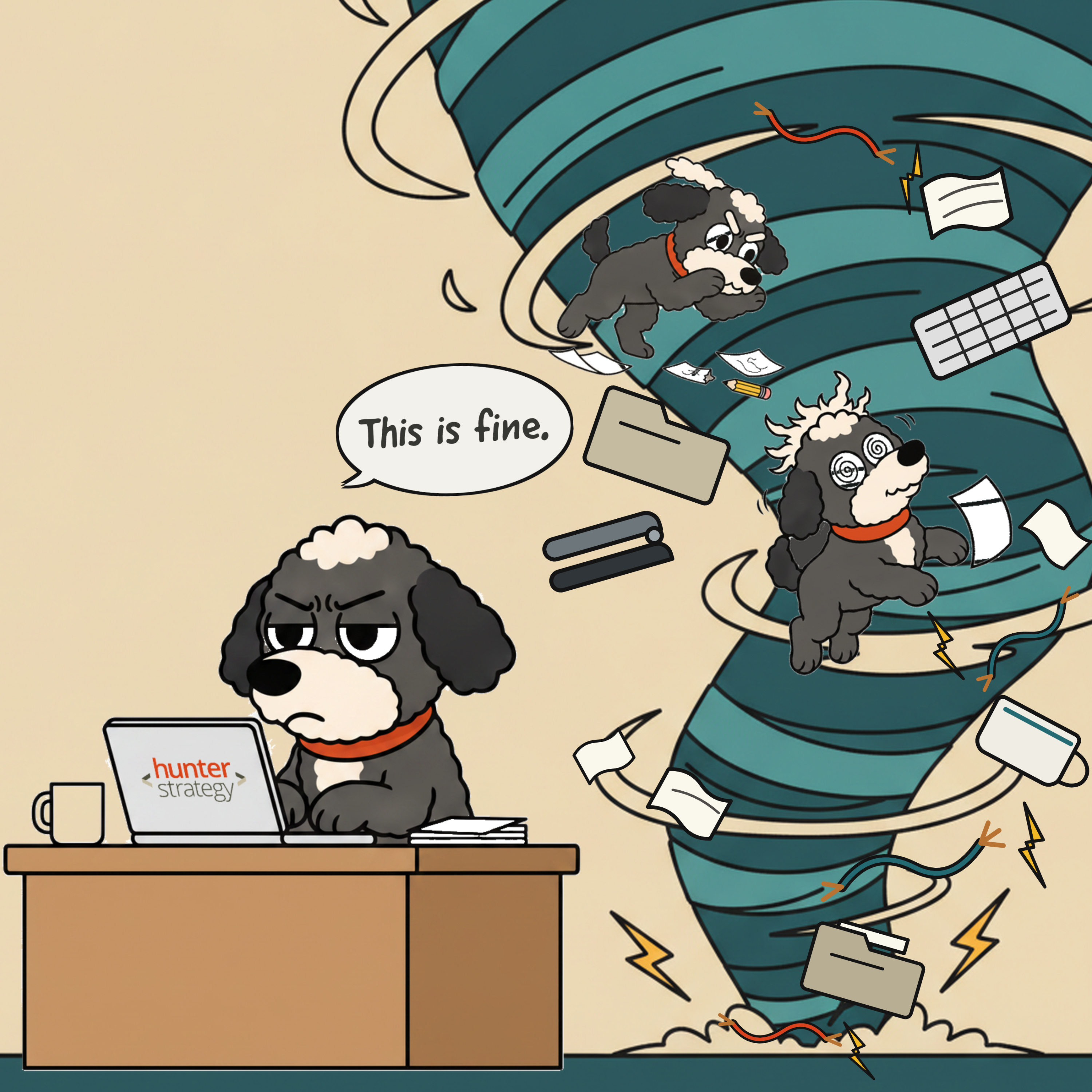
Team Death Spiral
4d ago00:54:48Tap to summarizeYour product is getting worse, not better, and everyone's too busy bailing water to notice the boat isn't even the problem. Hunter Strategy's Greg Vanore, Scott Hiland, and Jeff Segal break down the Team Death Spiral: the slow, often invisible slide from a healthy team into one buried in tech debt, low morale, and busted trust. They get into why "tech debt" is the wrong word to bring into a leadership conversation, what it actually means when a team isn't allowed to lead, and why more money or headcount rarely saves a struggling team. Spoiler: the fix usually has nothing to do with the budget.Episode Chapters: 00:00 Understanding the Team Death Spiral03:30 Identifying Warning Signs07:18 The Role of Leadership in Preventing the Spiral13:36 Communication and Team Dynamics18:03 Tech Debt: A Deeper Dive21:50 The Necessity of Automation in Agile Development22:49 Challenges in Team Automation and Ownership25:14 Leadership's Role in Preventing Team Death Spirals27:11 Effective Communication and Empathy in Leadership29:31 Balancing Fun and Seriousness in Team Dynamics30:11 Empathy Towards Non-Human Factors34:54 Navigating Difficult Conversations with Stakeholders37:18 Understanding Profitability and Team Efficiency39:09 The Importance of Maintenance Over Replacement48:02 Agency and Resource Allocation in High-Performing Teams54:48 The Impact of Resources on Team Performance
Transcribe →
Security Clearance Processes
2w ago00:42:21Tap to summarizeSecurity clearances are confusing enough on their own - facility clearances, personnel clearances, safeguarding, network access - and the rules rarely work the way people assume. In this episode, Matt Triner talks with Sean Blackman, co-founder and CEO of Nooks, about the real bottlenecks holding companies back from classified work, including the "chicken and egg" problem of needing a clearance to win a contract and a contract to justify a clearance. They dig into why building your own SCIF can take two years before a network is even touched, and why "go get a prime to sponsor you" is too often the only advice small businesses get.Sean explains what Nooks is actually solving: shared, subscription-based access to secure facilities around the country, and why he sees this as a national scaling problem, not just a paperwork one. If you're a founder, contractor, or engineer weighing whether classified work is worth pursuing, this conversation lays out what to expect and where to start.Episode Chapters: 00:00 Introduction and Overview05:01 Introducing Nooks: Classified Infrastructure as a Service08:01 The Challenges of Scaling in the Classified Marketplace11:57 The Role of Nooks in Solving the Access Problem19:56 Solving the Dual Use Problem: Defense and Intelligence22:52 The Timeframe for Security Clearances and Network Access28:42 The Role of Commercial Solutions for Classified33:57 Challenges and Opportunities in the Classified Marketplace39:52 Advice for Companies Entering the Classified Space
Transcribe →
How to Determine Materiality in a DFIR Situation
3w ago00:45:53Tap to summarizeWhat actually makes a cybersecurity incident "material" - and who gets to decide? In this episode of This Is Fine, host Matt Triner sits down with Lee Kim (IANS Faculty and Practicing Law Institute member) and Jake Williams (VP of R&D, Hunter Strategy) to break down materiality in digital forensics and incident response. They cover the legal definition of materiality, the SEC's share-price test from TSC Industries v. Northway, and why the call should sit with counsel rather than the forensics firm. The conversation also digs into practical guardrails: documenting decisions in real time to avoid hindsight bias, building scenario-based frameworks before an incident hits, and where large language models do (and very much don't) belong in forensic work. A grounded, occasionally profane look at a topic every incident responder eventually has to wrestle with.Episode Chapters: 00:00 Introduction to Digital Forensics and Materiality04:12 Understanding Materiality10:45 Regulatory Frameworks and Materiality15:32 Establishing Materiality in Incident Response23:20 Understanding Materiality in Forensics28:13 The Role of Stakeholders in Defining Materiality35:37 The Future of Materiality and Regulatory Changes41:09 AI's Role in Forensics and Materiality
Transcribe →NAICS Abuse
4w ago00:44:45Tap to summarizeMost companies exploit the NAICS system to unfairly skew government competition and few realize how deep the abuse runs. In this eye-opening episode, cybersecurity and government contracting experts Kevin Belanga, Chief Growth Officer at Hunter Strategy, and John Czaika, VP, Strategic Initiatives at Hunter Strategy, unpack how misclassifying NAICS codes can block small businesses, inflate costs, and even land shell companies lucrative contracts meant for true small firms.Discover how industry insiders manipulate NAICS classification for competitive advantage, sometimes unintentionally and often intentionally, and learn practical strategies to spot, challenge, and prevent these abuses. We also break down how government agencies, industry players, and watchdogs can work together to ensure fair play, safeguard small business opportunities, and uphold the integrity of federal procurement.Whether you’re a small business aiming to protect its opportunities or a government professional committed to transparency, this episode reveals the behind-the-scenes tactics that shape the federal marketplace and how to fight back.Episode Chapters: 00:00 Understanding NAICS Codes02:38 Implications of NAICS on Government Contracts09:24 NAICS Abuse and Its Consequences15:59 Challenges in NAICS Classification22:05 Understanding NAICS Codes in Contracting27:47 The Role of Contracting Officers33:26 Challenges in Contracting Oversight39:12 Balancing Competition and Accountability43:46 Navigating Acquisition Strategies
Transcribe →Secure Firmware Development for Embedded Systems
Jul 1600:46:12Tap to summarizeMost of us don’t realize just how deeply embedded systems and firmware influence our daily lives — from medical devices to cars, factories, and even space tech. But as these critical systems become more interconnected and complex, so do the security risks. In this episode, cybersecurity veterans Jake Williams and Mick Douglas unpack the real-world challenges of secure firmware development and why it can’t be an afterthought anymore.Episode Chapters: 00:00 Introduction to Secure Firmware Development02:26 Defining Firmware and Embedded Systems03:52 Challenges in Firmware Security08:03 Industry-Specific Trade-offs in Firmware Development13:56 Building Security into Firmware from the Ground Up22:24 Secure Firmware Updates and Supply Chain Risks23:11 Understanding Firmware Updates in IoT Devices31:14 Security Standards for Embedded Devices40:52 The Future of Liability and Standards in Embedded Systems
Transcribe →
Government Contract Types 101
Jul 900:42:44Tap to summarizeOn this episode of This is Fine, host Matt Triner sits down with guests John Czaika, VP, Strategic Initiatives of Hunter Strategy, and Kevin Belanga, Chief Growth Officer of Hunter Strategy, to break down the fundamentals of government contract types. John walks through how risk shifts across fixed-price, time-and-materials, and cost-reimbursement contracts, while Kevin brings the industry-side perspective on bidding, compliance, and common misconceptions. Together they trace the policy pendulum from Better Buying Power 1.0 through 3.0 and why the government increasingly favors firm fixed price. They close with practical advice for smaller companies entering the space, most notably to build strategic partnerships early and get comfortable understanding your own costs.Episode Chapters: 00:00 Introduction to Government Contracting Fundamentals02:26 Types of Government Contracts05:28 Understanding Risk in Contracting08:20 Business Development and Contract Types11:04 Government's Perspective on Risk13:56 Common Misconceptions in Government Contracting24:06 Navigating Government Contracting Challenges25:10 Misconceptions in Government-Industry Communication27:39 The Role of Market Research in Contract Types37:10 Advice for Small Businesses in Government Contracting
Transcribe →
Why Purple Team is the Team of the Future
Jul 200:47:52Tap to summarizeThis episode explores why purple teaming is becoming a smarter security strategy, with host, Matt Triner, speaking alongside guests Jordan Lazo, Gabriel Abdalawad, and Jake Williams from Hunter Strategy. They break down the difference between red, blue, and purple teams, and explain how collaboration helps organizations improve detections and reduce blind spots. The conversation also covers why purple teaming is especially valuable for less mature organizations that need to build stronger security foundations. Overall, the guests argue that sharing tactics, testing detections, and closing gaps creates more practical security than working in silos.Episode Chapters: 00:00 Introduction to Cybersecurity Teams01:00 Defining Blue, Red, and Purple Teams03:19 The Philosophy of Purple Teaming07:57 Real-World Examples of Detection and Exploitation12:55 Building a Purple Team in Less Mature Organizations18:39 The Importance of Detection Engineering23:49 Understanding Decay and AI Solutions29:53 Cloud Security: Risks and Responsibilities31:17 Documentation Challenges in Cloud Implementations37:54 The Case for Purple Teams44:24 Strategies for Implementing Purple Teams
Transcribe →
The Future of Cyber Warfare: Trends and Predictions
Jun 2500:42:57Tap to summarizeCyber warfare is often misunderstood and this episode explains why it’s usually a supporting act rather than the main event in modern conflict. Jake Williams and Bryson Bort break down how cyber operations differ from kinetic warfare, why attribution and battle damage assessment are so difficult, and why political and strategic limits often matter more than the technology itself. You’ll also hear how adversaries use low-cost, scalable cyber campaigns to create disruption without triggering direct escalation. Overall, it’s a sharp look at how cyber tactics are reshaping future warfare and global security.Episode Chapters: 00:00 Introduction to Cyber Warfare05:16 The Role of Cyber in Modern Warfare07:51 Stuxnet: A Case Study in Cyber Warfare10:52 Legal Definitions and Warfare16:17 The Complexity of Cyber Operations17:50 Investment in Cyber Capabilities22:10 The Future of Cyber Warfare27:06 Ethics and Cyber Warfare33:51 Predictions for Future Conflicts41:30 Educating on Cyber Warfare
Transcribe →Cybersecurity Challenges in Internet of Things (IoT) Devices
Jun 1800:51:00Tap to summarizeCybersecurity Challenges in Internet of Things (IoT) DevicesIoT isn't just smart bulbs and garage door openers, it's the badge scanner at your office door, the sensors on a wind turbine, the x-ray machine at your hospital, and the PLC system running a manufacturing floor. The attack surface is enormous, and most of it was never built with security in mind.In this episode, host Matt Triner sits down with Adeel Chohan, Head of Data & AI at Provectus, to unpack why IoT security is so hard to get right and why it keeps getting harder. They dig into device procurement gaps, firmware vulnerabilities, the challenges of securing brownfield infrastructure, and why security is almost always the last conversation in an IoT deployment, not the first.From power grids to hospital networks to factory floors, Adeel and Matt explore what it actually takes to secure environments where connected devices outnumber the people managing them - and why legacy perimeter defenses aren't built for this reality.You can't protect what you can't see.Episode Chapters:00:00 Introduction to IoT Device Security02:47 The Broad Scope of IoT Devices05:35 Unique Considerations for Securing IoT Devices09:56 Challenges in Implementing Security Measures for IoT Devices23:27 The Role of Cloud Providers in Enabling and Securing IoT Devices26:49 The Challenge of IoT Cybersecurity and the Need for Standardization27:42 From Point-to-Point Solutions to Standardized Device Management31:05 The Trade-Offs Between Proprietary and Standardized Protocols42:01 The Role of Regulation in Ensuring IoT Security44:27 The Impact of Decreasing Sensor Costs on IoT Security46:33 The Mindset Shift Towards Prioritizing IoT Security49:06 The Future of IoT Security: Regulations, Collaboration, and AI
Transcribe →
Continuous Monitoring and Risk Assessment
Jun 1100:47:23Tap to summarizeUnlock the future of cybersecurity in the Department of Defense with insights on the latest tools, frameworks, and strategies transforming network monitoring. Most agencies are still relying on outdated processes—are you prepared for the shift toward automated, real-time risk assessments? In this episode, Dan Beller, Director of Cloud Solutions at Hunter Strategy, and Chris Sowards, GRC expert, reveal how cutting-edge innovations like OSCAL, cloud-native integrations, and advanced vulnerability scanning are revolutionizing continuous monitoring for defense networks.Episode Chapters: 00:00 Introduction to Continuous Monitoring and Risk Assessment02:05 Continuous Monitoring and the ATO Process03:23 Continuous Monitoring and System Modifications06:15 Evolution of Continuous Monitoring08:45 Assessment and Compliance in Continuous Monitoring12:44 Tooling and Automation in Continuous Monitoring16:04 Future Trends in Continuous Monitoring19:04 Building Trust and Relationships19:43 Challenges in Generating Artifacts20:29 Automating ATO Process22:48 GRC as a Gateway into Cybersecurity24:00 The Value of GRC Professionals24:29 The Importance of GRC in Software Development25:51 The Need for Improved Tooling27:08 The Role of OSCAL in Trusting Tooling28:31 Tools for Managing Disparate Scanning Results29:52 The Challenge of Limited Authorizations30:51 Collaboration and Human Readability in OSCAL34:07 The Need for Connected Governance36:27 Measuring the Success of Continuous Monitoring
Transcribe →