← This Is Purdue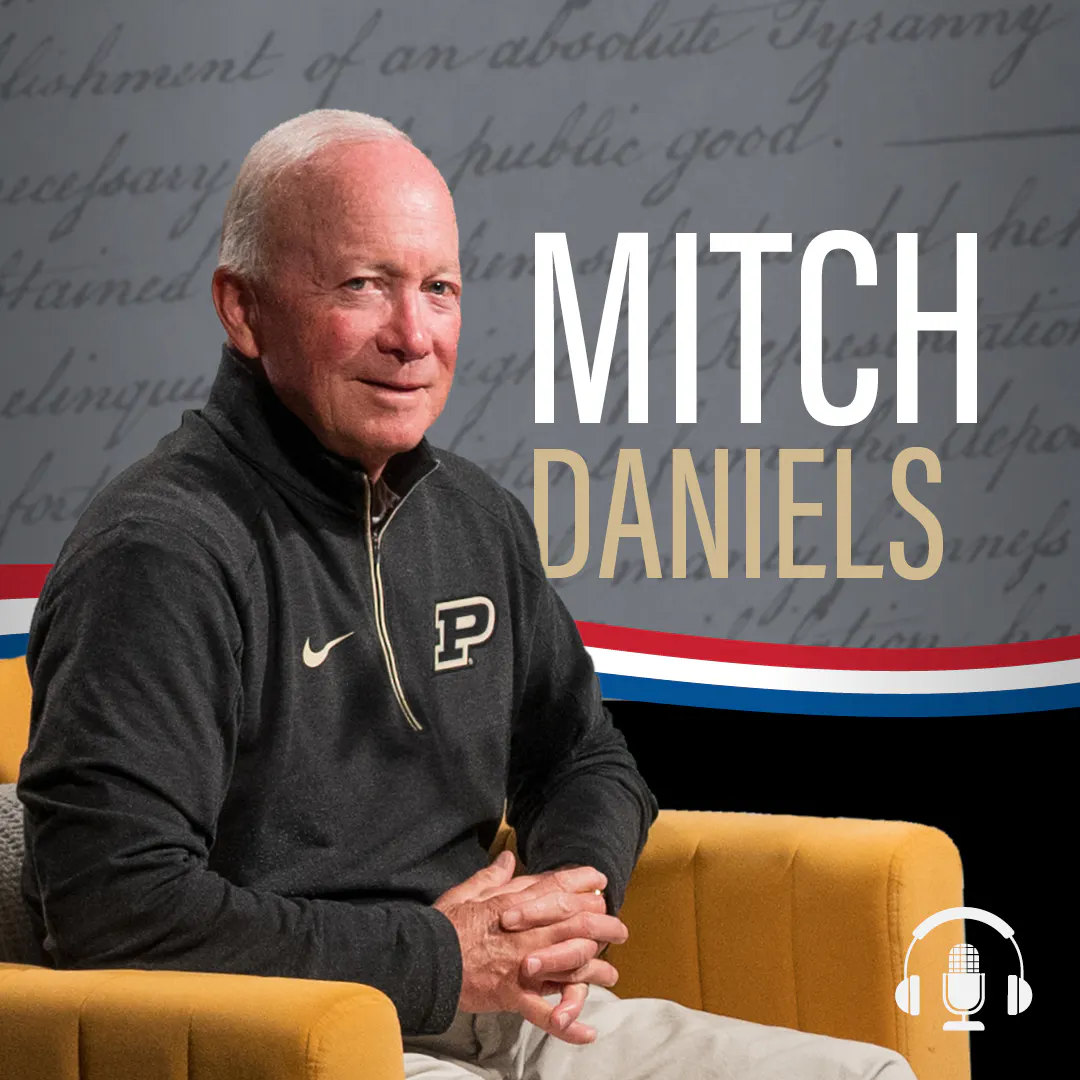
Loading summary
Transcript46 lines
- [00:00]
A
This is Mitch Daniels and you're listening to this Is Purdue.
- [00:07]
B
Welcome to this Is Purdue, the university's official award winning podcast. I'm Kate Young, your host and a proud Purdue alumna. This Is Purdue is all about sharing big ideas that spark broad interest and get people talking. We're passionate about highlighting notable boilermakers who are powering innovation and working together to solve today's toughest challenges. Tune in to each episode as we have engaging conversations with Purdue alumni, faculty, researchers, coaches and more who are inspiring change through small steps every day across timely topics like sports, well being, emerging tech and life changing research. Join us as we discover how these boilermakers are taking their next step. Giant Leap.
- [00:55]
A
It's about widening the opportunities for ordinary people. That's America. There's never been an engine in human history as effective at lifting people up, giving opportunities to people. If they had the diligence and the persistence and the personal responsibility to take advantage of those opportunities, that's what land grant schools were created to do. To me, it's the proudest and most important part of Purdue's mission.
- [01:21]
B
In this special edition episode of this Is Purdue, we're talking to Mitch Daniels, interim president of Purdue University. President Daniels served as Purdue's 12th president and is known for championing a frozen tuition policy. He was actually our very first video podcast interview on this Is Purdue back in 2021, and we're honored to have him back on the show for a second interview. This time we're celebrating America's 250th birthday and diving into Purdue's role in our nation's growth and evolution, specifically when it comes the state of higher education and its future. So let's get to it. Here's my conversation with President Daniels. President Daniels, thank you so much for joining us on this Is Purdue, our second time together. We're excited to welcome you back.
- [02:07]
A
Didn't expect to be, but I'm glad to be back.
- [02:09]
B
You can see we're celebrating America's 250th with our set here today. But we're going to dive into Purdue's role in our nation's growth and evolution. And it's a really special episode, so we're just thrilled to have you join us today. So, you know, major milestones like this always offer us a moment of reflection, consideration. From your perspective, what does America's 250th birthday signify for the country, for the State of Indiana, and for Purdue University?
- [02:39]
A
I hope it will mean some very serious and thoughtful reflection on the part of Americans who in recent years have focused on their differences and on what we imagine to be difficulties. Here we are living in the richest, healthiest, best educated, safest world anyone has ever imagined. But too many Americans are troubled and not happy. Even in the midst of all this. Plenty. I hope that this will be a time consistent with other things we celebrate birthdays, anniversaries, where we accentuate the positive, as the song used to say, in which we recognize our blessings, recognize. If we look back at history, we've had all sorts of troubled times before, some much worse than today. And we got through them because of our free institutions and our inclusiveness and our trust in each other. So I hope that's what this year brings, and I hope that Purdue will celebrate it in that spirit.
- [03:35]
B
So land grant universities like Purdue have always played a special role in our nation's evolution. We're making college education more accessible. We're driving economic growth. What does Purdue's commitment to our land grant legacy mean to you as a university leader?
- [03:50]
A
It quickly became the most important value and objective to me when I first came here years ago. It's a timely question. It's so consistent with what we're celebrating this year. The Morrill act can be seen as one of the great triumphs of domestic policy in American history. And what's it about? It's about widening the opportunities for ordinary people. That's America. There's never been an engine in human history as effective at lifting people up, giving opportunities to people if they had the diligence and the persistence and the personal responsibility to take advantage of those opportunities. That's what land grant schools were created to do. To me, it's the proudest and most important part of Purdue's mission. It means something different today, but the central value of it's still the one we've always had at the core of our mission.
- [04:44]
B
How do the newer additions like Purdue Global Purdue Polytechnic High School fit into that mission as well?
- [04:50]
A
That's such an important question to me. They define or certainly part of the definition of what the land grant mission means in the 21st century. We entered the online era ahead of most specifically because we couldn't stop at age 22 or 25 or 26 anymore. The whole world knows that success individually and the success of our society depends a lot on lifelong learning, probably, but certainly continuous learning. And too many people had been left out, just as too many people were Left out in 1869 of higher ed. These days, there are twice as many people who started college and didn't finish. Not even talking about those who never attempted college than all the students on all the four year campuses. And so we said to ourselves, we can't be a modern land grant school and ignore this responsibility and this opportunity. And I'm just so proud of the people of Purdue Global getting close, what to 100,000 or something degrees that they have conferred and you go to one of those commencements. I love that we're having them on campus now so people here can meet these single moms and grandparents and folks with all these other challenges and duties in life who are achieving the dream of a degree because of the people Purdue Global. So yeah, and the high school much the same. We simply weren't satisfied at all with the variety diversity of young people who were achieving admission to Purdue University. And so we decided to try to grow some of our own pipeline to augment what, sorry to say, the public schools were failing to provide what values
- [06:39]
B
set Purdue apart as an innovative leader in higher education, free speech and civil discourse.
- [06:45]
A
It's also sad to say that simply respecting the laws, values, constitutional rights of people in this country, that shouldn't set you apart. But unfortunately, in American higher ed for the last, you know, two or three decades, it did set you apart. Simply to say we're going to have free inquiry on this campus. We are not going to silence people because they don't pay lip service to somebody's idea of norms and values. The campus exists to be a place where these things are debated, so young people in particular can sample different points of view and make up their own minds. Too much of American I read seem to have lost sight of that. I don't think we ever really did at Purdue. But by staking or reasserting this is central to our job as an institution of learning. People seem to take note of it. That's fine. A large part of the job here was to get people to pay more attention to the wonderful qualities of Purdue University. And that was part of it.
- [07:52]
B
What are some key actionable ways that Purdue is building upon its long standing and ongoing commitment to academic freedom, public impact, civic responsibility?
- [08:02]
A
From the day a young person walks on this campus at bgr, I hope they're hearing about it, learning about it. I hope it attracted many of them. In fact, I know this because I've heard this from students over the years. Many students came to Purdue because they perceived that they'd be more free to sample opinions. They'd hear a wider range of opinions. They could express their own opinions without fear of being ostracized or somehow repressed. Starting at Boiler Gold Rush, we talked to students about this imperative value of the academic mission and encourage them to exercise these rights. I think that most of them get the message. I know they welcome it when they do. And of course, at the other end, we have a civics requirement here. It's not onerous, but it says to young people and to the outside world that this is not just about preparing great workers and business leaders and engineers and veterinarians. We do that, but we're also trying to send out good citizens who have a sense of their duties and responsibilities. You know, at the commencement, when I got to read the statement that confers the degrees, it talks about the rights, privileges, duties and responsibilities of this degree. I always emphasize the last two words. We've had a society where people were really quick to demand their rights and their privileges, okay? But we want young people to understand that there are duties and responsibilities that come with that. You earn those rights. I'd like to think that Purdue is doing a good job of communicating and reinforcing those values.
- [09:43]
B
Absolutely. I think that's a key theme of the podcast always. You know, you can get a higher ed degree anywhere in the world, but when you run into boilermakers out in the wild, they're always saying how special it is and how unique this education is. And the people here are so special.
- [10:01]
A
Everybody's proud of their school. Sure, we think we have very valid reasons. You just expressed many of them. But they require effort these days. Again, something I'm sad to say a lot of young people didn't get the much sense of that on their way to Purdue. Maybe they got it at home, but in too many of our public schools, they didn't learn any history or much. They may or may not have been given any sense of civic responsibility and why our free institutions need constant tending, why they work best once again, for lifting people to the extent that people take advantage of those freedoms.
- [10:42]
B
The state of higher ed is rapidly changing. You know, there's different factors. Affordability, AI, free speech like we talked about. How do you think this has impacted the public trust in higher education?
- [10:54]
A
One thing nobody can overlook is there's been a collapse in public trust and it's very unfortunate. We need a well functioning and highly regarded higher education system. It's not for everybody, but it's absolutely the right path for large numbers of young people coming up. Just as for a long time, maybe we encourage too many people. We said this is the only way to get a good start in life. We don't want to discourage young people, and I'm afraid that the current environment to some extent takes that risk. The reasons are not hard to identify. I always say it's value and values. Number one, people began to question, rightly, am I being charged too much for whatever I'm learning there? And secondly, in too many places, people say, well, I'm being indoctrinated or having values imposed on me that I'm not sure I agree with, and I'd like at least the chance to argue back or explore others. So I think we've got a lot of repair work to do, and I think Purdue can be proud of its record on both those fronts, value and values. And it's good to see a lot of other schools moving that direction now. It's couldn't happen soon enough.
- [12:10]
B
What would you say to young people today who are trying to decide, you know, is college for me, should I pursue this? What are some of the most important factors that they should weigh?
- [12:19]
A
Well, the two I just mentioned are starting point. Try to look for a place where there seems to be some sensitivity to cost and a commitment, though, to quality. And then also the kind of open environment of free inquiry that we've been talking about. But the other thing I would tell them do is go look at the Gallup Purdue index, which was done now over a decade ago. The basic lesson that came out of this biggest ever survey of college graduates, what helped them succeed? The simplest lesson was that matters less where you go than how you go, meaning how diligent a student is. Whether they're given the opportunity to, for instance, do undergraduate research, whether they take the opportunity to build a relationship with at least one faculty member. Simple things like this. Now, if you do those things at a place like Purdue, you are almost certain to succeed wherever a young person feels most comfortable. I hope that they'll apply themselves in that way. You know, years ago, our own students came up with a formulation. I never improved on it. I repeated it to other classes, and it was 4, 3, 2, 1, as I recall. Graduate in four years or less. Try to maintain a 3.0 grade average. Easy in some places. Not so easy at Purdue. Two, study two hours or more for every hour in class and be very active, not casually, but very active in at least one extracurricular activity. That is a terrific formula, no matter where a student enrolls.
- [13:53]
B
I love that. That shows belonging if you're not just going to classes, but you're involved in other things. So switching gears, I'd love to discuss the Transition into your new role as Purdue's interim president. You're not a stranger to. To the role as president of Purdue, but as we conduct our national search for the next president, how do you view your leadership role as you guide Purdue through this transitional period?
- [14:18]
A
Well, I've never had a role quite like this, and so I want to be thoughtful about how to approach it, and I've asked a couple people who have done this before. My sense is one thing I need to do is try to ensure that important initiatives on which the previous leadership and the board have agreed move forward without hiccups or interruption. It's not a time. I mean, I'm not making a promise here, but it's probably not a time to be creating new ideas. I'll try to resist the temptation if it comes because I hope that another service I can assist with in this job is, you know, standby equipment, emergency generator, you know, relief pitcher, whatever metaphor you like, is to make the transition as short as possible. My main goal is to get out of this job as fast as possible. Meaning that Purdue has a great new leader and she or he gets a head start. If I can help with that.
- [15:20]
B
Absolutely. What are your top priorities as interim president?
- [15:23]
A
Well, of course, first of all, to maintain the standards that we've talked about, make sure that students here are getting good value for their money, that they're in a place of open inquiry. I hope to see a little more definition, especially in this 250th year around citizenship, history and so forth. We might be able to do a little more than we already do to make sure that students here are well prepared for their life as citizens. Later, I'll be very specific about one thing. That's Indianapolis. Huge opportunity for our extended campus in Indianapolis, and I don't think enough of our applicants or enough of current students have seen this yet. The whole opportunity and the reason we went there is to augment, not a replacement for the West Lafayette experience. It's supposed to be West Lafayette plus, meaning maybe you spend one year or two there where we can absolutely assure an internship, a first job in a wide variety of occupations, businesses and otherwise. I think we've been a little slow out of the blocks on this just because I don't think we've communicated to students and their families how it broadens the opportunities. And so I want to work on that. I'm very excited about the upside.
- [16:33]
B
Absolutely. And you have the Lillys, you have the ncaa, all the sports in Indy that they can get internships and have that Chance?
- [16:41]
A
Yeah. I mean, we created Discovery Park District here very specifically to try to bring top businesses close to campus to work with our researchers, but also to create internships, job opportunities for our students. But there's a limit to how much we can do right here. There's a built in network of businesses, believe me, I've talked to them for years, who are eager to have access to more, you know, Boilermakers runs the spectrum from the big companies, Lillian Lanco and Roche and so forth on one end down to the startups that are blossoming down there and everything in between. And this is an opportunity we need to seize for our students, current and future.
- [17:24]
B
What do you believe Purdue needs in its next president that it didn't need 15 years ago?
- [17:29]
A
A real grasp of what the new technologies are and the changes they're going to bring. I think as much as is said and written every day now about artificial intelligence and how revolutionary it is, I think people are underappreciating the impact it may have and sooner than we think. So in addition to many other qualities that I suppose have always been important, a real grasp of, first of all, how to use these technologies to deliver our service better, more efficiently on the administrative front, perhaps much more effectively in terms of the way we teach and using these tools effectively there, but also may have to completely change the whole notion of a campus, whether in 10 years or even less, it will still make sense for this many students to come here and spend this much time residentially. I rather hope so. But AI could change that and we need somebody who can navigate that, whatever changes it brings.
- [18:36]
B
As Purdue's 12th president, you are known for championing a frozen tuition policy, famously. And it's a legacy that President Cheng continued during his time here as well. It's now in its 14th year. How do you reflect back on that legacy today?
- [18:51]
A
With a smile? Because I never imagined it shook people up the board and certainly people on the staff and all. When I said, you know, how about a one year timeout? It looks to me like we could do that, send a signal that we hear. Remember, I had just spent really 10 years traveling this state, which is a very diverse state, and I knew that people even then were very restless about the cost of higher ed going up and up and up every year. When I look back, I was pretty sure we could skip a year, maybe do. But people got the spirit of it here and I smile because I thought at the time, gosh, the market's going to demand this of schools and if we don't start to show some restraint about our prices. Somebody's going to make us do it. I was wrong. There were many more years where the rest of higher ed just kept going up and up and up. I mean, go look at the difference now. They were about the same then. Go look at the difference in full cost of attendance, not just tuition fees, everything, room, board and so forth between us and that school down south. It's six or seven thousand per year now. So the rest of the world, to my surprise, took a while to get the message. They're getting it now or sometimes state legislatures or somebody's sending it to them. So. But I'm very proud of it. It became a brand, a trademark. There's no other school like it and people know about it. So it brings, at least captures the attention of people. And it's, by the way, I think, been a driver. We know this in the growth of Purdue, which in turn has helped us to maintain the affordability policy you mentioned
- [20:39]
B
other schools never really caught on. Why do you think it was possible at Purdue and. And other institutions couldn't make it happen?
- [20:47]
A
They'd have to answer that question. Again, I think it was very consistent with our mission. How do we keep the doors wide open? How do we open the doors of higher ed more? And this was certainly consistent with that. And then again, I could just tell within a couple three years people were proud of it. I mean, it made us stand out and that's always good. But in a way that was again, that I think particularly boilermakers felt was reflective of who we are. I know our alums were obviously our students and their families were glad and the word spread and, you know, the citizens of our state knew about it and they were positive. So I think it generated a momentum of its own. Now, why that didn't happen at other schools, I mean, they didn't try in some cases.
- [21:36]
B
Why has that commitment to accessibility always been so important to Purdue?
- [21:42]
A
Why were we put here? And anything we can do to make the advantages of our unique service, when done well, our uniquely valuable service available to more people. Purdue Global, the Polytechnic High School, as a way into that, the work our regionals do and affordability, of course, that's all just absolutely part and parcel of our identity.
- [22:08]
B
This has been a topic of conversation on the podcast previously and we've talked about it throughout our conversation today. But what are your hopes for the future value of higher education and its broader role across the state and the
- [22:20]
A
country that higher ed will conclude this is not an either or proposition. I read things Hear people debating, say, well, they're treating it as vocational schools, all about getting a job, and it really needs to be about preparing people to be critical thinkers and participatory citizens and so forth, is not one or the other. I hope the future, if people are going to continue to invest in it the way they have and the way we hope they will, then I think it's got to serve both missions. You know, it's not that hard, I really don't think. And I think we're doing pretty well here. I'd like to see us do even better. I want our engineers, if they didn't, if they don't enroll in the Cornerstone program and our computer scientists and our pharmacists and all our STEM people, I want them to do something comparable so that they learn in the context of all the great technical advances and so forth they're going to be contributing to. I want to be able to read and write and reflect and know, you know, in the AI world, having an antenna that tell you when something's bogus, never going to be so important. This is what we call critical thinking.
- [23:30]
B
Yes.
- [23:31]
A
How do you know if you're being fed a line or peddled something that's tendentious or slanted? Well, now that's a bigger challenge than ever. So we got to walk and chew the gum and prepare people to be great, productive workers wherever they're going, but also smart, savvy citizens who can make sure that their freedoms that are making all the rest of this progress possible are not trespassed either by other people or by the machines we've built at Purdue.
- [24:03]
B
We love to talk about Amelia Earhart, Neil Armstrong. They're key figures in American history. Who are the historical figures from Purdue who inspire you?
- [24:12]
A
All of them. But, you know, let's take our Nobel Prize winners, Professors Negishi and Brown, and I'm going to lay claim to Vernon Smith, a great economist who did these real work here. He got the prize when he was by then somewhere else. But, you know, these intellectual. These great figures off our faculty, that's really the heart of the product that we try to produce here. And yes, of course, I think of Amelia and Neil and our other astronauts and so forth. Yeah, sure. And the great business leaders we put out. But my first thoughts go to the towering intellectual figures who made Purdue their home.
- [24:54]
B
Well, President Daniels, it's been an absolute pleasure. Thank you for joining us. Is there anything else that you'd like to tell our listeners or viewers?
- [25:02]
A
Just that I'm proud to be back in my spare tire role, but I'm going to do my very best to get out of it quickly and hand the brains back to somebody who will be wiser than I about the ways to take Purdue for make sure the next era is even better than the last.
- [25:20]
B
I don't think anyone thinks of you as a spare tire. I do have to put that on the record. Well, thank you again. It was a pleasure.
- [25:26]
A
I enjoyed it.
- [25:27]
B
Thanks to President Daniels for joining us for this powerful discussion. Now, our set for this special interview is on theme to celebrate America's 250th birthday. So if you want to watch the full video interview, head over to our podcast YouTube page, YouTube.com/this is Purdue and click that subscribe button while you're over there. This Is Purdue is brought to you by Purdue Brand Studio. The podcast is hosted and produced by me, Kate Young. The creative team behind the show's videography, design and writing and research includes Thad Boone, John Garcia, Cheryl Glutzpa, Ashwini Malshi, John Underwood and Delaney Young. Social media marketing is led by Maria Welch and our Project manager is Rain Goofy. Thanks for listening to this Is Purdue. For more information on this episode, visit our website at purdue.edu podcast and head over to your favorite podcast app to subscribe today so you never miss an episode. You can also check out all of our podcast video content on our YouTube page@YouTube.com thisis Purdue and as always, boiler up.