← This Is Purdue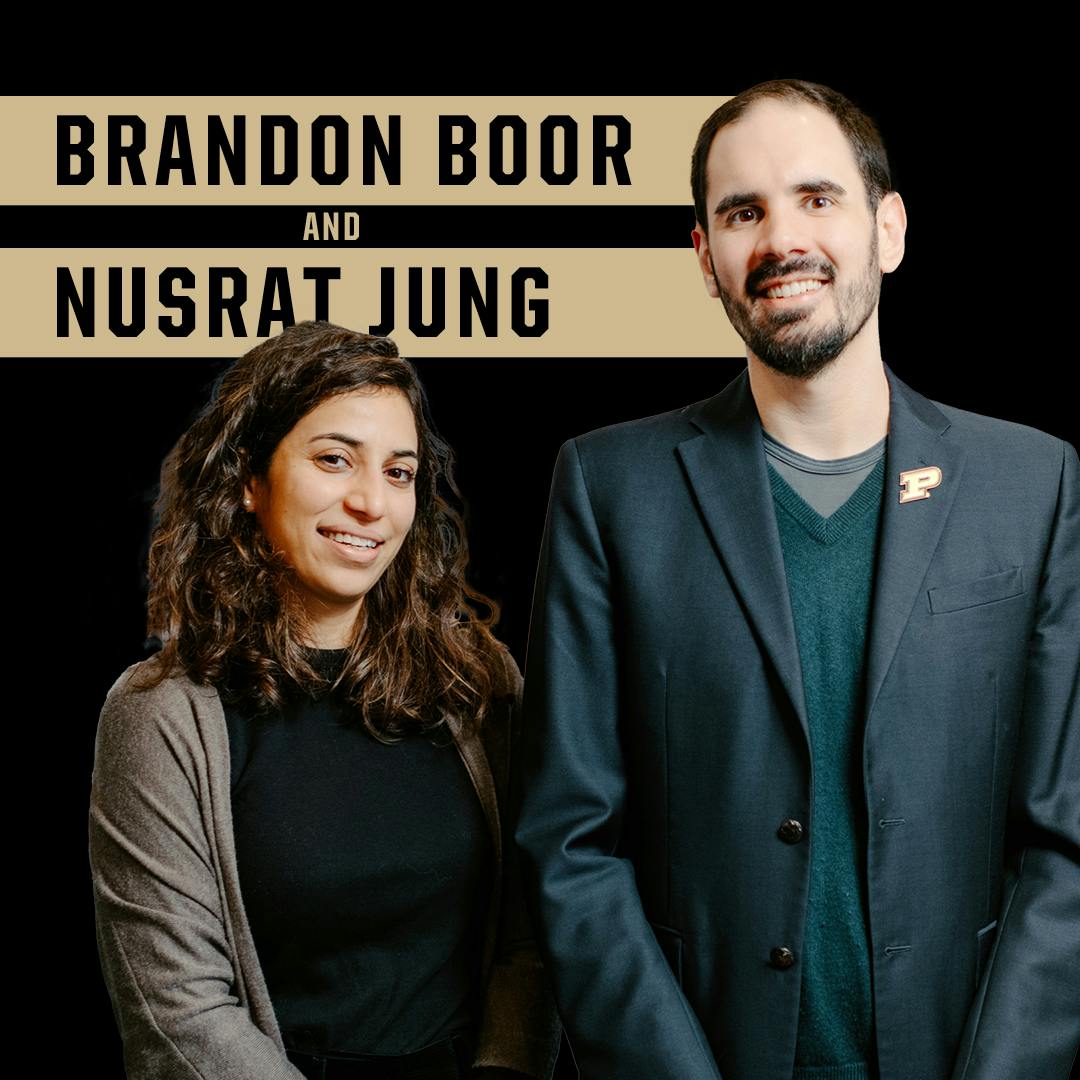
This Is Purdue
Purdue Professors Brandon Boor and Nusrat Jung on Their Groundbreaking Indoor Air Quality Research in First-of-Its-Kind Tiny House Lab
00:51:28
Loading summary
Transcript52 lines
- [00:04]
Kate Young
Hi, I'm Kate Young, and you're listening to this is Purdue, the official podcast for Purdue University. As a Purdue alum and Indiana native, I know firsthand about the family of students and professors who are in it together, persistently pursuing and relentlessly rethinking. Who are the next game changers, difference makers, ceiling breakers, Innovators? Who are these boilermakers? Join me as we feature students, faculty, and alumni taking small steps toward their giant leaps and inspiring others to do the same.
- [00:39]
Brandon Bohr
Our work recently in the past few years has been really focused on understanding the factors that affect the composition of indoor air. What is in the air that we're breathing. Whether we're sitting in our home, working in our office, or if you have a student that's out in the classroom.
- [00:55]
Nusrat Jeung
At school, air is very fascinating because it is something that you don't see. So having really, really cool instruments in our lab, allowing us to see what we cannot see.
- [01:09]
Kate Young
In this episode of this Is Purdue, we're talking to Brandon Bohr and Nusrat Jeung and diving into the groundbreaking indoor air quality research they're conducting right here at Purdue University. Brandon is Purdue's Dr. Marjorie E. Hoffman, Associate professor in Civil Engineering, and Neusrat is an Assistant professor in Purdue's Lyles School of Civil and Construction Engineering. Together, Brandon and Nusrat are working to advance healthier, more energy efficient living through collaborative innovation. And this research is happening inside a first of its kind tiny house lab on Purdue's campus. In this episode, you'll learn more about their recent research discoveries, like how hair care products and wax melts can impact indoor air quality. They'll also share ways you can improve indoor air quality in your own home. Oh, and by the way, have I mentioned yet that these two are not only a research pair, but also a real life pair? Let's dig in. Here's my conversation with Brandon and Nusrat. Thank you both for joining us on the official university podcast. This is Purdue. We're so excited to talk to you. You're both civil engineering researchers and professors, and you all have been working on some truly incredible stuff. So we're excited to dive into this groundbreaking work that you're doing at Purdue that's really making a global impact. So let's kick things off. We want to get to know you two a little bit better. You are not only partners in research, but you're partners in life. You're married. So we want to know, how did you meet and how long have you been married for?
- [02:42]
Brandon Bohr
Thank you, Kate. So we've been married for 10 years and we first met in Finland in 2011. Musraft was a research scientist at the VTT Technical Research center in Finland, which is like a big research center in the country. She was working on buildings research and then I joined VTT as a visiting PhD student. I had a grant from the National Science foundation called the Nordic Research Opportunity. So I was there for a few months. We met working in the same group the first week that I was there and the rest is history. So we really enjoyed our time in Finland together. You know, living up in the far north where it's quite cold and quite dark. But they have excellent research, excellent education, and I think it really prepared us for our faculty careers here at Vanu.
- [03:31]
Kate Young
That's incredible. So who else is part of your family? Any pets?
- [03:34]
Nusrat Jeung
Yes, we have three wonderful cats. Two of them came with us from Finland and one of the cat adopted us here in West Moffet. So we are family of five. We were very happy when we moved to Purdue because there is an excellent veterinary school and we were quite worried about, you know, the care that involves during the whole lifespan of a cat. So we have been really happy that there are right places and very, very good doctors that are available for anything that we need. So it's been a really nice setup.
- [04:08]
Kate Young
I mean, these are international cats. These are special cats.
- [04:11]
Brandon Bohr
Yeah.
- [04:11]
Nusrat Jeung
Yes. They actually have Finnish passports. It's really funny. So by the time to travel, the vet issued Finnish passports and the passports have information about the vaccination that they carry and that they are healthy. And it was really funny because I was asking about the Finnish language exam that they skipped.
- [04:31]
Kate Young
So that is so fun. Wow. Okay. So I can tell that you're both very passionate about the work that you do. When did you both realize that science was your passion? And do you remember any moment or experience maybe growing up that you were like, I really want to be a researcher and make these really cool discoveries?
- [04:52]
Nusrat Jeung
Yes, I remember I was always a very curious child. I was getting into things, I wanted to know about things. And I remember in high school we won the first award for science competition. We came up with a chimney that is, that is of a power plant. And we wanted to reduce the pollution somehow and come up with a control mechanism that will basically remove the pollution before it is exhausted. I think I have been thinking in terms of emissions and care for the environment and people's well being for a long time. So I have always been a person who needs an active research question in mind or something. To look for, for something, to find something related to science. And I think the sense of discovery, the excitement that comes with it.
- [05:47]
Brandon Bohr
For me it was also in high school. I grew up in Maryland and we had a technology magnet program at my high school that was really instrumental in introducing me to engineering and science. At a young age I had a chance to participate in rocketry and robotics competitions. I worked at the Johns Hopkins Applied Physics lab as a high school student. So I think that really drove me towards engineering. I really enjoy tinkering with things, working with my hands, the design aspect of engineering, working as part of a team. And then as a college student I had the opportunity to do a co op at the National Institute of Standards and Technology which is in Gaithersburg, Maryland. They had an indoor air quality research group that I worked with for about eight months and that introduced me to scientific research. Working in the laboratory, working with advanced analytical instrumentation, you know, working with scientists. And I think that really drove me towards pursuing a PhD, pursuing a research career. I learned that, you know, I could do experiments in the lab, make new discoveries, get all this interesting data and try to make sense of it. There was an open endedness to it that maybe is not so traditional kind of the conventional engineering path. So I think the research path allowed me to pursue my curiosities, do things for the first time in the lab and you know, make these discoveries that I found to be very interesting and also impactful because I think indoor air quality is a field that does impact our everyday lives.
- [07:14]
Kate Young
You talked about you were in Finland and now you're in West Lafayette. That must have been a big change. Tell us a little bit about your paths to Purdue.
- [07:23]
Brandon Bohr
So I applied to Purdue for a faculty position about a decade ago and was fortunate to receive an interview here. There is an open position in architectural engineering. So Purdue University is one of the few programs in the United States that has a very strong architectural engineering program within their civil engineering program. And architectural engineering is what Nousrat and I do, research wise, teaching wise. It's really the study of buildings, indoor environments and of course that encompasses indoor air quality. So I was fortunate to receive an offer and join Purdue in 2015 as an assistant professor. I've been very fortunate to be here because we have such a strong focus on buildings, research on research on the indoor environment and large scale research infrastructure, experimental facilities that really have allowed me to pursue all my interest research wives. And I think that in terms of the United States and what we have in architectural engineering, Purdue definitely has one of the best programs. We have facilities unlike any other university. And this has really enabled us to make discoveries that you cannot make anywhere else. So I've been very happy to be here for 10 years, almost this August, and to work with all the amazing students, undergraduate, graduate students and faculty that we have here at Purdue.
- [08:39]
Nusrat Jeung
For me, it was that Brandon moved away from Finland, of course, and it was. I was a PhD student at that time. And for me it was just so incredibly exciting to see the things you can do when you become a professor. So actually you have the ability to take something as an independent person, a thought that occurred, and then you can create and build upon it. You can actually write a proposal and then send it out somewhere for evaluation, then it will get funded. Of course, there's a whole sequence of things that you need to do, but at the same time, you can really bring your ideas to life. And that was very exciting of a thought. So once I was on the verge of completing my PhD in 2018, I actually never saw it as an end of something. I saw it as a new beginning path to independent research careers. So for me, it was incredibly exciting that you can actually do that. The only university I could think of was Purdue because Brandon was here. And I wanted to have my dreams come true as well. And it was very exciting to just simply come here and then be a professor. I was teaching a class after three months of graduating. Exciting. A new generation of engineers starting to create new infrastructure. I mean, it has just been such an exciting time being here all these years.
- [10:02]
Kate Young
When did you first start collaborating on your research together here at Purdue and what has that experience been like? I'm sure there might be pros and cons with that as well.
- [10:13]
Nusrat Jeung
We have actually enjoyed working together quite a lot. So our first opportunity came during COVID 19. So everything of course was shut down. We were, you know, we have very nice home offices as well. Both of us enjoy working during this time. There was this opportunity called as Protect Purdue Faculty Innovation Grant. And we had this idea because every time you would go out to groceries or to get something, you would smell all of these disinfectants in the air. And we started to talk about it and convert it into a short proposal that we put in for evaluation in this program. And we were so happy that it was accepted. And that was the first time that we collaborated. And we were quite pleased to find out that we work very well together. So it's been really fun to actually have somebody because naturally, of course, when you do research, you work in a team. So it is incredibly exciting when you have the whole team invested in the idea. When you make a discovery, it's even a bigger celebration. So we have now had the opportunity to take our celebrations home as well. So it's been quite nice.
- [11:22]
Brandon Bohr
It's been good because we brought different experiences and expertise together, and we did a PhD separately on different research topics, and they were both connected to buildings. You know, we were able to kind of leverage the different experiences that we have had throughout our academic and our research careers. And I think that has really helped us in looking at buildings through a unique lens and looking at indoor air pollution issues within buildings. So I think that's been very helpful for us to kind of approach a research problem from different perspectives. I think another aspect has been that a lot of the work that we have been doing has been in the form of these kind of large scale measurement campaigns. And this is common in air quality research, whether that's outdoors or indoors, where basically you bring together many faculty and graduate students to do a very intensive set of experiments at one particular location. And we've been able to do that here at Purdue, the two of us working together with other faculty collaborators, where, you know, these measurements are very intense. So we have many instruments up and running that are very complicated that are measuring all aspects of air quality, all the different pollutants that are in the air, and then all the different factors that are really affecting the composition of air. And then we work with faculty that have different areas of expertise related to atmospheric chemistry, environmental chemistry, and so forth, along with industry collaborators. So these very intensive measurement campaigns that we've been able to do at Purdue have really allowed us to make new discoveries because we're measuring so many different things that we're able to pick up on things that maybe other research groups with myths. So I think this has worked very well. But it takes a lot of work, a lot of coordination and a lot of project management to oversee such a large research team and to make sure that all these instruments are working together in unison. Because a lot of our work is looking at kind of real time dynamics of air pollutants. So everything has to be synced down to the second so we can make sense of the data that we're generating. And we generate tons of data in our measurement campaign. So I think working in this kind of format has been very productive for the two of us, along with our collaborators, and producing new research insights related to the factors that affect air quality in your home or your office or.
- [13:34]
Nusrat Jeung
In a school, and especially beneficial for our graduate students. So our graduate students have rights. They can come to us very easily and say, hey, Dr. Chung, I have this instrument I'm really interested in using in Dr. Chung Boris lab. Is that okay? And I'm like, okay, let's go talk to him, you know, so it's an easier conversation. Students have really enjoyed having the open opportunity to collaborate through between our labs and so on. And of course we have many independent projects as well that go on. We are also interested in our independent thoughts and ideas as we pursue them. We also work with many other faculty colleagues. So I mean, it's a mix of everything. It has been quite nice.
- [14:13]
Brandon Bohr
And I should add that we have worked with IU Indiana University. They have of course been our rivals on the basketball court, but we've worked with them on many different research papers related to indoor atmospheric chemistry, which has been certainly a kind of a positive aspect of the research here at Purdue.
- [14:31]
Kate Young
And speaking of Purdue basketball, you can check out some additional bonus content and hear what Brandon and Nusrat enjoy doing together in our Boilermaker community On our podcast YouTube page, YouTube.com/thisis Purdue now. For the past few years, Brandon and Nusrat have been focused on indoor air quality and studying airborne particle emissions and how architectural designs and energy efficient building innovations can impact air quality. So what's been this pair's biggest takeaways from this research so far?
- [15:03]
Brandon Bohr
Work recently in the past few years has been really focused on understanding the factors that affect the composition of indoor air. You know, what is in the air that we're breathing, whether we're sitting in our home, working in our office, or if you have a student that's out in the classroom at school, what are the factors that are affecting the air pollution that we're exposed to? And we try to approach this from different angles. We want to understand how the building affects air quality. Buildings have a big impact on the air that we breathe, whether that's protecting us from outdoor air pollution, for example wildfire smoke, or contributing to the transmission of respiratory viruses like SARS CoV2. But we try to look at it through the perspective of buildings, their design and their operation, because there's a lot of opportunity there to make buildings that promote our health and well being. So whenever we do our measurements, we always try to do it in the context of how is a building affecting the composition of air, affecting sources of air pollution, the removal of air pollutants, and so forth. Then we also want to look at occupants. So, you know, in any indoor environment People play a big role in what's going on, whether that's energy consumption or air quality. Our very presence is releasing variety of different gases and aerosols to the air around us. So we try to look at the role of the occupant. And we have done studies in the Herrick living labs looking at this in the Z edge, tiny house and other facilities where we're trying to frame the research around people, whether that's a lot of people present or just one person that's cooking on a stovetop. So we found that occupancy, occupancy patterns and occupant activities, cooking, cleaning, using personal care products have a big impact on the air that we breathe. So it's really looking at air quality through the lens of buildings and people and then trying to frame our results in the context of how can we improve indoor air quality and what are we exposed to, what are we inhaling into our body that may ultimately affect our health?
- [16:57]
Nusrat Jeung
I very often, you know, when I start my class, I do speak about this number that we spend 90% of the time in buildings. When you say it in a sentence, you actually don't think very much about it. But when you start to think how we are spending our everyday life, then it makes more sense. So for example, you are waking up in a building. When you get ready to go somewhere, you go to another building and you go to another building. So somehow we are moving through many buildings throughout our day. And it is incredibly important to understand the fundamental processes that are occurring in these spaces and what may be driving the change in the air that we are breathing, be it outdoors and indoors. So outdoor and indoors are both connected. We have outdoor air that we are going to bring into the many ways that the air can come in. Air is very fascinating. I find it to be very fascinating because it is something that you don't see. So having really, really cool instruments in our lab, allowing us to see what we cannot see, so we are able to measure a large particle size distribution in terms of aerosol science. And we are also able to understand the chemistry of the air, so chemical speciation of what is in them. So ultimately we are trying to understand the constituents of what is in this air and how rapidly it changes because of the activities we conduct in these buildings every day.
- [18:32]
Brandon Bohr
I would add that at Purdue University we've been very fortunate to have access to all the most cutting edge air quality instruments. Some of these we own here, they're in our lab and some have been on loan to us. From our industry partners. But we've been really excited to use these really cool sensors. Basically, these are very sophisticated sensing technologies that allow us to measure all sorts of things with excellent resolution, and that has enabled some of the discoveries that we have made. You know, we're able to, for example, measure incredibly small airborne particles, nanoparticles, that are present in the air when you're cooking on a gas stove. We're able to measure all these different chemicals that are in the air second by second. So I think having access to all this really cutting edge technology at Purdue is really advancing our research. It's very exciting for us and our students to use this equipment and to bring it all together to tell a story about indoor air quality and what affects it.
- [19:32]
Kate Young
So how and where exactly are Brandon and Neusrot conducting their research? The Purdue Zero energy design guidance for Engineers, or Z Edge lab is a 192 square foot tiny house that has all of the features of a typical home, but is equipped with sensors for closely monitoring the impact of everyday activities on a home's air quality. This lab is so uniquely Purdue, and it's the only residential lab space for indoor air quality research. Nusrat shares more about the tiny house lab plus digs into one of the biggest discoveries from her and her team's indoor air quality research. How chemicals like siloxins found in hair care products can linger in the air after its use. Nousrat, I want to talk to you about the Z Edge tiny house. You and a group of students designed this back in 2020. Tell us more about this lab. It's the first of its kind. It's the only one of its kind. How does it add to Purdue's status as a global leader in this specific research?
- [20:31]
Nusrat Jeung
We are continually working to elevate our status. So we are the gold standard. And I really want to continue, continue to strive to recreate the best. I was very fortunate to have received education in India, in Germany, in Finland, and I have very enriching experience in all of these countries. So when I moved here to the United States, I really wanted to create something that amalgamates all of my experiences and that resulted in creation of this perfectly tiny house, which is also a super high tech lab. It is a house because we want to provide our audiences to our students, to our researchers, to our fellow people, something to relate to. We live in houses and it really helps connect with the real world activities. So in this lab, everything is looking as if it is a normal house, but it is outfitted with Thousands of different kinds of sensors. We are sensing everything. So this serves for us something called as a completely mixed flow reactor. That means if I were to cause a little bit of pollution in this lab, all of my instruments will light up and collect that data set. And then that data set will allow us to identify, is there an issue with this pollutant? Is there something that we need to be worried about? So this very unique lab has been source of so many discoveries that have come out from our research lab. One of the major discoveries that we reported last year had to do with chemical products that we are applying in our hair. You mentioned hairspray right before you got ready today. I am not so happy to share that. Perhaps it's something to avoid. So we found that normal hair care products that you find in grocery shops, any shop that you would go to, it's actually, I have to say, quite amazing, the number of products there are. So if you go to any store, you would see the aisles are filled with them. And we rarely are looking into the composition of the product. Right? Because of course, we all want to look good. We want to get ready in the morning and improve how we look, because that's how we function as a society. But at the same time, we don't wish to be exposed to harmful chemicals. So we found that while we are conducting our everyday hair care routines, we might be exposing ourselves to very high levels of a compound called siloxane. And this compound is bioaccumulated, it is toxic, and it is really not something you should be exposing yourself to. And if you were to be someone who is using a heated appliance in tandem with application of the product, that further exacerbates the volatility of the product. So this activity is quite unique because, you know, you do it every day, but you don't realize that you're breathing right here, right? So this is our nose and our mouth, and this is the delivery of air into our lungs. So why we want to deliver the air into lungs, we really want to avoid the chemical delivery into our body, into our system. So my general advice about air quality or indoor air or how to avoid this is really being aware of what you are purchasing. Always remember it is a chemical mixture. And this mixture, as much as it may make you look better or look certain way, it might also be doing other things. So it's a good idea to always read the products that are behind, somehow gain an understanding that perhaps reducing our exposure is our number one option. So reduce the number of these products that we bring into our home and possibly avoid things that are scented. So it's nice to use fragrances every now and then. But a continuous exposure during several times a day of something that is chemically charged can possibly not be good for us. I mean, just to think, naturally, we all know taking a walk through a forest is a nice thing, but we rarely come across, like, a whole bed of roses. In terms of perfume. I just think about it in terms of, like, my grandfather's advice, everything in moderation maybe is the way to go.
- [25:07]
Kate Young
I have a strong feeling that our listeners and viewers at home are thinking, what can I do? What can I do to help control the air quality in my house? How can I still enjoy scented products? I just sprayed some hairspray before this interview. I know we talked about perfume. Is there anything that we all can do to help improve our air quality at home, in our workplace, etc.
- [25:32]
Brandon Bohr
So three strategies to improve indoor air quality in your home or an office. The first is better ventilation. This is something that came to light with the COVID 19 pandemic, that buildings are just not ventilated sufficiently. So ventilation is a great way to bring in outdoor air to dilute all the contaminants that we're generating indoors. These can be pollutants that are produced during cooking, cleaning activities, but also the human body. So we're releasing viruses into air bacteria, carbon dioxide. And these pollutants can build up over time if buildings are not sufficiently ventilated. So ventilation is a great strategy, but we need to sometimes make renovations to buildings to ventilate them better, install new H vac equipment. But this is something that can be a very effective mitigation strategy. The second would be filtration, and this can be done within the H Vac system. So the furnace that may be down in your basement or up in the attic, filters can remove contaminants very efficiently. We can create do it yourself air purifiers that we can place in your bedroom. We can put it into a classroom, and those can scrub out pollutants quite efficiently. So filtration is a great strategy to protect us from all the stuff that we're generating indoors, like viruses and bacteria, but also pollutants that may be coming from the outdoors. So wildfire smoke, for example, if you're living out in California and your home is exposed to wildfire smoke, how could you protect yourself? Well, you can use better filtration, and these filters can remove the particulate matter from the air. The last is to look at the different sources of air pollution around us. So when we go to the grocery store to buy different products that we bring into our home, we should be thinking about the different types of chemicals that may be present in those products. Some of those are listed on the label, some may be not listed. We have to be mindful that our buildings are chemical reactors. And we bring in a lot of household products, a lot of personal care products, cleaning products that do contain chemicals of concern. I think this is something where if you just don't use those products, you could reduce your exposure. But some things are hard to get away from, and some of these sources are connected to the building itself, from the different furnishings and building materials that we use. So we have to be thinking about, you know, long term, how can we create products that do not have hazardous chemicals in them? And to raise awareness about the chemical loadings of our home, of the indoor environment. Things like forever chemicals like pfas are quite ubiquitous and they're found in many different things. So we have to be thinking about how can we remove these pollutants from the indoor environment. Whether it's better ventilation, better filtration, or source control, just not bringing this stuff into our home. These are all effective strategies.
- [28:18]
Nusrat Jeung
We talked about filtration. That's great. We want to filter. We use filter media in buildings. We can improve that. I think the bigger issue is going to be in cities because it's. You are really close to each other's exhaustment. So exhausting everything out of a building may remove it from your immediate breathing zones, but it does not remove it from the atmosphere. So we have to understand that buildings are pumping out chemicals and aerosol pollutants into the air that then become part of the whole atmosphere. So it is a shared volume of air that we have access to. And what can we do to better it? We can really start with looking into these pumping of chemicals. We need to think about how do we filter the air that we are sending out in the world as well. So we do have solutions and ideas in mind. We do have new discoveries that will come out that will be reported. But it is important to think of systems as a whole, buildings as a whole, the whole world as a whole. How do we. Everything is interconnected. So interconnectedness of all of these systems do play a very important role.
- [29:40]
Kate Young
So hair care products impacting indoor air quality was one major discovery found from the research being done in the tiny house lab. But these two researchers are working on another major finding, which involves a popular cozy ritual. In their paper titled flame free Candles are not pollution free, which was recently accepted by Environmental Science and Technology Letters. Brandon and Musrat found that scented wax melts actually pollute indoor air as much as normal candles do. The pair explains more.
- [30:11]
Nusrat Jeung
If you go to any grocery store, you would notice that you have candles on one side which has a combustion element, so you have to light it up. And then you have something called as wax melt, which is something that you put in a wax warmer so you don't have that lighting part of it. So basically you wanted to study, hey, what is the real difference in it? Because they are being typically sold these days as pollution free possibility to create a scented atmosphere homes. Our major discovery here really led us to understand what is happening in terms of the chemical pollution they are generating at the house. We also noticed the really high amount of fragrance that it is injecting beyond a candle that you would purchase normally.
- [31:00]
Brandon Bohr
We found that even though the wax warmer, the wax mill has no combustion involved, we're actually generating similar amounts of airborne nanoparticles as you would have with a candle. So this is a non intuitive finding. You buy these products, you're not burning anything. You think that you should not be generating any smoke or particulate matter, but in reality you are. So this is something that we have reported on in a number of papers recently and that these fragrances that NEUSAT is describing are highly reactive. They're highly reactive with things like ozone. Ozone comes from the outdoors via ventilation and it can initiate very complex chemical reactions that can form very high concentrations of very small nanoparticles that can get deep into our respiratory system. So what we found is that using these fragrance, wax melts can actually produce a lot of nanoparticles. You don't see them, you don't see visible smoke. But these particles can impact our health. We think they can cause issues with our respiratory system. And we need to be aware that these particles are being formed within the indoor atmosphere. These are processes that are not so simple to understand, but they are occurring in the air around us throughout the day. And they can just be initiated with this kind of burst of fragrance that we release these very reactive molecules. So hopefully people could understand that these fragrance products, when they smell like lime or lemon or orange or pine, can initiate the formation of very small particles which can get deep into our respiratory system. And again, this is not something that you would be aware of if you're just looking at the product because you cannot see the smoke particles.
- [32:44]
Kate Young
We'll link their paper in our podcast show notes for you if you want to dig into more detail on this research. Both of you have talked about the industry partners with Purdue and the benefit that we have to work with these types of partners. And I know they've benefited from the tiny house lab as well. So why is that an exciting opportunity for Purdue to work with these industry partners?
- [33:06]
Nusrat Jeung
We really are very excited to have this opportunity to work with all the industry partners. I'd like to highlight that the equipment we have in the tiny house, for example, all this appliances and other equipment, they have been donated by two of the largest H VAC companies. We also have industry partners who have contacted us to actually test their instrumentation. So when they see that such creative, exciting discoveries are coming out of this research lab, they really want us to find out the capability of their instruments. So we are able to really test the lower threshold and the higher threshold of whatever product that they are producing because we are able to measure so much in our lab. So it has been very exciting to form new industry collaboration. It has happened on several occasions that we have received the instrument to test in our lab before it has been released to the public purchase. So we are really fortunate because we are always excited with the ability to measure air. If we can do that and help advance industry as well in that direction, we are very happy to take that as an argument.
- [34:21]
Brandon Bohr
I think that Nusrat highlighted the benefit of working with industry partners, especially related to measurement technologies for air pollution. This has been something that has really helped our research to move it forward. Going back now almost half a decade, working with different companies around the United States and beyond to use the most cutting edge instrumentation to measure different aspects of air quality that very few people in the world can measure. I think this has really been quite fun for us to use these instruments in neusrat's Tiny house, which is such a controlled atmospheric environment. So we can run these very controlled experiments, which enables us to make deep, fundamental insights. Since we know everything that's going on inside the tiny house. When we bring in an instrument, we have the ability to really characterize air pollution dynamics very carefully with a level of precision that you could not do perhaps in other environments. So I think working with companies working with their cutting edge instrumentation inside of Nusrat's tiny house has really been a great experience for the two of us.
- [35:31]
Kate Young
I know our this is Purdue team had the pleasure of meeting some of your students. It's so unique for the students to be working in this one of a kind lab as well. What are you hoping that they take Away from it.
- [35:43]
Nusrat Jeung
I think it's okay. First, I have to acknowledge that at Purdue University we do a very good job in providing opportunities of research to our undergraduate students. That is so important because it's not just about going through a curriculum for an undergraduate student. It is also about being part of our discoveries. This is really unique that they have an opportunity here at Purdue to participate in our discoveries. We have programs such as our office of Undergraduate Research. We have also had students from surf, which is summer Undergraduate Research Fellowship. We have also had many students that have come from international programs. We have had students from, I think Pontus program from Brazil. We have also had students from Brisae all across the world and United States. The students who go here to Purdue have been part of our lab. We also have an EPICS team, which is project management team. And there the students really work together in groups to create new engineering solutions. All of these students have had access to the tiny house to conduct research with our research groups. So overall, I think over hundreds of students have gone through the lab in terms of taking away new knowledge. I think the number one thing I would like students to take away from this lab is that buildings are very complex engineering systems, and each building presents a new challenge because it functions differently. For example, a hospital would function very differently than a residential house. So what are these parameters that make them different? What are these parameters that make them unique? And what are the things we have to be consistently careful about as engineers to improve our built environment? So I think this lab has allowed the students to have an understanding of these individual parameters that they need to care for to actually create an exceptional built environment. As civil engineers, we really play a very important role in society. We are the foundation of society. Everything we do is behind the scenes. But all of the infrastructure that exists, really, civil engineer has a huge role to play in that. So we want to basically enhance their learning in our lives and hopefully provide them with skill set where they can make better decisions when they go. Join us through it.
- [38:19]
Kate Young
Sounds like you're both really passionate about teaching and about your students. How do you think that the things that they're learning at Purdue through the two of you, specifically, how will that lead to them solving these tough challenges? As we look into the future, I.
- [38:34]
Brandon Bohr
Think we're trying to get our students a holistic understanding of buildings are a critical part of our built infrastructure in the United States. That, you know, we want to create buildings of the future that promote our health, our well being, our productivity, that are energy efficient, that integrate all the latest advanced sensing technologies, control technologies, appliances and materials. So I think within civil engineering, within the architectural engineering program, Nusrat and I and our faculty colleagues are really trying to help students, undergraduate and graduate students, view buildings holistically and really have a strong grounding in the fundamentals, the fundamentals of thermodynamics, heat and mass transport and so forth, so they can go into the workforce and bring with them all this new knowledge so they can design buildings of the future that outperform the buildings that we have now, that can address issues like indoor air quality, optimize lighting and thermal comfort, keep people in the center. I think that buildings are designed and created for people. I think that's something that we try to integrate into our teaching and into our research. We have a lot of opportunity through engineering, through design to create buildings that optimize our performance, whether that's in the home or in the office or the classroom. So I think that's something that we're trying to focus on for our education program in architectural engineering. And I think we have been successful with that. And I think that we will continue to work on helping our students understand emerging challenges, societal challenges related to energy, environmental pollution and so forth. So they can really be the leaders. And I think that at Purdue, students get a great education, whether that's in the fundamentals, but also as soon as I explained all this hands on experience that they can get here through ethics, through research experiences, through co ops and things like that, they can get a very holistic experience that will prepare them for the workforce or for perhaps a research career if they end up becoming a professor.
- [40:36]
Nusrat Jeung
We are always excited to see all of them succeed. The way we approach learning in both research and teaching is really also focused on to not shy away from the complexity of the problem. In fact, be very easy about it, take it easy in terms of how complex it is. So understanding something requires that you become comfortable with it being a very complex challenge to solve. So all the students who have gone through our labs, they are very, very, very much at ease looking at large quantities of data set, looking at huge problem in terms of what they are trying to solve, and then really taking a deep dive into each of the items that may have an impact. So I think it's not just about one thing, it is really about the whole picture. Those students in our labs have and in our classroom have a very holistic understanding. So they are not just book smart, we want them to be actually smart, like really smart. So we try to provide this real environment to that we always want to bring them back to reality, that all of these things that they are learning in our classroom have a very real use in the real world. And having mastery of what they are learning here will definitely improve their ability to meet in the future.
- [41:59]
Kate Young
Between facilities like the Z Edge Tiny House Lab and the innovative Boilermaker collaboration happening daily, Purdue is a global leader when it comes to environmental health research. Brandon shares more.
- [42:11]
Brandon Bohr
I think one aspect to that has been the research infrastructure available to faculty and students. We have a lot of large scale infrastructure in place so we can do cutting edge experimental work. I think that's one of the reasons I really enjoy being here. Whether it's been Nusrat's Tiny House or other facilities that we have access to, these large labs have really allowed us to do really cool things at a scale that you cannot do at other universities. For example, in air quality research, a lot of people may study processes in small chambers. Here we can do full scale test houses and offices and H Vac systems. I think that has really allowed us to do work that's fundamental but has a strong practical element because it's done in a real environment. So I think that's been very unique. And I think over the past decade and being at Purdue, I think there's been a growing number of faculty that have been working on environmental pollution issues, whether that's air quality, water quality, and, you know, collaborating together. And we have worked with a number of faculty within civil and environmental engineering, chemistry, you know, try to study some of these different environmental pollution issues. So I think there's been kind of a growing focus at Purdue to look at the environment, to try to understand where the pollution is coming from, to try to mitigate that pollution. And that really requires expertise from many different areas, engineering science, health and so forth.
- [43:42]
Kate Young
Okay, last question today. It's a big one. You get to see all the amazing work at Purdue, all of the researchers and the different fields, what they're doing every day. What do you want the world to know and remember about the work that Purdue is doing?
- [43:58]
Brandon Bohr
So I think Purdue is a leader in engineering research. Being here, I can see that we're doing really cutting edge research. We're doing research that a lot of universities in the world just cannot do because we have the infrastructure in place to do these kind of full scale investigations. And, you know, that spans all the engineering disciplines, whether it's like aerospace to civil to mechanical and so forth. I think we are just doing really cool things at Purdue that impact society. I am happy to be A part of this architectural engineering program because we're really focused on doing high quality research on buildings. And I think this is making a difference, and I think it will continue to make a difference. You know, the two of us are looking more at the indoor environment, the indoor air quality part of that. But there's just so much research that Purdue on buildings and how to make them healthier, more energy efficient. And it's really cool to be a part of that and to see so many different faculty and students studying our built environments from different perspectives. And all this high quality research that we produce at Purdue does have an impact. You know, people read it, researchers from around the world read our papers, and they learn about the knowledge that we're generating here in our lab. So we're sitting in this tiny house and we can make a discovery and we can publish that. And, you know, somebody in Europe, somebody in Asia can read these papers and learn about the new knowledge that we have created. And this can transform the whole research enterprise globally. And I believe that's what we're doing at Purdue. We have a lot of very productive faculty that are really generating high quality research that does play a role that can affect policies, it can provide the general public with new insights. And it's just great to generate this knowledge because, you know, it's something that's so important. You know, science is important, important part of society. And a lot of this science starts with professors and students and you know, doing really deep work. And I believe that Purdue was a leader in doing this really deep, fundamental work that has this kind of practical aspect to it, whether it's health or technology or so forth.
- [46:05]
Nusrat Jeung
I also believe it is also the years of training and the years of experience and expertise that you built over the year. Right. So there are several years of work has gone to all of these discoveries that have come out. And it is not just simply about your ability to measure, it is also about your ability to take that data, do a deep dive into it, build the mathematical models that allow you to actually see the discovery, then fine tune this work, then publish the work. So all of this is really years of hard work that has gone into what has come out of our labs. So it is the representation of extremely dedicated students that we have very committed professors, exceptional environment in our classrooms of innovation, of excitement about the future. So all of these things, when they culminate together, you really do have something brilliant and outstanding. So we are both really excited to be here and to be part of this culture and also creating our own culture around us. So it's really just been such a wonderful time. And we continue to be excited still every day when we come to the lab, which is quite amazing.
- [47:21]
Kate Young
We got to witness a little bit of your culture with the students and getting to see the tiny house lab in person and getting a tour of that. So we will link that for our listeners as well and they can check it out on our YouTube page. And speaking of this, one of a kind tiny house lab Nisrat shares one last interesting fact about the design of this lab that may surprise you all.
- [47:42]
Nusrat Jeung
So this is very funny. We actually our toilet doesn't have a door. So it's really funny. When everybody comes in here, it's like, professor John, where is the door? Like, I don't want you to use the toilet, which is why there is no door. So of course it is a house where it's a map. And we really want to avoid activities such as using the toilet in the back. So that is really funny. Every time that happens, I have to give a little bit of an explanation to everyone about why we don't have a door, but we have a toilet. It flushes, it works. Because of course, we also want to monitor all the flows in the building, right? So we also have a water meter. And at different points, we are also measuring what is flowing in the building and flowing out of the building. So we want to have like a system level approach to, a very engineering approach to all the problems that we look to. We are measuring energy, we are measuring air, we are measuring all of the water that flows through the building. We are measuring how these different appliances are operating, what kind of effect they have on the air inside. So we really believe in measuring things because when we measure, we can identify. And the quality of the equipment that you measure with is also very important because you might be looking for something that the instrument cannot detect, so you will never find it out. So it is important to really have a holistic engineering, very scientific approach to looking into each and every query that we conduct in our research labs.
- [49:13]
Kate Young
Now that's an interesting behind the scenes tidbit right there. Remember, if you want to see this incredible tiny house lab firsthand, you can watch a special tour with Nousrad on our podcast, YouTube page, YouTube.com/this is Purdue. Well, again, thank you so much. I know our listeners and viewers are going to certainly learn a thing or two from this episode and it was a pleasure talking to you both.
- [49:38]
Nusrat Jeung
Thank you, Kate, so much. We really enjoyed speaking with you. We wish you a Very nice. Happy New Year.
- [49:43]
Brandon Bohr
Thank you Kate. This was a fun experience for us.
- [49:45]
Kate Young
It was a pleasure getting to know these Boilermaker civil engineering professors and researchers. Their passion for their research, their students and the Purdue community really shines. Remember, there's additional bonus video content from both Brandon and neustrat on our YouTube page. They walk through more details and suggest useful tools you can use to improve your air quality at home. Trust me, you don't want to miss it. And of course, be sure to follow this Is Purdue on Apple Podcasts, Spotify, iHeartRadio, or wherever you get your podcasts as we continue rolling out new episodes this season, this Is Purdue is hosted and written by me, Kate Young. Our podcast videography for this episode was led by Ted Schellenberger. Our social media marketing is led by Maria Welch. Our podcast distribution strategy is led by Carly Eastman. Our podcast design is led by Caitlin Freeville. Our podcast photography is led by John Underwood. Our podcast team project manager is Rain goo. Our podcast, YouTube promotions is managed by Kirsten Bowman. Additional writing and research assistance is led by Sophie Ritz and Ashevini Malshi. Our video production assistant is Delaney Young. Our this Is Purdue intern is Caroline Keim, and Kayla Elbert is the author of several Purdue news articles featuring Brandon and Neusrat's research, which you can check out in our show Notes. Thanks for listening to this Is Purdue. For more information on this episode, visit our website at Purdue Podcast. There you can head over to your favorite podcast app to subscribe and leave us a review. And as always, boiler up.