← This Is Purdue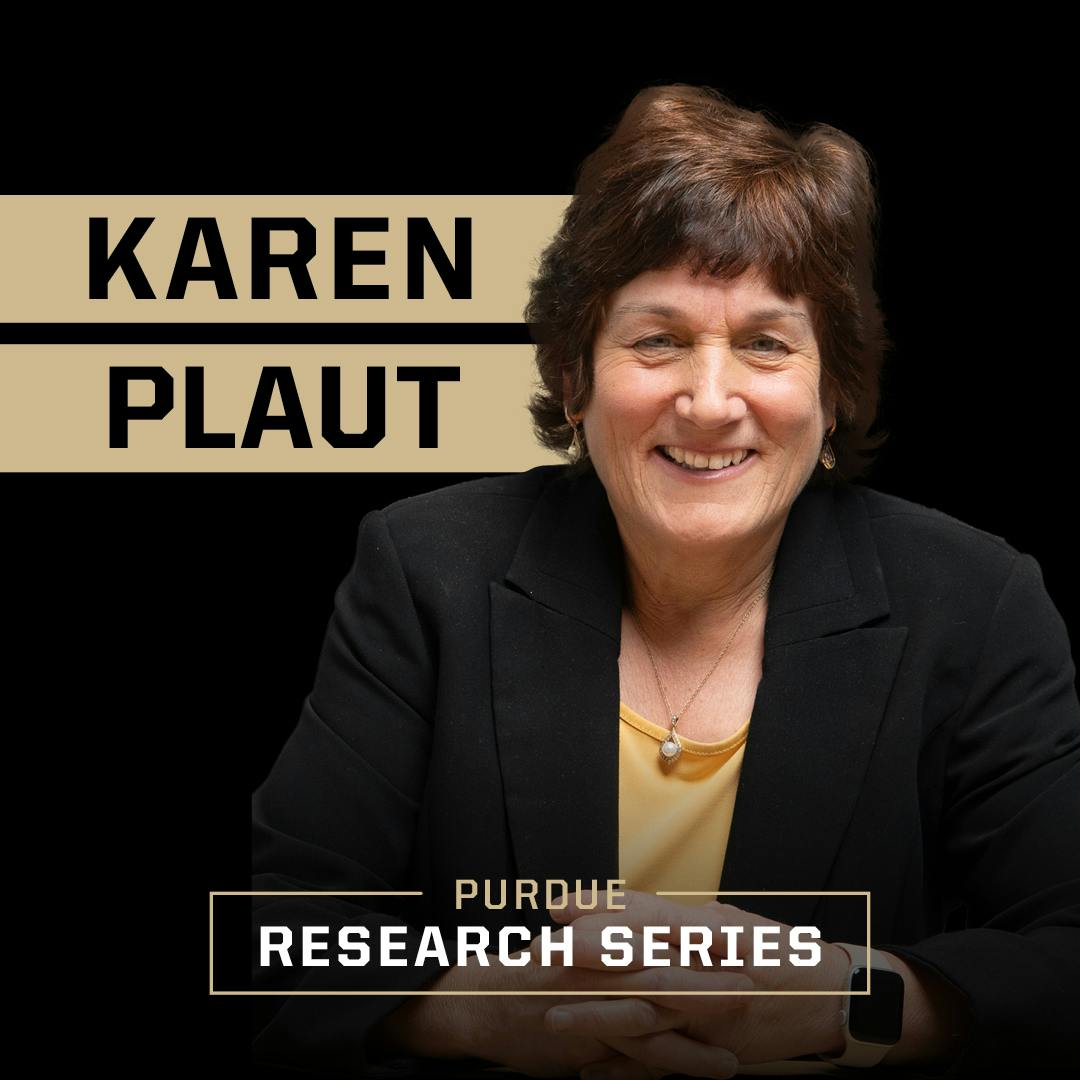
This Is Purdue
Purdue Research Series | A Look Into Innovative and Collaborative Boilermaker Research With Karen Plaut
00:30:15
Loading summary
Transcript74 lines
- [00:00]
Karen Plout
This is Karen Plout and you are listening to this Is Purdue.
- [00:09]
Kate Young
Hi, I'm Kate Young, and you're listening to this Is Purdue, the official podcast for Purdue University. As a Purdue alum and Indiana native, I know firsthand about the family of students and professors who are in it together, persistently pursuing and relentlessly rethinking. Who are the next game changers, difference makers, ceiling breakers, innovators? Who are these boilermakers? Join me as we feature students, faculty and alumni taking small steps toward their giant leaps and inspiring others to do the same.
- [00:44]
Karen Plout
Purdue is an economic engine. It's an economic engine for the state and it has a local and a global impact. What we do impacts so many people, so many businesses, and I want people to understand we make an impact. We make an impact around the world. We make an impact in Indiana. We make an impact in every county in the state by some of our local efforts too.
- [01:08]
Unknown Host
In this episode of this Is Purdue, we're talking to Karen Plout, Executive Vice President for Research at Purdue University. Karen oversees an expanding $600 million research enterprise and is responsible for university wide strategic initiatives and bringing together researchers and resources to drive interdisciplinary discoveries that have both a local and a global impact. She became a boilermaker back in 2010 when she joined Purdue as the Associate Dean for Research for the College of Agriculture and later became the Glenn W. Sample Dean of the College of Agriculture. Before that. Karen's background spans academia at other notable higher education institutions, space flight, animal sciences, and being a lead scientist for NASA's International Space Station Biological Research. And as a researcher at heart, we knew Karen would be the perfect guest for our research series. In this third episode of our 2024 research series, you'll hear more about Karen's leadership at Purdue as she continues to oversee research breakthroughs that truly make an impact on society. Okay, let's get to it. Here's my conversation with Karen.
- [02:31]
Unknown Interviewer
Karen, thank you so much for joining us on this Is Purdue, our official university podcast. We're excited to dig into all things Purdue research. It's such a hot topic now, and you're the perfect person to guide us through that. So today we're in Purdue's Data Science and Artificial Intelligence building, which ties into a lot of Purdue's research initiatives. So we'll get into that with you as well. But as the Executive Vice President for Research at Purdue, you're responsible for so many strategic initiatives, bringing together researchers, resources, and all of this impacts, you know, the whole world. So to start off, share a little bit about your journey To Purdue. How did you come here? And why Purdue?
- [03:10]
Karen Plout
Sure. And thanks for having me on the podcast. I started my career actually on the East Coast. I did my BS at University of Vermont, my master's at Penn State, and my PhD at Cornell. I then went to the National Institutes of Health, the National Cancer Institute, and did a postdoc in mammary gland biology. It's lactation biology. Then started a career at the University of Vermont in lactation biology. Was there for quite a number of years and did a sabbatical or took a leave and went to NASA, which we'll talk about later. And then from there I went to Michigan State as chair of their animal science department. I had been chair at the University of Vermont. And then I saw the ad for the position as associate dean for research at Purdue University for the College of Agriculture and said, that seems like fun. And so went ahead and applied for that job and got it. And that started my career at Purdue in 2010.
- [04:07]
Unknown Interviewer
Amazing. Yeah. We do want to get into your background in animal science and the time that you spent at NASA, so tell us a little bit more about that.
- [04:14]
Karen Plout
Sure. So my background is animal science. I'm a lactation biologist. So I work with mammals in general, many different kinds of mammals. Those are animals that make milk and been doing it for quite a few years. And then at the University of Vermont as an assistant professor. Actually, a professor from Indiana University called me, and he was doing some work in space and needed a lactation biologist. So. So he asked me if I was interested. A few people had referred him to me, and I said, sure, that sounds like fun. And as a result of that, we started a research project where we sent rats to space and actually brought them back to Earth. And we're looking at how lactation changed. He had some other things he was looking at, but my group particularly looked at how milk production was changing in these animals as a result of going to space when they were pregnant.
- [05:07]
Unknown Interviewer
Wow, that is super interesting. What drew you back into higher ed and then specifically to come to Purdue.
- [05:13]
Karen Plout
So that was my experiment in NASA. I actually was with NASA two different times. So that was as a researcher, and that led me to my interest in it. So I then had the opportunity to go to NASA as the lead scientist for the International Space Station for the biological research project. And there we actually were looking at all the habitats for space. And I worked with engineers and all different people, and there we had lots of different facilities, and we're looking at how do we build them for the space station. And it was a complex project because it's both the life scientists and the engineers working together to design these habitats for space. So I did that for a few years, but I really missed the academic environment. And so I decided to come back to academia and I did that. That's when I came back to the University of Vermont as chair of their department, then to Michigan State and then to Purdue. So that's sort of how I got back into academia. Really have enjoyed being in the research space. It's sort of my love also getting to work with undergraduates in undergraduate research and other projects like that.
- [06:19]
Unknown Host
As I mentioned earlier, Karen held various roles within Purdue before becoming the Executive Vice President for Research. I asked Karen what it was like to lead Purdue's prestigious College of Agriculture, which is ranked number four in the country and number six in the world.
- [06:34]
Karen Plout
It's wonderful to being at a world class institution with a world class agricultural college. And it was a great opportunity to move some things forward. One of them is digital agriculture, which refers to sort of the types of things happening in this building. So we're able to build a number of faculty in that area and really move that area forward. We were also lucky enough both when I was Associate Dean of Research and Dean to get the plant sciences. Purdue moves under Mitch Daniels. We got two moves that really moved plant sciences forward and that was lots and lots of fun. So had the opportunity to do both research as well as work with undergraduates, which I really enjoy. And then also the College of Agriculture really plays an important role in the communities in Indiana. So we have people in all 92 counties. So I was able to work with people and find out their needs at the local level and how we can help people at the local level as well as global. We have a World Food Prize winner who also won the National Medal of Science. That's Kabisa Jeddah. I'm able to work with people that are making a difference around the world. And looking at how, how do we feed the world, how do we make a difference for the future?
- [07:43]
Unknown Interviewer
Absolutely. We had two food science professors as part of our research series last year who talked about how do we feed the world. You know, the biggest problem that one could face, right, is hunger.
- [07:53]
Karen Plout
So absolutely. And it's hunger. And food security affects every single person on the planet. So it's one of the few areas where everybody is affected.
- [08:03]
Unknown Interviewer
So In January of 2023, you transitioned into the Office of Research. How did serving as dean of the College of Agriculture kind of help tee you up and prepare you to become the executive vice president of research.
- [08:15]
Karen Plout
Well, and I think both jobs, dean, and before that, the associate dean for research, both prepared me for the job I'm in today, the dean's job. You get to see the big picture. You get to see what's happening at the whole university. You get to work with your colleagues and really think about what does it mean at the university level as well as for your college. As associate dean for research, you help move the research mission forward in the college. You've also worked with all the other associate deans, which have changed over time, but the basic functions haven't. And it helps you understand what kind of tools do we need for research support for our faculty? How do we help our faculty move forward? So you have these two opportunities that really help prepare me as well as my time on NASA, because particularly when I worked with NASA, I worked with so many engineers, and so got a real chance to look at how those things work together. And then our Plant Sciences initiative, which is very interdisciplinary, so got a chance to work with many different people in different departments. And I think that prepared me well for my job.
- [09:18]
Unknown Host
Now, as a lifelong researcher, Karen brings unique insights to leading research and creating an environment conducive to innovation. So how is she fostering this environment in her role as EVP of research at Purdue?
- [09:32]
Karen Plout
I think one of the important things is seeing the connections and seeing how you can build relationships between departments. It's always surprising to me when I go places how few of our scientists necessarily know somebody from a different discipline. So one of the areas that we really help faculty is how do you find collaborators that'll make a difference for them? This week I put some people with Quantum, with some drug discovery, with some AI people. Building those relationships are what really make a difference. And it's one of the things that's really special at Purdue that you can build those interdisciplinary relationships that really make our science excel and soar.
- [10:11]
Unknown Interviewer
Your background, we've talked about a little bit animal sciences, space flight. You talked about NASA's International Space Station, biological research. How did all of these incredible experiences influence your approach to your role now with Purdue?
- [10:25]
Karen Plout
All of them add pieces to it. I think all of us know as you move from job to job, there's pieces you learn in different settings that you can bring to your new job. That spirit of collaboration is something that's happened through many of those jobs in different ways. And learning things like engineers do science a little bit different than life scientists. And so I learned those types of things which groups really collaborate and like to work together. Where is the fundamental science advances? How can we move those forward? All those different jobs teach you many of those different types of things.
- [10:58]
Unknown Interviewer
Through all these experiences and working in research, you know, you've probably had so many unique experiences. Do you have any particular stories or memories that really stand out to you with all of your research work?
- [11:10]
Karen Plout
I actually have a lot of them.
- [11:12]
Unknown Interviewer
Share them all. We have all day.
- [11:15]
Karen Plout
I thought one of the fun ones. So the projects we did at NASA, we actually worked down at Cape Canaveral when the animals come off the shuttle. First of all, seeing the shuttle land and knowing your animals are on that shuttle and that you're going to then work with them after they land, and working with different groups around that is really fun. But particularly all of our animal work involved a lot of undergraduates and bringing undergraduates out to Cape Canaveral. We had also the backup site, Edwards Air Force Base. So I had a full team in California, full team in Florida, all of them working for the same goal and to figure out what difference did space make for these animals. And actually the kind of findings we found from that are something that are unique. And it's a whole field that's moved forward in circadian rhythms. And our NASA work contributed to our understanding of how that works in lactation and with animals and has implications for humans and other species. But I just remember the undergraduates, one of the rules, because we went various times, was you cannot have any exams on Monday morning if we're going out. And of course they all said no. And then we're flying out Sunday and our plane broke. And what do you think happened? We finally made it out of California, but we were went to Iowa or somewhere. That was the only place they could get. And the students tell me, well, we have an exam in the morning. And I'm like, wait a minute, you weren't supposed to come if you had an exam. And we got it all worked out with their professors and things, but, you know, just that kind of interaction and they were so enthusiastic about going, they weren't going to tell me they had an exam.
- [12:52]
Unknown Interviewer
They were not going to miss that experience.
- [12:53]
Karen Plout
Exactly. So lots of fun things. And watching how those students have now grown and that their careers are now accelerating is really fun to watch and see.
- [13:03]
Unknown Interviewer
Have you had students come back to you and say, hey, you made this huge impact on me?
- [13:07]
Karen Plout
Oh, yeah, quite often, to be honest. Not. I don't want to sound braggy, if.
- [13:13]
Unknown Interviewer
That'S a word, but this has to be special.
- [13:15]
Karen Plout
For you, it's really special when students come back and say, hey, yeah, you made a huge impact. It made a big difference in my life.
- [13:21]
Unknown Interviewer
With your role as EVP of research at Purdue, what brings you fulfillment? What is maybe a special memory from your time leading research at Purdue right.
- [13:30]
Karen Plout
Now, seeing some of the big wins, seeing some of these teams that have incredible success. Some of the ones all the way back from the College of Agriculture and are digital forestry, which is part of Plant Science Moves. They've had quite a number of large grants and it's great to see them win these large grants. That allows us to move that whole field forward. It's a fairly new field and we're pioneers, so that would be an example of it. Some of the stuff we're doing in autonomous systems and watching that move forward has been really exciting. Xiaoxi Mu, who runs icon, you know, had recently a story about combining not only the autonomous car, but chatgpt together to help the car understand what you're thinking. Those are so fun and so amazing that we can do those kind of things and we move forward in that kind of direction.
- [14:20]
Unknown Interviewer
What is your vision for the future of Purdue research? What are some of those really big priority areas?
- [14:26]
Karen Plout
One of them is increasing our large multidisciplinary grants, so continuing to move forward in some of those areas. And also we don't have what's called like a uarc, a university affiliated research center or federally funded research and development center. These are other ways to bring resources to Purdue. So looking at how we can leverage those opportunities and move those types of things forward and then obviously making sure all of our areas have the chance to excel and move forward and taking advantage of new buildings like this and what it can do for AI and various things.
- [15:02]
Unknown Interviewer
Absolutely. So speaking of this and AI, we've heard a lot about AI as part of Purdue computes. Tell us a little bit about the areas of AI that Purdue is really focused on.
- [15:12]
Karen Plout
Yeah, so our focus is really physical AI and physical AI. Let me break that down into a couple different categories. So one of them is we make. So this is about making things. And I think most people know our state's a manufacturing state. How do we improve some of those processes using AI, including semiconductors that so many people hear about? So that's one of them. The next one would be we move, which is transportation. And when you think of transportation, you think about autonomous vehicles. It's not just on the ground, it's in the air and making things move forward. It's robotics. We have A researcher working on. I think it's so cool. Robots right now do really well on smooth surfaces, but they're making a robot that has sort of sea legs where it actually is sensing the ground so it can walk on a rocking ship and help the Navy, for example. So all of those kind of things are part of we move, we grow, which is agriculture. I mentioned before the digital agriculture. Really looking how we can use AI and robotics to put the right nutrients in the right place at the right time. It saves money, it helps the environment, and it helps the farmer. So looking at how we can increase productivity in those areas. And then the last area is we thrive, which is about health care, really, and what we can do. And we have some great researchers looking at AI assisted drug development and some of those kind of things to really help us move forward in healthcare.
- [16:40]
Unknown Interviewer
That's incredible. And speaking of healthcare, another big initiative for Purdue is One Health. Why is Purdue poised and set up to lead in that specific area?
- [16:49]
Karen Plout
One Health is a really exciting opportunity because it's the intersection. It's the intersection of humans, plants, animals, and environmental health. And we have expertise in all of those areas. Obviously, we have a veterinary school that really helps us move forward in terms of animals, as well as an animal science department. We have environmental programs. We have the Institute for Sustainable Future, which focuses on the environment. We have many aspects in health and human sciences and in Discovery Park District that work on health and health care. And so lots of opportunities with that. And then the plant sciences, we have all of those kind of things. When you start putting these areas together and look at new initiatives, one of the areas would be comparative genetics and genomics. Every animal has their own set of genes, but we have similarities that do similar functions. So if you start looking at that across species, you can make some findings that we may have never seen before. So really exciting things like that. And then you may have heard about our microbiome, which is the microbes that live, some in our gut, some on our hands, some are out there on the plants. And they all serve different purposes, but we can start using them to our advantage either for the environment. We have good microbes that help the environment. We have good microbes in our stomach when things are going well and looking at which ones really make a difference, how we can work together to figure out their function and figure out how do we maximize the system, the interconnected system, so that our animals benefit, our plants benefit, our environment and us as humans also benefit.
- [18:28]
Unknown Host
We've had a few this is Purdue podcast episodes that have highlighted Purdue's expansion into Indianapolis, which is one of Purdue President Meng Chang's strategic initiatives. I asked Karen what Purdue in Indianapolis means for Purdue research and how students in Indianapolis will contribute to and benefit from this vision.
- [18:46]
Karen Plout
Purdue in India is a really exciting opportunity for the future. We already have the start of some of those areas, motorsports being one of them. Certainly in engineering, that's one. What they're doing in autonomous systems is really exciting. We have a big center, Tassie down there that's doing some really cool things in that space. And then in health care, we already do work with IU Health and we work with IU School of Medicine, the VA hospital, starting to look at what we can do in health care and in biomedical engineering, which is one of our strengths. Start putting that all together and the opportunities are endless. Then I think I mentioned for my own research, the benefit of having those undergraduates, they contribute to these processes. It allows them to figure out where their careers are. And they also come into the lab, often with no preconceived notion about what you're doing. So they ask really insightful questions, really help you move forward and can help you discover whole new areas of research. And so for those students, I think it's going to be a game changer. And the fact that we'll have those opportunities as we move forward will be really powerful. And they can work with Lilly. So they also get game changing research that's changing human health and some things like that. So really I'm excited about the potential.
- [20:03]
Unknown Host
From computer science and life sciences to artificial intelligence, to engineering and aviation, Purdue's research areas are extensive. I asked Karen how she navigates the complexity of overseeing such diverse research areas.
- [20:18]
Karen Plout
Great fun, but sometimes overwhelming.
- [20:21]
Unknown Interviewer
Sure.
- [20:21]
Karen Plout
You know, because you go from learning about nuclear power, we have a digital nuclear reactor, the only one in the country, to learning about hypersonics, to thinking about audiology and hearing disease, to thinking about how you put fertilizer in a field, to all different things. So it provides lots of opportunities and lots of opportunities to connect people. But some days you're running from one to the other and trying to keep up. Okay, what's this one about again? What's this person doing? It makes it really exciting.
- [20:54]
Unknown Interviewer
Yeah. You never have a boring day, I would imagine.
- [20:56]
Karen Plout
That's right.
- [20:57]
Unknown Interviewer
As a public institution, Purdue's research significantly impacts everyone in Indiana, our economy. What are some of the key examples of this and what do you wish more people and maybe lawmakers understood about Purdue research?
- [21:11]
Karen Plout
Overall, Purdue is an economic engine it's an economic engine for the state and it has a local and a global impact. What we do impacts so many people, so many businesses, and over the years there's so many different examples of where we made an impact. Hoover Dam need is a Purdue grad. That's just one example. The most current one is Pluvicto, which is the prostate cancer drug that is saving lives for many, many people that feel low invented. That's like incredible what he's done. He's saving lives across the country. Kabisa Jeddah's work in Ethiopia and other developing countries to develop a Striga resistant sorghum, a sorghum that can feed the world, that can help people that had no means to eat because Strigo, which is a weed, was killing those things. And then what we do in national security. So opportunities to make sure that we have the deterrence we need. Everywhere you look, we've developed new popcorn varieties. Who knew that our apples, the most eaten apple in France was developed by Jules Janik at Purdue. Who would have known? The fda. I'm going back, you shouldn't ask me this question because I can't stop. But the FDA was actually started by a person at Purdue. Harvey Wiley started the fda. Before that, nothing you ate was regulated and so lots of people were getting sick. And he started the Pure Foods act, which started then the formation of the FDA and everything else. And that's why we all have safe food. Who would have thought?
- [22:45]
Unknown Interviewer
I'm thinking of all these new podcast ideas. That's incredible.
- [22:50]
Karen Plout
I want people to understand we make an impact. We make an impact around the world. We make an impact in Indiana, we make an impact in every county in the state by some of our local efforts too. I talked more about the global things people know about, but we also locally make an impact and we're an economic driver for workforce. The talent we develop here is the talent that our Indiana businesses hire. It is fantastic to be training students in a way that they can go out and achieve their own dreams because we've created that opportunity here for them to do that. And I think when you look at talent development, when you look at economic development, there's also new startups that all come from this innovation engine and that's really what we are.
- [23:40]
Unknown Interviewer
We've talked about your incredible career, NASA, other huge higher ed institutions. How does Purdue stand out to you when it comes to fostering innovation and research?
- [23:51]
Karen Plout
It is the most collaborative place I've ever worked in terms of working together. I always tell people other Places say they collaborate, but not the way Purdue does. You can go to anybody in any discipline and say, oh, you should go meet so and so in this other discipline, they never say, oh, they do that. I don't wanna work. They say, great. Oh, I can't wait to meet them. And so you can put people together and make amazing connections that you can't at other places. People just act like average people and like each other.
- [24:20]
Unknown Interviewer
Yeah.
- [24:20]
Karen Plout
And it's not just true at Purdue. It's actually the state of Indiana working across the state. We all work together. We believe in working together to make things happen. And that's not true in many, many other states and other places that I've been.
- [24:34]
Unknown Interviewer
We've had other guests remark on that on the podcast as well. We touched on this a couple minutes ago. But how does this research at Purdue impact the world? You know what would happen if Purdue, who wasn't doing all of this incredible.
- [24:46]
Karen Plout
Research, people would actually starve. I hate to sound dramatic, but some of the inventions and the things we've done in local communities around the world have made it so people can have a proper life. We host the Mandela Washington Fellows every year who are innovation fellows, who then go back to Africa and help develop the innovation ecosystem there. There are so many different types of things. We've had remarkable success in areas like AI. We've had a couple Nobel Prize winners, which you know about. All of these inventions just make a difference. Now, having said that, there are obviously other universities doing lots of good things, too. So I don't want to make it sound like it would be cataclysmic, because that's not true. But it would have a significant impact. I really do think it would have an impact on the world if we didn't exist. It's terrible. We didn't exist.
- [25:39]
Unknown Interviewer
We can't think about that.
- [25:40]
Karen Plout
Yeah.
- [25:42]
Unknown Interviewer
What does it mean to you to be a boilermaker and support Purdue research?
- [25:46]
Karen Plout
I'm proud of what we do. It's really fun to do what we do, and that's partly because of the people we work with. We work with people that care, that have a passion, and that makes it just really, really fun to support Purdue and be a boilermaker.
- [26:01]
Unknown Host
Karen shares a few of her most memorable boilermaker experiences and gives some final advice to those interested in pursuing a career in research.
- [26:10]
Karen Plout
I think anytime you go to a basketball game.
- [26:15]
Unknown Interviewer
Absolutely.
- [26:16]
Karen Plout
But when you're in the arena and the noise and the pride is fantastic. We also, my husband and I, we often support the international students who come and so we'll bring them over to our house. And they are so proud to be at Purdue. It makes you proud to be a boilermaker. And it's really fun, what we take for granted, to see what it means to them. And one of them, this weekend, we met with them and we asked, what did you find that was amazing at Purdue? And one of the things they said, security. And we're like, what does that mean? What are you talking? Secure to walk up the street? Secure to be at the university. We don't even think of some of these things. That, for him was the most amazing thing, was that you could go anywhere and do anything and it was safe.
- [27:04]
Unknown Interviewer
Anyone who's interested in research, what advice would you give to them?
- [27:07]
Karen Plout
Pursue your dreams. And I would say, don't get stuck if you don't like something. And this is even if you're not interested in research, it's any student. And I loved my graduate students, too. So just to be clear, I happen to focus on undergrad. Pursue your dreams. Don't let things get in your way. I'm a woman in a field that was very male oriented.
- [27:29]
Unknown Interviewer
Absolutely.
- [27:29]
Karen Plout
If I let the fact that I was a woman or some of the things that were said to me along the way get in my way, I wouldn't be where I am today. So be resilient. Think about what you want. Try different things. You never know what's interesting till you try it, and then just keep moving forward. When you find those things, say, okay, I want to do that. If you had asked me as a student, would I be working for NASA, I would have gone. That wouldn't happen. If you had asked me if I would have been the executive vice president for Purdue, I would have went, of course not. So you never know what can happen in life. Just pursue those things that make you happy and you'll be successful.
- [28:09]
Unknown Interviewer
I love that. That's great advice. Well, Karen, is there anything I missed? Anything else you want to share with our listeners?
- [28:15]
Karen Plout
I think we covered quite a bit of ground. I could talk for three hours if you wanted, but I don't think that's what we need to do. So thank you very much. I appreciate it.
- [28:23]
Unknown Interviewer
It was wonderful. Thank you.
- [28:24]
Karen Plout
Thank you.
- [28:25]
Unknown Host
We can't thank Karen enough for joining us for our final research series episode of the year. She had such wonderful insights and advice, and her passion for research was so evident during our conversation. Now, Purdue University is an R1 research institution, and there are less than 150 universities in the entire country that classify as one. What exactly does this mean, though? You can watch Karen explain more about Purdue's status as an R1 university on our ThisIs Purdue YouTube page YouTube.com/thisis Purdue and you can also check out Karen's full video interview in Purdue's data science and AI building as well while you're over there. Plus, be sure to follow this Is Purdue on Apple Podcasts, Spotify, iHeartRadio, or wherever you get your podcasts so you never miss an episode. This Is Purdue is hosted and written by me, Kate Young. Our podcast videography for this episode was led by Ted Schellenberger in collaboration with John Garcia, Thad Boone and Zach Mogenson. Our social media marketing is led by Maria Welch. Our podcast distribution strategy is led by Teresa Walker and Carly Eastman. Our podcast design is led by Caitlin Freeville. Our podcast photography is led by John Underwood. Our podcast team project manager is Rain goo. Our podcast YouTube promotions is managed by Kirsten Bowman. Additional writing and research assistance is led by Sophie Ritz and our this Is Purdue intern is Caroline Keim.
- [29:54]
Kate Young
Thanks for listening to this Is Purdue. For more information on this episode, visit our website at Purdue Edu Podcast. There you can head over to your Facebook favorite podcast app to subscribe and leave us a review. And as always, boiler up.