← This Week in AI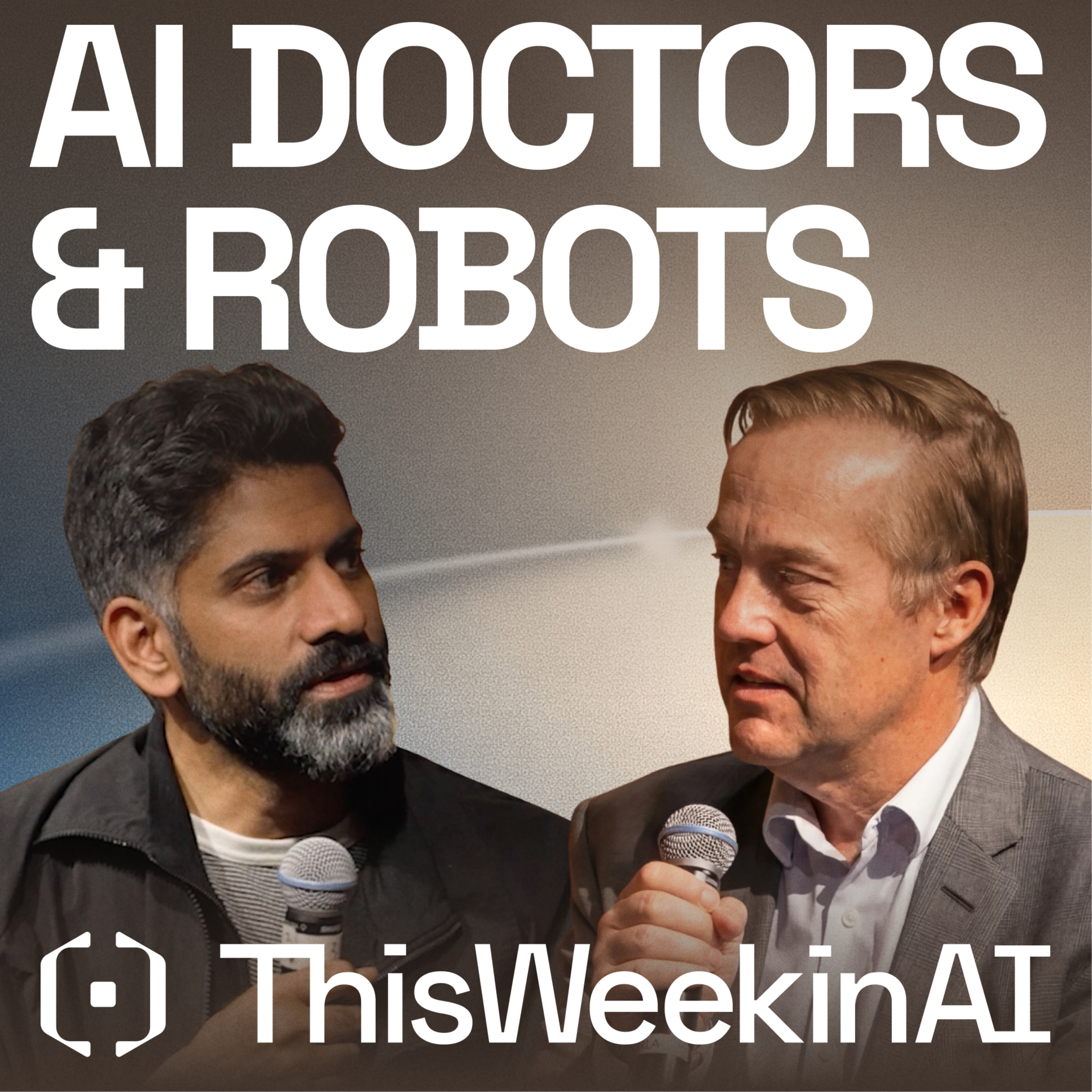
This Week in AI
How Abridge Built A $5B AI Healthcare Unicorn | Shiv Rao, CEO - This Week in AI Ep 5
00:36:13
Loading summary
Transcript73 lines
- [00:00]
A
Large language models can't give medical advice.
- [00:02]
B
Oh, it's coming. Doctors need 30 hours a day to get all of their work done. All of those jobs are what we're going after.
- [00:08]
A
Two choices. Go to the lower third of a general practitioner's and get advice or get it from the top three or four models. Which would you rather see them do?
- [00:18]
B
I would always do the models. There's more demand to see clinicians. There's more people who are on ChatGPT figuring stuff out that makes them think they've got to see somebody, but. But also when they get there, they've got all this information and they're the challenging patient. That 20% is now 100% of your patient load.
- [00:34]
A
Oh, boy. Healthcare is going to be absolutely seismically changed by AI.
- [00:42]
B
This week in AI is brought to you by Quadratic, bringing the productivity boost of AI into your spreadsheets. Visit Quadratic AI Twist to sign up and use the code Twist to get one free month of their pro tier subscription.
- [00:55]
A
There was just some legislation going around in New York and I think this is the surest sign that health care is going to be absolutely seismically changed by AI. And that legislation in New York was that large language models can't give medical advice. When you saw that, what did that say to you?
- [01:15]
B
Oh, it's coming. And I think as a health, as a country, we need this. You know, you think about it right now, there's this huge supply demand shortage. There's patients who are driving in from rural settings 3, 4, 5 hours to the inner city hospital, the UCSF or the Sutter to see that doctor who can save their life. And those systems in the rural settings are shutting down. So we've got to do something about it. And one way we can do that is to build agents that can actually deliver care.
- [01:44]
A
And the great paradox of all this is the United States spends fully twice as much on health care as other nations which have universal health care. And we seem to while having the best health care in the world, if you can afford it, the average person does not have the best health care. Have I summarized or framed correctly the situation here in the United States?
- [02:08]
B
Yeah, absolutely. It's just outcomes are not evenly distributed and in some ways we have the absolute world class. You go into the operating room, I'm a cardiologist, and you go into the catheterization lab. And the kinds of technology that we get to use on our patients is just unreal, unbelievable. It far eclipses anything else out there in any other country. And then at the same time, from an infrastructure standpoint, from a data liquidity standpoint, from those sort of architectural standpoints, we just don't have the fundamentals. We haven't had the fundamentals to build the kind of system that we could.
- [02:45]
A
In my research, I was using Claude and I was like, I'm going to be an expert on healthcare. And so I said, what are the top 10 codes for reimbursement? And then I was like, and how are they efficient or inefficient? How could they be made more efficient? And I gave it permission to think like a founder of a startup. It came back to me and said, hey, there's a lot of in the top 10. A lot of PT. A lot of people go to PT, huh?
- [03:12]
B
Yeah.
- [03:13]
A
But the number one, two and three all seem to be around meeting with a GP. So then I said, okay, educate me on that. And it was like, yeah, the average Visit is like 14 seconds. I mean, I'm exaggerating, but it's, it's somewhere in the teens in terms of minutes. It's absurdly expensive. And it turns out depending on the health care system, a full 15, 20% of the cost is that people who are either incredibly smart or who do not have health care do one of two things before going to the doctor, which is they open up ChatGPT or whatever language model they prefer. Gemini, Claude, Grok, and they do a series of questions just like they used to do web research and wind up on WebMD. Then during COVID we saw telemedicine modality break open. And then we saw companies like RO and HIMSS do telemedicine and prescriptions online. All of this is to say, as an MD, isn't the best solution for MDs in the entire system? Wouldn't it be to have a really tight AI intake process and first meeting with a human in the loop that maybe isn't necessarily a doctor, but understands what to do with your set of symptoms? How should that first visit and consultation work in your mind since you're building this?
- [04:36]
B
Yeah, absolutely. To just give some people context on what the world looks like right now. If a doctor has a clinic on Monday, maybe Sunday night, they're spending hours in front of the TV watching Sunday Night Football like I used to, and they're pre charting, they're looking up all the patients they're gonna see the next day. They're learning about them, they're going through years and years of data. They're sometimes pulling data from seemingly disparate systems just to sort of triangulate. What kind of encounters is this gonna be? Sometimes they'll even go to journals. They'll look up maybe some rare condition that the patient has. Cause they wanna make sure that the next day they're walking in the room and they've already got the contours of a plan. That takes a lot of time. Then the day of, they're walking in the room, oftentimes with a piece of paper, and they're taking chicken scratch while they're talking to the patient. And they have their backs turned to them. Oftentimes too, with the computer turned on and they're writing their notes, they're kind of keeping track of the conversation. Then they're thinking through all the actions that they have to go through afterwards. They have to place orders. They have to place those diagnosis codes. Because those diagnosis codes end up informing the claim, which is the bill, which ends up going to the insurance company over time. They're also putting in referrals. They're also putting in orders for diagnostics, but also therapeutics as well, maybe referring to a proceduralist for which prior authorization is required. Then they're getting on the phone and talking to the insurance company doctor who needs to clear that procedure. So it's a lot of work. There was an American journal, a general internal medicine article that was published a couple years ago that suggested that doctors need 30 hours a day to get all of their work done. And they even parsed where all of that time would go. All of those jobs are what we're going after. And we're trying to go after them in an order that makes sense. And so the order, I think what you're speaking to is that sort of intake process. Can we go after what happens before you're with the patient? Absolutely. Can you also go after what happens during the conversation? That's where we started. Can we take that raw substrate, the conversation, and then from it, can we sort of create all of the artifacts that come next? Notes are one artifact, it turns out. Notes are a rabbit hole. My note as a cardiologist looks very different than a primary care doctor's note, looks different than an orthopedic surgeon's note. And so you need to go after all the different specialties. And all the care settings, like outpatient clinics are different than urgent cares and ERs and inpatient hospitals, but even all the different spoken languages. So there's a lot of complexity to go after.
- [07:07]
A
And so would there be a case? Because I kind of feel like this is a little bit controversial and maybe I'm just reading into it. For every meeting with a doctor that's not an emergency to be done as a pre meeting, I'm going to just use the term pre meeting, even though we both know it might actually half the times be enough. A pre meeting that's done by an AI.
- [07:33]
B
Yeah, yeah, absolutely. What I want is a team, you know, a team of agents maybe that can go. One. One can go after doing the pre meeting. One can have my back during the meeting. One can prepare me for that meeting. One can then place all the orders after that meeting, do the prior authorizations for me. But that coordinated set of like, you know, tasks, like, that's where the real magic is.
- [07:59]
A
And it turns out like a rash, a scratch, or an upper respiratory cold are like two out of three of these meetings.
- [08:09]
B
Totally.
- [08:10]
A
I mean, as an entrepreneur and a doctor, when you look at something that's so obvious, how to fix, do you not lose your mind at a certain point and say, are we purposely not fixing this? And what's the conspiracy here? Is it that the doctors have an ego and they want those first meetings? Is it that the insurance companies have created unintended consequences around the first meeting? What's happening here?
- [08:42]
B
Yeah, I don't know if you remember this. It was, I think, an XKCD from years ago where they invoked Conway's law. You build what you look like. And they had all the sort of big tech companies and they sort of drew what their org charts look like that reflected their products. And so maybe Google looked like a graph or a network and Apple like circles even before their headquarters was built. And then there was Amazon. Everything going up to Bezos at the time. And then there was Microsoft. Pre Nadella, it was silos pointing guns at each other. And that's healthcare. The stakeholders in healthcare are all pointing guns at each other. They're all misaligned. And in an ideal world, they'd be aligned to do the right thing for the person who matters most, the patient, the human. And oftentimes these incentives are misaligned. And then you end up doing potentially perverse things. That's actually a big part of the problem that we're trying to solve. Doctors are burning out. You ask them why they're burning out. Yes. 1, 2, and 3. They'll mention clerical work. They'll say, this is crushing my soul, that I have to spend two to three hours every night in my pajamas doing all this clerical work. I just want to focus on delivering the best experience and the best outcome to my patient. But then you go deeper and you start to unpack that a lot of the tension, a lot of the burnout comes from moral injury that they don't get to do what they know they're capable of doing, which is spending the time making eye contact, actually unpacking the history, being creative, really doing the context engineering that the data isn't even liquid enough for models to be able to do just yet. And that's where I think people want to live. And that's where. And we're trying to get the system to.
- [10:26]
A
If you want to be a data driven founder, and trust me, you do, you're going to need to spend some time in spreadsheets, building models and doing projections. But so many of these spreadsheet programs are stuck in the 90s, thankfully. Now there's Quadratic, finally bringing the productivity boost of AI into your spreadsheets. But this isn't like some simple chatbot in the corner who can answer your questions. No, this is an AI native platform that handles all the number crunching and organization for you. You just describe what you want to do with your data and Quadratic makes it happen right there in the spreadsheet. Now you can get insights about your business without fighting formulas and you can immediately share your results with your team and all of your collaborators. No setup or payments are required upfront. You can just start using Quadratic right now. It's going to blow your mind. Visit Quadratic AI Twist to sign up and use the code Twist to get a free month of their pro tier subscription. That's Q U A D R A T I C AI Twist. Quadratic AI Twist. If I were to ask you candidly, you have a family member, a sibling. This is like an abstract question because obviously you would go figure out how to get them the best care in the world. But in this, you're locked in a chamber and your sibling has two choices. Go to the lower third of the GP sac general practitioners and get advice, or get it from the top three or four models, including yours. Which would you rather see them do?
- [12:07]
B
I would always do the models and then figure out who to see.
- [12:15]
A
And why is that? Because that seems obvious. And the reports out of Harvard and a couple of other very notable institutions that do have skin in the game because they have. Medical schools are reporting now that the answers are more consistent, better from an AI than a doctor off the top of their head, and that the patients prefer it, and that they have better bedside manner on average, which makes sense. They're perfect sycophants who will Tell you, like, oh, my God, that's a great idea. Maybe we should get you some orange juice and liquids, whatever. You know, it's kind of silly, but it's becoming clear that the models are better on average. Yeah.
- [12:58]
B
I think the best clinicians want to work with patients who can give them the best history. And the more prepared that patient can be, it might be off putting at first, but then you really quickly, it sort of pushes you, and that pressure helps you deliver better care. I trained, I did my medicine. So way back in the day, as a kid, I went to Carnegie Mellon and then. And then in the middle became a cardiologist. And I remember when I was training at University of Michigan, like, the. The first patient I saw was this professor at U of M. And as I walked in the room, she started to quiz me on whether or not she had multiple endocrine neoplasia, type 2a or 2b. And this is my first patient as a resident right out of med school. And it was a big eye opener that, okay, like, I need to admit I don't know. And then I need to turn the computer on, and then I need to look this up, and then I need to parse through the literature with this professor to figure out what the answer was, but also what the care plan should be. And I think that is the moment that every single clinician in this country is going to be in. So you need superpowers, yourself and the superpowers that clinicians have. The judgment that they have in understanding which piece of data or which article they should maybe trust, or the judgment that they have from their priors and all the patients that they've cared for is actually really valuable. And that's where they should sort of probably triple down focus their time.
- [14:21]
A
It would seem that getting rid of this charade that the doctor is all knowing and they're not going back and looking it up on the computer when the patient leaves. We should let go of that charade because it's not in anybody's service. It's a much more humble and simple and realistic thing to say. Let me pull up the punch list and the criteria. Let's walk through it together. I'll send you the page. You can put that page into a large language model, knowing that it could hallucinate. So we want to double check all of its results for now. And then myself and I know two other doctors who have seen the largest number of patients. We should probably consult them as to what their frontline experience has been when compared to that checklist because the checklist changes based on the frontline experience over some historic period of time with a little bit of lag, like.
- [15:11]
B
Exactly.
- [15:12]
A
Why doesn't it just occur that way where everybody's just honest about what's going on?
- [15:15]
B
I think we're getting there as a system.
- [15:17]
A
We're getting there.
- [15:18]
B
When a doctor uses a bridge, we have a new feature where we can give them that decision, decision support. We can ground it in the data, but we can also ground it in lived experience across our network. And so I remember In March of 2018, I saw a patient in my clinic. I see patients every. I do one week in the month now. So it's like the bare minimum, minimal. But at the time I had a weekly clinic and I saw this patient, she was 50 years old, had a 10 year history of breast cancer, super nervous and anxious, like crawling out of her skin as we went through sort of her issues. And the main reason she was seeing me as a cardiologist is that she was about to start a new chemotherapy that could affect her heart muscle. She needed clearance and she was super nervous and anxious, like crawling out of her skin. I asked her why at the end, if there was something I did or something I said to make her feel so uncomfortable. She told me that for the last 10 years her husband had come to every single visit with a new doctor, except this one, he just couldn't make it. And I asked her, well, what does he do that's not obvious. And she's an English professor at the University of Pittsburgh. She told me that he would just sit in the corner, he's quiet, he takes notes. And then after the visit, that would actually like help her feel liberated, to make eye contact, to be more present with me, to build a relationship, not be paranoid that when she got home she wouldn't be able to answer some family members question about what did the doctor say? But it also meant that when they got home, they could look at his notes and this is pre chatgpt. Google all the big words, all the medical jargon and rewrite their stories in words they understood and then go to the next doctor and retell it and feel like the main characters as opposed to someone looking in from the outside. Wow. You think about the other side of the room, doctors, it's the same issue. No agency, no autonomy, no ability to actually do the best they can. No ability to be present. And so I remember our first deck to Union Square Ventures in 2019.
- [17:04]
A
Oh, wow. My pal Fred Wilson.
- [17:06]
B
Yeah, to Fred and Andy was a slide where we were going to use the conversation as the primitive from which we would create artifacts for both sides. We would pun intend to build a bridge between them. We would allow them to be present with each other. And so today we're at scale. We're creating these summaries for patients, but we're also creating them for clinicians. And both know we've got superpowers, both of us, but we can kind of help each other.
- [17:30]
A
I started using this plod pin and a plod thing on the back of my phone to take notes. Incredibly powerful.
- [17:36]
B
Yeah, totally.
- [17:37]
A
And that's never existed in healthcare, but today you use something similar, or do you use that, or do you have your own. You turn on a microphone that starts taking these notes. How does it work?
- [17:49]
B
Yeah, we're using the phone right now. We also have a desktop app. We're also starting to partner with companies that might have microphones on the wall. And so where we get the signal, we're relatively agnostic. But the idea is, what can we do with that signal? Because it's never just the conversation. So much of of the challenge right now is context engineering. It's being able to combine that conversation with all the context that lives in all those other systems, whether it's in different medical record systems that don't talk normally, whether it's in medical textbooks, insurance company prior authorization guidelines, clinicaltrials.gov and the list goes on and on. And then it's being able to create those artifacts afterwards.
- [18:30]
A
At what point does your system have a voice and in real time is sharing what it's learning, like transcribing in real time, putting bullet points onto a screen and then saying, there are three more questions we could ask that would fill this out. And it asks the questions, when does that drop? Or is that in the laboratory now? Or have you tested it?
- [18:54]
B
Yeah, it is. There's a version of that that's live right now.
- [18:57]
A
How does it work?
- [18:58]
B
One important UX principle that we've got right now is that the user experience should feel like good air conditioning, where when it's set right, you're not aware of it, you're thinking about everything else that's more important. And so we want to earn the right to take the clinician's attention, because eye contact, being present with each other is so much a part of the value proposition that really helped inflect us. And so we don't have any flashing lights or beeping sounds, but this live assistant that's listening and that also has years of information on this Patient can listen and also hear like, okay, Shiv just prescribed this patient a sleep study. And this patient has this insurance plan in Michigan, Aetna in Michigan, let's just make up. And Aetna in Michigan needs this information in order to get the approval for the sleep study. And if Shiv could just ask this one more question right now while this patient's in front of him, we could give him this approval. That's what we're doing live right now, where it doesn't interrupt me, but when I look down and hit a button, it'll say, hey, three more questions that you should ask.
- [19:57]
A
Oh, so it's on the practitioner side to inform them. That's fascinating. Does it have a name?
- [20:06]
B
No, we're just a bridge right now, but we have a marketing team that's trying to figure that out.
- [20:11]
A
I think I know the name. It's Shiv. Oh no, I think they should know. I'm dead serious. It would then build trust that the founder who had a vision for this, this was Shiv. And Shiv interjects and says, hey, you know, if we're going to really talk about sleep, we need to talk about, you know, your wind down activity. Are you drinking some tea? Did you try reading a book? And you know, when was the last time you had a cup of coffee? And let's get those on tracked on here. Take me even further into the future. You're the doctor, you're having these conversations. But you also have lunatics like myself doing their blood work every six months on my own with function or superpower or whatever. They have a whoop, they've got an eight sleep and they want to talk to Shiv and put all that information in and then talk to a gp. And you know what, I'm going to pick and choose and experiment with Peptides. I'm from Austin, Texas. We do whatever the fuck we want in Texas. So I'm just going to start taking BPC157 and I'll take Retitrutide from a compounding pharmacy and yeah doctor, deal with it. I'm your crazy Joe Rogan Austin JKOW patient. Now take us into the future where people are really doing that self direction because I've seen this future and you've seen it too. People who are quantifying and doing, I guess, customer driven health care. Is there a term for it in the industry for lunatics who do this? What do you call the Joe Rogan crowd that are pursuing their own muse?
- [21:45]
B
Yeah, I don't know the word But I think Uberman's the consumerism is definitely exploding already. I've spoken to doctors recently who told me that they used to count on like an 80, 20 role in their clinic, where 20% of the patients they would see would be more challenging, would be more, you know, equipped with information and self directed. Self directed. And 80% would be more cookie cutter. Like, I've seen this patient a billion times, I know exactly what I need to do, do. And there's some version of Jevons paradox also to invoke here. But now more and more, there's more demand to see clinicians, there's more people who are on ChatGPT figuring stuff out that makes them think they've got to see somebody and maybe even a specialist, not just the primary care clinician, but they want to beeline to the specialist. But also when they get there, they've got all this information and they're the challenging patient. That 20% is now 100% of your patient.
- [22:42]
A
Boy.
- [22:43]
B
And so it actually compounds the issues right now, like some of the challenges, the supply, demand issues, the burnout. And so even more important to give clinicians as well all the tools they can to sort of parse through this to pre take. Like, you brought up the intake stuff and like, get leverage from technology.
- [23:01]
A
Why do we have to get advice from a GP as opposed to having, like, my mom's a nurse practitioner, she can do a couple of things and some nurse practitioners can write a prescription, but you go to France and they're like, oh, Z pack. Yeah, here you go. You want two? You just talk to the pharmacist or other people will talk to a consultant, a concierge. And why are we stuck on this GP thing here? Is it another example of everybody in the silos pointing guns at each other? Because it does seem like they have way too much pressure on them. They do. There's too few of them.
- [23:34]
B
There's too few of them. One thing I've learned over these last few years of talking to health system executives is that there is a natural progression of where AI specifically is getting implemented that relates to the GP issue, where you think about two axes, high stakes versus low stakes. And then on the other axis, think about frequency. The high stakes, high frequency workflows are the last to get touched. They end up being super clinical. For example, AI that can predict sepsis and tell the doctor to use this antibiotic versus another one that could make a really, really big difference on the patient's outcome, their trajectory. There's going to be hoops that technology companies are going to have to jump through and probably the FDA could be involved as well. Hardware oftentimes in the operating room is in that quadrant. But, but think about low acuity, high frequency in the low stakes, high frequency sort of quadrant. That's where prescription refills comes into play. This patient has a long standing history of gout and has been on a specific drug for it for 20 years. Can they not just get the refill from technology can not be automated. Can the context not be pulled from existing systems so that it's safe as well, that there's new, new drug, drug interactions that can't be de risked by some sort of model? 100%. And that's where things are going. So already Utah has approved AI refills for patients for very specific drugs. But I think what we should all expect over these coming years is that they'll land somewhere with a certain set of conditions and a certain set of medications, but then very quickly expand. And I think that lower stakes sort of quadrant for use cases like medication refills will go and then we'll start to get into maybe other aspects of primary care as well. But I expect primary care clinicians will still have more and more work to do on top of that. And so we'll still have a lot of catch up.
- [25:41]
A
Should the nurses be more empowered to take on some of those low stakes or mid stakes high frequencies?
- [25:48]
B
And are they 100%? They are. And physician assistants as well are as well. And we still don't have enough people. You know, like there's this labor addiction that healthcare has, not just on the clinical side, but just in general. There's just not enough people. I don't know what the statistic is. What is it like one in five people work for a health system or work in healthcare. It's pretty unbelievable that we still can't hire fast enough into all the different parts of healthcare delivery. Because it's not just care delivery with the doctor and the patient or the nurse and the patient. There's also all the back end stuff that happens, all the administrative work, revenue cycle. There's all the stuff related to what insurance companies do. There's just a lot of technology. Remember I was on a panel recently at GTC and Nvidia is an investor and they had put us together with some leaders from this current administration. And after the panel, one of these leaders from the administration sort of reached out to me and said, hey, can you keep you built on top of Cobalt?
- [26:53]
A
Cobalt, the programming language that Fred Friendstone and Barney Rubble learned on yes, and
- [27:00]
B
that's the world that we're like living in in healthcare. Obviously, when anthropic and cloud code announced that they could actually do like build on top of cobalt like that did a number on IBM, it did a number on like a lot of industries. But healthcare is one of those industries where a part of the opportunity is being able to abstract away and build something modern on top.
- [27:20]
A
Robotics keeps coming up. Healthcare has been engaged in that, specifically surgery, for a long time, right? Decades. What is your view on robotics and specifically humanoid robotics playing a role here?
- [27:35]
B
I think it'll happen, it'll take a little bit longer. There is already really interesting research that's happening involving large language models and robots at Hopkins. So at Johns Hopkins there is a robot model that can even not get distracted by the trainee medical students, hands fumbling around the operating sort of space and still get the job done. They demonstrate in these videos all the different types of sutures that this model has learned how to do and how exacting it can be. And so I imagine probably they'll deploy some aspects of this, almost like skills, you know, like they'll deploy a skill like the suture skill first and maybe go from there into the actual incision, you know, the opening.
- [28:23]
A
And then think about the emergency field cpr, totally intubation, totally mass pants. Like there's just getting people's vitals. Like there's a long list of emerging things. I wish all this money we're putting towards making more sophisticated BOMs, we could make a more sophisticated EMT or paramedic. Like think about that. There's a huge opportunity. There's probably $100 billion that are going to be invested in military tech startups. And I don't know if there's a hundred million dollars being invested in paramedic who could do frontline saving lives, but we're more than willing to pay to take them.
- [28:59]
B
And you think about those cost disease curves, you know, those Balmos graphs, and healthcare is right there at the top. If we don't do something about making it cheaper, better, faster, we are in for a lot of pain and suffering and our kids are as well, and their kids. And so what have you learned as
- [29:16]
A
an entrepreneur about going into a highly regulated space like this? It must be incredibly frustrating. But you did have the MD background, so you knew what you were getting into. But now that you've got a company that has to ship products, make money, has a certain amount of Runway, even if it's a lot right now. You have to make things happen. There's a clock ticking for all startups. What have you learned now about operating in one of these crazy environments that's so regulated and there's so much institutional
- [29:44]
B
inertia at every single health system? By the way, there's that one person in the basement who knows all of the secrets, who's actually got the context that you need to pull out. And honestly, that's part of the moat. That's a part of why vertical AI companies, especially in regulated industries like healthcare, can win. Prior to starting a bridge, I was a corporate VC for a large health system. So one of the maybe three health systems that was deploying a lot of capital into startups. So I got to learn osmotically from founders and other VCs. And that's where I got fixated on Union Square Ventures being a great seed investor for us. And then I just felt like I wanted to build myself so quit that job, not a spinoff. I really wanted to have complete control and then started a bridge. And one of the first lessons I would say that we learned over the first couple years of this company was that go to market means everything. Like in an industry like healthcare, especially if you don't sort of parse the market and figure out who you're building for, then you could be led astray really, really quickly. A lot of investors would tell us, go down market, build something, get some semblance of PMF as fast as you can, and then swim upstream over time, but go to where the bared entry is lowest. And sometimes I think what that leads to is startups sort of going there, but then getting pulled into, in healthcare's case, like sort of small clinics, SMB clinics sort of pulled into going direct to doctor to the individual, direct primary care.
- [31:10]
A
And that's a problem why it's such
- [31:12]
B
a problem right now in this AI moment, especially because the world is moving so quickly and by the time you're ready to move upstream, you've sort of lost your shot, like the window is closed. A lot of the decision makers in health care are on the same WhatsApp group and they're talking to each other. And so there's this word of mouth virality to just sort of succeeding. So it is like a high stakes move to make, but as soon as you can, you need to move upstream in healthcare. So there's a million doctors in this country, about 70% of them work or affiliated with large health systems. And if you can't get to that segment fast and it does mean that the bar is going to be higher for security and privacy and like your enterprise grade. And you're able to serve all the different types of people and all the different types of settings you can integrate into the workflow. You can pull data and push data. It's a higher bar, but you want to hit that bar as fast as you can and then run there as fast as you can. Because you can always go downstream. But. But swimming upstream is something that I think, you know, you won't, you'll have,
- [32:12]
A
you won't go to market strategy. And how much did you raise in that first round?
- [32:17]
B
Yeah. Oh, man, like rounds. Then we raised 3 million on 12. So that was 12 pre. 12 pre, yeah.
- [32:27]
A
Okay, so you gave away 20% of the company in that first round. Company's worth 5 billion now. That's a billion dollar return for Fred. Well done. You made that fund. He does $300 million fund. You3x the fund. Well done.
- [32:40]
B
That was 2019.
- [32:41]
A
2019.
- [32:42]
B
We started the company three months after attention is all you need. That was a part of our like why now Thesis. It was just Transformers. And we started with Bert Biobert long former Pegasus T5. So these pre trained models that predated LLMs. But when LLMs came out in 2022 in a real way for us, we kind of knew what to do with them. So there's this like, you know, refrain here that being early is being wrong, but not if you don't die, if you stay standing.
- [33:07]
A
Such a good insight is getting there early and then having a way to survive. And it's like you get to the new world and you're not killed immediately and you survive. Like, yes, the good things can happen. You have to survive for that next sunrise. And for you, that was what you were providing. What product?
- [33:28]
B
It was the same product that we were demoing. And what I didn't realize is we were preceding the market in 2021 and 2022, but the market wasn't pulling. But then ChatGPT definitely created a moment. And so late 2022 and early 2023, first quarter, everyone was like, ah, I remember that demo. And I remember that dinner you did about Generative AI a year and a half ago. Like, we'll try this out. Let's pilot this. And so we had to yolo.
- [33:51]
A
Yeah. It's such a important lesson. You have to. If you're too early, like, there was a company called Taxi Magic that allowed you and Vindigo, I think Vidigo. What was the one on PalmPilot. I forgot the name of it, but it let you order a taxi through text messaging. I think that was taxi magic. That did it. And just you had to wait for the iPhone moment. You needed to have GPS for it to actually work. No gps. It was kind of like, totally okay. You're just still talking to the dispatcher. You're not actually watching the car arrive.
- [34:23]
B
But it's tricky, too, for a founder, because I personally believe that you want to have. In order to withstand, to. To stay standing, to survive, you're served. Well, if you have at least one strong idea that you hold really tightly to, that's like your North Star. Your thesis, like, taxis are going to be on demand at some point. I'm going to ride or die on this. We are going to figure it out. We might do some little side projects here, but we're going to get there. And I think for us, the thesis has always been that in this country and around the world, healthcare is going to be pretty human for the foreseeable. Get really, really sick. Your loved one is going to go to the hospital and they're going to see a doctor or a nurse, and that doctor or nurse is going to have all the latest and greatest tools. But you're going to want to see a human and you're going to get maybe a procedure, and that's going to be a human. It's not going to be a robot anytime too soon. There's that basocim. What's not going to change in the next 10 years? For us, it was that if that's the case, then one of the original signals in healthcare is spoken. And if you can combine that with all the other context, all the other data, then you can get all the different jobs done. And then another really key thesis for us is that in this country, you're not compensated as a doctor for the care that you deliver. You're compensated for the care that you documented that you deliver. So these notes are actually bills. And that means you're sort of sitting upstream with the ability to impact not just how care is experienced, make it better. More eye contact, less burnout, less time at night doing clerical work. But you can also impact how it's paid for, how much is paid. You can get into outcomes over time because you can help the clinician make a better decision or help the patient, you know, better understand themselves.
- [36:05]
A
Give it up for Shiv. Thank you. Well done. Really appreciate you coming down and sharing. And we're rooting for you.
- [36:12]
B
Thank you.
- [36:13]
A
Thank you, brother.