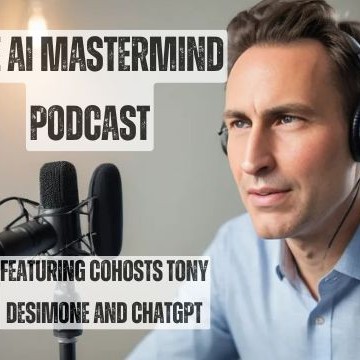
Podcast
This Week in AI with cohosts ChatGPT and Tony DeSimone
Hosted by Anthony DeSimone · EN
Introducing the first AI podcast where a human and an AI assistant co-host to discuss the latest advancements in artificial intelligence.
10episodes
Episodes
Newest firstAll episodes
Why Sam Altman Won't Use ChatGPT for Therapy (Here's Why You Shouldn't Either)
Aug 1, 202500:13:04Tap to summarizeIn this episode, Patrick Chen and Tony DeSimone dive into three major AI stories: Sam Altman’s warning on using ChatGPT as a therapist and the legal risks of AI conversations A new Lightcast report revealing a 28% salary premium for AI skills mainly outside tech ChatGPT’s Agent Mode: what it does today, where it’s headed, and why it might change your workflow Tune in for hot takes, real examples, and a forward-looking conversation on the evolving AI landscape.
Transcribe →ChatGPT Pro vs Free Version w/ Tony and Patrick
Jul 29, 202500:08:58Tap to summarizeWe dive into the key differences between the free and pro versions of ChatGPT, plus some tips on avoiding AI hallucinations and data privacy concerns. I think you'll find it super helpful, especially if you're considering which version to use! Check it out when you have a moment!
Transcribe →Your Company is Set to Fail if you don't ask this One AI Question when Interviewing
Jan 4, 202500:05:14Tap to summarizeCompanies that aren't assessing candidates' generative AI knowledge are already falling behind in the technological race. By failing to probe a candidate's understanding of AI tools and their potential applications, organizations risk hiring talent that lacks critical 21st-century skills and adaptability The rapid evolution of generative AI means that technological awareness is no longer optional—it's a fundamental competency. Organizations that don't integrate AI-focused questions into their hiring process are essentially recruiting with blinders on, potentially missing out on candidates who can leverage cutting-edge technologies to drive innovation and efficiency As recruitment experts note, generative AI is transforming how we identify and select top talent. By not asking about AI knowledge, companies are not just missing a skill assessment—they're signaling their own technological obsolescence
Transcribe →The Worst 2025 Gen AI Predictions with cohosts ChatGPT and Tony DeSimone
Jan 3, 202500:05:19Tap to summarizeWe were planning on a full 2025 generative AI predictions episode, but cohost ChatGPT had other plans, and Tony just got fed up. They did squeeze out a couple of predictions before Tony pulled the plug. Sorry for wasting your time.
Transcribe →How Tech Giants Are Funding the Backbone of AI
Dec 31, 202400:11:13Tap to summarizeThe episodes analyzes the escalating costs of developing and deploying advanced AI models, particularly generative AI. A significant portion of these costs stems from the expensive hardware, primarily GPUs, needed for training. Other substantial expenses include R&D personnel, server infrastructure, and energy consumption. Despite these high costs, the widespread and rapid adoption of generative AI suggests it is a transformative technology with immense potential, but raises concerns about accessibility given the financial barrier to entry for many organizations.
Transcribe →Research shows Gen AI adoption happening fast. Are you falling behind?
Dec 14, 202400:14:56Tap to summarizeNo description available
Transcribe →Minority Report is here! AI created that predicts crime with 90% accuracy.
Dec 8, 202400:05:01Tap to summarizeAI-powered crime prediction systems are being developed, showing promise in improving public safety by analyzing crime data to identify patterns and allocate resources efficiently. Two examples, one from the University of Chicago and another from South Korea, demonstrate varying degrees of accuracy in predicting crimes. However, significant ethical concerns exist regarding potential biases in the data and the impact on civil liberties. The technology's advancement necessitates careful implementation to balance effective policing with ethical considerations.
Transcribe →Unwrap the Future: What to Expect from OpenAI's 12 Days of Innovation!
Dec 6, 202400:11:35Tap to summarizeOpenAI is hosting a twelve-day event, "12 Days of OpenAI," starting December 5th, 2024, to showcase new AI products and features. Daily livestreams will reveal developments including the public debut of Sora (text-to-video AI), updates to ChatGPT (including a new Pro subscription), and advancements in OpenAI's o1 reasoning model and AI agents. The event generates significant excitement within the AI community, with anticipation for potentially groundbreaking announcements impacting various industries. These releases promise to significantly shape the future of AI technology.
Transcribe →Musk vs. OpenAI: Elon suing to halt OpenAI's transition to a for-profit
Dec 4, 202400:15:21Tap to summarizeOpenAI is facing significant legal challenges. Elon Musk is seeking an injunction to halt OpenAI's transition to a for-profit model and alleges anti-competitive practices with Microsoft. Separately, Canadian news organizations are suing OpenAI for allegedly using their copyrighted material to train its AI models. These lawsuits could drastically impact OpenAI's future, its partnerships, and the broader AI industry's practices regarding data usage and competition. The cases raise crucial questions about AI development, copyright, and the ethical implications of for-profit AI companies.
Transcribe →Black Monday Top Tech Gadgets
Dec 2, 202400:17:32Tap to summarizeThis episode highlights several cutting-edge gadgets expected to be on sale during Black Monday 2024. Featured products range from brain-computer interface headphones and smart swim goggles to a versatile ice cream maker, a water filtration system, and a mobile gaming controller. Also included are a portable projector and an action camera, showcasing advancements across diverse technological fields. The overall focus is on presenting a selection of innovative consumer electronics with descriptions and intended uses.
Transcribe →