← This Week in Global Development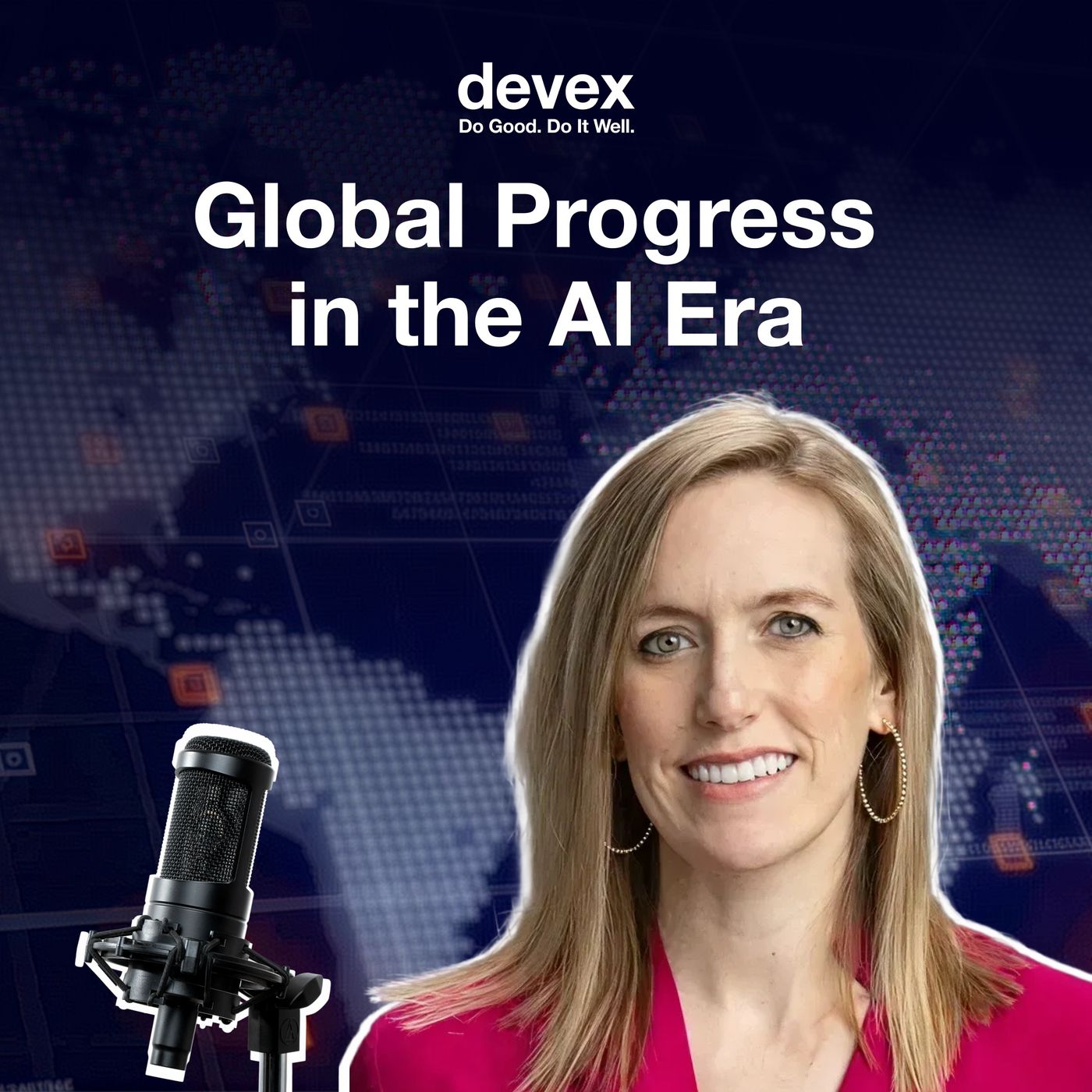
This Week in Global Development
Global Progress in the AI Era: Can a new effort scale AI for good to reach hundreds of millions?
00:41:41
Too many “AI for good” pilots fail before reaching the people who need them most. To solve this scaling crisis, Kanika Bahl, the CEO of Evidence Action, is stepping down from the helm of the organization to lead a new effort called the AI Access...
Loading summary
Transcript34 lines
- [00:00]
A
Foreign.
- [00:07]
B
Is one of the defining forces of our time. It's reshaping how money flows, how services reach people and who holds power. I'm Katherine Chaney, senior editor for special coverage at devex and this is Global Progress in the AI Era, a special edition podcast series exploring what happens when AI collides with the world's biggest challenges. In each episode we speak to leaders from philanthropy, government, civil society and the private sector who are responding to this technological turning point. They'll break down how AI could unlock breakthroughs in health, agriculture and education, and what it will take to avoid the risks of deepening inequality. We'll tackle difficult questions and spotlight promising ideas that will determine whether AI accelerates global progress or leaves more people behind. Artificial intelligence is advancing at extraordinary speed, but in global development, the story often looks very different. Promising pilots that never scale or tools that don't survive beyond donor funding, perpetuating the problem of so called digital graveyards. So what will it actually take to move from hype to population level impact and AI for Good? Today we're joined by Kanika Ball who has announced she'll be stepping down as CEO of Evidence Action and an organization she currently leads known for scaling evidence based interventions to hundreds of millions of people. And she'll be leading a new effort incubated within Evidence Action called the AI Access Initiative. Their goal is to strengthen the AI for Good ecosystem in order to ensure the technology delivers meaningful benefits for the 3.5 billion people living in poverty in low and middle income countries. Kanika is also a founding member of Anthropic's Long Term Benefit Trust, an independent body designed to help the AI lab achieve its public benefit mission. Kanika, welcome and thank you so much for joining us.
- [01:59]
A
Thank you for having me, Catherine. So I should be here.
- [02:02]
B
Great to have you. So I want to start with the big picture and this is really the problem you are looking to tackle, why AI for Good isn't scaling. So of course we're seeing extraordinary advances in AI capabilities, but in many low and middle income countries, a lot of this activity feels super fragmented. Lots of pilots, lots of excitement, but limited scale. So why is that such an important
- [02:29]
A
and such a great question? Katherine, we are at an exciting inflection point in AI for Good and I do want to note there's both early excitement and traction and also many actors doing strong work in research, design and building. But as you say, much more work is needed to ensure scaled reach. Most AI enabled actors at LMICs are designing for very specific context rather than asking how do we reach a meaningful percentage of the world's 3 1/2 billion? 4 who can benefit? And I think we oftentimes think the bottleneck is model quality. From my perspective, it is very much not the core bottleneck. It's actually fragmentation across policy, funding, benchmarking, last mile delivery. And like any technology, frontier labs, frontier tools can't solve distribution, trust and regulatory gaps. And so what we're seeing is what you, you alluded to, which is small pilots without the scale pathways can quickly turn into digital graveyards. They don't, you know, move beyond proof of concept because that hadn't been built into the design from the start. And I'll say that, you know, I've worked in global health for much of my career and this is very familiar. And I think the risk is we can easily spend billions of dollars on smell skill learning with little to show for it in terms of impact. And I think the analog I keep returning to is global health's delays in driving uptake of even very simple innovations. We've seen it again and again with things like vaccines, pediatric ARVs, simple innovations, they can take 10, 20 years to scale in low middle income countries versus one to two years in the developed world. And so for my organization, the AI Access initiative and for what we're promoting more broadly for the ecosystem, scale is core to our mission and to the design of projects from the start. We start asking ourselves from the outset, how do we create programs that could reach tens or hundreds of millions of people and then start from there rather than from the pilot or the technology? What does that mean practically? Well, first we look for where there are existing trusted systems. We want AI tools to integrate into centralized care pathways that are already reaching millions of people. That's the first criteria. Second, we look for minimal behavior change. We want AI tools that actually solve pain points for the users, whether that's healthcare workers, doctors, farmers, and actually streamline steps within existing care pathways rather than actually creating parallel or additional work burdens. Third, we are looking for highly cost effective approaches. AI needs to offer a cost effective means of achieving outcomes with clear cost savings for a possible.
- [06:00]
B
What are some examples that come to mind just to make this concrete in people's heads about the again the, the severity of the problem you're looking to address right now?
- [06:11]
A
Yeah, I think I will go to the example of health innovations where what we see is without concerted efforts and actions at the value chain, either really phenomenal new products don't get to scale or they can lag for many, many Years. And so an example that's very near and dear to my heart is work that I did with pediatric HIV AIDS drugs at the Clinton Health Access Initiative many years ago. What we were seeing then is that HIV AIDS drugs for adults had reached quite high penetration. This was in the early 2000s. But actually children, if they weren't treated, 50% of them die before the age of two. But very few were receiving treatment. And the reason that they weren't receiving treatment wasn't because the drugs didn't exist. The drugs existed. There was funding flowing from pepfar, there was funding flowing from Global Fund, there was, it was written into treatment guidelines, but it wasn't happening. And a lot of money was being spent on HIV aids, but these kids were being left behind. And the reason that was happening was because there was disconnected action at every level of the marketplace. You had suppliers, manufacturers who were producing drugs, but they were costing $600 per person per year versus $100 for an adult. They were these terrible tasting basket full of hard to dose syrups that kids needed to take. And as a mother of a child who hates taking medicine, I feel like it's karma. I have seen how hard it is to get kids to take any medication, let alone basketfuls of bad tasting syrup. The World Health Organization and Global Fund saw the benefits, but they were slow to purchase it because countries weren't demanding it because it was too expensive. Countries weren't scaling because they didn't have, you know, people weren't, they didn't have the doctors who were trained and it wasn't in their guidelines, et cetera. And so what you see is the situation where there was these uncoordinated actions. And what I and others the organization did was step into that and say, we're going to work in a coordinated department at every level of that value chain to drive uptake. We were able over the course of a year or two to bring prices down to $60 per person per year. Get small, easy to get, easy to take pills, get it into funding, get into the government systems and drive uptake. And I think that is the type of coordinated action that you need to be seeing here to prevent the situation where great products are simply not being uptaken. A lot of money is potentially being spent, but with very low return.
- [09:06]
B
It's funny, when I asked about examples, I was thinking AI examples, but it's actually really helpful to hear an example from your time when the Clinton Health Access Initiative and a lot of the parallel examples we've seen in Global Health, you've talked about how Evidence Action is really looking for unicorns. What does that mean and what does that mean now in your work with the AI Access Initiative? And in other words, why are you the person to be leading an effort like this? What are the parallels between your work at Evidence Action and what you're going to be doing now with these AI big bets?
- [09:36]
A
Thanks, Katherine. At Evidence Action we really have a very rigorous set of criteria we use to to identify interventions that are going to drive truly outsized impact. So we have an accelerator process and actually only 3% of the projects that we look at advance to ones that we will think will scale because we have very strict criteria which we have now applied to the AI work. And a large part of what we're doing is saying what can we identify that will meaningfully improve the lives of hundreds of millions of people in an evidence based way? And so as an example, at Evidence Action we have reached over 500 million people in the past decade with the products and projects that we have scaled. And that's how I came to this work. I really came to the work wearing a dual hat. As a founding member of Anthropic's Long Term Benefit Trust, I had a front row seat the pace of AI's development. And then from my time at Evidence Action I had this unicorn lens of how do you find interventions that reach massive scale in a cost effective, evidence based way? Last year the Trust in Anthropic's leadership really began grappling together with a question of if transformative AI arrives far faster than global systems are prepared for, who and how do we ensure its benefits reach low and middle income countries, particularly those living in poverty? And I will say the question to me felt urgent and I didn't have answers, nor could I readily find them. So I did what I do, which is I very systematically began to ask, what are these solutions? I spoke with a wide range of experts across technical implementation research disciplines. And I quickly realized more work was needed to drive a crisp picture of the opportunity. At that point I decided to pull together a dedicated team housed at Evidence Action. Leveraging some of the learnings from the accelerator approach, we rapidly researched potential AI enabled big bets with credible pathways to reach tens or millions of people. Tens or hundreds of millions of people. We were fortunate that Dario Amadai of Anthropic, Kent Walker from Google, Nobel Laureate Michael Kramer, all signed on as formal advisors and we also received just phenomenal advice across AI labs, academia, philanthropy, NGOs, government. Just the level of interest was really tremendous. We developed a rigorous evaluation process and applied the same discipline that guides evidence action. Scale up of interventions reaching 500 million plus people. Ultimately, the evaluation framework included things like scale. Can this intervention reach tens or hundreds of millions of people? Is AI a key unlock? We wanted to make sure that AI drove a clear meaningful improvement in the core outcome versus the status quo. We looked at evidence, both strong evidence that AI performed non AI options and evidence of the underlying intervention. We look at cost effectiveness. Is there a high impact per dollar, even if upfront investment is needed, which is important in this space because in some cases that will be needed. And then very importantly, we looked at tractability and a number of things underpin tractability. One is simplicity. Is there minimal behavior change and minimal touch points? Two, technical tractability are the data, the models, the infrastructure mature and ready for these solutions. Three operational do pilots show success in a path to scale? And then four political and social. We thought about things where there might be high regulation risk, negative externalities or a risk of costly AI errors. Mental health is an example of where there could be real upside but but also very meaningful risks that we may not be able to mitigate for. From there we built a picture that there are high readiness bets with potential for big impact. And that was a big question. We started with Catherine, is there a there there? And I think as we looked into this work, we were increasingly struck that yes, there is real work needed across the value chain to make these a success, but there are big bets here and there is really transformational impact.
- [14:35]
C
Hi, I'm Kate Warren, Executive Vice President and Executive Editor at devex. At devex, we don't just cover the biggest moments in global development. We create space to understand who and what are driving the headlines. Alongside gatherings like the World bank and IMF Spring and Annual meetings, the World Health assembly, the UN General assembly and beyond, we host Devex Impact House, where our journalism comes off the page and onto the stage. We bring together a curated group of leaders for live interviews, intimate roundtables, hands on workshops, and candid conversations you won't hear in the official meetings. That's where tough questions get asked, the spin gets stripped away, and meaningful connections happen. If you'd like to join us or stay in the loop on all of our events online and in person, please visit devex.com events and I know Kanika,
- [15:28]
B
in asking is there a there there? There are three examples that really kind of emerge to the top as potentially really exciting big bets. And I'm familiar with them. Of course we've spoken about them. But for those who are less familiar, can you tell us about them?
- [15:41]
A
Absolutely. So one is AI generated weather forecasts for farmers. So to sketch out the opportunity, there's over 475 million smallholder farmers who depend on weather for their livelihoods. Many of these farmers make less than $1,500 a year. So incremental changes in income are very meaningful for their lives. Most LMICs actually lack accurate and timely forecasts, which is even more problematic in an era of climate change. Usually weather models, traditional weather models, they perform poorly in tropical climates. And you typically generalize local forecasts via physics models, which can take days on supercomputers without AI. By the time physical forecasts reach farmers, the information is often outdated and not usable. AI is really exciting because AI based forecasting actually sharply reduces the cost and the time to generate high quality forecasts. We've seen that access to reliable forecasts allows farmers to adjust practices like planting, irrigation, fertilization. And so our focus with the weather forecasts is to actually deliver these forecasts to tens of millions, hundreds of millions. And that's through scaling forecast delivery systems, driving farmer uptake, through message testing and channel testing, and working with the AI labs to actually develop new AI enabled forecasts that meet farmers needs.
- [17:20]
B
In terms of working with the AI labs in this example and the other two, we'll talk about, what does that look like? You know, I keep seeing partnerships being announced with AI labs and you know, I think each AI lab approaches it differently. Some of them have, you know, in the case of anthropic, there's the beneficial deployments program for example. But can you just kind of unpack for me, what do you mean by AI labs getting involved in this kind of work?
- [17:50]
A
Yeah, that's a great question. So I think it really depends on a given area. So with weather forecasts, Google has very strong models, but we'd like other labs to be developing those. So part of that will be over time sharing with them. Here are the human centric needs of farmers. What is the gap to producing those models? In some cases we are hearing that good benchmarking is critical for the labs to know how these models are doing. It could be access to data, it could simply be a lack of understanding of what models are the most useful for farmers. And so a big part of what we foresee doing over time with the labs is actually helping alert them to what are the biggest needs and then working with them to fill the gaps that they may not have access to data from, from the countries, training Data, for example, good benchmarks to help really address that. In other instances I can envision with some of the clinical decision support, it may be much more saying, okay, what we really need to unlock this opportunity is voice to text and better voice to text on multiple languages and then working with the labs to really help prioritize that.
- [19:06]
B
So I know the other two areas, since we've talked through them before, are the clinical decision support to improve diagnostic accuracy, especially in overstretched health systems health, as well as this direct to consumer health information to reduce delays in care seeking. So across those three areas, I see a lot of opportunity for the global development community here because as you were just mentioning, when it comes to the AI generated weather forecasting for smallholder farmers, there's a lot that AI labs can do, but there are limits of their knowledge about these markets and what's needed. And so do you see the global development community and people who've worked on these issues for decades stepping up the way they should and engaging with these AI labs in the way that they should? I mean you have a unique lens because you've been leading evidence action and you've also served in this role on the long term benefit trust. But not everyone speaks both languages, not everyone operates in both worlds. How do you see opportunity to bring those worlds together? Because it seems like they should be talking more.
- [20:10]
A
I think it's really for each to understand what are the capabilities of the other as effectively as possible. So providing, I think the development community can be working with the labs to do things like provide structure, use case driven feedback on the technical adaptations needed from the models to get meaningful access and LMICs. So for us, some of the things we're excited about are improving model performance in mixed language environments. Right. My family is from India. I know that in our household you have a mix of Hindi, Punjabi, English, all of which gets, and that is not uncommon. Models are not well equipped to do that type of conversion. Low bandwidth settings, voice to data interfaces, particularly in noisy environments. Right. When a community healthcare worker is in a household that is not a quiet pristine environment for voice to data ingestion. And so I think that is a big part of what the development actors can be bringing, coupled with the expertise in distribution. Fundamentally these are distribution challenges that we are facing. How do you work with governments to scale partners? How do you get governments to set up the policies to take this to scale? How do you get the funding? That is a place where development actors can be really powerful. Meanwhile, I think the development actors need to understand that Labs are best positioned to drive cutting edge model development and foundational science that solves for LMIC use cases and then recognize that once those capabilities are built, then it is best to partner with development. And so I think what is really critical, and this also goes back to work that I've done at Evidence Action and chai. Ultimately, as development actors, we can be telling the manufacturers, right? In this case it's the AI labs, what are the specs that we need for the developing world. But ultimately I think we need to be limited in our expectation that they are going to be the core distribution partners.
- [22:16]
B
I think you're absolutely right. And now that we've sort of unpacked the problem you're working to address, I do want to get back into the model of the AI Access Initiative itself. So, you know, you assembled this team within Evidence Action, you worked on this AI for good cross sector analysis, like you said, kind of trying to figure out, is there a there there? You determined, yes, there's a there there. So can you tell us a little bit more about the AI Access Initiative? Where does it stand? Now, I mentioned that Evidence Action is actually searching for its next CEO. You're still leading the organization, but you're going to be leading the AI Access Initiative incubated within the organization you're hiring. So just take us into where do things stand? How is the effort coming together and what does success really look like for the AI Access Initiative, let's say over the next 18 months?
- [23:15]
A
Right. Well, I would say following the work that we did to identify is there a there there, we then said, okay, yes, in fact, big bet opportunities exist and actually there's a pressing need for an AI native NGO that is laser focused on building the ecosystem for AI for good and on driving against these big bets to exist. And so at that point I made the decision to leave Evidence Action and to spin out the AI Access Initiative, which we will be doing this year, midway through this year or so. And our view is that the focus here is to create an NGO that will drive measurable improvements in tens of millions, hundreds of millions of people's lives over the coming two to three years. And that means lives saved, incomes increased, not the number of technologies launched or the companies funded. It is a very clear eyed focus on major changes in outcomes for many, many people. And I do want to say the goal of the organization is bigger than any one big bet. So I will come to the specifics, but ultimately in my mind this is about building the AI for good ecosystem and moving us Away from these disconnected sort of pilotitis efforts, efforts. And we'll do this initially by using effectively the big bets as a demonstration that this can be done. This is how you drive coordinated action. But ultimately our focus is actually creating a lot more momentum around beneficial deployments, AI use cases at scale that meaningfully improve the lives of the poor. And so in the near term we'll be working across the value chain to ensure last mile impact. So very much taking that approach that I mentioned on the HIV AIDS work, working upstream with the AI labs and the academics, at the intermediate level with governments, funders and others, and then downstream to drive that last mile impact. And so in terms of what success looks like, we've identified three priority big bets that we talked about. We plan to launch two in 2026 and then across the next two to three years, we'll aim to reach tens of millions of people with AI enabled interventions. 2026 is a building year. We're establishing core programmatic infrastructure, generating evidence, doing the AB models, testing, establishing government partnerships, hiring up a lot, Katherine, we have a lot of hiring to do. And then in 2027 we'll meaningly scale reach to millions across these, across these big bets.
- [26:08]
B
I'd actually love to hear you mentioned you're hiring a lot. You know, it's been a tough year for the sector and I think a lot of the broader community of people who care about social impact see technology see AI as an exciting opportunity. There's of course a lot of risk to navigate as well. But I think this is an area where there will be more hiring kind of in the AI for good ecosystem. There will be more jobs, there will be more projects, hopefully projects at scale, there will be more hiring. What is the skill set you're looking for? And I think this could be useful insight or advice for people who are looking to get into this space.
- [26:48]
A
I would say we are looking for builders. So people who have that entrepreneurial spark, who can work through ambiguity, who can identify an outcome and solve problems very quickly and iteratively to get there. Second is an iterative mindset and a learning mindset. I cannot emphasize that enough. Even in the first months of doing this work, we're finding new challenges, new barriers and new opportunities and people who can very quickly do revolutions on that is critical. Three, we need people who are great translators, so who can fluidly move between, okay, this is what the government needs, this is what the tech can do. Being able to talk to very technical people, translate between very different needs. I think that fluid translation role is critical. And then four, not surprisingly, is AI fluency a comfort with using AI yourself and understanding of its limitations and ability to really stay up to date with how quickly it is evolving. So I would say those are some of the characteristics we're looking for.
- [27:56]
B
And additionally, I want to return to something you were talking about earlier in terms of what the real bottlenecks are. And as you mentioned, it's not about model quality, it's these less glamorous prerequisites. So hardware, data, systems, implementation capacity. So obviously you're looking for people who can work on that and I'm sure you know, work on conversations with government and understand procurement. And so can you tell us a little bit more about how that is going to be sort of, given that those unglamorous enablers are really the bottlenecks, how will the AI Access initiative work to tackle those either directly with your team or through partners?
- [28:42]
A
Yeah, absolutely. First, I will say part of what we are doing is selecting for solutions where the unglamorous enablers exist at the first pass. Right. So we talk a little bit about it. But you know, I where we are looking at clinical decision support, we are initially prioritizing places with electronic health records, where we are sending out weather forecasts. At first blush, it is places where there are already digital registries. That said, we recognize that comes with trade offs, as I mentioned. And so in terms of what we are looking for, we are looking for people who have a comfort with have you worked with the government of India to significantly increase the domestic financing going into a given AI effort? Once we've gotten it proof of concept, Right. We need individuals who understand how to be working with governments to build trust so that we can do these sometimes quite bold initiatives. And so that fluency is going to be critical. I would also say, and this is a sort of bolder step into the future that we do see opportunities over time for true leapfrogging where the infrastructure doesn't exist, but we could use AI to build it. So one such example is when you think of electronic health records, we could reach a point where actually if there's great voice to data ingestion, you could be capturing information directly from patients, getting into electronic health records and that can then be used for, for some of the types of things, the clinical decision support, et cetera, that we've talked about. So right now we are not focused on those leapfrogging efforts, but I do think that is something that we are looking at for the future.
- [30:30]
B
I do want to ask Though in terms of the trade offs, we actually had a Devex Pro briefing where you mentioned, you know, the AI, the AI Access initiative is not going to focus on the poorest of the poor first necessarily, but the places where there is the most tractability and simplicity. And I think you outlined why that is and that makes sense. But for those who are listening, who are wondering about the poorest of the poor, and you know, perhaps that is their focus and their greatest concern when it comes to this AI wave. You know, there are trade offs, but, but what more can be done in that space? What are the big questions and actions that need to be happening? You know, even if other organizations are taking those actions, as the AI Access Initiative focuses on, you know, these big bets,
- [31:21]
A
I would suggest for those organizations to, to take a look with very similar criteria and ask, even for serving those communities, what is the platform that can scale? Even if in this case it may not be reaching tens or hundreds of millions? Maybe it is reaching millions, but I think still thinking about what are scalable platforms, what are approaches that minimize behavior change and are most likely to be tractable, what is actually evidence based, both using AI and without AI, and what's going to be cost effective. And so I think it's a different population, but much of the criteria still applies. If the intent is really to say how do we most effectively reach people in those communities, one thing I want
- [32:04]
B
to make sure we get to is what you might describe as the capital stack for scale. And so something you said earlier, you said a big question for you is, is there a high impact per dollar, even if upfront investment is needed, which is important in this space. So let's talk a little bit about that. You know, when we're talking about scaling AI for good, obviously money is required and not just one form of capital. So what is your view on the right mix of capital needed? Of course, I'm sure it depends on the particular AI use case, but what's your sort of call to action on the capital stack for AI for good? And how is the AI Access Initiative taking that on and how do others need to step up?
- [32:53]
A
Yeah, first I would say we just need more big swings in AI for LMICs. We need funders who are bringing a sophisticated, thoughtful lens to how we drive against big bets, whether it's those we've identified or others in a systematic, thoughtful way to avoid the types of pilotitis that we talked about earlier. In terms of the role that different actors can play in the near term, I think private philanthropy, high net Worth individuals, including some at the hopefully emerging from the AI lab shortly enough can drive most early stage work. Philanthropy can play a really unique role in de risking the sector by funding things like early evidence generation, pilots, technical assistance that over time can unlock multilateral funding, government funding. So I would say that is a really critical role for philanthropists. Over time we see more and more of the funding actually being absorbed domestically and into government budgeting processes as well as by multilaterals. I think there is an open question in my mind about whether we need more dedicated funds akin to a global fund for the AI for good space. But I think it's something that we need to be keeping a very close eye on. And this is something that the AI Access Initiative is thinking about more deeply. How do we create thoughtful, appropriately pooled capital that can drive bigger bets. But that thinking, to be honest, is nascent. We want to see what the gaps and the needs are before making any recommendations. And then I will say we're encouraged to see the early threads of institutionalization. So Aim for Scale has actually mobilized significant funding for forecasting systems. The global Fund is investing in AI enabled TV diagnostics with portable XLAPE X ray platforms. So there are signals that multilateral actors are engaging in this. But again, over time we really do think there is a call to action to institutional funders and MBBs to be looking for scale solutions that are cost effective and proven and putting thoughtful, meaningful money behind those.
- [35:15]
B
That'll definitely be a space that devex will be watching closely. You mentioned early evidence generation. I do want to make sure we get to this question because you know, Evidence Action has really built its reputation on rigorous evaluation and yet AI is this space that is evolving much faster than traditional evaluation timelines. So how do you look at evaluation of evidence in the AI space? How do we judge what works? How do we track results and who should be responsible for that?
- [35:47]
A
Yeah, I do want to give a lot of recognition to the great thinking that's already happening in this space. So CGD, the agency fund, IDInsight are all driving strong thinking and tooling here. We have been following CGD's framework as well, looking at model product, user and impact evaluation. So that really resonates with us thinking about just a couple of those program impact. We think that strong causal evidence here still remains pretty essential. Katherine. I think that could be RCT styled. It could be quasi experimental designs, particularly before we take things to national scale. And then we continue to see a big need for assessing product program impact through actually AI enabled Monitoring and adaptive improvement where possible. For example, we're looking at LLM powered recursive feedback loops to optimize chatbots. So you're actually using AI within the chatbots to see what is driving engagement and then using that to improve the monitoring. But we don't see that as an either or. You really do want to have the upfront evidence generation combined with continuous monitoring. Great.
- [37:01]
B
And that's also a space we'll be following closely and we'll actually have an episode looking at the the evidence generation side of AI. So I want to make sure to ask you about the role of AI labs as development actors. Again, I think you have a rare vantage point given the work you've done with Anthropic's long term benefit trust. Increasingly, as we discussed earlier, these AI labs are showing up in partnerships with governments, with NGOs, with philanthropies. I wonder though, how do we ensure that AI access isn't defined solely by corporates with interests, you know, special interests of course, in the rollout of these models? What role should governments, multilaterals and civil society play in partnership with AI labs in determining the future of this technology for good?
- [37:58]
A
I think ultimately the governments need to be determining what is the future in their countries of AI for good. In terms of the AI labs themselves, we've been in touch with mission teams across all the major frontier labs and I will say they've all expressed strong interest in ensuring AI's benefits extend to everyone. We talked a little bit about the role that the AI labs are going to play on technology, but I'd also say there are some promising signals that labs are prepared to make investments in this space. So google.org has been a global development leader for years. Their weather models are contributing meaningfully to AI work. OpenAI's foundation has just launched and we're excited to see more about their investments in the health space and learn where those will be landing. Again. The labs themselves have a crucial role to play in driving model development that will solve for LMI use cases and the foundational science. And then I think more broadly in terms of the role multilaterals can play. I don't think it's dissimilar to what they've played in global health or in other areas. It really is providing the core financing to the most promising interventions that are reaching scale. Similarly, we hook to direct or we hope to see domestic financing going against use cases that are having meaningful impact in health and income generation. And then ultimately NGOs and others really playing this connective tissue role that is so valuable to ensure that some of these coordination and distribution challenges that can bottleneck real scale are being addressed.
- [39:45]
B
So finally, Kanika, I know that the AI Access Initiative has big goals and ambitions, but of course there's only so much you as one organization will be able to achieve. And I just love to hear anything more you have to say about what others need to be doing to ensure that we move from pilots to real scaling in terms of AI for good.
- [40:08]
A
First, I think we all need to be setting our ambitions much higher. Instead of saying how can we use AI to help some, I think we need to ask how do we ensure AI meaningfully benefits 50% of the three and a half billion people living in poverty or something similar. We need to have a North Star that is ambitious and audacious because if we don't, the gap between the developed and the developing world is going to explode in the coming decade. First, second, we need to be acting with real urgency. We are acting as a global development community as we have done business as usual and I do not believe we are in a business as usual phase. And we need to be moving more boldly, taking more risks, being more systematic and breaking down silos. And so my hope is that we can find ways through ambition and urgency and a willingness to think differently to meet this moment. But I think there needs to be a real shift in how we are approaching it.
- [41:18]
B
Well, thanks for helping to drive that shift and thanks for taking the time to share with us what you're up to. Kanika. I appreciate your time.
- [41:25]
A
Thanks so much Katherine. Such a pleasure. It.