← This Week in Global Development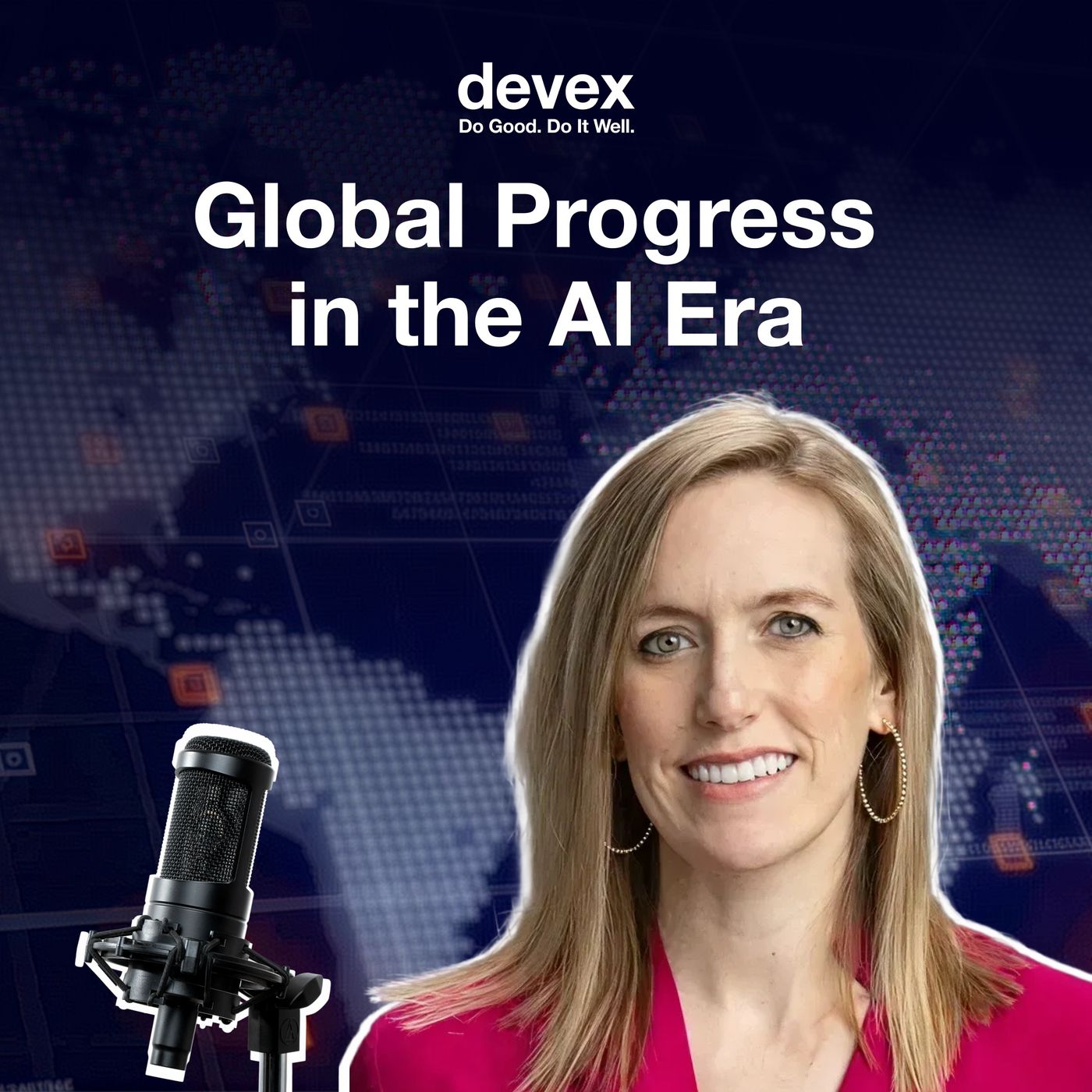
This Week in Global Development
Global Progress in the AI Era: The future of AI will be decided by small choices with big stakes
00:29:37
In this episode of Global Progress in the AI Era, a government minister and tech entrepreneur argue that the future of AI will be determined by thousands of small choices. Taking part in the conversation hosted by Devex Senior Editor for Special...
Loading summary
Transcript26 lines
- [00:00]
Bosun Tejani
Foreign.
- [00:07]
Katherine Chaney
Of the defining forces of our time. It's reshaping how money flows, how services reach people, and who holds power. I'm Katherine Chaney, senior editor for special coverage at devex, and this is Global Progress in the AI Era, a special edition podcast series exploring what happens when AI collides with the world's biggest challenges. In each episode, we speak to leaders from philanthropy, government, civil society, and the private sector who are responding to this technological turning point. They'll break down how AI could unlock breakthroughs in health, agriculture, and education, and what it will take to avoid the risks of deepening inequality. We'll tackle difficult questions and spotlight promising ideas that will determine whether AI accelerates global progress or leaves more people behind. Welcome to this live recording of Global Progress in the AI Era. The AI story is not just a technology story. It's an economic story, a geopolitical story, and a story about power ownership and agency. And I'm especially excited for this conversation because we are joined by two leaders who are actively working to ensure that as this story unfolds, it does not leave entire countries and regions on the sidelines. Kate Callow, founder and CEO of Amini, is building sovereign data infrastructure across the African continent and the global South. And Bosun Tejani, Nigeria's Minister of communications, Innovation and Digital economy, is leading the country's national AI strategy and influencing much of the African tech ecosystem through his work on digital policy and infrastructure. Both of our guests have been named among times 100 most influential people in AI. And I actually want to start by sharing something that Kate shared on stage when she accepted a TIME 100 impact award. You said something that really stuck with me, and I mentioned to Kate, I want this to be the focus of our conversation. So you said sovereignty and equity will not be achieved through grand gestures, but through thousands of small choices. Which systems we buy, which skills we invest in, which data we choose to protect, which voices we insist on bringing into the room. And whether in moments of fear or convenience, we trade away our people's agency or defend it. So that is exactly what I want to focus on, the future. This story is being written based on small choices. What are those choices? What are the stakes? Why do they matter? Let's start with that. I want to hear when it comes to those choices, what are the problems that each of you are working to solve? And how does that play out in terms of choices near your day to day? And we'll start with you, Kate.
- [02:46]
Kate Callow
Thank you for having me. It's a pleasure to be here. When it comes to the choices and how they relate to the problems we're trying to solve at Amini, we really trying to give governments and all countries a different perspective and a different way of doing AI. I think for the past few years the conversation has been highly dominated by large language models versus small language models or building gigawatt fast factories. But not a lot of the conversation has really been around. Okay, how do we look at building purpose built, contextualized and localized AI infrastructure? What does that mean? How do we unpack this for governments, for our ecosystems? What are the choices that governments are supposed to make and how do we make sure that when they are faced with the choice, they understand the risks and the opportunities on both sides? So a lot of the work we've been doing at Amini has been really helping governments unpack that and also giving them a different way of doing AI. It can be modular, it can be local, it can be small and can be big. But this is all that governments have to choose today. And I think we really at an inflection point when we think about sovereign AI, we always define sovereignty by choice and agency. So which choice? When you think about choice, where is your data being processed and stored? Which type of data center or compute infrastructure are you even building? Do you want to have data residency and keep your data closer to you, or do you want to be able to use public cloud? There are implications in each of those choices, but really it's about where will value be generated. Is it within your economy or is it outside and who will benefit from it. And this for me is the bigger framing when we think about sovereign AI.
- [04:37]
Katherine Chaney
I want to go to Dr. Tajani and I also want to reference something I heard you say and I thought it was a super accessible way of presenting the stakes of what we're talking about. In an interview I listened to with you, you mentioned that your main priority right now is ensuring that AI doesn't come for us, but helps us get to where we need to go? So tell us again, what are the choices that you are facing and making every day to make sure that that's what happens?
- [05:02]
Bosun Tejani
Thank you so much and it's a pleasure to be here. I like the framing of smart choices. Actually I think resonates with how I approach artificial intelligence as a minister, because I think when we talk about AI more lately, even in the description of the small choices, it sounded to me like it's still quite big. You know, it's always about production. Who is producing what is always about sovereignty. And all those details. But if you look at this from purely an economics and a governance perspective, I think the exciting part of artificial intelligence is how it's given us the opportunity to be able to do things differently as humans, regardless of where you find yourself. The growth in productivity that AI is bringing to how we do things is so phenomenal that the focus, for me, I think the foundation of the small choices is how do we ensure that as government we're providing the enabling environment to allow AI to serve our people. I think it's so foundational that if we don't focus on it, you'll find that I've been a minister now for over three years and everywhere I've been to talk about AI is always about geopolitics, about who is producing and things like that. When I return home and I start to look at the realities of the local farmers whose opportunities are now being eroded because there are farmers in Latin America that are doing way better than them using artificial intelligence, my worry switches to how do I enable those farmers? So there's a concept that we've started working on and I've seen that the World bank is also moving towards this thinking, which is absorptive capacity to make AI work. What are those? Foundational infrastructure. Whether you're talking about ubiquitous and meaningful connectivity, you're talking about access to compute so local people can build tools and applications, whether you're talking about talent, you're talking about data center, or you're even talking about governance. Does government have a clear understanding of how to help AI work in society? And I think lastly is the ecosystem. For me, those are the small choices that in a country like Nigeria, if you help build those enabling environment, you start to see Nigeria competing. And we've seen it in financial technology, for instance, across Africa. I know Africa is leading on that front, not because they were doing basic research and frontier stuff, but because people were empowered. Mobile telephony gave people the opportunity to be able to build solution to our problems. And that gave us the opportunity to lead.
- [07:36]
Katherine Chaney
So you talked about the importance of absorptive capacity to make AI work. And I know one of the initiatives you're working on is this 3 million technical talent program training 3 million people by 2027. Tell us a little bit more about that. And also, what does that not account for? Because that's only one part of the puzzle.
- [07:54]
Bosun Tejani
No, absolutely. I think for us it's just being clear that there are prerequisites for making technology work in a society. I think because the west is leading Conversation or developed countries are leading conversation on AI, we forget that there's so much that has been put in place for these countries to actually be able to appropriate artificial intelligence. And those countries will not spend time talking about the foundational things that they've built. I think one great example which is, is relevant or relatable across board, whether you're developed or developing, is talent. If you don't have talent to be able to build, we can use solutions that are built elsewhere. But if you truly, truly want to appropriate AI, you're going to need local talent who can digitize your reality, who can build models that are suited to what your realities are, and who can also then build applications off those things that your people can use in various sectors to help actually put AI to you. So for us, the essence of training 3 million technical talent is, say, Nigeria, largest, one of the fastest growing countries in the world in terms of population. Close to 60% of our people are under the age of 30. The average age is 16.9. Most of our people are coming into the world in a time where artificial intelligence is going to be the norm. So it's important for us, if we want them to be meaningful people, to contribute to society meaningfully, that will give them the skill sets that they require. Which is why we said we will start. And we started this again three years ago when I was appointed. It's known to be the largest technology talent accelerator program in the world. There's no country that is training 3 million technical talents, and about 6 to 7% of those are focused on artificial intelligence and machine learning.
- [09:46]
Katherine Chaney
So we've zoomed in on what's happening in Nigeria. And I know, Kate, you and I were speaking about how Amini is not working in Nigeria. It's a competitive ecosystem. A lot of people are working to ensure that Nigeria is not left behind in this AI wave. But there are countries very much at risk of being left behind where Amini is working. One example is Barbados. In fact, in a past episode of Global Progress in the AI Era, Kate joined along with Jonathan Reed, the tech minister from Barbados. And we heard about some of your work there. So whether it's Barbados or another country, can you kind of zoom in on another country where you're actively working to ensure that you know that country or that region is part of the AI value chain, if you will.
- [10:27]
Kate Callow
Since you mentioned Barbados, I'll use Barbados as an example. Minister Reed says hi. And when we started working in Barbados, we actually didn't start by thinking, okay, we're going to Help a country build itself data infrastructure. We really started by trying to understand what are the prerequisites from a foundational standpoint that a country needs to be able to make those small choices. And Barbados is a country of less than 300,000 people. So it's not a country where you will build like large scale data infrastructure. It's not a country where you have like Nigeria, a lot of the use that is extremely digitally native. It's actually more of an aging population. So it's very different problems and scales that you have to take into account. And it's a country also where energy is still very restricted and very expensive. So there were a lot of constraints that we had to look at before even thinking, okay, what does AI looks like in Barbados? But when we started peeling a little bit of the onion, we realized that the constraints that we were seeing in Barbados could actually be reversely used as superpowers. The first constraint around energy, around capacity, around space, and around compute. Because there were no compute in Barbados, we actually decided to build something that is modular. So really, truly starting by upgrading the infrastructure by shipping GPUs in a container, that's step one, then you realize that a lot of the data is very analog, very fragmented. Barbados still operates on papers. Okay, if you have beautiful GPUs but you don't have data, how are you going to trained models? So now you need to digitize all the data. Barbados started digitizing records back the 1600s. Civil, land, economic, all of it digitized. And we use our technology to kind of structure that newly digitized or structured data. And then you have to get governments to understand how AI can not just help the country, but also help them. We believe in technology. There is this word we use called dog footing. When we produce a platform which means as producer or as builders of the technology, you need to be the first users of it. So we had to make sure that the government all the way up to the Prime Minister would be the first user of the platform we had built so they could understand how to uptake and what AI could bring to themselves before even expanding this to the rest of the ecosystem.
- [13:04]
Katherine Chaney
So Mia Motley was engaged in this process?
- [13:06]
Kate Callow
Absolutely. We trained her on the AI tools. Actually, two weeks ago, we onboarded her and her entire cabinet. So we digitized all their cabinet papers. We made them cross referenceable, searchable for the first time. Imagine a digital knowledge base of the government that they're able to access for the first time. And then skills become also important. Because once you have that beautiful infrastructure and the government understands you need to be able to foster capacity. So we launched a fellowship program where we selected 10 young fellows in Barbados that we trained within. Amini gave them boot camp, got them to build practically on applications for the government. And today, just last week, all of them got a job, whether with us or with the government. So this is what true capacity and foundational capacity means. It's not just, I'm coming to a country to deliver some beautiful technology, is how do I make this sustainable and durable for not just the government but also the population and make sure that I create a pool of skills and young talent that will know how to use that infrastructure in the long term.
- [14:24]
Katherine Chaney
Are you interested in the intersection of business and social impact? Do you want to know how corporate sustainability, esg, impact investing and more can contribute to development finance? My name is Adva Saldinger. I'm a senior reporter at devex and I've been reporting on these issues for nearly a decade. I'm the author of Devex Invested, our free weekly newsletter dedicated to development finance. Every Tuesday, we explore how companies, investors and market mechanisms are reshaping the world of development finance. Visit devex.com newsletters and join us on Tuesdays. So, coming back to this question of what choices are being made? You know, we've heard from, you know, a government minister taking a leading role in a massive country. We've also heard from an entrepreneur doing pioneering work on a smaller scale in Barbados and in other countries across the global South. I want to start actually with the role of governments and the role of entrepreneurs, given that we have you here, but then I want to talk about what others need to be doing. So first I want to hear from Dr. Tajani in terms of the role of governments. I think often when we hear about emerging tech, governments are thought of more in terms of regulation, to be honest. But you are playing more the role of market shaper. So tell me a little bit more about that and why, in order to ensure that low and middle income countries benefit from this AI wave, governments can't just be regulators.
- [16:03]
Bosun Tejani
No, I used to be in the startup ecosystem. I founded the first tech startup hub in Nigeria, which is the largest in Africa now. So it used to be that we dictate where technology should be going from the private sector. But when I became minister, it also became clear to me that you absolutely can't find a nation that is doing well in artificial intelligence, where the government is not playing an active role or a leadership role because the technology is quite unique. In nature. And I think it's probably what we missed out with connectivity as well. In Africa, we left it solely to the private sector, which is not so even in the US today, government is still funding connectivity in difficult to reach locations. Right. So it's the same for artificial intelligence. It's shaping society significantly. AI is, you know, the compute part is just another part of the technology. But the core of AI is data. And there's no set of entities within any country that sits on more data than government. That's the reality. The sort of resources that you also need to quickly catch up on it. I think government is in a better place to take advantage of it. So for us, it was clear that the nation must have a clear strategy as to what you want to do with AI. And if government can shape that, we must be at the forefront, which is why we followed carefully. There's Oxford Insight from the UK that does AI readiness for countries. When we came in, Nigeria was rated, I think 105 out of 175 as of last December when they released the last one. Nigeria is Now, I think 70 something. We've moved about 32 places on the list. And when you break down their ranking, you see part of what they rated Nigeria really high on is vision. Yeah, the fact that the country has a clear vision on where we want to go. And for us, that vision is saying we shouldn't feel helpless because developing countries, countries are made to feel like this is a game of compute and hardcore science and you can be part of it if you've not invested historically or you don't have a lot of money. We said to ourselves, we're not going to put ourselves in that position. AI is going to need a lot of data. We can play there. It's low cost. AI is going to need a lot of talent. We can play the models. We have smart people who can build models. Some of our languages are spoken by 50 million people. We have about 3, 4 languages that are spoken up to 3 million people. Some of our languages are spoken in places like Brazil. So we do have a justification to play in this game. And whilst we're trying to figure out the compute elements, there's so much more that we can do as a nation. Which is why I think our strategy was quite clear. We did Nigerian AI strategy. I always say it's different from anything you've seen in the world because we actually use artificial intelligence to find all Nigerians all over the world that participate in AI. So we took all the academic publication in the last 15 plus years on artificial intelligence, we ripped out the names of the authors, we put them in the name library to match those with Nigerians all over the world. And we found close to 5,000 of them all over the world, in China, in the U.S. in Europe, all over the world. Then we put them out there. Then we started seeing folks who work for large companies like Google also saying you can't just work with academics. How about us who are in the private sector, but we're experts. And at the end of the day we had about 120 of those people return back to Abuja to co create our strategy. So Nigeria's strategy is not, you can say, is US centric or European centric. It's actually quite inclusive in nature. But we didn't stop there. We worked with Luminates, which is the foundation of payroll media to now. We then started a community of practice where we put all of these people and we funded that community of practice. So the development you're seeing in artificial intelligence is coming from them, inspired by the government. And we're taking it a step further, which I'll talk about later.
- [20:06]
Katherine Chaney
So it's interesting and I want to use your mention of Luminate as a segue here. So Luminate emerged from Pierre Omidyar's Omidyar Network. It's a philanthropic actor in this space. And part of what I hope people will take away from this session is not just learning about the choices each of you are making, but the choices they need to be making in this space. You know, philanthropic actors and others. So Kate, you work closely with governments. Anything to add in terms of the role of governments to build on what Dr. Tajani said and then what do you see as the role of entrepreneurs like yourself? And you know, since Luminate was just mentioned, we haven't talked much about the finance piece of this. And you know, what are the small choices being made by funders, whether it's at the scale of, you know, philanthropic foundations, large donors or investors in this space? What are those choices that are being made and is that getting us where we want to go?
- [21:06]
Kate Callow
I'll start with governments and then end with finance.
- [21:08]
Katherine Chaney
Maybe lots to cover.
- [21:10]
Kate Callow
So starting with governments. I think the example of Nigeria is pretty amazing. And I think this, this is how a lot of governments should start thinking about those choices that they have to make because it's about building an ecosystem. And I, I always bring it back to that moment in the 20th century when governments had to prioritize whether to invest into building energy Infrastructure or connectivity infrastructure. Some governments decided to build those infrastructure and some governments built structural dependencies. And then that brought us to where we are today. From an energy, from a connectivity standpoint. We all know about the digital divide, so we're really at that inflection point. And I think it's the moment where governments really have to build a road for us. There's so many young people, I mean, I'm standing here, but I know many of people like me who also decided to come back to the continent and started to apply their skills to help and advance our countries. And I think the only thing we need is the road to be able to scale the infrastructure, to be able to scale the enabling environment. We need to be listened to, we need to be heard, just like Minister did in Nigeria. And our insights that are a little bit different need to be integrated in the way. Now governments regulate and build the ecosystem locally. Now when it comes to funding, it's a very different story, right? We, we raised venture capital. The last round was about three years ago, but when we started, a lot of VCs were telling us, okay, so you're building AI in Africa. Where are you going to find the talents? What are the even applications? There's no AI in Africa. What do you mean? And the truth is today 90% of investments in AI companies goes to the US so that leaves very little for the rest of the world. Right? Second is probably Europe and the rest of the world is fighting for the small peanuts that are left. So we kind of need to think about it in a different way. And in our conversations with the ifc, with the World bank, there is an appetite to kind of de risk a little bit of that infrastructure that is being built. But it has to be kind of a coalition between governments, between the institutional capital, between venture capital, not just to invest in infrastructure, which are the hundreds of billions of dollars we're hearing about every day, but really understand what does the local ecosystem needs? If we need to build a road, if we need to build a foundational infrastructure, where are we going to continue investing to make sure that the local ecosystem can survive and thrive. And that might not be from funding directly companies, but it can also come from providing companies contracts. Government is still first biggest buyer, right? So making sure that before you decide to go and buy foreign technology, look in your own ecosystem, is there a developer, is there a startup doing something can tell you that most of the time it will beat the foreign technology. There's actually an MIT study who revealed that in the context of climate Resilience. Local applications that were built by people who were coming from those regions built global applications in terms of benchmarks and accuracy because they understood the local context and they integrated the local context into how they were building technology.
- [24:35]
Katherine Chaney
So I want to make sure we connect our conversation to this week, the World bank and IMF spring meetings. Each of you are here in Washington D.C. for a reason. For that reason, and you also mentioned that we need to learn from past mistakes in terms of digital infrastructure, in terms of connectivity and Internet access, in terms of energy infrastructure. So what are your key messages this week in Washington and what are the kinds of decisions happening this week that will determine whether we repeat those mistakes or in fact course correct?
- [25:13]
Bosun Tejani
Important question. So I'm working on a project at the minute for Nigeria where we're investing $2 billion into 90,000 kilometers of fiber optic network. It gives us the opportunity to connect every state in the country. And what we call the world is the closest level, where every citizen is probably less than a kilometer away from a central point in the world. And there will be fiber based connectivity in all these places. And one of the very significant support that I got to be able to make a strong case for that project, which is now being funded by the World Bank, European bank for Reconstruction and Development, Africa Development bank and a host of others, is the fact that the World bank has deep intelligence on how investment in connectivity leads to growth in economies. And that was quite significant. I think that level of thinking should not always be done when it's too late. And I think that's what we need to see with artificial intelligence. Because even when we talk about the fact that GPUs are expensive, if you look at the economic implication for not applying AI, you start to realize that the amount we're talking about is insignificant. Insignificant. You know, I always use the example of agriculture. Like farmers who are growing maize in Nigeria, there's no world where they can compete with farmers from Brazil or Argentina anymore. Because this guy, some of them are already using the AI. So you see a farm in Brazil I visited, one that is already getting between 10 to 12 tons per hectare of maize, while in Nigeria the guys are still getting 2.5 and they're using more herbicide because it is not precision, right? So there's no world where we continue to compete without those things. I think for me, the messaging and the experience from the Nigerian case will be that funders, development organizations need to understand that you can't truly help any nation build strong foundation and ecosystem for AI from outside you truly need to empower them to be able to envision what it means for them. This is what we need to do. We need to see there will be countries that will take the path that Iceland took, for instance. So even when we're talking about language models and whether you build your own or not, the countries like Iceland, who says we're not big enough to worry about that we can trust HRG, OpenAI to do it for us, Right? And they had a cool agreement with them, and now AI speaks their language. There will be countries that need to take such decision, but those decisions will have to come from the leaders having a good, thorough understanding of what AI means for them and where they can take it. And I think that's the support that is currently missing, because most organizations will have people who tend to, you see, very rich foundations that will have people who tend to think they know the answer to what every country needs to be doing with AI, and they want to dictate, and it won't work. So we have Makato foundation in the case of Nigeria, that is saying, you know, we're doing fantastically well with where we're going with AI, but what if there are changes in leadership? What will happen? And now Makato foundation is supporting us to create something that is called the AI Trust for Nigeria. And it's not the normal trust in AI that people think of. This is a body of trustees that regardless of who the government is, they will look after the vision for artificial intelligence in the country and also help to continue to fund it as well.
- [28:38]
Katherine Chaney
Kate, what about you? What does success look like this week? Very quickly, just what do you want to see change based on this week's conversations in Washington?
- [28:45]
Kate Callow
I want to see a change of conversation. I think we've been focusing too much between small and big and such.
- [28:52]
Katherine Chaney
Small and big AI.
- [28:53]
Kate Callow
Small and big AI. Yeah. I think we really need to empower local developers. And I think for me, if I have one message for the room and for the audience, this week is build the road for us.
- [29:06]
Katherine Chaney
Well, returning to where we began, this AI story is unfolding based on decision by decision, the kinds of decisions we talked about on stage today. So thank you for unpacking that for us. Thank you for the work that you're doing, and we look forward to following your work.
- [29:23]
Kate Callow
Thank you,
- [29:29]
Bosun Tejani
Sam.