← This Week in Global Development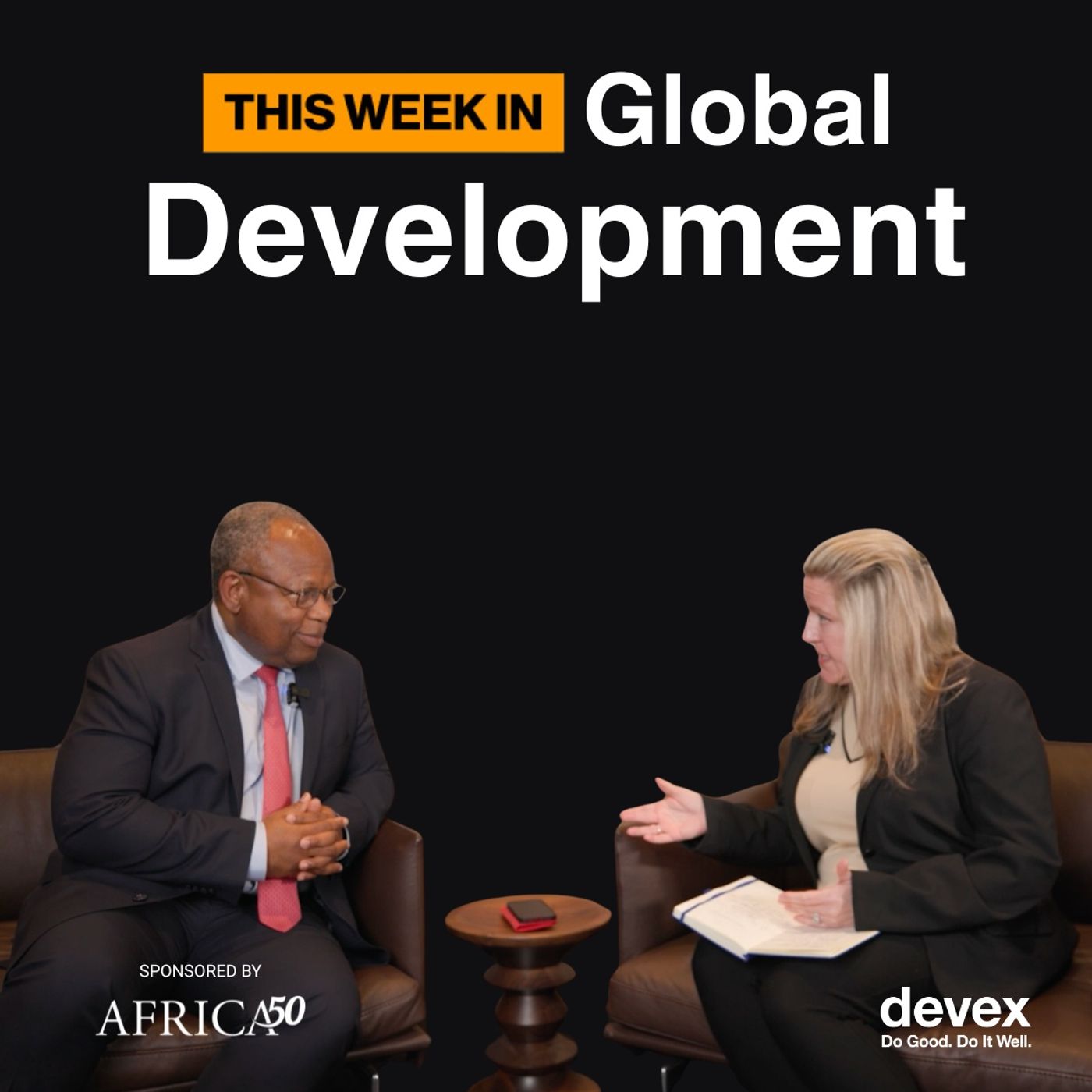
This Week in Global Development
Special edition: Turning sustainable energy into a viable asset class in Africa
00:20:47
In this special episode of This Week in Global Development, Alain Ebobissé, CEO of https://www.devex.com/organizations/africa50-120252, joins Devex Managing Editor Anna Gawel to discuss a paradigm shift in African infrastructure investment. Africa50,...
Loading summary
Transcript25 lines
- [00:00]
A
Foreign. Hello everyone, I'm Anna Gabelle, Managing editor of devex and I'm pleased to be joined today by Alan Ibaldisse, CEO of Africa50 for this special episode of this week in global development. Now, Africa50 is a pan African infrastructure investor and asset manager. It has a shareholder base of 33 African countries, AfDB institutional investors. I think one of the more intriguing goals it has is churning sustainable energy into a scalable institution grade asset class. In other words, kind of shifting the narrative from development imperative to a viable commercial opportunity. So let's start there. If you could talk a bit about this dynamic of development versus commercial opportunity and also what changed in the market to make this reality.
- [00:59]
B
Well Ana, thank you for having me here. And you know what we are looking at on the continent of Africa is first of all is looking at scale. So what we have done at Africa50 is to invest in projects that have developing impact but also commercial returns. But so far we've been investing in one off projects, smaller to medium scale project and those projects are good projects that deliver impact. But now what we want to do is to find a way to aggregate many projects to deliver scale so that we can attract large scale investors. But we also want to continue to focus on attracting African investors that will partner with us Africa50 and then deliver capital to developers to invest to developers, companies which are building power projects not only generation but also more and more transmission. And I'm very, very excited about transmission.
- [02:04]
A
Why in particular transmission?
- [02:07]
B
Well listen, transmission so far in Africa has been funded mostly, actually I should say exclusively by governments. So this has been so far public financing for transmission. Africa50 together with our partner power grid of India, working with the governor of Kenya, we're delivering the first independent power transmission on the continent. We signed a transmission service agreement in December and then we are demonstrating that just like what we saw in other regions in Latin America, in Asia, that you can have private transmission. So we believe that this will spark a huge volume of private capital that is coming into transmission because transmission is so important. You can have all generation you want. If you don't have transmission, you won't be able to deliver electricity to end users and businesses.
- [03:00]
A
Now let's go back, you mentioned scale. How does Africa 15 help standardize the market so that a project in one country can be replicable in another country?
- [03:11]
B
Well, that's a very good point because at the end of the day what we need to do, as I mentioned, is to make sure that we don't, we move from the one off project so that we have a series of projects. Now our experience is that the first project sometimes take a lot of times when once you have the blueprints, the framework, the structure, you can roll out many projects across different countries. Now the benefit that you, you know, we bring as Africa50, we are owned by many African countries. So because we are owned by African countries, they trust us, we work well with them. If we have developed projects that work well in one country, we can roll it out in other countries. In so doing, we put together a portfolio of projects and therefore we can achieve scale even though individual project may be slightly smaller. So this is how Africa fits because of who we are, because of the ability to work in many countries, because of the ability to engage mini government, we are able to put together those portfolio of projects faster than any other investors that will come in without having this competitive advantage.
- [04:26]
A
But let's get into some specifics. Can you give us an example of a country or project where you encounter challenges but were able to overcome them? And what were some of the lessons learned from those obstacles?
- [04:39]
B
Well, listen, when you do those large scale private infrastructure funding, you have multiple parties. You have the developers, of course, you have the EPC contractors, you have the lenders, you have the equity investors, and you have the government side. You have the government side, the ministries, the regulators, and then the off takers. So it's a lot of, a lot
- [05:02]
A
of books in the kitchen.
- [05:03]
B
Absolutely. A lot of people that are participating. So that's why in order to get to financial pros, you have to address many challenges. What we're seeing historically in Africa, but actually in some countries over continent, but also in other emerging markets, is that the engagement with governments is always a bit, let me say you have to know how to work with the government. You have to build trust. You have to make sure that the government understands that you are providing a very competitive infrastructure service. So what we've seen before is that you really have to be able to demonstrate good value for money, that the government has to be comfortable that what you're doing makes sense. So having Africa50 with you at the table helps in that process. But let me be very transparent. Even with us at the table, sometimes it takes more time because the folks on the government side, they have to be convinced that you're doing something which is in their interest. So this is what we've been dealing with. I have to say that it's not only an African issue. Okay. That's what you see in many countries where countries are in an early phase of private sector Capital that is coming into the country in a particular sector. But my experience is that we've overcome some of those challenges. Sometimes we needed to have help at the highest level in government. I can give you an example recently in one country, well, I could mention that in Kenya we actually had to get the support, direct support of the President of the country himself. President Ruto was actually engaged in trying to unlock the last issues that enable us then to sign the transmission service agreement. So you need to do what you need to do to get to financial close.
- [06:55]
A
Now I want to rattle off some statistics that many people may be familiar with that are sobering and I think they're worth, or they're repeating. Over 600 million people in sub Saharan Africa lack basic access to electricity. A deficit that represents nearly 80% of the global total. What, you know, a broad question. What are some of the most persistent long standing barriers that have contributed to this extremely detrimental energy deficit?
- [07:27]
B
Well, first of all, this is totally unacceptable that you have so many people on the continent of Africa not having access to electricity. Now I think the good news is that we are now focused extremely strongly in trying to address this problem. The World bank and the African Development bank recently launched the Mission300 initiative to connect 300 million Africans to electricity. And Africa50 is actively participating in addressing this challenge. You see, what you need to do to solve a problem like this is, is to be focused, to be determined, to be result oriented, to make sure that we collectively feel that this is unacceptable, that we can solve it because the problem is solvable. Indeed, what has happened is that private investors were not enthusiastic at taking on this challenge because the challenge is not so easy when you put in only commercial capital. The difference that we are seeing today is that it's acknowledgment that in order to solve this challenge, we need blended capital. You need a combination of constitutional funding and then commercial funding. That is what is happening. This is what the Mission300 initiative has brought to bear, that there is a consensus. So Africa 50, for example, we have launched a fund that will enable us to help make this happen. Is a blended finance structure that would enable us to provide capital to companies that will build those connections. So I'm very optimistic that we will reduce this problem and that we can solve it reasonably quickly.
- [09:11]
A
So the capital stack, and specifically Africa 50's formula.
- [09:25]
C
On May 20th and 21st, the journalists behind Devex Checkup, our global health newsletter, will be joined by leaders navigating the sector's toughest challenges from closing funding gaps to Harnessing AI to strengthening country led systems. If you're working to shape the future of global health, you don't want to miss devex Impact House at wha. Taking place on the sidelines of the World Health assembly in Geneva, we're convening leaders for two days of live journalism, candid interviews and curated conversations designed to go beyond the talking points. You'll hear directly from leaders ranging from ministers of health and heads of foundations to social entrepreneurs and tech leaders. The people actively determining whether the global health community can move from ambition to delivery. Request to attend in person, register for on demand content and reach out if you want a partner or suggest a speaker.
- [10:11]
A
I mean, in terms of this strategy, how do you support sufficiently de risk and diversify opportunities to attract capital globally on that scale?
- [10:24]
B
Yeah, you see what we do at the end of the day is about de risking offering products opportunities that provide the best risk adjusted return to investors given the risk that they're taking in the project. So we at Africa50, we believe we are a de risking mechanism by participating in the project first because we can come in in the early stages with our project development capital, our project development resources in order to build, to move the project from the concept to the bankability phase. With our capital and the resources and a relationship, we de risk the project. By the time the project gets to the financing phase, then we put in our own equity with partners. So what we do also we bring other partners to the table. Sometimes we bring the African Development bank as a lender, but also as a provider of partial risk guarantees. Sometimes also the World bank can be participating Omega. So what you need to do in those structures which are project finance, you need to find a way to allocate the risk to the parties which are best able to manage those risks. So it is something that is known. We know how to do this and we've done it. But what we need to do now is to it faster, faster and bigger because we're not reinventing the wheel here. Those structures, those derasing structures have been implemented in Africa and elsewhere. My p. My strong recommendation is that everybody around the table have to have a sense of urgency. We have to get things done. We are not seeking perfection. We have to go for the results. And if it's good enough, it's our mentor at Africa50. If it's good enough, you do it.
- [12:21]
A
Now on that note, have you found, because Africa50 has found success in, you know, clinching these deals, have you found it's been easier over time to attract more investors as the risk level is perceived as, as less.
- [12:36]
B
Well, it's been easier than at the beginning, but since at the beginning nobody knew, knew. Nobody knew us. But it's easier, but it's still quite difficult. Okay, we are improving as of today. People know us. Investors at least are taking our calls. But it doesn't mean that they say yes. They're asking us for risk adjusted return and scale. And so what we are also doing in order to improve our likelihood of attracting global capital, we focus on African capital. Because I can tell you that when you go to the global, global market to raise capital, when you come in and you say, I already have African investors backing us for 30% for 40%, the conversation is different from when you go to the global market and say you should be the first to back us. So they will ask you, where are the African investors? Africa50 is changing the game. When we did the Africa50 Infrastructure Acceleration Fund, a $400 million fund, we raised it with 22, 24 LPs, out of which 22 are Africans. We have two non African investors, the IFC and the family office out of France. But African investors, we have the afvb, the African European Bank. We have two sovereign wealth funds, we have pension funds, we have African investors. This is also, I should say, a de risking mechanism. But it's a way for us to show that we have a skin in the game. As African, we believe in African infrastructure. And this is a new trend that I'm seeing. I'm optimistic, as I said, I'm cautiously optimistic that we can narrow this gap and eventually we can close it.
- [14:16]
A
Now, I wanted to talk about an interesting dynamic, or I should say debate that's been going on for quite a while, which is whether Africa should use its resources such as oil and natural gas that other developing countries use to get wealthy. And you know, that could potentially lift millions out of poverty versus as opposed to clean energy such as solar. Even though the costs have gone significantly down, there are still upfront costs. So how do you make the more general case that sustainable energy is the way to go?
- [14:50]
B
Well, listen, we're very clear, contrary to many countries and many leaders in Africa, we have not changed about what we say about D.C. africa needs a balanced energy mix, including renewable, climate friendly project, but also natural gas. We do believe that climate change is real. We are combating climate change for sure. But we also believe that we need to use our natural gas to support our industrialization growth, our industrialization goals, our manufacturing goals. We want to use gas for manufacturing, for mineral Processing, critical mineral processing. So for us, it's very clear and we've been clear about it, and we continue to be clear about it. And then sometimes some people will say, well, I don't use your gas anymore. But the same people will come and try to buy our gas. But listen, everybody should understand. We believe climate change is something that everybody should combat. We should fight against climate change. I hope people also feel that access to energy development is important in terms of manufacturing, in terms of providing jobs to people. So let's have the energy mix that is good for the different regions. For us in Africa, this energy mix will have both renewable and natural gas. It's clear to us we are making that case unapologetically. We are totally for gas. Us. We are also for renewable.
- [16:32]
A
Now, you have held leadership posts at the World Bank Group. How did that kind of experience Prepare you for CEO of Africa Shifty, which you joined in 2016, I believe. Yes, yes. How did that kind of prepare you for the role?
- [16:49]
B
Well, listen, ifc, the World Bank Group is a good place to learn. It's a good place to experience many things. I had a global remit. I was the global head for IFC Infra Ventures, and I was able to observe and to be a participant in infrastructure project across the world. Really learning, being tested, observing that has prepared me to go to Africa, to be focused now in Africa and then help the continent. But when you do so, you also do so with your global partners. So the relationship that we've built globally in India, in China, in the us, everywhere, that is also something that, you know, I was fortunate to have developed when I was at the World Bank Group. And my friends at the World Bank Group, they see friends. We argue sometimes, which is not edified, but we argue in a friendly way. And they believe that we trust each other, that we mean well. We may have different ways of approaching things, but we mean well. But at the end of the day, I was very fortunate to have spent 17 years within the World Bank Group because it has provided me with very solid foundations. But one thing that I'm asking my friends at the World Bank Group, I mean, other big MDBs, we have to have a bit more sense of urgency. I know it's not easy for bigger institutions because for us, we are still smaller institutions at Africa50. But everybody should strive to do things faster. The needs are too urgent. People have to know that it's urgent. We need to change things urgently. We cannot see the gap growing. It's totally uncomfortable when you look at the gap growing. We need to close the gap, reduce it and eventually eliminate the gap.
- [18:50]
A
So now, final question. You joined in Africa 50 in 2016. It's now 10 years. What would you like to see in the next 10 years?
- [19:00]
B
Well, that's a very good question. What we have to see. But ideally I would like to see US having connected 600 million Africans because it's mission 300. Why can't it be mission 600 to basically to connect all Africans through electricity? I basically have the goal of contributing to Africa's development, having Africa as a vibrant continent where these young people, these young people that we have in Africa, they will be able to express themselves and work and create value and share some of the value that they've created. Really having as many countries as possible in Africa becoming middle income countries and then maybe doing even better. So this is my, I guess, outlook. This is what I see in the future. In 10 years, we can do it. We can leapfrog. It doesn't have to be too slow. Again, I'm talking about speed. We can do it. We can make a transformative change. To get to what I've just presented,
- [20:12]
A
it's an excellent vision and alons, thank you so much for being with us. We really appreciate your time and I want to thank everyone for joining us for this special episode of this week in global development with Africa50. And we look forward to seeing you next time. Take care.