← This Week in Global Development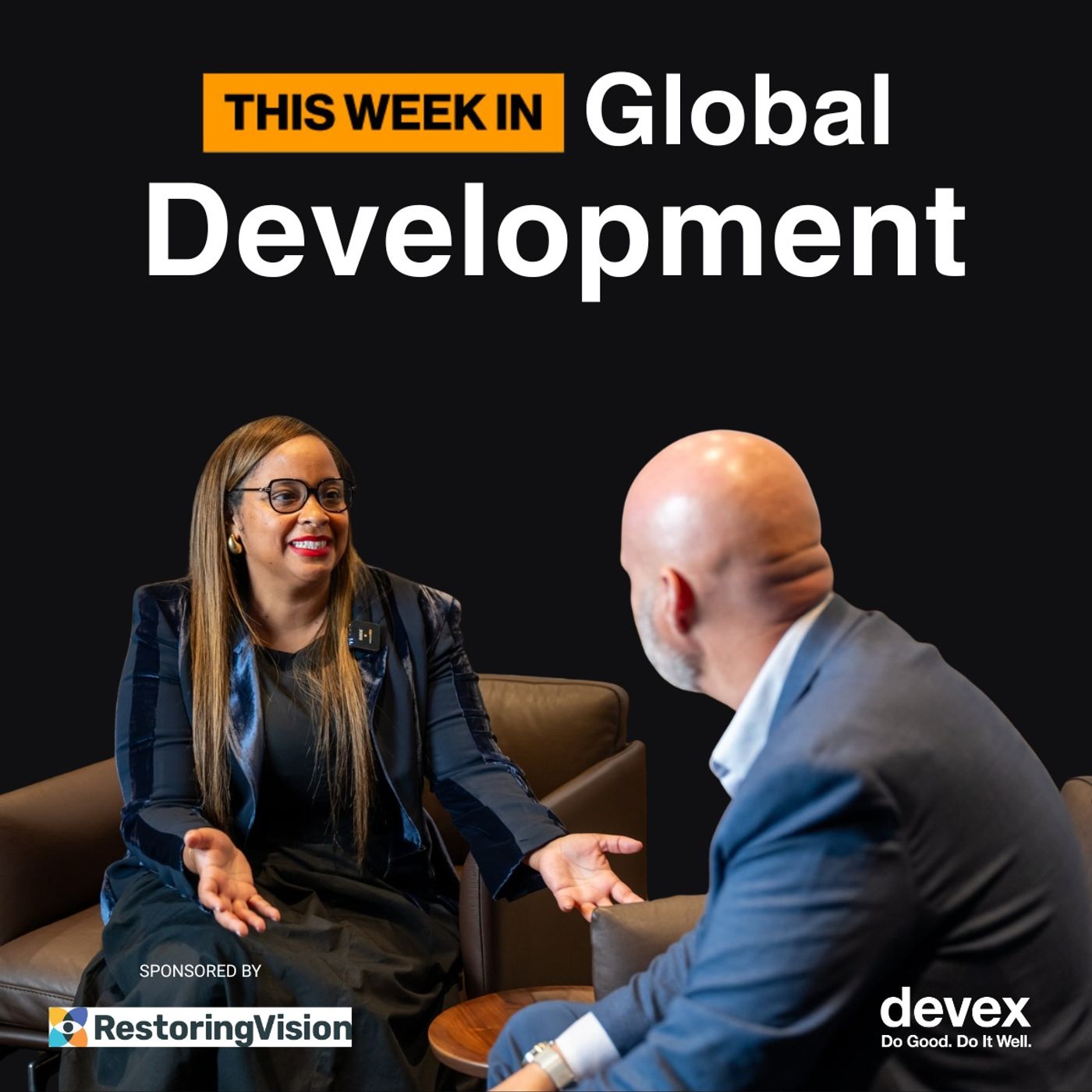
This Week in Global Development
Special edition: Visionomics - how eyeglasses drive economic growth
00:22:20
In a special edition of the This Week in Development podcast, Devex Executive Vice President Alan Robbins sits down with Ambassador Keisha McGuire, chief global affairs officer at https://www.devex.com/organizations/restoringvision-105646, to explore...
Loading summary
Transcript41 lines
- [00:00]
Advaah Saldinger
Foreign.
- [00:07]
Alan Robbins
Hi everyone, I'm Alan Robbins. I'm executive vice president and co founder of devex and I'll be your host for today's special edition of the this Week in Development podcast that we put together with our friends at Restoring Vision. Vision's so important to so many of us, but as a broader healthcare priority it often gets left behind and poor vision is certainly understood as a health issue or an individual issue. But one thing that we'll be diving into today is how it's much broader than that as a economic and social challenge as well. I'm very pleased to be here Today with Keisha McGuire, who is a chief global affairs officer at Restoring Vision, which is an NGO that's worked with, has helped. I looked at numbers, 40 million people in 150 countries and your mandate's really interesting because there's many vision related challenges, but you focus on near vision blurriness specifically, which is something that I think we can all relate to. But thank you for being here.
- [01:18]
Keisha McGuire
No, thank you for having me. And I look forward to our conversation. The atmosphere is really electric here and I look forward to excited for a conversation here today.
- [01:26]
Alan Robbins
Great, great. I should mention we are here at the DEVEX Impact House Capital Summit as on the sidelines of the World bank and IMF meetings. Kesha? Yeah, Personally I've been lucky to have good vision of my life. I was always told I have three older brothers and I was always told wait till you turn 50. And I turned 50 and boom, my vision, my near vision started going and this happens to almost everyone and it's annoying. It's really annoying, as everyone knows. And. But you argue that it's much more important than just annoying. It's a much bigger issue than that. Can you tell us a bit about what you mean by that or what the main issues that come with it are?
- [02:13]
Keisha McGuire
Right, of course. And you're correct, it is an age related. You talk about 50, but as a matter of fact it starts typically around the age of 40. So think of it in your prime working years and actually for some people it starts as early as 35. And it is as you rightly said, presbyopia is the natural age related deterioration of your near vision and it continues to deteriorate until around the age of 60 through 65. And yes, it is a much larger issue than just the mere fact of just seeing, you know, and most people associate it with just reading your ability to read. Right. You know, or see your phone. But when you really think about it, and this is A concept that we at Restoring Vision has coined and it's visionomics because it is the intersection of global health. Right. Vision with health and the economy. Right. And by that, what do we mean by vision nomics. Right. Visionomics is really and truly just simply connecting something as simple as being able to see clearly with something much bigger, economic development. And you know, for us at Restoring Vision and we see it in our daily work and as you said, when you reach 50, you experience it. And it's again not just about reading, think about of your livelihoods. You know, what comes to mind to me and you know, it's a story that makes me remember how rewarding the work that we do. You know, there was a tailor in Nigeria, Mrs. Adu, you know, she would describe as a tailor. It became very exhausting for her to be able to even do something as simple as thread the needle. The most basic right task in her being a tailor. She couldn't do it anymore. You know, her work as a result, you know, really crawled, you know, slow to a crawl, you know. So what does that mean for her family? What does that mean for her?
- [04:10]
Alan Robbins
The household less income.
- [04:12]
Keisha McGuire
Exactly, exactly. The household income decreases. She's now somehow potentially out of the economic engine of her community. You know, and then sometimes it has on that knock on effect. Think of it, the children sometimes now have to go and work. Well, what is that? What causes that? What's the consequence of that? They now have.
- [04:31]
Alan Robbins
They now can't learn.
- [04:32]
Keisha McGuire
Exactly. So when you ask me what are the sort of issues we're talking about, we're talking not just about your ability to just see, but what being able to see affords you. It's dignity, it's participation, it is inclusion. Right. And at the crux of it, as Visionomics says, it's an actual economic imperative.
- [04:53]
Alan Robbins
And I think you've gone so far as to say or assert that focusing on vision, particularly near vision blurriness, is the single most cost effective way to drive economic development. Am I paraphrasing you correctly?
- [05:11]
Keisha McGuire
Not me, the organization. But they are correct. They're certainly correct.
- [05:16]
Alan Robbins
Well, I'm not saying single most important healthcare intervention. I think they've said that. But I was saying poverty.
- [05:23]
Keisha McGuire
Yes, yes and yes. To end poverty. And that's the World Health Organization. They have said that. And really and truly what that shows you is exactly what it is. Because if you have it kind of looks, most of it is low cost. Right. When you think of a pair of gases, it's very cheap to me. But the impact is Immediate. And I will go back. The economic impact is immediate. I'll go back to the example of Mrs. Oduda Taylor in Nigeria when she went to a local clinic and and got that first pair of glasses. It was like an aha moment. Now she was able to go back and work faster with confidence. And it was such an impactful moment for her transformational in her life that she went out into the community and told others, hey, look at this, this is available. And this could have this sort of significant impact on your life. So when you think of it, visionomics, as I said, is connecting vision health with economic development. And what it really does is fuel what I would like to call the three Ps right? Productivity Prosperity. Right. And development progress.
- [06:28]
Alan Robbins
And why specifically age related near vision blurry dues is not the only vision issue. There's a lot. Why specifically this one? You outlined some of them, but I guess why not do it all?
- [06:42]
Keisha McGuire
Yes, yes. So yes, at Restoring Vision we focus on presbyopia and presbyopia. And just to give you some stats, of the 1.1 billion people who suffer from avoidable or treatable vision impairment is 826 million of them suffer from presbyopia. So it is the single largest cause of avoidable or treatable vision impairment. And I'll give you another statistic. The International Agency for the Prevention of Blindness recently last year published a very comprehensive report which showed that for every dollar that you invest in vision in low and middle income countries is a $28 return on that investment. And for us at Restoring Vision, again, Viperess Biopia la report came last year. We've been doing this for over 20 years. Why? Why, why, why? Right. And it is, but I would say two reasons, right? The need is great, right? As we. The scale of the need is great. As I just gave you that figure, it's the single largest cause of preventable or treatable vision impairment. But also it's because the solution works. We're talking about a solution that's been in existence for like 700 years and it's also very simple and very low cost.
- [08:02]
Alan Robbins
How low cost can he get it? Like how low cost can a pair of eyeglasses be in a low income context, right?
- [08:09]
Keisha McGuire
So generally you can provide these glasses I think, you know, for about $202.50, you know, but again there's a market, there's many different factors that go into the cost of glasses. But I'm. What we focus on just to tell you true is reading glasses, which of course is very different from other sorts of glasses.
- [08:28]
Alan Robbins
You mentioned 820 some odd million people who do not have access to, who have untreated vision issues. And 90% of those people I understand live in low to middle income countries. Restoring vision. You're doing great work. You're in a lot of countries, you're reaching a lot of people, but you can't reach that many people directly. So how do you work with local communities, local healthcare providers to make sure that these people can hopefully at some point end up getting, get treated?
- [08:59]
Keisha McGuire
Yes. So you know, in terms of where do we go, how do we decide where to go? You know, first of all, you know, I think it's twofold. Where the need is greatest and also where there is the ability, potential to scale. So we do work, you know, you asked about local partners. We do work with strong local partners who have a very strong, what do you call a network. And we're not in the business of trying to create a parallel distribution system. What we really want to do is to help build the systems that already exist and add value to it. So what we do is as I said, we work with local partners who already have the reach in the communities because we are trying to reach everyone, everywhere and we don't need to reinvent the wheel. But what we can do is add value to that. I mean look at systems that are, that are already, for example, national systems that already exist. Where we have, we are able to plug into it and provide these services, for example. One good example I have is that we work in Nigeria, you know, under the Presidential's, the President's Vision initiative where we work and we partner with, you know, a few partners, but including the national Eye, Ear and Sensory functions Health program and what we do there. And it's a very ambitious presidential vision initiative. By next year, I believe it's 5 million people that wants to be raised. And in the first year alone we were able to reach over 1.3 million people. So that shows you when you have the sort of system in place and you work with the governments, right. You can tap into that and really and truly scale your impact.
- [10:50]
Advaah Saldinger
Are you interested in the intersection of business and social impact? Do you want to know how corporate sustainability, esg, impact investing and more can contribute to development finance? My name is Advaah Saldinger. I'm a senior reporter at devex and I've been reporting on these issues for nearly a decade. I'm the author of Devex and Invested, our free weekly newsletter dedicated to development finance. Every Tuesday we Explore how companies, investors and market mechanisms are reshaping the world of development finance. Visit devex.com newsletters and join us on Tuesdays.
- [11:30]
Alan Robbins
And working with the governments is sort of the top of the funnel there. But you also, I understand you're not against, obviously working with eye clinics, but you have a model that also engages the community very directly, don't you?
- [11:44]
Keisha McGuire
Yes, we certainly do. And again, we work with a myriad of partners. That's for example, even in that Presidential Vision initiative. We also work with the Christian Health association of Nigeria and in other programs throughout the world. We do work with a myriad of different partners, but as you intimating, yes, we look for the ones that have the reach in the communities again where we can add the value to the distribution, you know, systems already in place and ensure that we build programs that can continue and grow. Because we don't want this to just be a one off intervention.
- [12:17]
Alan Robbins
Yeah. And it's not. I mean, I imagine, you know, a lot of times for health, health issues, stigma is an issue. I don't know if it's stigma so much, but just an annoyance of having to wear glasses. People like, I don't want to wear glass, I don't want to carry them around. I have a pair on me, I really don't want to carry them around. How do you convince people that no, this is actually going to make sense, not just so you can see, but so you can send your kids to school, so you can, you know, so you can go to your job and be a more effective worker. Like how, how do you get over that hump?
- [12:48]
Keisha McGuire
Yes, you know, yes, sometimes you would have that, you know. And you know, sometimes folks talk about making it attractive. Right. Because some people think, oh, I don't want to wear glasses. But you know what, when we do go into those communities in particular, a lot of times they didn't have access to, to vision services. So when they have. And I would hearken back again to the example I gave you of Mrs. Adu. For her it was life changing. Right. So she saw the benefit right away. Now she can be more productive. And that is what the crux of what visionomics is. It's showing you the knock on effects. There are many different knock on effects for vision. When you think, yes, you have, we talked a little bit about it being able to be productive, go back into the workforce, be able to contribute to the economic engine of your communities. Right. But you also have the intergenerational effect which we also talked a little bit about where you have children Staying in school longer because your household income has stabilized, because people could stay there longer. But then you also have think of digital and financial inclusion. Today on our phone we do everything right? So again, elderly folks in particular, sometimes if they can't read the phone, they can't see, they can't make payments, then they just retreat. And that goes on to another knock on effect when you think of dignity and participation so that you're no longer just excluded socially. And I would just, I would like to mention a couple programs we have which I think touches on some of this when we talk about elderly and women. Right. We have for example in Peru a pension 65 program. It's a government program where they have a program called to see you better. We partner with the Ministry of Development and Social Inclusion there as well as with Management Sciences for Health, msh, Peru and in there, where do we target? That program the government targets is designed to reach socio economically vulnerable older adults, you know, adults over the age of 65 and there folks who may not have ever gotten access to vision services do through that program and through that partnership.
- [14:53]
Alan Robbins
Now let's take it more of like a zoomed out level and talking about sort of UN agencies or organizations like the whole, how are you engaging them to make sure this stays on their agenda and is part of the work that they're doing every day.
- [15:08]
Keisha McGuire
Right. And that's part of the global advocacy. Right. And we've been engaged in that. For example, I'll just give you an example. At the un, we are part of the UN Friends of Vision, which really is member states coming together to again make this a global priority. And they have done that in 2021. They've been able to. The Group of Friends was established in 2018 and in 2021 they had the first ever UN resolution on vision. And now five years later, we're actually going to have a global summit for iHealth on the margins of the Commonwealth Heads of Government meeting in Antigua and Barbuda. So when you have that sort of global advocacy, what it does first and foremost is make it a global priority
- [15:51]
Alan Robbins
and remind us when that is.
- [15:52]
Keisha McGuire
That's going to be in November of this year. Yes, on the margins of the Commonwealth Heads of Government meeting in Antigua and Barbuda. Right. So you make it a global priority. Right. Then you also need to mobilize, have that kind of political will, right. To have the sort of policy and transformational changes of systems to be able to make the ground fertile to ensure that programs such as the work that we Work in, happens and is integrated so that you really and truly could reach everyone everywhere.
- [16:23]
Alan Robbins
We opened up talking about how eye health is such a important way to effective way to fight poverty, but it's also an effective way to help health and sort of like what everyone would assume. And why hasn't it gotten the same level of attention as some of the other health issues that are out there? You're saying it's starting to. You've got a conference coming up, it's starting to. But why do you think it hasn't gotten that so far, Right?
- [16:54]
Keisha McGuire
You know, so you're right. The Global attention to iHealth, right, has been lagging, it's been wanting. But you know, the tide is turned, as yours rightfully intimated one. And it's for three reasons, I think. Number one, there's new, major new funding commitments coming into the space. And second, we have the global leadership mobilizing, you know, around iHealth. And third, I think the development and investment case for vision is undeniable. You know, when I talk about major new funding commitments we have, for example, last year in 2025, Bloomberg Philanthropies announced their Vision Initiative, which is $75 million being invested into eye health. That's an unprecedented confidence, right? It signals an unprecedented confidence in eye health as a high impact development intervention. We also have, as we've been talking a little bit, the summit coming up in November of this year. Again, that is going to be a space where not only governments but all other stakeholders, for example, private sectors, funders, philanthropists, right, NGOs. We're going to come together because you're moving just away from evidence, which I think we have the evidence, we've talked about the IPB report, but make it, you don't have a concrete commitment, so you're taking it. Not a policy, finances and action plans. And then of course, as we all know, the investment case in of itself where we've seen shown the high return on investment, right?
- [18:26]
Alan Robbins
And what's one piece of, you know, for our listeners, many of whom sit in these global agencies, in ministries of health, ministries of finance, what's one piece of advice? Or advice might be not the right word, but one piece of solid data that you might give to them that would suggest that they should focus on these areas or how to focus on these areas, how they might focus on these areas, Right?
- [18:52]
Keisha McGuire
So I mean there's several ways, but of course in terms of data, as we have that high return on investment, the 28 to 1. Right. So I think if you start there, then you have programs which are illustrating the case in of itself. I've given you an example of the Taylor in, in Nigeria there's programs, for example, with rural cocoa farmers that we do in Ghana with an organization called Elucid, which is a social enterprise that, you know, add on health services too in their work with the rural local farmers. We're also going to be launching in Cote d' Ivoire as well with them. Again, these are folks who would not have had these services available to them. We also have in India, for example. Now you talk about women. I mentioned earlier about elderly, but also women. And there's a Blue Mountain near Vision Collective where we're empowering local women entrepreneurs whereby women are getting trained to what they call to become eye test technicians. Right. So to do basic screening and delivery of those glasses. So the real message I think at the end of the day is to tell folks to understand that global health can no longer, you know, and global iHealth rather can no longer sit on the sidelines of the general health agenda
- [20:08]
Alan Robbins
or the anti poverty agency and the anti poverty agent.
- [20:11]
Keisha McGuire
And you're correct because another data point is that if we actually do do it well in terms of addressing this global vision crisis, we are advancing, I think at least seven SDGs, the first five SDGs plus SDGs 8 and 10. And I will also add, I think partnerships because as I told you, even the summit, this is going to be a lot about partners. And yes. And that's what we do. We work with local partners. Right. And that's a core part of the way in which we work. So really and truly vision itself cannot be seen. And I think there needs to be that sort of paradigm shift in the narrative. It can't just be seen as a cost. It really needs to be seen as a catalytic investment that it is to make Progress on the SDGs, but also on the goals of every single country. Right. It. It has the ability to have a significant, significant economic return not just for the individual or their household, but rather for their communities and of course economies. So that, and really and truly it reaches everyone everywhere if we get this right.
- [21:17]
Alan Robbins
And all for $2.50.
- [21:20]
Keisha McGuire
Right.
- [21:21]
Alan Robbins
Which is amazing. Well, I think we'll end with that. Kesha, I really appreciate you being here and thank Restoring Vision for being our partner in this. And I've learned a lot. I think this is, to me, this comes across as a no brainer, to be honest, after learning about some of these numbers that are put out there. And I think it's something that hopefully we continue to see positive action. So thank you for being here.
- [21:48]
Keisha McGuire
No, thank you for having me. And it is, I think, as you rightly said, a pivotal year for vision. And we look forward to the road, to the summit and beyond.
- [21:56]
Alan Robbins
Appreciate it.
- [21:57]
Keisha McGuire
Thank you. Thank you.
- [21:57]
Advaah Saldinger
Alex. Sam.