← This Week in Global Development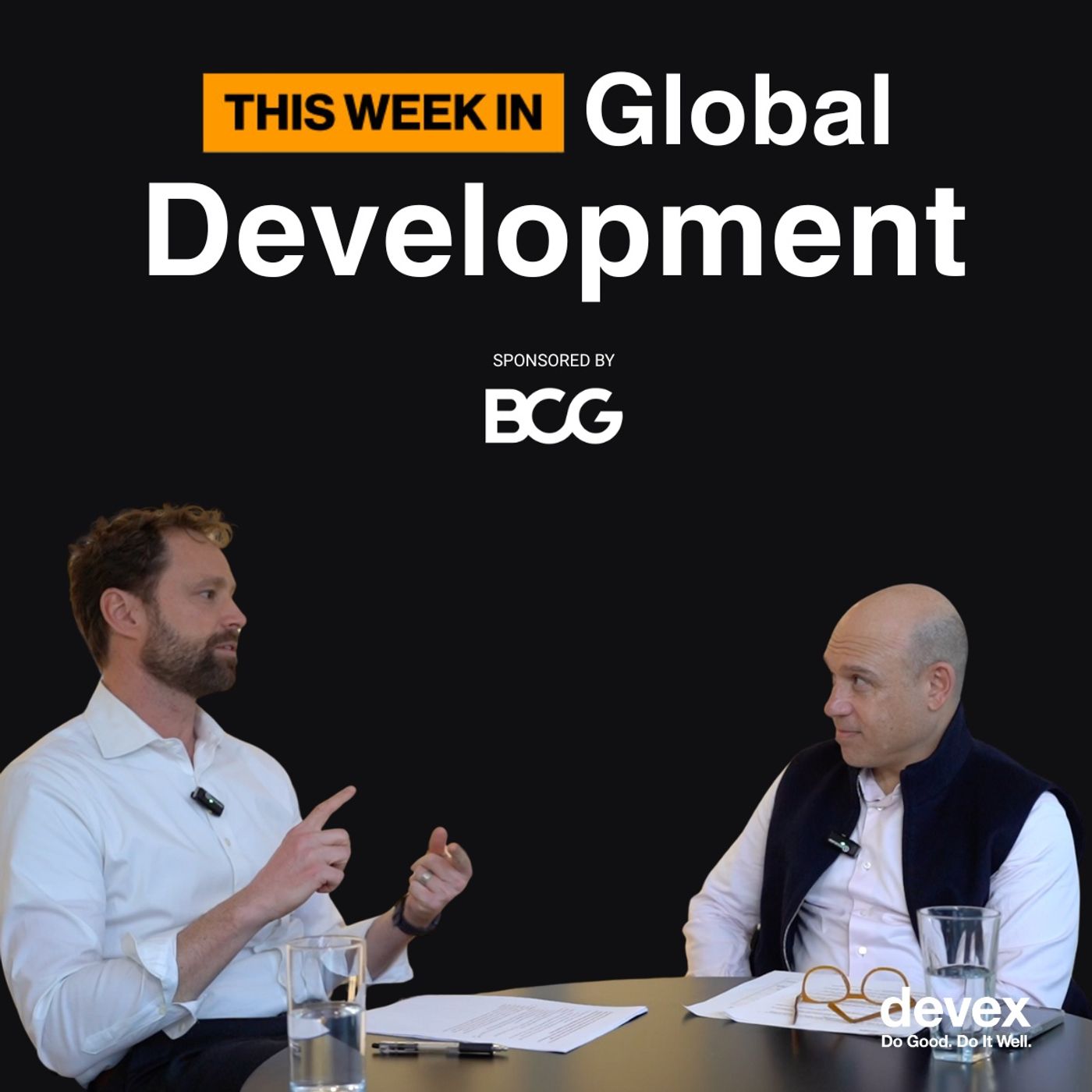
This Week in Global Development
Special Episode: BCG on scaling global impact in an era of constraints
00:34:17
In this special edition of https://www.devex.com/news/this-week-in-global-development-106893, recorded at Davos, we explore a fundamental shift in the development landscape: the move from funding gaps to impact-driven results. As global economic...
Loading summary
Transcript72 lines
- [00:00]
Jim Larson
Foreign.
- [00:05]
Raj Kumar
Here from snowy Davos, Switzerland. I'm Raj Kumar. I'm the president, editor in chief of devex. And this is a special edition of this Week in Global Development sponsored by bcg. And I'm with Jim Larson. Jim is the global lead for social impact at bcg. You're working on all the issues everybody listening to this podcast cares about and works on. Global. Global health and development writ large. Obviously, this year at Davos, there's a lot of things people are talking about. It's not all global health and development, but there is a strong undercurrent of that.
- [00:33]
Jim Larson
Yes.
- [00:34]
Raj Kumar
And part of it is like the dramatic moment that we're in the sense that, hey, we're moving from an aid model to something really different. That's something you've been thinking about writing about for a while and my phone's been ringing off the hook this year. My guess is yours has been too, as people want to understand what do they do with their organizations facing like, really significant fiscal constraints and many other changes happen. So let's just start kind of high level, like, how are you understanding this moment that we are finding ourselves in?
- [01:03]
Jim Larson
Wow, Great to be with you, Raj. I'm really excited to have the time together. I would just start by saying the number of shifts that individually would be seismic on their own are coming together. Right. So you've written quite a bit and we've obviously been following and helping our clients think through very closely the changes in aid and the aid landscape. Obviously that would be the biggest thing that had happened in the development space, space in decades. I think at the same time, we're seeing this AI revolution, which is also the biggest thing that has happened in, in the space in decades. As those two pieces collide, it is going to completely be in a position to reshape what happens in the development space.
- [01:46]
Raj Kumar
And I'm glad you bring that up because it could be one of the sort of untold stories here in Davos. Like World Economic Forum has a lot of sessions on AI, of course, but it's, you know, geopolitics is so powerful right now that it's easy to lose sight of that. And a lot of the development and health leaders I'm talking to are starting to tune into what you're saying, that, you know, aid is coming down, but there's this entirely new set of tools that could transform the way we work. So is this like in theory or are you starting to actually see this happen? I know you live in Nairobi and you spend a lot of time in the continent of Africa. Like what are you seeing in practice?
- [02:18]
Jim Larson
Yeah, well, and actually what I may say is just last year I think there's a reason that we didn't hear a lot so much in the development community about AI. I think it was just everyone was in reactive mode. And my hope is that this year what we're going to see from leaders and the leaders that are most effective or they're going to move from reactive mode to proactive mode. And I think it's going to be hard because we're going to continue to have a lot to feel like we need to react to. I don't think that the volatility is going to go down, but I do think that we're going to see that the best leaders are going to move or the most effective leaders are going to move to proactive mode. And when I say proactive mode, I think of a few different things. The first is we're seeing that leaders are going to have to move to much more of a value for money orientation. This is both on the cost side, certainly, which many experienced last year, but also much more on the impact side. I think that's number one. Number two is AI. Right. As we talked about, that's the second major piece.
- [03:17]
Raj Kumar
And those are already connected. Right. If you're trying to have value for money, AI could be a great way to do that.
- [03:22]
Jim Larson
Absolutely. Then the third is about how leaders think about finance. And you've written a lot about this, we think and advise quite a bit about this on this move from an aid, you know, a bilateral aid and multilateral aid oriented ecosystem to one that engages with lots of other types of finance, including private finance, including much more conscious engagement, multilateral development banks, and including the rising role of philanthropy. So that's the third piece. And then fourth, we've seen a real shift in how partnerships are coming together, which partnerships are effective and less effective. And so again, what we really want to see leaders, the ones who will be most effective, will recognize these sets of shifts and move into proactive mode. We hope this year.
- [04:10]
Raj Kumar
Let's spend a little time on that third one. You talk first about the fact that this is a very different environment we're in. You're going to have to save money. You need this kind of value for money orientation, cost efficiency, of course, and then AI, and as I said, maybe there's a connection there, you can use those tools to help be cost effective. But I think the third one is a little less clear, certainly to a lot of people I speak to in Our community who say, hey, I'm seeing aid being cut. Like, I feel that today in my organization, laying off people, closing programs, et cetera, I'm hearing, including from me, that, hey, don't worry, there's this new model coming, you know, like we're gonna, there's gonna be investment. What is this actual investment? How does it work in a way that's not going to just leave a huge gap and a lot of people underserved. Give us some tangible examples if you're in the health space or the ag space, where there are these new models that will ultimately serve the same people in real need, the people at the very bottom, but in a different model. How does it work?
- [05:08]
Jim Larson
Yeah, great. Well, first I just want to reinforce that we wouldn't be having this conversation about how to make it happen if the money weren't actually there. Right. The money is there. I think people who have been oriented towards bilateral, towards ODA specifically, have seen that money and have seen it come down. Right. And come down pretty significantly. But we also observe that fdi, even in Africa, where FDI to Africa rates are lower than other regions in the world. FDI is as big as aid before any of the cuts.
- [05:38]
Raj Kumar
Yeah.
- [05:38]
Jim Larson
Right. So.
- [05:38]
Raj Kumar
Or indirect investment.
- [05:39]
Jim Larson
Or indirect investment. That's right. Private sector investment into private sector companies was, was as big as aid even before the aid was being cut. And that's been growing at 10 per year over the, over the prior years. And we expect further growth going forward. So that's one part of it you've written a lot on philanthropy, I think that is into Africa about half the amount of what ODA was. That's a significant and sizable chunk.
- [06:03]
Raj Kumar
A lot.
- [06:04]
Jim Larson
And that one we also see growing. Right. While ODA is shrinking. And then of course, there's domestic resources as well. And this is an area that I think many of the organizations that we engage with is not even on the radar. But, but domestic resources are four to five times what the, what the before cut aid budget was. Yeah. And so these are also resources that can be harnessed towards the mission that, that so many of the actors in the space are after.
- [06:31]
Raj Kumar
And just a word on domestic resources, because it's easy, including for me when I hear that, to think taxes.
- [06:37]
Jim Larson
Right.
- [06:37]
Raj Kumar
Which could be a piece of it. You know, countries that may have very low tax collection rates need to change that. But there's also this other side of the picture which is there's a lot of money on the continent of Africa sitting in pension funds, sitting in enterprises, sitting in banks. That is not being invested back in African infrastructure and other African investments. It's to the tune of hundreds of billions of dollars. It's shocking numbers. And that's an interesting problem to have because if you can get some of that money, not even all of it, but some of it invested in these areas, right, on basic infrastructure, on roads and ports, et cetera, with maybe the guarantees that the development finance institutions, the MDBs, can offer to reduce the risk if it's pension funds, et cetera. But if you can make that work, you can unlock enormous money without a tax increase, which is a tough thing politically.
- [07:31]
Jim Larson
Completely agree with you. And that's exactly right. That 4 to 5x that is the domestic public finance. And then completely agree with you. There are balance sheets that exist beyond that that can be mobilized for what we're talking about. But then, Raj, you asked about how, so I want to get to your how question. And I think it's first we just have to recognize it's very different from the mode that the, the actors that we've been engaged with have been operating in. Right. It is a different thing versus a grant cycle from, you know, usaid. This is a different thing to go after these, these other sources of capital. So I think best is just to give you an example. So we've been working with the, in Nigeria, we've been working on an effort called the Nigeria Cassava Investment Accelerator alongside the office of the Vice President, Lagos Business School and the Gates Foundation. And the purpose of this is to, while Nigeria has the BEST is blessed with sort of the best natural resource to grow cassava in the world, it actually is still importing cassava type derivatives or things can be replaced with cassava derivatives. So massive development opportunity that can also be supportive of smallholder farmers and poverty leave users.
- [08:45]
Raj Kumar
These are things like cassava flour, for example.
- [08:47]
Jim Larson
Yes, exactly, Cassava flour. You can actually even create cassava like cassava ethanol as well. So, so it's, it's a range of derivative products. This accelerator intends to bring $300 million investment into cassava processing, which will then have a myriad of effects. So it will actually create over $300 million of revenue for those companies. But beyond that, it will also help over 200,000 farmers to increase their incomes by 50% and it will create another 200,000 jobs in those processors, most of whom will be women. So massive opportunity if you're able to mobilize that $300 million. But it's not easy. So then how do we actually do it? First thing we do is we go and we look at the market on both the supply of capital and the demand of capital side, right? So there are people, institutions who want to invest in projects like cassava processing, but don't have visibility into where they can actually put their money. And so we go and we discover on that side, we ask all the various folks, what kinds of deals are you interested in? What are your return requirements, what other parameters are you after?
- [09:58]
Raj Kumar
And these might be kind of impact.
- [09:59]
Jim Larson
Investors, let's say it could be impact investors, but it's also commercial banks. It's also MDBs. It's also. So it's a range of players in the space. And the key is actually to go to all those different types of capital and understand what are those various, not just the types of capital the actors interested in. So that's one side. Then we go to the other side and we look at who are the actors that are in the space that actually would have interest if they could find capital. They would have interest either in expanding their current operations or moving into a new set of operations that are, that they're not currently in. So we go and understand the potential recipients of the capital as well. Okay, so now we understand both sides of this. Neither until we've done that really has visibility into the other side, right? So now we're creating visibility across the supply and the demand side. So unfortunately it's not then just as easy as, oh, great, match up this one with this one instead. Then those deals then require real cultivation around analysis, structuring, project management. But then that is what then enables us to bring those deals from interested parties to put together interested parties to then actual deals that are then able to get us to that $300 million mark.
- [11:12]
Raj Kumar
I love the example. I love it in part because I have this conversation with my friends at the multilateral development banks that, you know, the change they need to make is going from being a lender, which is kind of the way they've typically thought about their activity, right? They go to a country, they meet with the Minister of Transportation, they sign a deal to provide a loan to build a road. That's kind of the old way that MDBs were set up. And you go back home, you get a pat on the back like, hey, you got a loan through and the board signed it and you got the money out the door. And now they have to be much more like deal makers, which, listening to you, you really explain what that deal making is all about. And that's kind of hard. Like that's a very different skill set in a lot of ways to understand the market dynamics, to find, hey, you know, look, there's a niche here in cassava flour or cassava ethanol. This country's importing it, you know, we produce it. The market dynamics work. You got to do the economics on it, you got to meet the market participants, you got to know the global investors. Like the way you describe, it's very clear. But it's also hard, isn't it?
- [12:09]
Jim Larson
It's very hard. And this is why this investment accelerator is such a, such a powerful model, right. Is that its entire goal is to actually do those various pieces of work and do it at scale. Right. So if one of the multilateral development banks came in, they'd have to do all of that work on their own. Right. Discover who wants, who wants finance and does it align to them. And then a commercial bank would have to do all of that work on their own instead. This serves as a way to actually surface those opportunities. The other piece that this does, right, so if, if someone from multilateral bank came to, to Nigeria and was looking for a cassava deal, they wouldn't know who the other investors were as well. And so this also unlocks, I'll use a, a buzzword, blended finance, but it is a real thing. Yep. So, so you, here is this deal, we have these different kinds of capital. No one is the right fit for this. But if we put these two pieces together, some concessional finance plus then a market based loan, that would actually meet the needs of the, the two finance providers and the needs of the recipient and actually enable the deal to get done.
- [13:17]
Raj Kumar
Yeah. One way I like to think about, I say to somebody, would you like to invest in a cassava flower?
- [13:23]
Jim Larson
Yeah.
- [13:23]
Raj Kumar
That sounds like a good thing. Is it? Would you put your retirement funds in and people pause, right?
- [13:28]
Jim Larson
Yes.
- [13:29]
Raj Kumar
But that doesn't mean you can't put your retirement funds in. It just means it needs to be structured in such a way that it's the least risky part of that capital.
- [13:37]
Jim Larson
Yes.
- [13:37]
Raj Kumar
Right. You need to blend it with people who are willing to take a lot more risk, maybe willing to just lose all their money.
- [13:42]
Jim Larson
Right.
- [13:42]
Raj Kumar
A pure grant that gives you a piece of the picture. And I think if you think in those terms, you might kind of land at how this could work. But again, it seems much more complex. And I think one of the challenges for people who are trying to move from the old aid world to this new investment world is they think, think, well, where do my projects go? You know, like I, I see how this is a great market opportunity. It's going to create jobs, it's going to do a lot of good things. But I was doing projects where I would like go find people who have a real need and help serve them. Are they going to be lost in this transition? How do you see that when you're, when you're talking to your partners, your clients and NGOs and then foundations, et cetera?
- [14:18]
Jim Larson
Yeah, well, I mean, so, so first we see the Nigeria Cassaba Investment Accelerator as a kind of project, right? So first there's that element to it. Then the second piece is there will still be funders who are interested in funding more traditional type projects, potentially even against something like developing processing for cassava in Nigeria. And actually it's the accelerator that helps to surface what those needs are as well. Right. So, so there are still needs in that space that aren't met by, by market capital and aren't meant by a for profit institution. And so, so we will continue to see these lines, but it's going to work in a different context. Right? So it'll be enabling of this, this market set of structures rather than something that sits on its own and tries to do it all on itself.
- [15:20]
Adva Saldinger
Are you interested in the intersection of business and social impact? Do you want to know how corporate sustainability, esg, impact investing and more can contribute to development finance? My name is Adva Saldinger. I'm a senior reporter at devex and I've been reporting on these issues for nearly a decade. I'm the author of Devex Invested, our free weekly newsletter dedicated to development finance. Every Tuesday we explore how companies, investors and market mechanisms are reshaping the world of development finance. Visit devex.com newsletters and join us on Tuesdays.
- [16:00]
Raj Kumar
One of the other interesting implications of what you're saying, and I'm hearing this more and more particularly from African leaders in the finance space, is the MDBs often thought of themselves as like solo actors. You know, they're going to fly in, they're going to do it, you know, figure out things on their own and they're in charge. And in this new world it's really like a local institution that would set up an accelerator like this, right? It would be a project with government buy in, with local market buy in. Maybe you have a regional bank, maybe you have a national public development bank, but the MDBs kind of come in later and they maybe come in as a coalition, working together, blending their money together, not necessarily designing everything, soup to nuts and writing one big check. And that's A really different place for the MDBs to be.
- [16:47]
Jim Larson
It absolutely is. Now I could imagine that some of the MDBs could say actually this is the model that we need in order to surface opportunities for us and to enable us to syndicate to others. What are the opportunities that are there? I could imagine some of the mvbs actually creating alongside local partners some of these investment accelerators that are doing what I just described. But I agree with you, that's a very different role than what they're doing today. And if they do that, they're still coming in later than they usually are in a deal cycle.
- [17:19]
Raj Kumar
This is the kind of stuff you guys in the consulting world work a lot in. Sort of like, you know, the leader of the development bank, Ajay Banga or Elon Goldfein or whoever, they might have a great reform plan, might make perfect sense on paper, but then a lot of it's about the people and the culture. You know, can you shift? You know, it's a very different set of skills and mindset even. I moderated a session here in the Congress center at the World Economic Forum and, and it was with a number of African leaders and one of them said, you know, our biggest challenge is going to be in moving to this new model. It's mindset. He said, we just got to change our mindset. We actually have all the assets with all the tools, but the mindset isn't quite there yet. And he sees that as the, as the next piece. How do you think about it?
- [17:59]
Jim Larson
I 100% agree with that. I would then just add to it. It's a set of mindset and capabilities. Right. So, so this really is a different set of capabilities than what we're talking about, you know, before. Right. It is a different thing to go and discover two sides of a market and be able to identify where the kind of multilayer deals are. That is a different thing even from very experienced finance professionals and what they've done before. And it's certainly quite a different thing from what many of the project based development programs have been. So I very much agree with the point that this has to move from a mindset of five year development projects to this more kind of invested in blended model. And then I do think capabilities will have to follow as well.
- [18:43]
Raj Kumar
Right.
- [18:43]
Jim Larson
The person who works at your local.
- [18:44]
Raj Kumar
Bank where you go to withdraw cash, they might say I'm a banker if you ask them what their job is. And the person who works at, you know, one of the big Wall street firms might say I'm a banker. But Those are two very different jobs.
- [18:56]
Jim Larson
Yes. Yeah, right on, right on.
- [18:57]
Raj Kumar
You know.
- [18:58]
Jim Larson
Yeah.
- [18:58]
Raj Kumar
And I think that's akin to what we're talking about here. Like the institutions are the same. We're talking about the development finance institutions, the, the multilateral development banks, but the people and the roles are actually really pretty different.
- [19:09]
Jim Larson
Yes, 100% agree.
- [19:10]
Raj Kumar
Yeah, I think it's going to be an interesting challenge. I think it relates to, to philanthropy, which may have a similar set of challenges. Right. Like you highlighted the opportunity for philanthropy to come into a program like this.
- [19:21]
Jim Larson
Right.
- [19:22]
Raj Kumar
To say, yeah, we'll help provide some of the, maybe technical assistance, maybe we'll do some grants to, you know, take some first losses and de risk private investment to let this, you know, Cassava accelerator grow. But that's a different mindset for philanthropy too. And it's a very different way of thinking and it's different set of capabilities. You work with a lot of foundations. Do you see them understanding this as an opportunity, being willing to move in this direction? How are you seeing that?
- [19:47]
Jim Larson
I would say it is a move further in a direction that I think much of what philanthropy has been going in. So I do think there are green shoots this direction, but I do think it's a further move. A couple of pieces that I think are important. A lot of philanthropies are set up where they have a dichotomy between their kind of program related investments and their grant making work. And so that is quite a typical setup. What we're talking about here is a much more integrated approach to those two things. And so grant makers actually need to be thinking about the role of other types of finance in an increasing way. And then also frankly, pri individuals need to be thinking about what role could, could grants play as well. I just want to expand on that second point a little bit. To date, we've almost entirely seen blended finance come off of balance sheets where the return for the concessional player is somewhere around 0%. Right. They might take first loss. So maybe that'll end up with a minus 10% overall on a portfolio basis, maybe even minus 20. That is very different from a grant. A grant is minus 100. Yes. And, and what a big unlock for, for blended finance will be and has been in some cases is actually enabling that minus 100 money to go into the same stack to then completely change the economics of that, you know, person who wants to put their retirement on the line. It completely then changes the economics in a, in a much more powerful way than 0 or even minus 10 or minus 20.
- [21:23]
Raj Kumar
There's a really fascinating mindset issue there. And I talked to a number of philanthropists around this. You know, you could think of it as a spectrum. You can give away some money, you can lose all of it because you're giving it away. So you're sort of losing it. It's off your balance sheet, you're never going to see it again. Or you can have somewhere on a sliding spectrum some amount of it come back in. And if it comes back, you can then give it away again or provide some kind of investment to others where you might again lose some of it, or you can even invest it for a gain. You might actually make a profit, a surplus on it that you can reinvest or give away in the future. And I think you're right. If you don't have an integrated mindset around that spectrum being one thing and being able to use that same capital in different ways to achieve an objective, then it's really easy to have this siloed culture inside a foundation. I'd actually add a third piece, which is a little outside the scope of our discussion, but policy and advocacy, because a lot of foundations have a whole arm where they're trying to change the regulatory environment, they're trying to change the way governments work to achieve some objective, and it's sitting off on its own. If your grants, your investments and your policy advocacy are in some way integrated, you're probably going to be a lot more effective in achieving that ultimate objective. Let's come back around to AI. Great. Because we just kind of skated on the surface and I want to make sure we spend some time on that.
- [22:37]
Jim Larson
Great.
- [22:37]
Raj Kumar
I'm personally pretty excited about it. We just hosted a breakfast this morning with a number of companies that are working in this space and it's kind of mind blowing, the scale of the, of the people on earth that are using this stuff already kind of voting with their feet, using. You know, I asked one group like, is everybody here using AI for their own personal health? Everybody raise it right. It's like moving at lightning speed and in very personal, direct ways that everybody's using these tools. So if you're in, let's say, the health space, what are you telling your clients around how they should be thinking about AI to bridge some of the gaps in finance, but also just like make a much bigger impact than they've ever been able to make before?
- [23:16]
Jim Larson
Yeah, I think the starting point is recognizing where we are in the adoption and scale of AI. And I think on the one hand we have These personal experiences that can make us think, oh my goodness, the, the AI revolution is here and already adding, you know, full value. We are experiencing the fullness of the AI revolution. We are actually so early in the impact of the AI revolution. Let me start just by illustrating that by companies, right? So companies that their CEOs like their jobs are on the line in terms of their ability to deliver value with AI, we're only seeing already at this point only about 15% of companies are delivering in year P and L impact right now. Only about 15%. Right. So, so even these profit motivated, very highly capacitated and where the leader is motivated to keep his or her job, we're only seeing that that's where we stand right now in terms of full like value delivery at scale inside these organizations. When we survey those organizations and then survey the social sector, we have a survey of over 2,000 leaders across sectors, including dozens that are in the space that we operate in. We find unsurprisingly that for a range of reasons the social sector is significantly lags behind. I think it's at least a year. And so it's just important to understand where we stand in this moment. So while we've just seen in 2025 those first, you know, it's the first significant chunk of value creation in, in the private sector, I think we're going to start to see that, you know, this year in the social sector and we're really not going to be at scaled impact for the next, you know, couple of years in terms of what we see.
- [25:03]
Raj Kumar
Yeah, that makes a lot of sense to me. On the other hand, the opportunity size is massive, right? I mean when you think of like the fact that there's 10x more doctors per capita in Germany than Nigeria, you know, just a few years ago the solution to that problem was let's build a lot of medical schools, let's try to train a lot of Doctors. Maybe in 30 years we'll get there.
- [25:24]
Jim Larson
Yes. Yeah. And Raj, look, this is not a case for skepticism. In fact, it's quite the opposite. Right. One could look at and say, oh, I'm not seeing real impact. And that could create skepticism. Actually this is in my mind a reason for optimism. Right. You have to understand where we are in the curve and I completely agree with you in the massive potential that exists. Let me just give a couple of examples of what we're seeing in those places that are getting real value in the private sector just to help it come to life. So a financial institution in Europe was looking at how they could rewire their customer service and they are finding across the board with an AI first approach, 30 to 50% efficiency gains. 30 to 50% on an already very well performing, you know, financial institution that's very profit motivated and is already well tuned. Right. So 30 to 50% reduction kind of cost savings that they're able to achieve. The impact is massive. We've seen in a marketing function, we worked with Reckitt on their marketing function. We've seen 90% improvement in their speed that they're able to do the same set of tasks. This enables their people to then spend their time to create more and better quality pieces that go out into the market that have enabled them to increase their performance as well. Right. So the size of potential impact is indeed massive. And when you look at the specific problems that we face, as you were highlighting in the development space, I think that that potential impacts even higher.
- [26:56]
Raj Kumar
Yeah, that makes a lot of sense. I'm curious, what kind of advice do you give? You know, I can imagine the MDBs and governments looking at the AI problem and saying, okay, we better get more Internet access. We got to make sure that there's more electricity. I mean in Africa there's still some 600 million households that don't have access to electricity. So there's some basic infrastructure that's got to get built for this AI revolution to actually reach everybody. And that's certainly the job of these big financial institutions and governments. But what about your NGO partners and clients? What's your advice to them about what they should actually be doing right now?
- [27:34]
Jim Larson
Yeah, I'll share. For NGOs and maybe even for health ministries or for these kinds of players that are engaged first, it's probably two primary things. One is about organizational leadership and what we observe in organizations that are having real impact is first, this is a CEO priority. The head of the institution is. We find that 72% of leading companies, it's the CEO who has the primary decision authority over AI. 72% rest at the, at the CEO level. So it's a CEO priority. And then what do they do with it? First they prioritize. So a, it's a priority for the, for the institution. But super importantly, they don't take an approach where they do a ton of different pilots and just testing and learning throughout the organization. That's a, that can be an important first step. But they choose the 2, 3, 4 places where AI is really going to deliver real value and undergo end to end transformation. That is AI led across that portion of their Organization. So that's number one. The second is that they super importantly invest, of course. So what we found is that the, the investment in, in AI for again leading organizations has gone from less than 1% to almost 2% of total revenue is now invested in AI. So there was in a doubling from 2024 to 2025. And organizations expect that to actually go up in percentage terms on a go forward basis. And then finally, super importantly is around upskilling. So it's the leaders, the heads of the institutions themselves that are upskilling themselves and then also super importantly upskilling their teams. This is different than anything that any of us as leaders have done before. We absolutely, in order to be able to be effective in it, have to understand it ourselves and not understand where AI stood and what we understood about how to make it successful a year ago, but rather we have to understand it today and understand where it's going and make sure that we stay on the cutting edge.
- [29:39]
Raj Kumar
Yeah, that's one of the great things about coming to this World Economic Forum annual meeting is you get to meet a lot of the people building these models, building the latest tools. It definitely it's eye opening. One of the, the things I picked up along the way was that you were just talking about how to do the kind of end to end transformation. Is that one thing companies and organizations tried to do initially with AI is okay, we'll look at our workflow and we'll go find a part of it and we'll swap it out with AI or add AI to augment it. And actually the insight I picked up this week is a lot of organizations instead have found it's much more successful to just start from scratch, completely reinvent the process using AI. Don't feel like you have to follow your old process. And I imagine that's got to apply in the social sector too. Right. If you're thinking about service delivery, whether it's in health or ad, like think about that end farmer and whatever service you're trying to deliver there and then reinvent the model using AI.
- [30:33]
Jim Larson
So I very much agree with that. I would just expand it. So what we see in terms of AI delivery is really on three horizons. So we see, we do see just deploy. Right? So we do see take an AI oriented solution and deploy it. I would say that the Global Fund supported AI based CT for TB diagnosis and TB screening. Excuse me, is absolutely this right? So it takes the basic flow. Certainly there are some changes needed. The basic flow puts much better technology into it and it has A transformational impact. So I do think there's opportunity in the deploy space, but it's not just in deploying within existing processes that we're looking at. It's also that there is the opportunity to reshape or even reinvent. So you went to reinvent, which 100% agree with you. It's what is now the new art of the possible, as we think about this. But that reshape space, this is an end to end transformation that seeks to deliver the same thing, only much more efficiently and effectively. And we're seeing that that's actually the primary place of value creation today. So agree with you, it's actually not in the deploy, it really is in that resource appreciate space.
- [31:42]
Raj Kumar
Okay, well, I mean, look, this is an exciting time in a lot of ways. One reason we love to come to World Economic Forum annual meetings, the start of the year, there's more happening than ever. It feels like we're in a very dynamic situation. And one thing that comes out of this week usually is some sort of a narrative. You know, people are all meeting each other in the hallways of the parties. You're trying to figure out like sort of what's going to come this year. Do you have a sense, I know that we're still in the middle of the week, but like you've been picking up through your discussions and meetings with leaders, what do you think is the sort of narrative in our space going forward this year?
- [32:12]
Jim Larson
Yeah, my sense is that the narrative is one of we need to do something different, but we need to figure out what that different is. So I don't think that there's a narrative of here's the new thing, But I do think we're increasingly at a narrative recognizing that we are not in the old anymore and that there is no going back to the old. Instead, we have to navigate together to something that's new. I think the emotions that I sense in that space is a mix of, I think there's some excitement. I think there's also a fair bit of nervousness. But I do think that people are now recognizing that we need to come to something that is new for each individual organization and then as an ecosystem, as a whole.
- [32:56]
Raj Kumar
To me, just as we wrap up here, I think one of the exciting parts of that narrative is that if you were just looking at the aid sector as an aid sector, it's obviously shrunk dramatically. But if instead you're thinking about the impact sector more broadly, and you can then crowd in companies, you can crowd in private investors, you can crowd in the development finance community, suddenly it's actually a lot bigger. There are a lot more assets trying to make a real impact in the world. It's a more complicated picture certainly and there's a lot that's probably lost in that transition. But in some ways you walk out of an event like this and you figure, wow, now we're aligned with lots of different kinds of organizations that are out there, some of them with massive reach and massive sets of assets. If we could just make that work. Not an easy how question.
- [33:43]
Jim Larson
Right, right.
- [33:44]
Raj Kumar
If we could somehow make that work, there's a lot of progress that could come from that.
- [33:48]
Jim Larson
Yeah, totally agree with that.
- [33:49]
Raj Kumar
Yeah. Well thank you for the great discussion. I'm always learning a lot here in Davos and I have learned a lot in this conversation.
- [33:54]
Jim Larson
Great. Thank you Raj so much. Jeff. Great to get to do it. Thank you. It.