← This Week in Global Development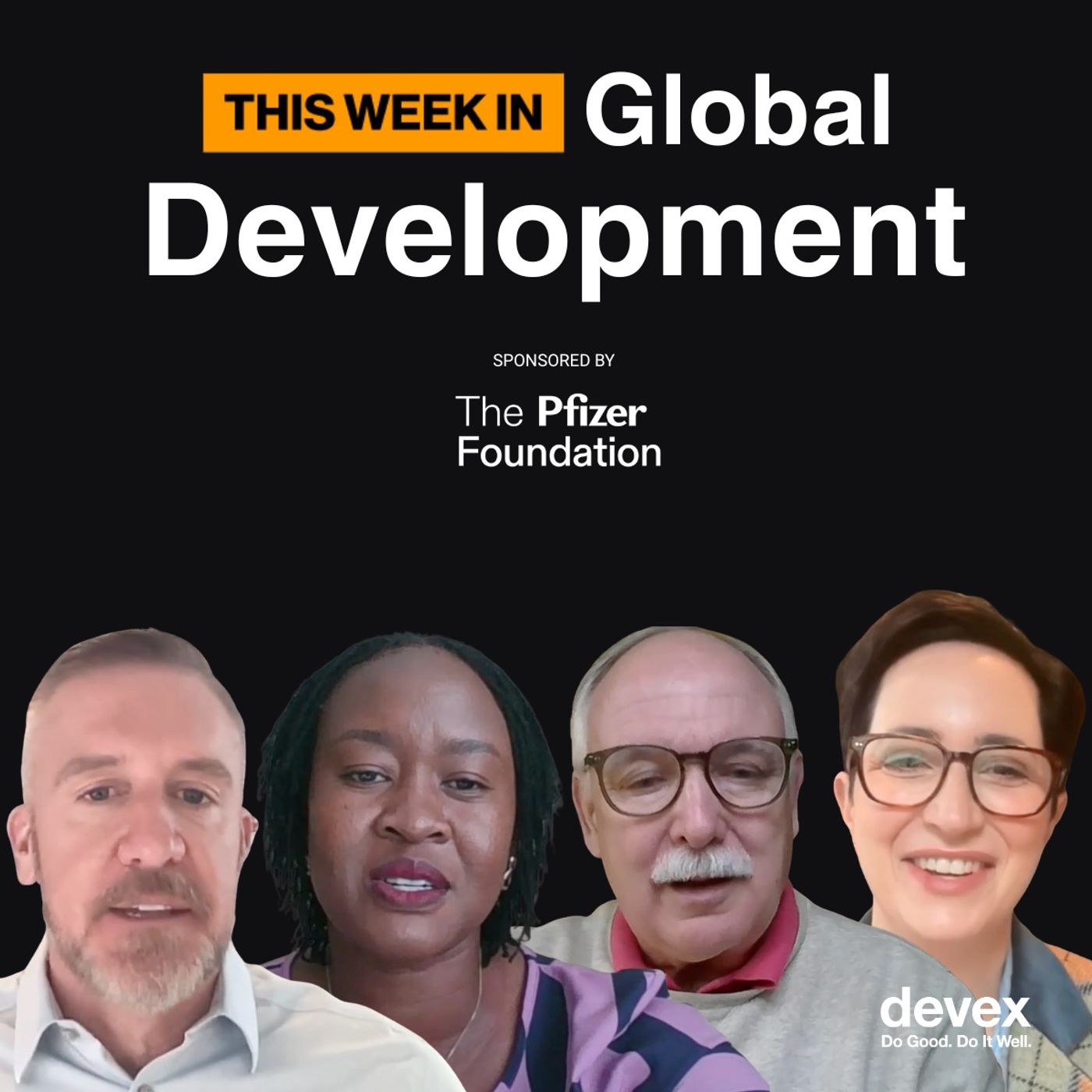
This Week in Global Development
Special edition: Breast cancer as a global development challenge
00:33:08
In this special episode of This Week in Global Development, we explore breast cancer not just as a health challenge, but as a critical development challenge. In low- and middle-income countries, or LMICs, a breast cancer diagnosis can have a...
Loading summary
Transcript24 lines
- [00:07]
A
Hi, everyone. I'm Kate Warren, executive vice president and executive editor at devex. And welcome to this special edition episode in partnership with the Pfizer Foundation. So today we're talking about breast cancer, but maybe not in the ways we usually talk about it in global health. We've gotten pretty good about framing breast cancer as a medical challenge. You know, disease to diagnose, treat, ideally, catch early, and something that is faced by, you know, patient, maybe their family alone. And that framing is important but also leaves something out because when a woman, particularly in a low and middle income country, gets that diagnosis, the consequences don't just stop at the doctor's office door or her own door, they really ripple out. Enter her household, her community, her income, her children's education. The economic fallout can be as devastating as the disease itself. So today's episode, we're asking what it looks like to treat breast cancer not just as a health threat, but really as a development challenge and what changes when you do? And I am joined by three people who are working exactly on that. We have Darren Back, who is the president of the Pfizer foundation, which is driving investment and community led partnerships around the world. We have Dr. Patrick Lehrer, who is the founding director of the center for Global Oncology at Indiana University and one of the key architects of ampath, a partnership that has built cancer care infrastructure in Western Kenya from the ground up. And we'll learn a little bit more about that in today's episode. And we have Dr. Eloise Citine, who is a consultant, radiologist and lecturer at Moi University School of Medicine in Eldoret, Kenya, where she is doing the work right on the front lines of diagnosis and care. So welcome to all three of you. We're so glad to have you as part of this conversation. So, Loyce, I actually want to start with you because you're the person in the room who actually sees patients. And when a woman comes to you in Western Kenya with maybe a late stage breast cancer diagnosis, what does that moment look like? And not just medically, but really for her life and for her community.
- [02:35]
B
So to talk about the Kenyan woman and their experience when it comes to breast cancer care here in Kenya, probably I would reflect on a story of one of our, our clients, one of our survivors, and probably walk you through her journey. And that would give us probably some insight on what that looks like down here. So this specific lady had about cancer awareness in a wild cancer day, and she thought, wow, I need to get myself checked. Because she heard about screening and she went to A facility near her home. She was turned away, told it was about Christmas. Most of us are not working, so come back. Probably later in the new year, she went to a second facility. A few days later, she was turned away again. And finally she decided, I still need screening. So she came to where I work teaching and referral hospital, which is about 150 kilometers away from her home, about 100 miles away. And she got her screening done. They found a lesion. She had what we call a biopsy that is taking a sample to take to the lab to test. And then she went back home and was told, wait for the results. So she has this duration of time, which can be prolonged. Sometimes it can go over a month before you get those results. And when the results come back, she's called back to the facility, she's given the results, and she's told she has cancer. So she is told, this is the treatment plan. This is what we intend to do for you. And she goes back home and tells the husband, I've been told I have cancer. The husband is like, no, you can't have cancer. You are young, you're beautiful, you don't look like you have cancer. And she's like, no, no, no, I have cancer and I need to be started on treatment. And the guy said, no, you're not starting treatment. So that, of course, ends up in a fight between the two of them, and the marriage is affected. Eventually, she gets treatment. She gets her first treatment, which was chemotherapy. She was treated, and then after that session, she never came back. She was due for surgery. She didn't come back to the system. And in that process, she also lost that marriage, she lost her job, because now she was unwell.
- [04:58]
A
So.
- [04:58]
B
So she's on treatment. And with that, she was not able to do her small business, what we call she had a small business in her town. So she couldn't work. So her daughter now had to step up to take care of her and provide for the family. This lady has other children other than the one daughter who was taking care of her. And she'd lost the husband. Then she didn't come for care that she was supposed to. So she stayed until the disease came back again. Now this time more serious with symptoms. Remember the first time she came, she didn't have symptoms. So she comes back. Now she has symptoms, severe disease, and she comes back for treatment. So she gets care. And she has been in care since then. But you can see all the challenges she had to go through. So that's basically the journey that a Kenyan woman might make, and I see that replicating thousands of other people's lives.
- [05:52]
A
Well, yeah, you really paint how persistent she had to be, too, in a lot of the barriers, whether it was the medical community or even her own spouse, in trying to treat the care that ultimately slowed down and delayed and really the ripple effects that's had across her family and her community. So, Darren, I want to bring you in because we started this talking about how we often treat health and economic development issues as separate issues. And the Pfizer foundation, through your Action Impact Initiative, has made a deliberate choice to really frame this as a development challenge, not just a health one. So first off, can you talk a little bit more about this initiative and then more broadly, why does that framing around broader economic resilience matter?
- [06:44]
C
Sure, yeah. And thank you, Kate. Thanks for the question. I mean, I'll start off by really saying that for us, health and economic resiliency are deeply connected. And I think breast cancer actually really is a visible way to see that. In terms of what you just heard with regards to the patient journey, it's devastating. Breast cancer's the leading cause of cancer in sub Saharan Africa, leading cause of cancer for women around the world. And of course, when you go to lower middle income countries and you go to sub Saharan Africa, there are so many more barriers that women have to face. And so really, that was the rationale for the Pfizer foundation in terms of why we launched this initiative. And so for our part, we launched, as you just mentioned, Kate, an initiative called Action and Impact. We launched this in 2025, and it's a $25 million commitment across five countries in sub Saharan Africa. And really, through this initiative, our supporting partners like ampath, they're working with governments to advance timely diagnosis, treatment and care. And our focus for this program is really on creating replicable, adaptable health solutions that are aligned with country priorities but can be embedded within the national health systems. We also want to be able to importantly really share these learnings to support global knowledge sharing. So if I talk about the initiative, recently, we actually expanded into Kenya and into Ethiopia, and we had really strong country leadership from the ministries of health, which is so important for the success of programs such as this. And so if I take the example of Ampath and the great work that they're doing in Kenya, they're working across the patient journey. So it's from the community level to promote breast cancer awareness all the way through to working with regional leadership to implement national cancer control plans. And that work is really showing what is possible when efforts are aligned. And that's the most important thing. The efforts have to be aligned all the way from national policy down to the patient level. And so back to your question, Kate. For us at the Pfizer foundation, we firmly believe that when health and development move together, this type of work not only improves breast cancer care, but also strengthens systems and long term prosperity.
- [09:15]
A
And Patrick, so you know you've spent decades working in oncology in the US and then you turned your focus building cancer care in Kenya where almost none of that infrastructure existed. Can you talk a little about what that experience was like? And to Darren's point, of how you build systems that really respond to local needs, local communities, but then be able to scale that up and align with national plans, maybe even scaling into other countries like Ethiopia, as Darren mentioned. But what has that experience been like? And how do you look to build a locally responsive healthcare system that also ties into a national strategy that can better bridge those links between health and overall sustainable development?
- [10:17]
D
Just briefly, I've been privileged to be part of the history of oncology. I was witness to my partner who put together the first cure for testis cancer. Back when we started 1970s it had a 95% mortality rate and today it's a 95% cure rate. And so I've been able to witness the possible. My experiences working in Kenya over the last 20 years was built upon the work that was done by the Ampath group and HIV AIDS and recognizing that it's the population health getting out in the community. There's so many great things to do with this impossible mission of trying to treat and cure HIV aids. We figure if they can do that for aids, we ought to be able to do it for cancer. We've seen that it's happened. So I think when we think about cancer, it's one of these. It's a great opportunity to think about the stressors to healthcare systems. There's no disease in which requires greater coordination of care than cancer. There's no disease that requires so many disciplines, from surgery to medical oncology, to radiation to the pathologist, to pulmonologists, to supportive care people. Every discipline in medicine is involved in some capacity in cancer. And so if it doesn't work for cancer, it's not going to work in other systems. If it does work for cancer, that means we can actually elevate the entire healthcare systems. And because of this, I think it's a great opportunity for us to really build upon what has been a platform for hiv, AIDS and Now look at what we can do for cancer. We're so deeply grateful for Pfizer because the money that's going to help with this initiative forced us actually to think about the continuum of care from patient awareness before they even have cancer, to let them know that it's okay to even talk about the word cancer, to getting public policy involved, working with community healthcare workers to make a diagnosis in a timely capacity. And as Dr. Ctna said, a woman gets a biopsy, but it may be a couple months before this pathology specimen is read and then given back to the patient who's forgotten about it. And when the patient then is diagnosed with cancer, it may be again another couple months before they're linked to care. And because of the great distances and the paucity of healthcare providers throughout sub Saharan Africa, this access to care may be hundreds of miles away. And so what we need to do is to work with systems that can bring patients into care, properly, get them the best treatment, and then get back to the community where they can have long term outcomes. Breast cancer is particularly problematic in sub Saharan Africa. In the United States, two thirds of the women who come in come with early stage disease and over 80% of them are going to be around 5 to 10 to 20 years later. In Sub Saharan Africa, 80% of people come in with advanced disease and less than half of them are going to be around in five years. And so we have a great challenge here, but what we have seen is the possible. We know what can happen. We just need now to make it a probable experience for people in Kenya.
- [13:57]
A
Hi, I'm Kate Warren, Executive Vice President, President and Executive Editor at devex. At devex, we don't just cover the biggest moments in global development. We create space to understand who and what are driving the headlines. Alongside gatherings like the World bank and IMF Spring and annual meetings, the World Health assembly, the UN General assembly and beyond, we host Devex Impact House, where our journalism comes off the page and onto the stage. We bring together a curated group of leaders for live interviews, intimate roundtables, hands on workshops, and candid conversations you won't hear in the official meetings. It's where tough questions get asked, the spin gets stripped away, and meaningful connections happen. If you'd like to join us or stay in the loop on all of our events online and in person, please visit devex.com events and I hope to see you at a future Devex Impact House. Yeah, and so Loyce, you know, you talked a lot about some of these challenges that a patient faces in seeking Care and a diagnosis, and then even some of the stigma and other challenges that they face once they maybe receive this diagnosis. Can you talk a little bit more about, you know, where the system might lose her along the way, and then, you know, what you are working on or see being successful in helping to close some of those gaps so that maybe you get that earlier diagnosis or you get that earlier treatment.
- [15:35]
B
So there are very many points that we can lose this lady starting from even before she comes to the hospital. The myths that are out there about cancer. Cancer is a killer disease. There's no treatment for cancer. So there's a lot that can be done at different levels. So we intend to start from education, such that we are telling them that, yes, we know we've had. Because most of them say when they see patients who come for treatment for cancer, they come and they die. And I think what we need to put out there is that these patients are actually coming in stage three and four disease when things are hard to manage. But if we can pick these diseases earlier. So we start with education, educate them that cancer can be treated when it's picked early. Also the support system, I come from a very patriarchal society, so the decision makers are the husbands, the brothers in the home. Can we also educate them to know that we need to support our women? So community awareness, community sensitization, and just not for the woman, but even the support system around the woman. Then when we to the hospital, as Pat has said, the diagnosis is a challenge at this point. And when a patient comes and they have to wait for diagnosis for more than a month, there are other treatments that they may seek. In between, we have what we call traditional herbalists or traditional healers, where they actually go and they get some substance injected into their breast, and they're told these will take care of the disease. And by the time they come back, they're coming with advanced disease because of the time that has been lost, from the time they went to see the traditional her list to the time they come to conventional doctors. Then other than that, there's a financial problem as well when they need to join the system. Like in Kenya, we have what we call the social health insurance fund. And you have to pay a premium to join the social insurance fund. Some homes cannot afford to pay for that premium. So with Pfizer, we'll be able to, you know, recruit some of the positive patients into the insurance fund so that they can access the insurance package that the government gives, because there's a package for cancer in that fund. So they can be able to access that and shield them from the financial challenges that they would go through if they had to pay for that off pocket, then other than that also is once they are in care, sometimes we lose them because the patient didn't have transport to make to the hospital. So how can we support them? We will also have what we call patient navigators, such that if the patient misses a clinic, we are able to call them and say, you are due for chemotherapy today, you didn't show up what happened and be able to find what is really going on. So we'll have the patient navigation to walk with the patient that journey as they go through treatment and eventually, hopefully have success stories. Have survivors, have these women together that can say, yes, we fought breast cancer, here we are, we are survivors and they can also be our champions out there to the world to tell them we can treat cancer. We are survivors. You've made it through. So I think those are the different points that we intend to work and where we easily lose the patients.
- [18:50]
A
Yeah, that whole point about the navigation and as Patrick said, it's such a complex disease that requires so many different specialties and navigating all of that, even for a well resourced person, is an overwhelming experience. So you add on these other barriers and you can only imagine how challenging that would be. So Darren, when the Pfizer foundation
- [19:18]
B
looks
- [19:18]
A
for a partner on the ground and you work a lot with local partners and the work you do, what does that partner need to have in terms of relationships, infrastructure, trust and how do you work with them to try to make this work actually possible and both being able to respond to the local needs, but being able to help attack some of these barriers Loyce laid out when it comes to financial resources or other just logistical challenges that patients face.
- [19:52]
C
Yeah, no, absolutely. And thank you, Kate. And thank you Loyce as well. I just wanted to add to what she said previously. I was fortunate enough to be with her earlier this year in Alzaret in Kenya and attend a community healthcare worker training session. And they had a breast cancer survivor there and just her share. Sharing her story was so powerful. It was such a powerful and important moment to be able to use survivorship really to push the message about earlier treatment, earlier diagnosis and earlier access to care. So I fully concur with what Loi said earlier. But back to your question, Kate. So from a Pfizer foundation perspective, ultimately we're not just funding programs, we're investing in trusted partners and those partners need to be embedded in the communities in which they're working and that's something that we primarily look to. And then they must have that connective tissue. This is really key, that binds the community experience, the clinical practice and national policy so they can work through the system to drive policy change which ultimately leads to scale and sustainability. And so if we take the example where we have we're working with Ampath in Kenya or we're working with partners in health in Rwanda, these are organizations that they have decades of presence and proven health impact in those countries. So that's key for us just to see that they are effective and they're able to drive change and health outcomes in whichever area they're working in. Importantly, a partner that also brings that lived experience is really key as well, because they become that voice to be able to share those lived experiences with the government, with the ministries of health, which really helps them inform their decision making. And ultimately it ensures that national cancer plans really reflect that real patient journey. So it's not just theoretical, it's real. But really, Kate, bottom line is webat partners who simplify and connect care pathways and ones that don't fragment them.
- [22:08]
A
You know, you talk about that lived experience. My mother was actually diagnosed with breast cancer when she was living in a rural part of Mexico and her doctors recommended that she get an immediate double mastectomy. And so she came back to the US where I live and got a second opinion. And the doctor said, oh no, no, you're still early stage. We can do a lumpectomy, radiation, not nearly as severe of a treatment course. And what they said is, well, actually the doctors that you're working with in Mexico are probably about 10 years behind on the research and science on where we think you need to be on how to treat cancer at this stage. And it really just got me thinking that it wasn't just a difference in resources financially. And actually a double mastectomy would have been more expensive and costly to treat than what she ultimately had done. And she's been cancer free for over seven years now. So it was a successful treatment, but it's also a difference in kind of the knowledge and the access to current research and science and you know what, how that reaches a clinician in a lower resource setting. So, Patrick, I'd love to hear kind of how you think about the quality of care and how you get not just to the resources, but also the latest research to medical expertise when it spreads so thin across rural areas.
- [23:45]
D
I think one of the things, particularly the fortunate people in high income countries need to be cognizant that we're visitors in these other countries, they are. There's a TV show here in the States called MacGyver, in which every episode he was found to be in a tragedy, and he looked around the room and found those things that he could do to get out of this disaster. These guys in Africa are doing the same thing. It's nice to say that the right treatment for early stage breast cancer is a lumpectomy, and that followed by radiation therapy. But if radiation therapy is not a around for another 700 miles, or if you have to go in there every day for. For five days a week, for five weeks in which you don't have a home in that, it's difficult. And so you have to do the best you can with the circumstances there. And so in many cases, actually doing a mastectomy may be the right answer. Now, again, in LMICs, most women present with advanced cancer, and so they don't have a tiny lump like we see here. And so I think what we have to do is have some cultural humility as we go into these countries, see what resources they have available and make the best use of it, and then be strategic in terms of helping them and trying to provide better access to care, to technology, to drugs, but also access to higher training to make sure that these physicians and healthcare providers are helping them out. So I think when we go embark on these programs and wherever it is around the world, we need to go there and listen for many months rather than going there and talking, find out what they have been doing and how we can help them in their own capacity, rather than coming in and saying, well, this is how we do this in Indianapolis, therefore you should be able to do that back home.
- [25:35]
A
Yeah, absolutely. And how do you then scale those approaches that, as you say, they really need to be embedded in the local context. And so what are some of the. Maybe the lessons you've learned about how to scale those effectively while still remaining relevant for the different contexts you might be operating in?
- [26:00]
D
Yeah, I want to throw an example. It's not breast cancer, but I think it goes to understanding the problems. And so there's another disease that's very common in Africa called Burkitt's lymphoma that affects young children. It's more common in Africa than it here in the states. In the States, it may have an 80 to 90% cure rate. In Africa, it's about 5%. And part of the problem is access to care. Parents would bring their kids in for a treatment. They may get one treatment, and not show up again. So we did a simple study with some money that we got from the NCI for a supplement and just provided a supplement to the families of a modest amount to help pay for transportation and housing. And this ended up having improving the patients coming back in every three weeks for treatment. And the cure rate went up to 60% just by providing money for access to care. It wasn't a lot, just a simple intervention. Again, when we think about here in our country, there are people who don't come in for care because it's too far. They can't pay for parking and they have no insurance. So these are issues that are, these global issues are important in LMICs, but they're also very important in high income countries where there's great disparities in care. So that's one example where it has nothing to do with medicine. It's just looking at the problems that are faced by the patients. The flip side is trying to have access to drugs. And I think what we have shown in Ampath and Eldoret is that we now have training programs in medical oncology and pediatric oncology and gyne oncology. We now have local Kenyans who are doing this work and with them we've now convinced the government that it's worthwhile investing in cancer care and it encouraged the national Health Insurance Fund to fund cancer care. And with that then companies are investing in dropping off drugs. So now we have greater access. So all of the WHO's essential medicines are now available in Eldoret for patients who have cancer. And that provides just a terrific platform for this. And then through help with the Pfizer foundation in the past we built a cancer and chronic care building that has radiation facilities there. And there was nothing in Western Kenya serving the 20 million people there. With that, the hospital actually bought another facility for radiation therapy. So now we have, we've leveraged this. So I think once you show that you can do this and you develop the confidence, people then start to invest. And what we want to see is the government investing and the local people investing, which is what we've demonstrated thanks to initiatives because of the Pfizer Foundation.
- [28:44]
A
And so Darren Patrick mentioned some of the just overall systemic changes and shifts that need to happen to tackle these challenges. If you were to be looking into the future and wanting to see one change that was done that you think would have the greatest potential to improve the global breast cancer survival rate, what would be that systemic change you would advocate for?
- [29:11]
C
Well, thanks Kate. I mean, as Loy and Patrick have described there are so many barriers across the patient journey. But I think if I were to pick just one system level change that I believe would really transform breast cancer care, it would be bringing diagnostic services closer to the community, so being able to reach patients and detect them in earlier stages of disease. As you've heard through this discussion, too many people are still dependent or their outcomes are dependent on how far they have to travel to facilities, how soon or how late they get diagnosed, their access to quality treatment services. I think if we just have that one change of really bringing that early diagnosis into the community along with their awareness, it's going to have a real systemic change and it's going to help women enter the health care system much more quickly and hopefully have better health outcomes.
- [30:11]
A
And loy so for our audience of many global health and development professionals, what would you like for them to leave this conversation understanding as it comes to how to approach breast cancer care?
- [30:29]
B
So I think the first thing is let's empower the communities, let them take charge of their health. I can't seek a service that I don't know, I need, I don't know I'm supposed to get screening, I want to go for screening. So I think empowering the communities and that just not knowledge only, but also the next thing is also economic empowerment for these communities that are able to access services, they can go to hospital. If I'm due for chemotherapy, I can go. But if I don't have the financial capability, how do I get there? And then making those services also affordable when they are out of range, out of pockets and in systems where the insurance systems may not be working, can this patient afford that service? So I think there's a lot of empowerment that needs to go along the way with the information that the patient gets as well or the population gets.
- [31:26]
A
Well, this has been such an important conversation to hear and I think it really struck me how complex of a challenge treating breast cancer and particularly low income environments is. But to your point that when you do solve for this complexity, not only do you get better outcomes for breast cancer patients, but you know, across the healthcare system, I think, Patrick, as you said, if you can solve for these really challenging cases, then there's many other health benefits and then the economic benefits that surround that, that come out of it. So thank you all for sharing about the, the challenging, difficult but also exciting work that you're doing on really improving outcomes for patients and really working with partners on the ground and governments and all the many stakeholders that you have to bring together to do this work. So really exciting to hear about what you all have accomplished and are continuing to work on. Darren Patrick Loyce, thank you so much for your time and your expertise. And a big thank you to the Pfizer foundation for partnering with us so we could bring this important issue to the DEVEX audience and to our listeners. Thank you for joining us and listening in.
- [33:00]
B
Sam.