← This Week in Global Development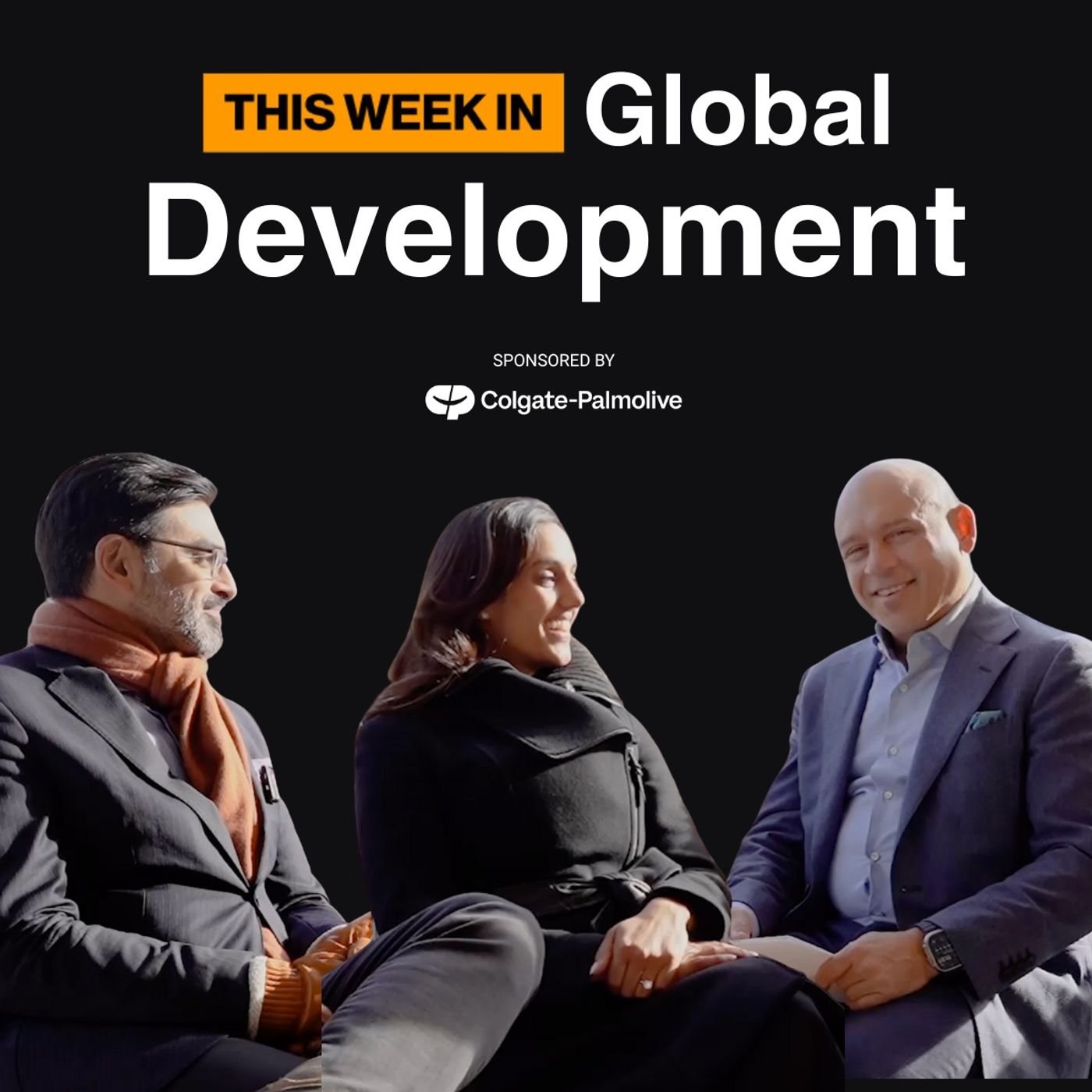
This Week in Global Development
Special Episode: Elevating oral health on the global agenda
00:21:17
In this special edition of our podcast, This week in global development, we explore the critical yet often overlooked issue of oral health with guests Anil Soni, CEO of the https://www.devex.com/organizations/who-foundation-164054, and Esha Gupta,...
Loading summary
Transcript42 lines
- [00:05]
A
Well, hello everybody, and welcome to a special edition of the Devex podcast. This one's sponsored by Colgate Palmolive and we're here in this incredible setting in Davos, Switzerland. If you're just listening to this podcast, use this as an excuse to check out our YouTube channel and watch it. I'm joined by two friends who are working on some of the most incredible issues that we're talking about this week and we're going to get into today. Anil Soni, he's the CEO of WHO foundation and, and Isha Gupta, who leads public health and social impact at Colgate Palmolive. And you guys have an announcement you want to make. But before we even get into the announcement, the issue you're putting on the table that honestly, as much as I work in global health and development, I don't hear this issue is oral health. And I'm kind of interested in why. And as I was looking into the announcement you're making and the partnership you're doing, it's kind of intrigued because it sounds like an issue that ought to be on Global Agenda. So we just start there. Like, why is oral health an issue that people listening to this who might not really be tuned into it, ought to care about?
- [01:02]
B
Great. Um, good question. So oral health today affects 3.7 billion people in the world, which makes it the most common non communicable disease. And people just don't know that, um, it is actually linked and has the same risk factors as hypertension, cardiovascular disease, diabetes. And I think we have historically just made silos. So we've viewed oral health as being separate from systemic health, but it's actually very linked. So the mouth is the gateway to the rest of our body. Healthy mouth leads to overall health.
- [01:33]
A
Yeah, I've had doctors say that to me, like, you know, if you care about your heart, you have doctors care about your mouth, which is interesting only in the last few years. It's not something I feel like I've heard for forever, you know. Anil, what's your thought on this as a topic on oral health?
- [01:46]
C
Well, if we think back to COVID 19 and the discussions we were having, so much of the question was how does that bug, how does that pathogen get into our body? Is it through the air? Is it through water? And when you think in those terms, the mouth, as Eisha just said, is a gateway to the rest of the body. And so that's where bugs come into our body. That's what I'm telling my 4 year old son and why he has to brush his teeth. Oral health is not marginal. It's actually the starting point for a lot of other health conditions. And now it is on the agenda. Rogers, you know, last year the United nations signed a declaration around non communicable disease. And for the first time, oral health is front and center in that declaration.
- [02:23]
A
Yeah. And you're at the WTO Foundation. You know this space really well. You're in a lot of those back rooms and those discussions. Anil, why did it take so long? You know, what is it about oral health that has made it a challenging issue to raise up on the agenda of global health?
- [02:37]
C
So I think a lot of our focus over the last 25 years is in the condition that was closest to the morbidity and mortality. You don't die of oral health necessarily. You die of diseases that arise from poor oral health. And so our focus was, well, let's fight aids, let's talk about cardiovascular disease, let's talk about cancer. But what we're increasingly doing is saying, but what are the risk factors? What's the starting point for those health conditions? And that's where oral health, mental health becomes so much more prominent. And in a moment in which resources are constrained, it's actually where you have great bang for the buck because you're intervening early in a process by which disease later emerges by tackling it at that early point.
- [03:22]
A
Let's hear about the announcement. What are you guys, what are you guys here to talk about?
- [03:25]
B
All right, so we this week at Davos, we announced a partnership between Colgate Palmolive and the WHO Foundation. We are supporting the WHO's efforts to scale and elevate oral health. And it is the first time that our company has signed a multi year partnership like this with the multilateral agency. And we are very excited about it.
- [03:45]
A
So give us your perspective of WHO Foundation. Why would you engage in this kind of partnership? What is it practically going to do?
- [03:50]
C
Yeah, well, Rogers, you know, I've spent half of my career in the private sector, half in the public sector. And I've always believed the problems we're tackling we can't tackle with any single organization alone or any sector alone. And that's been the secret of success for a lot of the gains we've made in vaccine preventable disease, in hiv, tb, malaria. You have companies working alongside international organizations, alongside national governments and implementers. We need to do a lot more of that across more health conditions. This is the first time Colgate Palmolive is working with the WHO and the WHO Foundation. We're thrilled. The WHO foundation was created five years ago to do exactly this, to broaden the tent of partnership, to broaden the tent of engagement. The majority of the money we've mobilized is from new partners to who. And so for us, this is a total win. Where we can say oral health is a cause, where you have the ability of the WHO to have tremendous impact, but it can only do that if it works alongside the other stakeholders in that space. And Colgate Palmolive has had a decades long commitment to improved oral health around the world. So I'm thrilled about this.
- [04:53]
A
And what needs to happen, like on the ground in countries where, you know, they might have a high burden? What is what actual, you know, changes do you want to see like a health minister make or, you know, local organizations that provide health services?
- [05:06]
B
So the partnership is going to be focusing on three pillars and the first is oral health education and programming. So I will take this moment to share that Colgate has. We have a program called the Colgate Bright Smalls Bright Futures Program. And we've been quietly working in over 100 countries around the world. We recently announced a major milestone where we reach 2 billion children, their families around the world with this programming.
- [05:29]
C
Wow.
- [05:29]
B
And the way we do that is through partnerships on the ground. And they're, I don't want to say they're one off, but they're at the country level. So we, you know, we have nonprofits to do the last mile, so we work with community health workers, nurses to provide the oral health education. We work through ministries of health and education and other places where we can embed oral health into existing school health programs. And that is something. Just looking at that pillar alone, think about how much more we can scale those efforts if we're working alongside the WHO foundation and the whole we right now. Philippines is an example where we have had a very successful Bright Smiles Bright Futures program. We've actually already embedded oral health into the UHC agenda by working with the Ministry of Health. Our partnership. POC there was so happy to know that we're signing this announcement because he was like, it's going to help us open even more doors. And our company uses us as a flagship to say, Philippines is so successful. And we are like, imagine it being even more successful. Imagine being able to scale it even more. Because now we're not doing it alone. We're doing it with the support of the who.
- [06:37]
C
So something I'd add, Raj, is as you know, last year we saw dramatic reductions in government assistance for health. We are not going to have a Global Fund for Oral Health and a Global Fund for Diabetes and a Global Fund for Heart Disease. And so to your point, what is this partnership going to do? The World Health Organization, its member states, because it's a government driven organization, they've adopted a plan for oral health for countries to improve oral health by 2030. There's targets that have been laid out, but the only way that's going to happen is if we integrate oral health into primary care. So we're not going to have a new vertical program. You're not going to go to Zambia and meet the coordinator of oral health. What we're really talking about is how do we treat oral health as public health and how do we bring the oral health interventions into the primary care engagement with populations, whether it's through a clinic, whether it's through a school. Increasingly, the WHO is recognizing that we have to decentralize care and think about self care. How do people do more in their own homes to take care of themselves, to look after their health? And oral health is a tremendous opportunity when it comes to self care. So it's that integration into programs where Colgate Palmolive is going to be powering who's work?
- [07:47]
A
Yeah, it might seem like a really thin silver lining to all the cuts that the WHO had to experience, but those cuts have in a sense, spurred the idea that we got to try some new things. We can't just let the problems fester. We need to find new ways. And these kinds of partnerships are a great example.
- [08:02]
B
And I just wanted to briefly touch upon the two other pillars of work and to answer a question on what do we want to see governments do differently or what we're hoping to support governments do. The second part of the partnership is focused on policy and advocacy. So it's actually WHO independently develops evidence based technical guidance or its member states. And so it's more along that of how can you recognize that oral health is an ncd, it should be tied to universal healthcare, and how can you further integrate it into your existing health infrastructure and systems as you build up? And the third is what we're talking about at the start of this discussion is just elevating oral health on the broader public health agenda and continuing to advocate and help. Everyone realized that it is integral to overall health.
- [08:49]
A
So it's educating the public about these issues, getting it integrated into the public health system, getting governments to see it as part of their own agenda, and then ultimately just elevating the issue in a way because it is connected as you said to so many other health issues that might have a vertical fund or might have their own group that is supporting and advocating for them. And this is really a cross cutting issue in a lot of ways.
- [09:23]
D
Are you interested in the intersection of business and social impact? Do you want to know how corporate sustainability, esg, impact investing and more can contribute to development finance? My name is Advaah Saldinger. I'm a senior reporter at devex and I've been reporting on these issues for nearly a decade. I'm the author of Devex Invested, our free weekly newsletter dedicated to development finance. Every Tuesday we explore how companies, investors and market mechanisms are reshaping the world of development finance. Visit devex.com newsletters and join us on Tuesdays.
- [10:03]
C
The last element that Eisha mentioned which is critical to reinforce is accelerating availability of new evidence and interventions. So innovation has driven so many wonderful global health outcomes and we think about innovation, we think about medicines and diagnostics and vaccines. Likewise, there are innovations in oral health and what we really want to see is the WHO to be able to evaluate that evidence and issue new policy guidelines as soon as possible. So we're constantly getting the best buy for oral health.
- [10:31]
A
And what are you hearing from governments? You know, you're a member driven organization. What do you think is the challenge? If you're a health minister today, you do have money coming into your ministry that's vertically tied to specific disease areas. You're seeing maybe budgetary cuts. Now you hear about this new initiative and you're told, hey, elevate oral health. How can they see this as a positive and opportunity for them?
- [10:55]
B
I was in a discussion yesterday and it was a panel with Bill Gates and the health or the finance minister of Norway and the ex vice president of Nigeria. And this was the discussion how do you make the economic case for investing in health? And it was a fascinating discussion and there's a few takeaways, but one of them was around why it's important to first of all prioritize investing in health. And I think a lot of governments are forced to prioritize and focus on short term outcomes and I'm going to say wins and seeing a return of investment, but we need to start shifting towards looking at longer term outcomes. So that's why I think one of the areas of partnership of just advocating for how oral health is linked to overall health will help make that case. The more we recognize that, you know, the same risk factors of gum disease are linked to heart attacks, it will just help make the point for prioritization.
- [11:52]
C
I think it's critical that we, as we announce new partnerships, we make clear we're not repeatedly saying spend more. That's no longer viable. It's spend smarter. So the integration of oral health into primary health means how do you take what you're spending now and achieve greater outcomes from it? By making sure that you're tackling all of the necessary interventions in a way that is more effective with your populations.
- [12:19]
A
I think these kinds of alliances, public and private, are happening more. And we're certainly here at the annual meeting, the World Economic Forum, but in general they're happening where this is kind of the era, as I've written about, moving from an aid model to more of an investment model. But it raises questions. Trust, accountability, right? There'll be people, maybe even inside your institution and you'll say, why are we working with the private sector in this way? How do you address people who have those kind of concerns?
- [12:43]
C
Yeah, I get asked about conflict of interest all the time. And what I want to continue to emphasize is there's a difference between conflict of interest and alignment of interest. We talk about billions of dollars of aid. A lot of those billions of dollars goes towards buying products. Those products were made by companies. Those companies and the people who work for those companies have a genuine commitment to improving oral health or health more broadly and at the same time making sure their businesses are sustainable. That doesn't make them the bad guys or the bad people. It actually makes them partners as long as their corporate interests don't influence the science. So at the WHO foundation, our number one goal is advancing the independent work of the World Health Organization, protecting its normative integrity, allowing it to make decisions about whether it's product A or product B to support. That's the who's job. And no matter who we're partnering with, whether Kove, Palmolive or a pharmaceutical company, we protect that independence. That's who's role and no one ever disputes that. At the same time, by investing in these health programs, we're creating markets. And in those markets, the companies that are making life saving products, whether a toothbrush or a vaccine, have the opportunity to supply those products and have impact. Do we want those products to be affordable? Absolutely. Widely available? Absolutely. But the companies that also want that same thing to have impact, they have a vested interest in working with organizations like WHO to make that impact possible.
- [14:11]
B
Yeah. And I just want to say that historically Colgate Palmolive started working in this space in the Bright Smiles Bright Futures Program. It was started as a CSR corporate social responsibility program, traditional grant giving. But also it was started because the company was like, we are a brand. We're an oral leader. Everyone knows Colgate. In parts of the world, Colgate is synonymous for toothpaste. So now, if everyone knows our brand and we're selling products, why don't we also make sure we're doing something good in the world? And that means let's reduce the burden of oral disease. Now, how can we reach children, specifically WHO may not know that they should be brushing twice a day? They, you know, we have heard stories from children and families around the world that they have one toothbrush, they don't have a toothbrush, or they brush once a week before going to a party. I think here the opportunity is for us to say now with, you know, we've been quietly working on this program for 35 years. How do we take it to the next level? We don't need to be doing it alone. We shouldn't be doing it alone. And so that's why we have formed this partnership with the WHO foundation to support the WHO's efforts. But I also just want to say here that the WHO foundation has made it possible for us to form this partnership. We would not historically have been able to go to the WHO because of what Anil described as how, how the WHO has to maintain its integrity and work independently and produce their evidence based guidance. But we know that forming a partnership with them can scale the work. The WHO foundation has enabled us to speak the same language as the WHO and align on priorities and align on what does impact mean? And the mission of all of the work we're doing is to reduce the burden of oral disease.
- [15:55]
A
I'm sure that's music to your ears, Anil, because I know, you know, when you created this institution, you know, I know that it was designed to do exactly this sort of thing. And so to see it after how many years now ago was the WHO foundation created? Five years ago. To see it come to this point has got to feel good.
- [16:11]
C
Yeah, it feels great. We exist to be a bridge and a catalyst. And oftentimes for your listeners who wonder, what are the conversations like between a technical expert at the WHO and a corporate executive like Eisha? It's not around undue influence, it's actually around saying, but what impact are we going to achieve and what's the theory of change and how do we get to that outcome and how do we test what's working and what's not working? And that's a two way conversation. Another positive aspect of these public private partnerships, again, that we've seen a long history of over the last couple of decades, is that companies also want feedback. As you know, I've worked with and for companies that have adapted their products to better meet patient needs based on engagement with national governments and international organizations. So if we want those products to actually be shaped differently, sometimes literally changing the shape or a color of a product or a formulation, that also can be one of the outcomes of this type of meaningful engagement.
- [17:10]
A
Yeah. We get a lot of questions at Devex why we come to the World Economic Forum in Davos. You guys are both leaders in global health and you're here. Why, like, what does it matter to you to be in Davos at the World Economic Forum?
- [17:22]
B
As Colgate Palmolive well, our mission is to reimagine a healthier future for all, and that's why we're here today.
- [17:30]
C
For us, the WHO's mission is health for all. There's remarkable alignment in the words that you just heard from Eisha and me. And that's why we're here. Because being in a place like this, but having partnerships like this is what allow different organizations with different assets and capabilities to come together to achieve what is, in fact, a very common mission.
- [17:52]
A
So what do you want people to take away? Esha, you're here at the World Economic Forum. I think it's your first time coming to us. So you're in a lot of these conversations. What are you telling leaders? What are you hearing from them? When you describe this elevation of the issue of oral health and the partnership.
- [18:07]
B
You'Re creating, my main message is going to be that we need to form more public private sector partnerships. We need to have common goals, and we need to take collective action to reach those goals. I think organizations like the WHO foundation are helping reduce the information asymmetry that exists between corporate companies like Joheepomolev and multilateral agencies. And we are. We're going to work together to reduce the burden of all disease.
- [18:33]
A
Yeah. And that'll have a huge impact on the world. Yeah.
- [18:38]
C
One with Colgate Palmola. I want to say to as many people as possible, oral health is public health. And now increasingly, with two young kids who I'm helping to brush their teeth, I believe that as a parent, as a professional. But there's a broader message for me, Raj, as the head of the WHO foundation, which is who is more relevant than ever. And that might sound odd given the reduction in aid that we've seen or the move away from multilateralism but so many of the health gains we've achieved over the last 20, 25 years have been through international centralized and vertical programs. But when we think about the needs of the future non communicable disease, oral health, mental health, the implementer, the change maker that's going to be in the driving seat are national governments. There's not going to be an international organization focused on each of these specific diseases to buy the medicines, to buy the products, to distribute them. And as a consequence, they need to work through and with the World Health Organization to power their programs. WHO is the one that's producing the normative guidance that's instructing which products to buy, which evidence to follow, is working right at the local level with national governments to integrate these evidence and policies into practice. WHO plays that role in a way that other organizations simply don't and so forth. For the health gains that we have to achieve to allow for a more equitable role for those to be achieved. WHO matters and public private partnerships are critical. Yeah.
- [20:05]
A
And you can almost imagine a fourth chair in this conversation in the future, country by country, because this is an alliance between a company, between the WTO foundation, but also, Julie, at the ground level with the countries, with the ministries of health who are going to help roll this out, you know, in each place. Where you want to address this next.
- [20:22]
C
Time, let's have the conversation in the KRA or Lusaka.
- [20:24]
A
Yeah, yeah, yeah. I think for me, having been in the global health space a long time and not heard much about oral health, it is interesting that it's so obvious, the message you're sharing. Right. That this is a top tier health issue, there's a significant burden and there are proven ways to address it. And so I think elevating that issue alone is maybe a key achievement of this alliance.
- [20:48]
C
Yeah. Well, and you and your listeners are helping us do that. So thanks.
- [20:52]
B
Thank you.
- [20:53]
A
Thank you.
- [20:56]
D
SA.