← This Week in Global Development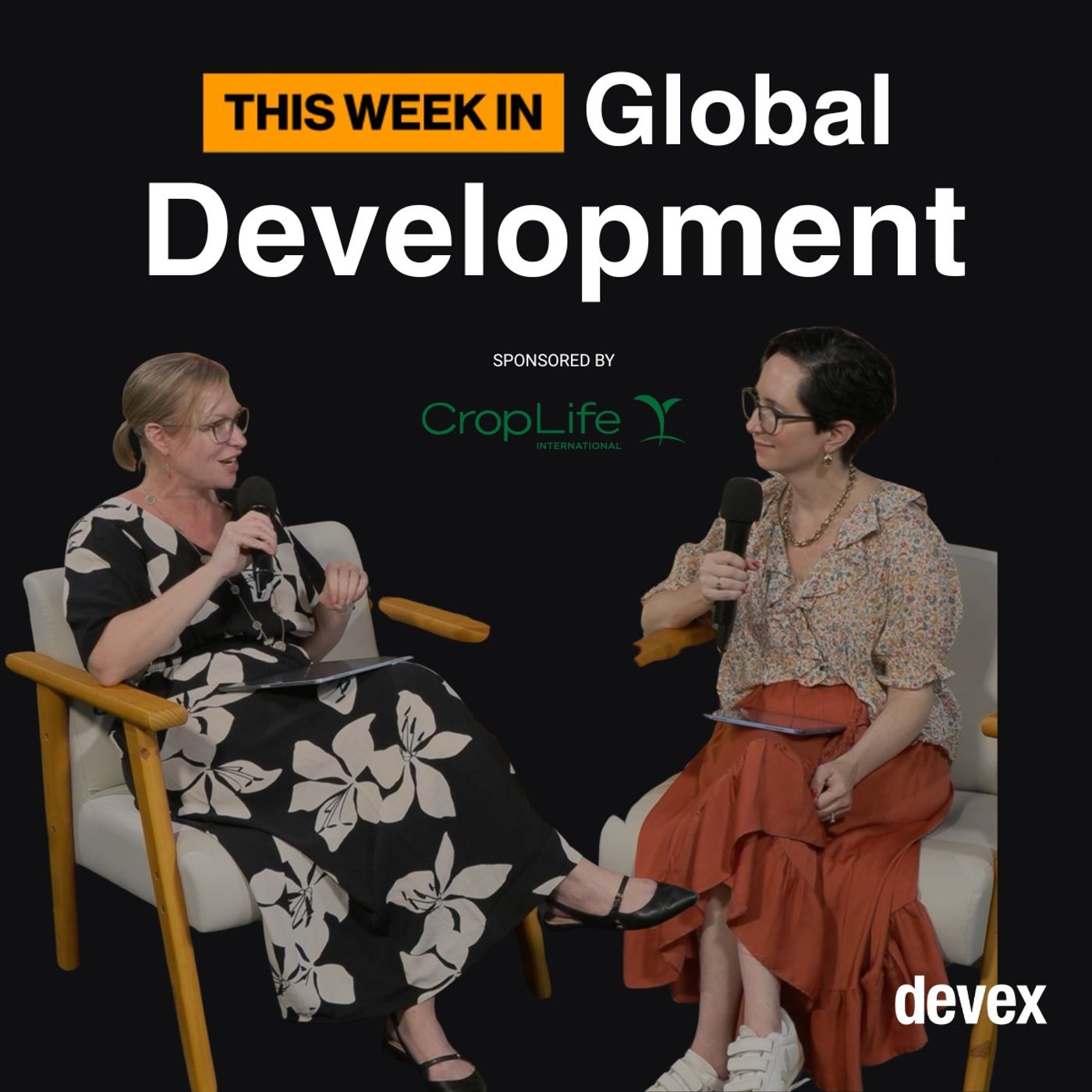
This Week in Global Development
Special episode: Innovation in Action - Scaling Climate Solutions from the Ground Up
00:16:39
In this week’s special episode of the https://www.devex.com/news/this-week-in-global-development-106893, filmed at COP30 in Belém, Brazil, and hosted in partnership with https://croplife.org/, we explore the expanding role of agricultural innovation —...
Loading summary
Transcript32 lines
- [00:00]
A
Foreign hello and welcome to this special edition of this week in global development and partnership with Crop Life International. I'm Kate Warren, executive vice president, executive editor at devex, and we are coming to you from the ground in Belem for COP30 for a special edition podcast with my friend here, Lori Goodwin, who is vice president of Public affairs and Communications at Crop Life International. And we're going to be talking about how innovation and open trade can scale climate solutions from the ground up. Laurie, thank you so much for joining me. And hot and balmy. Belem.
- [00:44]
B
Yeah, thank you. As I was just saying, every one of these cops just has a unique set of circumstances around it, and this one is no different.
- [00:52]
A
Yes, last year we were freezing in Baku, and this year we're sweating in Belem.
- [00:57]
B
That's right. Who knows what next year will bring.
- [01:01]
A
So, you know, I think actually is an appropriate backdrop for some of the conversations we're having here and really recognizing the challenges that we're facing. But this cop, you know, has really been described as the implementation cop, the action cop. And we talked a little bit last year about some of the goals that you wanted out of COP 29. When you look for what is the action, what is it that you want to see come come out of these couple weeks here?
- [01:28]
B
MLM yeah, I think, you know, we've talked last year as well, I think, about agriculture and its increasing prominence in the negotiations themselves and just, you know, as a solution and not just as an emitter. And so I think this year in Brazil with the agri zone, I'm not sure if you've had a chance to go over there, but having a whole dedicated facility to just talking about agriculture and the importance of agriculture and food systems, it's really elevated if we go back four or five years. So it's great to see the increasing prominence. I think there's work to do to really embed agriculture within the negotiations themselves. And we're seeing that a little bit more prominently and once again just to adaptation and mitigation, but also how agriculture is one of the industries that can provide solutions to some of these challenges.
- [02:20]
A
That we're seeing and one of the solutions to both. Right. Adaptation and mitigation. And you see it can be part of the challenge, but also part of the solutions. And so, you know, you all really help advance and bring innovation and technology to farmers for them to both realize all of the benefits for, I'd say both adaptation mitigation goals. Maybe you can talk a little bit about, you know, what you think needs to happen to be able to really scale these innovations and make some of this technology more accessible, particularly to smallholder farmers?
- [02:55]
B
Yes, that's a great, that's a great question. And I was fortunate to be on a side event last night with the World Farmers Organization. And they had a really interesting panel of just farmers from Zimbabwe, from Brazil and from Georgia talking about implemented programs in their parts of the world. And the one thing I really took away there was thinking was they all said farmers are the ultimate deciders. And so I think the other piece that they brought was they need new solutions, they need new tools, they need new ways to scale the solutions that they have seen in other parts of the world. And they need access. And so that's a lot of the reason we're here and have been here for a long, long time as part of the UNFCCC negotiations is this importance of bringing solutions to the table. And I think that's big part of the conversation here this year, which the COP presidency has been driving, not just in agriculture, but across different sets of industries, different sectors. And it's been encouraging to see that now I think it's what are the actions that we can take, not just as policymakers, but also as the private sector and as implementers like farmers, to really put all of these pieces together and have make a difference on the ground. And part of that for us is in our part in that is making sure that there is access to the solutions that can help advance some of these challenges. Yeah.
- [04:22]
A
And if you, you know, some of the farmers you work with, you know, what do you think that they would be saying to the policymakers about what they want to see to be able to, to be able to get more access?
- [04:30]
B
Yeah, I think, you know, it's kind of a two part. So there needs to be a predictable regulatory system so that you can get some of these innovations from the lab into the field. Right. So we need to have a predictable, you know, way for business to invest. And so to make sure there is a path to commercialization and that they are able to see how long it will take from a farmer perspective. They need to know that they'll still have access to markets. And so that's where really that intersection of trade and rules based trade can come in. To say there is some degree of commonality and rules that can apply to all of these commodities that we grow in different parts of the world and making sure that people that need that food can access it.
- [05:12]
A
And I'd love to hear just maybe some examples of some of the you know, an innovation that you're really excited about that you think shows a lot of promise.
- [05:19]
B
Yeah, I mean, everybody keeps talking about genome editing. I think genome editing is a way to improve plant breeding, selfishly. That's my background. I've always worked in plant biotechnology and plant breeding. And it's one of the tools that we're seeing, as you asked, about smallholder farmers being a little bit more accessible, I think, to a broader range of crops, to a broader range of plant breeders, to a broader range of institutions. And I think it'll allow farmers to have a different set of solutions than maybe we've seen historically. And so I think that's one where, you know, you're seeing some of the impacts from it already in some of the crops, especially in Africa, that are looking for climate adaptation, whether that's drought, whether that's too much water. I mean, we often think climate change means drought, but it also can mean flooding. So I think that's one of the technologies I'm most excited about. I think we need to learn some lessons about that need for predictable sort of risk assessments and paths to market so that we don't set ourselves up to have inadvertent trade barriers when we're talking about trade, global trade.
- [06:36]
C
Are you interested in the intersection of business and social impact? Do you want to know how corporate sustainability, esg, impact investing and more can contribute to development finance? My name is Advaaz Aldinger. I'm a senior reporter at devex, and I've been reporting on these issues for nearly a decade. I'm the author of devex Invested, our free weekly newsletter dedicated to development funding finance. Every Tuesday, we explore how companies, investors and market mechanisms are reshaping the world of development finance. Visit devex.com newsletters and join us on Tuesdays.
- [07:16]
A
Yeah, maybe you can talk about some of those barriers and what you think the negotiators, people here could do to address those challenges.
- [07:25]
B
Yeah, I think here it's challenging because we're talking at the international level.
- [07:29]
A
Right.
- [07:29]
B
And it's really hard to sometimes make that connection back, back down to what does it mean for me on the ground. And so I think what, you know, part of what happens here is definitely influential and gets connected back to that local field level. But one of the challenges that I've seen getting to be a part of many of these negotiations in the multilaterals, whether it's biodiversity or climate, these things tend to be negotiated independently. And so I think the more governments can work within themselves to connect these pieces and the more we can do it at this UNFCCC level, between biodiversity, between land degradation, between climate, that's where you're going to start to see a lot of these really synergistic effects and more holistic policies that on the ground farmers can implement at the field level to really make the difference in achieving the goals that the negotiators set out here.
- [08:22]
A
Yeah. And so you all, CropLife International, you just launched this practical guide to sustainable agriculture growth. Kind of like a knowledge compendium of success stories, policy insights. Can you talk a little bit about, you know, why you did this and you know, what problem this might solve for some of the policymakers and negotiators?
- [08:41]
B
Yeah, I think it's exactly what you were just asking is how do we put these pieces together and make it very tangible. So there are partners working together that are having impact already on the ground. Whether that's on, you know, from a technology standpoint or whether that's just unique partnerships and innovative ways to apply new practices to actually make a difference. And so we use the framework of SDG 2.4.1 that looks at 11 different indicators around soil health, around, you know, water, to really say here is an example in a country that is on the ground, it's working. What are the lessons we can learn from that? How can this be scaled? And one of the things that struck me last night at the farmer panel was one of the farmers spoke about biochar in Zimbabwe. And actually one of the case studies that we talk about is biochar in Cambodia. And so I think farmers, the farmer organizations we work with say the best way to scale is to have, not farmer to farmer, knowledge exchange. And I think that's what we were trying to do here is say, here's some case studies of things that have worked. They aren't without challenges, but here's how that was overcome and maybe it'll spread, spark some new conversations, new partnerships and new opportunities in other parts of the world.
- [09:58]
A
And you know how like if organizations want to be able to access this has healed learning where, where can they find it?
- [10:04]
B
Sure. So it's available online. We partnered with NTT Data to help produce the report and worked, like I said, with a number of, some of these are outside of the technologies we represent. But it's this idea of how do you partner between public and private farmer organizations. You know, farmers are always saying you need to keep us at the center and co create solutions with us. And so I think there's just some really excellent examples, but it's absolutely available online and I'm happy to leave a paper copy with you. We did print a couple, but not too many, so I can share the QR code if you want.
- [10:38]
A
That's great. Great. Yeah. You know, and you mentioned you're an agronomist and so you've really seen firsthand how this innovation can play on the field. You gave some really great examples. You know what, where do you see the role of technology and where do you see maybe like we're here in Amazon region where we have the largest group of indigenous people participating in a COP ever who are also bringing their long standing indigenous practices and we talk about farming and farmer learning. How do you think about those coexisting and a technology piece of innovation, but also looking to past practices.
- [11:16]
B
Yeah, I mean, I think sometimes we think of technology as a bit of a silver bullet. And, you know, the truth of the matter is everything needs to be tailored to local context and you need local solutions often to these big challenges. Right. So, you know, the example I always draw back from was I spent a part of my career in research and development in Hawaii, now I'm Canadian. What I learned about agronomy in Canada is a very different set of circumstances than when we were working in research in Hawaii. And so I've seen some of the benefits in tropical climates that these technologies that I represent, like plant biotechnology, can bring around insect resistance, around disease resistance. And I don't think that needs to be mutually exclusive with a lot of the indigenous practices. And I think you're seeing more examples of people having unique partnerships and collaborations to say, let's learn from each other, you know, but once again, not everything, you know, that we develop here at the international level is going to be easily implementable all around the world, and especially in agriculture. Farming in the tropics is very different than farming in other parts of the world where we have a very nice hard, cold winter in Canada.
- [12:26]
A
Well, that takes partnership. Right. And bringing all these actors and sectors together. And you know, maybe could you just talk briefly about how you see the role of partnerships and maybe even an example of a partnership that's been able to really bring to life some of the, you know, innovations that you have.
- [12:43]
B
Yeah, absolutely. So we have a program called the Sustainable Pesticide Management Framework. And the intention of that was to enable access to new technologies, but also to look at existing technologies and how they're stewarded. And so we have a project in nine countries around the world across three continents. And it's really looking at holistically what are policy approaches, what are training approaches, what are knowledge exchange approaches between partners that can facilitate access to new technologies and regulatory pathways, but also make sure that the technologies that are already there are being stewarded responsibly.
- [13:23]
A
And as we look beyond cop 30, I know we're still waiting if it's going to be Australia and Turkey. Interestingly, their pavilions are right next to each other, like in a battle for COP31. We know it'll be an honest the year ahead, but you know, what are you hoping will happen to really keep. You mentioned the momentum that food has had here in cop, but also in other convenings and conversations globally as really such a core part of climate action and other economic growth goals. How would you like to see this momentum continue beyond here?
- [13:56]
B
Yeah, I mean, one of the things that I was really encouraged by with the COP presidency was really trying to link the three Rio conventions sort of back, back together again. And I'm excited to see how that momentum moves forward within the other conventions. Like I said, I think where everything meets together, where these cross cutting challenges, like water, like soil, they all meet at the field and often at the farmer field. And so how can we make sure that the outcomes from here are able to be transferred into these other multilateral, you know, convenings? So I'm headed next week to Johannesburg for the B20 summit. Right. So, you know, how can policymakers learn from what happened here and what they take away from here to make sure that the work they're doing advances on what happened here? Right. So, so at the biological Diversity Convention next year, how do we make sure that any overlap is addressed so that when we're policymaking at the national and the local level, you're taking all of these pieces into consideration.
- [14:54]
A
I was part of a conversation earlier that was talking about sometimes the different language and disconnect between the finance world and the food world. And somebody said, but you know, who understands that all are the farmers, the people on the ground and the field. So, yep. Speaking their language and you'll.
- [15:09]
B
Yeah, I, I think so. And that's why, you know, it's really encouraging to work with them. And last night at this panel, you know, them saying like we're the decision makers and really taking ownership and being here with their own voices. And as you said, partnerships are key to making any of these holistic policy and systems approaches happen. And so having the people in the room that are going to be the implementers at the beginning of the conversations is just a really important part and so I'm happy they're here. There's a lot of representation from from them here, and so that they're able to give feedback in real time with their own voice.
- [15:43]
A
Well, thank you so much for this conversation. Thank you, Crap Life International. And hopefully next year when we talk, whether it's Australia or Turkey, we will continue to see this momentum going. But thank you.
- [15:57]
B
Thank you.
- [15:57]
A
Yeah. And thank you for those of you who tuned into this special edition of this week in Global Development, make sure you are subscribed to get access to all of our podcast episodes, as well as Tox Newswire. We are publishing newsletters straight here from COP as well as a daily Reporter's Notebook with all kinds of insights and nuggets about what's happening here on the ground. So thank you for tuning in, and thank you again, Laurie. Thank you, Sam.