← This Week in Global Development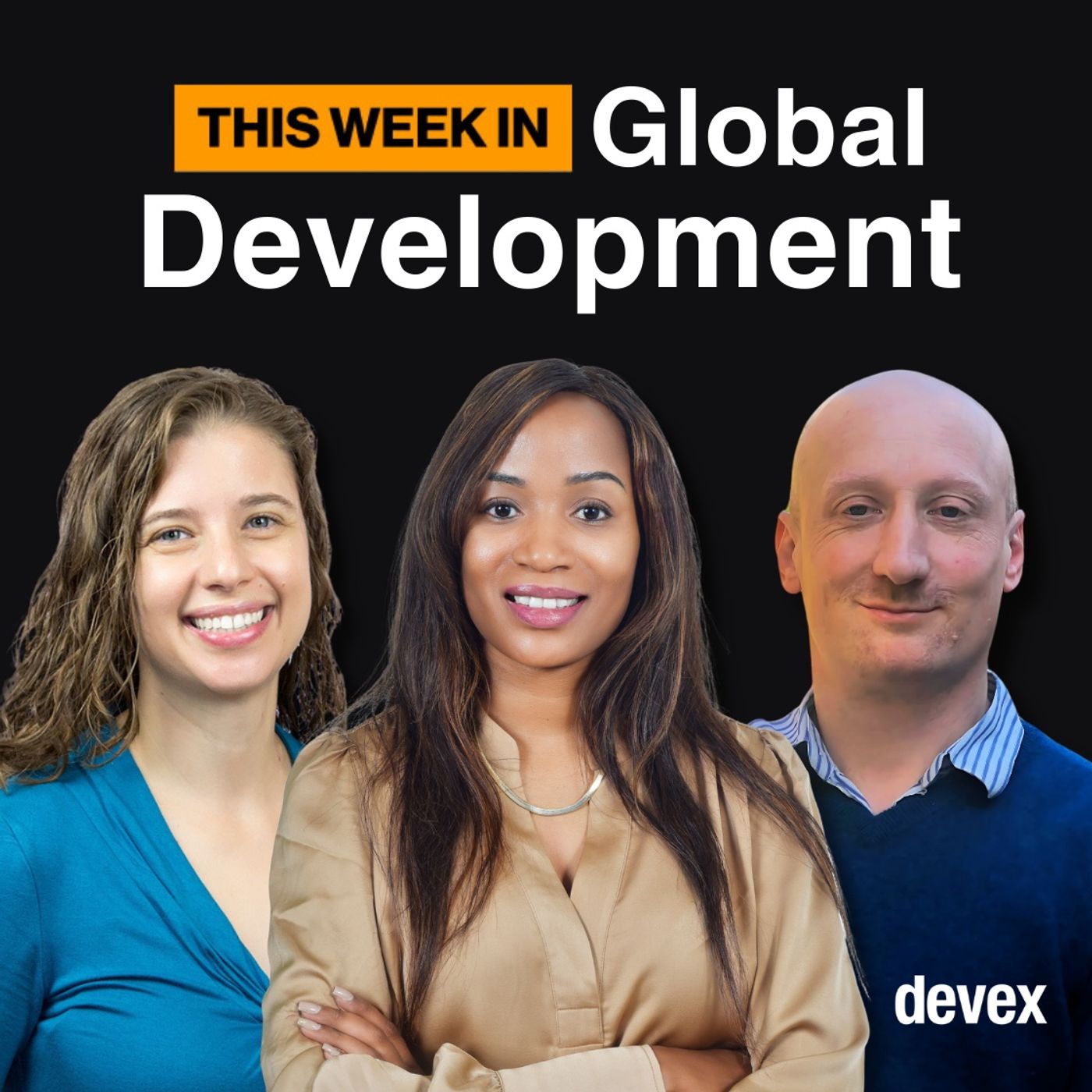
This Week in Global Development
Tracking the real-world impacts of US foreign aid cuts
00:36:25
This week, we discuss https://www.theaidreport.us/, a project supported by a media grant from the https://www.devex.com/organizations/gates-foundation-44525 to track the real-world impacts of U.S. foreign aid cuts. Over the past couple of months,...
Loading summary
Transcript34 lines
- [00:04]
A
My name is Rumbi Chakamba and you're listening to this Week in Global Development hosted by myself, Atma Saldinger and David Ainsworth. And this week I'm joined by my colleagues from the AGE Report, Kelly Woorges and Rashad Niema. Thanks guys so much for joining me. This is the first time on twigd, right?
- [00:19]
B
Yeah, yeah, thanks.
- [00:20]
C
Yes, it is happy to be here.
- [00:22]
A
It's so exciting to have you. And like, I think the newsroom was super excited about the AGE report when it launched. So I'm really excited to dig into it like few months down the line. But before we get started, maybe you guys could start off by telling our listeners, those who don't know what is the AID report and how did it come about?
- [00:39]
B
Yeah, happy to. So the AID Report is a data and editorial initiative that set out to track and understand the impacts of the US foreign assistance cuts. And so we've done that in a couple of different ways. One of them is through this impact tracker that we've created that lives on the homepage of our website. And, and that's where all of these discussions that we've had, we've been pouring through reports, white papers, any data that's available to us, we then corroborate that, vet it and make it publicly available in this public database. And then we've also been commissioning original reported feature stories to dig into some of these lesser understood impacts around the world. And together those have given us a much better sense of what some of the impacts are. And I think maybe to back up the kind of spark, spark of this project was because one, there was so much information floating around at the time. Right, like right after the foreign assistance cuts, there was a lot of data, there were spreadsheets, there was individual advocacy organizations who were kind of collecting their own information. So would, was it possible to create a hub where a lot of that information could come together and be vetted? And then the other piece was that I think some people were finding themselves maybe in meetings and unable to really articulate whether there were impacts of the aid cuts, if there were, what were those. And so we really wanted to become a resource for folks who were in those meetings as well.
- [02:08]
A
And I think like during that time they, it felt like there was a lot of downplaying as well of what the impact could be or what was actually happening on the ground. So I feel like this was a good, this is a good resource to sort of dig into that. But one thing I'm curious about is like after You've collected over a thousand impacts right now. Right, Right. So after looking at all those, what is the story that kind of emerges about the aid cuts and the impact of them? Rashad, I'm going to jump to you first.
- [02:35]
C
Yeah, happy to hop in here. I mean, there's so many different kind of narratives that, that we're able to talk about here. And I think it's, it's, it's hard to choose only one. I think, you know, I have in the past, I worked more in the democracy space. And so I, I think that there is kind of from early on, you know, the closing of civic space around the world has been really interesting and hard to watch. I think in a lot of ways that I think, you know, people don't exist in sectors. Right. And so, you know, we think about the work working on improving the role of civil society in different communities and how they're able to improve access services actually is a question of health care and is a question of education and access to food security and all of these things. And I think what we have seen is in response to kind of the aid cuts and some of the broader narratives around the work of agencies such as usaid, there's been a lot of the backlash against these organizations. And so, you know, for example, there was an organization in Serbia where their offices have been raided after everything, there was a lot of information spreading on social media about these organizations actually, you know, operating as foreign spies, you know, and then we saw some of like what they call the foreign agents laws being passed at the time, which were already often in process. But I think, you know, there's a history of USAID and other foreign assistance programs kind of being the obvious connection to civil society, but also the role that that had in the broader kind of allyship of the US Government for these organizations everywhere that now is gone alongside kind of the loss of trust has really increased kind of how hard it is for these organizations to be operating, especially if they had received, if they had received funds from the US Government. So I think for me, kind of closing civics space that we've, that we have been able to track here at the AID Report is kind of broader and broader kind of narrative that we're, we're able to see through a lot of the different sectors that is really hard and interesting.
- [04:47]
A
You know, one thing we're tracking on the health front here at Devex is what role civil society is going to play in this sort of next era, era of US Aid. Because if the US Government is directly funding governments and then that money is supposed to trickle down to implementers and somehow civil society. Are they still able to play that watchdog role in that position? So I think that's also something interesting to follow. But that's interesting. But Kelly, I wanted to jump to you and see what sort of are the emerging trends for you that are coming out of all this.
- [05:17]
B
Yeah, it's tough. There's so many, I think I'll say maybe macro for this in terms of what we're seeing because, because we have been diving in with a sectoral focus sort of month by month over the past year. There are some things that allow us to, to see a trend emerging right throughout all of those sectors. So one of them, I would say is sort of this like wholesale step back from prevention work. And this has been, I think it came through really clearly when we were focused on peacebuilding and stabilization. But also of course in Health RoomBee, which I know Devex has been tracking really closely. And so I'm using prevention maybe quite loosely or more loosely than folks would be using it in the development space. But I'm talking about things like, for example, in the Central African Republic, there was a local system that allowed communities to talk with one another on high frequency radios and with kind of a central hub to alert each other of, you know, activity of armed groups. So that no longer exists. And then in health and humanitarian aid, for example, there was a program in Nepal that was focused on maternal health, but it also had this really big piece of behavioral change attached to it so that women no longer needed to wait for permission from male relatives in order to seek care because women were dying in the waiting. And so it's sort of all of these kind of quiet programs that were meant to help resilience and to help communities help themselves. And so we're seeing less of that. We're seeing a lot of that work terminated. And I think that that has been concerning like from, from our vantage point to kind of hop from sector to sector and see that break in prevention work across all of them.
- [07:08]
A
One thing I always turn to, I don't know what people describe this as in the sector, but I call them like wraparound services, like all the services that enable you to actually be able to save lives. So when we were going through the WA heard, it was like we need only life saving services, but there's so many services that kind of wrap around all these life saving services that kind of enable you to be able to do that work. Like I think of things like you Mentioned a behavioral change program like mental health work and things like that. You need that for HIV services to, for people to be able to go and get that life saving medication. They probably need mental health support as well. And I think there was just like a sort of like ignoring of all that that was built around the systems to be able to actually save a life. And I think a big question after this would be like understanding what it takes to save a life and also being able to see if people are able to acknowledge that it probably takes a little bit more than delivering a product to save a life or delivering food to save a life. So I'm interested to see if that change comes in. But one thing I'm curious from both of you is were you surprised by any of the impacts? Was there a particular group or sector that was hit in a way that surprised you? Feel free to jump in, Rashad.
- [08:19]
C
Yeah, I mean I can, I can kind of hop in here and there's been a lot of surprises along the way. I will say that. I think in the process of the project and in what we found, I think I've often been surprised. I think there was. We kind of tried to track some of the work around the role of USAID with the private sector. And I think for me, you know, for example, there was a lot of efforts around work working on trying to counter violent extremism in the north of Mozambique, right. An area that has a lot of oil. There has been a lot of interest from the DFC and XM to build up the opportunities there. But then all of the risk that they had because of the lack of the development outcomes in this area, I think it was interesting to see kind of in conjunction with the trade over aid conversation happening, that even programs that are helping to facilitate the trade were gone. Right. And so I think for me the surprising kind of like narrative was the lack of intentionality in, even in the cohesive, cohesive narrative that we're now hearing around kind of really trying to focus in on trade, on the criticals, on energy, that there were programs that were kind of helping to support that work that were not saved. And so I think that for me was, was quite surprising. I mean, we heard kind of from some of the conversations that we had in other contexts that the role of USAID for the private sector isn't always obviously to give grants. Right. But it is that kind of a symbol of security that it's okay to operate there. And so I think when we take that out, you know, it increases the risk and So I think, you know, for the aid report, we weren't able to have a ton of conversations with huge multinational operations. But we have heard kind of, there's a lot of scrambling, trying to figure out how to, how to stay operating in areas that historically were helped by having aid programs. So I think for me that was a surprise along with everything happening that, that we weren't holding on to those programs.
- [10:35]
B
I was just going to say Rashad stole my, my idea of what I think we should still dig deeper into or someone, what someone should take forward is, is digging into this work that was supporting a lot of private sector investment and business in, especially in fragile context, I think would be fascinating to know.
- [10:55]
A
And it's actually like, I'm also interested to see if these programs come back in some form at some point in time because I also think that period of cuts was just really. It didn't seem well thought out. It did not seem all thought out. I'm trying to be kind here. It didn't seem well thought out. So I'm interested to see a few months down the line, a few years, years down the line, are we going to see some of those programs coming back? But one thing that people constantly say about this period in time is that as painful as it might be, it's going to lead to some sort of reset. And that reset is going to reshape aid in some way and that it was necessary. And I think a lot of people probably agree that there was a need to rethink how aid is delivered, etc, the method in it was done. We'll leave that up to others to judge how it was done. But are you seeing in any, in any form or shape that sort of rethink emerging from all this?
- [11:50]
B
Yeah, I think, I think what was helpful from the perspective of the aid report project is that we set out from the beginning making no assumptions about the effectiveness of foreign aid. So we sort of had to remove ourselves from a lot of those conversations in order to focus solely on the impacts of the loss. And so we were very open to hearing from people saying, you know, we never wanted this particular project anyhow, we're better off without it. Here's how. I remember having a conversation with a reporter who was going to be working on a story for us in Jaco, Colombia, about the closure of a youth focused program in that context that had seen a lot of violence, a lot of gang violence. And I was speaking with the reporter and he's sort of saying, okay, like what is the angle here? What should I be focused on. And I just said, really just ask the community how they feel about not having this program anymore. It's. Has there been an impact? If not, we should know that as well. Right? And in fact, you know, we found out that it was very impactful, the closure, the loss of the funding and the closure of this program and that, you know, many young people had, in fact, joined armed groups in kind of that interim time. And so I think being open to that, though, allowed us to see a lot of different results of the impacts of the cut. I'm thinking of one example was there was a program called Resilience for Peace that was working in Cote d'. Ivoire. It was attached to the Global Fragility act. And so it was working to kind of increase the way that development, defense and diplomacy came together to prevent violence. And so they were kind of busy doing that work. And then it was about a 20 million project, if I'm remembering right, lost that funding, but actually ended up creating sort of a more locally led collective as a result and are now back in existence doing very similar work, but in fact have found that with the newfound flexibility of being out from under, you know, sort of the bureaucracy of the US Government and being tied to, you know, which actors you can talk to and work with and which regions, that they've. They've found more flexibility, of course, acknowledging that they have not recovered funding and in any way close to what they had before, but. But that they're. They're operating with more flexibility. So that was one that stuck out to me that could be, you know, construed or taken as a positive. Another one, quickly that I'll mention is a story that freelancer Rebecca Root did for the aid report from Thailand. And this was focused on Burmese refugees who had been living, many of whom had been born in border camps in Thailand and who, you know, had. Had never had the opportunity to work and were reliant on food aid. And so with the termination of U.S. foreign assistance and the. Then the lack of services and food aid in the camps, Thailand actually decided to change the policy and allow, you know, a certain subset of refugees to work in the country. Again, this, you know, it could be exploitative. You have to be really careful, make sure safeguards in place, that this could be a positive thing, but still a very kind of unique, unexpected outcome of what was, you know, a very dire situation.
- [15:11]
A
I remember Rebecca's story. I think I was starved for positive news during that period, so I was looking for anything to hold on to. Russia did you see anything positive coming out of this?
- [15:20]
C
I mean, I think it's. I think it's a great and fair question. I mean, we, we had some really good conversations with a variety of NGOs and others who are able to have been able to survive and, and to change how they operate and have a level of a freedom that they hadn't had before. Right. I think, though, it has been interesting because I think we are, as a sector, as an industry, very quick to jump to, like, what is the future, what comes next? Right. You know, I think there's, there's kind of a trauma that happened that, that we all want to move onwards from. And the reality is, like, we're still navigating the impacts and things are still rapidly changing. Organizations are still seeing the closure of projects that they were told would survive. Right. You know, we're still kind of in it, and I think in that there's a lot that remains to be seen about kind of where the sector is going to land eventually. I think it's important also to acknowledge about, like, when we think about reshaping the sector, the way programs closed was just as impactful as the programs that closed. Right. I think, you know, there were programs, there were almost all of them, Right. Had a transition plan that they weren't able to get to because they were abruptly closed down. Right. So. So I think it's interesting hearing a lot of the detractors of the AID architecture, you know, it not being a sustainable kind of process, all of that. When that's true, if you're not able to get to the handover to the government or the handover to the community. Right. Which a lot of these programs were not able to get to because they were abruptly closed. So I think we're still really in the conversation even if we want to be, if, even if we want to be beyond it. And I think it also kind of comes to, like, you know, every sector is very different and every program was doing a very different kind of thing. And so I think there are areas that are, that are able to bounce back and there are areas that are, are not. I think there are countries that are able to respond with their own funds, and there are countries that are going to. Going to say that they're going to try, but they can't. Right. And so I think we're going to see, I think there's going to be a lot of change that is going to be, going to be good, especially in countries like Kenya or others that have a bit more of the funds to play with, to respond to this than a place that is navigating an act of conflict that also has super high levels of corruption, you know, that we're not going to see a response from the government. So super macro on that. But I just like, I think it's important to think about kind of the different, like who is going to be okay at the end of this. And you know, there are NGOs that have other funds from individuals or from other kind of philanthropies that are going to survive. The big contractors for the, the USAID space have lost so much money. Right. But a few have survived big contracts. But then there's the communities and the like, the people that these programs were trying to work with. And I think, you know, they're going to adapt. They have to. Early on in the project we discussed, you know, do we focus on some of the modeling about how many people are going to die and these like narratives that are, are not necessarily going to take into account the way that communities are going to protect themselves or going to respond. And our answer was we're, we're, we're going to look into what we find. Right. And they are changing. But whether or not it's changing for the, the for like on a positive or not, I, I think still remains to be seen in, in the long run.
- [18:56]
A
I was going to say, I think you raised such an important question just how different the context is. Because if you look at just the African continent itself and you look at the different countries and the different stages that they were at, it's like completely different. Like, and I think a lot of the times when they have conversations about aid and like the next stage of US Foreign assistance, you high countries like Kenya, Rwanda, and this is like completely different story from something like Sudan. So I think that's a really important point to note. Kelly, you're going to say something.
- [19:26]
B
No. Yeah, along those lines. I mean, we, we tried to get at some of this too. And what, what I see is more forced adaptation in terms of how our community members, in the meantime, I feel like we are in this meantime. And that's what Rashad has been describing. Like we are not. We are still in the threshold period, even though we want to be in the new era, but we are here in the meantime. And in the meantime, communities are doing all sorts of things that they've been forced to do to adapt. And I'm thinking of a reporting from Zimbabwe and from Kenya where local health workers and from Uganda where local health workers are just continuing doing their jobs, in many cases unpaid, just as a way to fill those gaps and getting together and having meetings and saying, okay, at this clinic, we're going to do 10 things instead of the two that we would normally do just to try and reach more people and spread our resources farther. So that's happening all over the place. But I would agree with Rashad that it's too soon, I think, to talk about actual impact, which will continue to cascade and, and come about for years to come.
- [20:46]
A
Do you remember carrying a UNICEF Trick or Treat box for Halloween? Or selling Thin Mints as a Girl Scout? Or writing letters in fourth grade to a child halfway around the world through Save the Children? Those weren't just fundraising campaigns. They were business models, innovative ideas that helped some of the world's most influential nonprofits grow and adapt and change millions of lives on purdure. We uncover the surprising origins of those ideas and explore how organizations reinvent themselves as technology, economies and societies change. Join me, Revi Sterling, and co host Alyssa Stern as we explore the business of doing well by doing good. Listen to Padur wherever you get your podcasts. And now we're part of the Devex Podcast network. And also like, so what would you want to be, like the biggest takeaway for policymakers to come away from this project for you?
- [21:39]
B
Kelly I think sort of along the lines of where our conversation is going now. I think there has been a lot of momentum in the past, I would say six to seven months, especially, of ushering in the new era of development assistance. And I would encourage us to stay in this really uncomfortable space of transformation. First, I think we owe it to the people who have lived through this transition and have been deeply, deeply impacted by it and sort of recognizing as a collective that transformation is not free and that there is a human cost and that we have to acknowledge who paid it and how. And so I think my advice would be if you're still someone, and this is obviously a shameless plug for the aid report, but if you're still someone who can't quite articulate what the impacts of the U.S. foreign assistance cuts were, or if there were any, and even if you are someone who is very aware, but you sort of reach for sort of an impersonal stat when you're talking about it, I would say try to read a couple of the aid report stories and get familiar with some of the people who we have featured in those stories. They won't be the kind of people that you'll meet at your next development conference, most likely, but Their experiences, I think are very instructional for what has been lost and what is needed moving forward.
- [23:13]
A
And Rashad, what would be your big piece of advice?
- [23:16]
C
How do I, how do I only have one? I mean, I think, yeah, I think there is a conversation that we need to have about accountability and what it means to partner, what it means, you know, to have broken promises. We often talk about the innate kind of risks of working with organizes organizations elsewhere or with the host nations. But there's also a risk in working with the U.S. government. Right. There's a risk with working with the government. Either a security risk or the funding might stop. And so I think for a long time, you know, the best practice in the development sphere is to do the long term funding. Right. Like the only way to get the outcomes that we want is to do it over years or over generations. Right. The reality is, is that the funding cycle of the US government doesn't work like that. And so I think that, you know, as we think about future, we, we need to think about ways that the partnership actually can survive changes if we want to see the outcomes that we want to see or be more honest about what outcomes we want to see happen and kind of how to contingency plan in that. So I was, I, I would say that, and if I can just add on as well, is that I think, you know, in the process of this, I think that we do need to have more conversations about how to use the documentation that we have to keep the government to account for what has happened. Right. I think again, when we go quickly to the future conversations, we forget that there's an important aspect of we need some transition from what has already occurred. We've, we have broken a lot of trust. People have died. Right. And that I think we need to really be able to reckon with that before you were able to create anything new in this industry when it comes to foreign assistance.
- [25:11]
A
So speaking about honesty and outcomes, a lot of people that I speak to on the continent, like the African continent, kind of say like, this might be the most honest we've ever heard of, like what the US wants, like what, you know, America first is like maybe a probably a really honest take on what foreign assistance is supposed to do for Americans. So they're like, okay, this is an honest take. But I also feel like in as much as you can say, okay, we want to put America first, want to promote American businesses, want to do this, want to do this, you kind of need things around that to support that in a sense. Like if you're going to go in a conflict zone. There's no way you can do business without supporting economic growth and supporting like, peace and stability, etc. So you kind of need that. Do you see? And this also leads me to my next question as well. But do you see like a reckoning or an understanding of like, it's not as simple as all that because if you take for example, the health deals, it was supposed, we're supposed to be in the implementation phase of the health deals right now, but that hasn't necessarily started because it takes a little bit more for countries to be able to now start, like, implementation. And you've taken away all this work from like, the NGOs that were, like, doing all this work and now it's supposed to be countries doing it. But it's not like we hand over, we give you money and then tomorrow you're up and running. Right. So are you seeing this sort of like, acknowledgement of like, what it actually takes to have this impact on the ground? And have you seen like, any impact from like, the work that you've done? Have you seen like, policymakers, like, referring to it and saying, oh, okay, this is what has been the, this has been the effect of this and we have this to refer to.
- [26:51]
B
Yeah, there. I think because we've had so many conversations not only with organizations who were receiving US Funds, maybe as a subcontractor, but also with prime awardees. There's been a lot of frustration on the behalf of people who in many cases have spent their entire lives devoted to a certain sector and to making the shifts necessary so that what they're doing meets the needs of what these communities need on the ground. Peace building and stabilization work comes to mind. It's very specific work. It's very context specific, contextual work. You can't just terminate it and then turn it off for three months and then come back in a conflict zone. That's not how that works. So there's a lot of frustration about, I mean, obviously, of course, in the health space as well, a ton of frustration on the part of people that we've interviewed and talked to about the lack of respect for the. Yeah, just the, the comp. The complex work that, that they were doing. We just had. Rashad and I just had a conversation the other day that really stands out to me with someone who has worked in humanitarian aid, humanitarian action for their whole career. And just this complete disregard for everything that goes into humanitarian action and distilling it down into commodities, into, you know, some, some food aid and emergency services. That just, that isn't what humanitarian action is, and that's not what it requires. And so this person is extremely frustrated and scared that it's being distilled down to. To food aid and what will be lost in the meantime. For example, safe spaces for women. That just stands out to me because it's all throughout our tracker, the loss of, I think, 50% of safe spaces in Somalia for women in humanitarian contexts. So, yes, I guess the answer to that question is yes, we've heard a ton, a ton of frustration and an acknowledgement on the end of those folks that we've interviewed of. We have to talk about this. We have to get out there and make sure that we are advocating for what this work needs to look like now and in the future. There's a sense of urgency, definitely. And we've seen, you know, we've seen policymakers. Well, we've seen aid organization and advocacy organization certainly take stories that we've produced at the airport as well as impact to marcher, and they let us know that they've used that information to prep for meetings on the Hill. They've used it for their own advocacy. You know, there was a story, the, the story that I mentioned on the loss of youth programming in a certain area of Columbia was circulated with lawmakers who had been on a codel to that exact place in Colombia sort of saying, hey, I think you all care about this context. You might want to know what's happening now that we've terminated these programs. And so we've seen instances of interaction with the work that we've produced. Yeah, certainly there could be more.
- [30:09]
C
The reality is, I think a lot of people are really hungry for this information, and it's harder and harder to get. I think that is also part and parcel to the fact that a lot of the programs that were helping to fund global information systems, like all of the coordination work of the humanitarian architecture and the health health architecture, is gone. Right. And so access to information now is so much harder, which also has made the work that we're trying to do harder, but also all the more important because it isn't as easy to get information from the communities that. That are often very hard to reach, even if you're from that context. Right. And so I, I think a lot of people in the aid sector, but also on the Hill and also elsewhere, really want this information. But, you know, it is harder to produce because of the loss of this funding in these programs. So it's all kind of interconnected in that way, which I. I Think it's also, also been a really interesting finding.
- [31:10]
A
Yeah, it has. I remember like, right after like the eight cuts, it was like, just so difficult to find like information, like for stories also in your life thinking, okay, what was the stat like last year? What was people delivering last year? And there's this whole period where there's like data missing and you don't know what actually happened within that period of time, which is scary. Which brings me to my next question. What do you think is still missing, like, from the conversation and from the information that people need to be accessing?
- [31:37]
C
I can start on this in that, you know, we have a thousand impacts in our tracker, but there were over 5,000 programs from USAID on its own that were canceled. And not to mention all of this, all of the State Department grants and the USDA and the U.S. forest Service and the, and every other kind of agency operating in the world of us. Or in a sense, there is a lot that has not been covered. And you know, we, we have been doing a whole lot to get access, but there is a lot more that we need to tell. And so I think, you know, there, it's, it is really important to think about a lot of the, a lot of the development programs have not been receiving as large of a share of the conversation. Obviously, I think it's important that we, that we talk about the programs that we've lost that, that are going to immediately harm communities. But I think going back to what Kelly was saying earlier, the prevention work, the point of the prevention, the prevention work is to make sure that we don't need to be responding to crisis. Right. And I think what we're seeing with the loss of these development programs is within the next couple of years, we are, we are going to see exacerbated emergency contexts because we don't have the infrastructure, because we don't have the cohesive communities. We don't have the prevention programs in place. And so I think, you know, there is a lot that still needs to be told, hopefully before things get worse in those contexts, but that I, I think we're going to be coming to as we start to see some of the unfolding realities of stripping away education programs or agriculture programs in the communities that really had to rely on this funding.
- [33:22]
A
And Kelly.
- [33:23]
B
Yeah, I'll jump in quickly. I think one of the, one of the ones that was on my mind actually based on some conversations that Rashad and I had, was water infrastructure and wash. I've seen a real lack of coverage and it's an area that we were really interested in continuing to dig into. I saw that Bloomberg actually just put out a story on the loss of a big water infrastructure project in Kenya and the impacts of that. I'd be really interested in seeing more on water and sanitation and the loss of those projects around the world. I also think a really interesting piece of what we were digging into was the research and development piece. And there's so much more there. Thinking about everything from fisheries data in the Lower Mekong river to all of the innovation labs that were doing things like trying to ensure that smallholder farmers could withstand diseases on their soybean crops. Just sort of all of this really interesting research that has been lost and in many cases, relationships that have been damaged with, with university partners abroad. And so I think that's another thread that would be interesting to, to follow. And then last thing I'll quickly say is the impact on women and girls. I know this is being covered, but I think that because of the types of terminations that we've seen, there will need to be more coverage on the outsized burden that the loss of those services is putting on women, just because historically and research shows that this is what will happen. And so I definitely want to see a lot more research and coverage of that.
- [35:03]
A
And in terms of the age report, I'm curious what's next for the project and what can we expect?
- [35:09]
B
We are winding down currently the AID report as you've known it for the past year, but we are in conversations about what this moment now requires and how we might be able to meet it. So those conversations are ongoing. In the meantime, though, this, the AID report website and our publicly available impact tracker will remain online and accessible for anyone who might like to check it out.
- [35:34]
A
Yeah, I spent the weekend on the website and I think it's like, it's fascinating because it's like just, it's so much like, it's, it's just so much. And like I was trying to go through as many impacts as I could and it's just so much. So I think it's like a wealth of knowledge and definitely we'll be making more use of it because I also think like, in terms of stories, like, just digging into that is really, really important and hopefully more reporters, policymakers, etc are also encouraged to just go and have a look and dig through. Yeah. But thank you guys so much for joining me. It's been interesting and it's been lovely to have you on the podcast finally.
- [36:07]
B
Thanks so much. For me, it was fun.
- [36:08]
C
Huge. Thank you happy to be here.