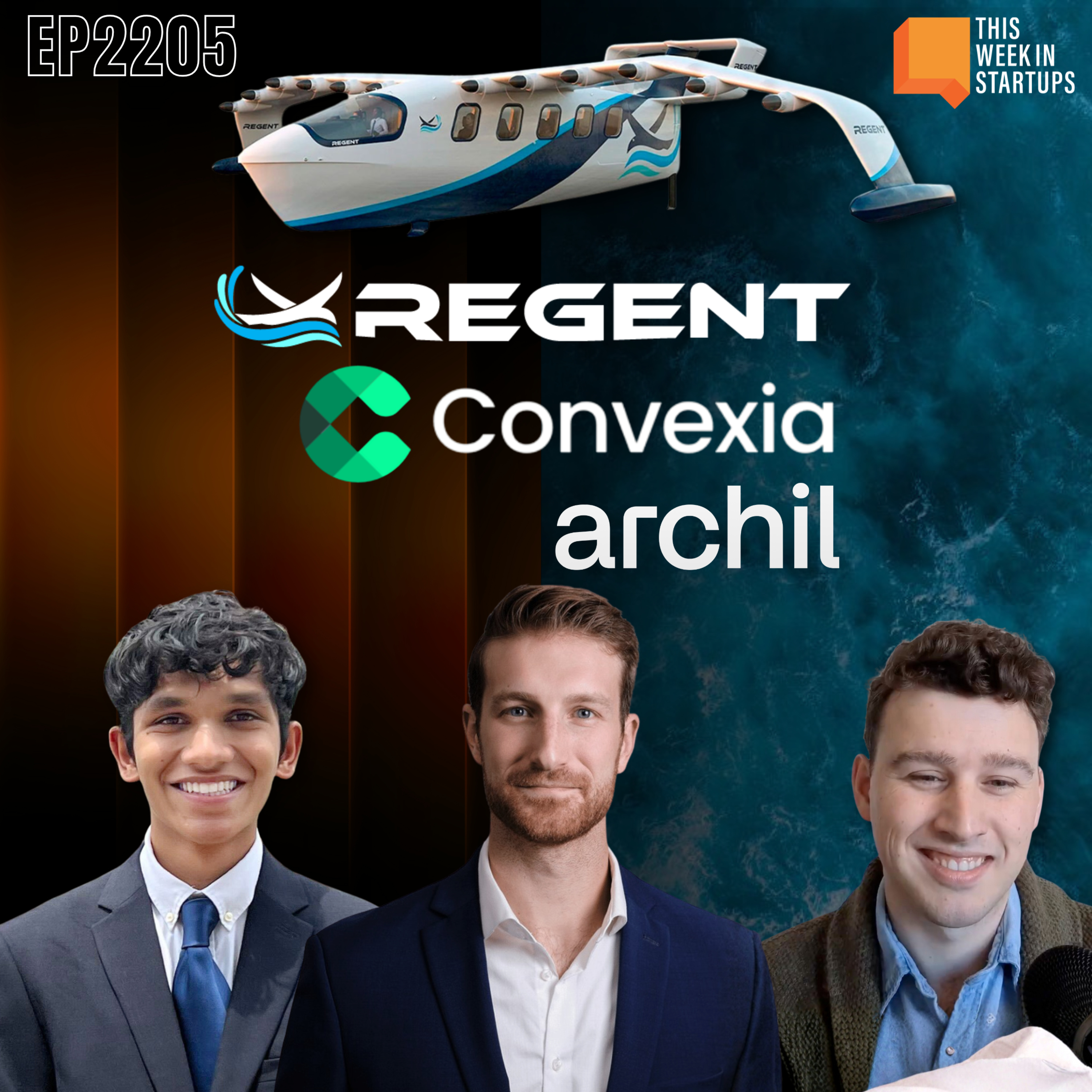
Loading summary
Transcript226 lines
- [00:00]
Alex
So how do you manage to have a thing that flies and doesn't use airports? It feels like you've hacked the system.
- [00:06]
Billy Talheimer
We are creating a fundamentally new vehicle. It goes fast, it flies low. It's sort of operating in this different way. Seagliders are sort of hybrids of boats and planes. Sort of use the best of both worlds. We'll go from Providence here to New York. That's about 180 miles. We can do that on battery technology. So you're going to board right next to the city center. We don't need to travel to an airport. It's floating at the dock like a boat. Then we're going to hydrofoil through the harbor, through the bay. We're going up to about 50 miles an hour on those hydrofoils to maneuver through the crowded waterways. We take off from those foils. So it's float, foil, fly.
- [00:42]
Alex
This is exactly what I was hoping to get because I do go to New York and currently takes 3 1/2, 4 hours on Amtrak when the trains are on time, which just seems archaic in the extreme and unimproved since like 1860.
- [00:54]
Billy Talheimer
Technical hard part of what we're doing and why we can only do this now with electric propulsion and digital flight control systems.
- [01:00]
Alex
Where are we in terms of progress? This week in Startups is brought to you by pipedrive. Bring clarity and control to your sales process with pipedrive, the number one CRM for small and medium sized businesses. Supercharge your sales today. Start with a 30 day free trial. Pipedrive.com twist LinkedIn ads start converting your B2B audience into high quality leads today. Launch your first campaign and get $250 free when you spend at least $250. Go to LinkedIn.com thisweekinstartups to claim your credit. And Sentry, your team should be focused on shipping features, not chasing down bugs. New users get 3 months free of the business plan which covers 150,000 errors. Go to Sentry IO Twist and use the code Twist. Welcome to this week in Startups. This is Alex. It is Friday, November 7, 2025 and we have three awesome interviews for you today. That means three twist 500 startups, three founders and three chances to learn from some of the best out there today. First up on the show Regent. It's a Rhode island based electric boat hydrofoil airplane startup that could shake up both how people commute today and also play in the rising startup defense market. I love this company. Then Convexia, a self titled AI maximalist pharma company it wants to mine IP and bring drugs to market that may be overlooked with a commercialization twist in the near term that I absolutely love. It's brilliant. Then to close off Arkil, they're building a tool that helps developers interact with cloud data as if it was local. Something that matters quite a lot in the AI era because companies really want to bring their own proprietary data to bear, but may not have it on site. I learned a lot. I hope you do too. Three interviews. Let's start with Regent. Now, here in the U.S. trains are a joke, ferries are under capacity and our airports are creaking because there's too many people that want to get around. Essentially we have cars or very little else. But there is a company called Regent that wants to make electric sea gliders that are going to take us around the coastal regions quickly and safely. I'm excited about this because I want to use it.
- [03:12]
Ayaan Parikh
So.
- [03:12]
Alex
So please join me in welcoming to the show. It's Regents, Billy Talheimer. Billy.
- [03:16]
Billy Talheimer
Alex. Good to be here.
- [03:17]
Alex
I'm so happy that you're here because I never get to make niche Rhode island jokes in the pre show. So thank you for showing up. But first let's talk about the technology here. This is not a seaplane, this is not a hydrofoil. You guys at Regent are building something that is kind of in between them using wing and ground effect. So for the folks out there, not in aerospace, what the hell is that?
- [03:38]
Billy Talheimer
And.
- [03:39]
Alex
And why do you like it?
- [03:39]
Billy Talheimer
Yeah, well, definitely next time we're going to have to do the show in person. We'll just walk right down the road and shoot in person. We'll do it from a seaglider sold. Regent builds seagliders. As you mentioned, Seagliders are sort of hybrids of boats and planes. Sort of use the best of both worlds. As you mentioned, the technical part is we are a hydrofoiling wing and ground craft. There's a lot there. What does that mean? We are wave tolerant and super efficient. So sea gliders use hydrofoils to rise up out of the water, giving us very high wave tolerance, therefore high utilization. You can rely on sea gliders. They operate in all weather conditions up to five foot waves, which is basically a hurricane. And then when we do fly, we fly on this cushion of air over the surface of the water called the ground effect. Sort of think about it as compressed air under the wing, between the wing and the water. Same thing that you see birds flying on when they're flying low over the surface of the water. It makes it very aerodynamic. Dynamically efficient for us to fly. And that allows us to get very long range on battery technology, 180 miles on our battery electric version. So overall there are a lot there. We float foil and fly. We operate in all three modes.
- [04:53]
Alex
Okay, so I presume that I start floating at rest and then I'm. I'm foiling at middle speeds perhaps, and then I'm flying a couple of feet, I think off the ground or off the sea, I suppose, at peak speed.
- [05:06]
Billy Talheimer
That's exactly right. We'll go from Providence here to New York. That's about 180 miles. We can do that on battery technology. So you're going to board right next to the city center. We don't need to travel to an airport. It's floating at the dock like a boat. Then we're going to hydrofoil through the harbor, through the bay. We're going up to about 50 miles an hour on those hydrofoils. We're using technology from America's cup and Sail gp, you know, these advanced racing yachting worlds to maneuver through the crowded waterways. We take off from those foils, so it's float, foil, fly, take off in the air. We actually retract the foils so it's like takeoff gear instead of landing gear. And then we fly on that cushion of air. We'll be about 30ft over the surface of the water.
- [05:48]
Alex
That's not very high at all. That seems actually quite pleasant.
- [05:51]
Billy Talheimer
Yeah, it's pleasant. It's high enough that the waves aren't a huge issue. So again, we want to be able to take off and operate in a wide range of weather conditions. Low enough where we still get that compressed air effect. So we get the long range, will fly 30ft over the water, zip on down to New York. We'll be there in about an hour. And the ticket price is less than 100 bucks. So we're talking about like high speed rail in every coastline on the planet.
- [06:13]
Alex
That's why I started out with public transit, because it turns out that building high speed rail in the US is impossible because we have a multi stakeholder form of governance and land ownership. And that's tricky. But this is exactly what I was hoping to get because I do go to New York and currently takes 3 1/2, 4 hours on Amtrak when the trains are on time, which just seems archaic in the extreme and unimproved since like 1860. So I'm stoked that this is coming. Where are we in terms of progress? Because I went through your company timeline, you know, opened your D.C. office in 24. You kind of picked your. You broke ground on your manufacturing facility here in Rhode island in January of this year, and you started sea trials in March for Viceroy, your first. First sea glider that is a little bit smaller than your later one. But I'm kind of curious how far this is from commercial application, because that's what I'm clearly waiting for.
- [07:06]
Billy Talheimer
We are moving really fast. So, as you mentioned, that Viceroy seaglider prototype is in the water right now undergoing sea trials. We started that in March. Viceroy is our first product, so that carries 12 passengers or 3,500 pounds of payload on our cargo and logistics missions. Viceroy prototype is in the water right now. You know, the hard part of building this machine that floats, foils, and flies is that we're simultaneously building the fastest hydrofoiling boat on the planet, and then we're also building the slowest flying machine on the planet at the same time. That's why this has never been done before, is because those two speed regimes have not been able to overlap. So we're. We're bringing up the hydrofoil speed, bringing down the flight speed, and we're able to overlap them for the first time with our electric propulsion digital flight control technologies.
- [07:58]
Alex
Well, we'll get to the EV side of this in a second. But the speed of the air component to this brings a question up, because it feels like you're cheating in the best possible sense, because going to the airport sucks. Going through security sucks. Waiting at the gate sucks. Being crammed into A Southwest Boeing 737 sucks. The whole thing's miserable. So how do you manage to have a thing that flies and doesn't use airports? It feels like you've hacked the system. So is the low speed a component of that?
- [08:24]
Billy Talheimer
It's actually the low altitude on that front. So the low speed allows us to use the foils. There's sort of a top speed of the foils. Water's 800 times more dense than air. Right. So you only go so fast through that. And then there's a low speed of landing, which is you need enough air going over the wings to generate lift. So that's why, you see, we have that distributed propulsion system. A lot of different propellers lining the wing. We're sort of blowing air over the wing, tricking it into generating high lift at low speeds. And in so doing, we can slow down that takeoff speed and for the first time, overlap it with the hydrofoil speed. So that's sort of the technical hard part of what we're doing and why we can only do this now with electric propulsion and digital flight control systems.
- [09:05]
Alex
How do you have so many propellers, right, pushing so much air to create enough lift to make this happen, but not endow with a lot more forward speed.
- [09:15]
Billy Talheimer
We can size the system with these electric motors, which give us compared to sort of conventional jet engines or internal combustion engines, we can really size how much power we put anywhere, how much thrust we're putting places. So we can really dial that in to sort of be the perfect amount and also make it an efficient system for our long range operations. So that's sort of the big unlock, right? We can do these unique configurations and we can distribute propulsion wherever we want it. And we can dial it in with electric motors and vacuum batteries.
- [09:46]
Sponsor Voice
I've been working with and investing in founders for so long, I've got supernatural startup powers. For example, I know your team is spending too much time on debugging. Your engineers are chasing down bugs at 1am, 8am and every time in between, instead of building amazing new features or pushing fresh code, just admit it, you'll feel better. The reality is, from time to time, your code is going to break. We all know that. But it doesn't have to be the end of the world. Now they're Sentry. They're the one stop application monitoring platform that's not just going to tell you, hey, something's broke, but what specifically happened, where, and most importantly, why. Plus, they've added Sentry logs. So now when something goes wrong, you get a complete report. No more random jobs that just don't run, no more tab hopping, just actionable information with tons of context. And that means faster fixes. And we want to give you three months free of Sentry's team plan. That's right. F R E E Just for being a loyal twist Listener. That covers 150,000 errors. Just go to Sentry IO and use the code twist that's S E N R Y IO and make sure you use that code twist so they know we sent you to me.
- [10:55]
Alex
This is competitive with trains for sure. It's competitive with all sorts of other kind of ground transportation. And it's better than flights for a lot of things. Like I will never have to fly to, you know, Newark again, for example. I'll just take a boat or.
- [11:08]
Billy Talheimer
Yeah, you take the boat. Exactly. It's a sea glider.
- [11:10]
Alex
It's a boat kind of a boat kind of a plane. I'm gonna have to figure out how to talk about it.
- [11:14]
Billy Talheimer
Well, it goes back to your previous point of you know what, what allows us to fly without using the airport? Because we stay in that effect because we're within a wingspan of the water, actually about half a wingspan at that 30ft. We are regulated under the Coast Guard as a vessel. There is a special rule in US Law that is also mirrored in international law and regulation that this kind of vehicle and a seaglider is a wing in ground craft, is a vessel under maritime jurisdiction. And that makes sense because we stay over the waterway, we do not rise up to airport altitudes or go into airspace. In fact, we're flying, you know, below the height of a sailboat mast and well below the height of a cruise ship. So we're in the maritime domain. And that's why this is regulated as a boat. We call it a boat. We have a lot of boat builders on the team here in around Rhode Island.
- [12:03]
Alex
There's a lot of boats, so you'll have to deal with traffic. You're also talking about a deal. You guys did a joint venture with the UAE to quote, bring manufacturing and aftermarket services for Viceroy and similar to the uae, lots of boats there. So how do you handle regular maritime traffic when you're going a multiple of the speed of any ship that might be in and around the Viceroy's area?
- [12:26]
Billy Talheimer
You mentioned the boat builders in Rhode island here. And that's actually one of the reasons why we're here is sort of, you know, a non characteristic startup market that's actually perfect for us because we can leverage this incredible local talent that we have here in building composite racing boats. It's like the center of the sailing racing worlds, but in terms of traffic avoidance and maneuvering, that's where float foil fly comes in. Because a conventional seaplane, you think about it just goes from float to fly. So you need to clear these long takeoff routes. You need to get to very high takeoff speeds to get on the wing. In our case, we don't need to do that. We can separate our high speed takeoff and landing operations from our docking operations. And so we can be hydrofoiling again at 50 miles an hour. So that's like highway speeds. We can actually. It's almost like a high speed taxi sea. We can go very far from the dock. We can go through rivers or bays or harbors on the foil where we're as maneuverable as any other boat. And then we can take off once we hit the open water. So here it'd be like we get south of Newport and we take off south of the bridge.
- [13:27]
Alex
Got it. So essentially, because you'll be being a boat around other boats. There's not much of an issue. And then when you get out where there aren't boats, then you can just fly.
- [13:34]
Billy Talheimer
Exactly, exactly.
- [13:36]
Alex
That's lovely.
- [13:37]
Billy Talheimer
It makes sense.
- [13:39]
Alex
What changed in technology terms to allow this to be possible now? Because when you explain to me the combination of float, foil, fly seems quite obvious, like, oh, God, of course. Why not? So it was the composites that have changed. Was it battery technology? Was it just people finally getting around the idea that we will have electric planes? Like, what changed?
- [13:58]
Billy Talheimer
Yeah, there's really three big things. The first is, you know, hydrofoil technology being used in the Americas cup for the past, say, decade or so, but really seeing a lot of maturation in that technology and the modeling of it, the hydrodynamic modeling of it.
- [14:13]
Alex
Right.
- [14:13]
Billy Talheimer
It's sort of like how we saw a trickling down, or there's always been a trickling down of the most advanced automotive technology from the racing world and F1 into sort of commercial automotive. All of this incredible racing technology in America's cup world did not have an outlet until now. It's like we can use that hydrofoiling technology. And I think you probably seen the listeners have seen around a lot more applications of hydrofoils. There's hydrofoil boats and hydrofoil surfboards and all these things.
- [14:41]
Alex
There's the famous Mark Zuckerberg with sunscreen on his face doing the.
- [14:45]
Billy Talheimer
Yeah, he was doing that for us, really, to try to, you know, advance the state of awareness of hydrofoils.
- [14:51]
Alex
That's why he's an early investor in the company.
- [14:53]
Billy Talheimer
Great partnership. Really great partnership there. So. So, you know, hydrofoil. So we're capturing that hydrofoil wave. Next is electric propulsion, that. Doing something like blowing the wing like that to enable takeoff from a hydrofoil at a relatively low flight speed. I mean, 50 miles an hour is very low speed to take off a plane. And so that is enabled with electric propulsion and not only unlocks that takeoff and landing operation, also brings down that cost, incredibly. If I told you you could get from home here in Rhode island to New York in an hour, but it was going to cost you the same as a flight ticket, it may not be that interesting, but if I could say it's going to cost you less than your train ticket, maybe less than the tolls you're paying on the road anyways, and it's faster and it's greener and it's more comfortable, all of a sudden you're way more interested. So we bring down that maintenance cost by Switching to an all electric system.
- [15:43]
Alex
You should just match whatever I pay for Amtrak, which is several, I think several hundred dollars to get from Providence to New York City, for example. I mean if you guys are cheaper and faster, I mean it's game over. It's absolutely game over.
- [15:56]
Billy Talheimer
And so the last piece now, because the control of that float, foil and fly, all different modes, all different controls. So the last part of this is the flight control system. So we now have like computers and softwares. We have this incredible, you know, half of our engineering team is software engineers. So we have this incredible control system to keep it safe in all modes to the point where you don't actually fly it. When it's a plane, we have this autonomous control system that governs it and make sure you're safe in your flight envelope and controls that height above the water. So the only thing you do as the captain is boat controls left and right, fast and slow and it just locks you in on that 30 foot plane. So now we can train Mariners.
- [16:36]
Alex
So it's kind of like super cruise for like cars in that it does the in for cars. It's this is the person in front of you tracking things over. But you're just really doing left and right. So in this case you're doing kind of the same idea. You're doing boat controls for a plane. Well, that solves your pilot problem right there. Because if you can have Mariners and there's a lot of people out there who, who know how to do boat. So what do you think that's going to take in terms of time and money to get like, I don't know, let's say a tugboat captain geared up and ready to rock a Regent.
- [17:02]
Billy Talheimer
Yeah, we're working on the training course right now. We actually have some great partners on that. We expect it to be about a four to six week course to go from say your, your trained commercial captain into a Seaglider. Because the operations are very similar and it's really just familiarity with, you know, the speeds and some of the systems. But you know, I'm a pilot. My co founder is a pilot. A lot of our teams are pilots coming from the aviation world. So much of your pilot training is how to take off and land and how to recover from an unusual attitude and all these failure mitigations. And a Seaglider you don't even have control of that. You're driving a boat and if something goes wrong, you land, press the land button.
- [17:39]
Alex
I googled it while we were talking the, the minimum takeoff speed for A Cessna one two, what I have most of my flight experience and is about 50 knots. So you know, that's a number that comes up quite a lot in this conversation you guys have talked about having. It was $7 billion in orders I think at the end of like 23 and I think was 9 billion in backlog by the 24. That's great, Billy, but why not not sell it and make your own coastal airline that just consumes tons of business and becomes enormous? Like why sell it? Why not just run it?
- [18:15]
Billy Talheimer
There's really three reasons. The first is brand recognition. And you know, we are creating a fundamentally new vehicle. It goes fast, it flies low, it's sort of operating in this different way. You know, I do expect a lot of people to just think this is an incredible experience, the ride is going to be smooth. You know, if you're afraid of heights, this is a great thing for you. But it's net new and I think there will be a lot more brand recognition by taking the service with trusted airline or trusted ferry company where you're already operating versus, you know, jumping on this net new region system. It also allows us sort of to use a very similar business model in selling to defense, which is actually I would say one of the fastest growing parts of our business and not operating in defense as commercial. So you know, that's one, two is from an economic perspective we can sell to sea gliders, get them off our balance sheet and onto our customers balance sheet as owners and then Regent participates in the aftermarket maintenance. And then number three, if you look at value accretion across say airlines today versus Boeing. Exactly. If you look at Boeing and Airbus and all of the tier one suppliers, the engine companies, avionics companies, significantly more market cap and value there than there is in all of the all of the world's airlines. So that took us down this road.
- [19:33]
Alex
What is the United Airlines price sales ratio?
- [19:37]
Billy Talheimer
Airlines tough. And airlines a tough business. We're going to help though. There's much better margins in operating seaglider lines. So those entrepreneurs out there that are.
- [19:44]
Sponsor Voice
Interested founders, listen, if you've got a B2B company and you're marketing your product or service to other businesses, you need to use LinkedIn ads. Otherwise you're wasting your time and you're wasting your money. LinkedIn isn't some random social network where everyone's using a fake name and posting nonsense. It's a network for professionals. LinkedIn knows who the big players are and who the key decision makers are in your vertical. Based on the data they're already collecting. Everyone's on LinkedIn. Me, you, everyone. The platform has more than a billion members and that includes those 10 million C suite executives. And that's the kind of reach you need to grow your business. LinkedIn's advertising tools aren't just throwing your messages around for anyone who's clicking. No. B2B marketers report 2.5 times higher returns on ad spend on LinkedIn compared to other social platforms. That's why my firm launch advertises our own projects on LinkedIn. We want to reach people who are actually, actually doing exciting work at real companies. Not randos, not bots, not trolls, real executives. So here's your call to action. We've got a special offer just for twist listeners. Launch your first campaign and get 250 free. When you spend at least $250, that's one for one. Go to LinkedIn.com thisweekinstartups to claim your credit. LinkedIn.com thisweekinstartups maybe the better question than.
- [21:07]
Alex
Billy is do you think there's gonna be eventually companies that specialize in using Regent CR Craft to run what we might call regional C routes? Because United guy, shout out United. They've flown me so many miles, but I'm not quite sure I need to have United run my Providence to New York City. You know, Regent Craft line, I mean.
- [21:27]
Billy Talheimer
We are already seeing it. We're seeing. So, you know, in that order book, which is now over 10 billion including firm orders, you know, we're one of the few, few companies in the space where we're taking substantial non refundable deposits, millions of dollars worth of these non refundable deposits that Regent is using to subsidize the build of these vehicles and actually non dilutive capital for us, which is fantastic.
- [21:51]
Alex
What's the list price for Viceroy when it comes off the manufacturing list?
- [21:55]
Billy Talheimer
So we haven't been public with the list price. We have an awesome sales team that's going out there. But I will say it's sort of between a Cessna Caravan and a Twin Otter. We're sort of in the middle of the size class our, our payload at 12 passengers and £3,500 is right in between. And so your upfront cost for the vehicle for the Seaglider is right in line with those competitors. And then the operating cost is half of those competitors. So huge, huge value in that operating cost. But yeah, so we're seeing entrepreneurs put together now Seaglider Lines and some of our orders are from net new operators that are saying we are forming to operate seaglider. So we have the airlines, we have the ferry companies, we have energy companies and oil and gas companies, we have.
- [22:40]
Alex
Hotels, no more helicopters out to oil rigs.
- [22:43]
Billy Talheimer
It's a big market.
- [22:44]
Alex
That's a huge market.
- [22:45]
Billy Talheimer
Exactly. And then one of the biggest ones is actually defense now too, that's buying these. We're with the Marine Corps, we've been working with them for three years. We have $15 million worth of contracts with them to do this experimentation. And so the great thing is it's, I think it's hard to be a dual use company, but what we have here is an asset that actually works for both of these customers in very similar ways.
- [23:08]
Alex
Briefly, what is the defense application for the Viceroy? Because I can absolutely see it as a way to like maybe move people between Navy ships, but I don't see as many obvious applications for it as I do with say, unmanned aerial drones. So just fill that in for me.
- [23:23]
Billy Talheimer
We really started with the Marine Corps on the mission of high speed logistics and contested logistics, which is moving around island chains. We're sort of in the secular shift from desert operations, you know, Afghanistan, Iraq, sort of conflicts, to now distributed maritime operations. South China Sea. Right, Exactly. Big island chains, long distance. We need more boats, we need faster boats. The boats we have today are slow, they're easy to hit with missiles and things. And the aircraft we have today, drones included, are still fairly expensive. And if you need the range to go between islands, you're building even more expensive systems and you still need land basing. So what we have is really in between. We're like a boat. We can operate from the water, we can sit out there indefinitely, but we have the speed of a plane. And so that's a huge, huge gap that we're feeling right now for Indo Pacific operations. So we're doing contested logistics, which is moving people and supplies around island chains. There are drones out there right now, lots of drones, which is definitely a focus of DoD. But you can win a battle with the drones. You cannot take and hold land and win a war with drones. You need people to do that at the end of the day. So you still have to move people when you're putting people into a fight. To do that, you have to be able to take them home safely. And so medevac is also one of our fastest growing applications for this vehicle of actually being able to go out, land on the water, rescue people and bring them home.
- [24:53]
Alex
So to be clear, you're going to be able to serve airlines Net new carriers, various military applications. And also, I presume there's going to be some rich people just buy these for themselves.
- [25:02]
Billy Talheimer
Big market.
- [25:03]
Alex
Big market. Which brings me to my last. My last question for you, Billy, which is just, you're doing it in Rhode island. And like, I look, Rhode Island's a tiny state. No one knows who we are outside of, like the Northeast. But I find it really exciting that not just Regent are here. I mean, we were talking about that and systems before the call, and you mentioned havoc and Andrew has a presence here. What's the. The Rhode island pitch? Like, what types of companies and startups should be thinking about putting down some boots here?
- [25:30]
Billy Talheimer
Rhode island is sort of in the midst of this maritime defense renaissance, which is very well aligned with, you know, national priorities. And that, that whole defense scheme I laid out of, you know, national defense for the next decade plus is going to be water based. And so you have a lot of sort of overlapping things in Rhode island that make it compelling. Obviously it's the ocean. Ocean State. You have Narragansett Bay. It's an incredible testing facility. There's a great military presence here. Naval Service Warfare center and the War College are here. So you get the top brass, the generals, the admirals, the decision makers coming into Rhode island, and you can call them up and say, hey, we're a half hour away. Come check it out. Because everything in Rhode Island's a half hour away, so you can just come on over and check it out. So that's been great for engagement at the highest levels of defense leadership. One of our senators, Senator Reid, is one of the ranking members on both Senate Appropriations and Senate Armed Services. So he's an incredible support to companies in the state. And being in a small state in Rhode island, it's like he comes and visits, you know, quarterly.
- [26:36]
Alex
Personally, you get so much more hands on, like, compared to, like, California, for example. I mean, I run into, like, the mayor of Providence was just like, eating in my local diner and I was like, this is. This does not happen in San Francisco, where I used to live. You know, like, you're not as abstracted from government. It's right there.
- [26:51]
Billy Talheimer
Exactly. And then I'd say the last thing is we're in what's called Quonset Business park here. So, like, General Dynamics builds their. Their nuclear subs here, and there's just this huge growth going on because of the compelling financing that the state offers. And we're just building factories left and right. Like, Quonset is the factory.
- [27:09]
Alex
Factory right now is Governor McKee sufficiently engaged for sure.
- [27:13]
Billy Talheimer
I mean, I was with him last week, super engaged in this, growing this out. The state is investing real capital into growing the manufacturing base here, all focused around maritime and defense. But for example, we are building our 255,000 square foot manufacturing facility that we were able to build. I mean, this is a $50 million project. We were able to build this as a Series A startup that had raised a total of 60 million to date. I know, crazy leaning in from the state. It's really incredible. So that facility will open in the spring. We'll start cranking out seagliders for both those commercial and defense customers. Will deliver our first sea Gliders in 2027. But it's not just us. You know, Anduril's building their facility across the street. We have all these other companies coming in. Saab is bringing their undersea warfare center. There's a good, you know, presence from Raytheon and rtx. Like, it is a. It is a very cool state to be in right now.
- [28:08]
Alex
I mean, Narragansen Bay is essentially one large sub pen. Like, let's be honest, like, it's just.
- [28:13]
Billy Talheimer
It's great. It's awesome.
- [28:14]
Alex
I love to be enthusiastic about a company and my adopted home state. So, Billy, thank you so much. I will come down at some point and high and just see what y' all are building. But 20, 27, last thing early seven later. 27. When did these first touch customer hands?
- [28:29]
Billy Talheimer
I would say second half of 27 is where we're focused right now. First half is going to be a lot of sea trials. So they'll be out on Narragansett Bay. They'll be working. They'll be in the hands of the Marine Corps, certainly, you know, working on those missions as well. Second half is those 27 deliveries.
- [28:46]
Alex
Can I come on a sea trial?
- [28:47]
Billy Talheimer
You got to come out. Yeah, come on over. Just walk. Just walk here.
- [28:50]
Alex
I think I will get in my EV and drive down, but I would love to see this before it's fully baked and such because I'm a huge dweeb for both airplanes and boats and getting places faster than Amtrak. So a pleasure, Billy. It's regent craft.com and any job you're looking to fill, you want to shout out while we have you.
- [29:08]
Billy Talheimer
We actually have a ton on regencycraft.com careers we're growing right now. We're looking for technical support on building the prototype. We're going to start to build our manufacturing team very soon as that buildings soon to be open so definitely go to that website there and check out careers and we have a bunch of cool videos too.
- [29:25]
Alex
So, Billy, you're the best. Thank you, man. We'll talk to you in late 26.
- [29:29]
Billy Talheimer
Early 27, hopefully before then we'll get you on the sea glider before then.
- [29:32]
Sponsor Voice
You can be a brilliant founder with a great product and you can have an amazing team, but it means nothing if your sales process is disorganized and if customers are slipping through the cracks. Trust me, if your pipeline's a mess, you're going to spend way more time time getting organized than talking to customers and closing deals. If this sounds like you, write down this name, Pipe Drive. They're the number one CRM for small to midsize businesses like me. I use pipedrive and have for almost a decade. It brings your entire sales process into one simple, elegant and central space. That's why the sales team here at this Week in Startups uses it day in and day out. You just drag deals along your pipeline and you're good to go. Plus, they've got some amazing new AI integrations. Generate sales reports with advanced metrics and personalized suggestions based on where your company is struggling and automate your sales conversations with AI generated prompts. And when you use my link, you're going to get a 30 day free trial. No credit card, no payment needed. Go to pipedrive.com twist to get started.
- [30:33]
Alex
If you listen to the show on a regular basis, you know, we talk about AI probably too much, but one thing we talk about in the realm of AI is agents. Little things that can go out there and do stuff for you. This usually comes up in a context of SaaS or enterprise software or something incredibly boring like expense reports or, I don't know, refactoring your spreadsheets. But there's a startup out there who wants to use AI agents to find old, unused bio ip, test drugs out and maybe bring them to market. It's a really interesting idea. I love the company and I wanted to learn more about both how it works and how fast it's going to change our world. So please join me in welcoming to the show. It's Ayaan Parikh from Convexia. Hey, how you doing?
- [31:11]
Ayaan Parikh
Hey, doing good. Thank you so much for having me, Alex. Looking forward to chatting with you.
- [31:14]
Alex
My pleasure. I just love to talk about AI in a context that isn't like trading or something involving enterprise SaaS. It's such a nice page. So Convexia, as far as I understand, it essentially wants to use a series of AI agents to find unused IP or just leftover ideas, vet those ideas, run business queries about how popular or commercially viable those drugs could be and then help bring them to market. Is that fair?
- [31:40]
Ayaan Parikh
Yeah, pretty much. So we're looking at all types of drugs. They could be really early stage drugs that are just sitting in labs, they could be shelved assets that are, you know, sitting in the shelves of these small mid or big pharma companies. Or they could just be things that have been overlooked. We evaluate the science viability, the clinical viability and the commercial viability to score which ones have the highest chance of succeeding and which ones and which ones can save the most number of lives.
- [32:04]
Alex
And why are those the most two important metrics? Because I could think like speed to market or number of people you could impact maybe on a non life saving basis. That would also be good vectors to, to judge against.
- [32:15]
Ayaan Parikh
Yeah. So I mean when you consider like what will bring a drug to market and what will, what'll make it succeed, there's generally, or the way that we think of it is like what will cause a drug to fail essentially. And the three reasons drugs will not come to market are because either it's not safe and effective in human bodies, either there's too high of a clinical risk, meaning like there's a manufacturing problem or just running a clinical trial is really, really hard. Or it could be that there's no commercial viability, that there will be that there's already something out there that's way better, or the market size just isn't there, or perhaps that like an insurance company will never cover it because the standard of care is already so good. So those are the three key reasons why drugs will fail. And those are the, that's why we look at those and consider why they'll either succeed or not succeed in the market.
- [32:56]
Alex
Oh no, that helps a lot because I was really curious about like to me there's a lot of ways you could approach this but you have to narrow it down. The thing that I was really kind of hung up on prepping for our job today was just how much leftover IP or ideas on the shelf or I don't know, preclinical trials out there. Like how much stuff is there for you to go out and look at and run through the agentix doc that you're building?
- [33:20]
Ayaan Parikh
An incredible amount. So just about some put some statistics out there.
- [33:24]
Alex
Yeah.
- [33:24]
Ayaan Parikh
Out of all the drugs that enter into phase one, only about 5 to 10% ever even make it to market. And the percent of drugs that even make it to phase one is a really, really small proportion as well. So the point being that there's a whole bunch of preclinical drugs that are never making it to clinical trials. And that even when they are entering clinical trials, many of them are shelled for reasons beyond just the molecule not being good. For example, the clinical trial might not have been run the right way or a company might just have a change in strategic incentives or in strategic alignment and now they just have this really cool drug that's just sitting on their shells. So there's many, many examples I can list off as to when a potentially life saving drug was just sitting pre clinically in a lab for really, really long or from where it's just sitting on a shelf even after entering clinical trials. There's a lot of examples like that. And I think as AI drug discovery continues to increase, the number of drugs being produced will simply continue to increase. Creating novel drug molecules will almost to some degree become commodified. But what will become really critical then is actually trying to evaluate which one of these will actually be successful out of all these drugs we're making, which ones of them will actually be successful in clinical trials. I think that's kind of where the future of the space is going to. The future of pharma is in M and A. I can talk a bit more about why that is, but the larger point here being that we want to be on that forefront.
- [34:53]
Alex
Okay. So down the road, you know, five, ten years from now, we're going to have a models of sufficient quality to kind of come up with our own ideas and then from there we can vet them and then eventually get them to market. If they work today though, AI models maybe not quite there yet, but there's tons of stuff out there that you can go out in mind. Okay, that makes sense to me. Glad that I understand that. The question is how do you get access to the information? Because I presume that if I was Merck or some other large pharma company, if I shelve something, the public may not know about it. So how do you get the ability to have access to the information you need to do the work to vet as these drugs as possible candidates for convexity.
- [35:29]
Ayaan Parikh
So I think the last mile of this is always somewhat relationship based in order to actually strike that deal to some degree you need to know the right people. However, in order to even start those conversations without already being in that circle, there's still a lot of predictive work that you can do to Understand what is shelved and what was being pursued at some point. For example, you can mine company reports, you can mine how much a company is manufacturing certain molecules, you can mine patents. There's a lot of information you can look at to predict what is being pursued and what is not being pursued. And we've built our models to be able to do that and predict which drugs will are up for market or are up to be sold or out licensed, which ones are just sitting there and which ones are actually being pursued right now.
- [36:10]
Alex
And this is the first layer of your agentix stack, as I call it, which is your sourcing agent. The thing that goes out there and pokes around and finds stuff and brings it back to the company. Is that part of the company's technology in production today? Is that going out there and doing this or is that something that you're working on building?
- [36:25]
Ayaan Parikh
So far we've done this. So we're not only using this in house internally, but we've also sold this technology out to some customers as well. As we kind of talked about, it's not only does it mine both structured and unstructured data, but it's also kind of hypothesis generating and thesis aware, which is how we compare to a lot of these other typical competitive intelligence tools. That's really the alpha that we generate compared to those.
- [36:47]
Alex
Essentially you better understand not only biology but also the pharma industry. And so with that information you can just make much better guesses.
- [36:53]
Ayaan Parikh
Exactly.
- [36:54]
Alex
Then comes the next thing, according to your rundown, which is the scientific agent. And this uses a number of, as far as I can tell, just like AI bio models. I'm not as familiar with how fast those are advancing. Can you give me just, I don't know, a state of the industry, if you will, for that part of AI?
- [37:11]
Ayaan Parikh
I guess the gold standard for a lot of these in silico tools has for the past years been physics based models. And that's been pretty true for a lot of, I mean the entire world of computational biology and computational chemistry. But now we're kind of seeing a bigger and bigger push towards ML based models. Like just today some cool models were released yesterday or a couple of days ago Bolt Gen was released from mit. So a lot of really, really cutting edge tools are being released in this ML space. And I think like when we look to the next 5, 10, 15, 20 years, I think these ML models will become increasingly better and become the gold standard. Whereas right now and in the past it's been more so the physics based models. So I think in different worlds there'll be different, I mean in different kind of sectors of the science side of things, change will be seen differently. Like right now if you look at like binding, the ML based models are actually pretty good. But if you look at like toxicity, there's not a lot of good ML based models or even models at all. So I think like there's a lot of room for growth in this space but we are getting there.
- [38:13]
Alex
So physics based models for the work that we're describing to my non biologist brain seem like the way to go. Why are ML based models in your view going to supplant and surpass them?
- [38:26]
Ayaan Parikh
Well, I mean I think the pace of ML innovation is faster than anything we've ever seen before.
- [38:31]
Alex
Yep.
- [38:31]
Ayaan Parikh
Okay, so like they're growing faster than ever before and like even physics based models, they have a lot of limitations right now as well. Like a lot of physics based models can actually predict everything that an ML based model can even touch on. So I think like the capability as far as like compute goes, as far as speed goes, as far as like raw capability goes will soon be, I mean the physics based model will be far exceeded by the ML based tools.
- [38:53]
Alex
That makes a lot of sense to me. Now the next thing is your commercial agent. That one makes great sense to me. Then we get to the clinical agent side of things. This is when I get even more excited because you're talking about using digital twin simulations and I think digital twins are brilliant approach from a lot of places, everything from you know, factory design on down. But in practice, how good is digital twin simulation for individual drugs? Because to me they could be a cool technology and maybe a tough use case. So I'm curious how well they, they wed if you will.
- [39:22]
Ayaan Parikh
Running digital twins is a very, very difficult problem and I think like we're still exploring what that looks like to its fullest capability. I think like kind of where we're starting is by not trying to boil the ocean and you know, try to create these digital twin simulations, but more so starting with like okay, how can you understand the manufacturing, how can you understand the patient stratification, how can you understand even the trial design? Right. These are all small components of clinical trials that might lead to, to a, to a clinical trial failing, but aren't like the whole, you know, digital twin in itself. So I think like the way that you eventually built to like being able to run a digital twin is by starting off with smaller components. And that's what we're focusing a lot of our time on right now.
- [39:59]
Alex
So if we go from sourcing through science, through commerce, through the clinical agent and we get all the way to a phase one trial. And you said earlier that what, 5% of drugs make it through phase one, more or less and get out on the other side?
- [40:10]
Ayaan Parikh
No. So 5% make it to market. So 5% of make it through phase one, two and three.
- [40:16]
Alex
When you guys have this full pipeline in place, how much better do you think you'll be able to do on that 5% from start of phase one through production?
- [40:24]
Ayaan Parikh
I think significantly better. We've been doing a lot of internal backtesting and we're going to be publishing some really cool results. We're actually publishing a paper pretty soon that'll talk about specifically some of these benchmarks. So I think that's coming up pretty soon and we'll be excited to publish what those exact results look like soon. But I mean based on what we've been seeing, there's a lot of promising results that we've been seeing by just doing simple back testing of our, of our agents.
- [40:46]
Alex
Are we talking about like 2% better, from 5 to 7% which would be 40% quite a lot, or are we talking like 5 to 25%, like a 5X?
- [40:54]
Ayaan Parikh
Yeah, something, something like the latter. It's, it'll be significantly better. And that's just because like not only are we now able to predict like just commercial success, like that wasn't too difficult before, but like also being able to look at like the actual science of this, being able to understand like out of all the history of clinical trials, how much better is it to use this contract research organization or this manufacturing organization? Like these are all very, very small details that we can actually fully understand and understand how that affects the probability of success of a certain drug. And I think that's where we get really excited because of how granular we can get with some of these details.
- [41:31]
Alex
Well, I mean that explains why you're, you've decided as a company to sell bits of your technology to other people and you're seeing uptake from it. What does your customer base look like today? Are you selling to like the pharma companies that I can name or are you selling your technology more right now to companies that are more in the startup realm?
- [41:47]
Ayaan Parikh
It's not big pharma. Most of our customers are small to mid cap pharma companies and then quite a few like investment firms as well. So things like biotech, VCs, hedge funds. We're starting to work with some investment Banking, like biotech, IV firms as well. So that's what the primary customer base looks like right now.
- [42:04]
Alex
Is the future of Convexia building technology that you sell to other companies that then use it to bring more drugs to market? Or are you eventually going to have the full stack put in place and you're going to run the process yourself? Because I could actually see a great argument for either direction.
- [42:19]
Ayaan Parikh
For the company, I think the goal is to be like, as the tagline says, an AI maximalist pharma company. That's kind of the long term goal. The way that we think through our company is that in order to actually bring a drug to market, you need a lot of information, you need a lot of experience and you need the right team. And the way that we eventually get to that long term goal is by first working hand by hand with our current set of customers and partners to understand how they do it and then we would leverage those insights to eventually run this process for ourselves. So the long term goal is to be fully vertically integrated and to be a pharma company.
- [42:49]
Alex
How far away is that? Is that five years, 10 years?
- [42:51]
Billy Talheimer
One year?
- [42:52]
Alex
I just don't have a good guess.
- [42:54]
Ayaan Parikh
Yeah, so when you look at like a lot of the other companies that have done something similar for them, like Schrodinger is a good example, Recursion is a good example. These are all companies that it took them like anywhere from like nine to maybe 12 years.
- [43:06]
Alex
Okay.
- [43:06]
Ayaan Parikh
I think our pace can be much, much faster. We're already helping a lot of companies make decisions about drugs to in license. So I think like, I mean, we're keeping our eyes out if we spot something that really piques our interest and that makes sense for our portfolio, like there's no reason why we can't pursue it. If you have the confidence that our models are actually that good and that it's worked in the past. So I think it could be as near as like, you know, a year from now. It could take a couple of years as well. It's pretty cool how quickly we can move in this space and given the right circumstances, we can actually move on some of these drugs pretty quickly as well.
- [43:39]
Alex
Is your ability to move quickly predicated on simply the advancements in AML we were talking about earlier, or is there something else going on at the regulatory level that's providing a tailwind just to your pace?
- [43:49]
Ayaan Parikh
I think it's a bit of both. I think like we certainly understand that like these models will continue to get better and we want to be on that Forefront. I think Sam Altman talks about this. As the model gets better, our company will also get better. So we're not really competing against models, but it's very synergetic.
- [44:02]
Alex
Yeah, sure, yeah.
- [44:03]
Ayaan Parikh
I think there's also some interesting regulatory tailwinds, specifically with rare diseases that we're very, very excited by. We can get into specifics of them. But CNPVs and PRVs, these are all vouchers that can essentially make it very lucrative or very monetarily exciting to pursue a rare disease drug. If you actually achieve some of these vouchers. I think this is like a really, really compelling space that, I mean, that's why we've been looking a lot into rare diseases, severely underserved market. And our model, like, we're a really, really small, lean team. So whereas like a Pfizer, they're looking for a $10 billion outcome, we can actually like an under a billion dollar outcome is incredible for our company, which is typically what the ultra rare or rare disease space might look like.
- [44:46]
Alex
Now, what is a good example of a rare or an ultra rare disease that people listening might be familiar with? Because I feel like we should ground that in something akin to an example.
- [44:54]
Ayaan Parikh
What's defined as an ultra Rare is under 200,000 people get affected by it each year. So I mean, there's a lot of examples. Tay Sachs is an ultra rare. And there are also some more commonly rare ones as well. But anything that kind of falls under that perspective is what would be defined as a rare disease?
- [45:10]
Alex
200,000 per year per. Around the world, not just here in.
- [45:14]
Ayaan Parikh
The U.S. in the U.S. oh, okay.
- [45:16]
Alex
So 200,000 in the U.S. per year. That doesn't seem that ultra rare to me. That seems like my hometown times four.
- [45:22]
Ayaan Parikh
So, so that's, that's what rare diseases, ultra rare would be under 50,000 still.
- [45:26]
Alex
That's my hometown. I grew up in a town of 50,000 people. That's a non insubstantial. I thought it was like five. I had this entirely wrong. Okay. But essentially because Convexia is so lean and because you don't run wetlands, you have lower operating costs, et cetera, you can afford to go after these drugs that don't match the cost structure of one of the pharma companies that we can manage. Exactly how many of these rare diseases are there out there that people need help with? Like, is it, is it, I don't know, a couple thousand? I mean, how long will it take to chew through them?
- [45:56]
Ayaan Parikh
An incredible amount. So I guess for some perspective, out of all the rares and ultra rares that are known right now, only 5% have cures. So 95% of the market is still up for grabs. So there's an incredible like thousands upon thousands of ultra rares and rare diseases that are like that are, that there's no solution for right now. And we've been spending a lot of time thinking about not only developing new cures, but also just repurposing existing drug composition. We've been working with a select number of partners to understand can we build out repurposing models using some version of our agents to help them find how some approved drug can be repurposed for an existing or like for or for some rare, ultra rare disease.
- [46:40]
Alex
So a bit like how GLP1s are great for reducing your appetite, for example. They're also great for diabetes, I think, and they're also good at like addiction control and they do a lot of stuff. So single compounds can have multivariate impacts. And so you want to see if existing compounds can help these super. How do you, how do you do that? What's the, what does the AI model or agent do to try to form, fit existing compounds into known but unrelated problems?
- [47:07]
Ayaan Parikh
There's a couple of ways. I think the kind of the standard way of doing it right now is just using like a graph neural network. I guess this is the standard way in terms of like how we would develop it or how we have developed it. I'm essentially trying to understand like what mechanisms is a certain drug hitting and can those mechanisms, like whether it's through off target impacts or on target impacts, can any of those be reapplied to fix diseases or to fix some of these ultra rare diseases. So just like cross applying, like, oh, this drug hits this mechanism, can that be used to help solve this drug? And then there's a lot of other steps that kind of go into it. You have to look at the pharmacokinetic properties. You have to look at like the dose ability, the toxicity at certain different levels. So there's a lot of kind of sequential steps that go into it, but at a high level it's a version of like making this puzzle based on all these different pieces of information that you have available to you.
- [47:56]
Alex
Okay. But if we have improving models, if we have agents that can do more and more, we're able to collect the data and do a lot of work, work outside of the lab to see what might be functional and we can go after lower commercially viable drugs. It sounds like if Convexia ends up winning, we could tackle quite a lot of these rare and ultra rare diseases in the next five to 10 years, which would revolutionize quality of life for millions of people here in the us.
- [48:21]
Ayaan Parikh
Agreed. I think that's the goal. I think there's, there's a couple of other players working in this space as well. But I think like, I think like the general vision of being able to find and bring drugs to market faster and use, find existing drugs and seeing is there a way to repurpose these for existing companies or sorry, for existing rare diseases. I think it's a really, really exciting space and I think given as you said, that the models are getting so much better so quickly, I think there's certainly a path to seeing a lot of value come out of this space in the coming five, ten years.
- [48:51]
Alex
One question I have though is just about capital because right now, if you look at where venture dollars are flowing, I don't think it's biotech's best year ever. And so I'm kind of curious, are you guys classified as a biotech company that uses AI or as an AI company?
- [49:06]
Hunter Leith
Woo.
- [49:06]
Alex
Easy fundraising that's working in bio.
- [49:08]
Ayaan Parikh
A mix of both, I think. I think for our seed round, we just closed up our seed round.
- [49:12]
Alex
Hey, congrats.
- [49:13]
Ayaan Parikh
Thank you. So that was I guess more so the latter, like an AI company that's being used for bio. I think as we transition over towards becoming a pharma company and actually like having an asset pipeline, I think we'll transition more towards like the kind of the bio side of things, the bio side of the spectrum. But I think right now it's more so, it's more so oriented towards like being an AI company that is being applied for the bio pharma space.
- [49:36]
Alex
I love this. You're giving me actual hope for the future that when I get old and need help, there'll be much better things there. So thank you for that. Two things before I let you go. One, what is the place people can find the company online? And also in case you want to shout it out, is there a job you're looking to hire for? And having a hard time finding the right candidate? They might be listening to the show today.
- [49:54]
Ayaan Parikh
Of course. Yeah. Convexia Bio is our website so we have a lot of information about the company there. And of course all the socials are linked as well. We're looking to work with AI ML people. I mean, as is everyone that are very interested. Good luck. That are interested in the bio and health space. So if you're interested or working in that space, but would love to chat. We love making great conversations. And if you're interested in hiring or interested in getting hired, even better.
- [50:23]
Alex
All right, well, thank you so much, my man. And when you have your next milestone, whatever that is, come back and tell me about it because I have an eye on you guys. I think you're on something big.
- [50:31]
Ayaan Parikh
Thank you so much, Alex. I really appreciate it.
- [50:34]
Alex
I frickin love data companies. I love companies that store it. I loved Box, I loved Dropbox. I've known databricks for so long, I think I actually grew up at that company. But that does not mean that we have solved the problem of information in the cloud and using it. And that brings me to the startup we're talking to today. They are called Arkil A R C H I L. And they have a very interesting, may I say, innovative way to ensure that you can access your cloud data very quickly as if it was local. How does that work? How's it going to make money? Let's find out, please. Welcome to the show, it's Hunter Leith from Arkil. Hunter, hey, how you doing?
- [51:08]
Hunter Leith
Great, thanks for having me, Alex.
- [51:10]
Alex
Dude, my absolute pleasure. So let's start with. Did I get that right? At a very, very high level, Arkil wants to make it possible for me to interact with my cloud data, say on Amazon aws, as if it was local to me. Therefore it's faster to access and just.
- [51:24]
Billy Talheimer
Easier to work with.
- [51:25]
Hunter Leith
Fair, that's right. Traditionally you would spin up like a server in a place like Amazon or Google, and then you would have to transfer that cloud storage to your server in order to be able to do anything with it, which is slow and expensive. And so we've cut out that step completely and just made cloud storage appear local.
- [51:43]
Alex
So for folks out there who are not deep into the storage weeds, instead of having to drive to a place and put something in my car, drive my car home, then walk back and forth to my car, it's essentially already in my living room. And you guys make that possible via some tech that we'll get to in a second.
- [51:56]
Hunter Leith
But fair, that's exactly right.
- [51:58]
Alex
Now we can go kind of one level deeper. You've created a caching system. And this is where I begin to have questions, because I get caching for sure, and I get the idea of having a cached copy of something that you can access more quickly. But where does the cache live? And you still need to get all the original data from, for example, S3.
- [52:20]
Hunter Leith
That's right. So we in the general sense, like to put everything in the same. We offer like a SaaS kind of model where you sign up with us, you get access to our mega shared cache, and we only bill you for the amount of data that you're actually using. So you don't have to worry about any infrastructure to take advantage of the performance benefits and the cost savings.
- [52:41]
Alex
How does the caching element of this work? Because that seems to be kind of the magical thing you guys are bringing to existing S3 customers, for example, to make their data more accessible. So maybe give me the idiot version and then the actual version in sequence.
- [52:54]
Hunter Leith
We effectively, if you think about S3 or cloud storage in general as this low cost, slow storage. There is also high cost, high performance storage you can buy, which are traditionally like the SSDs that you might have in your laptop. We run a fleet of servers with those drives attached to them so that we can serve the data that's in the cache really, really fast. And then we have a bunch of magic on the back end to effectively predict what kinds of data you're going to need so that you're never waiting for us to go to the cloud to download that data for you.
- [53:29]
Alex
How effective is that intelligent pre caching? Because my concern would be if I'm paying for the this as an active gigabyte per month and we'll get to pricing in a minute, I would not like you to pre cash more stuff than I need and therefore possibly incur either a higher bill on my side or unnecessary costs on your side.
- [53:48]
Hunter Leith
Yeah, I think that's right. And so what we aim to do is effectively make our service as simple as possible for anyone to use. This strategy is used by every company out there. Databricks, Snowflake, Netflix, everyone is effectively trying to cache data out of places like S3 to make it more accessible. And so we want to make that available to people. But then there is this next level of configuration around what if you know what you want, what if you don't want us to pre cache, what if you're cost sensitive that we can expose as knobs to our customers who care about that level of detail so that they get exactly the experience they want want.
- [54:29]
Alex
So essentially I might be able to tell our kill in the future that hey, you know, don't precache too much. Let me just kind of walk around and tell you what I need. And then you guys talk a lot about data being available effectively instantaneously. I presume that's after you've taken stuff out of S3 and then put it into the Alex Incorporated cache.
- [54:47]
Hunter Leith
It is. Yes. Okay, but the there's a different model of accessing the data in our system than before. Whereas if you were using say a 10 terabyte folder that was in S3 before, generally you would have to download this entire 10 terabyte file in order to use any of it, which backed everything up in your system.
- [55:11]
Alex
Okay.
- [55:11]
Hunter Leith
And what we've done is we make it possible for your applications to go ahead and use the data even if it's not in the cache. And they will wait as they request individual pieces so they can get started earlier. Even though we might be backfilling it.
- [55:27]
Alex
Asynchronously, I don't need to wait for 100% of a folder to make it over into the rkill cache. You guys will intelligently help me know what has been cached and then I can interact with that part of the data set or part of the files in question. Okay, that makes good sense to me. Silly question, but as someone who hasn't really written code since high school, how hard was that to do?
- [55:50]
Hunter Leith
Oh, it's incredibly difficult because you're making.
- [55:52]
Alex
It sound pretty easy. I have a question after this that I'm getting to, but I'm just curious.
- [55:56]
Hunter Leith
It's really interesting. So I built this company after spending eight years at Amazon working on a service called the Elastic File System, which does something similar in shape, which is offer this high performance storage in a fully elastic, expandable way. And it's really interesting if you look at the cloud companies and their offerings, because Amazon is the only company that has actually built a product in this space because it is so tremendously difficult to do. So it's easy to explain, everyone understands caches, but it's extremely hard on the back end.
- [56:33]
Alex
That kind of answers my next question, which is why hasn't someone built this before? Because going and looking at your kind of marketing, speaking of 90% lower cost than using EBS and 30x lower latencies than using S3 directly, it sounds almost like a magic potion for the problems of moving data around online and interacting with it at the corporate level. Like it seems like magic.
- [56:54]
Hunter Leith
That's good. That's exactly how we want you to feel.
- [56:57]
Alex
Well, everything feels like magic to me because I mostly bang rocks together and rub sticks together. Why were you able to do this when Amazon and Google Cloud and Azure haven't been able to? Is it partially because you're no longer inside the beast, as it were, and so because you're outside, you don't have to follow, I don't know, normal Amazon development patterns or what was the unlock that made you Hunter and Arkil able to do something that, you know, $10 trillion worth of market cap cannot?
- [57:24]
Hunter Leith
Well, I think if you look at the clouds as a market offering, you can effectively draw a through line from how people used computer and storage in the 1970s to actually the products that they offer in the cloud today. It's like servers, multi tenancy hard disks, object storage. Done. And I think what the unlock was for our product is really understanding that the cloud has actually changed the way that we can offer these primitives to customers. And so it's very non obvious this, that this product is like A worthwhile to build and B is possible to build.
- [58:06]
Alex
But you guys talk about how, you know, everyone has to kind of kludge together a similar caching system if they want to have a similar thing today. So it seems like the need for this is pretty obvious. And I'm curious if you guys have managed to convey what you're building to the market effectively. Like, are people reacting strongly to what Arkil has cooked up?
- [58:26]
Hunter Leith
Oh, yes. I think what is, I feel very lucky to be a part of is there is tremendous demand for what we're building and we get to collaborate with some of the largest companies on earth as well as some of the most innovative startups maybe working in AI that need this kind of technology and need it yesterday. So I think so obviously we can always improve. And because we're such a technical product, simplifying and making it easier for people to understand, is this really important part of how we think about marketing?
- [58:58]
Alex
I did complain a little bit internally. I'm like, why do I always fall in love with companies that are very complicated that I have to explain to an audience, like, it's just like, why can't you guys just do SaaS for bunnies, you know, that'd be so much easier. A question about where you guys actually store the cached data on the SSDs or whatever, is that also a bit of cloud technology that you're renting from one of the major cloud companies?
- [59:23]
Hunter Leith
That's right, yes. So we actually rent servers from the cloud that have these SSDs attached to them. We then pool all of that storage together and then we rent that storage space out to our customers at a smaller granularity. But even being on top of the clouds, we're able to effectively turn a profit on a service like this.
- [59:41]
Alex
We'll get to that. But I was curious If Amazon hates you, you, because I feel like you've kind of shown up to their party and been like, these people can't dance. Let me show you how. But it sounds like because you're helping in many cases, I presume Amazon customers better access their store data on aws. And you're also a customer of aws. You're probably like their favorite person because you're doing the hard technical work for them and they get to have two customers instead of zero.
- [60:08]
Hunter Leith
I think that's exactly right. People will frequently ask me about what it is like competing with Amazon and I have to kind of tell them that we're not in competition with Amazon. Amazon is in this great position where they win no matter what happens, because they own the underlying infrastructure. And so if we're able to unlock AWS for more enterprises that couldn't otherwise use it, or if we're able to bring these startups that are doing the new things in AI to Amazon's infrastructure, that's a net win for them.
- [60:38]
Alex
Do you guys plan to have a similar setup with Google Cloud, Azure, OCI and you know, et cetera, et cetera, et cetera? There's a lot of cloud providers now that are doing quite well. It's not 10 years ago when AWS was kind of the only game in town. So one, do you guys support other clouds today? Or two, is that something that's coming next year?
- [60:57]
Hunter Leith
Yeah, and this was one of the shocking things that I found out after leaving AWS was that there were other clouds that other people used. But we are today in Google Cloud as well. We intend to be in all of the major hyperscalers as we're just following customer demand as well as the GPU clouds that are actually becoming popular now.
- [61:17]
Alex
So your core waves, et cetera, et cetera, et cetera.
- [61:19]
Hunter Leith
That's right.
- [61:20]
Alex
That's interesting though, because when I think about caching lots of information, I can see how a company that wanted to use its information for, let's say rag in an AI context would want to have access to that data. But how does it interact with a NEO cloud directly? They seem like different related but different conversations to me. I presume I'm missing something.
- [61:42]
Hunter Leith
No, I think you're right. And so we actually segment the market a little bit internally, which is that there's all of these existing players, like maybe geospatial companies that are doing data analysis on imaging and bioinformatics and things like that, where they have applications that are, are in the cloud but maybe need better performance or are just otherwise underserved by the storage offerings that exist today. And then there's all of this new stuff that's happening with AI that we're excited to be a part of and that spans everything from pre training where people need to ingest a tremendous amount of data into the GPUs very quickly, of which there are only a few storage solutions that can support this at very high cost. And even all the way down into the kind of agent space that people are talking about today, where you need these agents to be able to crawl something like a file system in order to find out what data is available and use it effectively.
- [62:38]
Alex
Hence rag. Okay, so it sounds like for training, use cases you want to be able to move a lot of data into a NEO cloud for training, so you'd want to have it cached for quick transfer. Fair enough. And if you're doing anything in the agentic realm, you want to have access to specific information, lower quantities, but very quickly, and that's where you guys fit in as well. Oh, interesting. So you're kind of like, you help facilitate both inference and training for AI. Ah, well, that's a huge market.
- [63:03]
Hunter Leith
I like to tell people that our goal over like the next three years is to become the universal access layer for data, which is that our product, because we offer this kind of rare combination of performance benefits and cost benefits, should be the easiest way for anyone building any kind of cloud application to actually interface with their data, no matter where it lives.
- [63:27]
Alex
So how long until I don't need to go to Amazon to start my storage journey and then layer RKL on top? How long until you just white label S3 for me entirely? And I come to you guys and I'm just like, I don't really need to care about the cloud. I just want to have my data pre cached and available around the world?
- [63:45]
Hunter Leith
World. I absolutely think that we will get there in time. But today for us it's a matter of focus. And we are so focused on building this high performance layer on top of things that that's probably where we'll be in the short and medium term.
- [63:58]
Alex
That helps me with some timelines. Now on the customer side, you know, I can absolutely see why companies that are deep into the AI weeds would like to use this. But I'm curious what other company sizes, industries, sectors, whatever the right question is, are taking up rkill for their own uses.
- [64:15]
Hunter Leith
Because storage is so broad, we see our customer use cases also be incredibly broad. We see tremendous pull from enterprises that are Trying to spin up research environments for their ML and AI engineers who need to collaborate and share data very quickly and effectively. We see, like I mentioned earlier, kind of geospatial and bioinformatics companies which traditionally don't have applications that connect to cloud storage natively. It needs some way to bridge that gap which we make possible for them.
- [64:46]
Alex
And let's pause you there because this is actually, I think is pretty important. You guys use something called Posix Posix to ensure consistency and also to make it possible to treat storage served via rkill essentially as if it was local. So apps don't need to be cloud native to access it. They can treat it like it's on machine, which probably makes it more flexible.
- [65:09]
Hunter Leith
That's right. It unlocks an entire segment of applications, which is to say that traditionally S3 has this API that applications need to be written against in order to take advantage of. And while a lot of applications over the past 10, 15 years have changed to actually use S3 as their backend, most applications don't. If you think about databases or like FFmpeg, kind of of the video transcoding stuff, all of these things are things that you could imagine running on your laptop against files and folders that you could see in Finder. And so we take that cloud storage and turn it into this. Posix is the right word compatible format that can run with any application that works on a machine today.
- [65:53]
Alex
It's freaking awesome. What stops Amazon from just buying you now? Because I feel like you're going to become bigger and bigger and more expensive. But I can't see any major cloud not wanting to have this offering as part of their quiver, if you will.
- [66:08]
Hunter Leith
I agree and if that becomes relevant for us, it will certainly be interesting. But I think we are in a really good spot to execute on this quickly. And because of kind of the incentive structure that the clouds have around the products that they're selling today, I think it's unlikely that in the short term anyone builds this themselves.
- [66:28]
Alex
So that's a very interesting statement. Unpack that for me. What are the incentives that are pushing back against them building this? You can be rude, you don't work there anymore.
- [66:35]
Hunter Leith
I have tremendous respect for my people who are working at AWS and Oracle and all of these places.
- [66:40]
Alex
Here's the boilerplate, kids, in case the startup fails. Andy, take me back.
- [66:44]
Hunter Leith
But because these clouds in the storage realm today generally sell object storage like S3, which is something that is billed per byte used, it is very low margin for the cloud. And then in addition to that product, all of the hyperscalers also sell effectively a hard disk kind of product where when you launch a server, you tell the cloud how much storage space you need on that server and they provision something that looks like a hard disk and you pay in this instance for the amount of space that you asked for, not the amount of space you've used.
- [67:22]
Alex
This is one of the core things you guys put out as a developer sticking point as something you're trying to solve by making it essentially elastic.
- [67:29]
Hunter Leith
That's exactly right. And so if all of these clouds are making billions of dollars on effectively the unused space that's on those disks, it's very unlikely that they would want to spend a tremendous amount of R and D to get rid of that extremely high margin income stream.
- [67:45]
Alex
That makes a of lot, lot of sense, especially right now when technology companies are at once their most profitable and their poorest because they can't afford anything. Let's talk about costs. So for folks out there who have not looked up the S3 price list recently, if you're curious, for S3 Express 1 zone, it's about $0.11 per gigabyte. You guys are currently charging about 26 per quote active gigabyte per month. It does seem like you're not charging that much because if you have to pay for S3 yourself to a degree or, you know, compute, there's only so much margin there. Hunter. So tell me about the economics of this and how it works.
- [68:24]
Hunter Leith
I think that's right. And this is another reason why a lot of companies are not super interested in building storage solutions is because it's not your high margin. SaaS play where costs and revenue are completely unrelated kind of a thing. We are selling, much like the AI companies, effectively something that has costs of goods sold that we have to deliver actual margin on top of cogs plus.
- [68:50]
Alex
Margin is how it goes.
- [68:51]
Hunter Leith
That's right. But when we talk to engineers who are at these enterprises that are interested in using our product, they are very indexed on wanting to use cloud storage like S3 because for one of many reasons, it's very low cost. And so they want in the default case to only pay the costs that they would have for storing that data in S3 if nothing else is happening on the system. And that would make it a good design. So when we think about charging, our pricing is directly tied to what our customers are doing. If they're actively using that data and we're caching it and we're facilitating access for them, we're charging them for it it if they stop using their data, it's no longer in our cache. We charge them nothing and the data is just on S3 for them to use as if they only used S3 in the beginning.
- [69:46]
Alex
So there is enough margin there for you and it's positive for customers because they're just not paying for unused capacity. Unlike the current object oriented storage system set up by the major clouds. So you're more developer friendly and you're speedier.
- [69:59]
Hunter Leith
That's right.
- [70:00]
Alex
Pretty good combination of things. It does seem though that companies over time will sometimes try to take a bit of margin back, a bit of a little customer surplus. How are you guys going to avoid becoming the sort of company that puts ads in consumers, video subscriptions, all Amazon.
- [70:15]
Hunter Leith
It's funny, it's kind of hard to put ads on someone's file system though we have thought about what that might look like.
- [70:23]
Alex
Don't do that, please. God.
- [70:24]
Hunter Leith
I think that for us the story is the same as it is for something like any AWS or Google Cloud or things like that, which is that storage is a place where we start and then we want to provide services on top of that that might be more valuable to our customers. So rather than offsetting these prices with things like ads, we would rather offer things like compute on top of the storage that provide a better experience because it's tightly integrated with what we do to generate additional revenue.
- [70:57]
Alex
So if cloud computing and storage is abstracted compute for companies, it sounds like what you want to build is like a, like a synthetic layer on top of that. That takes kind of the raw grunt of data centers that other companies have built and makes them much more modern if that makes sense. And offer them to people in a manner that's much easier and better to consume and interact with.
- [71:21]
Hunter Leith
I think that's right. Which is that over time the way that we see people interact with systems continues to become higher and higher level. Which is like maybe 15 years ago developers really wanted to use S3 directly, use disks directly, put all these blocks together themselves. But now people expect higher level primitives. They want to just use Vercel and send us some JavaScript and have that work. And so I think that you'll see this same arc on this back end data intensive work, like even databricks where people just want to ship a problem to us and have us solve it for them in whatever way makes the most sense.
- [72:02]
Alex
Well, being pretty darn asset light because you're not making your own data centers, you're not buying land you're not trying to get power generation sorted out. You kind of get to lean on what has been built and take it a step further. I really like that. Last question for me is you guys raised some capital. I think it was in June or July of this year, I think, I think Felicis led that. Who is your lead investor?
- [72:21]
Hunter Leith
So Stasia at Felicis.
- [72:23]
Alex
I love Stasia, she's fantastic. One of the smartest VCs that I've ever met, actually. She was at Redpoint before, right?
- [72:29]
Hunter Leith
That's correct.
- [72:30]
Alex
So how much capital do you guys need though to. To take us as far as you want to in the next couple of years? I ask because I've talked to a lot of companies that are raising amounts of money that don't seem to track with their needs. And so I'm just kind of curious, like what, what will it take in dollar terms to get you through the next, I don't know, three or four years?
- [72:46]
Hunter Leith
I think it's hard to say. And I think there is obviously a spectrum of companies that you see today from all the way on the left, like light capital requirements, your traditional SaaS where there's not really any costs outside of R and D, to all the way on the right, where you're building a foundational model and you need to go buy a billion dollars of Nvidia chips. We're neither of those things. We're somewhere in the middle, which is because we're offering storage as a service. And storage is something that both the capacity and the performance and the safety actually scale with the number of servers you have. We have a fixed cost to actually appear in any region, which is why we're only in a couple regions in AWS and gc.
- [73:32]
Alex
I see. You have to. Okay, right. You have to provision or kind of take onto yourself a certain amount of, of, let's call it flash storage or whatever. And so if you replicate that in every single AWS instance, that's very expensive or region. I mean, sorry.
- [73:46]
Hunter Leith
Yes. And so we do have capital requirements. They are low compared to obviously model training or data centers or energy. But we hope to raise more capital over time to be in more places and then fund more R and D into the higher level services that we chatted about.
- [74:02]
Alex
I'm even more excited about the company now. Where can people find you on the Internet and what is a role you are hiring for? You would like to shout out to the audience in case there is the right person listening.
- [74:12]
Hunter Leith
So you can find us at arkil.com, a r c h-I l.com if you've heard this and decide you already need the product. We also have disk new which you can go to and just immediately get logged in and set up with something that gives you high performance storage. We're also on Twitter and LinkedIn on of course. As far as open roles go, everything for us is engineering as may or may not be a surprise to you.
- [74:36]
Alex
I'm blown away by that revelation. No marketing people, you're not hiring on the GTM side yet?
- [74:42]
Hunter Leith
Not yet. I think that if you look at companies like Modal for example, which are this kind of high performance compute platform, one of the things that they did well early on is just focus exclusively on engineering and if you get the best engineers, you can grow the product and then fill GTM in later. And I hope we take the same playbook.
- [75:01]
Alex
I think that's the right way to go in your case because you have to sell to developers who are famously relaxed, casual and not picky whatsoever.
- [75:07]
Hunter Leith
That's right.
- [75:08]
Alex
Hunter, an absolute pleasure. Thank you for teaching me so much. Good luck and I'd love to have you back in six or nine months.
- [75:13]
Hunter Leith
Thanks so much. Alex.