← This Week in Startups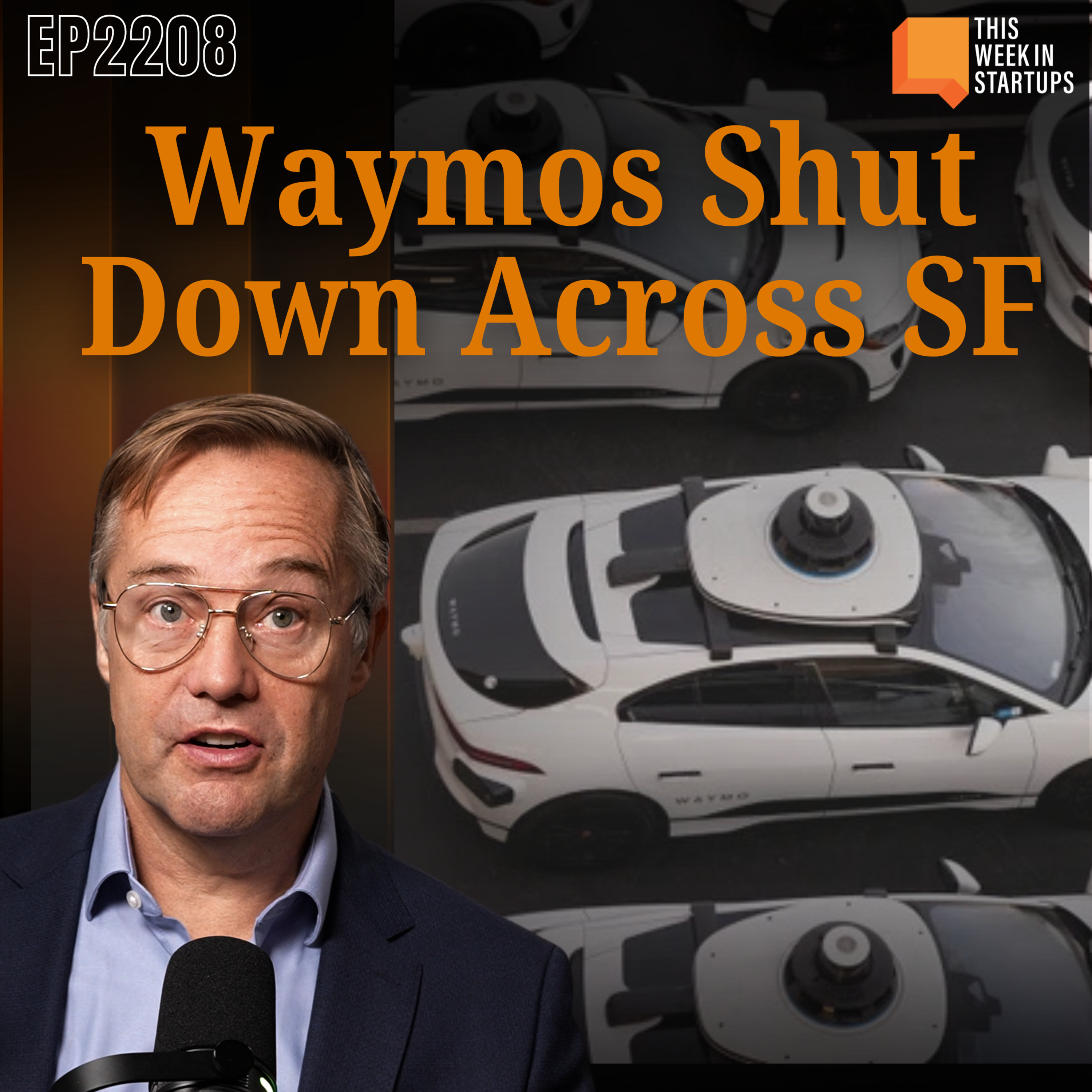
Loading summary
Transcript95 lines
- [00:00]
A
This is I don't think exactly what Waymo was promising the world.
- [00:04]
B
And as I was going to sacks holiday party, there were waymos all over the place. It was nuts.
- [00:12]
A
Yeah. So the power went out in San Francisco at about 1pm on Saturday for about 130,000 customers. Jason, the power goes out sometimes. Not a big deal. If you're just sitting in your apartment, light a candle, you'll survive. But it turns out if you are a Waymo self driving car and you don't have traffic lights anymore. Well Jason, I'll show you what happens. We have waymos literally just stopped in intersections. They are blocking traffic.
- [00:34]
B
There were like four of them, five of them it looks like in that one intersection in three different lanes. The parking lane on the right, the middle lane and the left lane and then there's one in the intersection past the crosswalk. These are the edge cases that will be quickly solved. You can be sure that there's an emergency meeting going on of what do we do when?
- [00:55]
A
This week in Startups is brought to you by Uber AI Solutions. Bad data equals bad AI. Your AI is only as good as the data it learns from Uber. That's right. Uber AI Solutions now works with enterprises around the world to source, label, evaluate and scale real world high quality data for every industry everywhere so that you can focus on building the next big thing. High quality data equals Smarter and faster AI. Uber.com twist Crusoe Cloud Crusoe is the AI factory company. Reliable infrastructure and expert support. Visit Crusoe AIBuild to reserve your capacity for the latest GPUs today and caldera Lab Whether you're starting fresh or upgrading your routine, Caldera Lab makes skincare simple and effective. Head to calderalab.com twist and use twist at checkout for for 20% off your first order.
- [01:53]
B
All right everybody, welcome back to Twist. I'm Jason Calacanis, your host. With me, my co host, Alex Wilhelm. And it is December 22nd at 10:37am in Lake Tahoe, which means plus three hours makes it, what is it, 1:30 your time there, Alex in Providence. So we've got the nation covered and a lot of talk. If you look behind me, yes, I am in Tahoe. Worst ski season ever, Alex. In I think 30 or 40 years they were saying no snow in Colorado, Utah, everywhere except like some just bad snow in the northeast, which is always bad. But I got up to Tahoe last night and as you can see behind me, the snow started falling. But half an hour before we went live here and it's supposed to dump three or four feet in the next week. A Christmas miracle, in fact.
- [02:43]
A
That's fantastic. I was going to ask if you got a property tax discount if the no snow comes, because I really do feel like that's the point of Tahoe. That and blackjack.
- [02:51]
B
Yeah. And I mean people. There is an expression, come for the. The come for the skiing, stay for the summer. So people who buy homes up here, they start to realize, wow, the summer is even more beautiful at Lake Tahoe than the winters. But lots going on and it was raining and they lost power in San Francisco. I was in San Francisco yesterday, Sunday, December 21st and Saturday night. And as I was going to Sacks holiday party, there were waymos all over the place. It was nuts.
- [03:25]
A
Yeah. So the power went out in San Francisco at about 1pm on Saturday for about 130,000 customers. Jason, a pretty bad power outage ended up lasting through into Sunday to turns out there was a transformer that lit on fire. For whatever reason, I've lived in San Francisco a lot. You have too. The power goes out sometimes. Not a big deal. If you're just sitting in your apartment, light a candle, you'll survive. But it turns out if you are a Waymo self driving car and you don't have traffic lights anymore, well, Jason, I'll show you what happens. This is, I don't think exactly what Waymo was promising the world, but if you watch this little clip, you'll see here in San Francisco a catastrophe. We, we have waymos literally just stopped in intersections. They are blocking traffic. And the camera's gonna pan back here, Jason, you'll see just how many cars were backed up. And that sound you hear is horns. Look at this, look at that traffic.
- [04:15]
B
There were like four of them, five of them, it looks like in that one intersection in three different lanes. The parking lane on the right, the middle lane and the left lane. And then there's one in the intersection past the crosswalk. Um, you know, these are the edge cases that will be quickly solved. You can be sure that there's an emergency meeting going on of what do we do when power goes out. I wonder if this is just the lights going out or if the robo taxis made by Waymo need to be connected to the Internet. And that when I was driving around these, and let me tell you, Uber drivers were not pleased with this situation. They were like, see, we told you, keep the humans in the loop. I wonder if this had something to do with connectivity because I was playing chess and I couldn't even make a chess move. So I think a lot of the routers and the 5G network were down. Maybe those are on some battery backups in some places, but we don't have redundancy. California is a disaster when it comes to the electrical grid because the electrical company has been blamed for the forest fires. Therefore whenever there's wind of a certain gust they basically turn power off proactively and then there's water and obviously you know, it's a bay. So if there's a lot of rain, flooding occurs. This is why you need redundant power and redundant Internet and I think this problem is solved pretty easily. This will be a one and done type situation. The next time this happens these Waymos will be instructed to on their own, without Internet connections just safely find a parking spot on the right side of the road which was happening. I was watching in real time as either remote drivers I think were instructing these waymos what to do. But they'll just program this into the stack and this will be the first and last time you get to laugh at them doing this. They'll be like ballet dancers and in Swan Lake making their way off the road and yeah, it'll be just fine.
- [06:18]
A
The reason why the connectivity argument struck me so so like a good possibility is because if they didn't have that issue then they could have just popped in remote drivers and solved the problem. They wouldn't leave four cars in the intersection Jason, if they could get them out. So combination of connectivity, traffic lights, etc. Bit of a mess though I will say not every company had the exact same problem and and the owner of a different competing service actually had a comment about this saying that quote Tesla Robo taxis were unaffected by the SF power outage. And I don't like to make light of people's misfortunes generally speaking but in this case I think it's a pretty fair comment because if your arch rival has this public of a catastrophe I think you can toot your own horn a little bit. Doesn't bother me.
- [07:00]
B
Yeah, for sure. Elon obviously has built the end to end system. Waymos are map based and heuristics based as opposed to the EMA system end to end models and so they'll just be a little bit. The Waymos are more accurate in the short term, more brittle when presented with new situations. That's why Waymo is also working on Emma. Emma E IME I think is how they say the end to end models that are being built for this specific purpose. The other thing that's going to be interesting is I saw that Tesla for filed a patent for putting connectivity in every single car, or ostensibly every single car, which I predicted years ago. Like if you have Starlink and you're also a car manufacturer, you could do what SiriusXM did. And I think Molly and I discussed it a couple years ago and we might have a clip of it that we pulled up. So here's a clip of me two.
- [08:05]
A
Years ago during Christmas, January 3rd, 2023.
- [08:10]
B
Yeah.
- [08:10]
A
Look at all the snow behind you in that one. Dang. All right, here's Jason talking about that.
- [08:15]
B
I predict that every Tesla produced will have a satellite dish on it. I don't have any inside information on this. It's just a prediction. But imagine if every cybertruck eventually or every one of the Tesla semi trucks or every other car. There's no reason they can't license it eventually to license it. Just like satellite radio was in every car. What does that mean? I have spectrum, I think, at home and. Or one of these services. And then when I'm on other. When I'm traveling sometimes like, hey, you want to connect to this person's WI fi and you can make your WI fi shared. So I. And like Boingo Wireless Sky Dayton created. I think this is going to be a Boingo kind of solution.
- [08:53]
A
Yeah.
- [08:53]
B
Where once you have an account, even if you don't have Starlink on your home, you might be able to buy a Starlink $25 a month subscription, which then lets you go on to any. At any time with your mobile phone. If you watch the video version of the pod on YouTube, you've probably noticed that Alex and I have radiant, beautiful skin. I don't like to talk about it, but we all see it, right? And that's not just a genetic accident. It's because of our newest partner, Caldera Lab. They've spent years developing and testing skincare products specifically for men. And they make your skin feel smoother and healthier, gives you a more youthful experience. And who doesn't want that? When you're getting up there in your late 30s like me, you get this puffiness around your eyes, maybe even dark circles like I have. But Caldera's eye serum makes your skin more resilient and leaves me looking well rested. Even when my sleep number. Yeah, sometimes it dips a bit. Right. I only get six or seven hours, so it's time to elevate your skincare routine with. With caldera. Head to calderalab.com twist and use the code twist at checkout for 20% off your first order. That's C-A-L--E-R-A L-A B.com twist calderalab.com twist.
- [10:10]
A
That I think is the future. I think that the idea that we don't have Internet connected cars all the time, it surprises me given how far we've come in building out car connectivity.
- [10:20]
B
5G, it's the expense of it. I mean, most of the cars you buy today will annoy you till the cows come home to put on your 5G. I'm not sure when the last time you bought a car was, but like at my Suburban is just constant, like, hey, Android and another 5G account. I'm like, I can't even handle it. Like the annoyance of it. Putting aside another $15 a month subscription in my life, you know, the 287th, um, what's going to be nice, I think about the Tesla one is even if you're not part of the network, they might give that to give it to you for free and then you're expanding the network. And Molly made a good contribution there where she said like, well, they could also license it to other cars. So if this patent works, you know, what's to stop Tesla from telling Waymo, hey, yeah, you can put our stuff in your waymos and it costs this amount. Plus you have to just allow other people onto the network and then you kind of create this mesh network. And then if you had an iPhone or a Tesla phone or a SpaceX phone, eventually you could be just connecting to cars everywhere in a giant mesh type network. It just expands everything and makes everything faster. But I got to stop by Tesla on Sunday. Elon invited me to come by and I got to see optimus3. Can't talk about that. But I was in the lab with the Optimus engineers looking at 2.5 and 2 and I saw the cyber cabs there. What they're planning is otherworldly, so less.
- [11:44]
A
Optimist that the public has seen. That was 2.5, right? Yeah, I had 2.5 in my mind. What can I ask you that you might be able to actually answer about three?
- [11:53]
B
It looks better, it has higher fidelity. And you know, the thing that Elon's talked about incessantly is the hand. And so I got to meet with the team that was meeting the hand and they showed me the hand and I touched the hand and I looked at what they're doing in the lab. So imagine coming in on a Sunday and seeing Essentially Westworld, like a large number of these being worked on by a large number of people on a Sunday morning at 10am it was wild. All I can say is like, if he can accomplish 10% of what he said publicly right now, these robots are going to change the world in a way that I don't think people are understanding. You know, the, the advances in the large language models combined with the advances in hardware and then if these things can start building themselves, the fine motor skills are going to be incredible. So I think these things will be able to like, you know, build a Swiss watch to perfection. They'll be able to, you know, make a 20 course, Michelin starred, you know, very precious dinner for you with 20 different dishes. These things are going to change the world in a big way. I don't think anybody will ever remember that Tesla made cars in 30 years. Like it'll be the exact situation like Sony that people don't remember. Sony started with heating blankets and rice cookers. Those were I think their first two products. According to a book I read back in the day. Everybody remembers the Walkman and you know, computers and cameras and everything else.
- [13:29]
A
May you be right. May you be right because I would love to have my house cleaned every day versus once a week, just straight up.
- [13:36]
B
I, I think, you know, I think he's been very public about like what the build, the build of parts will be and what these things will cost. $30,000 seems like a possibility. 20, 30, $40,000, you start putting that at a dollar or two an hour. These things pay for themselves very quickly. So it's going to be really interesting.
- [13:57]
A
Fun though, because when you think about consumer receptivity to this and we talk about self driving cars, talk about Waymo, they've launched accounts for teens now and I think those are doing quite well in Arizona. I think the public's gonna get over the self driving technology fear hump pretty quickly because they're just so much safer than humans driving. Jason. But I wonder how long it'll take until my spouse will be okay with me having a robot in the house doing things because she's, I would say, technology neutral. Probably more kind of the average consumer out there and I can see her getting in a self driving car in two or three years, but I think this might take a little longer.
- [14:31]
B
Yeah, everything happens in paradigm shifts. So young people, Gen Xers, boomers, you know, Gen Xers, we still have some privacy concerns. When I see somebody wearing one of these life pendants and I'm like, I don't Want to be part of your Truman Show? I think what's going to happen in 2026, it's not the predictions episode, but this is a prediction I'm working on, which is the pendants and the pockets and these always on recorders. I think that I'm going to lose this battle and that I think life casting or life recording, or I'll just call it Opt In Truman Show. This Opt In Truman show where you say, hey, I want to live in public. I want everything to be recorded. That's what those robots do, too. If the robot gets hacked, your entire life is recorded. There's a robot watching you sleep to make sure if anything happens to you, There's a robot watching your baby. God forbid the baby turns over or has a breathing problem in the middle of the night. The robot will save your baby's life and alert you and just start doing whatever it needs to do to save the baby's life. Like literally grab the baby, call 911 to the Heimlich maneuver, all in the first 10 seconds of there being a problem, right? And they could be just sitting there monitoring the number of breaths your baby's doing per night. And if the heart rate or the breathing changes, it connects to a server, calls the doctor and says, hey, this heart rate and breathing has changed 15% three nights in a row. And now we're at this and it's like, oh, yeah, your baby's probably got the ammonia.
- [15:57]
A
Boom.
- [15:58]
B
Oh, my God. The, the, the, the downstream effects we can't even realize of what these robots hanging out will have. But I do think privacy as a blocker is going to end. And the fear of giving up control of things that don't feel safe is ended already. Anybody who's used a Waymo or driven on FSD is very quickly trusting them, and I think rightfully so, because they're already two or three times better than humans. But I will implore people, like, if you have FSD and, you know, just remember it's still unsupervised fsd until Elon says it's, you know, now unsupervised. It's still supervised. So please don't, you know, trust it. You can trust it, but don't trust it and go to sleep or hack it in that way. Right? Like people are now. I watch the subreddits. People are trying to figure out how to get out of the seat, how to hack it. Don't do that kind of stuff, because if you kill yourself, you crash it, then that's going to reflect negatively on Tesla and then it's going to, the regulators are going to come in. So just you've been given this powerful technology. It's the only car you can buy, Alex, in the world is a Tesla that will self drive. You don't abuse the privilege of having that technology. Just be a good citizen and keep your eyes on the road.
- [17:15]
A
Agreed, Agreed, Agreed. The last thing I want is anything to form a roadblock or a speed bump to self driving cars taking over the world. So yes, everyone listen to Jason. He keep your eye on the road, you listen to your podcast, chill and then wait a year and then when it's finally figured out, take a nap.
- [17:30]
B
And there's things you can do. You can change your podcast. You could read a text, you could reply to a text. Just do that in 15 seconds is my best estimate. I'm not giving you advice here, but my advice would be if I was to give advice, but I'm not giving advice.
- [17:43]
A
Right. Theoretical advice if given, sure.
- [17:46]
B
Correct. This is not advice. But the advice if I did give advice would be switching a podcast in under 15 seconds, replying to a text or typing in a URL in under 15 seconds. That's. I think if I were to give advice, which I'm not giving advice would be the advice that I would theoretically give in a parallel universe.
- [18:04]
A
Right. Not legal advice, everybody.
- [18:06]
B
Not legal advice. Right. I'd also maybe buy and hold Tesla stock for the next 10 years. But that's not financial advice.
- [18:13]
A
I thought you didn't hold Tesla stock on.
- [18:15]
B
I typically have not held it directly, I have it in funds but. And the reason is because of my friendship with Elon, somebody might think when I talk about it, I'm trading on, you know, some information which I don't ever want to happen. That being said, I am thinking of putting on a big position just because of the self driving I think is going to grow. And I did a tweet today about it and we'll, we'll talk about it. I guess maybe we should talk about it now. I have redone my model, I've redone my model on what's going to happen in ride sharing. I did a tweet about it today and I can expand upon it in a moment. But we had some news, I think.
- [18:53]
A
So the big news is that Baidu, which runs the Apollo Go self driving service, a bit like how Robo Taxi is part of Tesla and Waymo's part of Alphabet, is teaming up with both Lyft and Uber to bring self driving Cars to London, that's in the UK if you don't know your geography. And what struck me about this Jason is that I thought they must have already had them. But then I realized that here in the US we're actually living in the future and that many countries don't have access to the same level of technology that we do. So if regulators give it the nod we will see Chinese robo taxis under two American brands auspices operating in London grad over in the UK a big deal. I think we don't pay as much attention on this show to Baidu's been cooking up with Apollo, talked about it a couple times but in China it's I think the leading service of of robo taxis and is doing quite well. I haven't heard any crises about safety so I presume it's on par with what we have here in the States.
- [19:47]
B
Yeah, the Chinese full self driving folks have replicated I think most of what we have in the west and they are a little bit more risk taking and have top down government there so they can deploy this stuff. But I think almost everybody in the space has solved FSD now. So we ride pony, Baidu, Alibaba, I think all of these programs, Tesla obviously Neuro. Now it's just a matter of getting through regulators city by city and then location by location in cities. So people don't know this but in order to put in order to go to London Heathrow you're going to need to do some banks. In order to go from London to another city outside of London you have to do things. Maybe there's some highways or some local communities like the People's Republic of Santa Monica is its own city. Like they could have their own regulations for self driving that Los Angeles doesn't have. And then people going from Malibu to Manhattan beach might have to deal with multiple cities regulators. You get the idea. Launching a new company is all about finding your first customers and then just learning how to solve their problems. And that is going to put you on a relentless pace and that means you're going to be releasing new products and features hopefully at a brisk pace or better. But my lord, the complexities of working with AI it's going to slow your developers down. You're going to have to install new GPU drivers, they're going to be provisioning clusters. All of this detail oriented labor intensive work can distract you from working on the thing that you're building your product. But now there's Crusoe. They are the AI factory that worries about your Back end so you, you can focus on your code. And their hardware has been designed specifically for AI development. So they're going to make sure that your models run with unparalleled performance every time. Head to Crusoe AI build to apply and receive $100,000 in credits for virtualized Nvidia GB200 NVL72 on Crusoe Cloud pending availability. Okay, that's Cruise QSOE AI build to apply and get those hundred thousand dollars in credits. What this really is interesting is that both Uber and Lyft announced they would have these cars in their networks at the same time essentially. So this is what I think people have been waiting for. Are these cars like this Apollo RT6? Are they going to be only in one network? And Waymo is going to pick Lyft in one city and Uber in another. And Alibaba is going to partner with one or another. I think of the 20, let's just round it up to 20 providers of this technology and then we'll probably consolidate down to 10. But let's just take the 20 number now of those 20, I think 18 will be network agnostic and not want to run a network. And I think there'll be two additional people who will want to run a network, obviously Tesla and then potentially Waymo and Zoox. So of Waymo and Zoox, I predict one will do it, one will just provide it. And Waymo is probably going to just provide their driver to Toyota like they have that deal and many other deals. And they're just going to say you can use the Waymo app or you can use Lyft or you can use Uber. And then it's just going to be, we're going to have a discussion about, you know, Uber, Lyft, Robo Taxi for Tesla. You know, which network has the lowest time, the lowest price and it'll just be a vibrant competition. So what this means is, and two to three dollars per mile will go down to 50 cents to a dollar. And then what's going to happen is consumption is going to change. Right now most people with a used car I think spend about 50 cents a mile. If you have a new car or a fancier car, you might spend $0.80 to $1.50amile on your car with depreciation, tires, gas, etc maintenance and the wear and tear you put on the car, put all that together, I think the number of rides is going to dramatically increase because as price goes down it will induce people to use the product more. And in addition to that I think car ownership, because these things are coming so fast and furious is going to go away. Therefore, I think we're going to have 50% of rides be done by ride sharing. Which means if Lyft, Uber, Robotaxi, Zoox and Waymo become the six competitors in every market, you, you, you're going to need 50 million cars produced for every year for the next 10 years. We're going to need to get about 500 million of these robo taxis on the road. 500 million would be like the supply of all cars produced every year. Being self driving cars, that's a big task because some people will still buy cars, obviously they'll want to own them. It's going to be impossible in 10 years to buy a car without self driving. And it just like it's really hard to buy one without airbags unless it's like a specialty car or you're in like, I don't know, some frontier market. So what this basically means is these networks are going to go from 1 to 50% of all rides. It's going to be one of the greatest categories of investment or wealth creation ever. I think the wealth creation up to this point in ride sharing is going to be not as big as the next phase because this whole phase that I watched Uber go through was to 1%. It's going to go from 1 to 50% in somewhere between 10 and 20 years.
- [25:21]
A
And the 1% has yielded Uber a market cap of $168.5 billion. So now imagine 50 times that. You have the largest company in the history of corporations.
- [25:31]
B
Well, I don't think they've run away with the whole thing. So I think if they wind up being, let's just say they wind up being 10 points, they'll be 10 times bigger. So let's say Tesla wins and is 30% of the mark, is 50% of the market. And Waymo and Uber and Noro, they all get 10, 20%, 5%, who knows what percent of the market, Zoox, etc. It's just going to be the biggest category of AI wealth creation. I think because people already are spending money on this. People don't understand how much of people's income go to their cars. It is massive. It's massive. How much of your income goes to transportation. It's like food, transportation and shelter, those are the three big ones. And I don't think housing is coming down in price, it's only going up, I don't think food's going down in price, it's only going up unless we get some, you know, Freiburg does some good stuff with Ohalo, but we will see the prices of rides go down.
- [26:29]
A
Let's keep it moving. A couple of big deals to Jason. Google is buying a company called Intersect for $4.75 billion. Quite the large dollar amount. People don't know what Intersect is, I don't think I had to do a little digging to figure this out. Essentially it's a development company and what they do is they build data centers and power right right next to each other. So that way you can bring your compute online without dealing with grid interconnect. You don't have to depend on what currently exists. They have many gigawatts of projects in the works and Google announced a partnership with them back in 2024, actually December of last year. So just one year ago. And they just decided to buy the whole thing because I believe that everyone is still compute constrained. There's a great story in the information about how Google is jockeying internally to allocate compute from research to search to, you know, in house, AI and so forth. So essentially they're having to share and they want a lot more compute. So to me, this shows that at least right now, the AI bubble, concerns about compute overbuild do not hold water, at least in the case of Google, because you don't drop nearly 5 billion, Jason, unless you have a big darn need.
- [27:35]
B
Yeah, for sure. What this symbolizes more than anything is my prediction about this being one of the great M and A years of all time is that the starter pistols happened. If you're willing to buy something for 5 billion, you know, next up they'll try 20 billion and after that they'll try 150 billion. I'm going to say it right now, it's not that I want this to happen, but I think Google is going to buy Uber. Yeah, I don't want it to happen. I'd rather see Uber be an independent company for some time to come. But I do think with Waymo being worth, we're going out and raising money at 100 billion and Google is looking at that saying, hey, we got to compete with Elon. That's a big task. He's going to have all this manufacturing. If we have Waymo plus Uber, you know, we don't have to change any behavior. We, you know, we have Google Maps, we have Waymo, we have all these other partnerships. I think the only way for Waymo to compete with, with Tesla right now is to partner with Uber. And so I think that's what's going to happen and then they'll spin it out or it'll just become part of the Google flagship and they'll have all that revenue inside of Google. It's a crazy prediction but you know, Sergey's been spending a lot of time in Washington D.C. you see pictures of him there all the time and it's this is the window. If you got a big M and a deal you want to get done, the next two years is your window.
- [28:56]
A
So there's a stack forming here which is compute, self driving and Internet connectivity. And Amazon has Project Leo, previously Kuiper, it's a Starling competitor Zoox and aws. Tesla has Xai Robo Taxi and Starlink roughly inside the Elon Verse And Google in your idea here would have, you know, this self driving stuff really well sorted out and the compute, but they don't have a competing, you know, satellite connectivity project. And I wonder if that's going to become a real detriment to Microsoft.
- [29:28]
B
Easy to rent. I don't think you need to own that. Connectivity is everywhere. So you could, you know, just do a deal for 5G and all these cars or you can do a deal with Starlink or you could do a deal with. And I think Google by the way was one of the major investors in SpaceX. So they have a huge position. I think it's no problem with them using Starlink or the Kepler project or whatever it is out of Amazon. I don't think that piece of the stack is going to be the hard one. I think the remaining hard piece is going to be building a network that has all the regs in every country. That's a hard task. Google has done that hard task. Tesla's done it where they sell cars. But it's just hard regulations in a hundred, in 10,000 cities, 20,000 cities in a hundred different countries is hard. And then manufacturing of cars is the other hard part. So I think Volkswagen, Toyota, you know, one of these car companies is going to come up for sale or you know, that's a possibility too. I don't know that it's necessary because there seem to be contract manufacturers who could build this stuff. I wouldn't be surprised if like Zoox, you know, just has the same people who build Xiaomi cars, build them them at scale. But that is the massive competitive advantage of Tesla is they can pump out 3 million cars a year and Elon can just say Instead of these three 2.7 million cars, I just want 2.7 million robotaxis. And next year I want 5 million. So back to that 50 million a year. You could see robotaxi being 10, 20, 30% of that number. And that's, you know, he's in a unique position to do that. The other people, Toyota could probably do it if they got their act together. Or Honda, there's a handful of manufacturers. Your AI is only as good as the data it's learning from. Every huge leap we're seeing, seeing in AI development is based on refining better data sets. And guess who came up with the ideal solution for your company? That's right, my pals at Uber. Did y' all know I was an early investor in Uber? Maybe you heard third or fourth and I never talk about it, but it's true. And now Uber AI Solutions works with enterprises all over the world, helping them source, label, evaluate and scale real world, high quality data for every industry. When you think about it, this makes total sense. No company understands how to maintain quality while scaling exponentially like Uber. Their own ability to refine and process data sets is why they currently power millions of trips per hour. Now they're bringing that insane level of insight and expertise to your startup or enterprise. It's pretty exciting. Book a demo today by going to uber.com twist that's uber.com twist.
- [32:13]
A
Did you see the robo taxi on the streets? Do you see the picture of those?
- [32:16]
B
I did see that. And yeah, they've been testing it with steering wheels.
- [32:20]
A
It's cool to see out in the wild. I mean, this to me is a very futuristic looking car. It's still a Tesla for sure, but I appreciate the slightly more brutal utilitarian vibe that it brings. It just suits my taste.
- [32:32]
B
Yeah. What Elon's proving with this car is he can get to 30, 40 cents a mile. That's what he's really saying. So one of the gifts Elon has is, hey, what is the final state of this in two or three years? Like, just where are we going to be at? And the final state is how cheap can you do a mile? Right? Like that's who wins ultimately, is who can go the cheapest. Now some, some markets, yes, people will want nice things as well. They might need larger cars. Like, I like a sprinter van. I took a sprinter van here to Tahoe. You know, it's six people, two dogs, a bunch of bags. We're not taking 12 of those with our bags in it, obviously, but that's a pretty good format to start with. And they have steering wheels in it. I think everybody in the world wants him to create and sell that car as the model two or whatever. You know, they're, they're two seat car and I don't think they're going to do it. I think he realizes, you know, he's got to burn the boats mentality. As far as I can tell if the steering wheel is coming out at some point so we might as well just take it out. But I mean I begged publicly on stage and all in, I was like, can I just buy two of those with the steering wheels? Make me two custom ones. I'll buy them, bespoke them for me. I want a two seat Tesla again. I want a two seat zippy Tesla. It's not, it's not happening folks.
- [33:46]
A
If you can't get them to do it, I doubt that I can. But I also would love to have a little, a little pocket rocket to zip around on. It'd be a treat. Before we get into the next deal though, question from the audience. Why is Google raising outside capital for Waymo instead of just self funding the project entirely for themselves? I presume it's cash conservation, but no.
- [34:02]
B
It'S been covered before. Publicly. The CFO of Google felt like the market thought that other projects like Loom, Google Glass, et cetera, they were perceiving that that was a money pit and they were like college projects that would never stand on their own. Therefore they said if you want to keep spending money on these, you've got to go get outside funding to put evaluation on it and prove that it's going to be commercialized. Because Waymo, it was like, when is this thing going to get commercialized? You know, we're in year seven, eight, nine and then they forced them to do that. Now that it's a real business, there is an argument of, well, why would you read outside capital? I think it's because they want to spin it out eventually make it its own company and force it to stand on its own. But there's nothing that says they can't change their mind. And then they could go to the existing shareholders and buy them out if they've already bought 10 or 20% of the company. I think BlackRock and some other folks had bought positions in it so they could just get their return or they could be converted into Google stock at some point if they really felt it was core to the Google mission going forward.
- [35:11]
A
The other acquisition deal that came out today is that Coinbase is going to buy the clearing company for an unlisted price. Jason, this is a company that raised $15 million earlier this year, USV led the round and some other crypto folks were inside of it. They are a crypto, sorry, they are a prediction market plumbing company. They want to build the framework to let other people run prediction markets. So you can see why Coinbase would want them. Coinbase announced last week that it's working with Kalsi initially to bring prediction markets onto Coinbase, trying to build a more broad exchange. But I just love to see startups getting snapped up by large companies. My question for you is pretty simple. If a company raises 15 million in a very healthy seed round and gets bought, you know, six, eight months later, what do you think is the minimum multiple on that preceding valuation that its investors would be happy to receive for that short amount of time?
- [35:58]
B
So those late stage investors probably don't have a choice. They'll get dragged along by management if they get any result in a year. If they double their money, if they made 50%, they can just say, Hey, I got an IRR of 50% on this money. Their LPs are going to be happy and they could also, you know, get shares in the company, earn outs. So there could be other kickers that happen as well to smooth out that issue. But this is exactly what happened to Sequoia. They made the investment in Instagram and then it doubled in value and it got sold within six months after their investment. A bummer for them, but they doubled their money quick. It's, you know, it's a high class problem. I would say the other issue is as an investor, you don't have ball control when you're a late stage investor buying low single digits, percentage of a company, you know, these days you really have to own well over 10% to have a board seat 20% maybe to have a board seat 15%. And even then the founders in today's world, they're not down at 10% or 5% anymore. They might own 40% collectively, 30%, 50%, they might have super voting shares or have the control of the board. So then that means if the founders want to sell, they're going to sell. We're not in the, you know, investors get to tell the founders what to do world and we haven't been for, you know, about 20 years. That's over. The founders get to dictate this. Unless the business is crippled or damaged in some way, you know, it's not profitable, it's burning a lot of money, then you have a problem. And by the way, just Coinbase has bought a lot of companies. I think super acquisitive yeah. When. Whenever we do these acquisitions, it'd be good to just get the running total of what the company has done. But just looking at producer Claude, they did nine deals in 2018. Looks like they did two deals in 2019, one deal in 2020. Okay, Wrath of Lina Khan starts. Looks like they might have done up to seven very small ones in 2021, one in 2022, one in 2023, one in 2024, and they've done five now in 2025. So you could see that 2020, 24 period, it kind of slowed down under Biden. And now I think this would, I think Coinbase is on a shopping spree now.
- [38:17]
A
Take a look at this chart right here, Jason. This maps out Coinbase Ventures investments over time. And they did so many deals from 2020 through 2020, late 2022. I presume that some of those are maturing and maybe they're the right pickup time for the company just to bring them in house. But they've also recently accelerated their deal making as well. So quite active there in the capital markets.
- [38:36]
B
And here they are, like in 2025 they acquired Strike at the Ciprospace unit of Bux for European expansion. Coinbase picked up Spindle in January. A three year old San Francisco startup develops blockchain based attribution system. May der a bit, then in July Liquify and now Echo and then this one. So you're. That's a lot of acquisitions. I think they're using their balance sheet to buy stuff. DoorDash bought three things earlier this year. So this is, if you look at, you know, politics, when you have anti capitalist or trying to slow down capitalism folks and then you have pro, pro capitalism folks. This is when the M and A teams get active. It is one of the few cases where a founder actually might need to pay attention on the margins if they were trying to do an exit of timing. Because you, you can't time it during certain administrations when they're anti M and A. But if an administration is pro M and A, that means if you were looking to sell an asset, you didn't want to go public and you wanted to sell to a strategic buyer, you got 24 months, you're on the clock.
- [39:47]
A
Yep. Counting down everybody. Because we don't know what's going to happen in 2028, let alone 2026. All right. Now a year ago, Jason, this is the state of the world. Xai was talking about an improvement to Grok 2 and dropping their first image generation tool a year ago OpenAI was stuck with GPT4O and it just kind of put 01 into general availability. Google was talking about Gemini 2 Flash experimental. That seems like 25 years ago and Anthropic was rocking the cross. Claude 3.5 family. So what I did was I went and I pulled some comparative data from artificial analysis about each of these companies and how much progress they've made in the last year. Because I think in the last couple months the vibes have gotten kind of weird and we've forgotten the progress that we've made. So roll with me here. This is a comparison between gro's models from the end of last year to the end of this year. So we are comparing the Artificial Analysis Intelligence Index score and essentially how smart it is comparing Grok 4.1 fast to Grok 2. And as you can see here, Jason 4.1 gets a score of 64. Grok 2 gets a 25. And that was good for the time. Then if you take a look at what OpenAI pulled off over the same timeframe, this is 5.1 high. And then GPT 4.0 I just realized it should be 5.2. My mistake. Still shows a 70 to 27 gap there. Quite impressive. Take a look at anthropic next. Here's Claude 4.5 sonnet and Claude 3.5 sonnet. The October version of that. A 63 to 30 point difference of just over 2x. And then finally we have Google here. Gemini 3 flash versus Gemini 2.0 flash.
- [41:20]
B
What is this? Artificial Analysis Intelligence Index version three. Yeah, explain that to me.
- [41:26]
A
This is what I consider to be the most useful head to head comparison of of AI model intelligence. And here's the current rundown and I'll just go ahead and read you the verbatim text here. The intelligence index incorporates 10 different evaluations. Things like GPQA diamond which you've all heard of. Humanity's last exam science code AMIE 2025 terminal bench hard and it kind of smushes them into one aggregate.
- [41:52]
B
So this is a Metacritic Rotten Tomatoes like score. So it if you had ace two or three of these and didn't ace the other ones, it would just blend it all together and wow, that's so. I mean basically in a year it's good analysis. Everything's gotten two and a half times better. Which if you were to keep pushing that out the, the sort of next piece of analysis here is where will be will we be next year and the year after on these scores if it just continues at this pace or slower or even if it accelerates and I don't know how much is left. Like at a certain point, will these tests be irrelevant? Are they scoring 99 out of 100, 97 out of 100 on these tests. And if that's the case, then AGI, you know, being able to ace all these tests, what's left to do is the question.
- [42:46]
A
I had that exact thought earlier today. So Z AI, one of the Chinese AI tigers put out a new model. This is a GLM 4.7, the upgrade from GLM 4.6. And Jason, here's a series of bar charts that shows its improvements versus its predecessor and its competition. And I'm not going to lie, they all, you know, they're all pretty similar now. Like, look at GPQA diamond here. It's an 85.7 score for the new model versus an 81 for the preceding model and Deepsea gets an 82 and anthropic, like it's an 83. And I mean we're all, this is just neck and neck, it feels like in a lot of these categories. So I agree, what's the point of these benchmarks at some point in time, but I do think over a year's timeframe we can see that we had a simply bonkers year for intelligence.
- [43:30]
B
They're going to need another test to do which is can it independently solve problems that are novel. So if you gave it instructions to go do something in the world like here's your ingredients, go make something delicious or you know, here's, you know, almost like dropping somebody on an island and saying, hey, survive like wilderness survival, the equivalent of like a novel exercise or like in a company, hey, do our taxes as opposed to answer these tax questions, just do our taxes for the year and then benchmark that versus the best human. That's where it's going to get sort of interesting. But we do need to have like some agent type testing to make this work. Bunch of hand wringing and news about the Warner Brothers acquisition and a 60 minute story. Putting aside the politics of all that and what's going on there with Bari Weiss, the Ellison family has changed their offer, is that right? They're guaranteeing and trying to make a last minute run at this asset.
- [44:31]
A
Yeah, I read through a lot of the legal TikTok on this deal. WBD put out essentially a 20, 30 page TikTok of exactly what happened each day, who they talked to, how the deal progressed and so forth. And one thing that there wasn't present in the last Paramount Deal for the W W B D assets was a personal guarantee from Larry Ellison, essentially the money guy behind the guy who runs Paramount. It's his son. And so today they updated their offer to include a irrevocable personal guarantee of $40.4 billion of the equity financing for the offer and any damages and so forth. So I was curious what impact that had on the Polymarket odds for who buys the company. And as it turns out, less than I anticipated. Because the folks over on Polymarket are not betting that things have changed too much now, Jason, if you look right here, you can see that since the news came out, people are kind of saying maybe they have a better chance. But still, Netflix is far and away the current leader in this challenge. And for fun, Jason, if you had to handicap this yourself, Netflix, Paramount, who wins?
- [45:33]
B
Yeah, it's obviously Netflix. That's the best offer, the fastest offer. They're going to just go with Netflix. I don't think they want to deal with all the potential legal hand wringing around the Paramount deal, but should go to the highest bidder. And the best deal terms, you know, the most secure deal terms, at some point you could ask people to put stuff in escrow. The breakup fees, all of these things add up to making what is the technical best deal. And we'll probably see like a late flurry here of people adding a dollar or two per share or so. Maybe that's what they're. Maybe that's if Warner Brothers is still negotiating this. Maybe what they just want is Netflix to give them an extra two bucks a share and call it a day. So they use that last little panic by Paramount to extract the extra 5 or 10% out of Netflix, which can afford it. But I'm tired of even talking about this story. Glad polymarket's there to sort it out for us. But I'm exhausted by this. I really don't care. These, these assets are not as important as YouTube, TikTok and these other more influential platforms.
- [46:42]
A
I think it does feel like this is a prestige story from like 20 years ago, like back when Warner Brothers was a bigger deal and Netflix was smaller. And, you know, like, people talk about these studios and I know you want to be a studio head, but like, I just.
- [46:54]
B
Studio 2.0 head. I want to. I want to. The only reason I want to be a studio head is to reinvent it. But we'll see. I got to figure out what I'm going to do with the last act of my career.
- [47:02]
A
Well, I can see the snow falling behind you. So I think I know what the last act of your day is going to be.
- [47:07]
B
Definitely going to try to get five days of skiing in. All right.
- [47:10]
A
And Jason, just to wrap up our show today, we had an amazing Gamma pitch from our friends over at Lumix Ads. We had a blast with this company. I think they really onto something. It's a good pitch. We learned a lot. Take a listen. All right, let's talk to a founder. It's time for another Gamma pitch deck today on the show, Mr. Jonathan Sherman from Lumix. Jason, we had talked about this show when we discussed launch accelerator class number 35. I am super excited to hear what he is cooking up. And as soon as we get Jonathan here on the screen, we're going to run through his deck. Jonathan, can you make yourself visible?
- [47:39]
B
And to just let folks know there's a lot at stake here, the top pitch in our Gamma pitch deck competition is going to get a $25,000 investment prize from Gamma and launch. All right, so Jonathan's here. I've seen Jonathan 17 times in the last two weeks as we wrapped up our accelerator.
- [47:56]
C
Are you sick of me yet?
- [47:57]
B
No, no. I'm in love with your company. I'm in love with us founders and the innovation and everything I typically do week one and like weeks 11 and 12 of the accelerator, I'm going to add myself back into week six because people want a little more JCal I hear on the back channel. So it's going to be weeks one, six and 12. I think Paul Graham does like the wrap up or the beginning. I'm going to do three markers. Week one, week six, week 12. Because I realized when I was doing the beginning and the end, I, I should have had an opportunity in the middle maybe to do some tweaks and get to know the companies a little bit more. Okay, Jonathan, we'll put two or three minutes on the clock here. I think two minutes and then we'll let you pitch using Gamma's amazing, amazing software. You can try Gamma's software at Gamma.
- [48:38]
A
App if you want to take a look at it and start working on an idea of your own.
- [48:42]
B
Gamma's incredible. It's like if PowerPoint and ChatGPT had a baby. That's Gamma app. Incredible. Okay, Jonathan, you ready to go share your screen?
- [48:52]
C
Yeah, let's go ahead and do it.
- [48:54]
B
I love this startup. 3, 2.
- [48:57]
C
Hi everybody, my name is Jonathan, co founder and CEO of Lumix and we're the go to market platform for SMBs. Meet Stephanie, owner of a local Miami preschool who had two options. Enroll more students or goes out of business. The problem is Stephanie was failing at marketing because she couldn't create high performing ads nor manage multi channel campaigns. So she's using our all in one platform. That starts with brand awareness from our mobile billboards. And here's how it works. Lumix handles installation on delivery bikers. Stephanie picks then where and when ads run. Her brand appears on drivers near her school. We collect AD IDs from nearby devices and ultimately retarget audiences across digital platforms, creating the first full marketing engine for SMBs. And since July, Stephanie's pipeline is filled. She's amassed 98 leads and counting and generating 3.4 times her money. Enough to fully enroll her program and stabilize her business. In terms of how we make money, we we charge advertisers an average of $10 per thousand views. Each biker generates 200,000 views per month, netting Lumix $2,000 per month per bike display. And since inception, we've seen explosive growth. We've now surpassed 55,000 in MRR and as of this month are profitable. Customers include DoorDash, Instacart, GoPuff alongside a host of other local businesses. And the market size is massive. Earning $2,000 per month per bike times 15 million global bikers. Equivalent equates to a $360 billion opportunity. So the path to 100 million is clear. Which encompasses just 4,200 bikers to get us to 100 million in ARR, which is only 1.5% of the US delivery market. And with just an all in cost of 700 per unit. We only need 3 million in capex to get us to that $100 million goal. And meet the team that's going to execute in less than a year. We launched Florida's largest digital transit network. We turned our Miami fleet profitable. And as of last week, alongside Jason, we launched our first units in San Francisco with just an only three person team. Now imagine what we'll do with the resources. Once again. My name is Jonathan and we turn delivery bikers into the go to market platform for SMBs.
- [51:03]
B
This is a perfect presentation to give you like a 9.9.5 on it we understand what you do. You find bikers who are delivering food. You put a box on the back of their scooter. It has multiple LED displays inside the box they put what they're delivering. Burritos go inside the box. Your Starbucks goes inside the box. The bike drives around some incredible neighborhood with houses that cost $1.5 million on average. Therefore the people there can afford to send their kids to a private preschool that costs $30,000 a year or $20,000 a year. And that local business finds product market fit. And then you have the second piece, which is if this goes national, you unlock the national advertisers. Alex when we look at startups, we say why these founders, why now? And we ask how big could it get? You address that here. The hundred million dollar opportunity is only a couple of thousand bikers. The why now is the most important. DoorDash and Uber Eats and before that, Postmates, which was acquired and all these other services. They have created a habit in the 12 years since this category has existed and it's hit scale. If there wasn't scale of bikers, this doesn't work. If the technology wasn't there to retarget, in other words, people who see the bike, they connect to the wi fi on the bike, they get targeted, they can get it retargeted when they're online. If that technology didn't exist in the Meta and Google networks, you can't do retargeting. And the price of LED screens was probably triple 10 years ago and it would have cost you 2000 $3000 per bike. Now you got it down to $700 per bike. So the timing's right, the team's right, the technology's right. When I look at this business, you're always looking for a founder with a big audacious vision. And that's what I like about Jonathan. When we met you, the vision was, hey, we got this working in Miami, we might get to profitability. 12 weeks later you start showing to me again or whatever six months later after we met you, and you get to profitability in one city, which means it's the right time to raise 3 or 4 million bucks. Get to, you know, 500 drivers in San Francisco. And just like Waymo and Uber and DoorDash created a playbook, you now have a playbook. The other great piece to this is like a secret that founders know that other folks maybe don't know. One of the secrets here is that drivers have to be independent contractors in order to be an independent contractor. That means you work for multiple different organizations, you direct your own work and your bike and your expenses aren't, aren't covered by DoorDash or UberEats. If DoorDash and UberEats were to provide the bikes, were to provide the ad network and have exclusives with you, that triggers full time employment benefits, everything else. Now some of these platforms of course they offer benefits and they let you, they have a middle ground between total fully freelance and, and taking care of their employees, which is great. But man, you put all these things together, feels like the right team at the right time with the right technology tailwinds behind them. What an amazing opportunity.
- [54:21]
A
Jonathan, can I ask a question about how the tech works? Because you said something very, very interesting in your pitch there. You talked about how you capture mobile IDs for retargeting. That to me sounds like something that I didn't know you could actually do. And so I'm curious how that works and what the privacy implications are.
- [54:37]
C
That's a great question, Alex. So we don't actually necessarily track people directly. So when somebody passes by our screens and they're within the specific view shot of roughly 15ft, we'll be able to then capture their mobile ad ID from the apps that these folks have already shared their location with. Think of Uber when you're putting that, you know, that blue dot, but putting the pin there to, you know, actually have that car come to where you are in real time. So those sort of use cases and then what we do is aggregate those populations for brands and then we inject them in digital platforms per Jason, like Meta, TikTok, so on and so forth. So we never actually see the names or phone numbers, just anonymous hashes until that person actually ends up converting on a digital channel in which then you can create lookalike audiences and do all these fun different, you know, bells and whistles that you know, are in the arsenal nowadays.
- [55:24]
A
What's the average lag between having a Lumix campaign out in the streets and then getting to the end of that digital funnel, I think, and seeing people actually convert via retargeting? I, I don't know if that's one day or two weeks. I'm just kind of curious about the.
- [55:37]
C
The time it takes, it's 24 hours, that's when we're getting it. So we can essentially have, you know, automations pull actually the, the direct mobile ad IDs into these digital platforms. So it's just seamless as we're, as we continue to build that population over and over every day that can automatically get published 24 hours later.
- [55:56]
A
Okay, awesome. And then I will question which is just the, the, the splits here. I think it's awesome that bikes can generate 2K. I mean that's fantastic. What portion of that do you have to remit to the driver themselves and what portion comes to the, to Lumix itself?
- [56:07]
C
Yeah. So we're running about 85% gross margins.
- [56:10]
A
Oh, hot damn.
- [56:11]
C
Yeah, hot, hot. Yep. So I feel like that's also a big myth in terms of hardware. People are like, oh, what hardware? Well, great. These only cost $700 per unit and we're making 2k a month off of each. So roughly, essentially. So like, in terms of like cost of goods. Right. So paying an average of about $200 to. To each driver every month. And that's based on actually the display being on and then have a couple other costs such as, you know, lead mechanic, shop and then the connectivity since these devices actually have WI fi, GPS and the full nine. So.
- [56:41]
A
And you can do all of that for 700.
- [56:43]
B
So.
- [56:43]
C
So 700 is just like the capex hit in the installation, but in terms of like the ongoing costs for $300.
- [56:50]
A
Per month per bike, you can do the GPS, the. And all, all the gear for. That's insanely cheap. I freaking love global supply chains and how much it's made affordable electronics possible for companies like yours. That's just so, so cool.
- [57:01]
C
The beauty of it, right, is I mean it's units of Seattle. So like, as we continue to grow, like that cost will continue to go down and down and yeah. Exploring different partnerships in ways actually that we can just completely offset the driver costs, which is going to be really exciting.
- [57:14]
A
So I'm going to be a big fan of your company until you add audio to these bikes and then I'm going to hate you.
- [57:18]
B
That's actually interesting. Yeah, I'm sure advertisers have asked for it. It's no bueno. I guess you have to. There's a lot of local regs here around displays. There might be some, I'm sure like Boulder or there's some community that doesn't want bikes driving around with LEDs.
- [57:34]
C
Yeah, yeah, completely agree. And I also just think it adds just another factor that can potentially break and we'd like to keep things very lean.
- [57:42]
B
So are there markets that don't let you do this or you have to get approval? What's the regulatory environment for LED screens?
- [57:49]
C
Yeah. For example, New York, specifically. So the TLC actually governs the illumination of complete signage. So there's a lot of red tape surrounding that market. But in terms of like how we go about picking markets. Right. And definitely the legality behind it. And then of course like biker density and advertiser demand. So there's a few different markets that are sort of of soft circled. And I think, Jason, that the best use of the funds that. That you had given us probably isn't earmarked towards lobbyists and lawyers. That's sort of on the back burner, but definitely, you know, have full visibility into, like, New York, obviously, gold standard.
- [58:22]
B
Uber took the same approach. They knew that Vegas would be a dog fight. They knew London would be a dog fight. So those cities came later, the ones that they knew would be permissive. Airbnb pursued the same strategy. Airbnb. Airbnb is banned in New York largely, but okay in France and Japan, you know, you know, just different locales have different regs. And this is why when we look at self driving or Ubers or doordashes or Airbnbs, it is a moat. It's a competitive moat. To understand local regulations when you're running one of these networks, you know, you have to understand that San Jose has their own laws. San Jose, as an example, when a taxi pulls up to San Jose and other airports, they have to give, like, a dollar every time they do a pickup or two bucks. Now, what happens when a robo taxi shows up there? Well, they have to give the $2. How do they give the $2? How does a robot give $2, you know, and pay for the local airport's way of collecting money? And that's a revenue stream for them and a regulation, you know, that infrastructure is not built yet. So amazing job. All right, that's another twist in the can for December 22, 2025. We'll see you all on the next episode.