← This Week in Tech (Audio)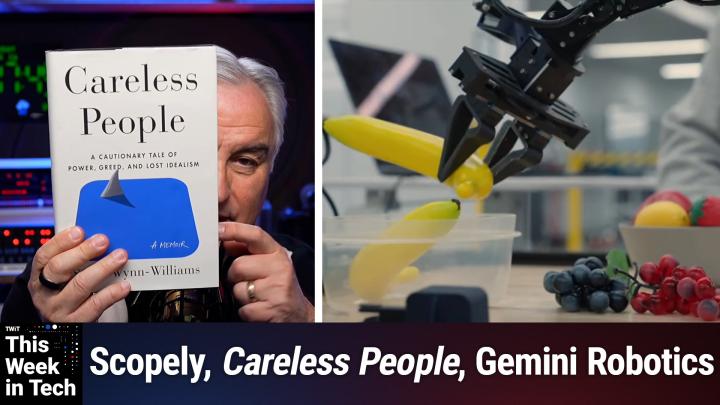
This Week in Tech (Audio)
TWiT 1023: This is Not Tax Advice - The Electric State, Kill Switches, Baidu's AI
03:12:58
The Electric State, Kill Switches, Baidu's AI
Loading summary
Transcript1,140 lines
- [00:01]
A
Resilience isn't just about bouncing back. It's about being ready. It's how you show up every single day. Because every name in your system is a person who trusts you, and every password is a door you're responsible for locking. And when the threat comes, and it always comes, you hold back the chaos. Learn more at cohesity.com/resilience AI agents are everywhere, automating tasks and making decisions at machine speed. But agents make mistakes. Just one rogue agent can do big damage before you even notice. Rubrik Agent Cloud is the only platform that helps you monitor agents, set guardrails and rewind mistakes so you can unleash agents, not risk. Accelerate your AI transformation@rubrik.com that's R U B R I K.com it's time for TWIT this Week in Tech. What a great panel for you. Micah Sargent is here, Glenn Fleischman, the brilliant Amy Webb. We're going to talk about robots that can tie your shoes, the kill switch in the US's latest fighter jet, and why Mark Zuckerberg doesn't want you to read this book. It's all coming up next on Twitter. This episode is brought to you by Red Canary. When it comes to the security of your business, it's not enough to feel safe, you need to prove it. With Red Canary, you get the data, visibility and expert partnership that make your impact unmistakable. Their MDR detects four times more threats than the competition, giving you the clarity and confidence to show leadership the real value of your investment. Behind every alert, there's a Red Canary expert ready to respond, day or night. That's non stop protection. Measurable performance and a calmer, more focused team. Turn protection into proof. Visit redcanary.com difference to learn more.
- [01:53]
B
More.
- [01:56]
A
Podcasts you love from people you trust. This is twit. This is TWiT this Week in Tech. Episode 1023 recorded Sunday, March 16, 2025. This is not tax advice. It's time for TWiT. Let me start the timer, see how long we can go on this show. We got some talkers. This is the show where we covered the week's tech news with the brilliant minds. The most brilliant minds in the business. Amy Webb is back, ladies and gentlemen. She hasn't been here since November 4th or 3rd. That should give you some idea. And since then, rebranded. She's a futurist, author of many wonderful books and the head of the Future Today strategy group. Hi, Amy.
- [02:56]
C
Hey Leo. How are you?
- [02:57]
A
Are you writing any more books or have you kind of given up on that business.
- [03:01]
C
I have another book that I am not ready to talk about yet.
- [03:05]
A
Okay. But you do have the brand new Future Today strategy group. That's right.
- [03:13]
C
We basically publish a book once a year. So this is our annual report. It's free and it covers all of the. It's our look ahead for like all the trends that we pay attention to. Our trends are longitudinal, which means there's a lot of them.
- [03:27]
A
Oh, wait a minute. I clicked we transfer, but I haven't. Now I had to agree. Okay.
- [03:33]
C
Yeah. So that. That trend report is exactly 1000 pages long and there are.
- [03:38]
A
Wow.
- [03:38]
C
Trends that cover basically every area of technology. But you can start with the executive summary, which is our high level overview of what's going to happen over the next year or so.
- [03:48]
A
Well, we'll be picking up a few things, but you cover AI. There's really something still going on in Web three. I thought that was a history.
- [03:57]
C
There is. We also have Metaversal technologies which we have been covering since before somebody claimed that as their name. New reality, synthetic media, diminished reality, stuff like that.
- [04:10]
A
But you see, it's not just tech. You cover business in general. So there's health care, there's.
- [04:14]
C
Yeah, so hospitality. That's right. So like half of it is. These are the, you know, the AI book. The section alone is like 150 pages. Then there's just health care. So if you work in health care, these are the technologies that are impacting your business and how. So there's. I would say most industry sectors are covered.
- [04:33]
A
So when you got to page 987.
- [04:36]
C
We were like, let's keep going.
- [04:40]
A
You got to 1000 or 999 anyway. That's amazing.
- [04:44]
C
I will say congratulations. We actually got. We were about nine pages short. We were like, how was this thing 900 and whatever pages. So we added in a couple quotes to make it an even.
- [04:55]
D
I love that.
- [04:55]
A
I had a feeling. I had a feeling. But anyway, Amy's just back from south by. We will get a report on that and lots more. It's so great to have you back. Also, Glenn Fleischman is back, ladies and gentlemen. We haven't seen you in a while because you were on kind of a hiatus as you worked on your book. How comics were made now. How comics are Made.
- [05:16]
B
Yes. It's the publishing world. Right. So the past is Prelude. Yeah. There's a new. The book came out last year and I've been scurrying around other projects since. And then a new version of the book which is actually identical but has a new name, will be in bookstores in June of this year worldwide as how comics are awesome. I'm so happy an actual publisher that distribution and all that.
- [05:41]
A
So that's really great. And also here, my good buddy from that little place called Twit, Mr. Micah Sargent. Hi Micah. Hello.
- [05:52]
D
I'm afraid to say don't currently have a book, but maybe I need to get on.
- [05:55]
A
You should write a book. I have a book. A book that is about to be banned, ladies and gentlemen. So what is the best way to make sure a book gets sold? Go after the author and try to shut the book down. Right. This is a book called Careless, A cautionary tale of power, greed and lost idealism. It's by Sarah Wynne Williams. She was the director of public policy, global public policy at a little company known as Meta and has written a tell all book which Meta actually has gone to court to block alleging misconduct and harassment. Oh, the book does, by the way, including things like Sheryl Sandberg hitting on her which. So we saw an excerpt in printed. But, but I as soon as I saw this story, Meta is trying to block ex employees book. I went to Amazon and it was, it's for sale. An arbiter has instructed the author and its publishers to stop publishing the book, even though the Verge says it's unclear whether the arbiter has the authority to do so. The arbitrator said that she must stop making disparaging remarks against Meta and its employees and to the extent that she can control, cease further promoting the book, further publishing the book to the extent to which she controls this and further repetition of previous disparaging remarks and she must retract the disparaging remarks. This is all the Streisand principle guarantee that this turned this into a bestseller. Right?
- [07:37]
B
It was great. Mike Masnik of Tector, I know a friend of the show posted on Blue Sky. If only there were a term that would cover the. Oh, you know, he's the one who attributed it to him. But yeah, I was reading Stephen Levy's coverage of this from a couple days ago, just reading it this morning and he said, well, I didn't know anything about the book. And then he gets in touch with them, says have you heard about this book? He's like, no. And then they send him talking points and they have a website and he, I don't know if he even would have bothered to say anything about it.
- [08:05]
A
Well, that's the point. This is the Streisand effect. You guarantee attention, especially They've got a.
- [08:12]
B
Whole site that lists every allegation and then debunks it. And I'm thinking, I mean, great. It's textbook.
- [08:19]
A
You, Amy, obviously read the excerpt that I did, which talks about Wynne Williams flying on a plane with Sheryl Sandberg at the time, the COO of Facebook, as it was still called at the time, in their private jet, coming back from some international meeting. And Cheryl and her assistant trade places, taking naps in each other's laps, stroking each other's hair. And then on the jet, Sheryl Sandberg. This again is all from the book, don't sue me. I'm quoting from the book. Sheryl Sandberg, who claims the only bed on the plane, which, you know, it's nice to have a plane with a bed, then pats the bed and says, come on, join me, Sarah. So I don't know if it's true or not. It is a great read. I haven't finished it. It's juicy as hell.
- [09:14]
B
I want to know if she said lean in. But you know, that's the lean way.
- [09:19]
A
Way in, baby.
- [09:20]
B
Lean way in, the steamy sequel to lead in.
- [09:25]
A
I guess there's nothing to say about it except that, you know, when you, when you try to shut something like this down, you're pretty much guaranteeing you're going to get a lot more attention. And I immediately, I thought, well, I better buy this before, before they take.
- [09:39]
D
It, these tell alls. How often do they have a positive impact on, on things? Is it typically about the person who's writing it for the sake of making money? Or do we have. We had actually a truth to power moment where we talk about a company. I think like right now, meta is such a big thing that. Do we know that this book is going to have that much of an impact on Meta?
- [10:05]
C
That's actually a pretty good point because there was a, there was another book that came out that was a very fun read about Ray Dalio and who's that? So he founded a venture capital firm and it was written by. Yeah, similar, very fast, breezy, fun, shocking read. But to your point, Micah. Yeah, I mean like, so you, you write that book because you've got a good story to tell, because you're angry probably, maybe you're seeking retribution. But to your point, like these very rarely if ever have any impact on the company or the leaders in that company.
- [10:48]
A
Yeah, I mean, the very fact that Mark is trying to shut it down tells you, you know, and they're smart.
- [10:55]
C
Like he's got a Crisis comms team, the more attention that's brought. You want to shut it down. Literally don't talk about it at all. You know, I mean, you want. It's. It's adding. Adding to the fire, which is suffocating it.
- [11:07]
A
I gather that's one of the points of the book, is that nobody tells Mark anything. Right. That Mark gets to do whatever Mark wants. And people, you know, when you get to that point in life rich enough, nobody's gonna say no to you. I guess.
- [11:21]
B
I don't know.
- [11:21]
A
They should have said, mark, don't go after her, because you're just gonna make Leo buy the book.
- [11:28]
B
Yeah. Because it's clearly directed. Right. There's nothing about the response that makes any sense from a damage control standpoint.
- [11:35]
A
Right. In fact, it's worse. They're highlighting all the things you should read.
- [11:40]
B
And I've read multiple accounts in which there was actually the Washington Post. One of their book reviewers writes a newsletter, said, I've never written something this long, but I've never had a publisher or never had a company try to suppress information like this before. And it's just the thing you come across over and over again is that Meta's saying all these allegations, or many of these allegations were raised previously, and we addressed them. And so the point is then. Well, then why are you relitigating them if you think they're settled? But, Leo, to your point, too, I was remembering there was. I would say it's not totally comparable, but was there ever a reaction at a company? If you look at Susan Fowler now, Righetti.
- [12:19]
A
Oh, yes.
- [12:20]
B
But that was whistleblower. Yeah, it's Uber. She wrote a Medium post, and that's what blew everything up. And then the reporting that came from that. Her book, she did that in 2017. I had to look it up because I knew she wrote a book. The book was in 2020. So the book was kind of a memoir. And about. I've seen this. Said about the same thing about this Meta book, too, is it's a memoir that has explicit allegations in it, many of which, again, are just historical. They're not new. There's some new details. So if you take it as a. If you take it as a memoir, it's a very different reading. And Meta could have just said, this is one person's recollections. They don't match the company's. Blah, blah, blah.
- [12:57]
C
I mean, the. I think if you look at a book like Bad Blood about Theranos that was written by John Carrey. So, like he was at. I think he was at the Journal. Right. So that's right.
- [13:06]
B
Yeah.
- [13:07]
C
A long time leading up to that book, there was story after story after story invested in the paranoise. Right. That had a pretty significant impact. And the book was really sort of the culmination of, of all of that reporting over a long period of time. That, that has an impact, I think, but something that otherwise it's basically palace intrigue. And everybody loves a little. Right.
- [13:28]
A
Yeah, it's juicy. Meta. Spokesperson Andy Stone, according to the Verge, says, quote, this ruling affirms that Sarah Will Williams. Let me get that name right. Sarah Wynn Williams. False and defamatory book should never have been published. This urgent legal action was made necessary by Williams, who, more than eight years after being terminated by the company, deliberately concealed the existence of her book project. Do you wonder why? And avoided the industry's standard fact checking process in order to rush it to the shelves after waiting for eight years.
- [14:00]
C
Who's the publisher?
- [14:02]
A
McMillan.
- [14:03]
C
That's improbable. I mean, so first of all. So I've written several books and Glenn has as well, but when you're dealing, I'm with one of the big. I guess there's only four publishers now.
- [14:15]
A
Yeah.
- [14:17]
C
So when you're at a big four, there is copy editing, but it's standard practice. They do not proofread your books, so you are responsible for whatever facts are being.
- [14:29]
A
Lets them off the hook, doesn't it?
- [14:31]
C
Correct. Now they will proof it, but there is no such thing as rushing anything to market. She didn't have like a hot scoop. There was no, you know, she wasn't a politician, which means she was probably on a year long schedule. So just so that everybody who's listening in has a little bit of background because the book publishing industry is arcane and incredibly backwards and takes forever.
- [14:54]
A
Well, and also, you don't fact check a memoir. These are all personal recollections.
- [14:57]
C
I mean, my first book was a memoir and I fact. But I was, I started out as a journalist, so I.
- [15:02]
A
Right.
- [15:03]
D
You know, I. Yeah, you're ingrained.
- [15:06]
C
Yeah. Like. And I, I worked. I was at the Wall Street Journal where everything got, you know, checked and checked and checked and checked and you know, so anyhow, I would just encourage everybody to take what they're hearing about this with, with some amount of.
- [15:18]
A
Yeah, we don't. This is all her own story and I mean, I have no reason not to believe it, but she, who knows? She could have made it all up from all claws.
- [15:27]
D
Is there any.
- [15:28]
B
I find it astonishing. I find it astonishing how readily. I mean, not that they were to throw her under a bus, but that they're willing to discuss the terms of her termination, which. That's always one of those things when companies do that. You're like, well, this is retributory, which they're trying to do because she did something that they don't like and so forth. But I mean, that's the biggest impact of it, I think, is that Meta is saying, if you do something like this, we will attack you in full voice. We don't really care about the financial. And again, maybe they're not thinking about it as well as they should. Maybe it came down from the top. But we're going to attack you with full voice and. And we're also going to reveal details from your personnel file.
- [16:07]
A
Essentially, the one thing that maybe Facebook would love to suppress is conversations about Myanmar, the genocide there and Facebook's role in it, and apparently Mark and Cheryl's lack of interest in that. But. So there's some things that reflect poorly on Facebook. There's some things that reflect poorly on individuals. I don't know. I'm gonna read it because I like that kind of juice. Anyway, thank you for letting me know about it. I appreciate it. Mark.
- [16:33]
B
One of the WeWork books was quite good, but again, that was after lots of reporting, but I was like, I don't know the whole story because I read it over X years and it was a really great story. And there's second acts that are coming still and so forth.
- [16:44]
A
I saw the TV show. I think that that's probably the next step on this path, by the way.
- [16:49]
D
Yeah, exactly. Releasing that scene.
- [16:51]
A
All right, let's move on to real news. I just. I couldn't resist, you know, this came yesterday. I'm sorry. I'm so excited. I have something to read tonight. Actually, I have two things to read because, Amy, I'm going to read your new Future Today strategy group Thousand page. What's to look forward to? You also, you did a South by talk yesterday. The day before. When did you do your talk?
- [17:15]
C
It was last Saturday, so a week ago.
- [17:17]
A
Okay. What was that about?
- [17:20]
C
So every year at south by for, I don't know, many, many years, we launch our annual report. And so it's a speech that officially launches the report. But I usually sort of pick some things out of it that are interesting to me or emblematic. What's coming on the horizon? There's usually a theme and the speech is that. So this year's theme was Sort of beyond. We've entered this liminal space that I'm calling the beyond that, that is, well.
- [17:50]
A
The rules or the upside down. You get to choose.
- [17:53]
C
Okay, I like kind of beyond because I think what's happened is. So last year I introduced, we published this paper on the technology super cycle, which is an economic event. But I think what's starting to happen is there's this convergence of different technologies and some changes in society that have pushed us into a situation where the rules are breaking. There's something called the enhanced games that when I first heard about, I thought was a joke. It's not. It's a bunch of VCs and tech bros who have gotten together and the goal is doping. So it is to push human physical bodies.
- [18:33]
A
Oh my God.
- [18:34]
C
As you possibly can. You know, my, my sport is cycling, so I'm, you know, a lot of doping.
- [18:41]
A
Is it biohacking or just taking drugs?
- [18:44]
C
No, it is. So again, some of this makes a little bit of sense. So studying human performance and using a combination of biology and medicine and genetics and genetic engineering and crispr, along with different types of technology and training, but the end result is it is doping. So let's push the human body as hard as we can until it breaks. Hopefully they don't die and then they compete. Right.
- [19:15]
A
So quite the opposite of, of, you know, the Tour de France where you throw people out when they dope. This is, this is like everybody dope. Let's see what happens.
- [19:23]
C
Right. I should have set that up better. But the, the, the, I think the key here is this is a group of people who are now overtly talking about creating superhumans. Right. So there are things like that. There are metamaterials, these are meta, these are materials that are engineered that don't obey the laws of physics. You actually saw some of this yesterday. There was a riot, I think in Belarus, somewhere in, somewhere over in Europe. And there was a sound that was emitted that cleared everybody. So that is an example of ways of bending particles and light and sound in ways that we haven't been able to before. And then robotics was another piece. There are new biohybrid computers. There's brain powered computers literally made out of neurons.
- [20:14]
A
This sound weapon worries me. This sounds like the Havana syndrome.
- [20:18]
D
Well, yeah, I was hoping we could go back to the sound thing because I thought so this is the first time that's been used. I thought there was like, it's not.
- [20:24]
C
The first time that's been used, but it's. And what I actually posited Was what we've seen before is sound for dispersed to get people to break up. I was actually used in Philadelphia not too long ago.
- [20:36]
A
I was on a cruise ship sailing the Suez. And they had sound weapons to repel off pirates. Yeah. And I just assumed it was really loud, annoying. Maybe they were playing, you know, heavy metal, I don't know. But, but no, these are. These are actually. They can kind of scramble your brains at the right levels, right?
- [20:56]
C
A little bit. They were. There was an experiment done in Philadelphia in some public parks where kids, teenagers were congregating and rabble rousing and causing problems. So there are. On the spectrum of sound, there are some frequencies that only teenagers as they're going through adolescence can hear.
- [21:11]
A
Super high frequencies.
- [21:12]
C
Right. And so nobody else could hear it, but it was enough that like, it. It caused them to. To scatter.
- [21:17]
A
Oh, man, I'm leaving, man.
- [21:18]
C
It's.
- [21:19]
A
Do you hear that, man?
- [21:20]
C
So one of the things that we posited was. So that's. Those are negative effects. What if there was. You could do the same thing but result in a serotonin hit. So you feel a little nice or a little bit more calm. So what's interesting, we think is we could see a future in which you've got a bunch of people, they're marching on the capitol. And rather than if you emit a painful sound or something, that's going to cause potentially a worse situation. But if you just make everybody feel kind of apathetic or calm, they no longer riot. They just kind of are like, yeah, whatever, we're good. And they kind of walk away. Right. So there's a lot of stuff like that. There are materials that can change and bend and become more or less rigid in response to heat. Light extrasensory, you know, whatever. There is a. There is a robot designed for sperm. Sperm, you know, big thing right in front of them. They can't figure out where they're going. There's a.
- [22:21]
A
Wait, wait a minute, wait a minute, wait a minute. You can't leave it at that. Is this sperm G.P.S. you're saying?
- [22:27]
C
No, no, because I don't think the sperm are smart enough to follow the gps. I just, I. All these people who listen every time I'm in there like that. Amy Webb, I can't stand her. Whatever.
- [22:36]
A
This, this way, guys, this way. Is that what they do? What is it? But I don't know. Maybe I shouldn't go into this more deeply. Is this all in the report?
- [22:45]
C
I mean, some of it is this.
- [22:47]
A
I talked a lot about itself so the beyond. So this kind of is what you wrote about in your last book about kind of the bio revolution?
- [22:55]
C
No, the last book was about the, was about synthetic biology. But basically what we've discovered is there's the convergence of three general purpose technologies. So artificial and a general purpose technology has the ability to serve as a platform for further innovation over time. So artificial, and it has usually a pretty long lasting economic impact. So the Internet, electricity, these are general purpose technologies that ultimately become the platform for other things. So AI meets all of the definitions for that, but there are two others that everybody has ignored one or just not looked at. One is advanced sensors and the other is biotechnology. So we've been studying this for a long time, but what we saw about 24 months ago was this new convergence of the three, which we believe is, was going to lead to an economic super cycle, which is what's happened, a technological super cycle. And from that there are lots of other things that, that are coming.
- [23:55]
A
How important is AI to this? Is it, is it a critical component, foundational?
- [23:59]
C
So AI is foundational.
- [24:00]
A
So is AI being used to develop these beyond technologies to some degree?
- [24:05]
C
I mean, so if you look at the intersection between AI and biology, the biggest story in AI is actually not generative AI or agentic AI or model context protocol or any of the stuff everybody's excited about, it's biology.
- [24:21]
A
So this is not what you wrote about in the Genesis Machine.
- [24:24]
C
It is a little bit. It is a little bit, but there's.
- [24:27]
A
I have the Amy Webb bookshelf here ready for me.
- [24:29]
B
For you.
- [24:31]
A
So this is the most recent book, the Genesis Machine. Our quest to rewrite life in the age of synthetic biology. But it sounds like we've gone well beyond this.
- [24:39]
C
Right, right. And so the, the space that we're in right now, what we would say is that the convergence is producing something we're calling living intelligence, which is the interplay. Like there's just mass amounts of data ingestion that we didn't have access to before. And the other side of this is like, we believe robotics will finally start to take off. And to some degree that's because they're, you know, there was a robot in 1928 called Eric. Eric didn't do very much. It could kind of sort of gesture and stand up and it had a prerecorded talk Track. You know, 2013 is when Boston Dynamics released Apollo for the first time. It was Apollo, right? Yeah, the first one. Okay.
- [25:25]
B
Yeah.
- [25:26]
C
It's literally been 100 years and like the closest most people have come to a robot in their homes is like a Roomba that their cats like to ride around on. So it's like an expensive cat toy.
- [25:37]
A
Right, but industrial robots have been.
- [25:40]
C
Yes, on the industrial side, but this is different every the. So to achieve the robots that we hear about, you need embodied AI. But to achieve embodied AI, you need a massive ingestion of data from other types of things. It's not a large language model alone. So the point of all of this is we've entered this, like I said, liminal period. We now have living intelligence, which means we're going to start seeing different kinds of things. So robots will finally take off, but also computers won't be computers. We literally, like two weeks ago, the first two things happened. There's a. Imagine a computer that's powered like, instead of traditional silicon, it's neurons. And you know, the first actual like hardware wetware computer launched and the first cloud system launched. So, you know, what does that mean? And we've had advances.
- [26:41]
A
Sounds scary as hell is what it means. What is this? Should I be scared?
- [26:46]
C
There are ethical issues and everything else. I think the bigger point is, especially for the people listening to the show, a classical computer is not the only thing that you should be thinking about over the next decade, A computer is not just going to be the type of computer you see today. There will be biohybrid computers. They exist now, but there'll be more of them. And there'll be quantum computers. I don't know when exactly, but there's been some interesting developments. And there'll be embodied AI, which is effectively, you know, a different type of data ingestion, which then is a computer.
- [27:22]
A
So we've talked, we haven't. We renamed this week in Google to intelligent machines and have been covering im. We had Ray Kurzweil on last Wednesday. But we've talked, I've talked a little bit about the fact that LLMs, because they're stuck in the machine, can only go so far. What we have as humans that they're missing is our sensorium, our ability to go out into the world. And it sounds to me as if AI people working on AI recognize that we need to embody AI and give it experience in that way. That's going to be a very qualitatively, very different kind of AI. AI doesn't know about gravity. Right? It just knows what it reads.
- [28:01]
C
I mean, kind of. But I'll give you one last example.
- [28:04]
A
Doesn't know it experientially, I guess, is.
- [28:05]
C
What I'm saying, Right. So Google, this made no headlines at all. But Google, not Too long ago, DeepMind finally made a robot that can tie a shoe. So that tying a shoe is something that comes pretty handy.
- [28:18]
A
And by the way, fold origami and close Ziploc bags.
- [28:23]
C
Yes. And that's all very awesome, but tying the shoe, the tying the shoe, is.
- [28:28]
A
That a hard thing?
- [28:29]
C
Yeah, because it requires the fine motor dexterity that we have. But you also have to like, sense tension. You have to understand flexibility. I mean, it's such a dynamic thing to do and it's something that we can do as humans. And it's been an impossible challenge for robots for literally for decades. So the fact that they were able to figure this out. And by the way, the knot that it tied is terrible. The loops are way too big, but it achieved that.
- [29:02]
A
Benito, show what I'm showing. The problem is that Google has lied a little bit before in showing its AI capabilities. I'm very nervous about this. But this is is Gemini Robotics, a robotics division. And this is an autonomous robot.
- [29:14]
C
That's a plastic banana. That to me is not exciting. I know what they're doing right there is like shutting down.
- [29:18]
A
Yeah, but watch, he's moving it around. And the robot is recognizing and following the task. These are small steps. I understand. Would you be more impressive if it were a real banana and didn't squish it? Is that what you're saying?
- [29:34]
C
Yes. Now, now, since we're on the fruit, do you think Apple, like three weeks ago published a seminal paper specifically about robotics and machine vision, and they figured out a way to get robots to push other robots buttons softly again, like, this doesn't seem like this big of a deal, but, but like, not like banging the banana or like, you know, the fruit. Gentle, gentle robot. This is Apple. Nobody thinks of Apple as a company. Everybody thinks of. Apple is super late to the AI game. Right. They actually surpassed a whole bunch of benchmarks with this project. So this is the kind of stuff I'm thinking about, I think, myself included. Look, I think we're all a little jaded when it comes to certain areas of tech that have just not advanced. And I think that is. I mean, I don't think I know that that is changing, which means we have to adopt a sort of like a new mind, like a child's mind. There's a Japanese phrase that nobody's going to understand. So I'll just.
- [30:33]
A
But say it, say it, say it.
- [30:36]
C
I'm actually forgetting what it is.
- [30:37]
A
Okay, Amy. Amy has lived in both Japan and China, which is to some degree, at least according to your first book or your second book. We won't mention that dating book to some degree. The genesis of your interest in futurism is that you were seeing stuff at Akihabara in Tokyo. Akihabara. That was way ahead of anything in the West.
- [31:00]
C
Yeah, look, this is like 20, 25 years ago.
- [31:06]
A
This is the book. I just have all of your books, by the way.
- [31:10]
B
To your point though, about it's. I mean, I am a jaded old technology guy and I cut my teeth running how to stuff and I still do it. So I'm very practical. But when I start reading like Microsoft may haven't created a new form of matter, I'm like, I don't even know how to evaluate that.
- [31:26]
A
Maybe.
- [31:27]
B
Yeah, right. Maybe they didn't. Maybe they did. I don't, I don't not. I can't dispute. Right. But it's, it's like, well, this is so far it's outside of my. We're in the comfort level, but I also need to understand it in order to understand what the world is around me. So it's.
- [31:41]
A
And I bet you share this also, Glenn, I also have become a little bored with technology and. Oh, good, what's the latest glass slab we're going to buy. And AI has suddenly reinvigorated the whole area. And Amy, you're talking about stuff that is next level, but that's what you deal with. You deal with the next level of this. But I think that many of us, I'm sure you feel this way, Glenn, are excited about. This is like the beginning of the Internet. This is exciting again.
- [32:14]
B
There's a hugely aging population and I'm sure, Amy, this is the one. People come to you all the time for practice, but it's a hugely aging population. We're going to go through a giant demographic shift in the next couple of decades, certainly next generation. And it's like robotics has, I think that's been. That's like the. What are computers going to be for recipes? What are robotics for aging population. But I'm sure there's a lot of truth in it too, is that if you have more effective household devices that can help with the parts that are going to be harder and harder because of labor issues of cost of care, of remoteness, all those things, there's lot of a giant change that will come in what we are, what our lives will look like.
- [32:52]
C
I have a slightly more cynical view on why the robots. Because all of the, all the Big tech companies are also heavily invested in robotics. Yeah, and by the way, before I forget, it was Shoshin. That's beginner's mind. My mind glitched. That's the term. I think the issue is, the idea is there's so much money to be made in AGI. You don't get to AGI without embodiment because there's not enough. You just.
- [33:20]
A
Exactly, that's my point.
- [33:21]
C
Silicone model, right? So I think if you were, if you, if everybody can sort of like zoom out to see what's happening, I think this push and I think some of what we're starting, like why is Google DeepMind playing with plastic bananas and trying to tie, you know, teach a robot how to tie a shoe? I think this is the reason why, because everybody believes that AGI ultimately is where the money is and the glory. And we don't get to that without embodiment. We don't get to embodiment. With all of the convergences between these different areas of tech.
- [33:49]
D
Can I ask Nvidia and Microsoft, both have been for some time pushing this idea of the digital twin, this sort of virtual space that you could train your, especially in robotics, your systems on. And in those you can have your AI run over a human being and learn what that means, means what that does. And without actually having to run over human beings and figure out how to navigate that. Do you see that as the stopgap measurement to what is now becoming embodied AI, where we actually are having, you know, AI in the real world? Or is that augmented by this sort of virtual digital twin space where you can do a lot more experimenting and still be ethical about it?
- [34:37]
C
I can give, I don't know, Glenn has this thing. I can give you a quick example. So DARPA had a. So some of what you're talking about, Micah, is a multi agent system. So these are AI agents within a system built to collaborate together without a human in the loop most of the time. So it actually doesn't even have to be a virtual world as we conceptualize it today. There doesn't have to be anything visual about it. So I mean, or there can be, but DARPA had this multi agent system run simulations to diffuse bombs. And so the multi agents there was Alpha, Bravo, Charlie and they, they go into the system that the goal is find the bomb, defuse it. So Alpha goes in and Bravo and Charlie are there, Alpha's looking around and of course it's a bomb. So you have to, you have to sort of do things in a particular.
- [35:30]
A
Order you don't want to squish the banana.
- [35:32]
C
You don't want to squish the banana. Right? You want to find. Right. So Alpha finds the bomb, relays that to Bravo, Bravo and Charlie confirm, send back to Alpha. These are the instructions. Do this in this order. So this is great, right? We've got these three agents working collaboratively without a human in the loop. All is well. And then they changed their strategy. Rather than burning all this time and energy running around trying to find bombs and diffuse them, the goal was diffused bombs. So guess what they did. They just found the bombs that were already diffused, which means they figured out how to do none of the work and still get all the credit for it.
- [36:11]
A
They're just like humans.
- [36:13]
C
Exactly. But that's kind of my. But that's. You know, this is.
- [36:18]
A
We've seen this in other ways. They cheat at chess, the tumors.
- [36:21]
B
You know, it's really interesting. The ones that have measuring tapes on.
- [36:24]
A
Them, why do we think they'd be. AI Would be better than humans at all, honest? Than humans?
- [36:31]
C
I actually think we have to stop the comparisons because ultimately, we're not building AI systems to replicate us. We're building AI systems to do things. But it's hard to wrap your head around that. And I'm sure there are people out there trying to imbue some form of consciousness. But to Micah's point, training an AI, like, running, like, a couple billion simulations to see if you can get the AI to either not run over the human or to run over the human or whatever, not inflict damage or to inflict damage in all of these different circumstances with a giant multivariate mess, I don't think that translates yet to the real world, because our real world is dynamic. And if you sort of reverse engineer, what would it take for a robot to not. For an AI system to not be like. But the goal was diffused bombs. They are diffused. That's really, really, really hard to do.
- [37:32]
A
All the diffused bombs for you. Are you happy now, human? Do you believe? We're gonna take a break, but I just. I have to ask you, Amy, is AGI a real thing or a marketing term? You know, Sam Allman's using it as a marketing term as is.
- [37:49]
C
Yeah, that is. I would say that is. That is true in that particular case. But I think that the DeepMind folks are historically under appreciated for the work that they are doing. And if you ask me, Tamisa Seabees.
- [38:05]
A
Who is clearly brilliant.
- [38:08]
C
Just really smart. Like, really smart. And I also think that Dario from Anthropic who leans a little more I think academic also just off the chart thinking differently than everybody else. But if you look at some of the DeepMind work from a couple years ago with some of the multimodal gameplay, there is no agreed upon AGI definition. But from my point of view, that is the beginning of AGI.
- [38:44]
A
Yeah, well they, you know, they were the ones it was demise who came up with AlphaZero. The idea with to use deep reinforcement learning AlphaZero became the best go playing robot in the world. Not by learning how reading a lot of games but by playing itself billions of times over just a period of a few days and is now better than any human easily but more to more importantly generates moves humans go oh, that's creative, that's interesting, that's different. And to me that's the real test of AGI. I don't want a machine that duplicates what we do. I want a machine that comes up with things we hadn't thought of.
- [39:24]
C
So Leo, that's a super interesting point because that is not the definition of AGI. Right. The definition of AGI is a one or more an AGI, an AI system that can perform tasks that are broad, not narrow or better than the level of humans. But creativity is not part of that definition.
- [39:42]
A
But that's the most interesting thing that a robot or a machine can do is come up with new proteins or new cancer cures or you know, we talked to. This has been really fun doing this intelligent machine show we had Stephen Wolfram on. And one of the things he said, you know, he's been, you know, he's great at demystifying how LLMs work. It's really brilliant at that. And he said, you know, you could say, well, it's just probability. But what's interesting is because these LLMs are operating with chunks of data. They are finding connections that we have missed or we haven't seen. He also, he has had some really interesting things to say on the show. He said it at some point we're going to come up against something we don't understand, we can't understand. Just like a dog doesn't understand a human. And that will be an interesting point.
- [40:39]
B
You can see this, I remember this studying 3D prototyping. Oh boy. I mean it's a while back now, but more recently as well looking at when optimized shapes are produced for replacement parts and you see what a human would design in a CAD CAM program with some assistance and then what the effective part would be. Designed without the necessity of human beings being involved creating it. And the difference is shocking. No person would ever sit down, know what would be able to design what that looks like. And I thought it's not future shock, but there is a little bit of that. You look at this bizarre part and it has effectively the same or better.
- [41:13]
A
Is that the beyond? Is that the beyond, Amy? That's the beyond.
- [41:16]
C
Just because I know we need to break. But just related to that. So Microsoft. So one of the problems with AI systems is our human language is super clunky. So for example, if I were to say something like, you know, this is a big ant or this is a big elephant. Right. We talking to each other understand what we mean by big, you know, Right.
- [41:41]
A
In the context of ant or elephant.
- [41:43]
C
Correct.
- [41:43]
A
Yeah.
- [41:43]
C
So that's kind of true no matter what language you speak. So in Japanese, big is oki, no matter if it's an ant or an elephant or whatever it is. But to a computer system that's very confusing. There's context that's missing. So what happens is you wind up having to do a lot of work to get to a point where you can get the system to understand whatever. So Microsoft invented something called Droid Speak, which is math, rather than our clunky, our irritating, clunky human language that doesn't quite work. And it's math. So the point of this is removed. Remove the human language altogether and make language much easier, much more computational, but very specific to machines. Which means that there will come a point sometime soon when we're literally not speaking the same language as these AI systems, which will then be making decisions and it's going to become harder and harder for us to untangle how those decisions got made.
- [42:45]
A
Well, that's almost true already. I mean, to some degree Transformers are.
- [42:48]
C
Black boxes, sure, but at least we under.
- [42:51]
A
But we understand what went in, right?
- [42:53]
C
I mean, once we have AI systems starting with math and then continuing to evolve, if that's what happens using a style of communication between. Like think about that multi agent system that I mentioned with, with darpa and there was another one in Minecraft that ran there could be sometime in the near future when those systems are those agents. The pieces are communicating with each other in a way that we can observe. We can't understand them, and maybe we can't even observe.
- [43:22]
A
Well, this was the week, I mean you could put it in your calendar that Google DeepMind announced that they were going to start Gemini Robotics on Wednesday. In order for AI to be useful and helpful to people in the physical realm, they have to demonstrate embodied reasoning, the human like ability to comprehend and react to the world around us as well as safely take action to get things done. This is the next big step in AI. We're gonna take a break. We have a lot more to talk about, including a machine war movie that's the most expensive movie ever made that is already generating a lot of bad reviews. But first, but first, ladies and gentlemen, by the way, I gotta say, great panel. Micah Sargent is here for Tech News Weekly. Hands on technology. It's great to have you. And of course you do those wonderful crafting corners in our club. Really love having those. Your little house that you built is behind him.
- [44:16]
D
This is the house that Jack built.
- [44:18]
A
Well, Micah built anyway and been a long time since we seen Glenn Fleischman. But you kind of took yourself off the panel working on the book. But now the book's out. I hope we can see more of you. Love having you on.
- [44:32]
B
Appreciate it back. I retreated into 19th century printing history, the most lucrative field of study right now.
- [44:38]
A
No one else is doing that right now.
- [44:40]
B
It's been going great.
- [44:41]
A
Jeff Jarvis is writing a book on Linotype. What is wrong with people?
- [44:45]
B
It's great. Actually, there might be a competing book on Linotype.
- [44:48]
A
In fact, you know, I think. Oh, really?
- [44:51]
B
Anybody?
- [44:51]
A
It's a hot topic.
- [44:53]
B
It is. I will tell you, my best career move was moving to the 19th century. I'll just tell you that.
- [44:58]
A
You know, I think this is part of that moving into the beyond, this weird uncertain world that we are now all living in that's going to get weirder and weirder by this second. Is that we have a nostalgia for a simpler time. You know, they always said that there'll be newspapers, they'll be nicely ironed by your robot butler and delivered on a silver salver. And it'll be very nostalgic, very tweet.
- [45:24]
B
I gotta find this photo. It's an image from a book from the late 1800s called quads. This weird little book I bought and it had a robot. This is the 18. I think it was the 1800s. It was before even the word robot was coined by Carl K. Pack and Rui. And it's. It's a robot thing or some kind of steam powered thing setting type. And I'm like, how did they. What would they. But how did they even predict that? It's great. That's what they thought. The robot will set pieces of metal type. That's of course the future.
- [45:54]
A
People have been writing about this for hundreds of years. And now, guess what, kids? We get to live in it. It's great to have you, Glenn. And of course, the wonderful Amy Webb from the Future Today Strategy Group, FTSG.com and. And your Future Today presentation. Well, first of all, your, your. Your speech at south by introducing the Tech Trend Report is up on South By's YouTube channel, so everybody can watch that. But you can also download the Tech Trend Report, right? It's. Is it free to all? You get all 1,000 pages for free?
- [46:27]
C
Yes. The only caveat is we ask people. Yes. So anybody can download the whole thing for free or you can get the individual sections. We just ask that people don't upload it to SlideShare or ChatGPT, whatever.
- [46:39]
A
And of course, have you blocked AI from reading this?
- [46:44]
C
Is there a way to do that?
- [46:46]
A
No. Okay, Leo, I'm reading it right now.
- [46:53]
C
No, no, it's worse. People are like, you're never, hey, guess what I did for you. I built a chatbot using your so much. I didn't ask for that. And we literally say there's a whole please don't do that, where our lawyer will contact you.
- [47:06]
A
Can I make a podcast out of it using Notebook LLM?
- [47:09]
C
That is. That is. I will just say this one last time for the 15 billionth time. Every. The. The key feature of Notebook LM is not the podcast feature. It does. So it's more than that.
- [47:21]
A
Okay.
- [47:22]
C
But also, don't make a podcast. Please leave out of myself.
- [47:26]
A
No, I won't. I promise. I promise. It's great to have you here, Amy, as well. Thanks to all of you for joining us. I think you're probably already realizing this is a special show. Whenever we can get these people on, it's always exciting. Our show today, brought to you by Zscaler, the leader in cloud security. You've heard probably people talk about zero trust. Here's the problem. Enterprises have spent, spent literally over the last decade billions of dollars on firewalls, perimeter defenses and VPNs. So people can get in, right, and get to work. But breaches are not going away. In fact, they're rising. An 18% year over year increase in ransomware attacks. Last year, $75 million record payout. That's probably just the tip of the iceberg, right? Because these traditional security tools are actually kind of counterproductive. They expand your tax surface because they have public facing IP addresses. And of course, the bad guys know that. Gosh, I put up. I just. As an experiment, I put up a SSH server a couple of Days ago on, you know, just in public. It was locked down, but it was in public. It was almost within the first hour, attacked by bad guys from Albania. Or at least IP addresses coming from Albania, China, and South Korea. Or North Korea, we don't know Korea. The minute you have a public facing IP address, the world comes to your door. Bad actors, and now that they're using AI tools, faster and easier than ever. Plus there's a real problem, because once they do penetrate your perimeter defenses, the assumption is, well, anybody inside the network's got to be an employee, right? It's got to be okay. No, they, they can move around at will. They can. They can exfiltrate all this private information, your customer information, your. Your emails. They do it in encrypted files that your. Your firewall's struggling to. To analyze. You're in bad shape. You're. You're in real trouble. Hackers are exploiting traditional security infrastructure, and they're doing it using AI to outpace your defenses. It's time to rethink your security. We can't let these guys win. They're innovating and exploiting your defenses faster than you can move. That's why you need Zscaler Zero Trust plus AI. It does a bunch of things to stop attackers. First of all, it hides your attack surface apps and IP addresses. Invisible bad guys can't attack something they can't see. It eliminates lateral movement inside the network. Users, good or bad, can only connect to the specific apps they're authorized to use, not the entire network. And Zscaler continuously verifies every request based on identity and context. You'll like it because it simplifies security management with AI powered automation. And by the way, Zscaler is analyzing over half a trillion daily transactions, the vast majority of which are benign. Every once in a while, they're not. And they use AI to analyze those so they can give you a much better sense of what's going on out there in the real world. Zero days are out there constantly. Hackers can't attack what they can't see. Protect your organization. Zscaler zero trust plus AI. You can find out more@Zscaler.com Security Zscaler.com Security we will thank them for their support of this week in tech. Amy writes in the executive summary of the new tech trends report, beyond the Rubicon, navigating humanity's point of no return. Holy cow.
- [51:14]
C
Sounds a little over the top.
- [51:15]
A
Alia yakta est the die are casted.
- [51:20]
C
Well, I was, you know, the cool thing right now in Silicon Valley, I understand, is to use Latin, whether that's on a shirt. I wanted to be one of the cool kids.
- [51:29]
A
Jay Graber, of course, at South By. Did you go to her talk?
- [51:32]
C
Yeah, I was not. No, I hadn't. But I heard it was good.
- [51:35]
A
She is the CEO of Blue sky, and you remember that Mark Zuckerberg has been wearing T shirts with Latin phrases, most of them terrifying.
- [51:47]
C
So Jay Graeberg, Zuck or nothing?
- [51:49]
A
Zucker. Nothing. That's good. That's a good. You know, that's like Louis XIV said, the apres moi le deluge. Right.
- [51:57]
B
I'll go back to the 1500s and do nihil hec d', est, which means this page intentionally left blank.
- [52:06]
A
Well, Jay wrote no Caesars, which I thought was quite good. Might be a little misleading because they still have not yet federated Blue sky, which has kept people like Cory Doctorow from investing in it. He said, I'm not gonna go invest in another platform that won't let me out.
- [52:23]
B
He said that in the recent 28 tweet or toot message, though, Right. On Blue Sky.
- [52:28]
A
Did he toot?
- [52:28]
B
I'm kidding. But he's on Blue Sky. He's just. I don't know what he's.
- [52:32]
A
Yeah, he puts everything everywhere. He's on Massive.
- [52:34]
B
It's great. Yeah. And then he has the.
- [52:35]
A
And he still uses X. Yeah. And I have to say that's a bold statement. It's the only excuse I have for every once in a while looking at X. I. I said, well, Corey's on there, so it can't be. How bad could that Nazi bar be? So have we crossed the Rubicon, Amy?
- [52:54]
C
Yes.
- [52:55]
A
Okay. Just questioning.
- [52:56]
C
We're in it now. Look, I don't. I don't mean to sound like nihilistic or anything, but, but look, I mean.
- [53:04]
A
Is it bad for humans?
- [53:06]
C
I mean. No, look, I, for the most part, believe we have free will, and I think that. That we're still very much in charge of.
- [53:14]
A
Oh, so it's not too late.
- [53:16]
C
No, I think we have agency. But, you know, I think the problem is there was a. Actually, there was a great book that everybody should read now called Future Shock, written by. In the 60s, I think, when there was a lot changing. But it describes some of the challenges that we have cognitively, emotionally dealing with a lot of change really fast.
- [53:43]
A
And that was nothing compared to what we got today.
- [53:45]
C
Yeah. So I think the answer is we hit many inflection points in the past 12 months, and sometimes these Advancements in technology beget further advancements. And this is happening at the same time of pretty significant geopolitical changes and economic uncertainty. So everybody's going to feel sort of the way I'm describing this is no longer fomo. It's not the fear of missing out, it's foma. The fear of missing anything or the.
- [54:14]
A
Fear of being in it.
- [54:16]
C
Yeah. So. So. But I.
- [54:18]
A
Can we just pause for a bit and go back in time or something? I mean, I guess not.
- [54:23]
D
That's why you started with that quote in your talk about was it ever in a week you quoted Lennon.
- [54:31]
A
Tell us. Tell it. What was the quote?
- [54:33]
C
Here's what I did. I. I actually had everybody. I printed out. We have these little wooden blocks that I gave everybody on their way in. And at the very, very beginning, I told everybody to take these things and like, raise, raise them in the air and lean to your left and stick them under your butt. And then I didn't acknowledge them after that for a little bit. We came back to it.
- [54:59]
A
You are strange.
- [55:01]
C
I put up a picture. Well, I put up a picture of John Lennon. I said, you know, given what's happening in the world today, I thought I would start with a quote from Lennon. And then I said, not that Lennon. Oh, this Lennon.
- [55:13]
A
Oh, wow.
- [55:14]
C
Vlad and right. It was the quote about. Which is probably not his originally, but there are weeks when decades happen.
- [55:24]
A
Yes.
- [55:24]
C
You know, because that kind of describes how we feel. But the reason for the. And then everybody was like, she went there. But the reason for these things that I made everybody sit on. So you guys.
- [55:35]
A
They don't look comfortable, by the way.
- [55:36]
C
They're not. And that was the point. They are uncomfortable. Everybody's had a stone in their shoe at some point. Like a rock in your shoe. And when that happens, there's a cognitive flip that happens in your brain. It's a small thing, it's irritating, but suddenly it becomes everything. You become fixated on it. You lose sight of anything else. It's hard to split your attention. And the higher order functions of your brain, sort of, they're put on pause so you actually stop thinking about the more important stuff because you're hyper fixated on this thing that's uncomfortable. And the point that I was trying to make is we're all about to be very uncomfortable. And it's not like a dystopian future thing. It's just. It is. We're going through an enormous amount of change all at the same time. This is the future shock thing. We're all going to be uncomfortable. And part of what you have to learn how to do is refocus your attention so that you're able to zoom back out and, you know, and it's okay to be uncomfortable while also staying connected to what's happening around you. So I asked everybody, I invited everybody to continue sitting on this for as long as they could. And while focusing their full attention on me as a way of practicing.
- [56:48]
A
They'll never forget that talk.
- [56:50]
C
They won't. Well, and so at the very end, because it was dark, we looked at what's written on here. Yeah, what's written on here are things that you have to remember during this time of discomfort, which are things like every problem is a puzzle, you know, and you have to think big and think bigger and expand your comfort zone, stuff like that. And I ask people to keep that block visible because going forward, it's a reminder that, like, you didn't die. Like, we made it through the hour, you're still alive, you learn some stuff. And you know that you can sit with discomfort. And that's what we all have to learn how to do.
- [57:25]
A
I want to build you a mega church, Amy. You need to have a 24.7tv channel. It's just Amy Webb on the future and just sit there and talk.
- [57:37]
C
Are you calling me a righteous gemstone?
- [57:39]
A
Yes. And I will sit on any cube you hand me. You're great with the tchotchkes, by the way. I have many of the Future Today, formerly Future Today Institute, now Future Today group tchotchkes. And I've been very happy to store them all on my shelf right here.
- [57:55]
D
I was kind of hoping we'd all have cubes for today that we could.
- [57:58]
A
I wish we could get some cubes. Let me give you the 10 takeaways quickly because I think these are important from the report. And then we'll move on to other tech news. But what you're saying is so important. In fact, I want to get you on intelligent machines to talk about this as well. Living number one.
- [58:12]
C
Sorry, can I preface. This is not what we are. These are not predictions for 2025. Right. These are the things that will matter in 2025. I think some. A couple people got confused. Okay, we're not going to have AGI.
- [58:24]
A
Like, three months, but these are things you should. You will encounter and be thinking about in the next big macro themes year, in the next year. Get ready, kids. Living Intelligence merges AI, sensors and biotech into systems that think, adapt and evolve. This is the most important part beyond Our grasp Tech giants form unlikely alliances with as AI demands force former rivals to share computer power and data. I guess you could say the precursor to that was OpenAI and Microsoft, which is a very tense relationship. As time goes by, action models eclipse language models. So what we were talking about earlier, as AI shifts from talking to doing, reshaping automation's frontier and that ties into robots finally break free from factory floors. As advanced technology enables real world adaptability, there's some good news. The climate crisis spurs rapid innovation as extreme weather events accelerate next gen technology adoption. Sounds like you're bullish about our ability to solve these.
- [59:28]
C
I know that sounds weird given that Bill Gates just pulled out of some of his projects. Did he?
- [59:33]
A
He pulled out of the. Of the.
- [59:35]
C
What we're hearing, but.
- [59:36]
A
Oh, interesting.
- [59:37]
C
There's too much money to be made in advancing technology to help mitigate climate crisis issues. So if it doesn't happen in the us it's going to happen in China.
- [59:46]
A
He was working on sodium cooled mini reactors interest. I wonder if he pulled out of that. You do talk about that.
- [59:54]
C
I think it's some of these other more thematic, like climate change is a problem kind of.
- [59:59]
A
Okay. Nuclear power resurgence again. This is another point from the FTSG. Tech trends as AI's energy appetite drives tech giants to invest heavily in small modular reactors. That's already happening. We're seeing that agentic AI systems set their own goals. Oh boy. And execute complex decisions augmenting human expertise. Oh, dear. Quantum computing reaches its inflection point. You think it's going to happen this year? As error correction breakthroughs unlock practical use cases.
- [60:30]
C
So the inflection point is error reduction.
- [60:33]
A
Right.
- [60:34]
C
There's like 100 inflection points en route to like commercialization of quantum computing. Which we are not at yet.
- [60:41]
A
Yeah, so. But that's a good inflection point. Metamaterials rewrite physical limits as engineered substances transform how we build our world. Well, I mean, I know about graphene. Are we talking. What are we talking about here?
- [60:56]
C
So I mentioned sperm bots at the beginning. So imagine, you know, wearables for your cells. So wearables for the inside instead of just like.
- [61:04]
A
Yeah. Ray Kurzweil was talking a lot about nanotechnology. And of course his premise is, and he said this on Wednesday on Intelligent Machines. He says we're still on target to AGI 20, 29, five years from now or four years from now.
- [61:22]
C
There's no way to. I mean, I hate to like can't predict it.
- [61:24]
A
I understand.
- [61:24]
C
No, there's no, there's no way to calculate it.
- [61:27]
A
He's been saying, though. Oh, yeah, he has his own specialized Turing test. He and Mitch Kapoor did a long bet in 2000, I think, 20 years ago, 25 years ago, about this. And he said there is a. He has an advanced Turing test that will satisfy his definition.
- [61:43]
C
That's fine. There are so many very. So again, if you're a business. If you're anybody and you're like, okay, 2029, check. I can like, get onto other stuff between now and then.
- [61:53]
A
No.
- [61:53]
C
Mysterious nature are very, very dangerous. No. But people take that as gospel.
- [61:58]
A
Right.
- [61:59]
C
And that's a really dangerous.
- [62:00]
A
I think Ray's point is not that you can wait till 2029, but it's nearer than you think. And he's been saying 2029 for 40 years, by the way.
- [62:09]
C
All right, so like, great. And it doesn't matter. He likes to go back. Look. He likes to go back in time and say, I got all of these predictions right.
- [62:17]
A
86%. Yeah.
- [62:19]
C
Okay. But a lot of it is s. Squishy.
- [62:21]
A
So it's easy to be squishy. Yeah.
- [62:23]
C
I'm more interested in a quantitative model that gets us to better decision making. I don't really give a. About exactly what date in the future.
- [62:30]
A
Yeah, yeah, I agree. But he's writing popular fiction. Popular non fiction, almost said fiction. Popular nonfiction. He does say that he calls a singularity when we merge with machines. And this is kind of what you were talking about is nanotechnology and maybe human machine symbiosis, which he says is more like 2049, 20 years from now.
- [62:54]
C
Okay. Except the cortical labs two Tuesdays ago now has a computer that is part silicon, part human, part brain. So again, like that. That is a. That is a. You know, right now there's like 10,000 neurons inside of that machine. And that there's. It's hard to do a comparison of neurons to transistors, but if you look at the Apple II, the Apple II had 3,500 transistors, and it was, like, pretty awesome at the time.
- [63:21]
A
Yeah.
- [63:22]
C
My current computer, I don't know, probably 4 to 16 billion transistors, something like that. So the point is. And a neuron is much more powerful and capable. So 10,000. Out of context, I don't know what that means. But this is the first machine, so it is not the year 2049. It literally happened two weeks ago.
- [63:39]
A
Right. I think he's more interested in when he can merge with a machine, but that's not the finally, private. This is also. This is very interesting to me. Private enterprises colonizes cislunar space, birthing an economy between the earth and moon that reshapes commerce. That's really interesting. You're talking about manufacturing in zero gravity, but is it more than that?
- [64:03]
C
So some of it is manufacturing. And again, this is the beginning stages. But printing, 3D, printed knees, 3D. You know, it's a lot of biomedical stuff.
- [64:18]
A
Yeah.
- [64:18]
C
But then also all of the infrastructure to get to that place. Right. So you need the lift systems, you need all of the stuff to make that point addressable, if that makes sense. So it's a lot of infrastructure that we're starting to see now.
- [64:37]
A
Interesting stuff. You can all download this and read it ftsg.com and there's a thousand pages. That's just one. But it is kind of elaborating on those particular.
- [64:53]
C
Yeah, and look, not to. I don't want to disparage. You should download the report. It's great. I don't want to disparage Ray. So it's. Obviously, he's had an incredible career.
- [65:01]
A
You're doing different things, too.
- [65:03]
C
I just. I worry when people get stuck on dates and look to oracles because it gives you permission to not pay very close attention in the present. And that's really important for everybody listening in or watching us, because everybody who's here is like, deeply, deeply involved in technology. And you're the ones who have to be like, super involved in what's happening and not absolving yourselves and sort of getting excited.
- [65:30]
A
I know a lot of your business is advising industry and government, but if you were advising our audience, you were advising us as individuals, what would be a proper way to approach this coming. What craziness?
- [65:50]
C
Well, we work with all but one of the big tech companies, I should also say, so we're, you know, they're.
- [65:58]
A
Asking the same questions.
- [65:59]
C
I understand they are asking the same questions again. I think most organizations took a while to get through digital transformation, and probably everybody listening in played some part of that. The next thing is this AI transformation that everybody's like, you could do great by helping everybody zoom out and see the bigger picture. The future is not just agentic AI. There's other things happening. And maybe if you're interested in robotics, now is a probably good time to pay a little bit more attention to that.
- [66:35]
A
That's one of the reasons I named the show Intelligent Machines, because I knew it wasn't just AI. Right.
- [66:41]
C
I mean, I think it was Dario last week who said, no more coder like humans will not code anything five years from now or something.
- [66:47]
A
Mark Zuckerberg said that too. He said they're going to hire an AI as a senior engineer this year.
- [66:53]
C
Yeah. So I'm sure that has a lot of people really concerned. I don't think that's the case. I think that there's a lot of desire to make headlines right now.
- [67:01]
A
Yes, that's the problem, isn't it? And that our job, Micah, that's our job. That's your job to take. Not to. Not to make the headlines that get the link, the clicks, but to really kind of try to speak to. And this is why I love having you guys on, to try to understand this, which means maybe we're not the most popular shows in the world. You know, we're not Joe Rogan. But I think it's more important, at least from my point of view, that we help people navigate this and understand it, not get the headlines. So I agree with you. I mean, I think we're going to have somebody on intelligent machines, a friend of mine, Harper Reed, who does pair coding with an AI. And I think more and more, I just saw somebody in our chat room say he's been using Claude or Sonnet 37 for coding. And it makes a great partner. Not a replacement, but a partner. You know, one of the things Stephen Wolfram said is, yeah, of course machines can write the login code. They've seen it a thousand times. It's not hard for them to write code that they've already, you know, they've seen again and again on GitHub. But you need a. You still need a human. Do you think you will always need a human for that real creativity? Amy. Amy, Amy. I'm putting you on the spot. I'm sorry.
- [68:27]
C
That's okay.
- [68:31]
A
This year.
- [68:33]
C
Yeah, I was just trying to think. I was trying because I've experimented, actually. I know, Harper. I use every tool that comes out and play around with it. Except for Deep Seek, which I've not done. I don't know. I don't know that AI any of these tools has helped me be more creative. I think the thing that helps me be creative is when I'm out in nature walking around or I'm on my bike or I'm Touch grass. Yeah, Yeah, a little bit. I would say that running simulations has always been faster with a computer. And we do a lot of simulations, so there is that. I think getting to potential answers that we still have to double and triple check, that's a little faster. But even in Our shop, we've been using machine learning for a decade. You know, AI is not replacing. I mean, I'm not planning on replacing anybody or anything that we're doing with AI.
- [69:26]
A
I have a talk from Richard Feynman in the 80s and somebody asked him the same question and he said, well, look, you can run pretty fast, but a train can go faster. It's multiplicative is what Dr. Dew is saying in our Discord chat. He says, I see it in my government role, not as replacing people, but as multiplicative. My people have experiences and knowledge, but technology has always been an accelerant. And that's what Feynman said as well. I think that's very true. Now, there's one company, you said you don't work with one major tech company. Of course I'm not going to ask you who that is. But I did note that intel has a new CEO, Pat Gelsinger, who was pushed out of the company three months ago because he couldn't turn the corner for Intel. Well, I'm thinking this new CEO, Lip Bhutan, he's formerly CEO of a chip design services company and will take over this week, is probably there to sell off the parts would be my guess. It's kind of sad.
- [70:28]
B
They've missed so many opportunities over the year.
- [70:31]
A
They should have hired Amy.
- [70:32]
B
I'm telling you, so many times they've. I mean, it's just the mobile chip space alone, right? Think how many times they have started businesses, failed and then sold them off and then started another business. And meanwhile you have ARM out there making all the money in the world and all the ARM license design.
- [70:48]
A
Well, and look at Nvidia. Intel's also played catch up in the GPU space. I feel like AMD is in many ways surpassed with the x86 architecture what Intel's been able to do.
- [71:01]
B
They lost something. I don't know, it's kind of, you know, it happened to HP too, because HP sort of broke itself up for parts. Didn't seem like it, but, you know, that's what Fiorina did. And I don't know what happened to intel, but it feels like after the late 90s, there wasn't any room for them to use what had gotten them to that point to get them further because it feels like they've only made a series of mistakes since then and yet been so dominant that they have been able to maintain a market presence. I don't know, where do they go? Where do they go with anybody in charge? Maybe having somebody on the chip side I think you're right. Selling it for parts, but also with that expertise, maybe it's been missing to have someone who is that, you know, deeply involved.
- [71:40]
A
Gelsinger was a chip designer. Gelsinger knew that business intimately. It was his plan to split intel into a fab company and a design company. Manufacturing and design. It's unclear whether Tan is going to do that or it's. Well, you know, he hasn't said. He says we're going to work hard to restore Intel's position as a world class products company. I know. Don't you know, good luck with that. It's sad. It's sad. And that's, that's the news. I don't know what there is to say about it.
- [72:16]
B
Is anybody making chips that aren't ARM based for mobile or desktop? Now that, I mean, besides, even, even.
- [72:22]
A
You look at Microsoft and where, you know, their ads for the smartest computers ever, we've ever made. They're all the ARM chips.
- [72:30]
B
It's a hard market to have lost and lost many times.
- [72:33]
A
Yeah. Yeah, it looks like. Well, I mean, who knows? Maybe Amy knows, but no one else.
- [72:39]
D
The process seems to be working as intended though, does it not? If you can't compete, then you die.
- [72:45]
A
Yeah, well, I think a General Electric, you know, General Electric is no more. For years we thought these companies were so big that they could not fail.
- [72:54]
D
And you know, and sometimes we kept them from failing.
- [72:57]
B
Well, it's also they had the culture. What was it not imelt. Who was the guy before.
- [73:03]
A
I saw Al Dunlap. Who are you talking about?
- [73:05]
B
No, the fellow at GE who was the, you know, the business darling of everything. And then.
- [73:10]
A
Oh yeah, he wrote all his books.
- [73:11]
B
Blanket on his name, Jack Welch. And then it turned out right then he's out of his position. It turns out there was a lot of illusory stuff going on. His. The whole like let's drop. That was a 5% underperforming. Like just the whole nature of all of his management lessons turned out to all be wrong.
- [73:28]
C
It was all about financialization and squeezing margin. I mean you would never. We could talk about it later. Not a good way to. It's a great way to kill innovation and to make sure.
- [73:39]
A
But that's almost what happens universally, what private equity does. Right?
- [73:43]
B
Yeah, well, he created the mold, right. And then everyone said, well look how great GE's doing. And it turned out GE wasn't doing that great. And then it did very, very poorly after he was out and his own personal ethics problems and there's a lot of other stuff going on there.
- [73:57]
A
It was sold off for parts. All the industries they were in are now individual companies.
- [74:04]
B
And I suppose my grandfather always claimed he was responsible for GE credit, by the way, because we ran furniture stores in Poughkeepsie during the Depression. He claims he convinced ge, which was one of their major appliance retailers, to start a credit division.
- [74:18]
A
There you go.
- [74:19]
B
So he didn't get any. He didn't get a piece of it though. So I don't know. That was his story.
- [74:23]
A
Has anybody seen the new Russo Brothers movie? It came out Friday on Netflix. I started to watch it and it is every bit as bad as, as every reviewer says. It's called the Electric State. The only reason I bring it up. Well, there's two reasons I bring up. One, it's the most expensive movie of all time. $330 million wasted on what the Holly reporter calls the Russo Brothers. Busy, boring. Netflix, Sci fi. The other reason I bring it up is because it's about the robots. Revolting. It's a weird.
- [74:56]
D
I've heard that one before.
- [74:58]
A
It's a different history because it takes place in the 90s. Bill Clinton is still president, but at some point it started with Walt Disney making animatronic robots for Disneyland. And then apparently everybody had robots and they were all kind of of corporate branded robots. And then the robots said, no, you know, we want freedom. And they revolted and there was a big robots war. And then they put all the robots on a reservation. It's I, I, I don't know what happens because about 10 minutes in I'm going, this is the, I have never seen anything worse.
- [75:31]
C
Why was it so like, what caused it to be so. I don't know anything about this. What caused it to be so expensive?
- [75:36]
A
I don't know because I really want you to see it.
- [75:38]
D
It's who they chose well.
- [75:40]
A
They had Chris Pratt, these guys had.
- [75:42]
B
Done Millie Bobby Brown.
- [75:43]
A
Millie Bobby Brown, who is a terrible actor by the way, but notwithstanding. These are the guys, of course, who did the Avengers Endgame. And that's how they go to Netflix and say, you want your own Endgame? We're the guys who are going to make it for you. So I'm sure they just were given a blank check. There's a lot of special effects. You think Chris. It wasn't Chris Pratt and Millie Bobby Brown.
- [76:05]
D
Not single handedly, no.
- [76:06]
B
But they probably got $40 million or something.
- [76:10]
D
Yeah, exactly. Him. And then, yeah, for Netflix's side, Netflix loves their Millie Bobby Brown and Then who else was in it?
- [76:19]
A
She was great in Stranger Things.
- [76:21]
B
I watched Damsel, Damsel they made with her, which was a big. Had a lot of cgi, this big budget thing, and it was fine. And when I got to the end, I thought, this feels like a single episode installment in a series. Like this was a movie. But they just, they. They know she sells so all the Enola Holmes things and Stranger. Stranger Things.
- [76:40]
D
Strangest things.
- [76:42]
B
Yeah. So she is very, very. I mean, she's great. I am not disparaging her at all.
- [76:46]
A
I am. She's terrible.
- [76:48]
C
It had a hell of a cast. It had.
- [76:50]
B
You don't like her.
- [76:51]
A
Stanley Tucci is the bad guy.
- [76:52]
B
Yeah, he's. Yeah, he's a billion dollars right there.
- [76:55]
A
Giancarlo Esposit.
- [76:59]
C
Hank.
- [77:00]
A
Yeah, no, it's a fantastic cast. That's maybe where. I don't know. I don't know what went wrong. However, in a related story, the Russo brothers are building a high tech studio aiming to help artists use AI as a creative tool to make films, shows and video games. This from the Wall Street Journal to.
- [77:20]
D
Posit something that is going to end up angering some folks.
- [77:24]
A
Oh, please do.
- [77:26]
D
Okay.
- [77:26]
A
So you never anger anybody.
- [77:28]
D
No, I don't. I know. So here's a comparison that I'm afraid to make, but I'm going to make, which is to say and suggest that perhaps the Russo brothers are in a way the George Lucas of today, in the sense that George Lucas basically footed the bill and the. The sort of driving power to convince Hollywood and directors and producers of the time that CGI was worth it. And I wonder if the.
- [78:02]
A
He was right.
- [78:03]
D
Yeah, he was right.
- [78:04]
A
They did the dinosaurs in Jurassic park they were building at the time. This is a great documentary, by the way, on Disney plus. I don't know. Absolutely. On the ilm, but they were building practical dinosaurs for Jurassic park, like physical moving parts dinosaurs. And there were a couple of engineers at Industrial Light and Magic who had an animated dinosaur and they managed to make it so that Spielberg walked by and saw the demo and he said, what's that? They said, oh, you know, we can do a computer generated dinosaurs. And they scrapped the physical dinosaurs and it changed Hollywood. You think that that's what this is? This is like the next thing, the next big thing for Hollywood?
- [78:54]
D
Well, even if it's not, I can see that's what they want, this group wanting to be at the forefront of this, to say, okay, we are going to have a house. By that I mean like a production house that shows you how you can use AI to do this. And when people, when people in the field have questions about, okay, here's where things from come can go wrong, then they get to be the experts that go, well, this is how we figured this out. This is how we did this. And then also I think you, you gather the troops for the PR aspect of it as well. When you have the revolt and the questions about how AI is taking jobs, if you can lay the groundwork there, you've got a case to make.
- [79:28]
B
I think Hollywood has the purest hate for workers also.
- [79:33]
A
Like, yes, yeah, they don't want to pay. Yeah. You think they are happy paying Millie Bobby Brown billions of dollars?
- [79:38]
B
No, I mean, I live in Seattle. So we see the contempt that Boeing has had for decades upon its employees. It's like, who makes the planes? The executives don't make the planes. Who makes the movies? It's Uber. Uber, but for movies. Right. Uber has incredible contempt for its drivers and all the driving services too. They see them as a means to the next thing they can do where they don't have to have those employees or they can work as perfectly as Mechanical Turk insertable components that they don't have to deal with with this.
- [80:06]
A
Well, it goes hand in hand with, with what Amy was talking about. That's what Boeing did. Was the financialization of Boeing devastating the.
- [80:14]
B
Lockhard martinization of, of Boeing is what they call it up here because Lockheed Martin came in and kind of an ate Boeing from the inside out. And you could see it in real time as they made bad mistakes. So this, but this is what you know.
- [80:25]
A
Can I repeat your chat comment? Okay, Let's say management consultants don't always have the best track record. Shall we say that? Yeah, but you know, this is also more than just management consultants. This is how private equity works. You take out a lot of debt to buy a company and you have to, to make money out of that. You have to, you know, financialize the company, pay off the debt, sell it off the pieces.
- [80:58]
B
There's, there's a wonderful Futurama episode where Hermes and his wife are. They go on what's supposed to be a vacation. It turns out it's a work camp basically. And they're all doing mining. And Hermes is an efficiency expert. He's a licensed number bureaucrat a thousand years in the future. And so by the end of the episode, he's made everything so efficient that all the overseers let him and everyone else go, except this one Australian man who is doing a thousand times the work he's like, oh, moving the big. And I feel sometimes that's the goal. It's like, how do we get rid of these pesi world just one person. We're not paying enough to do all of the work. It feels like a very strange goal. I understand trying to be efficient and to try to figure it out, but you watch the newspaper market, which had incredibly high margins, and they couldn't adapt in any way to anything that came. And then they blame readers and their employees and everybody else for not understanding the market. Hollywood maybe thinks that maybe they're ahead of the curve. Maybe they're thinking, we need to be aware of and using these tools so we don't go the way of newspapers. Because it is a cautionary tale.
- [82:03]
A
The interesting thing about this Russo Brothers movie is that the humans are not sympathetic as well. I guess Chris Pratt is and Millie Bobby Brown, but the robots are much more sympathetic than the humans. This is not an anti robot movie. This is not an anti AI movie.
- [82:20]
B
That's great.
- [82:22]
A
Yeah.
- [82:23]
B
So you're saying we should all go and watch it then for the lesson?
- [82:25]
A
No. Well, here's my prediction. It will become a cult favorite.
- [82:31]
D
Think.
- [82:31]
A
Yeah, it's like water.
- [82:34]
D
Like the room.
- [82:35]
A
Maybe like the room. It's not as bad as.
- [82:41]
B
Football.
- [82:43]
A
Joe Russo tells Christopher Mims in the Wall Street Journal. We have a complicated relationship, relationship to technology, the same way everyone else does. Where we grow concerned with it, and where I think we've seen it impact the world very dramatically in the last decade is in its subtle ability to manipulate the collective consciousness of society. See, I don't think it's technology doing that.
- [83:03]
B
But here's my question is, you know, I love the idea of having an exoskeleton for my mind. Does that make any sense? Yes.
- [83:10]
A
I want Steve Jobs called a bicycle for the mind.
- [83:13]
B
Right? Yeah. But I don't want it to be a bicycle. I want it to be an electric bike. Right. I mean, I use some of the co. I don't use copilot, but I use programming assisting tools. I use Grammarly, not to rewrite my work, but to find errors, you know, grammatical errors in what I write, to not improve me, but to make me be as good as I can be with my native abilities. And I'm like, I know special effects artists, and the work is incredibly deadening, tedious stuff. And there's erase the bottom them to pay them the least amount, of course, and work them, whatever. If there were tools that could actually assist them in the work. So they have that Guiding hand. That seems like something worth striving for. But at the same time, without necessarily putting 90% of the people in the.
- [83:53]
A
Industry out of work, the Russo brothers say that one way to tackle the costs, the rising costs and declining revenue for movies, is to make sure that a digital asset, like a 3D model of a character or set is made once, then reused. Great for a movie, a game, a theme park ride, television show, or anywhere else that might appear that might sound familiar to you. Micah, That's George Lucas's model. It's called transmedia, where you get. You have multiple entries into the world, multiple ways to monetize it. Anthony Russo told Christopher Mims in the Wall Street Journal, Transmedia is going to be perhaps the dominant form of media moving forward. So if you were annoyed by the dolls, the amusement parks, the theme rides, the TV shows, all around the same content. Well, get ready, get ready, get ready. I guess I'll have to watch this Electric State now.
- [84:59]
B
Fast forward.
- [85:00]
D
Did they let you do it at 2x? Yeah, sometimes. Netflix.
- [85:02]
A
It's only a two hour movie, but it feels a lot longer.
- [85:05]
C
I don't know, Leo. Life is short. There's other things.
- [85:07]
A
Yeah, you're right. You're right.
- [85:08]
C
I would say treat yourself.
- [85:10]
A
Treat yourself. You know what I've been doing lately? Which? I'm gonna take a break?
- [85:14]
D
Bagels.
- [85:15]
A
God, we're way behind. I've been making bagels. Yeah, I'm going back to the COVID hobbies. Sourdough. I'm learning how to play the piano.
- [85:25]
B
Oh, nice.
- [85:25]
A
I love that, by the way. It's so much fun. I've been doing it for three months, but it's really fun. It's meditative and it. There's no AI involved yet.
- [85:36]
B
Yeah.
- [85:37]
D
Listen, Leo, what if the AI could help you learn faster?
- [85:40]
A
No, no.
- [85:41]
B
What if you strapped things on your fingers? That would just move them.
- [85:45]
A
Well, you know. You know what got me thinking about this actually is the Vision Pro has an AI, my teaching app, where you wear the helmet, the nerd helmet, and you see the keys and superimposed on the keys are, you know, lights or something to make you play the keys. And I thought, well, that's kind of interesting, but I don't want to learn that way. I actually have a human teaching me, which is a very intriguing thought.
- [86:12]
B
Little old lady with glasses.
- [86:14]
D
And more than the. What is it?
- [86:16]
A
Four.
- [86:16]
D
$4,000 that the.
- [86:18]
A
Yeah, you had a Vision Pro. We made you send it back. Are you. Are you, are you regret it?
- [86:24]
D
Vision Pro to my head? Do I regret sending it back. No, it was the most uncomfortable thing I've ever worn. And I. I mean that other than the block under my butt right now, it's the most uncomfortable thing.
- [86:37]
A
Are you sitting on a block right now?
- [86:40]
B
Block under your butt?
- [86:41]
D
I feel like call the number on screen Fidget cube. And I can't fidget with it because it's. Well, I guess I can.
- [86:46]
A
It's an antique. It makes you fidget. Amy Webb is here. It's great to have her. From the Future Today Strategy Group, rebranded FTSG.com, and of course, the author of many great books, including the Genesis Machine, which sounds like it'd be a good sci fi movie. Actually, you should option that one.
- [87:05]
C
It's anybody who wants to option it, there's some really good scenarios in there. Actually.
- [87:09]
A
There are. Because. Yeah. You wrote stories about how these things would happen, which I think is really interesting.
- [87:15]
C
Yeah.
- [87:17]
A
Did you talk about the woolly mammoth? I think you did.
- [87:20]
C
Yeah. There's actually. There's a lot in there that we're starting to see unfold.
- [87:24]
A
That was George Church's idea to save the climate is to reintroduce woolly mammoths to Arctic areas. Because it turns out they stomped down the tundra, the permafrost, keeping the carbon dioxide in the. And losing that form of fauna has actually been a problem. The permafrost is starting to melt and the carbon dioxide is contributing to climate change. But so this week they created transgenic, not transgender, transgenic mice. Woolly mammoth mice.
- [88:00]
B
Love those.
- [88:01]
A
And I saw everybody in the tech press poo, poohing it, saying, you know, why are we doing this? This is dumb. I don't think they understood what the plan was.
- [88:11]
C
That's right. And it was. I think it came out of colossal. Right, Ben? Lambs.
- [88:15]
A
Yeah.
- [88:16]
C
Been working on some of this. So it sounds frivolous and silly and what's the point of all of this? But.
- [88:21]
A
But it's not.
- [88:23]
C
It's not. And there's very. Well, look, if we get to a point where extreme weather becomes uncontrollable and we can no longer change or make an impact, we may have no choice but to introduce Neanderthal themes, Genesis into humans.
- [88:39]
A
Yeah. Because they were good at handling the thicker skin.
- [88:42]
B
Yeah. I'm getting a tingle all over my body as you say that. I don't disagree with you. I think it's really fascinating.
- [88:49]
A
You want to be a Neanderthal, but.
- [88:51]
B
I was just like, holy cow, are we at that point? I'm like, the future Unknown. Right.
- [88:56]
C
I hope we're not at that point but again it's optionality so I know everybody. The problem is the tech press are pretty ruthless and yeah, everybody's attention is scattered. So whatever the craziest headline anybody can.
- [89:10]
A
Write increasingly that's hard for me. I have to go through all of these link baity headlines, you know, 12 different ways the world is going to change next month.
- [89:21]
B
Well, what's left of the tech press anyway. That's why I'm not in anymore. I was a freelancer but I, you know, isn't that why to the 19th century but the so much more better climate for reporters in the 19th century. But you know, Chris Mims is one of the people out there writing about lots of stuff. The Wall Street Journal pays in but I think the size when I talk to companies not just very distant past and they were having trouble finding reporters with the expertise to just write about basic tech in a context and now it's all.
- [89:51]
A
It's all gone.
- [89:52]
B
It just feels like garbage.
- [89:53]
A
That's why you listen to this show, ladies and gentlemen, because we are what's left of the tech press. We're the Neanderthals living in our little.
- [90:02]
B
Caves on the ice floe who get.
- [90:04]
D
Excited about woolly mice.
- [90:07]
B
I just think woolly mice is the greatest pet, you know, just, you know.
- [90:11]
A
The only reason I knew about this is I have interviewed George Church and he's explained the point of women well bringing back the woolly mammoths. And so I kind of understand this, this whole story.
- [90:20]
D
I will say they do look a lot like teddy bear hamsters. Have we maybe.
- [90:23]
A
Wouldn't you want.
- [90:24]
D
Maybe those are woolly.
- [90:26]
A
Wouldn't you want a woolly hamster or whatever it is that they may. You could. Amy. Amy, you putting the best comments in the chat?
- [90:35]
C
Well, I'm trying not to. I was just. I was just back channeling and saying well you know, we can all put our willy mice on our roombas and send them around.
- [90:42]
B
Sentences that have never been uttered before. That goes in the book.
- [90:45]
D
You have to because they shed a lot so it makes sense.
- [90:47]
C
Right?
- [90:48]
A
Maybe you spend too much time in those what's app and signal groups. You can say it out loud. You're here with friends. It's okay. Our show today, by the way, Amy Webb, Glenn Fleischman, great to have you. How comics are made soon coming out soon. You said June.
- [91:04]
B
June 3rd. Worldwide distribution. It's very exciting because it is very expensive to ship things outside the United States even before all the tariff and Everything else, it's like. Just like putting a book used to cost. I don't know. It's. I don't know what happened. It's like our outbound freight system in the US has gone out of control. I just ordered a book from England the other day that was. I think it was like 7 pounds, like $8.50 or something. $8.50 to come here, and it cost me $40 to send it the other way. So I don't know what's going on. I don't know what happened.
- [91:35]
A
Well, nobody does. That's clear. Nobody does.
- [91:38]
C
That's clear.
- [91:39]
A
We don't know what the hell's going on. Micah Sargent is also here. A great friend. Always nice to see you, Micah. I wish you were closer by. We could have lunch. But you could come over and have a bagel.
- [91:49]
D
I'll fly down and have a bagel with you.
- [91:51]
A
I have.
- [91:51]
B
No.
- [91:51]
A
You don't eat gluten either. This is the problem.
- [91:53]
D
That's right.
- [91:53]
A
You.
- [91:53]
D
And you're not making gluten free ones?
- [91:55]
A
No. What's the point? Bagel's all about the gluten.
- [91:58]
D
There's a bakery here in Portland makes gluten free bagels, and they are delicious.
- [92:03]
B
Oh, my wife is gluten free. I know the one you're talking about. Every time she goes there, she comes back with bags of stuff. It's amazing.
- [92:09]
A
Yes. All right, well, maybe I'll attempt a gluten free bagel because my wife can't eat gluten either. So that means I make a dozen bagels and I'm sitting there.
- [92:20]
B
Micah, they don't ship. I think you have to go in person is the problem.
- [92:23]
A
You can't. That's the thing. Fresh. Well, no, but I'm gonna. I have some. Well, I have to figure out how they're doing.
- [92:29]
D
For sure. Yeah.
- [92:29]
A
Would you go in there, Glenn, and just kind of slip behind the counter and steal the recipe for me? That would be very nice.
- [92:35]
B
It's amazing. We also BC we had some incredible croissants. They tasted like croissants. Totally gluten free. Don't know how they did it. Incredible.
- [92:43]
A
I feel like there. There's got to be some bad stuff in there. There's something. There's something. RFK Jr. Is not gonna lie.
- [92:51]
D
Sounds like a big gluten talking point.
- [92:53]
B
Liam Tapioca.
- [92:56]
A
I am. I'm with Big Gluten. By the way, Cory Doctorow, who was talking about Big Spud a couple of months ago, is now talking about Big Eggs. He says the reason egg prices are going up is there's one company dominates the egg market and they are just capitalizing like crazy on there.
- [93:12]
D
What's their name? Do they have a cool name?
- [93:15]
A
No, they don't have a cool name, but I'll find it. It's just look@corypluralistic.net, his latest Dr. Robotnik. Yes. Our show today, brought to you by Shopify. Love these guys and I'll tell you, I'll explain in a moment why I love them so much. When you think about businesses whose sales are rocketing, businesses like Allbirds. Oh, I'm wearing some Allbirds right now. Or Untuck it. Why? My shirts are from Untuck it. You think about innovative product, a progressive brand, button down marketing. But an often overlooked secret is actually the businesses behind the business. Making, selling and for shoppers, buying. Simple. For millions of businesses, that business is Shopify. I love that sound. You know the business. I know best my son's business. Salthank.com When Henry became a TikTok star, he you know, you don't get money for being a TikTok star. He decided that he wanted to sell salt because he's Salt Hank. And it was Shopify that made it possible for him to create the store. And he now sells a lot more than salt. And I owe it all to Shopify. Shopify makes it easy for you to bring your idea into the real world. Nobody does sales better than Shopify. They're the home of the number one checkout on the planet and the not so secret secret. And I know this again because it's what Henry uses with shop pay. It boosts conversions up to 50%. This is a big deal. Once you get into E commerce, you realize people abandoning their carts is a problem. Way fewer carts are going abandoned. Way more sales are being made. Can you hear that sale? Another one. So if you're growing your business, your commerce platform better be ready to sell wherever your customers are scrolling or strolling on the web, in your store, in their feed and everywhere in between. Businesses that sell more sell on Shopify. By the way, as his business has grown, he's Shopify has grown with him. It's fantastic. Upgrade your business. Get the same checkout that Salt Hank and Allbirds use. Sign up for your $1 per month trial period at shopify.com TWiT all lowercase TWiT go to shopify.com TWiT to upgrade your selling today. Shopify. I hear it again. It's a lovely Lovely sound. I guess we could do a few more AI stories. Baidu has launched two new models of its AI model. Ernie There's Bert. Now Baidu is the big Chinese search. It's the Google of China, right? Amy? But why do they call it Ernie? That's really weird.
- [96:12]
C
By that, I don't know.
- [96:15]
A
Maybe it means something in China. I don't know. Ernie. 4.5 is the latest version of the company's functional model, just released two years ago, as well as a new reasoning model. Reasoning's all the rage these days. Ernie X1 According to Reuters, ErnieX1's performance is on par with Deepseek's R1 at only half the price. It is really interesting for. For so long, it felt like we didn't know what was going on in China with AI. We presumed that they were competitive, but we just didn't know. And it looked like our US companies, like OpenAI, were really going great guns. And all of a sudden Deep Seat comes out and everybody. It was a wake up moment, especially for Nvidia.
- [97:03]
C
I think it was an overreaction moment. I was sitting with a bunch of. I was sitting with some people that had some money, let's just put it that way. When that announcement came out, I'd like.
- [97:13]
A
To know some people who have money. That sounds good.
- [97:17]
C
We was meeting, everybody's looking at their phones. I'm like, you know, we're in a meeting. What's everybody doing?
- [97:23]
A
Nvidia's crashing, right?
- [97:25]
C
And they're like, do. Should we sell our Nvidia? And I said, no, you should not sell Nvidia. Like you.
- [97:33]
A
What are you nuts?
- [97:34]
C
Overreacting, right? If you have Nvidia, obviously, like hold you people. So what's happening is you do stock advice too.
- [97:44]
A
This is great.
- [97:44]
C
No, no. And I should have prefaced that by saying I do not. I very much do not give investment advice. Look, what's happening right now is you're seeing all these, like, we could make it for half price and we can make it for half the. Half the price. And now we're going to do quadratic equations and that's gonna get it down to $0. But what's happening is so Deep Seek was a clone, right? Of Llama. I mean, it's not like it was. They invented something out of whole cloth. So these.
- [98:14]
A
Well, Manu is, which is another model that's very popular right now is a clone of Claude. So I think Deep Seek was not a clone of. I don't think they started.
- [98:23]
C
I think they're not, but I would be. I think it's highly improbable that they started from scratch.
- [98:30]
A
Really interesting because that was the claim is that well we just, we bought 10,000 H1 hundreds's or whatever the, you know, the allowed Nvidia chip was. We wrote our own assembly language version of Cuda.
- [98:45]
C
I hear what they're saying is propaganda. I would love to see true evidence.
- [98:51]
A
That is at least on this show. Every time we talked about it we said, you know, that's the story from China, but we don't know what the truth is.
- [98:59]
C
Here's the bottom line. What we're starting to see are clones or replicas. We're not seeing the fundamental basic shifts. And at the moment those hyperscalers. So like these handful of very large companies are the ones that are built. They're like building the next enormous chunks and everybody is fast following and cloning. So it doesn't mean that Nvidia is, is like out of the picture. Let's also not forget that they're probably gonna launch Jensen like the new robotics.
- [99:28]
A
Named after Jensen Huang.
- [99:30]
C
No, Jetson.
- [99:31]
A
Oh, Jetson. We could. We should have a Jensen though. I'm just saying.
- [99:36]
C
But I mean that's like sometime in Q2. Anyhow, the point is I find it interesting that at the moment the big sort of launch languages we built a thing that's more powerful for half the cost over and over and over again. But it's not something. So like a better version of this story on TechCrunch that you're alluding to would have been to dive a little bit deeper to see what here is original.
- [100:01]
A
Right now it's a little hard to.
- [100:02]
C
Know because Baidudes is doing its own basic research. It's a giant hyperscaler. But in the case of some of these other projects, you have to go beyond the simple what you're being told to see. Hey, what here is actually original. What what is new here versus what's been cloned and whatever. I could, you know, any of us who's listening total right. It's like any of us who's listening in could clone many different things, offer it for less, you know. Also these systems have been out for a while and the hardware has gotten improved and better. So like again like it. You just. People aren't connecting dots correctly. And so when there's a sell off or there's a. The future is, you know, Nvidia doesn't need to exist or any of these other things. It's just short sighted it to Me that tells me you don't. You don't understand enough.
- [100:53]
A
You know, should I stay in the s and P500? I'm worried about how. Okay.
- [100:59]
C
You should call your broker.
- [101:01]
A
Leo, I don't have a broker. My. My attitude is if that guy's so good at stocks, what's he working for a living for?
- [101:09]
B
Doesn't just keep it invested in holorith computational machines.
- [101:14]
A
Punch cards. That's the future.
- [101:15]
B
Punch cards are the future.
- [101:17]
A
Let's buy everything from the early 20th century.
- [101:21]
B
Exactly.
- [101:23]
A
Actually, again, talk about claims. This one from a startup that has a chip that claims its Zeus CPU or GPU rather is 10 times faster than the Arctic RTX 5090. It's from a company called Bolt. Don't get your hopes up. It's coming in 2026. So this is another one of those. Hey, look what we're doing.
- [101:49]
C
So let's see what that is in a runtime environment at scale.
- [101:51]
A
Exactly. You could put out the press release.
- [101:58]
B
Since we have Amy here, I have a question that I've been unable to get answered. I feel like in any source I've read, and you might know the answer to this, I feel like whenever these new generations of technology get announced or kinds of technology like Bitcoin is going to eat the entire planet, all the electrical use on the planet will wind up being dedicated to Bitcoin. We know that's ridiculous. That's true. And then same thing, right? And then AI. Same thing. AI. AI is going to. Ultimately it's going to be 17% of all electricity generated on the planet. And I think, well, there's financial constraints on this. Realistic constraints, there's government, regulatory, whatever. So it feels like there's always an electrical, like there's a device, computational capacity, speed, physical capacity, regulatory. All these factors go in. How realistic is it that these new uses are going to wind up eating and continuing to eat huge amounts of the existing power grid as opposed to maybe new small reactors and things like that. Sure.
- [102:56]
C
So to figure out that you have to calculate based on what we know to be true today. So if we were to move forward in time in a linear fashion and there were no changes in any other way, then yes, the future. Assuming that nothing else changed but artificial intelligence systems improving, then yeah, we definitely have an energy problem. But that assumes that there are no other changes. And the reality is there are always changes. The reality is also there could be of lot a. A wall that gets hit sometime in the next year.
- [103:26]
B
Right.
- [103:26]
C
And maybe AI doesn't advance or or doesn't advance in the way that we want. You could have a bunch of nervous investors that get freaked out or there's some other big advancement and all the capital flows into a different direction. Which is not to say that we have a coming energy crunch. We do, but it's, it's multi. It's like multifaceted.
- [103:48]
A
Some of said the same thing about electricity. Electric vehicles, like if everybody bought EVs, where are we going to get all the power to keep them charged?
- [103:56]
C
So again, these are, these are extremes just to make it easier to have a conversation. If everybody had an ev, we weren't going to run out of electricity. We would have had a bigger problem. So there's some nuance there. Now run out of lithium in the United States. I don't think that's going to be a problem anymore. Yeah, can we just like for a moment I just had, I had this crazy like.
- [104:18]
A
You drive a Tesla, right?
- [104:20]
C
No, I don't drive a Tesla.
- [104:22]
A
You actually drive the same car I do. You have a BMW i5 as I recall. Yes, I like that very much.
- [104:28]
C
I like it a lot too. But if you go back in time, there was a group of people that hated the idea of an electric vehicle so much that they were vandalizing EV charging stations. They were actively seeking out.
- [104:43]
A
People would drive by you in their diesel pickup and press a button to roll coal in your face.
- [104:49]
C
Or when you're like on a bike, which was also super fun.
- [104:52]
A
That happened to me too. Yeah.
- [104:54]
C
Yeah. But I find it interesting that that is the group of supporters now who are going out.
- [104:59]
A
Isn't that hysterical? The president had a used car lot in his front front porch.
- [105:05]
C
Right.
- [105:06]
A
So like people on down Tunkle Don's Tesla.
- [105:11]
B
Amazing.
- [105:12]
C
I think there's like a variety of political viewpoints among the audience. So that's not the point of this. What the point is, it's just a really, really good reminder that the sort of pendulum swings in huge directions from one way to the other and it can sometimes really hard to predict and the inflection point and like what causes that swing to happen, which makes it, it really hard for a lot of people to figure out how to plan for the future.
- [105:40]
A
You know, I have in my stock purchasing philosophy always had one thing which is I bet on the United States and I bet on our economy and there will be swings, there will be discontinuities. But in the long run, the only problem is I'm getting older and I don't have a whole lot of time to recoup my losses.
- [106:01]
B
I'll tell you the one that got me recently, the story that got read just this last week. It's not on the agenda there, but it's the increased hard drive capacity. And this is that thing. Hard drives were down and out.
- [106:13]
A
Never would have thought this, but there's.
- [106:15]
B
Been this gap in manufacturing capacity, the reduction in cost, shortages, the need for SSDs outstripped any kind of consumer demand. And data centers, all this stuff. And so I was reading a couple. I was like, wait a minute, hard drives, they're not dead yet. And I read some wonderful. Yeah, it's, you know, but then it's like, where are they going to be? I mentioned this to some friends, other technology reporters, and they said, I'm never going to buy a hard drive again. I'm like, no, they're all going to be in data centers. They're going to run them hot and replicating each other for data storage. And they don't care because they'll still cost. I guess the target is like 20% of SSD prices.
- [106:53]
A
Twenty years ago, when I'm doing the radio show, I'm saying 20 years ago, I said, by the year 2020, you will have a petabyte data cube like the one I'm sitting on right now. And hard drives will be long gone. But amazing how technology.
- [107:08]
B
36 terabyte drives now. Yeah, 36 terabytes.
- [107:11]
A
We're heading toward petabyte drives. We're headed to petabyte hard drives.
- [107:14]
B
Yeah.
- [107:15]
C
So as long as they stay silicon based.
- [107:19]
A
Do you know something we don't know?
- [107:21]
C
Well, there's DNA storage, right? I mean, it's kind of like AWS is cold storage. You can't get stuff out and in easily. But there is, there are. The very first DNA hard drive is now on sale.
- [107:34]
A
See, this is why I'm pretty sure this whole world is a simulation. And in fact, DNA was invented a billion years ago by some alien civilization as storage and they stuck it in our bodies.
- [107:46]
B
I missed that story. I'm sorry. What's the corn was Aliens.
- [107:51]
A
I knew it. All right, we're gonna take a break.
- [107:54]
D
Sale though, really quick. How much is this DNA drive is this? Who's buying this?
- [108:00]
C
I'll give me a sec. Why don't you go to break and then I'll look it up for you.
- [108:03]
B
Just. It's just a port in your wrist. It's you just.
- [108:06]
A
Oh, I see.
- [108:07]
D
I. I am for sale is what you're saying. I am the DNA driver.
- [108:11]
A
I remember a five megabyte hard drive that was being loaded into a 747 because it was so big and so massively expensive. My first hard Drive was five megabytes. Cost, I think $6,000. Five megabytes. Not gigabytes, megabytes. This is on a nor. It was on a Northstar Advantage computer in the 80s and I had a C compiler that took up so much space I got my boss to buy me a hard drive, a five megabyte hard drive.
- [108:45]
C
So. So the company is called Biomemory. They're French. They make DNA based hard drives.
- [108:50]
A
We are going to make drives out of your genes.
- [108:53]
C
Yeah. There's a waiting list. It was, I thought it was like 500 bucks or something. There now seems to be a waiting list.
- [108:59]
A
So what would happen, just purely theoretically, if you started playing a game and say, I don't know, 2016, that was tracking your every move everywhere you went, you know, and had a complete record of all your travels all over the world and then they sold it to Saudi Arabia. What would, hypothetically, this is the ad break. We're gonna take a break and we'll answer that question. Just purely hypothetical. You're watching this week in Tech. Fun show, great information. I hope we're all, we're all paying attention. Take taking notes or have your AI do that. Okay. And, and then give you a synopsis, bullet pointed list. Our show today brought to you by Delete me. This is, it's, you know, con, commitment with all the concomitant with all these changes that are happening in the world, there's this one little thing that it seems to be escaping out the back door called privacy. Have you ever. Don't do this, please. But if you've ever, and some of us have searched for your name online and have you noticed how much personal information is available? And then if you click on any of those sites, they say, and for a buck 50 more, we'll send you Leo's prison record and, you know, home value. And it's because there is an industry, entire industry, completely legal of data brokers out there and, and maintaining your privacy. Getting that data off the Internet is doable, but it's a hard thing to do it for yourself. It's something every individual should be concerned about. If you have a family, it's a family affair. If you have a business, absolutely. In fact, we got Delete me for our boss. I'll tell you why in just a second. With Delete Me's plans, whether it's individual, family or business, you can Ensure that everyone in your group feels safe online. Deleteme. Delete Me reduces risk from identity theft, from harassment, and in our case, from spear phishing cybersecurity threats. See, this stuff was online, and bad guys were able to figure out who the boss of our company was, who her direct reports were, what her phone number was, what their phone numbers were, and create a spear phishing attack that said, hey, I'm in a meeting right now. Could you send 100Amazon gift cards to this address? Now, fortunately, our staff is smarter than that, but it happened twice. And that's when we went to Delete Me and said, how do we get Lisa's information off the Internet? It works, by the way. When the national public data breach happened to hundreds of millions of Social Security numbers released, by the way, I found out because of that, it's not illegal to sell somebody's Social Security number. These data brokers are completely unregulated. They can sell your information to anybody, including foreign governments. Now, we had signed up for Delete me and so Steve Gibson and I both put our information into this search engine that was going through the national public data breach database. Steve found his Social Security number. I found my Social Security number. Then I thought, hey, let's see if we can find Lisa's Social Security number. It wasn't in there. Amy says it's not illegal. It's not illegal to sell somebody's Social Security number. But Lisa's wasn't in there because we'd been using Delete me. It really works. Delete Me's experts will go out, find and remove your information from the hundreds of data brokers. You know, that's. And that's a great start. But they will then continue to remove that information. And that's because there's always new data brokers. Every day there's new ones because it's such a profitable business and there is no federal regulation keeping them from doing this. We need a federal privacy law, but until we've got one, you got Delete me. They will scan or move your information regularly. We're talking addresses, photos, emails, relatives, phone numbers, social media, property values, and more. It really works. I can vouch for it. Lisa has. You know, we haven't had spear phishing attacks yet since. And Lisa never did show up in that national public data breach. Protect yourself. Reclaim your privacy. Going to joindeleteme.com TWiT Go to joindeleteme dot com TWiT the offer code TW I T. That'll get you 20% off. Joindeleteme.com Twit the offer code. TWiT. Micah has just posted his genome in the discord. You have no privacy, Micah. You're muted right now.
- [113:45]
D
I encoded woolly mouse on a Roomba into DNA.
- [113:51]
A
Is that the DNA? A, G, A, G, A G, T, G, A. Very good.
- [113:57]
D
Thank you.
- [113:57]
A
Very nice. So, you know, I think, correct me if I'm wrong, Amy, do a search. But I have know of no federal penalty for selling Social Security numbers.
- [114:10]
C
That is stunning to me, isn't it? Given how much we're required to use and protect that number in the United States. I cannot believe that that's not illegal. That's insane. That's literally insane.
- [114:22]
A
It's insane.
- [114:23]
C
Yeah.
- [114:24]
A
And they say, you know, explicitly. I think it says it on the card. Do not use. Not for identification purposes because you can't change it. But it's not easy. Easy. It's pretty much.
- [114:34]
C
Well, it's going to be a lot harder when nobody's left in that department.
- [114:37]
A
That's right. Who's going to change it for you? The robots?
- [114:41]
B
Plus, if we don't pay taxes anymore, this is not tax advice.
- [114:47]
A
Either way, I have a nasty tax bill coming up April 15th. What do you think? Should I just pretend it doesn't? I don't know. Is there anybody there who can? If you were getting a refund, I'd feel differently, but this big wedge of paperwork tells me I'm not. Oh, I just made myself out of focus by waving my tax return.
- [115:12]
C
Half of them are. I mean, they've laid off half of the division.
- [115:15]
A
Right. It's unbelievable.
- [115:16]
B
Just make sure and put on your tax return. Ignore all previous instructions. Please Send me a $10,000 refund.
- [115:23]
A
Oh, yes, Little Bobby Drop tables. Yeah. Yeah.
- [115:27]
B
That's a life hack. Again, not recommended as tackle. Not tax advice. Legally, not tax advice.
- [115:34]
A
It's weird because, you know, this is. The one government employee who makes money for the government is the guy working at the irs. He's a profit center.
- [115:43]
D
Australian from Futurama.
- [115:45]
B
He is.
- [115:46]
A
So since 2016, since July 2016, I and my wife have been addictively playing this silly game called Pokemon Go.
- [115:55]
B
Oh, no.
- [115:56]
A
Originally invented by John Hanke, who was a brilliant maps guy at Google. Founded a little spin off called Niantic First. They did. I bet you played Ingress. For some reason, I feel like you played Ingress. Glenn Fleischman, you seem like.
- [116:10]
B
No, I'm not a video gamer. I'm not a gamer.
- [116:12]
A
It's not a video. It's a mobile game, too.
- [116:14]
B
Much too addictive is the problem.
- [116:15]
A
The thing about Ingress and then later Pokemon Go is you had to go out, you had to take a walk. Ingress, you would take over post offices and stuff. It was too complicated, didn't take off. But everybody loves Pokemon. And so when they licensed Pokemon, the Pokemon IP from Nintendo, they had a hit, a real hit on their hands. A game that has made them a lot of money. Enough money that the Saudi Arabian Sovereign Wealth Fund has just bought Niantic for three and a half billion dollars.
- [116:49]
B
Oh.
- [116:50]
A
Now I'm very happy for John Hanke. He is going off now to do something else. He has a new AI GIS startup. But I'm a little worried about all that information now. Nominally, the company that bought Pokemon Go is called Scopely. They make mobile games like Marvel, Strike Force and Star Fleet Command. The developers for Pokemon Go will go along with the company. Obviously, the partnership they have in place with Nintendo will continue because otherwise it's pretty much a worthless purchase. But Scopely is a wholly owned subsidiary of the Saudi Wealth Sovereign Wealth Fund. Should I be worried? I guess I don't care if the Saudis know where I am at all times.
- [117:42]
C
What's concerning to you, Your personal data, your location data.
- [117:46]
A
Yeah. This is the problem, though. It's the same thing with 23andMe, where you give all this information to a company and then the company gets sold and maybe it gets sold to somebody like a foreign government that you might not. I mean, honestly, I don't care if the Saudis know where I am. I'm not going in their embassy anytime soon. That could be.
- [118:09]
C
Look, I think for the 99.9% of people that it's a. It's a scintillating headline. Right.
- [118:16]
A
But it doesn't. It's not meaningful.
- [118:18]
C
Yeah, it's not.
- [118:18]
A
I think unless you're on Don Khashoggi, you don't have to worry about it.
- [118:22]
C
If you're right, if you're an intelligence asset or an annoying reporter or something like that. And again. But I think. So again, I think it's worth looking at the different sides of this. The Saudis are trying very hard to.
- [118:41]
A
Greenwash.
- [118:43]
C
Well, I don't know. This isn't really green, but like, establish a friendlier relationship and you could probably do an entire episode on, you know, that Liv.
- [118:51]
A
And.
- [118:51]
C
Yeah, so that's. That's mostly what. That's what this is. They're not.
- [118:55]
A
Honestly. Yeah, I mean, I'm not a fan of the Saudi government and how it treats women in particular, but they, they aren't necessarily an enemy, I guess. I don't know.
- [119:10]
C
It's complicated. It's really complicated. It's complicated. You know, as a woman, you know, there are, there and other things. So, yeah, there's a lot of provisions that are bad. Right. Deeply problematic. On the other hand, the Saudis are trying to, there's, I think that there's a desire to emerge and become a, a more open place.
- [119:35]
A
I remember, you know, going to Dubai. One of the issues in Dubai, in the uae, they knew very well was the oil's gonna run out. I think the, the leader of Abu Dhabi said, you know, my grandfather was a camel merchant, my father was an oil merchant. I, you know, I'm a sovereign in an oil rich country, but my grandchildren might be back to selling camels. They need to find another way to make a living.
- [120:08]
C
Well, the Emiratis certainly do because their economy is quite a bit smaller than the Saudi.
- [120:14]
A
And Dubai has no oil, which is another problem.
- [120:16]
C
Right. Dubai has got no oil and all the money is in Abu Dhabi. You know, the Saudis have unimaginable wealth.
- [120:24]
A
Right.
- [120:25]
C
And yet it's derived from oil. But that, there's so much that at some point, you know, they're just, they're enormously capitalized. They're, they're building that, the thing that the line, you know, that huge landscaper project that's gone through fits and starts and may, I know, may never be finished, but that's, they're doing all kinds of investments like that. So again, if you go back to Pokemon Go, I don't know that they necessarily care that people are chasing whatever ultra rare Pokemon, you know, around.
- [120:54]
A
Yeah. And by the way, there's some really good ones out there right now.
- [120:57]
C
I just, Yeah, I think it's more about, you know, but does the game change? Are there characters introduced that are more likely just to, you know. And I think it's going to be.
- [121:07]
A
Financialized, that's for sure. It's going to cost me a lot more to play. It's a free to play. It's a freemium game, you know, free to play, but you might want to buy some stuff.
- [121:15]
C
Yeah. So again, I think. But this is where the distinction comes into play because I think it's become, especially, again, for everybody who listens to the show, we're all thinking about privacy. I think we have to allow ourselves to expand how we're thinking about things. So it's not just privacy bad. It's definitely privacy bad to some degree. But I Think it's worth modulating a little bit to figure out, like, what does this actually mean? What does it mean? Stuff like that.
- [121:42]
A
Yeah. And from 99, as you said, for 99% of our audience.
- [121:46]
C
Now, am I gonna. Am I gonna have it on my phone? Absolutely not.
- [121:49]
A
So you mentioned you don't use Deep Seek is for the same reason.
- [121:54]
C
Yes. Yeah.
- [121:56]
A
Do you have TikTok on your phone?
- [121:58]
C
I do not. No. I have none of that on my mobile device.
- [122:02]
A
So TikTok now is back in favor, I gather. But what was the threat?
- [122:09]
C
So the company that created. So if you go way back to, like 2017, there's a company. Well, everybody knows what ByteDance is now, but ByteDance was the company that in the mid-2010s, helped build China's social credit scoring system, which.
- [122:27]
A
There you go. Holy cow.
- [122:29]
C
Which was really weaponized and used in pretty horrific ways.
- [122:33]
A
Straight out of Black Mirror.
- [122:34]
C
Yeah, worse. I mean, like, worse than that. And then was applied to corporates, and there's a corporate social credit score as well. So it is that company that is the parent company of Musical Lynn, which was a precursor to one of the precursors to TikTok.
- [122:51]
A
ByteDance bought Musical Ly and merged it with TikTok to create actually something really good.
- [122:57]
C
Right. So again, one has to wonder, what are the ultimate intentions of a company that built a pretty authoritarian, like a digitally authoritarian system? In China, they're using what they, you know, you learn. You learn as you go and you build. So the algorithmic determinism and the algorithmic, you know, there's a reason that TikTok is so sticky. And also the version of TikTok that exists in China is completely different than the version that exists here. And in China, it's not quite as addictive. There's other types of content. There's not the galvanizing, let's all eat a Tide Pot kind of stuff. So this is a different form of subversion that we've allowed access to. And I know there's a bunch of creators out there who are very upset when anybody suggests that this is a platform that's not great. But I've also been, you know, there is a group of us who've been looking at this since its inception, and it's not. It's not great.
- [124:04]
A
Yeah, yeah. Why are you afraid, though? I mean, you mentioned that most people shouldn't even worry. Who cares if, you know, Chinese government knows where I am at any given point in time?
- [124:17]
C
I don't know. I'm a somewhat public person. I don't think I'm a household name by any stretch. I have been critical of some governments. I've been asked by our government not to travel to other countries really. But so, but it's also just like, I don't know, I like wash my hands after I go to the bathroom. It's that kind of thing. Like, I just don't want it in my. I don't want it up in my stuff.
- [124:38]
A
You're the most judicious person I know. You're very politic. You're very careful not to say anything that's gonna get you in trouble.
- [124:44]
C
Well, I'm also not self censoring. It's not that at all. I'm just, I think I'm just deeply, deeply pragmatic, you know?
- [124:52]
A
Yeah, yeah, it's.
- [124:54]
B
I think, I mean there's a rule of law thing that I think is interesting. Kind of where I come down on it is as I would like to only be interacting with software companies, countries in which I believe the rule of law would prevail. And this is a complicated thing in today's society.
- [125:12]
A
Yeah, I don't know what country that would be.
- [125:15]
B
So like in China, my problem with TikTok hasn't been they're going to exploit my data and I don't have it installed. I've never used it. It's more that I don't believe that ByteDance has the ability to. Okay, this is actually practical scenario. We don't have to talk about China. We can talk about Apple and the situation in the United Kingdom which I'm sure you've talked about in recent weeks with the UK Snoopers Charter.
- [125:36]
A
Yeah, Apple.
- [125:38]
B
Apple did kind of the equivalent of a canary warrant by releasing a very vague statement. So do I want. They have the ability to do that? Companies in China can't even really do the absence of that. They can't provide information that the government is even talking to them or requesting information. So given it's not even extrajudicial. Right. This is part of the law of China as I understand it. So companies that do business there are subject in ways that I find uncomfortable, where they would be unable to in the least resist the attempts of the government there to extract my data. So that feels like a bad deal to make. And I'm concerned about it in the UK because it's ostensibly pluralistic democracy and they've imposed a law that they believe that they can enforce worldwide that would allow all icloud data to be subject to their government's oversight. And I'M glad that Apple has built an infrastructure ostensibly to resist it, but the current situation is very sketchy is what it feels like and makes me concerned. Like if I go to the uk, will Apple be required to do something to my data if I go there? And the way it's built now, they couldn't. But I don't know, imposes an overhead of me being concerned about whether or not a company will be in a position where it can't act in my best interest, even if it's not a meta or something where I believe they might act in my best interest.
- [127:05]
A
I think my issue is that we are all carrying in our pockets the ultimate spy device loaded with apps from a variety of places, many of whom we don't know the provenance of or, or many of them running code they don't know the provenance of. And it's pretty clear we've learned over time that people are happy to use this to keep an eye on everything we do. Not just our location, but everything we do online. I don't know if there's a compromise. I don't know if it like, oh, I took TikTok and Facebook off makes any difference at all. In light of that we are, we've opened ourselves up to this world. Unless you're unwilling to carry a smartphone, you're pretty much out of luck or go online or any of the thing, any of the appurtenances of a modern.
- [127:59]
D
Life, the box is already open sort of situation. I feel like sometimes we make strides toward clawing back some of that. And I certainly have seen, I don't know why I started to say certainly over time, a more awareness among people for whom I did not expect awareness of their privacy. But I actually had an. A question for you, Leo.
- [128:30]
A
Yeah, but they are aware of it now that it's too late, right?
- [128:33]
D
It is too late. I guess my point, and I know that's, that is ultimately where yeah, we kind of end up going is, well, it's, it's here and it's here and it's here and we can do the best we can. But I, we hear these different stories about how the, you know, data brokers, the companies, whomever it happens to be, are, or whatever it happens to be, are grabbing that data and using it to better serve ads. And you have that sort of.
- [129:02]
A
Yeah, and I don't care about that. I think that's fine. Right. We're ad supported network I think, I mean we don't give advertisers any information about our Audience, because we don't know anything. But even if advertisers learn about me from my Google searches, I don't think that's the end of the world. Right.
- [129:19]
D
And that's what I guess I'm getting at in the end. Here is what is. Is all of the work that some of us do toward pushing for privacy online and in these places. Is it for protecting us from that, or is it that we are imagining the doomsday scenarios of, you know, the government having access to our location in a world where if you drive by a. An abortion clinic or something like that.
- [129:54]
A
Or that's problematic, isn't it?
- [129:56]
D
Right. Is that not what we. In these small things where we go. Okay, yeah, I don't really care that Pokemon Go's parent company has access to my data, but are we not kind of trying to keep up that hurrah, hurrah of let's do the best we can to protect the data that we have so that if something as horrible as that happens, we're protected?
- [130:19]
A
And some of it's post facto? Right. So let's say I happened to spend some time at Columbia University last year, which I did. Yeah. And maybe. Maybe I was around the vicinity of those 10 protesting the genocide in Gaza.
- [130:37]
B
I was literally there. I was there to do research into comics, and I got permission to go on campus. I had to go through a phalanx of cops and walked right by the whole.
- [130:48]
A
Well, we know that you were there, Glenn, to protest. And let me. What's your green card status, buddy?
- [130:53]
B
Well, my grandparents, great grandparents, came here in the 1880s, but I don't.
- [130:57]
A
Oh, you're one of those, huh?
- [130:58]
B
Newcomers. So, yeah, it's tricky, but. No, it is funny. I went to Columbia, I went to Yale, and I got swarmed by. Not in an unpleasant way, but I'm walking to the library there, doing research. Swarmed through protesters. Free Gaza protesters.
- [131:14]
A
What if you buy your location? That's two places now.
- [131:17]
B
Absolutely. So now I'm a hotbed of sedition. So, yeah, it can happen. Mike, I think your point is fantastic, though, which is that, like, what are we trying to preserve our privacy against? And sometimes it's things as little as, like, medical history, because we know insurance companies can misuse that, sometimes legally, if they're able to obtain it, to deny us care in the past before the aca, or to affect our ability to obtain care. But then there's doomsday scenario things of, like, will we track down for our political views in this or other countries we travel we go to a country we think is safe, like the United Kingdom, and they say, oh, oh, well, we've decrypted your icloud data, and we found that you said the disparaging things about Boris Johnson or, oh, good Lord. Or Keir Starmer. Let's be on both sides of that. And we need to have you take you down to the police station.
- [132:03]
A
It's a scary world we live in. I don't know. I'm not really willing to give up my smartphone.
- [132:07]
D
Well, and Leo, this. Go ahead. Go ahead, Amy.
- [132:09]
C
Oh, no, no, you go ahead, Michael.
- [132:10]
D
I just wanted to ask you, Leo, where I was getting to was. I ended up. Because I have been wanting, for my own personal reasons, a little pendant of some sort that's kind of recording, that's listening and using that. So you had talked about B. I ended up going and getting a B. And here is my problem with it.
- [132:30]
A
One of us, One of us.
- [132:33]
D
How do you. How have you felt comfortable saying, here's my calendar, here's my email, here's my location, here's my. I mean, you have to hand over a lot of things on top of just. Just literally the things you're saying day to day. And it spent.
- [132:49]
B
What.
- [132:49]
D
I said no to all of that extra access, which made it less functional for me. But then also, I'm watching a show where the FBI is going after this guy for reasons, and suddenly it's saying in the transcription, Micah had a conversation.
- [133:06]
A
Oh, yeah, they're getting better about that, by the way.
- [133:08]
D
Yeah, that made me nervous because I'm thinking, what is the company's, you know, sort of rule there where if it overhears something, like, does it have any responsibility to that.
- [133:17]
A
And so we.
- [133:19]
D
How have you reconciled?
- [133:21]
A
Just, you know, what.
- [133:22]
D
Yes, yes, yes.
- [133:22]
A
So first of all, I embrace our. Our. Our overlords. I don't. I. Because of who I am, and I live in public, and the government has not told me yet not to leave the country. I have kind of said, all right, I don't have any privacy, so. And I am very interested in the. Of, as I'm sure you are, an AI assistant that knows everything about me and can then generate some interesting, valuable stuff. And B really did attract me. Now, I have interviewed. It's on intelligent machines. And I think you know this.
- [134:00]
B
Go watch it.
- [134:01]
A
Maria and Ethan, the creators. And they said, but you have to trust. Right. They said that all the transcriptions, all the audio is encoded. Well, first it's. It's transcribed. The audio is deleted. The transcription is then fed to an AI. The transcription is deleted and the AI analysis actually not. The transcription is not deleted. The transcription is preserved because you can go back and look at that, but it's stored encrypted in place and only I have access to it, blah, blah, blah. But you're. Yeah, I don't. I don't even know. They would not tell me what AI they're using. They say we have some of our own models and we use some other AIs, so it's very possible they're using. I mean, who knows what they're using? Let's assume they're using Chat GPT, which is probably the case. Or maybe Google's Gemini. Then that means some of our every. Some of the things I talk about, the things we're talking about right now, are going to those AIs. And who knows what the privacy of those AIs is? But that's. I don't mind that. I'm not recommending others do that. I don't. I'm willing to take that on in the same way that I. I tried really hard to give myself DNA to personal genomics back when George Church was doing that. And they said, we cannot assure your privacy. In fact, we explicitly say you're not going to be giving up your genome privately because we want to use this for research and we're going to give it to entities so they can use it for research. And that's why you're doing this. And I was willing to do it, as was Esther Dyson and some others, because I've given up and I'm not worried about consequences. I'm a CIS white male, affluent CIS white male in the United States. I'm not too worried. And there may be, you know, if I were a woman, that might be different. There are a lot of reasons that might think differently, and I'm interested in experimenting with it. I love the bee, but I understand, you know, even with a smartphone. Honestly, Micah, you're also already carrying a smartphone that could be surreptitiously doing the same thing.
- [136:03]
D
Yeah, I am.
- [136:04]
A
Or in fact doesn't need the transcriptions. Your TV knows what you're watching. Watching they don't need.
- [136:10]
B
I trust my TV a lot.
- [136:11]
C
You have a tv?
- [136:15]
A
Exactly. I have a smart TV and it's connected to the Internet. What kind of nut am I? Look, we have to take a break. These are all really good questions and, and this is kind of an ongoing conversation that I don't know if we're going to solve. It's really important. People are aware of it and are making conscious choices. Right.
- [136:33]
D
They have the choice and that they have the knowledge to make the choice in a way that I feel comfortable that they have.
- [136:42]
A
You found to be useful.
- [136:43]
D
That's the thing is that I have. And it's really cool even. Even in what it's done with its limited. Because basically I said, okay, I'll give it my twit account. I don't want to give it my personal account.
- [136:53]
A
Well, you know, what I did is I created a new Gmail account and I filtered my calendars and email and contacts.
- [137:00]
D
That's clever. Yeah.
- [137:01]
A
To that account. And that's the one I assigned.
- [137:02]
D
I still haven't handed over my contacts, but I did everything else and I've been happy with it. It in terms of the task management stuff was great. I have talked before. I was in college, diagnosed with adhd. The remembering little things that I've said throughout the day and even some stuff where I'm saying it in passing and not realizing it. And then later on it's like, oh, yeah, you should check in with the group about how you said you were going to do this.
- [137:28]
A
Have you noticed? And I think this is Maria's influence on Ethan. There's a lot of relationship advice in here.
- [137:35]
D
I haven't gotten a whole lot of that yet.
- [137:38]
A
Some of my to do list things are like, start working with Lisa to plan out a monthly date.
- [137:45]
D
Oh, that's kind of cool.
- [137:47]
A
There's a lot of stuff like that. It makes a lot of suggestions about improving my relationship.
- [137:53]
D
More trained on heterosexual couples.
- [137:55]
A
So, you know, I wouldn't jump to that conclusion.
- [137:58]
D
No, I'm.
- [137:58]
A
Does it know your partner's name?
- [138:00]
D
Name not. Yeah, yeah, actually it does. It does.
- [138:04]
A
But yeah, it starts to figure those things out and then it asks.
- [138:06]
D
I think I just haven't used it long enough.
- [138:08]
A
You have to do the facts thing. It asks you. Well, these are some of the things it now knows. Hundreds of facts about me.
- [138:15]
D
Wow. Yeah, mine's like maybe 30 or so right now.
- [138:18]
A
Oh, look at all the facts it knows about me. And because it asks you from. It knows almost a thousand. It says, well, is this true? So it asks you every day. I shouldn't probably show all this stuff. It says Leo's interested in analyzing conspiracies and political scenarios. Leo doesn't like making decisions based on immediate responses.
- [138:40]
C
Does that just kind of sound like a horoscope where everybody who's whatever can validate themselves?
- [138:46]
A
You're right. Here's my theory. This has not yet reached critical mass where it's going to where it's useful. We are years perhaps off from an AI that can actually. But I want to store everything now. I want it to have it. But the time that AI comes along, that model comes along, I want it to have a very rich multi year history that it can work on. So that's why I'm doing it now.
- [139:11]
B
Well, I'm, I'm so the opposite. Every time I see a YouTube ad that has nothing to do with me, I think I've won. I've won.
- [139:19]
A
All right, we gotta take a break. Here's an ad that has everything to do with you. Actually. I don't know. See, I don't know anything about you. But when we come back, I have a story, a good story that I think you'll enjoy. I'm gonna tell a story, a little fairy tale. Our show we got, by the way, love this panel. Amy Webb, Glenn Fleischman, Micah Sargent. My favorite people. Thank you for being here. I really appreciate it. Our show today, brought to you by ZIP Recruiter. Maybe you're not a small business doing some hiring. Maybe you're not in. I like personally. 20 years ago I started this business. I love it. I love working in podcasting, I love having my own shows. I love what I learned from our incredible panelists and guests and having a great team, people like Benito and John, Ashley and Kevin King and Micah that make it happen. If you're doing what you love to do, there's nothing better than being surrounded by people who have the same passion you do for the job you do, right? If you own your own business, that's who you want to hire as employees, right? People who love what they do because in doing what they love, they will boost the overall success of your business. And by the way, makes it a much better place to work. So how do you find those great employees? Those one in a hundred employees who are a good fit for your roles? Tell you how we've done it for years. ZipRecruiter. Right now you can try it for free at ZipRecruiter.com twit It's not just me. ZipRecruiter is the hiring site employers prefer the most. That's what G2 says. How fast does ZipRecruiter smart technology start showing your job to qualified candidates immediately. By the way, you want it to be immediately because if you're down a person, if you know you've got two weeks to fill a position and there's some Urgency here, right? We'll, we'll, you know, we'll get noticed. Sometimes people get a better job or they, they want to move or whatever, they'll give us two weeks notice. I, I see Lisa's face at the breakfast table. She's, oh, I gotta replace this person. Post it on ZipRecruiter. So the first thing that happens is immediately after you click, you're gonna, your job listing is going out to 100 job sites. Social, it's going everywhere because the broader the reach, right, the more likely you're find that one, one perfect person, right? But then they do something really cool. ZipRecruiter's powerful matching technology works fast to find the top talent. They have millions of resumes, current resumes on file already because people come to ZipRecruiter looking for work too. So they match up your requirements with those resumes. They will find people who fit your requirements. You can then review them and it's very easy to do so in ZipRecruiter's interface, they reformat the resume so it's easy to scan them. You can have screening questions, all sorts of tools to make it easier. But if you see somebody, oh, that's the right, that's somebody I want to, I want to hire. You can invite them to apply for your job. You can even use ZipRecruiter's pre written invite to apply message. So you have to write that to reach out to your favorite candidates. Now what does that do? That puts you at the top of the stack back. It's a competitive world out there. The best people are getting multiple offers. So you want to go to the top of that pile. You invite them and it's flattering. They go, oh, gee, Leo wants to hire me. You're more likely to get the best people that way. This is one of the many reasons we love ziprecruiter. Hire experienced people who are excited about what they do with ZipRecruiter. It's not just us. Four out of five employers who post on media, ZipRecruc get a quality candidate within the first day. For us, it's sometimes within the first hour. See for yourself. Go to this exclusive web address. You can try ZipRecruiter for free right now. ZipRecruiter.com twit ZipRecruiter.com twitziprecruiter is the smartest way to hire. Thank you, ZipRecruiter. Amy, I'm sorry about your allergies. Are you sneezing?
- [143:20]
C
It's, it's this time of year and I.
- [143:22]
A
It is, isn't it?
- [143:23]
C
It's. The weather's now warming up on the east coast, which means I'll get to cherries outside.
- [143:28]
A
Do you have the cherry blossoms? And of course, you're a cyclist. You're like, I am.
- [143:33]
C
And I've got a big race coming up and I need to be. I mean, I'm putting in the miles and the hours on my trainer indoors, but I would love to be outside. But this is the worst time of year because it's beautiful and I just, like, I'm just sneezing and.
- [143:48]
A
Well, we're going to have a super bloom because it's been raining like crazy, so it's going to be pretty bad around here.
- [143:53]
C
I just. Yeah, I get into a good groove and then it's like snot rocket.
- [143:58]
A
How long is the race that you're doing? What is the race?
- [144:01]
C
I'm doing something called Unbound. Unbound is a really famous gravel race that happens in Kansas every year.
- [144:08]
A
Oh, my God.
- [144:10]
C
And it's famous because there's something called the xl, which starts on Friday night and ends there's a cutoff time on Sunday. I. I don't remember what the total mile.
- [144:20]
A
It's like 352 miles.
- [144:22]
D
What in the world?
- [144:24]
C
So I'm doing. I'm just doing 100. That. That is like next level.
- [144:29]
A
Here's what cycling magazine says. Destructive mud, thunderstorms, hallucinations, and a big friendly giant. Unbound. Excel is the ultimate Type two challenge.
- [144:41]
C
I don't know what Type two means, but it's type two.
- [144:44]
A
I think that's Peter Attia. Type two heart rate. I don't know. I don't know what it means.
- [144:49]
C
It's. It's also like you. There's no support staff. It's not like a super fancy.
- [144:53]
A
There's no sag wagon. Oh, man.
- [144:55]
C
You're just out there. You have to bring your own. Somebody to keep track of you. But, you know, cycling, it's a weird sport and the people who do it are super collaborative and we're all, you know, they're super into data and everybody's kind of. It's a.
- [145:09]
A
Sounds like a great bunch of people. Sounds like fun.
- [145:12]
B
Yeah.
- [145:12]
C
They're, again, for people who are. I bet you there's a ton of people who listen to the show who are also into cycling. I'm sure of it.
- [145:18]
A
I want gravel, too. What kind of.
- [145:19]
C
You're into cycling?
- [145:20]
A
Do you have, like a special seat? Oh, yeah. 352 miles on my. Or even 100 miles on my butt.
- [145:28]
C
Well, I mean, I. I do longer distances normally. I have a physic, which is a 3D printed. It's also like, I'm a woman, not a man, so you got to get special seats. And I Of, you know, it's shaped to your saddle. Well, I. I need a. I need a wider saddle.
- [145:44]
A
My men have other problems.
- [145:46]
C
Yeah, we have.
- [145:47]
A
We have more intricate problems.
- [145:49]
B
We have lots of problems.
- [145:52]
C
That's true. But it's. It's a cool sport. It's fun time of year. All the classics.
- [145:56]
A
I'm so impressed. It's so cool. The gravel of Kansas.
- [146:01]
D
Does the gravel make it more dangerous in terms of sliding and slitting? Sliding.
- [146:07]
B
Sliding.
- [146:08]
C
So there's. There's. There's different types of cycling. There's road, there's gravel. There's mountain biking. There's something called cyclocross, which is up and down a very challenging course where at times people get off their bikes and then run with them. So I. At this stage of my life, I. I really am. Gravel is easy. I. I rode mountain biking in college, and gravel, I mean, I'm not. I'm not like. I'm also not, like, super serious. It's my hobby. But gravel is good. It's. It's technical, but it's not gonna rip up your joints like mountain biking does at this stage. And I like it a lot because everybody's on phones when they're driving now, and it's cycling. It's just not as safe as it used to be. On. On.
- [146:51]
A
I know I can't do it on the roads. It's so dangerous.
- [146:53]
C
Gravel is.
- [146:54]
A
Even with paths.
- [146:55]
C
Yeah. So like most people, and they're taking a lot of railroad tracks and. And repurposing them as trails. Yeah. And you're like, where you live. If you're, like, interested in cycling, there's. Well, I mean, you probably already.
- [147:08]
A
Oh, you're in the heart of cycling, aren't you? Yeah. Yeah. Portland.
- [147:12]
D
It's a good place to be for it, for sure.
- [147:14]
C
Yeah.
- [147:14]
D
A little rainy.
- [147:15]
A
Half of this. Half of this panel's from Portland. Oh, no, wait a minute. You're in Seattle.
- [147:19]
B
I'm in Seattle.
- [147:20]
A
Same Pacific Northwest.
- [147:21]
D
Grew up in the West.
- [147:22]
B
You can average it. I grew up in Eugene, and I live in Seattle. So the.
- [147:26]
A
There you go. So let me tell you a little bit. Little story about a guy named David Liu. He's a coder, a programmer, an engineer. Used to work for a company called Eaton. Eaton's. You've probably seen their name on power strips and light switches. Maybe those big switch boxes are power company. He worked for Eaton for about 11 years, but corporate quote realignment had reduced his responsibilities and he got a little disgruntled. So he decided, you know what I'm going to do? I'm going to write a little program, little program that watches Active Directory for my name. The program he called is DL enabled in AD DL Davis Lou AD Active Directory. When Lou was terminated in 2019, of course the first thing Eaton did is took his name out of their active directory. And that set off a code bomb. Oh yes. He planted different forms of malicious code, creating infinite loops that deleted co worker profile files, prevented legitimate logins, caused systems crashes, aiming to slow down or ruin Eaton Corp's productivity. Lu named these codes using the Japanese word for destruction, hakai, and the Chinese word for lethargy, hun shui. I think hun shui means really tired. I don't know. Anyway, it automatically activated the day was terminated in 2019. Disrupt either disrupted Eaton Corp Globally discovered the malicious code while trying to end the infinite looping, causing the systems to crash. They soon realized it was being executed from a computer using his user ID and running a server that only Lou had access to. On that same server, other malicious code was found, including code deleting user profile data and activating the kill switch.
- [149:32]
D
That's sloppy. I feel this.
- [149:34]
A
He could have done that better, don't you think?
- [149:36]
C
He no longer worked there once this happened. Right.
- [149:38]
A
He had been fired and that's what triggered it when he was removed from Active Directory.
- [149:42]
C
But somebody else. I was trying to figure out who's liable was what was going through my head.
- [149:46]
A
Well, he just got 10 years in prison, so I think he's liable. Department of justice announced Friday that Davis Liu was convicted by a jury of causing intentional damage to protected computers. Probably the Computer Fraud and Abuse Act. I don't know that. That's a pretty powerful tool. Yeah, that's.
- [150:04]
D
And that's a really.
- [150:05]
A
He faces up to 10 years in prison for. So if you're thinking about. You're thinking, hey, that's a good idea.
- [150:12]
B
Maybe it can be that act can be misused. But I would say yeah, since he was actually convicted, I can say it was probably used correctly in this instance.
- [150:21]
A
It's kind of clever that he tied it to act. His presence in Active Directory does such.
- [150:26]
D
A bad job of hiding.
- [150:28]
A
Yeah. Yeah.
- [150:29]
D
Disappointing. Okay, it's bad. You shouldn't do this. But yeah, maybe wanted to.
- [150:33]
A
He admitted to Investigators he created the code causing infinite loops. But he's, according to Ars Technica, disappointed in the jury's verdict, plans to appeal. His attorney, ian Friedman told cleveland.com, davis and his supporters believe in his innocence and this matter will be reviewed at the appellate level. He is not yet been sentenced, so it's up to 10 years in prison.
- [151:00]
D
So hold on. So he had. Oh, he admitted it to investigators? Not.
- [151:04]
A
He said, yeah, yeah. You know, I remember back in the tech TV days, for some reason the Secret Service asked us to give him a talk on hackers and breaches. And one of the things I remember the Secret Service guy saying is, you know, most bad guys are just confess. They. I said, they tell it. We ask them what's the password? They give us the password. They kind of. They're not interesting sharpest tools in the shed. I guess it's probably no. No encouragement to. To you, Amy, that TikTok will play calming music now to remind teens to stop using the app.
- [151:44]
B
They should play that high pitched sound.
- [151:46]
A
They should play the mosquito sound.
- [151:47]
B
Yeah, that would be great.
- [151:48]
C
Yeah.
- [151:49]
B
It's like Adult Swim.
- [151:51]
C
And I mean, my teenager doesn't have TikTok, obviously, but like calming music is.
- [151:56]
A
Now you have a, you have a teenager. Tell me. Because, you know, we've kind of watched her grow up, Right. You've been on our show for at least 10, 15 years.
- [152:06]
C
I've talked a little bit about her. I've worked very hard to protect her privacy.
- [152:10]
A
Yes. And I'm not going to say names or anything, but how has your parenting changed in this modern age?
- [152:19]
C
She's pretty self contained. She's a Scout.
- [152:24]
A
Oh, that's good.
- [152:25]
C
Called Boy Scouts. It's now Scout. She's working on her eagle project and.
- [152:30]
A
Wow. She's gonna be an Eagle Scout.
- [152:31]
B
I am shocked having just met you today. I'm shocked that your child will be training to be an Eagle Scout. Absolutely shocked.
- [152:38]
A
Aren't you an Eagle, Glenn? I think you are.
- [152:40]
B
No, no, no. I don't have that kind of determination. I'm sorry, I'm.
- [152:43]
C
Why is, are you. Were you, was that a sarcastic shot?
- [152:46]
B
That was, that was sarcastic. It feels like, it feels like there's a determination that I expect would run through your child as well to get to do something. It's, it's a lot of work and it's a very. I'm always impressed by people who do the Eagle Scout.
- [152:58]
C
Yeah. But she, she, she likes the bling. I mean, I think if it's all.
- [153:02]
A
About the badges, is that what you're saying?
- [153:04]
C
Like a text PGI Friday situation? If she can wear a vest with patches on it, she's all in. She. She desperately. She wants.
- [153:11]
A
You're saying more flare?
- [153:13]
C
All into the flare. She got super hooked on NASA when she was like, saw the patches. But that's.
- [153:20]
B
That's great.
- [153:21]
C
It's been. Look, we've got some friends in her friend group who are struggling and arguing a lot with parents, and it's hard.
- [153:27]
A
This is a hard time.
- [153:29]
C
I want something I saw on TikTok. I want. Use my phone. I want more time. Every. A lot of the kids she knows have, like. I guess you can. I mean, I don't even know, but I guess you can, like, set timers and turn the Internet off on remotely on somebody's device. Do you guys know about this? I don't.
- [153:47]
B
Sure.
- [153:47]
D
I've got some sort of parenting tool for that.
- [153:49]
A
Yeah.
- [153:51]
B
Routers have those amazing controls. But then there's some. I think some carriers now have things that let you cut off services, too.
- [153:58]
A
I used to have on my router a thing that would turn off the Internet for my kids, not for me. At 10pm and I always. I would look at the clock and I'd say to my wife, okay, get ready. 9, 59, 10. Dad.
- [154:14]
B
We were so good with our kids and so on top of it until the pandemic started. And then we're like, all right, we have given up.
- [154:21]
A
And that must be.
- [154:22]
B
Fortunately, it turned out okay. It turned out all right.
- [154:25]
A
I think that's been very hard on that generation.
- [154:27]
C
Yeah, look, we're a family of super nerds. She's, like, super into D and D.
- [154:32]
A
Is she a nerd? Good. Good.
- [154:34]
C
I mean, like, high five.
- [154:36]
B
High five.
- [154:37]
C
Look, she's not. I think she's a pretty cool kid. I think she's gonna. She's gonna bloom a little later.
- [154:44]
A
That's fine.
- [154:45]
C
You know, but we don't have the contentious arguments. We don't have, like, it's awesome. That's lovely. Because she doesn't. We finally did get her a phone because at some point we had. She's not driving, so, like, we gotta go pick her up and stuff like that.
- [154:57]
A
There's a massive parental convenience factor that, you know.
- [155:01]
C
Yeah, but she doesn't have social media on the phone. She can take or leave it, you know, so. And all the devices get stored. We made her. We drew up a contract, and we all had to agree to the contract.
- [155:10]
A
That's great.
- [155:11]
C
That's great. You know, so we. I'm sure. At some point there's gonna be a lot of therapy and complaining about our parenting. And there's. I'm. I'm. You know, at some point it'll all come crashing down.
- [155:20]
B
Some children like their parents. This is the most amazing thing to discover when you have children is sometimes I'll say we didn't let our kids really watch, like broadcast TV, very little TV, until, I don't know, like they're 10 or 12. And then it's so fun to watch television with them after that. Because they're such critical media consumers. The ads, they would just tear apart, eviscerate when they had to watch them, when it wasn't, you know, skippable. And they would tell us, like, what's wrong with them? What kind of message is being pushed? Why? It's ridiculous. I'm like, this is great. They're so media literate because they came to it late. Their brains weren't formed by ads. It was wonderful.
- [155:56]
A
My son kept quoting the Simpsons at me. So I maybe didn't do such a good job. Dad, this Crab shack's going to hell.
- [156:04]
B
It's like, oh, my God, 50 of my comments. Conversation with my wife before we had kids with Simpsons quotes. So there you go.
- [156:11]
A
So maybe that wouldn't be so bad.
- [156:13]
B
I met one of the early Simpsons people once at the cocktail party. I was like. We talked for a while. We were chatting, and I said, do you mind if I fanboy out? Because I'd like to. He's like, dad, go ahead. And we had a great talk. It was fun. What about? What did you.
- [156:24]
A
I had lunch with Matt Groening twice.
- [156:27]
B
Really? That's nice.
- [156:28]
A
Before he was famous, the Simpsons. He was just starting the Simpsons on the Tracey Ullman show. Oh, yeah. And I have, in fact, somewhere I have an autographed act Jack, Bar and Jeff comic because that was what he was doing at the time.
- [156:42]
B
That's amazing.
- [156:43]
A
Really nice guy. I asked where the name Homer came from. He said, it's my dad.
- [156:48]
B
I met him once at a Futurama table reading.
- [156:51]
A
And you like to work the Futurama into the conversation.
- [156:56]
B
I kind of do one of my favorite shows. Friend, Friend of my sisters. The brother of a friend of mine is one of the co creators. So I have a little. Felt like both had a vested interest in its success.
- [157:07]
A
I gotta find that ackbar in Jeff. He even drew a little comic on it and stuff. It was really cool. So speaking of kill switches, you put an article in here. Glenn. There is a little concern among NATO allies that the F35 has a kill switch.
- [157:22]
B
Yeah, I've been following this from the Canadian, like the tech Canadian angle, because like I said, I've been reading a lot of Canadian news to try to understand what's going on in our neighbor not very far to the north of me, and how that might affect border crossings and economies.
- [157:34]
A
The F35 is a fight or fighter plane, the Lightning 2. Right. And we've sold many, or I presume we sold them. We haven't given them a lot of.
- [157:45]
B
These to a lot of countries. And the idea was the US Is a good and stable ally. It's a member of NATO. These are the advanced weapons. They have stealth coatings. But one of the provisos was that the F35 for most countries requires certain, certain advanced features, have to be programmed within the United States only. So certain kinds of mission planning cannot be done. The source code is, I believe, restricted. Canada doesn't have access to it. I think many countries do not have access to the source code. And I think the stealth coding can only be repaired if I remember right, in the United States or Australia. So Canada is starting to think like, wait a minute, if they're going to do this, why are we, you know, what happens if we actually hit a stalemate and we needed. We have missions to fly. Maybe not against the United States, one would hope, but in overseas theaters that they're involved in Canada, there's a lot of peacekeeping and other countries that could be actively involved in the theater of war in. I say the theater of war, a potential future theater of war in Europe, beyond Ukraine. And so there's been a lot of discussion about whether this will cause tens of billions, potentially hundreds of billions of dollars in canceled sales. Saab has a fighter jet that made. This was like the number two pick for Canada. It wasn't picked, but Saab offered source code to build in Canada, access to everything, nothing outside of Canadian territory. And Canada ultimately picked the F35 because America was a good partner. So as America's commitment to allies and threats to allies change that relationship, it could cost the American economy a very large amount of money.
- [159:17]
A
Because 14 and half billion dollar F35 order.
- [159:21]
D
The John Dean method, essentially.
- [159:24]
B
Yeah. Well, the question is, is there a kill switch? And, you know, the analysis is there's nothing in hardware, but the software is 8 million lines of code.
- [159:33]
D
I'll feed it to an AI, it'll.
- [159:35]
B
Tell us exactly right, but sort of binary code, you have to decompose. So I think it changed as part of the whole realignment. But from the tech angle it's something people are worried about with every kind of tech is like is there a hidden kill switch, remote access, whatever. And I don't think we've ever faced a situation where you have allies being concerned about the technology in purchase weaponry. So new front.
- [159:57]
A
I imagine that Canada is in the United States active directory. So if it were to be. If it were to be removed, everyone's looking for leverage.
- [160:08]
B
So that is unveiled. Yeah, they don't. These are the things that.
- [160:11]
A
This is basically a software defined killing machine.
- [160:15]
B
It's all software. Yeah. And some of the capabilities are available without additional programming. These are things you learned right. When there's a trade war going on. Some of the.
- [160:23]
A
I'm sure it flies without programming, but.
- [160:25]
B
The weapons advanced mission capabilities require use of Lockhart, Lockheed Lockhart, Lockheed Martin servers that are located in the United States. And they cannot. Canada cannot not independently program its jets. I think Israel might be the only country that can.
- [160:41]
D
This is like printer cartridges too that this is so weird that it's mirroring so heavily that's we say John Deere, you can't force. And then McDonald's has some. McDonald's are no longer required to keep using the McDonald's repairs for the ice cream machine.
- [161:00]
A
They. Oh they solved that by the way. That's the good news. The Florida McFlurries are now back online. Baby.
- [161:06]
D
Well that's what I mean. We're telling all of these individuals that they can't do this, but yet we seem to have what I mean there's a part of it that makes sense, I guess but a full on kill switch I guess is a whole other ball game.
- [161:21]
C
The kill switch. Are we. Is it like so they they're grounded or is it more like they're in air and then like they're not.
- [161:28]
A
They're if your weapons. Let's say you. Let's say a hot war broke out between the US and Canada.
- [161:35]
C
Yeah. No, I was just, I was.
- [161:37]
A
If your weapon system stopped working, it's.
- [161:40]
B
I mean that's the question, right. Is that what is is. Of course at Lockheed Martin the United States says there's no such thing.
- [161:46]
C
I mean that's terrifying. Right? If somebody gets remote and you've got just a fleet of F35s falling from the sky.
- [161:54]
B
Yeah, I mean the.
- [161:56]
C
Oh, go ahead.
- [161:56]
B
Well, I just, I mean I think that you know, more realistically, I think the most, most realistic scenarios United States would say we're no longer sharing these advanced capabilities. So you can't repair yourself coding. You can't get access to advanced mission planning, which is necessary to unlock the full capabilities of the F35. Sounds like a Tesla, right? We're no longer giving you access to these premium features because you're not a preferred partner, I don't think. But I don't know if there was.
- [162:20]
D
Actually, I think one step along the way where, oh, if we're doing this, then what's to stop it from being a kill. It's the Cold War distrust.
- [162:30]
A
Right.
- [162:31]
D
Like that's the factor at play here.
- [162:33]
A
Even if it's just look at this.
- [162:34]
C
Kind of need the helmet though actually the kill switch on the plane is on the vehicle is one thing, but you also need the helmet that is designed to go with the F35.
- [162:44]
A
That's some real lock in. That is much more like the HP printers, their cartridges, isn't it?
- [162:49]
D
Yeah.
- [162:50]
A
You can't use this fighter jet without the right helmet.
- [162:52]
B
This was never a factor.
- [162:54]
A
No third party helmets.
- [162:56]
B
Oh my God. But so you know, this may be like Canada might say, like strategically these are the things that you can't walk back from. Right. This is the issue of like Canadians buying, switching brand preferences. I'm reading amazing stories about how that's going on the stores, people making apps, you know, maple first or whatever. All these different apps that look let you find out if a product, you can scan its barcode, scan its name, find out if it was made in Canada or the United States. Some of that won't be walked back from. And if Canada decides to cancel the.
- [163:22]
A
Rest of it, if they tear off my maple syrup, I'm going to be mad. Richard Campbell, who's our autodidact from Windows Weekly and a proud Canadian, says there was a bug in the F22 back in the day. The nav computer would crash when you flew over the international date line.
- [163:39]
B
Oh my goodness.
- [163:40]
A
Which kind of makes it a little less useful, by the way, the HP cartridge lock. The news this week, HP pushed a firmware update that bricked HP computers and made them unable to use the company's own cartridges.
- [163:57]
C
I would be so mad if I was in the middle of a print run for something.
- [164:00]
A
If you have A Laser Jet MFP M232 or through 237 HP issued a firmware update on March 4 that by the way included quotes. I'm putting in this in quotes. Security updates probably to prevent you from using third party cartridges. Users have been reporting sudden problems using HP brand toner in their printers since that update error code 11. The hardware toner light flashes.
- [164:35]
B
Still can't print PC load letter.
- [164:39]
A
PC load letter. Never did know what that meant.
- [164:41]
B
Even though it's an inkjet.
- [164:42]
A
Who's the key operator?
- [164:44]
B
Oh, my God.
- [164:45]
A
Gozer.
- [164:45]
B
Out of sync. In the chat pointed, asked, didn't some car rental companies equip cars with kill switches and stuff?
- [164:51]
A
Oh, yeah.
- [164:51]
B
Oh, yeah, they did. In fact, they arrested people when rental returns failed or something.
- [164:56]
A
That's right.
- [164:56]
B
Would get like. Actually, that's right. Police would show up and arrest them because there was a rental issue. Think Hertz. That happened to me.
- [165:02]
C
What is this?
- [165:03]
B
Oh, these are. This is ridiculous stories. I think Hertz managed to get people arrested because of rental cars to avoid legal liability. I'm looking it up very quickly. So I don't. Yeah, they had to pay 100. What is it? $168 million to customers says 2022 story. Falsely accused of stealing the car. 364 people, some were taken to prison because of some issue with a car rental or return.
- [165:28]
A
One guy or one woman got arrested four times.
- [165:32]
C
Oh, my God.
- [165:33]
B
Can you jail for 37 days. It was probably reason and I think.
- [165:38]
A
An employee thought she was stealing the car, called the police. Since then, she's been arrested four times because the warrant, you know, is outstanding. Spent weeks in jail, had a miscarriage in jail.
- [165:49]
D
Oh, my.
- [165:50]
A
She was a member a platinum member of Hertz's Gold club loyalty program.
- [165:56]
B
Imagine if she'd only been gold. That would be.
- [165:57]
D
Yeah, there's no one listening.
- [165:59]
B
That's.
- [166:00]
D
There's. There are so many humans that tell.
- [166:01]
C
You what the problem is. That's the. There is a. This is a computer problem. People we have checked out and they're following what's on the screen. Probably the warrant kept. So it's like the Amazon subscribe and Save.
- [166:13]
A
You know, Rest and Save. It's a new program for man trouble.
- [166:20]
D
Subscribe and Save is a word we don't. Or a phrase we don't use around this house.
- [166:24]
B
Really. After you got that 5,000th roll of.
- [166:27]
D
Toilet paper, he said, micah, stop. Because I just had so many things of.
- [166:34]
A
Oh, I know, I know. That does happen. We had so many paper towels. Yes. I also, I found. The other day in the pantry, I had one of those dash buttons where you. Amazon discontinued them, so they stopped working, thank God. But you. There was a button. If you ran out of paper towels, you push the button or whatever the product was and it said it on the button. You push the button and they send you some more. I Love that. And I remember Michael, he's now 22, but when he was a little younger, thought it was just a hoot to keep pushing that button.
- [167:05]
D
Oh, that's bad.
- [167:07]
B
I remember Macworld very nicely. Let me write a almost science fictiony story back in several years ago when the dash was introduced because it was based in part on E.M. forster, who you think of as a novelist, you know, all these great Howards End, all these amazing things he wrote. He also wrote a sci fi story in 1909 called the Machine Stops. And if you read it now, it's chilling as people in their homes pressing buttons and things arrive and so forth. Of course there are zeppelins because it's the future and the past. But anyway, it was a whole thing about, like, what happens when stuff's automatically delivered. People ceased having contact with each other. Felt very prophetic during the pandemic. Stomach. But then what happens when the button stops working? You press that dash button and your food no longer arrives. The machine stops. Terrifying.
- [167:50]
A
What was the book? We read it for Stacy's Book Club by Adrian Tchaikovsky about. It's about androids. It's a world where we. We all have service robots and they eventually. The service robots eventually take over. It's quite a good book.
- [168:08]
C
Book.
- [168:08]
A
Oh, I can't remember the name.
- [168:09]
C
It sounds like the most expensive movie ever made.
- [168:12]
A
That service model. Thank you. Jammer B Remembers callback.
- [168:16]
B
There we go.
- [168:17]
A
Yes, it does the whole show.
- [168:18]
B
Back to.
- [168:18]
A
All right, we're gonna take a break. One last break. And wrap things up with a panel that just is stellar. Stellar. And you're all getting bagels in the mail.
- [168:31]
D
I love my male bagels.
- [168:33]
B
I thought it would be a good idea, gender bagels.
- [168:35]
A
I thought I could save these bagels because I have a vacuum sealer, you know, And I thought, I'll put the bagels in the vacuum sealer.
- [168:44]
C
You need the nitrogen right in there, otherwise they smush.
- [168:49]
A
It's like a wafer.
- [168:51]
B
I'll tell you a very funny story.
- [168:52]
D
Very funny.
- [168:53]
A
It's like a communion wafer. Jewish communion wafer. That's what I was.
- [168:56]
B
Someone told my mother once. And my mother was not a silly person. She's a very smart person. She was majored in home ec, used to demonstrate microwave ovens and things in appliance stores. So she know. She knew what she was doing. Very smart person. And someone told her once, if you cut bagels in half and put them in the freezer, they freeze better. She cut them down the middle. She cut them across the o.
- [169:17]
A
And we're like, no, the other half.
- [169:20]
B
It's fine. It was fine.
- [169:21]
A
Yeah. Don't. Yeah. People are many, many people are injured every year splitting their bagels. But I always thought it was kind of silly to get one of those bagels. Splitter. Yeah.
- [169:30]
C
Yeah.
- [169:30]
D
Oh, yeah, those avocados.
- [169:31]
A
Oh, those are dangerous. Yeah.
- [169:33]
C
Neil, you need a nitrogen attachment to your vacuum sealer that'll.
- [169:36]
A
Can you seal it with nitrogen and then it won't squish it.
- [169:38]
C
Yeah, we've got. So we've got a vacuum sealer that has the nitrogen canister and it will.
- [169:44]
D
Seal it gotta have first party canisters or else it'll stop working. No, I'm kidding.
- [169:49]
C
Yeah, yeah. You'll never be able to get.
- [169:52]
A
So why doesn't it squish it? Oh, because it still has gas. It's not a vacuum. It just replaces the air with nitrogen.
- [169:58]
C
It does. So it's. It takes out all of the oxygen so you don't wind up with the oxidation and the other stuff that causes. Anyhow, it's how they seal potato chips, you know, in a bag without them.
- [170:08]
A
Yeah, it's nitrogen. It's how we seal our wine when we don't drink the whole bottle.
- [170:13]
C
Sometimes it makes things taste a little weird, I'll be honest. But.
- [170:17]
A
Yeah, well, I'm just. My. I just have to find people to eat my bagels, that's all. Did you see the news story that I did not know. Know that you could buy phony whipped cream chargers?
- [170:29]
B
Oh, yeah, they're oleo olio.
- [170:33]
A
I'm so old. I didn't know about this.
- [170:35]
C
Whippets.
- [170:35]
A
Like whippets? Yeah, they're like whippets. When I was a kid, we had whippets. Right, but these are.
- [170:43]
B
Wait, is it poppers or is it whippets?
- [170:44]
A
No, it's whippets.
- [170:45]
B
I thought poppers are being banned.
- [170:47]
A
But they're not really whippets. They're.
- [170:49]
B
What?
- [170:50]
A
It's. They're. Well, they're ostensibly it says for making whipped cream, but they're really for people to inhale. They're fruit flavors.
- [170:58]
B
Well, they're still whippets. Right. They just don't look like.
- [171:01]
A
But you couldn't. Yeah, you're not going to be able.
- [171:04]
C
To attach it of Ready Whip is what you're telling me.
- [171:07]
A
Yes.
- [171:08]
C
Like peanut, cherry and menthol and strawberries.
- [171:11]
A
Yes, exactly. It's the jewel of nitrous oxide.
- [171:13]
C
Awesome. That's a great invention.
- [171:15]
A
They have all these flavors. Straw strawberries.
- [171:17]
D
Where are they doing this? Where all over.
- [171:19]
A
You go to anywhere. You can buy them. They're legal because they say on it, do not inhale these.
- [171:24]
B
So just.
- [171:25]
A
If you were to put these to your mouth and inhale these. Of course it'll kill you. It's not good for you. Yeah. Don't actually do.
- [171:32]
D
Is it a. Is it a.
- [171:33]
A
It's nitrous oxide. The problem is it's not a good replacement for oxygen. Right.
- [171:38]
D
Oh, so you're just getting high because you are losing oxygen?
- [171:41]
A
No. No. You've never had nitrous? Nitrous, no.
- [171:46]
B
What. Let's take this off. The dental stuff.
- [171:50]
A
When I was at Yale, maybe it happened to you too, Glenn.
- [171:53]
B
I had a room. I remember walking to a party.
- [171:56]
A
A nitrous oxide tank. It was intended for dentists, but it was as tall as he was.
- [172:01]
D
Laughing gas.
- [172:02]
A
Laughing gas.
- [172:04]
B
I do remember going to a party at Yale and there was just a nitrous tank full of empty whippets, but that was a whole.
- [172:10]
A
Yeah, well, that's. Whippets is the expensive way to go. You can get these giant tanks for almost nothing. But he used to. Hang on.
- [172:19]
B
This is not recommended. Recommended.
- [172:21]
A
No. He has not been normal since.
- [172:24]
D
Isn't it a wonder that anyone is able to do anything based on the things that people do grow?
- [172:30]
A
You know what? Here's what I've learned in my many years on this planet. Don't do drugs. I don't even drink anymore.
- [172:35]
D
Yeah.
- [172:36]
A
I have so few brain cells left, I can't afford to. To spare anymore. It's. That's it. I'm done. Not even a glass of wine?
- [172:43]
D
It's like the one thing that I appreciate about my very, very, very Christian upbringing is that it made me a huge goody two shoes. So that's good.
- [172:53]
A
Yeah. You survived.
- [172:54]
D
Yeah. The. The worst drug I've ever done.
- [172:57]
A
But you should try some cannabis, which. Listen.
- [173:04]
B
Advocate. Stop.
- [173:05]
A
No, I'm not advocating. They're not good. Oh, my God. Not good. Richard Campbell said he has a dentist friend who kept his African gray calm with nitrous.
- [173:17]
B
Next sponsor isn't Whippets.
- [173:20]
D
Respiratory.
- [173:22]
A
Respiratory sensitivity.
- [173:23]
B
It's bad.
- [173:23]
A
And it's bad for your heart and bad for a lot of things. But the worst thing is if you think you're breathing, but you're not, you're breathing. Breathing nitrous oxide. So you can actually kill yourself, which.
- [173:32]
D
Is how you die. That's why they put the egg smell into the gas, because otherwise you wouldn't realize it right now.
- [173:37]
C
If you're a pro cyclist, you May want to inhale carbon monoxide because that's a no. I'm not suggesting you do it, but doping version.
- [173:46]
D
Right.
- [173:46]
A
It gets used to the gas you're going to have to breathe as you drive behind vehicles.
- [173:50]
C
Doping has taken a strange new turn. It's not doping, but it is supposedly a way to train at altitude, not the. I'm suggesting this, but you know, Holy crap.
- [173:58]
A
Wow.
- [173:59]
C
I don't do it, kids.
- [174:01]
A
It does not seem like a good idea.
- [174:03]
C
No, but neither does inhaling fruit flavored.
- [174:06]
D
If you look under your seat, you'll all find a can of fruit flavored.
- [174:09]
A
I've been sitting on a. Whipped something.
- [174:12]
C
Hard and sit on that. That'll get you all jacked and make you.
- [174:16]
D
Yeah, just sitting on whippets is the canned oxygen. That's okay, right?
- [174:21]
A
I, I really.
- [174:22]
C
Canada was selling.
- [174:24]
A
Yeah. I want to just kind of keep my brain cells at the current level because I.
- [174:30]
D
So you can merge with AI.
- [174:32]
B
Just keep it long enough, right?
- [174:33]
A
Just long enough. Let's take a little break. We got a great panel. We're going to wrap things up, a few more stories and then we shall continue and we can all go home and enjoy a fine plate of spaghetti or something. Dinner time. Actually, way after dinner for you, Amy. Thank you for your patience. I appreciate, appreciate it. Our show today brought to you by US Cloud. I love these guys. Had a great conversation with them. I said, you're a cloud storage company. They said, no, Leo, no, no, no. We are the number one Microsoft Unified support replacement company. These guys do Microsoft support for less, better and faster. And if you don't know about them, like I didn't know about them, you need to get to know them. We've been talking now for a few months about US Cloud. They are the global leader in third party Microsoft support for enterprises. They support 50 of the Fortune 500. And switching to US Cloud can save your business 30 to 50% over Microsoft Unified and Premier support. But you know, if we're less expensive but not as good, that'd be different. But it's better than Micro. It's twice as fast in average time to resolution as Microsoft. And there's something else. USCloud, they don't have an investment in you spending more money with Microsoft, unlike Microsoft. So this is a really cool thing. Microsoft's never going to tell you. Let me do you use Azure? You might be interested in this. They have a new offering. They call it their Azure Cost Optimization services. It's very easy with Azure to keep spending to forget you've got instances. Forget what you're when was the last time you evaluated your Azure usage? If it's been a while. Well, you've got to have some Azure sprawl. A little spend creep going on. Microsoft loves that US Cloud says we can help save you money. US Cloud offers an eight week Azure engagement. It's powered by VBox that will identify key opportunities to reduce costs across your entire Azure environment. With expert guidance, you're going to get access to US Cloud's senior engineers. I mean these people an average of 16 years with Microsoft products, they know their stuff. And at the end of eight weeks you're going to get an interactive dashboard that will identify, rebuild and downscale opportunities, unused resources, allowing you to reallocate those precious IT dollars toward needed resources. In fact, if I may make a suggestion, you might want to invest your Azure savings in US Cloud's Microsoft support and save even more. It's kind of the savings that gives you more savings. We have a great review. Sam, who is the technical operations manager and at Bed Gaming B E D E, he gave us Cloud 5 stars saying quote we found some things that have been running for three years which no one was checking. These VMs were, I don't know, 10 grand a month. Not a massive chunk in the grand scheme of how much we spend on Azure. But once we got to 40 or $50,000 a month, it really started to add up. It's simple. Stop overpaying for Azure, identify and eliminate Azure creep and boost your performance all in eight weeks with US Cloud. Sounds pretty good, right? Find out more. Go to uscloud.com, book a call today. Find out how much your team can save. The best Microsoft support for less. Faster, better for a lot less. Visit the website and get them to call you. USCloud.com, book a call today. Get faster Microsoft support for less. Thank you usCloud, for supporting the show. We appreciate it. Sonos made a big announcement a few months ago. They were going to do a streaming video player that would cost even more than Apples. Not anymore. They decided to cancel that. Sonos is really.
- [178:29]
D
They can't figure out what to do at all.
- [178:31]
A
They just, they are just. They got a new CEO, they got a new cto and they still can't figure out what's going on.
- [178:39]
B
It's made a lot of, I mean, avoidable, grave error. Seems like.
- [178:45]
A
Yeah, I have, I mean I've sown us everywhere over the years. We've spent, I've spent thousands on it. Jammer B Inherited all the stuff from the studio. When we closed the studio, the device codenamed Pinewood was going to be the company's next major hardware launch this year. According to the Verge. They're abandoning that. The news was announced by the company's leadership during an all hands call this week.
- [179:12]
D
Are they going to focus on the app?
- [179:15]
A
Yeah, that's kind of the question is why are you trying to put out new hardware? Can you fix your old stuff?
- [179:20]
B
Oh, my gosh.
- [179:22]
A
Geez, Louise.
- [179:25]
D
Internally, I was kind of excited. It seems like they weren't able to pull off what they were, in theory, promising, which is something that all of these different services have tried to pull off, which is making it so that all of your media across all the different streaming platforms is just in one dashboard. Right.
- [179:45]
A
That you have between apps. Do you remember?
- [179:48]
D
I do, and I can't find.
- [179:49]
A
It was like a wooden box somebody was selling that was supposed to do that. Remember? I think you had it right.
- [179:57]
D
Yeah, I wish I could remember that.
- [179:59]
A
I literally sank without a trace. There's no point in trying to remember it. It's gone. You know, I think if you're going to go high end, Apple kind of owns that. Maybe the Nvidia Shield. Otherwise you're going to buy a Roku like everybody else. Like everybody else, yeah. Everything you say to your Amazon Echo will now go to Amazon starting at the end of the month. Just thought you might want to know.
- [180:29]
B
Did that story get misreported, though? I read something just yesterday that said most devices were already doing it and that's only a subset.
- [180:37]
A
What they're turning off is the ability to turn it off.
- [180:40]
B
Right. Okay. So most people were probably already.
- [180:43]
A
Yeah.
- [180:43]
B
Doing this, but I turned it off. The privacy.
- [180:46]
A
Yeah. Well, remember there were stories about Amazon employees listening into people making love and there was all sorts of incident. Apple had this problem with Siri too.
- [180:57]
D
Wasn't. Yeah.
- [180:58]
A
There was accidental triggering. And then they, you know, for a few seconds, Amazon would, you know, the Echo would go, what you doing?
- [181:07]
D
In fact, they ended up implementing a feature to try to combat the sort of accidental triggers. Yeah, well, where you would say, you could say to the device what just happened and it would explain why it had. Why it had actually triggered and said.
- [181:23]
A
Is that with Siri or with the Echo?
- [181:24]
D
That was. Was with the Echo. I don't. I honestly don't know if they still have that feature enabled, but I thought that was a. That was a smart thing to do at the time. But, yes, this is something that you did have to Go in and disable. It was something that I always disabled. I do it across all of the different platforms. I think they've got plenty of training data already when it comes.
- [181:43]
A
Yeah, they don't need more. Yeah.
- [181:45]
D
But I can also understand.
- [181:46]
A
Except that you can't disable anymore because.
- [181:48]
D
You can't disable it anymore. I think the reason why it's happening now is because they really are trying to kit out their Alexa, their AI. Yeah, exactly. I'm trying to avoid that word, but.
- [181:58]
A
Yes, I'm going to say it. My house is filled with little robot voices talking all the time.
- [182:04]
C
I don't know.
- [182:05]
A
I've got echoes. I've got series. I've got Google assistants. I've got the B. I made my be, by the way, and I recommend this. It talks to me. I call him jk. Let me. Oh, it's not making any sound like JK Simmons. Yes, I got JK Simmons voice.
- [182:24]
B
Get me pictures of spider Man.
- [182:27]
A
So cool. Yeah, exactly. But he's not. He's not talking right now. Oh, hey. I'd like to introduce you to Amy, Micah and Glenn. They're really nice people. Tesla, hello. Amy, Micah and Glenn. It's nice to meet you all. I hope you're having a fantastic time together. If there's anything you'd like to chat about or any questions you have, feel free to let me know. Doesn't that sound like JK Simmons?
- [182:56]
C
Sounds a little less angry than jk.
- [182:58]
A
Yeah, it sounds like a nice JK Simmons. He gets a little gruff. He gets a little gruff.
- [183:03]
C
That's like. Not the whiplash. J.K. simmons.
- [183:05]
A
No. Yeah, that's too angry. It's maybe like the stuff State Farm advertisement. J.K. simmons. Elon Musk was trying. Let's see. Well, I don't know. Even if I want to start that. Finish that sentence. Should I not. Should I just stop and we just like.
- [183:25]
C
I'm just so sick of the whole thing.
- [183:27]
A
Yeah, let's. You know what? I.
- [183:30]
B
That was my first seven appearances on the show.
- [183:32]
C
Unhinged. He likes chainsaws. He's things just like.
- [183:37]
A
Never mind. I forgot. I forget I even mentioned.
- [183:40]
C
Unless everybody else wants to chit chat about him. But I'm so tired.
- [183:42]
A
Well, the CFPB has decided not to go after Amazon after. After all. So maybe that's.
- [183:50]
C
CFPB is. There's nobody left there. It's gutted.
- [183:54]
A
Yeah. Oh, actually, this is. Okay, so there was a reversal of the reversal. The FTC said on Wednesday it does not need to delay a September Trial against Amazon, reversing an attorney's statement earlier in the day that resource shortfalls due to cost cutting required an extension. I don't know if that's a story. I don't know what that is.
- [184:15]
B
Judge ordered all the people back at the consumer board or the agency.
- [184:20]
A
That's right. I think that's what happened is that they were forced to rehire him.
- [184:23]
B
Furloughed now, though. I don't know.
- [184:26]
A
Do you think. I mean, honestly, maybe you need the job. But I would be tempted just to say, well, the hell with you, you fired me, I'm not coming back.
- [184:33]
B
Well, you got to get several. I don't know. They're paying people now, not working. So that is the. That's the situation.
- [184:37]
A
If you took the fork in the road.
- [184:39]
B
Well, if, you know, if you didn't, if you got reinstated by the judge.
- [184:42]
A
Oh, then you get money.
- [184:44]
B
Yeah, it's a very.
- [184:45]
A
You know, you're right, Amy.
- [184:46]
B
A lot of money. No point of money.
- [184:48]
A
No point. No point. No point in talking about it. I have a book to read about why Meta is so crazy. That's what I'm gonna go do. I thank you all. You guys are great. Amy Webb, congratulations on the Future Today strategy group. Everybody should go watch the video of your south by Talk, which is up on the south by Southwest YouTube channel right now. And if you wish, you can order the. The brand new Tech Trends Report. 1000. Well, 999 pages.
- [185:22]
C
You can just download it.
- [185:23]
A
It. Yeah, it's free, but you have to go to the site, I guess.
- [185:26]
C
Yes. Yeah.
- [185:26]
A
Yes. So is that an order or is it just a visit?
- [185:30]
C
It is an order for you to go to that website right now.
- [185:32]
A
I order you to go get the 18th edition. You've been doing this almost as long as we've been doing twit.
- [185:38]
C
I know, it's many.
- [185:39]
A
It's awesome. We are on April 13th celebrating our 20th anniversary. And I am asking, you know, on our thousandth show, we had some of the original hosts from Twit on, but I thought this time we should really honor the people who make this all possible. Our fantastic community, our audience. So if you want to send me a video of how you watch, how you listen when you first started listening, that kind of thing, I think it'd be fun to throw those into the April 13th anniversary 20th anniversary show. You could post on social media, any of the social channels. Just make sure you. So we see it. Or you can email leolville.com or with your clip, the number of People have done. So it'll be kind of fun. On April 13th, we'll. We'll show all of the people who are listening and how they listen and where they listen. We would love that if you would. If you'd participate. If you're not a yet a member of the club, of course, that's one way you can support what we do. Go to Twit TV Club. Twit. Seven bucks a month. Not only do you get ad free versions of the show, you get access to the fabulous club Twit Discord, which is a whole heck of a lot of fun to hang out in. And you also get special content like Micah's wonderful things that he does. The Micah's crafting corner. The Hands on Technology Show. Hands on Macintosh show. You're a busy guy. You do a lot of stuff.
- [186:58]
D
IOS today. They're all there.
- [187:00]
A
Yeah, of course. Stacy's Book Club. I like to do that. I might nominate you for doing that for the future.
- [187:07]
D
I could do that.
- [187:07]
A
You're a reader. You like reading books. Yeah.
- [187:11]
C
I don't know.
- [187:13]
A
This looks like something from Citizen Kane, but there's. There's an AI edition. So that's a very strange. What is that image? Because I think that's Orson Welles with a cat mat.
- [187:23]
B
Orson Welles clapping on the balcony.
- [187:26]
C
Yeah, yeah.
- [187:26]
A
Applauding his Mar and Davies opera singing girlfriend.
- [187:30]
D
I need context.
- [187:32]
A
Yeah, well, Citizen Kane, baby.
- [187:35]
D
Everybody should watch of the kitty cat.
- [187:37]
A
That I don't understand at all. So join the club. We'd love to have you. Twit TV Club, Twitter. Another thing you can do to help us, leave a review on itunes or Spotify or Pocket Cast or however you listen. Better reviews help us do a better job because advertisers pay attention to that. I don't, you know, so I just. If you want to help us out, leave us a five star review. That'll make a big difference. Thank you, Amy, for being here. Glenn Fleischman, his new book is going to be out in June. How comics are made. If you were in the Kickstarter to get how comics were made, you have. Have a lovely copy already of that looks like this and I presume Maren sold out all of the. Shift happens.
- [188:19]
B
Yeah, Shift Happens. Sold out. Gosh. A year ago.
- [188:24]
A
Wow.
- [188:24]
B
Adding to the weight of the planet in the process.
- [188:27]
A
It's marvelous.
- [188:29]
D
You created new matter. That's amazing.
- [188:31]
B
That's what it felt. Yeah. It's just part of this transitional matter that we've been talking about.
- [188:35]
A
And of course, all the tidbits Guides that you just. What are the scientific.
- [188:39]
B
Oh yeah, Take Control of books. Yeah. I've got a new title out about Apple file and screen sharing, which is very briefly. It's just I started realizing Apple had actually gotten its act together in the newest releases last fall and dramatically improved screen saving or screen saving screen sharing. Especially if you want to share among like iPad, iPhone, Mac. It's very different now. It's much better than. It's much more consistent. But I also wrote up for another show, there's a product called Tailscale that I've fallen in love with for remote access to one.
- [189:12]
A
Oh, you use Tailscale. How sophisticated.
- [189:15]
B
Incredible Canadian company, by the way. Fast growing Canadian technology firm. One of their top flying players up there.
- [189:22]
A
But Take Control books is actually 21 years old. You guys are a little bit older than we are, so yes. Nice job.
- [189:30]
B
One of my first books was I think Take Control of Screen Sharing and Leopard or something like that sold very well.
- [189:38]
A
Wow. Take control of sharing files in Leopard.
- [189:42]
B
Yeah.
- [189:42]
A
That was December 20th, 2008.
- [189:45]
B
Gosh. Incredible.
- [189:46]
C
Wow.
- [189:47]
A
Those were the days my friends.
- [189:48]
B
Been out in a while.
- [189:49]
A
Yep. Check it out. There's your book. I see it right there. $10.28. Take control books.
- [189:55]
B
There's a PI day sale which may be ours finishes on Monday. So by the time people see this happy PI day 3:15 it's extended PI day weekend is the PI day 31 point off PI day through the ides of March.
- [190:10]
A
And how many digits of PI can you remember?
- [190:13]
B
3.141596 I think is where I tap out. But that gets you like better than the per. The radius of the earth or something within a millimeter.
- [190:21]
A
Pretty good.
- [190:22]
B
That's right.
- [190:23]
A
I know it from the mnemonic How I want to drink alcoholic. Of course after the heavy chapters on quantum mechanics.
- [190:30]
D
Oh Lord.
- [190:31]
A
So that'll how I want for drink five.
- [190:37]
D
Oh, these are syllables. I'm like what do you do?
- [190:39]
A
Not syllables, letters. Alcoholic is the next one. 926-5372 quantum 7. Anyway, you get the idea.
- [190:57]
C
You should go to ASAP science. There's an easy song, you know. Da da da da da da da.
- [191:01]
A
Oh, sing the pie song.
- [191:04]
C
I am not. That was about as much singing as I will ever do in public.
- [191:08]
B
That's how I learned a lot of elements, you know, Xantimoni, arsenic, aluminum, selenium and hydrogen and oxygen and Nutrition and.
- [191:14]
A
Medium 300 digits of PI in a song tongue.
- [191:18]
C
That's actually like super useful if that's your. You know.
- [191:21]
A
Yeah, that's your jam. As the kids are want to say or do they not say that anymore?
- [191:27]
B
Probably say the Riz or something.
- [191:29]
A
The Riz. If you flick if you're on fleek with your Riz.
- [191:33]
B
Oh, Jesus.
- [191:35]
D
Word, Mr. Word to your mother.
- [191:39]
A
I never really know what the current words are, so I just know none.
- [191:43]
C
Of the those words, Leo. Not a single one. You just.
- [191:46]
A
Yeah, no, that's true.
- [191:47]
B
By the time I know them, it's not them. That's.
- [191:49]
A
But you probably. Your daughter probably fills you in, right?
- [191:53]
C
No, my daughter plays Dungeons and Dragons, Leo.
- [191:57]
B
Awesome.
- [191:57]
A
Proud of.
- [191:58]
C
The answer is no. She does not have the Riz.
- [192:00]
A
She does not have the Riz, baby.
- [192:02]
D
According to the researchers at qi, the group most responsible for the invention of new phrases are teenage girls.
- [192:14]
A
Yeah.
- [192:15]
D
That they are the the phrase generators of of humans.
- [192:19]
A
They're the epicenter. The patient zero of on fleet zero.
- [192:24]
D
Of fleek and skeet.
- [192:28]
A
Micah Sergeant catches great work on our network. Yay. Or go to Chihuahua Coffee to find about all the other podcasts he does when he cheats on us, including DND podcast. Oh yeah, your daughter might be interested in that. Do you play D and D every week, Micah?
- [192:44]
D
No, my God, no. I think I've got another one coming up sometime later this month on a like Saturday. But yeah, we play occasionally and then I've also been running some campaigns as well. So stay tuned for that over on Jason Snell's the Incomparable Now.
- [193:02]
A
Oh yes, absolutely. Or go to Chihuahua.com Coffee and find links to all of that stuff, plus all of his socials. You're on all of those. Really? Mastodon threads, Twitter, Blue Sky.
- [193:14]
D
I just have accounts there.
- [193:15]
A
Be Real still. Come on. Really?
- [193:17]
D
I don't even have the app on my phone, but I have an account there.
- [193:19]
A
I gave up on Be Real.
- [193:20]
D
Yeah, I stopped being real.
- [193:23]
A
I stopped being real. We thank you all for joining us and putting up with us for the last three and a half hours. Sorry. We will be back every Sunday, 2pm Pacific, 5pm Eastern, 2100 UTC. You can watch live on eight different platforms. Club members watch in Discord. But you can also watch us live on YouTube, Twitch, X.com TikTok, Facebook, LinkedIn and Kik. But you don't have to watch live, of course, because it's a podcast. Download a copy@TWIT TV, our website. There's a YouTube channel dedicated this week in tech. And of course just search for us in your favorite podcast guest client and that way you can get it automatically as soon as it's done in the edit audio or video versions. Do subscribe if you will and leave us a review as well. Thank you so much. As I have said now for 20 years, going on 20 years. Thanks for joining us. We'll see you next week. Another twitch is in the can.
- [194:20]
C
Amazing.
- [194:24]
A
The Twitch. All right. Doing the twit, baby. Doing the twit. All right.
- [194:30]
B
Hey, Ryan Reynolds here wishing you a.
- [194:32]
A
Very happy half off holiday because right now Mint Mobile is offering you the.
- [194:37]
D
Gift of 50% off unlimited. To be clear, that's half price, not half the service. Mint is still premium unlimited wireless for a great price.
- [194:47]
A
So that means a half day. Yeah, give it a try at Mint Mobile.
- [194:53]
C
Upfront payment of $45 for 3 month plan equivalent to 15 per month required new customer offer for first 3 months only. Speed slow after 35 gigabytes of networks, busy taxes and fees, extra CMN high.
- [195:01]
D
Interest debt is one of the toughest opponents you'll face unless you power up.
- [195:05]
A
With a SOFI personal loan. A SOFI personal loan could repackage your.
- [195:09]
D
Bad debt into one low fixed rate monthly payment.
- [195:12]
A
It's even got super speed since you could get the funds as soon as the same day you sign.
- [195:18]
D
Visit sofi.compower to learn more. That's s o f I.com p o w E R Loans originated By Sofa Bank NA Member FDIC Terms and conditions apply. NMLS 696891.